Brazil looks to ban Monsanto’s Roundup, other toxicity risks
RT | March 27, 2014
Brazil’s public prosecutor wants to suspend use of glyphosate, the active ingredient in Monsanto’s pervasive herbicide Roundup. A recent study suggested glyphosate may be linked to a fatal kidney disease that has affected poor farming regions worldwide.
The Prosecutor General’s office is also pursuing bans on the herbicide 2,4-D and seven other active herbicide ingredients in addition to glyphosate: methyl parathion, lactofem, phorate, carbofuran, abamectin, tiram, and paraquat, GMWatch reported.
The Prosecutor General of Brazil “seeks to compel the National Health Surveillance Agency (ANVISA) to reevaluate the toxicity of eight active ingredients suspected of causing damage to human health and the environment,” according to the prosecutor’s website. “On another front, the agency questions the registration of pesticides containing 2,4-D herbicide, applied to combat broadleaf weeds.”
The two actions have already been filed with Brazil’s justice department.
The prosecutor is also seeking a preliminary injunction that would allow the Ministry of Agriculture, Livestock and Supply to suspend further registration of the eight ingredients until ANVISA can come to a conclusion.
The country’s National Biosafety Technical Commission has been asked to prohibit large-scale sale of genetically modified seeds resistant to the 2,4-D as ANVISA deliberates.
Last week, Brazil’s Federal Appeals Court ruled to cancel use of Bayer’s Liberty Link genetically-modified maize. Earlier this month, France banned the sale, use, and cultivation of Monsanto’s genetically-modified maize MON 810. New research found insects in the United States are developing a resistance to the genetically-engineered maize.
As for glyphosate, new research suggests it becomes highly toxic to the human kidney once mixed with “hard” water or metals like arsenic and cadmium that often exist naturally in the soil or are added via fertilizer. Hard water contains metals like calcium, magnesium, strontium, and iron, among others. On its own, glyphosate is toxic, but not detrimental enough to eradicate kidney tissue.
The glyphosate molecule was patented as a herbicide by Monsanto in the early 1970s. The company soon brought glyphosate to market under the name “Roundup,” which is now the most commonly used herbicide in the world.
Two weeks ago, Sri Lanka banned glyphosate given the links to an inexplicable kidney disease, Chronic Kidney Disease of Unknown etiology, known as CKDu, according to the Center for Public Integrity. CKDu has killed thousands of agricultural workers, many in Sri Lanka and El Salvador.
El Salvador’s legislature approved in September a ban on glyphosate and many other agrochemicals, yet the measure is not yet law.
Related article


Israeli soldiers shot dead Palestinian teen in cold blood: Rights group
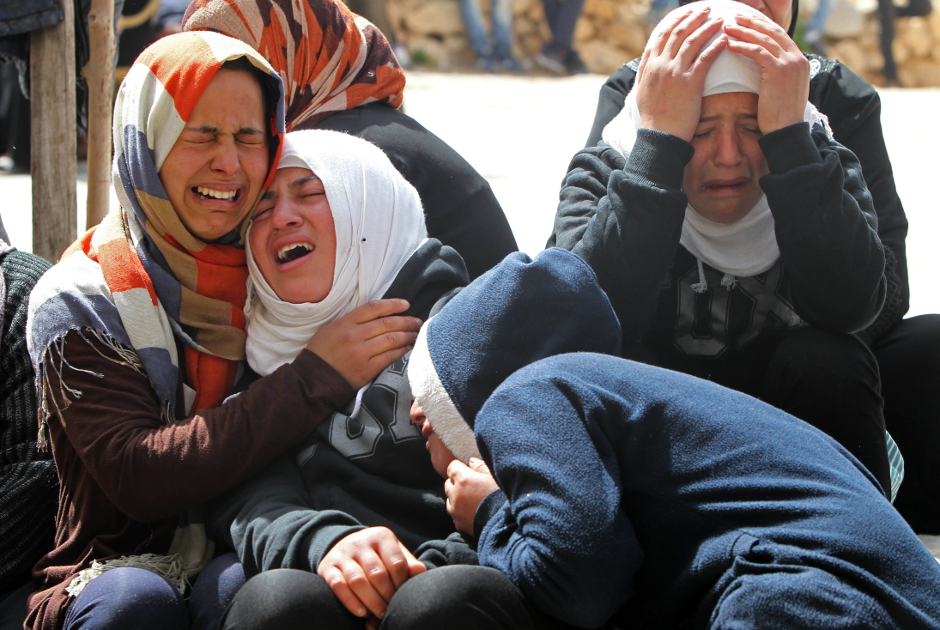
Relatives of Palestinian teenager Yussef Shawamreh mourn outside his house in the West Bank village of Deir al-Asal, 15 kilometers from Hebron on March 19, 2014 after he was shot dead by Israeli troops in the occupied West Bank. (Photo: AFP – Hazem Bader)
Al-Akhbar | March 26, 2014
Israeli occupation forces who shot dead a Palestinian teenager in the West Bank last week used live fire, without warning, against innocent youngsters out foraging for roots, an Israeli rights group said Wednesday.
After investigating the March 19 death of 15-year-old Yussef Sami Shawamreh, B’Tselem said it had found no evidence to support the army’s version of events that troops had opened fire at youths who had “sabotaged” the West Bank apartheid wall.
B’Tselem said the primary responsibility for the boy’s death rested with the army commanders who approved the use of live fire at a site where villagers from Deir al-Asal al-Tahta are known to go out and pick wild plants on their own land.
An army spokeswoman told AFP after the incident that soldiers had spotted three Palestinians vandalizing the wall, saying they had “verbally warned” them before firing warning shots in the air then shooting at their lower extremities.
But Shawamreh’s family and witnesses said the teenager had been looking for gundelia, a thistle-type plant used in cooking.
B’Tselem said the shooting occurred in an area where there is a wide breach in the barrier and where families regularly go out to forage on their own farmland.
“The two surviving youths… heard three or four shots as they got off the road, fired with no advance warning,” the report said.
Shawamreh, who was severely wounded but not picked up by a military ambulance for some 30 minutes, was later pronounced dead at an Israeli hospital.
The NGO said its findings were “markedly different” from the army’s version of events.
“The youths made no attempt at vandalism; they were crossing through a long-existing breach, and the soldiers did not carry out suspect arrest procedure, shooting at Shawamreh with no advance warning,” it said.
Troops in the area were “well aware” that over the past two years, Palestinians have been crossing the barrier at the breach “to pick gundelia on their own farmland,” B’Tselem.
It added that the use of live fire showed a “cynical lack of concern for the life of a Palestinian teenager.”
Two days earlier, soldiers had detained four teenagers in the same spot, beating them and confiscating the plants they had picked.
“The decision to mount an armed ambush at a point in the barrier known to be crossed by youths, who pose no danger whatsoever to anyone, for the purpose of harvesting plants is highly questionable,” the report said, noting it showed “extremely faulty discretion” on the part of the commanders.
“The primary responsibility for the killing lies with the commanders who sent the soldiers out on armed ambush,” B’Tselem director Jessica Montell said in a statement that urged the military police to consider whether the commanders should “bear personal criminal responsibility” for Shawamreh’s death.
There was no immediate response from the occupation authorities.
(AFP, Al-Akhbar)
European inspectors report no Russian military build-up on Ukraine border
Voice of Russia | March 23, 2014
Watchdogs from several European countries have noticed no indication of a massive build-up of Russian military that would threaten the security of neighboring states, Russian Deputy Defense Minister Anatoly Antonov said Sunday.
According to Mr. Antonov, as many as seven inspection groups paid visits to Russian border territories over the past month. “Our facilities and deployment areas along the Russian-Ukrainian border were twice checked by the Ukrainian military,” he noted.
Monitors from the US, Canada, Germany, France, Switzerland, Poland, Latvia, Estonia and Finland scrutinized Russia’s military camps stationed on its borders with neighboring nations. “It must have been a simple ‘coincidence’ that the majority of these [missions] focused on the regions near the Ukrainian border,” Mr. Antonov noted.
“We were as transparent as it comes and let our partners inspect all facilities they wanted. We have nothing to hide,” the defense chief pointed out.
The Russian military went as far as allowing EU and NATO watchdogs to interrogate Russian command, takes photos of bases where personnel and military hardware were stationed and accompany them during their routine maneuvers.
“The conclusion that our partners came to after the final briefing, which is a compulsory inspection procedure, was unanimous: Russian armed forces are not involved in any manner of unannounced military maneuvers that would endanger the security of neighboring states,” Antonov underscored.
The Russian deputy defense minister urged Ukrainian and European watchdogs to update their corresponding governments on the actual situation on the Russian borders, saying a clearer picture would certainly de-escalate the situation in the region.
Related article
Crimean self-defense squads enter Belbek airbase
RT | March 22, 2014
Crimean self-defense forces have surrounded Belbek airbase near Sevastopol after Ukrainian troops inside refused to lay down their arms and leave the base in accordance to the Crimean prime minister’s order.
The self-defense squads are now in control of the airbase while the Ukrainian troops have been given an opportunity to leave, Dmitry Osipenko, a journalist for Sevastopol news website ForPost who was present at the scene, told RT.
The commander of the airbase, Yuliy Mamchur, has been escorted to negotiations with Crimean authorities.
“After they refused [to leave the base] the Sevastopol self-defense troops tried to enter the territory of the base,” while gunfire was heard at the scene. “According to my information nobody was injured, but I’m not sure,” said Osipenko.
Osipenko claimed the gunfire was coming from the side of the Ukrainian troops. However, it is unclear who was shooting. “The self-defense forces hid behind cars and then a car rammed the gate [of the airbase],” he said.
He stated that apart from the self-defense squads, Sevastopol Cossaks were present.
The move follows the March 16 all-Crimean referendum which resulted in over 96 percent of voters opting for the autonomous republic to join Russia. Eighty-three percent of the Crimeans took part in the vote. The decision was sparked by bloody protests in Kiev that resulted in the ousting of President Viktor Yanukovich and fears that the unrest might spread to Crimea.
Russia finalized the legal process of taking Crimea under its sovereignty on Friday, with President Vladimir Putin signing a law amending the Russian constitution to reflect the transition.
‘We are being abandoned’
Though Crimea is no longer part of Ukraine, Kiev authorities have not yet officially ordered Ukrainian troops to leave their bases in Crimea.
Ukrainian military troops stationed at Belbek criticized their leadership for abandoning them in a post on the airbase’s blog.
“We are being abandoned – most sadly by our own government,” it reads. “The most dangerous enemy appeared to be our leadership and our government.”
“Today I’ve found an interview with Acting Minister of Defense [Igor] Tenyukh where he says he maintains contact with all troops on the territory of the Autonomous Republic of Crimea, that all relevant orders were given and the situation is under control. There were only two orders – ‘remain in place’ and ‘[you are ] allowed to use weapons.’ That’s it!”
“What is expected [of us] in case of an assault?” the military asked. ”There were no clear answers given to us.”
Meanwhile, most US financial assistance to Ukraine will focus on the formation and maintenance of the new military – the National Guard, said a source from the Ukrainian Ministry of Defense, as cited by Itar-Tass.
“Kiev is not planning to fund the army or navy which are in a deplorable state,” the source said.
The National Guard, the custodian of the coup-imposed government, is already in formation and will be comprised of 60,000 men and women from former and current Ukrainian troops and volunteers from Maidan self-defense squads. It will be appointed by the parliament upon the recommendation of the acting president.
Venice votes in online poll to split from Italy
Press TV – March 22, 2014
People in Venice and its surrounding region have voted in an online poll to split from the rest of Italy and establish their own independent state.
More than two million residents of the Veneto region participated in the week-long survey, with 89 percent voting in favor of secession from Italy.
The online vote, organized by local pro-independence parties, is not legally binding but is only meant to muster support for a bill calling for a referendum.
The Indipendenza Veneta party behind the bill says the separatist campaign is driven by the Italian government’s alleged inability to stem corruption, protect Venice’s citizens from a debilitating recession and control waste water in the poorer south.
Supporters say the new Republic of Veneto would be inspired by the ancient Venetian Republic, which existed from the seventh century until its fall to Napoleon in 1797.
Critics argue that an attempt to break away from Italy could be unconstitutional.
Kiev, EU sign ‘political provisions’ of association deal
Press TV – March 21, 2014
European Council President Herman Van Rompuy says Ukraine’s interim government has signed the “political” provisions of an association agreement with the EU.
“Signing [the] political part [of the] EU-Ukraine Association Agreement symbolizes [the] importance of relations [and] will to take it further,” Van Rompuy said in message on his Twitter account on Friday.
The 28-nation bloc and the new Ukrainian government signed the core chapters of the Association Agreement on the sidelines of a meeting of EU leaders in Brussels on Thursday.
The document reportedly carries the signatures of Van Rompuy, Ukraine’s interim Prime Minister Arseniy Yatsenyuk, European Commission President Jose Manuel Barroso as well as the heads of the 28-nation bloc.
The association agreement between the EU and Ukraine was initially to be signed last November. However, Ukraine’s then president, Viktor Yanukovych, refrained from signing the deal in favor of closer ties with neighboring Russia.
Yanukovych’s refusal to sign the accord triggered turmoil in the country, with months of unrest that led to the ouster of Yanukovych on February 23. He has travelled to Russia, where he was given sanctuary.
On March 11, Yanukovych said in a public statement that he is still Ukraine’s legitimate president and commander-in-chief. The ousted president also stated that he has never fled his country and promised to return.
Related article

Putin: Crimea similar to Kosovo, West is rewriting its own rule book
RT | March 18, 2014
Crimea’s secession from Ukraine was just like Kosovo’s secession from Serbia, and any arguments otherwise are just attempts to bend the West-advocated rules that were applied to the Kosovo case, Russian President Vladimir Putin said.
The statements came as Putin was addressing the Russian parliament to convince lawmakers to ratify a treaty, which would make Crimea part of the Russian Federation.
In the speech he challenged Washington’s position, which says that Kosovo was a unique case and could not justify any other move towards independence in the world.
“Our western partners created the Kosovo precedent with their own hands. In a situation absolutely the same as the one in Crimea they recognized Kosovo’s secession from Serbia legitimate while arguing that no permission from a country’s central authority for a unilateral declaration of independence is necessary,” Putin reminded, adding that the UN International Court of Justice agreed to those arguments.
“That’s what they wrote, what they trumpeted all over the world, coerced everyone into it – and now they are complaining. Why is that?” he asked.
Putin dismissed the argument that Kosovo was unique due to the large number of victims during the Balkan wars and the dissolution of Yugoslavia.
“It’s beyond double standards,” Putin said. “It’s a kind of baffling, primitive and blatant cynicism. One can’t just twist things to fit his interests, to call something white on one day and black on the next one.”
The president dismissed the allegations that Russia is violating international law with its actions in Ukraine.
“Well’ it’s good that they at least recalled that there is international law. Thank you very much. Better late than never,” Putin said adding that in fact nothing of this kind happened.
‘In Ukraine the West crossed the red line’
In fact, it was Russia that defended international law and its institutions, while western countries have been diminishing them. The situation in Crimea is just a reflection of this broader process, which has been happening for decades now.
“In the practical application of policies, our western partners – the United States first and foremost – prefer to be guided not by international law, but by the right of strength. They believe in their exceptionalism, that they are allowed to decide on the fate of the world, that they are always right,” Putin charged.
This disregard to rule of law was evident in Yugoslavia in 1999, when NATO bombed the country without a UN Security Council mandate, the Russian president said. There was Afghanistan, Iraq and the perversion of the UNSC resolution on Libya, when instead of imposing a no-fly zone NATO bombed the country into submission.
There were also orchestrated “colored revolutions” in Europe and the Arab World, which cynically used the feelings of people tired with corruption and poverty. The latest Ukrainian events are just the latest of such actions, and Russia’s willingness to seek dialogue and compromise was stonewalled again, Putin said.
“They were cheating us once more, took decisions behind our back, presented us with a fait accompli,” he said, adding that the patter is identical to that which accompanied NATO’s expansion to the east, the deployment of an anti-ballistic missile system, visa restrictions and numerous other issues.
“They are constantly trying to corner us in retaliation for our having an independent position, for defending it, for calling things by their names and not being hypocritical,” Putin accused. “Everything has its limits, and in Ukraine our western partners crossed the red line. They acted brutally, irresponsibly and unprofessionally.”
Putin said the West must stop being hysterical, restrain from the Cold War rhetoric and admit the obvious: “Russia is an independent and active participant of international relations. Just like any nation it has national interests that must be taken into consideration and respected.”
As for the Ukrainian red line, the coup-imposed authorities in Kiev voiced their desire to join NATO, and such a move would pose an imminent threat to Russia, Putin said.
“We stand against having a military organization meddling in our backyard, next to our homeland or in the territories that are historically ours. I just cannot imagine visiting NATO sailors in Sevastopol,” he stressed. “Most of them are fine lads, by the way. But rather let them visit us in Sevastopol than the other way around.”
At the end of his speech, Putin announced the submission to parliament of a draft federal law which would incorporate Crimea and the City of Sevastopol into Russian territory, as well as a request to ratify an international treaty with the government of Crimea to make this happen. He said he was sure of the legislature’s support for both documents.
New Ambassador Modernizes Canada’s Hidden Agenda in Venezuela
By Gerard Di Trolio | Venezuelanalysis | March 17, 2014
Amidst headlines dominated by the situation in Ukraine, this bit of news slipped by almost unnoticed at the end of February; Ben Rowswell replaced Paul Gibbard as Canadian ambassador to Venezuela, as mandated by Foreign Affairs Minister John Baird. But a quick look into the appointee’s background brings special significance to his promotion, especially as opposition protests escalate in Venezuela.
Described in 2010 as a “rising foreign service star” by the Toronto Star, Rowswell has served as Canada’s official diplomatic representative in a number of conspicuous places across the Middle East. From Kandahar, Afghanistan to Kabul and Iraq immediately after the fall of Saddam Hussein, Rowswell has become an expert at representing Canada’s interests in the heat of conflict.
At the age of 22 he was baptized into the foreign service by fire, working in Mogadishu during the Somali Civil War of the early 1990s. He went on to work for the Canadian Embassy in Cairo from 1995-98.
A diplomat for the digital age, he held the title of “Director of Innovation” at the Department of Foreign Affairs, Trade and Development.
While overseeing the “democratic transitions” of Afghanistan, Iraq, and Egypt, the fledgling attaché specialized in the harnessing of social media for diplomatic missions, in order to interact directly with non-state actors, in effect bypassing the target nation’s government.
In 2011, Rowswell gave a fascinating TEDx talk at Hayward University in California that outlined his views about the power of social media to shape democracy. He focused on post-Murbarak Egypt, before Mohammed Morsi’s election.
He detailed how notions of race, ethnicity and class may be pushed aside when organizing through social media platforms. He theorized that the internet allows for “opensource democracy,” allowing individuals to exchange their ideas as equals.
But let’s look at that idea in the context of Venezuela, where the middle and upper classes are more likely to have regular access to the internet. Twitter and Facebook have been the choice tools of the opposition in recent months, both to organize protests and to call upon international support.
The Bolivarian Revolution itself was born 15 years ago upon massive social movements and since has experimented with many revolutionary forms of democratic participation. But theirs is a different concept of democracy than what Rowswell and other Western powers have in mind.
After the 2002 coup attempt and the mass mobilizations that restored Chavez to power, the cause of socialism was taken up with greater enthusiasm. Since its commence the Bolivarian government has created institutions that, while not directly expropriating capital, have challenged its long term prospects.
Nowadays workers’ cooperatives and collective property exist alongside corporate conglomerates and private investments. There exists a form of dual power in Venezuela, and within that balance, a gulf of classes widened by the shift in authority.
The Canadian government has made it clear that its interests lie outside the decades of organization led by the Venezuelan masses.
A motion that received unanimous consent from all parties in the House of Commons and sponsored by NDP foreign affairs critic Paul Dewar effectively condemned the Venezuelan government’s attempts at dealing with recent protests.
The statement was approved by Conservatives and Liberals alike, including MP Jim Karygiannis who has been extremely critical of the Venezuelan government.
Rowswell also argued that social media can create transparency yet Venezuela’s opposition has provided ample evidence to the contrary. Many photos from Turkey, Ukraine, Brazil, and even Syria have flown around social networks, meant to stir up indignation at the treatment of protestors in Venezuela. During the telecast of the Oscars, the opposition took to Twitter to claim the ceremony had been censored. The truth was that the Oscars was aired on TNT in Venezuela, a satellite channel.
Canada, too, knows how to wage internet campaigns and will not be left behind. Within hours of Rowswell’s appointment, a new Embassy account popped up on Twitter. (https://twitter.com/CanEmbVenezuela) Adam Goldenberg, liberal partisan and former speechwriter for Michael Ignatieff, tweeted in response: “Congratulations, Ben! Excellent choice, Minister, for all sorts of reasons.” As always, Canada’s imperial foreign policy is a bipartisan affair.
There’s no smoking gun, however. This appointment isn’t proof positive that the Canadian government and the Venezuelan opposition are conspiring an attack against president Nicolas Maduro.
While violent coups carried out by a minority are far from being a thing of the past, Canadian policy planners understand that the transformation of the opposition into a mass movement would be a much more efficient way to protect their interests, with less international backlash.
Rowswell is the best man to encourage such a “democratic” counterrevolution, given his pedigree. He certainly knows how to interact with the angry middle classes on Twitter.
As protests continue, it would be wise to keep a close watch on the Canadian Embassy in Caracas.
(http://www.international.gc.ca/media/aff/news-communiques/2014/02/28b.as…)
2. (http://www.thestar.com/news/canada/2010/07/28/canadas_top_civilian_offic…)
3. (http://www.youtube.com/watch?v=I-zWJaXhHpI)
4. (http://www2.macleans.ca/2014/02/28/the-house-is-unanimously-concerned-ab…)
5. (http://www.karygiannis.net/venezuela)
6. (http://drdawgsblawg.ca/2014/02/constructing-venezuela-protests-a-photo-g…)
7. (http://www.ctvnews.ca/entertainment/many-venezuelans-miss-oscar-winner-l…)
8. (https://twitter.com/adamgoldenberg/status/439530569333211136)
China backs Russia on UNSC Ukraine vote
BRICS Post | March 16, 2014
After abstaining on the US-backed UN resolution vote that sought to brand the Crimea referendum as invalid, China on Sunday said it would not back a ‘confrontational route’ on the crisis.
Beijing said the Western-backed resolution does not conform to common interests of the people of Ukraine and that of the rest of the world.
“The vote on the draft resolution by the Security Council at this juncture will only result in confrontation and further complicate the situation, which is not in conformity with the common interests of both the people of Ukraine and those of the international community,” said Chinese Foreign Ministry spokesman Qin Gang in Beijing on Sunday.
Russia, a permanent member of the UNSC, has vetoed the UNSC resolution that declared that a planned referendum slated for Sunday on the status of Ukraine’s Crimea region “can have no validity” and urged nations and international organizations not to recognize it.
“China does not agree to a move of confrontation,” the Chinese Ministry spokesperson said on Sunday while asking all parties to “refrain from taking any action that may further escalate the situation”.
Authorities in Kiev and international leaders have condemned the referendum as illegitimate and threatened Moscow with sanctions over its apparent plan to annex the region.
Crimea is one of several Ukrainian regions that have rejected as illegitimate the government in Kiev that ousted President Viktor Yanukovych on February 22 after months of street protests following his step back from closer ties with the European Union.
Syrian forces in “full control” of Yabrud
Al-Akhbar | March 16, 2014
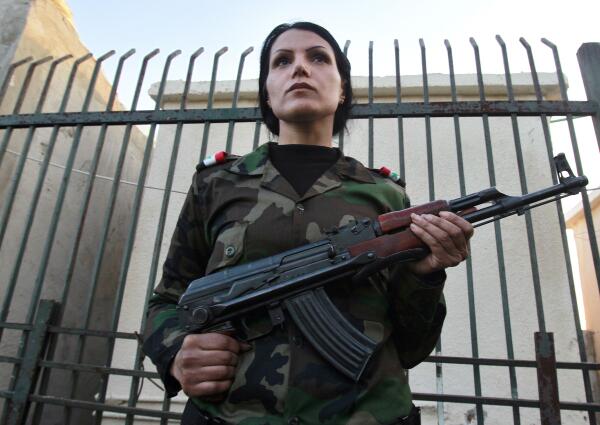 Syrian troops on Sunday seized full control of the rebel bastion Yabrud in the strategic Qalamoun region near the Lebanese border, Syrian state media reported.
“Our brave armed forces have full control over Yabrud in Damascus province and are combing through the town and removing explosive devices placed by terrorists,” state television said, citing a military source.
Capturing Yabrud, the last major rebel bastion near the Lebanese border north of Damascus, would help President Bashar al-Assad secure the land route linking his Mediterranean coastal stronghold with the capital Damascus, and choke off a cross-border rebel supply line from Lebanon.
A military source told Reuters that the rebels had pulled out of Yabrud around dawn, a day after pro-government forces had entered eastern districts of the town and captured several strategic hilltops.
A fighter in Yabrud from al-Nusra Front, al-Qaeda’s official affiliate in Syria, confirmed to Reuters the rebels had decided to pull out and said they were heading towards nearby villages including Hosh Arab, Rankos and Fleita.
He said they did not plan to withdraw across the Lebanese border to Arsal, a crossing point 20 kilometers (13 miles) to the northwest which rebels and refugees have used regularly.
The government has been making incremental gains along the land route as well as around Damascus and Aleppo in the past months, regaining the initiative in a conflict entering its fourth year.
Crimea vote in line with UN charter: Putin to Ban
BRICS Post | March 15, 2014
Ahead of the upcoming referendum in Crimea, Russian President Vladimir Putin told UN Secretary General Ban Ki-moon in a phone conversation on Friday the move was in line with the UN Charter.
Putin and Ban discussed “the situation in Ukraine, including the referendum to be held on March 16,” said a Kremlin statement.
“Putin emphasized that the decision to hold the referendum is in line with the provisions of international law and with the UN Charter,” says the statement.
International observers have arrived in Crimea on Saturday ahead of the controversial referendum.
The Crimean parliament declared independence Tuesday ahead of a popular vote Sunday on seceding from Ukraine and becoming part of Russia.
Authorities in Kiev and international leaders have condemned the referendum as illegitimate and accused Moscow of fomenting unrest in order to annex Crimea.
Ban told reporters in New York later in the day that the situation in Ukraine continues to deteriorate and there was “a great risk of dangerous, downward spiral.”
He also urged Russia and Ukraine not to take “hasty measures” that “may impact the sovereignty, unity and territorial integrity of Ukraine.” The UN chief said that peaceful solution was still an option.
Russia and the West have reached a standoff over the fate of Crimea, which has refused to recognize the legitimacy of the new central government in Kiev following last month’s revolution.
Russia has no plans of a military action in southeastern Ukraine, Russian Foreign Minister Sergei Lavrov said on Friday after talks with his US counterpart John Kerry in London.
“Russia does not and cannot have any plans to invade southeastern Ukraine. There are no reasons that prevent us from showing transparency [on the Ukrainian issue],” he said.
In spite of extensive talks between Kerry and Lavrov, disagreements between Moscow and Washington persist.
“As far as prospective sanctions are concerned… I assure you that our partners are fully aware that sanctions are a counter-productive measure. They will not benefit our mutual business interests or the development of our partnership in general,” Lavrov said.
Writing for The BRICS Post, Alexander Nekrassov, a former Kremlin and government advisor, said too much is at stake to make drastic changes in Russia-US ties, and “too much money is involved in deals and trade to simply ignore everything and turn back on years of tough negotiating and compromise”.
“Despite what is happening in Ukraine, relations between the US and Russia will continue; Exxon Mobile and others will keep on signing deals with the Russian oil giant Rosneft and trade between the two countries will not suffer,” writes Nekrassov.
TBP and Agencies
Venezuela: Who Are They and How Did They Die?
By Jake Johnston | CEPR Americas Blog | March 12, 2014
Since February 23, CEPR has been keeping track of those who have died during the last month of protests in Venezuela. Below is the most recent available information on the location, causes and status of investigations into the deaths. This list will continue to be updated as more information becomes available. As of March 13, the list contains 29 individuals; however in some cases press reports indicate that the death was not directly associated with the protests. Never the less, as they have often been reported as such, they are included below.
There are deaths on both sides of the political spectrum. In some cases, members of Venezuelan security forces have been implicated and subsequently arrested for their involvement. At least 10 individuals have reportedly been killed by crashing into barricades, from wires strung across streets by protesters and in some cases from having been shot trying to remove barricades. Three members of the National Guard have been killed.
– Bassil Alejandro Da Costa, an opposition demonstrator was shot, reportedly in the head, and killed in Caracas during the opposition protest that took place on February 12.
– Juan Montoya, a pro-government community activist, was reportedly shot in both the head and chest and died. Montoya’s body was found a short distance from the body of Da Costa. On February 26, the Attorney General, Luisa Ortega Diaz, announced that 8 officers from SEBIN, the Venezuelan intelligence agency, had been arrested for their role in the killing of Da Costa and Montoya. As of March 11, 6 SEBIN officers remain in jail. President Maduro has also removed the head of SEBIN.
– On February 12, Roberto Redman, another opposition demonstrator was also shot, reportedly in the head, and killed. The killing took place in a neighborhood in eastern Caracas. Witnesses attributed his death to armed civilians. There has been no update on the status of any investigation.
– On February 18 José Ernesto Méndez, a 17-year-old student who was participating in a demonstration in the Sucre department, was hit by a truck and later died. The Attorney General stated that the driver of the truck has been apprehended and charged with homicide.
– On the same day Genesis Carmona, a student and beauty queen was shot and killed in the state of Carabobo. Unconfirmed reports suggest that the she was shot from behind, potentially from within the group she was protesting with, though others contest that version of events. The government has pledged a full investigation. There have been no further updates on the status of the investigation.
– On February 19, Julio Gonzalez, a member of the public ministry in Carabobo reportedly died after crashing his vehicle while attempting to avoid a roadblock put up by protesters.
– On February 20, Arturo Alexis Martínez, the brother of a ruling party legislator, was reportedly shot in the chest as he attempted to clear a path for his car amidst the debris left by a barricade following an opposition protest in Lara state. Witnesses allege that the shot that killed him was fired from a nearby building. On March 6, the AG announced that an individual has been charged for their involvement in the death.
– On February 20, Asdrúbal Rodríguez was reportedly arrested for attempting to steal a motorcycle and then was found dead the next day. The arrest and killing occurred in Chacao. Two members of the Chacao police have been arrested and remain in jail.
– On the night of February 21, Elvis Rafael Durán De La Rosa was beheaded by a wire strung across the Rómulo Gallegos Avenue in Caracas while driving a moto. The wire had allegedly been put there by protesters who had set up a road block in the same location earlier that evening.
– On February 21 that a 37-year-old woman named Delia Elena Lobo had died the previous evening in the city of Mérida in similar circumstances to De La Rosa. The woman was heading home on a motorbike and ran into barbed wire stretched across a street. Nobody has been arrested for the deaths of Lobo or De La Rosa. Authorities have accused retired general Angél Omar Vivas Perdomo of having encouraged protesters to put wires across streets and have ordered his detention.
– On the evening of February 21, Jose Alejandro Márquez died due to injuries to the head suffered in clashes with the National Guard. Seven members of the National Guard are being investigated for the death.
– On February 22nd, Geraldine Moreno, a 23-year-old protester who had been injured by bird shot during a protest in Carabobo state a few days earlier reportedly died from head injuries. There has been no update on the status of the investigation.
– On February 23 in San Cristobal Danny Melgarejo, a local student, was stabbed to death. The mayor said that the killing was related to a robbery, and not the student’s participation in protests.
– On February 24 Antonio José Valbuena Morales was shot and killed, reportedly while trying to remove barricades that had been set up by protesters.
– On February 24 Wilmer Carballo was killed by a shot to the head in Sucre state. Reports suggest he was shot by individuals on motos. On February 25, the AG announced an investigation into the killing.
– On February 24, Jimmy Vargas died after falling from a second story building. Press reports continue to state that he was killed “after being hit by a tear gas canister and falling from a balcony,” despite video evidence to the contrary.
– On February 25, Eduardo Ramón Anzona Carmona died after crashing his moto into a barricade. The accident occurred in Valencia in the state of Carabobo
– Also on February 25, in El Límon, Jhoan Gabriel Quintero Carrasco was shot and killed near a supermarket where looting was taking place.
– Giovanny José Hernández Pantoja, a member of the GNB, was shot and killed in Valencia on February 28. News reports indicate he was removing a barricade when he was shot. At least three individuals have been detained for their alleged involvement.
– On March 3 in Chacao, Deivis José Useche died after crashing his moto. Press reports indicate that a manhole cover had been removed during earlier protests, which caused the crash.
– On Tuesday, March 4 Luis Gutiérrez Camargo crashed into a barricade and died in the state of Tachira.
– On March 6, a National Guardsman, Acner López Lyon, was shot and killed during an altercation in Los Ruices, a neighborhood in Caracas. News reports indicate that the National Guard was removing a barricade that was blocking a main avenue.
– In the same altercation that took the life of Lyon, a mototaxista, José Gregorio Amaris Castillo, was shot and killed. The AG announced an investigation into the deaths.
– On March 7, Johan Alfonso Pineda Morales died after he lost control of his moto on an oil slick, allegedly intentionally created by protesters.
– On the night of March 9, Giselle Rubilar Figueroa, a Chilean citizen, was reportedly shot and killed by protesters in Merida. The AG has announced an investigation.
– On the night of March 10, a student protester, Daniel Tinoco was shot and killed in San Cristobal. It is unclear who was responsible, though press reports indicate that the killing occurred after a day of clashes between the National Guard which was trying to remove barricades in San Cristobal. The mayor indicated that it was armed civilians that shot Tinoco. The AG announced an investigation into the killing.
– On March 12, university student Jesús Enrique Acosta was shot and killed in La Isabelica in the department of Carabobo. Family members told the press that Acosta was outside his house when armed civilians began firing. Reuters reports that “the state governor said the shot came from snipers among the protesters.”
– On March 12, the Governor of Carabobo, Francisco Ameliach reported that a captain of the National Guard, Ramso Ernesto Bracho Bravo was shot and killed during an altercation in the municipality of Naguanagua.
– Also on March 12 in La Isabelica, Guillermo Alfonso Sánchez was shot and killed. The circumstances remain unclear. The AG has announced an investigation into the three killings of March 12.
Featured Video
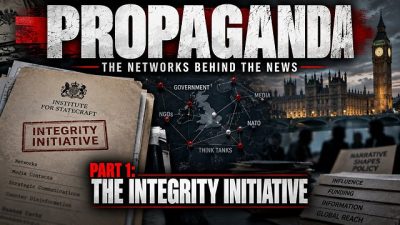
Integrity Initiative: UK-funded network framed dissent as Russian disinformation for years
or go to
Aletho News Archives – Video-Images
From the Archives
Why Saudi Ties to 9/11 Mean U.S. Ties to 9/11
By Kevin Ryan | Dig Within | September 27, 2015
Media interest in Saudi Arabian connections to the crimes of 9/11 has centered on calls for the release of the 28 missing pages from the Joint Congressional Inquiry’s report. However, those calls focus on the question of hijacker financing and omit the most interesting links between the 9/11 attacks and Saudi Arabia—links that implicate powerful people in the United States. Here are twenty examples. … continue
Blog Roll
 Aletho News
- Neria Leiter Was A Legitimate Military Target
- Integrity Initiative: UK-funded network framed dissent as Russian disinformation for years
- ‘We don’t seek permission to defend our country’: Snippets from President Pezeshkian’s UNGA address
- NATO chief wants Europeans to fight American wars [for Israel]
- German chemicals giant reveals details of downsizing
- Refaat Al-Areer Was The Canary In The Coal Mine In Israel’s War On The Truth
- Israeli election committee bars candidate from Knesset race over Gaza war opposition
- French-Lebanese man files war crimes complaint over Israeli attacks
- Mahan Air Flight Lands in China Despite US Threat against Iranian Airlines
- US eyes $10bn fund to rebuild war-battered Gulf infrastructure
- If Americans Knew
- An error has occurred; the feed is probably down. Try again later.
- No Tricks Zone
- New Study: Earth And Venus Surface Warmth Largely Explained By Convection And Lapse Rate, Not CO2 Or Radiation
- 2025 Nature Paper Claiming Worsening Global Drought Gets RETRACTED …Heavily Flawed
- New Study: ‘Global Drought Shows No Detectable Recent Acceleration Under Climate Warming’
- Economic Masterminds: German Socialists Suggest Taxing Productivity Gains Stemming From Using AI
- The South China Sea Has Not Been Cooperating With The Climate Change Narrative
- Energy Crisis: Germany Enters Heating Season With Historically Low Gas Reserve Fill Levels
- New Study: The Antarctic Ice Sheet Gained Mass From 2020-2024 Due To Staggering Snow And Ice Accumulation
- Study: Ocean Heating Rates From Thousands Of Years Ago ‘Dwarf’ Modern Ocean Heating Rates
- Climate Extremists Target, Attack Large-Scale Power Grid Infrastructure In Germany!
- New Study: Antarctic Ice Melt Has Contributed Less Than 1 Centimeter To Sea Level Rise In The Last 30 Years

