Crimean parliament guarantees broader rights to Tatar minority
RT | March 11, 2014
A resolution passed by the Crimean parliament guarantees proportional representation in the republic’s legislative and executive bodies for the Crimean Tatar ethnic minority and grants their language official status, among other things.
The resolution provides for constitutional reform that would amend several key provisions of Crimea’s basic law. Under the amended constitution, the Crimean Tatar language would be granted official status, on a par with Russian and Ukrainian in Crimea.
It stipulates proportional representation in future parliaments and provides for at least 20 percent of seats in the republic’s executive for Crimean Tatars. They would have guaranteed representation in the lower levels of government as well.
The parliament also wants to recognize as official the self-governance bodies of the Crimean Tatars, starting with the Kurultai, a general assembly of the Tatars.
Crimean MPs pledged to fund programs for support of the Tatar community in Crimea and repatriation of Crimean Tatars, who were deported from the peninsula by Joseph Stalin’s Soviet government in the 1940s.
There will also be recognition of the Tatars’ cultural impact on Crimea through the return of the original names of some geographical features such as mountains or rivers that were changed at the time of the deportation.
Parliament Speaker Vladimir Konstantinov called the bill “historic” and said Crimean Tatars have been waiting for the reform for 70 years.
“The Crimean Tatar people have not been offered anything like this from either the Soviet Union or independent Ukraine. They have been hoping for this for decades, and it will allow Crimeans of all nationalities to develop and feel safe and comfortable on Crimean soil,” he said.
The Crimean authorities have denounced the self-proclaimed government in Kiev. Crimeans began protesting after the new Kiev authorities introduced a law abolishing the use of other languages for official purposes in Ukraine. More than half the Crimean population is Russian and uses only this language for their communication.
On Tuesday, the Crimean parliament adopted a declaration of independence from Ukraine, which is required to hold a March 16 referendum. On Saturday, Crimean residents will cast their ballots to decide whether the region wants to remain part of Ukraine with broader autonomy rights, or to join Russia.
Related article


Russia says US proposals on Ukraine crisis ‘not suitable’
Press TV – March 11, 2014
Russia says proposals by the United States on finding a solution to the crisis in Ukraine are “not suitable.”
Russian Foreign Minister Sergei Lavrov said in a televised briefing with President Vladimir Putin on Monday that the proposals made by US Secretary of State John Kerry are inappropriate as they take the “situation created by the coup as a starting point”, in an apparent reference to the ouster of Ukraine president, Viktor Yanukovich by the parliament on February 23.
The Russian foreign minister said the document he received from Kerry on Washington’s recommendations to end the crisis in Ukraine “raises many questions.”
“Everything was stated in terms of allegedly having a conflict between Russia and Ukraine, and in terms of accepting the fait accompli,” Lavrov said.
He also commented on Kerry’s delay in a visit to Moscow for talks on the Ukraine crisis. Lavrov said the Kremlin had decided to draft counter proposals to resolve the situation on the basis of international law.
“We suggested that he (Kerry) come today… And we were prepared to receive him. He gave his preliminary consent. He then called me on Saturday (March 8) and said he would like to postpone it for a while,” the Russian foreign minister stated.
Russia has sent forces to Ukraine’s southern region of Crimea after the Russian parliament authorized President Putin to use armed forces to “protect Russia’s interests in that region.”
Yanukovych refrained from signing an Association Agreement with the European Union in favor of closer ties with Russia in November 2013. The move triggered weeks of anti-government protests in the country.
The local Crimean administration is expected to hold a referendum on March 16 in order to decide whether the Black Sea peninsula should become part of Russia or remain part of Ukraine.
Related article
Crimea invites OSCE mission to observe referendum on region’s future
RT | March 10, 2014
The parliament of the Autonomous Republic of Crimea has sent an official invitation to the Organization for Security and Cooperation in Europe (OSCE) to send a mission to observe the referendum on the region’s future, slated for March 16.
The Supreme Council has handed over the invitation to Switzerland, the country that holds the rotating presidency of the OSCE. Crimean authorities invited observers from both individual OSCE member-countries and the Office for Democratic Institutions and Human Rights (ODIHR) to come to Crimea.
“I am confident that the parliament of Crimea will make it possible for them to be present at polling stations. This process is underway now and the referendum itself will be as transparent as possible,” Crimean Prime Minister Sergey Aksyonov said, as quoted by Itar-Tass.
On Saturday, Crimean residents – about 60 percent of whom are ethnic Russians – will cast ballots to decide whether the region will “become part of the Russian Federation as its constituent territory.”
They will also decide whether Crimea’s 1992 constitution, under which the autonomous republic is part of Ukraine but has relations with Kiev defined on the basis of mutual agreements, should be restored.
Preparations for holding the referendum are in full swing.
Crimea will allocate up to US$2 million for printing ballots and providing technical support. A total of 1,550,000 ballots will be printed.
Some 1,500 Crimean troops will guard polling stations during the referendum, Prime Minister Aksyonov said.
“We will have about 1,500 armed troops by the time the referendum is held. They will be placed on duty at all polling stations,” he said. “The referendum will be guarded by armed people, primarily the autonomy’s self-defense units and Armed Forces.”
While Crimean authorities prepare for holding the referendum, radical groups plan provocations on the republic’s administrative border, according to unconfirmed reports from a Ukrainian Special Forces source, cited by RIA Novosti news agency.
“We are receiving information that Ukrainian radical groups are preparing provocations at the Crimean administrative boarder on the day of referendum, March, 16,” the source told the news agency.
The referendum has been brought forward twice from its original date of May 30 since it was appointed by local lawmakers last month.
The US has said it will not recognize the results of any referendum about the autonomous republic’s future, as Washington continues to consider Crimea a part of Ukraine, US Ambassador to Ukraine Geoffrey Pyatt stated.
Earlier, President Obama said that a referendum in Crimea would “violate the Ukrainian constitution and international law.”
This stance has been echoed by British Prime Minister David Cameron and German Chancellor Angela Merkel, who also stated that “any attempt by Russia to legitimize the results could bring more consequences.”
Speaking to Cameron and Merkel over the phone, Russian President Vladimir Putin expressed confidence that Crimea’s upcoming referendum will reflect the legitimate interests of its people.
Related article

OSCE military observer mission en route to Crimea
RT | March 5, 2014
The Organization for Security and Co-operation in Europe (OSCE) is sending a delegation which includes representatives from the US and 14 other nations to observe the situation in Crimea amid tensions in Ukraine, according to a US official.
Daniel Baer, the chief US delegate to the OSCE, told the Associated Press that each country is sending two individuals, bringing the total number of observers to 30. Baer added that the military observer mission is set to leave within 24 hours and hinted that other countries main still join.
The OSCE comprises of Russia, the US, all European countries, and some central Asian nations. It is based on consensus, meaning that the majority of the monitoring missions need full approval by all nations – including OSCE member Russia. According to Baer, Ukraine used the provision to ask other countries to send unarmed military monitors.
OSCE officials were already in Ukraine on Tuesday and making their way to Crimea, Baer said. The officials specialize in minority rights and freedom of the media.
The delegation has a week-long mandate that can be extended if Ukraine requests it. One of its main focuses is to concentrate on the potential of a military conflict between Russia and Ukraine.
Baer also added that the the military observer mission is a “broad-based monitoring effort” that will try to prevent a possible “military incursion” and encourage dialogue. The observers will keep an eye out for “areas where there has been tension or uncertainty has arisen over lack of clarity over military movements.”
RT news producer Lida Vasilevskaya reported on Tuesday evening that the OSCE delegation had arrived in Simferopol, Ukraine, but said they were not giving any comments to the media.
Tensions in Crimea became heated after the Ukrainian parliament voted to repeal a law which gave regional status to the Russian language. Authorities in Crimea requested Moscow’s assistance and Crimean authorities denounced the coup-imposed government in Kiev, declaring that all Ukrainian law enforcement and military deployed in the peninsula must take orders from them. The majority of troops in Crimea switched sides in favor of local authorities.
More than half of the Crimean population are ethnically Russian and use only the Russian language for their communication. The residents have announced they will hold a referendum on March 30 to determine the fate of the Ukrainian autonomous region.
Russian President Vladimir Putin clarified the country’s stance on Ukraine in an interview on Tuesday. He stated that Russia will not go to war with the people of Ukraine, but will use its troops to protect citizens if radicals with clout in Kiev try to use violence against Ukrainian civilians – particularly ethnic Russians.
Putin, who was given a mandate by the Russian Senate to send troops in order to protect the Russian-speaking population in Ukraine, said there is no need for such action yet.
Putin cited the actions of radical activists in Ukraine – including the chaining of a governor to a stage as public humiliation and the killing of a technician during an opposition siege of the Party of Regions headquarters – as justification for Russia to be concerned for the lives and well-being of people in eastern and southern Ukraine.
Incidents like those are why Russia reserves the option of troop deployment.
“If we see this lawlessness starting in eastern regions, if the people ask us for help – in addition to a plea from a legitimate president, which we already have – then we reserve the right to use all the means we possess to protect those citizens. And we consider it quite legitimate,” Putin said.
Russia’s representative to the UN, Vitaly Churkin, also said on Tuesday that the deal surrounding the Black Sea Fleet allows Russia to station a contingent of up to 25,000 troops in Ukraine.
According to the initial agreement, the Russian Black Sea Fleet was to stay in Crimea until 2017, but the deal was later prolonged for another 25 years.
Related article
Protests Continue as Venezuela Goes on Vacation
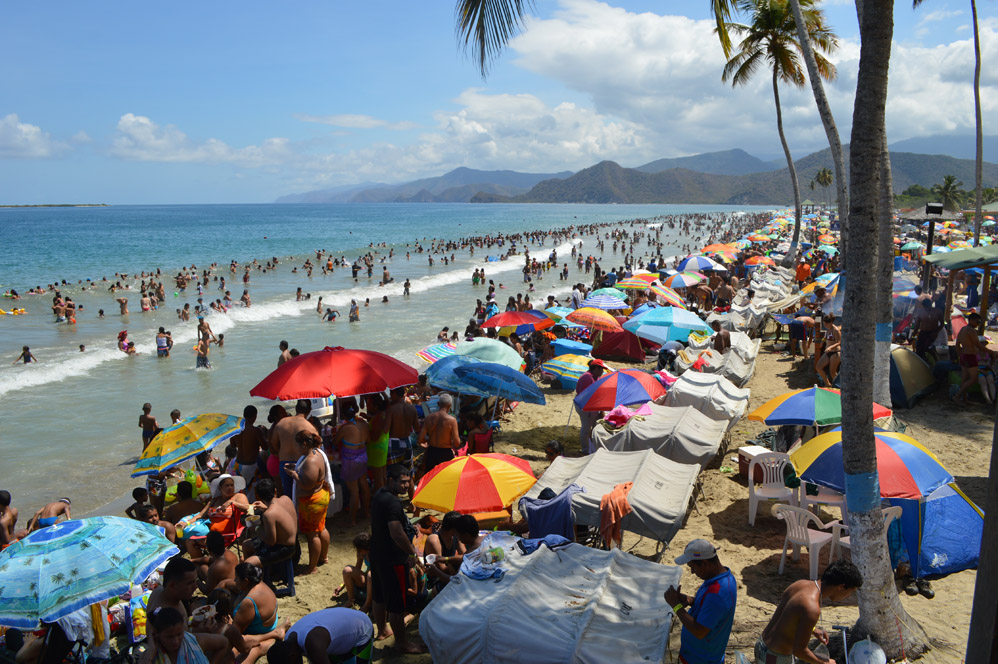
Venezuelanalysis | March 3, 2014
Mérida – Opposition protests continue in Venezuela, while masses of holiday-goers have headed to the beach to escape the unrest.
Over the weekend opposition supporters continued the protests that have mainly taken place in middle and upper class areas of Venezuela’s cities.
However the government has argued that the large numbers of people travelling to the beach and other destinations over the long “carnival” weekend shows that the protesters are a “minority” and that life in most of the country continues as normal.
Protests began last month after hard-line opposition leader Leopoldo Lopez, who is currently under investigation for incitement to violence, called for supporters to take to the streets and force the “exit” of President Nicolas Maduro. Led by pro-opposition students, demonstrators have also mentioned insecurity, high inflation and shortages as reasons for discontent.
While some protests have been peaceful, others have descended into violence and rioting. Further, small groups of radical opposition activists have set up burning street barricades in parts of some of Venezuela’s cities, blocking traffic and creating a range of problems for the normal functioning of civic life.
Protests vs. holidays
The opposition fought to keep the momentum of protests going as the country entered a long weekend on Thursday, which will last until this coming Wednesday. On Sunday, thousands of opposition supporters marched through Caracas to underscore their discontent.
The mayors of several opposition controlled municipalities cancelled local carnival celebrations, rejecting the government’s call for normality.
“There’s no reason to celebrate here,” said Ramón Muchacho, mayor of the wealthy Chacao municipality of eastern Caracas.
Also on Sunday 41 people, including an Italian photographer, were released from detention. They were arrested on Friday during a confrontation between National Guard officers and molotov-cocktail wielding opposition hard-liners in the up-market Altamira area of Caracas.
There were fresh confrontations in Altamira today, with National Guard officers using tear gas to disperse opposition radicals armed with molotov cocktails, the local mayor reported.
Meanwhile the government has said that at least a million people have taken advantage of the long weekend to go on holiday.
“With this mobilisation [of tourists] that there has been this carnival, it’s being demonstrated to the country that the violent ones are a minority…[and] that they’re ever more isolated,” said tourism minister Andres Izarra today.
On the country’s beaches, many Venezuelans expressed their desire to escape from the unrest.
“They [the violent protests and street barricades] are absurd, we all have the right to free transit whatever our political opinions: they’re not doing anything with these barricades,” said Oscar Figuera, a beach-goer with his family, to private Venezuelan news outlet Noticias 24.
“I’m self employed, and I’ve not been able to go out to work and my children haven’t been able to go to school. There are other ways to protest,” Figuera stated.
Meanwhile some opposition supporters stayed on the streets, arguing that they didn’t want the holidays to dampen the protests. “Going on vacation is really like saying that [the government] is right, that everything is calm and everything is fine, when we don’t feel that way,” said Carlos Torres, an engineer, to the BBC in Caracas.
“We want the street to remain active,” said another protester, a student named Eduardo.”If the protests are peaceful then people get tired,” he explained.
Nevertheless President Maduro argued today that the great majority had decided to use the long weekend to celebrate the carnival holiday. “You [the opposition] believed that we were going to let you take away the children’s happiness. The people of Venezuela have triumphed. The people want peace,” he declared.
Also today, right-wing legislator Maria Corina Machado and Metropolitan Mayor of Caracas, Antonio Ledezma, led a march to the Venezuela office of the Organisation of American States (OAS). Describing the situation in Venezuela as “the assassination of a democracy”, they demanded that the OAS debate events in Venezuela and support the opposition with a “firm reaction”.
“If the OAS turns its back on Venezuela in these hours it won’t just be betraying Venezuela, it will be burying the OAS,” argued Machado, who participated in the short-lived 2002 coup against former president Hugo Chavez.
Antonio Ledezma reiterated his faction of the opposition’s rejection of Maduro’s National Peace Conference initiative, which had its first meeting last Wednesday with business, religious, and some opposition figures.
“Those aren’t meetings of peace, they’re meetings of violence where citizens aren’t respected and there isn’t a clear agenda of what is wanted to be achieved,” he argued.
Opposition leader and former presidential candidate Henrique Capriles didn’t attend today’s march. Instead the state governor launched an initiative called the “People’s Defence Command”, which he said seeks “to form a great social movement…to push for change”.
One of the objectives of the initiative is to “leave aside the political agenda of violence” and to campaign on “social problems” that can be used to reach out to the opposition’s non-traditional base of support.
While also rejecting Maduro’s offer of dialogue, Capriles has previously criticised the hard-line opposition’s tactics as containing an “empty agenda” and representing a political “dead end”.
According to press and authorities, 18 have been killed and 260 wounded since violent protests began last month. The latest victim is a National Guard officer, Giovanni Pantoja, who died last Friday. He was reportedly shot by a gunman in an “ambush” while he and his colleagues were trying to clear the remains of a street barricade from a road in Carabobo state.
Venezuela’s Ombudsman, Gabriela Ramírez, reported today that the state’s human rights body has received 42 denouncements of abuses by security forces. She said that the majority of these were for excess use of force at the point of arrest, but “not one for torture”.
President Maduro has called for the formation of a bi-partisan Truth Commission to investigate and attribute responsibility for “all” acts of recent violence, although some opposition figures have rejected this as being weighted in favour of the government. The opposition’s MUD coalition is preparing a report solely focused on alleged abuses by state security forces, to be presented to “international organisations”.
3 South Ukrainian Cities Want to Join Crimea – Lawmaker
RIA Novosti | March 4, 2014
SIMFEROPOL – A senior Crimean lawmaker said on Monday that representatives of three southern Ukrainian administrative capitals expressed willingness to become a part of the autonomous republic if its autonomy is broadened in a referendum.
Deputy speaker of Crimea’s Supreme Council Serhiy Tsekov said Crimean authorities had received calls from “representatives of local administrative bodies” in Mykolaiv, Kherson and Odessa.
“They think that they should be together with Crimea,” he said.
Ukraine’s mainly ethnic Russian-populated region of Crimea is now at the center of the ongoing crisis in the country as pro-Russia groups move to distance themselves from a reformed national parliament that ousted President Viktor Yanukovych a week ago.
The Crimean parliament voted last week to hold a referendum on greater autonomy on March 30.
Ukrainian warships voluntarily leave Sevastopol: sources
RT | March 2, 2014
About 10 Ukrainian Black Sea Fleet ships have left the naval base in Sevastopol, with several vessels now heading to Odessa, administrative sources have said. The ships left the base voluntarily but some of them broke down and returned, they claimed.
Over the last 24 hours, “about 10 [war]ships and vessels of the Ukrainian Black Sea Fleet have left the Sevastopol base,” a source in the government of the Autonomous Republic of Crimea told Interfax on Sunday.
“Naturally, no one has compelled them to do so,” the government source added.
The administration of the Crimean autonomy has nothing to do with the moves of the Ukrainian ships, an administrative source also told RIA Novosti.
Several vessels have since returned to the base in Sevastopol “because of malfunctions,” the source said.
Meanwhile, former Ukrainian troops were due to swear allegiance to the Crimean authorities in Sevastopol at 5pm local time (15:00 GMT). An unnamed official source earlier told RIA Novosti that “the majority of the Ukrainian armed forces deployed in Crimea” have passed to the side of the region. The transition was made “without a single shot fired,” the source said.
Ukrainian state agencies have been categorically denying both the claims of Ukrainian soldiers switching sides en masse and, earlier, reports of warships leaving Sevastopol.
However, the governor of southern Ukrainian Odessa Region told local media that several Ukrainian ships are sailing to the city of Odessa and it is being decided where they will dock.
A Russian media report on Saturday claimed that Ukraine’s Navy flagship, the Hetman Sahaidachny frigate has refused to follow orders from Kiev, came over to Russia’s side and was returning home from the Gulf of Aden flying the Russian naval flag. Various Ukrainian media denied the report as “false” and “propaganda,” but gave only a Facebook statement of a former Navy officer turned journalist in support of the rebuttal.
This comes as the newly appointed Navy Chief rear admiral Denis Berezovsky has sworn allegiance to the people of Crimea, according to RIA Novosti.
“I, Berezovsky Denis, swear allegiance to the Crimean people and pledge to protect it, as required by the [army] regulations,” Berezovsky said.
Hours after the announcement, the self-proclaimed government in Kiev dismissed the Navy Chief and launched a treason case against him.
Gunmen from Kiev attempted to seize Crimea’s Interior Ministry overnight – Russia
RT | March 1, 2014
Unknown armed men from Kiev have tried to seize the Crimean Interior Ministry overnight, Russia’s Foreign Ministry said in a statement. It’s as Crimea’s PM urges Russia to help cope with the crisis, ensuring “peace and calm” in the region.
“Thanks to the decisive action of self-defense squads, the attempt to seize the building of the Interior Ministry was derailed. This attempt confirms the intention of prominent political circles in Kiev to destabilize the situation on the peninsula,” the statement added.
“We believe it is extremely irresponsible to further pressure the already tense situation in the Crimea,” the ministry stated stressing its concerns over the latest developments in the region.
Earlier, Crimea’s Prime Minister Sergey Aksyonov declared that firearms have been used in the clashes in the region, Itar-Tass news agency reported. The PM said the local Ministers’ Council and Supreme Court came under an attack.
He said he would temporarily manage all national security forces in the region, including police, emergency services and the Interior Ministry.
“All chiefs of staff should follow my orders. As for those who disagree, I ask them to leave the service,” Aksyonov said in an urgent statement to the region’s security forces.
Aksyonov said he had asked Russia’s President Vladimir Putin to “help ensure peace and calm on the territory of the autonomous region.” The request, the premier said, was due to “the understanding of the responsibility for the life and safety of the residents.”
Russian MPs urge Putin to react to Crimea crisis
A source in the Kremlin administration replied, “Russia won’t ignore that address,” Russian news agencies reported. Later in the day, both chambers of the Russian parliament asked Putin to take measures to ensure stability in Crimea.
“The Duma Council adopted an appeal to the president of Russia, in which parliamentarians are calling on the president to take measures to stabilize the situation in Crimea and use all available means to protect the people of Crimea from tyranny and violence,” said Lower House speaker Sergey Naryshkin.
The State Duma also said that currently it is impossible to conduct legitimate and democratic elections in Ukraine due to actions of “radical forces.”
The Upper Chamber of the Russian Parliament admitted a limited number of Russian troops could be brought to Crimea to ensure safety, speaker Valentina Matvienko said.
“It’s possible in this situation, complying with a request by the Crimean government, even to bring a limited contingent of our troops to ensure the safety of the Back Sea Fleet and the Russian citizens living on the Crimea territory. The decision is for the president, the chief military commander, to make of course. But today, taking the situation into account, even that variant can’t be excluded. We need to protect the people,” Matvienko said.
In their turn, Ukraine’s self-proclaimed authorities urged Moscow to “withdraw troops and comply with bilateral agreements” and “resolve the crisis peacefully and politically,” interim President Arseny Yatsenyuk said.
This comes despite Russia’s repeated statements that all military operations in the region fall within in the framework of the agreement that concerns the Russian naval base in the Black Sea.
Although Western politicians and the media have expressed concern over Russia’s alleged involvement in Crimea, they have not been able to produce any solid evidence. A US State Department spokeswoman told a press conference they have no confirmation of “intervention” in Crimea.
So far, Moscow and the Crimean authorities have agreed to guard objects belonging to the Russian Black Sea Fleet, whose main base is located in Sevastopol, according to RIA Novosti.
Crimeans began protesting after the new self-proclaimed government in Kiev introduced a law abolishing the use of other languages in official circumstances in Ukraine. More than half the Crimean population are Russian and use only this language for their communication. The residents have announced they are going to hold a referendum on March 30 to determine the fate of the Ukrainian autonomous region.
Russian senators vote to use stabilizing military forces on Ukrainian territory
RT | March 1, 2014
Russia’s Federation Council has unanimously approved President Vladimir Putin’s request to use Russian military forces in Ukraine. The move is aimed to settle the turmoil in the split country.
The upper house of the Russian parliament has voted in favor of sending troops to the Autonomous Republic of Crimea, which would ensure peace and order in the region “until the socio-political situation in the country is stabilized.”
The debate in the Federation Council has revealed that Russian MPs are united on the issue, with many of them sharing concerns on the recent events in Ukraine. The common notion was that since power was seized in Kiev, the situation has only been deteriorating with radical nationalists rapidly coming to power and threatening the lives of those opposing their actions, most notably the Russian citizens living in Ukraine.
The developments follow an appeal by the Prime Minister of the Autonomous Republic of Crimea, Sergey Aksyonov, who requested that Russia help cope with the crisis and ensure “peace and calm” in the region.
Crimeans began protesting after the new self-proclaimed government in Kiev introduced a law abolishing the use of other languages in official circumstances in Ukraine. More than half the Crimean population are Russian and use only this language in their everyday life. The residents have announced they are going to hold a referendum on March 30 to determine the fate of the Ukrainian autonomous region.
Putin on Saturday requested the Federation Council to use the Army for normalizing the socio-political situation in Ukraine in connection with the “extraordinary situation” there. The events in Ukraine indicate there is a “threat to the lives of citizens of the Russian Federation… and the personnel of the armed forces of the Russian Federation on Ukrainian territory,” the Russian president said.
According to Putin’s spokesman, Dmitry Peskov, the president has not yet made a decision on sending the troops to Ukraine.
Moreover, taking the decision to use the Armed Forces in Ukraine does not mean that it will be carried out immediately, Grigory Karasin, Putin’s official representative in the Federation Council, has said.
“The approval, which the president will receive, does not literally mean that this right will be used promptly,” Karasin said.
Russian citizens are among the victims of the turmoil gripping Ukraine, the speaker of the Federation Council, Valentina Matvienko, has said. In Crimea, there were Russian casualties during the storming of the local Interior Ministry building by gunmen overnight, she added.
“During the attempts to seize the building of the Interior Ministry in Crimea some were injured, there were victims also, the people are being threatened, and in this situation they are naturally voicing concerns for the security of their lives and families. This compelled the government of Crimea to ask Russia for help,” Matvienko said.
The speaker’s words coincided with the statement issued by Russian Federal Migration Service noting that some 143,000 Ukrainians have sought asylum in Russia. The number represents a sharp rise in such requests, the authority said.
The new Ukrainian authorities have been formed “under the dictate of Maidan” and “continue to use force in the forming of the decision-making structures,” Karasin said.
“We are particularly concerned with the situation in the Autonomous Republic of Crimea, where, in accordance with the international treaty, the Black Sea Fleet is stationed; where 1.5 million Russian people live,” Putin’s representative stressed.
The Crimean population “resents” the attempts to seize local administration buildings and the threats thrown at regional authorities, and demands stability, he said.
At the same time, Karasin said he believes the international community and those states that backed the February 21 agreement between the opposition and the legitimate Ukrainian government “have the power” to influence the self-proclaimed Kiev authorities to bring the situation back to “constitutional ways.”
The Russian Foreign Ministry also said that Moscow is expecting that the international community will influence the self-proclaimed Kiev regime to normalize the situation in the country.
‘Critical juncture’: Battles, attacks on convoys delay Syrian chemical weapons destruction
RT | March 1, 2014
Syrian convoys transporting chemical weapons under the international agreement were attacked twice late last month, according to a UN report, causing a delay in chemical shipments out to sea.
In a monthly report to the UN Security Council, the Organization for the Prohibition of Chemical Weapons (OPCW) said that the Syrian authorities told their team overseeing the destruction of its arsenal that the attempted attacks took place on January 27.
“In addition, Syrian authorities indicated that ongoing military activities rendered two sites inaccessible during most of the reporting period,” the five-page UN report said.
This caused the delay of “in-country destruction of the final quantities of isopropanol [one of two key ingredients for sarin gas production], preventing some activities to consolidate chemical material into a reduced number of locations, and preventing the physical verification of chemical material prior to movement on 27 January 2014.”
“When we talk about transferring those weapons, we talk about hundreds of kilometers that should be passed in safe conditions,” Charles Shoebridge, former British intelligence officer told RT. “They’ve attacked weapons carriers and made transporting the chemicals even more difficult and dangerous.”
The report also said that the elimination of the chemical weapons program in Syria stands at a “critical juncture.” It calls on Syria to “intensify and accelerate” its efforts to eliminate its stockpile, after falling behind on schedule. Syria denies in the very strongest terms that it is deliberately slowing things down.
“A look at the history of Syria since the formation of the United Nations, of which Syria is an establishing member, will recognize that Syria has always been committed to its vows,” Dr. Hassan Hassan, Syrian expert, told RT. “It has never given a promise without fulfilling it.”
The fourth shipment of mustard gas, left Latakia, Syria on Wednesday. Earlier in February the OPCW reported that Syria had shipped out only 11 percent of its stockpile, falling short of the February 5 deadline to have chemical stockpiles removed from the country.
Syria last week submitted a new 100-day plan to remove the remaining chemicals, which would have set a target of late May or early June for completion. The UN is considering the new timetable. Under the OPCW schedule, all Syria’s declared chemical weapons must be destroyed by June 30.
“Measurable progress has been made over the last months in the destruction of critical equipment and special features at a number of chemical weapons production facilities, as well as unfilled chemical munitions,” the report said. “As a result, the production, mixing and filling capabilities of the Syrian Arab Republic have been rendered inoperable.”
Syria has declared around 700 tons of the most-dangerous chemicals, 500 tons of less-dangerous precursor chemicals and 122 tons of isopropanol – an active ingredient in sarin gas production.
People of Crimea express desire to join Russia: Report
Press TV – March 1, 2014
People in the port city of Sevastopol in the Autonomous Republic of Crimea have been voicing support for the notion of Crimea joining Russia, a report says.
“In Sevastopol, where Russia’s Black Sea fleet has a base, residents speak unabashedly of wanting Crimea to return to Russia,” reads a report by Reuters on February 28, referring to the fact that the now autonomous Crimea was once part of the former Soviet Union.
“Crowds rally daily in front of city hall, and voted with roars of approval this week for Russian citizen, Alexei Chaliy, as their de facto mayor, chanting: ‘A Russian mayor for a Russian town.’”
Crimea, an autonomous region within Ukraine, has been the focal point of concern ever since Ukrainian politics became chaotic. Ukraine has been experiencing unrest since November 2013, when now-ousted Ukrainian President Viktor Yanukovych refrained from signing an Association Agreement with the EU in favor of closer ties with Russia.
The Ukrainian parliament ousted Yanukovych and named Oleksandr Turchynov, the legislature’s speaker, as interim president on February 23.
When Russia confirmed on Friday that it had moved its troops already based in Ukraine’s Crimea region to protect its naval fleet, a move Moscow said was in compliance with Russian-Ukrainian agreements, it was met with warnings from Ukraine’s new authorities as well as Western officials, who warned against “provocations” on the Crimean peninsula, where the Autonomous Republic of Crimea is also located.
As the crisis was brewing in Ukraine, US and European officials repeatedly expressed support for the anti-government Ukrainian protesters. The protests took violent forms as an increasing number of the protesters resorted to violence in confronting Ukrainian security forces.
The Reuters report said that while the anti-government protesters who “brought down” the Yanukovych administration in Ukraine are “heroes in the capital (Kiev) and the West,” in Crimea, “they are compared to the nationalist militias sometimes accused of siding with Nazi troops against Soviet forces during World War Two.”
The report quoted a resident of Sevastopol as saying, “Crimea has historically never belonged to Ukraine. We want historical justice. This is an exclusively Russian city. It was and will remain so.”
Ukraine’s Interior Minister Arsen Avakov recently claimed that Russian troops, backed by armored personnel carriers, entered the Belbek airfield near Sevastopol. Russia’s Interfax news agency, however, quoted an unnamed source as saying that the country’s Black Sea Fleet forces did not seize the airfield or take any other action there.
Referring to the calls by the people of Crimea for the autonomous region to join Russia, the Reuters report said that, “Moscow has not responded directly to calls… but a number of Russian lawmakers have visited Crimea, and are given a hero’s welcome.”
Crimea parliament announces referendum on Ukrainian region’s future
RT | February 27, 2014
The parliament of Ukraine’s Autonomous Republic of Crimea has announced it will hold a referendum to determine the region’s future amid the turmoil in the country.
The region’s parliament said the all-Crimean referendum is about “improving the status of autonomy and expanding its powers.”
“According to the underlying principles of democracy, the presidium of the Crimean parliament considers that the only possible way out of the situation on the ground is applying the principles of direct rule of the people. We are confident that only by holding an All-Crimean referendum on the issue of improving the status of the Autonomy and expanding its powers Crimeans will be able to determine the future of the Autonomy on their own and without any external pressure,” Oksana Korniychuk, the press secretary of the head of the parliament, said in a statement on Thursday.
As a result of “the unconstitutional seizure of power in Ukraine by radical nationalists supported by armed gangs,” Crimea’s peace and order is “under threat,” the spokeswoman stressed.
The Wednesday clashes near the parliament’s building in Simferopol, which led to two deaths and about 30 injuries is “a result of rampant political extremism and violence gripping the country,” which could bring Ukraine to “complete chaos, anarchy and economic catastrophe,” Korniychuk said.
The Autonomy’s parliament thus takes “full responsibility for the future of Crimea,” relying on the will of its people, she said.
Korniychuk spoke hours after an unknown group of people barricaded themselves inside the building of the Crimean parliament and installed Russian flags there. The group, however, allowed MPs inside, including the speaker of the parliament, Vladimir Konstantinov. The MPs then held their session as planned.
Hundreds of protesters gathered near the building on Thursday, demanding a referendum on the status of Crimea be held. They held banners reading “Crimea for peace!” and “Crimea for a referendum!”
The demonstration came a day after two rivaling rallies of ethnic Russians and ethnic Crimean Tatars clashed near the parliament. While the pro-Russian rally demanded the parliament dismiss the new Ukrainian government as “illegitimate,” the Tatars spoke out against a split. Some of the demonstrators openly demanded Crimea be returned to Russia, from which it was separated in 1954, while others shouted “Crimea is Ukraine!”
Related articles


Featured Video

Integrity Initiative: UK-funded network framed dissent as Russian disinformation for years
or go to
Aletho News Archives – Video-Images
From the Archives
Why Saudi Ties to 9/11 Mean U.S. Ties to 9/11
By Kevin Ryan | Dig Within | September 27, 2015
Media interest in Saudi Arabian connections to the crimes of 9/11 has centered on calls for the release of the 28 missing pages from the Joint Congressional Inquiry’s report. However, those calls focus on the question of hijacker financing and omit the most interesting links between the 9/11 attacks and Saudi Arabia—links that implicate powerful people in the United States. Here are twenty examples. … continue
Blog Roll
 Aletho News
- Iraqi Resistance faction links arms to sovereignty, questions US exit
- Cannon fodder no more… South Korea rejects Trump’s pressure to join his criminal war on Iran
- Neria Leiter Was A Legitimate Military Target
- Integrity Initiative: UK-funded network framed dissent as Russian disinformation for years
- ‘We don’t seek permission to defend our country’: Snippets from President Pezeshkian’s UNGA address
- NATO chief wants Europeans to fight American wars [for Israel]
- German chemicals giant reveals details of downsizing
- Refaat Al-Areer Was The Canary In The Coal Mine In Israel’s War On The Truth
- Israeli election committee bars candidate from Knesset race over Gaza war opposition
- French-Lebanese man files war crimes complaint over Israeli attacks
- If Americans Knew
- Trump administration digs an ever-deeper hole of complicity in genocide – Daily Update
- US-Israel $2.8 Billion Arms Deal, 40,000-Bomb Supply Faces New Gaza Complicity Accusations
- Caught on Tape: AIPAC CEO Boasted of Controlling Trump’s National Security Officials
- Why Hamas Attacked Israel in October 2023 – Israeli professor Ilan Pappé
- They see them, then kill them: Israeli quadcopters track, deliberately target civilians in Gaza
- Winter could turn Gaza’s treacherous, war-damaged buildings into deathtraps
- Majority of Democratic Voters Want to Prosecute Both Biden and Trump Administration Officials Over Gaza
- As Gaza languishes, world leaders gather at the UN – Daily Update
- Sanctions are collective punishment: immoral and self-defeating
- Phosphorus Munitions Fired by Israel Burn Groves, Orchards in Southern Lebanon
- No Tricks Zone
- New Study: Earth And Venus Surface Warmth Largely Explained By Convection And Lapse Rate, Not CO2 Or Radiation
- 2025 Nature Paper Claiming Worsening Global Drought Gets RETRACTED …Heavily Flawed
- New Study: ‘Global Drought Shows No Detectable Recent Acceleration Under Climate Warming’
- Economic Masterminds: German Socialists Suggest Taxing Productivity Gains Stemming From Using AI
- The South China Sea Has Not Been Cooperating With The Climate Change Narrative
- Energy Crisis: Germany Enters Heating Season With Historically Low Gas Reserve Fill Levels
- New Study: The Antarctic Ice Sheet Gained Mass From 2020-2024 Due To Staggering Snow And Ice Accumulation
- Study: Ocean Heating Rates From Thousands Of Years Ago ‘Dwarf’ Modern Ocean Heating Rates
- Climate Extremists Target, Attack Large-Scale Power Grid Infrastructure In Germany!
- New Study: Antarctic Ice Melt Has Contributed Less Than 1 Centimeter To Sea Level Rise In The Last 30 Years

