Assad: Syria Seeks to Build National Dialogue, Coalitions
Al-Manar | February 25, 2014
Syrian President Bashar al-Assad stressed Monday the importance of dialogue among the state’s parties in order to reach a sound political environment.
During his meeting with Baath party figures – Damascus branch, Assad pointed out to the importance of the Syrian capital Damascus, which is featured by preserving the Islamic and Christian inheritance together, thus presenting a model of modern openness.
“Damascus played a major role in Syria’s steadfastness during a three-year crisis,” the Syrian President indicated.
He also stressed the need for dialogue and effective and constructive communication with the new parties in Syria, in order to identify future mechanisms of sound communication.
“We are facing great challenges emerged by the crisis and the first one is to confront the extremist ideology which tries to penetrate the society,” he stated.
“We also have unprecedented serious intellectual vacuum… Our duty is to deal with it,” Assad went on to say, adding that “Without dialogue we cannot develop neither the party (Baath) nor the country.”
President Assad assured that the popular support of terrorism is shrinking while the reconciliation circle is being widened, and it is the most effective way to fight off the project of defeating Syria.”

Iraq signs deal to buy arms from Iran: Report
Al-Akhbar | February 24, 2014
Iran has signed a deal to sell Iraq arms and ammunition worth $195 million, according to documents seen by Reuters – a move that would break a UN embargo on weapons sales by Tehran.
The agreement was reached at the end of November, the documents showed, just weeks after Iraq’s Prime Minister Nouri al-Maliki returned from Washington, where he lobbied the Obama administration for extra weapons to fight al Qaeda-linked militants.
Some in Washington are nervous about providing sensitive US military equipment to a country they worry is becoming too close to Iran. Several Iraqi lawmakers said Maliki had made the deal because he was fed up with delays to US arms deliveries.
A spokesman for the Iraqi prime minister would not confirm or deny the sale, but said such a deal would be understandable given Iraq’s current security troubles.
“We are launching a war against terrorism and we want to win this war. Nothing prevents us from buying arms and ammunition from any party and it’s only ammunition helping us to fight terrorists,” said the spokesman, Ali Musawi.
The Iranian government denied any knowledge of a deal to sell arms to Iraq. It would be the first official arms deal between Iran and Iraq’s government and it highlights the growing bond between them in the two years since the departure of US troops from Iraq.
One US official, told of Reuters’ findings, said such a deal could further complicate Washington’s approach to negotiating with Iran on easing international sanctions over its nuclear program, which the West suspects, with no evidence, is aimed at producing bombs. Iran says its aims are purely peaceful.
“If true, this would raise serious concerns,” the US official said. “Any transfer of arms from Iran to a third country is in direct violation of Iran’s obligations under UNSCR 1747.”
The official documents seen by Reuters showed that six of eight contracts were signed with Iran’s Defense Industries Organization to supply Iraq with light and medium arms, mortar launchers, ammunition for tanks as well as artillery and mortars.
A final two contracts were agreed to with the state-owned Iran Electronic Industries for night vision goggles, communications equipment and mortar guiding devices.
One of the contracts includes equipment to protect against chemical agents. An Iraqi army major with knowledge of procurement issues said that would include items such as gas masks and gloves, as well as injections. Baghdad has expressed fear the militants will use such agents against its forces.
Officials from the Iraqi and Iranian defense ministries signed the agreements, according to the documents. They did not list a timetable for deliveries and it was not possible to confirm whether they had taken place.
Maliki is engaged in a nearly two-month-old battle in western Iraq against al Qaeda-inspired militants and rebellious tribesmen. The prime minister has blamed the unrest in Anbar on the conflict spilling over from neighboring Syria.
One Western security official said US government experts believed an Iranian-Iraqi arms deal had been in the works for some time.
The growing friendship between the two countries is discomfiting for the United States.
Iran already supplies Baghdad with electricity and gas and reiterated an offer of military assistance in January.
The weapons purchases amount to a drop in the ocean for Iraq, which receives most of its arms from the United States and has also bought weapons and helicopters from Russia and other countries.
But they are politically significant as Maliki pursues a third term in office.
“We have here a political and not a military deal,” said Amman-based Iraq analyst Yahya al-Kubaisi from the Iraqi Center for Strategic Studies, a think tank filled with political opponents of the Iraqi government. “On one hand it is aimed at financing Iran, which is desperately in need of dollars, and on the other it is clearly aimed at winning Tehran’s support for Maliki’s third term.”
Three Iraqi lawmakers, who said they had knowledge of the deals, argued they were due to Maliki’s unhappiness with Washington’s response to his request to supply Iraq with arms and ammunition to fight militant groups during his visit late last year. Iraq has long complained the timetable for US weapons and aircraft delivery was too slow.
“The Americans were obviously dragging their feet from implementing the arms deals signed with Baghdad and under different pretexts, and that was a reason to get urgent shipments from Tehran,” said one of the lawmakers, who spoke on condition of anonymity due to the sensitivity of the subject.
The US government in recent months has delivered Hellfire missiles and surveillance drones to Iraq as part of its long-standing relationship with Baghdad, which it illegally invaded and occupied in 2003. It has also supplied Iraq with M1 Abrams tanks and is in process of delivering F-16 fighter jets.
Since fighting broke out in western Anbar in January, Washington has pushed to move ahead with the sale of 24 Apache attack helicopters to Iraq, which had been held up for months due to the concerns of US lawmakers about how Maliki would use them.
A lawmaker close to Maliki said the deal with Iran sent a message to Washington that threatening to withhold or delay arms purchases would no longer work.
“If you went to a shop to buy a toy and they refused to sell it to you, then as long as you have the cash, you can get it from the shop next door. It’s as simple as that,” said the official, who also asked to remain unnamed due to the sensitivity of the issue.
A senior Iraq army officer said Iran was the best source for quick shipments as some of the arms used by the Iraqi army are similar to those manufactured by Tehran, including assault weapons, mortars, artillery and tank ammunition. Iran even produces ammunition for US-made M-12 assault rifles, used by the Iraqi military.
(Reuters, Al-Akhbar)
Venezuela: Retired General to be Arrested Following Decapitation of Motorist at Opposition Blockade
Venezuelanalysis | February 22, 2014
Merida– President Maduro has ordered the arrest of retired General Angel Vivas, who promoted the use of wire at blockades in order to “neutralise” people on motorbikes. One government supporter on a motorbike died by such a method last night.
On 20 February Vivas tweeted “In order to neutralise criminal hordes on motorbikes, one must place nylon string or galvanised wire across the street, at a height of 1.2 metres”.
He also tweeted, “to render armoured vehicles of the dictatorship useless, Molotov cocktails should be thrown under the motor, to burn belts and hoses, they become inoperative”.
Other tweeters responded to his tweet about decapitating motorbike riders with further advice for the violent blockades, including suggesting that “a lot of oil be used in the streets, it is good for two things, they fall off, and it can set [things] alight. The collectives are the ones in the vehicles”.
Last night a man died in Caracas when his throat was cut by wire that blockaders had erected. Santiago Enrique Pedroza was 29 years old. According to Minister Miguel Rodriguez, Pedroza “didn’t see the wire”.
“Murderers who put the wire there with the intention of causing the death of human beings have to be put in prison,” Rodriguez stated. He said Venezuela’s criminal investigation body (CICPC) was investigating the case.
This afternoon at a march of Women for Peace, Maduro said that those who had set up the wire had been “identified and will be arrested”.
He also denounced the alleged burning of 40 new Metro buses, and “various Mercal and Pdval trucks that were transporting food”. He further accused violent groups of setting a Bicentenario market on fire in Bolivar state. Mercal, Pdval and Bicentenario are state subsidised food programs.
Related articles
Death Toll in Venezuela Clashes Rises to Ten
By Ewan Robertson | Venezuelanalysis | February 21, 2014
Mérida – According to authorities and press reports a total of ten people have now died in connection with violent protests in Venezuela. The government and the opposition blame each other for the situation.
Summary of the deaths
Of the ten deaths recorded in connection with the violence so far, five occurred in the Caracas area. Three of these deaths resulted from violent clashes on 12 February between opposition activists, security forces and in a few cases, Chavistas. A Venezuelan intelligence service officer has been arrested in connection with one of the deaths. Authorities report that investigations into the events are “almost complete” and the results will be presented to the country soon.
On Tuesday Genesis Carmona, a student and former beauty queen, was shot during an opposition march in Valencia. According to national newspaper Ultimas Noticias, witnesses said an armed pro-government group attacked the march. However authorities say ballistic investigations show the woman was shot from behind “from within opposition ranks”, and claim that witnesses on the scene have confirmed this.
Five of the deaths occurred on the barricades that hard-line opposition supporters have erected in several Venezuelan cities to block the flow of traffic and pressure President Nicolas Maduro’s resignation.
On Tuesday a 17 year old student was run over by a car while trying to block a road as part of protests. The man accused of running him over has been arrested.
Meanwhile on Wednesday a public attorney, Julio Eduardo González, died when he crashed his car trying to drive around a barricade in Valencia. Yesterday a woman, Delia Elena Lobo, died after crashing her motorbike into a barbed wire street barricade in Mérida.
The ninth to die is Arturo Alexis Martinez, the brother of a socialist party parliamentary deputy, Francisco Martínez. He was shot dead in Barquisimeto while trying to clear away the burning remains of an opposition road barricade. An investigation has been launched into the incident.
A tenth person was confirmed dead this evening. Elvis Rafael Durán died in the Sucre municipality of Caracas after riding his motorbike into an unseen barbed wire barricade.
Venezuelan press initially reported a another death following a shooting attack against a pro-government “march for peace” in Bolivar state on Wednesday, in which industrial workers from the region participated. However it later resulted that the worker in question had not died, but was seriously wounded. Nine were wounded in the incident, and sixteen have been arrested. A video taken of the shooting appears to show hooded figures firing at the march from a nearby building.
Attorney General Luisa Ortega Díaz said today that a total of 137 people have been wounded as a result of the violence, of which 37 are members of security forces and 100 are civilians. Twenty-four people are currently being held by authorities to be charged for specific “violent acts”.
Venezuela has experienced a wave of opposition protests over the past few weeks. The demonstrations, led by pro-opposition students, began after hard-line opposition leader Leopoldo Lopez called on supporters to go onto the streets and seek the “exit” of President Nicolas Maduro. Demonstrators also mention food shortages, crime and corruption as reasons for discontent.
While many protests have been peaceful, others have descended into violent clashes with security forces, and on occasion, Chavistas. Meanwhile a violent element within the opposition has embarked on a strategy of burning street barricades, rioting and attacking property and civilians.
On Tuesday Lopez handed himself in to authorities, to be charged with incitement of criminal acts, among other offenses.
Debating responsibility
The government squarely blames the right-wing opposition for causing the violence, and accuses them of trying to create the conditions for a “state coup”.
“Venezuela is victim of an attack by the extreme-right to destabilise us, to take us into civil war,” said Maduro tonight. The president also alleged that the opposition has paid youths from “criminal gangs” to participate in the violent street actions.
However the opposition says the violence is being perpetrated by security forces and pro-government “paramilitaries”.
“State security forces, accompanied by paramilitary groups, have cruelly attacked peaceful and defenceless protesters…leaving a lamentable tally of citizens assassinated, seriously wounded, tortured and disappeared,” claimed the opposition’s Democratic Unity Table (MUD) coalition in a statement today.
President Maduro repeated his stance tonight that armed opposition groups, armed pro-government groups, and state security forces that fire weapons during protests will not be tolerated. “I won’t protect anyone in this country who fires during protests,” he said.
Maduro appeared to refer to an incident on 12 February in Caracas, with video evidence suggesting that several intelligence service (SEBIN) officers fired at a group of opposition protesters. All SEBIN officers were under presidential orders to remain indoors that day.
“I asked that no one go out onto the street, less so with guns. And they went out with guns. Ah, it looks a lot like the format of the state coup [of April 2002]. I’m investigating all of this, and if elements [of an inside plot] appeared I’d say it to my country…that there are plotters inside the government or that an officer has been bought. I’d say it with all of the willpower I have,” he stated.
The president also mentioned an audio recording, allegedly of a conversation between two opposition figures, which suggested that a plot was in place to create a “massacre” on 12 February.
The recording is claimed to be of a conversation on 11 February between former Venezuelan ambassador to Colombia, Fernando Gerbasi, and the head of the presidential guard during the Carlos Andres Perez presidency, Iván Carratú Molina. In the audio, the voice that is claimed to be Gerbasi, is heard saying, “Look, they inform me that [there will be] something very similar to 11 April [2002]…tomorrow”.
In light of the situation in the country, the government has repeated that it supports “social peace” and that it is open to “dialogue” with the opposition.
Opposition leader Henrique Capriles today accused the government of “manufacturing another 11 April”, and demanded “proof” of an opposition coup plot. He also argued for opposition protests to have greater “orientation”, criticising the “exit” strategy as being an “alleyway without an exit”.
CNN warning
There is fresh controversy over media reporting in Venezuela after President Maduro argued that CNN is trying to “justify a civil war in Venezuela for a military intervention”.
Saying that the channel’s reporting represents “war propaganda”, he warned that CNN would be prohibited from transmitting in Venezuela if it didn’t “rectify”.
“Twenty-four hours a day their programming is about war. They want to show the world there’s a civil war in Venezuela,” he said last night.
CNN has since confirmed that seven of its reporters have had their press accreditation removed.
“CNN has reported both sides of the tense situation in Venezuela, even with very limited access to government officials. We hope the government will reconsider its decision [to revoke the credentials]. Meanwhile, we will continue reporting on Venezuela in the fair, accurate and balanced manner that we are known for,” said CNN Español in a statement.
Maduro’s warning comes after the government removed Colombian channel NTN24 from Venezuelan cable services on 12 February, accusing it’s manner of covering the violent events as promoting “ a state coup like April 2002”. The channel said the move was an attack on freedom of expression.
Maduro has been a fierce critic of international media coverage of Venezuela during the on-going protests. “In the world, we’re confronting the most brutal manipulation [of information] that the Bolivarian revolution has faced since the state coup of 2002,” he said tonight.
Saudi Arabia replaces Bandar bin Sultan as leader of Syrian dossier
MEMO | February 21, 2014
Diplomatic sources told AFP on Thursday that Saudi Arabia has sidelined its intelligence chief, Prince Bandar bin Sultan, by transferring key aspects of the Syrian dossier, which he had previously been overseeing, to Interior Minister Prince Mohammed bin Nayef.
A Western diplomat in the Gulf region told the news agency that Prince Bandar is no longer in charge of the Syrian dossier, leaving Prince Nayef primarily responsible.
According to a source close to the dossier, Prince Nayef participated in a meeting last week in Washington between Western and Arab officials to discuss the situation in Syria.
Diplomatic sources added that Washington has criticised Prince Bandar’s management of the Syrian dossier.
Prince Bandar, the son of the former Crown Prince Sultan bin Abdul Aziz Al-Saud, was appointed in July 2012 as the head of the Saudi Intelligence Service. He had previously served as the Saudi Ambassador to Washington for 22 years and played a key role in encouraging the Bush administration to invade Iraq in 2003.
The Saudi media have not covered any activity of Prince Bandar’s since January.
A diplomatic source told AFP that he was hospitalised recently in the United States and is currently in Morocco.
Media aligned with the Syrian regime have accused him of backing extremists in Syria.
Prince Nayef is the son of the former Crown Prince Nayef bin Abdul Aziz, and is playing a major role in the war being waged by Saudi Arabia against terrorism and Al-Qaeda.
Related articles
Threats of sanctions against Ukraine look like blackmail – Lavrov
RT | February 20, 2014
Threats of sanctions against the Ukrainian government look like blackmail, and a demand for early elections is a way to force Kiev towards the EU, Russian Foreign Minister Sergey Lavrov said. The sanctions will only encourage extremists, he added.
Lavrov on Thursday blasted the sanctions against Ukraine, some of which have already been imposed by the US, and are now being eyed by the EU, as “double standards.” Such actions will only encourage extremists to continue violence in the country, he said.
“The [Ukrainian] opposition cannot or does not want to dissociate itself from extremists. The US lays all the blame on the Ukrainian government – this is a double standard,” Lavrov said.
“The EU is also trying to discuss the imposing of sanctions, at the same time there are uninvited missions coming to Ukraine. Such actions resemble blackmail,” the minister said.
Not only are such threats “inappropriate,” but also will aggravate the conflict in Ukraine, Foreign Ministry spokesman, Aleksandr Lukashevich, has said.
There is “no doubt” there is a “plain coup attempt” going on in Ukraine, with armed rioters widely using firearms, the spokesman added.
“We strongly condemn the actions of radicals and extremists, who are mostly responsible for violence and bloody riots. Serious responsibility also lies with the opposition, who have been unable to fulfill the agreements reached with the government,” Lukashevich said.
The so-called Maidan leaders must “immediately stop bloodshed” and “continue seeking a peaceful resolution to the crisis without threats or ultimatums,” he stressed.
Moscow is not interfering in the internal conflict in Ukraine, Lukashevich said, adding that there are plenty of “false flag reports,” such as Russian riot police taking part in quelling the riots, which are distributed over social networks and by “some politicians.”
“As regards to the accusations of Russia, there is a proverb saying that guilty mind is never at ease. We are deeply concerned with what is happening and how the Western states are commenting on it and are trying to affect it. In Western media, the situation is presented in an extremely perverted way, some simple mantras are hammered into heads like that the West is calling on the government to keep its hands off Maidan,” Lavrov said.
However, the Western politicians and media prefer not to go into detail on what is happening on Maidan.
“Police pelted with Molotov cocktails, the killings, the seizure of buildings – none of that is being commented on or explained,” the minister said.
The individual sanctions that the US and the EU are trying to impose are “absolutely illegitimate” from the point of view of the international law, the Russian Foreign Ministry said.
The only legitimate sanctions can be imposed by the UN Security Council, the ministry stressed.
Related articles


Death Toll Rises in Venezuela; Opposition Demonstrators Say They’re Fighting a War of “Attrition”
By Ryan Mallett-Outtrim | Venezuelanalysis | February 19, 2014
Merida – Anti-government demonstrations turned deadly again today, following yesterday’s arrest of far right leader Leopoldo Lopez.
Lopez heads the right-wing Voluntad Popular (VP) party, and was arrested yesterday on charges including inciting crime and homicide. Earlier today the attorney general Luisa Ortega stated that whether or not Lopez will remain in custody is yet to be determined. However Ortega stated that the government “guarantees and respects the human rights” of Lopez.
Around one hundred supporters rallied today outside a court in Caracas, where his hearing was expected to take place. However, the hearing was moved to a military jail at the last moment due to government concerns for Lopez’s safety. Lopez’s lawyer has claimed the move is illegal.
Violence continued today in the wake of the arrest, with at least two more reports of deaths.
One person was reportedly killed by gunfire and four others injured in Ciudad Guayana, Bolivar state during street clashes. Two of the injured also sustained gunshot wounds, according to local media. Thousands of industrial workers had marched in support of the government through the city earlier today. According to a report from Ultimas Noticias, the deadly clashes occurred after “motorbike riders” tried to break an opposition barricade.
Student and model Genesis Carmona has also died in a medical centre after being shot during clashes in the Carabobo state capital, Valencia.
An armed group also attacked Carabobo’s headquarters of the government owned energy company Corpoelec earlier today. A captain of the National Guard (GNB) was hit by a bullet during the incident.
Another person was injured by gunfire yesterday when opposition groups attacked the Carabobo offices of the United Socialist Party of Venezuela (PSUV), according to Governor Francisco Ameliach.
“I call upon our membership to not fall into confrontation,” Ameliach stated yesterday.
Three others were injured yesterday when groups armed with Molotov cocktails attacked a government building in Tachira state. Security forces reportedly battled with opposition groups for around two hours. The state’s socialist governor Vielma Mora described opposition attacks in the state as a “low intensity war”. Mora stated that security forces in the state capital San Cristobal have been targeted by hit and run attacks from assailants firing from vehicles. Journalists are also being targeted by armed groups, according to Mora.
The governor also said there have been reports of armed groups charging toll fees at roadblocks around the state.
In Caracas one person was injured when opposition groups threw rocks at public transport last night. Transport minister Haiman El Troudi announced via Twitter that the incident prompted the cancellation of another bus route. Previously, on Monday seven bus routes were cancelled due to vandalism and opposition attacks.
In a meeting with transport workers today, the minister stated that sixty buses in Caracas have been attacked, and five in other parts of the country. El Troudi condemned the attacks, stating that the perpetrators are “looking to generate an … escalation of unrest”.
Today the Caracas mayor Jorge Rodriguez announced that the government is developing a plan to rehabilitate public spaces damaged by recent opposition demonstrations.
State media have also reported that a sick elderly woman died in the early hours of the morning after her ambulance was impeded from accessing a nearby medical centre by an opposition roadblock. Luzmila Petit de Colina was 70 years old, and suffered from a chronic illness, according to Correo del Orinoco. Her daughter hosts a program on the state-owned channel VTV. Today communication minister Delcy Rodriguez expressed “solidarity” with Colina’s family.
Five trucks were also torched last night in Lara state, according to government sources.
In Merida, opposition groups continued to erect barricades around the city. Eight demonstrators were arrested in the Andean city last night, according to El Universal. The right-wing newspaper reported that the demonstrators had been involved in “non violent protests” yesterday. Photographs circulating in local media show opposition groups manning roadblocks of burning garbage yesterday afternoon.
Speaking on the condition of anonymity, hard-line opposition demonstrators at one barricade told Venezuelanalysis’s Ewan Robertson today that they are fighting a war of “attrition” against the government.
“We’re sunk in misery, corruption, so we want Maduro’s resignation now, that’s why we’re here,” one demonstrator stated.
“Either we get tired first, or they get tired first,” said another. According to the demonstrator, the group’s strategy is to block as many roads as possible “day and night”.
“There are two points of view. As the constitution orders, the government logically has to guarantee the free flow of transit. But the constitution also establishes that we have the right to protest,” he continued.
The demonstrators denied they have firearms, and blamed security forces and pro-government groups such as the Tupamaros of causing violence. Venezuelanalysis has previously observed opposition groups using small arms in Merida. The group spoken to by Venezuelanalysis today were visibly armed with rocks and what appeared to be Molotov coacktails.
One of the demonstrators also explained that they have adopted a strategy of retreating when security forces arrive, only to return once the police or GNB leave the area.
“We retreat, if they pass firing, we throw stones. When they’ve gone we come out and block everything again. That’s how we’re going,” he stated.
An opposition group in the same area clashed with riot police later in the afternoon. When two personnel carriers arrived on the scene, demonstrators threw rocks at officers, before retreating up the road. They continued to hurl rocks as police cleared the road.
While the clashes took place, Chavistas gathered in Merida’s central square, Plaza Bolivar with music, comedy and speeches from student groups condemning the violence.

An opposition roadblock in central Merida today. (Ryan Mallett-Outtrim/Venezuelanalysis)

Demonstrators armed with rocks and blocking traffic. (Ryan Mallett-Outtrim/Venezuelanalysis)
Related article

The Libyan Bedlam: General Hifter, the CIA and the Unfinished Coup
By Ramzy Baroud | Palestine Chronicle | February 19, 2014
On Friday, Feb 14, 92 prisoners escaped from their prison in the Libyan town of Zliten. 19 of them were eventually recaptured, two of whom were wounded in clashes with the guards. It was just another daily episode highlighting the utter chaos which has engulfed Libya since the overthrow of Muammar Ghaddafi in 2011.
Much of this is often reported with cliché explanations as in the country’s ‘security vacuum’, or Libya’s lack of a true national identity. Indeed, tribe and region seem to supersede any other affiliation, but it is hardly that simple.
On that same Friday, Feb 14, Maj. Gen. Khalifa Hifter announced a coup in Libya. “The national command of the Libyan Army is declaring a movement for a new road map” (to rescue the country), Hifter declared through a video post. Oddly enough, little followed by way of a major military deployment in any part of the country. The country’s Prime Minister Ali Zeidan described the attempted coup as “ridiculous”.
Others in the military called it a “lie.” One of those who attended a meeting with Hifter prior to the announcement told Al Jazeera that they simply attempted to enforce the national agenda of bringing order, not staging a coup.
Hifter’s efforts were a farce. It generated nothing but more attention to Libya’s fractious reality, following NATO’s war, branded a humanitarian intervention to prevent imminent massacres in Benghazi and elsewhere. “Libya is stable,” Zeidan told Reuters. “(The parliament) is doing its work, and so is the government.”
But Zedian is not correct. His assessment is a clear contradiction to reality, where hundreds of militias rule the country with an iron fist. In fact, the prime minister was himself kidnapped by one militia last October. Hours later, he was released by another militia. Although both, like the rest of the militias, are operating outside government confines, many are directly or loosely affiliated with government officials. In Libya, to have sway over a militia is to have influence over local, regional or national agendas. Unfortunate as it may be, this is the ‘new Libya.’
Some will find most convenient ways to explain the chaos: ‘East Libya is inherently unruly’, some would say; ‘it took a strong leader like Ghaddafi to maintain the national cohesion of a country made of tribes, not citizens,’ others would opine. But the truth is oftentimes inconvenient and requires more than mere platitudes.
Libya is in a state of chaos, not because of some intrinsic tendency to shun order. Libyans, like people all over the world, seek security and stability in their lives. However, other parties, Arab and western, are desperate to ensure that the ‘new Libya’ is consistent with their own interests, even if such interests are obtained at the expense of millions of people.
The New York Times’ David Kirkpatrick reported on the coup from Cairo. In his report, “In Libya, a Coup. Or Perhaps Not,” he drew similarities between Libya and Egypt; in the case of Egypt, the military succeeded in consolidating its powers starting on July 3, whereas in Libya a strong military institution never existed in the first place, even during Ghaddafi’s rule. In order for Hifter to stage a coup, he would need to rely on more than a weak and splintered military.
Nonetheless, it is quite interesting that the NYT chose to place Hifter’s ‘ridiculous’ coup within an Egyptian context, while there is a more immediate and far more relevant context at hand, one of which the newspaper and its veteran correspondents should know very well. It is no secret that Hifter has had strong backing from the US Central Intelligence Agency (CIA) for nearly three decades.
The man has been branded and rebranded throughout his colorful and sometimes mysterious history more times than one can summarize in a single article. He fought as an officer in the Chadian-Libyan conflict, and was captured alongside his entire unit of 600 men. During his time in prison, Chad experienced a regime change (both regimes were backed by French and US intelligence) and Hifter and his men were released per US request to another African country, then a third. While some chose to return home, others knew well what would await them in Libya, for reasons explained by the Times on May 17, 1991.
“For two years, United States officials have been shopping around for a home for about 350 Libyan soldiers who cannot return to their country because American intelligence officials had mobilized them into a commando force to overthrow Col. Muammar el-Qaddafi, the Libyan leader,” NYT reported. “Now, the Administration has given up trying to find another country that will accept the Libyans and has decided to bring them to the United States.”
Hifter was then relocated to a Virginia suburb in the early 1990’s and settled there. The news is murky about his exact activities living near Washington D.C., except for his ties to Libyan opposition forces, which of course, operated within a US agenda.
In his thorough report, published in the Business Insider, Russ Baker traced much of Hifter’s activities since his split from Ghaddafi and adoption by the CIA. “A Congressional Research Service report of December 1996 named Hifter as the head of the NFSL’s military wing, the Libyan National Army. After he joined the exile group, the CRS report added, Hifter began ‘preparing an army to march on Libya’. The NFSL, the CSR said, is in exile ‘with many of its members in the United States.”
It took nearly 15 years for Hifter to march on Libya. It also took a massive war that was purported to support a popular uprising. Hifter, as Baker described, is the Libyan equivalent of Iraq’s Ahmed Chalabi, a discredited figure with strong allies in Washington D.C. Chalabi was sent to post-Saddam Iraq to lead the ‘democratization’ process. Instead, he helped set the stage of the calamity underway in that Arab country.
It is no wonder why Hifter’s return was a major source of controversy. Since the news of his CIA affiliation was no big secret, his return to Libya to join the rebels in March caused much confusion. Almost immediately, he was announced by a military spokesman as the rebels’ new commander, only for the announcement to be dismissed by the National Transitional Council as false. The NTC was largely a composition of mysterious characters that had little presence within Libya’s national consciousness. Hifter found himself as the third man in the military ladder, which he accepted but apparently grudgingly so.
Despite the coup failure, Libya will subsist on uncertainty. Arab and Western media speak of illegal shipments of weapons arriving into various Libyan airports. The militias are growing in size. The central government is growing irrelevant. Jail breaks are reported regularly. And Libyans find safety in holding on tighter to their tribal and clan affiliations. What future awaits Libya is hard to predict, but with western and Arab intelligence fingerprints found all over the Libyan bedlam, the future is uninviting.
~
Ramzy Baroud is an internationally-syndicated columnist, a media consultant and the editor of PalestineChronicle.com. His latest book is “My Father Was a Freedom Fighter: Gaza’s Untold Story” (Pluto Press, London).
Lebanon: A new political alliance on the horizon?
Al-Akhbar | February 18, 2014
Yesterday, the leader of the Free Patriotic Movement (FPM) MP Michel Aoun announced that he mediated between Hezbollah’s Secretary General, Hassan Nasrallah, and the leader of the Future Movement (FM), former Prime Minister Saad Hariri, which coincided with the restoration of security and political channels of communication between Hezbollah and the FM.
Is Lebanon witnessing a new political scene based on a five-party alliance in the government that can manage a truce, which would in turn allow the election of a new president?
In 2005, the four-party alliance excluded the FPM which had won an unequivocal majority of the Christian vote in the parliamentary elections. The new alliance includes, in addition to Hezbollah and the Amal Movement, the FM, the FPM’s Change and Reform bloc, the Phalange Party and the Progressive Socialist Party. Based on the sectarian considerations governing Lebanese politics, the sectarian representation in this alliance appears to be complete. This five-party alliance seems to have become a reality, as an increasingly positive environment seeps out little by little.
Aoun announced yesterday that he mediated between Hezbollah and the FM, and specifically between Nasrallah and Hariri. In addition, a step was taken in the same direction yesterday, prior to Aoun’s announcement, when the head of Hezbollah’s Liaison and Coordination Unit, Wafiq Safa, visited the new Justice Minister Ashraf Rifi at his apartment in Achrafieh.
The official goal of the meeting was to offer congratulations to Rifi for his ministerial appointment, but the form the meeting took gives it additional significance. In addition to Rifi and Safa, the meeting was attended by the head of the Internal Security Force’s (ISF) Information Branch, Colonel Imad Othman and director of the ISF Operations Room, Colonel Hussam al-Tannoukhi.
According to political sources, Tannoukhi – who is on good terms with the leaders of both Hezbollah and the FM – arranged the meeting which relaunched the security and political communication back channels between the two sides. This back channel had maintained contact between both parties until Rifi’s retirement and the rising political tension between Hezbollah and the FM.
While at Rifi’s home, Safa called the new interior minister, Nohad al-Machnouk, and congratulated him on his new post. Political sources said that this “positive environment comes as a follow-up to the efforts that resulted in the formation of the new government and can be relied upon to carry the government through future political junctures such as the ministerial statement and the presidential elections.”
In a related matter, Aoun confirmed that he met both Hariri and Nasrallah, explaining: “Whoever wants to conduct mediation to bring disparate parties closer together has to talk to everyone, that is why I met both of them.”
When asked if his willingness to accept Rifi as interior minister during consultations on government formation angered Hezbollah, Aoun replied: “I was not present during the distribution of ministries and I am not the prime minister charged with assigning ministers to the various ministries. There was a difference of opinion between Hezbollah and the FM on this issue. To form the government, we suggested a kind of solution based on exchanging posts.”
Regarding concerns over the ministerial appointments of Machnouk and Rifi, especially since the Interior and Justice ministries could facilitate the work of terrorists and takfiris, Aoun argued “this issue is handled by the judiciary and the government as a whole and does not rely on the authority of one or two ministers.”
Akhbar Al-Yawm News Agency revealed that a family dinner was held Thursday evening at Aoun’s home in Rabieh and it included FPM minister Gibran Bassil and the director of the Future Movement’s presidential office, Nader Hariri. The obstacles that were still facing the formation of the government were overcome at this meeting.
In addition, information emerged in the past few days that Bassil traveled to Saudi Arabia last week where he met Saad Hariri.
Iran’s Khamenei says nuclear talks will ‘lead nowhere’
Al-Akhbar | February 17, 2014
Iran’s top decision-maker Ayatollah Ali Khamenei said on Monday that while he is not against a resumption of nuclear negotiations with the world’s major powers, the talks will “lead nowhere”.
“Some of the officials of the previous government as well as the officials of this government think the problem will be resolved if they negotiate the nuclear issue,” Khamenei said in remarks published on his website Khamenei.ir.
“I repeat it again that I am not optimistic about the negotiations and they will lead nowhere, but I am not against them,” he added.
Iran is due to resume talks on Tuesday in Vienna with the P5+1 powers – Britain, France, the United States, Russia and China plus Germany – aimed at reaching a comprehensive accord on its controversial nuclear program following a landmark interim deal in November.
Under the interim deal, Iran agreed to freeze some nuclear activities for six months in exchange for modest sanctions relief and a promise by Western powers not to impose new restrictions on its hard-hit economy.
Western powers and Israel, which is the only country in the region to have a nuclear arsenal, have long suspected Iran is pursuing a nuclear weapons capability alongside its civilian program, charges with no evidence and constantly denied by Tehran.
Khamenei said Iran would abide by its pledge to pursue the negotiations.
“The work that has been started by the foreign ministry will continue and Iran will not violate its commitment, but I repeat it again, it will lead to nowhere,” Khamenei said.
Iranian Foreign Minister Mohammad Javad Zarif, who is leading Tehran’s negotiating team, arrived in Vienna on Monday. He is scheduled to meet EU foreign policy chief Catherine Ashton over a working dinner.
Iranian media reported the negotiations would officially begin at 0830 GMT on Tuesday.
(AFP, Al-Akhbar)
France triggered CAR slaughter
By Finian Cunningham | Press TV | February 13, 2014
As the Central African Republic descends into a charnel house of mass killing, hunger and fleeing refugees, one country bears full responsibility for the catastrophe – France.
This week, France’s defence minister Jean-Yves Le Drian had the brass neck to tour the former French colony where hundreds of people – mainly Muslims – have been lynched in the streets in recent weeks, their corpses left to rot along the roadsides.
Thousands more have been burnt out of their homes and have fled to the jungles for refuge from inter-communal clashes. A Muslim man happened to fall off a truck ferrying refugees from the violence. He was then beaten, hacked to death by a frenzied mob on the street below.
An entire country has been turned upside down, and that chaos and suffering is all down to French imperialist meddling.
Le Drian had the nerve to claim that the dispatch of French troops to the Central African Republic in early December “had prevented even more deaths from occurring”. How dare the French minister distort the facts and exonerate his country from the cold-blooded mass murder and an unfolding humanitarian crisis that it – and it alone – has triggered.
The upsurge in killings in the CAR’s capital, Bangui, and the surrounding countryside began promptly on December 5. This was three days after France began sending hundreds of its soldiers to that country, supposedly with the remit of “humanitarian protection”.
It was only after France dispatched its troops to this country that the United Nations Security Council – railroaded by French diplomats – authorized the intervention with a mandate. The French military intervention is therefore illegal and its hastiness reveals what the hidden agenda for French meddling in Central Africa is really all about.
Prior to the arrival of the French military, there were only unconfirmed reports of sporadic fighting between the mainly Muslim rebel group known as Seleka and the Christian-based paramilitaries called Anti-Balaka. The Seleka ousted the French-backed Christian president Francois Bozizé in March 2013. Bozizé had been installed by a French-backed military coup in 2003. His ouster can be seen as a setback to French political and economic interests in the CAR. However, it was only after French so-called peacekeepers arrived in the CAR on December 2 that mass killings erupted in the African country.
Two major factors for the ensuing violence are that the French from the outset showed flagrant bias against the Seleka rebels, ordering their unilateral disarmament at gunpoint. Meanwhile, the Anti-Balaka factions were allowed by the French to retain their weapons. This one-sided policy by the French emboldened the Christian militias to see themselves as having a free hand to attack Muslim communities.
The French defence minister admitted so this week. Speaking to French media from Bangui, Le Drian said that French disarmament practices had up to now been focused solely on the Seleka rebels. “Now we must focus on the Anti-Balaka,” he added.
But it’s too late for supposed remedial action. Already, thousands of people, mainly Muslims, have been slaughtered across the Central African Republic. Thousands more have fled their homes for the neighboring countries of Cameroon, Chad and the Democratic Republic of Congo. Families are living in makeshift shelters with no food or medicines.
The ethnic cleansing of an entire community has already happened, and for the French government to now say that it is taking remedial action is beneath contempt. France has already overseen the slaughter. The second factor for the sudden massive bloodletting in the CAR is that several weeks before the dispatch of French soldiers, the Paris government was making very public announcements to the international media, warning that the African country “was on the brink of genocide”. Foreign minister Laurent Fabius was one of the main voices issuing those blood-curdling predictions.
These dire alarms were being made recklessly by France without any evidence to support such claims and at a time when, as noted, there were only unconfirmed reports of sporadic violence. In addition, the French media spin was directed against the Muslim Seleka rebels, which had ousted France’s puppet and corrupt proxy leader, Bozizé.
Thus when French soldiers began arriving in the CAR in early December, the country was primed for a deadly sectarian conflict because of the campaign of misinformation conducted by Paris in the previous weeks. Despicably, the fact is that the Christian and Muslim communities, comprising 60 and 15 per cent of the population, respectively, had always coexisted peacefully prior to this French meddling.
France has played with sectarian fire in Central Africa, and now other people are being horribly burned. The situation has been inflamed so badly by the cynical French that they are not able to control it. Now Paris wants the UN and other EU countries to send more troops to support the already 1,600 French military present in the CAR. The hidden agenda for Paris has always been about securing the rich natural resources of this Central African country. The CAR has super-abundant reserves of gold, diamonds and other precious minerals. It is believed to have vast untapped deposits of oil and gas, and proven copious reserves of uranium ore. The latter is the primary nuclear energy fuel, on which France is heavily dependent for its national electricity production. A new French-owned uranium mining plant began operations in the CAR in 2010 and is due to reach maximum production later this year.
This is the real background for why France felt compelled to intervene in the CAR, especially after its puppet president Francois Bozizé was ousted by the Seleka rebels.
But, paying the price for French criminal machinations, are thousands of innocent people who are being cut down in the streets, children who are orphaned from murdered parents, and impoverished, dispossessed families who are now starving in the jungles of Central Africa.
Truly, the brutal European colonial times of a past century seem to be back in Africa with a vengeance.
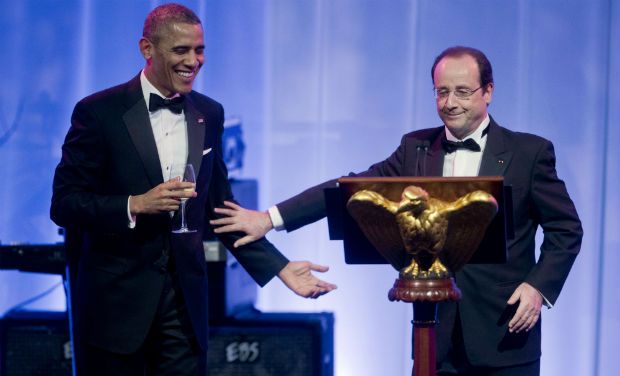
And yet the man who bears the responsibility for his country’s criminality in Africa – French president Francois Hollande – was being toasted at a sumptuous dinner in Washington this week by African-American president Barack Obama. Obama, with a glass of expensive wine in one hand, hailed Hollande for his country’s commitment to “security and peacekeeping” in Africa.
A day of reckoning cannot come soon enough. Just because these leaders are deluded does not mean we should ignore them or merely excoriate them. The international community must marshal the case and call for the prosecution of these criminals in high office.
Peaceful Marches and Opposition Violence, Two Deaths Mark Day of Youth in Venezuela
By Tamara Pearson and Ryan Mallett-Outtrim | Venezuelanalysis | February 12, 2014
Merida – Violent opposition groups attacked government buildings and civilians, and clashed with police and government supporters following peaceful marches commemorating the Day of Youth.
The violence has claimed two deaths and left 23 injured across the country. Thirty arrests have been made according to government sources.
Venezuela commemorates the day of the youth on 12 February each year in memory of the role of young people in the decisive independence battle in La Victoria in 1814. Today marked the bicentenary of the historic battle.
Caracas
In mid afternoon President Nicolas Maduro delivered a speech in Caracas, praising the morning’s marches as peaceful. However, shortly later one Chavista was reported to have been killed amid clashes involving opposition activists. Juan Montoya, also known as Juancho was shot. He was a community leader in the Chavista stronghold, Barrio 23 de Enero. This afternoon National Assembly head Diosdado Cabello condemned the shooting, and accused armed right-wing groups of “hunting down” Montoya.
“They are fascists, murderers, and then they talk about dialogue,” Cabello stated, referring to armed right-wing activists. The AN head called for calm, and urged against reprisals.
Violent opposition groups also attacked the attorney general’s office in Carabobo Park, Caracas. Photographs of the scene indicate the building’s exterior was damaged.
A building belonging to the government owned Fundacaracas organisation was also attacked by opposition groups. A few hours later the mayor of Caracas’s Libertador municipality, the PSUV’s Jorge Rodriguez also reported that the judicial offices in Chacao, Miranda, were also attacked. Later in the night the National Guard were deployed to the state owned VTV offices in Los Ruices. Disturbances had been reported in the area, though no further details were available at the time of writing.
In the evening, President Nicolas Maduro stated that violent opposition groups had also set fire to five police patrol vehicles. He also stated that a group of around two hundred violent activists had attempted to attack Miraflores Palace after the attorney general’s office.
Merida
After weeks of small, violent protests in Merida, there was a large march by government supporters in one part of the Andean city, and a larger march by opposition supporters elsewhere. Both were observed to be peaceful by Venezuelanalysis. However, violence began shortly after the opposition march finished. Clashes took place in Merida’s streets after individuals began burning garbage in intersections and erecting barricades.
A larger confrontation took place at a major intersection in the city’s north. Witnesses told Venezuelanalys that they saw men in balaclavas occupy a number of apartments, and fire live ammunition into the streets below. Riot police blocked the intersection. Hundreds of government supporters gathered a few hundred metres behind the police lines.
“We’re defending the city centre,” one supporter told Venezuelanalysis.
The Pro-Government March
At the pro-government march in the morning, Roger Zurita told Venezuelanalysis, “I’m worried about confrontations but I’m marching because today is the day of the youth, to celebrate the battle of La Victoria, not because of the opposition march. We have to organise ourselves around our values. We’re celebrating with happiness and peace the youth who struggle, our independence, the struggle for political power. Today we have an anti-imperialist youth and people are waking up, we’re not going to fall for the right wing’s games.”
“I’m marching for various reasons, mainly because I still believe in the project of our country, which still hasn’t been fully realised, but if we work just a bit harder we can do it, we have a lot to do. Also because it’s important to show that we are many, there are a lot of people who believe in this. What’s been happening in Merida is sad, regrettable. It’s a shame that they [violent sectors of the opposition] can’t propose anything without violence. We shouldn’t respond with violence. But the only proposal they seem to have is to get people into power who have never cared about the people, they just want to sell our country to the [US] empire,” Raquel Barrios told Venezuelanalysis, referring to the last four days of violence in Merida.
“I’m marching to commemorate the battle of La Victoria, but they [the opposition leadership] are manipulating the youth of Merida and parts of the opposition, they want to put an end to everything we’ve achieved, but they won’t be able to, because we’re peaceful people but ready for any necessary battle,” said Douglas Vasquez told Venezuelanalysis.
“Basically I’m marching to rescue Merida. We can’t let Merida be in the hands of violent people. I’m a teacher at the University of Los Andes (ULA), and I feel very ashamed that the recent violent incidents are mostly promoted by people from the ULA, who hope to create discomfort in the people in order to overthrow a consolidated and democratically elected government,” Katania Felisola said to Venezuelanalysis.
The Opposition March
The opposition march started at the ULA and went down the Americas Avenue after a last minute redirection.
Fernando Peña, a chemical engineering student at the ULA told Venezuelanalysis’s Ewan Robertson, “The students have felt the need to show themselves against [the goverment], because they have taken students prisoner in Mérida and Táchira just for expressing their right to protest. Right now feelings are very tense, because the people are tired of the government, [and] the students are the centre of the mobilisation throughout the country. The people now deeply disagree with the decisions that the government makes… living in Venezuela has become ever more difficult”.
Jan Carlos Lopez, worker in the Medical Faculty of the ULA told VA, “Some of the main reasons [for the march] are the shortages that are being experienced in the country, criminality, and insecurity. There isn’t an organisation that can protect us at night time so that we can go out. That’s what we’re asking for, security so that all Venezuelans can live in peace.”
Other opposition marchers told Robertson that they blamed the government for the violence, for “sending out motorbikes to attack students”.
In the violence after the marches, two people have been reported as injured, both shot in the legs. One of those was Jilfredo Barradas, a state government photographer.
“It’s a show, everyone knew it would turn out like this, it was planned,” one Merida activist told Venezuelanalysis, referring to the violence both in the Americas intersection as well as on Avenue 3.
Further, Gustavo Bazan told Venezuelanalysis, “On Friday they [violent opposition sectors] wanted to store Molotov cocktails [in the apartment where Bazan lives] and break up bricks in order to have rocks. I stepped out of line a bit and I told them that here they weren’t protesting against the government but rather against their own neighbours. I challenged them to take off their balaclavas and said to them they weren’t capable of coming over and having a conversation. They jumped over the fence and three of them started to beat me up. A friend and a building security guard saved me. I filmed them while they prepared the Molotov cocktails”.
Other cities
Electricity minister Jesse Chacon informed through his Twitter account that “violent groups” surrounded an electric substation in San Cristobal and threw Molotov cocktails at it.
According to AVN there was also violence in Aragua and Carabobo states “which left material damage”.
The governor of Carabobo state, Francisco Ameliach said that “violent groups burnt a truck with liquid asphalt”. Ameliach alleged that the head of the MUD in the state, Vicencio Scarano had financed the crimes.
The minister for internal affairs, Miguel Rodriguez Torres, said that violent groups had tried to set the Aragua state government building on fire.
Official response
Tonight Attorney General Luisa Ortega Diaz informed the public that so far there have been a total of two deaths, 23 injured, and thirty arrests. Along with Montoya, student Basil Da Costa died after suffering a gunshot. She added though that public lawyers were investigating and visiting hospitals to determine the exact number. According to Maduro the two men were both shot in the head, “like the sharp shooters who murdered [people] on 11 April [2002]”.
Ortega also said that four CICPC (Scientific Crime Investigation Body) vehicles were set on fire, as well as other private vehicles.
Regarding the march in Caracas, she said “they were guaranteed security from Plaza Venezuela to the Attorney General’s Office, there was nothing to impede them”.
Maduro also warned tonight that “whoever protests or marches without permission will be detained”.
“These are trained groups who… are prepared to overthrow the government in a violent way, and I’m not going to allow this, so I call on Venezuela to be peaceful,” Maduro said.
Foreign minister Elias Jaua alleged that Leopoldo Lopez was the “intellectual author of the deaths and injuries in Caracas”.
The Ecuadorian government emitted a statement today condemning the “acts of violence and vandalism by irresponsible members of the opposition”.
“We hope for the prompt reestablishment of social peace in our brother country and because respect for the government and its legitimately constituted institutions has precedence”.
Opposition statements and response
“This a call put out by the students and supported by the Democratic Unity [MUD opposition coalition], this march on the day of the youth is taking place when the government is repressing, with jail, with torture,” Leopoldo Lopez told CNN yesterday, in anticipation of today’s events.
“The government has an agenda of violence and as they control the monopoly [sic] over communication in Venezuela they hide it… the call that has been made is to be in the street,” he said, blaming the violence over the last week in Merida and Tachira on the government.
Speaking tonight on Noticias 24, Lopez blamed the national government for today’s violence and deaths. “Who is generating the violence? The government… repression by the national guard, the police,” he said.
Some of the top tweets by the opposition at the moment also blamed the Tupamaros groups. The Tupamaros are now quite small, but are often blamed for any violence that takes place. They support the national government.
“They (Tupamaros) are animals and they should all die,” wrote Daniel Garcia.
“Hitler, come back and put all the Tupamaros in gas chambers” wrote Andreina Leonett.
“When the first student dies all the streets of Venezuela will burn,” wrote Jose Gamboa.
Over the last week far right opposition leaders such as Leopoldo Lopez have been calling for people to “go out into the street” in order to achieve an “exit” of the national government.
Featured Video
Integrity Initiative: UK-funded network framed dissent as Russian disinformation for years
or go to
Aletho News Archives – Video-Images
From the Archives
Why Saudi Ties to 9/11 Mean U.S. Ties to 9/11
By Kevin Ryan | Dig Within | September 27, 2015
Media interest in Saudi Arabian connections to the crimes of 9/11 has centered on calls for the release of the 28 missing pages from the Joint Congressional Inquiry’s report. However, those calls focus on the question of hijacker financing and omit the most interesting links between the 9/11 attacks and Saudi Arabia—links that implicate powerful people in the United States. Here are twenty examples. … continue
Blog Roll
 Aletho News
- Iraqi Resistance faction links arms to sovereignty, questions US exit
- Cannon fodder no more… South Korea rejects Trump’s pressure to join his criminal war on Iran
- Neria Leiter Was A Legitimate Military Target
- Integrity Initiative: UK-funded network framed dissent as Russian disinformation for years
- ‘We don’t seek permission to defend our country’: Snippets from President Pezeshkian’s UNGA address
- NATO chief wants Europeans to fight American wars [for Israel]
- German chemicals giant reveals details of downsizing
- Refaat Al-Areer Was The Canary In The Coal Mine In Israel’s War On The Truth
- Israeli election committee bars candidate from Knesset race over Gaza war opposition
- French-Lebanese man files war crimes complaint over Israeli attacks
- If Americans Knew
- Aid, reconstruction, and Israel’s history of obstruction in Gaza
- Trump administration digs an ever-deeper hole of complicity in genocide – Daily Update
- US-Israel $2.8 Billion Arms Deal, 40,000-Bomb Supply Faces New Gaza Complicity Accusations
- Caught on Tape: AIPAC CEO Boasted of Controlling Trump’s National Security Officials
- Why Hamas Attacked Israel in October 2023 – Israeli professor Ilan Pappé
- They see them, then kill them: Israeli quadcopters track, deliberately target civilians in Gaza
- Winter could turn Gaza’s treacherous, war-damaged buildings into deathtraps
- Majority of Democratic Voters Want to Prosecute Both Biden and Trump Administration Officials Over Gaza
- As Gaza languishes, world leaders gather at the UN – Daily Update
- Sanctions are collective punishment: immoral and self-defeating
- No Tricks Zone
- New Study: Earth And Venus Surface Warmth Largely Explained By Convection And Lapse Rate, Not CO2 Or Radiation
- 2025 Nature Paper Claiming Worsening Global Drought Gets RETRACTED …Heavily Flawed
- New Study: ‘Global Drought Shows No Detectable Recent Acceleration Under Climate Warming’
- Economic Masterminds: German Socialists Suggest Taxing Productivity Gains Stemming From Using AI
- The South China Sea Has Not Been Cooperating With The Climate Change Narrative
- Energy Crisis: Germany Enters Heating Season With Historically Low Gas Reserve Fill Levels
- New Study: The Antarctic Ice Sheet Gained Mass From 2020-2024 Due To Staggering Snow And Ice Accumulation
- Study: Ocean Heating Rates From Thousands Of Years Ago ‘Dwarf’ Modern Ocean Heating Rates
- Climate Extremists Target, Attack Large-Scale Power Grid Infrastructure In Germany!
- New Study: Antarctic Ice Melt Has Contributed Less Than 1 Centimeter To Sea Level Rise In The Last 30 Years


