UK’s Prince Charles to visit Qatar, Saudi Arabia
Press TV – February 12, 2014
Prince Charles, the heir apparent to the British throne, is set to make a four-day official visit to Saudi Arabia and Qatar later this month.
According to a statement on the British government website, released on Wednesday, the Prince of Wales is expected to begin his trip to the Middle East region from Saudi Arabia on February 17 and end it in Qatar on February 20.
He will meet King Abdullah bin Abdulaziz Al Saud and Sheikh Tamim bin Hamad Al Thani during his trips.
In March 2013, Prince Charles and his wife Camilla, Duchess of Cornwall, also visited Saudi Arabia as part of a nine-day tour of the Middle East, with stops in Jordan, Qatar and Oman.
This comes as Britain as well as Saudi Arabia and Qatar are considered as major foreign supporters of the ongoing militancy in Syria.
The UK has also played a major role in fanning the flames of unrest in Syria by arming and training militants fighting against the government of Syrian President Bashar al-Assad.

Russia slams UN move on Syria as one-sided
Press TV – February 11, 2014
Russia has lashed out at the UN Security Council over a draft resolution that would impose more sanctions on Syria unless the government gives unrestricted access to aid delivery.
“Indeed, our Western partners in the [UN] Security Council addressed us and offered to work together to draft this resolution. However, the ideas that they shared with us are absolutely one-sided and divorced from fact,” Russian Foreign Ministry Sergey Lavrov said at a press conference in Moscow on Tuesday.
The top Russian diplomat went on to say that the draft resolution also disregards the measures already taken to deliver humanitarian supplies, and international agencies’ assessments of the humanitarian situation in Syria.
He further noted that the resolution needs to be issued in a way that would condemn terrorist activities in Syria.
Meanwhile, Russian Ambassador to the UN Vitaly Churkin has pledged to veto the proposed measure if necessary, saying the resolution would increase tension in Syria.
“This text would not have any positive impact on the situation,” Churkin said, “If anything, it would create disruption of humanitarian efforts.”
The Russian ambassador added that the measure would endanger the Geneva talks being held in Switzerland.
The comments come as the Syrian government delegation, led by Foreign Minister Walid al-Muallem, and foreign-backed opposition hold a second day of talks in Geneva.
The first round of the talks aimed at containing the deadly violence ended inconclusively on January 31, amid sharp differences between representatives from the Syrian government and the so-called Syrian National Coalition (SNC).
Related article

Violent Student Protests Mark New Phase of “Radical” Venezuelan Opposition Activity
By Ewan Robertson | Venezuelanalysis | February 7, 2013
Mérida – Violent opposition student protests have taken place in several Venezuelan cities in recent days.
The demonstrations over issues such as “insecurity” come as one sector of the right-wing opposition has called for supporters to “take to the streets” to seek a “way out” of the Venezuelan government.
The student protests began on Tuesday in San Cristóbal in the western state of Táchira, when two students were arrested for alleged breach of the peace during a demonstration. The students were released the following day.
In response, over the past three days small groups of pro-opposition students in Táchira and Mérida states have launched a series of protests. Belonging to the University of the Andes (ULA), among other institutions, the students have typically been masked and hooded, and do not display banners explaining the reasons for their protest.
Their actions so far have included blocking roads, burning tires, throwing stones at passers-by, stealing a truck, and in Mérida, attacking a government building project.
When interviewed, the students say they are protesting “insecurity”.
“[Venezuelan president Nicolas] Maduro and [socialist governor of Tachira state] Vielma Mora arrest and assassinate us students that fight for life, meanwhile they arm delinquents so that they rob, rape and murder the people,” claimed Vilca Fernández, leader of the radical “Liberation 13” ULA student group.
The most violent action took place yesterday, when a group of up to seventy radical opposition students attacked the official residence of the socialist governor of Tachira state, Vielma Mora.
According to Mora and other sources, the students were armed with “stones, bottles and some kind of molotov bomb”. They allegedly destroyed a police sentry post, broke down the residence’s main gates, and threatened Vielma Mora’s wife, who was protected by police while she tried to calm the students.
Governor Mora also said that “some students” had turned up at his young children’s nursery with the intention of “taking them out and causing them harm”, however without success.
Mora’s wife, Karla Jimenez, claimed that the students’ aim in the attack was to “get hurt and appeal to CNN in protest” although she insisted that “we’re not going to fall for that political game”.
Vielma Mora and Karla Jimenez blame the actions on Leopoldo Lopez, the leader of the right-wing Popular Will party, who they accused of giving “instructions” to the students. Lopez is leading a self-declared “radical” movement from within the opposition to seek an immediate “way out” of Nicolas Maduro’s government, and has demanded supporters to “go on to the streets”.
Many opposition leaders, such as Miranda state governor Henrique Capriles, don’t agree with Lopez’ strategy, referring to it “inopportune” and politically “suicidal”.
Leopoldo Lopez denied any involvement in the violent student protests, stating, “I don’t have detailed information about what’s happening in Tachira, but I can say that if there’s an accusation by governor Vielma Mora, creating tension that’s very far from dialogue…that could be the origin of the tension”.
The student protests come after a group of opposition supporters attacked the Cuban baseball team in Margarita on Sunday, calling on them to “go home”.
Today Governor Mora stated that a total of 12 police had been injured in the attack on his residence, and that authorities knew who the perpetrators were. The state governor also said he wanted “peace” in Tachira, and called for a solidarity gathering outside his official residence tomorrow morning.
Meanwhile President Maduro tweeted that those who had committed violent crimes during the protests would be “punished with the law”, and exhorted the wider population not to “fall for the provocation of hate-filled minorities that want to deviate us from the construction of the homeland and fill the country with chaos”.
FMLN Wins First Round of Presidential Elections in El Salvador
CISPES | February 3 2014
San Salvador —With 99% of votes counted, candidate for the governing Farabundo Martí national Liberation Front (FMLN) party, Salvador Sanchez Cerén, has won the first round of El Salvador’s 2014 presidential election, with ten-point lead over Norman Quijano of the Nationalist Republican Alliance (ARENA). Both candidates will head to a run-off on March 9.
According to the CISPES electoral observation mission, which included delegates from the National Lawyers Guild, the American Association of Jurists and various U.S. universities, the electoral proceedings were calm and peaceful.
As Laura Embree-Lowry reported for CISPES’ mission, “This has been a much more transparent and peaceful process than we’ve observed in the past.” Observers noted the positive impact of several steps taken by the Supreme Electoral Tribunal over the past four years to increase both voter access and transparency, especially the new neighborhood voting system, which was carried out throughout the entire country for the first time on February 2.
The mission reported several denouncements made to them throughout the day, primarily concerning voting centers that did not open to the public at 7:00 am as scheduled due to the lack of sufficient numbers of poll workers, but these incidents were characterized as minor anomalies.
Embree-Lowry noted, “CISPES has observed every election since the Peace Accords. Today’s election shows that the process of democratization in the country continues to advance.”
Supreme Electoral Tribunal president Eugenio Chicas announced that the final vote count will be formally announced on Tuesday, February 4th. None of the candidates have challenged the preliminary results; both Sánchez-Cerén and Quijano gave press conferences in San Salvador on Sunday night expressing satisfaction and hope for a victory on March 9.
The 70-person CISPES observer mission, together with the SHARE Foundation, U.S.-El Salvador Sister Cities, and other international organizations will issue their report on the election at a press conference on Tuesday in San Salvador.
PALESTINE: Thirteen-year-old boy arrested, questioned without parents present
CPTnet | January 31, 2014
Around noon today, 30 January 2014, members of the Christian Peacemaker Team in Hebron received a call from members of the International Solidarity Movement that soldiers had arrested a boy on New Shalala Street. Members of the Ecumenical Accompaniment Programme in Palestine and Israel (EAPPI) were just leaving the CPT apartment at the time and followed up, but by the time they arrived, soldiers had already taken the boy behind the gate at Beit Romano Settlement.
CPTers arrived and began interviewing children and other bystanders who had witnessed the incident and then reported that the boy’s name was Marwan Khalil al Jabari to the Palestinian District Coordination Office (DCO) and the Temporary International Presence in Hebron (TIPH). Witnesses said they had seen no stone throwing or other precipitating event that might have caused soldiers to take the boy.
After more phone calls, the team learned that Marwan was thirteen years old, and the son of Manal al Jabari, an employee of the Israeli human rights organization B’tselem. He had been delivering an item to his father, a vegetable vendor on New Shalala Street, when soldiers took him, accusing him of throwing stones at them. After taking him behind the gate of Beit Romano, they transported him to the police station at Kiryat Arba. His mother waited for forty minutes outside the station before they let her enter, even though Israeli law mandates that parents be present during interrogation of minors and al Jabari knew she had the right to be present when they were questioning the boy because of his age.
The family had to pay 500 NIS (about U.S. $143/ €106) to secure the boy’s release.
Related articles


Gunmen from Kiev attempted to seize Crimea’s Interior Ministry overnight – Russia
RT | March 1, 2014
Unknown armed men from Kiev have tried to seize the Crimean Interior Ministry overnight, Russia’s Foreign Ministry said in a statement. It’s as Crimea’s PM urges Russia to help cope with the crisis, ensuring “peace and calm” in the region.
“Thanks to the decisive action of self-defense squads, the attempt to seize the building of the Interior Ministry was derailed. This attempt confirms the intention of prominent political circles in Kiev to destabilize the situation on the peninsula,” the statement added.
“We believe it is extremely irresponsible to further pressure the already tense situation in the Crimea,” the ministry stated stressing its concerns over the latest developments in the region.
Earlier, Crimea’s Prime Minister Sergey Aksyonov declared that firearms have been used in the clashes in the region, Itar-Tass news agency reported. The PM said the local Ministers’ Council and Supreme Court came under an attack.
He said he would temporarily manage all national security forces in the region, including police, emergency services and the Interior Ministry.
“All chiefs of staff should follow my orders. As for those who disagree, I ask them to leave the service,” Aksyonov said in an urgent statement to the region’s security forces.
Aksyonov said he had asked Russia’s President Vladimir Putin to “help ensure peace and calm on the territory of the autonomous region.” The request, the premier said, was due to “the understanding of the responsibility for the life and safety of the residents.”
Russian MPs urge Putin to react to Crimea crisis
A source in the Kremlin administration replied, “Russia won’t ignore that address,” Russian news agencies reported. Later in the day, both chambers of the Russian parliament asked Putin to take measures to ensure stability in Crimea.
“The Duma Council adopted an appeal to the president of Russia, in which parliamentarians are calling on the president to take measures to stabilize the situation in Crimea and use all available means to protect the people of Crimea from tyranny and violence,” said Lower House speaker Sergey Naryshkin.
The State Duma also said that currently it is impossible to conduct legitimate and democratic elections in Ukraine due to actions of “radical forces.”
The Upper Chamber of the Russian Parliament admitted a limited number of Russian troops could be brought to Crimea to ensure safety, speaker Valentina Matvienko said.
“It’s possible in this situation, complying with a request by the Crimean government, even to bring a limited contingent of our troops to ensure the safety of the Back Sea Fleet and the Russian citizens living on the Crimea territory. The decision is for the president, the chief military commander, to make of course. But today, taking the situation into account, even that variant can’t be excluded. We need to protect the people,” Matvienko said.
In their turn, Ukraine’s self-proclaimed authorities urged Moscow to “withdraw troops and comply with bilateral agreements” and “resolve the crisis peacefully and politically,” interim President Arseny Yatsenyuk said.
This comes despite Russia’s repeated statements that all military operations in the region fall within in the framework of the agreement that concerns the Russian naval base in the Black Sea.
Although Western politicians and the media have expressed concern over Russia’s alleged involvement in Crimea, they have not been able to produce any solid evidence. A US State Department spokeswoman told a press conference they have no confirmation of “intervention” in Crimea.
So far, Moscow and the Crimean authorities have agreed to guard objects belonging to the Russian Black Sea Fleet, whose main base is located in Sevastopol, according to RIA Novosti.
Crimeans began protesting after the new self-proclaimed government in Kiev introduced a law abolishing the use of other languages in official circumstances in Ukraine. More than half the Crimean population are Russian and use only this language for their communication. The residents have announced they are going to hold a referendum on March 30 to determine the fate of the Ukrainian autonomous region.
Israeli forces prevent Palestinian activist from entering Jordan
Ma’an – January 31, 2014
HEBRON – Israeli forces prevented a Palestinian popular committee coordinator from traveling to Jordan via the Allenby Bridge on Thursday, the coordinator said.
Ratib al-Jbour told Ma’an: “I was heading to Jordan, and then to France to participate in solidarity campaigns with our people and show the true image of how we suffer as a result of the occupation and settlers.”
Israeli forces cited “security reasons” for preventing him from crossing to Jordan, al-Jbour said.
But he said the limitations on his freedom of travel were due to the impact Palestinian solidarity campaigns were making around the world.
Al-Jbour coordinates popular committees against settlements and the Israeli separation wall in areas south of Hebron and east of Yatta.
Palestinians and pro-Palestinian activists are often held up or denied entry at borders controlled by Israel.
Related article

Ukraine PM Azarov submits resignation to ease tensions
Press TV – January 28, 2014
Ukrainian Prime Minister Mykola Azarov has tendered his resignation in an attempt to help resolve a two-month political crisis in the country.
“I have taken a personal decision to ask the president of Ukraine to accept my resignation from the post of prime minister with the aim of creating an additional possibility for a political compromise to peacefully resolve the conflict,” he said.
World boxing champion and opposition leader Vitali Klitschko said Azarov’s announced resignation was only “a step to victory”.
Moments ahead of the news, Ukraine’s parliamentarians began holding a special session over a controversial anti-protest law, which has sparked a wave of clashes between protesters and police forces over the past weeks.
In a televised statement, Justice Minister Olena Lukash said the lawmakers would discuss the government’s responsibility in the crisis, signaling that a cabinet reshuffle could be imminent.
Earlier on Monday, in a meeting between the government and the opposition, Ukrainian President Viktor Yanukovych and the opposition agreed to scrap the anti-protest law.
Yanukovych also pledged an amnesty for detained demonstrators if the barricades set up by them on the streets are taken down.
In a bid to resolve the crisis, the Ukrainian president also offered to bring the opposition into the government. Leaders of the opposition, however, have rejected the offer.
Ukraine has been rocked by anti-government protests since Yanukovych refrained from signing the Association Agreement with the European Union at the third Eastern Partnership Summit in the Lithuanian capital, Vilnius, on November 29, 2013.
Related article

Increase in homicides linked to “extermination groups” and ARENA campaign
CISPES | January 21, 2014
Since the beginning of the New Year and with the February 2nd presidential elections less than two weeks away, El Salvador has seen a dramatic increase in homicides. In the month of January, El Salvador has seen an average of 9.4 violent deaths per day, a shocking increase from months past, many of them carried out en masse and reminiscent of death squad-style murders.
The Foundation for the Study of the Application of Law (FESPAD), a Salvadoran legal aid clinic and research group, reports that the murders are being carried out by “extermination groups.” Nelson Flores of FESPAD notes that these types of murders often occur prior to electoral periods, and that the “extermination groups” are trying to generate terror in the population and make the government look like it cannot stop this phenomenon.
The type of group that FESPAD describes have been operating in El Salvador since during the armed conflict; many of the groups take their names from “historic figures tied to the worst state violence, including General Maximiliano Hernández Martínez, Domingo Monterrosa, Roberto D´Aubuisson.” This is not the first time that FESPAD has publicized the continued operation of social cleansing groups in El Salvador (For more background, download a report in Spanish here).
Even before FESPAD’s recent announcement, many prominent voices in El Salvador had been questioning whether the right-wing Nationalist Republican Alliance (ARENA) party was behind the recent rise in homicides.
President Mauricio Funes expressed concern about a possible link between the increased violence and ARENA’s electoral campaign, while FMLN spokesperson Roberto Lorenzana described ARENA, wracked by internal crises and an unpopular candidate, as being driven to desperate measures, including the use of confrontation and violence as part of a last ditch effort at a “black campaign.”
ARENA’s new campaign manager, the infamous right-wing Venezuelan campaign manager J.J. Rendón, is renowned for his use of “rumorology” and smear tactics. At the very least, ARENA is taking advantage of the increase in murders in their campaign, which has in recent weeks turned more vitriolic, with a focus on violence and insecurity. Some ads use slogans like “My money will no longer go to gangs” and “Children will play safely in the streets again” while others directly attack the Funes administration’s public security policies. In a recent presidential debate, ARENA candidate Norman Quijano, who was the only candidate to directly attack the administration, proposed militarizing public security as a solution to the insecurity problems, a measure that would directly violate El Salvador’s Constitution.
President Bashar al-Assad’s interview with Agence France Presse
SANA | January 21, 2014
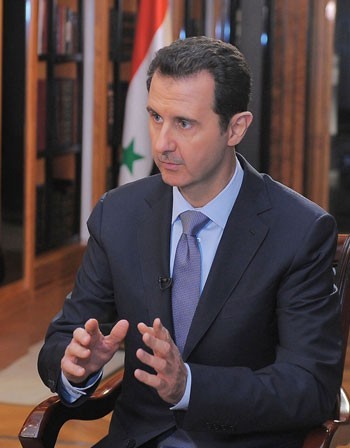 Damascus – President Bashar al-Assad gave an interview to Agence France Presse. Following is the full text of the interview:
Mr. President, what do you expect from the Geneva conference?
President Assad: The most basic element, which we continuously refer to, is that the Geneva Conference should produce clear results with regard to the fight against terrorism in Syria. In particular, it needs to put pressure on countries that are exporting terrorism, – by sending terrorists, money and weapons to terrorist organisations, – especially Saudi Arabia and Turkey, and of course the Western countries that provide political cover for these terrorist organisations. This is the most important decision or result that the Geneva Conference could produce. Any political solution that is reached without fighting terrorism has no value. There can be no political action when there is terrorism everywhere, not only in Syria but in neighbouring countries as well. From the political side, it is possible for Geneva to contribute to a process of dialogue between Syrians. There has to be a Syrian process within Syria and whilst Geneva could support this, it cannot be a substitute for it.
AFP: After nearly three years of devastating war and the big challenge of reconstruction in the country, is it likely that you will not be a candidate for the presidency?
President Assad: This depends on two things: It depends on personal aspirations or a personal decision, on the one hand, and on public opinion in Syria, on the other. As far as I am concerned, I see no reason why I shouldn’t stand; as for Syrian public opinion, there is still around four months before the election date is announced. If in that time, there is public desire and a public opinion in favour of my candidacy, I will not hesitate for a second to run for election. In short, we can say that the chances for my candidacy are significant.
AFP: In these past years, have you thought for a moment about losing the battle, and have you thought of an alternative scenario for you and your family?
President Assad: In any battle, there is always the possibility of winning and losing; but when you’re defending your country, it’s obvious that the only choice is to win. Should Syria lose this battle that would mean the spread of chaos throughout the Middle East. This battle is not confined to Syria and is not, as Western propaganda portrays, a popular uprising against a regime suppressing its people and a revolution calling for democracy and freedom. These lies have now become clear to people. A popular revolution doesn’t last for three years only to fail; moreover, a national revolution cannot have a foreign agenda. As for the scenarios that I have considered, of course these types of battles will have numerous scenarios – 1st, 2nd, 3rd……tenth, but they are all focused on defending the country not on running away from it. Fleeing is not an option in these circumstances. I must be at the forefront of those defending this country and this has been the case from day one.
AFP: Do you think you are winning this war?
President Assad: This war is not mine to win; it’s our war as Syrians. I think this war has, if you will, two phases. The first phase, which took the form of plans drawn up at the beginning, was the overthrow of the Syrian state in a matter of weeks or months. Now, three years on, we can safely say that this has failed, and that the Syrian people have won. There were countries that not only wanted to overthrow the state, but that also wanted to partition the country into several ‘mini-states;’ of course this phase failed, and hence the win for the Syrian people. The other phase of the battle is the fight against terrorism, which we are living on a daily basis. As you know, this phase isn’t over yet, so we can’t talk about having won before we eliminate the terrorists. What we can say is that we are making progress and moving forward. This doesn’t mean that victory is near at hand; these kinds of battles are complicated, difficult and they need a lot of time. However, as I said, and I reiterate, we are making progress, but have not yet achieved a victory.
AFP: Returning to Geneva, do you support a call from the conference for all foreign fighters to leave Syria, including Hezbollah?
President Assad: Clearly the job of defending Syria is responsibility of the Syrian people, the Syrian institutions, and in particular the Syrian Army. So, there would be no reason for any non-Syrian fighters to get involved had there not been foreign fighters from dozens of countries attacking civilians and Hezbollah especially on the Syrian-Lebanese border. When we talk about fighters leaving Syria, this would need to be part of a larger package that would see all the foreign fighters leave, and for all armed men – including Syrians – to hand over their weapons to the Syrian state, which would consequently achieve stability. So naturally, yes, one element of the solution in Syria – I wouldn’t say the objective – is for all non-Syrian fighters to leave Syria.
AFP: In addition to the prisoner exchange and a ceasefire in Aleppo, what initiatives are you ready to present at Geneva II?
President Assad: The Syrian initiative was put forward exactly a year ago, in January of last year. It’s a complete initiative that covers both political and security aspects and other dimensions that would lead to stability. All of these details are part of the initiative that Syria previously put forward. However, any initiative, whether this one or any other, must be the result of a dialogue between Syrians. The essence of anything that is proposed, whether it’s the crisis itself, fighting terrorism, or the future political vision and political system for Syria, requires the approval of Syrians. Our initiative was based on a process to facilitate this dialogue rather than a process to express the government’s point of view. It has always been our view that any initiative must be collective and produced by both the political actors in Syria and the Syrian people in general.
AFP: The opposition that will participate in Geneva is divided and many factions on the ground don’t believe it represents them. If an agreement is reached, how can it be implemented on the ground?
President Assad: This is the same question that we are asking as a government: when I negotiate, who am I negotiating with? There are expected to be many sides at Geneva, we don’t know yet who will come, but there will be various parties, including the Syrian government. It is clear to everyone that some of the groups, which might attend the conference, didn’t exist until very recently; in fact they were created during the crisis by foreign intelligence agencies whether in Qatar, Saudi Arabia, France, the United States or other countries. So when we sit down with these groups, we are in fact negotiating with those countries. So, is it logical that France should be a part of the Syrian solution? Or Qatar, or America, or Saudi Arabia, or Turkey? This doesn’t make any sense. Therefore, when we negotiate with these parties, we’re in fact negotiating with the countries that are behind them and that support terrorism in Syria. There are other opposition forces in Syria that have a national agenda; these are parties that we can negotiate with. On the issue of the vision for Syria’s future, we are open for these parties to participate in governing the Syrian state, in the government and in other institutions. But as I mentioned earlier, anything that is agreed with any party, whether in Geneva or in Syria, must be subject to people’s endorsement, through a referendum put to Syrian citizens.
AFP: In this context, could the ceasefire agreements that have been started in Moadimiya and Barzeh be an alternative to Geneva?
President Assad: The truth is that these initiatives may be more important than Geneva, because the majority of those fighting and carrying out terrorist operations on the ground have no political agenda. Some of them have become professional armed robbers, and others, as you know, are takfiri organisations fighting for an extremist Islamic emirate and things of that kind. Geneva means nothing for these groups. For this reason, the direct action and the models that have been achieved in Moadamiyeh, in Barzeh and other places in Syria has proven to be very effective. But this is separate from the political process, which is about the political future of Syria. These reconciliations have helped stability and have eased the bloodshed in Syria, both of which help pave the way for the political dialogue I mentioned earlier.
AFP: Are you prepared to have a prime minister from the opposition in a future government?
President Assad: That depends on who this opposition represents. When it represents a majority, let’s say in parliament, naturally it should lead the government. But to appoint a prime minister from the opposition without having a majority doesn’t make any political sense in any country in the world. In your country, for example, or in Britain or elsewhere, you can’t have a prime minister from a parliamentary minority. This will all depend on the next elections, which we discussed in the Syrian initiative; they will reveal the real size of support for the various opposition forces. As to participation as a principle, we support it, of course it is a good thing.
AFP: Are you prepared to have, for example, Ahmed Jarba or Moaz Khatib, be your next prime minister?
President Assad: This takes us back to the previous question. Do any of these people represent the Syrian people, or even a portion of the Syrian people? Do they even represent themselves, or are they just representatives of the states that created them? This brings us back to what I mentioned earlier: every one of these groups represents the country that created them. The participation of each of these individuals means the participation of each of those states in the Syrian government! This is the first point. Second, let’s assume that we agreed to the participation of these individuals in the government. Do you think that they would dare to come to Syria to take part in the government? Of course they wouldn’t. Last year, they claimed that they had control of 70% of Syria, yet they didn’t even dare to come to the areas that they had supposed control of. They did come to the border for a 30-minute photo opportunity and then they fled. How can they be ministers in the government? Can a foreigner become a Syrian minister? That’s why these propositions are totally unrealistic, but they do make a good joke!
AFP: Mr. President, you said that it depends on the results of the elections, but how can you hold these kinds of elections if part of Syria’s territory is in the hands of insurgents?
President Assad: During this crisis, and after the unrest started in Syria, we have conducted elections twice: the first was municipal elections and the second was parliamentary elections. Of course, the elections cannot be conducted in the same way they are conducted in normal circumstances, but the roads between Syrian regions are open, and people area able to move freely between different regions. Those who live in difficult areas can go to neighbouring areas and participate in the elections. There will be difficulties, but it is not an impossible process.
AFP: Now that opposition fighters are battling jihadists, do you see any difference between the two?
President Assad: The answer I would have given you at the beginning of the events or during its various phases, is completely different to the answer today. Today, there are no longer two opposition groups. We all know that during the past few months the extremist terrorist groups fighting in Syria have wiped out the last remaining positions that were held by the forces the West portrays as moderates, calling them the moderate or secular forces, or the Free Syrian Army. These forces no longer exist. We are now dealing with one extremist group made up of various factions. As to the fighters that used to belong to what the West calls ‘moderate forces,’ these have mostly joined these extremist factions, either for fear or voluntarily through financial incentives. In short, regardless of the labels you read in the Western media, we are now fighting one extremist terrorist group comprising of various factions.
AFP: Would it be possible for the army and the opposition to fight against the jihadists side by side?
President Assad: We cooperate with any party that wants to join the army in fighting terrorists, and this has happened before. There are many militants who have left these organisations and joined the army to fight with it. So this is possible, but these are individual cases. This is not an alliance between ‘moderate’ forces and the army against terrorists. That depiction is false and is an illusion that is used by the West only to justify its support for terrorism in Syria. It supports terrorism under the pretext that it is backing moderation against extremist terrorism, and that is both illogical and false.
AFP: The state accuses the rebels of using civilians as human shields in areas under their control, but when the army shells these areas, do you not think this kills innocent people?
President Assad: The army does not shell neighbourhoods. The army strikes areas where there are terrorists. In most cases, terrorists enter particular areas and force out the civilians. Why do you think we have so many displaced people? Most of the millions of displaced people in Syria have fled their homes because terrorists forcefully entered their neighbourhoods. If there are civilians among these armed groups, why do we have so many displaced people? The army is fighting armed terrorists, and in some cases, terrorists have used civilians as human shields. Civilian casualties are unfortunately the consequences of any war. There is no such thing as a clean war in which there are no innocent civilian victims. This is the unfortunate nature of war, and that is why the only solution is to put an end to it.
AFP: Mr. President, some international organisations have accused the government and the opposition of committing abuses. After this war ends, would you be ready for there to be an investigation into these abuses?
President Assad: There is no logic to this claim made by these organisations. How can the Syrian state be killing its own people, and yet it is still standing three years on, despite the fact that there are dozens of countries working against it. Had the Syrian state been killing its people, they would have revolted against it long ago. Such a state could not survive for more than a few months; the fact that it has resisted for three years means that it has popular support. Such talk is more than illogical: it is unnatural. What these organizations are saying is either a reflection of their ignorance of the situation in Syria, or, in some cases, it shows they are following the political agenda of particular states. The Syrian state has always defended its civilians; it is well documented, through all the videos and the photos circulating, that it is the terrorists who are committing massacres and killing civilians everywhere. From the beginning of this crisis, up until today, these organizations do not have a single document to prove that the Syrian government has committed a massacre against civilians anywhere.
AFP: Mr. President, we know of foreign journalists who were kidnapped by the terrorist groups. Are there any foreign journalists in state prisons?
President Assad: It would be best for you to ask the relevant, specialised agencies on this issue. They would be able to give you an answer.
AFP: Would a reconciliation be possible, one day, between Syria on the one hand, and Saudi Arabia, Qatar and Turkey on the other?
President Assad: Politics changes constantly, but this change depends on two factors: principles and interests. We share no common principles with the states you mention; these states support terrorism and they have contributed to the bloodshed in Syria. As for interests, we need to ask ourselves: will the Syrian people agree to shared interests with these countries after everything that has happened and all the bloodshed in Syria? I don’t want to answer on behalf of the Syrian people. If the people believe they share interests with these states, and if these states change their policy on supporting terrorism, it is plausible that the Syrian people might agree to restore relations. I can’t individually as President, answer on behalf of all the Syrian people at such a time. This is a decision for the people.
AFP: Mr. President, you were welcomed on the occasion of July 14 (Bastille Day) in the Elysee Palace in Paris. Are you now surprised by France’s position, and do you think France may one day play some kind of role in Syria?
President Assad: No, I am not surprised, because when that reception took place, it was during the period – 2008 to 2011 – where there was an attempt to contain Syria’s role and Syria’s policy. France was charged with this role by the United States when Sarkozy became president. There was an agreement between France and the Bush administration over this, since France is an old friend of the Arabs and of Syria and as such it is better suited to play the role. The requirement at that time was to use Syria against Iran and Hezbollah, and to pull it away from supporting resistance organisations in the region. This French policy failed, because its goal was blatantly obvious. Then the so-called Arab Spring began, and France turned against Syria after it had failed to honour the pledge it had made to the United States. This is the reason behind the French position during that period why it changed in 2011.
As for France’s role in future, let’s talk frankly. Ever since 2001 and the terrorist attacks on New York, there has been no European policy-making to speak of (and that’s if we don’t look back even further to the 1990s). In the West, there is only an American policy, which is implemented by some European countries. This has been the case on all the issues in our region in the past decade.
Today, we see the same thing: either European policy is formulated with American blessing, or American policy is adopted by the Europeans as their own. So, I don’t believe that Europe, and particularly France, which used to lead the European policy in the past, is capable of playing any role in the future of Syria, or in neighbouring countries. There is another reason too, and that is that Western officials have lost their credibility. They no longer have double standards; they have triple and quadruple standards. They have all kinds of standards for every political situation. They have lost their credibility; they have sold their principles in return for interests, and therefore it is impossible to build a consistent policy with them. Tomorrow, they might do the exact opposite of what they are doing today. Because of this, I don’t think that France will play a role in the immediate future, unless it changes its policy completely and from its core and returns to the politically independent state it once was.
AFP: How long do you think Syria needs to rid itself completely of its chemical weapons stockpiles?
President Assad: This depends on the extent to which the Organisation for the Prohibition of Chemical Weapons (OPCW) will provide Syria with the necessary equipment to carry out the process. So far, the process of making this equipment available has been quite slow. On the other hand, as you know dismantling and neutralizing the chemical materials is not taking place inside Syria nor by the Syrian state. A number of countries in different parts of the world have accepted to carry out that process; some have agreed to deal with the less dangerous materials, whilst others have refused completely. Since, the time-frame is dependent on these two factors – the role of the OPCW and the countries that accept to neutralize the materials on their territories – it is not for Syria to determine a time-frame on this issue. Syria has honoured its part by preparing and collecting data and providing access to inspectors who verified this data and inspected the chemical agents. The rest, as I said, is up to the other parties.
AFP: Mr. President, what has changed in your and your family’s daily, personal lives? Do your children understand what has happened? Do you talk to them about this?
President Assad: There are a few things that haven’t changed. I go to work as usual, and we live in the same house as before, and the children go to school; these things haven’t changed. On the other hand, there are things which have affected every Syrian household, including mine: the sadness which lives with us every day – all the time, because of what we see and experience, because of the pain, because of the fallen victims everywhere and the destruction of the infrastructure and the economy. This has affected every family in Syria, including my own. There is no doubt that children are affected more deeply than adults in these circumstances. This generation will probably grow up too early and mature much faster as a result of the crisis. There are questions put to you by children about the causes of what’s happening, that you don’t usually deal with in normal circumstances. Why are there such evil people? Why are there victims? It’s not easy to explain these things to children, but they remain persistent daily questions and a subject of discussion in every family, including my own.
AFP: Through these years, what was the most difficult situation you went through?
President Assad: It’s not necessarily a particular situation but rather group of elements. There are several things that were hard to come to terms with, and they are still difficult. The first, I believe, is terrorism; the degree of savagery and inhumanity that the terrorists have reached reminds us of what happened in the Middle Ages in Europe over 500 years ago. In more recent modern times, it reminds us of the massacres perpetrated by the Ottomans against the Armenians when they killed a million and a half Armenians and half a million Orthodox Syriacs in Syria and in Turkish territory. The other aspect that is difficult to understand is the extent of Western officials’ superficiality in their failure to understand what happened in this region, and their subsequent inability to have a vision for the present or for the future. They are always very late in realizing things, sometimes even after the situation has been overtaken by a new reality that is completely different. The third thing that is difficult to understand is the extent of influence of petrodollars in changing roles on the international arena. For instance, how Qatar was transformed from a marginal state to a powerful one, while France has become a proxy state implementing Qatari policies. This is also what we see happening now between France and Saudi Arabia. How can petrodollars make western officials, particularly in France, sell their principles and sell the principles of the French Revolution in return for a few billion dollars? These are only a few things, among others, which are difficult for one to understand and accept.
AFP: The trial of those accused of the assassination of former Lebanese Prime Minister Rafic Hariri has begun. Do you think it will be a fair trial?
President Assad: Nine years have passed since the beginning of this trial. Has justice been served? Every accusation was made for political reasons. Even in the past few days, we have not seen any tangible proof put forward against the parties involved in the case. The real question should be: why the timing? Why now? This court was set up nine years ago. Have the things produced in the last few days been uncovered only now? I believe that the whole thing is politicized and is intended to put pressure on Hezbollah in Lebanon in the same way that it aimed at putting pressure on Syria in the beginning, immediately after al-Hariri’s assassination.
AFP: You have said the war will end when terrorism is eradicated. But the Syrians and everyone else want to know when this war will end. Within months? After a year? In years to come?
President Assad: We hope that the Geneva conference will be able to provide an answer to part of this by exercising pressure on these countries. This aspect has nothing to do with Syria; otherwise we would have put pressure on these states from the beginning and prevented terrorism from entering Syria. From our side, when this terrorism stops coming in, ending the war will not take more than a few months.
AFP: It appears Western intelligence agencies want to re-open channels of communication with Damascus, in order to ask you for help fighting terrorism. Are you ready for that?
President Assad: There have been meetings with several intelligence agencies from a number of countries. Our response has been that security cooperation cannot be separated from political cooperation, and political cooperation cannot be achieved while these states adopt anti-Syrian policies. This was our answer, brief and clear.
AFP: You have said in the past that the state has made mistakes. In your view, what were the mistakes that could have been avoided?
President Assad: I have said that mistakes can be made in any situation. I did not specify what those mistakes were because this cannot be done objectively until the crisis is behind us and we can assess our experience. Evaluating them whilst we are in the middle of the crisis will only yield limited results.
AFP: Mr. President, without Russia, China and Iran’s help, would you have been able to resist in the face of the wars declared against you?
President Assad: This is a hypothetical question, which I cannot answer, because we haven’t experienced the alternative. Reality has shown that Russian, Chinese and Iranian support has been important and has contributed to Syria’s steadfastness. Without this support, things probably would have been much more difficult. How? It is difficult to draw a hypothetical picture at this stage.
AFP: After all that has happened, can you imagine another president rebuilding Syria?
President Assad: If this is what the Syrian people want, I don’t have a problem with it. I am not the kind of person who clings to power. In any case, should the Syrian people not want me to be president, obviously there will be somebody else. I don’t have a personal problem with this issue.
Thank you very much Mr. President.
Lebanon: March 14 Christians on Shaky Ground With Hariri
By Maysam Rizk | Al-Akhbar | January 20, 2014
Lebanon’s March 14 Christians are banding together in an attempt to pressure former Prime Minister Saad Hariri about the government. However, their game will be over very soon. According to March 14 sources, “March 14 Christians are used by Hariri to fuel his battles then sacrificed when a settlement is reached.”
The smile on Lebanese Forces leader Samir Geagea’s face was not enough to convince French presidential envoy Emmanuel Bon that the situation is well. Geagea stressed that Hariri would never join Hezbollah in one government. Yet no matter how hard Geagea attempts to show confidence in his relationship with Hariri, he will never manage to cover up their discords.
Geagea remarked, “We are still in the stage of deliberations and negotiations regarding the government,” perhaps not noticing that Hariri announced from The Hague his willingness to join Hezbollah in the government.
MP Sami Gemayel spoke to Geagea via telephone for 15 minutes, assuring him that Kataeb will boycott the government, even if Hariri participates. He expressed his support for Geagea’s position favoring a neutral cabinet. Sami later announced, “We are not concerned with the nature of the government. What matters is its agenda.” Perhaps Sami had heard about Hariri’s positive attitude before the rest of Lebanese, hence his taking a middle ground.
Former minister Boutros Harb seemed ready to overcome the tensions that emerged between the Lebanese Forces and March 14 independent figures following the debate over the infamous Orthodox Electoral Law. Due to Hariri’s “concessions,” Harb now sees his alliance with the Lebanese Forces as the only available option to confront Hariri’s waiving of March 14 demands, mainly Hezbollah’s withdrawal from Syria.
At the peak of the confrontation, Hariri left his allies blundering. According to leaked information, Hariri’s statements on the sidelines of the Special Tribunal for Lebanon show “he is holding negotiations with the opposite side while his allies are in a whole different place.” Some March 14 sources even stressed that Hariri is going to participate in the upcoming cabinet “even if his allies refuse to join him.”
Hariri is willing to drop his Christian-Muslim partnership, and “March 14 will no longer be united.” Sources confirmed that Hariri cannot be part of any compromise regarding the government unless he receives a Saudi order.
March 14 Christian sources said, “There has been no Saudi password. Riyadh left the decision to its people in Lebanon so they do what they deem suitable. Hence, Hariri is seeking his own interests, not those of his alliance! Despite all that, some in Geagea’s and Gemayel’s circles still believe that Hariri negotiators are trying to reach a compromise that would include the Baabda Declaration in the government statement and would omit the word ‘resistance’ in order to gain leverage against Hezbollah.”
The Christian wing of March 14 is counting on “Sunni politicians to continue what Maronite politicians started in their policies against Syrian and Iranian hegemonies,” said a source. They hope Hariri “will change his mind about joining a government with Hezbollah if the party doesn’t return to the state and comply with all conditions.”
Geagea didn’t make any “loud statement” concerning Hariri’s latest remarks, neither did Gemayel, Harb, or anyone who sees himself as future president. These politicians are seeking to “buy time and announce positions that they can concede to Hariri when the time comes.”
Some March 14 Christians are convinced that “Hariri is not very pleased with his alliance with Geagea and Gemayel. Even though they all shared a common political position in 2005, Hariri still believes that he naturally belongs alongside Nabih Berri and MP Walid Jumblatt, whom his father used to reach compromises with.”
UN invites Iran to Geneva II
BRICS Post | January 20, 2014
The United Nations formally extended an invitation for Iran to attend the Geneva II Syria Peace Summit to be held later this week, much to the surprise of US officials and the chagrin of opposition forces fighting to remove the Damascus government.
Echoing previous statements from BRICS officials that Iran’s presence at the talks is pivotal, UN Secretary-General Ban Ki-Moon told reporters, “I believe strongly that Iran needs to be part of the solution to the Syrian crisis,” he added.
Last week, Russian Foreign Minister Sergei Lavrov said during a joint press conference with US Secretary of State John Kerry that Iran’s role was important.
“[The] presence of Saudi Arabia, Iran [are] necessary at the Geneva-2 talks on Syria, it’s obvious for Russia… We’ve called for the [opposition] National Coalition to work with other oppositional groups: the delegation should be truly representative,” said Lavrov.
China has also supported Iran’s participation in the Syria peace talks.
“Proper resolution of the Syria issue will be impossible without the participation and support of regional countries, especially countries with leverage over concerned parties in Syria,” Chinese Foreign Ministry Spokeswoman Hua Chunying has previously said.
But according to the US State Department, Iran has to comply with a central condition before it can attend the Syria peace talks.
Spokeswoman Jen Psaki said in a statement that Iran has not yet accepted the tenets of the Geneva I communique in 2012 which call for a “transitional body to govern Syria” by the mutual consent of all the summit participants.
Iranian diplomatic officials have assured the UN that they will play a constructive role in the talks, the Secretary-General said.
Iran’s participation has for nearly a year been a source of contention between Russia and the US and has been a partial reason that the peace talks have been repeatedly delayed.
Late on Sunday, Syria’s largest anti-Assad opposition bloc said it was angered by Ban’s announcement and threatened to withdraw from participating in the Geneva II talks on January 22.
According to Reuters, quoting National Coalition spokesperson Louay Safi on Twitter, “The Syrian Coalition announces that they will withdraw their attendance in Geneva 2 unless Ban Ki-moon retracts Iran’s invitation”.
Syria analyst Camille Otrakji, however, says there is no substitute to Iran’s participation in the Geneva II talks because of the influence it wields in the region.
“Russia and Iran must help in pressuring the regime to accept to maintain control on foreign policy and national security matters, while giving up power to a government that is formed by a coalition of parties that manage to win a majority of monitored and free parliamentary elections,” he writes.
Featured Video
Integrity Initiative: UK-funded network framed dissent as Russian disinformation for years
or go to
Aletho News Archives – Video-Images
From the Archives
Why Saudi Ties to 9/11 Mean U.S. Ties to 9/11
By Kevin Ryan | Dig Within | September 27, 2015
Media interest in Saudi Arabian connections to the crimes of 9/11 has centered on calls for the release of the 28 missing pages from the Joint Congressional Inquiry’s report. However, those calls focus on the question of hijacker financing and omit the most interesting links between the 9/11 attacks and Saudi Arabia—links that implicate powerful people in the United States. Here are twenty examples. … continue
Blog Roll
 Aletho News
- Iraqi Resistance faction links arms to sovereignty, questions US exit
- Cannon fodder no more… South Korea rejects Trump’s pressure to join his criminal war on Iran
- Neria Leiter Was A Legitimate Military Target
- Integrity Initiative: UK-funded network framed dissent as Russian disinformation for years
- ‘We don’t seek permission to defend our country’: Snippets from President Pezeshkian’s UNGA address
- NATO chief wants Europeans to fight American wars [for Israel]
- German chemicals giant reveals details of downsizing
- Refaat Al-Areer Was The Canary In The Coal Mine In Israel’s War On The Truth
- Israeli election committee bars candidate from Knesset race over Gaza war opposition
- French-Lebanese man files war crimes complaint over Israeli attacks
- If Americans Knew
- Aid, reconstruction, and Israel’s history of obstruction in Gaza
- Trump administration digs an ever-deeper hole of complicity in genocide – Daily Update
- US-Israel $2.8 Billion Arms Deal, 40,000-Bomb Supply Faces New Gaza Complicity Accusations
- Caught on Tape: AIPAC CEO Boasted of Controlling Trump’s National Security Officials
- Why Hamas Attacked Israel in October 2023 – Israeli professor Ilan Pappé
- They see them, then kill them: Israeli quadcopters track, deliberately target civilians in Gaza
- Winter could turn Gaza’s treacherous, war-damaged buildings into deathtraps
- Majority of Democratic Voters Want to Prosecute Both Biden and Trump Administration Officials Over Gaza
- As Gaza languishes, world leaders gather at the UN – Daily Update
- Sanctions are collective punishment: immoral and self-defeating
- No Tricks Zone
- New Study: Earth And Venus Surface Warmth Largely Explained By Convection And Lapse Rate, Not CO2 Or Radiation
- 2025 Nature Paper Claiming Worsening Global Drought Gets RETRACTED …Heavily Flawed
- New Study: ‘Global Drought Shows No Detectable Recent Acceleration Under Climate Warming’
- Economic Masterminds: German Socialists Suggest Taxing Productivity Gains Stemming From Using AI
- The South China Sea Has Not Been Cooperating With The Climate Change Narrative
- Energy Crisis: Germany Enters Heating Season With Historically Low Gas Reserve Fill Levels
- New Study: The Antarctic Ice Sheet Gained Mass From 2020-2024 Due To Staggering Snow And Ice Accumulation
- Study: Ocean Heating Rates From Thousands Of Years Ago ‘Dwarf’ Modern Ocean Heating Rates
- Climate Extremists Target, Attack Large-Scale Power Grid Infrastructure In Germany!
- New Study: Antarctic Ice Melt Has Contributed Less Than 1 Centimeter To Sea Level Rise In The Last 30 Years

