Jordan Invites US Targets for Syrian Retaliation
By Nicola Nasser | Alarabi | September 4, 2013
Located at the crossroads of several regional crises, including the Palestinian – Israeli and Iraqi conflicts, Jordan has been in the eye of the Syrian storm for more than thirty months, and managed to navigate safely so far, but the reportedly imminent US strike is pressuring the country between the rock and the hard place of the antagonists of the war on Syria.
Heavily burdened by the pressure of its strategic allies and financiers in the US and the GCC Arab states, who have been leading an unwavering bloody campaign for a “regime change” in Damascus, Jordan could not but yield to their demands for logistical facilities in the country, consequently shooting its self-proclaimed neutrality in the legs.
Thus, grudgingly or otherwise, Jordan has in practice invited potential US targets for Syrian retaliation on its territory if and when the Syrian government perceives that those facilities are used in any US-led strike, now expected.
Anthony Cordesman, an analyst at the Center for Strategic and International Studies, on August 29, interviewed by abcnews online, said that “Jordanian targets” could be targeted by Syria or by a Syrian allied “third party,” a possible development that could embroil the US in defense.
Should such a scenario develop, Jordan will evolve unwillingly into a war zone, to regret yielding to the prerogatives of its strategic alliance with the United States regardless of who emerges winner or loser in the war.
US Targets Invited
When the Eager Lion 2013 exercise ended in June this year, Jordan, inviting a US target for Syrian retaliation, asked the US military to leave behind some equipment, including some F-16s and a Patriot missile defense system.
Then, Jordan’s Prime Minister, Abdullah al-Nsour, indicated a second US target when he told reporters that some 900 U.S. military personnel were in the country, of whom 200 are experts training Jordanians to handle a chemical attack and 700 manning the Patriot system and reportedly 45 F-16 fighter jets.
On last August 14, Gen. Martin Dempsey, Chairman of the US Joint Chiefs of Staff, said that Jordan asked the United States to provide manned US surveillance aircraft to help keep an eye on its border with Syria; thus a third US target for Syrian retaliation was invited.
The USA embassy would be a fourth target should any planned US strike target Syrian non-military presidential or governmental headquarters.
However the Centcom’s Forward Command in Jordan, officially called Centcom Forward-Jordan (CFJ), remains the oldest and the most important US target for Syrian retaliation.
In mid-August, Gen. Martin Dempsey was in Amman to inaugurate the CFJ, which is manned by 273 US officers, with a closed section, which “houses CIA personnel who control the work of US agents going in and out of Syria,” and also a communications center, where “atop the underground facility is a large surface structure accommodating the American military and civilian offices dealing with Syrian issues from Jordan,” according to the Israeli http://www.debka.com on August 17, 2013, which confirmed a report two days earlier by The New York Times according to which “American correspondents were allowed to visit the site under ground rules that its location not be disclosed.”
However, on October 18 last year the Egyptian Al-Ahram Weekly reported that the location chosen to host the CFJ was “a Jordanian military base built in an abandoned quarry north of the Jordanian capital Amman, just 35 miles from the Syrian border,” which extends 300 miles along Jordan’s northern flank, and some 120 miles from the Syrian capital Damascus.
Al-Ahram explained that “the origins of the previously secret US deployment in Jordan” dated back to May the same year, “when the Pentagon sent American troops, including Special Forces units, to the country to participate in joint military exercises dubbed Operation Eager Lion. Some 100 military personnel stayed behind and were then joined by dozens more. The task force, according to the New York Times, is commanded by a ‘senior American officer’.”
Speaking to the media at the close of a two-day NATO defense ministers meeting at the time in Brussels, former US Defense Secretary Leon Panetta confirmed the existence of a “US task force that has been sent to Jordan this week after it was first reported in The New York Times,” Al-Ahram added. “The force would be tasked with ensuring the security of the chemical and biological weapons in Syria,” Panetta was quoted as saying. Al-Ahram’s report added: “the outpost near Amman could play a broader role should American policy change” and Washington decide to launch an intervention in Syria.
Denial in Doubt
The denial of the initial reports about the existence of the CFJ as “not true” by a spokesman from the country’s armed forces, quoted by the state-run news agency Petra, sheds doubt on a statement by Jordan’s PM al-Nsour, quoted by the London –based pan-Arab daily Al-Quds Al-Arabi on Monday, that his country knows nothing about the timing, track and targets of a US military strike in Syria, which the US President is now seeking an “authorization” from the Congress to launch.
Al-Nsour’s “lack of knowledge” sounds odd in view of the long established multi-faceted strategic ties between Jordan and the United States, which makes it the obligation of Washington to inform Amman in advance of at least the “timing” of the imminent US strike and makes it an obligation of the Jordanian government to ask for it, at least to be on equal footing with the other Israeli strategic “partner” of the US; it is public knowledge now that the US is committed to inform Israel in advance of any imminent US strike on Syria.
In comparison, at least logistically, if not militarily, especially as far as the Syrian conflict is concerned, Jordan is much more important to the US than Israel to deserve a US warning in advance of any imminent strike.
Moreover, Jordan is in the immediate danger of being flooded with more Syrian refugees who for sure will be an integral part of the humanitarian crisis that the US strike will inevitably exacerbate in Syria.
Unless Jordan is denying its “knowledge” to avert being accused by Syria of complicity with the US, al-Nsour’s “lack of knowledge” sounds more odd not only because his country hosts the CFJ.
Hosting and participating in the meetings of the US – led so – called “Friends of Syria,” as well as the military meetings of eleven chiefs of staff of “The Friends of Syria Core Group,” in addition to hosting the annual Eager Lion exercises, let alone the bilateral strategic ties between Jordan and the US and the anti-Syria members of the GCC, have all combined to posture the country as being an active member of what the Syrian government rename as the “Enemies of Syria,” who are party in the conflict and not part of its solution.
Moment of Truth Approaching
The Eager Lion exercises, from the start, focused on training to intervene and secure the purported Syrian chemical weapons if and when developments dictate such an intervention, which the imminent US strike is now turning into a matter of time.
Last June 18 the AP reported that the Eager Lion Drills “are focused on ground operations, involving commandos from Jordan … practicing offensive operations.” Although the Jordanian embassy spokeswoman in Washington D.C., Dana Zureikat Daoud, told The Center for Public Integrity earlier this year that those drills are “not mission-oriented,” reported recent involvement of Jordanian commandos in Libya and elsewhere in the region gives credence to the reports on their possible involvement anew in Syria.
US Secretary of State, John Kerry, during his testimony at the Congress on Tuesday, while confirming that the administration of President Barak Obama “has zero intention of putting troops on the ground,” he in practice retained the option of sending US “boots” to Syria.
“I don’t want to take off the table an option that might or might not be available to the president of the United States” in a scenario where “Syria imploded” and stockpiles of chemical weapons needed to be secured from extremists, he said.
It is public knowledge now that what Obama said will be a strike “limited in time and scope” aims at “degrading” Syrian chemical “capabilities;” the purported Syrian chemical weapons which are now very well secured will be far less secured after the strike and will demand immediate intervention to secure them.
So the moment of truth is around the corner for an intervention either from or with the participation of Jordan, where training in preparation for this moment has been going on by leaps and bounds for the past two years, expectedly inviting reciprocal Syrian preparations for retaliation.
A Syrian possible military clash with Jordan or with Jordanian – hosted US – led intervention units was only a postponed development and will most likely be accelerated by the US planned strike, which is expected to embroil Jordan militarily in the Syrian conflict, willingly or unwillingly.
Counterbalancing with Syrians
To counterbalance with the Syrians, who so far seem flexible enough or under too much pressure to open a diplomatic or non – diplomatic dispute with their southern Arab neighbor, Jordan kept the diplomatic and security channels of communication open with Damascus and went on record to offset its “enemy” posture, but only verbally, to make Jordan a place where words and deeds collide.
As recently as August 29, Jordan’s King Abdullah II after a meeting with Pope Francis, according to an official Vatican statement, reaffirmed that dialogue is the “only option” to end the conflict in Syria.
More than twenty two months ago, in comments in the Oval Office alongside President Obama, King Abdullah II was the first Arab leader to urge Syrian President Bashar al-Assad to step aside. “I believe, if I were in his shoes, I would step down,” he told BBC World News in an exclusive interview.
So far, Jordan declined to go public and on record in a clear-cut opposition to the imminent US strike; not excluding the military option, Information Minister Mohammad Momani said that “Jordan believes diplomatic efforts must be exhausted before Washington opts for military action,” but PM Al-Nsour said there will be “no strategic” benefit in insisting on striking Syria and he as well his Foreign Minister Nasser Judeh reiterated that the territory of the kingdom “will not be a launchpad for any military operation against Syria.”
Jordan’s noninterference in internal Syrian affairs is the officially declared policy, but the reported training in the country of Syrian opposition fighters, the recent visit to the country by the President of the Syrian National Coalition (SNC), Ahmad al-Jarba, the latter’s visit to southern Syria across the Jordanian borders and the reports about opening a SNC representative office in Amman after al-Jarba’s meeting with Nasser Judeh, and the reported infiltration of arms and “Jihadists” from Jordan into Syria are all indications that compromise Jordan’s officially declared policy of noninterference.
In April this year, Syrian President al-Assad said that Amman “is facilitating the passage of thousands of fighters into our country;” it was his first public warning to Jordan. His state TV told the Jordanians they were “playing with fire.” The Syrian newspaper Al-Thawra, also said in a front-page editorial that the Jordanian government “could not claim neutrality” anymore.
Al-Assad added that he had sent envoys to the kingdom during the preceding two months to remind Amman of the two countries’ shared goal of fighting the “terrorists.” “The fire does not stop at our border and everyone knows that Jordan is exposed to what Syria is exposed to.”
In November 2005, al-Qaeda mounted a series of devastating bomb attacks at three luxury hotels in the Jordanian capital, killing some 60 people. The attacks were said to be in retaliation for Jordan hosting training centers for the new Iraqi army and police, and for becoming a de facto logistical transit base in support of the US occupation of Iraq in 2003.
– Nicola Nasser is a veteran Arab journalist based in Birzeit, West Bank of the Israeli-occupied Palestinian territories. Contact him at: nassernicola@ymail.com.
Related article
- Jordan Prepares For Syrian Fallout; Places Air Force On High Alert (blacklistednews.com)
Resistance Is Our Destiny

By Ibrahim al-Amin | Al-Akhbar | August 31, 2013
To hell with all the talk about democracy backed by the United States, France, Britain … and Saudi Arabia, Turkey, and Israel.
To hell with every bid for freedom with the support of these murderers.
To hell with every fool, criminal, and coward, no matter what they look like, what they are called, where they live, or what they do.
To hell with all those who support an international war to topple Syria.
To hell with this bunch of collaborators, who people will no doubt hold accountable one day, come chaos or stability.
To hell with all traitors, their speeches, their false tears, and to hell with their human rights groups and their subservient civil society organizations.
The decision to wage war on Syria is only the last step in the course set two and a half years ago, to destroy Resistance, its cities, people, and even its very idea.
There is no room for any kind of bargaining, and there is no room for any discussion or debate. There is no room to listen to any collaborator touting the list of causes of war and the causers, and there is no room for those who cling to their opinions, positions, or labels, wearing bandanas on their foreheads after wearing blindfolds on their eyes, and joining forces with collaborators and takfiris.
To begin with, these people live on the crumbs thrown to them by the robbers of Arab resources and fortunes. They work for them and receive from them money and all kinds of support.
It is a duty for every capable person to fight these killers, wherever they may be, wherever there is a chance to take revenge against them, and punish all the traitors, one after the other, in their beds, behind their desks, inside their tanks, or in their palaces, whether they are alone, or among their families.
What do you want from us today?
Do you want to repeat the experience of Iraq?
Do you want to repeat the experience of Afghanistan and Somalia?
Do you want to repeat the experience of Libya? Do you want to repeat the experience of war in Lebanon?
Or do you think that this will be a war to destroy the right that will never be eliminated, and whose name, forever shall remain: Palestine?
We do not have to repeat our arguments or repeat the process of searching for answers; we do not have to repeat our comments or our warnings. All we have to do is declare one position, namely, that the war being prepared for Syria is a colonial war, and every participant in it, whether by supporting it, funding it, promoting it, justifying it, or directly fighting in it, is a cowardly collaborator… .
It’s war!
They will gang up on Damascus, the mother of all cities, with the aim of crushing the people, the army, and the leadership. They want to destroy its history and its heritage of resisting invaders. They want to destroy every spirit that resists colonialism and supports resistance in the whole region. They want to extend a permanent lifeline to Israel and the oppressive regimes in our Arab countries, and they want to have collaborators of all kinds take over countries, rob their resources, and annihilate their peoples.
When America says that it needs no cover, legal justification, scientific investigation, or political support, and that it is able to manipulate the fate of a nation, for the sole reason that it has decided that its interests require it, then this means that we must act exactly like America, and wait for no cover, support, justification, or ask about international norms and so forth.
We must fight against it, and against its colonies, all forms of war, and we must spare no effort to seek to transfer the struggle to its soil, in every place of its land and cities; we must scream in the face of the butcher. We would do all this, without giving them the ability to strip us of our humanity, which we shall keep for ourselves, our children, and for the oppressed everywhere.
Yesterday, the West showed its true colors: a spiteful, murderous West, that has no place for anyone except those who know how to kneel down before it, and raise the white flag above their heads.
Yesterday, Europe showed its foul nature. It is not just a foolish old crone, but an ugly one too, with venom spewing from all its folds. Dishonor mars its opinion-makers, factories, schools, universities, and its people who do not come out to disavow the killers among them.
All we can do is resist them, with all our capabilities. Nothing will prevent us from seeking out our sole enemy, which has many faces, but one name: the barbarians, the bloodsuckers. As for us, resistance is our destiny.
Ibrahim al-Amin is editor-in-chief of Al-Akhbar.
This article has been edited for posting at Aletho News.
Related article
Russian rocket engine export ban could halt US space program
RT | August 27, 2013
Russia’s Security Council is reportedly considering a ban on supplying the US with powerful RD-180 rocket engines for military communications satellites as Russia focuses on building its own new space launch center, Vostochny, in the Far East.
A ban on the rockets supply to the US heavy booster, Atlas V, which delivers weighty military communications satellites and deep space exploration vehicles into orbit, could put a stop to NASA’s space programs – not just military satellites.
An unnamed representative of Russia’s Federal Space Agency told the Izvestia newspaper that the Security Council is reconsidering the role of Russia’s space industry in the American space exploration program, particularly the 2012 contract on delivering to the US heavy-duty RD-180 rocket engines.
Previously, Moscow has not objected to the fact that America’s Atlas V boosters rigged with Russian rocket engines deliver advanced space armament systems into orbit. If a ban is put in place, however, engine delivery to the US would probably stop altogether, starting from 2015.
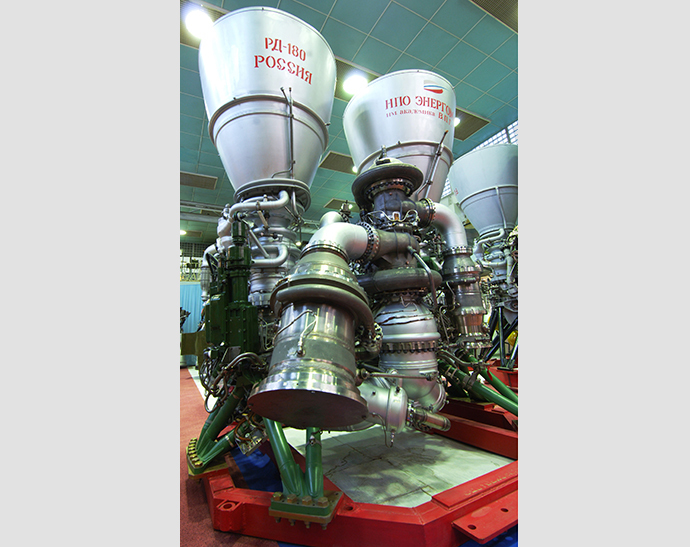
RD-180 rocket engine used in the first stages of American rockets Atlas-3 and Atlas-5. (RIA Novosti / Sergey Pyatakov)
Over the last decade, most of NASA’s Atlas V heavy rocket launches, performed by the United Launch Alliance (a Boeing/Lockheed Martin joint venture), were carried out using Russian RD-180 dual-nozzle rocket engines, a legacy of the Soviet Buran space shuttle program and its unparalleled rocket booster Energia, which could put 100 tons of spacecraft or satellites into orbit.
Military payloads
It is widely believed that many Atlas V launches have a military payload. Such Lockheed Martin-designed military spacecraft include the Advanced Extremely High Frequency (AEHF) series of communications satellites launched for Air Force Space Command, the mysterious super-secret Palladium at Night communication platform designed for the US Navy’s Ultra-High Frequency (UFO) Follow-On program and most certainly all three launches of Boeing’s X-37 unmanned demonstrator spacecraft. These are only a part of the military space missions undertaken by Atlas V rockets, boosted by RD-180 engines
A ban could also affect the US’s non-military space exploration launches, which are also highly dependent on the Atlas V rocket and RD-180 engines. The most famous and challenging among them are NASA’s New Horizons spacecraft mission, now traveling to Pluto and the Kuiper Belt (launched in 2006), and the Curiosity Mars rover (launched in 2011) currently operating on the Red Planet
A number of experts told Izvestia that termination of the rocket engine contract would not be a good idea commercially for NPO Energomash, which produces the rockets, because at the moment it makes RD-180 engines exclusively for the US space industry. The rockets typically take Energomash 16 months to produce.
If production of the RD-180 engine is stopped, the enterprise would have to find other contracts to keep the production line and experienced staff busy.
“In my opinion, stopping the export of rocket engines to the US is stupid, as we would suffer financial and reputational losses,” Ivan Moiseyev, scientific head of the Space Policy Institute, told Izvestia. “The US would not suffer much and would definitely continue with military space launches, while Russia would have to stop production of the RD-180, because no one else needs the RD-180 engine.”
However, many space experts believe that the US would find it difficult to quickly replace the Russian rockets. Also, Energomash could find other orders soon. Russia plans to start space launches from its new, multibillion-dollar Vostochny cosmodrome in the Far East in 2015. Vostochny will host a heavy rocket class launch pad, which means the producer of the world’s most powerful rocket engines will be kept busy for many years to come.
The RD-180 is equivalent to half of the Soviet-era Energia booster, the most powerful liquid rocket engine ever made by man. With 20 million horsepower output, the Soviet-era RD-170 was about 5 percent more powerful, yet 1.5 times smaller, than American’s F-1 first stage rocket engine made for the Saturn V booster of the Apollo lunar program.
Reportedly, when the Energia booster with the Buran space shuttle was launched in November 1988, the massive concrete bays paving the Baikonur cosmodrome in Kazakhstan were flying around like dry leaves, due to the immense power coming from the four RD-170 engines, which blasted the 2,400-ton rocket booster into space.
In the post-Soviet era, Russian-US rocket engine cooperation started back in 1996, when America’s General Dynamics Company bought exclusive rights for use of RD-180 in the US, later selling it to Lockheed Martin for its Atlas rocket program. NPO Energomash, the producer of unique engines based in Moscow’s suburb Khimki, signed a contract for production of 50 RD-180 engines and an option for the production of another 51 units.
A specially created joint venture, RD-AMROSS, between NPO Energomash and Pratt & Whitney Rocketdyne, has already delivered 63 engines to the US worth $11-15 million apiece, reportedly 40 of them have already been used. In December 2012, a new contract was signed to deliver another 31 engines. But this contract is now being reconsidered by Russia’s Security Council, according to Izvestia.
Rocket engines: space at stake
The RD-AMROSS joint venture has always been controversial for Russia’s military.
In 2011 Russia’s Audit Chamber announced that the RD-180 rocket engines delivered to the US according to the 1996 contract were sold for only a half of their real production value. The total loss in 2008-09 reached 880 million rubles (about $30 million) or 68 percent of all financial losses of NPO Energomash at the time, the Audit Chamber said.
In an interview, the general director of RKK Energia Corporation, Vitaly Lopota, estimated that at the time of the RD-180 first launch in the late 1980s, USSR was “at least” 50 years ahead of America’s liquid fuel rocket engine technology.
In the 1990s Russia agreed not only to sell unique engines to the US, but also provided the Americans with full documentation on the engine’s design specifications. But the US space industry opted to buy ready made engines instead of trying to make them on their own, because of the technological and material engineering gap between the two countries’ space industries.
And today the situation appears to be pretty much the same.
In December 2012, the head of Roskosmos, the Russian Federal Space Agency, Vladimir Popovkin, commented to Izvestia on the engines: “Americans are buying RD-180 engines and are negotiating to buy promising new RD-193 engines, because they’ve learned that we’re making a quality product, the best liquid-fueled rocket engines in the world. For them it’s easier to buy than to make up with us, [while] for us it is important to ensure the development of the NPO Energomash enterprise.”
In June 2013, the US Federal Trade Commission launched an antitrust investigation into United Launch Alliance, which was accused of “monopolizing” the rocket engine market and thus barring its direct rival, Orbital Sciences Corporation, from obtaining RD-180 engines for its Antares rocket booster to break into the lucrative market for US government rocket launches.
Experts say that the fact that Orbital Sciences Corporation is battling for the RD-180 could only mean that the company has so far failed to acquire anything similar on either the American, or the international space industry market.
Orbital Sciences’ Antares rocket is powered by Aerojet AJ-26 engines, which are actually Soviet NK-33 engines produced for the super-heavy N-1 rocket booster of USSR lunar program. Orbital Sciences once managed to buy 43 NK-33 engines stored for decades in Russian space corporation’s depots, and then adopted them for their needs. Now Orbital Sciences would like to restart production of the NK-33, but Energomash announced that this engine is out of production for the time being. In this situation, Orbital Sciences is taking ULA to court for the right to buy Russia’s RD-180 rocket engines.
SpaceNews reported earlier this month that NASA’s internal agency audit is warning that the Orion deep-space manned spacecraft program faces a “difficult budget environment” that ultimately could cause delays and cost increases. The Orion capsule could be launched with various rockets, including ULA’s Atlas V and Space Exploration Technologies’ Falcon 9.
In spring this year, Amazon founder and space enthusiast Jeff Bezos, owner of the Blue Origin space exploration start-up, financed a successful expedition recovering two F-1 engines for Apollo project’s Saturn V rocket from the Atlantic sea bed near Florida’s Kennedy Space Center. Bezos said that his fascination with space began back in 1969 with the Apollo program, when he saw astronaut Neil Armstrong walk on the Moon.
The rocket engines still remain property of NASA and the US government, and Bezos has promised have NASA put them on display at a museum in Seattle as “testament to the Apollo program.”
US contractors major beneficiaries in Egypt arms deal: Report
Press TV – August 17, 2013
The US refuses to cut off its military aid to Egypt as the American military contractors are the major beneficiaries of the scenario, a report says.
Although Washington claims that suspending the 1.3-billion-dollar annual aid will destabilize the North African country, “There is perhaps a more significant – but undisclosed – reason for sustaining military aid flows to Egypt: protecting U.S. defense contractors,” said a Friday report carried by the Inter Press Service.
“Virtually all – or an overwhelming proportion – of the 1.3 billion dollars granted under Foreign Military Financing (FMF) is plowed back into the US economy, specifically into the US defense industry,” it added.
The United States has shown no sign to stop its annual aid to Egypt’s military as the latest figures show over 600 people have died in the recent fatal crackdown by Egyptian security forces on the supporters of ousted President Mohamed Morsi.
Over the past 30 years, the bulk of the roughly USD 40 billion US military aid to Egypt has “gone straight into the coffers of US weapons makers,” the report quoted William Hartung, director of the Arms and Security Project at the Center for International Policy (CIP), as saying.
According to the report, the sophisticated weapons systems already purchased by Egypt include F-16 fighter planes, E2-C Hawkeye reconnaissance aircraft, Apache and Sikorsky helicopters, C-130 transports, Sidewinder, Sparrow, Improved-Hawk and Hellfire missiles, M-1A1 Abrams and M60A1 battle tanks, and M113A2 armored personnel carriers.
Major US defense contractors, including Lockheed Martin, Northrop Grumman, General Electric, Boeing, Sikorsky, General Dynamics, United Defense and Raytheon, are among the companies which have delivered or will deliver the weapons to Egypt, the report read.
The report cited political analyst Jacob Chamberlain as saying that although the Congress allocates the hefty military aid to Egypt on an annual basis, “That money never gets to Egypt. It goes to the Federal Reserve Bank of New York, then to a trust fund at the Treasury and, finally, out to US military contractors that make the tanks and fighter jets that ultimately get sent to Egypt.”
On Friday, tens of thousands of Egypt’s Muslim Brotherhood activists and their supporters across the country took part in what the party called the “Day of Rage” against the army and its handpicked government.
On Friday, security forces and opponents of the Brotherhood opened fire on pro-Morsi supporters, leaving more than 100 people dead and hundreds more injured across the country.
The carnage followed Wednesday’s bloodshed when Egyptian security forces killed almost 640 people during a crackdown on two pro-Morsi camps– one near the Rabaa al-Adawiya Mosque in Cairo’s Nasr City and a another one in Nahda Square in Giza.
Egypt has been the scene of massive protests since July 3, when army chief Abdel Fattah al-Sisi removed Morsi from office, suspended the constitution and dissolved the parliament.
Related article
- U.S. Arms Industry Would Lose Big from Egypt Aid Cut-Off (ipsnews.net)
Jewish settlers seize Palestinian lands in Bethlehem
Palestine Information Center – 10/08/2013
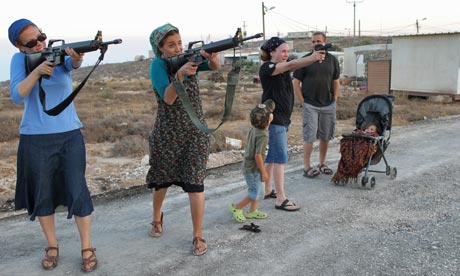 BETHLEHEM — A group of Jewish settlers seized agricultural lands in the Bethlehem village of al-Khader southern occupied West Bank on Saturday.
Settlers from Elazar settlement, led by the extremist settler Nadia Matar’s organization “women in green”, have seized an agriculture land belonging to a Palestinian farmer in the village, said Ahmed Salah the coordinator of the Popular Committee against the Wall and Settlement in al-Khader village.
The settlers planted the confiscated land, belonging to Ibrahim Odeh Salah, with olive trees, the local activist added.
Related articles
- Jewish settlers attack buses filled with children in Jerusalem (alethonews.wordpress.com)
- Several Palestinians Injured In al-Khader (imemc.org)
- Israeli Settlers dump sewage on Palestinian farmland near Bethlehem (imemc.org)
Mercosur complains to Ban Ki-moon on US global espionage and EU affront towards Bolivia’s Evo Morales
MercoPress |August 5, 2013
Mercosur foreign ministers warned UN Secretary General Ban Ki-moon of the serious implications which the United States global espionage system represents for the international community, during a Monday midday meeting at the UN headquarters in New York.
“We have expressed our concern and warning over the serious implications that these illegal procedures displayed by the government of the US have on the political stability of countries and the necessary mutual trust of the international community members”, said Venezuelan minister Elias Jaua at a press conference following the meeting with Ban Ki-moon.
Jaua was the spokesperson of the Mercosur group of foreign ministers, Antonio Patriota, from Brazil; Hector Timerman from Argentina and Luis Almagro, Uruguay, as well as associate member Bolivia’s David Choquehuanca, because Venezuela since last July holds the rotating chair of the South American trade block.
The ministers thus complied with the formal request from the last presidential summit of Mercosur in Montevideo in mid July, when there was an official release condemning US world espionage, which was revealed by the former intelligence officer and whistle-blower Edward Snowden currently with one year political asylum in Moscow.
“This practice is absolutely in violation of international rights for the safeguard of countries sovereignty and independence, and even more, is in violation of fundamental human rights of the citizens of our countries”, underlined Jaua.
When asked about the reply of Ban Ki-moon to the Mercosur statement, Brazilian minister Patriota said that the top US official “shared the concern” of the block. “UN Secretary General reacted in a way that showed awareness towards the message we transmitted from our presidents”, added Patriota.
During the meeting the ministers also expressed Mercosur ‘deep concern’ because of ‘the abuse and affront’ to Bolivian leader Evo Morales presidential immunity “when he was impeded air space free passage over several European countries under suspicion that his aircraft could be transporting Mr. Snowden”, when he was still stranded in the Moscow airport and hoping to be granted political asylum by some country.
The decision adopted by Spain, France, Italy and Portugal last 2 July “seriously endangered not only the dignity of president Evo Morales, but also his own physical safety since he had to over-fly with limited fuel and was forced to land in Vienna”, explained Jaua.
Snowden who is wanted by Washington for having leaked the existence of a US secret program that operates domestically and internationally to spy on phone and internet communications, was finally granted temporary asylum (one year) in Russia given the difficulties to fly to Latinamerica where several countries had offered to help him.
Precisely asylum was another issue addressed with Ban Ki-moon following on the strong pressure exercised by the US on several Latam countries (Bolivia, Nicaragua and Venezuela) which offered an alternative to Snowden.
“For us Latinamericans the right to asylum is a right all citizens can exercise as well as the right of States to be respected when they extend such a benefit, and it is a principle we are not willing to negotiate” said the Mercosur spokesperson emphatically, who then recalled that ‘this very principle helped to save many lives during the hard years of the military dictatorships suffered by many countries of the region”.
Finally the foreign ministers reiterated their standing concern on two recurring issues: the US blockade on Cuba and Argentina’s claim over Falklands/Malvinas sovereignty.
There is a demand that these two issues “definitively find a solution since they are highly sensitive and of great concern for the Latam region”.
Argentine President Cristina Fernandez was scheduled to meet Ban Ki-moon later in the day in advance of her speech to the Security Council on Tuesday, taking advantage of the fact that Argentina will be holding the presidency of the council during the month of August. The president arrived in New York on Monday morning.
Related article
- S. American states to recall ambassadors from Europe over Bolivian plane incident (alethonews.wordpress.com)
Russian official slams US for turning down Moscow’s extradition requests
RT | July 22, 2013
The US is pressuring Russia to hand over NSA whistleblower Edward Snowden to face espionage charges. However, it routinely denies Russian requests to hand over suspected criminals living in America.
“Law agencies asked the US on many occasions to extradite wanted criminals through Interpol channels, but those requests were neither met nor even responded to,” spokesman for the Russian Interior Ministry Andrey Pilipchuk said on Monday.
He named Ilyas Akhmadov and Tamaz Nalbandov as examples of people living in the US, who Russia unsuccessfully tried to get for prosecution.
Akhmadov, a former officer in the Soviet Union’s Red Army, joined the militant movement in the Russian Republic of Chechnya in the early 1990s, fighting for some time along with the notorious terrorist Shamil Basayev. He is wanted in Russia over his connection to crimes committed by the insurgents.
He served as an official of the short-lived ‘government of Ichkeria’, an entity which wanted to form a sovereign Islamist state on Chechen territory. In 1999, Akhmadov was appointed ‘Foreign Minister of Ichkeria’, and toured Western countries to rally support for his cause.
After Moscow re-established control over Chechnya, he settled in the US in 2003 and sought political asylum there. He received it a year later, despite objections from the US Department of Homeland Security.
Nalbandov, an ethnic Ossetian, is suspected of abduction and extortion in Russia. In 2001, he was placed on domestic and international wanted lists.
In 2000, he moved to the US seeking political asylum and successfully obtained it. He was granted a residence permit in 2002.
Russia sought extradition of both men on several occasions in vain.
The criticism comes as the US pressures Russia to hand over Edward Snowden, a former NSA contractor, who exposed the agency’s secret surveillance programs and the role that other countries played in them.
Snowden is stranded at a Moscow airport after arriving there from Hong Kong last month. The US cancelled his passport as part of its effort to apprehend him and prosecute him on espionage charges. His limbo status means Snowden is unable to leave the airport’s transit zone in any direction.
The whistleblower is seeking political asylum in several countries, including Russia. Moscow tried to distance itself from Snowden’s case, although several Russian officials voiced their support for him and called on the government to help him.
Snowden won sympathies from activists worldwide, as many people see him as a hero, who sacrificed his career and possibly freedom to expose questionable secretive government policies. Russian human rights activists supporting the American said they regularly receive offers of money, jobs and even marriage to Snowden, the latter to facilitate his entrance to the country.
Related article
The European Union: Where Corporate Fantasies Come True
By David Cronin | New Left Project | July 18, 2013
Edward Snowden has exposed more than a massive spying operation. The whistleblower has – perhaps unintentionally – drawn attention to just how obsequious Europe’s political leaders are towards the US.
Angela Merkel and François Hollande are reportedly furious over revelations that America has been reading their diplomats’ emails (though their fury can’t be that intense given that a rumour that Snowden was on a flight to Bolivia was sufficient for France to block the plane from its airspace). There were hints too that a planned trans-Atlantic trade agreement could be in jeopardy as a result of the controversy. Yet the talks have opened this month as planned. With many of the world’s most powerful corporations adamant that the talks take place, they were unlikely to be derailed by a spat over snooping.
In May this year, a ‘business alliance’ to support the planned trade deal was established. Many of the firms belonging to this coalition – BP, Coca-Cola, Deutsche Bank, British American Tobacco, Nestlé – have been involved in similar initiatives since the 1990s. Using a highly dubious methodology, the alliance estimates that a transatlantic trade and investment partnership (known by the ugly acronym TTIP) would bring benefits of €119 billion to the EU and €95 billion to the US per year. What they don’t spell out is that the price of any such benefits could be the destruction of democracy.
A leaked document detailing what EU officials wish to achieve in the negotiations says that an eventual agreement should include ‘state-of-the-art’ provisions on ‘dispute settlement’. Under this plan, special tribunals would be set up to allow corporations to sue governments over laws that hamper them from maximising their profits.
When clauses like those being envisaged have been inserted into previous investment treaties, corporations have invoked them in order to challenge health and environmental laws that were not to their liking. Australian rules that all cigarettes be sold in unattractive packaging and Germany’s decision to abandon nuclear power are among the measures that corporations have tried to torpedo in the name of ‘investor protection’.
What will the masters of the global economy take on next: minimum wage levels; restrictions on hazardous chemicals; food quality standards? All of these advances are the results of struggle by workers and campaigners. All of them could be at risk if European and American negotiators go ahead with their plan to set up a special court system that corporations alone may use.
Peter Mandelson must shoulder some of the blame for the extremist agenda now being pursued. In 2006, when he was EU trade commissioner, Mandelson published an official blueprint called Global Europe. It committed the Brussels bureaucracy to work in tandem with corporations to remove any obstacles they encountered throughout the world.
The blueprint closely resembled recommendations made by pressure groups like the European Services Forum (ESF). Bringing together Microsoft, BT, Veolia and – at the time – Goldman Sachs, the ESF has its origins in the 1999 conference of the World Trade Organisation, best remembered for the ‘Battle of Seattle’ – the large-scale protests against it.
In The Brussels Business, an excellent film about corporate lobbying, the ESF’s Pascal Kerneis waxes emotional as he recalls how some ‘high-VIPs’ were unable to attend important meetings in Seattle because of the demonstrations outside their hotel. Kerneis, however, did not allow this display of people power to weaken his determination to refashion the international economy in the way that his elitist pals wanted.
In his dealings with Mandelson’s team of advisers, Kerneis argued that if the EU is unable to have the wishes of corporations fulfilled at the WTO level, it should concentrate on twisting the arms of individual governments. The stilted phrasing of some ESF briefing papers though could not conceal that they were designed to turn some of the wildest capitalist fantasies into reality. One advocated that the EU should strive to remove all capital requirements for banks and caps on foreign ownership of companies in its key trading partners, as well as any pesky rules preventing corporations from sending profits abroad (to, say, a tax haven).
As they were drafted before the financial crisis that erupted in 2008, these papers have a carefree, almost naive feel to them. And yet the European Commission is still striving to attain the core goals identified in such documents. The Commission’s latest annual report on ‘trade and investment barriers’ says that all ‘relevant instruments and policies’ will be marshalled worldwide ‘to make sure the playing field is levelled’. On the surface, that may sound innocuous. In practice though, it means that corporations are accorded more rights than human beings.
If an Indian arrived in Heathrow Airport tomorrow and demanded to automatically have the same entitlements as a British citizen, he or she would probably be arrested. Yet the EU executive believes that big Western companies active in India should enjoy ‘national treatment’ – that is they should be treated exactly like Indian firms. Britain’s industrialisation was achieved at least partly because the textiles sector was shielded from foreign competition. Yet blinkered by neoliberal ideology, Brussels officials want to prevent poorer countries from applying the same tactics, which they now describe as ‘protectionist’ (a dirty word, according to these ideologues).
The willingness to allow corporate lobbyists to set the rules is not confined to trade policy. Financial regulation too has been heavily influenced by the world’s most powerful banks.
Charlie McCreevy, the EU’s single market commissioner from 2004 to 2010, displayed a deep aversion to oversight during his time in office. His hands-off approach can be attributed to the fact that the ‘experts’ he appointed to guide him held exorbitantly-paid posts at the investment banks Goldman Sachs and Morgan Stanley. A consultative group on hedge funds that the Irishman assembled was comprised entirely of insiders from the financial services industry.
When Michel Barnier was tasked with taking over McCreevy’s portfolio, Nicolas Sarkozy (remember him?) contended that giving this post to a Frenchman was a defeat for the Anglo-Saxon model of capitalism. Like many of Sarkozy’s proclamations, it was fanciful. Barnier has kept up the dishonourable tradition of relying primarily on advice from the private sector. An ‘expert group’ on banking reform set up at his behest last year had a token representative from the European Consumers’ Organisation (known by the French acronym BEUC) and a couple of academics. Most of its eleven members, however, were sitting or former bankers – or, worse still, weapons salesmen.
Financial service whizzkids are held in awe by EU policy-makers. This became much apparent during 2009. Boris Johnson hopped on the Eurostar to Brussels that year to champion the City of London and predictably grabbed the headlines. Away from the glare of publicity, however, an army of hedge fund managers succeeded in eviscerating a law designed to restrain their gambling. When the law went before the European Parliament, the hedge fund industry prepared a voluminous set of amendments. Sharon Bowles, a Liberal Democrat MEP who chairs the Parliament’s economics committee, admitted to me that she signed amendments drafted by the financial industry and then tabled them in her own name. This obviously begs the question of whether she is really working on behalf of her constituents or on behalf of banks.
The corporate lobby has proven adept at concocting myths. Whereas it was patently obvious that the economic crisis was caused by the reckless behaviour of banks, powerful groupings have spread the falsehood that extravagance in public spending was really to blame. The European Roundtable of Industrialists (ERT) – which includes the chief executives or chairmen of Shell, Volvo, Nestlé, Vodafone and Heineken – has been leading efforts to demolish the welfare state. Among its core demands are that healthcare should be privatised so that Europe more closely resembles the US. The ERT enjoys the kind of access to top-level politicians that defenders of the underprivileged are denied. Herman Van Rompuy, the EU’s unelected ‘president’, is known to have dined with ERT delegations in private clubs, without any details of these encounters being posted on his website. And in March this year, Merkel and Hollande, along with the European Commission’s head José Manuel Barroso, met ERT representatives in Berlin. The ERT is pushing the Union’s governments to agree on a ‘competitiveness pact’ over the next twelve months. Under this pact, each EU country would become obliged to drive down its wage levels and dilute its labour laws.
‘Competitiveness’ is a byword for crony capitalism. It should not be confused with competition: among the ERT’s demands are that the EU becomes less fussy about controlling mergers between large companies. Far from encouraging diversity, it wants to have wealth concentrated in increasingly fewer hands.
Repeated so often, the idea of ‘competitiveness’ has assumed an almost religious significance among the EU elite. Opposing it is regarded as heretical.
Despite Thatcher’s tetchy relationship with the EU institutions, the main tenets of Thatcherism have gone mainstream in Brussels. Attempts made in earlier decades to give the Union a social dimension – by, for example, championing gender equality – always amounted to fig-leafs for a project that was essentially right-wing and anti-democratic. In more recent years, these fig-leafs have become increasingly slender.
Barroso is among a new generation of leaders who are demonstrably in thrall to the ‘Iron Lady’. While he habitually describes the EU as a ‘social market’ economy, it is evident from his favoured policies that his real agenda is to bolster corporate power. One key objective of the European Commission is to promote ‘public-private partnerships’. This idea of handing over services financed by taxpayers to unaccountable companies can be traced back to Thatcher and her successor, John Major.
With few exceptions, the Union is cuddling up to big business and screwing the rest of us. Building a mass movement to confront corporate power has never been more urgent.
Venezuela ends normalization of US relations
Press TV – July 20, 2013
Venezuela says it has ended the process of normalizing relations with the United States over remarks by Washington’s ambassador-designate to the UN.
During her confirmation hearing before a US Senate committee on July 17, Samantha Power claimed Venezuela, along with several other countries, was conducting a “crackdown on civil society.”
“The Bolivarian Republic of Venezuela hereby ends the process … of finally normalizing our diplomatic relations” that started in early June, the Venezuelan Foreign Ministry said in a Friday statement.
The statement added that Caracas is opposed to the “interventionist agenda” presented by Power.
On Thursday, the Venezuelan President Nicolas Maduro denounced Power’s remarks as “outrageous,” and demanded “an immediate correction by the US government.”
“Power says she’ll fight repression in Venezuela? What repression? There is repression in the United States, where they kill African-Americans with impunity, and where they hunt the youngster Edward Snowden just for telling the truth,” he added, referring to the killing of unarmed black teenager Trayvon Martin.
Venezuela has offered asylum to Snowden, an American former technical contractor for the US National Security Agency (NSA), who is wanted in the United States for leaking details of Washington’s secret surveillance programs.
Maduro was the first foreign leader to state openly that he was offering sanctuary to Snowden.
Venezuela and the US have not exchanged ambassadors since 2010. However, in June US Secretary of State John Kerry and Venezuelan Foreign Minister Elias Jaua agreed on the sidelines of a regional summit in Guatemala that officials would “soon” meet for talks that could lead to an exchange of envoys.
In March, Caracas expelled two US military attaches over allegations of trying to foment instability in Venezuela.
Washington also angered Caracas by supporting Venezuelan opposition leader Henrique Capriles, who disputed the results of the April presidential election, in which Maduro won the race with 50.7 percent of the vote against 49.1 percent for Capriles.
Related articles
Nigeria, AU criticised for hosting Sudan’s Bashir at summit
By Tesfa-Alem Tekle | Sudan Tribune | July 18, 2013
ADDIS ABABA – European Union lawmakers on Wednesday criticised the African Union (AU) and Nigeria for allowing Sudanese president Omer Al-Bashir to attend a special summit on HIV/AIDS, tuberculosis and malaria held in Abuja.
The EU delegation held talks with AU and Ethiopian officials on a number of national and continental concerns, as part of an official visit to Ethiopia.
Barbara Lochbihler, who led the delegation, said the AU’s position towards the International Criminal Court (ICC) and the failure of Nigeria to arrest Bashir undermines the work of the ICC and victims’ fight for justice.
The 54-member continental bloc has called on member states not to cooperate with the ICC arrest warrant for Bashir.
The Sudanese president left for Nigeria on Sunday, but cut short his visit the following day after calls for his arrest intensified.
Nigeria has also come under fire after the government refused to arrest Bashir and surrender him to the ICC.
However, Nigerian officials dismissed criticism, saying the Sudanese president was in Nigeria at the invitation of the AU and not as a guest of the federal government.
“President al-Bashir was in Nigeria under the auspices of the AU, based on the assembly’s decision to convene the special summit in Abuja to deal with three diseases that together constitute a heavy burden on member states”, a statement by the foreign ministry said on Tuesday.
The ICC issued two arrest warrants against Bashir in 2009 and 2010 for alleged war crimes, crimes against humanity and genocide committed in Darfur.
Related articles
Netanyahu denies reports of Israel agreeing to peace talks along ’67 borders
Al-Akhbar | July 18, 2013
A spokesman for Israeli Prime Minister Benjamin Netanyahu denied Thursday previous reports stating that Israel had agreed to a proposed formula for new peace talks with the Palestinians under which the border of their future state would be along lines that existed before the 1967 Middle East war.
An Israeli official had previously said on Thursday that Israel was open to talks based on the 1967 borders, but with agreed land swaps and Palestine recognizing Israel as a “Jewish state.”
The denial comes as a blow to US Secretary of State John Kerry, who has been working for the past six months to restart peace talks between Israel and Palestine.
Kerry had urged Israel on Wednesday afternoon to carefully consider a 2002 peace initiative approved by the Arab League.
“Israel needs to look hard at this initiative, which promises Israel peace with 22 Arab nations and 35 Muslim nations – a total of 57 nations that are standing and waiting for the possibility of making peace with Israel,” he had said.
The plan, put forward by Saudi Arabia at an Arab League summit in Beirut in 2002, offered full recognition of Israel but only if it gave up all land seized in the 1967 Middle East war and agreed to a “just solution” for Palestinian refugees. Softening the plan three months ago, a top Qatari official raised the possibility of land swaps in setting future Israeli-Palestinian borders.
Speculation had been rife that Kerry, now in the region for his sixth time since March in an effort to revive peace talks that deadlocked in 2010, may be close to a breakthrough.
Palestinian President Mahmoud Abbas was conferring with Palestinian leaders on Thursday to decide whether to accept Kerry’s proposals for renewing talks with Israel.
Kerry said on Wednesday after talks with Abbas in neighboring Jordan that gaps between the sides had “very significantly” narrowed. An Arab League committee endorsed Kerry’s proposals for resuming peace talks, saying they “provide the ground and a suitable environment to start negotiations.”
However, the issue of Israeli settlements in the West Bank and East Jerusalem, which are considered illegal under international law, is still to be resolved. Palestinians are refusing to return to negotiations without a freeze on settlement activity, as Israel has greenlighted the construction of hundreds of settlement homes in the past several months.
(Reuters, Al-Akhbar)
Foreign-backed Syrian opposition-assigned ‘prime minister’ resigns
Press TV – July 9, 2013
A foreign-backed Syrian opposition figure, Ghassan Hitto, who had been proclaimed by the divided Syrian National Coalition (SNC) as “prime minister” and tasked to form an “interim government,” has resigned.
On Monday, Hitto announced his resignation in a statement only four months after his appointment, citing his inability to form the “interim government,” amid the escalating divisions and the infighting within the SNC.
The foreign-backed opposition formed the SNC back in November 2012 with Moaz al-Khatib as its head.
Khatib also announced his resignation a few months after his appointment.
George Sabra became acting president of the SNC in April 2013, shortly after Khatib had resigned.
On Saturday, the SNC elected a Saudi-linked member, Ahmad Assi Jarba, as its new president during its latest meeting in the Turkish city of Istanbul.
Jarba received 55 votes, defeating Mustafa al-Sabbagh, Qatar’s point man in the opposition, in the second round of the election at the group’s meeting in Istanbul, where the foreign-backed Syrian opposition group is based.
Jarba is a tribal figure from the eastern Hasaka Province with connections to Saudi Arabia, which has been supporting the militants in Syria.
The divisions within the foreign-backed opposition comes as the Syrian army has been gaining further ground against the militants. Syrian forces drove out militants from Ghouta, Zamalka and Irbin neighborhoods, inflicting heavy losses on the armed groups.
On July 6, Syrian army restored security to the industrial area of al-Qaboun, east of the capital. The army also retook control of the northwestern part of the Sayyida Zeinab camp near Damascus.
The foreign-sponsored militancy in Syria has taken its toll on the lives of many people, including large numbers of Syrian soldiers and security personnel, since March 2011.
In an interview with Syrian daily Al-Thawra published on July 4, Syrian President Bashar al-Assad said the opposition and their foreign supporters have “exhausted all their tools” in a conspiracy against Syria.
Related article
- “Syrian Opposition Won’t Attend Geneva II unless It Becomes Militarily Strong” (alethonews.wordpress.com)
Featured Video
Integrity Initiative: UK-funded network framed dissent as Russian disinformation for years
or go to
Aletho News Archives – Video-Images
From the Archives
Why Saudi Ties to 9/11 Mean U.S. Ties to 9/11
By Kevin Ryan | Dig Within | September 27, 2015
Media interest in Saudi Arabian connections to the crimes of 9/11 has centered on calls for the release of the 28 missing pages from the Joint Congressional Inquiry’s report. However, those calls focus on the question of hijacker financing and omit the most interesting links between the 9/11 attacks and Saudi Arabia—links that implicate powerful people in the United States. Here are twenty examples. … continue
Blog Roll
 Aletho News
- IAEA inspectors cannot return to Iran amid US threats: Russia
- Senate Rejects Iran War Powers Resolution Passed By House
- ‘We did not attack Pakistan with drones’: Afghan sources
- Iraqi Resistance faction links arms to sovereignty, questions US exit
- Cannon fodder no more… South Korea rejects Trump’s pressure to join his criminal war on Iran
- Neria Leiter Was A Legitimate Military Target
- Integrity Initiative: UK-funded network framed dissent as Russian disinformation for years
- ‘We don’t seek permission to defend our country’: Snippets from President Pezeshkian’s UNGA address
- NATO chief wants Europeans to fight American wars [for Israel]
- German chemicals giant reveals details of downsizing
- If Americans Knew
- Israel displaces hundreds of Palestinians amid wave of demolitions in West Bank
- Aid, reconstruction, and Israel’s history of obstruction in Gaza
- Trump administration digs an ever-deeper hole of complicity in genocide – Daily Update
- US-Israel $2.8 Billion Arms Deal, 40,000-Bomb Supply Faces New Gaza Complicity Accusations
- Caught on Tape: AIPAC CEO Boasted of Controlling Trump’s National Security Officials
- Why Hamas Attacked Israel in October 2023 – Israeli professor Ilan Pappé
- They see them, then kill them: Israeli quadcopters track, deliberately target civilians in Gaza
- Winter could turn Gaza’s treacherous, war-damaged buildings into deathtraps
- Majority of Democratic Voters Want to Prosecute Both Biden and Trump Administration Officials Over Gaza
- As Gaza languishes, world leaders gather at the UN – Daily Update
- No Tricks Zone
- New Study: Earth And Venus Surface Warmth Largely Explained By Convection And Lapse Rate, Not CO2 Or Radiation
- 2025 Nature Paper Claiming Worsening Global Drought Gets RETRACTED …Heavily Flawed
- New Study: ‘Global Drought Shows No Detectable Recent Acceleration Under Climate Warming’
- Economic Masterminds: German Socialists Suggest Taxing Productivity Gains Stemming From Using AI
- The South China Sea Has Not Been Cooperating With The Climate Change Narrative
- Energy Crisis: Germany Enters Heating Season With Historically Low Gas Reserve Fill Levels
- New Study: The Antarctic Ice Sheet Gained Mass From 2020-2024 Due To Staggering Snow And Ice Accumulation
- Study: Ocean Heating Rates From Thousands Of Years Ago ‘Dwarf’ Modern Ocean Heating Rates
- Climate Extremists Target, Attack Large-Scale Power Grid Infrastructure In Germany!
- New Study: Antarctic Ice Melt Has Contributed Less Than 1 Centimeter To Sea Level Rise In The Last 30 Years

