Will Assad Propose a National Unity Government for Syria?
By Ibrahim al-Amin | Al Akhbar | December 18, 2011
Frantic Arab and Western efforts on the Syrian front will do nothing to change the entrenched positions on either side – of those who blame the regime for all that is happening, or those who accuse its opponents of driving the country to ruin.
The crisis is sure to be protracted. It is delusional to speak of calm being restored to Syria in the foreseeable future.
In the meantime, as the country continues to haemorrhage and the status quo persists in the absence of any substantive political changes, Syrians are being faced with a fresh set of questions, in addition to those posed during the long months since the crisis began. The latter concerned freedom, democracy, change, toppling the regime, the foreign war of intervention, and related matters. These are now increasingly to be joined by daily concerns related to communal coexistence, and the severity of the political schism, sectarian divisions, the economic crisis, and living conditions.
The outside world, near and far, will in turn increasingly find itself having to live with the new realities in Syria – irrespective of all the assessments made by Western embassies and intelligence agencies, so widely quoted in media and political circles, that the regime’s end is nigh (while taking care to avoid giving any time-frames).
It is only to be expected for Syria’s foreign detractors to do what they can to advance their plans to topple the regime and install in power a political group beholden to them.
But the debate within the Syrian opposition itself has now turned into one about how to best support those Western plans – rather than how to formulate an independent program that would attract international support. We are referring here to the offshore opposition, as the internal opposition seems incapable of pronouncing a unified position that would carry the support of the street. The offshore opposition quickly exhausted whatever policies, slogans and ideas it set out with, and has begun to operate in accordance with the foreign agenda.
Thus, when the Arab states opted to convene an emergency Arab League meeting to up the pressure on the regime, the offshore oppositionists performed on cue: raising the rhetoric about the exceptional circumstances warranting intervention in Syria, and producing huge casualty figures attributed solely to the regime. (The daily funerals of members of the army and security forces are somehow ignored; or else they are counted as demonstrators killed by the regime’s forces).
But are decision-makers in Syria changing their way of thinking? By way of a caveat, nobody can tell for sure how their handling of developments will progress. Yet ideas are being discussed which could be said to reflect a change in the Syrian leadership’s approach to the crisis. It is being stressed that this should not be seen as the taking of dramatic steps in response to pressure. On the contrary, considerable calm is being maintained, yet with heightened apprehension about the forthcoming period, and with a number of considerations in mind. These include:
– The Syrian leadership knows that the domestic crisis is real. President Bashar Assad met a great many Syrians at the series of gatherings he held, and a large proportion of them harbored fundamental grievances. He reached the firm conclusion that what the Syrian people want – and want badly – is political pluralism. Pluralism that would enable the exercise of more freedoms and the rotation of power, rid state institutions of one-party control, regulate the security establishment and halt its massive intrusion into people’s lives, and thereby overcome the pervasive wave of corruption.
– The Syrian leadership knows that this obliges it to cancel Article VIII of the Constitution, and seek to bring others from outside the Baath Party into government. Those considering the matter propose striving to form a Government of National Unity. This would comprise both supporters and opponents of the current regime, as well as independents who neither see themselves as regime insiders nor are involved in any opposition groups. Such a government would have sweeping powers that would enable it to institute real administrative and economic reforms, and genuinely keep the security agencies out of people’s daily lives.
– The Syrian leadership believes that the oppositionists gathered under the banner of the offshore Syrian National Council (SNC) cannot, in their current condition, become real partners. The regime has therefore apparently resumed discreet contacts with home-based opposition figures. According to some officials, however, the latter remain highly wary, fearing they could lose public support. The regime is also open to efforts being made by some external parties to mediate with certain groups and figures within the SNC.
– The Syrian leadership is in no doubt that it is facing a concerted onslaught by an alliance that includes a number of Arab and Western states alongside Turkey. It is energetically seeking to counter this by cementing its relations with Russia, China, Iran and other countries such as Iraq, without closing the door to other players. It is particularly interested, in this regard, in ongoing mediation efforts with Saudi Arabia.
It will take a while for the picture to become clear. Pending that, attention inside Syria will increasingly focus on the effects of the economic and financial embargo, and its impact on the people as well as the government. The talk of sectarian and military flashpoints, meanwhile, suggests that moves should be anticipated from the Syrian leadership in its confrontation with its armed opponents.
Ibrahim al-Amin is editor-in-chief of al-Akhbar.
Syria signs deal to allow in AL monitors
Press TV – December 19, 2011
Syria has agreed to allow Arab observers in to monitor the rights situation in the country and the implementation of an Arab League initiative to end months of unrest.
Syrian Foreign Minister Walid al-Muallem said on Monday that Damascus had agreed to sign the observer mission after making sure it did not violate its sovereignty, and after the Arab League accepted amendments demanded by the Syrian government.
“Signing the protocol is the start of cooperation with the Arab League and we will welcome the observers’ mission from the Arab League,” Muallem told a news conference in Damascus adding that “Sovereignty is protected in the text of the protocol”.
“Article 8 of the Arab League charter protects existing structures and bans countries from interfering… In this protocol we are talking about protecting civilians from terrorist groups,” the top Syrian diplomat said.
Under the terms of the deal, which was signed at the AL headquarters in Cairo, the Arab observers are intended to oversee the implementation of an Arab League peace plan which calls for the withdrawal of Syrian troops from crisis-hit areas and the opening of negotiations between Damascus and the opposition under League auspices.
The Arab League had given Syria until Wednesday to ink the document and threatened to ask the UN Security Council to adopt its peace plan if Damascus refused to sign the deal.
On November 27, the 22-member League approved a range of economic sanctions against Syria for failing to admit observers.
Syria has been experiencing unrest since mid-March and according to the UN, 5,000 people have been killed in the country over the past nine months.
While the West and the Syrian opposition accuse the government of the killings, Damascus blames ”outlaws, saboteurs and armed terrorist groups” for the unrest that erupted in mid-March, insisting that it is being orchestrated from abroad.
In interviews with Israeli news outlets over the past few months, the Syrian opposition members have clearly expressed their vision for the future of Syria and their interest in establishing relations with the Tel Aviv regime.
Pakistan to redraw key pacts with US
South Asian News Agency ⋅ December 14, 2011
Islamabad – Pakistan will renegotiate two key agreements signed with the United States and its Western allies nine years ago as part of a wider policy review following last month’s deadly Nato air raids on Pakistani border posts.
The agreements – both signed in 2002 during former military ruler General Pervez Musharraf’s regime to allow transit of supplies and logistics support for the US-led Nato forces – were considered crucial for the decade-long battle against the Taliban insurgency in Afghanistan.
The decision to reconfigure those arrangements was taken at the end of a two-day envoys’ conference convened to revisit the country’s foreign policy against the backdrop of a deadly Nato incursion.
The conference was attended by over two dozen ambassadors and high commissioners serving in key world capitals.
A senior foreign ministry official said that a set of recommendations had been finalised for the government to re-evaluate and review cooperation with the US and Nato.
Recommendations include fresh agreements for Nato supplies and logistics support to the US, minimising the ‘CIA footprint’ in the country, seeking an honourable return of Afghan refugees and pursuing efforts to stabilise Afghanistan irrespective of Washington’s approach, according to the official, who was part of the consultations.
The conference also decided to seek a formal public apology from the US over the November 26 incident and firm guarantees that there would be no violation of Pakistan’s sovereignty in the future, added the official, who asked to remain anonymous.
The envoys, according to the participant, were of the view that the US appears to be uninterested in the Afghan reconciliation process.
However, irrespective of Washington’s approach, Islamabad must redouble its efforts to facilitate the Afghan reconciliation process, he added.
The conference recommended that the government reach out to Britain, Germany and other European countries, which have been making efforts to seek a peaceful end to the Afghan conflict.
The diplomats also urged the government to ensure that over 3.5 million Afghan refugees, still living in Pakistan, are repatriated to their homeland.
There are indications that the United Nations High Commission for Refugees (UNHCR) may ask Pakistan to extend the repatriation of Afghan refugees beyond the 2012 deadline.
Delegates at the conference believe that the repatriation of Afghan refugees is necessary because, according to the government assessment 95 per cent of terrorist attacks in Pakistan are traced back to the refugee camps.
The recommendations will now be presented before the parliamentary committee on national security, which has been mandated to redraft terms of engagements with the US. The concluding session of the conference was chaired by Prime Minister Yousaf Raza Gilani, who described the Nato attack as a “huge setback to prospects of the much-needed cooperation among the important stakeholders.”
“Our cooperation with US/Nato/Isaf was based on respect for Pakistan’s sovereignty and territorial integrity. Under no circumstances, could we accept flagrant transgression of our territorial frontiers. This remains our baseline and there can be no compromise on sovereignty, dignity and national honour,” Gilani said.
“We expect the US/Nato/Isaf inquiry that is being undertaken to reveal all the facts and provide answers to questions that our own investigations have raised,” he said.
Gilani maintained that recommendations finalised by the foreign ministry will be considered by a joint sitting of parliament.
A statement issued by the Foreign Office said, Sherry Rehman, ambassador-designate to the US, presented the recommendations furnished by the envoys’ conference to the prime minister.
Homs: The Bleeding Capital of Syria’s Revolt
By Ziad Rifaii | Al Akhbar | December 12, 2011
Multiple narratives of sectarian strife, resilient resistance to the regime, and conspiracy are circulating in Homs, home to the latest scene of confrontation between the regime and the forces of the uprising
Homs – It has been called the “capital of the revolution,” and the world’s eyes have turned towards it. The city is Homs in western Syria – the hotbed of the Syrian uprising.
The images emerging from Homs of evening protests, where the camera focuses on hundreds of protesters swaying to their festive songs, do not resemble the city during the day. Garbage piles up everywhere and the smell of destruction and blood is in the air.
Walls are painted and repainted with slogans and counter-slogans, and a sense of solemnity weighs down all political discussions.
The graffiti on major streets is covered with black paint, suggesting that it is against the regime. But you can see the anti-regime graffiti on side streets and it includes both obscene insults and reasonable political discourse.
Young conscripts stand behind their sandbag barricades, their fingers on the trigger, keeping an eye out for snipers or rocket-propelled grenade (RPG) shells.
Young men in neighborhoods and side streets observe every suspicious move. Attempts to engage them in conversations fail. Suspicion and fear of their interlocutors’ identity prompt them to answer by referring everything to a divine will: “God is with us and with righteousness. He will not fail us.”
Hassan, whose parents own a shop in the city market, takes most things humorously. But today he said, “The regime is to blame for everything that has happened. The protests were non-violent and their demands were clear. The regime used violence and brought men from other sects to put us down. This is a sensitive issue for us. We cannot accept death and stay silent, we are giving them a taste of their own medicine.”
Hassan does not want to talk about what will happen after the regime is toppled or the reason why a lot of people from other sects have not joined the protest movement.
For him, they are nothing but tools that the government uses against protesters. “We will topple the regime and we’ll have a transitional period like Egypt and Tunisia,” he insists.
One opposition activist from al-Zahraa neighborhood says the sectarian crimes “were committed by security forces in Homs to instigate trouble between Sunnis and Alawites.”
He is certain beyond any doubt that all those who died in Homs from the other sect were killed by the security forces and its gangs to instigate cross sectarian killing. But he says protesters are “aware and cautious against any efforts to drag them into sectarian violence.”
Osama, a graduate from a medical institute and a regime loyalist, says sectarian strife became a reality “since Tamam al-Mahmoud and his two companions were killed, after he was forced to confess that he brought snipers from Hezbollah to Homs and Hama.”
“Tens of sectarian crimes have been committed since the beginning of the uprising by armed men who have been embraced by the protest movement. All the protesters know that these armed men are the ones killing, setting up checkpoints, and kidnapping people,” he continued.
There were no kidnappings before armed conflict broke out. Kidnappings became common with the rise of armed groups who took over the streets. At the same time, regime loyalists accepted the rules of the game and started kidnapping people from the other side too – tit for tat.
There are no reliable figures for the number of people who have been kidnapped. The disappeared represent the most pressing issue for al-Zahraa and other adjoining neighborhoods.
Wasim Ibrahim’s cousin who lived in al-Zahraa neighborhood was kidnapped, but she was freed less than two days later. “Do we wait for the government to bring back our girls and young men while it is unable to protect its own forces or liberate them if they get kidnapped?” says Ibrahim confidently.
“All we had to do was kidnap two girls from Jib al-Jandali neighborhood and my cousin was set free. If they kidnap two of our girls, we will kidnap five of theirs. They are to blame for starting this cycle of kidnappings,” he says.
Kidnapping, which is used to exert pressure and to strike a balance of “terror” between the two sides, has raised the profile of a particular social group – the elders.
Even state media has started to use the term in reference to attempts to free kidnapped individuals, with help from security forces and elders.
Ahmad, a university student, does not deny that there are, in his pro-regime neighborhood, people who kidnapped and killed citizens from the other side. But he does say it was done in retaliation, or to exchange them.
“When the government does not protect us and we become the whipping boy or fall guy, then we will carry arms to protect ourselves. If the government arrests a wanted armed man or a member of the opposition, they kidnap a man or a woman from our sect to use them in an exchange. This is the reality of the Syrian revolution. Your problem is with the regime, why take it out on us? And then you blame us if we stand with the regime?” Ahmad said.
Rakan is a driver from Baba Amro who advised me not to go into the neighborhood without getting some sort of guarantee from the “rebels,” but denied knowing any of them personally.
“We want to be safe. When I pass by a rebel checkpoint, I tell them may God protect you and grant you victory, and when I reach an army checkpoint, I tell them may God protect you and grant you victory. That is the only way to protect myself,” he explained.
Noureddine who lives in Jib al-Jandali, a neighborhood controlled by armed groups, says it is “not possible to have a free opinion here. Non-violence and the dream of political change and ending tyranny have turned into the nightmare of armed groups who are presenting themselves as protectors of the demonstrations.”
“No one wants to believe the story of the armed groups until one of their children is killed by mistake or on purpose. Our lives have turned into hell because of them,” he said.
Noureddine’s words upset his friend Yasser, a secular member of the opposition. Yasser believes the security forces are “responsible for everything, they are the ones who played the sectarian card to prevent the protests from expanding and the presence of armed men from the beginning of the crisis forced them to acquiesce to the demands of the people. The protest movement followed [the incendiary Muslim cleric] al-Arour because he stood with the revolution from the get go.”
Yasser criticized all media outlets that have not “covered the work done by secular and leftist activists, especially the Nabd Coalition for Syrian Civil Youth, whose members play a big role in Homs by taking part in the demonstrations and easing some of the sectarian tensions.”
Abu Khaled, from the large and well-known al-Bakara tribe in Syria, left Aleppo to live in Homs twenty years ago.
“Simply put, these guys are hooligans, no more no less. They raise signs demanding protection against Muqtada al-Sadr fighters and members of Hizb al-Shaitan [party of the devil]…which is what they call Hezbollah. And they raise signs thanking the Lebanese Future Movement – it seems they receive money from them,” he said.
“I am a regular guy. I was happy to see Hosni Mubarak fall because he was a foreign agent, but Bashar Assad is a good guy. He is a nationalist and against Israel…I support him and refuse to insult him. But for me, denouncing Hassan Nasrallah, Hezbollah’s secretary general, is a grave sin because he has dedicated his life to fighting Israel and only a foreign agent or a crazy person would offend him in such a way,” Abu Khaled added.
Statistics regarding the number of casualties in Syria since the outbreak of the uprising reveal that almost a third have fallen in Homs, the birthplace of many Syrian presidents. The opposition, confident of its victory, often says that the next president will also hail from that city.
Tensions in Homs had reached boiling point about two weeks ago, when the city fell into chaos for a few hours and dozens became victims of revenge killings across a number of neighborhoods.
These reprisal attacks were ignited by the execution of four people in al-Zahraa neighborhood, near the Khaled bin al-Walid mosque, as Arab satellite channels were broadcasting false news that it was being shelled.
The crime coincided with attacks on security checkpoints disrupting movement between neighborhoods. News of the killings spread among people angered over the loss of loved ones, exacerbating an already tense situation in the city and leading to 51 deaths, half of whom fell in al-Zahraa neighborhood and its surroundings.
One journalist from Homs commented on what happened by saying: “Whoever was in the wrong place at the wrong time was killed.”
Each side claims that they had to engage in kidnapping to rescue their daughters and sons, who have been captured and are being held in neighborhoods belonging to rival sects.
Each side believes that the other party is behind the mayhem, while their own are patriotic and committed to national unity.
Narrative and counter narratives extend to events that took place all the way back in April, including the killing of a brigadier-general in the army. The general, believed to be Abdu Tallawi, was killed with his children and nephew while passing through an agitated neighborhood.
There are two accounts of what happened to him and his family, and they differ about the victim’s sect. Regime loyalists say that he was killed by takfiris – hardline Islamists who accuse other Muslims of apostasy – because he belonged to Alawite sect.
The protesters insist that he is a member of the Tallawi family from Homs and that he was killed by security forces to accuse the opposition and destroy their reputation. Some even claim that he was shot because he refused to fire at protesters.
The third account is ignored due to the extreme polarization of opinions in the city. The brigadier-general was killed because he was in a military vehicle, even though he had his kids with him.
Whoever killed him was not concerned with his sect but with directing a blow to the regime, thus provoking an even harsher crackdown, which, in turn, would drag the protest movement into a cycle of violence with the state.
Syrians vote in local elections
Press TV – December 12, 2011
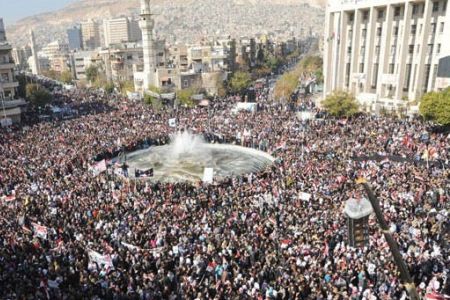
Thousands of Syrians demonstrate in Damascus to express their support for President Bashar al-Assad, November 28, 2011.
People in Syria have begun voting in the country’s elections of local administration councils that take place every four years, Press TV reports.
About 14 and a half million people are eligible to cast their ballots. More than 42,000 candidates are competing for 17,000 seats.
The candidates have promised to meet public demands and implement the reforms that the government has announced over the past few months.
The Syrian opposition has boycotted the current elections, which take place as the country experiences unrest.
Damascus blames “outlaws, saboteurs and armed terrorist groups” for the unrest that erupted in mid-March, insisting that it is being orchestrated from abroad.
In interviews with Israeli news outlets over the past few months, the Syrian opposition members have clearly expressed their vision for the future of Syria and their interest in establishing relations with the Tel Aviv regime.
However, Syrian people have repeatedly expressed solidarity with the government. Figures show that during the past weeks, about 12 million people have demonstrated in support of Syrian President Bashar al-Assad.
Iran protests over U.S. drone incursion
Tehran Times | 10 December 2011
TEHRAN – The Iranian ambassador to the United Nations has called on the UN to condemn U.S. aggressive moves against the Islamic Republic including the recent violation of Iranian airspace by a U.S. spy drone and adopt “clear and effective measures” to end such “dangerous and unlawful acts.”
Ambassador Mohammad Khazaii made the plea in a letter that he sent on Thursday to UN Secretary General Ban Ki-moon, General Assembly President Nassir Abdulaziz Al-Nasser, and Vitaly Churkin, Russia’s UN ambassador who holds the rotating Security Council presidency for December.
“Upon instructions from my government, I have the honor to draw your kind attention to the provocative and covert operations against the Islamic Republic of Iran by the U.S. government, which have increased and intensified in recent months,” the letter said.
The letter added, “In the continuation of such trend, recently, an American RQ-170 unmanned spy plane, bearing a specific serial number, violated Iran’s airspace.
“This plane (flew) 250 kilometers deep into Iranian territory up to the northern region of the city of Tabas, where it faced prompt and forceful action by the Armed Forces of the Islamic Republic of Iran.”
Khazaii also wrote that the Iranian government regards the provocative U.S. move as an act of hostility against Iran, which is in clear contravention of international law and the basic principles of the UN Charter.
The government of the Islamic Republic of Iran strongly protests such hostile and aggressive moves and warns about harmful consequences of the repetition of such actions, he said.
The Islamic Republic of Iran reserves the right to adopt the measures necessary to defend its national sovereignty, he stated.
He added that the Iranian government calls on the UN to fulfill its responsibility to safeguard world peace and security through the condemnation of aggressive U.S. moves and the adoption of “clear and effective measures” to end such “dangerous and unlawful acts”
Years Of Drone Flights Find No Iranian Nuclear Weapons Program
Moon of Alabama | December 8, 2011
The officials say the RQ-170 Sentinel drone that went down over Iran was part of a fleet of secret aircraft that enabled the CIA to carry out dozens of high-altitude surveillance flights deep into Iranian territory without being detected.A former senior Defense Department official said the stealth drone flights had been underway for “at least four years,” …
…
The CIA is thought to have a dozen or so of the batwing-shaped, radar-evading aircraft, which are capable of being fitted with different “sensor payloads,” meaning they can be equipped to capture a range of intelligence material, including high-resolution images, radiation measurements and air samples.
WaPo, Dec 8 2011
One important point seems to get lost in the reports on the U.S. stealth drone Iran managed to obtain.
Despite such espionage by flying sophisticated spy drones over Iran “for at least four years” those flights have not found any hint of an Iranian nuclear weapons program.
Then National Intelligence director Dennis Blair told Congress in 2009 that Iran had not made the decision restart an alleged nuclear weapons program:
But as for the nuclear weapons program, the current position is the same, that Iran has stopped its nuclear weapons design and weaponization activities in 2003 and did not — has not started them again …
U.S. spy drones had been flying over Iran for some two years when that statement was made.
In February 2011 the current National Intelligence director James Clapper gave a similar testimony (pdf) at a Congress hearing:
We continue to assess Iran is keeping open the option to develop nuclear weapons in part by developing various nuclear capabilities that better position it to produce such weapons, should it choose to do so. We do not know, however, if Iran will eventually decide to build nuclear weapons.
When that statement was made radiation sniffing and air sampling spy drones had been flying over Iran for some three and a half years. Obviously they had not detected anything the intelligence community identified as a nuclear weapons program. Otherwise Clapper’s statement would not hold.
That is the real important point to take from this drone brouhaha. Despite using them for years in highly sophisticated espionage on Iran no sign of an Iranian nuclear weapons program has been found.
India’s Bhopal protest turns violent
Press TV – December 4, 2011
Thousands of survivors of the world’s worst industrial accident have blocked trains and clashed with police in India’s central Madhya Pradesh state to demand more compensation.
Police attacked the protesters with sticks and tried to clear the railway tracks in Bhopal city on Saturday, the Associated Press reported.
Protestors pelted police with stones and burnt four police jeeps and several motorcycles in the skirmish that followed. Several people, including a police superintendent, were injured in the scuffle.
The protesters shouted slogans like “We want compensation,” and said Indian government accepted far too little in 1985 in a 470-million-dollar settlement.
The Indian government is seeking an additional 1.7 billion dollars for victims of the Bhopal gas tragedy from the Dow Chemical Company.
The protest came on the 27th anniversary of the chemical disaster in Bhopal, where a large volume of toxic gases leaked into environment following an accident in a Union Carbide pesticide plant.
The chemical disaster killed an estimated 15,000 people, and maimed tens of thousands more.
The Dow Chemical Company purchased the Union Carbide Corporation in August 1999.
Meanwhile, Bhopal activists and survivors are calling for Dow Chemicals to be dropped as a sponsor of the 2012 London Olympics.
At least 21 Indian Olympic athletes have urged the organizers of the London Olympic Games to end Dow’s sponsorship.
Russia warns West over Iran tensions
Press TV – December 1, 2011
Russia has warned Western countries over exacerbating tensions with Iran, stressing that such a move would be “fraught with severe consequences.”
“We speak out categorically against cranking up a spiral of tension and confrontation on issues linked with Iran. We believe that this … is fraught with severe consequences,” Reuters quoted Russian Foreign Ministry spokesman Alexander Lukashevich as saying on Thursday.
“The increasing tensions in relations with Tehran is essentially blocking the renewal of talks” between Iran and the five permanent members of the UN Security Council — Britain, China, France, Russia, and the US — plus Germany over Tehran’s nuclear program, he told a news briefing.
The comments came after foreign ministers of the European Union (EU) imposed fresh sanctions against 180 Iranian individuals and companies on Thursday, but failed to impose an embargo on the country’s oil sector.
The EU ministers further claimed that they would keep working on developing additional measures which would directly affect Iran’s oil industry.
On November 21, the United States, Britain and Canada imposed unilateral sanctions on Iran’s energy and financial sectors after the International Atomic Energy Agency (IAEA) released a bogus report on Tehran’s nuclear program on November 8, which claimed Iran’s nuclear program had a military aspect.
“We are talking about the counterproductive, ill-timed and weakly based International Atomic Energy Agency (IAEA) report,” Lukashevich said.
“We are also talking about the imposition by some states of extra-territorial, unilateral sanctions … and the completely unacceptable threats of the use of force against Iran,” he added.
The IAEA report on Iran was dismissed by Tehran as “unbalanced, unprofessional and prepared with political motivation and under political pressure by mostly the United States.”
The United States, Israel, and some of their allies accuse Tehran of pursuing military objectives in its nuclear program and have used this pretext to push for the imposition of sanctions as well as to call for an attack on the country.
Iran, however, refutes such allegations as “baseless” and maintains that as a signatory to the nuclear Non-Proliferation Treaty and a member of the IAEA, it has every right to develop and acquire nuclear technology for peaceful purposes.
The IAEA has conducted numerous inspections of Iran’s nuclear facilities, but has never found any evidence indicating that Tehran’s civilian nuclear program has been diverted towards weapons production.
Arab League approves sudden Syria sanctions
Press TV – November 27, 2011
The Arab League has approved the imposition of unprecedented sanctions against Syria over the months-long unrest in the country.
On Sunday, Qatari Foreign Minister Hamad bin Jassim said in a press conference in the Egyptian capital of Cairo that 19 of the 22 member nations of the Arab organization were in favor of the sanctions, AP reported.
The approved sanctions against Syria include cutting off transactions with the Syrian Central Bank and an embargo on investments for projects in Syria.
The Qatari foreign minister added that Iraq abstained from the vote and would refuse to implement the sanctions, and Lebanon “disassociated itself” from the move.
Meanwhile, Damascus censured the Arab League decision, describing it as “a betrayal of Arab solidarity.”
On November 12, the Arab League voted to suspend Syria’s membership during an emergency session in Cairo, and called for the imposition of sanctions against the country.
Syrian Foreign Minister Walid al-Muallem accused the Arab League of seeking to “internationalize” the unrest in Syria.
Last week, Muallem also described the Arab body as a “tool” that is being used to take the Syrian crisis to the United Nations Security Council.
Syria has been experiencing unrest since mid-March, with demonstrations being held both against and in favor of President Bashar al-Assad. Hundreds of people, including members of the security forces, have been killed in the turmoil.
The opposition and Western countries accuse Syrian security forces of being behind the killings in the country, but Damascus blames what it describes as outlaws, saboteurs and armed terrorist groups for the deadly violence, stressing that the unrest is being orchestrated from abroad.
President Assad has warned against any foreign attack against Syria, saying the military action will cause instability in the whole Middle East.
The Electronic Intifada barred from reporting inside UK “delegitimization” conference
By Asa Winstanley – The Electronic Intifada – 11/26/2011
An anti-Palestinian conference due to take place in the UK tomorrow has barred Electronic Intifada from attending the event, despite admitting other journalists that will be given free entry.
“The Big Tent For Israel” in Manchester will bring together an alliance of pro-Israel groups specifically to combat the increasingly successful Palestinian campaign of boycott, divestment and sanctions (BDS). New Israeli ambassador Daniel Tuab is due to address the conference as keynote speaker, according to its program.
The event is focused on a 2010 report by influential Israeli think tank the Reut Institute, which named London as the “hub of hubs of delegitimization”.
Palestinian media seemingly excluded
I emailed the organizers on Thursday, telling them I am journalist who writes for The Electronic Intifada, a Palestinian news website. I asked to register as press, and offered to openly wear my national press credentials while on the conference floor.
I heard nothing back, so gave them a call on Friday. I was passed onto one Debbie Marks, who said she was an organizer. On most questions I put to her, she declined to comment. Ms. Marks said she worked for Qube Events, and thus did not make the final decision. The business was contracted to organize conference logistics. She said a decision on my application to attend would follow via email.
She promised to get back to me either way by the end of the day. When I pressed her on this point she said “at the moment it looks like we are fully booked for press”. I said that, were I to be declined permission to attend, I would like an explanation as to why. Ms. Marks replied that they would likely not give out that information.
Bruce Levy of Jews for Boycotting Israeli Goods (J-BIG) had previously registered for a related event in London (he has the story on the London BDS blog). The London event was said to include Michael Weiss of the Henry Jackson society and Douglas Murray of NGO Monitor (both of whom are also slated for the Manchester even). But the day before, Ms Marks wrote to Mr Levy canceling his ticket. When he wrote again asking why, she was not very helpful: “we are not obliged to give a reason.”
On the phone, I asked Ms. Marks which media outlet would be attending. She replied at first that they had a “big selection” of journalists coming, so she couldn’t go through the list on the phone. Pressed on this point, she said Qube “can’t give out that information”. I asked whether or not there any Palestinian media attending, but she dodged the question, saying they “can’t go through” that.
She reiterated that I would receive a reply either way by the end of the day. She said if my application was successful, she would send me an email with a ticket.
I expressed concern that their website at that point stated applications would be closing by 2pm, and that the end of the day may be too late. I pointed out that I hadn’t paid for it yet. She replied it was free for press to attend anyway. Thus she confirmed other journalists will be given press passes.
Come six o’clock, the promised email had not materialized. So I called again. All I got was a voicemail message stating that applications had now closed. Today at 3.12pm I received the following email:
Dear Asa,
I regret that your application to attend has been unsuccessful.
Regards
Debbie
The Big Tent for Israel
I wrote back asking for the reason behind this decision, but have yet to receive a reply.
Since it’s technically a private event, organizers of “The Big Tent For Israel” are entitled to invite whoever they want. But the question must be asked: is the pro-Israel case so weak it cannot stand up to critics? Clearly, I come from a critical perspective, but would still have covered the event accurately and honestly.
Who’s who
In relation to this question, the conference’s website tells us quite a lot, especially the line-up for the day.
The opening plenary’s panel includes Ivan Lewis MP, Reut’s Eran Shayshon, Histadrut chief of staff Yakov Triptou and Israeli settler Itamar Marcus. It also includes a video message from mining tycoon Mick Davis, a trustee of the United Jewish Israel Appeal.
Lewis was foreign office minister for the Middle East under the previous Labour government. He is also a member and former vice-chair of lobby group, Labour Friends of Israel. According to The Independent, his appointment “raised eyebrows in the Foreign Office” as he had been one “one of the most outspoken political supporters of Israel’s military assault on Gaza.”
Judging from the 2010 report’s preamble, Shayson headed the team responsible for its authorship. According to a Reut website, his team “deals with the Palestinian challenge”.
South Africa-born executive Davis is connected to the recent Adam Werritty scandal, Werritty himself told the recent inquiry [PDF] by the head civil servant Gus O’Donnell. Davis was one of the donors to Pargav, the company controlled by Werritty. Former defence minister Liam Fox was forced to step down last month after it was revealed that Werritty (best man at his wedding) was posing as his advisor, although he had no approved formal role. Werritty used Pargav funds “to fund travels across the world” according to an article in the Guardian Wednesday (the article was removed from the Guardian website Friday “pending investigation”, but is mirrored here and here).
Marcus is the founder and director of Palestinian Media Watch. He lives in the illegal West Bank settlement of Efrat, according to transparency lobby SpinWatch. He was one of the interviewees appearing in Islamophobic film “Obsession”. Marcus also spoke at the 2008 “Facing Jihad” conference in Jerusalem, on the same day as Islamophobic Dutch MP Geert Wilders.
Zionist anti-Semitism under “The Big Tent”
“The Big Tent” program itself is also concerning. One of the workshops is titled: “Every Jew is an Ambassador for Israel, why don’t we use them?” According to a definition on the website of the Community Security Trust, “Holding Jews collectively responsible for actions of the state of Israel” is an example of anti-Semitism.
One of the speakers at this workshop is Lorna Fitzsimons, former Labour MP and chief executive of the Britain Israel Communications and Research Centre (BICOM). A company owned by BICOM’s chairman and main donor Poju Zabludowicz was another of the donors to Werritty’s Pargav.
On the phone, I put it to Ms Marks that this workshop’s title is anti-Semitic. She refused to comment on the contents of the program, which she said she was not involved in writing: Qube “don’t have any details on the actual program,” she claimed. I asked her if she personally thought the title was anti-Semitic but she declined to comment.
Mystery venue
In common with most pro-Israel events in the UK these days, the venue of “The Big Tent” is not being publicly advertised. “The conference venue will be advised in due course” says the website. This seems to be an attempt to avoid BDS activists protesting against the event, or getting a view from the inside.
An activist source tells me the venue is probably Manchester Conference Centre, but I could not verify this. I put it to Ms. Marks that this was the venue but, unsurprisingly, she had no comment.
The Reut Institute
The 2010 Reut report that “The Big Tent” is centered on is titled: “The Assault on Israel’s Legitimacy: London as a Case Study”. The report says London “has been referred to as the ‘Mecca of Delegitimization.’ Londoners have played a key role in all major recent delegitimization campaigns, including the Durban conferences, the Gaza Flotilla, and the Boycott Divestment Sanctions (BDS) Movement.”
Reut is notorious for advocating in 2010 that Israel should “sabotage” the BDS movement.
CIA intelligence fiasco in Lebanon
Press TV – November 21, 2011
Hezbollah has dealt a heavy blow to CIA operations in Lebanon, forcing the intelligence agency to curtail its espionage activities in the country, US officials say.
According to current and former US officials, CIA operations in Lebanon have been badly damaged after the resistance movement identified and captured a number of US spies this year, AP reported.
They have also said that CIA officials have secretly been scrambling in recent months to protect their remaining spies, foreign assets or agents working for the agency, before Hezbollah finds them.
Giving credit to Hezbollah for uncovering the espionage rings, the US officials blamed negligence by CIA managers and sloppy practices used by the spies for their networks being discovered in Lebanon, which is considered a key watching post for collecting crucial intelligence on Middle East countries including Syria and Iran.
It remains unclear whether anyone has been or will be held accountable in the wake of this counterintelligence disaster.
Hezbollah Secretary General Seyyed Hassan Nasrallah in June announced the arrest of several spies affiliated with the CIA, who had infiltrated the ranks of the group. Nasrallah said that CIA officers, posing as diplomats at the US Embassy in Beirut, had recruited them in early 2011.
At the time, US officials denied the report, but now current and former US officials concede that Hezbollah busted several US spy rings and arrested a number of American spies, which affected CIA espionage activities in Lebanon.
“Beirut station is out of business,” said one source using the CIA terminology.
In April 2009, Lebanon launched a nationwide crackdown on spy cells, mostly Israeli networks, arresting nearly 100 people, including members of the country’s security forces and telecommunications personnel, on suspicion of espionage for Mossad.
A number of the suspects have admitted to their role in helping Israel identify targets inside Lebanon, mostly belonging to Hezbollah, which Tel Aviv heavily bombed during its 2006 war against the country.
Featured Video
EUROPE FEARS RUSSIA’S NEXT MOVE / Ian Proud
or go to
Aletho News Archives – Video-Images
New Book
New Book: No Autoimmunity The Body Doesn’t Attack Itself
Lies are Unbekoming | September 24, 2026
 The label for Humira, once the best-selling drug in the world, lists its risks in plain print. One of them, in the label’s own words, is new “autoimmune” disease.
A drug prescribed for a condition labelled autoimmune carries a warning that it can cause a condition labelled autoimmune. That contradiction sits in every box, on a folded paper almost nobody reads.
My new book starts there.
No Autoimmunity: The Body Doesn’t Attack Itself
For seventy years, “your body is attacking itself, and we don’t know why” has ended the conversation for people diagnosed with multiple sclerosis, lupus, rheumatoid arthritis, Hashimoto’s, Type 1 diabetes, Crohn’s and psoriasis. More than eighty conditions now carry the autoimmune label. The diagnosis comes with a prescription for life. It almost never comes with a question about cause.
This book asks the question and answers it from the framework’s own records: its drug labels, its journals, its regulatory filings, and its own experiments. … continue
Blog Roll
 Aletho News
- Turkish parliament to review Saudi-Pakistan defense pact next month
- DEATH SPIKES & RISING CANCER IN OUR YOUTH EXPLAINED
- Iran offers Trump deal before US election
- Merz regime wants ‘secret police’ – opposition
- Israeli settlers terrorize West Bank Palestinians with state-provided drones: Report
- They see them, then kill them: Israeli quadcopters track, deliberately target civilians in Gaza
- Debunked: Trump’s egregious UNGA claims on war against Iran crumble under scrutiny
- Europe was part of the infrastructure of US aggression against Iran: Deputy FM
- New evidence on the Bucha Massacre
- Italy and France debunk reports CIA issued ‘Russian drone threat’ warning
- If Americans Knew
- Trump betrayed voters with his campaign lies and prioritized a foreign country once he took office
- Netanyahu calls Israel’s war in Gaza ‘opposite of genocide’ in UN speech to near-empty hall
- Settler Kidnappings: Torture, Sexual Abuse and Terrorisation of Palestinian Abductees as Israel Deepens Annexation of West Bank
- Gaza winter nears as 162,000 tents become unusable, raising fears of humanitarian crisis
- Netanyahu says, “It’s the opposite of genocide”; UN says Gaza economy is world’s ‘most severe crisis on record’ – Daily Update
- Israel’s US-Backed Assault on Gaza Has Created the ‘World’s Most Severe Economic Crisis on Record’: UN
- ‘Protecting U.S. Citizens’… From Israel
- ‘This is where I live now, the back of a truck’: a day in the life of a grandmother in Gaza
- In UN Speech, Iran’s President Displays Pictures of Children Killed by US, Brings Attention to Israel’s Nuclear Arsenal
- Israel displaces hundreds of Palestinians amid wave of demolitions in West Bank
- No Tricks Zone
- New Study: Earth And Venus Surface Warmth Largely Explained By Convection And Lapse Rate, Not CO2 Or Radiation
- 2025 Nature Paper Claiming Worsening Global Drought Gets RETRACTED …Heavily Flawed
- New Study: ‘Global Drought Shows No Detectable Recent Acceleration Under Climate Warming’
- Economic Masterminds: German Socialists Suggest Taxing Productivity Gains Stemming From Using AI
- The South China Sea Has Not Been Cooperating With The Climate Change Narrative
- Energy Crisis: Germany Enters Heating Season With Historically Low Gas Reserve Fill Levels
- New Study: The Antarctic Ice Sheet Gained Mass From 2020-2024 Due To Staggering Snow And Ice Accumulation
- Study: Ocean Heating Rates From Thousands Of Years Ago ‘Dwarf’ Modern Ocean Heating Rates
- Climate Extremists Target, Attack Large-Scale Power Grid Infrastructure In Germany!
- New Study: Antarctic Ice Melt Has Contributed Less Than 1 Centimeter To Sea Level Rise In The Last 30 Years

