Yemenis urge ousting US, Saudi envoys
Press TV – June 15, 2011
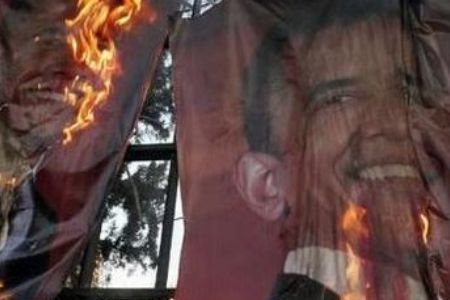
The deputy head of Yemen’s Democratic Party has called for the expulsion of American and Saudi Arabian ambassadors from his country.
In an interview with Al-Alam news channel on Tuesday, Abdul Salam Faqih warned that Washington and the members of the [Persian] Gulf Cooperation Council ([P]GCC), including Saudi Arabia, want to hijack the Yemeni people’s uprising.
This will be done through the establishment of a proposed Transitional Council in Yemen, made up of officials loyal to President Ali Abdullah Saleh’s regime, Faqih said.
The revolutionary figure added that Saleh regime elements will not solve any of the problems facing Yemen, and urged Yemenis to stand up to such a proposition.
Yemeni youth must vouch for national figures that have no foreign links, in order to form the Transitional Council, Faqih stressed.
The remarks come amidst conflicting reports about Saleh’s fate following the attack on his presidential palace earlier this month.
Some media outlets quoting Israeli and European sources claim Saleh is dead.
However, a Saudi source says the long-time Yemeni leader is still alive, but is in bad shape and not fit to re-take the helm as president.
Yemen’s official news agency is meanwhile quoting Saleh as telling Saudi King Abdullah that his health is improving.
Saleh was flown to Saudi Arabia on June 4, a day after an explosion ripped through the Yemeni presidential compound in the capital, Sana’a. Since then Saleh has not been seen in public.
Opposition groups believe that with his departure, Saleh’s 33-year rule has come to an abrupt end.
The protesters are now demanding the formation of a transitional presidential council in the country.
On Tuesday, hundreds of thousands of protesters took to the streets of the Yemeni capital Sana’a once again.
The demonstrators massed outside the home of acting president Abd Rabbo Mansour Hadi, demanding the immediate formation of a transitional presidential council in the country. Otherwise they said they would act unilaterally.
The protesters also called for the total overhaul of Yemen’s political system as well as the trial of Saleh and his aides.
They hold Saleh responsible for the killing of hundreds of people since anti-government rallies began in late January.
Jordan, Israel affirm resumption of Egyptian gas supply
Palestine Information Center – 11/06/2011
AMMAN — Jordanian official sources and Hebrew media affirmed that the supply of Egyptian gas to both Jordan and Israel was renewed as of Friday night after one and half month of halt due to an explosion that targeted the pipeline in northern Sinai.
Jordanian minister of energy and mineral resources Khaled Tukan said that the natural gas supply resumed for the first time after the pipeline explosion on 27 April.
He said in a statement carried by the official Jordanian news agency Petra that the Egyptian gas supply would reach 70 million cubic feet per day within the few coming days.
For its part, the Hebrew radio said that EMG, which imports the gas from Egypt, announced resumption of the gas exports but said, ”The pressure in the pipeline will be restored to its full level gradually in the coming days”.
Egypt supplies Jordan with 80% of its needs to produce electricity while Israel depends on Egyptian gas for the production of 40% of its electricity.
US universities in Africa ‘land grab’
Institutions including Harvard and Vanderbilt reportedly use hedge funds to buy land in deals that may force farmers out
John Vidal and Claire Provost | The Guardian | June 8, 2011
Harvard and other major American universities are working through British hedge funds and European financial speculators to buy or lease vast areas of African farmland in deals, some of which may force many thousands of people off their land, according to a new study.
Researchers say foreign investors are profiting from “land grabs” that often fail to deliver the promised benefits of jobs and economic development, and can lead to environmental and social problems in the poorest countries in the world.
The new report on land acquisitions in seven African countries suggests that Harvard, Vanderbilt and many other US colleges with large endowment funds have invested heavily in African land in the past few years. Much of the money is said to be channelled through London-based Emergent asset management, which runs one of Africa’s largest land acquisition funds, run by former JP Morgan and Goldman Sachs currency dealers.
Researchers at the California-based Oakland Institute think that Emergent’s clients in the US may have invested up to $500m in some of the most fertile land in the expectation of making 25% returns.
Emergent said the deals were handled responsibly. “Yes, university endowment funds and pension funds are long-term investors,” a spokesman said. “We are investing in African agriculture and setting up businesses and employing people. We are doing it in a responsible way … The amounts are large. They can be hundreds of millions of dollars. This is not landgrabbing. We want to make the land more valuable. Being big makes an impact, economies of scale can be more productive.”
Chinese and Middle Eastern firms have previously been identified as “grabbing” large tracts of land in developing countries to grow cheap food for home populations, but western funds are behind many of the biggest deals, says the Oakland institute, an advocacy research group.
The company that manages Harvard’s investment funds declined to comment. “It is Harvard management company policy not to discuss investments or investment strategy and therefore I cannot confirm the report,” said a spokesman. Vanderbilt also declined to comment.
Oakland said investors overstated the benefits of the deals for the communities involved. “Companies have been able to create complex layers of companies and subsidiaries to avert the gaze of weak regulatory authorities. Analysis of the contracts reveal that many of the deals will provide few jobs and will force many thousands of people off the land,” said Anuradha Mittal, Oakland’s director.
In Tanzania, the memorandum of understanding between the local government and US-based farm development corporation AgriSol Energy, which is working with Iowa University, stipulates that the two main locations – Katumba and Mishamo – for their project are refugee settlements holding as many as 162,000 people that will have to be closed before the $700m project can start. The refugees have been farming this land for 40 years.
In Ethiopia, a process of “villagisation” by the government is moving tens of thousands of people from traditional lands into new centres while big land deals are being struck with international companies.
The largest land deal in South Sudan, where as much as 9% of the land is said by Norwegian analysts to have been bought in the last few years, was negotiated between a Texas-based firm, Nile Trading and Development and a local co-operative run by absent chiefs. The 49-year lease of 400,000 hectares of central Equatoria for around $25,000 (£15,000) allows the company to exploit all natural resources including oil and timber. The company, headed by former US Ambassador Howard Eugene Douglas, says it intends to apply for UN-backed carbon credits that could provide it with millions of pounds a year in revenues.
In Mozambique, where up to 7m hectares of land is potentially available for investors, western hedge funds are said in the report to be working with South Africans businesses to buy vast tracts of forest and farmland for investors in Europe and the US. The contracts show the government will waive taxes for up to 25 years, but few jobs will be created. … Full article
Bahrain police summon female activist
Press TV – June 2, 2011
 The Manama police department in Bahrain has summoned a female human rights activist as intensified crackdown on peaceful anti-government protests continue in the Middle Eastern country.
Bahrain Center for Human Rights (BCHR) said Wednesday that Zainab al-Khawaja has been summoned to appear at the police department in the capital Manama on Thursday.
The daughter of a prominent Bahraini opposition figure, al-Khawaja went on a ten-day hunger strike in April to protest the detention of her close relatives amid the government’s brutal crackdown against anti-regime demonstrators.
The rights center also stated, “The summoning raises concern as her father, Abdulhadi al-Khawaj, told his family a few days ago that security forces inside the prison kept threatening that they had arrested and raped his daughter Zainab.”
Abdulhadi al-Khawaja, a former president of BCHR, was arrested on April 9 and put on trial with 20 other detained activists over allegations of attempting to topple the Bahraini government. He has also been threatened with rape by the prison guards after he refused to apologize to Bahrain’s king on camera. … Full article
Hezbollah Condemns Attack on UNIFIL
Al-Manar | May 28, 2011
Hezbollah condemned the attack which targeted United Nation Interim Force in Lebanon (UNIFIL) patrol, considering it as a “criminal act”.
Hezbollah Media Relations issued a statement, saying the party “ considers this a criminal act and calls on the Lebanese special services to investigate and uncover the perpetrators and hold them accountable”.
Six Italian peacekeepers were wounded, along with two civilians on Friday in a roadside bomb explosion targeting a UN patrol along Rmeileh highway leading to the coastal city of Saida, south of Lebanon.
According to Italian Defense Minister Ignazio La Russa, two of the peacekeepers were in serious condition.
A spokesman for the UNIFIL, Neeraj Singh, said: “this is a despicable act that is clearly directed at undermining UN Security Council Resolution 1701 and stability in Lebanon”, referring to the resolution that ended July war in 2006.
Report: Egypt working with Israel on Rafah policy
Ma’an – 27/05/2011
JERUSALEM — Egypt has explained to Israel that the Rafah crossing will not be used to transfer goods, and restrictions will be imposed on the movement of individuals, Israel radio reported Thursday.
According to political sources quoted in the report, Egyptian authorities are aware of the risk that “terrorist elements” could pass through Rafah, the sole non-Israeli entrance point, and Cairo will act accordingly.
Egypt said Wednesday it would open the crossing on a daily basis in a bid to ease the blockade.
The measure, which will come into force Saturday, will give Gazans a gateway to the world as Rafah is the only crossing which does not pass through Israel.
The frontier will now be opened for eight hours a day from 9:00 a.m., with the exception of Fridays and public holidays, Egypt’s official MENA news agency said.
Until now, it had been open only intermittently, mainly for Palestinians who can prove humanitarian need. … Full article
US holds up Smallpox stock eradication
Press TV – May 25, 2011
Despite opposition by many nations, the eradication of the world’s last smallpox stocks remaining in the US and Russian labs have been postponed for three more years.
After two long days of strong debate, UN members at the World Health Assembly in Geneva reached an agreement on the destruction of smallpox samples held in stockpile in the US Center for Disease Control labs in Atlanta, Georgia and a Russian-government sponsored lab in Siberia.
Washington and Moscow said that they want to keep their virus stocks for five more years to develop new vaccines for possible resurgence in future. The European Union, Canada, Israel, Monaco, Colombia and China are among countries that support the delay.
Many countries including the North African nations, Iran, Thailand, Zimbabwe and Malaysia, on the other hand, are in favor of the immediate destruction of the remaining samples of the virus.
The debate over the destruction of the stocks of the deadly smallpox virus, which was irradiated in 1979, has been recurring since 1986.
The supporters of the US and Russia’s program finally accepted to compromise with at most 3 years of delay in the destruction program.
Based on the final decision, there will be another meeting in 2014 in the World Health to decide on a more defined date of complete destruction of the stocks.
The supporters of the destruction program are satisfied with the decision. “The outcome shows destruction is imminent,” said Edward Hammond, a consultant for the Third World Network, a nongovernmental organization based in Malaysia that advocates for smallpox-virus destruction.
The US-led resolution for saving the stocks for five more years did not succeed despite the intense lobbying, Hammond said, adding that “I have never seen the US put more time and effort into trying to get a resolution passed.”
Israeli attaché warned before expulsion
Press TV – May 24, 2011
A Russian newspaper reports that Moscow has given three warnings to Israeli military attaché to Russia Colonel Vadim Leiderman before expelling him.
Liederman contacted Russian military officials without first coordinating with the Russian Foreign Ministry, Komsomolskaya Pravda daily said on Monday.
Russia warned the Israeli Embassy in Moscow several times that Leiderman has violated the Vienna Convention on Diplomatic Relations, according to the paper.
The Soviet-born Israeli Air Force Colonel was arrested during a May 12 meeting with Russian officials.
Following the warnings issued in November 2009, April 2010 and December 2010, Israeli diplomats have promised that all of the actions of the military attaché would be in strict compliance with the Vienna Convention.
However, Russia’s Federal Security Service (FSB) announced that Leiderman was expelled because of his attempts to acquire secret information on military sales to Arab states.
The FSB said in a statement that it had “impregnable evidence” of the “illegal activities in our country, whose substance was to recruit a number of Russian civilians as possible information providers.”
Army Demolishes Ten Homes Near Hebron
By Saed Bannoura – IMEMC & Agencies – May 06, 2011
Israeli soldiers demolished on Thursday ten Palestinian homes in the Hebron district, in the southern part of the occupied West Bank.
The army invaded Um Nir village and Yatta town, near Hebron, and provided protection to army bulldozers that flattened the homes and damaged infrastructure and roads, local sources reported.
The sources added that the army declared the village of Um Nir as a closed military zone preventing the residents from entering or leaving it.
In related news, soldiers invaded Al Saray’a and Abu Hindi Bedouin villages near occupied East Jerusalem, and handed eviction orders to fifty families living in the area. The residents were granted ten days to leave the area before the army demolishes their homes.
The families live in a valley that is located between the Kidar illegal settlement and the Maali Adumim settlement bloc.
The villagers are subject to frequent attacks by Israeli soldiers and settlers, yet, have continuously expressed their rejection to being displaced and removed from their lands.
Home demolitions and eviction are direct violations to the International Law, and all laws and regulations that clearly stipulate the need to protect civilians in conflict zones.
Ex-Bahraini MP dies under detention
Press TV – May 5, 2011
A former Bahraini lawmaker and member of the country’s main opposition group has died in a hospital after being held in custody of the Manama regime.
Jawad Firouz who was a member of al-Wefaq political society, was recently arrested and detained by Bahraini police, local sources said on Thursday.
The development comes after rights group Amnesty International appealed to rulers in Manama on Wednesday to end the arrest of opposition members.
Manama regime has intensified its crackdown on the popular revolution against the decades-long ruling of al-Khalifa dynasty in the small Persian Gulf country, which has been continuing since Mid-February.
On Tuesday, the Bahraini parliament voted to extend the state of emergency for three more months, due to expire on June 15.
Human rights organizations have strongly criticized Saudi-backed Bahrain forces for their heavy-handed crackdown on peaceful protesters.
On March 13, Saudi-led forces were dispatched to the Persian Gulf island at Manama’s request to quell countrywide protests.
According to local sources, dozens of people have been killed and hundreds arrested so far during the government clampdown on peaceful demonstrations.
Bahrain is home to major military base of the US Navy Fifth Fleet.
Palestinian Source: “Hamas And Fateh Agree Fayyad Won’t Be Heading New Interim Government”
By Saed Bannoura – IMEMC & Agencies – May 04, 2011
A senior Palestinian source reported that the Hamas and Fateh movements agreed that the current Prime Minister in the West Bank, Dr. Salaam Fayyad, will not be heading the new interim unity government that would be formed after the unity deal is officially signed.
Speaking on condition of anonymity, the source told UPI that both Hamas and Fateh movements agreed on removing Fayyad, and added that this decision does not mean totally removing him from the government as some officials are calling for appointing him as a Minister of Finance for his ability to obtain international and financial support due to his good relations with donor countries.
The new head of the interim government will likely be from the Gaza Strip.
The government will not carry a political agenda, and will have certain tasks headed by ensuring a positive atmosphere for a lasting reconciliation, preparing for the new general and presidential elections, and to supervise the reconstruction of Gaza.
Other tasks of the government include resolving the social and administrative effects of the internal rifts and conflict, and to reform all Palestinian institutions, including the Palestinian Liberation Organization (PLO).
All political prisoners held by Fateh in the West Bank and by Hamas in Gaza will be released following the official ceremony of signing the deal, while the Legislative Council will be resuming its duties in the West Bank and the Gaza Strip.
The security forces will be controlled and run by the unity government.
The general, presidential and National Council elections will be consecutively held one year after the deal is signed.
The elections will be held under Arab and International supervision, and an elections court headed by a judge, and eight supervising judges, will be formed to ensure fair and transparent elections.
Featured Video

Pravin Sawhney: Massive Escalation Pushes Every Side Toward the Brink
or go to
Aletho News Archives – Video-Images
From the Archives
A sample of vaccine and injectable medication tragedies during my lifetime
This is what happens when you demand speedy production in an era of politicized regulation
By Meryl Nass, MD | February 12, 2022
All these tragedies have been due to failures of testing or failures in manufacturing processes. Most occurred before vaccine manufacturers were given virtually complete protection from liability in 1987.
With the duration of patent exclusivity determining how much new products earn, products are rushed to market as quickly as possible, most using a shortened path for FDA review. Recalls and market removals of approved products are much more common than they used to be. We can only expect more of these disasters in the future, especially if the products are mandated for everyone. … continue
Blog Roll
 Aletho News
- Moscow mocks Kiev’s language hypocrisy exposed by ‘torture chamber’ scandal
- Military ‘torture chamber’ triggers new scandal in Kiev
- Algerian army launches second operation to clear French nuclear test sites
- Pravin Sawhney: Massive Escalation Pushes Every Side Toward the Brink
- UK High Court Upholds Speech Regulator Notices To Meta, WhatsApp, X, And TikTok
- Two working on US Senate candidate’s campaign registered as foreign agents for Israel: Report
- Greece bans protest over docking of Israeli cruise ship
- Israel elections: More Arab votes, same Zionist consensus
- Taking the Houthis at Their Word: The Bill Saudi Arabia Doesn’t Want to Read
- Trump claims he would have bombed Ho Chi Minh City to win Vietnam War
- If Americans Knew
- An error has occurred; the feed is probably down. Try again later.
- No Tricks Zone
- Germany’s Green Energy Transition Becoming Increasingly Expensive…Another 6 Trillion Euros!
- Sudden Stratospheric Warming, Powerful El Niño Combination May Lead To Extreme Europe Cold, Energy Crisis!
- Two New Studies Find Thwaites Glacier Melt Cannot Be Driven By Human Activity Or A Warming Ocean
- E-Cars Reduce CO2 Emissions By Only 41% Compared To Internal Combustion Engine Vehicles
- Predictions Made By Renowned Climate Professor Over Past Decades Have Been Proven To Be Poor
- New Study Suggests Large Regions Of The Pacific Ocean Have Been Cooling For The Last 80 Years
- Germany’s Green Energy Debacle: High Energy Costs Force Kahla Porzellan to Close After 182 Years!
- New Study: 50 Years Of The Most Aggressive ‘Net Zero’ Policies Can Only Affect The Global Climate By 0.03°C
- US September “Heat” Was No Record…Many Records Set Decades Ago
- Latest European Green Energy Debacle; Portugal’s Largest Flagship Solar Park Insolvent!

