3 Palestinians, including a child wounded in Israeli occupation airstrikes
Palestine Information Center – 05/08/2011

GAZA — Three Palestinians, including a child, were wounded in one of five airstrikes carried out by the Israeli occupation airforce at dawn Friday against various targets in the Gaza Strip.
Adham Abu Selmeyyah, spokesman for the emergency services in Gaza said in a statement on Friday morning that three Palestinians, including a child were wounded when an Israeli occupation airstrike targeted an open area in Beit Lahia in the northern Gaza Strip.
He added that the three were taken to the Kamal Adwan hospital and that two of them lost lower limbs.
The Israeli occupation airforce carried out 4 other airstrikes against targets in the Deir al-Balah and Khan Younis in the central and southern Gaza Strip, but no casualties were reported.
Local sources told PIC correspondent that occupation aircraft fired two rockets at a chicken farm to the east of Deir al-Balah before targeting resistance training grounds to the west of the town.
Meanwhile, sources in Khan Younis said that occupation aircraft targeted a container used as mobile accommodation to the west of Asda’a Media City.
The sources added that occupation tanks fired artillery shells at agricultural fields to the east of Qara town, in Khan Younis district.
Abu Selmeyyah said in the statement that the airstrikes on Khan Younis and Deir al-Balah did not result in human casualties, adding that the air raids cause a lot of distress to the civilian population of the Gaza Strip.
Killing ‘Our Guy’ in Kandahar
By CONN HALLINAN | CounterPunch | July 28, 2011
The assassination of Ahmed Wali Karzai in Kandahar July 12 is one of those moments when the long and bloody Afghanistan war suddenly comes into focus. It is not a picture one is eager to put up on the wall.
Karzai, a younger half brother (because their father had multiple wives) of Afghan President Hamid Karzai, was the Kabul government’s viceroy in southern Afghanistan. What his nickname, “the king of Kandahar,” translates into is “warlord.” He controlled everything from the movement of drugs to the placement of car sales agencies. Want to open a Toyota dealership? See “AWK,” as he was also known, and come with a bucket load of cash.
AWK’s power, according to the Financial Times, “lay in a mafia-style network of oligarchs and loyal elders, funded, according to U.S. media reports, by heroin trafficking.” He was also on the CIA’s payroll. No truck moved through the south without paying him a tax. No United Nations or North Atlantic Treaty Organization (NATO) projects could be built without his okay. In case someone didn’t get the message, his Kandahar Strike Force Militia explained it to them. Next to AWK, Al Capone was a small-time pickpocket.
And he was our guy.
So was Jan Mohammed Khan, assassinated July 17, a key ally and advisor to the Afghan president, and a man so corrupt that the Dutch expeditionary forces forced his removal as the governor of Uruzgan Province in 2006.
The entire U.S. endeavor in Afghanistan—from the initial 2001 invasion to the current withdrawal plan—has relied on a narrow group of criminal entrepreneurs, the very people whose unchecked greed set off the 1992-96 Afghan civil war and led to the victory of the Taliban.
AWK was a member of the Popalzai tribe, which along with the Alikozai and Barakzai tribes, has run the southern provinces of Kandahar and Helmand since the early 1990s, systematically excluding other tribes. According to the Guardian’s Stephen Gray, “The formation of the Taliban was, in great measure, a revolt of the excluded.”
When the Americans invaded, “AWK and the Barakzai strongman and former Kandahar governor Gul Agha Sherzai not only seized control of NATO purse-strings by acquiring lucrative contracts, but they also manipulated U.S. intelligence and Special Forces to gain help with their predatory and retaliatory agenda,” says Gray, harassing and arresting Taliban members until they fled to Pakistan.
AWK not only poured money into the coffers of the Kabul government, he insured a second term for his brother by stuffing ballot boxes in the 2009 election, and he was a key actor in identifying targets for U.S. night raids. It is the success of these night raids in killing off Taliban leaders that has allowed the Obama Administration to claim a measure of victory in the Afghan war and to lay the groundwork for a withdrawal of most American troops by 2014.
With U.S. polls running heavily against the war—59 percent oppose it—and with more than 200 votes in Congress for speeding up the withdrawal timetable, the White House wants the war to be winding down as the U.S. goes into the 2012 elections.
For the Afghan central government and the Obama administration, then, AWK was probably the most powerful and important warlord in the country.
As in chess, there are winners and losers when a major piece falls.
The assassination has dealt a serious blow to the Americans. The rosy picture of progress painted by the U.S. Defense and State departments is shot to hell, literally. The Taliban have demonstrated that all the hype on “improved security” is about as real as an opium dream. Even if the assassination was due to a personal quarrel rather than a Taliban hit, few will believe that is so, particularly after Khan’s assassination just five days later.
While the Kabul government has appointed another Karzai in AWK’s place, there is almost certainly going to be a bloody internecine battle among surviving Kandahar power brokers. A major infight will end up robbing Kabul of much needed funds and further isolate the government. The only hope for the Karzai government now is to ramp up talks with the Taliban while Kabul still has some power and influence.
And that fact puts Pakistan in the driver’s seat, because there will be no talks without Islamabad. The Americans need these talks as well, so don’t pay a lot of attention to the White House’s huffing and puffing over aid.
In any case, the decision to cut some $800 million in aid to the Pakistani military has been less than a major success. Pakistan Defense Minister Ahmed Mukhtar told Express TV that “If Americans refuse to give us money, then okay…we cannot afford to keep the military out in the mountains for such a long period.”
Pakistan currently has tens of thousands of troops on the 1,500-mile Pakistan-Afghan border, fighting an insurgency that did not exist until the American invasion drove the Taliban into the Tribal Areas and the Northwest Territories. From Pakistan’s point of view it is fighting its own people, and losing up to 3,000 soldiers and civilians a year, because of Washington’s policies in the region.
One loser is India, even though in the long run peace in Afghanistan will allow New Delhi to reap the rewards of a Central Asia gas pipeline. In the short run, however,Indian diplomacy in the region has badly misfired. India intervened in Afghanistan— providing more than a billion dollars in aid—in order to discomfort Pakistan.
But in 2009 New Delhi withdrew its support for the Karzai government because India was convinced the Americans were about to jettison the Afghan President. That never happened, but Karzai decided that his long-term survival lay in making peace with the Taliban, which in turn meant warming up ties with Islamabad.
In the meantime, Pakistan—fearful of India and suspicious of the U.S.—tightened its ties with China (discomforting the Indians even more). In fact, in the end, China may be the big winner. Beijing runs a huge copper mine and seems to have no trouble getting its ore out of the country, which suggests there is a deal among China, Pakistan and the Taliban to keep the roads open. China is also building a railroad, as well as exploring for iron ore and rare earth elements.
There are other potential winners here as well. Iran has traditionally been involved in northern Afghanistan, where it has roots among the Tajiks, who speak a language similar to Iran’s Farsi. Iran also has close ties to the Shiite Hazaras and pumps aid into western Afghanistan. Iran’s help will be essential if the Tajiks, Hazaras and Uzbeks are to join in any peace agreement.
Whatever the final outcome, the U.S./NATO adventure has been an unmitigated disaster. With Europeans overwhelmingly opposed to the war, there is a stampede for the exit by virtually every country but Britain and the U.S. In the end, Afghanistan may well end up the graveyard of NATO.
The major losers, of course, are the Afghans. So far this has been the deadliest year for civilians since 2001. Most of those deaths come via roadside bombs, but casualties from NATO air attacks are up. In spite of hundreds of billions of dollars in aid, Afghanistan is still grindingly poor and stunningly violent. After almost a decade of war the words that spring to mind are Macbeth’s: “A tale told by an idiot, full of sound and fury, signifying nothing.”
Conn Hallinan can be reached at: ringoanne@sbcglobal.net
Lieberman wants to eject Turkish workers amid showdown over ties with Turkey
Palestine Information Center – 28/07/2011
 OCCUPIED JERUSALEM — Israeli Foreign Minister Avigdor Lieberman wants to eject some 350 Turkish workers as Israel’s relations with Turkey have spiraled after the 2010 flotilla attack.
Israeli ministers Ehud Barak and Lieberman have been at odds over whether to meet Turkey’s condition of an apology over the attack before it would restore ties with Israel.
The workers were brought into Israel to upgrade tanks that the Israeli Military Industries was contracted to build under a defense agreement.
Israeli Prime Minister Benjamin Netanyahu held a cabinet meeting on Wednesday to mull over Turkey’s demands for an apology, compensation to be paid to the flotilla victims’ families, and lift the blockade enforced on the Gaza Strip.
The war ministry wants to extend the workers’ visas amid fears that ejecting the workers could dampen already dismal relations with Turkey.
Gaza blockade keeps Saleh away from sea
Rami Almeghari | The Electronic Intifada | 14 July 2011
For five years now, Saleh has only been able to sail for short distances. Most of the time, it sits idle in a parking lot for boats near a sea port to the west of Gaza City.
Saleh is the name of a large boat that belongs to Abu Ayman Kabaja, a 56-year-old fisherman and father of five children, all of whom have worked in Gaza’s fishing industry for many years.
On a Saturday around noon, Kabaja’s three sons — including his eldest, Ayman, a 34-year-old father of four daughters — are busy sticking sheets of fiberglass to Saleh’s body to help preserve the boat as it gets older. They are joined by two of Kabaja’s nephews.
“As you see, my children and my nephews are doing this in order to protect the boat from decaying because of heat from the sun,” Kabaja tells The Electronic Intifada. “This boat Saleh has stopped functioning for the past five years due to our inability to sail beyond the Israeli-enforced limit of three nautical miles. Our fishing work has been badly affected.”
Before Israel imposed its blockade, Saleh and hundreds of other fishing boats used to sail approximately 12 nautical miles off Gaza shores. Yet for the past four years such boats have been allowed to sail only a small distance offshore.
Under the Oslo accords, the US-sponsored peace process between Israel and the Palestine Liberation Organization in the mid-1990s, fishermen in Gaza were allotted access up to twenty nautical miles offshore. When Israel imposed the 2007 blockade, this access area was shrunk to just six nautical miles, and within the last year, Israel once again cut the distance to three nautical miles.
Saleh is one of about 25 similar boats in the area that used to sail from Gaza before Israel imposed the maritime blockade. These boats are all out of regular use as a result of the siege on Gaza.
“Saleh and boats like it used to bring large quantities of sardines to Gaza,” Kabaja says. “Sardines are the most popular and cheapest type of fish in the territory. I recall that prior to the maritime siege we used to catch three to five tons of this type of fish every work day and make a very good business out of it. I estimate our net profit every year at $15,000. Or even more, brother, even more.”
Debt still unpaid
Saleh, 16 meters long and 5.5 meters wide, was first used by Kabaja in 2005. He had to borrow thousands of dollars to buy it. Saleh cost him a total of $70,000, $15,000 of which he still owes to a friend.
“At this time of the year, from March through the beginning of July, we used to enjoy the blessings of God as this particular time period is the golden time for us fishermen,” Kabaja says. “Sardines used to be very much available along with some other kinds of fish.”
Kabaja says that in October of 2010, he was harassed by the Israeli navy while trying to earn a living as a fisherman.
“Some colleagues of mine have been frequently exposed to harassment by the Israeli naval vessels. Maybe you heard about the seizure by the Israeli navy of two fishing boats a few weeks ago. It has been even worse at times, to the extent of the Israeli forces firing live shorts against fishermen,” he adds.
According to Kabaja, Saleh now only sails along the port’s beach front. The boat’s short distance trip only takes place during three or four months of the year.
“To maintain Saleh we used to drag it in the water for three to four months in order not to allow the wooden bars and some of the metal, as well as the engine’s fan, to get rusty or broken,” he explains. “Then we would bring it back to the soil here for the rest of the year. We have got used to doing this for five years, since Israel has prevented Saleh and other boats from sailing into the sea.”
No jobs to be found
Kabaja’s son Ayman says the Israeli blockade has meant that there are few job opportunities in the fishing industry. One of the few sources of employment he has found was from the UN agency for Palestine refugees (UNRWA) but that was only on a temporary basis.
“Can you imagine?” Ayman asks, as he applies some glue to his boat. “Can a three-month temporary UNRWA-provided job opportunity ensure you a living? Absolutely not, absolutely not. I have already availed of that option and now there is nothing more, except what you see me doing, maintaining Saleh. [I wonder] whether Israeli fishermen or any other fisherman in the world would accept to sail for only two and a half nautical miles.”
Ayman’s uncle Abu Mohammad says that Saleh’s first voyages were during a prosperous time for Gaza’s fishermen. “Before the blockade was enforced, myself, my brother Abu Ayman and our own children — almost a total of forty people — used to rely so much on fishing as we used to build house and finance our children’s education and even marriages. But our incomes have sharply decreased,” he tells The Electronic Intifada.
Asked what other factors have caused their incomes to plummet, the fifty-year-old fisherman says: “Our inability to go further from Gaza’s shores has led many other fellow fishermen to try to bring large quantities of various types of fish from Egypt through underground tunnels and then sell them in the local market. You know why? In order for us to sail for almost 12 hours within such a limited distance of three nautical miles of the shores, we need fuel and other things. [It costs] $600 for each sailing but with no guarantees of catching fish. So bringing in Egyptian fish is less costly than sailing.”
Fishing is considered to be a main source of food for the Gaza Strip’s 1.6 million residents. According to statistics from the Palestinian Centre for Human Rights, there are approximately 8,200 fishermen and workers in the fishing sector in the Gaza Strip, who provide for approximately 50,000 dependents throughout Gaza (“Israeli attacks on Palestinian fishermen at Gaza sea,” 1 February 2011).
“You know, we have been maintaining Saleh for the past month and we have not sailed for fishing,” Ayman Kabaja says. “Why fish? Why? We had better maintain this boat, before Saleh is totally broken. Maybe one day Saleh will be back to normal activity after the Israeli blockade has been lifted once and for all.”
Rami Almeghari is a journalist and university lecturer based in the Gaza Strip.
Israeli Army Kidnaps Hamas Leader, Two Residents, Near Jenin
By Saed Bannoura | IMEMC & Agencies | July 05, 2011
Israeli soldiers kidnapped on Tuesday at dawn a Hamas political leader in Jaba’ town, near the northern Western Bank city of Jenin, along with two other residents, and took them to unknown destinations. Three more Palestinians were kidnapped in different West Bank areas.
Local sources reported that, approximately at 1 after midnight, the army surrounded the house of Nazeeh Abu ‘Oun, 50, and used loud speakers ordering him to step out.
The army then broke into the home and cuffed Abu ‘Oun before forcing him into one of their jeeps and driving away.
His family said that the soldiers did not even grant him enough time to step out, and that he previously spent more than 14 years in Israeli prisons. He was also imprisoned for two months by the security forces of the Palestinian Authority in the West Bank.
The family added that soldiers also forced their son to take them to the house of Ahmad Nimir Malaisha, 37, who was also kidnapped and taken to an unknown destination.
Malaisha is a former political prisoner who spent more than 13 years in Israeli prisons; he was last released nearly one year ago.
Also, soldiers kidnapped Engineer Bashar Anis Khaliliyya, 29, as he was visiting his parent’s home in the town.
Khaliliyya works in Saudi Arabia and was on vacation visiting his family. He was planning to travel back to Saudi Arabia on Wednesday.
Also on Tuesday at dawn, soldiers kidnapped three Palestinians in the West Bank districts of Bethlehem, Ramallah and Hebron. They were all moved to interrogation centers.
Israeli forces confiscate Palestinian olive orchards near Ramallah
By Saed Bannoura – IMEMC News – June 30, 2011
Hundreds of acres of olive orchards in Al Mazra’a al Gharbiya village were taken over by Israeli troops on Tuesday, who claimed that the area was a ‘closed military zone’ and that the land was being confiscated for military use.
Representatives of the Palestine Information Center stated that Israeli forces provided them with a map showing the area of confiscation, which consists of hundreds of acres of Palestinian farmland.
Under Israeli law, Palestinian land can be expropriated by the Israeli government in a variety of circumstances: if the owner of the land is considered ‘absentee’ (not currently living on the land), if the land is zoned by Israel for settlement, or if the Israeli military wants the land for ‘military purposes’.
Already, the Israeli government has expropriated almost half of the West Bank and East Jerusalem, and has constructed a Wall to cement the confiscation – despite the fact that such land confiscation is considered illegal under international law and signed peace agreements with the Palestinians.
According to the local military commander overseeing Tuesday’s confiscation, Palestinian landowners have 45 days to contest the takeover by filing a complaint with the Ofer military court, which is located inside an Israeli settlement and thus inaccessible to most Palestinians.
Complaints against the Israeli military have a poor record of success – less than 5% of such complaints result in the return of confiscated land, according to human rights groups. The court is also carried out in Hebrew, a language which few Palestinians know, and with Israeli lawyers, which are difficult for Palestinians to access, since they are not allowed to enter Israel.
The troops that arrived in the village on Tuesday hammered signs into the ground and painted demarcation lines to indicate the area of confiscation, according to eyewitnesses.
Olive orchards are key to the Palestinian economy, with many Palestinian families depending on the sale of olives and olive oil for their livelihood.
Two fishing boats shot off Gaza coast
21 June 2011 | International Solidarity Movement
At around 9am on June 21, two fishing boats were attacked by the Israeli Navy, with bullets piercing both engines, rendering them unusable.
The first boat was shot at in the motor, at the rear end and, when the 4-man crew took cover at the front of the boat, away from the shots directed at the motor, the front of the boat was fired upon.
Yaser Baker is one of the four fishermen who were aboard the first boat which was shot. “We were at around two and a half miles out to sea when they shot at our engine and it broke. We stopped the boat and all moved to the front, away from the engine so that we wouldn’t get hit. Then they shot at the front, right at us, the bullets just missing our bodies and one landed right by my leg.”
A second boat, manned by Mohammed Bakri Sabir came to assist the first, but was also attacked, both in the engine and the front of the boat, where the crew was taking cover.
Aboard the second boat were three fishermen and two of their children, aged nine and ten years old.
The boats managed to escape when around twenty other local fishing boats surrounded them and escorted them back to shore as the nine-year-old feigned an injury. “He had to play dead,” Baker explained, “it was the only way we could get them to stop firing.”
Israeli Platoon Violates Lebanon Borders, Dogs Confront It
Sara Taha | Al-Manar | June 18, 2011
A group of Israeli soldiers crossed towards Lebanon, chasing a young Lebanese shepherd in attempt to kidnap him. However, the shepherd’s dog obstructed their plan and fought with the penetrators.
A report broadcast on Al-Manar TV station Friday, revealed that a platoon of Israeli soldiers set up an ambush inside Lebanese territory, 250 meters away from the border, in the liberated Saddana hill in Shebaa.
“Clashes took place between the dogs accompanying the shepherd’s flock of sheep and the Israeli soldiers, where one of the dogs bit an Israeli soldier after he hit it with a rifle that deeply injured the dog’s head”, Al-Manar reporter Ali Shoaib stated.
The shepherd Alaa Mohammad Al-Nabaa told the TV station that “I was herding… the dog started barking… every time I move forward it barks more. Suddenly, two Israeli platoons appeared, one coming from the left side and another from the right side”.
“I ran away, they started calling me and asking me to stop, but I kept on running… and then, they started fighting with the dog that attacked them and they hit it on the head”, Al-Nabaa added.
On his part, Development and Liberation bloc MP Kassem Hashem who visited the location told Al-Manar that “before we raise this violation to the International Community, we should reveal it to some Lebanese politicians and political groups who continuously praise the International Community and its decisions, and urge us to commit to them”.
“We ask them today, who is the part[y] violating international resolutions?” Hashem asked.
In parallel, the Al-Manar reporter pointed out that “the Saddana hills are supervised by the UNIFIL that continuously surveils the region by land and air. However, people there look forward that the UNIFIL would not settle for just counting the violations”.
Ali Shoaib contributed to this report.
Yemenis urge ousting US, Saudi envoys
Press TV – June 15, 2011
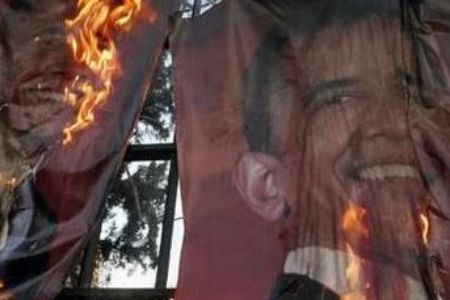
The deputy head of Yemen’s Democratic Party has called for the expulsion of American and Saudi Arabian ambassadors from his country.
In an interview with Al-Alam news channel on Tuesday, Abdul Salam Faqih warned that Washington and the members of the [Persian] Gulf Cooperation Council ([P]GCC), including Saudi Arabia, want to hijack the Yemeni people’s uprising.
This will be done through the establishment of a proposed Transitional Council in Yemen, made up of officials loyal to President Ali Abdullah Saleh’s regime, Faqih said.
The revolutionary figure added that Saleh regime elements will not solve any of the problems facing Yemen, and urged Yemenis to stand up to such a proposition.
Yemeni youth must vouch for national figures that have no foreign links, in order to form the Transitional Council, Faqih stressed.
The remarks come amidst conflicting reports about Saleh’s fate following the attack on his presidential palace earlier this month.
Some media outlets quoting Israeli and European sources claim Saleh is dead.
However, a Saudi source says the long-time Yemeni leader is still alive, but is in bad shape and not fit to re-take the helm as president.
Yemen’s official news agency is meanwhile quoting Saleh as telling Saudi King Abdullah that his health is improving.
Saleh was flown to Saudi Arabia on June 4, a day after an explosion ripped through the Yemeni presidential compound in the capital, Sana’a. Since then Saleh has not been seen in public.
Opposition groups believe that with his departure, Saleh’s 33-year rule has come to an abrupt end.
The protesters are now demanding the formation of a transitional presidential council in the country.
On Tuesday, hundreds of thousands of protesters took to the streets of the Yemeni capital Sana’a once again.
The demonstrators massed outside the home of acting president Abd Rabbo Mansour Hadi, demanding the immediate formation of a transitional presidential council in the country. Otherwise they said they would act unilaterally.
The protesters also called for the total overhaul of Yemen’s political system as well as the trial of Saleh and his aides.
They hold Saleh responsible for the killing of hundreds of people since anti-government rallies began in late January.
Jordan, Israel affirm resumption of Egyptian gas supply
Palestine Information Center – 11/06/2011
AMMAN — Jordanian official sources and Hebrew media affirmed that the supply of Egyptian gas to both Jordan and Israel was renewed as of Friday night after one and half month of halt due to an explosion that targeted the pipeline in northern Sinai.
Jordanian minister of energy and mineral resources Khaled Tukan said that the natural gas supply resumed for the first time after the pipeline explosion on 27 April.
He said in a statement carried by the official Jordanian news agency Petra that the Egyptian gas supply would reach 70 million cubic feet per day within the few coming days.
For its part, the Hebrew radio said that EMG, which imports the gas from Egypt, announced resumption of the gas exports but said, ”The pressure in the pipeline will be restored to its full level gradually in the coming days”.
Egypt supplies Jordan with 80% of its needs to produce electricity while Israel depends on Egyptian gas for the production of 40% of its electricity.
US universities in Africa ‘land grab’
Institutions including Harvard and Vanderbilt reportedly use hedge funds to buy land in deals that may force farmers out
John Vidal and Claire Provost | The Guardian | June 8, 2011
Harvard and other major American universities are working through British hedge funds and European financial speculators to buy or lease vast areas of African farmland in deals, some of which may force many thousands of people off their land, according to a new study.
Researchers say foreign investors are profiting from “land grabs” that often fail to deliver the promised benefits of jobs and economic development, and can lead to environmental and social problems in the poorest countries in the world.
The new report on land acquisitions in seven African countries suggests that Harvard, Vanderbilt and many other US colleges with large endowment funds have invested heavily in African land in the past few years. Much of the money is said to be channelled through London-based Emergent asset management, which runs one of Africa’s largest land acquisition funds, run by former JP Morgan and Goldman Sachs currency dealers.
Researchers at the California-based Oakland Institute think that Emergent’s clients in the US may have invested up to $500m in some of the most fertile land in the expectation of making 25% returns.
Emergent said the deals were handled responsibly. “Yes, university endowment funds and pension funds are long-term investors,” a spokesman said. “We are investing in African agriculture and setting up businesses and employing people. We are doing it in a responsible way … The amounts are large. They can be hundreds of millions of dollars. This is not landgrabbing. We want to make the land more valuable. Being big makes an impact, economies of scale can be more productive.”
Chinese and Middle Eastern firms have previously been identified as “grabbing” large tracts of land in developing countries to grow cheap food for home populations, but western funds are behind many of the biggest deals, says the Oakland institute, an advocacy research group.
The company that manages Harvard’s investment funds declined to comment. “It is Harvard management company policy not to discuss investments or investment strategy and therefore I cannot confirm the report,” said a spokesman. Vanderbilt also declined to comment.
Oakland said investors overstated the benefits of the deals for the communities involved. “Companies have been able to create complex layers of companies and subsidiaries to avert the gaze of weak regulatory authorities. Analysis of the contracts reveal that many of the deals will provide few jobs and will force many thousands of people off the land,” said Anuradha Mittal, Oakland’s director.
In Tanzania, the memorandum of understanding between the local government and US-based farm development corporation AgriSol Energy, which is working with Iowa University, stipulates that the two main locations – Katumba and Mishamo – for their project are refugee settlements holding as many as 162,000 people that will have to be closed before the $700m project can start. The refugees have been farming this land for 40 years.
In Ethiopia, a process of “villagisation” by the government is moving tens of thousands of people from traditional lands into new centres while big land deals are being struck with international companies.
The largest land deal in South Sudan, where as much as 9% of the land is said by Norwegian analysts to have been bought in the last few years, was negotiated between a Texas-based firm, Nile Trading and Development and a local co-operative run by absent chiefs. The 49-year lease of 400,000 hectares of central Equatoria for around $25,000 (£15,000) allows the company to exploit all natural resources including oil and timber. The company, headed by former US Ambassador Howard Eugene Douglas, says it intends to apply for UN-backed carbon credits that could provide it with millions of pounds a year in revenues.
In Mozambique, where up to 7m hectares of land is potentially available for investors, western hedge funds are said in the report to be working with South Africans businesses to buy vast tracts of forest and farmland for investors in Europe and the US. The contracts show the government will waive taxes for up to 25 years, but few jobs will be created. … Full article
Featured Video

Death Spikes & Rising Cancer In Our Youth Explained
or go to
Aletho News Archives – Video-Images
From the Archives
Politicians lie
By Mazin Qumsiyeh | Popular Resistance | August 18, 2013
There is no way to say this truth nicely: Politicians lie. That includes Japanese, American, Egyptian, Israeli, and Palestinian politicians! Is there something more common sense than that? Yet, so many citizens around the world believe their own politicians or wistfully acknowledge lies but think it is part of the job needed to run things. They believe even when politicians contradict themselves blatantly. This phenomenon is rather remarkable. It is a dissonance and disconnect from reality that many seem oblivious to. It is very dangerous because it can lead to accepting rationales for going to war. These can be deadly wars that lead to millions of lives lost as happened in what was called World War 1 and WW2. Even when incredible and declassified evidence abound, politicians continue to lie and old mythologies refuse to die. Here are just a few of the countless lies told to us over the past few decades… continue
Blog Roll
 Aletho News
- Turkish parliament to review Saudi-Pakistan defense pact next month
- DEATH SPIKES & RISING CANCER IN OUR YOUTH EXPLAINED
- Iran offers Trump deal before US election
- Merz regime wants ‘secret police’ – opposition
- Israeli settlers terrorize West Bank Palestinians with state-provided drones: Report
- They see them, then kill them: Israeli quadcopters track, deliberately target civilians in Gaza
- Debunked: Trump’s egregious UNGA claims on war against Iran crumble under scrutiny
- Europe was part of the infrastructure of US aggression against Iran: Deputy FM
- New evidence on the Bucha Massacre
- Italy and France debunk reports CIA issued ‘Russian drone threat’ warning
- If Americans Knew
- An error has occurred; the feed is probably down. Try again later.
- No Tricks Zone
- New Study: Earth And Venus Surface Warmth Largely Explained By Convection And Lapse Rate, Not CO2 Or Radiation
- 2025 Nature Paper Claiming Worsening Global Drought Gets RETRACTED …Heavily Flawed
- New Study: ‘Global Drought Shows No Detectable Recent Acceleration Under Climate Warming’
- Economic Masterminds: German Socialists Suggest Taxing Productivity Gains Stemming From Using AI
- The South China Sea Has Not Been Cooperating With The Climate Change Narrative
- Energy Crisis: Germany Enters Heating Season With Historically Low Gas Reserve Fill Levels
- New Study: The Antarctic Ice Sheet Gained Mass From 2020-2024 Due To Staggering Snow And Ice Accumulation
- Study: Ocean Heating Rates From Thousands Of Years Ago ‘Dwarf’ Modern Ocean Heating Rates
- Climate Extremists Target, Attack Large-Scale Power Grid Infrastructure In Germany!
- New Study: Antarctic Ice Melt Has Contributed Less Than 1 Centimeter To Sea Level Rise In The Last 30 Years

