Somali PM Calls for Plan Like US Afghan Strategy
Voice of America – December 5, 2009
Somalia’s prime minister is asking for U.S. President Barack Obama’s vision for Afghanistan to be applied to his country.
In a letter published Saturday in the British newspaper The Times, Omar Sharmarke said Obama’s plan for Afghanistan, announced in a speech Tuesday, “marks a sea change in international support to troubled countries.”
Prime Minister Sharmarke said Somalia needs similar aid, to restore an effective government and train security forces, to police Somalia’s waters to ensure only Somalis profit from the fish, oil, and gas, and to launch a vocational training program for young people.
Mr. Sharmarke said the chaos and conflict Somalia has endured since the last stable central government fell in 1991 may appear “beyond repair,” but he said it can be fixed.
Referring to warships sent by the international community to combat Somali pirates, he said his proposal would cost a quarter as much, and would “solve the problems rather than simply chasing them round the Indian Ocean.”
On Tuesday, Mr. Obama announced he would send 30,000 additional troops to Afghanistan to fight insurgents and accelerate the transition of responsibility to Afghanistan’s own security forces. He also pledged to support Afghan ministries, governors and local leaders, while holding them accountable for corruption.
Some information for this report was provided by Reuters.
Who is responsible for the anarchy in Afghanistan?
Afghan Resistance Statement | December 5, 2009
Obama’s new strategy which is the result of the same mentality that wants to continue the occupation of Afghanistan by military means, will add to the anarchy prevailing in the country. In fact, Americans are responsible for the chaotic situation. They handed over power to notorious warlords, venal officials and mafia-linked governors;
But still, they claim that they want a clean government in Kabul while their convoys of logistics are escorted by some murderous militias involved in kidnapping and the extortion of arbitrary taxes. There are hundreds of private unregistered militias in Afghanistan under the guise of security guards who carry heroin in official vehicles. These militias have links with warlords who have a hold over high government positions. They carry out their criminal activities with impunity.
The warlords usurp government and people’s lands and buildings. No one can ask them why. A government land in Shirpur, located to the north-east of the Kabul city is a good example at hand. Once a property of the Ministry of Defense, now it is a posh area usurped by the warlords who have built luxurious houses there. Karzai himself has granted 6000-7000 acres of lands to his favorites. Many drug-smugglers who had been sentenced to prison by court have been released by decrees of the President.
General Khudaidad, Minister of the Narcotic Campaign of the the Kabul Administration has acknowledged in a press conference that US military officers had hands in the drug trafficking. Abdul Jabbar Sabit, former attorney general of the Kabul Administration, says he was not able to lay his hand on some notorious governors involved in drug trafficking and bribery because they were protected by high-ups in the government. Ultimately, Abdul Jabar Sabit was forced to resign. US Secretary of State, Hillary Clinton, many times has referred to Afghanistan as a Mafia State but she did not disclose that the Mafia State was their own handiwork.
Independent analysts around the world believe that USA wants to keep a corrupt government installed in Kabul because this will provide a justification to maintain American military presence in the country. Similarly, on the one hand, the White House Security Advisor James Jones says there are fewer than 100 Al-qaeda members in Afghanistan and on the other hand, Obama sends 30,000 more troops to Afghanistan. This high gap between words and deeds shows that America has other colonialist objectives in Afghanistan and in the region, ostensibly under the name of the so-called War on Terror. Furthermore, they claim that they want to resolve the Afghan issue through negotiation and reconciliation; but practically, they want the Mujahideen to lay down arms and accept the Constitution conceived and framed by America and want to keep their bases in Afghanistan for a longer period. Thus under the ploy of negotiation, the White House wants to find a pretext to continue their occupation of Afghanistan.
The Afghans, particularly the Islamic Emirate of Afghanistan, have no agenda of meddling in the internal affairs of other countries and is ready to give legal guarantee if the foreign forces withdraw from Afghanistan. But the Mujahideen are not ready to allow foreign bases in Afghanistan or trade on the independence of the country. Ironically, after American invasion of Afghanistan, the country has been turned into a battle ground of rival intelligence agencies which are linked with the regime in Kabul and have hidden agendas against surrounding countries.
Bomb blasts in public places are the work of these agencies. The more the foreign troops stay in Afghanistan, the more such gruesome events will take place. At the present time, the Mujahideen are the only force which wants to release the Afghans and the country from being hostage in the cobweb of foreign agencies. With the victory of Mujahideen in Afghanistan, the whole region will take a breath of relief and the current bloodshed will come to an end. But it is the responsibility of all who have free conscience to morally help the Mujahideen to free the region from the vortex of the colonialist machinations.
Taser trouble
Stun guns are taking a toll
Salt Lake City Tribune Editorial
12/03/2009
The autopsy results are in. But, despite the definitive findings the verdict is still out on the weapon that killed Brian Cardall.
Cardall, a promising research scientist and Utah native, died from “ventricular fibrillation following conducted energy weapon deployment … .” In other words, death by Taser.
Here’s what happened. In June, Cardall, 32, was returning to Arizona after visiting Utah when he experienced a manic episode brought on by his bipolar disorder. He pulled his car to the side of the road, got out, removed his clothes, and began flagging down vehicles on State Road 59 outside Hurricane.
Cardall’s wife gave him medication, called the police, informed the dispatcher of her husband’s psychotic condition and the fact that it would take a while for the medicine to take effect. But Cardall ran out of time.
Just 42 seconds after Hurricane Chief of Police Lynn Excell and officer Ken Thompson arrived at the scene, Thompson claims, a confused Cardall, who refused to get on the ground as ordered, stepped toward the officers. Thompson fired his Taser, striking a naked and unarmed Cardall in the chest over the heart. When the Flagstaff resident attempted to rise, Thompson gave him a second jolt. Within minutes, Cardall was dead, one of about 350 Americans to die after a Taser deployment since 2001.
Had the incident occurred 20 years ago, before Tasers came on the market, Cardall, who weighed just 156 pounds, would have been physically taken to the ground and handcuffed. He may have suffered bumps and bruises, cuts and scrapes. The police officers would have risked same. But nobody would have died.
Cardall’s family says the officer used excessive force, a claim rejected by investigators, who determined that Thompson adhered to both his department’s use-of-force policy and Utah law. No charges were filed. And, because the policy and not the officer was at fault, none was deserved.
Thompson certainly didn’t mean to kill Cardall. In fact, along with officers in 14,200 police, military and corrections agencies in 44 countries, Thompson had been taught that the Taser can prevent physical altercations that cause injury, and negate the need for deadly force. That it saves lives. As a result, Tasers have become the “nonlethal” weapon of choice in law enforcement circles. But that could change.
In the months since Cardall’s death, Taser International, which manufactures the stun guns, lost a wrongful-death lawsuit, a first. A California jury determined that the company failed to adequately educate police about the risk of cardiac arrest from using the weapon.
Plus, the Arizona-based company recanted its long-standing advice to aim at center body mass, and advised police not to shoot suspects in the chest.
And, the American Medical Association determined that Tasers can do more harm than good. In a report issued the same month Cardall died, the AMA said “Tasers are used too frequently … and may contribute to the death of suspects directly or indirectly.” The group said more research is needed to determine if Tasers are safe for use on suspects in altered states, like Cardall.
The next move belongs to police departments, which should change their policies regarding Taser use. Tasers should be used sparingly, a weapon of next-to-last resort, until all of the evidence is in.
Dr Kelly WAS murdered and there has to be a new inquest, say six top doctors
By Tim Shipman – Daily Mail – December 5, 2009
Six doctors who believe government scientist David Kelly was murdered have launched a ground-breaking legal action to demand the inquest into his death is reopened.
They are to publish a hard-hitting report which they claim proves the weapons expert did not commit suicide as the Hutton Report decided.
They have also engaged lawyers to write to Attorney General Baroness Scotland and the coroner Nicholas Gardiner calling for a full re-examination of the circumstances of his death.
The doctors are asking for permission to go to the High Court to reopen the inquest on the grounds that it was improperly suspended. If Baroness Scotland rejects that demand, or the court turns them down, their lawyers say they will have grounds to seek judicial review of the decision.
Dr Kelly was found dead at a beauty spot near his Oxfordshire home in 2003, days after he was exposed as the source of a story that Tony Blair’s government ‘sexed-up’ its dossier on Saddam Hussein’s weapons of mass destruction to justify invading Iraq.
In one final phone conversation, he told a caller he wouldn’t be surprised ‘if my body was found in the woods’.
The inquest into Dr Kelly’s death was suspended before it could begin by order of the then Lord Chancellor Lord Falconer. He used the Coroners Act to designate the Hutton Inquiry as ‘fulfilling the function of an inquest’.
Lord Falconer, a former flatmate of Tony Blair, was also responsible for picking Lord Hutton to run the inquiry.

A police officer stands next to a cordon near Harrowdown Hill in Oxfordshire where Dr David Kelly’s body was found in July, 2003
But the doctors claim that the original inquest was never formally closed and should now be allowed to hold a proper inquiry.
The six are Michael Powers, a QC and former coroner; trauma surgeon David Halpin; Andrew Rouse, an epidemiologist who established that deaths from cutting the ulnar artery – as claimed in Dr Kelly’s case – are extremely rare; Martin Birnstingl, another surgeon; plus Stephen Frost and Chris Burns-Cox.
Lord Hutton concluded that Dr Kelly killed himself by severing an ulnar artery in his left wrist after taking an overdose of prescription painkillers but he skated over the controversies about the causes of death.

Lord Hutton concluded Dr David Kelly killed himself
The bulk of his report was dedicated to the political row between Downing Street and the BBC, which revealed the sexing-up of the dossier.
Dr Kelly’s death certificate states that he died of a haemorrhage, but the results of a post mortem examination have never been made public.
Crucially, the doctors say that Lord Hutton had no witnesses on oath and did not have to make a finding, as the coroner does, beyond a reasonable doubt.
The doctors tried to persuade the coroner to reopen his inquest in 2004 but were rejected because they were not judged to be ‘properly interested persons’ with the authority to demand an inquiry.
Now they have hired human rights lawyers Leigh Day & Co to challenge the use of the Coroners Act to close the inquest.
A source close to the doctors said: ‘Lord Falconer is on record saying this is a “useful little law” but it was set up to avoid multiple inquests in cases where there were multiple deaths.
It has been used for victims of train crashes and the Harold Shipman case but Dr Kelly’s was not a multiple death.
‘We argue that that’s an abuse of due process. The lawyers have sent the letters this week.
We have concentrated on the finding on the death certificate that the primary cause of death was a haemorrage. We are spelling out why he could not have died from a cut to the small ulnar artery.’
One of the doctors, who preferred not to be named, added: ‘When the Romans committed suicide they would slit all four arteries in a warm bath, which keeps the blood flowing. The arteries would close up in the open air and you would not lose that much blood.’
A book on the unanswered questions surrounding the case by Liberal Democrat MP Norman Baker concluded that Dr Kelly may have been murdered by Iraqi exiles – but the finger has also been pointed at MI5 and the CIA.
Dr Kelly’s family have never commented publicly on his death.

Guantanamo writings cost ex-prosecutor his new job
By Peter Finn
Washington Post
Saturday, December 5, 2009
The former chief military prosecutor at Guantanamo Bay has been dismissed from his current position as an assistant director at the Congressional Research Service for penning an op-ed in the Wall Street Journal and a letter to The Washington Post that offered strong opinions on the prosecution of detainees held at the military prison in Cuba.
The American Civil Liberties Union wrote Friday to the CRS, a branch of the Library of Congress, demanding that retired Air Force Col. Morris Davis be reinstated. If he is not, it said, the CRS would face a lawsuit charging that Davis’s First Amendment rights were violated.
A spokesman at the CRS, which provides neutral policy and legal analysis to Congress, declined to comment on a “personnel-related matter.” But in a Nov. 20 letter to Davis, the director of CRS, Daniel P. Mulhollan, said Davis had not shown “awareness that your poor judgment could do serious harm to the trust and confidence Congress reposes in CRS.”
The letter, which was released by the ACLU, said Davis would not be kept on after his one-year probationary period at CRS ends Dec. 21. The dismissal was first reported on Newsweek’s Web site.
In the Nov. 10 Journal article, Davis wrote that Attorney General Eric H. Holder Jr.’s decision to use both federal court and military commissions to try detainees was “a mistake.”
“It will establish a dangerous legal double standard that gives some detainees superior rights and protections, and relegates others to the inferior rights and protections of military commissions,” Davis wrote.
Davis’s opinions about Guantanamo Bay are well known, and he has been a critic of military commissions since he resigned in 2007, alleging that prosecution decisions were corrupted by political interference.
In a letter to The Post that was published Nov. 11, Davis said former attorney general Michael B. Mukasey was engaged in “fear-mongering worthy of former vice president Dick Cheney” when he raised security concerns about bringing detainees into the United States for prosecution.
Davis said he was writing in his personal capacity, and neither the op-ed nor the letter identified him as an employee of the CRS, where he is an assistant director in the Foreign Affairs, Defense and Trade Division. Davis also said he had previously spoken at events on Guantanamo with permission and without incident.
“Military commissions are not my area of responsibility,” Davis said. “Library of Congress policy says people are encouraged to write, teach and speak on areas that are outside their official responsibilities. The ultimate irony is we are in the James Madison Building but the First Amendment doesn’t apply for those who work in the building named for the guy who wrote it.”
Bernanke Channels Willie Sutton In Assault On Social Security: ‘That’s Where The Money Is’
By Ryan Grim – December 3, 2009

Ben Bernanke has overseen the greatest expansion of the Federal Reserve’s balance sheet in its history, pouring trillions of dollars into Wall Street firms at roughly zero interest rates.
His generosity, however, has a limit.
In testimony before the Senate Banking Committee today, where he’s seeking re-appointment as the Fed’s chairman, Bernanke called for cutbacks in Medicare and Social Security even as unemployment rises and the middle class is endangered.
Citing legendary bank robber Willie Sutton, Bernanke said of the retirement and health care funds that are the legacy of the New Deal: “That’s where the money is.”
Sen. Bob Bennett (R-Utah) sympathized with Bernanke, saying that, because of entitlement spending, “you’re going to be looking at a situation where the Congress will be unable to provide any kind of fiscal discipline because of the mandatory spending. That puts an enormous burden on your plate.”
“Well, Senator, I was about to address entitlements,” Bernanke replied. “I think you can’t tackle the problem in the medium term without doing something about getting entitlements under control and reducing the costs, particularly of health care.”
Bernanke reminded Congress that it has the power to repeal Social Security and Medicare.
“It’s only mandatory until Congress says it’s not mandatory. And we have no option but to address those costs at some point or else we will have an unsustainable situation,” said Bernanke.
Story continues below 
But there are several other obvious options that could make the situation sustainable — including a transaction tax on Wall Street speculation or a slight tax hike on the wealthiest Americans.
Bernanke talks as if increasing taxes on the wealthy simply isn’t an option.
Sen. Jack Reed (D-R.I.) followed Bennett and pointed out that “there’s only really two ways you can deflect this deficit, and that’s either by cutting expenditures or raising income taxes or other forms of taxes.”
Reed asked him if he could think of other ways, but Bernanke returned to entitlement money as the way to balance the budget.
“Willie Sutton robbed banks because that’s where the money is, as he put it,” Bernanke said. “The money in this case is in entitlements.”
There’s also money at the very top of the income ladder. Reed asked if Congress would be wise to tax some of it. Full of suggestions when it came to cutting entitlements, Bernanke was suddenly overtaken by a bout of policy modesty.
“Would you take taxes off the table?” Reed asked.
“Those decisions are up to Congress,” Bernanke said.
“Well, your predecessor signaled very strongly that the tax cuts in 2000 were appropriate,” Reed reminded him.
“I have not done that. I’ve done my best to leave that authority where it belongs, with the Congress,” Bernanke said, just moments after telling Congress to cut entitlement spending.
Study: Elite papers marginalize public opposition to war
Fairness and Accuracy in Reporting searches for missing debate on withdrawal and finds leading papers at odds with public views
By Steve Rendall
FAIR – Excerpt
December 5, 2009
FAIR’s study looked at all opinion columns in the New York Times and the Washington Post during the first 10 months of 2009 that addressed what the U.S. should do in the Afghanistan War. Columns were counted as antiwar if they called for withdrawal or clearly called into question the need or rationale for the war. Columns that supported continuing the war were counted as pro-war; these were divided into those that endorsed the idea of escalating the war and those that advocated some sort of alternative strategy, including reducing the number of troops.
Both newspapers marginalized antiwar opinion to different degrees. Of the New York Times’ 43 columns on the Afghanistan War, 36 supported the war and only seven opposed it—five times as many columns to war supporters as to opponents. Of the paper’s pro-war columns, 14 favored some form of escalation, while 22 argued for pursuing the war differently.
In the Washington Post, pro-war columns outnumbered antiwar columns by more than 10 to 1: Of 67 Post columns on U.S. military policy in Afghanistan, 61 supported a continued war, while just six expressed antiwar views. Of the pro-war columns, 31 were for escalation and 30 for an alternative strategy.
At times the Post’s editors seemed unaware that an antiwar position even existed. For instance, in an op-ed roundtable (9/27/09) appearing in its recurring “Topic A” feature, the section’s editors, in their words, “asked foreign policy experts whether President Obama should maintain a focus on protecting the population and rebuilding the country, or on striking terrorists.”
Excluding withdrawal from the discussion was a theme echoed by Post columnist Fareed Zakaria, who began a column (9/14/09): “It is time to get real about Afghanistan. Withdrawal is not a serious option.”
Some columnists changed positions during the study period, which spanned two separate escalation discussions. Zakaria, for instance, supported the first escalation but opposed the one debated in the fall of 2009. The Post’s David Ignatius mostly opposed escalation, calling instead for continuing the war while paying more attention to humanitarian concerns, but he wrote one column that supported sending additional troops (10/30/09).
Pro-war columns opposing escalation included a variety of views. The Post’s Ignatius argued (10/4/09) that the U.S. should “[keep] our troop levels firm and reliable, until the Afghans acquire the tools and political consensus to secure their country”; Ignatius’ Post colleague George Will (9/1/09) wanted to replace ground troops in Afghanistan with more long-distance aerial attacks—which are notoriously hazardous to civilian populations:
“So, instead, forces should be substantially reduced to serve a comprehensively revised policy: America should do only what can be done from offshore, using intelligence, drones, cruise missiles, airstrikes and small, potent Special Forces units, concentrating on the porous 1,500-mile border with Pakistan, a nation that actually matters.”
Calls for a scale-back or drawdown but not an end to the war were counted as pro-war, including columns that expressed some antiwar sentiments but suggested that the war should continue at some level—such as Times columnist Bob Herbert’s January 6 op-ed, which criticized the war but ultimately seemed to call merely for scaling down the troop commitment, arguing that “our interest in Afghanistan is to prevent it from becoming a haven for terrorists bent on attacking us,” a mission that he said “does not require the scale of military operations that the incoming administration is contemplating” or “a wholesale occupation.”
Herbert’s five subsequent columns on Afghanistan policy, on the other hand, made him by far the loudest antiwar voice in the study period, and the author of the majority of the Times’ seven antiwar columns. His October 26 column was a clear example, concluding: “Let’s explore creative alternatives to endless warfare and start bringing the weary troops home.”
Only one of the Times’ antiwar columns was written by a guest columnist (Leslie Gelb, 3/13/09); by contrast, only one of the Post’s antiwar columns was written by a regular columnist (Eugene Robinson, 10/27/09). And three of the Post’s six antiwar columns were short “Topic A” responses rather than full-length columns.
The voices the papers featured on the Afghanistan debate were overwhelmingly male, with only 12 of 110 columns written or co-written by women. Though women oppose escalation more strongly than men—according to a Clarus poll (10/1–4/09), 45 percent of men but only 33 percent of women favored additional troops—women’s columns were overall more pro-escalation than the male-penned op-eds. All nine columns appearing in the Post written or co-written by women were pro-war, with seven calling for an escalation; all three Times columns bearing female bylines supported the war, with two arguing for escalation. No antiwar column by a woman appeared in either paper.
Only two columns in the study period were written or co-written by Afghan nationals (New York Times, 4/20/09; Washington Post, 10/18/09); both generally supported the war, though neither called for escalation. Neither paper published a single column written by an antiwar activist or peace movement leader.
As hawkish advocates are ramping up their pro-war campaigns—including on the country’s leading op-ed pages—opposition to the war is not diminishing. In fact, according to the latest poll from AP/GfK, the opposite is happening: Its November 5–9 survey found 57 percent opposed to the war and just 39 percent in support.
So the American public’s majority view is a decidedly minority view on the op-ed pages on the country’s most prestigious newspapers. That’s good and bad news for democracy: It’s good news that the public is not entirely captive to the narrow, elite range of debate prescribed by newspapers.
It’s bad news because, however diminished their roles as opinion leaders may be, the New York Times and the Washington Post continue to wield an unmatched influence in the nation’s capital and in newsrooms across the country. One can only imagine what public opinion would be, and what policy might result, if these papers truly offered a wide-ranging debate on the Afghanistan War.
Research assistance by Valerie Doescher and Taylor Moore.
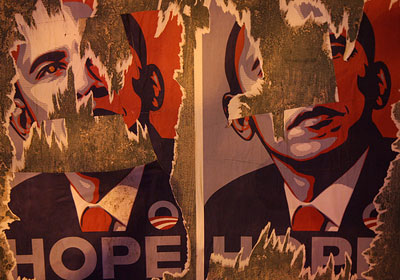
The Twin Frauds of Obama
December 4, 2009
Goldman Sachs senior executives are arming themselves with New York gun permits, according to Alice Schroeder on Bloomberg.com. The banksters “are now equipped to defend themselves if there is a populist uprising against the bank.”
One can understand why the banksters are worried. The company, now known as Gold Sacks, has a large responsibility for the financial crisis and the fraudulent “securities” that wrecked the world economy and Americans’ pensions. A former Gold Sachs CEO had control of the US Treasury during the Bush regime from which he diverted $750 billion to bail out the banks, thus supplying them with free capital. Gold Sachs made $27,000 million during the first three quarters of 2009 and is paying out massive bonuses, leaving the busted taxpayers with the debt and interest charges.
Little wonder the US can’t afford health care for the uninsured and unemployed. It is far more important to finance multi-million dollar bonuses for investment bankers. I mean, what would we do without capitalism?
Of course, it is not really capitalism. It is an oligarchy or a financial plutocracy.
In a failed state, the government’s priorities are totally separate from those of the people. The US can’t afford health care or a bailout for jobless homeowners, but it can afford a pointless war and multi-million dollar bonuses for banksters who wrecked the economy.
Millions of laid-off workers lost their health insurance subsidies on December 1, the day President Obama announced a $30 billion “surge” in Afghanistan.
The expensive “surge” came 24 hours after the Detroit Free Press published a 127-page supplement of home foreclosures in its metro area. In Michigan 48 per cent of mortgages are on properties that are worth less than the loan, according to a report from First American CoreLogic.
As bad as it is in Michigan, the state ranks seventh in foreclosures, so six states are in even more dire straits.
Why does President Obama think the US can afford a war in Afghanistan when the US economy is falling apart? Massive joblessness. Massive homelessness. Millions of Americans without medical care.
The additional $30 billion for the war comes on top of the $65 billion already appropriated for the year. These appropriations are always fattened with supplementary appropriations. The true cost is well in excess of $100,000,000,000.
Whose going to pay for it? Democratic Representative David Obey, chairman of the House Appropriations Committee proposes to raise income taxes on everyone earning more than $30,000. This is called “trickle-up” economics. You tax the little guy and give the money to the armaments companies.
There was a time when Democratic presidents represented the little man, and Republicans represented business. Today both parties represent the moneyed interests. On December 3 at the jobs summit with business leaders, Obama said, “We don’t have enough public dollars to fill the hole of private dollars that was created as a consequence of the crisis.”
In other words, all the public’s money has been spent on the banks and the wars.
Despite Democratic majorities in the House and Senate and the ease with which Obama won the presidential election over McCain/Palin, the Democratic Party has totally collapsed. The Democrats have abandoned every constituency. Democrats have discarded the American people. Democrats, in pursuit of campaign contributions, represent the moneyed interests on Wall Street, the munitions companies, the insurance companies, the agri-businesses that have destroyed independent farmers, despoilers of the environment, unaccountable police, and the builders of detention centers. The exception is Rep. Dennis Kucinich.
The Democrats have become brownshirt Republicans.
The American people, except for the one percent of super-rich, have been abandoned.
Obama had a different message during the presidential campaign. On May 4, 2008, he went to Elkhart, Indiana, to sympathize with the unemployed. On February 9, 2009, just after his inauguration, he returned to Elkhart to say:
“You know, we tend to take the measure of the economic crisis we face in numbers and statistics. But when we say we’ve lost 3.6 million jobs since this recession began – nearly 600,000 in the past month alone; when we say that this area has lost jobs faster than anywhere else in America, with an unemployment rate over 15 percent; when we talk about layoffs at companies like Monaco Coach, Keystone RV, and Pilgrim International – companies that have sustained this community for years – we’re talking about Ed Neufeldt and people like him all across this country.
“We’re talking about folks who’ve lost their livelihood and don’t know what will take its place. Parents who’ve lost their health care and lie awake nights praying the kids don’t get sick. Families who’ve lost the home that was their corner of the American dream. Young people who put that college acceptance letter back in the envelope because they just can’t afford it.
“That’s what those numbers and statistics mean. That is the true measure of this economic crisis. Those are the stories I heard when I came here to Elkhart six months ago and that I have carried with me every day since. I promised you back then that if were elected President, I would do everything I could to help this community recover. And that’s why I’ve come back today – to tell you how I intend to keep that promise.”
What’s the story in Elkhart 9 months after President Obama reaffirms his promise? “Long-term unemployed face dwindling options.”
Lawrie Covey, 58, has been out of work for two years. “I can’t even get a job cleaning rooms at a local motel.” Her son, who was night shift foreman for a local manufacturer and who lost his job after eight years, was splitting the rent. Winter is upon them, and the heating bill is rising. Their transportation is 20 years old and needs a new radiator. Both her and her son’s unemployment benefits have run out. Lawrie Covey has fallen back on her experience growing up on a firm. She is raising chickens and picking wild mushrooms and has a garden. If she makes it through the winter, she hopes to get a couple of baby pigs to raise to see them through the next year.
Lawrie Covey, to whom President Obama made a promise could just as well be an Afghan peasant. She doesn’t count any more than the thousands of Afghans who have been murdered in their sleep by US air strikes on “terrorists.”
She voted for a president who spent all the money on wars based in lies and deceptions and on Gold Sacks, the richest institution in the world.
Obama is loading up the poor with enormous debts that imply hyperinflation in order to make Gold Sacks too heavy to lift and in order to reward the munitions industry for its service to world peace and American hegemony.
Paul Craig Roberts was Assistant Secretary of the Treasury in the Reagan administration. He is coauthor of The Tyranny of Good Intentions. His new book, How the Economy was Lost, will be published next month by AK Press / CounterPunch. He can be reached at: PaulCraigRoberts@yahoo.com
Gaza Freedom March less than one month away
Press Release, Gaza Freedom March, 4 December 2009
The Gaza Freedom March that will take place in Gaza on 31 December is an historic initiative to break the siege that has imprisoned the 1.5 million people who live there. Conceived in the spirit of Mahatma Gandhi, Nelson Mandela and nonviolent resistance to injustice worldwide, the march will gather people from all over the world to march — hand in hand — with the people of Gaza to demand that the Israelis open the borders.
Marking the one-year anniversary of the December 2008 Israeli invasion that left more than 1,400 dead, this is a grassroots global response to the inaction on the part of world leaders and institutions. More than 1,000 international delegates from 42 countries have already signed up and more are signing on every day.
Participants include Pulitzer Prize winning author Alice Walker, leading Syrian comedian Duraid Lahham, French Senator Alima Boumediene-Thiery, autthor and Filipino Parliament member Walden Bello, former European Parliamentarians Luisa Morgantini from Italy and Eva Quistorp from Germany, President of the US Center for Constitutional Rights Attorney Michael Ratner, Japanese former Ambassador to Lebanon Naoto Amaki, French hip-hop artists Ministere des Affaires Populaires, and 85-year-old Holocaust survivor Hedy Epstein.
We also have families of three generations, doctors, lawyers, diplomats, 70 students, an interfaith group that includes rabbis, priests and imams, a women’s delegation, a Jewish contingent, a veterans group and Palestinians born overseas who have never seen their families in Gaza.
The international delegates will enter Gaza via Egypt during the last week of December. In the morning 31 December, they will join Palestinians in a nonviolent march from northern Gaza to the Erez/Israeli border. On the Israeli side of the Erez border will be a gathering of Palestinians and Jews who are also calling on the Israeli government to open the border.
Inside Gaza, excitement is growing. Representatives of all aspects of civil society, including students, professors, refugee groups, unions, women’s organizations, nongovernmental organizations, have been busy organizing and estimate that at least 50,000 Palestinians will participate. People from the different sectors will march in their uniforms — fishermen, doctors, students, farmers, etc. Local Palestinian rappers, hip-hop bands and dabke dancers will perform on mobile stages.
Related Links
There Is No ‘Consensus’ On Global Warming
By Prof Richard S. Lindzen – Wall Street Journal – 2006-06-26
 According to Al Gore’s new film “An Inconvenient Truth,” we’re in for “a planetary emergency”: melting ice sheets, huge increases in sea levels, more and stronger hurricanes and invasions of tropical disease, among other cataclysms — unless we change the way we live now.
Bill Clinton has become the latest evangelist for Mr. Gore’s gospel, proclaiming that current weather events show that he and Mr. Gore were right about global warming, and we are all suffering the consequences of President Bush’s obtuseness on the matter. And why not? Mr. Gore assures us that “the debate in the scientific community is over.”
That statement, which Mr. Gore made in an interview with George Stephanopoulos on ABC, ought to have been followed by an asterisk. What exactly is this debate that Mr. Gore is referring to? Is there really a scientific community that is debating all these issues and then somehow agreeing in unison? Far from such a thing being over, it has never been clear to me what this “debate” actually is in the first place.
The media rarely help, of course. When Newsweek featured global warming in a 1988 issue, it was claimed that all scientists agreed. Periodically thereafter it was revealed that although there had been lingering doubts beforehand, now all scientists did indeed agree. Even Mr. Gore qualified his statement on ABC only a few minutes after he made it, clarifying things in an important way. When Mr. Stephanopoulos confronted Mr. Gore with the fact that the best estimates of rising sea levels are far less dire than he suggests in his movie, Mr. Gore defended his claims by noting that scientists “don’t have any models that give them a high level of confidence” one way or the other and went on to claim — in his defense — that scientists “don’t know… They just don’t know.”
So, presumably, those scientists do not belong to the “consensus.” Yet their research is forced, whether the evidence supports it or not, into Mr. Gore’s preferred global-warming template — namely, shrill alarmism. To believe it requires that one ignore the truly inconvenient facts. To take the issue of rising sea levels, these include: that the Arctic was as warm or warmer in 1940; that icebergs have been known since time immemorial; that the evidence so far suggests that the Greenland ice sheet is actually growing on average. A likely result of all this is increased pressure pushing ice off the coastal perimeter of that country, which is depicted so ominously in Mr. Gore’s movie. In the absence of factual context, these images are perhaps dire or alarming.
They are less so otherwise. Alpine glaciers have been retreating since the early 19th century, and were advancing for several centuries before that. Since about 1970, many of the glaciers have stopped retreating and some are now advancing again. And, frankly, we don’t know why.
The other elements of the global-warming scare scenario are predicated on similar oversights. Malaria, claimed as a byproduct of warming, was once common in Michigan and Siberia and remains common in Siberia — mosquitoes don’t require tropical warmth. Hurricanes, too, vary on multidecadal time scales; sea-surface temperature is likely to be an important factor. This temperature, itself, varies on multidecadal time scales. However, questions concerning the origin of the relevant sea-surface temperatures and the nature of trends in hurricane intensity are being hotly argued within the profession.
Even among those arguing, there is general agreement that we can’t attribute any particular hurricane to global warming. To be sure, there is one exception, Greg Holland of the National Center for Atmospheric Research in Boulder, Colo., who argues that it must be global warming because he can’t think of anything else. While arguments like these, based on lassitude, are becoming rather common in climate assessments, such claims, given the primitive state of weather and climate science, are hardly compelling.
A general characteristic of Mr. Gore’s approach is to assiduously ignore the fact that the earth and its climate are dynamic; they are always changing even without any external forcing. To treat all change as something to fear is bad enough; to do so in order to exploit that fear is much worse. Regardless, these items are clearly not issues over which debate is ended — at least not in terms of the actual science.
A clearer claim as to what debate has ended is provided by the environmental journalist Gregg Easterbrook. He concludes that the scientific community now agrees that significant warming is occurring, and that there is clear evidence of human influences on the climate system. This is still a most peculiar claim. At some level, it has never been widely contested. Most of the climate community has agreed since 1988 that global mean temperatures have increased on the order of one degree Fahrenheit over the past century, having risen significantly from about 1919 to 1940, decreased between 1940 and the early ’70s, increased again until the ’90s, and remaining essentially flat since 1998.
There is also little disagreement that levels of carbon dioxide in the atmosphere have risen from about 280 ppmv (parts per million by volume) in the 19th century to about 387 ppmv today. Finally, there has been no question whatsoever that carbon dioxide is an infrared absorber (i.e., a greenhouse gas — albeit a minor one), and its increase should theoretically contribute to warming. Indeed, if all else were kept equal, the increase in carbon dioxide should have led to somewhat more warming than has been observed, assuming that the small observed increase was in fact due to increasing carbon dioxide rather than a natural fluctuation in the climate system. Although no cause for alarm rests on this issue, there has been an intense effort to claim that the theoretically expected contribution from additional carbon dioxide has actually been detected.
Given that we do not understand the natural internal variability of climate change, this task is currently impossible. Nevertheless there has been a persistent effort to suggest otherwise, and with surprising impact. Thus, although the conflicted state of the affair was accurately presented in the 1996 text of the Intergovernmental Panel on Climate Change (IPCC), the infamous “summary for policy makers” reported ambiguously that “The balance of evidence suggests a discernible human influence on global climate.” This sufficed as the smoking gun for Kyoto.
The next IPCC report again described the problems surrounding what has become known as the attribution issue: that is, to explain what mechanisms are responsible for observed changes in climate. Some deployed the lassitude argument — e.g., we can’t think of an alternative — to support human attribution. But the “summary for policy makers” claimed in a manner largely unrelated to the actual text of the report that “In the light of new evidence and taking into account the remaining uncertainties, most of the observed warming over the last 50 years is likely to have been due to the increase in greenhouse gas concentrations.”
In a similar vein, the National Academy of Sciences issued a brief (15-page) report responding to questions from the White House. It again enumerated the difficulties with attribution, but again the report was preceded by a front end that ambiguously claimed that “The changes observed over the last several decades are likely mostly due to human activities, but we cannot rule out that some significant part of these changes is also a reflection of natural variability.” This was sufficient for CNN’s Michelle Mitchell to presciently declare that the report represented a “unanimous decision that global warming is real, is getting worse and is due to man. There is no wiggle room.” Well, no.
More recently, a study in the journal Science by the social scientist Nancy Oreskes claimed that a search of the ISI Web of Knowledge Database for the years 1993 to 2003 under the key words “global climate change” produced 928 articles, all of whose abstracts supported what she referred to as the consensus view. A British social scientist, Benny Peiser, checked her procedure and found that only 913 of the 928 articles had abstracts at all, and that only 13 of the remaining 913 explicitly endorsed the so-called consensus view. Several actually opposed it.
Even more recently, the Climate Change Science Program, the Bush administration’s coordinating agency for global-warming research, declared it had found “clear evidence of human influences on the climate system.” This, for Mr. Easterbrook, meant: “Case closed.” What exactly was this evidence? The models imply that greenhouse warming should impact atmospheric temperatures more than surface temperatures, and yet satellite data showed no warming in the atmosphere since 1979. The report showed that selective corrections to the atmospheric data could lead to some warming, thus reducing the conflict between observations and models descriptions of what greenhouse warming should look like. That, to me, means the case is still very much open.
So what, then, is one to make of this alleged debate? I would suggest at least three points.
First, nonscientists generally do not want to bother with understanding the science. Claims of consensus relieve policy types, environmental advocates and politicians of any need to do so. Such claims also serve to intimidate the public and even scientists — especially those outside the area of climate dynamics.
Secondly, given that the question of human attribution largely cannot be resolved, its use in promoting visions of disaster constitutes nothing so much as a bait-and-switch scam. That is an inauspicious beginning to what Mr. Gore claims is not a political issue but a “moral” crusade.
Lastly, there is a clear attempt to establish truth not by scientific methods but by perpetual repetition. An earlier attempt at this was accompanied by tragedy. Perhaps Marx was right. This time around we may have farce — if we’re lucky.
Richard S. Lindzen is the Alfred P. Sloan Professor of Atmospheric Science at MIT.
Germany Almost Has World War One Reparations Paid Off
Germany is just 10 short months away from finally paying off one of the most onerous post-war reparations debts in human history, its massive war debt from the Treaty of Versailles.
The German Empire entered World War One in 1914 on the side of Austro-Hungary. In June 1919 they were forced to sign the Treaty of Versailles, ceding West Prussia to Poland and Alsace-Lorraine to France. In addition, Germany was forced to pay for all damages suffered by every Allied state during the war, roughly 100 million kilograms of gold.
With hard currency flowing out of the country en masse to pay the reparations, post-war Germany’s Weimar Republic saw massive hyperinflation and a huge drop in standard of living. Resentment of the Treaty of Versailles and the economic strife the reparations brought led to growing nationalism and eventually World War Two.
But Germany’s reparation debt came back after World World Two, and was quickly frozen again when the nation was split into West and East Germany. Following the 1990 reunification, the debt was again renewed and, several generations and several regime changes later, Germany was expected to continue paying for the war.
The good news is the debt is finally almost paid off. Another 56 million Euros are owed, and it is expected that the last payment will be made on October 3, 2010.
Shattering “Israel’s” image of ‘democracy’
In the Negev, an area targeted for so-called ‘development’, lies the Israel that its government does not want to be seen
by Ben White, guardian.co.uk, Thursday 3 December 2009
A struggle over land, home demolitions, and an Israeli government working with Jewish agencies to “develop” the land for the benefit of one group at the expense of another. It could be a picture of the illegal settlements in the occupied West Bank, but in fact, it’s inside Israel – in the Negev.
The Negev, or al-Naqab in Arabic, is an area that since the inception of the state has been targeted by Israeli governments, along with agencies like the Jewish National Fund (JNF), for so-called “development”.
This investment in the country’s periphery is characterised by systematic discrimination against the Negev’s Bedouin population, many of whom live in “unrecognised” villages or townships. Recent developments bring these policies into sharper focus, as well as pointing to fundamental problems with Israel’s image as “the Middle East’s only democracy”.
First, three vital clinics serving Bedouin women and children have been shut down, with the result that the nearest equivalent facilities are now hours away. The official reason is a shortage of staff, but this does not sit well with the severity of the health problem among these Bedouin children, where the infant mortality rate is more than three times higher than in the Israeli Jewish community.
Second, in mid-November the Knesset passed an amendment to prevent around 25,000 Bedouins from voting for their mayor and regional councillors. Elections had already been postponed for two years, but now the law means “that as long as the minister of interior deems the residents not ready for elections, the elections will be postponed”.
Finally, six weeks ago, lawyers acting on behalf of the Bedouins who live in the unrecognised village of Umm al-Hieran appealed against a previous court decision ordering the eviction of the community’s residents.
Ironically, this village had been established by the Israeli military in the 1950s as part of a wider-scale forced relocation of Bedouins from territory intended for Jewish settlement. Now they are once again being targeted for removal, labelled “intruders”, to make way for the planned creation of a Jewish town, Hiran.
Meanwhile, there have been reports about a Bedouin “mini-intifada” in the Negev, with Israeli military personnel targeted on the roads near a key base. Such fears are not new: a Haaretz article in 2004 predicted that a “Bedouin intifada” was “on the way” – a conclusion supposedly shared by senior government and military leaders.
What then, is the wider context? As a Human Rights Watch report put it last year, “the state’s motives for these discriminatory, exclusionary and punitive policies can be elicited from policy documents and official rhetoric”. The Israeli state’s aim: “maximising its control over Negev land and increasing the Jewish population in the area for strategic, economic and demographic reasons”. Professor Oren Yifatchel of Ben-Gurion University has put it bluntly: “the government wants to de-Arabise the land”.
This is the common thread that runs through Israel’s approach to the Negev since 1948: from physical expulsions and the legislation used to exclude communities from official recognition, through to budget allocations, creating Bedouin townships, and the flipside of “development” – demolitions.
In 2003, then-PM Ariel Sharon announced a new initiative calling “for the establishment of some 30 new towns” in the Galilee and Negev. One of the PM’s advisers at the time, Uzi Keren, told a radio station that it was important to locate the new towns in “the places that are important to the state, that is, for Jewish settlement”, in order to “strengthen settlement in areas sparse in Jewish population”.
One of the groups helping the state is the Jewish Agency for Israel. A few years ago, the organisation’s foreign media liaison officer was quoted on the JTA news website as describing the goal of the joint venture with the Israeli government as “a Jewish majority in all parts of Israel”.
Another key organisation involved is the Jewish National Fund. Its UK website, for example, talks about how “the future of Israel lies in the Negev” and says the goal of the “major initiative” known as “Blueprint Negev” is to “revitalise Israel’s southern region”.
In January, the chief executive of JNF in the US, Russell Robinson, expressed his concern that “if we don’t get 500,000 people to move to the Negev in the next five years, we’re going to lose it”. To what – or who – went unsaid. In 2005, Robinson was clearer about the consequences of the JNF’s “project to remake” the demographics: “such an influx” of Jews would mean “a certain amount of displacement” for the Bedouin.
Robinson actually tried to present this as helping tackle Bedouin unemployment. With their slick focus on “environmentally friendly” initiatives and helping the disadvantaged Arabs, groups like the JNF do their best to make sure that scenes like this go unnoticed.
This is the Israel that its government and propagandists do not want to be seen, the Israel where non-Jews are a demographic “threat”, and the state works with agencies (often funded by western donors) to “secure” a Jewish majority. It is the reality behind the myth of Israel as the region’s only democracy, and away from the weekly twists and turns of the peace process, such policies shed light on the root problem preventing a resolution of the conflict just as well as, or better than, the number of housing units in Gilo.
Featured Video

AIDS Inc. by Gary Null (2007)
or go to
Aletho News Archives – Video-Images
From the Archives
Clash of Civilization, Iran Part II
By Jamal Kanj – Intifada-Palestine.com – January 14, 2011
Israel’s survival kit is: perpetuate conflict, insecurity to rationalize collective hate and finally playing victim.
Devoid of conflict, Israel implodes internally; without hate, Zionism loses its justification; and playing eternal victim to continue blackmailing the West. Absence of this holy trinity, Israel ceases to exist.
From its inception, the house of Zion has mastered exploiting adversarial powers to advance Israel’s cause. For instance, their influence over the Democratic Party in the US began with President Truman’s bid for 2nd term election in 1948.
Responding to strong opposition from Secretary of State General George Marshall and Department experts urging against recognition of Israel, President Truman replied: “I’m sorry gentlemen but I have to answer to hundreds of thousands [Jewish voters] who are anxious for the success of Zionism. I do not have hundreds of thousands of [voting] Arabs among my constituents”
Zionists influence over liberal American politics was matched with the doctrinal school of Conservative theoreticians aligning the Republican Party’s platform with Israel’s objectives. The Neoconservative Zionists, coined Zioncons, invented the “Clash of Civilization” concept to fight Israel’s wars. … continue
Blog Roll
 Aletho News
- Merck Virologists Admitted to Falsely Certifying Vaccine Efficacy
- Mandatory Folic Acid for every man, woman & child
- Pro-Palestine protesters arrested outside UK’s ruling Labour Conference in Liverpool
- Mauritius denies landing permit to flight from Israel, forcing cancellation: Tour operator
- Israeli finance minister calls for genocidal war on West Bank, annexation of south Lebanon
- 12 Things Your Psychiatrist Was Trained Not to Tell You
- From Unipolar Universalism to Multipolar Civilizational Distinctiveness
- RSF military group defects, joins Sudanese army: State media
- Ireland goalkeeper refuses to play ‘Israel’ as squad weighs boycott
- China pushes back against US on Cuba, Iran
- If Americans Knew
- Israel forces Gazans to live in constant peril – Daily Update
- Deconstructing Netanyahu’s pants-on-fire UN rant – Daily Update
- Trump betrayed voters with his campaign lies and prioritized a foreign country once he took office
- Netanyahu calls Israel’s war in Gaza ‘opposite of genocide’ in UN speech to near-empty hall
- Settler Kidnappings: Torture, Sexual Abuse and Terrorisation of Palestinian Abductees as Israel Deepens Annexation of West Bank
- Gaza winter nears as 162,000 tents become unusable, raising fears of humanitarian crisis
- Netanyahu says, “It’s the opposite of genocide”; UN says Gaza economy is world’s ‘most severe crisis on record’ – Daily Update
- Israel’s US-Backed Assault on Gaza Has Created the ‘World’s Most Severe Economic Crisis on Record’: UN
- ‘Protecting U.S. Citizens’… From Israel
- ‘This is where I live now, the back of a truck’: a day in the life of a grandmother in Gaza
- No Tricks Zone
- New Study: Earth And Venus Surface Warmth Largely Explained By Convection And Lapse Rate, Not CO2 Or Radiation
- 2025 Nature Paper Claiming Worsening Global Drought Gets RETRACTED …Heavily Flawed
- New Study: ‘Global Drought Shows No Detectable Recent Acceleration Under Climate Warming’
- Economic Masterminds: German Socialists Suggest Taxing Productivity Gains Stemming From Using AI
- The South China Sea Has Not Been Cooperating With The Climate Change Narrative
- Energy Crisis: Germany Enters Heating Season With Historically Low Gas Reserve Fill Levels
- New Study: The Antarctic Ice Sheet Gained Mass From 2020-2024 Due To Staggering Snow And Ice Accumulation
- Study: Ocean Heating Rates From Thousands Of Years Ago ‘Dwarf’ Modern Ocean Heating Rates
- Climate Extremists Target, Attack Large-Scale Power Grid Infrastructure In Germany!
- New Study: Antarctic Ice Melt Has Contributed Less Than 1 Centimeter To Sea Level Rise In The Last 30 Years

