US must make security deal with Russia – Hungary
RT | May 23, 2023
An agreement between the US and Russia is the only thing that can end the conflict in Ukraine, Hungarian Prime Minister Viktor Orban stated on Monday. Orban has repeatedly accused EU leaders of serving American, rather than European, interests by continuing to bankroll Kiev.
Speaking at the Qatar Economic Forum in Doha on Tuesday, Orban reiterated his position that Ukraine cannot win on the battlefield, and that Kiev and its Western backers must pursue peace talks with Russia.
“First we should have a ceasefire,” he said. “Then let’s talk about the new security architecture of the European continent.”
“The only peace agreement that could close this whole conflict is if it is between Russia and the United States,” he elaborated. “What is at stake is the future security of Europe. It’s obvious that without the US there is no security architecture for Europe, and now the war can only be stopped if the Russians can make an agreement with the United States.”
“As a European I am not happy with that,” he added. “But this is the only way out.”
Throughout the conflict, Orban has repeatedly spoken out against the West’s twin policies of military aid to Kiev and sanctions on Moscow, arguing that the former risks escalating the conflict to a global war and the latter harms Europe’s economy more than Russia’s.
The Hungarian prime minister has also argued that only Washington has the power to pressure Kiev into peace talks, and that decisions made in Brussels “reflect American interests more often than European ones.”
With the US dragging Europe into a conflict it cannot win, Orban has suggested that “the solution would be a European NATO” without the US as a member.
Hungary is currently blocking a €500 million ($540 million) EU military aid package for Ukraine. Apart from his long-standing opposition to escalating the conflict, Orban cited Ukraine’s sanctioning of a Hungarian bank as a reason for the hold up.
“If a country like Ukraine would like to get our financial support, they can’t put our companies on a blacklist,” he said on Tuesday. “If you need our money, please respect us.”
Beijing Banning Micron Means China Has Mastered Chip-Making
By Ekaterina Blinova – Sputnik – 22.05.2023
China has slapped a ban on US chipmaker Micron, prohibiting it from selling to Chinese companies involved in key infrastructure projects. Beijing has mirrored Washington’s sanctions on the People’s Republic’s hi-tech technology, Asia-Pacific consultant Thomas W. Pauken told Sputnik, adding that there’s more to the development than meets the eye.
The Cyberspace Administration of China (CAC) announced on May 21, that a cybersecurity review indicated Micron Technology’s products “have relatively serious cybersecurity risks, which pose significant security risks to the country’s critical information infrastructure supply chain and would affect national security.” Thus, the CAC banned the US chipmaker from participating in the People’s Republic’s domestic critical infrastructural projects. In response, the US Commerce Department expressed its opposition to the restrictions, insisting that they “have no basis in fact.” Micron’s shares plummeted roughly 6% on Monday, given that the American company used to derive over 10% of its revenue from the People’s Republic.
“It’s rather interesting that the Washington side may be shocked or surprised by this news,” said Thomas W. Pauken II, the author of US vs China: From Trade War to Reciprocal Deal, consultant on Asia-Pacific affairs, and geopolitical commentator. “However, they have taken similar measures themselves to stop Chinese semiconductors and Chinese chips manufacturers or companies that are connected with the chips manufacturing and semiconductor manufacturing to be more involved with the supply chains in the United States as well. So this is not a case where there’s a shock or a surprise announcement. It’s actually basically China doing the same thing that the US has been doing to China.”
US President Joe Biden speaks about how the Bipartisan Infrastructure Law will rebuild the US and the progress made since he signed the bill into law, in the South Court
Since October 2022, Washington has imposed sweeping export curbs on advanced chips and chip-making equipment to China, trying to cut off the nation’s access to critical technology. Prior to that, under the Trump administration, the US and its Western allies kicked off nothing short of a crusade against the People’s Republic’s telecom giants, including its flagship Huawei, citing “security” concerns.
“This is a very simple response for Beijing to make and say, ‘Well, has the US not acted similarly to what we’ve been doing?'” noted Pauken. “So it would be hypocritical on the US side to criticize Beijing for taking actions that are similar to Washington’s actions. This is hypocrisy at its finest, in regards to Washington and how they’re complaining and criticizing China when they’re doing the exact same thing that they’re criticizing China for. It’s laughable. It’s just absurd for them to make such an argument when they’re doing the same thing.”
The Asia-Pacific consultant suggested that Micron had not been caught off guard: Pauken revealed that when he visited Taiwan last month, he learned from his source that the Micron senior executive in the Kaohsiung office had started laying off employees in April.
As per Pauken, plausibly, the Taiwanese Micron branch had anticipated these instructions, so it could have been the case that they were alerted by Beijing that there was an investigation and they likely realized that the chances of continuing to sell their chip technologies to the mainland were slim.
They had already started to do layoffs even before this announcement happened, the commentator noted. Nonetheless, even if they were prepared for the CAC announcement, it had a devastating impact: “From what I heard, the layoffs in the Taiwan offices were very massive,” Pauken emphasized. “Definitely it’s a major problem for Micron.”
However, there is more to the development than meets the eye, continued Pauken: according to him, it clearly indicates that Beijing has made considerable advancements in chip-making despite the US trying to contain the country’s technological rise.
“You also have to think about this from a strategic level,” the author said. “There’s no way China would have blocked any chips from Micron if it would cause extreme damage to the Chinese economy. Obviously, they have probably set up supply chains in place and have chips made in China that are maybe not equal in quality to Micron, but close enough so that they could handle the impact of no more Micron chips coming to China.”
“So what I’m getting at is that there’s no way Beijing took this announcement all of a sudden. They have prepared for it well in advance in anticipation that, of course, the US and Micron would complain. But they, of course, also took the right steps to protect their economy from being severely damaged by this announcement,” Pauken concluded.
China says it sees no point in dialogue with US amid sanctions
Press TV – May 22, 2023
China says it sees no reason to keep talking with the United States as long as it pursues a wholly disingenuous policy and continues to step up pressure on the country through sanctions.
“Where is the sincerity and sense of dialogue, when the US side talks about the need to maintain contacts only to use them as a means to put pressure on China and hamstring our country,” Chinese Foreign Ministry spokesperson Mao Ning told reporters in Beijing on Monday.
The Chinese official called on Washington to “immediately lift sanctions” against China.
“It is necessary to create a favorable atmosphere and favorable conditions for dialogue and contact,” Mao explained.
Beijing maintains “necessary contact” with Washington, she stated.
“The United States applies sanctions against individuals and organizations of the PRC,” Mao reiterated.
“China is strongly against such unilateral restrictions, which are unlawful. We have strictly set forth Beijing’s stance on this issue to the American side,” she added.
The Chinese spokesperson called on the United States to have the right understanding of China, meet it halfway and bring bilateral relations back on track.
China views its relations with the US under the three principles of mutual respect, peaceful coexistence and win-win cooperation as proposed by President Xi Jinping, she said.
China to US: Stop interfering in our internal affairs
Elsewhere in her remarks, Mao urged the United States to immediately stop interfering in China’s internal affairs.
“We urge the US to form a correct perception of China, stop interfering in China’s internal affairs and harming China’s sovereignty, security and development interests, and work with China to bring China-US relations back to the right track with concrete actions,” she added.
The spokeswoman made the remarks in response to US President Joe Biden suggesting that a shift in US-China relations could occur soon.
Biden said on Sunday during the Group of Seven (G7) summit in the Japanese city of Hiroshima, that he expected a thaw in Chinese-US relations in the near future.
“We should have an open hotline,” Biden stressed.
Biden has said he expects to see a “thaw” in US relations with Beijing, even as he concluded a G7 summit in Japan that made a concerted effort to counter alleged military and economic security threats from China.
The US president said in a news conference at the end of the three-day summit that talks between the two countries had shut down after a “silly balloon” carrying spying equipment flew over North America in February, before being shot down by the US military.
“Everything changed in terms of talking to one another. I think you’re gonna see that begin to thaw very shortly,” Biden said.
Biden added that his administration was considering lifting sanctions against Chinese Defence Minister Li Shangfu.
Beijing recently refused to agree to a meeting with US Defense Secretary Lloyd Austin when the two men attended the Shangri-La Dialogue security forum in Singapore next month due to the sanctions.
US officials had previously said privately that the Biden administration would not remove the sanctions.
Biden: US stands by ‘one China’ policy
Biden reiterated at the news conference that the US stood by the “one China” policy, which recognizes Beijing as the sole government of China, and Washington did not support any move by the self-ruled Taiwan to declare independence.
China has sovereignty over Taiwan. The US does not recognize Taiwan as an independent country and officially supports the “One China” policy, but regularly oversteps its own principles. The island nation has become China’s most sensitive territorial issue and a major bone of contention with Washington.
Washington continues to antagonize Beijing by siding with Taipei’s secessionist administration, engaging in frequent military missions around the island, and serving as its largest weapons supplier.
Russia, China express ‘strong dissatisfaction’ with G7 communique
Press TV – May 20, 2023
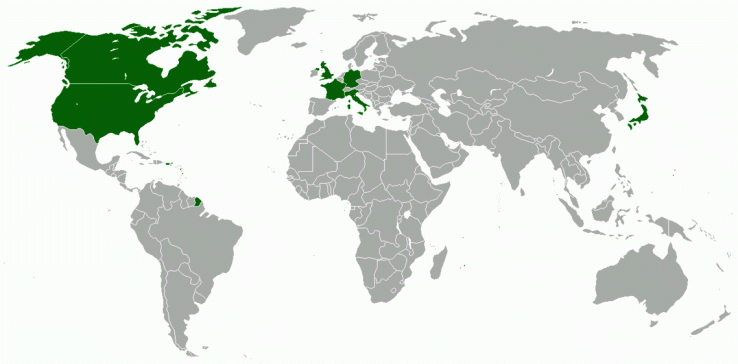
Russia and China have expressed “strong dissatisfaction” with the final statement issued at the end of the Group of Seven (G7) summit in the Japanese city of Hiroshima, a city that was destroyed by the US atomic bombing in 1945.
In a joint statement on Friday, which was revised on Saturday, the G7 — consisting of the United States, Japan, Germany, Britain, France, Canada and Italy — targeted both Russia and China with threats and disparaging remarks.
Russian Foreign Minister Sergei Lavrov said on Saturday that decisions taken at the G7 summit were aimed at the “double containment” of Russia and China.
Lavrov, in a televised conference, reiterated Moscow’s viewpoint that the West is using Ukraine as a tool to inflict a strategic defeat on Russia.
“The task was set loudly and openly – to defeat Russia on the battlefield, but not to stop there, but to eliminate it as a geopolitical competitor,” Lavrov noted.
“Look at the decisions that are being discussed and adopted today in Hiroshima at G7 summit of the Seven, and which are aimed at the double containment of Russia and China,” Russia’s top diplomat stated.
Lavrov said Moscow enjoyed the support of its many allies and Russia will weather the hardships despite the West’s efforts to put pressure on countries to cut trade and economic ties with the Russian nation.
Russian President Vladimir Putin said on Friday that the West was trying to break Russia up into dozens of different states.
The US-led West is driving a wedge between different ethnic and national groups in Russia and breaking the country up into dozens of different states, Putin warned.
Beijing, in a similar approach, showed its strong disapproval of the G7 for smearing and attacking the Chinese nation.
The Chinese Foreign Ministry said on Saturday that it has lodged stern representations to the G7 summit’s host, Japan, and other relevant parties after the group criticized Chinese policies in regard to Hong Kong, Xinjiang and Tibet.
The group advocates “promoting a peaceful, stable and prosperous world,” but what it does is hinder international peace, undermine regional stability and curb other countries’ development, the statement said, adding that it simply shows how little international credibility means to the G7.
The Chinese Foreign Ministry’s statement pointed out that Taiwan is China’s Taiwan and resolving the question is a matter for the Chinese. It reiterated that the one-China principle is the solid anchor for peace and stability across the Taiwan Strait.
Despite emphasizing on cross-Strait peace, G7 said nothing about the need to oppose “Taiwan independence,” which in effect constitutes connivance and support for “Taiwan independence” forces, and will only result in a serious impact on cross-Straits peace and stability, according to the statement.
The Chinese statement said no one should underestimate the determination, resolve and capability of the Chinese people in safeguarding China’s sovereignty and territorial integrity.
The issues related to Hong Kong, Xinjiang and Tibet are purely China’s internal affairs and China firmly opposes interference by any external force in those affairs under the pretext of human rights, the statement noted.
It urged the G7 to stop pointing fingers at China on Hong Kong, Xinjiang and Tibet and take a hard look at their own history and human rights record.
The statement reminded the G7 nations that the East China Sea and the South China Sea have remained overall stable, and it called for other countries to respect the regional countries’ efforts to uphold peace and stability and stop using maritime issues to drive a wedge between regional countries and incite bloc confrontation.
The statement also noted that the massive unilateral sanctions slapped by the United States and acts of decoupling and disrupting industrial and supply chains make the US the real coercer that politicizes and weaponizes economic and trade relations. It urged the G7 not to become an accomplice in the Americans’ economic coercion.
China is the only nation among the five nuclear weapon states that pledged “no first use” of nuclear weapons and always kept its nuclear capabilities at the minimum level required by national security, the statement noted, adding that China’s position on the matter should not be distorted or denigrated.
As a responsible major country, China firmly upholds the UN-centered international system, the international order underpinned by international law and the basic norms governing international relations built around the purposes and principles of the UN Charter, it said, adding that the Chinese nation will never give in to the so-called rules imposed by the few.
“The international community does not and will not accept the G7-dominated Western rules that seek to divide the world based on ideologies and values, still less will it succumb to the rules of exclusive small blocs designed to serve ‘America-first’ and the vested interests of the few,” the statement said.
The Chinese Foreign Ministry urged the G7 to stop engaging in closed and exclusive “small circles,” stop containing and suppressing other countries, stop creating and provoking confrontation and return to the right path of dialogue and cooperation.
Foreign interference in Arab world must come to an end: Arab leaders
The Cradle | May 20, 2023
At the conclusion of the 32nd annual Arab League summit hosted by Saudi Arabia on 19 May, the regional bloc issued a joint declaration calling for an end to foreign interference in the region and reaffirming their support for Palestinian liberation.
“We call for stopping foreign interference in the domestic affairs of Arab countries and categorically reject all support for the formation of armed groups and militias outside the scope of state institutions,” the joint statement reads.
It also stressed that the Israeli occupation of Palestine remains “one of the key factors of stability in the region” and condemns “in the strongest terms the practices and violations targeting Palestinians in their lives, property and existence” while calling for the formation of a sovereign Palestinian state “on the 1967 borders with East Jerusalem as its capital.”
The statement goes on to hail the decision made by regional leaders to welcome Syria back into the Arab League.
“We stress the importance of continuing to intensify pan-Arab efforts aimed at helping Syria overcome its crisis in line with the joint Arab efforts and brotherly relations that connect all Arab peoples,” the statement reads.
During his closing remarks at the end of Friday’s summit, Saudi Crown Prince Mohammed bin Salman (MbS) stressed that the region must not turn into a conflict zone and reassured attendants that “world peace” was near.
He also hoped Syria’s “return to the Arab League leads to the end of its crisis.”
Earlier in the day, MbS warmly welcomed Syrian President Bashar al-Assad to the summit’s venue, officially marking the end of Syria’s isolation within West Asia after 12 years of a US-backed war.
“I would like to loudly welcome Syria back to its seat among its brothers,” Algerian Prime Minister Ayman Benabderrahmane said in the opening speech of the summit.
“Today we are facing an opportunity to change the international situation that appears in the form of a unipolar world, a result of the dominance of the west, who lack all ethics and principles,” the Syrian president said during his speech.
“We stand together against the movement of darkness,” Assad added, referring to extremist armed groups that dominate the Syrian opposition, many of which have had the support of Arab League member states, including Saudi Arabia and Qatar.
An unexpected guest at Friday’s summit was Ukrainian President Volodymyr Zelensky, who arrived at the last minute in a French government jet to address those present in what regional observers called “an entertainment break.”
During his speech, the Ukrainian leader invoked the Arab world’s history of invasion and occupation by claiming his country “will never submit to any foreigners or colonizers.”
“Unfortunately, there are some in the world and here among you who turn a blind eye to those [prisoner of war] cages and illegal annexations,” Zelensky, an ally of the Israeli government, told the gathering of Arab leaders.
“I’m here so that everyone can take an honest look, no matter how hard the Russians try to influence, there must still be independence,” he added before departing for Japan to plead with G7 leaders for further military and financial assistance.
After meeting with Zelensky earlier on Friday, MbS spoke about “the kingdom’s readiness to continue mediating efforts between Russia and Ukraine,” adding he would “support all international efforts aimed at resolving the crisis politically in a way that contributes to achieving security.”
According to reports in Russian media, Zelensky was set to meet with a delegation from Moscow during his brief stay in Jeddah.
Bashar al-Assad’s full speech at the Arab League
The 2023 Arab League summit, officially the 32nd Ordinary Session of the Council of the League of Arab States at the Summit Level, is a meeting of heads of state and government of member states of the League of Arab States that took place in Jeddah, Saudi Arabia, on 19 May 2023. All countries were represented at this meeting, including Syria, which returned triumphantly after its membership was suspended in 2011.
Speech of Bashar al-Assad, President of the Syrian Arab Republic
Transcript:
Your Highness Prince Mohammed bin Salman, Crown Prince of the Kingdom of Saudi Arabia, Your Majesties, Highnesses, and Excellencies, Ladies and Gentlemen…
Where does one begin his speech when the dangers are no longer imminent, but realized? He begins with the hope that motivates achievement and work. And when ailments accumulate, a doctor can treat them individually, provided he addresses the underlying disease causing them.
Therefore, we must look for the main issues that threaten our future and produce our crises, so that we do not drown and drown future generations in dealing with the consequences rather than the causes. Threats contain risks and opportunities. Today, we are presented with an opportunity as the international situation changes, and a multipolar world appears as a result of the dominance of the West, which is devoid of principles, ethics, friends, and partners. It is a historic opportunity to reorganize our affairs with the least possible foreign intervention, which requires repositioning ourselves in this world that is shaping today to be an active participant in it, and investing in the positive atmosphere resulting from the reconciliations that preceded the summit and made the situation as it is today.
It is an opportunity to solidify our culture in the face of the impending collapse with modern liberalism that targets the innate human nature and strips people of their ethics and identity, and to define our Arab identity with its civilizational dimension, as it is falsely accused of racism and chauvinism in order to make it in conflict with its natural national, ethnic, and religious components, so that our societies die in their struggle within themselves, and not with others.
There are many too many topics that cannot be discussed for lack of time, and summits would not be enough to evoke them all… They do not begin with the crimes of the Zionist entity, rejected by Arabs, against the Palestinian resistance people, nor do they end with the danger of the Ottoman expansionist thought grafted with a deviant Muslim Brotherhood flavour ; and they are inseparable from the challenge of development as a top priority for our developing societies. Here comes the role of the Arab League as a natural platform for discussing and addressing various issues, with the condition of its working system being reviewed in its charter, internal system, and the development of its mechanisms in line with the times. Joint Arab action needs common visions, strategies and goals that we later turn into executive plans. It needs a unified poliicy, firm principles and clear mechanisms and controls. That is how we’ll be able to move from mere reaction to the anticipation of events. Then the Arab League will be a way out in case of siege, not a partner to it, and a refuge from aggression and not an enabler for it.
As for the issues that concern us daily, from Libya to Syria, passing through Yemen and Sudan, and many other issues in different regions, we cannot treat diseases by treating symptoms. All of these issues are the results of larger problems that have not been dealt with previously. To talk about some of them, we need to address the cracks that have arisen on the Arab scene during the past decade and restore the role of the Arab League as a healer of wounds, not a deepener of wounds. The most important thing is to leave internal affairs to their peoples, as they are capable of managing their own affairs, and our role is only to prevent external interference in their countries and assist them exclusively upon request.
As for Syria, its past, present, and future is Arabism, but it is the Arabism of belonging, not the Arabism of embrace [alliances], because the embraces are transient, while belonging is permanent. A person may move from one embrace to another for some reason, but it does not change his belonging. Those who change it are without belonging in the first place, and those who fall in the heart do not fade in the embrace. Syria is the heart of Arabism and in its heart.
Ladies and Gentlemen,
As we hold this summit in a turbulent world, hope is rising in light of the Arab-Arab rapprochment, and regional and international rapprochment, that culminated with this summit, which I hope will mark the beginning of a new phase of Arab action, for solidarity among us, for peace in our region, for development and prosperity instead of war and destruction.
In accordance with the allocated five minutes for speeches, I extend my sincere thanks to the heads of delegations who have expressed their deep sympathy with Syria, and I reciprocate their sentiments. I also thank the Custodian of the Two Holy Mosques for the significant role he has played and the intensive efforts he has made to enhance reconciliation in our region and for the success of this summit. I wish him, His Highness the Crown Prince, and the brotherly Saudi people, continued progress and prosperity.
Peace be upon you, and may the mercy of God and His blessings.
Translation: resistancenews.org
The US Is Receptive To Kissinger’s Suggestion To Revive Talks With China On A New Détente
BY ANDREW KORYBKO | MAY 19, 2023
Two new narratives were introduced into the West’s information ecosystem over the past week. The first concerns the need to adapt to multipolar processes by engaging more with the Global South, which was expressed by German Chancellor Olaf Scholz, former US National Security Council member Fiona Hill, and Goldman Sachs’ President of Global Affairs Jared Cohen all on the exact same day last Monday. The next narrative complemented this one and came two days later on Wednesday.
Global affairs guru Henry Kissinger’s lengthy interview with The Economist from late April was published on that day, in which he devoted considerable time explaining why the US should revive its talks with China on a New Détente that were unexpectedly derailed by February’s balloon incident. CNN then reported on that same day that “Biden administration looking at arranging high-profile visits to China by senior officials,” which suggests that it was briefed earlier about his proposal and heeded his advice.
The first narrative about engaging more with the Global South complements the second one about reviving talks with China on a New Détente in the sense that the former is one of the three prerequisites for successfully accomplishing the latter, at least according to how American policymakers likely view it. They want to signal that the US won’t voluntarily cede influence in the Global South to China, but instead plans to compete with it there via economic and diplomatic means.
This goal will be greatly advanced through a combination of pragmatic engagement with the Global South’s informal Indian leader, whose Prime Minister visits the US late next month, and coordinating between America’s “Build Back Better World” and the EU’s “Global Gateway” development initiatives. These subgoals also align with Kissinger’s suggestions about cooperating more closely with India as well as crafting an inspirational vision for this century (i.e. merging the West’s development initiatives).
The second prerequisite for successfully negotiating a New Détente with China upon the seemingly impending resumption of this process is to diplomatically displace its envisaged role in the Russian-Ukrainian peace process. In pursuit of this, the US wants to “de-Sinify” the scenario of a ceasefire after the end of Kiev’s NATO-backed counteroffensive, which explains its support of the African-led peace mission that was announced on Tuesday in between Monday and Wednesday’s new narratives.
What’s most interesting about this initiative is that it’s organized by the Brazzaville Foundation, whose French chairman Jean-Yves Olivier is known for his shadow diplomacy over the decades that was documented by Wikipedia. This suggests that their peace mission is secretly organized by France with the US’ tacit approval, if not jointly coordinated with it, which would advance their goal of diplomatically engaging with the Global South in parallel with “de-Sinifying” the Russian-Ukrainian peace process.
Both’s prospects would be bolstered by India’s participation in these efforts, which has its own interests in presenting itself to the world as a peace broker, especially throughout the course of its G20 chairmanship. These two prerequisites for enhancing the odds that the US successfully negotiates a New Détente with China concern the economic and diplomatic spheres respectively, while the third that’ll now be described deals with the military one.
“The US Is Rounding Up Allies Ahead Of A Possible War With China”, while “NATO’s Planned Liaison Office In Japan Will Accelerate The Expansion Of AUKUS+”, both of which will contribute to more effectively containing China in the Asia-Pacific. American policymakers apparently expect that the People’s Republic will accept this emerging regional military reality instead of it serving to preclude the resumption of their talks on a New Détente.
Not only that, but they seem to think that it could even give their side an edge of some sort in those negotiations too, or at least enable the US to speak to China “from a position of strength” as they see it. The message would be that this containment noose could tighten even more if Beijing doesn’t agree to resume such talks, not to mention if they fail to achieve anything tangible, thus making it a form of military blackmail when viewed from this perspective.
Altogether, the introduction of this week’s two complementary narratives into the West’s information ecosystem suggest that this de facto New Cold War bloc’s American leader is recalibrating its grand strategy. Policymakers appear to have concluded that their side can’t restore unipolarity, instead settling for managing multipolar processes in the direction of their interests as much as is realistically possible, to which end they must engage more with the Global South and revive talks with China on a New Détente.
The observations shared in this analysis shouldn’t be interpreted as predicting the success of these policies, but simply as arguments that this approach is indeed being attempted and was almost certainly influenced by Kissinger’s suggestions that he shared in his interview. He and The Economist are close to American policymakers so they likely passed his ideas along to relevant figures, after which they agreed with the gist thereof and subsequently began implementing them this week as proven in this piece.
USA: Increasingly polarized
By Veniamin Popov – New Eastern Outlook – 19.05.2023
The decline of civic life in the US is primarily down to the de-facto absence of the freedom of press. This freedom is only proclaimed in words, but in reality, a single point of view is imposed on everyone. This has furthermore exacerbated the divisions in American society.
The highly acclaimed primetime TV host, Tucker Carlson, who was recently fired, alleged that the American media is prohibited from discussing important topics that affect the future of the United States and the whole world: “The undeniably big topics, the ones that will define our future, get virtually no discussion at all: war, civil liberties, emerging science, demographic change, corporate power, natural resources.”
The reporter has repeatedly criticized the conduct of American officials; for instance, he spoke about the consequences for the United States of the conflict in Ukraine and also affirmed the allegations Russia made regarding the terrorist attack on Nord Stream, claiming “it is the West’s biggest lie.”
Faisal J. Abbas, editor-in-chief of the Saudi newspaper Arab News, emphasized that the biggest threat facing the United States today is polarization – the media has been used by politicians to cultivate their own audiences and create ideology: politicians only think from one election cycle to the next, so they take ideological positions that are not really essential to the daily life of the average American citizen. Issues such as gender identity and abortion are central to public discourse; on the other hand, issues affecting the daily lives of ordinary Americans, such as deteriorating living standards, increasing homelessness, unaffordable rents, and college education, are not being addressed.
Virtually no one talks about the real problems faced by the average American; their attention is focused on secondary issues that benefit politicians. Meanwhile, domestic social, ethnic and racial contradictions in the US are becoming more and more acute. A global financial “storm” in the event of a default on US government debt payments is not out of the question. The US Treasury Secretary spoke about this possibility just recently. A banking crisis also looms on the horizon.
The New York Times in March 2023 published an article about the serious danger of a “national divorce.”
This topic began to be more often raised in the American press in connection with the actual beginning of the presidential campaign of 2024 – as you know, the current President Joe Biden announced it at the end of April.
In response, the Republican Party released their video, created using “AI-generated imagery”: a realistic-looking news summary announcing Biden’s victory in 2024, followed by a long list of hypothetical disasters – Chinese invasion of Taiwan, the collapse of financial markets, immigrants taking over the southern border and the closure of San Francisco due to escalating crime.
One American newspaper called the conflict between Biden and Trump not so much a confrontation between Democrats and Republicans as a confrontation of essentially moral and immoral worldviews, a rivalry between decency and its opposite.
Much has been said in this regard about how the unregulated deployment of artificial intelligence can create social chaos – people wonder what will happen when a non-human intelligence becomes better than the average person at telling stories, composing melodies, drawing pictures, writing laws, scriptures. And yet all this can be used to propagate fake news and form new cults.
At the same time, the Democratic Party does not hide the fact that they see the danger of the current moment in the likelihood of Trump becoming a nominee in the 2024 elections – and all means are good here.
Driven by immediate interests, they are organizing a lawsuit against the former president, trying not only to discredit him, but also to block his way to participate in the upcoming elections. The fact that the former president of the United States is about to be indicted in a criminal court sets a dangerous precedent – there is no guarantee that another American president won’t also be arrested after leaving his official office.
Republicans, for their part, are intensifying investigations into Hunter Biden, the President’s son: he is being charged with providing false information when purchasing weapons, withholding treatment for drug addiction. Tax evasion in transactions abroad became the main point of the charges, with Republicans wanting to go after Biden’s entire family as well.
In this regard, the well-known columnist Nicholas Christophe mentions a bunch of closely intertwined problems that hold the country back: childhood trauma, drug addiction, mental health problems, homelessness, loneliness, family breakdown, unemployment. More than a quarter of a million Americans die each year from drugs, alcohol and suicide.
“To alleviate our chronic pain,” Christoph writes, “we must do a better job of healing deeper wounds in our economy and society.”
In this regard, it is not surprising that an Arab newspaper compared the situation in America to the current civil strife in Israel, where society is divided into roughly the same two halves. The same newspaper also spoke about the possibility of an openly fascist regime in Israel.
The famous American philosopher Noam Chomsky said in an interview with Al Jazeera on 09.04.23: “The United States is increasingly collapsing like Israel.”
According to a recent poll, more than 50% of Americans now expect a new civil war “in the next couple of years,” with several predictions about the end of America.
In one, in the event that Trump, or any other Republican, occupies the White House, Californians take serious steps toward secession from the United States.
The other scenario, which is being seriously discussed, says that if the Democratic Party wins, including a second term for Biden, the reds, i.e., Republican states, begin a movement for independence.
Meanwhile, a December 12, 2022 article on the Saudi Arabian television station Al Arabiya’s website, as if to summarize the many musings of American political scientists, argues under the title “How America Will Divorce Itself” that a divorce agreement could take the following form: California, parts of Oregon, Washington and Nevada agree to become the new federal system.
But the greatest threat to America’s very existence is the widening gap between the rich and the poor. Bloomberg, reviewing the book “The Triumph of Injustice: How the Rich Dodge Taxes and How to Make Them Pay” by Gabriel Zucman and Emmanuel Saez on May 7, noted that the widening gap between the rich and the poor could lead to a revolution.
Veniamin Popov is Director of the Center for the Partnership of Civilizations at the Moscow State Institute of International Relations (MGIMO) of the Russian Ministry of Foreign Affairs, Candidate of Historical Sciences.
Who is delusional?
By Gilbert Doctorow | May 18, 2023
Over the past several months, I have seen the word “delusional” applied to those, like myself, who bring nonconformist, non-mainstream news and views about Russia and the Ukraine war to the reading public. Language is constantly evolving, and the shop-worn label “Putin stooge” has now been replaced by this more generalized but similarly derogatory ad hominem labeling.
Allow me then to ask whether it is not the accusers who are truly “delusional” by insisting on a Washington narrative that is daily being ground into the dirt, as are Germany’s Leopard tanks and America’s Patriot air defense systems in Ukraine by technically superior Russian military hardware.
This military come-uppance is a story in itself. I involuntarily think back over a chance meeting I had four years ago with Russian-Americans during a tourist visit I made to a small and picturesque town in the Schwaebisch region of southern Germany with its typical half-timbered houses on the main square. We struck up a conversation while shopping in a souvenir store and this dentist was glowing with pride for his new Fatherland. Somehow the discussion turned to the newly announced strategic weapons systems that the Kremlin claimed had passed testing and were on their way to serial production. The dentist was beside himself with chuckles, insisting that this was all pure fabrication, pure propaganda and that Russia was incapable of designing and manufacturing any weapon system that could pose a threat to the good old USA.
But that ridicule for things Russian is a subject for another day. I will speak here first about the delusional framing and implementation of U.S. foreign policy today that is costing the United States more dearly in prestige and influence globally than anything that Donald Trump and his ‘diamond in the rough’ Secretary of State Pompeo accomplished during his presidency. And I will direct attention to one face in the vast group portrait of world leaders, Kassym-Jomart Tokayev.
Tokayev is the president of Kazakhstan and in recent months was being courted by the U.S. State Department in the hope and expectation that Kazakhstan could be induced to split with Russia and join the American team of countries sanctioning Moscow over its ‘war of aggression’ in Ukraine. Indeed, Secretary of State Blinken paid him a visit to woo or threaten him to follow the U.S. lead and this was reported enthusiastically by American mainstream media.
This U.S. policy can only be described as “delusional” insofar as it takes no cognizance of who is Tokayev and what are the realities of the geopolitical environment of Kazakhstan. The policy is based on willful ignorance of the counselors who formulated it, and that in turn is based on the assumption of America’s superior strength and ability to get its way by hook or by crook wherever in the world and whenever it so wishes.
Russian diplomacy is more discerning.
On 9 May, Tokayev was on the Red Square reviewing stand along with all the other presidents of the Central Asian republics. Together with them and with President Vladimir Putin, he then walked to the Alexander Gardens to place a red carnation before the eternal flame monument to the Unknown Soldier. That may have been picked up accidentally by one or another Western television broadcaster. What was not shown in the West was the side trip arranged for Tokayev to the town of Rzhevsk where he could pay tribute to the memory of his uncle, for whom he is named, Kassym Tokayev, who died in the Battle of Rzhev as a Red Army soldier and is buried there. That visit was broadcast on Russian and on Kazakh state television. Tokayev had no choice but to go, and his people had no choice but to see the historical connection with Moscow in the fight against Nazi Germany.
Last night there was another video of Tokayev on Russian television. He was shown descending from his plane in Beijing, where he is joined by all the other heads of state of Central Asia in a group meeting with the Chinese leadership. We were shown his tête-à-tête meeting with a senior official of the Chinese Ministry of Foreign Affairs, conducted in Mandarin, without translators. As anyone can easily learn from his Wikipedia entry, from 1970 Tokayev studied Chinese in his undergraduate years at the prestigious Moscow State Institute of International Relations (MGIMO) and in his final year there underwent training courses at the Soviet embassy in China for six months. He then served in the Russian Ministry of Foreign Affairs and in 1983 continued his language training at the Beijing Language Institute. He was later posted to the Soviet embassy in Beijing and was promoted to successively higher responsibilities there.
My point is that Tokayev knows the map of his region very well. He and his country find themselves between a rock and a hard place. They do not have much wiggle room. Somehow these facts of life elude America’s delusional policy makers.
I could go on about how the ignorance and complacency of high officials in the Biden administration result in self-defeating policies elsewhere. One example of what I mean occurred just a couple of days ago when similarly delusional behavior was shown by America’s messenger boy within the European Commission. Josep Borrell succeeded in alienating his hosts in India and humiliating himself by insisting that India curtail its purchases of Russian oil lest the EU ban imports of refined petroleum products, mainly diesel fuel, from India. The consequence of his ignorant warning that contradicted EU law on the subject was Borrell’s exclusion from the trade talks that the EU delegation was in Delhi to conduct.
©Gilbert Doctorow, 2023
Russian ‘Kinzhal’ hypersonic missile destroys Kiev’s US-made ‘Patriot’ air defense system
By Drago Bosnic | May 17, 2023
For most of this month, the mainstream propaganda machine has been parroting the same story over and over again – a Russian 9-A-7660 “Kinzhal” air-launched hypersonic missile was shot down by a US-made “Patriot” SAM (surface-to-air missile) system. The “conclusive” evidence cited by the political West is laughable at best, but it was enough to convince those without specific knowledge of how weapons actually work, which includes most of the population. Moscow didn’t really comment on the claims. Or to be exact, not until the early hours of May 16, when the actual response came in a very “non-rhetorical” form.
Namely, the Russian Aerospace Forces (VKS) launched a SEAD (suppression of enemy air defenses) mission over Kiev, with the operation including two “Kinzhal” hypersonic missiles, which were used to neutralize at least one battery of the “Patriot” SAM system. While neither side commented on the variant of the destroyed US-made air defense system, video evidence shows that it was most likely one of the latest iterations, the PAC-3 MSE (Missile Segment Enhancement upgrade) that also includes the much-touted CRI (Cost Reduction Initiative) interceptors. The cost of a single CRI missile currently stands at close to $5,300,000, meaning that the 32 interceptors fired by the Kiev regime forces amounted to nearly $170,000,000.
Such a massive quantity of interceptors was still nowhere near enough to stop the Russian hypersonic weapons, although the Neo-Nazi junta announced that it shot down most of the missiles fired by the VKS, including the claim that it allegedly neutralized six “Kinzhals”, despite the fact that the Russian military used only two during this attack. Although Moscow didn’t publicly reveal this, the information is based on the comments from the Russian Defense Minister Sergei Shoigu himself. In response to the Kiev regime’s reverie, Shoigu stated laconically:
“The figures given by the Ukrainians about the interception of Russian missiles are [usually] three times higher than the amount [of weapons] we actually use.”
Several military experts estimate that the VKS used a lot of decoys of various types to bait the air defenses in and around Kiev, which would explain the claims of the local authorities that the Russian strike was “exceptional in density”. The Neo-Nazi junta officials stated that the attack also included cruise missiles and drones. Local air defense forces allegedly shot down 18 missiles and nine drones, including six “Kinzhal” hypersonic missiles. The claims are widely ridiculed by military experts and numerous Telegram channels, with dozens of memes and practical jokes being posted by users and commenters.
Serhiy Popko, the head of the capital city’s military administration, stated: “The barrage was exceptional in its density, with the maximum number of missiles in the shortest time possible, but the vast majority of enemy targets in Kiev airspace were detected and destroyed.”
CNN, the flagship of the mainstream propaganda machine, immediately resorted to damage control to save the “Patriot’s” reputation, as it only arrived late last month and just recently entered service, claiming that “a US-made ‘Patriot’ air defense system was likely damaged, but not destroyed, as the result of a Russian missile barrage in and around Kiev early Tuesday morning local time”, citing a US official as its source. The report further claims that “the US is still assessing to what degree the system was damaged”, adding that “this will determine whether the system needs to be pulled back entirely or simply repaired on the spot by Ukrainian forces”. It also noted that “a US National Security Council spokesperson referred CNN to the Ukrainian government for comment”.
Such advice by the US government can only be interpreted by the fact that even Washington DC simply wants to avoid having to do anything with the Neo-Nazi junta’s ridiculous claims. The issue obviously lies in the fact that such laughable propaganda is not only completely unsubstantiated, but also makes the US itself look like a laughingstock of the world. This is particularly noticeable when looking at somewhat less propagandistic US media, such as The National Interest. Geoff LaMear, the author of one of the analyses recently published by the TNI, stated that “Patriot missiles won’t save Ukraine“, with the following assessment:
“‘Patriot’ systems are limited to pinpoint defense of major assets and are designed to operate in tandem with air defenses engaging targets at higher and lower altitudes. Without these additions, ‘Patriot’ will have too many threats to engage and the result will either be porous coverage that doesn’t protect its defended assets, or coverage that quickly subsides when ‘Patriot’ runs out of interceptors. Moreover, ‘Patriot’ systems are themselves vulnerable. Operating a ‘Patriot’ radar system gives away its location, making it an open target for Russian attacks. This means that ‘Patriot’ is not a one-stop-shop for defending Ukraine’s military assets or its people.”
Indeed, the “Patriot” is simply one segment of the US air defense/ABM (anti-ballistic missile) doctrine that also includes several other types of longer-range systems and interceptors. However, considering how lucrative air defense contracts are, the political West will surely continue suppressing any information about the destruction of its much-touted systems, while also parroting the ludicrous claims that Russian hypersonic weapons are being shot down by these same SAM systems. Such assertions come despite the fact that even top US officials repeatedly reiterated that there’s no viable defense against maneuvering hypersonic targets. This includes President Joe Biden himself, who stated last year that the “Kinzhal” cannot be intercepted.
Drago Bosnic is an independent geopolitical and military analyst.
Neighboring countries ready to pay Zelensky to stop conflict – Seymour Hersh
RT | May 17, 2023
Poland is leading a group of European nations that are secretly urging Vladimir Zelensky to find a way to settle the conflict with Russia, veteran journalist Seymour Hersh has reported, citing a “knowledgeable” American official.
According to US intelligence, other EU countries that want to see an end to the fighting include Hungary, Germany, the Czech Republic, Lithuania, Latvia and Estonia, Hersh wrote in an article published on his Substack page on Wednesday.
“Hungary is a big player in this and so are Poland and Germany, and they are working to get Zelensky to come around,” the unnamed official claimed. Those countries have made it clear that “Zelensky can keep what he’s got if he works up a peace deal even if he’s got to be paid off, if it’s the only way to get a deal.”
By “keep what he’s got,” the source was referring to the Ukrainian president’s villa in Italy and interests in an offshore bank, Hersh clarified.
However, Zelensky has so far rejected the proposal, while other major European players – France and the UK – “are too beholden” to the Biden administration, which is continuing to back the Ukrainian leader, the official said.
One of the main reasons why Poland and the others want the conflict to end is because the burden of accommodating Ukrainian refugees has become too much for them, the Pulitzer Prize-winning journalist wrote.
The problem for those countries “is how to get the US to stop supporting Zelensky,” Hersh’s source suggested.
He claimed that US intelligence is well aware that “Ukraine is running out of money and… that the next four or months are critical. And Eastern Europeans are talking about a deal.”
However, he added that “it’s not clear to the intelligence community what the president and his foreign policy aides in the White House know of the reality.”
The US is “still training Ukrainians how to fly our F-16s that will be shot down by Russia as soon as they get into the war zone. The mainstream press is dedicated to Biden and the war, and Biden is still talking about the Great Satan in Moscow while the Russian economy is doing great,” the official explained.
Russia has repeatedly stated that it’s ready to resolve the conflict at the negotiating table. However, it did not receive any proposals from Ukraine and its Western backers that it could consider reasonable.
Zelensky has been promoting his ten-point peace plan, which calls for Russian forces to withdraw to borders claimed by Ukraine, to pay reparations, and to submit to war-crime tribunals.
Moscow has rejected the plan as “unacceptable,” saying it ignores the reality on the ground and is actually a sign of Kiev’s unwillingness to solve the crisis through diplomatic means.
Iran claims successes in its air defense
By Alexandr Svaranc – New Eastern Outlook – 16.05.2023
Despite decades of sanctions imposed by foreign powers, the Islamic Republic of Iran has garnered tremendous experience surviving and thriving in isolation. Given Tehran’s political system, which is not so much a theocratic form of government as an independent course, is under attack by Iran’s adversaries, the Iranian authorities have prioritized the strengthening of their army and navy. In order to do this, a lot of attention is put on the development of key technologies, mainly in the defense industry, as well as the advancement of education and research.
For many foreign experts it was a revelation that it turns out that Iran has achieved a major breakthrough in the development and production of unmanned aerial vehicles. At the same time, the spoils of the Iranian UAVs on some “hot conflict” fields have allowed experts to also discover advanced Western technology. The Iranian capabilities, meantime, created a stir in a number of international newspapers, raising the question of how the Persians acquired these outlawed and sanctioned technologies from the West or Israel.
Some believe that the Iranians simply ordered products through the AliExpress channel to fictitious addresses, disassembled them, and had local engineers create new inventions (such as joining a water line to a gas line in the hopes of creating carbonated water). Others argue that Iranian replicas of Western technologies are the result of successful scientific, technological, and industrial espionage by Iranian foreign intelligence agencies, specifically the Ministry of Information, IRGC intelligence units, and the Ministry of Defense.
How can one, however, recognize such enemy intelligence triumphs when it also indicates counterintelligence support failures for sanctioned technology and products from NATO nations and their partner Israel? At the same time, their opponents cannot admit (whether out of envy or for other reasons) that Iran simply had to spend a lot of money over the years to build its own education and research, rather than encouraging corruption, as is the situation in other post-Soviet countries. However, the real condition of the arms of the Iranian army should be accepted as a fact.
The commander of the Iranian Army’s Air Defense Force, Brigadier General Alireza Sabahi-Fard recently stated in an interview with Al-Alam News Network, an Arabic news channel, that Iran now has absolute power in the region due to significant technological progress in the production of military equipment, particularly air defense weapons. Moreover, Iran relies 100 percent on its own high-tech production. Tehran now has more opportunities to export domestically produced weapons therefore.
Any army and every war place a high priority on an effective air defense. By assuming control of aerial combat, the army is able to conduct effective defensive and offensive operations during combat operations.
Iranian air defense forces are structurally a combination of the army and IRGC air defense units. Khatam-al Anbiya Central Headquarter of General Staff of Armed Forces is in charge of coordinating joint military operations within the Iranian forces. It should be mentioned that the Iranians build their own air defense systems and have previously tested several of them in live combat.
Iran’s air defense system includes: Radar systems (Nazir, Fath-14, the Matla ul-Fajr and Kashef, Meraj-4, etc.); medium-range SAMS (100-240 km) Bavar-373, Khordad-15, Talash, 3rd Khordad, Mersad-16 and short-range SAMS (up to 100 km) Ya Zahra-3 and Herz-9. In fact, the Bavar-373 is an enhanced version of the Russian S-300PMU-2 Favorit. Iran makes a variety of combat and reconnaissance unmanned aerial vehicles (UAVs), including the Karrar, Ababil, and Mojaher as well as upgraded ballistic Shahab, Sajil, and the Meskat medium-range cruise missiles.
In addition to using outdated but still functional U.S. systems left over from the Shah regime, trophy French equipment from the experience of the war with Iraq, Iran still has to combine its own production of air defense equipment with imports of relevant military equipment from Russia, China, and India. Some of Iran’s most recent innovations in this field involve modifying the equipment bought from China and Russia.
Air defense facilities cover the sky, administrative and political centers, troop concentrations, and critical facilities such as defense-industry enterprises, Natanz nuclear facility and the Bushehr Nuclear Power Plant.
Iran, despite its reliance on domestic production, cannot yet match the world leaders in the development and production of air defense systems, particularly Russia and the United States. Nonetheless, the Iranian military-industrial complex’s success is becoming noticeable in the Middle East. According to Russian experts such as Ruslan Pukhov, developing air defense systems is an expensive and time-consuming endeavor. The process of testing one type of equipment at army ranges to placing it on combat duty in the troops can often take up to ten years.
However, since the 1979 Islamic Revolution, Iran has had to deal with improving its own defense industry for more than four decades. We only possess a portion of the information available in public, since no one discloses all of their accomplishments and technological characteristics.
Furthermore, the current political and military environment and tensions with Israel, the NATO bloc, and the United States encourage Iran to accelerate its military development. For Iranian topography, the east, south, and west have always had a high level of military escalation. On Iran’s northern borders with Azerbaijan and Armenia, a new hotbed of military conflict developed in the post-Soviet era. Of course, this is about the unresolved Karabakh issue, the two conflicts that took place there from 1991 to 1994, 2016, and 2020, as well as the ongoing provocations across the line of contact.
Given the accomplishments of the domestic military-industrial complex, Iranian air defenses undoubtedly have a certain advantage over some nations in the region, including Armenia, Azerbaijan, Georgia, Iraq, Syria, Qatar, the KSA, and even Turkey, which is a NATO member. Nonetheless Iranian missile and air defense systems are unlikely to be more advanced than those of Israel, let alone the United States, in terms of technology.
Turkey started paying more attention to import substitution and modernizing the country’s military-industrial complex throughout the years of President Recep Erdoğan’s rule. Ankara was able to supply the army and navy’s weaponry with 80% of its own manufacturing thanks to this strategy for boosting the country’s independence. The development and manufacture of Turkey’s Baykar Bayraktar Kızılelma reconnaissance and combat unmanned aerial vehicles (UAVs), Hisar surface-to-air missile and SIPER air defense missile, TCG Anadolu with unmanned combat aerial vehicles on board, Altay tank, BMC Kirpi, etc. are all being observed around the world.
The Turkish government holds regular events practically every day to showcase the aforementioned and additional products of the military-industrial complex, especially during current election campaigning days. Some of the military equipment on display in Turkey might still be purely for show, and it will take some time before testing and real breakthrough is made. Even so, Turkey is making an effort to keep up with Iran and its neighbors in terms of the military-industrial complex.
There is always hope for the army because of the generals’ faith in their own air defense systems and airspace control forces. However, public statements frequently don’t match reality (or don’t match it completely), which can further the goals of misleading the direct and potential enemy or fostering diplomacy during the negotiation process.
Anyway, Iran is expanding its military-technical cooperation with Russia, China, and India to produce air defense systems in all circumstances, keeping up with new advancements, and testing them not only on army ranges but also in combat theaters, where it takes part in varying degrees.
Featured Video
Elijah Magnier: Yemen’s strikes are shattering Saudi Arabia’s long-term strategy
or go to
Aletho News Archives – Video-Images
From the Archives
British weapons and personnel doing much of the killing in Yemen
Press TV – June 18, 2019
A detailed report published by the Guardian newspaper has shown how Britain is massively contributing to Saudi Arabia’s devastating war on Yemen as it suggests that London is not only supplying the bombs that fall on Yemenis, but it provides the personnel and expertise that keep the war going.
The comprehensive report by Arron Merat published on Tuesday showed that Britain was doing much of the killing in Yemen as the country continues to provide Saudi Arabia with everything it needs to turn its southern impoverished neighbor into a graveyard.
“Every day Yemen is hit by British bombs – dropped by British planes that are flown by British-trained pilots and maintained and prepared inside Saudi Arabia by thousands of British contractors,” said Merat in the report. … continue
Blog Roll
 Aletho News
- A West Bank War for Netanyahu’s Election Campaign, Could It Backfire?
- Yemen denounces European Parliament’s ‘hypocritical’ push to blacklist Ansarullah
- Qalibaf: UAE’s UN bid aims to ‘clear the runway’ for ‘Greater Israel’, whitewash genocide
- Pakistan reopens Iran border after boosting security: Report
- Why are so many Brazilians voting for Flávio Bolsonaro?
- Democrats Put Anti-Russia Agenda Ahead of American Workers
- Elijah Magnier: Yemen’s Strikes Are Shattering Saudi Arabia’s Long-Term Strategy
- Pentagon designates Chinese cultural centers national security threat
- Israel Demolishes Home Of Lebanese Journalist Whose Viral Film Exposed Pager Attack
- Record Oil, Empty Tanks: The UAE’s Miracle Recovery
- If Americans Knew
- An error has occurred; the feed is probably down. Try again later.
- No Tricks Zone
- Sudden Stratospheric Warming, Powerful El Niño Combination May Lead To Extreme Europe Cold, Energy Crisis!
- Two New Studies Find Thwaites Glacier Melt Cannot Be Driven By Human Activity Or A Warming Ocean
- E-Cars Reduce CO2 Emissions By Only 41% Compared To Internal Combustion Engine Vehicles
- Predictions Made By Renowned Climate Professor Over Past Decades Have Been Proven To Be Poor
- New Study Suggests Large Regions Of The Pacific Ocean Have Been Cooling For The Last 80 Years
- Germany’s Green Energy Debacle: High Energy Costs Force Kahla Porzellan to Close After 182 Years!
- New Study: 50 Years Of The Most Aggressive ‘Net Zero’ Policies Can Only Affect The Global Climate By 0.03°C
- US September “Heat” Was No Record…Many Records Set Decades Ago
- Latest European Green Energy Debacle; Portugal’s Largest Flagship Solar Park Insolvent!
- Green Energy Debacle: German Expert Professor Fritz Vahrenholt Warns Of Severe Economic And Social Consequences

