US ‘disappointed’ with UN court ruling on Iran
RT | March 31, 2023
The US State Department has criticized a ruling by the International Court of Justice (ICJ), which found that some Iranian funds were seized illegally by American authorities.
Judges at the UN’s top court in The Hague concluded on Thursday that a 2016 decision by the US Supreme Court was in violation of the 1955 Treaty of Amity, Economic Relations and Consular Rights between the two countries. Back then, the US court ruled that certain assets belonging to Iranian companies should be paid to victims of terrorist attacks blamed by Washington on Tehran.
“Iran is entitled to compensation for the injury caused,” the ICJ said, adding that the US has 24 months to agree on an amount for the payout, or the court will determine one itself.
However, the judges rejected Tehran’s bid for $1.75 billion in assets owned by Iran’s Central Bank (Bank Markazi) in the US to be unblocked, arguing that the ICJ does not have jurisdiction over the matter.
“We are disappointed that the Court has concluded that the turnover of assets of other Iranian agencies and instrumentalities to US victims of Iran’s sponsorship of terrorism was inconsistent with the Treaty,” US State Department spokesman Vedant Patel said on Thursday.
The 1955 agreement, signed more than two decades before the Islamic Revolution that toppled the US-backed government in Iran, “was never intended to shield Iran from having to compensate US victims of its sponsorship of terrorism,” he insisted. The US withdrew from the treaty in 2018.
Speaking at a news conference on the same day, Patel argued that the ICJ’s decision to keep the funds of Bank Markazi frozen was “a major blow to Iran’s attempt to avoid its responsibility, in particular to the families of US peacekeepers, who were killed in the 1983 bombing of the Marine Corps barrack in Beirut.”
Iran denies its involvement in the attack in the Lebanese capital, which killed 299 people of whom 241 were US troops, as well as other terrorist incidents blamed by Washington on Tehran.
The Iranian Foreign Ministry welcomed the ruling by the ICJ, calling it “proof of the Islamic Republic of Iran’s righteousness and the violations by the US government.”
‘Russia alone can already confront the entire West…’
BY M. K. BHADRAKUMAR | INDIAN PUNCHLINE | MARCH 30, 2023
The Russian media reported that President Vladimir Putin made an extraordinary gesture as President Xi Jinping left the Kremlin following the state dinner last week on Tuesday evening by escorting him to the limousine and seeing him off.
And Xi during the goodbye handshake reportedly responded, “Together, we should push forward these changes that have not happened for 100 years. Take care.”
Xi was alluding to the past 100 years of modern history that witnessed the United States transforming from a country to the north of Mexico in the Western Hemisphere to a superpower and global hegemon.
With his profound sense of history and dialectical mind, Xi was recalling the intense talks with Putin that dwelt on the contemporary realities burying the US’ unipolar moment in the dustbin and on the imperatives of China and Russia joining hands to consolidate the transition of the world order toward democratisation and multipolarity.
It was an appropriate finale to a state visit that began the previous evening with Xi expressing confidence that Russians will support Putin at the presidential elections next year. At one stroke, Xi “cancelled” the West’s demonising of Putin, mindful of the absurdity of even arranging an arrest warrant against the Kremlin leader to detract from his talks in Moscow.
China has a scrupulous policy of refraining from commenting on the internal politics of other countries. However, in the case of the situation surrounding Russia, Xi has made a notable exception by signalling his keenness for Putin’s proactive leadership in such tumultuous times. The majority of world opinion, especially in the Global South, will agree.
Won’t the erudite Russian public opinion take cognisance too — with a roar of approval? Yes, Putin’s consistent 80 percent rating is a signpost. Xi may have poured cold water on the last desperate western ploys of instigating a bunch of Russian oligarchs to spearhead a regime change in the Kremlin.
To be sure, the timing of Xi’s state visit in the middle of the war in Ukraine messaged the highest importance that China attaches to the relations with Russia. There is great deliberation in doing so, as both China and Russia are locked in spiralling tensions vis-a-vis the United States.
There has been a dramatic change of mood in Beijing. The nadir was reached with the boorish behaviour by President Biden in his State of the Union address on February 7 when he went off-script and hysterically shouted, “Name me a world leader who’d change places with Xi Jinping.”
In the Eastern culture, such boorishness is taken as unforgivably scandalous behaviour. In the weeks since the US shot down the Chinese weather balloon and maligned China internationally, Beijing has rebuffed several attempts by the White House seeking telephone conversation for Biden with President Xi.
Beijing has had enough of Biden’s hollow promises to mend ties while on the sly strengthening alliances across the Asia-Pacific region, inserting the NATO into the Asia-Pacific power dynamic and sending additional forces and firepower to places like Guam and the Philippines, apart from single-mindedly striving to weakening China’s economy.
Xi’s Moscow visit became a great occasion for Russia and China to reaffirm their “no limit” partnership and scatter the western attempts since the war broke out in Ukraine to create rift in the Sino-Russian relationship.
To quote Professor Graham Allison at Harvard University, “Along every dimension—personal, economic, military and diplomatic—the undeclared alliance that Xi has built with Russian President Vladimir Putin has become much more consequential than most of the United States’ official alliances today.”
However, alliance or not, the fact remains that this “new model of major-country relations featuring mutual respect, peaceful coexistence and win-win cooperation” — to quote Xi Jinping — is anything but a hierarchical order.
America’s pundits have a problem comprehending equal relationships between two sovereign and independent nations. And in this case, neither Russia nor China is inclined to declare a formal alliance because, simply put, an alliance inevitably requires assuming obligations and limiting the optimal pursuit of interests in deference to a collective agenda.
What emerges, therefore, is that Putin’s strategic calculus in Ukraine will be shaped much more heavily by events on the battlefield than on any Chinese input. Russia’s reaction to the Chinese “peace plan” regarding Ukraine testifies to that reality.
No sooner than Xi departed from Moscow, Putin in an interview with with Russia 1 TV, set the record straight that Russia is outproducing the West’s ammunition supplies to Kiev. He said, “Russia’s output level and its military-industrial complex are developing at a very fast pace, which was unexpected by many.”
While multiple Western countries will provide Ukraine with munitions, “the Russian production sector on its own will produce three times more ammunition for the same period of time,” Putin added.
He repeated that the West’s arms shipments to Ukraine are of concern to Russia only because they constitute “an attempt to prolong the conflict” and will “only lead to a bigger tragedy and nothing more.”
However, this is not to belittle the great significance of the partnership for both countries in the political, diplomatic and economic spheres. The salience lies in the two countries’ growing interdependency in multiple directions that cannot be quantified yet and keeps “evolving” (Xi) and appears seamless.
The Ukraine war, paradoxically, is turning out to be a wake-up call — a war that can prevent another world war rather than engender one. China understands that Russia has single-handedly taken on the “collective West” and shown it is more than a match.
This assessment in Beijing cannot escape the West’s attention and will impact the western thinking too for the medium and long term — not only for Eurasia but also the Asia-Pacific.
A recent article in the Global Times some weeks ago by Hu Xijin, the former editor-in-chief of the Chinese Communist Party Central Committee daily highlighted the ‘big picture.’
Hu wrote that the war in Ukraine “has evolved into a war of attrition between Russia and the West… While NATO is supposed to be much stronger than Russia, the situation on the ground doesn’t appear so, which is causing anxiety in the West.”
Hu drew some stunning conclusions: “The US and the West have found it much more difficult than expected to defeat Russia. They know that China has not provided military aid to Russia, and the question that haunts them is: if Russia alone is already so difficult to deal with, what if China really starts to provide military aid to Russia, using its massive industrial capabilities for the Russian military? Would the situation on the Ukrainian battlefield fundamentally change? Furthermore, Russia alone can already confront the entire West in Ukraine. If they really force China and Russia to join hands, what changes will there be in the world’s military situation?”
Isn’t the notion prevalent in the US and Europe that the Russia-China alliance is an alliance of unequals itself a self-serving western fallacy? Hu is spot on: Although China’s comprehensive strength is still short of that of the US, in combination with Russia, there is a paradigm shift in the balance and the US is no longer entitled to act as it pleases.
It is the common concern of Russia and China that the world order must return to an international system with the UN at its core and a world order based on international law. There is no question that the two countries’ strategy is to overturn the “rules-based order” dominated by the US and return to an international order centred on the UN.
In fact, Article 5 is the very soul of the joint statement issued in Moscow: “The two sides reaffirm their commitment to firmly upholding the international system with the United Nations at its core, the international order based on international law and the basic norms governing international relations based on the purposes and principles of the UN Charter, and oppose all forms of hegemonism, unilateralism and power politics, the Cold War mentality, confrontation between camps and the establishment of cliques targeting specific countries.”
Make no mistake that this is not about removing the US as the boss and replacing it with China, but about effectively checking the US from bullying smaller, weaker states, and thereby ushering in a new international order with primacy on peaceful development and political correctness that overrides all ideological differences.
Former CIA officer urges US to make Zelensky drop claims on Crimea and Donbass
By Ahmed Adel | March 30, 2023
The US should bluntly tell Ukrainian President Volodymyr Zelensky that Kiev will eventually have to accept territorial concessions, former CIA Counterterrorism Center chief Robert Grenier said. This comes as Zelensky admitted that his people are becoming weary of conflict.
“The time is fast approaching when a senior representative of the Biden administration will need to begin a similarly tough, realistic — and empathetic — dialogue with Zelensky,” he wrote in The Hill, adding that although the US president is “a great friend” of Kiev, “his ability to deliver on his implicit and explicit promises of support for Ukraine ‘for as long as it takes’ is likely to be curtailed in the near future.”
“Zelensky must be pushed in the direction of a negotiated solution, likely to include territorial concessions on Crimea and the Donbass,” the former CIA official said.
In the expert’s opinion, the Ukrainian conflict does not threaten Washington’s national security, and therefore the total defence of every inch of Ukrainian territory is not on the list of vital interests of the West.
“Now is the time for the administration to engage in some hard critical thinking, followed by tough talk in Kyiv, in NATO capitals, and yes, in Moscow,” Grenier said. He caveated that by saying it is important for NATO to make Ukraine an impregnable fortress to deter Russia in the future, but that the West does not need the whole country for this purpose.
Moscow has repeatedly stressed that the Kherson, Zaporozhye, Donetsk and Lugansk regions, as well as the Crimean Peninsula, are inseparable parts of Russia. At one point in the future, these regions will be completely liberated by Russia and this will be a bitter reality for Kiev and the West to accept.
For his part, US Marine Corps intelligence officer Scott Ritter recently said that the Ukrainian army would eventually lose Artyomovsk (Bakhmut), which will in turn lead to the country’s defeat and the downfall of Zelensky. He argued that Zelensky still has a chance to avoid further catastrophe if he decides to follow the plan proposed by China. The former intelligence officer said if Zelensky followed China’s peace plan, Ukraine would survive as a nation, its army would be preserved, and it keeps the door open for EU membership.
Known for decades as Artyomovsk, and still called that in Russian, the city has recently been the scene of bloody fighting due to its importance for supplying Ukrainian troops in the Donbass region. When the town is captured by Russian forces, large swathes of Donbass will be opened for liberation.
It is for this reason that Zelensky said in an interview with the Associated Press on March 28 that Russia may begin building international support for a peace deal that could require Ukraine to compromise on promises already made, adding that if Russian President Vladimir Putin “will feel some blood – smell that we are weak – he will push, push, push.”
Zelensky also admitted that he is worried that the war could be impacted by shifting political forces in Washington, which is why in desperation he also extended an invitation for Chinese President Xi Jinping to visit Kiev.
“We are ready to see him here. I want to speak with him. I had contact with him before full-scale war. But during all this year, more than one year, I didn’t have,” he said.
Zelensky also begrudgingly acknowledged “our society will feel tired” if the Ukrainian military were defeated in Artyomovsk. “Our society will push me to compromise with them.”
Although he expressed confidence in finally prevailing over Russia, Zelensky is leaving a trail of breadcrumbs to perhaps slowly normalise the idea that a compromise must be made, one that very well could be unpopular for Ukrainians, especially after all the boastful and arrogant comments made by their president about a final victory.
The war in Ukraine will continue to be a difficult grind, in which Russia will ultimately prevail in, but a realistic mindset by Washington and Kiev can avoid a lot of unnecessary bloodshed. Although there are a lot more voices urging for an acceptance of Russia’s terms, there is still little indication from the Biden administration that they will wind back their support for Kiev.
So long as this flow of Western support does not end, the war will drag out longer than necessary but will still reach the same conclusion. Many US experts are pushing for a swift conclusion to the war as they would rather focus on the deteriorating economic situation at home, especially as the next US presidential election is next year.
Although the economic situation in the US is worsening, Biden continues to blindly send billions to Ukraine, something that cannot be sustained as the election comes closer and closer and criticism becomes harsher. Zelensky perhaps senses that not only his own people are tired of the war, but also Westerners, who are feeling the indirect impact of it, which is why now he has placed such great importance on Artyomovsk.
Ahmed Adel is a Cairo-based geopolitics and political economy researcher.
Police identify Nashville school shooter
RT | March 27, 2023
Authorities in Nashville, Tennessee have identified the person who killed three students and three teachers at the Covenant School on Monday morning as Audrey Hale. The 28-year-old was said to have been a former student at the Christian elementary school, and identified as a transgender man.
Initial reports spoke of a “teenage woman” as the attacker who was fatally shot by the responding police officers. Police chief John Drake told reporters that Hale was armed with two rifles and a handgun, and opened fire after using a side entrance.
During the search of Hale’s home, police discovered a plan of attack on the school. Another location, which police did not identify, was also considered as a potential target, until Hale decided it had too much security.
Police also found a manifesto, but have not shared any of its contents. Hale had no prior criminal history “at all,” Drake said, while two of the weapons were “obtained locally, legally.”
Hale’s rampage was cut short by two officers, who “went to the sounds of gunfire” and “engaged the shooter on the second floor,” according to the Nashville police.
Police also identified all six victims of Hale’s rampage – three students and three faculty at the Covenant School. They were named as nine-year-old Evelyn Dieckhaus, Hallie Scruggs, and William Kinney, as well as Cynthia Peak (61), Katherine Koonce (60), and Mike Hill (61).
The school is run by the Covenant Presbyterian Church, and serves children ages 6-12. It has more than 200 students and 40 staff.
Earlier this month, Tennessee banned transgender surgeries on minors and adult performances (such as “drag queen story hour”) in front of children. In response, the Virginia-based Trans Radical Activist Network (TRAN) called for a “Trans Day of Vengeance” to “Stop trans genocide” on April 1 in Washington, DC and announced a fundraiser for firearms training.
The White House responded to the Covenant School shooting by calling for stricter gun control laws.
Russian tactical nuclear weapons in Belarus – escalation or legitimate response?
By Drago Bosnic | March 27, 2023
On March 25, Russian President Vladimir Putin announced that Russia will start deploying its tactical nuclear weapons in Belarus. Construction of designated storage facilities for the weapons is planned to be completed by July 1. The decision to transfer nuclear weapons to Belarus was made after Minsk issued a formal request, essentially mirroring Washington DC’s nuclear sharing agreements with several NATO member states. And while the decision was officially made after the United Kingdom announced it would supply depleted uranium munitions to the Kiev regime, the actual reasoning might have to do with much more sinister plans by the United States.
Namely, Warsaw and Washington DC have been floating the idea of transferring some of the US nuclear weapons stockpiled in Europe to Poland. The move has been mentioned several times in recent years, including in early October last year, when Polish President Andrzej Duda mentioned it in an interview with Gazeta Polska. The US has nuclear sharing agreements with the Netherlands, Belgium, Germany, Italy and Turkey, with approximately 100 (mainly air-launched) tactical nuclear weapons deployed in all five countries. Greece also took part in the program, but discontinued its participation in 2001, although it’s widely believed Athens still keeps the necessary storage facilities functional.
President of Belarus Alexander Lukashenko advised against UK plans to deliver depleted uranium munitions to the Kiev regime and warned that Russia would soon supply Belarus with “munitions with real uranium”. However, Putin himself stated that “even outside the context of these events”, Belarus still has legitimate security concerns and that “Alexander Grigoryevich [Lukashenko] has long raised the question of deploying Russian tactical nuclear weapons on the territory of Belarus”. This clearly implies that threats to Minsk transcend the immediate danger of depleted uranium munitions deliveries to the Neo-Nazi junta in Kiev.
“There is nothing unusual in such a decision, as the United States has been doing this for decades. They have long placed their tactical nuclear weapons on the territories of their allies, NATO countries, and in Europe. In six states – the Federal Republic of Germany, Turkey, the Netherlands, Belgium, Italy and Greece – well, not in Greece now, but there is still a storage facility,” Putin stressed, further adding: “[Russia and Belarus] will do the same, without violating our international obligations on the non-proliferation of nuclear weapons”.
He added that Russia is indeed mirroring the United States in this regard and that it’s not transferring the ownership of its tactical nuclear weapons to Belarus, but that it’s simply deploying them to the country and training the Belarussian military to operate and use them in the case of a wider escalation by the US and NATO. The Russian military has already provided Belarus with the necessary upgrades to be able to deliver tactical nuclear warheads. At least 10 (presumably Belarussian Air Force) jets have been assigned and equipped to carry such weapons, although neither side specified what type of aircraft received the said upgrades.
Belarus operates several types of nuclear-capable fighter jets, including the recently acquired Su-30SM and the Soviet-era MiG-29. In addition to air-launched nuclear weapons, Russia already deploys ground-based assets in Belarus, including the “Iskander” systems capable of launching nuclear-tipped hypersonic and regular cruise missiles. Minsk also operates its own “Iskander” units, meaning that those too could be equipped with tactical nuclear warheads, further bolstering the country’s deterrence capabilities. This is particularly important as Belarus has also been targeted by US/NATO covert/black operations in recent years, including an attempted Maidan-style color revolution in 2020.
“We have handed over to Belarus our well-known and very effective ‘Iskander’ system that can carry [nuclear weapons],” Putin stated, adding: “On April 3, we will start training the crews and on July 1 we will complete the construction of a special storage [facility] for tactical nuclear weapons on the Belarussian territory.”
In addition to the “Iskander”, Belarus still maintains a number of Soviet-era nuclear-capable assets, including a substantial arsenal of “Tochka-U” tactical ballistic missiles. These could serve as a secondary delivery option given their shorter range and inferior accuracy when compared to the “Iskander” which boasts a 500 km range, high precision, extreme maneuverability at every stage of flight, as well as a hypersonic speed estimated to be at least Mach 5.9, although military sources indicate that it can go up to Mach 8.7. This makes the “Iskander” virtually impossible to intercept, as evidenced by its performance during the SMO (special military operation). The system also provides a significant advantage over NATO forces in Eastern Europe.
President Lukashenko strongly indicated that Minsk could host Russian nuclear weapons as soon as NATO implied it could deploy US B61 nuclear bombs to Poland, highlighting that his country’s Soviet-era infrastructure for such weapons remains intact despite US pressure to destroy it during the 1990s. Belarus is home to a growing arsenal of state-of-the-art Russian military units and equipment, including strategic assets such as the S-400 SAM (surface-to-air missile) systems, as well as the advanced Su-35S air superiority fighter jets and MiG-31 interceptors, including the K/I variants capable of deploying the already legendary “Kinzhal” hypersonic missiles, which are also nuclear-capable.
Drago Bosnic is an independent geopolitical and military analyst.
What you need to know about Russia-China relations, but were afraid to ask
By Fyodor Lukyanov | RT | March 26, 2023
So much has been said about Xi Jinping’s visit to Russia last week, that the descriptive genre has been exhausted. What is needed instead is either details on specific aspects or some sort of in-depth socio-cultural analysis. That will no doubt be done by specialists in those areas, so we will confine ourselves here to brief answers to the most frequently asked questions.
Are Russia and China allies?
Both countries have limited experience of alliances and are not really inclined towards this form of relationship. Such a declaration implies a commitment and, more importantly, a limitation of one’s own interests and capabilities in favor of the other state. If it is reciprocal, it is fine – and can be mutually beneficial – but the dominant attitude in both Chinese and Russian political logic is freedom of action and maximum sovereignty. As a result, both Moscow and Beijing shy away from describing their relationship as an alliance, preferring more fluid phrases. This has happened again. It should be noted, however, that the expressions used by Xi come perhaps as close to the idea of an alliance (as is possible in Chinese culture) without using the term.
Is the relationship equal?
The question of equality is largely arbitrary – it is not clear how to measure it. There is no formal hierarchy in relations between Russia and China, and in principle there cannot be such a system. It is difficult to compare the weight. China is, of course, much more powerful economically, and now also in many technological respects. However, Russia is a major military and political power in its own right. Indeed, when it comes to preparedness for adverse changes and shocks (let’s call it state endurance), Moscow is probably in the lead, but Beijing’s room for maneuver in global politics is now much greater.
The question could be posed differently: who needs it more, and who should therefore do more to strengthen ties? At first glance, Russia would seem to need it the most – no matter how well you do, an acute conflict with a group of the world’s most successful and influential states significantly limits your options. Thus, they need to be compensated by other partners which are no less important and therefore able to impose conditions. The most powerful of them all is China.
This is true, but there is another side to it. Beijing has finally realized that the time of peaceful and comfortable development is over. It is China that the United States sees as its main adversary for decades to come, and the pressure on it will only increase. Beijing has no more solid and reliable partner than Moscow; there is simply no other candidate. And the importance of such a relationship will continue to grow. Traditional Chinese pragmatism works in our favor.
Did China support Russia in the Ukrainian conflict?
The Ukraine crisis is a complex phenomenon with multiple dimensions. China’s position on different aspects can vary. As far as the conflict between Moscow and Kiev itself is concerned, Beijing’s position boils down to restraint. China does not see it as its right (or interest) to interfere directly, limiting itself to calling for peace and respect for common norms. Russia’s set of claims against Ukraine, accumulated under specific historical circumstances, is not important to the Chinese, and is not their concern. There is, however, the other aspect – the conflict is central to Russia’s relations with the West and, consequently, has an effect on the state of the global hierarchy and the very world order itself. Beijing is much more active here, taking a position very close to Moscow’s and in opposition to that of the West.
Perhaps most importantly, China has no interest in seeing the US-led bloc succeed in Ukraine, which would significantly weaken Russia.
Beijing will therefore undoubtedly tread carefully, stressing the need for a cessation of hostilities and that there is no alternative, but it will not pressure Russia or take any action that would complicate its position. On the contrary, a gradual increase in support can be expected.
The Western orientation of Russia’s trade flows is a long-standing and complex problem. The current crisis, in which these relations have been abruptly severed on the initiative of the West, makes the task somewhat easier and leaves no other options open. Nevertheless, the restructuring will be painful and will take time, at least to build the infrastructure. The emerging political will (or lack of it) is stimulating a process of change in our country.
China is a global economic superpower, and its interests and needs extend almost everywhere. In strengthening relations with Russia, which is currently at a disadvantage in terms of external pressure, Beijing will carefully weigh the risks to itself. The Chinese are not going to blow themselves up for the sake of their northern brother.
However, Xi’s visit was crucial as a signal from the ruling Communist Party to all companies that they should work and look for opportunities in this country. This is understood in China. Russia’s task, for its part, is to support this process in every way possible.
Fyodor Lukyanov is the editor-in-chief of Russia in Global Affairs, chairman of the Presidium of the Council on Foreign and Defense Policy, and research director of the Valdai International Discussion Club.
Xi’s ‘Chilling’ Remarks: A Multipolar World Offers Challenges and Opportunities to the Middle East and Africa
By Ramzy Baroud | MEMO | March 26, 2023
The final exchange, caught on camera between visiting Chinese President Xi Jinping and his Russian host and counterpart, Vladimir Putin, sums up the current geopolitical conflict, still in its nascent stages, between the United States and its Western allies on the one hand, and Russia, China and their allies, on the other.
Xi was leaving the Kremlin following a three-day visit that can only be described as historic. “Change is coming that hasn’t happened in 100 years and we are driving this change together,” Xi said while clasping Putin’s hand.
“I agree,” Putin replied while holding Xi’s arm. ‘Please take care, dear friend,” he added.
In no time, social media exploded by sharing that scene repeatedly. Corporate western media analysts went into overdrive, trying to understand what these few words meant.
“Is that part of the change that is coming, that they will drive together?” Ian Williamson raised the question in the Spectator. Though he did not offer a straight answer, he alluded to one: “It is a chilling prospect, for which the west needs to be prepared.”
Xi’s statement was, of course, uttered by design. It means that the Chinese-Russian strong ties, and possible future unity, are not an outcome of immediate geopolitical interests resulting from the Ukraine war, or a response to US provocations in Taiwan. Even before the Ukraine war commenced in February 2022, much evidence pointed to the fact that Russia and China’s goal was hardly temporary or impulsive. Indeed, it runs deep.
The very language of multipolarity has defined both countries’ discourse for years, a discourse that was mostly inspired by the two countries’ displeasure with US militarism from the Middle East to Southeast Asia; their frustration with Washington’s bullying tactics whenever a disagreement arises, be it in trade or border demarcations; the punitive language; the constant threats; the military expansion of NATO and much more.
One month before the war, I argued with my co-writer, Romana Rubeo, that both Russia and China might be at the cusp of some kind of unity. That conclusion was drawn based on a simple discourse analysis of the official language emanating from both capitals and the actual deepening of relations.
At the time, we wrote,
“Some kind of an alliance is already forming between China and Russia. The fact that the Chinese people are taking note of this and are supporting their government’s drive towards greater integration – political, economic and geostrategic – between Beijing and Moscow, indicates that the informal and potentially formal alliance is a long-term strategy for both nations”.
Even then, like other analysts, we did not expect that such a possibility could be realized so quickly. The Ukraine war, in itself, was not indicative that Moscow and Beijing will grow closer. Instead, it was Washington’s response, threatening and humiliating China, that did most of the work. The visit by then-US House Speaker, Nancy Pelosi, to Taiwan in August 2022 was a diplomatic disaster. It left Beijing with no alternative but to escalate and strengthen its ties with Russia, with the hope that the latter would fortify its naval presence in the Sea of Japan. In fact, this was the case.
But the “100 years” reference by Xi tells of a much bigger geopolitical story than any of us had expected. As Washington continues to pursue aggressive policies – with US President Joe Biden prioritising Russia and his Republican foes prioritising China as the main enemy of the US – the two Asian giants are now forced to merge into one unified political unit, with a common political discourse.
“We signed a statement on deepening the strategic partnership and bilateral ties which are entering a new era,” Xi said in his final statement.
This ‘no-limits friendship‘ is more possible now than ever before, as neither country is constrained by ideological confines or competition. Moreover, they are both keen on ending the US global hegemony, not only in the Asia and Pacific region, but in Africa, the Middle East and, eventually, worldwide as well.
On the first day of Xi’s visit to Moscow, Russia’s President Putin issued a decree in which he has written off debts of African countries worth more than $20 billion. Moreover, he promised that Russia is “ready to supply the whole volume sent during the past time to African countries particularly requiring it, from Russia free of charge ..,” should Moscow decide “not to extend the (grain) deal in sixty days.”
For both countries, Africa is a major ally in the upcoming global conflict. The Middle East, too, is vital. The latest agreement, which normalised ties between Iran and Saudi Arabia is earth-shattering, not only because it ends seven years of animosity and conflict, but because the arbitrator was no other than China itself. Beijing is now a peace broker in the very Middle East which was dominated by failed US diplomacy for decades.
What this means for the Palestinians remains to be seen, as too many variables are still at work. But for these global shifts to serve Palestinian interests in any way, the current leadership, or a new leadership, would have to slowly break away from its reliance on western handouts and validation, and, with the support of Arab and African allies, adopt a different political strategy.
The US government, however, continues to read the situation entirely within the Russia-Ukraine war context. US Secretary of State Antony Blinken responded to Xi’s trip to Moscow by saying that “the world should not be fooled by any tactical move by Russia, supported by China or any other country, to freeze the war (in Ukraine) on its own terms.” It is rather strange, but also telling that the outright rejection of the potential call for a ceasefire was made by Washington, not Kyiv.
Xi’s visit, however, is truly historic from a geopolitical sense. It is comparable in scope and possible consequences to former US President Richard Nixon’s visit to Beijing, which contributed to the deterioration of ties between the Soviet Union and China under Chairman Mao Zedong.
The improved relationship between China and the US back then helped Washington further extend its global dominance, while putting the USSR on the defensive. The rest is history, one that was rife with geostrategic rivalry and divisions in Asia, thus, ultimately, the rise of the US as the uncontested power in that region.
Nixon’s visit to Beijing was described by then-Ambassador Nicholas Platt as “the week that changed the world.” Judging that statement from an American-centric view of the world, Platt was, in fact, correct in his assessment. The world, however, seems to be changing back. Though it took 51 years for that reversal to take place, the consequences are likely to be earth-shattering, to say the least.
Regions that have long been dominated by the US and its western allies, like the Middle East and Africa, are processing all of these changes and potential opportunities. If this geopolitical shift continues, the world will, once again, find itself divided into camps. While it is too early to determine, with any degree of certainty, the winners and losers of this new configuration, it is most certain that a US-western-dominated world is no longer possible.
Putin: West’s Weapons Supply to Ukraine Won’t Be Enough to Outgun Russia
By Ilya Tsukanov – Sputnik – 25.03.2023
The United States and its European allies have sent tens of billions of dollars-worth of military equipment to Kiev to fuel a proxy war against Russia in Ukraine. Moscow has warned repeatedly about the consequences of these actions for regional and global security.
Western countries won’t be able to deliver enough weapons in Ukraine to outgun Russia, President Vladimir Putin has assured.
“Threats exist, of course. When weapons are supplied to a country we are in conflict with, this is always a threat. As for how they can be assessed, of course we know about the plans to supply them,” Putin said in an interview with Russian TV on Saturday, responding to a question about whether Moscow considers Western arms deliveries to Kiev a “threat” to national security.
“We see, hear about and know about these delivery plans. You mentioned one million shells, about the delivery of tanks. One million – is it a lot or a little? This is a significant amount. First of all, the leading NATO countries, let’s say the United States of America, according to our information, produce about 14,000-15,000 shells per month… Ukraine’s Armed Forces, according to our military’s estimates, use up to 5,000 shells per day of hostilities,” Putin said.
Russia is aware of NATO’s plans to ramp up shell production to 42,000 per month by this year, and to 750,000 per year by 2025, Putin said. “We don’t know yet what will happen in 2025, but right now, this year, 14,000-15,000 shells are being produced, despite the fact that Ukraine’s military is spending up to 5,000 per day,” he noted.
“We are concerned about [weapons deliveries] from the perspective that this is an attempt to prolong the conflict,” Putin said, noting that “from the point of view of the logic of those who provoked this conflict and are trying to preserve it at any cost, [the supply of weapons] is probably the right decision. But in my opinion, this will only lead to a greater tragedy,” he said.
Emphasizing that Russia will not allow for the “excessive militarization” of its economy, Putin said that to date, Moscow hasn’t reduced civilian construction, health care, education and infrastructure development, but the West will be forced to do so.
“The [NATO] ‘arsonists’ plan to send between 420 and 440 tanks to Ukraine. Here it is the same thing as with ammunition. During this period, we will produce and modernize over 1,600 tanks, Putin said. “The total number of tanks of the Russian Army will be three times greater than the number of tanks of the Ukrainian Armed Forces. Even more than three times,” he added.
Depleted Uranium Weapons
Putin disagreed with claims being made by Western officials and media that the depleted uranium weapons being sent to Kiev won’t result in any health or other consequences.
“This, of course, is not the case. The fact is that they do not belong to the category of weapons of mass destruction. That’s true. But the core of the projectile with depleted uranium (different materials can be used, it is used for armor-piercing purposes) still generates so-called radiation dust, and in this sense it of course amounts to a weapon of the most dangerous kind,” he said.
Russia has the means to respond, Putin warned. “Without exaggeration, we have hundreds of thousands, namely hundreds of thousands of such rounds. We haven’t used them yet,” he said.
The Russian president didn’t rule out that the UK’s announcement of DU munitions deliveries to Kiev were “deliberate” and designed specifically to try to disrupt this week’s talks between himself and Chinese President Xi Jinping to discuss Beijing’s 12 point Ukraine peace plan.
“On the same day that President Xi Jinping told me about the positive aspects of the Chinese plan to resolve the Ukrainian [crisis] by peaceful means, we learned about the supply of millions of shells to Ukraine from the Western countries which served as the instigators of the conflict. The next day, right before our meeting with the press, we learned about this story that the UK is planning to send depleted uranium shells,” Putin said. “It’s as if the West did this on purpose to somehow disrupt our negotiations or influence them somehow.”
The UK’s announcement of plans to send DU munitions to Kiev this week have sparked fears that wide swathes of Ukraine could become another depleted uranium-contaminated wasteland similar to parts of the former Yugoslavia and Iraq, where cancers and other illnesses have shot up dramatically in the aftermath of US and British DU use in the 1990s and 2000s. The Russian military’s chief of Radiation, Chemical and Biological Defense Troops warned Friday that the use of such arms would “cause irreparable harm to the health of the Armed Forces of Ukraine and the civilian population.”
Tactical Nukes in Belarus
Putin also commented on matters of strategic security, saying Moscow and Minsk had agreed in principle that, without violating its obligations under the New START Treaty, Russia will be able to deploy tactical nuclear weapons on Belarusian territory.
“We agreed that – in this sense, [Belarusian President] Alexander Grigorievich [Lukashenko] is right when he says ‘listen, we are your closest allies. Why do the Americans place nukes on their allies’ territory?’ They also engage, by the way, in the training of their pilots to use these weapons if necessary. We have agreed that if necessary, we will do the same thing, without violating our obligations – I would like to emphasize – without violating our international obligations on the nonproliferation of nuclear weapons,” Putin said.
“The United States has been doing this for decades. They have long placed their tactical nuclear weapons on the territory of allied countries, NATO countries, in Europe. In six states, if memory serves: Germany, Turkey, the Netherlands, Belgium, Italy and Greece. There are no nukes in Greece right now, but there is a storage facility,” Putin said.
Nord Stream Terrorism
Asked to comment on the investigations surrounding last year’s sabotage attacks against Russia’s Nord Stream natural gas pipelines, Putin expressed his “full agreement” with the sentiment that the blasts were the handiwork of US intelligence.
“An American journalist who has become quite famous in the world now, conducted… an investigation and came to the conclusion, as you know, that this explosion of the gas pipelines was organized by the special services of the United States. I absolutely agree with such conclusions,” Putin said, referring to the investigative work conducted by Seymour Hersh.
Zelensky Admitted That Ukraine Already Ran Out Of Ammo
By Andrew Korybko | March 25, 2023
The US-led West’s Mainstream Media (MSM) began reporting more accurately on the military-strategic dynamics of the NATO-Russian proxy war in Ukraine since the start of the year, but the true test of their comparatively improved integrity will be whether they raise awareness about Zelensky’s latest damning admission. In an interview with Japanese newspaper Yomiuri Shimbun, he candidly told his interlocutors that “We do not have ammunition. For us the situation in the East is not good.”
This is a major revelation for several reasons. First, it proves that Russia is winning NATO’s self-declared “race of logistics” in the sense that its armed forces still have ammo to continue fighting while the West’s Ukrainian proxies already ran out of that which their patrons provided over the past year. Second, the aforesaid aid that was already extended to this crumbling former Soviet Republic exceeds $100 billion, which makes Russia’s leading position in this “race of logistics” all the more impressive.
Third, Zelensky’s admission adds credence to what the Washington Post recently reported regarding how poorly Kiev’s forces are faring in this conflict, especially its “severe ammunition shortages” that one of its sources spoke about. Fourth, the preceding points drastically decrease the chances that Kiev’s upcoming counteroffensive will achieve much of anything and actually make it increasingly likely that such a move would be an epic mistake that could ultimately lead to a decisive Russian breakthrough.
And finally, it can therefore be expected that Zelensky and his agents of influence across the West will beg for even more aid, arguing that the failure to pay up would risk making their prior investments in this proxy war all for naught if Kiev ends up losing to Russia. The problem, however, is that no amount of money can make ammunition appear out of thin air since it requires a lot of time to scale production accordingly to meet these newfound exorbitant needs.
The very fact that Ukraine is out of ammunition proves that the West’s defeat in its self-declared “race of logistics” with Russia might already be a fait accompli by this point since it’s clear that Kiev can’t keep pace with its opponent despite being backed by all of NATO’s military-industrial capacity. Zelensky almost certainly didn’t realize that his candid admission essentially amounted to this, but it’s presently unclear whether the MSM will inform their audience about this or not.
On the one hand, doing so could contribute to his forthcoming begging campaign, but it could also backfire if taxpayers start asking whether it’s worth ponying up even more money if Ukraine already ran out of ammo despite the over $100 billion in aid that it’s received thus far. After all, if that astronomical sum wasn’t enough to keep their guns firing, then there’s no telling how much will be needed for Kiev to reconquer more of its lost territory like it intends to do.
Not only that, but as was earlier explained, no amount of money can make ammunition appear out of thin air. Quite clearly, fundamental changes in the Ukrainian Armed Forces are needed in order to indefinitely perpetuate this conflict like the US is plotting to do, but its fighters can’t immediately transition to using exclusively Western equipment when they’re used to operating Soviet-era wares. This poses a dilemma since Russia keeps moving further ahead in this “race of logistics” as each day goes by.
Objectively speaking, the military-strategic dynamics are trending in the Kremlin’s favor, which would ordinarily compel Kiev to seriously consider China’s peace plan if it wasn’t for its American overlords preventing it from doing so. The longer that Zelensky remains resistant to the very thought of a ceasefire, the greater the chances are that Russia will transform its growing advantage in its “race of logistics” with NATO into a decisive victory that could result in Ukraine losing even more territory.
US asks Serbs to ‘set aside’ grievances over bombings
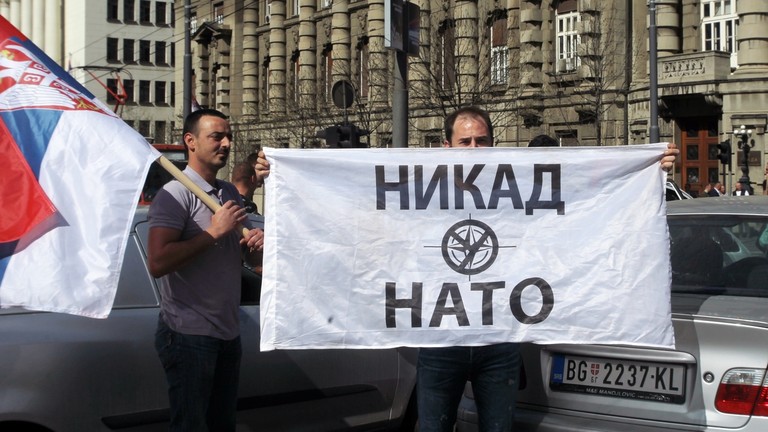
Serbs protesting the EU plan for independence of the breakaway province of Kosovo carry a sign that says ‘Never NATO,’ March 2023. © Sputnik / Aleksandar Jorovich
RT | March 24, 2023
In a carefully worded statement to the public on Friday, US ambassador in Belgrade Christopher Hill commented on the 78-day bombing campaign against Yugoslavia by calling on the Serbs to build a “better future” together with Washington.
“I offer my personal condolences to the families of those who lost their lives during the wars of the 1990s, including as a result of the NATO air campaign,” Hill said in a series of tweets.
“I know that the Serbian people will never forget that terrible time, nor should they,” he added. “The Serbian people will never set aside their grief, but I believe they are strong enough to set aside their grievances.”
The US has an “unwavering” commitment to diplomacy and “partnership” with Serbia, Hill claimed. “Together, we can build the better future the Serbian people deserve and want for future generations.”
His comments came on the anniversary of ‘Operation Allied Force’, the air war launched by the US-led bloc on behalf of ethnic Albanian insurgents in Kosovo. Against the UN Security Council Resolution 1244 that ended the war, the US-backed Kosovo provisional government declared independence in 2008.
As the immediate pretext for the bombing, NATO had cited Belgrade’s rejection of the ultimatum presented by then-US Secretary of State Madeleine Albright at Rambouillet, including a deployment of NATO troops in Kosovo and independence of the breakaway province within three years. Annex B of the proposal also demanded unrestricted access of NATO forces to all of Yugoslavia – present-day Serbia and Montenegro – which the government in Belgrade could not accept.
Hill was present in Rambouillet, and in what seemed to be a nod to that episode, he claimed in his statement that he had learned during his long career that “sometimes diplomacy fails. When it does, the results can be tragic.”
According to official casualty figures by the Serbian government, the 1999 war resulted in the deaths of 1,031 soldiers and police officers, as well as 2,500 civilians – including 89 children. On Friday, Russian Ambassador Aleksandr Botsan-Kharchenko laid a wreath at the children’s memorial in Belgrade.
Russian governor’s son flees house arrest in Italy
RT | March 23, 2023
Artyom Uss, son of the governor of Russia’s Krasnoyarsk Region, Aleksandr Uss, has fled house arrest near the Italian city of Milan, the ANSA news agency has reported.
The Carabinieri – an Italian law enforcement agency that also acts as the military police – is searching for the alleged fugitive, the agency added.
According to ANSA, Uss is believed to have broken his electronic tag before fleeing his home on Wednesday afternoon.
The developments come just days after a court of appeals in Milan approved the 40-year-old’s extradition to America. Uss was detained last October at Milan’s Malpensa Airport on allegations of sanctions evasion and money laundering. The New York district attorney had earlier issued an international arrest warrant for him.
Uss, who had been held under house arrest since his initial detention, denied the allegations and his lawyer had told TASS that they intended to appeal the extradition decision. According to ANSA, Uss was preparing to contest the court’s decision when he disappeared.
The US has claimed that the governor’s son allegedly purchased American military technology before selling it to sanctioned Russian entities. He is also accused of smuggling oil from Venezuela to customers in China and Russia.
In October, a Russian court ordered Uss’s arrest on money laundering charges. Moscow has since demanded that he be extradited to his homeland.
Governor Aleksandr Uss has claimed that the charges against his son are politically motivated. Lawyers for Artyom Uss have also suggested that Washington may want to use him in potential prisoner exchanges with Moscow.
Yemeni prisoner exchange deal reached
The Cradle | March 20, 2023
The head of the National Committee for Prisoners’ Affairs, Abdul Qader al-Murtada, announced on Monday, 20 March, that a deal to exchange prisoners had been reached between the Ansarallah resistance movement and the Saudi-led coalition, with implementation to take place in three weeks, Al-Masirah TV reported.
Al-Murtada stated that “Today we concluded the latest round of negotiations in Switzerland regarding prisoners, and it was agreed, praise be to God, to implement a broad prisoner exchange deal that includes 706 of our prisoners in exchange for 181 prisoners of the other side, including Saudis and Sudanese.”
“The deal will be implemented after three weeks, hopefully, and another round will be held after the month of Ramadan to complete the implementation of the rest of the agreement,” Al-Murtada added.
The latest round of negotiations began 10 days ago under the auspices of the United Nations.
The prisoner exchange deal comes amid renewed hopes for a broader end to the Yemen conflict.
UN Special Envoy to Yemen Hans Grundberg told the UN Security Council on 15 March that “Intense diplomatic efforts are ongoing at different levels to bring the conflict in Yemen to an end” and that “we are currently witnessing renewed regional diplomatic momentum, as well as a step change in the scope and depth of the discussions.”
Much of this momentum has resulted from a recent agreement between rival Islamic powers Saudi Arabia and Iran to resume diplomatic relations and work toward peace in the region. As part of this reconciliation, Iranian President Ebrahim Raisi is set to visit Saudi Arabia for talks with Saudi King Salman in the coming weeks.
Since the beginning of the Saudi-led war in Yemen, which began in early 2015, an estimated 377,000 Yemenis have died, according to a UN Development Programme report issued in late 2021.
Some 60 percent of these deaths were caused by the indirect effects of the war, such as lack of safe drinking water, hunger, and disease, while fighting has directly killed more than 150,000 people.
Most of those killed by the war’s indirect effects were “young children who are especially vulnerable to under- and malnutrition,” according to the report.
During the same period, the US government provided $54.6 billion of military aid to Saudi Arabia and the United Arab Emirates, according to a report issued by the US Government Accountability Office. The report noted that the US has 140 military advisers working in Saudi Arabia on training missions and to facilitate weapons sales.
The New York Times reported that the internal government report concluded that the US State Department and Department of Defense “failed to assess civilian casualties caused by a Saudi-led coalition in the catastrophic war in Yemen and the use of American-made weapons in the killings.”
Featured Video

Elijah Magnier: Yemen’s strikes are shattering Saudi Arabia’s long-term strategy
or go to
Aletho News Archives – Video-Images
From the Archives
British weapons and personnel doing much of the killing in Yemen
Press TV – June 18, 2019
A detailed report published by the Guardian newspaper has shown how Britain is massively contributing to Saudi Arabia’s devastating war on Yemen as it suggests that London is not only supplying the bombs that fall on Yemenis, but it provides the personnel and expertise that keep the war going.
The comprehensive report by Arron Merat published on Tuesday showed that Britain was doing much of the killing in Yemen as the country continues to provide Saudi Arabia with everything it needs to turn its southern impoverished neighbor into a graveyard.
“Every day Yemen is hit by British bombs – dropped by British planes that are flown by British-trained pilots and maintained and prepared inside Saudi Arabia by thousands of British contractors,” said Merat in the report. … continue
Blog Roll
 Aletho News
- Racist Seinfeld Dances for Joy as Bibi Unveils His New Map
- A West Bank War for Netanyahu’s Election Campaign, Could It Backfire?
- Yemen denounces European Parliament’s ‘hypocritical’ push to blacklist Ansarullah
- Qalibaf: UAE’s UN bid aims to ‘clear the runway’ for ‘Greater Israel’, whitewash genocide
- Pakistan reopens Iran border after boosting security: Report
- Why are so many Brazilians voting for Flávio Bolsonaro?
- Democrats Put Anti-Russia Agenda Ahead of American Workers
- Elijah Magnier: Yemen’s Strikes Are Shattering Saudi Arabia’s Long-Term Strategy
- Pentagon designates Chinese cultural centers national security threat
- Israel Demolishes Home Of Lebanese Journalist Whose Viral Film Exposed Pager Attack
- If Americans Knew
- An error has occurred; the feed is probably down. Try again later.
- No Tricks Zone
- Sudden Stratospheric Warming, Powerful El Niño Combination May Lead To Extreme Europe Cold, Energy Crisis!
- Two New Studies Find Thwaites Glacier Melt Cannot Be Driven By Human Activity Or A Warming Ocean
- E-Cars Reduce CO2 Emissions By Only 41% Compared To Internal Combustion Engine Vehicles
- Predictions Made By Renowned Climate Professor Over Past Decades Have Been Proven To Be Poor
- New Study Suggests Large Regions Of The Pacific Ocean Have Been Cooling For The Last 80 Years
- Germany’s Green Energy Debacle: High Energy Costs Force Kahla Porzellan to Close After 182 Years!
- New Study: 50 Years Of The Most Aggressive ‘Net Zero’ Policies Can Only Affect The Global Climate By 0.03°C
- US September “Heat” Was No Record…Many Records Set Decades Ago
- Latest European Green Energy Debacle; Portugal’s Largest Flagship Solar Park Insolvent!
- Green Energy Debacle: German Expert Professor Fritz Vahrenholt Warns Of Severe Economic And Social Consequences

