US paranoid about Russia-China summit
BY M. K. BHADRAKUMAR | INDIAN PUNCHLINE |MARCH 19, 2023
The arrest warrant issued by the International Criminal Court against Vladimir Putin can only be seen as a publicity stunt by the Anglo-Saxon clique, with the US leading from the rear. Ironically, though, the ICC acted on the eve of the 20th anniversary of the Anglo-Saxon invasion of Iraq in 2003, which led to horrific war crimes but the “judges” at Hague slept over it. Both Washington and London admit today that the 2003 invasion was illegal — based on trumped up allegations against Saddam Hussein.
There’s no chance, of course, that the ICC warrant will ever be taken seriously. ICC has no jurisdiction in Russia, which like the US is not a signatory to the Rome Statute. But the intention here is something else.
The mud-throwing at Putin is yet another display of President Biden’s visceral hatred towards the Russian leader that goes back in time by well over a decade, and is timed to distract attention from the state visit by Chinese President Xi Jinping to Moscow on Monday, an event that not only has spectacular optics but is sure to intensify the “no limit” partnership between the two superpowers.
The Anglo-Saxon clique is watching the talks in Moscow tomorrow with dismay. To be sure, Moscow and Beijing have decided to stand together to push back the US hegemony.
Today, China exceeds the combined manufacturing capacity of the US and its European allies, and, equally, Russia has emerged as the world’s largest nuclear weapon state superior to the US both in the quantity and quality of the weaponry.
It has dawned on the American mind that Russia cannot be defeated in Ukraine. There is a chicken-and-egg situation facing NATO, according to a report in Politico. Massive investments are needed to catch up with Russia’s defence industry but Europe’s ailing economies have other critical priorities.
The notions of defeating Russia in a proxy war in conditions of “sanctions from hell” have turned out to be delusional. It is US banks that are collapsing, it is European economies that are threatened by stagnation.
The US’ exasperation is evident in the top secret mission by MQ-9 Reaper drone near the Crimean peninsula on March 14. US Global Hawk drones have been spotted regularly over the Black Sea in recent years but this case was different.
The Reaper’s transponder was switched off as it entered Russia’s temporary regime for the airspace established for the purposes of the special military operation near the Crimean peninsula (which Moscow had duly notified to all users of international airspace in accordance with international norms.)
In the event, Russia’s Su-27 fighter jets outmanoeuvred the Reaper, which lost control and drowned in the Black Sea. Moscow conferred state awards to the two pilots who drove Reaper to the seabed.
The Russian ambassador in Washington has since warned that while Moscow is not seeking any escalation, any deliberate attack on a Russian aircraft in neutral airspace will be construed as “an open declaration of war against the largest nuclear power.”
If the US planned the drone incident to test Russia’s reaction, well, the latter has given an unambiguous message. And all this took place in the immediate run-up to President Xi’s visit.
Biden since hit back by welcoming the ICC warrant on Putin saying “it’s justified… (and) makes a very strong point.” But Biden’s memory is failing him. For, the stated American position on ICC is that Washington not only doesn’t recognise the jurisdiction of the ICC but if any US national is arrested or brought before the ICC, Washington reserves the right to use military force to rescue the detainee!
Furthermore, Washington threatens reprisal against any country that cooperates with an ICC warrant against a US citizen. The George W Bush administration stated this categorically against the backdrop of the horrific war crimes in Iraq, and the US never resiled from it.
By the way, there has been no referral by the UN Security Council or General Assembly to the ICC. So, who organised this arrest warrant? Britain — who else? The Brits bullied the ICC judges who are highly vulnerable to blackmail, as they draw fat salaries and would sup with the devil if it helped secure extended terms for them at the Hague. This becomes yet another case study of the piecemeal destruction of the UN system by the Anglo-Saxon clique in the recent years.
Suffice to say, the drone incident and the ICC warrant vitiate the climate for any dialogue between Moscow and Kiev. Evidently, the Anglo-Saxon clique is worried like hell that China might spring another surprise as it did recently by mediating the recent Saudi-Iranian deal.
In a meaningful remark, the Chinese foreign ministry spokesperson Wang Wenbin said on Friday that Xi’s visit is partially to promote “peace.” Beijing has already released a “peace plan” for Ukraine, a 12-point agenda for “a political resolution of the Ukraine crisis,” which is on Zelensky’s table in Kiev although the West studiously chose to ignore it.
In a phone call on Thursday, Chinese foreign minister Qin Gang told his Ukrainian counterpart Dmytro Kuleba that Beijing hopes “all parties will remain calm, rational and restrained, and resume peace talks as soon as possible.”
The Chinese readout said Kuleba discussed “the prospect of peace talks … and noted that China’s position paper on the political settlement of the Ukraine crisis shows its sincerity in promoting a ceasefire and an end to the conflict. He expressed the hope to maintain communication with China.”
Unsurprisingly, Biden is paranoid about China’s push to mediate between Moscow and Kiev. The point is, he and Zelensky are locked in a deathly embrace — the corruption scam involving the activities of Biden’s son in Kiev is hanging over POTUS like the Damocles’ sword, while on the other hand, Zelensky is fighting for political survival and is increasingly acting on his own.
Disregarding western doubts about the wisdom of holding the shattered frontline city of Bakhmut, Zelensky is digging in and keeping up an attritional defence that may drag on. (Politico)
Evidently, Biden is acting like a cat on a hot tin rood. He can neither let go Zelensky nor can afford to be locked into a forever war in Ukraine while Taiwan Straits beckons.
Beijing’s stance has visibly hardened lately and the scorn that the US poured on China’s national pride by shooting down its weather balloon has only exacerbated the distrust. Similarly, the nadir has been reached for Russia with the Reaper drone provocation and the Anglo-Saxon clique’s ICC scam. A point of no return has been reached.
Xi has chosen Russia for his first visit abroad in his third term also, the war in Ukraine notwithstanding. While announcing Xi’s visit to Russia, the Chinese Foreign Ministry said, “As the world enters a new period of turbulence and change, as a permanent member of the UN Security Council and an important power, the significance and influence of China-Russia relations go far beyond the bilateral scope.”
Again, Biden would have thought he was putting Putin on the mat with the Reaper stunt and the ICC scam. But Putin is nonchalant, choosing today to defiantly make his first-ever visit to Donbass.
Putin toured Mariupol, the port city that was bitterly contested by the NATO operatives, drove a vehicle along the city streets, making stops at several locations and surveying reconstruction works. It was a defiant signal to Biden that NATO has lost the war.
Iran-Iraq Security Deal Signed in Baghdad
Al-Manar | March 19, 2023
Secretary of Iran’s Supreme National Security Council Ali Shamkhani will reportedly sign a bilateral agreement on security cooperation with Iraq during a visit to Baghdad.
Accompanied by governor of the Central Bank of Iran (CBI) and two Foreign Ministry deputies, Shamkhani left Tehran for Baghdad on Sunday morning at the invitation of Iraq’s National Security Advisor Qasim al-Araji.
In addition to meetings with senior Iraqi political and economic officials, Shamkhani is scheduled to sign a document on mutual security cooperation that was being prepared for months.
The agreement would commit Iran and Iraq to safeguarding the principles of good neighborliness and protecting the common border. The deal is believed to have a significant role in ending the illegal presence of anti-Iranian armed groups and the elements affiliated with the Zionist regime in the Iraqi areas adjacent to Iran’s northwestern border regions.
Shamkhani’s visit to Iraq, made days after a landmark trip to the United Arab Emirates, comes after Iran and Saudi Arabia announced their decision to restore ties.
Following days of intensive talks in Beijing, Iran and Saudi Arabia agreed on March 10 to resume their diplomatic relations and reopen their embassies and diplomatic missions within at most two months.
Arab governments neighboring Iran have eagerly welcomed the rapprochement between the two regional heavyweights.
US Changed UAVs Flight Routes After MQ-9 Incident: Tracks Analysis
Sputnik – 17.03.2023
The United States changed the flight routes of its strategic unmanned aerial vehicles Global Hawk after the incident with the MQ-9 Reaper drone that fell into the Black Sea, according to data from the Flightradar24 portal analyzed by Sputnik.
According to information on the portal, one of the US strategic drones, which regularly carry out reconnaissance missions from a base in Sicily to the region of Russia’s Crimea peninsula, once again arrived in the airspace over the Black Sea. This is the first flight of the Global Hawk over the Black Sea since the Reaper incident, and this time the route of the drone has been significantly changed.
As follows from the flight tracks, today, before entering the airspace over the Black Sea, the Global Hawk preliminarily performed barrage over the eastern part of Romania. Previously, Global Hawk had not performed such maneuvers. Then the drone went to the airspace over the Black Sea, where these aircraft are usually on duty in the air abeam the southern tip of the Crimea, sometimes up to 24 hours. However, this time the distance of the drone route from the southernmost point of Crimea has increased significantly. Earlier, these aicraft flew past the peninsula at a minimum distance of 80-100 kilometers (50-62 miles), today the drone passed the southern coast of Crimea at a minimum distance of 150 kilometers (93 miles).
The main loitering area over the Black Sea was also changed — in the current flight of the US drone, it was not abeam the southern coast of Crimea, but much to the east, closer to Novorossiysk and Sochi.
Currently, the Global Hawk continues to fly over the Black Sea towards Romania.
The hidden security clauses of the Iran-Saudi deal
By Hasan Illaik | The Cradle | March 12, 2023
Under Chinese auspices, on 10 March in Beijing, longtime regional competitors Iran and Saudi Arabia reached an agreement to restore diplomatic relations, after a break of seven years.
In its most optimistic reading, the deal can be seen as a historic strategic agreement, reflecting major changes underway in West Asia and the world. At worst, it can be characterized as an “armistice agreement” between two important rivals, that will provide a valuable space for direct, regular communications.
The Sino-Saudi-Iranian joint statement on Friday carried strong implications beyond the announcement of the restoration of diplomatic relations between Tehran and Riyadh, severed since 2016.
The statement is very clear:
- The embassies of Saudi Arabia and the Islamic Republic Iran will reopen in less than two months.
- Respect for the sovereignty of States.
- Activating the security cooperation agreement between Saudi Arabia and Iran signed in 2001.
- Activating the cooperation agreement in the economic, trade, investment, technology, science, culture, sports and youth sectors signed between the parties in 1998.
- Urging the three countries to exert all efforts to promote regional and international peace and security.
At first glance, the first four clauses suggest that the Chinese-brokered deal is essentially a mending of diplomatic relations between the two longtime adversaries. But in fact, the fifth clause is far from the standard text inserted into joint statements between states.
It appears to establish a new reference for conflicts in West Asia, in which China plays the role of “peacemaker” — in partnership with Iran and Saudi Arabia — in which Beijing assumes a role in various regional conflicts or influences the relevant parties.
Sources familiar with the negotiations have revealed to The Cradle that Chinese President Xi Jinping did not merely coat-tail a deal already underway between Tehran and Riyadh. Xi has, in fact, personally paved the way for this agreement to materialize. The Chinese head of state delved deep into its details since his visit to Saudi Arabia in December 2022, and then later, during Iranian President Ebrahim Raisi’s visit to Beijing in mid-February 2023.
More than one round of negotiations was held under Chinese auspices, during which the Iranians and Saudis finalized details negotiated between them in Iraq and Oman, during earlier rounds of talks.
It was by no means a given that the two sides would arrive at an agreement in their last round of discussions (6-10 March, 2023). But the Chinese representative managed to overcome all obstacles between the two delegations, after which the parties obtained approval from their respective leaderships to announce the deal on Friday.
China as regional guarantor
In the past couple of days, much has been written about the strategic implications of a Chinese-brokered Saudi-Iranian agreement and its impact on China’s global role vis-à-vis the United States. The Persian Gulf is a strategic region for both powers, and the main source of China’s energy supply. It is likely why Beijing intervened to stem tensions between its two strategic allies. It is also something Washington, long viewed as the region’s “security guarantor,” could never have achieved.
Undoubtedly, much will be said about Saudi Crown Prince Mohammed bin Salman’s (MbS) “strategic adventurism” and his exploitation of global changes to offset the decline of US regional influence. The rise of a multipolar, post-American order allows traditional US allies some space to explore their international options away from Washington, and in service of their immediate national interests.
Saudi Arabia’s current interests are related to the ambitious political, economic, financial, and cultural targets that MbS has set out for his country, and are based on two pillars:
- Diversifying regional and global partnerships in order to adapt to global systemic changes that will help realize Riyadh’s grand plans.
- Establishing security and political stability to allow Saudi Arabia to implement its major projects, especially those outlines in MbS’ “Vision 2030,” through which Riyadh envisions itself transforming into a regional incubator for finance, business, media, and the entertainment industry – similar to the role played by the UAE in decades past, or by Beirut before the Lebanese civil war in 1975.
In short, regional and domestic security and stability are vital for Riyadh to be able to implement its strategic goals. As such, confidential clauses were inserted into the Beijing Agreement to assure Iran and Saudi Arabia that their security imperatives would be met. Some of these details were provided to The Cradle, courtesy of a source involved in the negotiations:
- Both Saudi Arabia and the Islamic Republic of Iran undertake not to engage in any activity that destabilizes either state, at the security, military or media levels.
- Saudi Arabia pledges not to fund media outlets that seek to destabilize Iran, such as Iran International.
- Saudi Arabia pledges not to fund organizations designated as terrorists by Iran, such as the People’s Mojahedin Organization (MEK), Kurdish groups based in Iraq, or militants operating out of Pakistan.
- Iran pledges to ensure that its allied organizations do not violate Saudi territory from inside Iraqi territory. During negotiations, there were discussions about the targeting of Aramco facilities in Saudi Arabia in September 2019, and Iran’s guarantee that an allied organization would not carry out a similar strike from Iraqi lands.
- Saudi Arabia and Iran will seek to exert all possible efforts to resolve conflicts in the region, particularly the conflict in Yemen, in order to secure a political solution that secures lasting peace in that country.
According to sources involved in the Beijing negotiations, no details on Yemen’s conflict were agreed upon as there has already been significant progress achieved in direct talks between Riyadh and Yemen’s Ansarallah resistance movement in January. These have led to major understandings between the two warring states, which the US and UAE have furiously sought to undermine in order to prevent a resolution of the Yemen war.
In Beijing however, the Iranian and Saudis agreed to help advance the decisions already reached between Riyadh and Sanaa, and build upon these to end the seven-year war.
Hence, although the Beijing statement primarily addresses issues related to diplomatic rapprochement, Iranian-Saudi understandings appear to have been brokered mainly around security imperatives. Supporters of each side will likely claim their country fared better in the agreement, but a deeper look shows a healthy balance in the deal terms, with each party receiving assurances that the other will not tamper with its security.
While Iran has never declared a desire to undermine Saudi Arabia’s security, some of its regional allies have made no secret of their intentions in this regard. In addition, MbS has publicly declared his intention to take the fight inside Iran, which Saudi intelligence services have been doing in recent years, specifically by supporting and financing armed dissident and separatist organizations that Iran classifies as terrorist groups.
The security priorities of this agreement should have been easy to spot in Beijing last week. After all, the deal was struck between the National Security Councils of Saudi Arabia and Iran, and included the participation of intelligence services from both countries. Present in the Iranian delegation were officers from Iran’s Ministry of Intelligence and from the intelligence arms of the Islamic Revolutionary Guard Corps (IRGC).
On a slightly separate note related to regional security — but not part of the Beijing Agreement — sources involved in negotiations confirmed to The Cradle that, during talks, the Saudi delegation stressed Riyadh’s commitment to the 2002 Arab peace initiative; refusing normalization with Tel Aviv before the establishment of an independent Palestinian state, with Jerusalem as its capital.
What is perhaps most remarkable, and illustrates the determination by the parties to strike a deal without the influence of spoilers, is that Iranian and Saudi intelligence delegations met in the Chinese capital for five days without Israeli intel being aware of the fact. It is perhaps yet another testament that China — unlike the US — understands how to get a deal done in these shifting times.
The Covid Response Museum

By Bhaskaran Raman | Brownstone Institute | March 11, 2023
The world’s Covid response has been steeped in such absurdities and atrocities. Worse, there has thus far been little accountability for the human right violations. The sheer scale and planet-wide nature of the crimes needs to be recorded for posterity in various forms.
The idea that people’s fundamental birthrights can be taken away forcibly, in an ostensible attempt to “protect” them, belongs only in a museum. Indeed, it should have belonged only in fiction. Unfortunately, atrocities far worse than possible in fiction were committed worldwide, in the three years following the declaration of the Covid-19 pandemic.
“A 24-year-old MTech scholar at the Indian Institute of Science (IISc) in Bengaluru died by suicide, after he was depressed over allegedly having covid-like symptoms” ~ Aug 2020, Karnataka, India
The risk of Covid death, or even severe Covid, was always negligible for the young. Regardless of the risk, it shouldn’t have been a stigmatizing sin to catch an infectious respiratory virus.
“Unable to bear the mountain of debt due to closure of his salon, Manoj Zende ended his life”.~ Apr 2021, Maharashtra, India
What did lockdown achieve, except such needless misery for people whimsically labeled as “non-essential” for society? The US Vice President Kamala Harris posted a photo on Twitter, of herself with a child; the leader was unmasked, but the child’s smile was hidden behind a mask
~ Feb 2023, USA
A society which has lost the desire to see children’s faces is in deep disrepair.
“Schools Lost Track of Thousands of Students Who Left During Pandemic” ~ Feb 2023, Wall Street Journal
School closures in the name of Covid response were the largest peacetime rights violation in human history.
“23-year old Hitesh Kadve was pressured to take the Covid vaccine, due to the vaccine mandate for local train commute; he died within hours of taking the vaccine.” ~ Sep 2021, Maharashtra, India
Mandating an experimental medical product should be recorded in history as among the worst violations of medical ethics.
The Lockdown and Covid Response Museum is intended to be a documentation of the atrocities in the Covid-19 response, and the absurdities which were part and parcel of the atrocities.
The museum is intended to make people, especially the next generation, think and reflect, wonder and ponder how some unthinkable things came to be, laugh at some absurdities, feel sorry for some, cry in empathetic anguish at others. Most important of all, it is for them to resolve: “NEVER AGAIN.”
The Lockdown and Covid Response Museum is an initiative of the Universal Health Organisation (UHO), a group of epidemiologists, doctors, journalists, and other professionals. The UHO is based in India: a forum to ensure impartial, truthful, unbiased and relevant information on health reaches every citizen of the world to make informed choices pertaining to their health.
The target inauguration date for the museum is March 25, 2023, which is the third anniversary of mass incarceration of one-sixth of humanity, i.e. India’s first lockdown. To start, the museum will be online. We also encourage people to set up physical museums using the material from this website, under creative commons license: free to share with attribution.
For the museum, UHO invites story contributions from people around the world, who have suffered or seen others suffer due to the various extreme measures in the name of Covid-19 response. The museum will display submissions with only state/country information, and no personal identifying information (names will be anonymized).
The material in the museum will be under the “Creative Commons By Attribution” license : free to share with attribution. Possible submission types include: (1) image/photo, (2) video, (3) audio, (4) real-life story/account, (5) link to news report, (6) copy of government or other official (office/school/residential) rule/guideline. Submissions to the museum can be in one or more of the following categories: (1) lockdown, (2) Covid “containment” restrictions, (3) school closure, (4) other restrictions on children, (5) PCR/antigen testing: dirty unless proven clean, (6) Covid-19 vaccine mandate, (7) Covid-19 vaccine adverse event, (8) mask mandates, (9) virus avoidance extreme, (10) censorship, (11) police excess, etc.
To see sample entries in the museum, and to submit your entry, please visit.
Bhaskaran Raman is a faculty in the Department of Computer Science and Engineering at IIT Bombay. Views expressed here are his personal opinion. He maintains the site: “Understand, Unclog, Unpanic, Unscare, Unlock (U5) India” https://tinyurl.com/u5india . He can be reached via twitter, telegram: @br_cse_iitb . br@cse.iitb.ac.in
China steps up, a new era has dawned in world politics
BY M. K. BHADRAKUMAR | INDIAN PUNCHLINE | MARCH 11, 2023
The agreement announced on Friday in Beijing regarding the normalisation of diplomatic relations between Saudi Arabia and Iran and the reopening of their embassies is a historic event. It goes way beyond an issue of Saudi-Iranian relations. China’s mediation signifies that we are witnessing a profound shift of the tectonic plates in the geopolitics of the 21st century.
The joint statement issued on Friday in Beijing begins by saying that the Saudi-Iranian agreement was reached “in response to the noble initiative of President Xi Jinping.” The dramatic beginning goes on to state that Saudi Arabia and Iran have expressed their “appreciation and gratitude” to Xi Jinping and the Chinese government “for hosting and sponsoring the talks, and the efforts it placed towards its success.”
The joint communique also mentioned Iraq and Oman for fostering the Saudi-Iranian dialogue during 2021-2022. But the salience is that the United States, which has been traditionally the dominant power in West Asian politics for close to eight decades, is nowhere in the picture.
Yet, this is about the reconciliation between the two biggest regional powers in the Persian Gulf region. The US retrenchment denotes a colossal breakdown of American diplomacy. It will remain a black mark in President Biden’s foreign policy legacy.
But Biden must take the blame for it. Such a cataclysmic failure is largely to be traced to his fervour to impose his neoconservative dogmas as an adjunct of America’s military might and Biden’s own frequent insistence that the fate of humankind hinges on the outcome of a cosmic struggle between democracy and autocracy.
China has shown that Biden’s hyperbole is delusional and it grates against realities. If Biden’s moralistic, ill-considered rhetoric alienated Saudi Arabia, his attempts to suppress Iran met with stubborn resistance from Tehran. And, in the final analysis, Biden literally drove both Riyadh and Tehran to search for countervailing forces that would help them to push back his oppressive, overbearing attitude.
The US’ humiliating exclusion from the centre stage of West Asian politics constitutes a “Suez moment” for the superpower, comparable to the crisis experienced by the UK in 1956, which obliged the British to sense that their imperial project had reached a dead end and the old way of doing things—whipping weaker nations into line as ostensible obligations of global leadership —was no longer going to work and would only lead to disastrous reckoning.
The stunning part here is the sheer brain power and intellectual resources and ‘soft power’ that China has brought into play to outwit the US. The US has at least 30 military bases in West Asia — five in Saudi Arabia alone — but it has lost the mantle of leadership. Come to think of it, Saudi Arabia, Iran and China made their landmark announcement on the very same day Xi Jinping got elected for a third term as president.
What we are seeing is a new China under the leadership of Xi Jinping trotting over the high knoll. Yet, it is adopting a self-effacing posture claiming no laurels for itself. There is no sign of the ‘Middle Kingdom syndrome,’ which the US propagandists had warned against.
On the contrary, for the world audience — especially countries like India or Vietnam, Turkey, Brazil or South Africa — China has presented a salutary example of how a democratised multipolar world can work in future — how it is possible to anchor big power diplomacy on consensual, conciliatory politics, trade and interdependence and advance a ‘win-win’ outcome.
Implicit in this is another huge message here: China as a factor of global balance and stability. It is not only Asia-Pacific and West Asia who are watching. The audience also includes Africa and Latin America — in fact, the entire non-Western world that forms the big majority of world community who are known as the Global South.
What the pandemic and the Ukraine crisis have brought to the surface is the latent geopolitical reality that the Global South rejects the policies of neo-mercantalism pursued by the West in the garb of ‘liberal internationalism.’
The West is pursuing a hierarchical international order. None other than the EU foreign policy chief Josep Borrell blurted this out in an unguarded moment recently with a touch of racist overtone when he said from a public platform that ‘Europe Is a garden. The rest of the world Is a jungle, and the jungle could Invade the garden.’
Tomorrow, China could as well be challenging the US hegemony over the Western Hemisphere. The recent paper by the Chinese Foreign Ministry titled ‘US Hegemony and Its Perils’ tells us that Beijing will no longer be on the defensive.
Meanwhile, a realignment of forces on the world stage is taking place with China and Russia on one side and the US on the other. Doesn’t it convey a big message that on the very eve of the historic announcement in Beijing on Friday, the Saudi Arabian foreign minister Prince Faisal bin Farhan Al Saud landed suddenly in Moscow on a ‘working visit’ and went into a huddle with Foreign Minister Sergey Lavrov who was visibly delighted? (here, here and here )
Of course, we will never know what role Moscow would have played behind the scenes in coordination with Beijing to build bridges between Riyadh and Tehran. All we know is that Russia and China actively coordinate their foreign policy moves. Interestingly, on March 6, President Putin had a telephone conversation with Iran’s President Ebrahim Raisi.
Audacity of hope
To be sure, the geopolitics of West Asia will never be the same again. Realistically, the first sparrow of spring has appeared but the ice was melted for only three or four rods from the shore. Nonetheless, the sun’s rays give hope, signalling warmer days to come.
Conceivably, Riyadh won’t have any truck further with the diabolical plots hatched in Washington and Tel Aviv to resuscitate an anti-Iran alliance in West Asia. Nor is it in the realms of possibility that Saudi Arabia will be party to any US-Israeli attacks on Iran.
This badly isolates Israel in the region and renders the US toothless. In substantive terms, it scatters the Biden administration’s feverish efforts lately to cajole Riyadh to join Abraham Accords.
However, significantly, a commentary in Global Times noted somewhat audaciously that the Saudi-Iranian deal “set a positive example for other regional hotspot issues, such as the easing and settlement of the Israeli-Palestinian conflict. And in the future, China could play an important role in building a bridge for countries to solve long-standing thorny issues in the Middle East just as what it did this time.”
Indeed, the joint communique issued in Beijing says, “The three countries [Saudi Arabia, Iran and China] expressed their keenness to exert all efforts towards enhancing regional and international peace and security.” Can China pull a rabit out of the hat? Time will tell.
For the present, though, the Saudi-Iranian rapprochement will certainly have positive fallouts on the efforts toward a negotiated settlement in Yemen and Syria as well as on the political instability in Lebanon.
Besides, the joint communique emphasises that Saudi Arabia and Iran intend to revive the 1998 General Agreement for Cooperation in the Fields of Economy, Trade, Investment, Technology, Science, Culture, Sports, and Youth. All in all, the Biden administration’s maximum pressure strategy toward Iran has crashed and the West’s sanctions against Iran are being rendered ineffectual. The US’ policy options on Iran have shrunk. Put differently, Iran gains strategic depth to negotiate with the US.
The cutting edge of the US sanctions lies in the restrictions on Iran’s oil trade and access to western banks. It is entirely conceivable that a backlash is about to begin as Russia, Iran and Saudi Arabia — three top oil/gas producing countries start accelerating their search for payment mechanisms bypassing the American dollar.
China is already discussing such an arrangement with Saudi Arabia and Iran. China-Russia trade and economic transactions no longer use American dollar for payments. It is well understood that any significant erosion in the status of the dollar as ‘world currency’ will not only spell doom for the American economy but will cripple the US’ capacity to wage ‘forever wars’ abroad and impose its global hegemony.
The bottom line is that the reconciliation between Saudi Arabia and Iran is also a precursor to their induction as BRICS members in a near future. To be sure, there is a Russian-Chinese understanding already on this score. The BRICS membership for Saudi Arabia and Iran will radically reset the power dynamic in the international system.
Colonel McGregor: ‘Russia is crushing the Kiev regime’
By Drago Bosnic | March 9, 2023
Colonel Douglas McGregor doesn’t need a lot of introduction to people aware of the current geopolitical situation, as his actions, integrity and wisdom speak for themselves. Unfortunately, such cadres are now almost entirely absent from Washington DC, particularly the Pentagon. They have been replaced by a plethora of post-Cold War neoconservatives and neoliberals intended on not just maintaining the so-called Pax Americana, but also extending it to essentially every corner of the planet. In his latest interview with “Real America’s” Dan Ball, Colonel McGregor gave an assessment of the current state of the Kiev regime forces, as well as their prospects in the coming weeks and months.
After the anchor gave a brief breakdown of the disastrous state of the United States under the troubled Biden administration, he touched on the subject of ever-escalating military “aid” the Washington DC has been sending to the embattled Neo-Nazi junta in hopes of stopping Russia from finally inflicting a crushing defeat on them. He pointed out that the US Congress just approved its latest “aid” package worth $400 million, pushing the publicly revealed amount to $32 billion of US taxpayer dollars for Washington DC’s favorite puppet regime, out of the $113 billion approved thus far, “with no end in sight”, as he correctly noted.
Dan Ball then assessed the meeting between Joe Biden and German Chancellor Olaf Scholz, signaling the symbolic end of the very last remnants of Berlin’s sovereignty as Germany pledged to send more weapons and funds for the Neo-Nazi junta, despite the tremendous problems this is causing on the home front. Ball also pointed out the glaring hypocrisy of the political West, as NATO is publicly bragging about its involvement with the Kiev regime, including the massive weapons shipments and ISR (intelligence, surveillance, reconnaissance) assets, while openly threatening China in case it sends armaments to Russia.
Aside from the fact that Beijing never made such statements, nor is there any indicator that Moscow is desperate to get help from China, it’s quite obvious the US has completely lost touch with what actual diplomacy is. The anchor also questioned the impact of the “aid” the Neo-Nazi junta is getting, but warned that it’s certainly “drawing down our existing weapons stock, which puts America in a bad spot, kind of like Biden draining our emergency oil reserves”. The last line refers to Joe Biden’s unrelenting squandering of America’s SPR (Strategic Petroleum Reserve), which has been actively (ab)used for nearly a year now, despite the fact it was founded for emergencies such as nationwide natural disasters or major wars.
After touching on the topic of sending F-16 fighter jets, the question even the Pentagon is “stingy and unsure” about, Dan Ball introduced Colonel Douglas McGregor, who immediately pointed out the staggering losses of the Kiev regime forces, “now approaching 200,000”. According to McGregor, this was largely due to the Neo-Nazi junta’s disastrous decision to defend Bakhmut (Artyomovsk), with the Russian military using the opportunity to “apply all of their rockets, missiles, artillery fire against concentrations of Ukrainian infantry, inflicting enormous casualties”. He also stated the city is going to fall anyway, making the deaths of thousands of forcibly conscripted Ukrainians all the more pointless.
McGregor also touched upon the increasingly strained relationship between the Kiev regime frontman Volodymyr Zelensky and his General Staff which is rightfully furious at him for not listening to their assessment it would’ve been better to leave the city and set up a new defense line further to the west. The colonel warned that the junta has expended most of its reserves, both in terms of equipment and manpower, while its “best soldiers are dead, so it’s now shoving boys, old men, women into the breach”. He further added that Zelensky is essentially admitting defeat and taunting the political West, specifically the US, to “come here and win the war for us,” otherwise, “it’s over”.
Once again, the anchor Dan Ball mentioned the fighter jets and how the US has essentially lied it wouldn’t provide specific weapons systems, such as advanced missiles or tanks, all of which have been delivered in the meantime (or are about to). Ball warned that the same is true for F-16s, adding that “there’s now a bipartisan push in the Congress to send the jets”, but also stated that it would take at least a year to train pilots, “prolonging the killing in Ukraine”.
Colonel McGregor responded that the US doesn’t have a military strategy, but only a media one to convince everyone that the Neo-Nazi junta is supposedly winning. As the number of those who believe this narrative has dwindled to almost nothing and as the losses are piling up, the Kiev regime is forced to use contractors, the vast majority of whom are NATO personnel, meaning that if F-16s were to be sent, they would require American/NATO pilots to fly them. McGregor warned that “this is now a slow slide into [global] war that many people have really worried about for a long time” and that the US is faced with either admitting failure or pushing for a direct confrontation with Russia.
Ball and McGregor then discussed the issue of an escalating disinformation campaign in the US media, with the colonel pointing out that Washington DC has been doing this for decades, particularly in cases when any given administration was trying to not only justify, but also praise the US aggression against the world, specifically mentioning Bosnia, Iraq and the NATO-occupied Serbian province of Kosovo and Metohia. However, McGregor stated that the media are now forced to admit that “the weight of Russian manpower, as well as their military power in general, is crushing Ukrainians”.
He added that the message to the viewers is that “no amount of Ukrainian valor is going to stand up to [Russian] firepower” and people need to read between the lines and that “the message is – Ukraine can’t win”. The colonel further pointed out the Biden administration is certainly aware of this, with the recent Blinken-Lavrov meeting on the sidelines of the G20 summit in India perfectly illustrating it. McGregor thinks that “our threats don’t ring with much credibility” and that this behavior “puts everything at risk, including the United States“. However, the Biden administration is worried about its political future, so it’s refusing to admit the reality and finally come to an agreement that would take Russia’s security concerns into account.
Drago Bosnic is an independent geopolitical and military analyst.
Virgin Australia flight from Adelaide to Perth forced to make emergency landing as First Officer suffered heart attack 30 minutes after departure
By Dr. William Makis MD | COVID Intel | March 7, 2023
Two days ago I wrote about pilots and fight attendants suffering cardiac arrests in-flight and then dying suddenly.
One of my readers kindly wrote in the comments section about a very recent incident on a Virgin Australia flight. This is that incident and now we have more information.
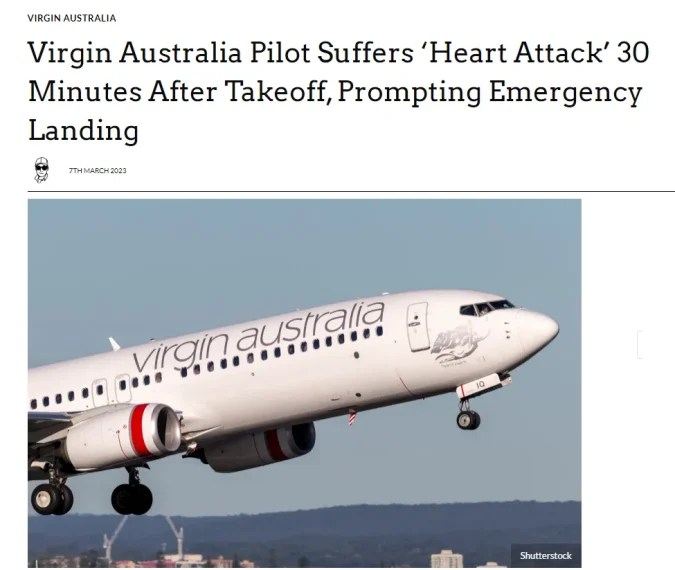
“Virgin Australia flight from Adelaide to Perth was forced to make an emergency landing after the First Officer reportedly suffered a heart attack just 30 minutes after departure. (click here)
The incident occurred on March 3, 2023, and resulted in the Airbus A320 being forced to return to Adelaide, where emergency responders were waiting to transport the sick pilot to the hospital.
The First Officer became incapacitated after suffering a heart attack. The Captain of the flight declared an emergency and successfully landed the aircraft around 70 minutes later.”
Aero Inside reports:
“A VARA Virgin Australia Regional Airlines Airbus A320-200, registration VH-VNB performing flight VA-717 from Adelaide, SA to Perth, WA (Australia), was enroute at FL320 about 240nm westnorthwest of Adelaide about 30 minutes into the flight when the first officer suffered a heart attack and became incapacitated. The captain declared PAN PAN and returned the aircraft to Adelaide for a safe landing on runway 23 about 70 minutes later.”
Here is additional information (thank you to @AirBo55):

Mainstream media pushing for one pilot in cockpit…
I have not seen any mainstream media reporting of this frightening incident. However, I have seen many articles from the media pushing for one pilot in the cockpit instead of two.
CNN – Why airplanes might soon have just one pilot
CBS News – Airlines are lobbying for a change to federal regulations that could put one pilot in the cockpit
Forbes – Airlines Move To Have One Pilot, Not Two, In Cost-Cutting Solution
“In a move to save costs and ease staff shortages, many countries are asking the UN body that controls global aviation safety rules, to move to a one-pilot model in commercial flights, instead of two.”
My Take…
As I’ve written before, I fear that we are getting closer and closer to a major airline crash due to pilot and or co-pilot incapacitation, as a result of COVID-19 vaccine injuries.
In the meantime, the mainstream media are aggressively pushing the concept of only one fully COVID-19 vaccinated pilot in the cockpit. Almost as if they want a major airline crash to take place. Would such an incident bring about a crackdown on flying in general? To fight climate change? And for our safety, of course?
I am currently working on a substack about small plane crashes and helicopter crashes in the past year where there was no obvious evidence of mechanical problems. As you can imagine, there are many of them.
Blinken hopes to derail India’s relationship with Russia following Scholz’s failure
By Ahmed Adel | March 1, 2023
With Russia’s military operation in Ukraine evidently destroying NATO’s ambitions, Washington is becoming increasingly frustrated that Moscow has not been isolated. Russia did not economically collapse, as was predicted in the West, partly because of the robust and longstanding relationship it has with India. It is unsurprising that in only a matter of days, Germany and the US have pressured India to capitulate their sovereignty and serve Western interests instead of their own.
German Chancellor Olaf Scholz sought assurances from India on February 25 that it would not only refuse to block, but also support efforts to isolate Russia. Following his talks with Indian Prime Minister Narendra Modi, the chancellor refused to reveal what exactly they discussed in relation to Ukraine.
Although the contents of the discussion were cited as being confidential in nature, it is likely that Scholz did not want to humiliatingly admit that India refused to step back from its tried and tested relationship with Russia. Scholz did reveal though that he and Modi had discussed the war in Ukraine “very extensively and very intensely.”
It is noted that this trip was Scholz’s first official visit to India but his fourth meeting with Modi since taking office in 2021. Although they also discussed ways to boost economic cooperation, including through a free trade agreement between the European Union and India, it cannot be overlooked that US Secretary of State Antony Blinken arrived in New Delhi only days after Scholz.
Days before arriving in the Indian capital, Blinken said that countries like India, which have not joined the West in denouncing Russia’s military operation, were on a supposed trajectory away from alignment with Moscow. He stressed that the process would not occur “in one fell swoop.”
“There are countries that have long-standing, decades-long relationships with Russia, with the Soviet Union before, that are challenging to break off in one fell swoop. It’s not flipping a light switch, it’s moving an aircraft carrier,” Blinken said in an interview with The Atlantic on February 24.
However, for all of Blinken’s claims that India is moving away from Moscow, there is no actual suggestion that this is occurring. The US and India cooperate through the QUAD format, a naval bloc aimed against China, but this has not meant India’s submission to Washington, as the Americans evidently anticipated.
Although India has faced sustained and continued pressure from the West to distance itself from Moscow, New Delhi has thus far resisted, citing its longstanding ties with Russia and its economic and oil interests. It cannot be overlooked that Russia has been India’s largest weapons supplier since the Cold War-era, particularly since the US traditionally favoured Pakistan.
However, Washington in recent years has looked to turn New Delhi away from its main military supplier (but without wanting to adjust its policy to Pakistan).
“India for decades had Russia at the core of providing military equipment to it and its defences, but what we’ve seen over the last few years is a trajectory away from relying on Russia and moving into partnership with us and other countries,” Blinken said, without mentioning the fact that India is moving towards home-grown production, something that Russia is playing a key role in.
None-the-less, it is expected that Blinken, in the same way as Scholz, will try and convince India to change course regarding its ties with Russia.
As Bloomberg reported, citing Kpler’s lead crude analyst, Viktor Katona, “India purchased almost no Russian oil a year ago, but has become a crucial market after the US and European Union imposed sanctions on Moscow. The Asian country imported around 1.85 million barrels a day from Russia in February, close to its potential maximum of about 2 million barrels a day.”
The cold hard facts are that Moscow and New Delhi have a longstanding relationship that India will not break just for the sake of serving Western interests. Beyond the time-tested security ties, Russia offers energy hungry India the best deal for oil, something that will not be sacrificed because of a far-off war in Eastern Europe.
According to QUARTZ, India has in less than a year saved an estimated $3.6 billion by increasing Russian oil imports. This is a significant amount for a country that depends on imports to meet 85% of its petroleum needs.
It is recalled that in November 2022, Indian Foreign Minister S Jaishankar said “Russia has been a steady and time-tested partner. Any objective evaluation of our relationship over many decades would confirm that it has actually served both our countries very, very well.”
With this statement, he effectively confirmed a continuance of the current policy despite sustained pressure – a pressure that Scholz and Blinken are the latest to apply. They are however also the latest that were unable to convince New Delhi to change its policy regarding Russia.
Ahmed Adel is a Cairo-based geopolitics and political economy researcher.
NATO is de facto at war with Russia – Kremlin
RT | February 28, 2023
The US-led collective West must change its approach to global security and finally take Moscow’s concerns into consideration, before talks on the New START nuclear agreement can be renewed, Kremlin spokesman Dmitry Peskov has insisted.
Speaking to the Izvestia newspaper for an interview published on Tuesday, Peskov said relations with the United States and Europe have “changed radically” since President Vladimir Putin formulated draft security treaties that were sent to Washington, Brussels and Vienna in late 2021, only to hear that “they were not ready to talk about anything with us.”
“If they wanted, they could have sat down at the negotiating table [back then, before the decision to launch a military operation in Ukraine],” he said. “There would have been very complex, positional, sometimes irreconcilable talks, but they would have been under way. But they refused.”
With the failed attempt at dialogue, tensions continued to soar between Moscow and the West in the lead up to the conflict in Ukraine. Peskov argued that NATO is now fully involved in the hostilities, noting “their intelligence is working against us 24 hours a day, their weapons… are supplied to Ukraine for free to shoot at our military, not to mention that they shoot at Ukrainian citizens.”
“The moment when NATO de facto became a participant in the conflict in Ukraine, the situation changed,” the spokesman continued. “In fact, the NATO bloc is no longer acting as our conditional opponent, but as our enemy.”
“President Putin was and remains open to any contacts that can help Russia achieve its goals in one way or another,” Peskov continued. “Preferably peacefully, at the negotiations table, but when this is not possible, also by military means, as we are seeing now.”
Peskov touched on the New START treaty, a US-Russian accord intended to limit both nations’ nuclear stockpiles and allow them to monitor each other’s military facilities to confirm compliance. Amid the conflict in Ukraine, however, Moscow and Washington have accused each other of failing to facilitate such inspections.
Last week, Russian President Vladimir Putin announced that Moscow intended to formally suspend its obligations under the pact, with Peskov explaining “the conditions must somehow change.” During the New START negotiations, the nuclear arsenals of France and Great Britain were left out of the equation, even though they are “significant enough for the entire system of European strategic security,” he said.
“These countries – France, Britain, the United States – are members of an organization which is de facto at war with us… you need to call a spade a spade,” Peskov added, noting how Western states nevertheless keep “repeating like a mantra that they do not want to be participants in the conflict.”
Putin has also accused NATO specialists of helping Kiev to launch drone attacks against Russian airfields hosting long-range bombers, which are part of Moscow’s system of nuclear deterrence. He blamed Washington and NATO’s proxy war against Russia for destroying the foundation of trust on which the treaty was initially built.
Russia explains halt in oil exports to Poland
RT | February 27, 2023
Russian oil flows to Poland have been halted due to the stoppage of payment for deliveries, Russia’s state-owned pipeline transport company Transneft announced on Monday.
Transneft, which operates Russia’s section of the Druzhba pipeline, explained that it transfers oil to other countries in line with the export schedule approved by the Russian Ministry of Energy, as well as routing orders processed by freight forwarders.
“Transneft is not currently transporting oil to Poland,” the company’s spokesman Igor Demin said. He noted that pumping to Polish refineries was scheduled for “the third ten-day interval” of February. However, “routing orders with confirmed resource and transit payments were not processed,” he explained, adding that “operational changes were made to the schedule, excluding supplies for Polish consumers.”
On Saturday, Poland’s largest oil company PKN Orlen said it had stopped receiving oil via the Druzhba pipeline from Russia. While the EU banned seaborne oil imports from the country last December, pipeline deliveries were exempted from the sanctions package in order to secure supplies to landlocked members of the bloc.
Poland has been getting piped oil under a contract with Russian oil and gas company Tatneft after a previous supply agreement with oil major Rosneft expired.
According to Orlen’s CEO Daniel Obajtek, Russian oil currently accounts for 10% of Poland’s imports, after Warsaw slashed shipments from the sanctioned country. The current contract with Tatneft provides 200,000 tons of oil per month to Polish refineries and expires in December 2024.
The northern part of the Druzhba pipeline system feeds two refineries in eastern Germany as well as plants operated by Orlen in Poland. Warsaw has repeatedly pledged to replace Russian oil with crude from the US, the Middle East and other sources.
Oil shipments via the pipeline’s southern branch to Slovakia and the Czech Republic, where Orlen operates two refineries, remained unchanged.
China Actually Has A Decent Chance Of Negotiating A Russian-Ukrainian Ceasefire
By Andrew Korybko | February 25, 2023
Most observers are convinced that the Russian-NATO proxy war in Ukraine will be a protracted struggle due to each side’s polar opposite envisaged end game in this conflict, yet China actually has a decent chance of negotiating a Russian-Ukrainian ceasefire after the positive reaction to its official peace plan. It was expected that Moscow would praise Beijing’s pragmatic 12-step proposal yet few could have foreseen that Kiev would also be interested in it too.
Zelensky reacted by saying that “China started talking about Ukraine, and I think this is a good thing. But it actually begs the question, what will these words be followed with? The steps next are important”, after which he announced that he has plans to meet with Chinese President Xi in the coming future. Approximately 24 hours later, his Belarusian counterpart Lukashenko disclosed that he’ll be traveling to the People’s Republic on a state visit from 28 February-2 March.
It can’t be known for sure, but it compellingly appears as though he’ll discuss reviving the peace talks that his country hosted last spring but which were ultimately sabotaged by the UK at the US’ behest. Should that be the partial purpose behind his trip at this particular point in time, it would likely then be the case that President Xi might soon visit Eastern Europe in an attempt to personally encourage his Russian and Ukrainian counterparts to resume this process or at least reach a ceasefire.
The Chinese leader was invited by President Putin late last year to visit Russia sometime this spring, and its top diplomat’s latest trip to Moscow last week was interpreted as paving the way for that event, especially after he met with his country’s host in the Kremlin. In light of Zelensky’s unexpected interest in China’s peace plan and his announcement that he intends to meet with President Xi, the latter would likely visit Kiev during the same regional sojourn and might also make a pit stop in Minsk too.
The fast-moving sequence of diplomatic events that followed the release of China’s peace plan on Friday – Russia’s praise of it, Zelensky’s unexpected interest, his announcement that he hopes to soon meet President Xi, and then Lukashenko’s trip to Beijing next week – extends credence to this prediction. The very fact that the Ukrainian leader didn’t dismiss it outright like his American counterpart and other Western ones did is worthy of explanation since it defied many observers’ predictions.
Zelensky might seriously be concerned about his Golden Billion patrons’ military-industrial reliability amidst the NATO chief’s belated admission that this de facto New Cold War bloc is in a “race of logistics”/”war of attrition” with Russia. In that scenario, it makes sense why he might intend to diversify from his near total dependence on its US leader by gradually engaging China, which is also occurring in the context of France, Germany, and the UK reportedly offering Ukraine a defense pact.
The Wall Street Journal (WSJ) broke the story on Friday, which was the one-year anniversary of Russia’s special operation and the same day that the previously mentioned sequence of diplomatic events began rapidly unfolding. This adds another dimension to everything since that development could serve as a compromise for allaying Kiev’s fears, both in the substantive but also soft power sense, that seriously exploring a ceasefire would amount to a tacit admission of defeat that’ll only embolden Moscow.
Europe has been the second-most directly affected party to the Ukrainian Conflict other than the former Soviet Republic itself within which this Russian-NATO proxy war is being fought so there’s a certain logic to its three most powerful countries coordinating their own possible peace plan. The US successfully reasserted its unipolar hegemony over the EU at the expense of the bloc’s objective interests, but while the UK immediately benefited from this, it too risks blowback over the long-term.
The combination of the collective Franco-German-British security pact with Kiev and China’s peace proposal could create the optics required for Zelensky to comparatively climb down from his absolutist-maximalist demands of Russia with a view towards pragmatically negotiating a ceasefire. Of course, this probably wouldn’t happen until both their reportedly planned offensives have been launched and there’s more clarity about their success or lack thereof, but it appears to be a credible scenario.
In that event, the Ukrainian leader might remain reluctant to recognize the ground realities that Russia demands as the condition for resuming the peace process, but President Xi’s diplomatic intervention in the coming future, should he ultimately visit Kiev, could greatly increase the chances of a ceasefire. He wouldn’t meet with Zelensky just for a photo-op, especially since the Chinese leader has only traveled abroad on three occasions and only in just the last half-year since the pandemic began three years ago.
The only reason why President Xi would visit Kiev to meet with Zelensky is if the latter is serious about there being a tangible outcome to this trip in terms of de-escalating his country’s conflict with Russia. The Ukrainian leader’s interest in China’s peace plan and the announcement that he plans to meet with his counterpart, which occurred against the backdrop of a reportedly proposed collective Franco-German-British security pact to Kiev and Lukashenko’s upcoming trip to Beijing, makes this possible.
To be clear, no prediction is being put forth confidently stating that this fast-moving sequence of diplomatic developments will successfully result in a Russian-Ukrainian ceasefire, but just that it nevertheless can’t be ruled out right now for the reasons that were explained. A lot can still happen and the US can always attempt to sabotage this process, which it’ll likely try to do (potentially even via a false-flag provocation) if a breakthrough appears imminent, so nobody should get their hopes up.
Featured Video
Elijah Magnier: Yemen’s strikes are shattering Saudi Arabia’s long-term strategy
or go to
Aletho News Archives – Video-Images
From the Archives
British weapons and personnel doing much of the killing in Yemen
Press TV – June 18, 2019
A detailed report published by the Guardian newspaper has shown how Britain is massively contributing to Saudi Arabia’s devastating war on Yemen as it suggests that London is not only supplying the bombs that fall on Yemenis, but it provides the personnel and expertise that keep the war going.
The comprehensive report by Arron Merat published on Tuesday showed that Britain was doing much of the killing in Yemen as the country continues to provide Saudi Arabia with everything it needs to turn its southern impoverished neighbor into a graveyard.
“Every day Yemen is hit by British bombs – dropped by British planes that are flown by British-trained pilots and maintained and prepared inside Saudi Arabia by thousands of British contractors,” said Merat in the report. … continue
Blog Roll
 Aletho News
- Racist Seinfeld Dances for Joy as Bibi Unveils His New Map
- A West Bank War for Netanyahu’s Election Campaign, Could It Backfire?
- Yemen denounces European Parliament’s ‘hypocritical’ push to blacklist Ansarullah
- Qalibaf: UAE’s UN bid aims to ‘clear the runway’ for ‘Greater Israel’, whitewash genocide
- Pakistan reopens Iran border after boosting security: Report
- Why are so many Brazilians voting for Flávio Bolsonaro?
- Democrats Put Anti-Russia Agenda Ahead of American Workers
- Elijah Magnier: Yemen’s Strikes Are Shattering Saudi Arabia’s Long-Term Strategy
- Pentagon designates Chinese cultural centers national security threat
- Israel Demolishes Home Of Lebanese Journalist Whose Viral Film Exposed Pager Attack
- If Americans Knew
- An error has occurred; the feed is probably down. Try again later.
- No Tricks Zone
- Sudden Stratospheric Warming, Powerful El Niño Combination May Lead To Extreme Europe Cold, Energy Crisis!
- Two New Studies Find Thwaites Glacier Melt Cannot Be Driven By Human Activity Or A Warming Ocean
- E-Cars Reduce CO2 Emissions By Only 41% Compared To Internal Combustion Engine Vehicles
- Predictions Made By Renowned Climate Professor Over Past Decades Have Been Proven To Be Poor
- New Study Suggests Large Regions Of The Pacific Ocean Have Been Cooling For The Last 80 Years
- Germany’s Green Energy Debacle: High Energy Costs Force Kahla Porzellan to Close After 182 Years!
- New Study: 50 Years Of The Most Aggressive ‘Net Zero’ Policies Can Only Affect The Global Climate By 0.03°C
- US September “Heat” Was No Record…Many Records Set Decades Ago
- Latest European Green Energy Debacle; Portugal’s Largest Flagship Solar Park Insolvent!
- Green Energy Debacle: German Expert Professor Fritz Vahrenholt Warns Of Severe Economic And Social Consequences

