Court convicts UK firm over cataclysmic 2020 blast in Beirut
Press TV – February 23, 2023
The UK High Court has ruled a London-based company that delivered the explosive ammonium nitrate to Beirut’s port is liable towards the victims of a devastating blast in 2020.
Lebanon’s Beirut Bar Association said on Thursday the high court had ruled the London-registered chemical trading firm, Savaro Ltd., will have to pay compensations now.
The huge Beirut port blast on August 4, 2020 killed more than 200 people, injuring over 6,000 and damaging large parts of the port city.
Friends and families of the blast’s victims saw the legal development as a rare step towards justice and against the political intervention that has obstructed the investigative judge leading a probe in Lebanon for over two years.
The court ruling in London is an unusual judicial success for the victims’ families, some of whom opted to file lawsuits abroad.
The Beirut Bar Association, alongside three of the victims’ family members, filed a lawsuit against the British firm more than a year ago.
The ruling by the High Court of Justice in London means the proceedings now move to a “damages phase” of the case that determines the firm’s compensation for the families, Camille Abousleiman, one of the lawyers involved in the case, told media.
Head of the Bar Association Nader Kaspar considered the ruling a “great achievement,” paving the way to continue the quest for justice and the truth about what caused the devastating explosion in Beirut’s port.
“It’s the first time there is an actual judgment on this matter in reputable courts,” Abu Suleiman, also a former Lebanese labor minister, said. The ruling “certainly will open the door for potential justice in courts overseas.”
Mariana Foudoulian, whose sister Gaia died in the explosion, called the judgment a “very important step.”
“Through this judgment, we can try to access more important details,” Foudoulian told media. “This does give us some hope.”
Court documents showed Savaro chartered a huge shipment of ammonium nitrate in 2013 which eventually ended up in Beirut’s port area.
Documents show officials were aware of the highly inflammable chemical substance docked at the port for years, but did not take decisive action to have it removed.
The lawsuit against Savaro was lodged in August 2021. It remains unclear who own(s) Savaro. Probes into the company’s ownership listed agents from a corporate services firm.
Accountability Now, a Swiss organization, said some of the Beirut blast victims’ families had filed a lawsuit in Texas against US-Norwegian geophysical services group TGS.
The TGS firm owns a company that allegedly sub-chartered the ship carrying the ammonium nitrate in 2012. Accountability Now said it hoped the Texas lawsuit would help disclose communications between TGS and other parties involved in the Beirut blast.
Russia expands its partners as special military operation progresses
Contrary to what Westerners predicted, Moscow is gradually looking like an attractive alternative for emerging countries.
By Lucas Leiroz | February 24, 2023
One year after the start of the special military operation, little seems to have changed in the Russian diplomatic landscape. NATO’s members and allies continue to condemn Moscow’s actions, while virtually the rest of the world remains neutral – in addition to a number of states openly supporting the operation. The Russian Federation is not isolated in the global society and all measures aimed at making it a “pariah” have had the reverse effect, making the collective West itself a “bad partner”.
Since the beginning of the special military operation for the demilitarization and de-Nazification of Ukraine, on February 24, 2022, Russia has maintained a team of great partners, guaranteeing strong diplomatic support. Countries with a more openly pro-Russian geopolitical position, such as North Korea, Belarus and Syria, support the operation and vote against anti-Russian resolutions at the UN, while countries with a more neutral position, such as China and India, abstain from voting and demonstrate tacit support for Moscow through economic cooperation.
Throughout 2022, the West tried to coerce emerging countries to adopt hostile policies against Russia, but this proved ineffective. Anti-Russian sanctions have become an exclusive practice of NATO allied countries, with no adherence to such measures among emerging nations. Even governments of emerging countries that act with ambiguity and try to maintain good ties with the West continue to insist on a neutral foreign policy, without actively joining one of the sides in the conflict. This is the case of Brazil, for example, which voted against Moscow in UN resolutions, but continues to refuse to comply with requests from the West to supply weapons to Kiev.
Indeed, this conclusion contrasts with what many Western biased analysts predicted last year. Many experts stated that as the conflict progressed, it was most likely that Russia would naturally become more isolated on the international arena. There was a bet on the propaganda capacity of the Western media to promote the narrative that Moscow would be blamed for the global security crisis, but apparently this type of discourse is no longer able to convince most state officials around the world.
Countries that remained neutral or pro-Russian were able to see over the course of one year what happened to states that, unlike them, adhered to the Western-Ukrainian axis. Among almost all NATO member countries or allies, the scenario arising from observance to the irresponsible policy of sanctions against Moscow was the same: economic crisis, energy instability, food insecurity and government unpopularity.
Europe entered a deep social crisis, with its development rates declining significantly. But the European states did not even consider banning sanctions against Russia, maintaining a posture of subservience to the US. In addition, there were some episodes of direct violence against European countries, such as the sabotage against the Nord Stream gas pipelines, which showed how relations between the US and its allies are maintained through coercion and fear.
Of course, this just made joining the anti-Russian side even less attractive for most countries. It is now evident to the emerging world that the US allied countries have been severely harmed due to their decision to side with Kiev in the conflict, although they continued to be absolutely submissive. This resulted, contrary to what optimistic Westerners predicted, in a growth in the number of neutral and pro-Russian countries.
For example, comparing the vote on the anti-Russian resolution of March 24, 2022, with the resolution of February 23, 2023, it is possible to see that the number of countries voting against the withdrawal of Russian troops increased from five to seven, as well as that abstentions increased from 32 to 38. In practice, this means that, as time passes, more countries are adopting neutral or pro-Russian attitudes.
If this has been the scenario so far, it is unlikely that this will change anytime soon. Countries that chose to maintain friendly ties with Russia at the beginning of the special military operation tend to continue to maintain them, regardless of what happens on the frontlines and of what the West does to try to persuade them. Neutrality has proven to be a more interesting, strategic and pragmatic path for most states, and that will certainly not change.
In fact, with the recent visit of China’s top diplomat to Moscow and the reaffirmation of the unlimited cooperation ties between both countries, this scenario seems increasingly clear to the whole world: Russia friendly countries will continue to cooperate with Moscow. The Western strategy of relying on coercion and propaganda to prevent Russia from having allies has absolutely failed. As the operation continues, Russia gains more allies and deepens ties with the already-existing partners. The best the West can do is to prioritize diplomacy and accept the reality that Russia cannot be isolated.
Lucas Leiroz is a researcher in Social Sciences at the Federal Rural University of Rio de Janeiro; geopolitical consultant.
Biden posing in Kiev as problems at home pile up

By Drago Bosnic | February 21, 2023
On February 20, United States President Joe Biden made a surprise visit to Kiev. The unannounced trip comes on the heels of the failed Munich Conference and just days ahead of the first anniversary of Russia’s counteroffensive against NATO aggression in Europe. Various sources indicate that Moscow is very likely to launch another massive offensive, resulting in the political West’s arms shipment frenzy, as it is desperate to at least postpone Russia’s victory. NATO member states are flooding the Kiev regime with new weapons, particularly tanks, IFVs (infantry fighting vehicles) and APCs (armored personnel carriers) to offset the Neo-Nazis junta’s mounting losses.
As per usual, Biden reiterated his “full support” for the “vibrant democracy in Ukraine” and once again condemned Russia’s special military operation as a “brutal, unprovoked invasion”. According to the AP, he also announced another “earth-shattering” $500 million in military “aid” which includes new ATGMs (anti-tank guided missiles), air defense radars, howitzers, shells, ammunition and other systems. However, there was no mention of any of the advanced weapons the Kiev regime has been “begmanding” for nearly a year. Considering that Neo-Nazi junta frontman Volodymyr Zelensky requested a “mere” trillion dollars (1.000.000.000.000), if Biden makes at least two Kiev trips per year, bringing at least $500 million each time, it would take him “only” a thousand years to fulfill this “perfectly reasonable” request.
Biden also stated that Russian President Vladimir Putin was “dead wrong” for allegedly “believing he could instantly take Ukraine”. However, nothing indicates this was Russia’s intention, as it is virtually impossible to take the largest country in Europe with only the 200-250 thousand soldiers initially engaged in Russia’s counteroffensive. What Putin announced was demilitarization and denazification and considering the Neo-Nazi junta’s staggering losses, both tasks are going as planned. Biden also insisted that “the US has built a coalition of nations from the Atlantic to the Pacific to help defend Ukraine with unprecedented military, economic, and humanitarian support”, although the Munich Conference showed just how isolated the political West is.
Biden also announced additional sanctions “against elites and companies that are trying to evade or backfill Russia’s war machine”. It’s not entirely clear what the US president meant by this, but considering that the current economic siege has failed spectacularly, Moscow could even rejoice as the existing sanctions have actually helped it achieve greater economic growth than most of the countries enforcing them. Some have suggested that new restrictions will be aimed at Russia’s military industry. However, this would make little sense, as the Russian military has been virtually unscathed by the sanctions, given the fact that its suppliers are state-owned companies with their own resources and technologies.
Rather theatrically, during Biden’s meeting with Zelensky, air raid sirens sounded in Kiev. What was planned for a dramatic effect to portray the US president as some sort of a “hero” turned out to be nothing more than posing, since Washington DC revealed it has notified Moscow that Biden would be going to Kiev. White House national security adviser Jake Sullivan stated that “the Russians were notified President Biden would be traveling to Kiev hours before his departure” and that this was done “for deconfliction purposes”. He didn’t disclose how Moscow responded to this, but despite the melodramatic air raid sirens, there were no Russian missiles or airstrikes in Kiev. Biden was promptly mocked for his theatrics by many around the world, including in the US.

Perhaps the most appropriate response to this came from Ohio, where many are jokingly suggesting the state be annexed by Ukraine, so they could get some relief, since Biden has made no mention of the disaster-stricken town of East Palestine in Ohio where a toxic chemical spill happened more than two weeks ago. The mainstream propaganda machine has been ignoring or at least trivializing the event, despite thousands of complaints about the resulting pollution. Approximately 50 freight train cars derailed on the outskirts of the town on 3 February, causing a toxic chemical spill that left the surrounding areas effectively unfit for habitation. Residents have reported headaches and eye irritation, in addition to finding their cars and lawns covered in soot. The hazardous chemicals have already killed pets and wildlife, including thousands of fish.
Since Biden took office, the US has been experiencing a plethora of issues, including 40-year peak inflation that has effectively pushed its economy into recession. The DNC neoliberals have exponentially intensified the existing issues, leaving chaos across the US, particularly in core urban areas. States such as California have seen soaring homelessness and record-breaking crime rates, to say nothing of the substance abuse crisis. Similar issues exist in most other DNC-run urban areas across the country. However, instead of tackling these issues, in addition to numerous already existing problems (racism, gun violence, immigration, etc.), the US keeps trying to divert attention by inciting wars and destabilization around the globe.
Drago Bosnic is an independent geopolitical and military analyst.
Leaked files reveal Britain’s ambulances aided terrorists in war-torn Syria
By Kit Klarenberg | Press TV | February 20, 2023
On February 6, Syria and Turkey were rocked by devastating back-to-back earthquakes. Ever since, people in these countries and the region have been subjected to a particularly merciless – yet illuminating – crash course in Western double standards on humanitarian aid.
While aid and assistance have flowed into Istanbul and Damascus from all neighbors, initially many governments were reticent to dispatch anything at all to Syria, because US and EU sanctions made it illegal for planes to land in its airports.
It meant that those eager to provide humanitarian assistance could not dispatch it, for fear of dire repercussions. Such concerns were well-founded. Washington enforces sanctions with an iron fist, and any individual or state breaching them faces severe penalties.
Giving in to intense global public pressure, the US Treasury on February 10 enacted a 180-day waiver on certain sanctions imposed on Syria, to allow for vital earthquake relief to reach the country.
Still, neither Washington nor its constellation of international allies has provided any meaningful assistance to Damascus whatsoever, despite the death toll in the country grimly ratcheting daily.
Meanwhile, Israeli regime officials expressed the readiness to bomb Iranian aid deliveries arriving by land. And, in the end, they ended up bombing the people still recovering from the shock of a colossal human tragedy.
Complicating matters further, terrorist groups that still occupy portions of Syrian territories, such as Hayat Tahrir al-Sham (HTS) in the northwest, are blocking the government’s attempts to distribute provisions, a spokesperson for HTS in Idlib telling Reuters no shipments would be permitted to pass its checkpoints, on the basis, “we won’t allow the regime to take advantage of the situation to show they are helping.”
These pockets crisscross the country, an enduring and shameful legacy of the West’s failed decade-long dirty war against Damascus.
Almost never acknowledged by the mainstream media, their continued presence is particularly relevant to consider now, for they are relics of a time when the Western world was only too eager to invest vast sums to flood Syria with medical aid, albeit in service of “regime change”.
Healthcare as psychological warfare
In August 2016, a remarkable and never-before-disclosed covert British intelligence operation began near Amman, Jordan.
At a secret training site operated by London and Washington, British Foreign Office contractor Torchlight – which this journalist has repeatedly exposed for assisting Britain’s infiltration of security and spying agencies across West Asia – extensively tutored violent groups funded and armed by the spy agencies CIA and MI6 in providing medical assistance to terrorists and mercenaries.
Dubbed “MAO CASEVAC” (Moderate Armed Opposition Casualty Evacuation), the program ran the gamut from practical training for paramedics to the provision of multiple ambulances purchased from Qatar, advanced medical technology, elaborate communications systems to ensure the safe and timely transfer of injured “rebels” from the frontline, and the creation and maintenance of dedicated facilities to treat the wounded, at a cost of millions.
Internal documents related to the effort note that at the time it was launched, injured fighters relied “on inadequately prepared and supported self-help at the point of injury, followed by ad hoc systems and capabilities to evacuate and treat them in a hostile and austere environment,” with an overwhelming reliance on civilian hospitals and healthcare infrastructure.
Moreover, CIA and MI6-supported terrorist groups lacked “dedicated doctors”, and medical professionals locally, while willing to treat anyone whatever their ailments, remained “keen to maintain their independence” lest they be accused of serving as in-house doctors for armed actors.
These practitioners even lacked high-tech equipment such as scanners for detecting internal bleeding, and access to resources such as blood products.
So it was Torchlight that set about training 200 opposition actors every year for three years in all conceivable medical disciplines and equipping them accordingly.
While London was careful not to publicize the initiative’s existence in any way, its results were intended to be broadcast widely locally and internationally – for MAO CASEVAC’s objectives were as practical as they were psychological.
It was hoped that on top of saving lives and protecting the welfare of terrorists, their “morale and motivation” would all “be enhanced”, while “purpose, ethos and culture” would be instilled in them:
“If the MAO is able to provide this support then fighters will have greater confidence that they can be provided for in case of injury. Consequently, this will improve motivation, a sense of welfare, and the credibility of MAO troops, as well as reduce battlefield losses. This will add credibility to the MAO.”
As such, MAO CASEVAC was but one component of Britain’s wide-ranging information warfare campaign throughout the Syrian dirty war, designed to destabilize the democratically-elected government of Bashar al-Assad, while rebranding the murderous militant groups rampaging across the country as a “moderate” alternative. Its founding documents make these objectives very clear.
Noting that the British government sought to “foster a negotiated political transition” in Syria, these papers openly state that MAO CASEVAC’s aim was to “generate pressure” on the Assad government.
This was predicated on the notion that “regime change” required “an empowered opposition on the ground,” capable of convincing locals, Western citizens and international bodies that they were courageous freedom fighters on a righteous mission, rather than a ragtag bunch of crazed fundamentalists complicit in countless hideous atrocities, wholly dependent on foreign backing to survive in every way.
Of course, if the opposition could demonstrate to the world they were highly skilled in saving lives, it would go some way to cementing the perception of a professional, humanitarian-orientated force.
This was precisely the rationale behind the creation of the White Helmets – a terrorist group masquerading as a civil defense force – by the British intelligence agency.
‘Risk of ricochet’
Another indication of MAO CASEVAC’s darker nature is provided in Torchlight documents on risks related to its operation.
The training area in Jordan, provided to the company by British intelligence “at no cost to the project,” offered “accommodation, ablution, dining, classrooms, driving tracks, outside rural environment areas, and open space for equipment storage.”
However, the milieu was far from idyllic – medics would be trained alongside opposition fighters learning the art of killing, including the use of AK47s and other weaponry. The proximity between the two programs was such, Torchlight repeatedly warned of the “physical security risk” posed to their students by the site’s dual purpose:
“Another training conducted on the site involves live firing. Consequently, third-party personnel are in possession of weapons and live ammunition on the camp in addition to the Jordanian Security Personnel on site. Risk of ricocheting from the live firing ranges onto the driving range and wider area behind. There is likely to be an overlap of live firing and driving courses [emphasis added].”
If that wasn’t enough, Torchlight also forecast the threat of a “disaffected student” or Jordanian security operative “in possession of a weapon and ammunition” carrying out an armed attack on its staff and trainees to be “high” risk.
Absent was any consideration of students joining the al-Nusra Front and Daesh Takfiri group, and equipment being one way or another appropriated by these terrorist groups, although such considerations are writ large in leaked Foreign Office risk assessments of the fighter training program, which was likewise overseen by British intelligence cutouts.
However, the UK Foreign Office, which funded the program to the tune of $21 million over the same timeframe as MAO CASEVAC, with up to 600 fighters trained annually as a result, was intensely relaxed about those prospects. Any loss of equipment was to be “tolerated” to “a reasonable degree.”
The same was true of AJACS, a controversial British intelligence “aid” project that created the Free Syrian Police, which was run in coordination with Nour al-Din al-Zinki, a CIA-backed entity linked to heinous crimes against humanity, including the videotaped beheading of a Palestinian teenager in 2016.
The implementing contractor of that effort, the notorious Adam Smith International, simply didn’t consider it “cost-effective” to prevent their participation.
All of this begs the question of whether the real objective behind MAO CASEVAC and other interrelated British intelligence operations was to insidiously bolster and equip the most violent, deranged elements on the ground in Syria.
At the very least, it’s evident that whatever anxieties London may harbor today about humanitarian aid making its way to earthquake-hit Syria, an enemy state in dire need of respite, hasn’t historically applied to terrorist groups that further its interests in the country.
This may explain why they remain active there so long after the dirty war theoretically ended.
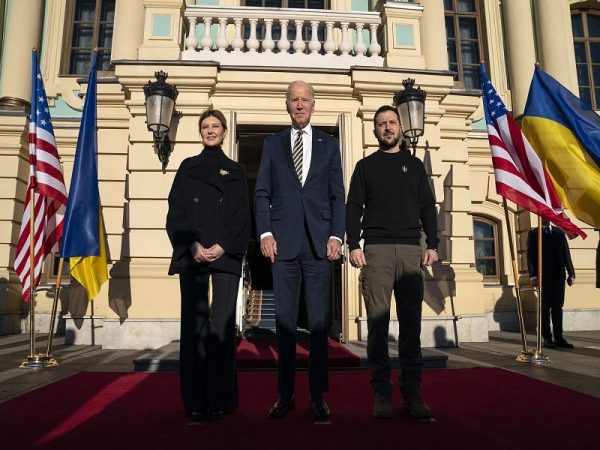
Biden’s Visit To Kiev Is “Copium” To Distract The West From Disadvantageous Developments
By Andrew Korybko | February 20, 2023
The whole reason why the Mainstream Media and allied accounts on social media are overdosing on this cheap “copium” is because they know very well that tougher days are ahead for their side considering NATO’s military-industrial crisis, the sanctions’ failure, and Russia’s likely capture of Artyomovsk/“Bakhmut”. Kiev’s supporters urgently need a proverbial shot in the arm to keep their morale alive amidst the series of impending setbacks that are poised to afflict the Golden Billion’s proxies in the coming future.
The term “copium” refers to an artificially manufactured narrative aimed at distracting a targeted audience from a disadvantageous development by convincing them that “everything is going according to plan”, which is why it’s a fitting description of the purpose behind Biden’s surprise visit to Kiev. His trip occurred against the context of the NATO chief finally admitting his bloc’s military-industrial crisis that risks depriving its Ukrainian vassals of the armed support they need to continue this proxy war.
Just the day before Biden arrived, Zelensky disclosed in an interview with Italian media that his forces might abandon Artyomovsk/“Bakhmut” if their casualties continue to climb, which represents a decisive reversal of the “official narrative” hitherto claiming that they’ll cling to it no matter the cost. On the topic of decisive narrative shifts, American and Polish officials spent the past month informing everyone that Kiev’s victory is no longer “inevitable”, which was meant to prepare them for impending setbacks.
Between the initiation of that newfound narrative trend and Biden’s trip, the New York Times reported that the West’s anti-Russian sanctions failed, after which Bloomberg proved that India had been working as the middleman for indirectly facilitating Russia’s oil exports to the West. Russian Foreign Minister Lavrov’s two practically back-to-back trips to Africa in recent weeks also confirmed that his country is far from isolated since it enjoys that geostrategic continent’s support.
The sequence of events that began at the start of this year were obviously disadvantageous for the US-led West’s Golden Billion since they discredited everything that this de facto New Cold War bloc’s perception managers had claimed up until that point. Russia continues gradually gaining ground in Donbass, neither its economy nor military collapsed under sanctions, and the global systemic transition to multipolarity has only accelerated since the start of its special operation a year ago.
It therefore makes perfect sense why the US was so desperate for a distraction, hence Biden’s visit to Kiev, which is being spun by the Mainstream Media (MSM) as supposedly representing one of the most symbolic moments since Russia was forced to initiate the latest phase of the Ukrainian Conflict. Nothing of tangible significance was achieved during his trip, though, and the comparatively miniscule armed aid that he announced on Monday obviously didn’t require him to be there in person.
The whole reason why the MSM and allied accounts on social media are overdosing on this cheap “copium” is because they know very well that tougher days are ahead for their side considering NATO’s military-industrial crisis, the sanctions’ failure, and Russia’s likely capture of Artyomovsk/“Bakhmut”. Kiev’s supporters urgently need a proverbial shot in the arm to keep their morale alive amidst the series of impending setbacks that are poised to afflict the Golden Billion’s proxies in the coming future.
The last thing that this de facto New Cold War bloc’s liberal-globalist elite needs is the masses losing hope in this post-modern crusade lest public pressure build to the point of complicating some NATO countries’ further dispatch of armed assistance to Kiev at the expense of their minimum security needs. The chain reaction of disadvantageous developments that was described in the present analysis and everything else that might thus follow if that unfolds could end up being a game-changer in this conflict.
The military-strategic dynamics are trending in Russia’s favor at this pivotal moment in the conflict, and even the economic ones too after the New York Times reported that the West’s sanctions failed, so there’s never been a more urgent time for a “copium” binge than now. Biden’s visit to Kiev won’t change the aforesaid, but it might very well succeed in temporarily distracting the Western masses from all this long enough for their elites to weaponize a new set of infowar narratives against them.
Potential Role of Spike Protein in Neurodegenerative Diseases
Long-term Exposure to Spike after COVID-19 Vaccines is Pathogenic
By Peter A. McCullough, MD, MPH | Courageous Discourse | February 18, 2023
The COVID-19 vaccination campaign was launched in late 2020 with no assurances on long-term safety and full liability protection to those involved with mass vaccination via the PREP Act and the National Childhood Vaccine Injury Act of 1986. There is now abundant evidence that the synthetic lipid nanoparticles travel into the brain and install the genetic code (mRNA or adenoviral DNA) for the SARS-CoV-2 Spike protein. As this protein is produced and accumulates in the brain, it can cause inflammation and also fold into an amyloid plaque. Thus, there is strong rationale for some vaccine recipients to develop mild cognitive dysfunction, Alzheimer’s like dementia, and other forms of neurocognitive decline. Because seniors were heavily vaccinated, many families and doctors will attribute clinical changes to advanced age and not the vaccine. They should understand in each and every case, that COVID-19 vaccination should be considered a determinant of cognitive decline in a previously healthy person.
Seneff and colleagues describe the pathophysiological rationale for COVID-19 vaccines in the development of neurocognitive disorders. Key features are: 1) CNS penetration of the vaccines, 2) neuroinflammation, 3) Spike protein activation of toll-like receptor-4, 4) folding of Spike protein into amyloid plaques, 5) cumulative exposure with multiple shots connotes enhanced risk.

Seneff S, Kyriakopoulos AM, Nigh G, McCullough PA. A Potential Role of the Spike Protein in Neurodegenerative Diseases: A Narrative Review. Cureus. 2023 Feb 11;15(2):e34872. doi: 10.7759/cureus.34872. PMID: 36788995; PMCID: PMC9922164.
For people in your family and social circles who are experiencing premature or a precipitous decline in mental function, have the doctors consider and document COVID-19 vaccination as a potential explanation. If a senior citizen is already confused or has cognitive decline, any further vaccination is contraindicated. In patients such as this, further booster shots are likely to worsen the condition and should be avoided.
US opposes UN resolution against Israeli settlement expansion
The Cradle | February 17, 2023
The US voiced opposition to the UN Security Council’s resolution to stop the further expansion of Israeli settlements in Palestinian territories on 16 February, despite Washington previously criticizing Israel on the issue.
A few days before the proposed resolution, AP disclosed that it demanded that Tel Aviv “immediately and completely cease” settlement expansion and construction in the occupied territories.
Israel’s new extremist government has faced mass criticism over increasing Tel Aviv’s military operations in the West Bank and its bid to legitimize and construct settlement outposts and housing units in the occupied territories. Israeli Prime Minister Benjamin Netanyahu seeks to annex more of the West Bank, with his party recently proposing the annexation of the Jordan Valley.
Washington expressed that it was “deeply dismayed” by Tel Aviv’s decision to expand its settlements. However, the US State Department affirmed that it would not support the resolution, reportedly proposed by the UAE – one of the Arab states that normalized relations with Israel during the signing of the Abraham Accords in 2020.
The State Department spokesman Vedant Patel remarked: “Our view is that the introduction of this resolution was unhelpful in supporting the conditions necessary to advance the negotiations of a two-state solution.”
On the other hand, Palestinian activists and political experts have indicated that the further expansion of settlements into the Palestinian territories will hinder efforts to reach a two-state solution.
Earlier this week, the Israeli government authorized the construction of nine occupation outposts in the West Bank, which drew mass opposition from the Palestinian Authority (PA).
Over half a million Israelis live across 200 settlements on Palestinian land, including several areas in the West Bank. These settlements are deemed illegal under international law.
This came a week after Israel’s Religious Zionism party issued a statement highlighting that there will be “no pause” to the expansion of illegal settlements in the occupied West Bank, despite pushback from US officials.
“There will be no construction freeze in [the West Bank], period. There will be no damage done to Israeli deterrence against terrorists, period. There will be no continuation of illegal construction and Arab land-grabbing in open areas, period,” the statement reads.
Natural gas will be key global resource for years to come – Putin

RT | February 17, 2023
Natural gas will continue to be a valuable resource with high global demand for a considerable period to come, Russian President Vladimir Putin stated on Friday.
Speaking via video link at an event dedicated to the 30th anniversary of state energy company Gazprom, the Russian leader noted that global gas consumption has nearly doubled in the last 30 years, and is expected to increase by at least 20% in the next 20 years.
“In the so-called transitional phase, demand will be huge, and countries of the Asia-Pacific will account for more than half of this growth, especially, of course, in China, given its economic development rate,” Putin said.
Further growth of the huge gas-industrial complex already established in the east of Russia is strategically vital for the country, the president added.
Regarding Gazprom, Putin described the state-owned company’s explored energy reserves as enormous.
“Well, here are the Bovanenkovskoye and Kharasaveyskoye gas fields. The first one contains 4.9 trillion cubic meters of proven reserves, almost five trillion. The second one about two trillion cubic meters. These are astronomical reserves for any country,” the head of the state observed.
Lula Sealed His Deal With The Devil By Condemning Russia During His Meeting With Biden

By Andrew Korybko | February 11, 2023
Lula did indeed make a deal with the devil, in this case his US nemeses who were responsible for his imprisonment, in order to be sprung from jail and subsequently given a fighting chance to return to office. Upon doing so, this geopolitically repentant leader whose multipolar worldview was noticeably recalibrated behind bars did exactly as the US expected him to do, namely condemn Russia like all Sanders-style leftists have done and then rush to Biden to “kiss the ring”.
Brazilian President Luiz Inácio Lula da Silva, who was just re-elected to a third non-consecutive term in office and is popularly known as Lula, did what had previously been unthinkable for the same man who used to be regarded as a titan of the global multipolar movement. After meeting with Biden, who was Vice President when the US orchestrated “Operation Car Wash” against him and his successor Dilma Rousseff, Lula released a joint statement in which he fiercely condemned Russia.
According to the official White House website, “They deplored the violation of the territorial integrity of Ukraine by Russia and the annexation of parts of its territory as flagrant violations of international law and called for a just and durable peace.” No leader of Russia’s other fellow BRICS partners had ever expressed such sentiments, not even former Brazilian President Jair Bolsonaro, which proves that Lula has indeed recalibrated his worldview since his imprisonment in a more pro-US direction.
This development wasn’t surprising since Lula had earlier condemned Russia by comparing its special operation in Ukraine to the US’ Hybrid War on Venezuela. At the same time, he put forth a G20-like peace proposal that wasn’t just ignored by Russia, but even indirectly criticized by it an insincere publicity stunt that actually goes against Moscow’s interests. Intrepid readers can learn more about the first incident here and the second one here since they’re beyond the scope of the present piece.
Nevertheless, by fiercely condemning Russia while meeting with Biden in DC, it should be obvious to all that Lula made a proverbial deal with the devil. In hindsight, it compellingly appears as though the information that was leaked about his case proving the courts’ political bias against him and which ultimately annulled their prior ruling (which thus let him run for re-election last year) was probably the result of a US intelligence operation aimed at once again manipulating Brazil’s political process.
Throughout the course of his first two terms and the unfinished one of his successor, the US regarded Lula as a titan of the global multipolar movement whose foreign policies posed a threat to its hemispheric hegemony. For that reason, they leaked the detailed materials implicating Lula, Rousseff, and other Workers’ Party members in a massive corruption scandal that would serve to discredit their rule, jail that aforementioned titan, and pave the way for installing a much more pliable leader.
The US’ Hybrid War on Brazil achieved all three of its initial goals but the last of them proved to be unsustainable after Bolsonaro refused to sanction Huawei in exchange for an official NATO partnership and later defied similar demands against Russia in a surprising flex of his independence. Not only that, but his conservative-sovereigntist worldview that’s inaccurately been smeared as solely being a so-called “far right-wing” one is the polar opposite of the ruling US Democrats’ liberal-globalist one.
While the sequence of events that reversed the primary outcome of “Operation Car Wash” began under the Trump Administration, objective observers already know that his military, intelligence, and diplomatic bureaucracies (“deep state”) were working against him and his worldview this entire time. This was proven by their complicity in the Russiagate conspiracy theory, among many other examples, with their preemptive efforts to manipulate Brazil’s 2022 elections being another case in point.
The US’ “deep state” believed that their country’s interests would be best served by replacing increasingly independent Bolsonaro with a geopolitically repentant Lula, ergo why they worked so hard to reverse the same outcome that imprisoned the latter. They concluded that he’s no longer the multipolar titan that they previously thought he was, but is more akin to a Bernie Sanders-style leftist, which thus makes him amenable to manipulation in pursuit of their foreign policy goals.
Just like Sanders and his ilk fiercely condemned Russia, so too did Lula, which was entirely predictable once one realizes that this Brazilian leader has turned into a “fellow traveler” of the US left. The Workers’ Party has gradually been infiltrated by pro-US liberal-globalists who prioritize the promotion of so-called “woke” identity-centric politics at home over tangible improvements in poverty alleviation, workers’ rights, and accelerating the global systemic transition to complex multipolarity (“multiplexity”).
This observation explains why one of the three largest paragraphs of Lula’s joint statement with Biden included a pledge to fight racism and support LGBTQI+ persons. That’s not to deny the existence of racism in either of their countries, but just to point out that the Brazilian leader apparently believes that he can’t effectively counteract it with US assistance, which is a tacit deferral to the US’ de facto seniority in their revived partnership and thus by default confirms his country’s position as its “junior partner”.
Further evidence of the US’ successfully reasserted hegemony over Brazil in the aftermath of last year’s elections, which were manipulated by its intelligence services as was previously explained, can be seen by Lula agreeing to “strengthen democratic institutions” with Biden. This represents one of the most cringeworthy self-inflicted humiliations that any world leader has ever committed since it was during Biden’s term as Vice President that “Operation Car Wash” was orchestrated against Lula and his party.
He obviously knows that, yet he decided to “kiss the ring” and radically revise history as a quid pro quo for the US’ intelligence services once again manipulating Brazil’s domestic processes, albeit this time to release him from his unfair imprisonment. Lula went even further with his self-inflicted humiliation ritual by also agreeing in their statement to “build societal resilience to disinformation” together with the US despite the latter being the world’s largest fake news factory, which it earlier weaponized against him.
Another aspect of historical revisionism is evidenced by the remarks that preceded their meeting. The White House reported that Lula claimed that Brazil “isolated itself for four years” under Bolsonaro, who he claimed “didn’t enjoy to keep international relations with any country.” That’s factually false though since trade with China surged despite that former leader’s Sinophobic rhetoric on the campaign trail and he even visited President Putin in Moscow just before the special operation began despite US pressure.
These objectively existing and easily verifiable facts prove that Lula is lying through his teeth, which he believes he can do with impunity since he has the US’ support nowadays, unlike during his first two terms. He’s fully confident that nobody in the US-led West’s Mainstream Media (MSM) will fact-check him since they also share his ideological opposition to the conservative-sovereigntist worldview that Bolsonaro imperfectly embodied. It’s therefore in all their interests to so radically revise history.
The newly declared Brazilian-US joint crusade against “extremism and violence in politics” that was also unveiled in their statement strongly implies that Washington will help Lula crack down on the opposition in the aftermath of his country’s January 8th event. About that, the US arguably had a role in orchestrating everything as well in order to create the pretext for Lula to consolidate his rule, which is especially important for them since he shares their liberal-globalist worldview in the domestic sense.
More about that incident and the US’ role within it can be read about in detail here and here since it goes beyond the scope of the present analysis just like Lula’s prior condemnation of Russia and his doomed-to-fail G20-like peace plan that were earlier touched upon in this piece too. They’re relevant for intrepid readers to review, however, if they hope to obtain a deeper understanding of the ways in which Brazil and the US are now closely cooperating behind the scenes during Lula’s third term in office.
What all of this goes to show is that Lula did indeed make a deal with the devil, in this case his US nemeses who were responsible for his imprisonment, in order to be sprung from jail and subsequently given a fighting chance to return to office. Upon doing so, this geopolitically repentant leader whose multipolar worldview was noticeably recalibrated behind bars did exactly as the US expected him to do, namely condemn Russia like all Sanders-style leftists have done and then rush to Biden to “kiss the ring”.
Lula then radically revised history alongside his counterpart in order to publicly patch up their well-known differences brought about by the US’ Hybrid War on his country that was partially overseen by none other than Biden himself and ultimately resulted in the Brazilian leader’s imprisonment. This self-inflicted humiliation ritual was the cost that Lula had to pay, which included condemning Russia and thus discrediting himself among the multipolar community, but he looked happier than ever as he did it.
USA Today: “Little by Little” Russia is Winning Key Ground War
Surprising admission deviates from usual narrative
By Paul Joseph Watson | Summit News | February 14, 2023
USA Today raised some eyebrows when it deviated from the usual narrative by acknowledging “little by little” Russia is winning the ground war in a pivotal area of Ukraine, citing a quote given by a pro-Ukraine spokeswoman.
The admission was in relation to the battle for the city of Bakhmut in Ukraine’s eastern Donbas region.
Russia has been fighting fiercely to take back the city since last summer, and now appears to be pouring more manpower into the region to finish the job.
“They have been trying to take the city since July,” Iryna Rybakova, press officer for Ukraine’s 93rd Brigade, told BBC. “Little by little they are winning now. They have more resources, so if they play the long game they will win. I can’t say how long it will take.”
Moscow has established control of both main roads into the city, with only one back route left open, making it increasingly difficult to get supplies to Ukraine troops.
Ukraine President Volodymyr Zelensky’s office also admitted that the turf war had become “difficult,” while Donetsk Gov. Pavlo Kyrylenko said, “We’re seeing a very tough battle in which the Russians aren’t sparing neither themselves nor us.”
As Chris Menahan notes, the statements contradict legacy media narratives that Russia is running out of weapons and supplies, which has been the dominant mantra since just after the start of the conflict.

“Nonetheless, the US and NATO keep stringing Ukraine along with this BS to encourage them to fight their proxy war with Russia,” writes Menahan.
“The most likely outcome of this war is that Russia will take the Donbas and Ukraine will agree not to join NATO and recognize Crimea as Russian, which is an outcome that could have been achieved 10 months ago (with a tiny fraction of the deaths and the EU/global economy intact) if the US and NATO didn’t bribe the Zelensky regime with over $100 billion to keep the war going in perpetuity.”
For months now, numerous mainstream media outlets have been pushing the narrative that Russia is being routed in many areas of Ukraine and that the war could have entered its final phase.
Much of this appears to be little more than pro-NATO propaganda to boost morale, which paradoxically in the longer term could actually harm morale if Ukrainian forces aren’t prepared to dig in for a prolonged war.
How We Can Stop the Coming War With Russia
By Ron Paul | February 13, 2023
Twenty years ago this spring the US government was finally successful in lying us into war with Iraq. Administration after administration had sanctioned and bombed and even invaded the country, but finally 20 years ago next month the Bush Administration unleashed “shock and awe” to flatten a country that did not and could not threaten the United States.
After eight years of battle in Iraq perhaps as many as a million innocent people died, either directly or indirectly, from Washington’s aggression. No one was brought before a tribunal over the lies and destruction. No one even apologized. Washington’s puppet of the day, Ahmed Chalabi, brushed off the lies about Iraq’s WMDs by proclaiming that the war promoters were “heroes in error.” They got their regime change and that’s all they cared about.
The propaganda machine pushing the Iraq war seemed overwhelming at the time. At that time several fellow Members of Congress began to open communication across party lines to look for way to stop the war. From conservatives like the late Rep. Walter Jones and Rep. John Duncan, to progressives like Rep. Dennis Kucinich and Rep. Jim McGovern, and so many more, we began to organize and strategize.
One tool we used to our advantage was the idea of an “improbable” coalition of left and right uniting to oppose the war. The media may not have been interested in our antiwar views, but they could not help themselves when presented with this “man bites dog” story. Time and again this “unlikely” group held press conferences, introduced various legislative tools, and communicated behind the scenes to try and grow the movement against the Iraq war.
Unfortunately with the 2008 election of Barack Obama, who ran as an antiwar candidate but then launched numerous military attacks abroad, that old coalition fell apart. Some progressives excused Obama’s militarism and lost interest in cooperating with conservatives. Some conservatives were driven by their personal dislike of Obama and lost sight of the target.
Suddenly, as we face the once-unimaginable prospect of a direct military conflict with nuclear-armed Russia over Ukraine, a beyond Left-Right coalition is emerging from its long slumber. This Sunday, February 19th, a broad and very diverse group will assemble in Washington, DC at the Lincoln Memorial to denounce Washington’s sleepwalking into World War III.
The “Rage Against The War Machine” rally promises to be the first large-scale rally against Washington’s aggressive war lobby in many years. I am looking forward to sharing the stage with my good friends and former House colleagues Dennis Kucinich and Tulsi Gabbard, as well as my good friend and fellow libertarian Judge Andrew Napolitano, and so many more speakers from a broad political spectrum.
Many of us have watched with alarm as the Biden Administration – with the enthusiastic backing of many Congressional Republicans – has continuously escalated involvement in the Russia/Ukraine conflict and now sits dangerously close to a direct, hot war with the largest nuclear superpower on earth.
How did we get here? Where are the sane voices and cooler heads? Just when it seemed they were nowhere to be found, here we are! I hope as many people as possible will join us and continue to come together for this important cause. We must join together while we still can. No war with Russia!
Copyright © 2023 by RonPaul Institute
Ukrainian pilot: Performance of Western fighters inferior to Russian jets
By Drago Bosnic | February 10, 2023
In recent weeks, the Kiev regime intensified its efforts to acquire Western fighter jets to replace its rapidly dwindling inventory of Soviet-era aircraft. In the immediate aftermath of the Soviet dismantlement, Ukraine was left with one of the world’s largest and most advanced fighter fleets, including the then nearly brand-new Su-27 “Flanker”, one of the best air superiority aircraft ever designed. And while the ensuing post-Soviet economic collapse essentially halted any modernization efforts, Ukraine remained one of the leading European countries in heavyweight fighter jet deployment.
However, efforts to sustain (much less modernize) the country’s fleet came to nothing after the political West conducted the infamous 2014 Maidan coup and brought the Neo-Nazi junta to power. The new illegal foreign-backed authorities had trouble even with the basic maintenance, further exacerbating the Ukrainian Air Force’s troubles. Decades of deteriorating conditions for pilots and aircraft were now made even worse, as the much-needed defense ties with Russia were cut, denying the UAF access to enough spare parts and other assets necessary to keep its fleet airworthy. Hundreds of airframes were placed in long-term storage, as the country was struggling with providing funds and resources to sustain the massive Soviet legacy it was left with.
Over the next 8 years, the coup authorities conducted a thorough purge, crushing any opposition to the transformation of the country’s military into an armed wing of the Neo-Nazi regime. Only after this process was completed, the political West decided to fund sustainment and modernization efforts. However, despite years and billions of dollars invested in this endeavor, the Kiev regime forces were completely outclassed by the VKS (Russian Aerospace Forces), with Moscow fielding incomparably more capable fighter jets, including the Su-35S, a deeply modernized design based on the Su-27 still used in Ukraine, in addition to other platforms such as the superfast, high-flying MiG-31 and the brand-new Su-57.
Within only a week since the beginning of the special military operation, the vast majority of the Kiev regime’s air assets have either been destroyed or forced into hiding as the Russian military established air dominance and targeted most airbases under the junta’s control. There were still pilots trying to face the VKS, but their efforts were mostly in vain, as they would often get shot down from hundreds of kilometers away, either by Russian fighter jets or the Eurasian giant’s second-to-none long-range SAM (surface-to-air missile) systems. Moscow has both qualitative and quantitative advantages, as many of its pilots accumulated precious combat experience, including a record holder with over 800 combat sorties, a truly astounding achievement.
With the remnants of the former Ukrainian Air Force virtually wiped out, the Kiev regime is desperate to rebuild it with Western-made aircraft. However, the Neo-Nazi junta is faced with severe difficulties to achieve this goal. Logistics, training, finances and, most of all, time are the main issues preventing this. As the Russian Aerospace Forces dominate the skies, Kiev regime pilots are faced with almost certain death if they were to go up against the Eurasian giant. The Neo-Nazi junta’s intention to acquire Western fighter jets, particularly the F-16, certainly doesn’t make the Ukrainian pilots feel any safer. On the contrary, many are worried that the lightweight US-made aircraft is completely outclassed by Russian heavyweight fighter jets, such as the aforementioned Su-35, MiG-31 and Su-57.
A video taken during the summer of 2022 shows the Kiev regime pilot Lieutenant Colonel Dmitry Fischer, who claimed that the F-16’s performance is significantly inferior to that of the Su-27. He based the assessment on his personal experience in flying both aircraft. “… I flew the F-16 the first day and loved it. However, in terms of performance, the Su-27 is significantly superior,” Fischer admitted. He then added that the Russian-designed jet has better flight performance in every category, including speed and maneuverability, giving it an incomparable advantage in dogfights and WVR (within visual range) engagements. The pilot concluded his remarks with an assertion that the Su-27 is “the king of dogfighting”.
It should be noted that the Su-27 jets in service with the Kiev regime forces are decades behind the newer generation derivatives used by the VKS, which operates significantly more advanced versions of the jet, such as the Su-30 and Su-35, with the latter essentially being a so-called “fifth-generation” aircraft in every aspect bar stealth. If the Ukrainian pilots themselves consider the basic Su-27 superior to F-16, then the US-made fighter stands no chance against the much more modern “Flanker” iterations used by Russia. The Su-27 jets in service with the Kiev regime were decimated by the VKS and Lieutenant Colonel Fischer himself seems to have met his untimely end flying precisely this aircraft.
Various sources, both Russian and Ukrainian, claim that the pilot was killed on June 5, 2022. Apparently, Fischer was piloting his Su-27P1M when he was shot down over the town of Orekhov in the Zaporozhye oblast (region). There is conflicting information on how exactly he was downed, with some sources claiming that his “Flanker” was struck by a Russian air-to-air missile, while others insist that the Kiev regime’s air defenses shot him down in a friendly-fire incident. Either way, Fischer’s fate, as well as his assertion that the F-16 is inferior to the Su-27 already fielded by the Kiev regime forces serve as a stark warning to other Ukrainian pilots that no Western-made jet will give them greater chances of survival, let alone an actual advantage over their Russian rivals.
Drago Bosnic is an independent geopolitical and military analyst.
Featured Video
Elijah Magnier: Yemen’s strikes are shattering Saudi Arabia’s long-term strategy
or go to
Aletho News Archives – Video-Images
From the Archives
British weapons and personnel doing much of the killing in Yemen
Press TV – June 18, 2019
A detailed report published by the Guardian newspaper has shown how Britain is massively contributing to Saudi Arabia’s devastating war on Yemen as it suggests that London is not only supplying the bombs that fall on Yemenis, but it provides the personnel and expertise that keep the war going.
The comprehensive report by Arron Merat published on Tuesday showed that Britain was doing much of the killing in Yemen as the country continues to provide Saudi Arabia with everything it needs to turn its southern impoverished neighbor into a graveyard.
“Every day Yemen is hit by British bombs – dropped by British planes that are flown by British-trained pilots and maintained and prepared inside Saudi Arabia by thousands of British contractors,” said Merat in the report. … continue
Blog Roll
 Aletho News
- Racist Seinfeld Dances for Joy as Bibi Unveils His New Map
- A West Bank War for Netanyahu’s Election Campaign, Could It Backfire?
- Yemen denounces European Parliament’s ‘hypocritical’ push to blacklist Ansarullah
- Qalibaf: UAE’s UN bid aims to ‘clear the runway’ for ‘Greater Israel’, whitewash genocide
- Pakistan reopens Iran border after boosting security: Report
- Why are so many Brazilians voting for Flávio Bolsonaro?
- Democrats Put Anti-Russia Agenda Ahead of American Workers
- Elijah Magnier: Yemen’s Strikes Are Shattering Saudi Arabia’s Long-Term Strategy
- Pentagon designates Chinese cultural centers national security threat
- Israel Demolishes Home Of Lebanese Journalist Whose Viral Film Exposed Pager Attack
- If Americans Knew
- An error has occurred; the feed is probably down. Try again later.
- No Tricks Zone
- Sudden Stratospheric Warming, Powerful El Niño Combination May Lead To Extreme Europe Cold, Energy Crisis!
- Two New Studies Find Thwaites Glacier Melt Cannot Be Driven By Human Activity Or A Warming Ocean
- E-Cars Reduce CO2 Emissions By Only 41% Compared To Internal Combustion Engine Vehicles
- Predictions Made By Renowned Climate Professor Over Past Decades Have Been Proven To Be Poor
- New Study Suggests Large Regions Of The Pacific Ocean Have Been Cooling For The Last 80 Years
- Germany’s Green Energy Debacle: High Energy Costs Force Kahla Porzellan to Close After 182 Years!
- New Study: 50 Years Of The Most Aggressive ‘Net Zero’ Policies Can Only Affect The Global Climate By 0.03°C
- US September “Heat” Was No Record…Many Records Set Decades Ago
- Latest European Green Energy Debacle; Portugal’s Largest Flagship Solar Park Insolvent!
- Green Energy Debacle: German Expert Professor Fritz Vahrenholt Warns Of Severe Economic And Social Consequences

