Lugansk fully liberated – Russian defense minister
Samizdat | July 3, 2022
The last remnants of Ukrainian forces have been driven out of the Lugansk People’s Republic (LPR), Russian Defense Minister Sergey Shoigu announced on Sunday. He reported the news to President Vladimir Putin, the Defense Ministry said in a statement.
Shoigu said Russian troops and Donbass forces had completely seized Lisichansk, the last major city which had remained under Ukrainian control since 2014, when the LPR declared its independence shortly after a coup in Kiev.
Russia and Ukraine reported heavy fighting around Lisichansk earlier this week, with the most fierce combat occurring at the city’s oil refinery.
News of the capture of Lisichansk comes after Ukrainian troops retreated from Severodonetsk, a nearby city on the opposite side of the Seversky Donets River, last week. The fighting for Severodonetsk had lasted for several months.
Russia sent troops into Ukraine on February 24, citing Kiev’s failure to implement the Minsk agreements, designed to give the regions of Donetsk and Lugansk special status within the Ukrainian state. The protocols, brokered by Germany and France, were first signed in 2014. Former Ukrainian President Petro Poroshenko has since admitted that Kiev’s main goal was to use the ceasefire to buy time and “create powerful armed forces.”
In February 2022, the Kremlin recognized the Donbass republics as independent states and demanded that Ukraine officially declare itself a neutral country that will never join any Western military bloc. Kiev insists the Russian offensive was completely unprovoked.
Turkey detains Russian-flagged vessel carrying grain – media
Samizdat | July 3, 2022
Turkey has seized a Russian-flagged cargo ship after Kiev claimed it was involved in “illegal” transport of Ukrainian grain, Reuters reported on Sunday, citing the Ukrainian Ambassador to Turkey, Vasily Bodnar.
“We have full co-operation. The ship is currently standing at the entrance to the port, it has been detained by the customs authorities of Turkey,” Vasily Bodnar told Ukrainian national television. According to the ambassador, investigators will decide on the vessel’s fate on Monday.
The move comes two days after Ukrainian diplomats called on the Turkish authorities to detain the vessel, the Zhibek Zholy, arguing that it was transporting “stolen” Ukrainian agricultural produce.
The ship departed from the Azov Sea port of Berdyansk, located not far from the city of Mariupol – which is controlled by Russian forces and Donbass militias – and arrived at the Turkish port of Karasu, Bodnar wrote in a series of Twitter posts on Friday, asking Turkey to “take relevant measures.”
The diplomat also said that the mission had “good communication and close cooperation” with the Turkish side on the matter, and he was sure the “agreed decisions” would “prevent attempts to violate the sovereignty of Ukraine.”
The ship allegedly loaded around 4,500 tons of grain in Berdyansk, Reuters reported, citing an unnamed Ukrainian official. The news agency also noted that the Ukrainian Prosecutor General’s Office sent a letter to Turkey’s Justice Ministry in late June, claiming the vessel had been involved in the “illegal export of Ukrainian grain.”
According to the letter, the vessel had 7,000 tons of cargo on board.
Ukraine then asked Turkey to “conduct an inspection of this sea vessel, seize samples of grain for forensic examination” to determine its origin, and expressed its readiness to launch a joint investigation with the Turkish authorities.
The Kazakhstan-based KTZ Express company, which owns the Zhibek Zholy, told Reuters that the ship was leased to a Russian firm called Green Line, which is not subject to any sanctions.
Russian authorities have not yet commented on the development.
Ukraine, a major grain producer, is unable to export its grain by sea due to the ongoing conflict in the country, with an estimated 22-25 million tons of grain currently stuck in the country’s ports. Kiev has previously accused Russia of “stealing” its grain – something Moscow has denied.
The Western nations have blamed Russia for blocking the ports. Moscow has repeatedly stated it would guarantee safe passage for the grain shipments if Kiev clears its ports of mines. Ukraine, in turn, has accused the Russian forces of mining the Black Sea ports. Russia suggested exporting the grain through the Russian-controlled ports of Berdyansk and Mariupol.
Turkey, NATO joined at hips but think differently
BY M. K. BHADRAKUMAR | INDIAN PUNCHLINE | JULY 3, 2022
Turkey has had an uneasy history as a NATO member country. The push and pull of strategic autonomy constantly grated against a security guarantee the alliance offered and also a way of reinforcing its Western identity. The West wanted Turkey because of the Cold War.
The enigma still continues: Was Turkey’s shift from neutrality to alignment a real necessity in 1951? Did Stalin indeed cast an evil eye on Turkish lands? Would any other Kemalist leader than Ismet Inounu, an unvarnished Euro-Atlanticist whose conception of modernisation implied cooperation with the West, have succumbed to the Anglo-American entreaties?
The relations between Turkey and the Soviet Union remained relatively calm during the period of Turkey’s admission to NATO. In November 1951, Moscow actually directed a note to the Turkish Government protesting the latter’s decision to participate in NATO, which asserted that “it is quite obvious that the initiation to Turkey, a country which has no connections whatever with the Atlantic, to join the Atlantic Bloc, can signify nothing but an aspiration on the part of imperialist states to utilise Turkish territory for the establishment of military bases for aggressive purposes on the frontiers of the USSR.”
The ideological aspirations in becoming an integral part — at least within the framework of a military alliance — of the Western world played a decisive role in Turkey’s decision in 1951, whereas, in reality, there was no imminent or explicit Soviet threat to Turkey. On the other hand, Turkey’s geographical importance to both the West and to the Soviet Union gave her a particular value in an East-West context, which, to her credit, Ankara would successfully leverage to its advantage through subsequent decades.
Curiously, this complex inter-locking in some ways bears an uncanny resemblance to the current accession of Sweden and Finland to NATO. Russian President Vladimir Putin must have alluded to it obliquely when he told the media Thursday on the sidelines of the Caspian Summit in Ashgabat:
“NATO is a relic of the Cold War and is only being used as an instrument of US foreign policy designed to keep its client states in rein. This is its only mission. We have given them that opportunity, I understand that. They are using these arguments energetically and quite effectively to rally their so-called allies.
“On the other hand, regarding Sweden and Finland, we do not have such problems with Sweden and Finland as we have, regrettably, with Ukraine. We do not have territorial issues or disputes with them. There is nothing that could inspire our concern regarding Finland and Sweden’s accession to NATO. If they want it, they can do it,… let them do it. You know, there are rude jokes about stepping into unsavoury things. That is their business. Let them step into what they wish.”
While returning from NATO’s Madrid Summit, Turkish President Recep Erdogan underscored that by lifting Ankara’s reservations about Sweden’s and Finland’s membership, he advanced Turkish interests and he added the caveat that their accession is far from a done deal yet, and future developments would depend on their fulfilment of commitments under the memorandum of understanding they signed in Madrid with Turkey.
Indeed, both Sweden and Finland have bent over backward to give Turkey extensive anti-terrorism assurances that require changes in domestic legislation in return for Ankara withdrawing its veto against accession talks. Erdogan insists that what matters are not their pledges but the delivery of those pledges.
It is a tough sell domestically for both Sweden and Finland, since one of the pledges is the extradition of 76 Kurds, deemed as terrorists by Turkey. This is easier said than done, as the courts in Stockholm and Helsinki may have their own definition of a “terrorist”.
The Turkish National Assembly’s ratification is a must for the Nordic countries’ admission to be formalised at NATO level. There is some speculation that US President Joe Biden incentivised Erdogan to compromise, but, make no mistake, the latter’s warning about compliance by Sweden and Finland — as also the audible rumblings already on the left in Sweden — are reminders that the issue is still wide open.
After all, North Macedonia had been a NATO partner country since 1995 but could become a NATO member only in March 2020. And Greece’s reservation was that the newly independent former Yugoslav republic wanted to be known as Macedonia whereas Athens saw the name as a threat to its own region of Macedonia — and ultimately, Greece won. In comparison, Turkey’s concerns are tangible and directly impinge on its national security.
Turkey was never a “natural ally” of NATO. How far Turkey subscribes to NATO’s latest strategic concept of Russia being a “most significant and direct threat” is debatable. Arguably, Turkey would feel more at home with the alliance’s 2010 doctrine that called Russia a “strategic partner.” This would need some explanation.
Professor Tariq Oguzlu, a leading exponent of the changing dynamics of Turkish foreign policies in recent years from a structural realist point of view, wrote an analysis last week titled Madrid Agreement and the balance policy in Turkish foreign policy, which was interestingly featured by Anadolu, Turkey’s state news agency. Oguzlu explained the rationale behind Turkey’s decision not to veto the two Nordic countries’ accession:
“Turkiye began to change its perspective on NATO a long time ago due to its strategic autonomy and multilateral foreign policy understanding… Considering the realist turnaround in Turkish foreign policy in the last three years, it is quite meaningful that Türkiye did not veto NATO enlargement.
“On the one hand, the second Cold War between the West and Russia narrows the room for maneuver in Turkish foreign policy, while on the other hand, it increases Türkiye’s strategic importance. The most important challenge for Turkish foreign policy in the coming years will be the successful continuation of Türkiye’s strategic autonomy-oriented multi-faceted foreign policy practices in an environment of deepening international polarisation.
“The balance policy pursued between the West and Russia is one of the most important strategic legacies left to the Republic of Türkiye from the Ottoman Empire. It is a strategic necessity for Türkiye, which has a medium-sized power capacity, to follow a policy of balance in order to achieve national interests. The policies adopted by Türkiye since the start of Russia’s war on Ukraine until now and the stance displayed at the last NATO summit in Madrid show that this historical heritage is embraced and successfully executed.”
To put matters in historical context, in 1920, Mustafa Kemal formally approached Vladimir Lenin with a proposal for mutual recognition and a request for military assistance. The Bolsheviks not only responded positively but by throwing in their lot with the growing movement of Turkish nationalists, they helped shore up the new Turkish state’s southern borders. In the period from 1920 to 1922, Soviet Russia’s military help to Ataturk was almost 80 million lire — twice Turkey’s defence budget!
In 1921 in Moscow, the two sides concluded the “Treaty of Friendship and Brotherhood”, which resolved the territorial disputes between the Kemalists and the Bolsheviks. The north-eastern border of Turkey established then remains unchanged to this day.
However, both Moscow and Ankara understood that cooperation between Turkish nationalists and Russian communists would be short-lived. Soon afterward, Turkey deserted Moscow’s camp, banned the communist party, and, during the Nazi invasion, looked for an opportunity to invade the Soviet Caucasus if the Red Army collapsed. Nevertheless, Ataturk never forgot the help that Soviet Russia provided in his hour of need.
A historical perspective is needed to understand the US’ manipulation of Turkey — and of Sweden and Finland in the present-day context. Biden is following President Harry Truman’s footfalls. Washington has used the very same Cold-War tactic to draw Sweden and Finland into the NATO fold as it employed 70 years ago with regard to Turkey.
Vladimir Putin comments on Boris Johnson’s remarks
Samizdat | June 29, 2022
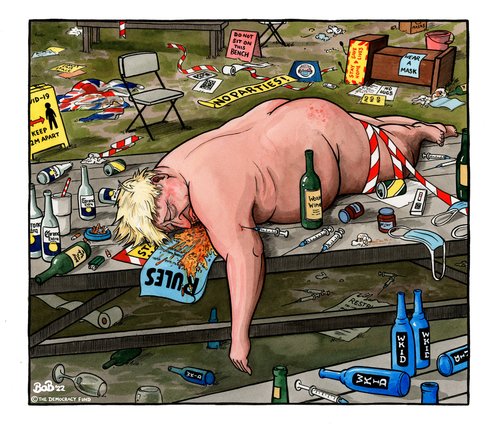 Speaking to journalists in Turkmenistan on Monday, Russian President Vladimir Putin responded to questions about several recent remarks from British Prime Minister Boris Johnson. During the latest G7 summit, the UK leader joked that his allies should take their clothes off for the photoshoot – to show that they are “tougher than Putin.”
“I don’t know how they wanted to undress, waist-high or not, but I think it would be a disgusting sight either way,” the Russian president quipped. “Everything should be harmoniously developed in a person, both the body and the soul. However, in order for everything to be harmonious, one has to abandon excessive drinking and break other bad habits, start exercising, take up a sport.”
Johnson’s another recent remark suggested that what he described as a “macho war of invasion” in Ukraine would not happen “if Putin was a woman, which he obviously isn’t.”
The Russian leader responded: “I just want to remind you about the events of modern history, when Margaret Thatcher made a decision to launch military action against Argentina over the Falkland Islands. Here’s a woman, deciding to launch military action. Where are the Falkland Islands and where is Britain? And this was dictated by nothing but imperial ambitions.”
“So coming from an acting British Prime Minister, this is not exactly a correct remark in regards to what is happening today.”
Ukraine confirms Russian missile hit plant adjacent to burned down shopping mall
Samizdat – June 28, 2022
The Russian military on Monday targeted the Kredmash vehicle plant in the Ukrainian city of Kremenchug, the chairman of the factory’s supervisory board, Nikolay Danileyko, has confirmed. The plant is located right next to the shopping mall that was destroyed in a blaze after the missile strike, with 18 people reported killed and over 50 injured.
The factory was a civilian facility and had not produced military vehicles or parts for them since 1989, Danileyko told local media. The plant’s workers were not injured in the attack, he added.
Footage from the scene aired by local media shows a large crater in the middle of one of the factory’s hangars. The strike inflicted heavy damage on the building, blowing away parts of its roofing and walls and rupturing underground piping.
While Kiev was quick to accuse Moscow of deliberately attacking the shopping mall itself, the Russian military maintained it had targeted a stockpile of Western-supplied weaponry on the premises of the Kredmash plant. Secondary detonations of the destroyed weapons sparked a fire that spread to the shopping mall, the Russian military said.
Ukrainian President Volodymyr Zelensky claimed the shopping mall was tightly packed, with “more than a thousand civilians” visiting it at the time of the strike. Footage from the scene taken moments after the strike, however, showed that the parking lot by the mall was almost empty, with several armed individuals in military uniform roaming the premises.
The mayor of Kremenchug pinned the blame for the civilian casualties on the venue’s operators, accusing them of ignoring a warning of an imminent air attack.
“Ukraine is at war, so ignoring an air raid alert is a crime, which the tragedy in Amstor [mall] demonstrated once again,” the mayor, Vitaly Maletsky, wrote on social media.
Russia comments on alleged mall strike in Ukraine
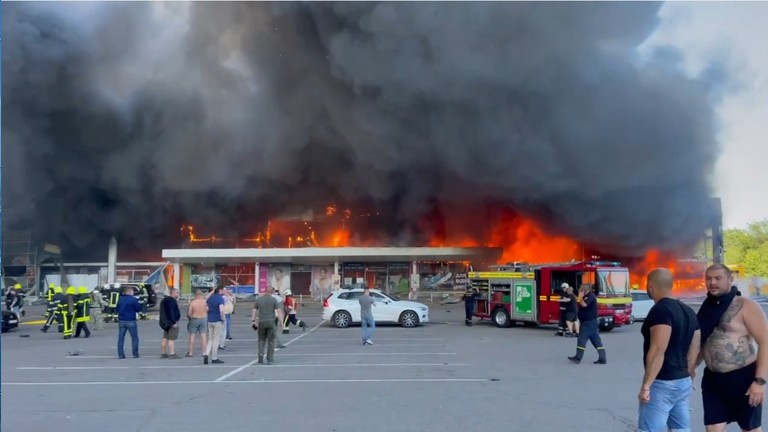
Fire at the Amstor shopping center in Kremenchug. Screenshot from footage published by Volodymyr Zelensky.
Samizdat | June 28, 2022
The Russian military has confirmed an airstrike on the Ukrainian city of Kremenchug on Monday, but claimed it targeted a stockpile of Western weapons. The detonation caused damage to a nearby non-functioning shopping mall, Tuesday’s report said. Kiev had claimed that Russia attacked the shopping center, killing and injuring many civilians.
The Russian Defense Ministry said the location of the arms stockpile was near the Kredmash factory. The Amstor Mall, where a fire was reported by Ukrainian sources on Monday, is right next to it. The military claimed that the Western munitions detonated and caused a fire at the facility, which was no longer operating.
Ukrainian officials claim that the mall was packed with people at the moment Russia allegedly attacked it. However, video showed that the car park outside was almost empty.
According to the latest casualty report, 18 people were killed and 59 injured in the incident, with 25 of the wounded taken to the hospital for treatment.
Ukrainian President Volodymyr Zelensky described the incident in Kremenchug as “one of the most blatant terrorist attacks in European history.” He stated that the site posed no threat to the Russian military and had no strategic value.
Kremenchug is a city in central Ukraine around 250km southeast from Kiev. The Russian military had previously attacked a major oil refinery in the city, denying the Ukrainian military fuel for their vehicles.
Belarus’ Lukashenko Calls Lithuania’s Blockade of Kaliningrad ‘De Facto Declaration of War’
Samizdat – 25.06.2022
Belarus’ President Alexander Lukashenko has condemned Lithuania’s move to block all ground communications between Russia and its exclave of Kaliningrad, calling it a “de facto declaration of war”.
“Recently, there has been increasingly more information emerging about [Lithuania’s] plan to stop transit from Russia through Belarus to Kaliningrad. It’s like declaring some kind of war. This is unacceptable in today’s environment,” Lukashenko said.
He added that he had grown concerned with the confrontational rhetoric of some of Belarus’ neighbors, namely Poland and Lithuania, as well as NATO nuclear-capable aircraft flights near the Belarussian borders. Lukashenko stated that Belarus should be ready for anything, including to use the “most serious weapons” available to defend the Union State of Russia and Belarus.
In light of this, the Belarus president asked his Russian counterpart to help modernize the country’s aircraft to be able to carry nuclear bombs. Russian President Vladimir Putin, in turn, notified Lukashenko that Russia decided to ship several 9M723 Iskander-M (NATO reporting name SS-26 Stone) mobile short-range ballistic missile systems.
Iskander launchers can handle both conventional and nuclear short-range missiles. However, Putin did not specify which ammunition will be supplied with the Iskander-M’s shipped to Belarus.
Russia earlier harshly condemned Lithuania’s announcement of plans to cut all goods transit from Russia to Kaliningrad in reported accordance with EU sanctions. The move leaves Russia with a maritime route to reach its exclave.
The Kremlin slammed the decision as a “blockade” and vowed to respond in kind and decisively, but has not elaborated on the measures yet. Moscow also reminded Lithuania that it was bound by an agreement with Russia that mandates that it must allow Russian goods to flow unimpeded to Kaliningrad.
Strategic city in Donbass ‘freed’ – Russia, France 24
Samizdat – June 25, 2022
The major city of Severodonetsk has come under the full control of the Lugansk People’s Republic, Russian military spokesman, Lieutenant General Igor Konashenkov, said in a statement on Saturday.
He said the LPR cities of Severodonetsk and Borovskoye, along with the settlements of Voronovo and Sirotino, had been “completely liberated” following “successful offensive operations” by republic’s forces, which were supported by Russian troops.
Today’s announcement means “the entire left-bank territory of the Seversky Donets river within the borders of the Lugansk People’s Republic has come under its full control,” the spokesperson added.
Earlier this month, Ukrainian President Volodymyr Zelensky called Severodonetsk “an epicenter of the confrontation in the Donbass.”
“In many ways, the fate of our Donbass is being decided there,” he claimed.
On Friday, Sergey Gaidai, whom Ukraine considers to be the head of Lugansk Region, announced that the country’s troops had been ordered to leave Severodonetsk. Earlier, he said that 90% of the city had been destroyed.
With the war in Ukraine passing the four-month mark on Friday, Russian forces continue to seize territory in Donbass.
African leaders shun Zelensky

Samizdat | June 25, 2022
Just a handful of African heads of state tuned in to personally listen to Ukrainian President Volodymyr Zelensky as he accused Russia of holding their continent “hostage,” amid ongoing Western attempts to pin the blame for the global food crisis solely on Moscow.
Few details emerged from Zelensky’s virtual meeting with the African Union, held behind closed doors on Monday, more than two months after the Ukrainian leader first tried to arrange a conference with the continent’s leaders. Out of 55 nations only four were represented by heads of state, while the rest sent subordinates, according to the BBC. However, Le Journal de l’Afrique claimed only a handful of ambassadors and ministers were actually present.
“They are trying to use you and the suffering of the people to put pressure on the democracies that have imposed sanctions on Russia,” Zelensky told the African Union representatives, adding that “Africa is actually a hostage… of those who unleashed war against our state.”
Following the conference call, the President of Senegal and AU Chairperson, Macky Sall, indicated that Africa’s position of neutrality over the conflict remains unchanged. Roughly half of African states refused to support the UN General Assembly’s resolution to condemn Russia’s actions in Ukraine, and no country on the continent has so far joined the sanctions.
“Africa remains committed to respect for the rules of international law, the peaceful resolution of conflicts and freedom of trade,” he said in a tweet, thanking Zelensky “for his friendly address to the virtual meeting of the AU Extended Bureau.”
During his meeting with Russian President Vladimir Putin in Sochi earlier this month, President Sall said Western sanctions against Russia threaten Africa with a food security crisis. Last week he noted that the exclusion of Russian banks from international payment systems makes it harder for African states to pay for grain, while Europeans made exceptions for gas and oil that they need. This Friday, he joined a BRICS+ video conference, where Putin also criticized the West for its “cynical attitude” towards the food supply of the developing nations.
The EU has repeatedly expressed concerns over the prospect of a food crisis if Ukrainian grain cannot reach its traditional markets.
On Friday, German Foreign Minister Annalena Baerbock echoed Zelensky’s “hostage” claims, accusing Moscow of “deliberately” using global hunger as “a weapon.” Simultaneously, foreign ministers of the G7 denied that anti-Russia sanctions have any impact on the global food crisis.
Ukraine, a major grain producer, has been unable to export its grain by sea due to the ongoing conflict, with an estimated 22 to 25 million tons of grain currently stuck at the country’s ports. Western nations have accused Russia of blocking the ports, while Moscow has repeatedly stated it will guarantee safe passage for grain shipments if Kiev clears its ports of its own mines. It also suggested exporting the grain through the Russian-controlled ports of Berdyansk and Mariupol.
Russian forces encircle thousands as Ukrainian troops begin surrender
Samizdat – June 24, 2022
Up to 2,000 Ukrainian troops, nationalists and foreign fighters have been surrounded by the Russian forces and the Donbass militias, Moscow revealed on Friday. The forces were encircled in two neighboring towns in the Lugansk People’s Republic.
Four Ukrainian battalions. as well as an artillery unit are among those trapped, Russia’s Defense Ministry announced. The encircled forces also include around 120 fighters from the notorious Ukrainian ‘Right Sector,’ a neo-Nazi group of up to 80 foreign fighters, according to the ministry.
The troops have been surrounded in the towns of Gorskoye and Zolotoye, located south of the major cities of Severodonetsk and Lisichansk, which have recently become one of the major targets for both sides amid the continued fighting for the territory of the Donetsk and Lugansk People’s Republics.
The Russian military has also claimed that the surrounded units have lost over 60% of their strength. According to the defense ministry, 41 Ukrainian soldiers encircled in the area have surrendered. The Defense Ministry has also published a video supposedly showing the surrendered soldiers.
The head of the Ukrainian Gorskoye military administration, Aleksey Babchenko, confirmed to the Ukrainian media on Friday that the town has been fully seized by the Russian forces and the Donbass militias.
Sergey Gaidai, who Ukraine calls the head of the “Lugansk Oblast,” has also said on Telegram that the Ukrainian forces might soon retreat from Lisichansk since their defensive positions had been destroyed by the Russian forces and there is “little sense” in staying.
The Russian Air Force has also successfully hit a Ukrainian artillery battery equipped with the US-made M777 howitzers in the Kharkov region. Earlier, Washington vowed to supply 90 such artillery pieces to Kiev, according to a May report by the New York Times.
The news comes just days after the Russian military claimed to have killed hundreds of Ukrainian troops in a strike on a shipbuilding plant in the Ukrainian port of Nikolaev. Last week, the defense ministry also claimed to have killed scores of Ukrainian officers after striking a compound where a meeting of commanders of several Ukrainian units was taking place.
Pfizer CEO says “beauty” of mRNA will allow for annual doses
TCS WIRE | June 22, 2022
Pfizer CEO Albert Bourla touted the “beauty” of mRNA vaccine technology in a recent MSNBC interview, saying he fully expects the Coronavirus to require an annual dose.
“Do you think we’re going to get updated mRNA vaccines every season that will be directed to each new variation of the Coronavirus, and will we have to take those shots every year?” asked the host.
“I’m almost certain about it, and I say almost certain because, of course, regulators have the final say on all of that, but that’s the beauty of mRNA. You can adapt your vaccine just by changing the sequencing, which is a very minor change,” said Bourla.
“For this reason, I’m very confident we will be able to respond very, very fast to every new variant.”
Prime Minister Justin Trudeau recently lifted travel mandates and vaccine requirements after facing widespread pushback from the public and airlines.
When lifting the mandates, the Liberals maintained they were only temporarily suspending the restrictions citing the threat of future waves.
“The reality is, as much as people would like to pretend that we’re not, we’re still in a pandemic,” said Trudeau early in June.
“There are Canadians who die every single day because of COVID-19 in our hospitals.”
Bourla has stated in the past that anyone who spreads misinformation regarding Coronavirus vaccines or potential side effects were literally criminals responsible for millions of deaths.
“Those people are criminals,” Bourla told Atlantic Council CEO, Frederick Kempe. “They’re not bad people. They’re criminals because they have literally cost millions of lives.”
“The only thing that stands between the new way of life and the current way of life is, frankly, hesitancy to vaccinations,” he added.
Canada’s Chief Public Health Officer Theresa Tam echoed fearmongering about a theoretical future wave earlier this month.
“The pandemic is not over,” Tam said. “We think that it is very likely that we will get some more viral activity in the future, and we can’t predict exactly how big the next wave is, but I think we need to prepare.”
Trudeau wasted over $100 million on expired vaccines
The Counter Signal | June 21, 2022
The 13.6 million expired AstraZeneca vaccines that Trudeau donated to foreign countries is estimated to have cost Canadian taxpayers over $100 million.
As per a report from the National Post, “According to a document tabled in the House of Commons last week, the government disposed of roughly 1.2 million doses of Moderna vaccines that expired either in mid-March or mid-April this year.”
“But that wastage is just a drop in the bucket compared to the nearly 13.6 million doses of AstraZeneca vaccines that the government donated to other countries last year and that sat in the manufacturer’s warehouses until they expired, according to new data provided to the National Post by Health Canada.”
According to the Financial Times, doses of AstraZeneca were priced at roughly $3 to $4 per dose when mass-produced, and governments secured orders of the COVID vaccine.
But this is inaccurate in the case of Canada. Trudeau managed to bungle the deal and secured 20 million doses at more than double that price.
“The only cost per dose revealed so far was released by accident when the price for the AstraZeneca-Oxford vaccine was accidentally left in an email included in a package of documents released to the health committee. That email said Canada would pay $8.18 per dose of AstraZeneca, which would amount to $163 million for the 20 million doses ordered,” the CBC reported in June 2021, just a month before Trudeau announced he’d be donating most AstraZeneca vaccines to foreign countries.
At $8.18 per dose of AstraZeneca, that means that the Trudeau government is estimated to have spent a whopping $111,248,000 on vaccines that were never needed or even wanted, as COVAX was flooded by other countries similarly pawning off their unwanted AstraZeneca vaccines after it was found to cause blood clots.
Indeed, the original agreement was to send even more AstraZeneca vaccines to COVAX that would expire — a total of 17.7 million.
And that’s just for AstraZeneca. Both the Moderna and Pfizer vaccines — for which Canada paid a premium — were even more expensive, and many of these are also either already expired or will expire soon.
However, even this is just the tip of the iceberg regarding how much Trudeau sent to COVAX.
In July 2021, the Trudeau government donated an additional $10 million to COVAX, which was on top of a $440 million in prior donations.
Overall, had the PM had better foresight or financial planning, hundreds of millions of dollars could have been saved throughout the pandemic.
Featured Video
Theodore Postol: Iran’s Missiles & Drones Were Underestimated
or go to
Aletho News Archives – Video-Images
From the Archives
What is the Israeli Lobby in Australia Doing in Interfaith Dialogue?
By Ali Kazak | Dissident Voice | October 11, 2015
For years Israel and its lobby around the world have been trying to normalise their relations with Arabs and Muslims without solving the Palestine Question.
One of the methods they resorted to in the last few years is using human rights and community organizations such as interfaith dialogue and Multiculturalism to achieve this objective and to: isolate the Palestinians, marginalise the Palestine question, end Israel’s isolation, and prevent criticism of Israel, knowing that these organisations will be the first to stand against Israel’s violations, racial and religious discrimination.
The group responsible for this task in Australia is The Australia/Israel & Jewish Affairs Council (AIJAC); its Director of International & Community Affairs, Jeremy Jones is in charge of lobbying religious community organizations, specifically Muslims and Christians. Consequently he convened the Faith Communities for Reconciliation, founding participant in the Australian Partnership of Religious Organisations and the Australian National Dialogue of Christians, Muslims & Jews.
AIJAC is a private political propaganda group. It is recognised as the main Israeli lobby in Australia. It coordinates its activities and works intimately with the Israeli embassy in Canberra and different institutions in Israel. It is privately funded by some Jewish businessmen. It monitors closely Australian politicians, the media, ethnic and religious groups, (especially Arabs and Muslims), unions and academics on their stands towards Israel and the Palestine question. … continue
Blog Roll
 Aletho News
- The Most Important Bet You’ve Never Heard Of
- The killing of three Indonesian soldiers in Lebanon should remind Jakarta that Israel does not want peace
- Defeated and delusional: Netanyahu’s remarks reveal $80bn war failure, says analyst
- Iran’s friends are about to make life much more difficult for Israel and the US
- The war of liberation of the Arab and Islamic peoples expands across the Gulf
- Envoy warns UN on Trump’s threat to ‘obliterate’ Iran’s civilian infrastructure
- The Larak Corridor: Iran’s Rial Gate With No US, No Israel, and No Way Around
- ‘Economic terrorism’: Steel facilities hit again in US-Israeli strike
- ‘War Crime’: Iran condemns attacks on Arak, Ardakan nuclear sites
- Two-thirds of Americans want quick end to Iran war even if goals unmet
- If Americans Knew
- Gaza families reunite years after babies evacuated amid Israel’s war
- International Rescue Committee warns Gaza’s children face grave protection risks
- Iran’s Alleged 47-Year War on America: Debunking the 1,050 American Deaths Canard
- Israel wants US to bomb more of Iran’s civilian structures (113,000 is not enough) – Not a ceasefire Day 173
- Ann Coulter Rips Into Fox News for Iran War Coverage
- Joe Kent Urges Americans To Call White House and Congress To Object To Sending Troops Into Iran
- DNC Resolution to Reject AIPAC Funding Puts Democratic Leaders in the Hot Seat
- Swedish foundation to build 400 schools as over 650,000 Gaza children remain without education for 2 years
- Israeli army admits photshopping image of slain Lebanese journalist
- This is how Israel is systematically killing health workers under the cover of war in Lebanon
- No Tricks Zone
- New Study Finds Warming Saves Lives…Cold Temperatures 12 Times More Deadly Than Excess Heat
- German Science Blog Accuses PIK Climate Institute Of Hallucinating Climate Tipping Points
- Devastating Assessment Of Comirnaty Vaccine By Former Senior Pfizer Europe Toxicologist
- New Study: CO2 Is ‘Effectively Negligible’ As An Explanatory Climate Change Factor Since 2000
- Former Pfizer Toxicologist Dr. Helmut Sterz Tells Bundestag Hearing Pfizer Vaccine Should Have Never Been Approved
- Energy Expert: Germany’s Nuclear Phaseout Was A “500 Billion Euro Mistake”
- New Research: South Australia’s Mid-Holocene Sea Surface Temperatures Were 4°C Warmer Than Today
- Storing Green Energy To Last Germany 10 Days Would Require A 60-Million Tonne Battery
- New Studies: UK Sea Levels Were 4 Meters Higher Than Today During The Mid-Holocene
- Destructive Green New Deal: German Energy And Metal Group Warns Of Drastic Crisis
 Aletho News