NATO would have attacked Crimea if not stopped – Iran
Samizdat | July 19, 2022
Iranian Supreme Leader Ayatollah Ali Khamenei declared on Tuesday that had Russian President Vladimir Putin not “taken the initiative” in Ukraine, the NATO alliance would have launched a war with Russia over Crimea, which Kiev claims as its own land.
Speaking alongside Putin in Tehran, Khamenei stated that “as regards Ukraine, if you did not take the initiative, the other side would have initiated the war.”
Describing the West as “completely opposed to a strong and independent Russia” and NATO as “a dangerous entity that sees no boundaries in its expansionist policy,” the Iranian leader added that “had they not been stopped in Ukraine, they would have launched the same war sometime later under the pretext of the Crimea issue.”
Considered Russian land since imperial times, Crimea was an autonomous republic within the Soviet Union until it was ceded to the Ukrainian SSR by Soviet Premier Nikita Kruschev in 1954. The region fell under Ukrainian control after the breakup of the USSR, and voted to join Russia in 2014.
NATO considers Crimea to be “illegally annexed” Ukrainian territory. While the alliance has not threatened Russia with open war, it has demanded that Moscow return the region to Ukrainian control and a number of decisions made by its leaders and the government in Kiev suggest a possible path to war over Crimea.
NATO first established a partnership with Ukraine in 1997, and in the 2008 Bucharest Declaration stated that Ukraine and Georgia “will become members of NATO” at an unspecified future date. The Declaration remains alliance policy, and were Ukraine to join NATO, its 30 other members would instantly become parties to a territorial dispute with Russia.
For its part, Ukraine has signaled that it both intends to join NATO and intends to act on this dispute. Under President Pyotr Poroshenko, the country wrote its goal of becoming a NATO member into its constitution in 2019, despite Moscow’s warnings that having the alliance’s forces and weapons on its border would constitute an unacceptable security threat. Two years later, President Vladimir Zelensky signed a decree ordering his government to “prepare and implement measures to ensure the de-occupation and reintegration” of Crimea.
Ukraine’s ambitions of joining NATO appear to have fallen by the wayside, with Igor Zhovkva, an adviser to Zelensky, telling Financial Times last month that Kiev won’t pursue accession any further. Its ambitions of seizing Crimea, however, persist. Zelensky announced last month that he intends to “liberate” Crimea, and a spokesman for Ukraine’s Ministry of Defense, Vadim Skibitskiy, declared on Saturday that his forces may use American missiles to strike the peninsula.
Ukraine’s ‘Great Game’ surfaces in Transcaucasia
BY M. K. BHADRAKUMAR | INDIAN PUNCHLINE | JULY 19, 2022
If the metaphor of the “Great Game” can be applied to the Ukrainian crisis, with the expansion of the North Atlantic Treaty Organisation (NATO) at its core, it has begun causing reverberations across the entire Eurasian space. The great game lurking in the shade in the Caucasus and Central Asian regions in recent years is visibly accelerating.
The edge of the game is above everything else the targeting of Russia and China by the United States. This unfolding game cannot be underestimated, as its outcome may impact the shaping of a new model of the world order.
Starting with the Caspian Summit in Ashgabat on June 29, the inter-connected templates of the great game in the Caucasus began surfacing. The fact that the summit was scheduled at all despite the raging conflict in Ukraine — and that Russian President Vladimir Putin took time out to attend it — testified to the high importance of the event.
Basically, the presidents of the 5 littoral states — Kazakhstan, Iran, Turkmenistan, Azerbaijan and Russia — synchronised their watches, based on the Convention on the Legal Status of the Caspian Sea — the Constitution of the Caspian Sea — that was signed at their last summit in 2018. While doing so, they considered the current international situation and geopolitical processes worldwide.
Thus, one of the key points of the Final Communiqué of the Ashgabat Summit was the reiteration of a fundamental principle regarding the total exclusion of the armed forces of all extra-regional powers from the Caspian Sea (which primarily meets the geopolitical interests of Russia and Iran.) The fact that the heads of the Caspian countries confirmed this in writing can be regarded as the main result of the Summit. Secondly, the leaders focused on the Caspian transport communications and agreed that the region could become a hub for the East-West and North-South corridors.
The Caspian Summit was held just 5 weeks after Russian forces gained control of Mariupol port city (May 21), which established its total supremacy over the Sea of Azov and the Kerch Strait in eastern Crimea. Kerch Strait has a strategic role in Russian policies, being the narrow maritime gateway (5 kms in length and 4.5 km. wide at the narrowest point) which links the Black Sea via the Sea of Azov to Russia’s major waterways including the Don and the Volga.
In effect, it is yet to sink in that in the geopolitics of the entire Eurasian landmass, the liberation of Mariupol by Russian forces was a pivotal event in the great game, since the Kerch Strait ensures maritime transit from the Black Sea all the way to Moscow and St Petersburg, not to mention the strategic maritime route between the Caspian Sea (via the Volga-Don Canal) to the Black Sea and the Mediterranean.
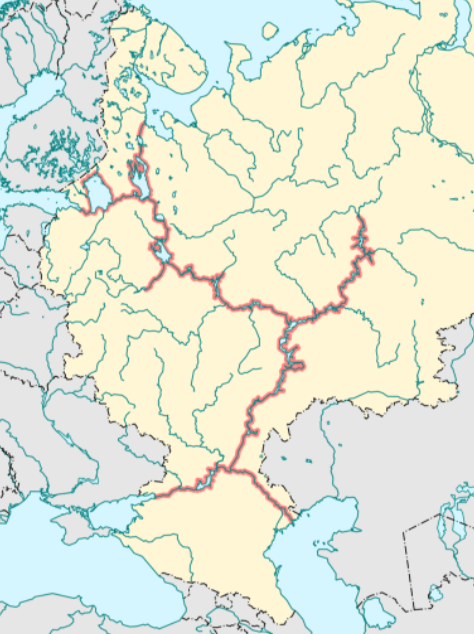
United Deep Waterway System of European Russia linking Sea of Azov and Caspian Sea to Baltic Sea and the Northern Sea Route
Now, to get the “big picture” here, factor in that the Volga River also links the Caspian Sea to the Baltic Sea as well as the Northern Sea Route (via the Volga–Baltic Waterway). Suffice to say, Russia has gained control of an integrated system of waterways, which connects the Black Sea and the Caspian Sea to the Baltic and the Northern Sea Route (which is a 4800 km long shipping lane that connects the Atlantic with the Pacific Ocean, passing along the Russian coasts of Siberia and the Far East.)
No doubt, it is a stupendous consolidation of the so-called “heartland” — per Sir Halford Mackinder’s theory (1904) that whoever controls Eastern Europe controls the Heartland and controls the “world island.”
Looking back, therefore, there is no question that the reunion of Crimea with the Russian Federation in 2014 was a major setback for the US and NATO. Putin caught Washington and its allies by total surprise. It complicated their objective to integrate Ukraine into the NATO.
The US was caught unawares for the second time when in the early days of the current special military operation, when all western eyes were trained on the Kiev region, Russian troops captured the highly strategic southern city of Kherson as early as on March 2. The significance of it was understood only by those who could perceive the great game unfolding in Ukraine as something much more than a mere military conflict. (Most Americans still don’t get it.)
The capture of Kherson in early March practically spelt doom for NATO’s design to extend its military presence in the Black Sea basin. Today, the game is practically over for the US and NATO, once Russia took control of the entire basin of the Sea of Azov. Russia now de facto controls the access of Dniepr to and from the Black Sea. And Dniepr happens to be the main river way for Ukraine’s transportation links to the world market.
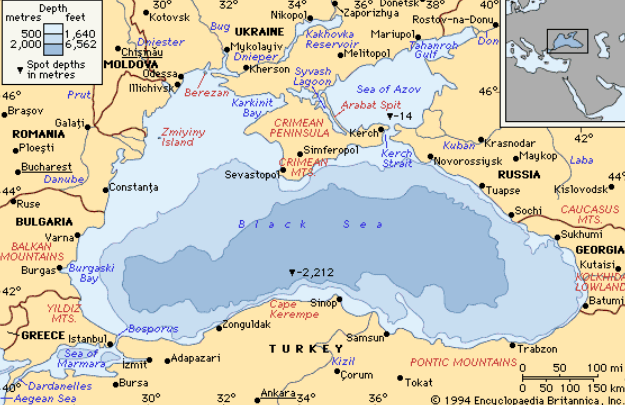
To the immediate east of the Kerch Strait is Russia’s Krasnodar region, which extends southwards to Russia’s largest commercial port on the Black Sea, Novorossiysk at the cross-roads of major oil and gas pipelines between the Black Sea and the Caspian Sea. In sum, control of the Kerch Strait gives Russia a big say with regard to the transportation routes linking Western and Eastern Europe to the Caspian Sea basin, Kazakhstan and China. Put differently, this part of the Russian special military operation becomes an integral part of Moscow’s Eurasian project linking up with China’s Belt and Road Initiative.
Washington has belatedly understood that Russia has outwitted the western alliance and gained the upper hand in the great game in the eastern Black Sea region. So, the Western strategy towards the Caucasus and Central Asia is being reworked. The NATO Secretary-General Jens Stoltenberg scheduled a meeting in Brussels today with the foreign minister of Azerbaijan Jeyhun Bayramov.
Importantly, Bayramov also attended a meeting of the EU-Azerbaijan Cooperation Council today in Brussels. The EU foreign policy chief Josep Borrell later said at a joint news conference with Bayramov that “Azerbaijan is an important partner for the European Union and our cooperation is intensifying.” Meanwhile, yesterday, the European Commission President Ursula von der Leyen visited Baku to sign a memorandum of understanding with Azerbaijan on energy cooperation.
All this is taking place against the backdrop of Charles Michel, the president of the European Council, spearheading efforts to mediate between arch rivals Azerbaijan and Armenia. As part of the EU’s diplomatic efforts, Michel hosted in April a meeting in Brussels between Azerbaijan’s President Aliyev and Armenia’s Prime Minister Nikol Pashinyan where the two sides expressed willingness to secure a peace agreement. Last week, CIA Director William Burns paid an unpublicised visit to Yerevan in this connection. Evidently, Washington and Brussels are jointly strategising a game plan to replace Russia and Turkey, which have hitherto taken the lead roles in Transcaucasia.
There should be no doubt that Moscow is watching closely the synchronised US-EU-NATO moves in the Caucasus targeting Azerbaijan with a view to undermine Russia’s consolidation in the Black Sea and the Caspian Sea regions, which poses a formidable hurdle to the advancement of the NATO strategies toward Central Asia and Xinjiang. This is a high-stakes game.
It will be recalled that on February 22, just two days prior to the launch of the special military operation in Ukraine, Putin hosted the president of Azerbaijan Ilham Aliyev in the Kremlin. They signed “a wide-ranging agreement,” the details of which were not divulged. The document is titled the Declaration on Allied Interaction.
Clearly, oil-rich Azerbaijan, which is not only a littoral state of the Caspian Sea but a gateway to both Central Asia and Russia’s Volga region, is destined to play a key role in the great game in the period ahead.
Breakaway region bordering Ukraine seeks security guarantees
Samizdat | July 19, 2022
Transnistria, a breakaway region of Moldova, has proposed that all parties in the ongoing ‘5+2’ peace talks sign a document providing security guarantees for the unrecognized republic that borders Ukraine.
Transnistrian President Vadim Krasnoselsky floated the idea during his meeting with Russia’s representative at the talks, ambassador-at-large Vitaly Tryapitsin, on Tuesday.
“There is an idea to appeal to all participants in the ‘5+2’ format [to] draw up a single document on the guarantees of peace and security of Transnistria,” Krasnoselsky said, as quoted by his press service. “If they keep talking about peace, let’s see them all sign it.”
The talks between Moldova and Transnistria are being mediated by Russia, Ukraine and the OSCE, while the US and EU attend as observers. They began in 2005 in an attempt to find a solution to the conflict between Chisinau and the breakaway republic. They have effectively been on hold since 2019.
According to Krasnoselsky, even if the ‘5+2’ format shows no signs of progress, there still should be at least some bilateral engagement between Moldova and the Russian-speaking breakaway Pridnestrovian Moldavian Republic (PMR).
“There are political representatives, there is the president, there are other Moldovan officials who should now be talking and finding compromises on the issues that are currently not being solved. The agenda of the talks is known by everyone quite well, and it still holds true,” he said.
The disputes between the PMR and Moldova should now be viewed “in a different light” because of Chisinau’s decision to apply for EU membership, the president added. “Moldova and the PMR are moving in opposite directions,” he said.
A nation of 2.6 million people sandwiched between Ukraine and Romania, Moldova declared itself a neutral state soon after gaining independence as a result of the collapse of the Soviet Union. However, it has long aimed to become a member of the EU – and was finally granted candidate status in late June, along with Ukraine.
Since the start of the conflict between Russia and Ukraine, Transnistria has seen a number of explosions and other provocations. The region, stretching along the Ukrainian border, maintains strong ties with Moscow and hosts Russian peacekeepers.
Chinese military issues warning to US
Samizdat | July 19, 2022
The foreign and defense ministries in Beijing issued harsh statements on Monday condemning the Biden administration’s approval of a new US arms sale to Taiwan. The deal is worth an estimated $108 million and includes armored vehicle parts and technical assistance.
Beijing “demands” that the United States “immediately withdraw the above-mentioned arms sales plan to Taiwan,” as well as halt all other arms deals and cut military ties with the island, said Defense Ministry spokesman Colonel Tan Kefei. “Otherwise, the US side will be solely responsible for undermining the relationship between China and the US and the two militaries and the peace and stability of the Taiwan Strait.”
“The Chinese People’s Liberation Army will take all necessary measures to firmly defend national sovereignty and territorial integrity, and resolutely thwart any form of external interference and separatist attempts for ‘Taiwan independence’,” the colonel added.
Chinese Foreign Ministry spokesman Wang Wenbin echoed this sentiment, saying that Washington’s arms supplies “gravely undermine China’s sovereignty and security interests, and severely harm China-US relations and peace and stability across the Taiwan Strait.”
“China will continue to take resolute and strong measures to firmly defend its sovereignty and security interests,” Wang added.
The Pentagon revealed on Friday that the US State Department had greenlit the transaction, which is valued at up to $108 million. It has yet to receive congressional approval, however. The military aid package will include parts for tanks and other combat vehicles, as well as technical and logistical support services provided by the US government and its contractors, in order to enhance the Taiwanese military’s interoperability with American forces and other allies, according to the US Defense Security Cooperation Agency.
State Department spokesman Ned Price dismissed China’s concerns, claiming later on Monday that the US has certain obligations to supply Taiwan with the necessary means to “defend itself.”
“Under the Taiwan Relations Act, we make available to Taiwan defense articles and services necessary to enable Taiwan to maintain a sufficient self-defense capability. This is something that successive administrations have done. It is entirely consistent with our One China policy,” said Price.
Taiwan has been ruled by the nationalists who fled to the island in 1949 after losing the civil war on the Chinese mainland. Beijing considers the island of 23.5 million a part of its own territory, under the One China policy.
China has recently increased its maritime and aerial military activity around the island, saying that this was needed to deter “collusion activities” between “Taiwan independence forces” and the US government.
While agreeing with the One China policy on paper, Washington maintains strong unofficial ties with Taipei, selling weapons to the island and tacitly encouraging its push for sovereignty. Beijing has repeatedly decried such contacts as provocations and as meddling in China’s internal affairs.
Ukraine plots partnership with Big Tech, a cashless society, and the use of AI to assess criminals
By Didi Rankovic | Reclaim The Net | July 18, 2022
Ukraine hopes to team up with Big Tech for some big plans to make the war-torn country “digitally indestructible,” reports citing statements made by officials during recent conferences suggest.
The main goal is to move towards a cashless society by introducing non-crypto digital money, and use AI systems even for purposes like producing “pre-trial and pre-sentencing reports assessing the risk of a suspect re-offending.”
An initiative, called “Digital4Freedom” was presented by Ukraine’s Deputy PM and Minister of Digital Transformation Mykhailo Fedorov in Switzerland. Fedorov is described as long-time friend of President Volodymyr Zelensky and a fellow enthusiast in ushering it ever greater levels of digitalization.
The initiative appears very ambitious, and optimistic: it is to make Ukraine “the most digital state in the world,” and that has been the pitch made to the audience in Lugano, who were asked to contribute funds and cooperate on forging a “digital Marshall plan” for Ukraine.
The general promise is that in the future, the Ukrainian government and Big Tech will be “closely interlinked,” while turning the country into “a European Israel.”
The push presented by Fedorov is to make Ukraine 100 percent digital, and he has a lot of faith in storing data on Amazon’s and Microsoft’s severs, which he says “cannot be destroyed by missiles.”
The plan is to allow Ukrainians to use digital services for all administrative tasks, like car, property, and land registration, paying customs duties and starting businesses.
More sectors slated for similar transformation, other than the payments system that is supposed to completely do away with paper money, are education and healthcare.
In his own appeals made on several occasions, Zelensky made it clear he expects Big Tech to build this infrastructure. According to reports, Fedorov left out mentioning Big Tech by name as he asked for donations and funding.
Even though appearing to address an eager audience, one part of the plan that was viewed with some apprehension is the judiciary using AI in risk assessment.
Fedorov’s name for this portion of the presentation was, “Judge Dredd.” Fair Trials seems to agree that’s what it might turn into, and expressed concern, saying that using AI for this purpose should be banned, as it “undermines the fundamental right to be presumed innocent.”
Ukraine, meanwhile, already has pilots that “produce pre-trial and pre-sentencing reports assessing the risk of a suspect re-offending,” the reports say.
Germany’s Energy Crisis About To Get Even Worse As Rhine Water Levels Plummet
By Tyler Durden | Zero Hedge | July 18, 2022
What has already been a year from hell for Germany, which is suffering energy hyperinflation as a result of Europe’s sanctions on Russia, and which is “facing the biggest crisis the country has every had” according to the president of the German employers association, is about to get even worse as the declining water level of the Rhine river, which has historically been a key infrastructure transit artery across Germany, continues to fall and as it does, the flow of commodities to inland Europe is starting to buckle threatening to make an already historic crisis even worse.
The alarming lack of water is contributing to oil product supply problems in Switzerland and preventing at least two power plants in Germany from getting all the coal they need, and what’s more, the continent’s sizzling summer temperatures are forecast to climb even higher in the coming week, leading to even lower water levels.
The 800-mile (1,288-kilometer) Rhine river runs from Switzerland all the way to the North Sea and is used to transport tens of millions of tons of commodities through inland Europe. But with water levels at their lowest for the time of year in 15 years, there is a limit how much fuel, coal and other vital cargo that barges can carry up and down the river.
Low water levels on the Rhine River mean that barges hauling middle distillate-type oil products – typically gasoil/diesel – past Kaub in Germany, are limited to loading about 30% of capacity, according to maritime brokerage services firm Riverlake.
A barge loading in the energy hub of Amsterdam-Rotterdam-Antwerp (or ARA), which can haul 2.5k tons when fully laden, is restricted to taking on about 800 tons if sailing to destinations beyond Kaub. The water level at Kaub has fallen in recent days and is at its lowest on a seasonal basis since at least 2007. According to Riverlake, further decreases in loading volumes for barges hauling middle distillates from ARA to inland destinations beyond Kaub are expected in coming days.
This – coupled with capacity issues on German railways – has meant that Switzerland is struggling with supplies of oil products, mainly diesel/heating oil, according to Avenergy Suisse, the landlocked country’s organization for fuel importers.
Low Rhine water level combined with capacity problems on German railways are the reasons, managing director Roland Bilang told Bloomberg, adding that supply problems mainly concern diesel/heating oil.
“It has happened from time to time in the past that temporarily not enough mineral oil products could be transported to Switzerland and therefore the compulsory stocks had to be tapped.” Biland recommends private households fill their heating oil tanks early.
Meanwhile, Bloomberg reports that power plants at Mannheim and Karlsruhe in Germany, operated by Grosskraftwerk Mannheim and EnBW, have been struggling to source coal because of the shallow water – just as the country frets that Russia won’t restart flows on a key gas pipeline. The companies said their generation operations aren’t currently affected.
Because of the tight coal market and low Rhine levels making it hard to deliver the fuel, only 65% of Germany’s coal capacity will be available in coming months, according to S&P Global Commodity Insights analyst Sabrina Kernbichler. This is bad news for a country whose biggest energy utilities are starting to drain natgas reserves as a result of the halt in Nord Stream 1 shipments, jeopardising millions of Germans with freezing should the country fail to restock fully ahead of the winter.
Germany also imports oil products up the Rhine, including fuel and heating oil. There’s currently no shortage of gasoline or diesel in the country, according to Herbert Rabl, spokesman for Tankstellen-Interessenverband e.V., which represents fuel station leaseholders and owners in Germany.
Shell – which owns the Wesseling and Godorf refineries along the Rhine – is monitoring the situation, according to a spokesperson.
Germany and France ‘killed’ Minsk agreements – Russia
Samizdat | July 18, 2022
Germany is demanding that Russia guarantee Ukraine’s territorial integrity, but such a deal was previously signed, only to be “killed” by Berlin and Paris, Russian Foreign Minister Sergey Lavrov said on Monday.
“When [German Chancellor] Olaf Scholz demands that Russia should be compelled to sign an agreement granting Ukraine guarantees of territorial integrity and sovereignty, all his attempts are in vain. There was already such a deal – the Minsk agreements – which was killed by Berlin and Paris. They were shielding Kiev, which openly refused to comply,” he wrote in an op-ed for the Russian newspaper Izvestia.
Russia, Germany and France brokered the 2015 Minsk agreements between Ukraine and Donbass, which were designed to put an end to hostilities. But according to Lavrov, Berlin and Paris failed to ensure Kiev’s compliance.
The Russian foreign minister noted that former Ukrainian President Petro Poroshenko admitted the Minsk agreements meant nothing for Kiev, and Ukraine used them only to buy time.
“Our task was to stave off the threat… to buy time to restore economic growth and create powerful armed forces. This task was achieved. The Minsk Agreements have fulfilled their mission,” Poroshenko said in June.
Lavrov also mentioned that in December 2019, Ukrainian President Volodymyr Zelensky had a chance to fulfil the Minsk agreements at the so-called Normandy format summit held in Paris. After negotiations with leaders of Russia, Germany and France, Zelensky pledged to resolve issues surrounding the special status of Donbass. “Of course, he did nothing, and Berlin and Paris were shielding him once again,” he noted.
The Minsk agreements included a series of measures designed to rein in hostilities in Donbass and reconcile the warring parties. The first steps were a ceasefire and an OSCE-monitored pullout of heavy weapons from the frontline, which were fulfilled to some degree.
Kiev was then supposed to grant a general amnesty to the rebels and extensive autonomy for the Donetsk and Lugansk regions. Ukrainian troops were supposed to take control of the rebel-held areas after Kiev granted them representation, and otherwise reintegrate them as part of Ukraine.
Poroshenko’s government refused to implement these portions of the deal, claiming it could not proceed unless it fully secured the border between the breakaway republics and Russia. He instead endorsed an economic blockade of the rebel regions, initiated by Ukrainian nationalist forces.
Zelensky’s presidency gave an initial boost to the peace process, but stalled after a series of protests by right-wing radicals, who threatened to depose the new Ukrainian president if he tried to deliver on his campaign promises.
Kiev’s failure to implement the roadmap, and the continued hostilities with rebels, were among the primary reasons cited by Russia when it attacked Ukraine in late February. Days before launching the offensive, Moscow recognized the breakaway Ukrainian republics as sovereign states, offering them security guarantees and demanding that Kiev pull back its troops. Zelensky refused to comply.
Russia-Iran relations take a quantum leap
BY M. K. BHADRAKUMAR | INDIAN PUNCHLINE | JULY 17, 2022
When US National Security Advisor Jack Sullivan first spoke about a potential Iran-Russian drone deal, Moscow kept quiet and Tehran issued a pro forma rebuttal, which suggested that it is still a work in progress. Sullivan’s disclosure appeared at the end of a White Course briefing for President Biden’s West Asia tour to Israel and Saudi Arabia, and seemed to have an element of grandstanding aimed at fuelling the latent anti-Iran sentiments in the Gulf region that could in turn impart momentum to POTUS’ project to put together an Israeli-Arab military front in the region.
In the event, the ploy didn’t work. After Biden’s visit ended, the Saudi Arabian foreign minister Prince Faisal bin Farhan told CNN, amongst other things, that talks are going on between Iran and the GCC states for improvement of relations and the focus should be on changing Iran’s behaviour.
But Sullivan has repeated his charge and has since added that an official Russian delegation “recently received a showcase of Iranian attack-capable UAVs,” the last time being as recently as on July 5. CNN has cited White House officials as saying that Iran is expected to supply Russia with hundreds of drones for use in the war in Ukraine, “with Iran preparing to begin training Russian forces on how to operate them as early as late July.”
Iran is known to have a varied drone ecosystem and is reportedly showcasing to Russia the Shahed-191 and Shahed-129 “killer” drones. According to published information, Shahed-129 has a wingspan of 50 feet with a cruising speed of about 160 km per hour, an endurance of 24 hours with a range of 1,700 km and a ceiling of 24,000 feet. The 129 can carry 8 Sadid-345 miniaturized precision-guided bombs capable of hitting moving targets. The bomb’s small size with a range of 6 km, reduces collateral damage and would allow the Shahed to achieve more kills or attack strikes per mission.
The Shahed 191 carries two Sadid-1 missiles internally, has a cruising speed of 300 km/h, an endurance of 4.5 hours, a range of 450 km, and a payload of 50kg. The ceiling is 25,000 ft. Iran’s Fars News Agency says the Shahed 191 has been used in combat in Syria.
Both are stealth drones, harder for air defences to detect. Russia is, reportedly, short of such armed drones, which have the capability to undertake long-range missions to find and destroy, for example, the US-supplied HIMARS mobile rocket launchers which are currently deployed in Ukraine as well as knocking out Ukrainian air defences. Besides, drones are relatively cheap and expendable, unlike crewed aircraft.
If the drone deal indeed goes through, as seems likely, it will mark a quantum leap in Russia-Iran relations. For, Iran will be doing something that only China is capable of doing but won’t out of fear of US reprisal. That makes Iran a very special partner country indeed. Ironically, Russia is yet to upgrade its relationship with Iran as “strategic.”
On its part, Iran is literally sticking out its neck in an act of defiance of the West’s “rules-based order”, as Russia will be deploying its weapon systems on a European battlefield against the air defence systems supplied to Ukraine by the US and NATO countries. There cannot be many parallels of an emerging middle power rendering such critical help to a superpower in high-tech warfare in real conditions on the frontline. Of course, it enhances Iran’s standing regionally and internationally.
In geopolitical terms, however, the most important salience lies in the certainty that the door is closing on the nuclear negotiations between Iran and the US via European mediators. Tehran would have drawn the conclusion already that President Joe Biden is virtually co-opting his predecessor’s [Israel Lobby dictated] Iran policy and the US has reverted to its decades-old strategy of promoting an Israeli-Arab front against Tehran. Put differently, Tehran is moving on to a trajectory that is predicated on unremitting American hostility.
This will mean that Tehran will double down on its efforts to improve relations with its Aran neighbours and explore all possible avenues in that direction, seizing the window of opportunity in the new Saudi thinking to reduce its dependence on the US and explore its strategic autonomy. It is possible to say that Tehran is a beneficiary if the Saudi-Russian and Saudi-Chinese relationships strengthen. Arguably, Saudi Arabia’s quest for BRICS membership brings the Kingdom tantalisingly close to Iran’s world view which places primacy on a democratised, multipolar world order where every country is free to choose its developmental path.
To be sure, against this backdrop, President Vladimir Putin’s visit to Tehran on Tuesday is invested with great importance. Iran is becoming one of the most consequential relationships for Russia. What began as a limited alliance in Syria is taking on a global character.
US sponsored Kurdish SDF calls on Russia and Iran to prevent planned Turkish military operation
MEMO | July 17, 2022
The head of the Kurdish-led militant group Syrian Democratic Forces (SDF) has called on Russia and Iran to help prevent Turkiye from launching a military offensive against its positions in northern Syria, as the threat of a new Turkish operation continues to loom.
According to the AFP news agency, the SDF’s chief commander Mazloum Abdi urged the involvement of Moscow and Tehran against Ankara’s aims in the region this week, accusing the US-led global coalition to defeat Daesh – also known as Operation Inherent Resolve – of taking a “weak” position that is “insufficient to end the threats.”
In May, Turkish president Recep Tayyip Erdogan announced plans to launch a new military operation into the areas controlled by the Kurdish militias, which would be Turkey’s fourth such offensive in northern Syria. The operation is meant as an effort to clear the 30-kilometre-deep ‘safe zone’ in northern Syria from remaining Kurdish militant elements, in order to settle at least a million Syrian refugees there.
Abdi also reiterated that after negotiating with Russia, Kurdish militant forces allowed the Syrian regime of Bashar al-Assad to reinforce their troops in Kurdish-controlled areas, particularly in cities such as Kobane and Manbij in the north of the country. The threat of a renewed Turkish offensive had seemingly forced the SDF to strengthen ties with Assad, Russia, and now Iranian forces in an effort to repel Ankara’s planned operation.
Abdi’s call for Russian and Iranian assistance is likely more diplomatic than military, as it comes only days before a summit that is to be held in Iran from Tuesday, in which Iranian president Ebrahim Raisi will host Erdogan and their Russian counterpart Vladimir Putin in a renewed set of negotiations on Syria and the ongoing 11-year-long conflict.
If Moscow and Tehran heed the SDF’s call, they may be expected to attempt to discourage Ankara from its planned military operation.
Russia comments on deadly strike on Ukrainian city
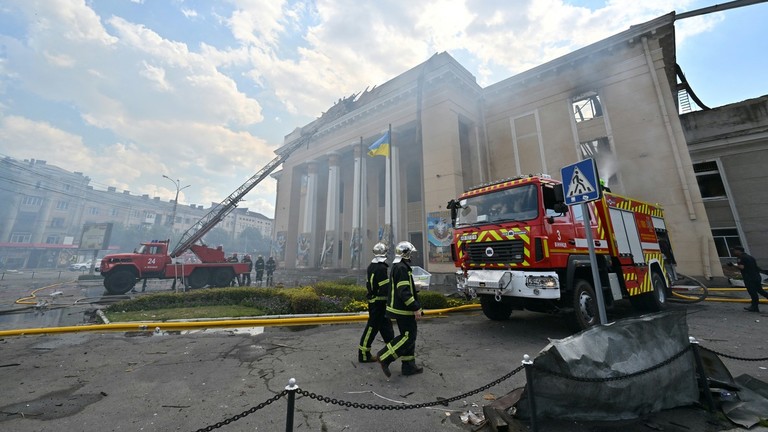
Firefighters extinguish fire in the city of Vinnytsia, west-central Ukraine on July 14, 2022. © AFP / Sergei SUPINSKY
Samizdat | July 15, 2022
The Russian military has confirmed launching a missile attack at a target in the city of Vinnitsa in Ukraine. It denied claims that it was a deliberate strike on civilians, stating that it hit Ukrainian military commanders as they negotiated with foreign arms suppliers.
Russia attacked the House of Military Officers in Vinnitsa with sea-launched Kalibr cruise missiles, the Defense Ministry said on Friday during a daily briefing. The statement claimed that the attack happened when a group of Ukrainian senior military officers were holding a meeting with foreign arms suppliers. The discussion was about the “transfer of more warplanes and weapons systems as well as the repair of the Ukrainian military air fleet,” the ministry said. The Russian strike killed all participants at the gathering.
According to Ukrainian officials, the Russian strike killed 23 civilians and injured scores of others, 80 of whom had to be hospitalized for treatment. President Volodymyr Zelensky claimed that Moscow attacked the city center deliberately and accused it of terrorism.
The head of Vinnitsa Region, Sergey Borzov, reported that Ukrainian air defenses engaged Russian missiles over the city and claimed they intercepted four of them.
Kiev has accused Russia of waging a genocidal war, claiming that Russian forces have a policy of killing Ukrainians. Moscow has rejected such allegations, saying its forces only attack legitimate military targets.
Russia sent troops into Ukraine on February 24, citing Kiev’s failure to implement the Minsk agreements, designed to give the regions of Donetsk and Lugansk special status within the Ukrainian state. The protocols, brokered by Germany and France, were first signed in 2014. Former Ukrainian President Petro Poroshenko has since admitted that Kiev’s main goal was to use the ceasefire to buy time and “create powerful armed forces.”
In February 2022, the Kremlin recognized the Donbass republics as independent states and demanded that Ukraine officially declare itself a neutral country that will never join any Western military bloc. Kiev insists the Russian offensive was completely unprovoked.
Putin’s summits next week will strengthen ties with Iran, Turkey
BY M. K. BHADRAKUMAR | INDIAN PUNCHLINE | JULY 14, 2022
Kremlin spokesman Dmitry Peskov announced in Moscow on Tuesday that President Vladimir Putin will travel to Tehran on July 19, to take part in a tripartite meeting with his Iranian and Turkish counterparts as part of the Astana peace process to end the war in Syria as well as hold a bilateral meeting with Turkish President Recep Erdogan.
Such a summit was long expected but the pandemic and the Ukraine conflict delayed matters. The current impasse in Syria is fraught with risks. Turkey has plans to launch another military incursion into Syria’s northern border regions that are under the control of Kurdish groups, who, Ankara alleges, are linked to the separatist PKK and also happen to be Pentagon’s inseparable allies.
Damascus, Moscow and Tehran — and Washington — disfavour the Turkish move as potentially destabilising, but Erdogan is keeping plans in a state of suspended animation, while tactfully dialling down the threatening rhetoric and acknowledging he’s “in no rush.”
For want of green lights from its Astana partners, presumably, Erdogan is unlikely to launch the military incursion, but Russia and Iran are wary that the incursion could complicate their presence and political influence in Syria and risk confrontation between Turkish troops and Syrian government forces.
However, Syria apart, Putin’s trip has much wider ramifications. What transpires in his bilateral meetings with Erdogan and Iranian leaders are certainly the more important templates to watch. Clearly, Turkey and Iran are emerging as two of the most consequential relationships of Russian foreign policies and diplomacy. And Putin’s visit comes at a highly transformative period in the US’ approach toward both Turkey and Iran.
Erdogan’s hopes of a rapprochement with the US have been dashed as Greek Prime Minister Kyriakos Mitsotakis told reporters on June 30 that Athens had submitted a letter of request “in recent days” to the US government for a squadron of 20 F-35s, with options to buy an additional squadron. The Greek announcement came just a day after President Joe Biden had assured Erdogan on the sidelines of the NATO summit in Madrid that he backed the latter’s pending request for F-16s to Turkey.
Erdogan should have known that Biden’s long, successful career has been inextricably linked with the powerful Greek lobby in America, which is a big source of election funding for aspiring politicians. Therefore, Greece’s F-35 deal is certain to be approved and it could further drive a wedge between the already strained relationship of the US and Turkey — and will only reinforce Ankara’s suspicion that Washington is using Greece as a pawn to control Turkey. Conceivably, the deal could change the military balance in the Eastern Mediterranean, taking into account Greece’s alliance with Cyprus and Israel as well.
Suffice to say, Putin’s conversation with Erdogan comes at a time of uncertainties in Turkish-American relations. In immediate terms, therefore, the circumstances are most conducive for establishing a Black Sea naval corridor to export grain from Ukraine. There is a strategic convergence between Moscow’s keenness to prove it has not caused the global grain crisis, and Turkey’s desire to project its strategic autonomy, although a NATO member country.
Turkish defence minister Akar announced on July 13 that a consensus has been reached on the establishment of a coordination centre in Istanbul with the participation of all the parties, and the Russian and Ukrainian sides also agreed on joint control of the ships in both entering and exiting the ports as well as on maritime security. It is a signal victory for Turkish mediation. In the process, we may trust the strong relationship between Erdogan and Putin to harness fresh energy for deepening Turkish-Russian political-economic relations. Turkey has a unique role to play, as Moscow navigates its way around the western sanctions.
Equally, Putin’s talks with the Iranian leadership also have a big geopolitical setting. US President Joe Biden will have just finished his trip to Saudi Arabia, an event that impacts Iran’s core interests at a crucial juncture when the nuclear negotiations are adrift and Teheran-Riyadh normalisation talks have made progress.
US National Security Advisor Jack Sullivan’s theatrical disclosure on Monday of Iran supplying “several hundred UAVs, including weapons-capable UAVs on an expedited timeline” and of Russian personnel undergoing training in Iran in this connection, etc. appear to have been timed carefully.
The important thing to be noted here is that Sullivan’s story overlaps secret parleys reportedly between Riyadh and Jerusalem on defence technology exchanges, specifically related to Saudi concerns about Iranian drones!
Furthermore, Sullivan’s loose talk comes against the backdrop of the announcement by Israel last month of the formation of a mutual air defence coalition that is expected to involve, among others, the UAE and Saudi Arabia.
To be sure, Sullivan’s revelation right before Biden’s trip to Riyadh comes with a political aspect, as it puts pressure on Saudi Arabia to rethink both its blossoming relationship with Russia as well as its normalisation talks with Iran.
Moscow understands that Biden’s primary purpose in the Middle eastern tour is to put together a front against Russia and China. Indeed, Biden wrote in an op-Ed in the Washington Post last week on his Middle East tour, “We need to counter Russian aggression, be in a better position to win the competition with China, and work to strengthen stability in an important region of the world. To do this, we need to interact directly with countries that can influence the results of such work. Saudi Arabia is one of those countries.”
Biden hopes to bring Saudi Arabia into some sort of format with Israel beneath an overarching binding strategic defence cooperation pact that goes beyond anything the US has agreed to before. This, inevitably, requires the demonising of Iran as a common threat. Simply put, Biden is reviving a failed American strategy — namely, organising the region around the goal of isolating and containing Iran.
Indeed, if history is any guide, Biden’s idea of creating a collective security system is doomed to fail. Such attempts previously met with fierce resistance from regional states. Also, Russia has certain advantages here, having pursued a diplomacy with the regional states that is firmly anchored in mutual respect and mutual benefit, and predictability and reliability. During Foreign Minister Sergey Lavrov’s recent visit to Saudi Arabia, a certain understanding was reached, which Riyadh is unlikely to disown.
Indeed, Saudi Arabia and Russia have a convergence of interests with regard to the oil market. At any rate, expert opinion is that both Saudi Arabia and the UAE have very limited spare capacity. The expectation is that Saudi Arabia will most likely agree to loosen the oil taps on the back of the Biden visit, but the leadership will still strive to find a way to do it within the context of the current OPEC+ agreement (with Russia) that extends through December by, say, compensating for the production underperformance of struggling OPEC states such as Nigeria and Angola. (The OPEC+ capacity is already well below the level implied in the agreement.)
Fundamentally, as the executive president of Quincy Institute Trita Parsi noted recently, “any reduction in tensions between Saudi Arabia and Iran is a threat to the durability of the Abraham Accords… That means in order for Israel and Saudi Arabia and the UAE to continue to have enough strategic incentives to collaborate and have relations and all jointly forget about Palestinian suffering, there needs to be a threat from Iran. Otherwise the whole house of cards falls apart.”
Iran understands that the JCPOA talks are neither dead nor alive but in a comatose state, which may perish soon unless salvaged — depending on the degree of success or failure of Biden’s talks in Saudi Arabia. But all signs are that Tehran is pressing the pedal on strengthening the ties with Moscow. Its SCO membership is through, while it is now seeking BRICS membership. The compass for Iran’s foreign policy trajectory is set. Surely, from such a perspective, Putin has a lot to discuss in Tehran with the Iranian leadership as the new world order is taking shape.
Even with regard to Sullivan’s drone story, although Iran has issued a pro forma rebuttal, we may not have heard the last word. The fact of the matter is that Iran is among the top five world leaders in the development and production of UAVs that may interest Russia — Shahed strike systems, Mohajer tactical drones, various versions of Karrar reconnaissance and strike UAVs with range of 500-1000 kms, Arash kamikaze drones, etc. Interestingly, Iran’s MFA spokesman alluded to the existing framework of Iran-Russia military-technical cooperation that predates the war in Ukraine.
EU clarifies stance on Russian exclave blockade
Samizdat – July 13, 2022
No “sanctioned goods” are allowed to be transported by Russian operators through EU territory by roads, the EU Commission has said in its fresh “additional guidance” on the transit of Russian goods. The document published on Wednesday comes amid tensions around the Russian Kaliningrad exclave. Lithuania had previously blocked the shipment of goods to the region via its territory to comply with EU sanctions against Russia.
Transit via rail is still allowed, according to the document, but only as long as the EU member states “perform effective controls.” The bloc’s nations should “check whether transit volumes remain within the historical averages of the last three years” as well as whether they reflect “the real demand for essential goods at the destination,” the guidelines say.
The transit of sanctioned military and dual use goods and technology is fully prohibited, the document says, adding that any “unusual flows or trade patterns” could potentially be suspected of giving “rise to circumvention” of anti-Russian sanctions.
The document specifically notes that the EU members “are obliged to prevent all possible forms of circumvention of EU restrictive measures.” The EU Commission also pointed to the “importance of monitoring the two-way trade flows between Russia and Kaliningrad” aimed at ensuring that “sanctioned goods cannot enter the EU customs territory.”
The document comes just hours after the Russian newspaper Izvestia reported that the EU is in talks with Lithuania on lifting sanctions on the transit of goods to Russia’s exclave. The media outlet also claimed that the EU had sent a draft document to Moscow in early July outlining that the transit of goods by both rail and road from mainland Russia to Kaliningrad would be removed from sanctions.
The EU, however, has denied this information. “There were no talks between the EU and Russia on the issue you’re talking about, contrary to the reports you are citing,” Eric Mamer, the EU Commission chief spokesman, told the RIA news agency when asked to comment on the reports.
The Russian Foreign Ministry previously threatened Lithuania with “tough measures” if it continued to block Russian transit to the exclave. The response measures have already been prepared, the ministry’s spokeswoman, Maria Zakharova, said on Sunday. “The European Commission, the EU must understand that the clock is ticking,” she warned.
Lithuania blocked the transit of goods by rail to Kaliningrad through its territory on June 18, with the restrictions affecting about 30% of deliveries to the Russian exclave. Moscow called the measures unprecedented and illegal, as they affect Russia’s access to part of its own territory.
Following the release of the document, Russia’s Foreign Ministry replied that it would closely monitor how the EU’s new guidelines were put into practice.
On Tuesday, Lithuania’s Customs Department reported it had stopped 34 trucks trying to cross its border from Kaliningrad and Belarus because they were transporting “sanctioned goods.” The trucks were forced to return to the Russian and Belarusian territories, it added. The vehicles were transporting car parts, furniture, glass, and alcohol, it revealed.
Featured Video

Iran FM Araghchi: “Hormuz Will No Longer Be the Same”
or go to
Aletho News Archives – Video-Images
From the Archives
Sam Husseini: The entire US establishment helped lie their way into the Iraq war
By Slava Zilber | American Herald Tribune | October 14, 2019
Sam Husseini is a senior analyst with the Institute for Public Accuracy, independent journalist and contributor to The Nation and FAIR.
Slava Zilber: Sam, three years ago, you appeared on Talk Nation Radio with David Swanson and spoke about the case of the GCHQ whistleblower Katharine Gun. You pointed out that the people involved in the spying on the UN and the people authorizing the Iraq War were not held accountable:
“Virtually everybody who went along with the war, whether it is Kerry or Clinton, of course, the Bush administration themselves has falsified their own records in terms of why, what they did, when they did, why they did it, to the extent that they’ve been scrutinised at all.”
You also address it in a recent article. And recently, Joe Biden has been lying about his position on the Iraq War. How can such an important issue escape meaningful scrutiny? … continue
Blog Roll
 Aletho News
- Oman FM: Persian Gulf states, Iran, Iraq should form security pact excluding US
- Trump peddles fresh falsehoods, claims Iran ‘started the war’ as US aggression drags on
- Ukraine quagmire? Yes, but it’s for NATO, not Russia
- US intelligence hypes Chinese, Russian space threats while accelerating its own military buildup in orbit
- Iran FM Araghchi: “Hormuz Will No Longer Be the Same”
- EU facing trillion-euro debt hole while seeking more cash for Kiev
- How US, Europe, Persian Gulf states exhausted missile stockpiles, splurged billions to defend Israel
- Up in arms… Koreans reject U.S. empire’s plan to make South Korea the next Ukraine
- Iran, Turkey, Pakistan, Saudi Arabia could advance region-led security framework in Tehran: FM spox
- Netizens condemn Japanese drama for projecting Japan’s wartime atrocities onto Chinese characters
- If Americans Knew
- An error has occurred; the feed is probably down. Try again later.
- No Tricks Zone
- Sudden Stratospheric Warming, Powerful El Niño Combination May Lead To Extreme Europe Cold, Energy Crisis!
- Two New Studies Find Thwaites Glacier Melt Cannot Be Driven By Human Activity Or A Warming Ocean
- E-Cars Reduce CO2 Emissions By Only 41% Compared To Internal Combustion Engine Vehicles
- Predictions Made By Renowned Climate Professor Over Past Decades Have Been Proven To Be Poor
- New Study Suggests Large Regions Of The Pacific Ocean Have Been Cooling For The Last 80 Years
- Germany’s Green Energy Debacle: High Energy Costs Force Kahla Porzellan to Close After 182 Years!
- New Study: 50 Years Of The Most Aggressive ‘Net Zero’ Policies Can Only Affect The Global Climate By 0.03°C
- US September “Heat” Was No Record…Many Records Set Decades Ago
- Latest European Green Energy Debacle; Portugal’s Largest Flagship Solar Park Insolvent!
- Green Energy Debacle: German Expert Professor Fritz Vahrenholt Warns Of Severe Economic And Social Consequences

