Anarchists & ‘antifa’ occupy Seattle police station abandoned by ‘regime’ forces, set up ‘Capitol Hill Autonomous Zone’
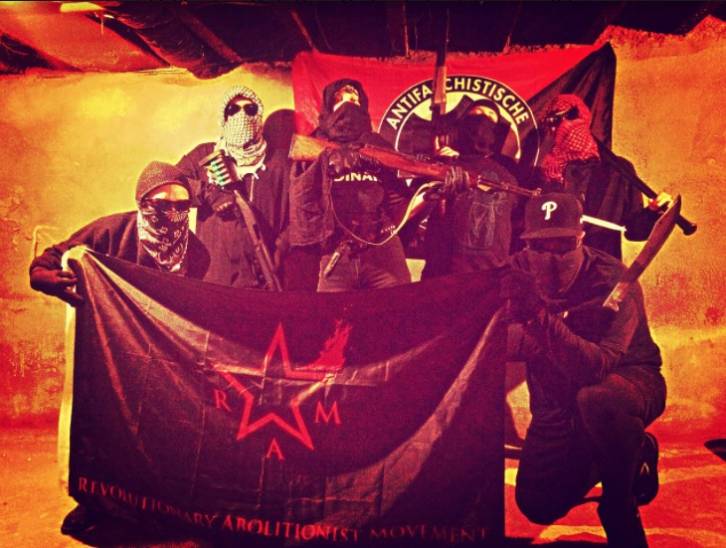
File photo
RT – June 9, 2020
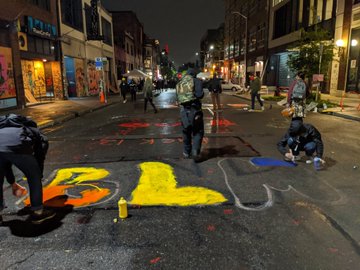
Six blocks of downtown Seattle have been declared the ‘Free Capitol Hill Zone’ or ‘Capitol Hill Autonomous Zone’ (CHAZ), according to area activists that have taken control of Seattle PD’s East Precinct, on 12th Avenue and E. Pine Street.
Journalist Julio Rosas tweeted out photos from the ‘Zone,’ including flyers demanding that Seattle PD be defunded, and declaring that police “will always be racist because capitalism requires inequality.”

Journalist Andy Ngo described the group in control of the area as “Antifa,” and cited tweets to suggest there were armed guards among them.
The report of armed personnel seems to have been confirmed by another activist, who said that members of the John Brown Gun Club – a leftist militia also known as Redneck Revolt – “showed up to offer help, some armed.”
Sympathizers have described the atmosphere inside the zone as “wonderful” and peaceful, more like a concert than anything else.

“Police want you to think that without them there will be chaos. But what if without them there was peace?” mused Resistance activist Joshua Potash, holding up Seattle as an example of what Democrat demands to ‘defund police’ might result in.
Police Chief Carmen Best confirmed that her department evacuated the precinct on Monday evening as an exercise in “trust and deescalation.”
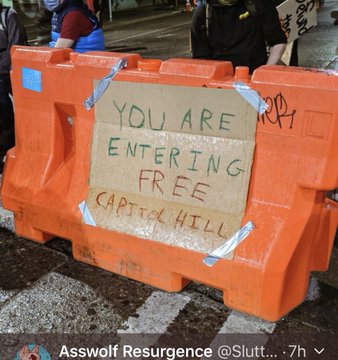
Two days earlier, Seattle PD used flash-bangs and pepper spray to push back demonstrators at 11th Avenue and Pine Street, just a block away, after they had moved a security barricade and allegedly threw objects at the officers. Protesters insisted that tear gas had been used, but police denied it, saying they had not violated the 30-day moratorium on the substance declared by Mayor Jenny Durkan, a Democrat.
City authorities may be expecting the activists to disperse, but the barricades and the content of their social media suggest they intend to stay. Local businesses and residents have “agreed to disaffiliate from Seattle basically,” in the words of one activist, who called it a “flux state in the making” – a reference to an anarchist commune from the fiction series Shadowrun.
Maps of the zone apparently made by the activists refer to ‘Captured Regime East Precinct’ and also use ‘regime’ to refer to reported police positions.
Democrats have ruled Seattle for almost 50 years. The current city council has eight Democrats and one socialist.
UK Rates ‘Worst’ National COVID-19 Response, Vietnam Best
By Tyler Durden – Zero Hedge – 06/09/2020
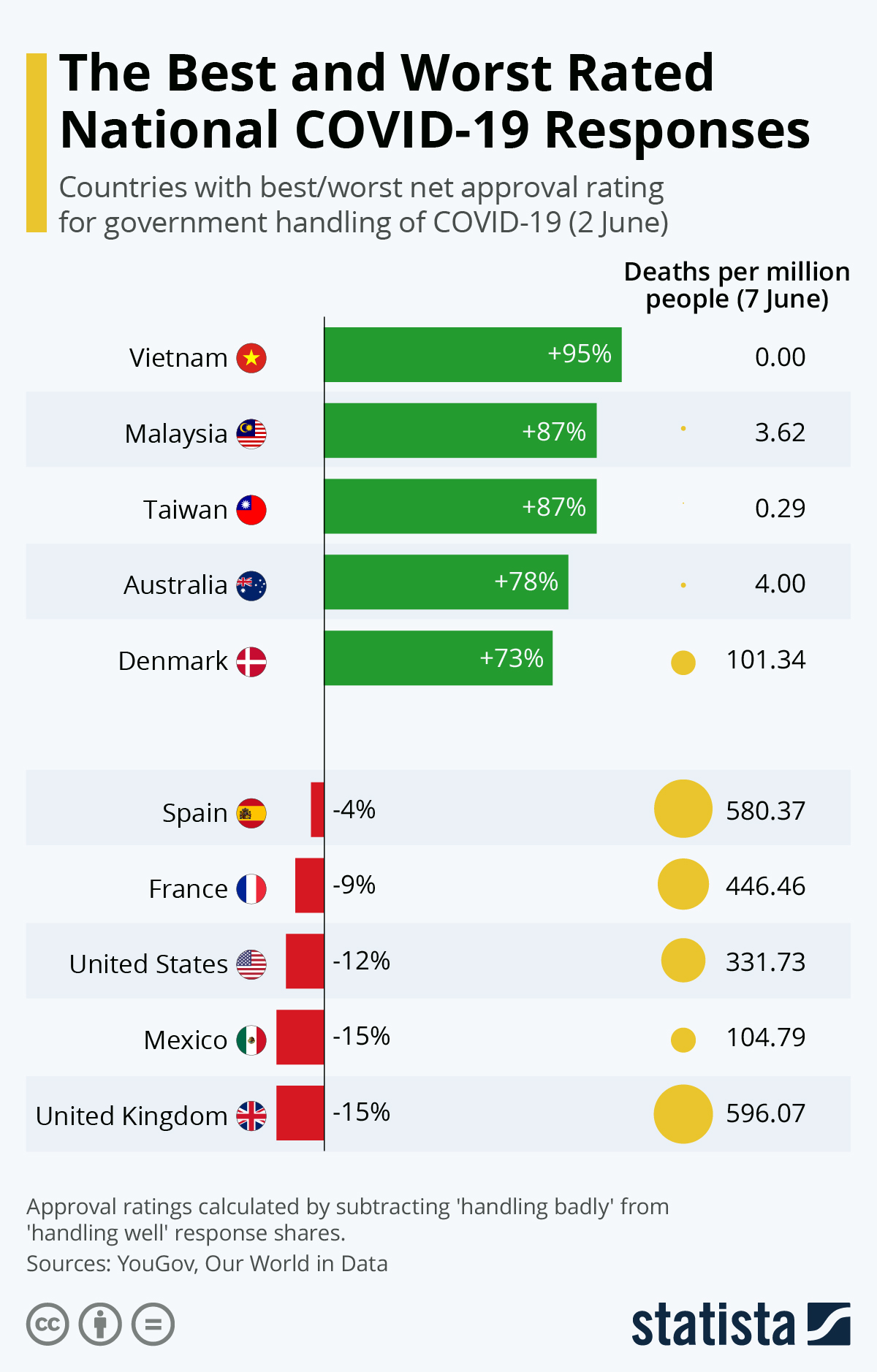
The extent to which the COVID-19 pandemic has affected countries varies vastly, connected in part to the respective government’s handling of the situation. As Statista’s Martin Armstrong shows below, these national responses can be worlds apart – both in terms of efficacy and as survey data from YouGov shows, the subsequent level of public approval, too.
You will find more infographics at Statista
In the UK, where the government’s response has been heavily criticised, the net approval rating (calculated by subtracting ‘handling badly’ from ‘handling well’ responses) is the joint-lowest of all countries surveyed.
Also with a rating of -15 is Mexico, where President López Obrador originally downplayed the severity of the pandemic and is now struggling to find the right balance between prioritizing public health and protecting the economy.
At the other end of the scale, Vietnam has so far recorded just over 300 cases and zero deaths.
In contrast to Mexico, Vietnam’s ‘overreaction’ to the crisis is thought to be the reason for the astonishing results achieved so far.
To compare to the countries at the bottom of the ranking, Our World in Data figures have the number of deaths per million people for the UK and Mexico at 596.07 and 104.79, respectively.
Countries included in the survey were: Australia, Canada, Denmark, Finland, France, Germany, India, Indonesia, Italy, Japan, Malaysia, Mexico, Norway, Philippines, Poland, Singapore, Spain, Sweden, Taiwan, UK, USA, Vietnam.
Iranian scientist jailed in US returns home
By Ghanbar Naderi – Press TV – June 8, 2020
Iranian scientist Majid Taheri, who was imprisoned in the US for more than 16 months, finally returned home on Monday. Upon arrival, Taheri was received by his family as well as high-ranking Iranian officials at the Imam Khomeini International Airport.
The Iranian national who was a longtime resident of the US state of Florida, spent 16 months in prison for allegedly violating US sanctions on Iran. Speaking to Press TV, he denied all allegations.
The development came days after another Iranian scientist Sirous Asgari, a professor of material sciences at Sharif University of Technology, also returned home.
He spent about three years in US detention on trumped-up charges of fraud and theft of information relating to his work with a university in Ohio. The case however, was dismissed by a US district judge and he managed to return to his country.
Iran has called on Washington to release all other Iranian citizens taken hostage. The country says the US must make up for the damages caused by detaining Iranian scientists.
4 or more hydroxychloroquine doses reduced risk of coronavirus in healthcare workers: Indian Council of Medical Research study
A sustained intake of anti-malarial drug hydroxychloroquine (HCQ) has shown positive results in reducing the risk of coronavirus in the healthcare workers, the ICMR study says. However, HCQ prophylaxis should be taken in tandem with wearing the personal protective equipment (PPE) to minimise risk exposure.
India Today | June 1, 2020
The Lancet study and the World Health Organization (WHO) solidarity trials may have put a pause on the use of the anti-malarial drug hydroxychloroquine (HCQ) as prophylaxis or treatment to reduce the risk of the novel coronavirus. However, a case-control study by the Indian research body, the ICMR continues to rally for its usage in the healthcare workers (HCWs) who are at an elevated risk of contracting Covid-19.
The case-control investigation of the ICMR reveals that consumption of four or more maintenance doses of hydroxychloroquine led to a significant decline in the odds of healthcare workers getting infected with the coronavirus infection.
The ICMR study indicates that “simply initiating HCQ prophylaxis did not reduce the odds of acquiring Covid-19 infection among HCWs. However, with the intake of four or more maintenance doses of HCQ, the protective effect started emerging. A significant reduction of about 80 per cent in the odds of Covid-19 infection in the HCWs was identified with the intake of six or more doses of HCQ prophylaxis. This dose-response relationship added strength to the study outcomes.”
“Biologically, it appears plausible that HCQ prophylaxis, before the onset of infection, may inhibit the virus from gaining a foothold,” researchers said in the study.
The National Task Force for coronavirus in India recommended once a week maintenance dose for seven weeks i.e., 400 mg once every week, following the loading dose of 400 mg. Adherence to this recommended regimen is underlined by the findings of the study, researchers said.
Scientists who co-authored the study said, “It has been noticed that 4th week onwards there is a risk reduction of contracting the Covid-19 virus if the maintenance dosage is being taken as prescribed for seven weeks. Of course, this doesn’t rule out the risk minimisation of those frontline workers who are treating Covid-19 patients while wearing PPEs and taking further precautions.”
Data were collected from May 8 to May 23, 2020. Doctors, nurses, housekeeping staff, security guards as well as laboratory technicians and operation theatre technicians, tested between the first week of April 2020 and in the first week of May 2020, formed the sample pool from which cases and controls were drawn.
The sample size consisted of 378 symptomatic healthcare workers who tested positive for coronavirus. They were defined as cases. 373 symptomatic healthcare workers who tested negative were part of the control group. A total of 751 people formed the sample size for the study.
Of these, 58 per cent of the cases and about half of the controls were males.
“Of the 172 cases and 193 controls reporting HCQ intake, no significant difference in the occurrence of adverse drug reactions was noted,” the study noted.
The three most common side effects of HCQ as reported by the cases and controls were nausea (8 per cent), headache (5 per cent), and diarrhea (4 per cent). While none of the controls on HCQ complained of palpitations, only one case (1/172, 0.6 per cent) reported the same.
The study also revealed that gastrointestinal symptoms such as acidity and vomiting following HCQ intake ranged from 0.6 per cent in cases to about two per cent in controls. Very few cases (0.6%) and controls (1.4%) had skin rashes after consuming hydroxychloroquine.
The study also mentions how the international medical research looks at the use of hydroxychloroquine for treatment, like the Lancet Study that stated intake of the HCQ could lead to increased risk of mortality in coronavirus patients.
“While the observational study involving registry-analysis focussed on the treatment of hospitalised Covid-19 patients, our emphasis was on the prevention of infections among healthcare workers. In treatment settings, severe Covid-19 patients are likely to have a very high viral load and cytokine levels, which may not be improved by HCQ therapy. The registry-based analysis further recorded higher frequencies of ventricular arrhythmias in patients receiving HCQ. The toxicities of HCQ are likely to be infrequent in healthy groups undergoing prophylactic therapy as observed in our study participants. Biologically, it appears plausible that HCQ prophylaxis, before the onset of infection, may inhibit the virus from gaining a foothold.” it stated.
The study comes as a reckoner for the medical fraternity until the clinical trials on HCQ yield definitive results. “Until the results of clinical trials for HCQ prophylaxis become available, this study provides actionable information for policymakers to protect HCWs at the forefront of coronavirus response. The public health message of sustained intake of HCQ prophylaxis as well as appropriate PPE use need to be considered in conjunction with risk homeostasis operating at individual levels.” ICMR study stated.
Staggering Death Rate in 7 US States
American deaths per million equal or exceed Europe’s worst-hit nations in several locales

click to enlarge
By Donna Laframboise | Big Picture News | June 3, 2020
At first glance, the United States appears to have fared reasonably well during this pandemic. So far, 327 Americans have died of the coronavirus out of every one million in the population.
That’s according to official numbers. Which are all we have to work with at the moment. (There are solid reasons why official numbers should be viewed as provisional and inexact. See the bottom of the page here.)
If we compare its overall rate of 327 deaths per million to the hardest hit nations in Europe, America looks blessed. Belgium has experienced 820 deaths per million. Spain and the UK, 580. Italy, 555.
But peer a bit closer, and another story emerges. America’s number is low because many parts of that country have (so far) been spared a serious outbreak. In places where the virus gained a foothold in the wider community, the death rate exceeds even the worst countries in Europe:
New York state: 1,546
New Jersey: 1,327
Connecticut: 1,114
Massachusetts: 1028
Rhode Island: 691
District of Columbia: 666
Louisiana: 611
Michigan: 556
This being an election year, some people are blaming US President Donald Trump, a Republican, for the lives lost. It’s worth observing, therefore, that the governor is a Democrat in six of the seven US states is which the death per million rate equals or surpasses Italy.
Likewise, the mayor of the District of Columbia is a Democrat. Only in Massachusetts is a Republican in charge.
As Trump vows to declare Antifa a ‘Terrorist Group,’ AG Barr equates rioting to domestic terrorism
RT | May 31, 2020
 The US “will be designating ANTIFA as a Terrorist Organization,” President Donald Trump has said. The move comes amid anti-police-brutality protests and riots gripping the country, which he has blamed on the “radical left.”
“The United States of America will be designating ANTIFA as a Terrorist Organization,” Trump tweeted on Sunday, offering no further explanation. One day earlier, Trump, as well as Attorney General William Barr, accused the loose-knit group of orchestrating rioting and looting across the country, following the death of George Floyd in Minneapolis on Monday.
If designated as a terrorist group, Antifa would join international groups like Al Qaeda and Hezbollah, as well as domestic organizations like the Aryan Nations and Black LIberation Army, on the government’s blacklist. Before the 9/11 attacks, the list was populated exclusively by foreign groups. However, the post-9/11 Patriot Act expanded the definition of “terrorism” to cover home-grown organizations.
Antifa – whose name is short for ‘antifascist’ – models itself on the European left-wing militias of the 1920s and 1930s. Rising to prominence since Trump’s election in 2016, the group is now known for attacking right-wing demonstrations and speeches, and instigating violence at rallies.
With riots gripping America’s major cities for the last five nights, reports of Antifa organizers directing rioters and providing them with weapons began to surface. Conservatives clamored for Trump to crack down on the militants, and Sunday’s tweet is the first indication that the president intends to do just that.
Immediately after Trump’s statement, Attorney General Barr announced that the Justice Department would use its network of 56 regional Joint Terrorism Task Forces to investigate “the violent radical agitators who have hijacked peaceful protest and are engaged in violations of federal law.”
“The violence instigated and carried out by Antifa and other similar groups in connection with the rioting is domestic terrorism and will be treated accordingly,” a statement from Barr read.
While any forthcoming designation would make it easier to use counterterrorism legislation against violent protesters, targeting Antifa as a group would be a difficult proposition. The organization has no clearly-defined hierarchy or membership, and many disparate groups of leftist militants have used its imagery and slogans.
Some left-wing commenters accused the Trump administration of attempting to “criminalize dissent.” However, the alleged militants have come under scrutiny before, and in countries more liberal than the US. In Germany, where the ‘antifascist’ movement began in the 20th century, intelligence agencies closely monitor Antifa groups, and police union head Ranier Wendt has described their actions as “the basic definition of terrorism.”
Kabul ready to start intra-Afghan peace talks with Taliban: Abdullah
Press TV – May 30, 2020
A senior Afghan official tasked with leading the much-awaited intra-Afghan peace negotiations with the Taliban militant group says his team is ready to commence talks “at any moment” with the militants.
Abdullah Abdullah, the head of Afghanistan’s High Council for National Reconciliation (HCNR), made the comment on Saturday at his first press conference since taking the role, saying the lull in violence created by an unexpected truce offered by the Taliban had set the tone for starting the peace talks.
“The announcement of the ceasefire, a reduction in violence and the exchange of prisoners have all paved the way for a good beginning,” Abdullah said, adding, “The negotiating team is ready to begin the talks at any moment.”
After months of political crisis over the outcome of a disputed September presidential election, which declared Ashraf Ghani as the president for a second term, Abdullah, Ghani’s bitter rival, agreed to ink a power-sharing deal with the incumbent president.
Part of the agreement is that Abdullah henceforth heads Kabul’s negotiating team in its intra-Afghan peace talks with the Taliban militant group, which has already controls large parts of the war-torn country.
Kabul responded to the ceasefire by releasing some 1,000 Taliban inmates this week, and plans to further free an equal number of prisoners in the coming days.
The militant group, for its part, has said that it plans to release another group of government prisoners. The Taliban have so far freed around 300 Afghan security force personnel.
The Taliban-proposed three-day ceasefire was held over the Eid al-Fitr, which marks the end of the holy fasting month of Ramadan. Although the truce, in effect from Sunday through Tuesday, maintained relative peace across the country, it was soon followed by deadly attacks on security forces.
Afghan officials blamed the attacks on the Taliban.
A peace deal inked between the United States and the Taliban on February 28 stipulated that the Taliban stop their attacks on foreign forces in return for the US military’s phased withdrawal from Afghanistan and also a prisoner exchange between the group and the government in Kabul, which was excluded from the talks.
The prisoner swap is regarded as a confidence-building move ahead of long-awaited peace talks between Kabul and the militant group, which rejected a government offer of truce for the duration of Ramadan and continued its attacks.
Nearly 14,000 US troops and 17,000 troops from NATO allies and partner countries remain stationed in Afghanistan years after the invasion of the country that toppled a Taliban regime in 2001.
How the U.S. response to COVID-19 failed and caused thousands of deaths
CGTN | May 25, 2020
There have been over 1.6 million #coronavirus cases and nearly 100,000 deaths in the U.S. While many countries are gradually recovering, no turning point for the pandemic in America is on the sight.
Lots of people are shocked at how America, the largest economy in the world, and a great country in the eyes of many, has got to this point. So to find out what led to this mess, let’s back up a little and take a look at the timeline.
Biden/Abrams 2020?
By William Stroock | May 22, 2020
The Blue Checkmarks of the American media are an uncreative lot. They lack the basic curiosity once thought necessary to the art of journalism. As a former Obama White House advisor said in 2016, ‘The average reporter we talk to is 27 years old, and their only reporting experience consists of being around political campaigns. That’s a sea change. They literally know nothing.’ The Blue Checkmarks are stenographers really, retelling narratives set by the nation’s two most important newspapers the New York Times and the Washington Post.
This week both papers ran glowing profiles of Stacey Abrams, former member of the Georgia State House and failed gubernatorial candidate. The Times portrayed Abrams as the candidate who could help Biden reach swing voters. But the Washington Post took the science of hagiography to a level thought impossible by physicists. The Post published a 6,000 paeon to Abrams titled “The Power of Stacey Abrams.” Accompanying the piece was a photograph of Abrams wearing a cape and backlit like an angel. And so, the Times and the Post set the narrative: for the Blue Checkmarks, Abrams is the Democrat Party’s savior. Does the Democrat Party ever need a savior?
Democrats have a tremendous problem: their presumptive nominee is Joe Biden. This observer has been saying the same thing about Biden since the summer of 2019 and is aware he sounds like a broken record. But right now, the most important fact of campaign 2020 is that Joe Biden is old and out of touch. The Coronavirus quarantine isn’t helping the man. Biden’s been confined to his basement for two months, campaigning via Twitter, television interviews, and rallies via Zoom. At last week’s MSNBC townhall, geese honked and distracted the 77-year-old. In the background, a pink shirted Secret Service agent wandered about. Biden tried to carry on a conversation with a young Californian who had pre-recorded his question. ‘Hi… thank you for participating,’ the former Vice President said to the recording.
This can’t go on, and the Blue Checkmarks know it. Since the Coronavirus outbreak, they’ve wondered if New York Governor Andrew Cuomo could replace the sunsetting Biden. For weeks they’ve swooned at Cuomo’s daily press briefings in which he played the man in charge and on top of things. But now, Cuomo has come under fire for ordering nursing homes to accept elderly Coronavirus patients. As of this writing, more than 5,000 nursing home residents have died in New York State. Cuomo is now politically vulnerable. We know this because he’s arguing that nursing homes should be immune from prosecution for wrongful deaths. ‘Older people, vulnerable people are going to die from this virus. That is going to happen despite whatever you do,’ declared the man who in March said, ‘I want to be able to say to the people of New York — I did everything we could do. And if everything we do saves just one life, I’ll be happy.’ These days the king of New York seems humble, an unusual position for the three-term governor who, with great braggadocio, portrayed himself as the leader of the anti-Trump resistance. So, Cuomo is unlikely and the Blue Checkmarks are now touting Stacy Abrams.
Already, during this election cycle, the Blue Checkmarks tried elevating a losing candidate to victory. Does anyone else remember Robert Francis O’Rourke? For six months, the former El Paso Congressman and failed senatorial candidate was the heart throb of the Democrat field. The lanky 46 year-old was the reincarnation of Bobby Kennedy, the old liberal lion, tinged with a bit of Robert Redford’s weather beaten and sinewy good looks. He too was the subject of hagiographic profiles, photographed in the Texas desert standing beside his trusty pickup, hands thrust into the back pockets of his blue jeans as he contemplates the progressive task before him. ‘You’re a Rock Star!’- ABC’s Paula Faris gushed during an interview. O’Rourke didn’t win a single delegate.
The Democrat Party faithful see Biden as vessel for his advisors to advance their agenda. Already, the leftwing intelligentsia is saying Biden should pledge himself to a single term. Which makes Biden’s vice-presidential pick exceedingly important. So, who is Stacey Abrams? She served ten years in the Georgia State House rising to the position of Democrat minority leader. In 2018, she ran for the state’s open governor’s seat against Republican Brian Kemp and lost by 55,000 votes. In the aftermath of the election, without evidence, Abrams alleged systematic minority voter suppression and refused to concede. Prominent Democrats everywhere insist Abrams only lost because of minority voter suppression. Since then, she’s been a regular on cable news and is actively campaigning for the vice-presidential slot, telling an interviewer, ‘I would share your concern about not picking a woman of color because women of color, particularly black women, are the strongest part of the Democratic Party — the most loyal, but that loyalty isn’t simply how we vote, it’s how we work.’
Last week, Joe Biden asked Stacey Abrams to appear with him on MSNBC. Host Lawrence O’Donnell asked Biden if he had a reason for inviting Abrams. Did he have an announcement to make? Abrams laughed and her face lit up. Then Biden talked about Abrams’s efforts at minority outreach and voter turnout, rambling on until he ran out of steam. One could actually see Abrams’s face turn to stone.
Early March Did Not Predict the Future
Certain adamant coronavirus declarations look foolish now
By Donna Laframboise | Big Picture News | May 20, 2020

compare early March to April 7-May 7, when the coronavirus claimed more than 2,000 American lives on each of 19 separate days – click for source
It’s easy to misunderstand the danger that infectious diseases pose. Here’s conservative commentator John Hinderaker on March 20th (a mere 61 days ago):
In the last 21 days, approximately 162,000 Americans have died. Of that number, 150 were killed by the Wuhan virus. If governments at all levels had done nothing, other than eliminating regulatory barriers to the deployment of already-existing medicines, would the virus have killed more Americans? Yes, that is what flu bugs do. Would it kill more than the 13,000 or so who have died from this year’s seasonal flu virus? Who knows? More than the estimated 80,000 who were killed by the flu in the U.S. just two years ago? I doubt it: world-wide, it has killed only a little more than one-tenth that number. [bold added; see March 20th data here]
The wisdom of various government responses to the coronavirus will be debated for many years. Hinderaker’s view that economic shutdowns carry their own, heavy price was fair enough. But he clearly had no idea what this virus was capable of.
If he were in charge, he’d have done nothing more than eliminate regulatory barriers. His big mistake was imagining that the 150-person US death toll during the first three weeks of March was a reliable guide to the future. It now exceeds 93,500.
Who knows, wrote Hinderaker 61 days ago, if the coronavirus will kill more than the 13,000 US flu victims. It has now claimed seven times that number.
Hinderaker doubted the virus would kill more than the “estimated 80,000 who were killed by the flu in the U.S. just two years ago.” Wrong again. (Those flu statistics are highly questionable, but that’s another story.)
61 days ago, Hinderaker dismissed and downplayed this virus. In his words, government-imposed lockdowns were an “insane overreaction” given that a mere 8,000 or so people had perished worldwide. Since he penned those words, global deaths have officially surpassed 325,000.
OFFICIAL/CONFIRMED CORONAVIRUS DEATHS
| ITALY | SPAIN | FRANCE | US | UK | BRAZIL | RUSSIA | total deaths world wide |
|
| 14th Feb. | 0 | 0 | 0 | 0 | 0 | 0 | 0 | 1,523 |
| 14th Mar. | 1441 | 195 | 91 | 57 | 21 | 0 | 0 | 5,821 |
| 14th Apr. | 21,067 | 18,056 | 15,729 | 25,924 | 12,107 | 1,532 | 170 | 126,066 |
| 14th May |
31,368 | 27,321 | 27,425 | 88,873 | 33,614 | 13,993 | 2,305 | 303,024 |
Between April 7th and May 7th, this virus claimed more than 2,000 American lives on each of 19 separate days (see the chart at the top of this post). That’s with sporting events, music concerts, cinemas, political rallies, and St. Patrick’s Day parades all shut down.
We will never know how many more infections, ICU admissions, long term disabilities, or funerals would have resulted had Hinderaker been the person making the decisions. What’s clear is that his analysis back in March wasn’t rooted in deep research or genuine understanding. It didn’t rest on a solid grasp of the history of infectious disease.
Hinderaker’s remarks were merely an expression of his own political worldview, his personal abhorrence of government interference in economic life. Which makes him no different from others who mistook their own worldview for reality.
Remember back in early March, when left-wing New York City officials were telling residents there was nothing to worry about? The mayor said the city was “fully prepared to respond” to the coronavirus. Health Commissioner Oxiris Barbot insisted “appropriate measures” were being taken to prevent its spread, and that New Yorkers were “at low risk.”
“As we confront this emerging outbreak,” she continued, “we need to separate facts from fear, and guard against stigma and panic” (bold added).

screen grab from the Johns Hopkins virus website; 6:26 am, 20 May 2020 (click)
More than 20,000 people have since perished in NYC from this virus. The suffering has been immense. To date, that jurisdiction is America’s most deadly hotspot. Might this be connected to the fact that, blinded by her leftist worldview, the city’s Health Commissioner thought anti-Asian stigma was the big issue?
Moral of this story: Ideological blind spots have deadly consequences. It’s hard work seeing the world as it really is.
Venezuela sues Bank of England for refusal to return country’s gold amid coronavirus crisis
RT | May 20, 2020
Venezuela’s Central Bank has launched legal action to force the Bank of England to release more than $1 billion in gold held in its coffers to battle the Covid-19 outbreak, according to Reuters.
The claim, submitted in a London court on May 14, says that Caracas needs the gold back to buy healthcare equipment, medicine, and food to address the “COVID-19 emergency” in the country, the document seen by Reuters said. Once it is sold by the Bank of England (BoE), the funds are transferred to the United Nations Development Programme.
The gold reserves of many developing nations are held in BoE vaults, with Venezuelan assets on its deposit reportedly worth around $1.7 billion. However, Venezuela has been unable to retrieve its assets from London due to political pressure from the US, which has been seeking to oust President Nicolas Maduro.
“The foot-dragging by the Bank of England is critically hampering Venezuela and the UN’s efforts to combat COVID-19 in the country,” Sarosh Zaiwalla, a London-based lawyer representing the central bank, said as cited by Reuters.
In January, the BoE rejected Venezuela’s request to withdraw $1.2 billion in gold. Bloomberg reported at the time that the refusal came after the request of high-profile US officials to help cut off the Maduro government from its overseas assets.
Venezuela had 749 coronavirus cases with 10 people dead as of Wednesday, according to Johns Hopkins University data.
The South American nation plunged deeper into political crisis after opposition leader Juan Guaido declared himself ‘interim president’ following calls for regime change from Washington. While offering support to Guaido, Washington has been targeting Venezuela with multiple rounds of sanctions, crippling the nation’s finances. The restrictions include the country’s vital oil sector which accounts for most of its revenues.
US Supreme Court heaps more damages on Sudan in embassy bombing cases
MEMO | May 18, 2020
The US Supreme Court dealt a legal setback to Sudan on Monday, ruling that the African nation cannot avoid punitive damages in lawsuits accusing it of complicity in the 1998 al Qaeda bombings of US embassies in Kenya and Tanzania that killed 224 people.
Siding with hundreds of people hurt and relatives of people killed in the bombings, the justices ruled 8-0 to throw out a lower court’s 2017 decision that had freed Sudan from punitive damages awarded in the litigation in addition to about $6 billion in compensatory damages. Justice Brett Kavanaugh did not participate in the case.
The case hinged on the Supreme Court’s view of a 2008 amendment to a federal law known as the Foreign Sovereign Immunities Act allowing for punitive damages. The US Court of Appeals for the District of Columbia Circuit in 2017 upheld Sudan’s liability but ruled that the amendment was made after the bombings occurred and could not be applied retroactively.
Justice Neil Gorsuch wrote in Monday’s ruling that for claims made under federal law, “Congress was as clear as it could have been when it authorized plaintiffs to seek and win punitive damages for past conduct.”
The ruling also ordered the D.C. Circuit to reconsider its decision that the foreign plaintiffs who sued Sudan under state law in the United States also could not seek punitive damages.
Starting in 2001, groups of plaintiffs sued in federal court in Washington under the 1976 Foreign Sovereign Immunities Act, which generally bars claims against foreign countries except those designated by the United States as state sponsors of terrorism – as Sudan was in 1993. A federal judge found Sudan liable and awarded the plaintiffs $10.2 billion, including $4.3 in punitive damages.
Sudan has faced a deepening economic crisis since the 2019 overthrow of its longtime ruler Omar al-Bashir.
President Donald Trump’s administration had urged the justices to side with the plaintiffs who sued Sudan.
Twelve Americans were killed in the August 7, 1998, attacks. The lawsuits involve 567 people, mostly non-US citizens who were employees of the US government and their relatives.
The damages had been imposed by default because for most of the litigation Sudan did not appear before a lower court to counter accusations that it harbored and provided support to the Islamist militant group al Qaeda. Sudan denied the allegations.
The truck bombs that detonated outside the embassies in Nairobi, Kenya, and Dar es Salaam, Tanzania marked the first large-scale al Qaeda attack.
Featured Video

ARE PATIENTS BEING PROPERLY INFORMED ABOUT OZEMPIC?
or go to
Aletho News Archives – Video-Images
New Book
Breast Cancer: Before You Consent
A new Unbekoming paperback
Lies are Unbekoming | September 18, 2026
Peter Gøtzsche reviewed every randomised mammography screening trial ever conducted for the Cochrane Collaboration. Cochrane’s headline is that, assuming a 15% mortality reduction, one woman in 2000 avoids dying of breast cancer over ten years. Ten are overdiagnosed and treated. Two hundred experience false alarms.
But that headline assumes the reduction. When Gøtzsche looked only at the trials with adequate randomisation — the higher-quality ones — the reduction disappeared. No effect on breast cancer mortality. No effect on all-cause mortality.
This is the Cochrane finding, published in the establishment’s own database of systematic reviews.
No woman being asked to consent to a mammogram this week knows it.
That is why the new Unbekoming paperback exists. … continue
Blog Roll
 Aletho News
- The Truth About the Trump Shootings with Ken Silva
- ARE PATIENTS BEING PROPERLY INFORMED ABOUT OZEMPIC?
- US lawmaker blocks $2.8 billion weapons sale to Israel: Report
- Yemeni army claims responsibility for strikes on sensitive sites in Saudi capital, Aramco facilities in Yanbu
- Iran Judiciary issues indictments against 159 US, Israeli officials for assassination of Leader, commanders
- Turkiye revokes Iranian bank license under US sanctions campaign
- US-Denmark Agreement on Greenland Is ‘PR Stunt’ Ahead of Midterms
- Araghchi: Military intervention cannot create security; coercion cannot bring peace
- Fraud Squared
- Breast Cancer: Before You Consent
- If Americans Knew
- Inside Gaza’s death trap of collapsing, bombed-out buildings
- The everyday items Israel bans from Gaza every day
- Inside the siege, the ruined buildings of Gaza – Daily Update
- Debunking The Claim That Macklemore Has A “History Of Antisemitism”
- CPJ demands release of arrested Palestinian-US journalist near Bethlehem
- Robert Kraft: The Billionaire Friend of Netanyahu Pulling The Strings Behind the Macklemore/Ed Sheeran Blow Up
- Columbia Administered Fund Gives Big Money to Pro-Israel Groups
- Deportation Case of Palestinian Activist Salah Sarsour Tests First Amendment
- ‘We Will Not Forget’: Palestinians Mark 44 Years since Sabra and Shatila
- Why do we let Zionists decide what we can and can’t say?
- No Tricks Zone
- 2025 Nature Paper Claiming Worsening Global Drought Gets RETRACTED …Heavily Flawed
- New Study: ‘Global Drought Shows No Detectable Recent Acceleration Under Climate Warming’
- Economic Masterminds: German Socialists Suggest Taxing Productivity Gains Stemming From Using AI
- The South China Sea Has Not Been Cooperating With The Climate Change Narrative
- Energy Crisis: Germany Enters Heating Season With Historically Low Gas Reserve Fill Levels
- New Study: The Antarctic Ice Sheet Gained Mass From 2020-2024 Due To Staggering Snow And Ice Accumulation
- Study: Ocean Heating Rates From Thousands Of Years Ago ‘Dwarf’ Modern Ocean Heating Rates
- Climate Extremists Target, Attack Large-Scale Power Grid Infrastructure In Germany!
- New Study: Antarctic Ice Melt Has Contributed Less Than 1 Centimeter To Sea Level Rise In The Last 30 Years
- Fear Of Debate: Alarmist German Climate Scientist Calls On Mainstream Media To Discredit Skeptic Voices
 Aletho News