America’s Dirtiest Secrets

BY LARRY ROMANOFF • UNZ REVIEW • FEBRUARY 12, 2023
This essay is the Introductory Chapter to a new series of E-books which will very soon be published on bluemoonofshanghai.com.
When I began doing my historical research in earnest perhaps 20 years ago in Shanghai, my interest was driven by primarily two things: one was the incessant American propaganda flooding the world, and particularly China, with an entirely unjustified air of moral superiority that masked all of the American crimes and atrocities committed over centuries. The second was the irritating flood of negative propaganda about China, filling the print and airwaves about China’s mostly imaginary inferiority to the exceptional Americans. From this, I intended to write a series of articles, and perhaps a book or two, that illuminated the opposite side of these two pictures. This is an oversimplification, but my research and writing interests were limited to an attempt to rectify the standard narrative of “China bad; US good”.
But near the beginning of this enterprise, I encountered a statement that said, “The history of the world is the history of the Jews.” That remark registered on me and remained in my memory because it startled me and because it made no sense to me at the time. However, as I progressed with my research into things Chinese and American, I would occasionally encounter references to Jews but, at the time, I had absolutely no interest whatever in the Jews, and I initially would delete those references. In my mind, I had a clean story line which I was pursuing and those increasingly occasional references to the Jews were contaminating my story line and confusing my approach. But eventually I had to realise that the references to the Jews were not contamination but were in fact the real story line.
As one example, I was researching the opium travesty inflicted upon China by – as we were all taught – “the English”. But as I delved deeper into the historical record, I was surprised to discover that “the English” had nothing to do with the opium (except as military enforcer) and that the entire opium landscape was 100% Jewish, primarily Rothschild and Sassoon, with Kadoorie and a few other families. Those families may have held British passports, but they were all Jews and not “Englishmen“. This is also true of the HSBC bank which was created solely to launder the Jews’ drug money – a talent in which it still specialises today. The same pattern appeared to evolve in almost any historical topic I chose to investigate. I was, as we all were, taught, indoctrinated, propagandised and browbeaten to believe that the Russian Revolution was really Russian, and I was very surprised to learn that it was 99.9% Jewish, and that “Russians” had nothing to do with it except as victims. Similarly, I was taught the two World Wars were caused by Germany and that gallant little England prevailed over an evil enemy, but was again surprised to learn that it was the European Jews who contrived mightily to bring about both World Wars, that in fact Germany resisted war until the very end, and was the victim of a massive hate campaign by the Jews who wanted it destroyed.
In an earlier essay, I ended with these words:
The Boer Wars were a British story, but the manuscript was written entirely in Jewish handwriting. In like fashion, the two World Wars, the British East India Company, the unconscionable looting, famines, and slaughters of India, and China’s opium century with its vast atrocities of slaughter, misery, and slave-trafficking, were “British stories”, but the manuscripts for these were also written entirely in Jewish handwriting. Similarly, the stories of Yugoslavia, Greece, Iraq, Libya, and Syria today are “American stories”, but these also were written entirely in Jewish handwriting.
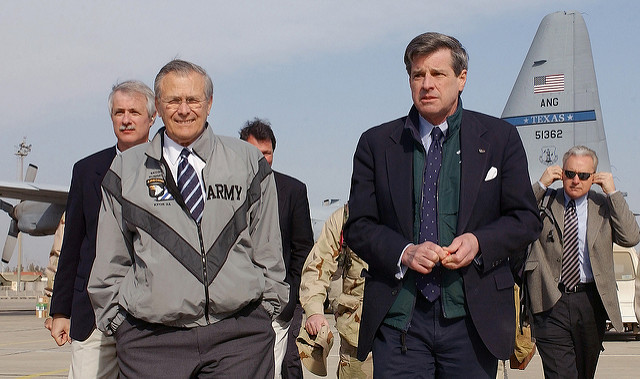
The blithe optimism demonstrated by the planners of the invasion of Iraq is still capable of taking one’s breath away. (Photo: Lisa M. Zunzanyika / Flickr Commons). Source
This is where we are today. These several volumes were originally to be titled, “America’s Dirtiest Secrets”, but that title no longer strictly applies because there is no sensible way to separate the actions of the Americans from their Jewish masters who gave the orders. For example, we know the media stories of the US hijacking of Iraq and believed this was done to remove a dictator. But our perception is severely altered when we learn the invasion was done entirely on Jewish orders, that the so-called “Provisional President” of Iraq – Paul Bremer – was a Jew and was taking all his orders from the Jews in the City of London, and that further those Jewish bankers have confiscated all of Iraq’s assets and are taking – free – more than 2/3 of Iraq’s oil. Likewise, we were taught it was the British military (with a bit of French help) that looted the 10 million priceless artifacts from China’s Summer Palace (the Yuanmingyuan) and then utterly destroyed it. But again, our perception changes when we learn the British did so under the orders of the Jews Rothschild and Sassoon, and that a great many of those priceless artifacts ended up in Jewish hands and remain there to this day.

Professor Lindemann (left) on an inspection with Churchill, 1941
In similar fashion, we were all taught about the famous British aviator “Bomber Harris” who won eternal fame for the incendiary carpet-bombing of countless dozens of German cities like Dresden, creating firestorms that incinerated millions of German civilians in one of the world’s greatest wartime atrocities. But again, our perception is severely altered when we learn that it was a Jew named Frederick Lindemann, sent by the Rothschilds as an “advisor” to Churchill, who brought with him the notion of carpet-bombing civilians with incendiary bombs, and that Churchill simply obeyed his Jewish masters in executing this program to help effect “the total destruction of Germany” that the Jews wanted. In like fashion, we were taught that the US dropped the atomic bombs on Japan to hasten the end of the war and “to save lives”. But again, our conceptions are thrown in disarray when we learn that it was a Jew, Bernard Baruch, ostensibly “the most powerful man in America” at the time, who not only chose Japan as the target for these bombs, but also personally selected the cities to be incinerated. Our conceptions are even more challenged when we learn that Baruch’s motivation may well have been retaliation to both Japan and Nagasaki for their expulsion of all the Jews prior to the war. (See End Notes)
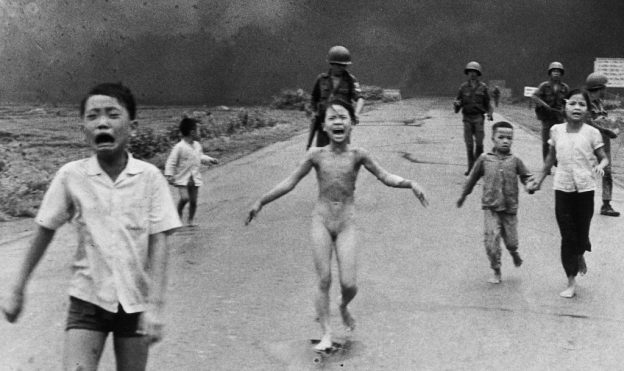
Phan Thi Kim Phuc, burned with napalm at age of 9. Source
And with both Europe and especially with Vietnam, in the application of napalm for incinerating civilians, it was indeed the Americans who extensively applied napalm during World War II, in “vast but historically-deleted genocidal incendiary attacks both in Europe and on Japanese cities, as well as during the wars in Korea and Vietnam”. But it was a Jewish chemist named Louis Fieser who developed napalm in a secret laboratory at Harvard University in 1942, and America’s Jewish masters who engineered its use on civilians. Even worse, in Vietnam, the locals discovered they could evade incineration by diving into any body or container of water to extinguish the flames. But it was another Jew, again at Harvard, who engineered the infusion of napalm with white phosphorus, which cannot be extinguished once lit, and will burn a man right through to the bones even under water. In all cases, the Americans did the dirty deeds, but they were “just following orders” from their Jewish overlords.
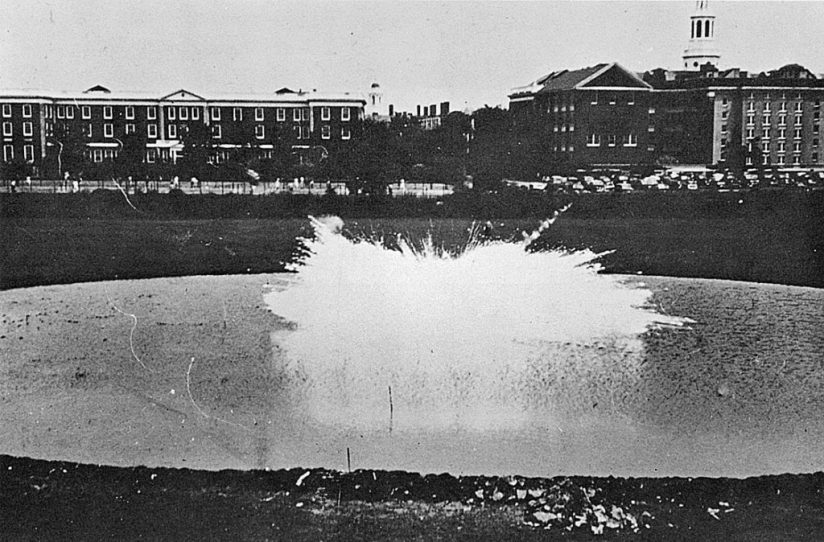
Independence Day, 1942: first field test of napalm, behind Harvard Business School. Photograph courtesy of Harvard University Archives/ Louis Fiester, The Scientific Method
And we realise, as with all such events in the past, that the American military is, just as the British military was doing in the past, functioning as “The Bankers Private Army”. And thus, in real terms, there is no sensible way to separate the actions – the “Dirtiest Secrets” of the Americans – from the “Dirtiest Secrets” of the Jews who issued the Americans and British their marching orders. We cannot disassociate the Mafia boss from his own orders executed by his own underlings.
And thus, while in these books we will be apparently (and superficially) examining America’s Dirtiest Secrets, there will in almost every instance be a distinct under-layer of Jewish influence and control. It is true we will see a few occasions or events where the Americans appeared to act independently – as in the hijacking of Hawaii – with no apparent evidence of Jewish involvement, but these are very few. And so, what we are really discussing and exposing in these pages are the Jews’ Dirtiest Secrets, and we will see that in virtually every instance the Jews operate admirably and very efficiently with what they call “A Gentile Front”, with some non-Jew apparently in charge but with a full complement of Jews in the background instigating, inciting, and ordering Gentiles to execute their plans.

The censorship board. George Creel is seated at far right. Harris & Ewing/Library of Congress. Source
One striking such example you will read about is US President Wilson’s Creel Commission, which perpetrated an astonishingly intense propaganda campaign designed to create a “white-hot hate” for Germans and lead Americans into a World War no one wanted. Creel was selected by Wilson’s Jewish handlers, quite likely by the so-called “Colonel” House, who was a Jew and whose real name was Huis, but it was the Jews Lippman and Bernays who were actually in control of the entire effort. This Jewish manipulation was so effectively done that Creel became the lightning rod for all the historical disapprobation while Bernays is celebrated today as “The father of public relations” in America. In fact, Bernays, the nephew of Sigmund Freud, was the Father of War Marketing, a template invented and executed by the Jews in the most despicable manner imaginable.
In many cases, these situations include historical events that have been so deeply buried by the Jewish media and Jewish book-publishing industries that perhaps not one person in a million has any knowledge of their existence. One such situation consists of the unremitting and unconscionable atrocities inflicted on Germany and the German people during – but especially after – both World Wars, atrocities committed primarily by the Americans but done under the orders of their Jewish masters. This was so widespread – and so true – that today it is illegal in Germany for anyone to even attempt to research atrocities committed against Germans. The reason is that anyone attempting such research would quickly discover that it was the Jews who were responsible for all those atrocities, by both hate propaganda and direct influence, and the Jews naturally don’t want those truths escaping confinement. Thus, the German government was forced to pass a law rendering illegal any investigation into such matters, and most German people today have no knowledge of the incredible betrayals and atrocities inflicted upon them by the Jews. They are instead taught by Jewish-authored books and by Jewish university professors, aided immensely by the Jewish-controlled mass media, that it was Germans who inflicted atrocities on the Jews.

‘We Hated What We Were Doing’_ Veterans Recall Firebombing Japan – The New York Times
Another such example is the incendiary carpet-bombing of nearly 100 Japanese cities – long after Japan had agreed to surrender – carried out by the American Curtis LeMay and resulting in the deaths of about 50% of the population of all those cities, done in the same manner as the Jews arranged for Germany and with the same blood-thirsty determination to utterly destroy Japan and the Japanese as they had for Germany and the German people. This immense and unconscionable atrocity, which resulted in the deaths of at least 10 million civilians – almost all women and children – was so heavily excised from history, including the re-writing of all Japanese history books, that almost no one in Japan has any knowledge of it, and no one outside Japan either. The excision in this case was so total that even Japan’s national population statistics were completely forged, fabricated, and re-calculated after the war, to entirely bury the fact of one of the greatest war-time atrocities in history.
The Japanese also do not research atrocities committed against Japan because they have been taught by their Jewish masters, as in Germany, the same things and for the same reasons. Nobody today in Japan has any knowledge of the involvement of the Jews in their destruction. This is not to dismiss atrocities that were indeed committed by the Japanese against others, but to illuminate the fact that the Jews committed much worse atrocities against the Japanese, and yet have such near-total control over the media, over book-publishing, and over the government itself, that these events have been totally excised from the historical record and the knowledge is deleted from the world’s consciousness. Again, this condition is much abetted by “the Gentile Front” where the Jews used the Americans to perpetrate these horrendous crimes while remaining hidden in the background. And again, let’s not forget that it was a Jew – Bernard Baruch – who chose Japan as the victim for the new atomic bombs and who personally selected the cities to be incinerated, almost certainly done as punishment for Japan’s prior eviction of all the Jews.
It would be of use to you to read two of my previous E-books on Propaganda and the Media[1] and Bernays and Propaganda[2], to help gain an appreciation of some of the methods used by the Jews to ensure silence (and ignorance) about past events. One of the tenets of propaganda is that we have a powerful tendency to believe the first thing we read or hear about a topic, especially if those statements are repeated a number of times. Later, even when faced with incontrovertible proof, facts that cannot be disputed, proving that our now-accepted beliefs are in fact false, we are surprisingly reluctant to change our minds, and we will “hesitate and waver and continue to believe there must be some other explanation”. Our minds are apparently unable to accept that we have believed lies.
This is important because the Jews use this to great advantage to pre-empt the discovery of their atrocities and prevent rational thought. Typically, if knowledge of their past crimes is showing signs of escaping historical confinement, the Jews will use this propaganda tactic to “get there first”, with some Jewish author quickly writing a book or treatise on the subject that is replete with lies and falsified history that attempts to exclude the Jews from involvement and, if at all possible, to blame the victim.


When the truths of China’s opium travesty were beginning to creep out of the sarcophagus and into the daylight of public knowledge, a Jewess named Julia Lovell was there with a book titled Opium War in which Jews are not even mentioned and which she categorised as a “tragic-comedy”, the hundred or so million Chinese being killed by the Jews apparently being funny to her. But a great many Americans and others, unfamiliar with the true circumstances and never having read anything else, will tend to believe this woman’s despicably false version of events and the Jews will perhaps be spared exposure.
Another such situation occurred when the truth of the mysterious depopulation of Easter Island was beginning to escape confinement. That truth seems to be that it was Jewish slave traders who kidnapped virtually the entire population of Easter Island as slaves to work their guano mines in Peru. Immediately upon this leakage, a Jew named Jared Diamond from the University of California was there with a book explaining that the Easter Islanders simply had some violent disagreement among themselves and killed each other off. Diamond was ridiculed by other academics for his foolish theory that “had not a shred of evidence to support it”, but his book wasn’t written for academics. It was written for the great unwashed of the US who had no knowledge of these events and would likely accept Diamond’s false version. And once again, the Jews might be spared exposure.

The same thing happened again when details began to emerge and leak about the Holland Tulip Bubble having been entirely staged by Jewish ‘bankers’, what with their futures market and all the rest, and not at all a “public mania” as we have been told, but a deliberate attempt to take advantage of public greed and gullibility and empty half the bank accounts in Holland. Once again, immediately on the risk of these leaks becoming public there was a female Jewish author on hand to write a “definitive” work on the topic which oddly made no mention of Jews, but furthermore claimed that no financial losses had occurred to anyone. In fact, this Jewess solemnly claimed that she had access to all the records in Holland and that through the most diligent search she found records of only a few people in Holland who had gone bankrupt during that time, and all those were bankrupt due to “property speculation“ and nothing to do with tulips. In real life, that so-called “bubble“ bankrupted probably half the people in Holland, but once again the Jews are there to pre-empt the truth and to propagate an entirely falsified version of history to protect themselves from exposure.

I have written elsewhere that at least 90%, and maybe even 95%, of everything that you know, or think that you know, or that you believe to be true about history, is wrong. To re-state another way, if we were to take the history of the entire world for the past 500 years and condense it into a history book of 100 pages, at least 50 of those pages would be blank. This is the amount of history – almost entirely involving the Jews – that has been so thoroughly excised from the historical record that it has literally evaporated from human consciousness with almost no living persons having any knowledge of it. And of the remaining 50 pages in this book, probably 45 are so extensively Photoshopped, sanitised, twisted, with crucial details omitted, that they are largely a work of fiction. And of course, anyone attempting to open this historical sarcophagus and expose the contents, is denounced as a deranged revisionist spreading misinformation. And, if the Jews are at all mentioned in this “revisionism”, we have the added attraction of being labeled an “anti-Semitic, holocaust-denying, Nazi Jew-hater”. Most of those souls attempting this historical illumination have very often paid with their careers, their reputations, their bank accounts, sometimes with their freedom and, in some cases, with their lives. These Mafia overlords in the City of London, the Khazar “so-called” Jews, are today just as brutal, savage, and filled with contempt for humanity as they were 1,000 years ago.
David Edwards was quoted in the “Third World Traveler“ as having written:
”Even open-minded people will often find themselves unable to take seriously the likes of Noam Chomsky, Edward Herman, Howard Zinn and Susan George on first encountering their work; it just does not seem possible that we could be so mistaken in what we believe. The individual may assume that these writers must be somehow joking, wildly over-stating the case, paranoid, or have some sort of axe to grind. We may actually become angry with them for telling us these terrible things about our society and insist that this simply ‘can’t be true‘. It takes real effort to keep reading, to resist the reassuring messages of the mass media and be prepared to consider the evidence again.”
This is the condition we face today in dealing with these recovered historical truths. In the case of the Jews, they know the truth but are frantic and nearly desperate to keep it buried and under confinement, which is why they so vengefully and viciously attack en masse whenever these facts emerge into daylight. With the Americans, their ignorance of their own nation’s criminality is founded on a blind faith and conviction based on a century of clever Jewish propaganda that is almost always flatly contradicted by the facts. But even citizens of the victim nations – like Germany – suffer enormous shock and disbelief when confronted with the historical truths of their own country, because the Jews and the Jewish media have for nearly 100 years browbeaten them with a totally false historical narrative. Friends sent to German acquaintances my articles on the Jews’ 1933 worldwide boycott of Germany and some related items, with those Germans replying that they found even those brief articles too painful to read at one sitting because, while the evidence was incontrovertible, it contradicted everything they’d been taught all their lives about themselves and their country, and the shock of learning that the things they “knew” were all lies, was emotionally too painful to bear.
At the same time, the world has been subjected to a century or more of outrageously false positive propaganda about the Jews, an almost incomprehensible volume of rose-tinted misinformation about the Jews as the world’s impoverished, misunderstood, persecuted “chosen ones“. In truth, there is little about the Jews and Israel today that is not based on fabricated historical mythologies, buried history, biased presentations, facts twisted so badly as to be often unrecognisable. Probably 95% of what the world knows about the Jews, their history, their massive crimes spanning centuries, their astonishing contempt for both humanity and truth, their conduct in international affairs, is not only wrong, but violently wrong. And to the same extent, the world has also been subjected to enormously and brutally false negative propaganda and misinformation about other nations – about the Jews’ victims, an equally incomprehensible volume of black-tinted information whereby the Jews typically seek to blame their victims for the atrocities perpetrated against them.
These buried historical truths are the content of my books and articles, the history of the world (or parts of it) as it really was, and is, harsh provable truths and documented realities without the vast carpet of propaganda, jingoism, and misinformation that Jewish media power has used to blanket and blind the world for well over a century.
END NOTES
The incendiary bombing of German working-class neighborhoods was planned in detail by the Jews. Since at least the early 1900s, Rothschild had owned most of the armament and munitions factories in Germany. It was through those that he supplied Japan (and Russia too) with the weapons for their war in 1905. During the Second World War the Jews didn’t want all their factories bombed to rubble when the Allies began flying over Germany. Their solution was to kill all the factory workers instead but leave the factories untouched. And it was the Jew Frederick Lindemann, sent by Rothschild to Churchill as an advisor, who brought the scheme to him. We have records of Lindemann’s submission of his plan to the war cabinet urging this method and suggesting that “greater flesh-incineration-per-bomb could be achieved” that way. This is further documented by a memo dated March 30, 1942, from Lindemann to Churchill that resulted in those intense terror-bombing campaigns of German civilians. The working-class neighborhoods were high-density, with these incendiary munitions creating natural intense firestorms that incinerated virtually every living thing in many of them. The British and the Americans, obeying the plans of their Jewish leaders, executed one of the most barbaric and inhuman atrocities of the war.
As I discuss in my essay on Japan, where the same was done there, the country’s population statistics were heavily forged, fabricated, and recalculated after the war to bury the evidence of these atrocities. I am almost certain the same was done with Germany. I haven’t the resources or time to delve into this with Germany, and researching atrocities against Germans is now illegal in Germany, but it is almost a certainty that Germany’s population statistics were massaged in the same was as those of Japan, to hide the truth. There had to have been many many millions of civilians killed in these raids, which were nothing more than an inhumanly deliberate attempt to depopulate Germany. And this doesn’t include the normal war casualties nor the 12 million to 15 million German civilians killed after the war from execution, starvation and migration, nor does it include Eisenhower’s Death Camps nor the perhaps additional million civilian deaths from Operation Paperclip.
*
Mr. Romanoff’s writing has been translated into 32 languages and his articles posted on more than 150 foreign-language news and politics websites in more than 30 countries, as well as more than 100 English language platforms. Larry Romanoff is a retired management consultant and businessman. He has held senior executive positions in international consulting firms, and owned an international import-export business. He has been a visiting professor at Shanghai’s Fudan University, presenting case studies in international affairs to senior EMBA classes. Mr. Romanoff lives in Shanghai and is currently writing a series of ten books generally related to China and the West. He is one of the contributing authors to Cynthia McKinney’s new anthology ‘When China Sneezes’. (Chapt. 2 — Dealing with Demons).
His full archive can be seen at
https://www.bluemoonofshanghai.com/ and https://www.moonofshanghai.com/
He can be contacted at:
NOTES
[1] Bernays and Propaganda
https://www.bluemoonofshanghai.com/wp-content/uploads/2022/10/BERNAYS-AND-PROPAGANDA-.pdf
[2] Propaganda and the Media
https://www.bluemoonofshanghai.com/wp-content/uploads/2022/11/ENGLISH-PROPAGANDA-and-THE-MEDIA.pdf
Former Acting US Defense Secretary: ‘Cut Military Spending’ by Half, Stop Hyping China Threat
By Wyatt Reed – Sputnik – 10.02.2023
As the Biden administration prepares to request congressional approval of the largest military budget in US history, Trump’s final pick for Pentagon chief has urged a “40-50%” reduction in spending on the armed forces, saying the Defense Department is “too big and bloated and wasteful.”
Former acting Secretary of Defense Chris Miller has raised eyebrows by calling out the “military-industrial complex” by name, as well as urging policymakers to “dramatically” cut the Pentagon’s budget and to stop demonizing China.
“We have created an entire enterprise that focuses economically on creating crisis to justify outrageously high defense spending,” Miller lamented in an interview with CBS.
With the military-industrial complex having become a “hydra-headed monster” and with “virtually no brakes on the American war machine,” Miller told CBS that “you have to starve the beast to make people come out of their cubby holes and start thinking creatively.”
The former acting defense secretary has also condemned the frequent saber rattling that’s come to dominate popular American political discourse regarding the alleged military threat which US leaders claim emanates from China.
Miller argued that “by constantly harping on the fact that the Chinese are the greatest threat to America and what not,” Washington’s political class is giving China’s leadership the “opportunity” to “have an enemy that they can focus their people’s anger and attention on.”
 In his new memoir, “Soldier Secretary,” Miller calls to cut Defense Department spending by 40% to 50% so that it would be closer to pre-9/11 spending levels, given that the US is “no longer waging wars in Afghanistan and Iraq.”
Much of his frustration with the course of the US military appeared to stem from the double standards he says have been exposed in the wake of disastrous and bloody US invasions in the Middle East.
“The more I thought, the more I was horrified,” Miller writes. “We invaded a sovereign nation, killed and maimed a lot of Iraqis, and lost some of the greatest American patriots to ever live — all for a goddamned lie.”
What “really bothers me,” Miller said in an interview with The Hill this week, is how “our young soldiers see the hypocrisy” in the system.
“If they end up being late for work, they get in a lot of trouble,” he noted, adding that if a soldier were to “mess up a piece of paperwork for a supply request, there’s a possibility they can be kicked out of the service.”
And on the other side of the equation, “there’s the people who lose wars and end up advancing on to other positions of power and wealth,” Miller stated. “And that’s what really bugs me.”
It’s a theme the former acting secretary of defense returns to frequently in his new book.
“The recognition that so many sacrifices were ultimately made in the service of a lie, as in Iraq, or to further a delusion, as in the neoconservatives’ utopian fantasy of a democratic Middle East… It still makes my blood boil, and it probably will until the day I die,” he writes.
But despite the raw emotions on display in the memoir, Miller doesn’t express much optimism that lawmakers in Washington will heed his call for a more reasonable Pentagon budget.
“There’s no incentive to reduce military spending,” he told the Hill. “I think there’s whispers, but [we need] someone with the courage and experience to get in there and force it.”
Jeffrey Epstein: A Jewish Individual?
Review of “One Nation under Blackmail”
The Occidental Observer | February 5, 2023
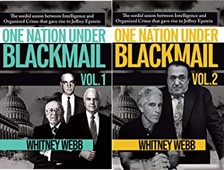
One Nation Under Blackmail: The Sordid Union between Intelligence and Organized Crime that Gave Rise to Jeffrey Epstein (Volume 1 & 2)
Whitney Webb
Trine Day, 2022
“Far from being an anomaly, Epstein was one of several men who, over the past century, have engaged in sexual blackmail activities designed to obtain damaging information (i.e., “intelligence”) on powerful individuals with the goal of controlling their activities and securing their compliance.”[1]
Jeffrey Epstein is dead and Ghislaine Maxwell is locked away in prison, and the thought-makers of our world seem keen to let the more explosive parts of the scandal dissipate from the public consciousness. As far as the mainstream media is concerned, Epstein and Maxwell were little more than well-connected socialites who ran a sex-trafficking ring for the rich and the powerful, and the focus has shifted instead to the criminal and civil cases seeking to achieve redress for the victims of sexual abuse.
On occasion some newspaper articles will mention the hidden cameras littered across Epstein’s properties, others the reams of CDs and hard drives found within them during the FBI raids. Altogether missing from the Netflix documentaries (Jeffrey Epstein: Filthy Rich [2020] and Ghislaine Maxwell: Filthy Rich [2022]) or the articles that spend their time narrowly focusing on the links between Epstein and Bill Gates, is the acknowledgement of the true nature of Epstein himself and the ultimate purpose of this sex-trafficking of minors — a sexual blackmail operation.
Not everyone is cowardly enough to let these controversial aspects lie untouched, as the newly released two-volume book One Nation Under Blackmail by independent reporter Whitney Webb seeks to blow wide open this media-enforced blackout. Utilizing primarily open-source information (that is, publicly accessible information such as books, newspapers articles and government reports),[2] Webb’s book delves into the life and times of Jeffrey Epstein and his deep ties to Jewish billionaires and Israeli intelligence. The intersection of sexual politics with Jewish power has long since been of interest to this writer, and the case of Jeffrey Epstein is easily one of the most damning instances, as evident by the large amount of popular interest in the story. A selection of other books on the Epstein/Maxwell case has appeared in bookshops over the past two years, but a cursory glance through their pages and at their appendices, where the words ‘Israel,’ ‘Jewish,’ and ‘Zionism’ are conspicuously lacking, shows you how surface-level they are in comparison to Webb’s book.
As Webb details extensively throughout the first volume, using sexual blackmail[3] to achieve political ends is far from being an Epstein innovation; it is almost certainly a tactic he learned from others in the murky world where crime meets intelligence. Nor is it something exclusive to Jews. But one can’t help but notice a consistent ethnic pattern in the known major perpetrators of this sort of behavior in Western countries. I have previously written about the Australian variety, where Jewish underworld figure Abe Saffron acquired compromising pictures of prominent Australians (more often than not with underage prostitutes) and leveraged this for his own nefarious ends. Webb (in Chapter 2: Booze and Blackmail) outlines in detail the blackmail operations ran by mob-linked figures Lewis Rosenstiel and Roy Cohn from a bugged suite at the Plaza Hotel in New York. Other non-Jews that Webb identifies as running parallel schemes, such as Saudi arms dealer Adnan Khashoggi or Craig Spence, were likewise deeply enmeshed in the same circles (Khashoggi in fact worked for Israeli intelligence).
Ultimately what is most frightening about the Epstein case, and what makes it stands out from the rest, is the sophistication of the operation, the high profile of the targets—from sitting US presidents to senior members of the British Royal Family—and the extraordinary lengths gone to in order to protect Epstein and avoid the true nature of his activities being exposed. It was as if there was something important at the heart of it all, something worthy of being protected by those in power, with lots at stake lest it be brought into public view. On a number of occasions Webb points to the underreported comments attributed to Alex Acosta, the attorney who gave Epstein his infamous plea deal in 2007, who allegedly told the Trump White House transition team that he backed off upon being told that Epstein “belonged to intelligence.”[4] At every stage where Epstein came under scrutiny, from his first legal conviction, to his second arrest and the questionable circumstances of his death, and even in the post-mortem coverage of his indiscretions, forces seemingly moved in the background to obscure and obfuscate, to clean up the mess and avoid as much detail be allowed to come to light as possible.
Like many books published by small dissident publishers with limited resources, both volumes would have been improved with editing for a more streamlined narrative, as neither makes for easy reading. Without a familiarity with the major events and actors described throughout each densely-packed chapter, the connections and the significance of the interactions between people are sometimes difficult to comprehend. Webb’s sources are conveniently compiled in endnotes at the conclusion of each chapter, and she uncovers a level of detail that makes it a worthy resource for your bookshelf that you will inevitably return to when trying to remember a name or make sense of a connection. Nevertheless, as this review concludes, the book falls short of providing a satisfying answer to the questions that readers of The Occidental Observer would go into it having, and shies away from responding to the most glaring aspects of the Epstein case of all.
ONE NATION UNDER BLACKMAIL
The central thesis of the book is that there has historically between a connection between organized crime and intelligence agencies in America, where the two are in some cases so intensely interwoven in their activities that it is difficult to tell where one ends and the other begins. This thesis, Webb claims, allows us to understand the nature of Jeffrey Epstein and his mysterious life, and that Epstein is one of many such nefarious actors who have operated on the margins of legitimacy. Volume 1 begins in the first half of the twentieth century, where Webb argues that the first connection between intelligence and organised crime was forged in America during the midst of World War II, in an undertaking known as Operation Underworld. This collaboration, specifically between the National Crime Syndicate (an alliance between the Italian and Jewish mobs) and the forerunners of the modern intelligence apparatus, came out of a sort of national security necessity that reaped geo-political dividends and continued after 1945 and into the Cold War.
Though intriguing, many of the chapters of Volume 1 deal with events and personalities of more limited relevance to the main Epstein blackmail story, covering the web of intrigue and scandal surrounding things such as Watergate, the BCCI, the China Lobby, and more obscure events like Billygate and Koreagate. Those chapters dealing with the spiritual forebears of Jeffrey Epstein are the ones that provide the most context and are the most enlightening to read. Webb presents a wealth of information about the history of the Jewish mob and other powerful Jewish figures during the middle years of the twentieth century, when wider Jewish political and cultural influence was beginning to solidify within America and the West. The cast of Jewish characters implicated in major American criminal, financial and political scandals, especially those with a direct line of descent to the Epstein blackmail operation, is staggering: the Bronfman family, Roy Cohn, Bruce Rappaport, Meyer Lanksy, Lewis Rosenstiel, Marc Rich, Max Fisher, Edmond Safra, and Robert Maxwell.
In Chapter 3, “Organised Crime and the State of Israel,” Webb underscores that much of the support given to the Zionist paramilitary groups that operated prior to the foundation of Israel—in the form of smuggled arms and funding—came from criminal networks. Canadian-Jewish liquor barons the Bronfman family, who participated in bootlegging during prohibition, financed the purchase of weapons for Haganah troops. Other Jewish mob figures with Zionist sympathies donated large sums and aided the Zionist cause during Israel’s formative years. This criminal collusion was, in Israel’s case, ongoing throughout its history and was “baked in at the very foundations of, not only its intelligence services, but the origins of the state itself.”[5]
Chapter 9, “High Tech Treason,” introduces us to Robert Maxwell, British media mogul and Israel’s Superspy, another figure of importance in Epstein’s younger years, who jumped almost seamlessly between the roles of organized crime associate and intelligence agent. Webb explores Maxwell’s involvement with the Eastern Bloc mob, including when he lobbied Israel to grant Semion Mogilevich an Israeli passport, allowing him access to the US financial system, and the PROMIS scandal, whereby Maxwell helped Israeli intelligence sell bugged computer software to governments and corporations around the world.
When MI6 attempted to recruit Maxwell for the service, it concluded, after conducting an extensive background check, that Maxwell was a “Zionist—loyal only to Israel.”[6]
Chapter 10, “Government by Blackmail: The Dark Secrets of the Reagan Era,” brings Volume 1 to a close, where many of the cast of disreputable characters revealed in earlier chapters come home to roost during the Reagan administration and the Iran-Contra scandal. The familiar figure of Roy Cohn appears again as a “political fixer” for the Reagan campaign, but Webb notes that Reagan’s intimacy with powerful Jewish figures with organised crime links goes all the way back to the very start of his career, with his mentor Lew Wasserman, the long-time president of Hollywood’s MCA, Inc. and “arguably the most powerful and influential Hollywood titan in the four decades after World War II,” acting as a political patron.
JEFFREY’S SHIKSES
Volume 1 sets the stage for Volume 2, where the interwoven networks of people introduced come together to contextualize the world that Epstein sprang from. Webb covers the underreported early years of Epstein’s financial career in the 1970s and 1980s, which are filled with just as much criminal intrigue as his later years as sex criminal, including his role as a “financial bounty hunter” allegedly working for Saudi billionaire Adnan Khashoggi. His years as an investment banker at Bear Sterns, where he was seemingly brought directly into the company by Alan Greenberg,[7] sat for many years under a cloud of suspicion that he participated in an insider trading scheme carried out by the Bronfman-owned company Seagram. Epstein’s involvement with Steven Hoffenberg in what was at the time the largest uncovered Ponzi scheme in American financial history, Towers Financial Corporation, is yet another fascinating detail largely ignored elsewhere.
How and when Epstein was inducted into the world of intelligence cannot be accurately deduced, but Webb offers a number of potential scenarios, relating to his proximity to people such as Maxwell and Khashoggi. Elsewhere she points to the direct relationship Epstein seemingly had with the highest levels of the Israeli government. Former Israeli Prime Minister and military intelligence figure Ehud Barak, another close Epstein associate, claimed that he was first introduced to Epstein by none other than Shimon Peres.[8] Webb pins the beginning of the sexual blackmail scheme to some point in the early 1990s, around the time Ghislaine Maxwell latched onto Epstein following the death of her father.
Chapter 18, “Predators” deals with the nuts and bolts of the operation, exploring in detail the various methods both Epstein and Maxwell used to recruit and procure girls. Sometimes it was through friendships with the owners of modelling companies, other times it was as simple as Maxwell approaching a girl on the street and recruiting them for “massages.” Even literally purchasing underage Slavic girls from Eastern Europe was apparently a possibility for Epstein.[9] Their relationship with Les Wexner (Epstein was Wexner’s long-time money manager) also proved fruitful, using their connection with the popular Victoria’s Secret fashion chain—a brand owned by Wexner—to pose as recruiters.
Webb first came to my attention when she conducted an interview with Maria Farmer, considered the earliest Epstein victim to report him to the authorities. The interview is long, upwards of three hours, but well worth a listen, especially when Farmer begins to discuss how she was treated by the powerful Jewish figures surrounding Epstein:
I don’t know any White supremacists, but I know a lot of Jewish supremacists… They made it very clear that I was a servant [to them] because I was White.[10]
Farmer may be unfamiliar with the word shikse, but it perfectly describes how Epstein and Maxwell considered these young gentile girls ensnared in their net of abuse. The supposed “trope” of the Jewish man lusting after the shikse finds in Epstein yet another real-life example, with underage blonde girls being his victim of choice when satisfying his own urges. Former Ghislaine Maxwell friend Christina Oxenberg, quoted in the book from an at-the-time anonymous source, relayed a conversation she once had with Maxwell about who these women were that she was “recruiting.” Maxwell reportedly dismissed them with ease: “They’re nothing, these girls. They are trash.”[11]
On the other side of the operation was of course the hidden cameras and the recording equipment. The presence of these hidden cameras in Epstein’s properties is independently confirmed by a number of eyewitnesses, court documents and early newspaper articles that detail this curious addition to Epstein’s properties, and the existence of the CDs and hard drives to store the footage is a matter of public record, including from the latest FBI raid of Epstein’s New York mansion in 2019:
Per photographs taken at the time of the raid, hard drives were found inside a safe forced open by the FBI and numerous large black binders were found in a closet that contain “CDs, carefully categorized in plastic slipcovers and thumbnails with photos on them.” When shown in court, the “homemade labels” were redacted, as judge Alison Nathan had ruled that they contained “identifying information for third parties.” Did that information involve only the names of underage girls, the names of blackmail victims, or both?[12]
The FBI conveniently lacked the warrant to seize these items, and upon returning four days later with the correct warrant, the CDs and hard drives were gone. They were later handed over by Epstein’s lawyer, but having not had the chance to view what was on them, we can only assume that this was more than enough time to delete any incriminating files.

Epstein schmoozing with elites. Left, from left: Epstein, Alan Dershowitz, Steven Pinker, and Larry Summers, presumably at Harvard. Right: with Ghislaine and Bill Clinton
Much has been made of the relationship that existed between Epstein and Donald Trump before they allegedly fell out with each other in 2004 over a property dispute in Palm Beach, Florida, but as Webb exposes in Chapter 16, “Crooked Campaigns,” Epstein and Maxwell had a far more politically intimate relationship with President Bill Clinton that coincided with his time in office and his early post-presidency years. Epstein visited the Clinton White House 17 times, and was apparently a prominent figure in the formation of the Clinton Global Initiative, which saw Clinton as a regular passenger on Epstein’s infamous plane, the “Lolita Express.” Webb refers to other attempts of sexual blackmail against Clinton, including in 1998 when Prime Minister Benjamin Netanyahu apparently threatened Clinton with tape recordings Israel had obtained proving outright that he had a sexual relationship with Monica Lewinsky, using them to pressure Clinton to pardon Israeli spy Jonathon Pollard.[13] It seems the Clinton White House, which was seeking a peaceful solution to the Israel-Palestine conflict, was of key interest.
Chapter 21, “From PROMIS to Palantir: The Future of Blackmail,” finishes off Volume 2 with the chilling insight that perhaps one of the reasons Epstein’s sexual blackmail operation collapsed was because it was allowed to collapse — it had become outdated and irrelevant. The advent of the permanent internet connection has brought about opportunities for far more widespread and even more intimate forms of blackmail, instead conducted and collected via electronic means. A technological panopticon whereby the cameras once placed by Epstein throughout his properties are instead now placed by big tech and social media companies in our own homes, omnipresent in our lives. After his 2008 conviction, both Epstein and Maxwell seemed to be shifting away from sexual blackmail and were making inroads in Silicon Valley and mixing with data-harvesting IT companies. Epstein’s previous ties with higher-ups at Microsoft and his financial support for John Brockman’s Edge Foundation gave him an in with plenty of big tech leaders, and he had re-branded himself as a tech investor, starting a company focused on collecting genetic data. Ghislaine’s siblings in the Maxwell family also have pedigree in the tech industry going back to the 1990s. As noted by Webb, “in a world where blackmail is overwhelmingly electronic, people like Jeffrey Epstein and Ghislaine Maxwell become liabilities to be silenced, rather than assets to protect.”[14]
WHO, WHAT AND WHY?
Upon finishing Volume 2, I found that many of the questions raised by Webb still remained open. Who or what is “the system” that enabled Epstein and protected him from justice? If so many people knew, why was there such an institutional resistance to speak out about Epstein? And the most important question of all: what was the goal behind collecting this sexual blackmail? Why were Epstein and his benefactors trying to control these victims? Unfortunately, Webb’s book does not provide a satisfying conclusion.
Webb does not shy away from pointing the finger at Israel or from discussing wider Zionist motivations and groups like B’nai B’rith. However, she stops frustratingly short of the obvious conclusions. Granted the reluctance is one that all those knowledgeable on the Jewish question are familiar with, and perhaps she simply avoids the discussion for the sake of keeping her book on Amazon and appealing to a wider audience, rather than have it be relegated to the ADL’s banned book department. But for an answer to the questions most readers are likely after, we are given nothing more than a few measly sentences concluding that the Epstein operation was instigated by Israeli intelligence and that those in the “power structure” and “the system” — the same people that made Epstein untouchable — have now strengthened their stranglehold over America. Ultimately, readers are given the impression that this blackmail was collected as control merely for the sake of control, power merely for the sake of power, without a deeper underpinning goal.
Upon being challenged during an interview by Jewish podcaster Adam Sosnick on the obvious Jewish identity of the key players, Webb retreats to the safe position: By referring to Israeli intelligence or Jewish criminals, one is not referring to all Jewish people, and one cannot conflate the Epstein network or powerful billionaire Zionists with the whole Jewish community, or ascribe any wider group motive to them. Sosnick also exhorts the listener to avoid speaking of groups and instead only of individuals, lest it breed hate.[15]
One is of course allowed to speak of the Chinese or Catholics or Russians in general terms and in a political sense as behaving out a sense of group identity and a sense of group interests, and it is sophistry to claim that the speaker is referring to every single Catholic in the world or every single Russian in the world. Regardless of which sociological theory of power you ascribe to, what is clearly being referred to is the organized community, the power structure that represents the wider in-group and operates towards a unique ingroup goal. In the case of the Russians, this is currently Putin and the Russian state apparatus, supplemented by the Russian military, media and business elite that do not dissent from achieving Russian strategic interests as determined by the state apparatus. For Catholics, it is the Vatican and the international network of dioceses, bolstered by the Catholic Universities, think tanks and charities. People are not forced to declare “not all Catholics” when dealing with the allegations of a cover-up of child sexual abuse within the church.
When one speaks of the Jews, it stands to reason that the same scenario should apply. That is, it quite reasonably refers to the organized Jewish community, including organizations like the ADL; the powerful figures in Israel and in the diaspora, as well as the religious and intellectual leaders, the business figures and the lobbying groups. Sure there are dissenters and outsiders, and of course there is internal debate and a difference of opinion on the best means for meeting its goals, but the organized Jewish community exists just the same, and remains firm in its fundamental goal of ensuring the security and survival of the Jewish people and the state of Israel.
Herein lies the problem for Webb and the reason behind the demand to treat Epstein as a mere “Jewish individual.” The network of powerful Jewish figures and institutions chronicled throughout Webb’s book is a network that is intimately connected to Jeffrey Epstein or to his blackmail operation: Robert Maxwell, the Pritzker Family, Larry Summers and Alan Dershowitz, Ehud Barak and Israeli intelligence, the world’s wealthiest Jewish families that formed the Mega Group (the Bronfman, Lauder and Wexner families). The list goes on and on. These are not powerless fringe figures or outsiders who are scorned by Jewish leaders or the wider Jewish community. They are the leaders of the organized Jewish community, some of whom practically direct Jewish-American cultural, political and even religious life. To remove them from the equation of power would be the equivalent of removing half of the highest-ranking members of the Vatican from the Catholic Church or leading members of the Chinese Communist Party from the Chinese state.
Using the phrase “the Jews” cuts the Gordian Knot at the heart of Webb’s attempt to understand Epstein, whom he was working for, and how he so effortlessly moved among the elite strata of society, why it was covered up, who stood to benefit from this blackmail operation, and what its ultimate aim was. With those two words, all the jumbled euphemisms of “elites” and “Zionists” melt away, and the confusing mix of organized crime and intelligence, legitimate and illegitimate enterprises seemingly working in unison with each other starts to become intelligible. The ease with which Epstein and Maxwell abused and then dismissed these young girls as mere “trash” makes more sense when you know the meaning behind the word shikse (an unclean abomination). The reason for the legal cover-up and the inhibition of the mainstream media to run the story, even when they have no direct connection to the Epstein network, is obvious when you know who the proprietors of most mainstream American media outlets are, and with whom both cultural and institutional power in the US now lies. All this interwoven association is merely two sides of the same coin—a system constructed to ensure the security of Israel and the survival of the Jewish people. To talk openly about Epstein’s true activities is to talk openly about the nature of Jewish power, and for that reason alone most will not do so, for fear of the Jews. In all, Webb has picked up the puzzle pieces and assembled them neatly on the board, but she refuses to take that final step back and honestly contemplate the picture she has pieced together.
What are we to make of the institutional silence and protection, and the dishonest shifting of the narrative to a mere sex-trafficking ring? What can you conclude from the attempt to declare anyone who dares point out the clear ethnic goal at the heart of this vile sexual blackmail operation an anti-Semitic conspiracy theorist? The only reasonable conclusion is that Epstein functioned with the support and backing of Jewry’s most powerful figures, and that the organised Jewish community is willing to conceal a criminal conspiracy of frightening proportions if it serves to benefit the Jews or would otherwise negatively affect them (by creating more anti-Jewish sentiment) if the American public knew the truth.
Had Epstein’s personal indiscretions not become too big to ignore and had it not all unravelled so spectacularly due to the pressure of the #MeToo movement, would Epstein also have been buried in honor like Robert Maxwell, with Israeli Prime Ministers and dignitaries lining up to give a tearful goodbye to yet another faithful servant to the Jewish people? If he had been released early from a prison sentence, would he also have been welcomed back to Israel with open arms like Jonathon Pollard? Epstein had already once been professionally rehabilitated by Jews after his first conviction, there’s no reason why it couldn’t have happened again.
Notes
[1] Webb, W 2022, One Nation Under Blackmail: The sordid union between Intelligence and Organised Crime that gave rise to Jeffrey Epstein (Volume 1), Trine Day, Oregon USA, p.IX.
[2] Webb does on occasion rely on interviews she conducted with figures close to the Epstein story such as Ari Ben-Menashe and Maria Farmer.
[3] As distinct from simply bribing someone with sex with a consulting adult, or honey pots traps, a tactic as old as time—think Samson and Delilah or modern versions such as the honeypot trap that captured Mordechai Vanunu.
[4] Vicki Ward, “Jeffrey Epstein’s Sick Story Played Out for Years in Plain Sight,” The Daily Beast (August 19, 2019). https://www.thedailybeast.com/jeffrey-epsteins-sick-story-played-out-for-years-in-plain-sight
[5] Webb, Op. Cit., p.93.
[6] Webb, Op. Cit., p.382.
[7] Webb, W 2022, One Nation Under Blackmail: The sordid union between Intelligence and Organised Crime that gave rise to Jeffrey Epstein (Volume 2), Trine Day, Oregon USA, p.6.
[8] Tarnopolsky, N 2019, ‘Ehud Barak: I Visited Epstein’s Island But Never Met Any Girls’, The Daily Beast, July 15, retrieved from: https://www.thedailybeast.com/israels-ehud-barak-i-visited-epsteins-island-but-never-met-any-girls
[9] Webb, Volume 2, Op. Cit., p.266-267.
[10] See https://www.youtube.com/watch?v=dtD02MeZU4o from 1:31 or so
[11] Webb, Volume 2, Op. Cit., p.276
[12] Ibid., p.58.
[13] Stoil, R. S 2014, ‘Netanyahu said to have offered Lewinsky tapes for Pollard’, The Times of Israel, July 23, retrieved from: https://www.timesofisrael.com/netanyahu-said-to-have-offered-lewinsky-tapes-for-pollard/
[14] Webb, Vol 2, Op. Cit., p.373.
[15] PBD Podcast 2020, The TRUTH About Jeffrey Epstein w/ Whitney Webb, Episode 198, retrieved from: https://youtu.be/GVVHWVoZ4kU?t=5978
JFK and America’s Destiny Betrayed
A Review of DiEugenio’s “Foreign Policy Coup” Theory
BY LAURENT GUYÉNOT • UNZ REVIEW • JANUARY 21, 2023
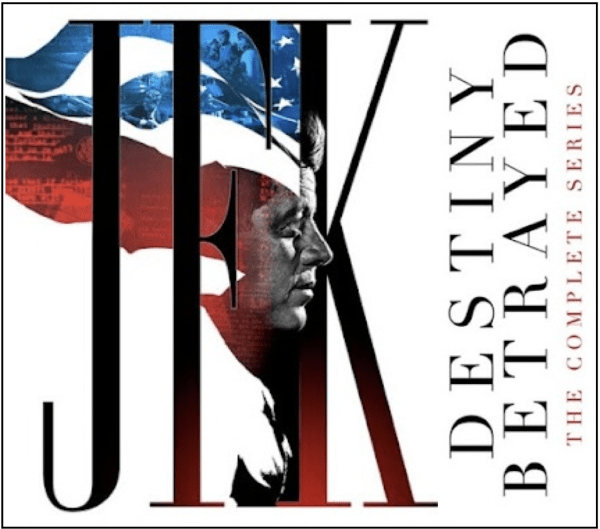
I have watched Oliver Stone’s documentary on the assassination of JFK, both the short version, JFK Revisited: Through the Looking Glass, and the long version in four episodes, JFK: Destiny Betrayed. I recommend the latter, which I will discuss here. Although the technical parts (the bullets, the autopsy, Oswald’s CIA handlers) are interesting and partly new, I will focus exclusively on the theory regarding the main culprits and their motive. And I will discuss the larger work of James DiEugenio, who wrote the film—and probably interviewed the different contributors, although Stone appears to be doing it.
James DiEugenio has been investigating the Kennedy presidency and the Kennedy assassination from the time of the Assassination Records Review Board (ARRB), which was largely a consequence of Oliver Stone’s Hollywood film JFK (1991). His first book was Destiny Betrayed: JFK, Cuba, and the Garrison Case (1992, newly edited in 2012). In 1993, he founded Citizens for Truth about the Kennedy Assassination (CTKA), and co-edited Probe Magazine, now replaced by the website KennedysandKing.com.
In 1997, DiEugenio published a powerful two-part book-length article, “the Posthumous Assassination of JFK” (1997). It is still essential reading for anyone interested in the controversies surrounding Kennedy’s presidency and assassination, or puzzled by the unending stream of bizarre Kennedy lore. This is the text you want to send to anyone telling you about the Kennedys’ mafia dealings and unrestrained sex life, their murder of Marilyn Monroe, or Bobby’s irresponsible assassination plots against Castro that backfired on his brother. These stories are so widespread, repeated in well-published and well-reviewed books, that millions of people assume them to be documented. Writing on the occasion of the release of Seymour Hersh’s The Dark Side of Camelot, DiEugenio exposed their fraudulent nature and their true motivation: the obsession to “smother any legacy that might linger,” for “assassination is futile if a man’s ideas live on through others.” This flow of defamation had started in the 70s, as a counter-fire to the Church Committee and the House Select Committee on Assassinations (HSCA), and intensified in the 1990s after the ARRB. It never dried up.
Character assassination is only one part of the propaganda unleashed against the Kennedy legacy. Another part has consisted in distorting the historical record of Kennedy’s presidency, and particularly the radical but short-lived innovations of his foreign policy. DiEugenio writes in “Dodd and Dulles vs. Kennedy in Africa” (1999, modified 2016):
a clear strategy of those who wish to smother any search for the truth about President Kennedy’s assassination is to distort and deny his achievements in office. Hersh and his ilk have toiled to distort who Kennedy really was, where he was going, what the world would have been like if he had lived, and who and what he represented.[1]
DiEugenio has provided insightful answers to these questions. A graduate in Contemporary American History, he is probably the best Kennedy historian among Warren Commission critics, and his work has opened the way for other revisionist historians like Monika Wiesak, author of the recent and excellent America’s Last President: What the World Lost When It Lost John F. Kennedy (read DiEugenio’s review here). According to DiEugenio, there has been, in addition to the cover-up about Kennedy’s death, a “cover-up about Kennedy’s foreign policy,”[2] so that even critics of the Warren Commission fairytale have largely failed to grasp the full extent of Kennedy’s changes from the foreign policy of his predecessors—dominated by the Dulles brothers; “by only chasing Vietnam and Cuba, to the neglect of everything else, we have missed the bigger picture.”[3] The bigger picture drawn by DiEugenio includes the Congo, Indonesia, Laos and the Middle East. DiEugenio’s most essential articles on these topics are:
- “Deconstructing JFK: A Coup d’État over Foreign Policy?” written for Covert-Operation magazine (2021)
- “Nasser, Kennedy, the Middle East, and Israel” (2020)
- “Introduction to JFK’s Foreign Policy: A Motive for Murder” (2014)
- “ Dodd and Dulles vs. Kennedy in Africa” (1999, modified 2016)
The three scholars who most contributed to DiEugenio’s understanding of the uniqueness of Kennedy’s foreign policy, and who are interviewed in the film JFK: Destiny Betrayed, are:
- Richard Mahoney, for JFK: Ordeal in Africa, Oxford University Press, 1983,
- Philip Muehlenbeck, for Betting on the Africans: John F. Kennedy’s Courting of African Nationalist Leaders, Oxford University Press, 2012,
- Robert Rakove, for Kennedy, Johnson, and the Nonaligned World, Cambridge University Press, 2012 (read DiEugenio’s review).
Although he praises James Douglass’s JFK and the Unspeakable (2008), DiEugenio rejects his mythical portrayal of JFK as a Cold Warrior converted to peacemaking during the 1962 Cuban Missile Crisis.[4] Despite the contrary impression he made during his televised debates with Nixon in 1960, Kennedy was never a Cold Warrior. The collection of statements published under the title The Strategy of Peace for his presidential campaign proves it.
DiEugenio traces Kennedy’s general ideas on foreign policy back to 1951, when Kennedy toured the Middle East and Asia. His meeting in Saigon with Edmund Gullion, whom he later brought into his cabinet, had convinced him that sending American troops to Indochina was a grave mistake.[5] He would never change his mind on that issue.[6]
By 1957, Kennedy was formulating a radical—by U.S. standard—foreign policy for the Arab world, which he outlined in a speech on the Senate floor denouncing French colonial occupation of Algeria:
In these days, we can help fulfill a great and promising opportunity to show the world that a new nation, with an Arab heritage, can establish itself in the Western tradition and successfully withstand both the pull toward Arab feudalism and fanaticism and the pull toward communist authoritarianism.[7]
Unlike his predecessors Truman and Eisenhower, and in defiance of the doctrine that prevailed in the CIA, the Pentagon and the State Department, Kennedy accepted and welcomed a multipolar world, the only way, in his view, to overcome the dangerous bi-polarization of the Cold War. Had he succeeded, he would have transformed the U.S. into something totally different from what it was starting to become since WWII, and has fully become since he died: an imperial bully feared but hated throughout the world. In “Deconstructing JFK: A Coup d’État over Foreign Policy?” DiEugenio makes the point that:
[Kennedy’s] speeches, correspondence and high-level meetings with emerging Third World leaders reveal his growing antipathy for colonialism, rejection of imperialism, toleration for the non-aligned movement—contrasting markedly with his predecessor—and promotion of nationalistic leaders, albeit ones that were considered to be “responsible” in their moderation.[8]
The first foreign policy reversal that Kennedy made once in office was on the Congo. Patrice Lumumba, Congo’s first democratically elected leader, was killed three days before Kennedy’s inauguration, victim of a coup supported by the CIA. Jacques Lowe’s shot of JFK getting the news of Lumumba’s death on February 13th is, to DiEugenio, the picture that best symbolizes Kennedy’s personal commitment to support the national independence of Third world countries, and the ordeal of his struggle against the CIA’s machinery of assassination and regime change. After U.N. Secretary-General Dag Hammarksjold was killed (likely murdered) in a plane crash in September 1961, Kennedy carried on his campaign for a free and independent Congo. Lyndon Johnson destroyed this first attempt at a democracy in post-colonial Africa, and backed Josef Mobutu, who turned into a corrupted dictator and allowed his country to be utilized by outside imperial interests.

Kennedy rejected the “with us or against us” mentality of the foreign policy establishment, and this was also demonstrated by his support for Indonesia’s nationalist leader Sukarno, who co-founded the Non-Aligned Movement. In 1958, Eisenhower had authorized the CIA’s attempt at overthrowing Sukarno, but when Kennedy assumed office, he reversed that policy, and helped Sukarno stabilize his country. Less than a year after Kennedy’s death, the CIA was planning again covert action against Sukarno, which led to the killing of at least 500,000 people suspected of communist sympathy. Sukarno was placed under house arrest and CIA-backed Suharto ruled for three decades, turning his people into low-wage workers for foreign companies.[9]
And then, of course, there is Cuba and Vietnam. The story of Kennedy’s resistance to the Pentagon and the CIA’s push for military confrontation and escalation in these countries has been told many times—most eloquently by James Douglass—, so that I do not need to tell it again. Authors of the dominant school of JFK assassination research—and that includes those interviewed in Stone’s documentary—assume that Cuba and Vietnam are, in that order, the most important reasons why Kennedy was killed. DiEugenio agrees, but brings a larger spectrum of motives.
DiEugenio writes in “Nasser, Kennedy, the Middle East, and Israel”:
For decades, the critical community overlooked areas of Kennedy’s foreign policy outside of Vietnam and Cuba. Kennedys and King has attempted to correct that oversight in recent years. We have tried to educate our readers on issues like Kennedy’s policies in Congo, Indonesia, Dominican Republic, and Laos. We have also tried to show how, after his murder, those policies—as well as his policy toward Vietnam and his attempts at detente with Moscow and Havana—were also altered.
But there is still another area of the world about which Kennedy’s reformist foreign policy is overlooked. That area is the Middle East. This is odd since many commentators justifiably perceive that the Middle East is one of the most important areas on the globe.[10]
He writes in his “Introduction to JFK’s Foreign Policy: A Motive for Murder”:
Why is the JFK case relevant today? Well, because the mess in the Middle East now dominates both our foreign policy and the headlines, much as the Cold War did several decades ago. And the roots of the current situation lie in Kennedy’s death, whereupon President Johnson began the long process which reversed his predecessor’s policy there.[11]
In other words, the Middle East is the region of the world where Kennedy’s foreign policy and Johnson’s reversal of that foreign policy have had the most dramatic and most lasting consequences. What was at stake was America’s involvement in the conflict between Israel and the Arab world, and that meant, essentially, between Ben-Gurion and Nasser.
So DiEugenio acknowledges that: 1. LBJ completely reversed JFK’s foreign policy, and 2. the most consequential reversal was in the Middle East, for the longtime benefit of Israel and to the detriment of Egypt. Yet he points, not to Johnson or Ben-Gurion, but to Allen Dulles as the most likely culprit for the Dallas coup. Does he document any evidence that Allen Dulles was interested in switching alliance from Egypt to Israel? None whatsoever. It is true that the Eastern Establishment generally favored Saudi Arabia over Egypt, but it is not the case that they wanted a closer relationship with Israel. So what is unique about Johnson’s pro-Israel policy is that it was not a return to a pre-Kennedy policy, but something new altogether. It was a radical break from all previous administrations. Recall Eisenhower’s resolute reaction to Israel’s invasion of the Sinai in 1956, and contrast it with what happened ten years later, when Johnson greenlighted Israel’s attack on Egypt and expansion, and covered up Israel’s false-flag attack on the USS Liberty designed to draw the U.S. into the war.
Allen Dulles’s major interest in foreign policy in the 1960s was over Cuba. Assassinating Castro and/or invading Cuba to restore an American colonial regime was his priority. Like the majority of JFK investigators, DiEugenio considers that Kennedy had so angered the CIA, and Dulles in particular, when he didn’t go along with their plan to invade Cuba—not once but twice, first with the Bay of Pigs landing in 1961, and secondly during the Cuban Missiles Crisis in 1962—that Dulles’s gang decided to assassinate him. But guess what: LBJ did not invade Cuba either. He didn’t give the CIA and Pentagon hawks the retaliatory invasion of Cuba that their plan was supposed to force upon him. He didn’t even try.
This is a major weakness of that semi-mainstream theory to which DiEugenio subscribes, and which he contributed to write. That weakness is partly compensated by the secondary focus on Vietnam. It is true that, in Vietnam, Johnson gave the National Security state what they wanted, and more. As author Peter Dale Scott wrote, Johnson “had been, since 1961, the ally of the Joint Chiefs (and in particular Air Force General Curtis LeMay) in their unrelenting efforts, against Kennedy’s repeated refusals, to introduce U.S. combat troops into Asia.”[12] Yet, that presentation ignores one aspect of the full story.
The strongest push for sending ground troops to Vietnam came from Walt Rostow (“the biggest Cold Warrior I’ve got,” Kennedy said). As deputy to the National Security Advisor McGeorge Bundy under Kennedy, Rostow had already weighted heavily on Kennedy’s decision to send military “advisors” to Vietnam. But Kennedy had grown weary of his bellicose advise (“Walt had ten ideas, nine of which would lead to disaster”).[13] Walt Rostow was promoted by Johnson as National Security Advisor, and found in the new president more enthusiasm for his war plans. Rostow was the main promoter of the lie that Johnson’s Vietnam policy was a continuation of Kennedy’s.[14]
Johnson named Walt’s brother Eugene Under-Secretary of State, “appointed precisely to support the coming Israeli war” according to Joan Mellen.[15] Walt and Eugene Rostow, sons of Jewish immigrants, had a good deal of control on U.S. Israeli policy. On June 8, 1967, the very day of the Israeli attack on the USS Liberty, Walt had recommended to Johnson that Israel be allowed to keep the captured territories.
Why did the Rostow brothers want a Vietnam War? In “Was Vietnam a Holocaust for Zion” I explained why the Vietnam War was good—even crucial—for Israel. But don’t take my word for it. Here is what French president Charles De Gaulle said during his November 27, 1967 press conference:
Without the tragedy of Vietnam, the conflict between Israel and the Arabs would not have become what it has become. And if South-East Asia could experience a renewal of peace, the Middle-East would also find its way to peace, in the climate of détente which would follow such an event.[16]
I am not implying that the shift in policy on Vietnam between Kennedy and Johnson does not support the theory that CIA and Pentagon killed Kennedy. It does. I am merely pointing out that Johnson’s pro-Israel cabinet members were at least as influential as Dulles and LeMay in Johnson’s reversal of Kennedy’s decision to withdraw from Vietnam, a fact which is also consistent with the theory that Israel was the prime mover.
In his JFK and the Unspeakable, James Douglass has documented JFK’s deep commitment to prevent nuclear proliferation and even abolish weapons of mass destruction “before they abolish us” (Kennedy’s speech at the UN General Assembly, September 25, 1961). But Douglass makes no mention of JFK’s bitter confrontation with Ben-Gurion and Eshkol on that very issue. In this way, Douglass has proven that the historical school of which he has become a standard bearer is involved in a cover-up. To be generous, I ascribe it to a case of “cognitive inhibition”. I imagine it works somewhat like this: “My work—that is, the truth—is too important to risk it being censored by saying something bad about Israel.” Personally, I prefer to stick to Peter Janney’s principle that “the truth takes no prisoners.”
To his credit, DiEugenio does not eschew the Dimona story. His website links to two articles by Avner Cohen, author of Israel and the Bomb (1998), and William Burr of the National Security Archive, accompanied by declassified documents (here and here).[17] DiEugenio himself writes about Israel’s effort to acquire nuclear weapons in “Nasser, Kennedy, the Middle East, and Israel” (2020):
Ben Gurion and the other Israeli leaders were so devoted to this aim that they resorted to two illicit means in order to secure the goal. First—there is no other way to say this—they involved themselves in a government-wide conspiracy to deceive Kennedy about the true nature of the Dimona reactor.
Israel’s second means to go nuclear was the theft of enriched Uranium from the U.S.:
Through [Roger] Mattson [author of Stealing the Atom Bomb], and also author Grant Smith [author of Big Israel], we know today that Israel had stolen hundreds of pounds of highly enriched uranium out of what was essentially their shell plant in Apollo, Pennsylvania, called NUMEC.[18]
Stone and DiEugenio mention the first of these Israeli deceptions in their film (the long version only, episode 3, 40:50). After a brief reminder of Kennedy’s decision to support the U.N. resolution for the return of Palestinian refugees, we are told:
The other problem Kennedy faced with Israel was the construction of the atomic reactor at Dimona. JFK was strongly against any proliferation of nuclear weaponry. He had been assured by Prime Minister David Ben-Gurion that Dimona was designed for peaceful uses of atomic energy. In the spring of 1963, Kennedy demanded full inspections by the US of the Dimona reactor, and threatened to place American aid for Israel in limbo if no agreement was reached. And at the time of his assassination, negotiations were in process for biannual inspections.
That is better than nothing. But since that story is only incidental to the thesis defended by Stone and DiEugenio, it seems to have been included only to immune the authors from the blame of covering it up, that Douglass deserves.
Interestingly, it is Stone who brings up this topic in this interview with Canadian journalist Éloïse Boies. At 34:20, DiEugenio states that “nobody was more anti-nuclear proliferation than John F. Kennedy. This was really a very important issue with him.” At this point, Stone interjects:
He took on Israel. He took on Ben-Gurion in Israel, because they were building a bomb that they’d stolen from us. And he really wanted to put a stop to that, but he, unfortunately died before, and Johnson carried through, knew about it and let it go, till Israel had the bomb by 1968. And even then, in 68, Johnson shut the Pentagon up. He said: “We are not going to announce this. The American people won’t know that Israel has the bomb.”
Notice Éloïse’s reaction: “Let’s talk about [something else].” The point is that, for Stone and DiEugenio, Dimona seems to be anecdotal and hardly relevant to solving the case. At the end (from 50:27), when asked “Who did it, and why?” they stick to the conclusion that Allen Dulles was the mastermind, with perhaps Curtis LeMay. But, they add as an afterthought, Dulles is only “the executioner” and “does get the OK from someone else. … You know who they are: the people with money” … like “David Rockefeller”. Éloïse gets it: “It’s all about money, at the end of the day.” It becomes absolutely ridiculous. When your theory implodes under its own hollowness, it’s time to change. But, as Stone says “once they’re locked in, it’s very hard for historians to go back” (19:10).
It might seem unfair for me to point to an interview rather than to the film itself. But the value of that interview is precisely to reveal the logical fallacies and confusions that are not apparent in the film.
In that same interview (from 40:30), Stone says: “I don’t think Johnson was involved in the murder.” DiEugenio adds: “Johnson fell for the CIA story coming out of Mexico City” (an Oswald impersonator visiting both the Soviet and the Cuban embassies in Mexico in October 1963). But then DiEugenio mentions that Edgar Hoover had told Johnson that the Mexico story was impossible, since neither the voice nor the photo provided by the Mexico CIA station fitted the real Oswald. So now “the question becomes: did Johnson really believe this?” This gets confusing. DiEugenio can’t seem to decide whether Johnson believed Oswald’s communist legend or not.
But DiEugenio’s dilemma has no reason to be. For not only Johnson knew the communist Oswald to be bogus; it was he who used this fake communist connection to block all investigations. DiEugenio is an admirer of the work of professor John M. Newman, whose books he reviewed (here, here, here, and here), and whom he interviewed for the film. One contribution of Newman, introduced in the 2008 edition of his book Oswald and the CIA and repeated in the first three volumes of his series The Assassination of President Kennedy, is, in his own words:
An essential element of the plot was a psychological operation to raise the specter of WWIII and the death of forty million Americans. This threat of a nuclear holocaust was then used by President Johnson to terrify Chief Justice Earl Warren and some of the other men who served on the Warren Commission to such an extent that they believed there was no alternative to writing a report stating Lee Oswald alone had assassinated the president.[19]
According to that theory, endorsed by DiEugenio in this review,[20] Oswald’s profile as a communist pro-Castro activist was inbuilt in the plan (by none other than James Jesus Angleton), not for the purpose of starting WWIII, but as a national security pretext that Johnson could use to impose the lone-nut theory, lest the discovery of a conspiracy would “kick us into a war that can kill forty million Americans in an hour,” as Johnson kept repeating.[21] One important implication is that “many of the post-assassination lies and cover-ups were carried out by people who had nothing to do with the pre-existing plot to assassinate the president” and who “thought that what they were doing was in the best interests of the country.”[22] This applies to thousands of people from the Dallas Police to TV networks. But can it apply to Johnson himself? Given Johnson’s quick and efficient mastery of this device, it is much more likely that it was fabricated by Angleton specifically for Johnson and with his foreknowledge.
Yet DiEugenio and other authors on his site are dismissive of investigators who incriminate Johnson, and especially of Phillip Nelson, author of LBJ: The Mastermind of JFK’s Assassination. A big book like that (730 pages) is bound to contain some weak arguments, but the reviews in KennedysandKing.com (here and here) do not do justice to the strong evidence accumulated by Nelson that Johnson was actively involved, not just in the cover-up, but in the preparation of the Dallas ambush.[23] (Read Nelson’s response to KennedysandKing.com here). DiEugenio concurs with Douglass that Johnson was unaware of the conspiracy against his president, but “chose to cover-up everything and surrender to Cold War prerogatives.”[24] He assumes that Johnson was a man who had no clear idea of his own in foreign policy and liked to be told what to do. That is at odds with everything we learn from Johnson’s biographers—especially Robert Caro.
From my viewpoint, which differs from Nelson’s, Johnson’s role in the assassination cannot be understood independently from Israel’s—nor can Angleton’s role. Johnson allowed, and probably planned, the Israeli attack on the USS Liberty in 1967, and he excused Israel when the operation failed (“Johnson did not break relations with Israel, and there were no trials held over this atrocity,” notes DiEugenio).[25] Not only that, but, as DiEugenio writes in “Nasser, Kennedy, the Middle East, and Israel”:
As Roger Mattson notes in his book on the subject, when the CIA alerted the new president that it appeared that Israel had now developed the atomic bomb, Johnson barely reacted. (Mattson, p. 97) There was no official investigation launched. In fact, Johnson told the CIA not to alert either State or Defense about the discovery.[26]
For those two acts, Johnson qualifies as a traitor to the country he had been sworn to serve. If Johnson was working for someone, it was not for the “Eastern Establishment,” of which he had never been part; it was for Israel. Johnson was the initiator of a pro-Israel policy that Truman, Eisenhower, the Dulles brothers or the Joint Chiefs of Staff under Kennedy would never have imagined in their worst nightmare. It is today widely known that Johnson is the US president who “firmly pointed American policy in a pro-Israel direction.”
In conclusion, I find several logical flaws in DiEugenio’s general theory, the basis for Stone’s documentary:
- DiEugenio recognizes that the change of foreign policy from JFK to LBJ was most consequential in the Middle East, yet he blames the CIA and the Pentagon (Dulles and LeMay) for the assassination, although neither the CIA nor the Pentagon ever advocated the pro-Israel policy that Johnson set up. Johnson’s unprecedented support for Israel, to the point of treason, went against the approach advocated by the CIA, the Pentagon or the State Department. But it was the best foreign policy that Ben-Gurion could dream of.
- According to DiEugenio and the dominant school, the CIA’s prime motive for eliminating Kennedy would have been to resume their favored foreign policy toward Cuba, which Kennedy had stubbornly opposed. But that didn’t happen after the assassination. Johnson kept Kennedy’s pledge to Khrushchev not to invade Cuba, which Dulles and LeMay considered pure treason.
- DiEugenio agrees that Kennedy was intensely worried about nuclear proliferation, and that Israel posed him the most difficult problem. He also knows that Johnson did nothing to stop Israel from going nuclear, and showed neither surprise nor displeasure when told that Israel made its first nuclear bomb in 1968, with bomb-grade uranium stolen from the U.S. Johnson tried to keep it secret—which obviously was what Israel wanted. Yet DiEugenio does not see Dimona as having been a motive in the assassination, and finds no reason to suspect either Israel or Johnson.
- DiEugenio believes that JFK’s assassination was a “coup d’État over foreign policy,” and I agree that this is the only way to make sense of it. But the purpose of a coup d’État is to replace one head of state by another. Therefore, it is self-contradictory for DiEugenio to minimize Johnson’s role and motive in the assassination.
Actually, I think DiEugenio’s notion of a “cover-up about JFK’s foreign policy” needs to be qualified. Not all areas of Kennedy’s foreign policy are equally covered up. The three teachers of DiEugenio—Richard Mahoney, Philip Muehlenbeck and Robert Rakove—are published by Oxford University Press and Cambridge University Press: not exactly fringe publishers. Rakove and Muehlenbeck are even included in the bibliography of the Wikipedia article on “Foreign policy of the John F. Kennedy administration” (so are James Douglass and John M. Newman). This Wikipedia article is quite accurate and detailed, with one exception for the section about “Israel and Arab States”—a fine hasbara job, probably by Bennett Naftali’s army of Zionist Wikipedia editors. See by yourself:

The real “cover-up about JFK’s foreign policy” is the cover-up about JFK’s Israeli policy. According to DiEugenio’s own logic, that points in the direction that DiEugenio is not looking.
Since DiEugenio sees a link between Kennedy’s assassination and his “posthumous assassination”, I also suggest that he gets a clue about Kennedy’s assassins by looking at the political profile of Kennedy’s “posthumous assassins”. The list includes, next to Seymour Hersh, authors who specialize in trashing the Kennedy family, like Ronald Kessler (The Sins of the Father, 1997), Edward Klein (The Kennedy Curse, 2004), or the incomparable C. David Heymann, the Mossad employee (by his own admission)[27] who wrote the salacious Bobby and Jackie: A Love Story (2009). Is there a pattern here?
What about Howard Zinn, Gar Alperovitz, Martin Peretz, and Noam Chomsky, that DiEugenio blames in “The Left and the Death of Kennedy” (1997) for their defense of the Warren Commission report and their participation in the orgy of Kennedy-bashing. Chomsky, whom DiEugenio sees as the most nefarious liar when it comes to Kennedy’s presidency or his assassination (here and here), has nothing in common with Allen Dulles or Curtis LeMay. He is an anti-imperialist, and as such he should make Kennedy his hero, his icon. But Chomsky has another agenda: one of his specialties is blaming America for the crimes of Israel. As for Martin Peretz, DiEugenio writes that his New Republic buried Kennedy’s death in 1979, then “tried to bury his life.”
It actually made a feature article out of a review of the tawdry Horowitz-Collier family biography The Kennedys. Who did that publication find suitable to review this National Enquirer version of the Kennedy clan? None other than Midge Decter, wife of neo-conservative godfather Norman Podhoretz, mother-in-law of Elliot Abrams.
The Podhoretzs are not Eastern Establishment, but they hate the Kennedys. Their hatred is transgenerational and inextinguishable. If you doubt it, read the piece below, written by Norman’s son a week after the tragic death of John F. Kennedy Jr. The author imagines Satan—or is it Yahweh?—teasing Joe Kennedy in hell and bragging to have killed his grandson—a particularly heinous version of the “Kennedy curse”.

Perhaps DiEugenio should give more serious consideration to the “who” and the “why” of Kennedy’s “posthumous assassination”. But that would take him on the road less traveled, a dangerous path—some say suicidal.
Strangely, though, many other well-trodden roads seem to now converge on the Israeli trail:
- Investigators tracking Johnson end up finding a snake pit of sayanim in his White House, as did Phillip Nelson in his second and third books (LBJ: From Mastermind to “The Colossus” and Remember the Liberty).
- Jefferson Morley, investigating Angleton, saw him in cahoots with the cream of the Mossad, who considered him “the biggest Zionist of the lot,” while Robert Amory, head of the CIA Directorate of Intelligence, called him a “co-opted Israeli agent” to his face.
- David Talbot concludes that RFK was assassinated by the same cabal as his brother, who now used for a patsy an anti-Zionist Palestinian, thereby presenting RFK’s assassination as motivated by “a visceral, irrational hatred of Israel” (but Talbot sees no Israeli fingerprint in there—another case of cognitive inhibition).
- No one investigating Jacob Rubenstein, known as Jack Ruby, can now ignore his work for the Irgun as a “gangster for Zion” and his repeated declarations that “I did it for the Jews”.[28]
- Clay Shaw, the only person (beside Oswald) to have been charged with having participated in the assassination, has been found a board member of Permindex, “a Mossad arms trading and money laundering venture” chaired by Louis Bloomfield, a devoted supporter of the Israeli cause and of the Mossad, as shown by Michael Collins Piper.[29]
- The word is out that Arlen “Magic Bullet” Specter was a dedicated Israel-firster, honored by the Israeli government as “an unswerving defender of the Jewish State,” and by AIPAC, as “a leading architect of the congressional bond between our country and Israel”.[30]
- It can’t be ignored that Abraham Zapruder, the man whose camera didn’t shiver when Kennedy’s head exploded, had his business office in one of the snipers’ nests, the Dal Tex Building overlooking Dealey Plaza, owned by B’nai B’rith financier David Weisblat.[31]
- Investigators interested in George DeMohrenschildt cannot fail to learn that, before being found dead with a bullet in his head, he had complained that “the Jewish mafia” was out to get him.[32]
And of course, we must add to the equation Israel’s criminal record for the last sixty years. Thanks to Ronen Bergman, author of Rise and Kill First: The Secret History of Israel’s Targeted Assassinations, we know that Israeli secret services has never had any inhibition against eliminating anyone perceived as a threat to Israel’s national security, especially when it comes to Israel’s nuclear hegemony in the Middle East. Bergman learned from the assassins themselves because, he writes, “acts that people in other countries might be ashamed to admit to are instead a source of pride for Israelis.”[33]
We now know so much more than Stone and DiEugenio could know when they first got involved in Kennedy assassination research. But those who understood Israel’s power back then already had a clue. In March 1992, commenting critically on Stone’s motion picture JFK, American Congressman Paul Findley noted in the Washington Report on Middle East Affairs:
It is interesting — but not surprising — to note that in all the words written and uttered about the Kennedy assassination, Israel’s intelligence agency, the Mossad, has never been mentioned. … on this question, as on almost all others, American reporters and commentators cannot bring themselves to cast Israel in an unfavorable light — despite the obvious fact that Mossad complicity is as plausible as any of the other theories.
Three years later, Mike Piper filled the gap with Final Judgment: The Missing Link in the JFK Assassination Conspiracy (expanded through five editions until 2005). His work has been ignored by most investigators, but in 2013, historian Martin Sandler (listen to him here) mentioned it in his precious edition of The Letters of John F. Kennedy, to introduce Kennedy’s letter to David Ben-Gurion dated May 18, 1963:
author Michael Collins Piper actually accused Israel of the crime. Of all the conspiracy theories, it remains one of the most intriguing. What is indisputable is that although it was kept out of the eye of both the press and the public, a bitter dispute had developed between Israeli prime minister David Ben-Gurion, who believed that his nation’s survival depended on its attaining nuclear capability, and Kennedy, who was vehemently opposed to it.[34]
In his previous letter to Kennedy, dated May 12, Ben-Gurion had assured Kennedy that the Egyptians “want to follow the Nazi example,” and begged: “Mr. President, my people have the right to exist… and this existence is in danger.”[35] He also made a bizarre digression about Jordanian King Hussein: “there is always a danger that one single bullet might put an end to his life and regime.”[36]
Notes
[1] DiEugenio, “Dodd and Dulles vs. Kennedy in Africa,” 15 February 1999, last modified 16 October 2016, www.kennedysandking.com/john-f-kennedy-articles/dodd-and-dulles-vs-kennedy-in-africa
[2] “DiEugenio at the VMI seminar,” 16 September 2017, www.kennedysandking.com/john-f-kennedy-articles/jim-dieugenio-at-the-vmi-seminar
[3] DiEugenio, “Introduction to JFK’s Foreign Policy: A Motive for Murder,” 22 December 2014, www.kennedysandking.com/john-f-kennedy-articles/introduction-to-jfk-s-foreign-policy-a-motive-for-murder
[4] “DiEugenio at the VMI seminar, 16 September 2017, www.kennedysandking.com/john-f-kennedy-articles/jim-dieugenio-at-the-vmi-seminar
[5] James Norwood, “Edmund Gullion, JFK, and the Shaping of a Foreign Policy in Vietnam,” 8 May 2018, www.kennedysandking.com/john-f-kennedy-articles/edmund-gullion-jfk-and-the-shaping-of-a-foreign-policy-in-vietnam
[6] James Douglass, JFK and the Unspeakable: Why He Died and Why It Matters, Touchstone, 2008, pp. 107, 102.
[7] Quoted in “DiEugenio at the VMI seminar,” 16 September 2017, www.kennedysandking.com/john-f-kennedy-articles/jim-dieugenio-at-the-vmi-seminar
[8] DiEugenio, “Deconstructing JFK: A Coup d’État over Foreign Policy?” January 14, 2021, covertactionmagazine.com/2021/01/14/deconstructing-jfk-a-coup-detat-over-foreign-policy/
[9] DiEugenio, “Deconstructing JFK: A Coup d’État over Foreign Policy?” January 14, 2021, covertactionmagazine.com/2021/01/14/deconstructing-jfk-a-coup-detat-over-foreign-policy/
[10] DiEugenio, “Nasser, Kennedy, the Middle East, and Israel,” 22 October 2020, www.kennedysandking.com/john-f-kennedy-articles/nasser-kennedy-the-middle-east-and-israel
[11] DiEugenio, “Introduction to JFK’s Foreign Policy: A Motive for Murder,” 22 December 2014, www.kennedysandking.com/john-f-kennedy-articles/introduction-to-jfk-s-foreign-policy-a-motive-for-murder
[12] Peter Dale Scott, Deep Politics and the Death of JFK, University of California Press, Berkeley, 1993, pp. 30-33.
[13] David Halberstam, The Best and the Brightest, Random House, 1972, pp. 156-162.
[14] John K. Galbraith, “Exit Strategy – In 1963, JFK ordered a complete withdrawal from Vietnam,” Oct/Nov 2003, www.bostonreview.net/articles/galbraith-exit-strategy-vietnam/
[15] Joan Mellen, Blood in the Water: How the US and Israel Conspired to Ambush the USS Liberty, Prometheus, 2018, p. 32.
[16] Film of De Gaulle’s press conference on fresques.ina.fr/de-gaulle/fiche-media/Gaulle00139/conference-de-presse-du-27-novembre-1967 at 41 min.
[17] Avner Cohen and William Burr, “ Concerned About Nuclear Weapons Potential, John F. Kennedy Pushed for Inspection of Israel Nuclear Facilities,” April 21, 2016, nsarchive.gwu.edu/briefing-book/nuclear-vault/2016-04-21/concerned-about-nuclear-weapons-potential-john-f-kennedy and “ The Battle of the Letters, 1963: John F. Kennedy, David Ben-Gurion, Levi Eshkol, and the U.S. Inspections of Dimona,” May 2, 2019, nsarchive.gwu.edu/briefing-book/nuclear-vault/2019-05-02/battle-letters-1963-john-f-kennedy-david-ben-gurion-levi-eshkol-us-inspections-dimona
[18] DiEugenio, “Nasser, Kennedy, the Middle East, and Israel,” 22 October 2020, www.kennedysandking.com/john-f-kennedy-articles/nasser-kennedy-the-middle-east-and-israel For more detail, read DiEugenio’s review of Roger Mattson’s book Stealing the Atom Bomb (2016), “How Israel Stole the Bomb”, September 11, 2016, on consortiumnews.com/2016/09/11/how-israel-stole-the-bomb/ Read also DiEugenio’s review of Monika Wiesak, America’s Last President.
[19] John Newman, Where Angels Tread Lightly: The Assassination of President Kennedy, volume 1, self-published, 2017, p. xx; repeated in vol. 2, Countdown to Darkness, and in vol. 3, Into the Storm.
[20] DiEugenio’s words: « In his new Epilogue for this 2008 edition, Newman explains why only someone who a.) Understood the inner workings of the national security state, and b.) Understood and controlled Oswald’s files, could have masterminded something as superhumanly complex as this scheme. One in which the conspiracy itself actually contained the seeds that would sprout the cover-up » (DiEugenio, “John Newman, Oswald and the CIA (re-issue),” 01 September 2008, on www.kennedysandking.com/john-f-kennedy-reviews/newman-john-oswald-and-the-cia-re-issue
[21] LBJ in a conversation to Senator Richard Russell on November 29, 1963, quoted in Douglass, JFK and the Unspeakable, op. cit., p. 83.
[22] John Newman, Where Angels Tread Lightly, op. cit., p. xx.
[23] Phillip Nelson, LBJ: The Mastermind of JFK’s Assassination, XLibris, 2010, p. 377-378
[24] Douglass, JFK and the Unspeakable, op. cit., p. 81.
[25] DiEugenio, “Deconstructing JFK: A Coup d’État over Foreign Policy?” January 14, 2021, covertactionmagazine.com/2021/01/14/deconstructing-jfk-a-coup-detat-over-foreign-policy/
[26] DiEugenio, “Nasser, Kennedy, the Middle East, and Israel,” 22 October 2020, www.kennedysandking.com/john-f-kennedy-articles/nasser-kennedy-the-middle-east-and-israel
[27] “C. David Heymann,” on spartacus-educational.com/JFKheymann.htm
[28] William Kunstler, My Life as a Radical Lawyer, Carol Publishing, 1994, p. 158.
[29] Michael Collins Piper, Final Judgment: The Missing Link in the JFK Assassination Conspiracy, American Free Press, 6th ed., 2005, chapter 15, pp. 247-269.
[30] Natasha Mozgovaya, “Prominent Jewish-American politician Arlen Specter dies at 82,” Haaretz, October 14, 2012, www.haaretz.com/jewish/arlen-specter-dies-at-82-1.5192779.
[31] That shots came from the Dal Tex was suggested by Jim Garrison in his October 1967 Playboy interview, p. 165-166, ia801307.us.archive.org/20/items/JimGarrisonPlayboyInterview/Jim-Garrison-Playboy-Interview.pdf.
[32] Police report on fr.scribd.com/document/258263723/Police-report-on-sucide-of-de-Mohrenschildt; His wife confirmed to Jim Marrs that her husband thought that “the Jewish Mafia and the FBI” were out to get him: Jim Marrs, Crossfire: The Plot that Killed Kennedy, Carroll and Graf, 1989, p. 285.
[33] Ronen Bergman, Rise and Kill First: The Secret History of Israel’s Targeted Assassinations, John Murray, 2019, p. xv.
[34] Martin Sandler, The Letters of John F. Kennedy, Bloomsbury Publishing, 2013, p. 333. Listen to Sandler here on this topic on www.c-span.org/video/?c4547313/user-clip-jfk-gurion-mossad-dimona
[35] Avner Cohen, Israel and the Bomb, Columbia UP, 1998, pp. 109 and 14.
[36] Quoted in Monika Wiesak, America’s Last President: What the World Lost When It Lost John F. Kennedy, self-published, 2022, p. 214.
Turtles All the Way Down: Vaccine Science and Myth
Edited by Zoey O’Toole and Mary Holland
 If you are reading this, you are probably aware of the fierce debate surrounding vaccination and looking for information that will allow you to make the best decisions for yourself and your loved ones. Whether you are a parent or a parent to be, sorting through the many arguments on vaccines can be daunting. Still, you need an answer, a definitive one, to the crucial question: Who has it right in the great vaccine debate – the critics, who claim that vaccines often cause serious harm, or the medical establishment, which tells us that vaccines are safe and effective and the science is settled?
Rest assured, you have come to the right place. “Turtles All the Way Down: Vaccine Science and Myth” will resolve the vaccine question for you, once and for all. By the time you finish reading, not only will you see the answer clearly for yourself, you will also have the scientific references and specific quotes at your disposal that prove it — more than 1,200 of them – all from mainstream scientific papers and textbooks, the official publications of relevant government agencies, or manufacturers’ documents.
The book consolidates a great deal of information (accompanied by detailed analysis) that is scattered in hundreds of medical articles, books, and websites. All discussion is presented in clear and easy-to-understand language, so no medical education is required. It presents several original concepts in addition to laying a robust scientific foundation for the more established ones.
Some of the fundamental vaccine safety issues covered in the book are:
- How is safety demonstrated before a new vaccine is licensed? What technique do vaccine manufacturers use in clinical trials to make vaccines appear safer than they actually are?
- What “last ditch” technique is employed when the above one cannot be, and what are its grave (and damning) ethical implications?
- What is the scientific foundation of the safety of vaccination, and what practical tools does this body of science provide physicians to anticipate, diagnose, and treat vaccine injury?
- What fundamental flaws are built into vaccine adverse events reporting systems, and how are these systems used (or misused) by health authorities to support their safety claims?
- What kinds of post-marketing vaccine studies are conducted, and how can they be manipulated by researchers to produce “favorable” outcomes?
- Why would researchers want to skew vaccine research, and how could skewed results be promulgated by the scientific community?
- Why would medical journals publish faulty vaccine science? What is the role of the famed “peer review” in this process?
- What are “the studies that will never be done” by the medical establishment and how long it has resisted doing them? (Hint: more than 100 years!)
- What key CDC-recommended childhood vaccination guidelines were arbitrarily set, without an adequate scientific basis?
In addition, three cornerstones of vaccination lore are covered in depth:
- What is herd immunity, and how does it apply (or not) to the vaccines on the childhood schedule?
- What role did vaccines actually play in the historical decline of infectious disease?
- Was the paralysis associated with polio actually caused by the poliovirus? Is there a better explanation for the great paralysis epidemics of the 20th century? What are the “19 polio mysteries”?
The book is intended for parents overwhelmed by conflicting messaging on this important topic, but it is also an excellent reference for medical researchers and professionals who seek a better understanding of vaccine safety science. Whether you are new to the vaccine debate or a “veteran” seeking a deeper grasp of the science, this book is a must-read. It also serves as an excellent primer on vaccination to share with friends and relatives who may benefit from a deep dive into the subject.
The battle between Big Pharma and scientific integrity
Review – Taking on Big Pharma: Dr. Charles Bennett’s Battle
 By Julius Getman and Terri LeClercq
Larger-than-life, creative, and fiercely ambitious, Dr. Charlie Bennett has a long history of revealing dangerous side effects of bestselling medicines. In 2006, his meta-analysis of existing data showed that top-selling ESAs (erythropoietin stimulating agents) created previously unrecognized risks, deaths, and serious illness. According to Dr. Steven Rosen, chief medical officer of the City of Hope Cancer treatment center, Bennett “saved more lives than anyone in American medicine.”
Bennett’s work also created enemies: Bennett was accused, on the basis of flimsy evidence, of mishandling government grant money and violating the False Claims Act (also known as the “Whistleblower Act”). Powerful interests within Big Pharma, academia, and law enforcement joined in the attack on Bennett. By 2010, he was forced from his academic position; was besieged by lawsuits; and became the victim of a coordinated, well-funded campaign to discredit him and refute his work. From pharma superstar to disgrace and disrepute in the blink of an eye.
“Taking On Big Pharma” explores Bennett’s achievement and evaluates the charges against him. Exposed is the unsettling relationship between the pharmaceutical industry and academia. The result of more than five years of research and hundreds of hours of interviews with scientists, academicians, and federal prosecutors, this is an unflinching look at how institutions, purportedly devoted to public health and education, can be corrupted for profit — from drug sales or research grants.
Merriam-Webster Declares ‘Gaslighting’ 2022 Word of the Year
From the film Gaslight: Paula has finally had enough of Gregory’s Gaslighting
By John Leake | Courageous Discourse | January 1, 2023
Merriam-Webster just announced the following:
In this age of misinformation—of “fake news,” conspiracy theories, Twitter trolls, and deepfakes—gaslighting has emerged as a word for our time.
A driver of disorientation and mistrust, gaslighting is “the act or practice of grossly misleading someone especially for one’s own advantage.” 2022 saw a 1740% increase in lookups for gaslighting, with high interest throughout the year.
Merriam-Webster’s report and definition of the term acknowledge that the meaning of ‘gaslighting’ has evolved since the word was coined. In my opinion, the current spike of usage is based on a misunderstanding of the concept. In the current, popular imagination, gaslighting is often confused with gross lying and deception, but in fact the term refers to tricking the victim into believing he is losing his mental competence so that he will doubt his perceptions of reality.
The term originated in a play and 1944 film Gaslight, starring Ingrid Bergman and Charles Boyer, in which a woman is manipulated by her sinister husband into believing she is losing her sanity. In his initial gambit, he rigs their home’s gaslights to flicker periodically. When she asks him, “Why do the lights keep flickering?” He says he doesn’t know what she’s talking about—that the lights are NOT flickering.
In another notable scene, he gives her a valuable brooch—a family heirloom that he claims had belonged to his mother—while warning her that she must be very careful not to lose it. “You know how you tend to lose things,” he says. Later, when the brooch goes missing from her purse, it seems (in her mind) to confirm her husband’s concern (not realizing that he removed it from her purse).
Gaslighting is a particularly malevolent form of psychological warfare, most often deployed in interpersonal relationships by what the Austrian psychoanalyst Otto Kernberg called “malignant narcissists.” The concept of the malignant narcissist is closely related to Dr. Robert Hare’s concept of the psychopath. Incidentally, in a recent conversation with the British cardiologist, Aseem Malhotra, he observed that the pharmaceutical industry displays distinct traits of psychopathy in the way it conducts business.
I suspect that the spike in usage of ‘gaslighting” is an outcome of our current Orwellian administration. As Orwell memorably wrote in 1984:
The party told you to reject the evidence of your eyes and ears. It was their final, most essential command.
I frequently thought of this command as I was reading Edward Dowd’s new book, Cause Unknown: The Epidemic of Sudden Deaths in 2021 and 2022. Every day we see reports of young people suddenly dropping dead, and our mainstream media would have us believe the cause is unknown.
This is a crazy-making form of mass deception and pretending that indeed bears a resemblance to the original meaning of ‘gaslighting.’
UK government asked Twitter and Facebook to “tweak” algorithms during Covid
By Cindy Harper | Reclaim The Net | December 12, 2022
Former United Kingdom Health Secretary Matt Hancock, self-styled as an official who was at the forefront of Britain’s battle against Covid, didn’t seem to feel like he had done enough in 2020 and 2021, so he felt compelled to milk the pandemic cow by writing a book about that “battle.”
But he wasn’t laboring alone, since he had a co-author, Isabel Oakeshott, who reports say is actually opposed to Hancock’s policies and is a lockdown skeptic.
And now, Oakeshott, who had access to official records and Hancock’s notes exchanged with “all the key players in Britain’s Covid-19 story” – as the book’s blurb states – has penned her own “story,” an article based on the collaboration published by the Spectator, whose content draws from the material used for the book.
Oakeshott writes about the “key lessons” that include revelations about the details of UK’s vaccine and mask policies, but also the mechanisms to deal with dissenters, particularly online.
 According to the journalist, Hancock genuinely considered those who disagreed with him on how to handle the situation as “mad and dangerous” and more importantly, as persons that “needed to be shut down.”
Judging by the article, his “response” to online skepticism effectively came even before pandemic restrictions themselves. Hancock had no problem revealing that in January 2020, his special adviser was already in conversation with Twitter about the ways to “tweak” the platform’s algorithms.
Another social media giant was co-opted somewhat later, and by Hancock personally, when he got in touch with former British PM and politician Nick Clegg – now president for global affairs at Meta.
Clegg, who was at the time Facebook’s VP of global affairs and communications, was reportedly “happy to oblige.”
And according to Oakeshott, Hancock’s department together with the Cabinet Office (PM and government), “harnessed the full power of the state to crush individuals and groups whose views were seen as a threat to public acceptance of official messages and policy.”
The Cabinet Office enlisted the help of a unit that previously worked on stifling the influence of Islamic State (ISIS) to now deal with “anti-vaxxers,” she writes, and notes that the policy of zero tolerance did not spare doctors, scientists, and academics, such as those behind the Great Barrington Declaration.
Even then PM Boris Johnson was not as ardent a “dissent suppressor” as Hancock, Oakeshott’s writing suggests.
American Pravda: Lost Histories of the Great War

Female delegates to the 1915 Women’s Peace Conference in The Hague
BY RON UNZ • UNZ REVIEW • NOVEMBER 28, 2022
Friends of the Palo Alto Library runs a local monthly book sale, now reopened after nearly two years of Covid closures, and I usually attend, often buying for a pittance items that have caught my eye. A few weeks ago I picked up for a quarter a copy of Adam Hochschild’s widely praised 2011 volume To End All Wars, his account of the British anti-war movement during World War I, which I’d seen very favorably reviewed in the Times and elsewhere when it was originally released. My own knowledge of that era was relatively meager and sparse, so I spent a couple of days reading the text.

Hochschild seems a fine writer and researcher, certainly earning the glowing blurbs by prominent scholars that stud his book, and he told a very interesting story of the men and women who organized and led Britain’s powerful but heavily suppressed anti-war movement as it opposed the continuing slaughter in the trenches. Many of these individuals suffered harsh imprisonment for their dissent, including Keir Hardie, the founder of what became the Labour Party and Bertrand Russell, the brilliant mathematical philosopher and future Nobel Laureate.
Support for the war split the militant Suffragette movement straight down the middle, and important political families were also often deeply divided, with the beloved elder sister of Britain’s own military commander-in-chief in France becoming a prominent peace campaigner. Just a few years earlier, E.D. Morel, the country’s leading investigative journalist, had been celebrated as an international hero for exposing the horrors of the Belgian Congo, but he was now imprisoned for his anti-war writings, with the treatment so brutal that it permanently broke his health and he died at the age of 51, a few years after the war ended.
Just as I’d expected, I discovered a wealth of information about a period only known to me in outline, and I saw no reason to doubt any of its accuracy, including the brief but surprising references to supposedly widespread German war crimes in occupied Belgium. I was very glad to fill these large gaps in my existing knowledge.
But near the end of Hochschild’s discussion of the year 1916, he emphasized that unlike Britain there was absolutely no corresponding anti-war movement in most other countries, including Germany. As he put it on p. 217:
“Both sides were committed to fight to the bitter end, and by now, two years into the war, if someone in a prominent position on either side so much as advocated peace talks, it was considered close to treason.”
On reading this, I did a double-take and almost questioned my sanity. Surely, Hochschild must be aware that exactly at that point in time, the government of Germany had publicly proposed international peace talks without preconditions aimed at ending the war, suggesting that the massive, pointless slaughter be halted, perhaps largely on a status quo ante basis.
The Germans had recently won several huge victories, inflicting enormous losses on the Allies in the Battle of the Somme and also completely knocking Rumania out of the war. So riding high on their military success, they emphasized that they were seeking peace on the basis of their strength rather than from any weakness. Unfortunately, the Allies flatly rejected this peace overture, declaring that that the offer proved Germany was close to defeat, so they were determined to hold out for complete victory with major territorial gains.
As a result, many additional millions needlessly died over the next two years, while just a couple of months later in early 1917 Russia’s Czarist government collapsed, eventually leading to the Bolshevik seizure of power, a turning-point with fateful, long-term consequences.
I don’t recall having ever seen any discussion of that rejected German peace proposal in the cursory treatment of the First World War provided by my basic high school or college textbooks, so I hadn’t originally heard of it. But around 2000, I’d begun a software project aimed at digitizing the near-complete archives of many of America’s most influential opinion magazines of the past, and along the way I’d been surprised to notice all those late 1916 headlines describing the peace offer, then glanced at a few of the articles and discovered the important history that I’d previously missed. For example, the December 23, 1916 lead article in America’s influential Literary Digest carried the headline “Germany’s Peace-Proposals” and for several weeks around that date numerous other stories in that periodical, as well as in the Nation, the New Republic, and various other publications had covered the same topic.
But although my introductory textbooks had failed to mention those facts, Hochschild was an award-winning author and historian, someone who had obviously devoted years of diligent research to his book on WWI peace movements. I found it difficult to believe that he was unaware of those crucial events, and I assumed that he would discuss them in the next chapter, but I finished his entire 450 page book seeing absolutely no mention anywhere.
At that point, I decided to confirm my recollections by doing a few casual Google searches on the topic, and found surprisingly little on the Internet. I then consulted the Wikipedia entry on World War I, which ran almost 40,000 words including nearly 500 references, but it only featured a single sentence on the German peace proposal that might have ended the fighting and thereby saved many millions of lives. Fortunately, that brief mention did link to a short 2018 Washington Post piece by a couple of professional historians, whose account fully matched my own understanding of the facts. The Great War ended on November 11, 1918, and their piece had appeared exactly one hundred years later to the day. So apparently it had required the centennial anniversary of the conclusion of that war to prompt our mainstream media to finally provide some coverage of that nearly forgotten story.
- Why the First World War Lasted So Long
Alexander Lanoszka and Michael A. Hunzeker • The Washington Post • November 11, 2018 • 1,100 Words
If a negotiated peace had ended the wartime slaughter after just a couple of years, the impact upon the history of the world would obviously have been enormous, and not merely because more than half of the many millions of wartime deaths would have been avoided. All the European countries had originally marched off to battle in early August 1914 confident that the conflict would be a short one, probably ending in victory for one side or the other “before the leaves fell.” Instead, the accumulated changes in military technology and the evenly-balanced strength of the two rival alliances soon produced a gridlock of trench-warfare, especially in the West, with millions dying while almost no ground was gained or lost. If the fighting had stopped in 1916 without a victory by either side, such heavy losses in a totally pointless conflict surely would have sobered the postwar political leadership of all the major European states, greatly discouraging the brinksmanship that had originally led to the calamity let alone allowing any repeat. Many have pointed to 1914 as the optimistic high-water mark of Western Civilization, and with the sobering impact of two disastrous years of warfare and millions of unnecessary deaths, that peak might have been sustained indefinitely.
Instead, the consequences of the continuing war were utterly disastrous for all of Europe and much of the world. Many millions more died, and the difficult wartime conditions probably fostered the spread of the deadly Spanish Flu epidemic of 1918, which then swept across the world, taking as many as 50 million lives. Russia’s crippling defeats in 1917 brought the Bolsheviks to power, leading to a long civil war that killed many millions more, followed by three generations of global conflict over Soviet Communism, certainly accounting for tens of millions of additional civilian deaths. The extremely punitive terms that the Treaty of Versailles imposed upon defeated Imperial Germany in 1919 eventually led to the collapse of the Weimar Republic and a second, far worse round of global warfare involving both Nazi Germany and Soviet Russia, a catastrophe that laid waste to much of Europe and claimed several times as many victims as the Great War itself.
Although the Allies at the time had bitterly denounced what they sometimes called the dangerous “German Peace Offensive” of late 1916, it seemed obvious to me that the world would have been a much better place if it hadn’t been rejected.
Just out of curiosity, I queried quite a number of knowledgeable, well-read individuals, asking what they knew of the abortive 1916 German peace proposal and their responses were quite interesting. A mainstream scholar who had written several books on First World War topics was a little surprised at Hochschild’s lack of awareness, but noted that academic fashions since the 1960s had shifted in a direction sharply hostile to Imperial Germany, and as a result coverage of those elements of the historical record suggesting otherwise had been greatly minimized over the last half-century or more.
Meanwhile, nearly all of the lay individuals I contacted had never heard of the 1916 effort at peace and were mostly shocked by the story, the one notable exception being Kevin Barrett, whose long-running Truth Jihad podcast show had featured various conspiratorial guests over the years who had discussed it, sometimes with regard to broader, less plausible historical plots.
The extent to which the seemingly undeniable facts of the 1916 peace proposal have disappeared from public discussion is really quite remarkable, and I gradually discovered that Hochschild was far from alone in providing no hint of the story.

Consider high-profile British-born historian Niall Ferguson of Harvard and Stanford Universities, who had made his early name with his publication of The Pity of War in 1999, a highly heterodox reanalysis of World War I that came to numerous controversial conclusions. Among other positions, Ferguson boldly argued that the British should have stayed out of the conflict, which would then have resulted in a quick and sweeping German victory, leading Germany to establish political and economic hegemony over Continental Europe. But this would have simply resulted in the creation of the EU three generations earlier and avoided the many tens of millions of needless deaths in the two world wars, let alone the global consequences of the Bolshevik Revolution.
Although Ferguson was deliberately provocative in his account, I didn’t remember seeing any specific mention of the 1916 peace proposal when I’d read the book a few years ago, and reexamining it now confirmed my recollection, even though his Introduction contains nearly a page of “What If?” scenarios, and he discussed numerous “alternative realities” later in his text. Indeed, just a couple of years earlier he had edited Virtual History, a collection of more than a dozen lengthy essays by professional scholars examining the consequences of history taking a different turn at numerous key junctures, including a German victory in WWI, but once again it totally lacked any suggestion of a possible negotiated peace in 1916.
An even longer volume of a very similar type, appropriately titled What If? appeared in 2001, edited by historian Robert Cowley and it was just as silent. The book ran over 800 pages, of which more than 90 were devoted to seven different alternate scenarios involving World War I, but the possibility of a 1916 peace nowhere appeared, despite surely being one of the most obvious and important “What Ifs.”
Comprehensive mainstream histories also seemed quite silent. In 1970 renowned British historian A.J.P. Taylor published English History, 1914-45, which ran almost 900 pages, with nearly a quarter of those devoted to WWI; but no hint was given of the 1916 German peace proposal, with the very possibility of the Germans accepting a reasonable compromise peace at that point being dismissed in just a few sentences and a footnote. John Keegan’s 1999 volume The First World War runs 475 pages and also appears to lack any mention. While I’ve hardly performed an exhaustive review of all the standard historical texts, I think these two examples seem fairly typical, probably thus explaining Hochschild’s complete lack of awareness, with Ferguson and other distinguished authors likely having similar gaps in their knowledge.
The issue also seemed not to come up in more specialized studies, even when it might have played an important role. A couple of years ago I’d read Sean McMeekin’s 2017 history The Russian Revolution, an outstanding, meticulous reconstruction of the complex and contingent circumstances that led to the 1917 fall of the Czarist Regime and the subsequent triumph of Lenin’s Bolsheviks.
The prologue is devoted to the murder of Grigory Rasputin, the peasant faith-healer who exercised such enormous influence over the Czar and his family that although he held no official position, he probably ranked for many years as the third most powerful figure in the Russian Empire. Moreover, his December 1916 death at the hands of a conspiratorial group that included top members of Russia’s elite seems to have been an important factor in destabilizing the regime, leading to its collapse in the February Revolution just a couple of months later.
Rasputin had long had severe misgivings about continuing the costly war against Germany, and this was a crucial motive behind his killing; indeed, fears of the defection of their huge Russian ally led members of British Intelligence to assist the effort. Although plots against Rasputin’s life had been circulating for months, he was finally struck down on December 20th, exactly when Germany’s very public “peace offensive” was gaining considerable international attention; and although the author doesn’t directly connect the two developments, the timing hardly seems likely to have been purely coincidental. So the desperate Allied moves to block any support for the proposed German peace plan may have actually helped trigger the Russian Revolution.
Obviously an early end to the Great War would have been an event of tremendous importance and the 1916 German efforts to secure peace were certainly treated as such in the news reports of the day. But Germany ultimately lost the war and the resulting official narrative blamed Europe’s catastrophe upon relentless German militarism, so that German peace proposal became a discordant element, raising troubling questions about the overall storyline. As a consequence, those facts were eventually flushed down the memory-hole for most of the next one hundred years, and if I hadn’t glanced at those original 1916 headlines, I certainly never would have discovered them.
Indeed, once I casually mentioned this interesting history on my website, one or two of the other commenters sharply challenged my claims, regurgitating the orthodox narrative that the Germans had been opposed to any reasonable negotiated peace, without explaining why all the contemporaneous media accounts had said exactly the opposite. According to these critics, Germany’s powerful military establishment would certainly have vetoed any such proposals, and I decided to see if I could find anything stronger to support my position than merely a thousand-word centennial op-ed in the Post written by a couple of obscure, junior academics.
To my considerable surprise, I discovered that just last year an entire book had been published on the lost chances for peace in 1916, apparently the first and only English-language work ever devoted to that seemingly important topic. Moreover, the author of The Road Less Traveled was Philip Zelikow, best known for having served as executive director of the 9/11 Commission, and therefore someone entirely in the good graces of the mainstream establishment. Near the end of his Introduction, he explained that he had been working on the project off and on for more than a dozen years.
Although the main text ran well under 300 pages, his account of events seemed thorough and persuasive in its coverage, drawing heavily upon archival records and private diaries to firmly establish the same remarkable story that I had originally glimpsed in those old publications. His exhaustive research had uncovered a great deal of additional material, piecing together an account radically different than what had been presented in many decades of highly misleading treatments. And despite such seemingly controversial “revisionism,” his work received glowing endorsements from leading academic scholars and favorable reviews in such influential publications as Foreign Affairs, the National Interest, and Foreign Policy, though since it never caught the attention of my newspapers I’d remained unaware of it.
The story Zelikow tells is a really fascinating one, especially since it had remained almost entirely hidden from public awareness for more than a century.
Although influential elements including his closest political advisor had wanted America to enter the war on the Allied side, President Woodrow Wilson had been hoping all along that he could mediate an end to the conflict, much like his predecessor Theodore Roosevelt had done in the Russo-Japanese war, with the latter’s success crowned by winning the 1906 Nobel Peace Prize.
During the first two years of the fighting, neither side had responded favorably to his peace feelers, but by August 1916 circumstances had changed, and although the conflicted British leadership finally decided to continue trying their luck on the battlefield, the similarly-conflicted German government secretly accepted Wilson’s offer to preside as mediator at a peace conference. Given the horrific casualties that both sides had already suffered, it was widely believed that once public peace negotiations began, there was little chance that the fighting would ever resume. And with Wilson, most of the German leadership, and much of the British Cabinet ready for peace, the prospects certainly appeared excellent, especially since the Allies were so heavily dependent upon American supplies and financing for survival.
But although all the pieces seemed ready to fall into place, opportunities were repeatedly missed during the more than five months that followed. One important factor was the extreme difficulty of communications since the British had severed Germany’s trans-Atlantic telegraph cable at the beginning of the war, meaning that German communications with Wilson or their own ambassador had to take a circuitous route through various neutral countries and Latin America, finally arriving at DC in encoded form days or even weeks later.
Another crucial factor was that Wilson lacked any strong staff that could translate his broad ideas into serious policy proposals. Unlike major European countries, America back then had little bureaucratic infrastructure, with Wilson mostly writing his own speeches and regarding his new Secretary of State, a lawyer who had no diplomatic experience, as merely an intelligent clerk. Instead, his only close advisor was Col. Edward House, a wealthy Texan dilettante who often had eccentric views, and so strongly favored the British that he sometimes seemed to deliberately sabotage the peace effort. As a lifelong academic, Wilson himself had only spent two years as Governor of New Jersey before unexpectedly reaching the White House in 1913, and therefore he had little direct experience in either politics or international diplomacy.
So although the German government responded favorably to his offer of a peace conference in August 1916, Wilson failed to grasp the urgency of their request, and decided to take no action until after the November election. Meanwhile, within Germany, the military advocates of an unrestricted U-boat campaign against the American ships carrying Allied supplies were pressing very hard for their alternate strategy, which was sure to lead to a break in American relations.
After the British had suffered enormous casualties in their attack on the Somme, including losing nearly 20,000 dead on the first day of fighting, their own peace party was strengthened and the government became willing to consider Wilson’s offer. A son of Prime Minister H.H. Asquith had died in the battle and another had been wounded, while the German offer to restore occupied Belgium satisfied the most important British condition.
But then at the end of September, War Minister David Lloyd George — who had been a leading advocate of the American peace option — suddenly switched sides, and declared that Britain would never accept a compromise peace and would instead be willing to fight for twenty years if necessary in order to achieve a total military victory, with anything less than a “knockout” being “unthinkable.” Zelikow plausibly argues that Lloyd George believed he could use his reversal on peace to gain the support of British hardliners such as Lord Northcliffe’s powerful newspaper group for replacing Asquith as Prime Minister, and indeed that was exactly what happened within a couple of months, with the advocates of peace being pushed out of the government.
Despite the shifting positions of the British, Wilson returned to his peace efforts after his November 7th reelection, only to encounter strong opposition from House, his key advisor. Although Britain was already locked in a desperate struggle with Germany and totally dependent upon American supplies, House somehow became convinced that if America pressed too hard for peace, the British would declare war against our own country. Incredible as it might sound to us, House repeatedly argued to Wilson and others that a British army could sweep down from Canada while the Royal Navy would land hundreds of thousands of troops from their Japanese ally on our coasts, together seeking to conquer the United States. Although these bizarre concerns were rejected, they assisted the overwhelmingly pro-British State Department officials in delaying Wilson’s plans to launch his peace proposal.
Around this same time, the German ambassador began pleading with the Wilson Administration to act immediately lest the opportunity for peace be lost, and Zelikow entitled this chapter “Peace Is on the Floor Waiting to Be Picked Up!” which was one of the impassioned phrases that envoy had used. Meanwhile, Germany’s hard-line military leadership was steadily increasing the pressure on their government to abandon its peace efforts and instead return to the unrestricted submarine warfare that they claimed could quickly win the war.
Growing desperate at the president’s endless delays, Germany and its allies eventually issued their own unconditional call for peace talks on December 12th, hoping that step would finally prompt Wilson to act by inviting participants to a peace conference at the Hague and offering himself up as the mediator. The German announcement captured the attention of the world and forced Wilson to respond lest he be eclipsed, and a week later he finally circulated his own peacemaking note, but as Zelikow explains, it constituted a “misfire,” lacking as it did any specifics let alone an invitation for the warring parties to attend an actual peace conference. So the Allies firmly rejected the German offer as a “trick” and were able to ignore Wilson’s statement since it required them to do nothing. Over the next few weeks, the opportunity for peace faded away, and in late January the Germans announced they would return to unrestrained submarine warfare, leading Wilson to break off relations and move towards war with Germany.
Although influential elements within the American government had sought this result from the beginning, Zelikow persuasively argues that the mistakes, errors, and misunderstandings by Wilson and the others also seeking a negotiated peace were probably more responsible for this outcome than the efforts by the individuals who actually intended it. His harsh historical verdict on the former hardly seems unfair:
In the failure to make peace at the most opportune moment, no one failed, and failed the world, more than President Wilson. His was the most consequential diplomatic failure in the history of the United States.
Thus, one of the most important turning points of the twentieth century probably came in late 1916 with the tragic collapse of a peace effort that initially seemed so likely to succeed, and Zelikow’s gripping narrative tells the story of how and why that opportunity slipped away. By all rights, the Lost Peace of 1916 should have become the subject of countless novels, plays, and films, but instead it remains almost totally unknown today, even among the most highly educated.
My own encounter with some of the lost history of World War I came when I noticed the headlines and read the articles that had run in our leading publications while the story was still unfolding. Once important events have been finalized and the heroes and villains officially determined, there is a natural tendency to reinterpret the past in the light of what ultimately transpired, thereby establishing a simple narrative that follows straight lines. Put another way, the winners write most of the histories.
For that exact reason, I think that one of the least known but most absolutely valuable books about the Great War was completed in mid-March 1917, just weeks before our own involvement inevitably distorted all subsequent analysis. The author was Lothrop Stoddard, who had earned his Ph.D. in history at Harvard and was then just beginning a career that would soon establish him as one of America’s most influential public intellectuals. His book was Present-Day Europe, a scrupulously even-handed survey of the wartime politics and recent history of each individual nation.
The work is not overly long, running less than 75,000 words, and can easily be read in just a day or two, but it provides an enormous wealth of detailed, contemporaneous information, much of which appears to have been left on the cutting-room floor of later historiography, written after the official narrative had already hardened. Moreover, as he explained in his Preface, Stoddard followed a rigid requirement of only quoting the natives of each country in their own chapter, Englishmen on England, Germans on Germany, and so forth, thereby providing an invaluable presentation of the elite and popular sentiments of each nation, something very useful to those of us seeking to reconstruct the situation more than a century later.
- Present-Day Europe
Its National States of Mind
Lothrop Stoddard • 1917 • 74,000 Words
Stoddard’s book had gone to press just weeks after the final rejection of the German peace offer, and he hardly let a failed diplomatic project well-known to all of his readers dominate his narrative. But although the author was unaware of the extensive backstory, he gave the peace efforts reasonable treatment in the chapters on Britain and Germany, adding interesting details missed by both Zelikow and Hochschild. For example, as early as June 1916 several prominent British political figures of very mainstream views had publicly called for peace negotiations, including in the pages of the Economist, and their declaration had been emphatically endorsed by the editor of that influential publication. But this high-profile ideological rebellion in the elite media was swiftly crushed, with the editor losing his job as a consequence. Stoddard later explained that the uncompromising Allied rejection of all German peace offers had by early 1917 “spurred the entire German people to desperate wrath.”
A perfect example of the tremendous value of Stoddard’s material comes in his discussion of war aims, which obviously provided the necessary context for the differing national reactions to early peace negotiations, and there was a stark contrast between those of the two opposing camps. The goals of the Germans were relatively mild, with almost no demands for annexations of new territory. By contrast, the French were absolutely committed to the total destruction of Germany as their primary objective, with those sentiments being almost universally held across all political parties. They regarded the unified Germany created in 1870 as simply too powerful a European rival, which therefore had to be fragmented back into multiple, weak states. And not only would France reabsorb the lost provinces of Alsace-Lorraine, but it would also annex much of the Rhineland, territory that had been German for a thousand years. The British were not quite that extreme, but most of their political leadership class strongly believed that Germany needed to be totally crippled as an economic and military competitor.
In the East, the primary war aim of the Russian Empire was the annexation of Constantinople, the capital city and largest metropolis of Germany’s Ottoman Empire ally, which would give Russia strategic control of the Bosphorus Straits. Although Serbia had already been defeated and occupied by this date, elements of the Serbian government had originally provoked the war by arranging the assassination of Franz Ferdinand, the prospective Austro-Hungarian ruler, with their broader goal being the total destruction of that multi-ethnic state, several of whose major pieces would then become part of a Greater Serbia.
So to a considerable extent, Germany and its allies were actually the “status quo powers,” reasonably satisfied with the existing arrangement of borders, a situation totally different from that of their Allied opponents. When one side in a conflict is determined to dismember and destroy the other, an early peace is difficult to arrange. Moreover, the German alliance faced an opposing coalition that was far superior in manpower, economic strength, and potential military resources, so it was fighting what it reasonably regarded as a purely defensive war. This clear situation at the time is exactly contrary to what has been implied or even explicitly stated in our basic History 101 textbooks for the last one hundred years.
Obviously, the complete picture was not entirely one-sided, and an important factor behind the outbreak of the war had been German concerns over the rapidly growing population and military power of its enormous Russian neighbor to the east. Indeed, although the very powerful Social Democratic political block in the German parliament was strongly anti-militarist, its members were also intensely hostile to the Czarist regime, which their influential Jewish elements demonized as fiercely anti-Semitic, so the Russian threat was an important factor behind the near-total domestic political unity once war broke out. Meanwhile, important elements of the German military establishment had long favored waging a preventive war aimed at breaking Russian power before it became too overwhelming.
Major German victories during the first couple of years of fighting had led to the occupation of considerable Russian territory, and Jozef Pilsudski, Poland’s George Washington figure, had organized an army of 20,000 Poles that fought side-by-side with the Germans. As a consequence, the Germans decided to resurrect an independent Poland as a German client state more than a century after it had disappeared from the map, a geographical change that would greatly weaken Russia while providing a buffer against the latter’s future westward expansion.
Although of relatively minor importance, one of Stoddard’s most impressive sections is his discussion of the Balkans, home to several bitterly quarrelsome states, whose stories I had never previously seen treated, let alone analyzed in such intelligent detail. These countries had all fought wars against each other in 1912 and then again in 1913, and given the triggering 1914 events in Sarajevo, the Great War that followed might almost be regarded as merely a third consecutive Balkan round of fighting that unexpectedly brought in the rest of Europe.
As the author points out, prior to the Ottoman conquest and long occupation, each of the different Balkan peoples had at one time or another ruled a larger regional empire of their own, which they naturally sought to resurrect after Ottoman power receded. But all those previous Balkan empires had overlapped in territory, thus leading to bitter, conflicting claims, and the repeated rounds of new fighting between Bulgaria, Romania, Serbia, and Greece, all of which also coveted portions of the neighboring Austro-Hungarian and Ottoman empires, thereby contributing to the severe instability. Totally contrary to my assumptions, Stoddard explained that these individual countries actually had very different political and social profiles, with Bulgaria’s characteristics being entirely different from those of neighboring Romania, for example, though they had always been lumped together in my mind.
Although Stoddard’s book focused on the internal dynamics of the major European participants without directly addressing the exact causes of the conflict, his material generally supported the impression I’d always gotten from my textbooks that two heavily-armed and hostile alliances had blundered into a huge war, neither of them fully expecting or intending what eventually occurred. Just as Zelikow’s detailed scholarship indicated that the US, Germany, and Britain had together fumbled away the possibility of peace in 1916, the European great powers had started the conflict a couple of years earlier in much the same fashion.
Two major historical volumes focusing on exactly that last topic had appeared about a decade ago, just before the hundredth-year anniversary, and they strongly reinforced that same conclusion with exhaustive scholarship. The Sleepwalkers by Christopher Clark and July 1914: Countdown to War by Sean McMeekin, together received a very lengthy and favorable front-page treatment in the NYT Book Review by Harold Evans, former editor of the Times of London. I’d read the first of these books a couple of years ago and the second just very recently, and found them both excellent, telling as they did a broadly similar story across their combined 1,100 pages.
McMeekin’s very detailed narrative of the exact circumstances and decision-making process during July 1914 greatly emphasizes the extremely important role of unexpected, contingent factors that could so easily have diverted the history from its track. For example, just prior to the assassination in Sarajevo, Britain seemed on the very verge of violent civil war over Irish Home Rule, a conflict so bitter that it was weeks before the Cabinet even considered the developing situation in the Balkans, so if the events had occurred just a couple of months later, British military involvement might have been impossible. Similarly, by his strong initial stand against any attack on Serbia, the powerful Hungarian Prime Minister prevented the sort of immediate retaliatory strike that probably would have avoided bringing in other countries, unlike the eventual attack that came more than a month after the assassination; so the determined peace policy of a leading European statesman actually helped trigger the wider war. In all these countries, there were obviously powerful factions that had spent years pressing for war, but there were other powerful factions that felt otherwise, and the circumstances of the outbreak depended largely upon the particular decisions made.
Once the enormous conflict began, assigning the exact measure of guilt for the calamity became a strategic objective during the years that followed, especially on the part of the Allies, with Clark even noting that both the French and the Russians created fraudulent documents that they then inserted into their own diplomatic archives. The scholarly dispute over relative war-guilt has continued unabated for more than a century now, and while neither of these books settles the matter, I do think that they provide a very solid factual basis, explaining exactly who did what and when, thereby allowing each of us to assign the appropriate quantity of guilt to those particular actions.
A very different sort of book on the same topic published almost simultaneously was Hidden History by amateur British historians Gerry Docherty and Jim Macgregor. Although totally ignored by the mainstream media, their extremely conspiratorial account of Britain’s political leadership prior to the outbreak of the war has become wildly popular in many alternative circles, and I finally decided to read it a couple of years ago. Unfortunately, I was far from impressed by their analysis, and although they usefully described some of the machinations of the most aggressive British political faction, I think they accorded it far more power than it probably possessed. I wrote my own appraisal in a comment after I’d only read a chapter or two, but once I’d finished the remainder of the book, my negative verdict was unchanged:
Well, I’ve seen numerous commenters give glowing endorsements of the Docherty/Macgregor book over the last year or more, so since I had it sitting around, I finally decided to take a look. So far, I haven’t really been very impressed.
As near as I can tell, their “revolutionary” hypothesis is that near the end of the 19th century a small group of individuals near the top of Britain formed a “secret society” with the central goal of greatly enhancing the power and wealth of the British Empire, sometimes using ruthless or dishonest means, and permanently dominate the world.
Is that really so remarkable? Suppose the “secret society” had never been formed? Wouldn’t we naturally assume that the normal, run-of-the-mill leaders of Britain would be doing their best to enhance the power and wealth of the British Empire? Wouldn’t it be much more shocking if they weren’t?
Should someone write a book: “Top executives at Google are secretly trying to expand Google’s wealth and power and gain dominance over the entire Internet.” Or “Top executives at Goldman Sachs are secretly trying to expand Goldman’s wealth and power and permanently dominate Wall Street.”
Neither Docherty nor Macgregor seem professional historians, and they’re certainly correct in attempting to refute the “legend of German villainy,” but I think that lots and lots of professional historians have already done that.
Decades ago, my ordinary high school texts emphasized that one of the main factors behind WWI was Britain’s fears of a rising Germany. And it’s also true that another major factor was Germany’s fears of a rising Russia. Historians have endlessly argued about the relative weighting of all these different factors, but everyone’s certainly aware of them.
In sharp contrast, a different book published just over a century earlier might today be seen as a product of the conspiratorial fringe, but it was certainly not viewed that way at the time, given that the author was widely regarded as one of America’s leading public intellectuals and the work was favorably discussed in the influential Literary Digest. David Starr Jordan was the founding president of Stanford University, a biological scientist by training who had published at least ninety-odd books, mostly of a scientific nature but also including works of broader public policy.
Unseen Empire, which appeared in 1912, fell into that latter category and argued that although the United States and the major European powers remained nominally sovereign, their heavy, unproductive military spending had gradually bound them into tight coils of debt, leading most of them to quietly become political vassals of a network of powerful financiers, the “unseen empire” of the title. So instead of kings, parliaments, or kaisers, the true rulers of Europe were a set of interconnected and intermarried banking dynasties, almost all of them Jewish: the Sterns and Cassels of Britain, the Foulds and Pereires of France, the Bleichroders of Germany, the Gunzburgs of Russia, the Hirsches of Austria, the Goldschmids of Portugal, the Camondos of Turkey, the Sassoons of the Orient, and above all of them, the Rothschilds of London and Paris.
Although in today’s world, such a description might seem insane or at least incendiary, Jordan presented it rather matter-of-factly without rancor, and indeed that particular claim didn’t even constitute the main theme of his analysis. The Stanford University President firmly regarded modern warfare as disastrous for a society, but also argued that wars had become so ruinously expensive that they could not last for long. Moreover, since the true financial owners of Europe believed that they were bad for business, no major wars would be permitted to break out.
Obviously, Jordan’s predictions were exploded just a couple of years later, but subsequent events did provide some hints that his analysis was not entirely mistaken. For example, according to Stoddard’s account, much of Britain’s wealthy Jewish elite, often having German roots like the Rothschilds, was widely regarded as being in the peace camp, so much so that in 1916 hard-line publications regularly denounced the country’s German-Jewish financiers as undercutting Brtain’s continuing military resolve. Similarly, Zelikow reports that Paul Warburg, the German-Jewish vice chairman of America’s Federal Reserve, was an enthusiastic supporter of Wilson’s efforts to pressure Britain into making peace, including discouraging American banks in late 1916 from making the additional loans that Britain required to purchase supplies. In private communications, the strongly pro-British head of the J.P. Morgan banking empire denounced that decision and argued for a public attack on the German-Jewish influence that he believed was behind this peace policy. Similarly, many of the wealthy Jewish interests in Germany were generally in the peace camp. So Jordan’s main mistake was probably to overestimate the political power of Europe’s dominant financial interests.
This extended discussion of the Great War was prompted after I read Hochschild’s book on the British anti-war movement, and I’d decided to do so because I’d been very impressed with his previous, award-winning bestseller King Leopold’s Ghost, which I’d read earlier this year. That latter work recounted the vivid history of the Belgian Congo and the horrific mistreatment of its inhabitants, which may have claimed the lives of up to ten million Africans, with Hochschild also telling the story of the British-led international moral crusade against those crimes, privately organized by E.D. Morel, a journalist, and Roger Casement, a civil servant. Their final victory came just a year before war broke out, and Hochschild’s last two chapters constitute an extended epilogue, including a description of the sad wartime fates suffered by his pair of champions.
At the time of the Sarajevo assassination, both Morel and Casement were towering international heroes, with the latter having even been knighted for his humanitarian achievements. But both were firmly opposed to the war and generally sympathetic to Germany’s position, and their public standing quickly collapsed, merely one of the many ironies that Hochschild describes.
One of the worst horrors that the colonial Belgians had inflicted upon the Congolese was chopping off the hands of those Africans who failed to meet their work-quotas or otherwise disobeyed, and photographs of the atrocity victims had triggered outrage across the globe. But in August 1914, the German army invaded Belgium, and the Belgians were suddenly transformed from monsters to martyrs, with British propagandists soon falsely claiming that the Germans were chopping off the hands of disobedient Belgians. For many years, the story of the millions of Africans who died in the horrors of the Belgian Congo had been the world’s leading humanitarian issue, but Hochschild plausibly argues that the sudden wartime propaganda-elevation of Belgians to unrivaled global victimhood status probably explains why that earlier story so quickly faded from public awareness until being eventually revived a half-century later.
Casement himself was Irish and his efforts to free the Congolese had brought him public honors and acclaim; but when he began seeking German help to free his own country from British rule, he was hanged for treason, becoming the first holder of a British knighthood to suffer that fate in hundreds of years. Morel similarly fell from grace for his anti-war writings, and after he sent a copy of one of his pamphlets to his pacifist friend, Romain Rolland, a French Nobel Laureate in literature living in Switzerland, he received six months of brutal imprisonment, which permanently broke his health.

However, once the war ended, British sentiments changed, and the newly rising Labour Party considered Morel a wronged hero and nominated him as a candidate for Parliament. As a young Cabinet Minister, Winston Churchill had played a crucial role in leading Britain into the world war, and in a remarkable symbolic turnabout, Morel now defeated him for reelection in 1922, taking his seat in the House of Commons. Morel was one of Labour’s leading spokesmen on foreign affairs and according to Hochschild, he was expected to be named Foreign Minister in Ramsay MacDonald’s new Labour government of 1922, but MacDonald decided to keep the portfolio in his own hands, perhaps because he feared Morel might overshadow him as a political rival. However, Morel’s political fairy tale had a less than happy ending, for although he was easily reelected in 1924, his harsh wartime imprisonment had destroyed his health and he died later that year at the unripe age of 51.
I had never previously heard of Morel and found his story a fascinating one, but when I consulted his Wikipedia page I discovered that much of the long entry focused on aspects of Morel’s postwar activism that the book had avoided mentioning, presumably for ideological reasons. In his epilogue chapters, Hochschild had rightly denounced the hypocrisy of the major European powers, which were willing to condemn the brutal treatment of Africans under Belgian colonial rule while ignoring the fact that they often behaved in a similar manner in their own African colonies. But he must have found Morel’s extreme lack of any such hypocrisy troubling for other reasons, so the last major project of that remarkable man’s career was excluded from his hagiography.
Morel heavily blamed France and Czarist Russia for the war and regularly condemned the extremely punitive terms of the Treaty of Versailles from the pages of Britain’s Foreign Affairs journal, an influential Labour publication that he directed, condemning, for example, the mutilation of Hungary, which had lost two-thirds of its territory.
But according to Wikipedia, his most important postwar project was launching the international “Black Shame” campaign, denouncing the horrific atrocities committed by France’s African colonial troops against the helpless German civilians of the occupied Rhineland, including widespread rape and murder. Wikipedia entries are usually heavily sanitized, so portions of this very surprising entry are worth quoting at length:
In a front-page article in The Daily Herald on 9 April 1920 by Morel about the French occupation of the Rhineland, the headline read, “: “Frankfurt runs red with blood French Blood Troops Use Machine-guns on Civilians”.[42] The following day, the same paper had another cover story by Morel, the title of which was “Black Scourge In Europe Sexual Horror Let Loose by France On Rhine Disappearance of Young German Girls”. In it, Morel wrote that France is “thrusting her black savages into the heart of Germany” and that the “primitive African savages, the carriers of syphilis, have become a horror and a terror” to the Rhinelanders.[42] In his article, Morel claimed that the Senegalese soldiers serving in the French Army were “primitive African barbarians” who “stuffed their haversacks with eye-balls, ears and heads of the foe”.[43] Morel declared in his article:
“There [the Rhineland] they [the Senegalese soldiers] have become a terror and a horror unimaginable to the countryside, raping girls and women – for well known physiological reasons, the raping of a white woman by a negro is nearly always accompanied by serious injuries and not infrequently has fatal results; spreading syphilis, murdering inoffensive civilians, often getting completely out of control; the terrible barbaric incarnation of a barbarous policy, embodied in a so-called peace treaty which puts the clock back 2,000 years”.[43]
Morel wrote that “black savages” have uncontrolled sexual impulses that “must be satisfied upon the bodies of white women!” (emphasis in the original).[44]
The phrase that Morel coined to describe the alleged terror by Senegalese troops in the Rhineland was the “Black Horror on the Rhine“, which became internationally famous, and the campaign against the “black horror” took much of his time for the last four years of his life.[45] Morel predicated the “black horror” would cause another world war, writing that the average German boy was thinking: “Boys these men raped your mothers and sisters” (emphasis in the original).[46] Morel used the “black horror” as a way of attacking France, which he claimed had caused a “sexual horror on the Rhine” and whose “reign of terror” was a “giant evil” that should inspire “shame into all four corners of the world” and ultimately should “a revision of the Versailles Treaty and the relief for Germany”.[47]
The somewhat censorious Wikipedia article condemns Morel for his blatant racism and cites a German sociologist who argues that those same sentiments had actually governed his earlier Belgian Congo activism as well. But this new Rhineland campaign was soon followed by his rise within the British Labour Party and his electoral triumph over Churchill, so both British Socialists and British voters apparently gave a different verdict. Moreover, Adolf Hitler soon alluded to some of Morel’s accusations in the pages of Mein Kampf, though in much less blood-curdling fashion, and those brief, mild passages have often been cited as proof of the German dictator’s deep racism.
Hochschild is a committed racial liberal, whose lifelong support for blacks in the American South and under Apartheid dominated his early career, and this easily explains why he elevated Morel to heroic stature for his international campaign to end European atrocities against Africans in the Belgian Congo. But it equally well explains why he excluded any mention of his moral exemplar’s final humanitarian crusade, this time focused on African atrocities against Europeans, which was contemporaneous with similar political projects by the KKK in America and may have even played an important role in inspiring Adolf Hitler.
Related Reading:
Featured Video
Pentagon insider says high US official Douglas Feith reported to Netanyahu
or go to
Aletho News Archives – Video-Images
Frlom the Archives
Who’s to blame for the Iraq war?
A not-so-trivial quiz
By Maidhc Ó Cathail | 14 March 2010
Maidhc Ó Cathail names and shames the top 19 politicians, academics and policy makers – all con men and all Zionist Jews – who lied and conspired to steer the US toward aggression against the Iraqi people. … continue
Blog Roll
 Aletho News
- Iranian model of warfare bleeds US dry while Persian Gulf states watch and learn: Analyst
- IRGC orders ‘defeated’ US to evacuate industrial facilities in region
- Hegseth’s call for ‘no mercy’ to Iranians deemed war crime
- Iran War Exposes Limits of US Military Power – Journalist
- Even The Neo-Cons Admit The Iran War Is Failing
- Inside the Caucasus Drone Corridor Fueling Tensions With Iran
- ‘Not our war’: Trump’s naval coalition to reopen Strait of Hormuz dead in the water
- Iran declares support centers for USS Gerald R. Ford legitimate targets
- Moscow issues warning over Trump’s Golden Dome plan
- Brussels wants ‘our sons to die for Ukraine’ – Orban
- If Americans Knew
- ‘I Liked the House’: When Israeli Soldiers Turn Palestinian Homes into Barracks
- ‘They Were All I Had’: Lebanese Father Buries Parents, 4 Daughters Killed by Israeli Bombing
- Israel and its supporters are causing attacks on Jewish institutions. Case in point: Michigan synagogue tragedy.
- These are the casualties and cost of the war in Iran 2 weeks into the conflict
- Chicago Teachers Union accuses AIPAC of swaying elections with ‘dark money’
- Predictions of another 9/11, amid Israel-US killing spree – Not a ceasefire Day 157
- As US-Israel war on Iran rages, Gaza faces massive dust storm – Not a ceasefire Day 156
- No let-up in attacks on Gaza as Israel takes on Iran, Lebanon – Not a ceasefire Day 155
- ‘Of Course’: IDF Drops Case Against Soldiers Accused of Raping Palestinian Prisoner
- Don’t Fall for the Regime Change Talk. Israel Is ‘Mowing the Lawn’ in Iran
- No Tricks Zone
- Storing Green Energy To Last Germany 10 Days Would Require A 60-Million Tonne Battery
- New Studies: UK Sea Levels Were 4 Meters Higher Than Today During The Mid-Holocene
- Destructive Green New Deal: German Energy And Metal Group Warns Of Drastic Crisis
- New Study Documents A 20-Year Pause In Arctic Sea Ice Decline – Driven By Internal Variability
- Wake-up Call: Survey Shows Majority Of Germans Now Favor Postponing Climate Targets!
- Televised! Leading German Political Candidate Tells Schoolchildren CO2 Makes Sun Hotter!
- New Study: A Century Warming Of 1.1°C Is ‘Commonplace’ And ‘Not Unusual’ During This Interglacial
- New Study: ‘Internal Noise’ And Volcanic Forcing Can Trigger 10-15°C Warming Within Decades
- Glaciers Worldwide Are Suddendly Surging, Experts Blame Warming!
- Surprising Discovery: Sahara Is Greening…Billions Of Trees Where Once Thought To Be Barren
 Aletho News