In our book, The Courage to Face COVID-19: Preventing Hospitalization and Death While Battling the Bio-Pharmaceutical Complex, Dr. McCullough and I give numerous examples of how anyone—even eminently qualified scientists and researchers—who questions the prevailing orthodoxy about a range of public policy issues will likely be labelled a “conspiracy theorist.” Since the JFK assassination, “conspiracy theorist” has become a pejorative, accusatory label like “racist” or “sexist.” Through common usage, the label has become charged with the power to smear and dismiss someone outright without supporting evidence.
The greatest trick that powerful interest groups ever pulled was convincing the world that everyone who detects and reports their activities is a conspiracy theorist. Only the naivest consumer of mainstream news reporting would fail to recognize that powerful interest groups in the military, financial, and bio-pharmaceutical industries work in concert to further their interests. Their activities cross the line into conspiracy when they commit fraud or other crimes to advance their interests. The term “conspiracy theory” suggests the feverish imaginings of a crackpot mind. This ignores the fact that the United States government prosecutes the crime of conspiracy all the time. As one prominent defense attorney describes this reality:
Any time the government believes that it can allege that two or more individuals were a part of a common agreement to commit the same crime, they will include a charge of conspiracy in the indictment. There is no requirement that all of the members of the conspiracy even know about each other, or even know each other personally.
A person may be charged with conspiracy to commit a crime even if he doesn’t know all of the details of the crime. History is full of well-documented conspiracies. During the reign of Queen Elizabeth I, there were three major conspiracies to murder her and replace her with Mary Queen of Scots. All were detected and foiled. The final “Babington Plot” was discovered by Elizabeth’s secretary, Sir Francis Walsingham (an astute intelligence gatherer) and this led to Mary’s execution for treason.
Are we really to believe that there are no longer power-hungry men who conspire to acquire greater power and wealth?
As far as “theory” goes, every prosecutor develops a theory of a crime and presents it to the jury. If you are a concerned citizen and you perceive that your government officials and media are not telling the truth about a vitally important matter, you have no choice but to formulate a theory of what is going on. Developing a theory to explain a pattern of ascertainable facts is a rational attempt to detect and expose criminal conduct. To be sure, some theories are more plausible than others. Some are logical and coherent; others are wild and contradictory.
When President Eisenhower left office in 1961, he expressly warned about what he called the Military-Industrial Complex acquiring “unwarranted influence” that could “endanger our liberties and democratic processes.” When COVID-19 arrived, the Bio-Pharmaceutical Complex vigorously and exclusively pursued the vaccine solution instead of the early treatment solution. In order to realize their ambition, multiple actors simultaneously waged a propaganda campaign against hydroxychloroquine, ivermectin, and other repurposed drugs.
It’s likely that only a relatively small number of these actors knew they were making fraudulent claims about the generic, repurposed drugs, and knew they were taking action to impede access to these drugs based on fraudulent claims. These actors were the conspirators. Countless others unwittingly played roles in the conspiracy because they themselves believed the propaganda.
April 20, 2023
Posted by aletho |
Book Review, Timeless or most popular, War Crimes | Covid-19, COVID-19 Vaccine |
Leave a comment
Roger Daltry of mod rock band The Who screamed “We won’t get fooled again” in its lengthy and punchy signature song. But it appears we have. Almost everything that those on the sceptical side of the Covid narrative recognise about the hyped-up nature of the recent pandemic will see parallels in Overturning Zika: the pandemic that never was by Randall S. Bock.
Bock is a U.S. physician who has long harboured scepticism about something that most of us had completely forgotten: the Zika ‘pandemic’ of 2015 in Brazil. Like COVID-19, this was accompanied by dire predictions of deaths in the millions and, parallel to the ridiculous and extraordinary locking down and social distancing mandates of 2020-2021, Zika was accompanied by ludicrous suggestions that women should not have babies and even abort the ones they were carrying. Some did.
Zika is a mosquito-borne virus that is present in South America. According to Wikipedia, it can be associated with the birth defect microcephaly, whereby a child is born with a smaller than normal brain. One source, GAVI (‘The Vaccine Alliance‘) claimed in 2022 that one third of babies exposed pre-birth to Zika developed microcephaly. However, it then proceeded to say there is a “continued need to develop a safe and effective vaccine for preventing Zika virus infections during pregnancy”. GAVI has a vested interest in vaccine production and distribution.
It is worth pointing out that the author of this book is not a tin-foil hat wearing virus sceptic, ‘anti-vaxxer’ or conspiracy theorist. He does not deny the existence of the Zika virus, or specifically deny its potential to cause microcephaly and does not ascribe the manufacturing of the Zika pandemic to evil forces determined to reduce the population of the world. Instead, he examines the evidence as it stands, contextualises this within the scientific paradigm and examines some of the social and media forces at work which fan the flames. Thus, a smouldering fire of (misplaced) suspicion that there was an outbreak of Zika-related microcephaly in Brazil soon became a forest fire of panic across the country and elsewhere in the region.
The simple facts are that a case of microcephaly was attributed to Zika without a shred of evidence that Zika was the cause. Microcephaly occurs in possibly one in every 800-5,000 babies. If you go out armed with only a hammer, everything looks like a nail and other cases of microcephaly were soon identified and misattributed to Zika. In 2019, when Zika was a distant blip in the rear-view mirror, Bock tried to publish a short review demonstrating that the accompanying pandemic had been a mistake, but major medical journals refused to publish it. This was not because it was inaccurate or that what was contained was not fairly common knowledge among the medical community, but in case it undermined public trust in public health initiatives related to Covid. This is what is now referred to as ‘malinformation’; something that is true but uncomfortable for those controlling the narrative.
The story, briefly, is that Zika was considered the cause of a cluster of cases of microcephaly. This was done against a background of poor baseline information about the extent of microcephaly and without specific laboratory testing for the presence of Zika. A purported Zika test had never been standardised and Zika and its close relative dengue fever are almost identical genetically and almost impossible to distinguish. Scepticism about the existence of Zika, based on the poor science applied to its characterisation was quashed and likewise scepticism about the link between it and microcephaly.
In the sceptical free zone that was allowed to exist around the Zika microcephaly story, local, national, regional and international panic ensued. Pregnant women lived in fear that their babies were going to be born brain damaged, the WHO issued travel advice related to the 2016 Brazil Olympics and NPR, never known to let a good pandemic go to waste, reported fears amongst athletes and staff at the games over Zika infection.
However, when accurate Zika testing became available in 2016, the purported link between the virus and microcephaly failed to hold. Zika-related microcephaly, now described as ‘rare’, just disappeared. The only reasonable conclusion, in the absence of a vaccine or additional preventive measures, was that it probably did not exist. In the meantime, pregnant women had been smothering themselves in insecticides potentially harmful to their unborn babies and the family planning lobby had got to work with increased calls for ‘net zero’ related to birth rates.
Bock traces the main characters involved from the group of physicians who initially raised the alarm, through incompetent national health officials up to the ubiquitous eminence grise, without whom no pandemic is complete, Anthony Fauci who said all the usual things about vaccines and public health measures. In this case, rather than being a driving force, Fauci jumped on the Zika bandwagon. What had started as a cock-up soon became a conspiracy. Fauci used Zika to “wage war” on pandemics. We now know what he meant.
The book is written in a very familiar and even colloquial style. It is reasonably easy to read and not too heavy, within the text, on scientific jargon. It does suffer, however, from a somewhat samizdat style of presentation and there is a great deal of repetition of what the appropriate scientific procedures should have been. That said, the opening synopsis is very helpful, makes all the main points and stands alone. The accompanying diagrams and figures are far too busy, poorly produced, and not signposted properly. On the whole, some ruthless editing may have helped to produce a more concise text. Nevertheless, this is a book that should be read.
Randall S. Bock (2023) Overturning Zika: the pandemic that never was. Drivestraight Publishing, Istanbul, is available to purchase on Amazon.
Dr. Roger Watson is Academic Dean of Nursing at Southwest Medical University, China. He has a PhD in biochemistry.
April 15, 2023
Posted by aletho |
Book Review, Deception, Full Spectrum Dominance, Science and Pseudo-Science, Timeless or most popular |
Leave a comment
 Fear of a Microbial Planet, by Dr. Steve Templeton, is a wonderfully accessible book on the Covid era now published by Brownstone institute, offers desperately needed clarity and science on the organization and management of individual social life in the presence of pathogenic infection. It can be read as a definitive answer to expert arrogance, political overreach, and population panic.
For three years following the arrival of the virus that causes Covid, the dominant response from governments and the public has been to be afraid and stay far away through any means possible. This has further mutated into a population-wide germophobia that is actually being promoted by elite opinion.
Steve Templeton, Senior Scholar at Brownstone Institute and Associate Professor of Microbiology and Immunology at Indiana University School of Medicine – Terre Haute, argues that this response is primitive, unscientific, and ultimately contrary to individual and public health. The most unhealthy populations are those which preserve immunological naivete in the presence of a virus that is otherwise going to circulate widely.
Dr. Templeton’s story is both scientific and highly personal, taking the reader through the basics of immune response and public health even while relaying his personal frustrations with trying to talk sense to others in senseless times.
If a public health response is like an immune response, then consider this book as immunization against germophobia, politicized science, a self-defeating safety culture, and misplaced faith in experts. Dr. Templeton is our guide to helping us gain a new and more robust understanding of the relationship between the microbial kingdom and our own lives.
The pandemic forecasts in the United States were very grim. Experts were predicting that 60-70 percent of the population would ultimately be infected resulting in over 1.5 million deaths in just a few months. People on social media were in an absolute panic. Stories about empty shelves and runs on toilet paper were everywhere. Those who tried to refute these doomsday predictions were shouted down and eventually silenced.
And yet, the science on the virus was very clear. Disease severity was age-stratified. Extreme measures would not drive it away and would cause a tremendous amount of collateral damage. Even if the worse-case scenarios were true, it was extremely important that we take measures based on evidence.
But eventually, the cry to “do something” became overwhelming, and the costs no longer mattered. Trying to calm people with wisdom about infectious disease became nearly pointless. Germophobia swept through society and political culture.
Hardly anyone wanted to hear the truth that microbes are everywhere, and they cannot be avoided. There are an estimated 6×10^30 bacterial cells on Earth at any given time. By any standard, this is a huge amount of biomass, second only to plants, and exceeding that of all animals by more than 30-fold.
To live at peace with the microbial kingdom requires trained immune systems, as George Carlin said years ago. That means exposure and the protection of normal social functioning even under pandemic conditions with a new virus.
Many books have been and will be written about pandemic response mistakes, and that’s a good thing. There can’t possibly be enough reflection on what went wrong, otherwise we will be doomed to follow the same path, or an even worse one, next time. This book argues that the safety-at-all-costs culture will continue to result in counterproductive policies until it is challenged at its root.
How did people in our communities and around the world get to the point of hysteria over a pandemic with a clear age-stratified and comorbidity-amplified mortality? Why were young and healthy people with very little risk for disease and death treated as if they were a grave danger to others?
It was always pointless to try to stop much less eradicate this virus. We’ve evolved with pathogens and need to learn to live with them without imposing mass psychological, social, economic, and public-health damage.
Everyone who panicked to the point of meltdown needs this book as a corrective. And even if you did not, everyone knows someone who did, public-health officials above all else.
April 14, 2023
Posted by aletho |
Book Review, Civil Liberties, Science and Pseudo-Science, Timeless or most popular | Covid-19 |
Leave a comment
This excerpt is from a very important book on the conflict in Ukraine: To the Last Ukrainian: An American War. It is written by Régis Le Sommier, who was embedded in both the Ukrainian and Russian armies. The account that he gives in this riveting chronicle tells of the perfidy of politicians and the tragedy of ordinary soldiers caught up as pawns in the machinations of geopolitics.
Régis Le Sommier is one of France’s great journalists whose work, spanning thirty years, has received several awards. He is the only war reporter who went to both sides of the front line with the Ukrainian and Russian armies for a year. This is his story.
You may purchase a copy of To the Last Ukrainian: An American War either from Amazon, or from Barnes and Noble.
The Strange Carl Larson
 The bus stopped in the center of a village.
“This is the place,” Max announced.
We, the Frenchmen, picked up our luggage and walked about two kilometers to a place designated by the GPS on Max’s smartphone. At a bend in the road, Ukrainian soldiers came to meet us.
“We are French. We’ve come for the Ukrainian legion.”
One of the soldiers made a phone call. A few minutes later, a man of athletic build, dressed in grey and wearing a commando cap on his head, got out of a vehicle.
<
“You have a military training?” He asked after shaking hands.
Max and Sabri nodded in response. This soldier was American.
“They call me the Grinch,” he said to the Frenchmen who had no idea what this nickname was supposed to mean. Neither did the Ukrainian soldiers around them.
The Grinch is the American bogeyman, a grumpy, greenish character from a Theodor Seuss Geisel cartoon, whose goal is to ruin Christmas. This cultural reference reflected the mindset of this American who naturally believed that the whole world knew about the Grinch. He announced that he was part of a team of American instructors who had come to train foreign volunteers.
“I’m here to put the internationals in order,” he told the Frenchmen. “I am in charge here. Too many people showed up at the center and they had no business being there.”
The French volunteers listened to him without saying a word. Then he moved on to instructions and declared:
“If you have international phones, you’ll have to cut them off or get local SIM cards.”
It was at this point that I told him that Noël, my sidekick, and I were journalists. Until then, he naturally thought we were volunteers. His face tightened immediately. What? Journalists who’ve dared to come out here?
The American was upset, or perhaps he realized that he had said too much? He chose to deal with the problem in a radical way:
“You don’t belong here,” he told me in an icy tone.
I protested by invoking the right to information:
“The French public has the right to know what is happening to their fellow-
citizens who’ve come to fight alongside the Ukrainians.”
The man was embarrassed. As a good American, and even though his presence here fell in the realm of clandestine operations, he believed that the right to information was sacred, that it was a virtue of his country.
Technically, he had no right to ask us to leave. So, he called his Ukrainian counterparts on the phone and, as if to pass the buck, asked them:
“You don’t want reporters, do you?”
Then he turned to me and with his white teeth gleaming announced:
“They don’t want reporters.”
He then explained his approach in a more conciliatory tone. He had come to help the Ukrainians. He was fighting for the freedom of the people, the great American classic line which I’ve hear since Iraq. However, from the way he spoke to us earlier, this individual clearly had far greater responsibilities. I’ve been around the US military in Iraq so much that I know by instinct who’s in charge, regardless of what they’re wearing.
Judging from the docile behavior of the Ukrainians around him, this man was no simple volunteer filled with good will. He could have just said that he was an instructor, that he was in charge of training, and that he was from the United States, and that would have been enough. But his commanding tone, that “I’m in charge here,” left no doubt.
I did some research on him. I found an interview he gave to the Seattle Times. His name is Carl Larson and he admits to being one of the American instructors who came to help the Ukrainian army against Russia.
But when we were listening to him with the volunteers, everyone was thinking the same thing. The scene was worthy of being in the Hall of Legends. There were also curious elements in his background. He was an Iraq War veteran. He was part of a military contingent that participated in the initial phase of the invasion. Then, he was no longer in the news. And today, was he still in the military? Was he on a mission for the Pentagon? I can’t say for sure. I tried to verify this through contacts in the American army and in French intelligence, but I did not get any answers. Cover-up is big part of the war in Ukraine.
What I can confirm is that in the recruitment of foreign volunteers to fight in Ukraine, an American veteran was in charge. Another Seattle Times article appeared about him on October 25. It said that after his assignment to select international recruits, Carl Larson trained a unit deployed to the Kharkiv front. Then he returned home. On his role in the selection of volunteers for the Ukrainian Legion, it is written that he was reluctant at the beginning, partly because of the recruits who were “unstable or without military experience.” The article went on to say that he himself was reluctant to join the Legion for fear of not being properly utilized.
“Finally, after discussions with Ukrainian officials, he agreed to select and train a unit before it went to the front.”
We had to leave quickly after we revealed ourselves to the American. We were not allowed to wish our friends well. Just a look, a little wave before they boarded an Opel Corsa, to my great surprise, registered in Essonne and driven by the American. The day after this hasty departure, Sabri explained to me in a text message that they had left by bus for a front line where they had to relieve a unit. They signed a commitment to stay until the end of the war.
April 2, 2023
Posted by aletho |
Book Review | Ukraine, United States |
Leave a comment
James Bamford’s new book Spyfail: Foreign Spies, Moles, Saboteurs, and the Collapse of America’s Counterintelligence devotes nine chapters to the impunity of Israel, its spies and U.S. lobby.
Bamford is best known as America’s premiere chronicler of the ultra-secretive National Security Agency in his books The Puzzle Palace and The Shadow Factory.
Unlike most authors published through mainstream publishing houses, Bamford has not held back on exposing extremely damaging and behind the scenes exploits of Israel and its lobby in this damning look at U.S. counterintelligence. That was a shock to the second most prominent reader reviewer on Amazon.com who claimed, “I did not expect a full-throated anti-Israel screed completely devoid of nuance or historical context.” Most other reviewers were much more appreciative of Bamford’s honest take.
Among the most scandalous episodes chronicled in Spy Fail are stunning new details about Hollywood movie producer Arnon Milchan’s espionage and weapons smuggling operations targeting the United States.
Bamford follows Milchan’s early efforts to prop up apartheid South Africa through well paid weapons dealing and propaganda, including the production of feel good theatrical works depicting exploited blacks as happy with their lot in South Africa. Milchan’s recruitment into Israel’s Bureau of Scientific Relations Lakam spy agency then leaves him scouring the U.S. for nuclear weapons related technology.
Since Israel had already stolen enough U.S. weapons grade uranium to build atomic bombs from NUMEC, Milchan was tasked to obtain high speed switches that could provide the precisely timed pulses to trigger a detonation. Milchan recruited the hapless Richard Kelly Smyth to set up the front company “Milco” in Huntington Beach California by bedazzling the failing businessman with stars and starlets at his Hollywood parties.
Smyth provided the triggers and many other export prohibited items, but always managed to give away what he was doing to vigilant federal government authorities. Smyth (but not Milchan) was eventually indicted and fled overseas. When he sought help, Milchan ghosted him while working to stay ahead of the law.
Milchan benefitted from mainstream press support to spread the word that the billionaire had no idea what was going on in his global network of companies. Perhaps the most valuable diversion was the New York Time’s Tom Friedman who quickly got wind of the Smyth indictment and promoted Milchan’s innocence. While Bamford mentions the Netanyahu-Milchan connection he does not delve into Smyth’s revelation that Israel’s current Prime Minister Benjamin Netanyahu worked inside the “Project Pinto” krytron smuggling network at the Israel based Heli Trading company. Heli executed the purchase orders from the Israeli Ministry of Defense for export controlled items Milco misclassified and exported.
The devolution of the Milchan Netanyahu relationship is perhaps the most important revelation of extreme current relevance in the book. Milchan pressed Netanyahu to pressure U.S. Secretary of State John Kerry for a 10-year visa after the agency—finally wise to Milchan’s espionage—refused to renew it. The feckless John Kerry eventually acquiesced to Netanyahu and issued the visa. To this day Milchan continues to produce blockbusters and allegedly dodge taxes in the U.S.
But just as Milchan burned Smyth, Netanyahu began pumping Milchan for endless boxes of expensive cigars—“leaves”—and cases of $400 per bottle champagne—“bubbles”—and other gifts for his wife in exchange for the visa favor. Bamford’s depiction of this shakedown is as detailed as it is relentless.
The resultant Israeli corruption cases against Netanyahu have recently led him to seek judicial reforms, which could give his coalition power to shut the cases down. Netanyahu’s initiative has torn Israel apart and put the country on the verge of civil war as protesters sought to stop the gutting of court oversight.
Americans who read and fully digest Spyfail will come away with new insights about how the politicization of American counterintelligence produces media frenzies and scapegoats—such as Maria Butina—while continually steering clear of Israel’s hugely damaging covert intelligence operations against the U.S. Bamford pins this impunity squarely on the Israel lobby and the oversize role it plays in financing the political careers of ever-compliant U.S. elected officials and their political appointees.
Grant F. Smith is director of IRmep and forced the declassification and release of many of the NUMEC and “Project Pinto” documents cited in this book through FOIA lawsuits.
April 1, 2023
Posted by aletho |
Book Review, Corruption, Deception, Mainstream Media, Warmongering | Israel, New York Times, United States, Zionism |
Leave a comment
Podcast: Play in new window | Download | Embed
Have you ever thought that the Bill of Rights was a bit lacking? Did you ever wish there was a list of obligations detailing those things we owe to the government for the privilege of being born into a certain political jurisdiction? Then, boy, do I have the perfect book for you! Join James for today’s dissection of The Bill of Obligations, the latest turgid tome of trash from Richard Haass, the outgoing president of the Council on Foreign Relations.
Watch on Archive / BitChute / Odysee / Rokfin / Rumble / Substack / Download the mp4
For those with limited bandwidth, CLICK HERE to download a smaller, lower file size version of this episode.
For those interested in audio quality, CLICK HERE for the highest-quality version of this episode (WARNING: very large download).
DOCUMENTATION
March 15, 2023
Posted by aletho |
Book Review, Civil Liberties, Full Spectrum Dominance, Video | COVID-19 Vaccine, Human rights, United States |
Leave a comment
Christine Pulfrey remembers her mother as ‘very fit’ and ‘in good form’ when she was admitted to a private hospital in Hull for a routine knee operation. Complications arose after surgery so the 86-year-old was transferred to the Royal Hull Infirmary where, according to her daughter, in February 2017 she was ‘deliberately deprived of hydration and food and was neglected’.
‘When she died she looked as if she had been starved, like people who were starved in the concentration camps,’ said Christine.
This anecdote is from one of 17 case studies included a report called ‘When End of Life Care Goes Wrong’, which will be published on Tuesday by the Lords and Commons Family and Child Protection Group in response to a growing number of complaints made by bereaved relatives to Voice for Justice UK, a campaign group.
All the studies, drawn from more than 600 cases (a total described by the group as only ‘the tip of the iceberg’), make deeply disturbing reading.
They include, for instance, the case of a 78-year-old man called John with non-terminal lung cancer. At the Countess of Chester Hospital he was injected with both morphine and midazolam, a lethal combination in a patient like him.
This jab, in the view of Sam Ahmedzai, Emeritus Professor of Palliative Medicine who offers medical analysis for each case study, was ‘directly responsible for the cessation of breathing’ some 30 seconds later. He concluded that the family ‘were made to witness what they could only interpret as an act of involuntary euthanasia’.
The family called in their lawyers, intent on bringing about the prosecution of medics who might have killed John by a combination of drugs they knew to be lethal. According to the report, their efforts were thwarted by medical documentation they say was fabricated but which was taken at face value by the police.
Another case concerned Laura Jane Booth, 21, who had learning difficulties and Crohn’s disease. She could communicate only through limited sign language, yet her family knew her as ‘kind and caring’ and someone who ‘loved life’.
Laura was admitted to the Royal Hallamshire Hospital in Sheffield for a routine eye operation and died there three weeks later. The NHS issued a death certificate attributing Laura’s demise to her conditions combined with pneumonia and respiratory failure from fluid on the lungs. Her family were convinced she was starved to death and fought for an inquest. They had to wait four and a half years for their day in court but the coroner issued a new death certificate which listed untreated ‘malnutrition’ among the causes. Jamie Bogle, a barrister and co-author of the report, identifies this case as one of a number ‘where proceedings for alleged homicide may have been indicated’.
Fat chance of that. As a journalist who spent years researching and writing about the Liverpool Care Pathway, the end-of-life care protocol scrapped in 2014 as a ‘national disgrace’, I would consider it a minor miracle if the police took such complaints seriously. My debut novel, The Beast of Bethulia Park, https://amzn.eu/d/i9rllc1 published shortly before Christmas, was written partly with the purpose of demonstrating how unscrupulous doctors and nurses could use such ‘death pathways’ to kill elderly and ‘nuisance’ patients more or less with impunity, if they chose, or indeed were encouraged, to do so.
The evils about which I had heard so many families complain over the last decade are practised in the book by two villainous characters and other manifestations of the problem, which appear in this report, are there too: falsified death certificates, fabricated or omitted medical documents, police officers unwilling or unable to investigate allegations from families, a system which callously places obstacles in the way of aggrieved relatives seeking the truth, which short-circuits their complaints or takes years to resolve them and to scant satisfaction, and which treats the bereaved, the anxious and the heartbroken as contemptuously as criminals. Common mechanisms for killing are set out: contrived prognoses of death followed by the withdrawal of food and fluid and the simultaneous use of a sedating ‘chemical cosh’, or ruses like the deliberate use of contra-indicated drugs in patients susceptible to their lethal side effects. They appear in this report as well.
What is shocking and new about the report is that all but two of the case studies have occurred since the abolition of the LCP in 2014 following the review led by Baroness Neuberger the previous year. Eleven of the patient deaths described came after new guidelines were issued in 2015 by the National Institute for Health and Care Excellence, and four of them were within the last three years.
This would suggest that the problems that the demise of LCP was supposed to have remedied are continuing, that the protocol was damaged but far from dead, and that patients have been duped into believing they are safe.
The Rev Lynda Rose, a former barrister and the executive editor of the report, said the work of the parliamentary group showed ‘all too clearly that misdiagnoses and mis-assessments as to quality of life and proximity to dying are disturbingly common.
‘Excessive and inappropriate use of midazolam and morphine, rendering a patient comatose, coupled with the withdrawal of food and hydration, have combined to impose a death sentence on the elderly and vulnerable from which there is no right of appeal,’ she said. ‘For all our sakes we need to end the abuse now.’
The group is recommending a national inventory of local end of life care plans, policies and procedures being used in all healthcare settings; a national rapid response service to advise and support people who have a loved one experiencing poor quality end-of-life care; a fast track advice helpline for bereaved families; a national register of cases where end-of-life care has fallen below standards or breached guidelines; the urgent adoption of a uniform national system to capture patients’ preferences for end-of-life care, and further high quality research into social, medical and nursing aspects of end-of-life care.
However Professor Patrick Pullicino, a recently retired consultant neurologist who was among the senior physicians to blow the whistle on LCP abuses more than a decade ago, believes that more must be done.
‘The report flags up shortcomings of the Care Quality Commission repeatedly,’ he said. ‘This is the body that is tasked with the safety of patients in NHS. The CQC must bear full responsibility for the continued use of lethal pathways.
‘They need to make dehydration a notifiable occurrence and sanction hospitals that dehydrate patients. The one body that could force a change and stop inappropriate deaths is doing nothing despite repeated complaints made to it.
‘The sick elderly necessarily take up a lot of hospital beds and therefore consume a lot of resources. Despite the increase in the elderly population the number of hospital beds in the UK has dramatically fallen. It is impossible to avoid the connection with the widespread use of end-of-life pathways.’
Pullicino puts his finger on the nub of the problem. The real dangers of such pathways lie not inherently in the systems, the level of expertise of those who deploy them, or the extent of communication between families and medical professionals. They lie first and foremost in fallen human nature. Is it so really so difficult to accept that the ‘key workers’ of our glorious NHS are not always motivated by the best of intentions? Any system of care must not only be conceived, operated and regulated to the highest standards but sufficiently robust and transparent to withstand the designs of those who would kill from pleasure or from conviction, and from those who would permit and encourage such killings for gain and for profit. Such people will always be around.
The NHS needs to be effectively policed. The law exists, after all, to protect the innocent and to punish the perpetrator. Yet this new report would suggest that in some areas of health care it is barely present at all. That is not only a scandal, it’s a danger to all of us.
March 6, 2023
Posted by aletho |
Book Review, Deception, Malthusian Ideology, Phony Scarcity, Supremacism, Social Darwinism, Timeless or most popular, War Crimes | UK |
Leave a comment
As glasses help people focus their eyes to see,” medical experts from the American Academy of Pediatrics rule, “medications help children with ADHD focus their thoughts better and ignore distractions.” In their view, as well as in the view of multiple other expert consortiums, the most appropriate way to treat the “lifelong impairing condition” of Attention Deficit Hyperactivity Disorder (ADHD) is by taking stimulant medications on a daily basis.
Although stimulants, as suggested by their name, are frequently abused for stimulating (potentially addictive) sensations of high energy, euphoria, and potency, they are often compared to harmless medical aids, such as eyeglasses or walking crutches. Numerous studies, we are told, support their efficacy and safety, and evidence-based medicine dictates that these substances will be administered to children with ADHD as the first-line treatment.
There is only one, huge problem. ADHD is currently the most common childhood disorder in Western-oriented countries. Its ever-increasing rates are now skyrocketing. The documented prevalence of ADHD is not about 3 percent, as it used to be when the disorder was first introduced in 1980. In 2014, a survey by the US Centers for Disease Control and Prevention (CDC) revealed that over 20 percent of 12-year-old boys were diagnosed with this “lifelong condition.”
In 2020, thousands of real-life medical records from Israel suggested that over 20 percent of all children and young adults (5-20 years) received a formal diagnosis of ADHD. This means that hundreds of millions of children around the world are eligible for this diagnosis and that most of them (about 80 percent), including very young, preschool children, will be prescribed with its treatment-of-choice, as if regular use of stimulants is indeed comparable to eyeglasses.
Stimulant brands for ADHD, such as Ritalin, Concerta, Adderall, or Vyvanse rank at the top of the best-selling lists of medications for children. Indeed, the American dream may play a significant role in the proliferation of such cognitive enhancers in the US, but the rush for the magic pills crosses national borders. In fact, the ‘semi-final’ countries that are currently ‘winning’ the Ritalin Olympics, according to the International Narcotics Control Board, are: Iceland, Israel, Canada, and Holland.
But what if the scientific consensus is wrong? What if the medications for ADHD are not as effective and as safe as we are told? After all, stimulant medications are powerful psychoactive substances, which are prohibited to use without medical prescriptions, under federal drug laws. Like all psychoactive drugs, which affect the central nervous system, stimulant medications are designed to penetrate the blood-brain barrier – the specialized tissue and blood vessels that normally prevent harmful substances from reaching the brain. In this way, stimulant medications are essentially impacting the biochemical processes of our brain – that miraculous organ that makes us who we are.
In my new book ADHD is Not an Illness and Ritalin is Not a Cure: A Comprehensive Rebuttal of the (alleged) Scientific Consensus, I do my best to answer these disturbing questions. The first part of the book offers a step-by-step refutation of the notion that ADHD meets the required criteria for a neuropsychiatric condition. In fact, a close reading of the available science suggests that the vast majority of the diagnoses simply reflects common and pretty normative childhood behaviors that underwent unjustified medicalization. The second part of the book uncovers the massive evidence that exists against the efficacy and safety of the treatment-of-choice for ADHD.
Hundreds of studies, published in well-recognized, mainstream academic journals tell a totally different story than the one told by the American Academy of Pediatrics. Stimulant medications are nothing like eyeglasses. Of course, it is impossible to summarize an entire book here, but I do wish to outline three principal failures in the common comparison between stimulant medications and eyeglasses – or any other daily used, harmless medical aids for that matter, such as walking crutches.
- Even without considering the specific criticism about the validity of ADHD, the very comparison between organic/bodily conditions, which are typically measured through objective tools, to amorphic psychiatric labels that rely exclusively on subjective assessments of behaviors, is inappropriate and misleading. The ‘brain deficit’ and the ‘chemical imbalance’ that have been associated with ADHD are unproven myths. Stimulants do not ‘fix’ biochemical imbalances and they can easily be used also by non-ADHD individuals to enhance cognitive performance (even though these individuals are not assumed to have this alleged ‘brain deficit’).
- As opposed to visual impairments that restrict the individual’s everyday functioning, regardless of school demands, the primary impairment in ADHD is manifested in school settings. Eyeglasses and walking crutches are needed outside of school premises as well, even during weekends and holidays. ADHD, in contrast, seems to be a ‘seasonal disease’ (despite endless efforts to exaggerate and extend its negative outcomes to non-school-related settings). When schools are closed, its daily medical management is often no longer needed. This simple real-life fact is even acknowledged, to some extent, in the official Ritalin leaflet, which states that: “During the course of treatment for ADHD, the doctor may tell you to stop taking Ritalin for certain periods of time (e.g., every weekend or school vacations) to see if it is still necessary to take it.” Incidentally, these ‘treatment breaks,’ according to the leaflet, “also help prevent a slow-down in growth that sometimes occurs when children take this medicine for a long time” – a noteworthy point that brings us to the third, and most important error in the comparison between stimulant medications and other daily, physical/medical aids, such as eyeglasses.
- The benign examples used by proponents of the medications, such as eyeglasses or walking crutches are not regulated by the Dangerous Drugs Ordinance. Typically, these medical aids do not cause serious physiological and emotional adverse reactions. If stimulant drugs are as safe as experts say, like “Tylenol and aspirin,” why do we insist that they will be medically prescribed by licensed physicians? This question has philosophical and societal implications. After all, if the medications are safe and helpful to various populations (i.e., not only to people with ADHD), what is the moral justification to prohibit their usage among non-diagnosed individuals? This is unjustified discrimination. Moreover, why are we condemning (non-diagnosed) students who use these medications to improve their grades? If regular use of Ritalin and alike is so safe, why not place them on the pharmacies’ shelves, next to the non-prescription pain relievers, moisturizers, and chocolate energy bars?
The last rhetorical questions illustrate how far the eyeglasses metaphor is from the clinical reality and the scientific evidence regarding ADHD and stimulant medications. ADHD medications are not fundamentally different from other psychoactive drugs that cross the blood-brain barrier. At first usage, they may trigger intense sensations of potency or euphoria, but when used for prolonged periods, their desired effects subside, and their unwanted negative effects start to emerge. The brain recognizes these psychoactive substances as neurotoxins and activates a compensatory mechanism in an attempt to fight the harmful invaders. It is this activation of the compensatory mechanism, not the ADHD, that might cause the biochemical imbalance in the brain.
I realize that these last sentences may sound provocative. I therefore encourage readers not to ‘trust’ this short article blindly, but to dive with me into the deep (and sometimes dirty) water of the scientific literature. Despite the academic orientation of my book, I made sure to make the science available to most readers through plain language, illustrative stories, and real-life examples. And even if you disagree with some of its content, I am positive that, by the end of the reading, you will ask yourself, like I did: How is it possible that such critical information about ADHD and stimulant medications is being hidden from us? Does it really make sense to compare these drugs to eyeglasses? Are we medicating millions of ADHD children without proper scientific justification?
March 2, 2023
Posted by aletho |
Book Review, Science and Pseudo-Science, Timeless or most popular | Canada, Human rights, Iceland, Israel, United States |
Leave a comment
The BBC and the mainstream media regularly frighten everyone with the latest climate disaster news with pictures of floods, fires and hurricanes, always followed by scary predictions that things will only get worse unless mankind mends its irresponsible ways.
My alma mater Reuters, the global news agency, used to be above all this hysteria and would relentlessly apply its traditional standards of fairness and balance, but even this mainstream outfit seems to have sold out to the hysterics and axe grinders.
The trouble is, many if not all of these disaster stories, far from being another step in a worsening scenario, are often nothing of the kind. In a recent book Unsettled. What Climate Science Tells Us, What It Doesn’t, And Why It Matters, Steven Koonin uses the UN’s Intergovernmental Panel on Climate Change data to show that if reporters took the trouble to do a minimum amount of checking, most of these incidents would appear to be natural disasters, yes, but not part of some ever worsening syndrome.
Economist Bjorn Lomborg has been pointing out for years that humans are having an impact on the climate, but technology will be a match for any problems. Current Government plans to combat climate change will squander massive amounts of taxpayers’ money and achieve very little in terms of stopping rising global temperature, Lomborg says.
Warmist politicians and lobby groups regularly trash the work of a significant group of climate experts, insulting them with unfounded accusations that they can’t be taken seriously because they have barely perceptible links with ‘Big Oil’ and are ‘climate change deniers’. Criticisms are mainly personal and not aimed at their work. Koonin and Lomborg also suffer the unethical ‘denier’ slur, so let’s destroy that canard first.
Every scientist knows the world’s climate has been gradually and occasionally irregularly warming since the last Ice Age over about 10,000 years. Nobody denies the climate is changing. The ‘denier’ charge is nonsensical. But it performs the useful function of making clear the user knows nothing about climate science. The argument is about the ‘why’ not the ‘if’. Warmists say all the warming is because of man’s activity. The rest say some, a little or none.
Education is another area where balance has been replaced by hysteria-inducing propaganda. Children shown demonstrating on the news are often borderline hysterical. No doubt their teachers didn’t bother to tell them that man-made global warming is a theory not a proven fact, and that it’s okay to talk about different opinions.
If you wonder why much of the mainstream media seem united in accepting that the world will soon die unless humans don hair shirts, freeze in winter and walk instead of driving, you need to know about websites like Covering Climate Now (CCN).
Reuters and some of the biggest names in the news like Bloomberg, Agence France Presse, CBS News, and ABC News have signed up to support CCN, which brags that it is an unbiased seeker after the truth. But this claim won’t last long if you peer behind the façade. CCN may claim to be fair and balanced, but it not only won’t tolerate criticism, it brandishes the unethical ‘denier’ weapon with its nasty holocaust denier echoes. This seeks to demonise those who disagree with it by savaging personalities and denying a hearing, rather than using debate to establish its case.
CCN advises journalists to routinely add to stories about bad weather and flooding to suggest climate change is making these events more intense. This is not an established fact, as a simple routine check would show.
I asked CCN about the nature of its dealings with Reuters and the likes of Bloomberg. Was it to thrash out a general approach to climate change reporting or to be more partisan?
CCN hasn’t replied.
I have a particular interest in Reuters’ attitude because I spent 32 years there as a reporter and editor. The global news agency’s traditional insistence on high standards in reporting makes this liaison with CCN seem questionable.
When Reuters announced its tie-up with CCN in 2019 it said this, among other things.
The (CCN) coalition, which includes more than 350 organisations [there are many more now] has no agenda beyond embracing science and fair coverage and publishing more climate change content.
That is clearly not true. It has a partisan agenda and encourages reporters to dismiss those with contrary opinions as ‘deniers’.
The statement went on to quote Reuters Editor-in-Chief Stephen J. Adler:
Reuters is committed to providing the most accurate and insightful coverage of the climate crisis, as it threatens the health, safety and economic well-being of people world-wide. Our hope is that our careful, factual reporting will help nations, businesses and individuals respond to the challenge rapidly and intelligently.
The idea of a ‘climate crisis’ is not widely accepted, but partisans shout about it. It is a very vague claim and hard to define or prove. By Reuters standards shouldn’t this include a balancing view? Certainly, many people believe that there is such a crisis, but lots of people don’t. The idea climate change threatens the health, safety and economic well-being of people worldwide is an assertion, not a fact.
The involvement of Reuters in CCN seems to me to be in direct contradiction to three of its 10 Hallmarks of Reuters Journalism – Hold Accuracy Sacrosanct, Seek Fair Comment, Strive For Balance and Freedom From Bias.
I asked Reuters for its reaction to criticism of its CCN involvement in a new book Not Zero by Ross Clark, published by Forum, and it said this in a statement.
Reuters is deeply committed to covering climate change and its impact on our planet with accuracy, independence and integrity, in keeping with the Thomson Reuters Trust Principles.
When I became Reuters global Science and Technology Correspondent in the mid-1990s, the global warming story was top of my agenda. Already by then the BBC was scaring us saying we would all die unless humankind mended its selfish ways. Carbon dioxide (CO2) was the culprit and had to be tamed, then eliminated. I had no reason to think this wasn’t established fact. I was wrong.
My Reuters credentials meant that I had easy access to the world’s finest climate scientists. To my amazement, none of these would say categorically that the link between CO2 and global warming, now known as climate change, was a proven scientific fact. Some said human production of CO2 was a probable cause, others that it might make some contribution; some said CO2 had no role at all. Everybody agreed that the climate had warmed over the last 10,000 years as the ice age retreated, but most weren’t really sure why. The sun’s radiation, which changes over time, was a favoured culprit.
My reporting reflected the wide range of views, with Reuters typical “on the one hand this, on the other, that” style. But even then, the mainstream media seem to have run out of the energy required, and often lazily went along with the BBC’s faulty, opinionated thesis. It was too much trouble to make the point that the BBC’s conclusion was challenged by many impressive scientists.
Fast forward 20 years and firm proof CO2 was warming the climate still hasn’t been established, but politics has taken over. Sure, there are plenty of computer models with their hidden assumptions ‘proving’ man is guilty as charged, and the assumption that we had the power and knowledge to change the climate became embedded.
The Left had lost all of the economic arguments by the 1990s, and its activists eagerly grabbed the chance to say free markets and small government couldn’t save us from climate change; only government intervention could do that. Letting capitalism run free was a certain way to ensure the end of the planet; smart Lefties should take charge and save us from ourselves.
The debate about climate change is far from over. I’m not a scientist so I don’t know enough to say it’s all man-made or not. But politicians and lobbyists have decided that we are all guilty. They are in the process of dismantling our way of life, ordering us to comply because it’s all for the future and our children. If we are going to give up our civilization, at the very least we ought to have an open debate. Journalists need to stand up and be counted. The trouble is that requires bravery and energy, and an urge to question conventional wisdom.
Reuters should be leading this movement. All it has to do is stand by its 10 Hallmarks. And maybe tell CCN thanks but no thanks; it needs to apply Reuters principles to its climate reporting.
February 27, 2023
Posted by aletho |
Book Review, Fake News, Mainstream Media, Warmongering, Science and Pseudo-Science, Timeless or most popular | Bloomberg, Reuters |
Leave a comment
Another €100,000 (£88,000, $107,000) has been gifted to a climate journalist via the foundation of Spain’s second largest bank, Banco Bilbao Vizcaya Argentaria SA (BBVA). The money is an annual presentation and was recently given to the New Yorker writer Elizabeth Kolbert. The bank said it gave her the cash “for her extraordinary ability to communicate in a rigorous, attractive manner the fundamental environmental challenges of our time”. BBVA is deeply involved in funding subsidy-heavy renewable technologies. It recently declared record profits for 2022 of €6.42 billion, and noted that it had channelled €50 billion into “sustainable business”. Past cash recipients include Matt McGrath of the BBC, the Guardian newspaper and Marlowe Hood of Agence France-Presse (AFP).
The foundation was particularly impressed with Kolbert’s 2016 seminal book, The Sixth Mass Extinction, which was awarded a ‘non-fiction’ Pulitzer Prize. This was said to have documented the dramatic loss of species that the planet is suffering. “One third of all reef building corals, a third of all freshwater molluscs, a third of sharks and rays, a quarter of all mammals, a fifth of reptiles and a sixth of all birds are heading towards oblivion,” she said. For good measure, she claimed that around a half of all living species on the Earth could disappear by the end of the century.
Kolbert is a Climate Catastrophist straight from central casting. She fervently believes that humans can control the climate by adjusting levels of carbon dioxide in the atmosphere, a proposition that is disputed by many scientists. She compares climate ‘deniers’ to flat-earthers. What ‘deniers’ think of climate science, or rather her take on said science, is “completely irrelevant“. Like most people in her world, she says, “I have low tolerance for people who deny facts and disregard truths”.
The sixth mass extinction scare is becoming very popular in climate Armageddon circles, and is heavily promoted by the World Wildlife Fund (WWF). But it suffers from a major flaw – a lack of proof. Most of the claims are produced by models and are just opinions. The International Union for Conservation of Nature (IUCN) lists 823 animals and plant species (mostly animals) that have gone extinct since 1500. If you are in the Pulitzer prize winning territory of a sixth mass extinction, you might expect to be able to show more than 823 extinct species in 522 years.
The WWF has been responsible for much extinction alarmism since its Living Planet Index has estimated at least a 50% vertebrate decline since 1970. But a group of Canadian biologists recently cast considerable doubt on this claim, suggesting that it was a cherry pick. They showed that the estimate was produced from less than 3% of vertebrate populations. “If these extremely declining populations are excluded, the global trend switches to an increase,” they point out. “More informative indices are needed,” they conclude. The finding is perhaps not surprising since the small increases in CO2 over the last 40 years has produced 14% more vegetation across the globe.
Five years ago, the eminent Smithsonian palaeontologist Doug Erwin dismissed sixth mass extinction talk as “junk science“. He went on to state that “many of those making facile comparisons between the current situation and past mass extinctions don’t have a clue about the difference in the nature of the data, much less how truly awful the mass extinctions recorded in the marine fossil record actually were”.
As regular readers are aware, MIT Emeritus Professor Richard Lindzen believes the entire climate narrative is “absurd”. However, he acknowledges it has near-universal acceptance, despite the fact that in a normal world the counterarguments would be compelling. “Perhaps it is the trillions of dollars being diverted into every green project under the sun, and the relentless propaganda from grant-dependent academics and agenda-driven journalists, along with the political control offered to elite groups in society by Net Zero, that currently says it is not absurd,” he suggests.
Neil Winton spent 34 years working for the international news agency Reuters, including four years as science and technology correspondent reporting on global warming. He wrote a recent article noting that anyone who abused people by calling them a climate denier “betrays the fact they know little about climate science, or are too lazy to do their own research”. They are more interested in forcing their views on the public and silencing debate, he added. The idea that the science is settled, he says, won’t last long if the reporter can be bothered to use a search engine revealing “scores if not hundreds of highly qualified scientists who beg to differ”.
In his new book on Net Zero, Winton notes, the author Ross Clark accuses Reuters of joining an organisation “which is dedicated to presenting a partisan view of climate change, and silences those who dare to disagree by activating the obnoxious ‘denier’ assertion”.
This organisation is called Covering Climate Now (CC Now), and it specialises in ready-to-publish climate scare stories. The Daily Sceptic wrote about it in December under the heading ‘How billionaires fill the Media with climate fear and panic’. CC Now feeds over 500 media operations and its ‘partners’ include some of the biggest names in news publishing such as Reuters, Bloomberg, AFP, CBS News, ABC News and MSNBC News.
Winston notes that CC Now issues the advice: “For God’s sake do not platform climate denialists.” Op-eds that detract from the scientific consensus or ridicule climate activism “don’t belong in a serious news outlet”, it says. Since when did Reuters require an outside organisation to advise it on how to report on controversial issues, asks Winton.
He adds: “If you dig deeper though you’ll find it uses weasel words only too familiar to those like me who’ve striven to provide real honesty and balance to the argument. It reveals itself as just another arrogant, warmist outfit dedicated to shutting down those with whom it disagrees. Not a thing Reuters should be associated with, surely?”
February 19, 2023
Posted by aletho |
Book Review, Corruption, Mainstream Media, Warmongering, Science and Pseudo-Science, Timeless or most popular |
Leave a comment
In late 2019 and early 2020, I was asked to work on the front line in an emergency department to help with the ‘war effort’. We had no idea what was going on, apart from a few videos of the Chinese suddenly collapsing due to this new contagion. We were waiting for it to hit the U.K.
It hit, I saw what it did to people, they became unwell, x-ray x-ray x-ray, PPE, barriers, red lights, code words, panic, panic. Our world changed overnight, and my world changed especially. One minute we were told not to wear masks, the next moment it was made mandatory etc.
At this point, my sole focus was to protect myself and my family, so I began studying in order to do so successfully. I read papers during my breaks and at night before work. I reflected on what I saw at work and made a mental note of the real-life evidence.
The emergency department warped as time went on; I saw a lot of errors and mismanagement of resources. Patient care was being delayed, which led to staff burnout and medical errors. I could see that if this went on, people would needlessly die.
I knew something had to change. So in efforts to bring about some change, I wrote a book outlining how Toyota’s lean manufacturing methods could aid in improving patient safety as well as reducing costs in emergency departments. The book was called Saving A&E The Toyota Way. While researching for it, I learned a lot about healthcare infrastructure, artificial intelligence and preventative medicine. I knew what the national health situation was like; I knew we had to change as a species.
I presented that book to my hospital; my consultants liked it, but as an academic piece. That was not my intention, but hey ho, life goes on. There were more pressing matters at hand.
As the pandemic was progressing, I continued to research, write blogs and share what I saw. And I saw a lot of unscientific rubbish, unethical practices and poor care. The research papers said one thing, and yet we were doing something completely different. I knew very early on that not everyone needed to be jabbed. Something seemed fishy.
I worked in the emergency department and then paediatrics during the second peak. There was one child admitted due to COVID-19 who was later discharged. The ward was largely empty. And yet many doctors online were saying that COVID-19 was extremely dangerous to children. Nonsense.
Something was off: doctors weren’t being doctors, autopsies weren’t being done, the medical field was ignoring anyone who didn’t have COVID-19, and yet staff were doing TikTok dances. They asked me to join. I refused.
While all this was happening, I lost my grandma. The doctors didn’t want to see her in her home; her infection got bad; she didn’t want to go to the hospital; she became septic; she had to go in. I visited her after my shifts and fed her during my breaks.
I got the bad news from a doctor on the night she died. I asked the doctor if we could see her as a family, and he approved. We saw her one after the other, in tears and trying not to wake the other patients. Midway through, a matron I used to work with told us we couldn’t see her due to hospital policy and warned us that if we carried on she would call security on us. I told her we had approval already. She didn’t care. I saw evil in her eyes.
I asked her why she became a nurse. It was surely to treat and help people with compassion. She didn’t budge. I said, “Go ahead and call security then.”
Thank God, we had enough time for our family to all say their goodbyes. I made sure I was the last one. I knew and saw that many others weren’t as lucky as I was. Many had to FaceTime their dying family members. We were treated so badly and healthcare professionals encouraged it. I also knew the evils that lurked inside mankind that day.
During paediatrics I asked my colleagues about masks and jabs. Why did we only allow one parent to see their newborn child while wearing a mask, whereas we could all snuggle up together in the staff room maskless? I’d get responses that sounded like parrots. “It’s the rules”; “Policy”; “To stop infection”; “We just have to do it”. No science. No debate. No conversation. No brain.
I later worked in a children’s psychiatric ward, and what I witnessed was truly backward. Many children, many of whom wanted to commit suicide, were placed in solitary confinement so that useless PCR swabs could be taken. Two would need to be done, and the nurses would sometimes forget to do these. I actually had to make them a table so they would remember. Children were required to be swabbed, but staff members who would go wherever they pleased over the weekend were not.
I told my seniors that none of this made sense and that children did not suffer with COVID-19, but they just told me it was policy. The hospital trust actually recruited people to make sure staff were changing into scrubs before work too. The worst of it was when we had a ward round on one occasion. In psychiatry, the patient would sit in the room with the rest of the staff. This particular time my consultant found out that the young person who was in the room with us wasn’t swabbed. After the patient had left, she made us all stay in the room and asked us to lock the door and find ways to disinfect the room. She was seriously considering bleaching all surfaces. In disbelief, I asked her if we had to all strip down naked and shower together too. I had work to do, so I left.
The mental health of children and adults during lockdown was the lowest I’ve ever seen it in my career. Children were arriving with life disruption-related issues such as trauma, abuse, etc. all related to lockdowns.
My next job was in general practice. I was working towards becoming a GP. I enjoyed understanding and caring for all sorts of patients. I’m a generalist at heart. However, this transition marked another difficult time for me.
On the last day of hospital medicine and just before the first day of GP work, a close work colleague of mine went to play football, collapsed and never woke up. Deep down, I knew what had caused this. I knew the link between mRNA technology and myocarditis early on.
I cried finding this information out. I cried in front of my mother for the first time in my adult life. I’m in fact tearing up typing this. My friend was killed.
I went to his parents’ house to give my condolences. His parents were there, broken. He recently proposed to his fiancée. She was there too, broken. We viewed his funeral via Zoom.
There’s a spot in the park I dip into regularly while looking up at the leaves. I am reminded of him when I do this. I am reminded of how lucky I am to be alive. Deep down, I was terrified about what this meant for people around the world.
Time went on, and I worked in general practice. There was discussion about making vaccinations mandatory for all healthcare workers. I knew this was not only unscientific and unethical, but murderous. Yet my colleagues didn’t seem to care. They were safe, I guess.
Regardless, I could not do anything about it, so I plodded along. I never stopped reading papers, writing, tweeting and sharing information. I saw patients; I saw jab-related side effects, missed periods, new-onset whole-body inflammation, hair loss, etc. I saw cognitive dissonance too.
All of a sudden, one day, my practice asked me for my full jab status. This puzzled me because the managers knew I had to be jabbed with everything else in order to work in all the other specialties. I knew they wanted to know only one result. Whether or not I had taken the COVID-19.
I didn’t lie. I told them the truth. The next day, in a panic, they asked me to stop seeing patients face-to-face. They had made a team decision as a team, without me, that I was no longer able to see patients. They felt that I was a threat to them and that I would scare them away.
I have never had COVID-19. I worked on my health and immunity every day, and I purposely breathed in the virus in the emergency department to stimulate T cells. I knew jabs increased one’s risk of infection and showed them evidence. I was the least risky person in the practice and I knew it.
They didn’t care. They didn’t care about evidence. They didn’t care about ethics, about immunity, about anything. I shrugged this off and called patients instead. I was ostracised at work and many colleagues acted coldly towards me. I was alone, but not lonely; I knew I had evidence on my side.
Many doctors had to take sick leave from work multiple times due to COVID-19. I had meetings discussing my jab status. A doctor with myocarditis on long-term meds post-jab urged me to get the shot. One said I was “too principled”, It was surreal.
They admitted it was all politics. I asked them why they didn’t read papers? I asked them about T cells. Silence.
I have wanted to become a doctor since the age of six. I love biology and enjoy helping people using my knowledge. But I understood that I was working in an environment that was harming people. I had many sleepless nights thinking about leaving.
One morning, after parking my car at work, I felt a warmth around my head. It had no words, but if it did, it told me that everything would be okay. As soon as I had that experience, my decision was made, and I felt light; a colossal weight had been lifted.
I asked to quit, and a few meetings later (carried out to make sure I wasn’t crazy), I left healthcare and then deregistered myself from the medical register. I wanted to be totally free. I needed to be.
The flat my girlfriend and I were planning to buy fell through. I was in financial turmoil. My mother cried for weeks. I was lost, but I was free. I wasn’t part of the killing system.
I did what I only knew – I began writing. I started a Patreon and am grateful for those who did and continue to contribute to that. But it wasn’t enough. I ended up being on the dole for just less than a year. The guy I had to call every two weeks was surprised I was once a doctor.
I began learning and researching everything I could to help people who had been jabbed. I knew what was going on and I didn’t want another pandemic to happen. I wanted to save as many lives as possible.
I would take my bike, cycle across the park to my local library, and work feverishly every day till close. Around this time, I was permanently suspended on Twitter for stating facts.
I see this as a blessing now, as it made me work even harder to produce something that could never be banned. A book. I worked and researched to make sure I got this book out before 2023.
I was blessed around this time to come into contact with Alex Mitchell. He introduced me to other people injured by the shots. I was determined to make sure their voices got heard. I included their stories in the book.
During this time, on my walks, I had many insights and extraordinary experiences that many people may not believe or might dismiss as crazy. I saw light, and I ended my fears.
Before the new year, I released my book, Calling Out The Shots. It goes through what genetic agents are, what they do to our bodies, how we can improve our immunity, ways we may mitigate jab damage and what we need to do as a society to heal.
The book marks my first gift to the world. I am working on many more and other projects. I will fight for humanity until my final breath.
Dr. Eashwarran Kohilathas is a medical doctor, qualified personal trainer and author who aims to help people achieve physiological, psychological and spiritual freedom. This article first appeared as a Twitter thread.
February 16, 2023
Posted by aletho |
Book Review, Science and Pseudo-Science, Timeless or most popular | Covid-19, COVID-19 Vaccine, Human rights, UK |
Leave a comment

This essay is the Introductory Chapter to a new series of E-books which will very soon be published on bluemoonofshanghai.com.
When I began doing my historical research in earnest perhaps 20 years ago in Shanghai, my interest was driven by primarily two things: one was the incessant American propaganda flooding the world, and particularly China, with an entirely unjustified air of moral superiority that masked all of the American crimes and atrocities committed over centuries. The second was the irritating flood of negative propaganda about China, filling the print and airwaves about China’s mostly imaginary inferiority to the exceptional Americans. From this, I intended to write a series of articles, and perhaps a book or two, that illuminated the opposite side of these two pictures. This is an oversimplification, but my research and writing interests were limited to an attempt to rectify the standard narrative of “China bad; US good”.
But near the beginning of this enterprise, I encountered a statement that said, “The history of the world is the history of the Jews.” That remark registered on me and remained in my memory because it startled me and because it made no sense to me at the time. However, as I progressed with my research into things Chinese and American, I would occasionally encounter references to Jews but, at the time, I had absolutely no interest whatever in the Jews, and I initially would delete those references. In my mind, I had a clean story line which I was pursuing and those increasingly occasional references to the Jews were contaminating my story line and confusing my approach. But eventually I had to realise that the references to the Jews were not contamination but were in fact the real story line.
As one example, I was researching the opium travesty inflicted upon China by – as we were all taught – “the English”. But as I delved deeper into the historical record, I was surprised to discover that “the English” had nothing to do with the opium (except as military enforcer) and that the entire opium landscape was 100% Jewish, primarily Rothschild and Sassoon, with Kadoorie and a few other families. Those families may have held British passports, but they were all Jews and not “Englishmen“. This is also true of the HSBC bank which was created solely to launder the Jews’ drug money – a talent in which it still specialises today. The same pattern appeared to evolve in almost any historical topic I chose to investigate. I was, as we all were, taught, indoctrinated, propagandised and browbeaten to believe that the Russian Revolution was really Russian, and I was very surprised to learn that it was 99.9% Jewish, and that “Russians” had nothing to do with it except as victims. Similarly, I was taught the two World Wars were caused by Germany and that gallant little England prevailed over an evil enemy, but was again surprised to learn that it was the European Jews who contrived mightily to bring about both World Wars, that in fact Germany resisted war until the very end, and was the victim of a massive hate campaign by the Jews who wanted it destroyed.
In an earlier essay, I ended with these words:
The Boer Wars were a British story, but the manuscript was written entirely in Jewish handwriting. In like fashion, the two World Wars, the British East India Company, the unconscionable looting, famines, and slaughters of India, and China’s opium century with its vast atrocities of slaughter, misery, and slave-trafficking, were “British stories”, but the manuscripts for these were also written entirely in Jewish handwriting. Similarly, the stories of Yugoslavia, Greece, Iraq, Libya, and Syria today are “American stories”, but these also were written entirely in Jewish handwriting.
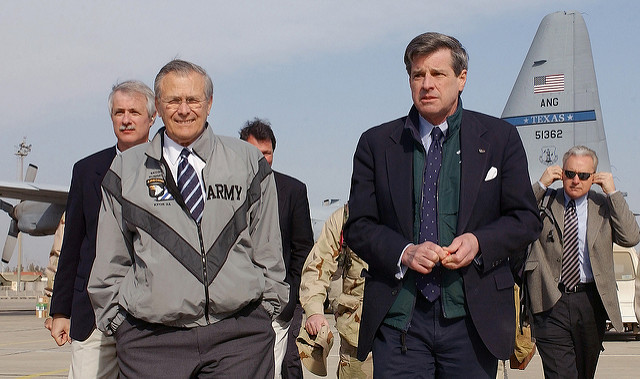
The blithe optimism demonstrated by the planners of the invasion of Iraq is still capable of taking one’s breath away. (Photo: Lisa M. Zunzanyika / Flickr Commons). Source
This is where we are today. These several volumes were originally to be titled, “America’s Dirtiest Secrets”, but that title no longer strictly applies because there is no sensible way to separate the actions of the Americans from their Jewish masters who gave the orders. For example, we know the media stories of the US hijacking of Iraq and believed this was done to remove a dictator. But our perception is severely altered when we learn the invasion was done entirely on Jewish orders, that the so-called “Provisional President” of Iraq – Paul Bremer – was a Jew and was taking all his orders from the Jews in the City of London, and that further those Jewish bankers have confiscated all of Iraq’s assets and are taking – free – more than 2/3 of Iraq’s oil. Likewise, we were taught it was the British military (with a bit of French help) that looted the 10 million priceless artifacts from China’s Summer Palace (the Yuanmingyuan) and then utterly destroyed it. But again, our perception changes when we learn the British did so under the orders of the Jews Rothschild and Sassoon, and that a great many of those priceless artifacts ended up in Jewish hands and remain there to this day.

In similar fashion, we were all taught about the famous British aviator “Bomber Harris” who won eternal fame for the incendiary carpet-bombing of countless dozens of German cities like Dresden, creating firestorms that incinerated millions of German civilians in one of the world’s greatest wartime atrocities. But again, our perception is severely altered when we learn that it was a Jew named Frederick Lindemann, sent by the Rothschilds as an “advisor” to Churchill, who brought with him the notion of carpet-bombing civilians with incendiary bombs, and that Churchill simply obeyed his Jewish masters in executing this program to help effect “the total destruction of Germany” that the Jews wanted. In like fashion, we were taught that the US dropped the atomic bombs on Japan to hasten the end of the war and “to save lives”. But again, our conceptions are thrown in disarray when we learn that it was a Jew, Bernard Baruch, ostensibly “the most powerful man in America” at the time, who not only chose Japan as the target for these bombs, but also personally selected the cities to be incinerated. Our conceptions are even more challenged when we learn that Baruch’s motivation may well have been retaliation to both Japan and Nagasaki for their expulsion of all the Jews prior to the war. (See End Notes)
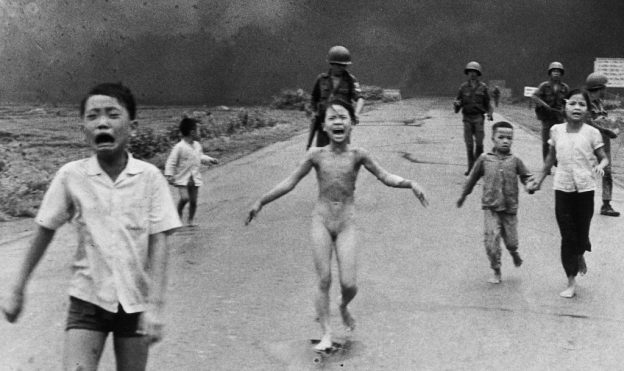
And with both Europe and especially with Vietnam, in the application of napalm for incinerating civilians, it was indeed the Americans who extensively applied napalm during World War II, in “vast but historically-deleted genocidal incendiary attacks both in Europe and on Japanese cities, as well as during the wars in Korea and Vietnam”. But it was a Jewish chemist named Louis Fieser who developed napalm in a secret laboratory at Harvard University in 1942, and America’s Jewish masters who engineered its use on civilians. Even worse, in Vietnam, the locals discovered they could evade incineration by diving into any body or container of water to extinguish the flames. But it was another Jew, again at Harvard, who engineered the infusion of napalm with white phosphorus, which cannot be extinguished once lit, and will burn a man right through to the bones even under water. In all cases, the Americans did the dirty deeds, but they were “just following orders” from their Jewish overlords.
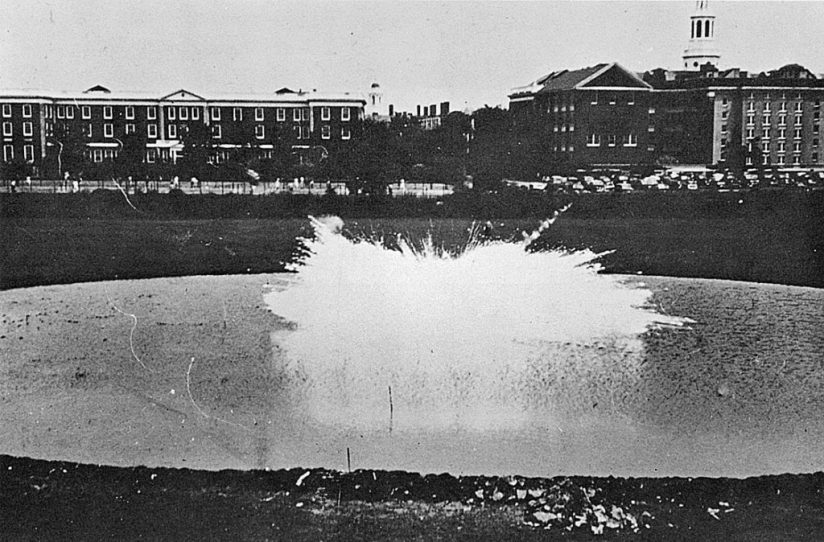
Independence Day, 1942: first field test of napalm, behind Harvard Business School. Photograph courtesy of Harvard University Archives/ Louis Fiester, The Scientific Method
And we realise, as with all such events in the past, that the American military is, just as the British military was doing in the past, functioning as “The Bankers Private Army”. And thus, in real terms, there is no sensible way to separate the actions – the “Dirtiest Secrets” of the Americans – from the “Dirtiest Secrets” of the Jews who issued the Americans and British their marching orders. We cannot disassociate the Mafia boss from his own orders executed by his own underlings.
And thus, while in these books we will be apparently (and superficially) examining America’s Dirtiest Secrets, there will in almost every instance be a distinct under-layer of Jewish influence and control. It is true we will see a few occasions or events where the Americans appeared to act independently – as in the hijacking of Hawaii – with no apparent evidence of Jewish involvement, but these are very few. And so, what we are really discussing and exposing in these pages are the Jews’ Dirtiest Secrets, and we will see that in virtually every instance the Jews operate admirably and very efficiently with what they call “A Gentile Front”, with some non-Jew apparently in charge but with a full complement of Jews in the background instigating, inciting, and ordering Gentiles to execute their plans.
The censorship board. George Creel is seated at far right. Harris & Ewing/Library of Congress. Source
One striking such example you will read about is US President Wilson’s Creel Commission, which perpetrated an astonishingly intense propaganda campaign designed to create a “white-hot hate” for Germans and lead Americans into a World War no one wanted. Creel was selected by Wilson’s Jewish handlers, quite likely by the so-called “Colonel” House, who was a Jew and whose real name was Huis, but it was the Jews Lippman and Bernays who were actually in control of the entire effort. This Jewish manipulation was so effectively done that Creel became the lightning rod for all the historical disapprobation while Bernays is celebrated today as “The father of public relations” in America. In fact, Bernays, the nephew of Sigmund Freud, was the Father of War Marketing, a template invented and executed by the Jews in the most despicable manner imaginable.
In many cases, these situations include historical events that have been so deeply buried by the Jewish media and Jewish book-publishing industries that perhaps not one person in a million has any knowledge of their existence. One such situation consists of the unremitting and unconscionable atrocities inflicted on Germany and the German people during – but especially after – both World Wars, atrocities committed primarily by the Americans but done under the orders of their Jewish masters. This was so widespread – and so true – that today it is illegal in Germany for anyone to even attempt to research atrocities committed against Germans. The reason is that anyone attempting such research would quickly discover that it was the Jews who were responsible for all those atrocities, by both hate propaganda and direct influence, and the Jews naturally don’t want those truths escaping confinement. Thus, the German government was forced to pass a law rendering illegal any investigation into such matters, and most German people today have no knowledge of the incredible betrayals and atrocities inflicted upon them by the Jews. They are instead taught by Jewish-authored books and by Jewish university professors, aided immensely by the Jewish-controlled mass media, that it was Germans who inflicted atrocities on the Jews.

Another such example is the incendiary carpet-bombing of nearly 100 Japanese cities – long after Japan had agreed to surrender – carried out by the American Curtis LeMay and resulting in the deaths of about 50% of the population of all those cities, done in the same manner as the Jews arranged for Germany and with the same blood-thirsty determination to utterly destroy Japan and the Japanese as they had for Germany and the German people. This immense and unconscionable atrocity, which resulted in the deaths of at least 10 million civilians – almost all women and children – was so heavily excised from history, including the re-writing of all Japanese history books, that almost no one in Japan has any knowledge of it, and no one outside Japan either. The excision in this case was so total that even Japan’s national population statistics were completely forged, fabricated, and re-calculated after the war, to entirely bury the fact of one of the greatest war-time atrocities in history.
The Japanese also do not research atrocities committed against Japan because they have been taught by their Jewish masters, as in Germany, the same things and for the same reasons. Nobody today in Japan has any knowledge of the involvement of the Jews in their destruction. This is not to dismiss atrocities that were indeed committed by the Japanese against others, but to illuminate the fact that the Jews committed much worse atrocities against the Japanese, and yet have such near-total control over the media, over book-publishing, and over the government itself, that these events have been totally excised from the historical record and the knowledge is deleted from the world’s consciousness. Again, this condition is much abetted by “the Gentile Front” where the Jews used the Americans to perpetrate these horrendous crimes while remaining hidden in the background. And again, let’s not forget that it was a Jew – Bernard Baruch – who chose Japan as the victim for the new atomic bombs and who personally selected the cities to be incinerated, almost certainly done as punishment for Japan’s prior eviction of all the Jews.
It would be of use to you to read two of my previous E-books on Propaganda and the Media and Bernays and Propaganda, to help gain an appreciation of some of the methods used by the Jews to ensure silence (and ignorance) about past events. One of the tenets of propaganda is that we have a powerful tendency to believe the first thing we read or hear about a topic, especially if those statements are repeated a number of times. Later, even when faced with incontrovertible proof, facts that cannot be disputed, proving that our now-accepted beliefs are in fact false, we are surprisingly reluctant to change our minds, and we will “hesitate and waver and continue to believe there must be some other explanation”. Our minds are apparently unable to accept that we have believed lies.
This is important because the Jews use this to great advantage to pre-empt the discovery of their atrocities and prevent rational thought. Typically, if knowledge of their past crimes is showing signs of escaping historical confinement, the Jews will use this propaganda tactic to “get there first”, with some Jewish author quickly writing a book or treatise on the subject that is replete with lies and falsified history that attempts to exclude the Jews from involvement and, if at all possible, to blame the victim.


When the truths of China’s opium travesty were beginning to creep out of the sarcophagus and into the daylight of public knowledge, a Jewess named Julia Lovell was there with a book titled Opium War in which Jews are not even mentioned and which she categorised as a “tragic-comedy”, the hundred or so million Chinese being killed by the Jews apparently being funny to her. But a great many Americans and others, unfamiliar with the true circumstances and never having read anything else, will tend to believe this woman’s despicably false version of events and the Jews will perhaps be spared exposure.
Another such situation occurred when the truth of the mysterious depopulation of Easter Island was beginning to escape confinement. That truth seems to be that it was Jewish slave traders who kidnapped virtually the entire population of Easter Island as slaves to work their guano mines in Peru. Immediately upon this leakage, a Jew named Jared Diamond from the University of California was there with a book explaining that the Easter Islanders simply had some violent disagreement among themselves and killed each other off. Diamond was ridiculed by other academics for his foolish theory that “had not a shred of evidence to support it”, but his book wasn’t written for academics. It was written for the great unwashed of the US who had no knowledge of these events and would likely accept Diamond’s false version. And once again, the Jews might be spared exposure.

The same thing happened again when details began to emerge and leak about the Holland Tulip Bubble having been entirely staged by Jewish ‘bankers’, what with their futures market and all the rest, and not at all a “public mania” as we have been told, but a deliberate attempt to take advantage of public greed and gullibility and empty half the bank accounts in Holland. Once again, immediately on the risk of these leaks becoming public there was a female Jewish author on hand to write a “definitive” work on the topic which oddly made no mention of Jews, but furthermore claimed that no financial losses had occurred to anyone. In fact, this Jewess solemnly claimed that she had access to all the records in Holland and that through the most diligent search she found records of only a few people in Holland who had gone bankrupt during that time, and all those were bankrupt due to “property speculation“ and nothing to do with tulips. In real life, that so-called “bubble“ bankrupted probably half the people in Holland, but once again the Jews are there to pre-empt the truth and to propagate an entirely falsified version of history to protect themselves from exposure.

I have written elsewhere that at least 90%, and maybe even 95%, of everything that you know, or think that you know, or that you believe to be true about history, is wrong. To re-state another way, if we were to take the history of the entire world for the past 500 years and condense it into a history book of 100 pages, at least 50 of those pages would be blank. This is the amount of history – almost entirely involving the Jews – that has been so thoroughly excised from the historical record that it has literally evaporated from human consciousness with almost no living persons having any knowledge of it. And of the remaining 50 pages in this book, probably 45 are so extensively Photoshopped, sanitised, twisted, with crucial details omitted, that they are largely a work of fiction. And of course, anyone attempting to open this historical sarcophagus and expose the contents, is denounced as a deranged revisionist spreading misinformation. And, if the Jews are at all mentioned in this “revisionism”, we have the added attraction of being labeled an “anti-Semitic, holocaust-denying, Nazi Jew-hater”. Most of those souls attempting this historical illumination have very often paid with their careers, their reputations, their bank accounts, sometimes with their freedom and, in some cases, with their lives. These Mafia overlords in the City of London, the Khazar “so-called” Jews, are today just as brutal, savage, and filled with contempt for humanity as they were 1,000 years ago.
David Edwards was quoted in the “Third World Traveler“ as having written:
”Even open-minded people will often find themselves unable to take seriously the likes of Noam Chomsky, Edward Herman, Howard Zinn and Susan George on first encountering their work; it just does not seem possible that we could be so mistaken in what we believe. The individual may assume that these writers must be somehow joking, wildly over-stating the case, paranoid, or have some sort of axe to grind. We may actually become angry with them for telling us these terrible things about our society and insist that this simply ‘can’t be true‘. It takes real effort to keep reading, to resist the reassuring messages of the mass media and be prepared to consider the evidence again.”
This is the condition we face today in dealing with these recovered historical truths. In the case of the Jews, they know the truth but are frantic and nearly desperate to keep it buried and under confinement, which is why they so vengefully and viciously attack en masse whenever these facts emerge into daylight. With the Americans, their ignorance of their own nation’s criminality is founded on a blind faith and conviction based on a century of clever Jewish propaganda that is almost always flatly contradicted by the facts. But even citizens of the victim nations – like Germany – suffer enormous shock and disbelief when confronted with the historical truths of their own country, because the Jews and the Jewish media have for nearly 100 years browbeaten them with a totally false historical narrative. Friends sent to German acquaintances my articles on the Jews’ 1933 worldwide boycott of Germany and some related items, with those Germans replying that they found even those brief articles too painful to read at one sitting because, while the evidence was incontrovertible, it contradicted everything they’d been taught all their lives about themselves and their country, and the shock of learning that the things they “knew” were all lies, was emotionally too painful to bear.
At the same time, the world has been subjected to a century or more of outrageously false positive propaganda about the Jews, an almost incomprehensible volume of rose-tinted misinformation about the Jews as the world’s impoverished, misunderstood, persecuted “chosen ones“. In truth, there is little about the Jews and Israel today that is not based on fabricated historical mythologies, buried history, biased presentations, facts twisted so badly as to be often unrecognisable. Probably 95% of what the world knows about the Jews, their history, their massive crimes spanning centuries, their astonishing contempt for both humanity and truth, their conduct in international affairs, is not only wrong, but violently wrong. And to the same extent, the world has also been subjected to enormously and brutally false negative propaganda and misinformation about other nations – about the Jews’ victims, an equally incomprehensible volume of black-tinted information whereby the Jews typically seek to blame their victims for the atrocities perpetrated against them.
These buried historical truths are the content of my books and articles, the history of the world (or parts of it) as it really was, and is, harsh provable truths and documented realities without the vast carpet of propaganda, jingoism, and misinformation that Jewish media power has used to blanket and blind the world for well over a century.
END NOTES
The incendiary bombing of German working-class neighborhoods was planned in detail by the Jews. Since at least the early 1900s, Rothschild had owned most of the armament and munitions factories in Germany. It was through those that he supplied Japan (and Russia too) with the weapons for their war in 1905. During the Second World War the Jews didn’t want all their factories bombed to rubble when the Allies began flying over Germany. Their solution was to kill all the factory workers instead but leave the factories untouched. And it was the Jew Frederick Lindemann, sent by Rothschild to Churchill as an advisor, who brought the scheme to him. We have records of Lindemann’s submission of his plan to the war cabinet urging this method and suggesting that “greater flesh-incineration-per-bomb could be achieved” that way. This is further documented by a memo dated March 30, 1942, from Lindemann to Churchill that resulted in those intense terror-bombing campaigns of German civilians. The working-class neighborhoods were high-density, with these incendiary munitions creating natural intense firestorms that incinerated virtually every living thing in many of them. The British and the Americans, obeying the plans of their Jewish leaders, executed one of the most barbaric and inhuman atrocities of the war.
As I discuss in my essay on Japan, where the same was done there, the country’s population statistics were heavily forged, fabricated, and recalculated after the war to bury the evidence of these atrocities. I am almost certain the same was done with Germany. I haven’t the resources or time to delve into this with Germany, and researching atrocities against Germans is now illegal in Germany, but it is almost a certainty that Germany’s population statistics were massaged in the same was as those of Japan, to hide the truth. There had to have been many many millions of civilians killed in these raids, which were nothing more than an inhumanly deliberate attempt to depopulate Germany. And this doesn’t include the normal war casualties nor the 12 million to 15 million German civilians killed after the war from execution, starvation and migration, nor does it include Eisenhower’s Death Camps nor the perhaps additional million civilian deaths from Operation Paperclip.
*
Mr. Romanoff’s writing has been translated into 32 languages and his articles posted on more than 150 foreign-language news and politics websites in more than 30 countries, as well as more than 100 English language platforms. Larry Romanoff is a retired management consultant and businessman. He has held senior executive positions in international consulting firms, and owned an international import-export business. He has been a visiting professor at Shanghai’s Fudan University, presenting case studies in international affairs to senior EMBA classes. Mr. Romanoff lives in Shanghai and is currently writing a series of ten books generally related to China and the West. He is one of the contributing authors to Cynthia McKinney’s new anthology ‘When China Sneezes’. (Chapt. 2 — Dealing with Demons).
His full archive can be seen at
https://www.bluemoonofshanghai.com/ and https://www.moonofshanghai.com/
He can be contacted at:
2186604556@qq.com
NOTES
Bernays and Propaganda
https://www.bluemoonofshanghai.com/wp-content/uploads/2022/10/BERNAYS-AND-PROPAGANDA-.pdf
Propaganda and the Media
https://www.bluemoonofshanghai.com/wp-content/uploads/2022/11/ENGLISH-PROPAGANDA-and-THE-MEDIA.pdf
February 14, 2023
Posted by aletho |
Book Review, Deception, Timeless or most popular, War Crimes | China, Germany, UK, United States |
Leave a comment