The Façade of “Humanitarian Intentions” in Libya
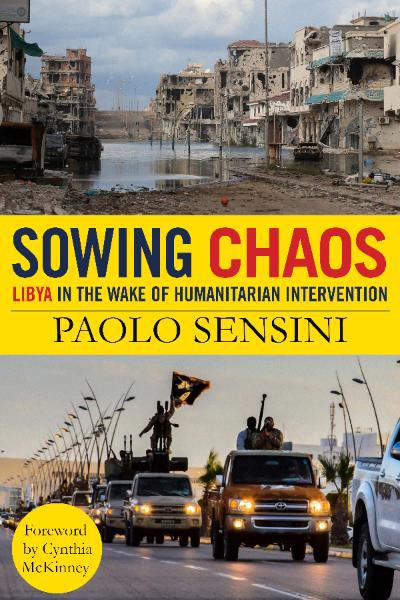
Review of Paolo Sensini’s book, Sowing Chaos: Libya in the Wake of Humanitarian Intervention
By Edward Curtin | Global Research | August 10, 2016
It is rare for a historian to write a history of a significant issue and bring it into the present time; even rarer when the work coincides with the reemergence of that issue on the world stage. Paolo Sensini has done just that with Sowing Chaos: Libya in the Wake of Humanitarian Intervention (Clarity Press, 2016). It is a revelatory historical analysis of the exploitation and invasion of Libya by colonial and imperialistic powers for more than a century.
It is also timely since the western powers, led by the United States, have once again invaded Libya (2011), overthrown its government, and are in the process (2016) of creating further chaos and destruction by bombing the country for the benefit of western elites under the pretext of humanitarian concern.
 As with the history of many countries off the radar of western consciousness, Libyan history is a tragic tale of what happens when a country dares assert its right to independence – it is destroyed by violent attack, financial subterfuge, or both.
Although an Italian and Italy has a long history of exploiting Libya, a close neighbor, Sensini stands with the victims of colonial and imperial savagery. Not an armchair historian, he traveled to Libya during the 2011 war to see for himself what was true. Despite his moral stand against western aggression, his historical accuracy is unerring and his sourcing impeccable. For 234 pages of text, he provides 481 endnotes, including such fine sources as Peter Dale Scott, Patrick Cockburn, Michel Chossudovsky, Pepe Escobar, and Robert Parry, to name but a few better known names.
His account begins with Italy’s 1911 war against Libya that “Francesco Saverio Nitti charmingly described …. as the taking of a ‘sandbox’.” The war was accompanied by a popular song, “Tripoli, bel suol d’amore” (Tripoli, beauteous land of love). Even in those days war and love were synonymous in the eyes of aggressors.
This war went on until 1932 when the Sanusis’s resistance was finally crushed by Mussolini. First Italy conquered the Ottoman Turks, who controlled western Libya (Tripolitania); then the Sanusis, a Sunni Islamic mystical militant brotherhood, who controlled eastern Libya (Cyrenaica). This Italian war of imperial aggression lasted 19 years, and, as Sensini writes, “was hardly noticed in Italy.”
I cannot help but think of the U.S. wars against Afghanistan and Iraq that are in their 15th and 13th years respectively, and counting; they are not making a ripple on the placid indifference of the American people.
Sensini presents this history clearly and succinctly. Most of the book is devoted to the period following the 1968 overthrow of King Idris by the Free Unionist Officers, led by the 27 year old captain Mu’ammar Gaddafi. This bloodless coup d’état by military officers, who had all risen from the poorer classes, was called “Operation Jerusalem” to honor the Palestinian liberation movement. The new government, The Revolutionary Command Council (RCC), had “three key themes …. ‘freedom, socialism, and unity,’ to which we can add the struggle against western influences within the Arab world, and, in particular, the struggle against Israel (whose very existence was, according to Gaddafi, a confirmation of colonialization and subjugation).”
Sensini explains the Libyan government under Gaddafi, including his world theory that was encapsulated in his “Green Book” and the birth of what was called “Jamahiriyya” (State of the Masses). Gaddafi called Libya the “Socialist People’s Libyan Arab Jamahiriyya.”
Under Gaddafi there was dialogue between Christians and Muslims, including the establishment of diplomatic relations with the Holy See, and visits from Eastern Orthodox and Anglican religious leaders. Fundamentalist Islamic groups criticized Gaddafi as a heretic for these moves. Gaddafi described Islamists as “reactionaries in the name of Islam.” His animus toward Israel remained, however, due to the Palestinian issue. He promoted women’s rights, and in 1996 Libya “was the first country to issue an international arrest warrant with Osama bin Laden’s name on it.”
He had a lot of enemies: Israel, Islamists, al Qaeda, the western imperial countries, etc. But he had friends as well, especially among the developing countries.
A large portion of the book concerns the U.S./NATO 2011 attack on Libya and its aftermath. This attack was justified and sanctioned by UN Resolutions 1970 (2/26/11) and 1973 (3/17/11). These resolutions were prepared by the work of the International Commission on Intervention and State Sovereignty (ICISS) that in 2000-2001 produced a justification for powerful nations to intervene in the internal affairs of any nation they chose. Termed the “Responsibility to Protect” (R2P), it justified the illegal and immoral “humanitarian” attack on Libya in 2011. The ICISS, based in NYC, was founded by, among others, the Carnegie Corporation, the Simons, Rockefeller, William and Flora Hewitt, and John D. and Catherine MacArthur foundations, elite moneyed institutions devoted to American interventions throughout the world.
When the US/NATO attacked Libya, they did so despite the illegality of the intervention (an Orwellian term) under the UN Resolutions that prohibit arming of ‘rebels’ who do not represent the legal government of a country. On March 30, 2011 the Washington Post, a staunch supporter of US aggression, reported an anonymous government source as saying that “President Obama has issued a secret finding that would authorize the CIA to carry out a clandestine effort to provide arms and other support to Libyan opposition groups.” None of the mainstream media, including the Washington Post, noted the hypocrisy of reporting illegal activities as if they were legal. The law had become irrelevant.
The Obama administration had become the opposite of the Kennedy administration. Whereas JFK, together with Dag Hammarskjold the assassinated U.N. Secretary General, had used the UN to defend the growing third world independence movements throughout the world, Obama has chosen to use the UN to justify his wars of aggression against them. Libya is a prime example.
Sensini shows in great detail which groups were armed, where they operated, and who they represented. The US/NATO forces armed and supported all sorts of Islamist terrorists, including the Libyan Islamic Fighting Group (LIFG), led by Abu al-Laith al Libby, a close Afghan associate of Osama bin Laden, and al Qaeda’s third in command.
“These fanatical criminals (acclaimed as liberators by the mainstream media worldwide) were to form Libya’s emerging ruling class. These were people tasked to ensure a democratic future for Libya. However, the ‘rebel’ council of Benghazi did what it does best – ensuring chaos for the country as a whole, under a phantom government and a system of local fiefdoms (each with a warlord or tribal chief). This appears to be the desired outcome all along, and not just in Libya.”
Sensini is especially strong in his critical analysis of the behavior of the corporate mass media worldwide in propagandizing public opinion for war. Outright lies – “aligning its actions with Goebbels’ famous principle of perception management” and the Big Lie (thanks to Edward Bernays, the American father of Public Relations) – were told by Al Jazeera, Al Arabiya, and repeated by the western media, about Gaddafi allegedly slaughtering and raping thousands of Libyans. Sensini argues persuasively that Libya was a game-changer in this regard.
Here, the mass media played the part of a military vanguard. The cart, as it were, had been put before the horse. Rather than obediently repackaging and relaying the news that had been spoon fed to them by military commanders and Secretaries of State, the media were called upon actually to provide legitimation for armed actors. The media’s function was military. The material aggression on the ground and in the sky was paralleled and anticipated by virtual and symbolic aggression. Worldwide, we have witnessed the affirmation of a Soviet approach to information, enhanced to the nth degree. It effectively produces a ‘deafening silence’ – an information deficit. The trade unions, the parties of the left and the ‘love-thy-neighbor’ pacifists did not rise to this challenge and demonstrate against the rape of Libya.
The US/NATO attack on Libya, involving tens of thousands of bombing raids and cruise missile, killed thousands of innocent civilians. This was, as usual, explained away as unfortunate “collateral damage,” when it was admitted at all. The media did their part to downplay it. Sensini rightly claims that the U.S./NATO and the UN are basically uninterested in the question of the human toll. “The most widely cited press report on the effects of the NATO sorties and missile attacks on the civilian population is most surely that of The New York Times. In ‘Strikes on Libya by NATO, an Unspoken Civilian Toll’, conveniently published after NATO’s direct intervention had ceased. The article is truly a fine example of ‘embeddedness’:”
While the overwhelming preponderance of strikes seemed to hit their targets without killing noncombatants, many factors contributed to a run of fatal mistakes. These included a technically faulty bomb, poor or dated intelligence and the near absence of experience military personnel on the ground who could direct air strikes. The alliances apparent presumption that residences thought to harbor pro Gaddafi forces were not occupied by civilians repeatedly proved mistaken, the evidence suggests, posing a reminder to advocates of air power that no war is cost or error free.
The use of words like “seemed” and “apparent,” together with the oft used technical excuse and the ex post facto reminder are classic stratagems of the New York Times’ misuse of the English language for propaganda purposes.
Justifying the killing, President Obama “explained the entire campaign away with a lie. Gaddafi, he said, was planning a massacre of his own people.”
Hillary Clinton, who was then Secretary of State, was aware from the start, as an FOIA document reveals, that the rebel militias the U.S. was arming and backing were summarily executing anyone they captured: “The State Department and Obama were fully aware that the U.S.-backed ‘rebel’ forces had no such regard for the lives of the innocent.”
Clinton also knew that France’s involvement was because of the threat Gaddafi’s single African currency plan posed to French financial interests in Francophone Africa. Her joyous ejaculation about Gaddafi’s brutal death – “We came, we saw, he died” – sick in human terms, was no doubt also an expression of relief that the interests of western elites, her backers, had been served.
It is true that Gaddafi did represent a threat to western financial interests. As Sensini writes, “Gaddafi had successfully achieved Libya’s economic independence, and was on the point of concluding agreements with the African Union that might have contributed decisively to the economic independence of the entire continent of Africa.”
Thus, following the NATO attack, Obama confiscated $30 billion from Libya’s Central Bank. Sensini references Ellen Brown, the astute founder of the Public Banking Institute in the U.S., who explains how a state owned Central Bank, as in Libya, contributes to the public’s well-being. Brown in turn refers to the comment of Erica Encina, posted on Market Oracle, which explains how Libya’s 100% state owned Central Bank allowed it to sustain its own economic destiny. Encina concludes, “Hence, taking down the Central Bank of Libya (CBL) may not appear in the speeches of Obama, Cameron and Sarkozy [and Clinton] but this is certainly at the top of the globalist agenda for absorbing Libya into its hive of compliant nations.”
In five pages Sensini tells more truth about the infamous events in Benghazi that resulted in the deaths of US Ambassador Christopher Stevens and three American colleagues than the MSM has done in five years. After the overthrow of Gaddafi, in 2012 Stevens was sharing the American “Consulate” quarters with the CIA. Benghazi was the center of Sanusi jihadi fundamentalism, those who the US/NATO had armed to attack Gaddafi’s government. These terrorists were allied with the US. “Stevens’s task in Benghazi,” writes Sensini, “now was to oversee shipments of Gaddafi’s arms to Turkish ports. The arms were then transferred to jihadi forces engaged in terrorist actions against the government of Syria under Bashar al-Assad.” Contrary to the Western media, Sensini says that Stevens and the others were killed, not by the jihadi extremists supported by the US, but by Gaddafi loyalists who had tried to kill Stevens previously. These loyalists disappeared from the Libyan and international press afterwards. “The reports now focused on al-Qaida, Islamists, terrorists and protesters. No one was to mention either Gaddafi … or his ghosts.”
The stage for a long-term Western intervention against terrorists, who were armed by the US/NATO, was now set. The insoluble disorder of a vicious circle game meant to perpetuate chaos was set in motion. Sensini’s disgust manifests itself when he says, “Given its record of lavish distribution of arms to all and sundry in Syria, the USA’s warning that, in Libya, arms might reach ‘armed groups outside the government’s control’ is beneath contempt.”
Sowing Chaos: Libya in the Wake of Humanitarian Intervention is a superb book. If you wish to understand the ongoing Libyan tragedy, and learn where responsibility lies, read it. If the tale it tells doesn’t disgust you, I’d be surprised.
In closing, I would be remiss if I didn’t mention that former Congresswoman Cynthia McKinney, a stalwart and courageous truth teller, has written a fine forward where she puts Libya and Sensini’s analysis into a larger global perspective. As usual, she pulls no punches.
Copyright © Edward Curtin, Global Research, 2016
Who killed Vladimir Petukhov?

Farida Islamova, widow of murdered mayor Vladimir Petukhov
OffGuardian | September 17, 2016
However much the likes of the Guardian try to portray Mikhail Borisovich Khodorkovsky as a champion of freedom who suffered under the yoke of government oppression before escaping tyranny for the freedom of the West, the fact remains he was and is more Capone than Solzhenitsyn; a greedy robber-baron and willing tool of US hegemony, who exploited his country’s darkest hour, cheated his workforce and eventually served a well-deserved term in prison for fraud, tax-evasion and money-laundering, before scuttling out of his mother-land to live the life of a celebrated “pro-democracy” exile.
It’s less widely understood that there are even darker things being laid at his door than corruption, theft and opportunistic lying for profit. Murder for example. But yes, in 2015, Russian Interpol put Khodorkovsky on a wanted list in connection with the murder of a Siberian city mayor in 1998.
Vladimir Petukhov was the first mayor of oil-rich Nefteyugansk. Popular locally and considered to be a man of the people, he was shot dead on his way in to work, June 26, 1998. A subsequent criminal investigation described the killing as an assassination, and implicated two members of Khodorkovsky’s Yukos Oil Company in a plot to be rid of the Mayor.
A court eventually sentenced Alexei Pichugin to life in prison for multiple murders and attempted murders. His boss Khodorkovsky was not accused of, or prosecuted for, any involvement, though many have claimed he may have known more than he claimed. According to Pravda :
In May 1998 Petukhov accused Yukos of tax evasion, which resulted in the shortage of funds in the local budget to pay wages to employees of state-run enterprises. The mayor went on a hunger strike demanding chairmen of municipal and district tax offices be dismissed from their positions and a criminal case against Yukos be filed on counts of tax evasion.
Vladimir Petukhov was shot dead on June 26 on his way to work.
Local residents took to the streets soon after the assassination of their mayor. Many attempted to seize the local office of Yukos. The Office of the Prosecutor General of the Russian Federation brought assassination charges against an employee of Yukos’s security service, Aleksei Pichugn, only in 2005.
Petukov’s wife, Farida Islamova was and is convinced Mikhail Borisovitch was involved in the plot to murder her husband, and for many years she has been trying to have him brought to justice. She has even written a book – Khodorkovsky, who killed my Husband?, given an English language translation in 2014. In it she says:
Vladimir Petukhov, Mayor of Nefteyugansk, was shot down on his way to work, not far from the municipal administration building. The killer fired several submachine gun bursts from the cover of nearby bushes. Later on, the investigators would find 18 empty cases at the crime scene. In the face of such fire-power, the unarmed security man, Vyacheslav Kokoshkin, was helpless, he himself took several bullets, has never recovered from his wounds… At that time he was only 30 years old, and still today lives with one of these bullets – a sort of a message from Khodorkovsky – in his body…..
Vladimir Petukhov died in the hospital several hours after the attempt. That was a planned contract assassination…
Unsurprisingly, Farida has had little success in getting the English-language media to take interest in her story. No mainstream outfit has covered her book. Her wait for justice drags on as the western media continues to fete Mikhail Borisovich, embezzler of state funds, tax-evader and suspected murderer, as a symbol of the values they hold most dear.
Then again – maybe that’s not as stupid as it first sounds.
Clinton’s new book sells less than 3,000 in first week
By Rebecca Savransky | The Hill | September 14, 2016
Democratic presidential nominee Hillary Clinton’s newest book sold fewer than 3,000 copies in its first week on sale, The New York Times reported.
The book, titled “Stronger Together,” outlines policies Clinton would pursue if she were elected president.
According to the Times, a book’s first-week sales normally make up about a third of the total sold.
The book features a photo of Clinton and her running mate, Sen. Tim Kaine (D-Va.), on the cover and labels it: “A blueprint for America’s future.”
It gives readers “specific and practical solutions, while also articulating a bold and expansive vision of change and renewal” and runs about 250 pages.
The proceeds from the book will reportedly go to charity.
In line with the release of the book, Clinton plans to do “a series of ‘Stronger Together’ speeches over the course of the next several weeks,” campaign spokeswoman Jennifer Palmieri said, according to the Times.
Clinton talked about her book last week.
“We’re putting out a book tomorrow, called ‘Stronger Together,’ which is our blueprint for America’s future,” Clinton said at the time, speaking with reporters on her plane. “We wanted voters to be able to find, in one easy place, all of the various plans and policies that I’ve been talking about throughout this campaign.”
How Israel Stole the Bomb
By James DiEugenio | Consortium News | September 11, 2016
In 1968, CIA Director Richard Helms was presented with a disturbing National Intelligence Estimate (NIE) stating that Israel had obtained atomic weapons, a dangerous development that occurred earlier than the CIA had anticipated.
It was particularly dangerous because just the year before, the Six Day War had marked the beginning of open hostilities between the Israelis and Arab nation states. To prevail, Israel had launched preemptive air attacks against Egypt, Jordan, Syria and Iraq at the start of the conflict. Considering that violent backdrop, Helms immediately arranged a meeting with President Lyndon Johnson to inform him of this troubling milestone.
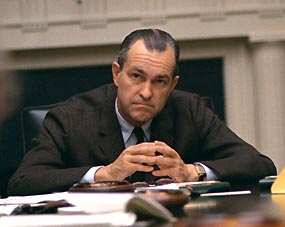
CIA Director Richard Helms
The man who had prepared the NIE and gave it to Helms was the CIA’s chief science and technology officer, Carl Duckett. After Helms met with Johnson, the CIA Director told Duckett about the President’s rather odd reaction. LBJ did not get upset, and he did not order an investigation into how it happened. Further, he did not tell Helms to let both the Defense Department and State Department know about it so they could establish intelligence inquiries or consider sanctions.
Instead, Johnson did the opposite. He told Helms to keep the news secret and specifically told the Director not to let the secretaries of State or Defense know about it.
Helms obeyed the orders of his Commander in Chief, but he decided to talk to the FBI about how this development had occurred earlier than expected. Thus begins Roger Mattson’s Stealing the Atom Bomb: How Denial and Deception Armed Israel, the riveting story of duplicity, betrayal, cover-ups and deceit.
As the book shows, the cover-ups and duplicity did not just come from Israel and its agents in America. The deceit also came from men inside the American government who, for whatever reasons, decided to cast a blind eye on what was really happening under their jurisdiction, even after they had been alerted to it.
What Mattson reveals is no less than an atomic heist – one that could have been prevented if men in high positions had done their duty.
Highly Enriched Uranium
After Johnson told Helms not to tell State or Defense, the CIA Director called Attorney General Ramsey Clark, because what made this news even more ominous — and a potential crime — was what the CIA had discovered when it conducted a chemical test around the Israeli nuclear reactor at Dimona, in the Negev desert.

U.S. AG Ramsey Clark with Lyndon Johnson in 1967
Duckett had concluded that Israel had something that they should not have possessed at that time: HEU, or highly enriched uranium, which could only be produced by one of the five major powers that already had nuclear weapons.
But the test had also revealed characteristics that showed the material had originated in the United States. (Mattson, p. 97) Specifically, the HEU came from Portsmouth, Ohio and then was further processed at a plant in Apollo, Pennsylvania.
The importance of this information was that the HEU was processed to such a degree – well over 90 percent U 235 – that it was classified as weapons grade uranium. The technical term for it is the acronym SNM, or Special Nuclear Material, meaning that it is fissile: it can easily be split with neutrons. Although the Portsmouth plant is shut down today, beginning in 1956 it did produce weapons-grade uranium.
It was in Apollo, Pennsylvania, that the trail of the SNM and the crime of its diversion becomes exceedingly suspect. The plant that did the further processing of HEU, and the ultimate shipping, was named Nuclear Materials and Equipment Corporation, or NUMEC, and there were a number of reasons why suspicion had centered on NUMEC even before Helms called Clark.
First, NUMEC had a rather unreliable record when it came to keeping track of HEU and other materials that had been given to it through the Atomic Energy Commission (AEC). The way the system worked is that the particular company would forward its business requests — from either private or governmental agencies — to the AEC. The AEC would then estimate how much nuclear material NUMEC would need to fulfill the contract. If a company was using up more material than the AEC properly estimated, that company would be fined quite a lot of money. If the shortages persisted, the AEC and the FBI could then open up an investigation.
With CIA’s discoveries, the possibility presented itself that a diversion of the nuclear material could be taking place. Either someone from the outside was stealing the material, or someone on the inside was embezzling it.
As Mattson shows with charts, graphs and testimony, NUMEC had an extraordinarily bad record in this regard. The company was eventually fined over $2 million for missing materials, which, with inflation factored in, would be about $15 million today. Mattson adduces that from 1959 to 1977, about 345 kilograms of HEU went missing from NUMEC, which translates to well over 700 pounds. (ibid, p. 286)
Explaining the Deficits
In just one year, there was a loss of over 56 kilograms (or about 123 pounds). The company made up all sorts of rationales as to why this much HEU was missing, including losses during the mechanical processing. But as the author points out, there are two problems with this accounting.
First, no other plant in America reported losses of this magnitude. The AEC concluded that the losses at Apollo were more than double what they were at any other comparably sized atomic plant in the U.S. (ibid, p. 65)
Secondly, even if one chalks up some of the missing HEU to a processing loss, that still does not account for the entire record of NUMEC. Mattson figures that, even giving the company the benefit of the doubt, it still leaves about 200 pounds of missing HEU. (ibid, p. 67) That’s enough for about six atomic bombs, larger than the one used on Hiroshima.
As Mattson reports, what makes NUMEC an even more intriguing suspect is the fact that the company had some legitimate business transactions with Israel, concerning the irradiation of plants. And these legitimate packages were sent at about the time the HEU went missing. Further, the inventory records at NUMEC were extremely sloppy and some appear to have been destroyed in direct violation of the AEC code, meaning NUMEC should have been cited, but wasn’t. (ibid, p. 75)
That brings us to the founders of the NUMEC plant in Apollo, Pennsylvania, a small town of approximately 1,600 people that lies about 30 miles northeast of Pittsburgh. In 1955, the Apollo Steel Plant was purchased by David Lowenthal. Two years later, Lowenthal and Zalman Shapiro cooperated in forming NUMEC.
Shapiro, a very accomplished metallurgist who lived next door to Lowenthal, had been employed for a number of years at the nearby Bettis Atomic Power Laboratory, which supported the AEC’s Office of Naval Reactors.
In May 1958, Lowenthal merged Apollo Steel with the San Toy Mining Company in Maine. San Toy then changed its name to Apollo Industries, with the main operating officers of this new corporation Morton Chatkin, Ivan Novick and Lowenthal. (ibid, p. 43)
The board comprised these three men plus Shapiro, and later others. In the early 1960s, the steel plant’s name was changed to Raychord Steel, but with the decline of the steel industry, Raychord became a subsidiary company to Apollo.
Ties to Zionist Groups
Novick, one of Apollo’s officers, later served as national president of the Zionist Organization of America, in which Chatkin, another officer, also held a leadership role. The ZOA was a member group of the American Zionist Council, which later became the American Israel Public Affairs Committee, which today is considered to be the leading lobbying group for Israel and one of the most powerful lobbying groups in Washington.
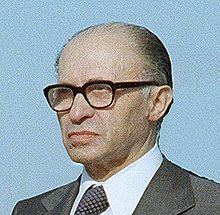
Israeli Prime Minister Menachem Begin
Novick also later served as a personal liaison between Ronald Reagan’s White House and the administration of Israeli Prime Minister Menachem Begin.
Lowenthal, who was born in Poland in 1921, came to America in 1932 and served in the American armed forces in World War II, eventually becoming a citizen in 1945. After the war, he worked with the Haganah, the Jewish paramilitary force inside Palestine, on the Zionist mission to ferry Jews into Palestine in 1947 on board the boat SS Exodus.
Since almost none of the passengers had legal immigration certificates to enter Palestine, the British Royal Navy, which ran the Palestinian Mandate, seized the ship and deported its passengers back to Europe. Lowenthal’s mission was a practical failure, but a tremendous propaganda success for the Zionist cause. The event was novelized by author Leon Uris in the number-one best-selling book Exodus, which was published in 1958 and was made into a movie two years later by director Otto Preminger, starring Paul Newman.
Lowenthal later served on board the ship Pan York, which also attempted to evade the British quarantine but was captured in Cyprus with the crew arrested, including Lowenthal. He escaped and fled to Palestine where he served with the Haganah during the war that broke out there in 1948 after the British abandoned the mandate early. (ibid, p. 44)
Lowenthal ended up serving under the legendary Meir Amit, the leading intelligence officer in Israel during the 1960s. Lowenthal was also personally acquainted with future prime ministers David Ben Gurion and Golda Meir.
Nuclear Experience
Shapiro, who had advanced degrees in chemistry and metallurgy from Johns Hopkins, worked for Westinghouse and the Navy on the nuclear reactor that powered America’s first atomic submarine, the Nautilus. Shapiro also helped develop the fuel for the first commercial nuclear reactor, the Shippingport Atomic Power Station in Pennsylvania.
Like Lowenthal, Novick and Chatkin, Shapiro also was active in supporting Israeli causes, although his activities had a slightly educational tone. He was a member of the Technion Society, which supported advances in Israeli science and technology. Indeed, he became an Honorary Life Member of the group.
He also was a Director of Hillel, an international organization that tries to acquaint Jewish students with each other on campuses and organize student trips to Israel. Like Novick and Chatkin, he was a member of the Zionist Organization of America. Many years later, it was discovered that Shapiro was on the Board of Governors of the Israeli Intelligence Center, which honors spies for Israel who clandestinely advanced the interests of the state. (Mattson, p. 84)
Beyond the individual backgrounds of these four men, there was also something else which should have attracted the U.S. intelligence community’s attention prior to Helms’s meeting with President Johnson. While running NUMEC, both men – Shapiro and Lowenthal – were taking trips to Israel and had contacts with high officials of Israeli intelligence as well as Israel’s version of the AEC.
Further, NUMEC had a guest worker, an Israeli metallurgist, in its plant, as part of an agreement NUMEC had with Israel to serve as a training consultancy which resulted in the formation of a joint company with Israel called ISORAD that initially was to deal with irradiation of citrus fruits through gamma rays. But the FBI later discovered that NUMEC also had contracts with Israel for the development of plutonium oxide as fuel elements in nuclear reactors. (Mattson, pgs. 80-81)
Since Lowenthal had so many acquaintances in high positions, he often visited Israel, including a most curious instance at about the time he purchased Apollo Steel in 1956. It was at this time that Israel was making decisions about foreign sourcing for nuclear materials and technology.
A year later, NUMEC was formed and Shapiro immediately applied for a license from the AEC to process uranium fuel in a building formerly occupied by Apollo Steel. John Hadden, CIA station chief in Tel Aviv, later noted the unusual coincidence of these events on two continents. (ibid, p. 45)
Israeli Visits

Israel’s Dimona nuclear weapons plant
But declassified FBI files reveal that the visitations were not just one way, i.e. from Apollo, Pennsylvania, to Israel. There were also visits and meetings of Israeli officials who went to Apollo.
At the time of those meetings, there were four main branches of Israeli intelligence. The Shin Bet corresponded with the Federal Bureau of Investigation; the Mossad with the Central Intelligence Agency; the Aman roughly with the Defense Intelligence Agency; and the LAKAM, which was responsible for security at Dimona and for procuring scientific and technological data from Western sources. (Mattson, p. 108)
In the mid-1960s, France started scaling back its support for the Dimona reactor, which was supposedly a research facility. With France’s pullback, LAKAM began seeking out and purchasing parts and supplies from other sources to complete the project.
LAKAM’s job included concealing the reactor’s true function – the development of a nuclear bomb – from American inspections. (ibid) During an American inspection in 1964, LAKAM even created a “Potemkin village” control room to deceive the visitors.
Unlike American intelligence, Israel also had a special operations unit that served all branches. Established in 1957, it was run by Rafi Eitan and his deputy, Avraham Bendor. (In the 1980s, Eitan became notorious for the Jonathan Pollard spy case, in which Pollard, a navy intelligence employee, was paid tens of thousands of dollars to spy for Israel in the United States with Eitan his ultimate control agent.)
In September 1968, the AEC told the FBI that they were giving permission to NUMEC for a visit by four Israelis, including Eitan and Bendor. However, in the application to the AEC, the occupations of the two were disguised. Eitan was said to be a chemist in the Defense Ministry; Bendor supposedly worked for the electronics division. (ibid, p. 110)
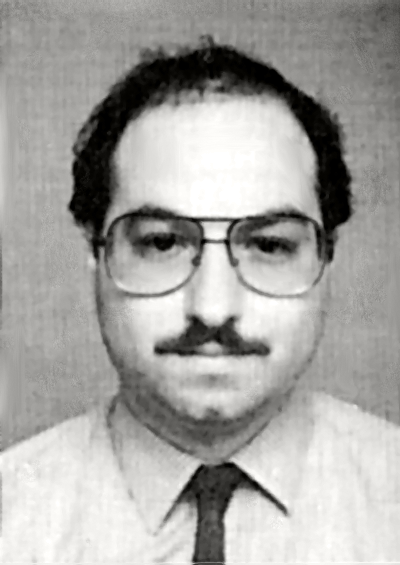
Convicted Israeli spy Jonathan Pollard
The other two men were Avraham Hermoni, who was billed as a Scientific Counselor in the Israeli Embassy in Washington, and Dr. Ephraim Biegun, described as working in the Division of Electronics for Defense. Again, this was misleading. Hermoni did, at times, work out of Washington’s Israeli Embassy, but his prime and most important function was overseeing and planning Israel’s nuclear weapons program, which he did from 1959-69. Biegun was actually head of the technical division of the Mossad from 1960-70.
CIA Suspicions
After the visit, NUMEC reported that the four men were in Apollo to buy thermo-electrical generator systems. (ibid, p. 119) Why Eitan and Bendor had to be there for that purpose is not readily apparent.
CIA officer John Hadden thought the real reason for the visit was that Shapiro was divulging top-secret technical information about plutonium manufacture – and that he was aided in this by the visiting Israeli scientist working at NUMEC. The FBI later came to agree that this was most likely the true reason for the visit. (ibid, p. 120)
Hermoni revisited Shapiro in November 1968, but the capstone to the visits to Apollo came later that month. As noted previously, France had cut back on its support for Dimona in the mid-1960s, halting the supply of uranium fuel in 1967.
In late November 1968, the Mossad arranged a covert operation called Operation Plumbat, which employed a front company in West Germany to purchase 200 tons of uranium yellowcake from Belgium. The transaction was approved by Euratom, the European organization controlling such transactions, but once the transport ship set sail for the port of Genoa, Italy, it was intercepted by another ship used by the Mossad. When the original ship reached port, the hull was empty.
The timing of this operation, on the heels of the mysterious visits by Israeli intelligence agents to Apollo, seems to constitute powerful circumstantial evidence of Israeli intentions.
Then, right after the completion of the Plumbat mission, who arrived in Israel? None other than Zalman Shapiro. The FBI discovered that in November 1968, in addition to the personal visits, Shapiro was in frequent phone contact with a number of Israeli intelligence agents, including Hermoni. (Mattson, p. 126)
A Longstanding Goal
Israel’s long trail of subterfuge and duplicity was part of a longstanding goal. As early as 1948, David Ben-Gurion, Israel’s first prime minister, stated that what Einstein, Teller and Oppenheimer did for America, they could easily do for Israel, since they were all Jews. In fact, he offered Einstein Israeli citizenship, which the great man declined. (ibid, p. 22) Ben-Gurion then had two meetings with Oppenheimer and numerous ones with Teller.
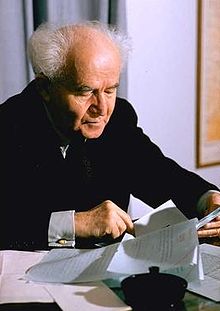
David Ben-Gurion, Israel’s first PM
Ultimately, Israel settled on David Bergmann, a brilliant chemist whom Ben-Gurion appointed first chief of the Israel Atomic Energy Commission in 1952. By 1955, Bergmann was essentially running the day-to-day operations of Israel’s atomic program.
In a conversation with the American ambassador, Bergmann said the Israeli science education program was adequate in physics and chemistry but weak in engineering and non-existent in metallurgy. He also revealed that the design he had laid out for a reactor was the same as the one at Shippingport, Pennsylvania, an intriguing clue because Shapiro was a metallurgist and had worked on the Shippingport power station.
Indeed, Shapiro eventually met Bergmann and the two became close friends and colleagues, serving on the board of ISORAD, which was a joint venture of NUMEC and the IAEC. Bergmann made his first visit to America for IAEC in 1956, the year before Lowenthal turned Apollo Steel into NUMEC.
There were two significant investigations of Shapiro and NUMEC. The first was instigated by Dick Helms’s call to Ramsey Clark in 1968 and the discovery of the highly enriched uranium at Dimona. (Mattson, p. 99) The second began in 1976 when Jim Conran, a whistleblower at the Nuclear Regulatory Commission, voiced complaints about the background and actions of Shapiro. Conran was a security officer and his warnings eventually got the attention of the White House. (ibid, p. 161)
During the first investigation, the FBI could not find enough evidence to justify a violation by Shapiro of the Foreign Agents Registration Act, which mandates that any person in the U.S. who is representing a foreign country’s interests has to register with the Justice Department. But the FBI did recommend cancelling Shapiro’s security clearances, based on wiretaps that revealed Shapiro in close contact with Israeli intelligence officials and with members of the IAEC. (ibid, p. 138)
During these calls Shapiro reportedly said he would help Israel in any way that he could. He also expressed frustration with the new ownership at NUMEC, which had been purchased by ARCO. But his Israeli contacts said he was too valuable to leave and encouraged him to stay there. (ibid, p. 139)
FBI Surveillance
One of the most curious episodes that the FBI surveillance revealed was a meeting between Shapiro and a man named Jeruham Kafkafi, a suspected Mossad officer working under diplomatic cover. He had left Washington by air on the morning of June 20, 1969, and met Shapiro at the Pittsburgh airport for about an hour. He then left and flew back to Washington.
As a result of that surveillance, Shapiro was interviewed by the AEC in August 1969, with some of Shapiro’s answers to questions rather dubious. For instance, he said he did not know Hermoni was in charge of the Israeli nuclear development program and thought he was a university professor. Shapiro said his discussions in September and October 1968 with the Israeli officers were about water contamination, saboteur detection and military activities.
When asked why the Israelis could not have talked to the Defense Department about those topics, Shapiro had no answer. The interviewer wrote in his summary that Shapiro was cool and calm throughout except when the Kafkafi meeting was brought up. At first, Shapiro said he could not recall it, even though it happened just two months earlier. He then said he did remember it, claiming it was about an overdue invoice and a power supply resource. (p. 142)
The AEC investigators did not find the last reply credible, since it did not seem to justify an airline flight from Washington to Pittsburgh and back. Shapiro adjusted his answer by saying that there was some discussion of an investigator whom he knew from America who was going to visit Israel. He also added the figure of $32,000 as to how much Israel owed NUMEC. As Mattson notes, again, this explanation does not seem to justify an air flight and an hour-long meeting with a clandestine Mossad officer.
Closing the Inquiry
The man who ultimately decided to close this initial inquiry was Glenn Seaborg, head of the AEC. Not only did he not see any civil or criminal charges as being viable, but when President Richard Nixon’s Attorney General John Mitchell recommended revoking Shapiro’s security clearances, Seaborg balked at that also.
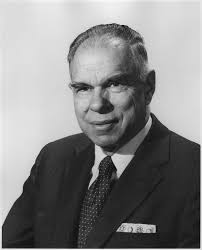
Glenn Seaborg, chairman of the AEC
Mattson clearly sees Seaborg as being a villain in the piece. Late in the book, he explicitly accuses him of running a cover-up. (see p. 297) And, there is evidence to back up this charge. It was later discovered, during the second inquiry, that Seaborg had a close personal friendship with Shapiro. (ibid p. 268)
Earle Hightower, assistant director of safeguards at AEC, explicitly stated that the whole case regarding NUMEC was rigged because it was known that Seaborg would not take action. Little more than three years after Seaborg left the AEC, it was dissolved in 1975 and was replaced by the Nuclear Regulatory Commission, in part, because critics accused the AEC of an insufficiently aggressive regulatory program.
The second, much longer, and more vigorous inquiry into NUMEC and Shapiro came about at the creation of the NRC when Jim Conran was tasked with reviewing the record of how safeguards had worked previously for the AEC so they could be strengthened in the future. In that review process, he came across the case of Shapiro and NUMEC.
When Conran asked to see more files on both, he was denied access, causing him to go up the NRC ladder to Chairman William Anders, who was briefed by, among others, Carl Duckett of the CIA. Since Anders was about to leave for a diplomatic post, he took his concerns to James Connor at President Gerald Ford’s White House.
In March 1976, the CIA’s Duckett addressed an informal gathering of pilots and astronauts, saying there was little doubt Israel had about 20 nuclear warheads. Although this was supposed to be off the record, the information leaked. In April 1976, Time reported that this claim was accurate, except the newsmagazine put the size of the arsenal at 13 bombs and added that the warheads could be delivered by Phantom jets or Jericho missiles.
Duckett wrote a memo to CIA Director George Bush in which he said he suspected that the Israeli program was jumpstarted by a diversion of enriched uranium from the NUMEC plant. (p. 165) He attached various appendices to the memo to show the results of previous inquiries into NUMEC and explain why his belief was justified.
One of the appendices consisted of a paper by John Hadden in which he expressed the suspicion that NUMEC was actually a shell company the Israeli government had set up for the express purpose of diverting materials, technology and information that Israel needed to speed up and facilitate its longstanding quest for atomic weapons. (ibid, p. 166)
A New Investigation
Attorney General Edward Levi was then sent a summary of the FBI’s previous investigation of NUMEC. Levi alerted Ford that he thought NUMEC was culpable for several crimes and, with Ford’s permission, he wished to begin a criminal inquiry. Since Ford’s close adviser James Connor was also disturbed by these findings, the President approved the investigation.
What followed was a tedious bureaucratic battle between the CIA and FBI. The FBI felt it did not have direct proof that a diversion had taken place, while the CIA had the proof — the chemical tests at Dimona — but was reluctant to reveal the intelligence to the FBI. Also, the CIA did not want to furnish the FBI with technical experts to help educate the investigating agents so they could effectively cross-examine important witnesses. Thus, the FBI’s inquiry dragged on through three presidents: Ford, Jimmy Carter and Ronald Reagan.
But even with these obstructions, the FBI did eventually find witnesses to a diversion from the Apollo plant. It turned out that the FBI did not do enough interviews of plant employees in its initial inquiry because there were at least four of them willing to talk. Those witnesses form the climax of Mattson’s book.
In 1980, one witness said that when he read newspaper accounts about the losses of enriched uranium at Apollo, he had to chuckle to himself. When asked why, he replied that in 1965 or 1966, he was walking near the loading dock at Apollo and saw people loading containers – the dimensions that were used for HEU packets – into equipment boxes. He noticed that the shipping papers for the boxes revealed that the packages were destined for Israel. This witness then suggested some other workers at the plant who had seen similar activity. (Ibid, p. 272)
Suspicion Shipment
One of these witnesses saw a flatbed truck backed up into the loading dock area with Shapiro pacing around the area while the driver was loading “stove pipes” into a cabinet on the truck. This struck the witness as odd because the plant had regularly assigned workers for loading duties during the day but this shipment was being prepared in the evening. He explained that “stove pipes” were cylindrical containers that the plant used to pack enriched uranium inside. Each stove pipe usually contained three or four packets of HEU.
When he glanced at the clipboard resting on a package, he saw the destination was Israel. The clipboard then was yanked away and an armed guard escorted him off the dock. He also said it was unusual to see Shapiro in this area of the plant, and further, that Shapiro was very seldom there at night. (ibid, p. 275)
There were two other witnesses who told the FBI about similar events. The FBI also interviewed an NRC inspector named James Devlin, who told the agents that, contrary to what Shapiro had said, the security at the Apollo plant was below par and that NUMEC did not employ a professional security force. The company had one regular armed guard and Devlin happened to know who he was, since he was also a deputy for the township. The only other guards were unarmed and non-uniformed. (ibid, pgs. 272-73)
By this time, the FBI did not want to continue the investigation, believing that nothing would come of it, although the Justice Department urged the investigators on. But the FBI was correct since, as Mattson notes more than once in his book, the last president who really wanted to stop Israel from becoming a nuclear power was John F. Kennedy. (See pgs. 38-40, p. 256)
Richard Helms’s conversation with a disinterested President Johnson underscores how that attitude changed after Kennedy’s death. As Mattson further notes, opposition to Israel’s nuclear-weapons program was more or less negated by President Richard Nixon’s meeting with Prime Minister Golda Meir in 1969 when he agreed that the U.S. would not make any public statements revealing Israel’s nuclear arsenal nor demand that it sign the Non-Proliferation Treaty, as long as Israel did no testing and made no public threats.
Even that policy was probably violated in 1979 with the Vela Incident: a suspected Israeli nuclear test done in the Indian Ocean.
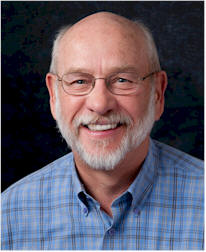
Author Roger Mattson
Author Roger Mattson was part of the inquiry about the illegal transfer of atomic secrets to Israel, working in the NRC’s safeguards department when Conran first voiced his fears about a diversion at NUMEC. Thus, Mattson became part of an internal review of the Shapiro case, seeing firsthand how certain intelligence agencies were, by accident or design, obstructing the investigation.
Mattson concludes his important book by stating that this policy of casting a deliberate blind eye towards a nuclear heist by Israel places the U.S. in a compromised position when trying to enforce a policy of non-proliferation on other nations because of the obvious double standards.
To point out one paradox, the U.S. government executed Julius and Ethel Rosenberg for purportedly supplying nuclear secrets to the Soviet Union with less evidence. Plus, the tinder box of the Middle East is probably the last place where America should have allowed atomic weapons to proliferate, but it did.
Because of that, the U.S. has little or no moral authority on the issue today.
James DiEugenio is a researcher and writer on the assassination of President John F. Kennedy and other mysteries of that era. His most recent book is Reclaiming Parkland.
How the CIA Used LSD to Destroy the New Left
By Stuart Jeanne Bramhall | Dissident Voice | September 4, 2016
Drugs as Weapons Against Us: The CIA’s Murderous Targeting of SDS, Panthers, Hendrix, Lennon, Cobain, Tupac and Other Activists is a virtual encyclopedia of the global drug trade. Author John L Potash devotes special attention to the long involvement of the British and US governments in illegal drug trafficking – for the political and financial benefit of the elite families who control these governments. Most of the book focuses on MKULTRA, the top secret CIA program devoted to developing and experimenting with mind altering drugs, such as LSD, MDA (an ecstasy precursor), STP, PCP and Scopolamine.
 Although CIA Director Richard Helms ordered all MKULTRA records destroyed in the mid-seventies, 30,000 pages of documents were preserved in the CIA Finance Department. Meticulously researched and footnoted, Drugs as Weapons relies on an extensive variety of sources, including the 30,000 pages, FOIA releases, police files, whistleblower statements, media and alternative media investigations and other prominent researchers such as Peter Dale Scott, Alfred, McCoy, Alex Constantine, Catherine Austin Fitts, and the late Gary Webb and Michael Rupert.
Using MKULTRA to Target Leftists and Radical Pop Stars
As the title suggests, Potash is mainly interested in the CIA’s use of LSD (with the help of British intelligence, which ran a parallel MKULTRA program at the Tavistock Clinic) to “neutralize” leftists and activist pop stars, such as Paul Robeson, Mick Jagger, Abbie Hoffman, Brian Jones, Janis Joplin, John Lennon and Jimi Hendrix.*
Like many activists, I am well aware of the CIA’s historic role in heroin trafficking in Southeast Asia and in cocaine trafficking in Latin America. However, prior to reading Drugs as Weapons, I was totally unaware they were also responsible for most of the LSD produced between 1955 and 1973 – for the specific purpose of “neutralizing” the New Left in Berkeley, at Columbia University and elsewhere. This particular MKULTRA project was conceived in response to a 1962 Rand Corporation study recommending that getting left wing leaders hooked on LSD could “cause them to resign or become inactive.”
The Haight Ashbury was a CIA Invention
I was particularly horrified to learn about the LSD distribution network MKULTRA agents set-up in the Haight Ashbury to lure Berkeley students away from the nationally influential Free Speech movement. The latter, originally formed in 1957 to protest the anti-democratic activities of Senator Joseph McCarthy’s House on Un-American Activities Committee, went on to inspire the national anti-Vietnam War Movement.
In addition to various MKULTRA scientists and agents, the CIA also relied on a number of high profile personalities – LSD guru Timothy Leary (an admitted CIA asset), author Ken Kesey (One Flew Over the Cuckoo’s Nest), and Grateful Dead band members – to promote and distribute LSD as an alternative to organizing against the Vietnam War.
How the Opium Trade Created America’s First Millionaires
Potash begins his book with important historical background on the origins of the global drug trade, which he traces back to 1500 and which European elites relied on heavily to finance imperial expansion and colonization. He also recounts the history of important Wall Street families – the Cabots, Cushings, Bushes, Astors, Russells, Pierponts (JP Morgan’s family) – who all owe their immense wealth to the opium trade the British involuntarily forced on China via the Opium Wars. The investment of these families in illegal drug trafficking continues to the present day, as evidenced by the involvement of all major US banks in multi-billion dollar drug money laundering.
The Russell family, who would go on to found Yale and the Skull and Bones Society, openly used a skull and bones pirate flag on their opium trading ships.
The Vietnam War: Protecting Wall Street Drug Interests
Potash also carefully details the special relationship between these Wall Street families and the intelligence agency they founded during World War II (the OSS, which became the CIA in 1947) to protect their special interests. This comes out clearly in the chapter in which Potash traces the origins of the Vietnam War. He makes a really strong case that this war (which began in the late fifties as a CIA intervention) stemmed directly from CIA determination to protect Golden Triangle opium production from efforts by nationalist leaders in Laos, Thailand and Vietnam to eradicate it.
One of Mao’s first acts after winning control of China was to destroy the country’s vast opium network. With the support of the CIA, the nationalist Chinese generals who had controlled it moved their networks into Burma, Laos and Thailand.
The Link Between CIA-backed Nazi War Criminals and Colombian Cocaine
In a similar vein, the CIA assisted Klaus Barbie and other Nazi war criminals it smuggled out of Germany in setting up a cocaine production and distribution network in Colombia and later the Afghan Mujaheddin in turning their country into the world’s largest producer of heroin.
Potash makes a compelling case that the proximate cause for the US invasion and occupation of Afghanistan in October 2001 was the Taliban’s successful eradication of opium production earlier that year.
* The cases of radical pop stars and activists targeted with LSD and other drugs (in many cases along with witnesses and key investigators) Potash examines include:
- Paul Robeson – African American singer whose career was destroyed when he was involuntarily dosed with LSD and committed for two years to a psychiatric hospital, where he received 54 electroconvulsive treatments,
- Richard Wright – African American writer involuntarily dosed with LSD who later died under extremely suspicious circumstances.
- Elvis Presley – became addicted to amphetamines and narcotics after covert intelligence officer became his manager.
- Mama Cass Elliott – died under mysterious circumstances at age 32 after starting to date an international drug smuggler with suspected intelligence links.
- Abbie Hoffman –introduced to LSD by roommate who worked for Army Intelligence research LSD effects on unconsenting GIs.
- Mick Jagger – involuntarily dosed with LSD and subject to numerous drug frame-ups and two unsuccessful Hell’s Angels (working closely with US intelligence) assassination attempts.
- Brian Jones – subject to numerous drug frame-ups and intense phone harassment and stalking prior to 1969 murder (which police covered up as “accidental” drowning).
- Jimi Hendrix – intelligence-linked manager strongly implicated in death related to involuntary drugging.
- Janis Joplin – introduced to amphetamines and heroine via intelligence-linked boyfriend, died after “friend” slipped her a bolus of pure CIA heroin.
- John Lennon – involuntarily dosed with LSD and framed on bogus cannabis charge. Lennon’s alleged assassin Mark Chapman had strong intelligence links and appeared to be under influence of scopolamine.
- Bob Marley – involuntarily injected with the cancer-causing chemical methlychoanthine (via a copper wire hidden in boots gifted to him by CIA asset Carl Colby) and subsequently died of fibrosarcoma.
- Kurt Cobain – involved in heavy drug use by his wife Courtney Love, who had shadowy underworld and intelligence connections. Cobain allegedly shot himself in the head with a shotgun after consuming so much heroin he would have lost consciousness before he could pull the trigger.
- Huey Newton – initiated into heavy cocaine use by girlfriend/undercover agent. Witnesses maintain he was shot after a failed attempt to kidnap him, discrediting police disinformation about “a drug deal gone bad.”
- Tupak Shakur – multiple assassination attempts and police frame ups. Coerced, as part of a bail agreement, into signing with Death Row records, The latter was run by Los Angeles police intelligence unit and heavily involved in drug and gun trafficking. Killed in drive-by shooting instigated by US intelligence.
- Eminem – initiated into heavy drug use via undercover intelligence “friends” after helping Afeni Shakur (following Tupak’s assassination) to record many of Tupak’s songs.
Dr. Bramhall is a retired American psychiatrist and political refugee in New Zealand. She has published a free, downloadable non-fiction ebook 21st Century Revolution. Her first book The Most Revolutionary Act: Memoir of an American Refugee describes the circumstances that led her to leave the US in 2002. Email her at: stuartbramhall@yahoo.co.nz, or visit Stuart Jeanne’s website.
Conspiracy Theory in America
By Lance deHaven-Smith | OffGuardian | September 4, 2016

As an opener to our “9/11 – 15 years on” we’re sharing this extract from the book Conspiracy Theory in America by Lance deHaven Smith. Regardless of where we stand on the events of 9/11 we need to be aware of the intelligence-backed media campaign that lies behind the current social context of the phrase “conspiracy theory”.
A Curious History
The term “conspiracy theory” did not exist as a phrase in everyday American conversation before 1964. The conspiracy-theory label entered the American lexicon of political speech as a catchall for criticisms of the Warren Commission’s conclusion that President Kennedy was assassinated by a lone gunman with no assistance from, or foreknowledge by, any element of the United States government. Since then, the term’s prevalence and range of application have exploded. In 1964, the year the Warren Commission issued its report, the New York Times published five stories in which “conspiracy theory” appeared. In recent years, the phrase has occurred in over 140 New York Times stories annually. A Google search for the phrase (in 2012) yielded more than 21 million hits—triple the numbers for such common expressions as “abuse of power” and “war crime.” On Amazon.com, the term is a book category that includes in excess of 1,300 titles. In addition to books on conspiracy theories of particular events, there are conspiracy-theory encyclopedias, photographic compendiums, website directories, and guides for researchers, skeptics, and debunkers.
Initially, conspiracy theories were not an object of ridicule and hostility. Today, however, the conspiracy-theory label is employed routinely to dismiss a wide range of anti-government suspicions as symptoms of impaired thinking akin to superstition or mental illness. For example, in a massive book published in 2007 on the assassination of President Kennedy, former prosecutor Vincent Bugliosi says people who doubt the Warren Commission report are “as kooky as a three dollar bill in their beliefs and paranoia.” Similarly, in his recently published book Among the Truthers (Harper’s, 2011), Canadian journalist Jonathan Kay refers to 9/11 conspiracy theorists as “political paranoiacs” who have “lost their grip on the real world.” Making a similar point, if more colorfully, in his popular book Wingnuts, journalist John Avlon refers to conspiracy believers as “moonbats,” “Hatriots,” “wingnuts,” and the “Fright Wing.”
The same judgment is expressed in more measured terms by Cass Sunstein and Adrian Vermeule in a 2009 journal article on the “causes and cures” of conspiracy theories. Sunstein is a Harvard law professor appointed by President Obama to head the Office of Information and Regulatory Affairs. He and Vermeule claim that once a person buys into them, conspiracy theories are resistant to debunking because they are “self-sealing.” That is, because conspiracy theories attribute extraordinary powers to elites to orchestrate events, keep secrets, and avoid detection, the theories encourage their adherents to dismiss countervailing evidence as fabricated or planted.
In a book on technology and public opinion, Sunstein argues further that conspiracy-theory groups and networks are proliferating because the highly decentralized form of mass communication made possible by the Internet is altering the character of public discourse. Whereas television and radio provide platforms for debating competing viewpoints on matters of widely shared interest, the Internet tends to segment discussion into a multitude of small groups, each focusing on a separate and distinct topic. Sunstein argues that this splintering of discourse encourages extremism because it allows proponents of false or one-sided beliefs to locate others with similar views while at the same time avoiding interaction with competing perspectives. In Sunstein’s words, “The Internet produces a process of spontaneous creation of groups of like-minded types, fueling group polarization. People who would otherwise be loners, or isolated in their objections and concerns, congregate into social networks.” Sunstein acknowledges that this consequence of the Internet is unavoidable, but he says polarization can and should be mitigated by a combination of government action and voluntarily adopted norms. The objective, he says, should be to ensure that those who hold conspiracy theories “are exposed to credible counterarguments and are not living in an echo chamber of their own design”.
In their law review article, Sunstein and Vermeule expand this idea and propose covert government action reminiscent of the FBI’s efforts against the civil rights and antiwar movements in the 1960s. They consider a number of options for countering the influence of conspiracy theories, including public information campaigns, censorship, and fines for Internet service providers hosting conspiracy-theory websites. Ultimately rejecting those options as impractical because they would attract attention and reinforce anti-government suspicions, they call for a program of “cognitive infiltration” in which groups and networks popularizing conspiracy theories would be infiltrated and “disrupted.”
A Flawed and Un-American Label
As these examples illustrate, conspiracy deniers assume that what qualifies as a conspiracy theory is self-evident. In their view, the phrase “conspiracy theory” as it is conventionally understood simply names this objectively identifiable phenomenon. Conspiracy theories are easy to spot because they posit secret plots that are too wacky to be taken seriously. Indeed, the theories are deemed so far-fetched they require no reply or rejoinder; they are objects of derision, not ideas for discussion. In short, while analyzing the psychological appeal of conspiracy beliefs and bemoaning their corrosive effects on public trust, conspiracy deniers have taken the conspiracy-theory concept itself for granted.
This is remarkable, not to say shocking, because the concept is both fundamentally flawed and in direct conflict with American legal and political traditions. As a label for irrational political suspicions about secret plots by powerful people, the concept is obviously defective because political conspiracies in high office do, in fact, happen. Officials in the Nixon administration did conspire to steal the 1972 presidential election. Officials in the Reagan White House did participate in a criminal scheme to sell arms to Iran and channel profits to the Contras, a rebel army in Nicaragua. The Bush-Cheney administration did collude to mislead Congress and the public about the strength of its evidence for Iraqi weapons of mass destruction. If some conspiracy theories are true, then it is nonsensical to dismiss all unsubstantiated suspicions of elite intrigue as false by definition.
This fatal defect in the conspiracy-theory concept makes it all the more surprising that most scholars and journalists have failed to notice that their use of the term to ridicule suspicions of elite political criminality betrays the civic ethos inherited from the nation’s Founders. From the nation’s beginning, Americans were fearful of secret plots by political insiders to subvert constitutional governance. Those who now dismiss conspiracy theories as groundless paranoia have apparently forgotten that the United States was founded on a conspiracy theory. The Declaration of Independence claimed that “a history of repeated injuries and usurpations” by King George proved the king was plotting to establish “an absolute tyranny over these states.” Today, most Americans are familiar only with the Declaration’s opening paragraphs about self-evident truths and inalienable rights, but if they were to read the rest of the document, they would see that it is devoted to detailing the abuses evincing the king’s tyrannical design. Among the complaints listed are onerous taxation, fomenting slave rebellions and Indian uprisings, taxation without representation, and indifference to the colonies’ complaints. The document’s signers claimed it was this “design to reduce them under absolute despotism,” not any or all of the abuses themselves, that gave them the right and the duty “to throw off such government, and to provide new guards for their future security.”
The Founders considered political power a corrupting influence that makes political conspiracies against the people’s interests and liberties almost inevitable. They repeatedly and explicitly called for popular vigilance against antidemocratic schemes in high office. Educated in classical political philosophy, they understood that one of the most important questions in Western political thought is how to prevent top leaders from abusing their powers to impose arbitrary rule, which the Founders referred to, appropriately, as “tyranny.” Whereas Great Britain relied on common law to define the powers and procedures of its government, the generation that established the American republic developed a written constitution to set clear limits on public officials. Nevertheless, they understood that all constitutions are vulnerable to subversion because ultimately they are interpreted and administered by public officials themselves. The Founders would view today’s norms against conspiratorial suspicion as not only arrogant, but also dangerous and un-American.
The Founders would also be shocked that conspiracy deniers attack and ridicule individuals who voice conspiracy beliefs and yet ignore institutional purveyors of conspiratorial ideas even though the latter are the ideas that have proven truly dangerous in modern American history. Since at least the end of World War II, the citadel of theories alleging nefarious political conspiracies has been, not amateur investigators of the Kennedy assassination and other political crimes and tragedies, but the United States government. In the first three decades of the post–World War II era, U.S. officials asserted that communists were conspiring to take over the world, that the U.S. bureaucracy was riddled with Soviet spies, and that the civil rights and antiwar movements of the 1960s were creatures of Soviet influence. More recently, they have claimed that Iraq was complicit in 9/11, failed to dispose of its biological weapons, and attempted to purchase uranium in Niger so it could construct nuclear bombs. Although these ideas were untrue, they influenced millions of Americans, fomented social panic, fueled wars, and resulted in massive loss of life and destruction of property. If conspiracy deniers are so concerned about the dangers of conspiratorial suspicions in American politics and civic culture, why have they ignored the conspiracism of U.S. politicians?
Finally, there is something very hypocritical about those who want to fix people who do not share their opinions. Sunstein and Vermeule say conspiracy believers need to have their discussions disrupted, because they are dangerous. But what could be more dangerous than thinking it is acceptable to mess with someone else’s thoughts? Sunstein and Vermeule’s hypocrisy is breathtaking. They would have government conspiring against citizens who voice suspicions about government conspiracies, which is to say they would have government do precisely what they want citizens to stop saying the government does. How do Harvard law professors become snared in such Orwellian logic? One can only assume that there must be something bedeviling about the idea of conspiracy theory.
Naming the Taboo Topic
In what follows, I shall attempt to reorient analysis of the phenomenon that has been assigned the derisive label of “conspiracy theory.” In a 2006 peer-reviewed journal article, I introduced the concept of State Crime against Democracy (SCAD) to displace the term “conspiracy theory.” I say displace rather than replace because SCAD is not another name for conspiracy theory; it is a name for the type of wrongdoing about which the conspiracy-theory label discourages us from speaking. Basically, the term “conspiracy theory” is applied pejoratively to allegations of official wrongdoing that have not been substantiated by public officials themselves.
Deployed as a pejorative putdown, the label is a verbal defense mechanism used by political elites to suppress mass suspicions that inevitably arise when shocking political crimes benefit top leaders or play into their agendas, especially when those same officials are in control of agencies responsible for preventing the events in question or for investigating them after they have occurred. It is only natural to wonder about possible chicanery when a president and vice president bent on war in the Middle East are warned of impending terrorist attacks and yet fail to alert the American public or increase the readiness of the nation’s armed forces. Why would Americans not expect answers when Arabs with poor piloting skills manage to hijack four planes, fly them across the eastern United States, somehow evade America’s multilayered system of air defense, and then crash two of the planes into the Twin Towers in New York City and one into the Pentagon in Washington, DC? By the same token, it is only natural to question the motives of the president and vice president when they drag their feet on investigating this seemingly inexplicable defense failure and then, when the investigation is finally conducted, they insist on testifying together, in secret, and not under oath. Certainly, citizen distrust can be unwarranted and overwrought, but often citizen doubts make sense. Americans are not crazy to want answers when a president is assassinated by a lone gunman with mediocre shooting skills who manages to get off several lucky shots with an old bolt-action carbine that has a misaligned scope. Why would there not be doubts when an alleged assassin is apprehended, publicly claims he is just a patsy, is interrogated for two days but no one makes a recording or even takes notes, and he is then shot to death at point-blank range while in police custody at police headquarters?
Of course, some suspicions go too far. The idea that lizard-like aliens from space are secretly infiltrating top positions in government and business is ludicrous. However, the conspiracy-theory label makes fun of conspiratorial suspicions in general. Consequently, the label discourages Americans from registering doubts about their leaders’ motives and actions regardless of the circumstances. Any suspicions that public officials conspired to cause a tragedy or allowed it to happen are dismissed without further discussion because, supposedly, public officials simply do not engage in conspiracies.
Communication scientists Ginna Husting and Martin Orr, both of whom are professors at Boise State University, have studied the use of the conspiracy-theory label as a putdown. At the beginning of a peer-reviewed 2007 article on the subject, they point out how the label works rhetorically:
If I call you a conspiracy theorist, it matters little whether you have actually claimed that a conspiracy exists or whether you have simply raised an issue that I would rather avoid . . . I twist the machinery of interaction so that you, not I, are now called to account. In fact, I have done even more. By labeling you, I strategically exclude you from the sphere where public speech, debate, and conflict occur.
Husting and Orr go on to explain that the accusation of conspiracy theory discredits any explanations offered for specific social or historical events “regardless of the quality or quantity of evidence.” The label has this discrediting, end-of-argument effect because conspiracy theories have come to be seen as mere suspicions with no basis in fact, not as reasonable inferences from circumstances and evidence about matters of great importance.
In contrast, the SCAD construct does not refer to a type of allegation or suspicion; it refers to a special type of transgression: an attack from within on the political system’s organizing principles. For these extremely grave crimes, America’s Founders used the term “high crime” and included in this category treason and “conspiracies against the people’s liberties.” SCADs, high crimes, and antidemocratic conspiracies can also be called “elite political crimes” and “elite political criminality.” The SCAD construct is intended, not to supersede traditional terminology or monopolize conceptualization of this phenomenon, but rather to add a descriptive term that captures, with some specificity, the long-recognized potential for representative democracy to be subverted by people on the inside—the very people who have been entrusted to uphold the constitutional order.
SCADs are defined as concerted actions or inaction by government insiders intended to manipulate democratic processes and undermine popular sovereignty. Examples of SCADs that have been officially proven include the Watergate break-in and cover-up; the illegal arms sales and covert operations in Iran-Contra; and the effort to discredit Joseph Wilson by revealing his wife’s status as an intelligence agent.
Many other political crimes in which involvement by high officials is reasonably suspected have gone uninvestigated or have been investigated only superficially. They are included in SCAD studies even when the evidence of state complicity is contested, because excluding them would mean accepting the judgment of individuals and institutions whose rectitude and culpability are at issue. The nature of the subject matter is such that official inquiries, if they are conducted at all, are usually compromised by conflicts of interest. Hence the evidence must be evaluated independently on its merits, and decisions must be made on a case-by-case basis about which events are most likely elite political crimes. Of course, as Husting and Orr point out, engaging the evidence is precisely what the pejorative conspiracy-theory putdown is deployed rhetorically to avoid.
SCADs constitute a special type of political criminality. Unlike bribery, kickbacks, bid-rigging, and other, more mundane forms of political corruption, which tend to be isolated and to affect only pockets of government activity, SCADs have the potential to subvert political institutions and entire governments or branches of government. Committed at the highest levels of public office, they are crimes that threaten democracy itself. Clearly, such crimes and the circumstances that allow or encourage them warrant scientific study, both to better understand elite politics and to identify institutional vulnerabilities that can be corrected to make antidemocratic conspiracies less likely and less likely to succeed. Hence, one would have expected elite political crime, like white-collar crime, hate crime, and racketeering, to have been singled out for research and theorizing by social scientists long ago.
However, because powerful norms discourage Americans from questioning the integrity of their top leaders, and because anyone who raises such questions is likely to be seen as a “conspiracy theorist” who may be mentally unbalanced, the topic has been almost completely ignored by scholars. Social scientists have studied various forms of state crime, but in almost every case the potential for public officials in liberal democracies to subvert democratic institutions has been disregarded. Political science research on Watergate, Iran-Contra, and other U.S. political scandals has sidestepped questions about state criminality by studying the use of congressional investigations and independent prosecutors as political tactics in partisan competition.
Of course, a vast popular literature exists that presents a wide range of conspiracy theories of domestic assassinations and other high crimes, but the form of analysis employed, while careful and in many ways insightful, is not really scientific. Amateur investigators have uncovered important evidence overlooked by official inquiries, but, with only one or two exceptions, they have failed to investigate the general phenomenon of high criminality and instead have speculated about one suspicious incident at a time. There is a body of work on the assassination of President Kennedy, another on the events of 9/11, and still others on the 1980 October Surprise, the disputed 2000 presidential election, and the anthrax letter attacks. To be sure, we do learn a lot about each case; we learn a great deal, for example, about the assassination of President Kennedy and the assassination of Martin Luther King, but we learn next to nothing about assassinations in general, such as their typical targets, tactics, and timing, nor do we learn much about differences and similarities between assassinations and false-flag terrorism as political tactics. By the same token, since we learn little about the nature of elite political criminality in general, we gain little insight into the extent, nature, and role of elite crime and intrigue in American politics.
Perceptual Silos
The tendency to consider suspicious political events individually and in isolation rather than collectively and comparatively is not limited to the conspiracy-theory literature; it is built into the conspiracy-theory label and has become a pervasive predisposition in U.S. civic culture. For Americans, each assassination, each election breakdown, each defense failure, each war justified by “mistaken” claims is perceived as a unique event arising from its own special circumstances. While Americans in the present generation have personally witnessed many political crimes and tragedies, we see them as if through a fly’s eye, situating each event in a separate compartment of memories and context.
Even when obvious factors connect political crimes, the crimes are thought of as disparate and unrelated. For example, John Kennedy and Robert Kennedy were brothers; both were rivals of Richard Nixon and were hated by Lyndon Johnson; their murders occurred less than five years apart; both were killed while campaigning for the office of president; and both appeared likely to win the upcoming presidential election. Without their murders, neither Nixon nor Johnson would probably have ever become president. Nevertheless, the assassinations of John and Robert Kennedy are seen as entirely unrelated; parallels, if they are recognized at all, are dismissed as coincidences. It is seldom considered that the Kennedy assassinations might have been serial murders.
In fact, in speaking about the murders, Americans rarely use the plural, Kennedy assassinations. In the lexicon, there is the Kennedy assassination (singular), which refers to the murder of President Kennedy, and there is the assassination of Robert Kennedy. Clearly, this quirk in the Kennedy assassination(s) lexicon reflects an unconscious effort by journalists, politicians, and millions of ordinary Americans to avoid thinking about the two assassinations together, despite the fact that the victims are connected in countless ways and that they also deserve better—they deserve to be remembered as brothers who stood for the same values and who were somehow struck down by forces still beyond our grasp. This clever feat of keeping the Kennedy assassinations singular and separate might be called linguistic “compartmentalization,” for, by avoiding the plural of “assassination,” we have unconsciously split and compartmentalized in our awareness significantly related events.
For another example, consider how we compartmentalize our perceptions of the disputed 2000 and 2004 presidential elections. The election breakdowns are not widely suspected of being repeat offenses by the same network of political operatives employing the same tactics and resources, even though both elections were plagued by very similar problems, including inadequately equipped and staffed polling places in heavily Democratic areas, computer anomalies in the tabulation of county and state totals, highly partisan Republicans in charge of election administration, aggregate vote tabulations benefiting George W. Bush, and exit polls indicating that the other candidate had won rather than Bush. The two elections are seen as separate and without any forensically important parallels. No one called for statisticians to review both elections for similar problems or signs of election tampering. No one speaks of “the disputed Bush-Cheney elections,” or of “the back-to-back election disputes,” or even simply of the plural, “election breakdowns.”
A slightly different example of this phenomenon of compartmentalization is offered by contemporary perceptions of, on the one hand, the hijacked-airplane attacks on September 11, 2001, and on the other hand, the anthrax letter attacks that began a few weeks later. Today, 9/11 and the anthrax mailings are cognitively dissociated even though initially they were thought to be closely connected. It made sense to think they were connected because they shared many characteristics: they occurred closely together in time; both were acts of terrorism; both targeted private individuals as well as government officials; and both exploited essential services (commercial air travel and the postal service). In fact, for the first few months, the anthrax letter attacks were blamed on the terrorist group that was assumed to have carried out the hijacked-airplane attacks on the Twin Towers and the Pentagon.
Soon, however, the FBI investigation reached the conclusion that the anthrax came from a strain developed by the U.S. military at the Army Medical Research Institute of Infectious Diseases at Fort Detrick, Maryland. This discovery should have caused investigators and the public to wonder if the events of 9/11 might likewise have been connected in some way to the U.S. military. Alarm bells should also have sounded when, shortly after the anthrax letter attacks were discovered, the FBI authorized the destruction of a rare collection of anthrax samples at Iowa State University. According to scientists, this made it much more difficult to trace the anthrax in the letters to domestic laboratories. However, rather than look for connections between the anthrax case, the 9/11 hijackings, and what appears to have been an effort to prevent the domestic origins of the anthrax from being discovered, everyone just dropped the anthrax attacks from consideration as a terrorist threat. Talk of duct tape ended. In effect, the anthrax letter attacks were quickly sealed off cognitively, and awareness of their domestic origins did not have to be reconciled with what Americans later learned about 9/11—about the warnings President Bush received in his daily briefing in August 2001; about the war games that were scheduled on 9/11, some of which included hijacked airplanes and interfered with the response to the real hijackings; about the expedited flights of Osama bin Laden’s relatives . . . The list could go on. The point is that the domestic origins of the anthrax became a side story, and yet, at the time the anthrax letters were being received and people were being infected, the anthrax attacks appeared to be an integral part of a war on America.
But once the anthrax was traced to Fort Detrick, the fear was relieved and the crime was mentally cordoned off. There were no calls for investigators to look for U.S. military personnel with multiple connections to air defense, war games, and germ warfare. There was never any effort to identify government officials who were involved in national defense policy and who owned or had recently purchased stock in pharmaceutical companies that manufactured medicines for preventing or treating anthrax infections. To the contrary, rather than look for people linking anthrax, 9/11, air defense, and biological weapons, the investigation was narrowed to lone microbiologists who were considered to be disgruntled, emotionally troubled, or opportunistic.
Causes and Consequences
It should be stressed that this way of thinking about elite political crimes—this very common tendency to view parallel crimes separately and to see them as disparate and unrelated—is exactly opposite the way crimes committed by regular people are treated. If a man marries a wealthy woman and she dies in a freak accident at home, people would be suspicious simply because she was wealthy and the accident was improbable. If this same man then marries another wealthy woman who dies in a freak accident at home, foul play would naturally be suspected, and the husband would be the leading suspect in the wives’ demise. If the husband had taken out a life insurance policy on either wife a few weeks or months prior to the accidents, it would be considered circumstantial evidence of foreknowledge. If police failed to recognize the obvious similarities in the wives’ deaths, they would be considered incompetent, negligent, or bought off.
It is routine police protocol to look for patterns in burglaries, bank robberies, car thefts, and other crimes, and to use any patterns that are discovered as clues to the perpetrators’ identity and the vulnerabilities to crime that are being exploited. This method of crime analysis is shown repeatedly in crime shows on TV. It is Criminology 101. There is no excuse for most Americans, much less criminal investigators, journalists, and other professionals, to fail to apply this method to assassinations, election fiascos, defense failures, and other suspicious events that shape national political priorities.
Why do we compartmentalize crimes involving political elites while doing just the opposite with the crimes of ordinary people? At least two factors discourage us from connecting the dots in elite political criminality. One is the term “conspiracy theory,” which is applied to crimes that have major political consequences but not to other crimes. The conspiracy-theory phrase encourages cognitive compartmentalization because the phrase is not meant to apply to interconnected crimes. In American public discourse, multiple crimes planned and committed by a single group are generally called “organized crime,” not conspiracies. The term “conspiracy” is reserved for plots surrounding one major criminal objective and for the networks that come together for that purpose. The Mafia is not a conspiracy; it is an organization. A conspiracy theory about the assassination of President Kennedy is implicitly a theory about a temporary combination of plotters, not an enduring assassination squad or lethal criminal organization. Therefore, even if we think the assassination of John Kennedy was a conspiracy, and we think the assassination of Robert Kennedy was a conspiracy, we are nevertheless unlikely to see the two as connected, because the conspiracy concept envisions them as isolated, self-contained schemes.
The second factor impeding us from drawing connections between political crimes involving political elites is that looking for connections requires being suspicious to begin with, and yet being suspicious of political elites violates norms that are embodied in the pejorative connotations of the conspiracy-theory label. As shown by our speech habits and observation tendencies about assassinations, disputed elections, and terrorist attacks, we are averse to talking about such events as connected in any way.
This aversion is learned. Americans know that voicing suspicions about political elites will make them objects of hostility and derision. The verbal slaps vary, but they are difficult to counter because they usually abuse reason. For example, in using the conspiracy-theory label as a putdown, conspiracy deniers imply that official accounts of troubling events are something altogether much more solid than conspiratorial suspicions—as if official accounts are in some sense without speculation or presuppositions. In fact, however, conspiracy deniers and debunkers are relying on an unstated theory of their own—a very questionable theory. In the post-WWII era, official investigations have attributed assassinations, election fiascos, defense failures, and other suspicious events to such unpredictable, idiosyncratic forces as lone gunmen, antiquated voting equipment, bureaucratic bumbling, innocent mistakes, and, in the case of 9/11 (to quote the 9/11 Commission, p. 339), a “failure of imagination.” In effect, official accounts of suspicious events have answered conspiracy theories with coincidence theories.
Far from being more factual and plausible than theories positing political crimes and intrigues, coincidence theories become less and less plausible as coincidences pile up, which they have been doing for decades in the U.S. It is like flipping a coin ten times and it always falls on heads. In general, as SCADs and suspected SCADs pile up, the odds of coincidence drop rapidly. The Bush-Cheney ticket winning in one or two states despite exit polls indicating they had lost could have been the result of random variations in exit poll samples. When the same thing happens in state after state; when the difference between exit polls and election returns almost always favors the same candidates, the odds of this being by chance alone are astronomically low. This does not necessarily mean the elections were stolen, but it does mean something caused the election returns to differ from how voters said they voted.
The CIA’s Conspiracy-Theory Conspiracy
If political conspiracies in high office do, in fact, happen; if it is therefore unreasonable to assume conspiracy theories are, by definition, harebrained and paranoid; if the Declaration of Independence is a conspiracy theory; if the United States was founded on a conspiracy theory that alleged King George was plotting to take away the colonists’ rights; if the conspiracy-theory label makes it difficult to see connections between political crimes that, in fact, may be connected; if, because it ridicules suspicion, the conspiracy-theory label is inconsistent with the traditional American ethos of vigilance against conspiracies in high office; if, in summary, the conspiracy-theory label blinkers perceptions, silos thinking, and is un-American and unreasonable, how did the label come to be used so widely to begin with?
Most Americans will be shocked to learn that the conspiracy-theory label was popularized as a pejorative term by the Central Intelligence Agency (CIA) in a propaganda program initiated in 1967. This program was directed at criticisms of the Warren Commission’s report. The propaganda campaign called on media corporations and journalists to criticize “conspiracy theorists” and raise questions about their motives and judgments. The CIA told its contacts that “parts of the conspiracy talk appear to be deliberately generated by Communist propagandists.” In the shadows of McCarthyism and the Cold War, this warning about communist influence was delivered simultaneously to hundreds of well-positioned members of the press in a global CIA propaganda network, infusing the conspiracy-theory label with powerfully negative associations.
Renouncing Jewishness: Shlomo Sand and Gilad Atzmon
By Eric Walberg | July 30, 2016
For years now, I’ve known there was something wrong when my well-meaning anti-Zionist Jewish friends found it necessary to join Jewish anti-Zionist groups opposing Israel. In the US, Jewish Voice for Peace, in Canada, Not in Our Name; in Britain, Jews Against Zionism — every country has its group, usually more than one. “I am a Jewish witness against Israel,” I would be told. Sounds good, even brave. Sand’s latest deconstruction of Jewishness and Israel, How I Stopped Being a Jew (2014), makes it clear why my suspicions were well founded.
Barely 100 pages, it is a page-turner, a precis of his earlier more scholarly works, arguing that the romantic, heroic age of Jewish nationalism, as embodied in the creation of a Jewish state, is coming to an end. Israel will not disappear, but it is an anachronism, an embarrassment in the postmodern age. A reminder of the horrors of Nazism, but not as the Zionist crafters of the “holocaust industry”, or “holocaust religion”, would have it. The Zionist project is exposed by Norman Finkelstein, Noam Chomsky, Gilad Atzmon, Israel Shamir and many more Jewish critics as reenacting the same policies of yesteryear. A flawed answer that is doomed, “an insidious form of racism“.
For the Israeli Sand, the Jewish “national” identity is a fraud (an Israeli identity is fine); the only viable Jewish identity is a religious one, and as a nonbeliever, he logically concludes, “Cogito, ergo non sum.”
Gilad Atzmon takes Sand’s logic further. He tore up his Israeli passport, becoming an ex-Israeli as well as an ex-Jew.
What’s so wrong with a secular, ethnic Jewish identity? Well, it can be based on only one of two things: persecution (being “forced” into being a Jew whether one likes it or not, as in the Nazi’s racial laws) or being “born” into the Jewish people. The former is no longer an issue and the latter is full of holes, and based on a dangerous myth.
 When was the Jewish People invented?
Sand’s answer is simple: “At a certain stage in the 19th century, intellectuals of Jewish origin in Germany, influenced by the folk character of German nationalism, took upon themselves the task of inventing a people ‘retrospectively’, out of a thirst to create a modern Jewish people.” For Jews, this required a homeland, and the westernized Jewish elite were able to provide this. As the West suffered one mortal blow after another (WWI&II), Zionism took on a new meaning. Voila! Israel.
But the exile legend is a myth. Sand is a historian and couldn’t find any texts supporting it. The Romans did not exile peoples. “Judaic society was not dispersed and was not exiled.” Jews continued to live in the Holy Land through thick and thin, freer under Muslim rule than Christian, but even the latter never “ethnically cleansed” them. Most converted to Christianity or Islam. Voila! The (Christian, Muslim) Palestinians. However, a tiny core stuck stubbornly to the original monotheism, nurtured by the Babylonian exile in the 6th century BC (the only bona fide exile–from which they returned, the earlier Egyptian exile legend being crafted much later, when the Torah was written down and collected in the 3rd century BC).
Jews are not a race but rather a collective of many ethnic groups who were hijacked by a late 19th century ‘national’ movement. There is no racial or ethnic basis for being Jewish any more than there is for being Christian or Muslim. The great majority of those who today consider themselves Jewish are descended from converts in Central Asia, eastern Europe and north Africa, not from ancient Hebrews expelled from the Holy Land by the Romans. They are not ethnic “Semites”, of near eastern origin, or ethnic anything else.
Atzmon is a noted jazz musician, and deconstructs a popular 1970s Israeli pop song by Shlomo Artzi: All of a sudden a man wakes up in the morning. He feels he is people and to
everyone he comes across he says shalom. Artzi’s youth suggests Jews suddenly became “people” thanks to the state of Israel, conflating being Jewish with being Israeli, suggesting only Israelis can really feel free as Jews. What Artzi ignores is that feeling proud to be an Israeli is only for those Israelis who have “Jew” stamped in their passport, and, among them, only those who are blind to the bloody colonial basis for this privilege. Hardly a recipe for a healthy feeling.
Can a liar tell the truth?
Israel is a “democratic and Jewish state” according to Israeli law. The “Jewish” nature was first defined in the Declaration of Independence of 1948. The “democratic” character was added by the Knesset in 1985. This is a contradiction in terms, as Jewish by definition determines the state according to race, making it undemocratic for those in the state not Jewish. In cartesian lingo, both ‘A’ and ‘not A’ are true.
This flawed logic now lies at the heart of what it means to call oneself a secular Jew, either Israeli or ‘diaspora’. Sand joins other ex-Jews, Gilad Atzmon, Israel Shamir, and Will Self, who have renounced Jewishness, either as secularists, or as converts to Christianity, shedding a contradictory, now empty, signifier. Given what Israel has become, “democratic” and “Jewish” are no longer compatible. Sand rejects the faux Jewish nationalism served up by Zionism, which excludes non-Jews from the narrative, and is left with nothing except himself, his books, his sense of right and wrong. A lonely world.
Atzmon takes Sand’s attack on identity politics a step further, arguing in The Wandering Who that secular Jewish anti-Zionism feeds into the Zionist narrative, the do-gooder counterpoint to the more sinister role of the diaspora, taking Sand’s concerns to an even more uncomfortable conclusion: The Jewish Diaspora is there to mobilize lobbies by recruiting international support. The Neocons transform the American army into an Israeli mission force. Anti-Zionists of Jewish descent (and this may even include proud self-haters such as myself) are there to portray an image of ideological plurality and ethical concern.*
Sand dismisses both religion and nationalism as the basis for his identity. Atzmon argues both are legitimate, though they both are perverted in the case of the Israeli state. Nationalism is an authentic “bond with one’s soil, heritage, culture, language”, a cathartic experience, not at all “empty” as a signifier. Though nationalism may well be an invention, it is still “an intrinsically authentic fulfilling experience”. It can be misused, is often suicidal, but nonetheless, “it sometimes manages to integrate man, soil and sacrifice into a state of spiritual unification.”
What is especially moving about ex-Jews like Sand, and ex-Israel ex-Jews like Atzmon, is that they are trapped by their own Israeli heritage, whether or not they emigrate. Reading Sand’s book in Hebrew, writes Atzmon, “is for me, an ex-Jew and ex-Israeli, a truly authentic experience that brings me closer to my roots, my forgotten homeland and its fading landscape, my mother tongue or shall I simply say my Being.” He is confronted not by some “‘identity’ or politics but rather the Israeliness, that concrete nationalist discourse that matured into Hebraic poetry, patriotism, ideology, jargon, a dream and a tragedy to follow.” Israel’s present state has “robbed him of that Israeliness which was once to him a home.”
Hollow identity
Most still yearn to keep a diaspora Jewish identity alive. Judith Butler’s Parting Ways: Jewishness and the Critique of Zionism (2013) is by a liberal-leaning Jew who feels she must salvage her Jewishness from Israel’s nationalism and occupation policies. “A new Jewish identity might emerge that connects Tel Aviv with New York’s Upper West Side, Berlin, Paris, London and Buenos Aires — and all of them on an equal footing,” writes Carlo Strener in his review.
For Sand and Atzmon, there is no “new Jewish identity” possible, because there is no diaspora. French Jews are French. Canadian ones are Canadian. It’s fine to be a believing ‘person of the Book’, and even an Israeli, speaking Israeli (really a new language) and being a citizen of a well-behaved multi-ethnic nation state, based on universal norms, like France or Canada. But everyone eats matzo balls already.
Assimilation is not like extermination, despite Golda Meir’s cries of “Wolf!” Non-religious Jewishness will continue to evaporate, along with Christian and Muslim identities for those who abandon their faith. There is no shame in calling oneself an ex-Christian or ex-Muslim.
Occam’s Razor: less is more
Anti-Zionists “rightly see [Zionist] policies as threatening the renewal of Judeophobia” that identifies all Jews as a “certain race-people, and confuses them with Zionists.”** Yes, but, as Atzmon argues, this “confusion” is part of the agenda, pushing Jews outside of Israel to support Israel unthinkingly and accept the resultant resentment they experience as “anti-Semitism”.
And even if they protest–as Jews–they inadvertently support the “Zionist world conspiracy”:
If those who call themselves anti-Zionist Jews without having lived in Israel, and without knowing its language or having experienced its culture, claim a particular right, different from that of non-Jews, to make accusations against Israel, how can one criticize overt pro-Zionists for granting themselves the privilege of actively intervening in decisions regarding the future and fate of Israel?*
The Jewish signifier undermines the anti-Zionist one. Slots muddy things. Medea Benjamin, a “one percenter, a nice little Jewish girl” founded the now legendary peace group Codepink. QAIA (Queers against Israeli apartheid) folded when its organizers realized by highlighting their ‘gay’ signifier, they were doing more harm than good. The queers don’t have the luxury of renouncing their queerness, but thoughtful Jews like Benjamin similarly downplay their own tribalism, and Sand and Atzmon have renounced it, as the honorable way out of their Catch-22.
* Gilad Atzmon, The Wandering Who?, Zero Books, 2011, p70.
** Shlomo Sand, How I Stopped being a Jew, Verso, 2014, p94–95.
War with Russia
Irrussianality | July 11, 2016
As NATO wraps up its summit meeting in Warsaw, it will no doubt be patting itself on the back for displaying ‘unity’ and ‘resolve’ in the face of ‘Russian aggression’, in particular by agreeing to station a semi-permanent garrison of four battalions in Poland and the Baltic States. If we are to believe NATO’s former Deputy Supreme Allied Commander Europe, General Sir Richard Shirreff, such displays of strength are exactly what are needed to ‘deter’ Russia and prevent war. That is the message of a novel he has just published, entitled 2017. War with Russia. An Urgent Warning from Senior Military Command.

Shirreff’s book tells the story of a war between Russia and NATO in 2017. It comes with a foreword by former Supreme Allied Commander Europe, Admiral James Stavridis, who states that, ‘Of all the challenges America faces … the most dangerous is the resurgence of Russia under President Putin.’ In his own preface, Shirreff states that ‘Russia is now our strategic adversary’, due to Putin’s ‘self proclaimed intention in March 2014 of reuniting ethnic Russian speakers under the banner of Mother Russia’. ‘The president’s vow to reunite “Russian speakers” … was little different from Hitler’s annexation of the Sudetenland in 1938’, says Shirreff, who denounces the West’s ‘failure to understand the realities of dealing with bullies.’ His book advertises itself as a warning of what could happen if Western countries fail to increase their defence spending.
War with Russia begins with Russian special forces abducting some American soldiers in Kharkov, where the Americans have been training Ukrainian forces. They then take the Americans back to Russia, where they are displayed on TV and accused of having crossed Russia’s border. Russian fighters then shoot down an American plane over Ukraine, again falsely claiming that it had crossed the frontier. The purpose is to provide an excuse to launch a full-scale invasion of Ukraine. A false-flag operation in which the Russian Army fires artillery on a school in rebel-controlled Donbass, killing 80 children, and blames it on the Ukrainians, provides the final pretext for the invasion. Within a few days, Russian forces have swept the Ukrainian Army aside and established a land-bridge to Crimea.
Shirreff never refers to the Russian president by name, but some of the Russians in the book call him ‘Vladimir Vladimirovich’, so he is obviously meant to be Putin. One might wonder why Putin would launch an unprovoked war. According to Shirreff’s scenario, the answer is that his poll ratings are falling and he thinks that a short, successful war will restore his popularity. Shirreff also believes that Putin has long been yearning to reunite Eastern Ukraine and the Baltic States with Russia, and all that has been stopping him is fear of the consequences. Believing that NATO lacks the will to react, in Shirreff’s book Putin decides to seize the opportunity. Before his war in Ukraine is even over, he starts a second war, invading the Baltic States.
As a pretext for this invasion, Russian special forces carry out another false flag operation, using a sniper to kill some Russian speaking Latvians marching in a demonstration in Riga. Soon afterwards, Russian forces assault Latvia, Lithuania, and Estonia in order to ‘protect Russian speakers’. In the process they attack an airbase manned by American servicemen, and bomb British and German ships docked in Latvia. Annoyed by the British, the Russian president then orders his troops to take action against the United Kingdom. As a result, a Russian submarine sinks the aircraft carrier Queen Elizabeth, killing 900 people. All-out war between Russia and NATO erupts.
If we are take this scenario seriously, Russia’s leaders are idiotic, reckless and, quite frankly, psychopathic. Shirreff’s Putin is a cold-hearted villain, devoid of all humanity. After conquering the Baltics, for instance, he tells his staff:
Russian speakers must, of course, stay and are to be the basis of their new security forces. Any – and that includes Russian speakers – not prepared to swear the oath of allegiance to me as President are to be deported to the gulags.
The Russian president, says one of Shirreff’s characters, is ‘a ruthless predatory bastard’. ‘It’s long been obvious that he’s a self-obsessed nutter’, says another. Russians as a whole aren’t much better. ‘All knew that when the Russians exacted revenge, they did so with total ferocity’, we read. The commander of the Russian forces in Kaliningrad is described as having been famous for the ‘scorched earth approach he had taken to root out the Mujahidin in the Panjshir valley, regardless of the casualties to the civilian population … [he used] equally brutal tactics in the Chechen wars … which left thousands of men, women, and children dead. … [He] was now doing much the same in the Baltics.’ In general, as one of the Latvians in the book says,
You’ll never have a better friend than a Russian. And I have a number. They’ll give you their last kopek if you need it. They’ll laugh with you, cry with you, and drink with you to the end of time. But as a nation … as a neighbour … they’re horrible.
In short, Russia is just looking for the chance to invade its neighbours. Any sign of weakness on NATO’s behalf is potentially fatal. Shirreff’s characters give regular, and rather repetitive, lectures about the harm done by defence cuts and about how the war he describes is a direct result. The lesson of the book is clear: everything he describes could really happen unless we buck up and start spending more on defence right now.
Shirreff’s novel claims to present a genuine near-term possibility. In truth, it is a fantasy, as there is no evidence that Putin really is a reckless psychopath, and beggars belief that he would launch a full-scale invasion of the Baltic states out of the blue in the manner Shirreff describes. In any case, Shirreff’s belief that weakness invites invasion and that only powerful displays of strength can prevent it is based on a highly selective view of history in which we are always confronting Adolph Hitler in 1938. In 1914, war did not begin because the Austrians lacked resolve in the face of Serbian provocation, or because the Russians failed to show strength after Austria declared war on Serbia, or because Germany chose the path of weakness following Russia’s decision to mobilize its army. Quite the contrary – it was the obsessive belief that only strength could preserve peace that led to war.
Despite all this, Shirreff’s book does serve a useful purpose. As an analysis of the probable future or as a description of how the Russians think and behave, it is woefully wide of the mark. But as a depiction of the warped worldview of some of the Western world’s most senior military officers it is quite enlightening. It justifies its subtitle ‘An urgent warning’; just not quite in the way that its author imagines.
How the Australian, British, and US Governments Shamelessly Helped Kill Countless People in Indonesia in 1965
Asia-Pacific Research – July 23, 2016
The Hague-based International People’s Tribunal has ruled that the Indonesian regime that replaced Indonesian President Sukarno committed crimes against humanity in 1965. The governments of Australia, Britain, and the United States have also been pronounced guilty as complicit partners in the massacre of 500,000 to 1000,000 people or more in Indonesia. People were murdered in Indonesia due to their principles, political ideology, ethnic backgrounds, and opposition to foreign influence. Albeit the ruling is an important historical acknowledgment, the assistance that the Australian, British, and US governments provided to the coup and played in the massacres is not a secret.
Asia-Pacific Research presents these excerpts from the Australian journalist John Pilger’s book The New Rulers of the World, which was published by Verso in 2002, in the interest of providing the historical background about the massacres that took place in Indonesia. Reading them will educate one on the despicable and criminal roles that Australia, Britain, and the US played. ”There were bodies being washed up on the lawns of the British consulate in Surabaya, and British warships escorted a ship full of Indonesian troops down the Malacca Straits so that they could take part in this terrible holocaust,” for example Pilger writes. In his work John Pilger also notes that the US was directly involved in the operations of the death squads and helped compile the lists of people to be murdered while the Australian, British, and US media were used as propaganda tools to whitewash the coup and bloodbaths in Indonesia. A key point, however, that is emphasizes is that the underlying economic motivations and plunder hidden behind the ideological discourse of the Cold War that really motivated the massacres in Indonesia. – Mahdi Darius Nazemroaya, Asia-Pacific Research Editor, 22 July 2016.

Indonesians preparing to die in a mass grave
Excerpts from The New Rulers of the World (Verso)
John Pilger, 2002
… according to a CIA memorandum, Prime Minister Harold Macmillan and President John Kennedy had agreed to ‘liquidate President Sukarno, depending on the situation and available opportunities’. The CIA author added, ‘It is not clear to me whether murder or overthrow is intended by the word liquidate.’
Sukarno was a populist, the founder of modern Indonesia and of the non-aligned movement of developing countries, which he hoped would forge a genuine ‘third way’ between the spheres of the two superpowers. In 1955, he convened the ‘Asia-Africa Conference’ in the Javanese hill city of Bandung. It was the first time the leaders of the developing world, the majority of humanity, had met to forge common interests: a prospect that alarmed the western powers, especially as the vision and idealism of nonalignment represented a potentially popular force that might seriously challenge neo-colonialism. The hopes invested in such an unprecedented meeting are glimpsed in the faded tableaux and black-and-white photographs in the museum at Bandung and in the forecourt of the splendid art deco Savoy Hotel, where the following Bandung Principles are displayed:
I – Respect for fundamental human rights and the principles of the United Nations Charter.
2 – Respect for the sovereignty and territorial integrity of all nations.
3 – The recognition of the equality of all peoples.
4 – The settlement of disputes by peaceful means.
Sukarno could be a democrat and a demagogue. For a time, Indonesia was a parliamentary democracy, then became what he called a ‘guided democracy’. He encouraged mass trade unions and peasant, women’s and cultural movements. Between 1959 and 1965, more than 15 million people joined political parties or affiliated mass organisations that were encouraged to challenge British and American influence in the region. With 3 million members, the PKI was the largest communist party in the world outside the Soviet Union and China. According to the Australian historian Harold Crouch, ‘the PKI had won widespread support not as a revolutionary party but as an organisation defending the interests of ‘the poor within the existing system’. It was this popularity, rather than any armed insurgency, that alarmed the Americans. Like Vietnam to the north, Indonesia might ‘go communist’ .
In 1990, the American investigative journalist Kathy Kadane revealed the extent of secret American collaboration in the massacres of 1965-66 which allowed Suharto to seize the presidency. Following a series of interviews with former US officials, she wrote, ‘They systematically compiled comprehensive lists of communist operatives. As many as 5,000 names were furnished to the Indonesian army, and the Americans later checked off the names of those who had been killed or captured.’ One of those interviewed was Robert J Martens, a political officer in the US embassy in Jakarta. ‘It was a big help to the army,’ he said. ‘They probably killed a lot of people and I probably have a lot of blood on my hands, but that’s not all bad. There’s a time when you have to strike hard at a decisive moment.’ Joseph Lazarsky, the deputy CIA station chief in Jakarta, said that confirmation of the killings came straight from Suharto’s headquarters. ‘We were getting a good account in Jakarta of who was being picked up,’ he said. ‘The army had a “shooting list” of about 4,000 or 5,000 people. They didn’t have enough goon squads to zap them all, and some individuals were valuable for interrogation. The infrastructure [of the PKI] was zapped almost immediately. We knew what they were doing . . . Suharto and his advisers said, if you keep them alive you have to feed them.’
Having already armed and equipped much of the army, Washington secretly supplied Suharto’s troops with a field communications network as the killings got under way. Flown in at night by US air force planes based in the Philippines, this was state-of-the-art equipment, whose high frequencies were known to the CIA and the National Security Agency advising President Johnson. Not only did this allow Suharto’s generals to co-ordinate the killings, it meant that the highest echelons of the US administration were listening in and that Suharto could seal off large areas of the country. Although there is archive film of people being herded into trucks and driven away, a single fuzzy photograph of a massacre is, to my knowledge, the only pictorial record of what was Asia’s holocaust.
The American Ambassador in Jakarta was Marshall Green, known in the State Department as ‘the coupmaster’. Green had arrived in Jakarta only months earlier, bringing with him a reputation for having masterminded the overthrow of the Korean leader Syngman Rhee, who had fallen out with the Americans. When the killings got under way in Indonesia, manuals on student organising, written in Korean and English, were distributed by the US embassy to the Indonesian Student Action Command (KAMI), whose leaders were sponsored by the CIA.
On October 5, 1965, Green cabled Washington on how the United States could ‘shape developments to our advantage’. The plan was to blacken the name of the PKI and its ‘protector’, Sukarno. The propaganda should be based on ‘[spreading] the story of the PKI’s guilt, treachery and brutality’. At the height of the bloodbath, Green assured General Suharto: ‘The US is generally sympathetic with and admiring of what the army is doing.” As for the numbers killed, Howard Federspiel, the Indonesia expert at the State Department’s Bureau of Intelligence and Research in 1965, said, ‘No one cared, as long as they were communists, that they were being butchered. No one was getting very worked up about it.’
The Americans worked closely with the British, the reputed masters and inventors of the ‘black’ propaganda admired and adapted by Joseph Goebbels in the 1930s. Sir Andrew Gilchrist, the Ambassador in Jakarta, made his position clear in a cable to the Foreign Office: ‘I have never concealed from you my belief that a little shooting in Indonesia would be an essential preliminary to effective change.’ With more than ‘a little shooting’ under way, and with no evidence of the PKI’s guilt, the embassy advised British intelligence headquarters in Singapore on the line to be taken, with the aim of ‘weakening the PKI permanently’ .
Suitable propaganda themes might be: PKI brutality in murdering Generals and [Foreign Minister] Nasution’s daughter . . . PKI subverting Indonesia as agents of foreign Communists . . . But treatment will need to be subtle, e.g. (a) all activities should be strictly unattributable, (b) British participation or co-operation should be carefully concealed.
Within two weeks, an office of the Foreign Office’s Information Research Department (IRD) had opened in Singapore. The IRD was a top-secret, cold war propaganda unit headed by Norman Reddaway, one of Her Majesty’s most experienced liars. It would be salutary for journalists these days to study the critical role western propaganda played then, as it does now, in shaping the news. Indeed, Reddaway and his colleagues manipulated the press so expertly that he boasted to Gilchrist in a letter marked ‘secret and personal’ that the story he had promoted – that Sukarno’s continued rule would lead to a communist takeover – ‘went all over the world and back again’ . He described how an experienced Fleet Street journalist agreed ‘to give exactly your angle on events in his article … . i.e. that this was a kid glove coup without butchery.’
Roland Challis, the BBC’s South-East Asia correspondent, was a particular target of Reddaway, who claimed that the official version of events could be ‘put almost instantly back to Indonesia via the BBC’. Prevented from entering Indonesia along with other foreign journalists, Challis was unaware of the extent of the slaughter. ‘It was a triumph for western propaganda,’ he told me. ‘My British sources purported not to know what was going on, but they knew what the American plan was. There were bodies being washed up on the lawns of the British consulate in Surabaya, and British warships escorted a ship full of Indonesian troops down the Malacca Straits so that they could take part in this terrible holocaust. It was only much later that we learned the American embassy was supplying names and ticking them off as they were killed. There was a deal, you see. In establishing the Suharto regime, the involvement of the IMF and the World Bank was part of it. Sukarno had kicked them out; now Suharto would bring them back. That was the deal.’
With Sukarno now virtually powerless and ill, and Suharto about to appoint himself acting president, the American press reported the Washington-backed coup not as a great human catastrophe, but in terms of the new economic advantages. The massacres were described by Time as ‘The West’s Best News in Asia’. A headline in US News and World Report read: ‘Indonesia: Hope . . . where there was once none’. The renowned New York Times columnist James Reston celebrated ‘A gleam of light in Asia’ and wrote a kid-glove version that he had clearly been given. The Australian Prime Minister Harold Holt, who was visiting the US, offered a striking example of his sense of humour: ‘With 500,000 to a million communist sympathisers knocked off,’ he said approvingly, ‘I think it’s safe to assume a reorientation has taken place.’
Holt’s remark was an accurate reflection of the complicity of the Australian foreign affairs and political establishment in the agony of its closest neighbour. The Australian embassy in Jakarta described the massacres as a ‘cleansing operation’. The Australian Ambassador, KCO Shann, enthused to Canberra that the Indonesian army was ‘refreshingly determined to do over the PKI’, adding that the generals had spoken approvingly of the reporting on Radio Australia, which he described as ‘a bit dishonest’.’ In the Prime Minister’s Department, officials considered supporting ‘any measures to assist the Indonesian army … cope with the internal situation’.
In February 1966, [British] Ambassador Gilchrist wrote a report on the scale of the massacres based on the findings of the Swedish Ambassador, who had toured central and eastern Java with his Indonesian wife and had been able to speak to people out of earshot of government officials. Gilchrist wrote to the Foreign Office: ‘The Ambassador and I had discussed the killings before he left [on the tour] and he had found my suggested figure of 400,000 quite incredible. His enquiries have led him to reconsider it a very serious under-estimate. A bank manager in Surabaya with twenty employees said that four had been removed one night and beheaded . . . A third of a spinning factory’s technicians, being members of a Communist union, had been killed … The killings in Bali had been particularly monstrous. In certain areas, it was felt that not enough people [emphasis in the original] had been killed.’
On the island of Bali, the ‘reorientation’ described by Prime Minister Holt meant the violent deaths of at least 80,000 people, although this is generally regarded as a conservative figure. The many western, mostly Australian, tourists who have since taken advantage of cheap package holidays to the island might reflect that beneath the car parks of several of the major tourist hotels are buried countless bodies.
The distinguished campaigner and author Carmel Budiardjo, an Englishwoman married to a tapol and herself a former political prisoner, returned to Indonesia in 2000 and found ‘the trauma left by the killings thirty-five years ago still gripping many communities on the island’. She described meeting, in Denpasar, fifty people who had never spoken about their experiences before in public. ‘One witness,’ she wrote, ‘who was 20 years old at the time calmly told us how he had been arrested and held in a large cell by the military, 52 people in all, mostly members of mass organisations from nearby villages. Every few days, a batch of men was taken out, their hands tied behind their backs and driven off to be shot. Only two of the prisoners survived . . . Another witness, an ethnic Chinese Indonesian, gave testimony about the killing of 103 people, some as young as 15. In this case, the people were not arrested but simply taken from their homes and killed, as their names were ticked off a list.’
[…]
‘In the early sixties,’ he said, ‘the pressure on Indonesia to do what the Americans wanted was intense. Sukarno wanted good relations with them, but he didn’t want their economic system. With America, that is never possible. So he became an enemy. All of us who wanted an independent country, free to make our own mistakes, were made the enemy. They didn’t call it globalisation then; but it was the same thing. If you accepted it, you were America’s friend. If you chose another way, you were given warnings, and if you didn’t comply, hell was visited on you. But I am back; I am well; I have my family. They didn’t win.’
Ralph McGehee, a senior CIA operations officer in the 1960s, described the terror in Indonesia from 1965 – 66 as a ‘model operation’ for the American-run coup that got rid of Salvador Allende in Chile seven years later. ‘The CIA forged a document purporting to reveal a leftist plot to murder Chilean military leaders,’ he wrote, ‘[just like] what happened in Indonesia in 1965.’ He says Indonesia was also the model for Operation Phoenix in Vietnam, where American-directed death squads assassinated up to 50,000 people. ‘You can trace back all the major, bloody events run from Washington to the way Suharto came to power,’ he told me. ‘The success of that meant that it would be repeated, again and again.’
[…]
Indonesia, once owing nothing but having been plundered of its gold, precious stones, wood, spices and other natural riches by its colonial masters, the Dutch, today has a total indebtedness estimated at $262 billion, which is 170 per cent of its gross domestic product. There is no debt like it on earth. It can never be repaid. It is a bottomless hole.
Copyright © Asia-Pacific Research, Asia-Pacific Research, 2016
Featured Video

Bombing Hitler’s Hometown
or go to
Aletho News Archives – Video-Images
From the Archives
‘Conspiracy Theory’ Now Fact: Greater Israel Has Arrived
By Kit Klarenberg | Mint Press News | January 28, 2025
Ever since Tel Aviv’s 1948 creation, much has been said and written about ‘Greater Israel’ – the notion Zionism’s ultimate end goal is the forcible annexation and ethnic cleansing of vast swaths of Arab and Muslim lands for Jewish settlement, based on Biblical claims this territory was promised to Jews by God. The mainstream media typically dismisses this concept as antisemitic conspiracy theory, or at most the fringe fantasy of a minuscule handful of extremist Israelis.
In reality … continue
Blog Roll
 Aletho News
- Hezbollah’s Surprise Weapons Redefine Ground Battle with Israel
- Yemen joins fight against US, Israel by firing missiles at occupied territories
- Seizing the Kharg: Washington’s path to defeat in the Persian Gulf
- Iran reports 500 US casualties in strikes on covert US military sites
- Pro-Israel terrorist arrested before assassination of pro-Palestinian activist
- Bombing Hitler’s Hometown
- German journalist threatened with homelessness as German court upholds EU sanctions in landmark free speech case
- US Tells Allies That Ukraine-Bound Arms Could be Sent to Middle East
- Organized terrorism: Iran condemns killing of its diplomats in Lebanon
- Why could Gaza enter the regional war?
- If Americans Knew
- Researchers at Human Rights Watch Resign Over Blocked Report on Palestinian Refugee Return
- Jewish Groups Are Backing a War Americans Don’t Want
- Eric Fingerhut Thinks He’s the President of the Jews
- Top Jewish Philanthropists, Rabbis Urge Israeli President to Take Action Against ‘Jewish Extremists’
- Don’t Be Fooled. Zionist Leaders Have Always Wanted to Control Southern Lebanon
- Israel’s widespread use of torture is a core element of its genocide against the Palestinian people
- In Israel’s War on Iran, Many Middle East US Bases Rendered “All But Uninhabitable”
- ‘Burn the lawn’: Israel pursues ‘Rafah model’ in southern Lebanon
- A genocide here, an amputation there
- Reports: Iran mobilizing 1M fighters, Israel-US run low on ammo, Israeli army faces shortage – Not a ceasefire Day 168
- No Tricks Zone
- Devastating Assessment Of Comirnaty Vaccine By Former Senior Pfizer Europe Toxicologist
- New Study: CO2 Is ‘Effectively Negligible’ As An Explanatory Climate Change Factor Since 2000
- Former Pfizer Toxicologist Dr. Helmut Sterz Tells Bundestag Hearing Pfizer Vaccine Should Have Never Been Approved
- Energy Expert: Germany’s Nuclear Phaseout Was A “500 Billion Euro Mistake”
- New Research: South Australia’s Mid-Holocene Sea Surface Temperatures Were 4°C Warmer Than Today
- Storing Green Energy To Last Germany 10 Days Would Require A 60-Million Tonne Battery
- New Studies: UK Sea Levels Were 4 Meters Higher Than Today During The Mid-Holocene
- Destructive Green New Deal: German Energy And Metal Group Warns Of Drastic Crisis
- New Study Documents A 20-Year Pause In Arctic Sea Ice Decline – Driven By Internal Variability
- Wake-up Call: Survey Shows Majority Of Germans Now Favor Postponing Climate Targets!
 Aletho News