Syria Ready to Start Communication with US if National Sovereignty Respected
Al-Manar – November 17, 2016
The Syrian Presidential Political and Media Advisor Dr. Bouthaina Shaaban said that Syria’s upcoming victory is a victory for the axis of resistance and all the states which believe in the sovereignty of states.
Dr. Shaaban was speaking in the First Media Forum launched by the Journalists Union on Wednesday at the Conferences Hall at Damascus University on the occasion of the 46th anniversary of the Correctionist Movement, in which the Advisor talked about her book “Ten Years with Hafez al-Assad 1990-2000”.
In reply to the audience’s questions, Dr. Shaaban affirmed that Syria is committed to establishing good relations with all countries of the world without deviating from national principles and interests which form the compass for any policy or decision.
In reply to a question, the Advisor confirmed that there are no secret talks with the United States, expressing Syria’s readiness to open channels of communication with US in a way that suits Syria’s national interests and sovereignty, adding “But the US administration was not able to deliver on its agreement with the Russian Federation. How can it open any files with others?”
On the importance of historical documentation of events in Syria, she said that the young generation has the right to know the Syrian policy away from the Western media which is separated from the Syrian reality completely.
“We are currently observing and studying and we are not making any judgments now, but the signs so far are good,” the Advisor said speaking about the statements of the new US president.
She hoped that the new US administration’s policy will be “balanced and sensible” and takes into account the historical stage through which the world is passing.
The Advisor pointed out that “few companies are in charge of western media and 90 percent of the Arab media are owned by Saudi Arabia and held by those who are targeting Syria and want to destroy it. That’s why we have to find media and research centers that are not controlled by Western media.”
In a press statement following the event, Information Minister Mohammad Ramez Tourjman said that the historical stages documented in the book clarify the reasons for targeting Syria in order to liquidate the Palestinian cause, the right to return and the occupied Golan.
Review: “Against Our Better Judgment”
The Hidden History of How the U.S. Was Used to Create Israel, by Alison Weir
Stephen J. Sniegoski • Unz Review • November 14, 2016
Alison Weir’s relatively short book covers the history of Zionism in the United States from the last decades of the 19th century until the creation of the state of Israel in 1948. (She is working on a second volume that will carry this history to the present.) Its brevity does not mean, however, that it is in any sense superficial, as it brings out key historical information, all well-documented, that sets the stage for the troubled world in which we now live. While histories of Zionism have usually focused on Europe, Weir shows that American adherents of this ideology have been far more important than generally has been recognized
 The basic theses of this book are encapsulated in the title and subtitle. The history of how American Zionists used America to create Israel was “hidden” in two respects. First, it was “hidden” in the sense that American Zionists often worked behind the scenes. More importantly, however, that history is known but has been kept hidden from the general public, who rely on the mainstream media, and exists almost exclusively in works produced by small publishers—often of a scholarly bent—read by only a few. As Weir points out, those who have tried to bring this information to the general public have suffered both venomous verbal attacks and economic threats that quickly silence the message and often destroy the messenger. This treatment obviously serves to prevent others from doing likewise—“Pour encourager les autres.”
America’s support for Israel ran “against our better judgment” in the sense that American foreign policy experts of the era covered by this work recognized that support for Zionist goals would damage American national interest and that this support only came about because of the political power of American Zionism.
While Weir is not a professional historian, she has intensively studied the literature on this subject for years, much of it rather arcane, as well as spending considerable time traveling in the region. Having a Ph.D. in history myself, I would like to point out that the writing of history does not require any specialized talents as are needed in such fields as theoretical physics or medicine, so that intelligent, hardworking laypersons can often produce works of great value. Weir does not purport to have pored over primary sources to discover new information, which is the hallmark of the professional historian’s craft, but rather synthesizes information from existing published studies that are largely unknown to the general public. Moreover, she brings to her work knowledge of the land and the peoples which she has picked up from her travels.
For those who still might find her background insufficient for her task, it should be further added that Israel apologist Alan Dershowitz, who lacks as far as I can tell any college degree in history, manages to produce works on Israel that are picked up by major publishers who would not think of publishing anything done by most academic historians. It might be added that academic historians, who specialize in monographs, would be loath to produce a comparable account of this subject from Weir’s perspective, since it would do little for their careers and might serve as their professional death knell.
While the book’s narrative is very readable and the key points can easily be digested by the average reader, it is nonetheless well-documented. To satisfy the more academic reader, the book has a section of extended endnotes longer than the narrative. I found the endnotes section valuable not only for confirming and expanding upon the content of the narrative but also in serving as a point of departure for additional research. I often switched from my Kindle book to a Web search, coming up with names of related books and articles that I would like to peruse, should I ever have the time to venture to a research library.
The work goes over a large number of little known but very important topics to demonstrate the powerful influence of Zionism over American foreign policy. Space, naturally, precludes me from discussing all the topics in detail so I have focused on those which seem to deal most directly with the major themes of the book.
The early political influence of Zionism is illustrated by the fact that in 1887 a Jewish American was made ambassador to the Ottoman Empire, which then controlled Palestine and was thus considered by Zionists as the key country with which to deal. This set the precedent of a Jewish ambassador to this country that was continued for the next 30 years, by which time the Zionist search for outside support had turned elsewhere.
The book brings up the central importance of Louis Brandeis and his disciple Felix Frankfurter in advancing the interests of Zionism. Brandeis was a noted social and economic reformer who was a Zionist and happened to be very close to President Wilson, who would put him on the Supreme Court in 1916, the first Jew to hold such a position. Even after joining the Supreme Court, Brandeis used this access to Wilson to promote Zionist interests, sometimes acting as a go-between for Wilson and British Zionists.
Brandeis would head the international Zionist Central Office during the teens but, perhaps even more significant, he would be a leading member of a secret society, the Parushim, the Hebrew word for “Pharisees” and “separate,” which covertly advanced the interests of Zionism in the United States and Europe. The Parushim was founded in 1913 by a University of Wisconsin philosophy professor, Horace M. Kallen, who ironically is considered to be the father of cultural pluralism in the United States. Obviously this idea conflicted completely with his support for the creation of a Jewish exclusivist state, but it is a contradiction that is rather commonplace among many Jews and liberal gentiles alike.
Kallen was regarded by some as first promoting the idea for what became the Balfour Declaration, which would set the stage for the modern state of Israel. He promoted this scheme in 1915 when the U.S. was still a neutral. He told a British friend that this would serve to bring the United States into World War I. It should be pointed out that at that time, despite serious diplomatic issues regarding German submarine warfare, the great majority of the American people wanted to avoid war and Wilson would be re-elected president in November 1916 on the slogan “He kept us out of war.” Kallen’s idea for advancing the Zionist goal, however, soon gained traction.
Frustrated in their efforts to achieve a Jewish homeland in Palestine from the Ottoman Empire, the American Zionists turned toward Britain to bring this about. In 1916 as World War I dragged on indecisively, Zionist leaders promised the British that in return for a Jewish homeland in Palestine—which the British could expect to gain from the Ottomans as one of the spoils of a victorious war—American Zionists would work to bring the United States into the war on behalf of Britain and its allies. Many British strategists at the time, such as Winston Churchill, believed that such an event would turn the tide for victory. Weir holds that it “appears” that the Zionists’ activity was one factor in bringing America into the war [1] and cites a number a number of reputable books and leading contemporary figures—such as then-British Prime Minister Lloyd George—that held that Zionists carried out their side of the bargain by pushing the United States into war.
The Balfour Declaration was a letter, dated November 2, 1917 (and coming out in the press one week later), from British Foreign Secretary Arthur Balfour to Walter Rothschild, a British Zionist leader, officially stating that Britain would use its “best endeavours to facilitate the achievement” of a Jewish Homeland in Palestine.
Now even to give attention to the Balfour Declaration in a history of World War I is somewhat outré; to claim that it caused the United States to enter war is one of those ultra-taboos. Although my Ph.D. was in American history with a focus on diplomacy (and a minor in 20th Century European history), never did I come into contact with anything about the Balfour Declaration in my college studies (which, granted, did not deal with the Middle East). I only knew about it from reading what the mainstream historical profession would regard as disreputable authors.
Reference to the Balfour Declaration and the Zionist role in it was considered one of the daring things done by the iconoclastic Israeli “New Historian” Tom Segev who discussed it in his book, One Palestine, Complete: Jews and Arabs Under the British Mandate (2000). In a lecture on his book that I heard at the University of Maryland in 2002, Segev, though acknowledging that the British goal was winning over Jews to their side [2], derided the idea of any real Jewish power, attributing that mode of thinking to “anti-Semitism.” In 2010, Segev expressed this view in a review of a new book on the Balfour Declaration: “Obviously there was no ‘Jewish power’ controlling world affairs, but Weizmann [3] successfully pretended that the Jews were in fact turning the wheels of history. For once, the anti-Semitic image of the Jews proved useful — they were believed to be so maliciously dangerous that one would do best to acquire them as allies rather than as enemies.”[4]
Although Segev is a daring historian who often rejects the Zionist myths on the creation of Israel, in this case he essentially relies on a classic Zionist-constructed strawman, which involves greatly exaggerating the view that the Zionists (and Jews in general) don’t like. It is highly doubtful that the British foreign office believed that Jews were so powerful as to be “turning the wheels of history.” (If that had been the case, one would think that the British would have offered Jews much more than Palestine from the very start of the war.) Furthermore, as noted earlier, Weir does not subscribe to anything like this Zionist strawman in regard to the Balfour Declaration, or anything else, I should add.
However, what is important is not only whether the American Zionists were able to bring the United States into a war, but that they made a solemn promise to a foreign country that they would try to do so. As a matter of fact, since Zionists such as Brandeis knew much about Wilson’s thinking and undoubtedly were kept abreast on what Germany was likely to do (it being well-known that Germany was suffering from the British “starvation” blockade and that politically powerful voices there wanted to retaliate by pursuing a harsher submarine policy toward neutrals such as the U.S.), they may have realistically thought in 1916 that there was a good chance that the United States would shortly go to war whether they interceded or not, which meant it would be a wise move to make such a deal and be able to get credit for a result that was not of their own making.[5]
It is also of significance that the American Zionists promised to push the U.S. into war not because they believed that it was in their own country’s national interest—as was the case for a number of prominent Americans such as former President Theodore Roosevelt—but solely for what they considered to be in the interests of world Jewry. Ascribing “dual loyalty” to any Jews is regarded as a classic anti-Semitic canard. In this case, however, the American Zionists’ position did not even rise to the level of “dual loyalty,” being purely singular in that it evinced no apparent concern whatsoever for American interests.
Linked to the Balfour Declaration, Weir points out that “American Zionists may also have played a role in preventing an early peace with the Ottoman Empire.”[6] In 1917, the U.S. State Department had heard that the Ottomans were becoming weary of the war, and it decided to send a secret mission to explore the possibility of detaching the Ottoman Empire from its alliance with the other Central Powers. Such a separate peace would likely leave the Ottoman Empire (or Turkey as it would become shortly)[7] in control of its Asian possessions, which would mean that since Britain would not gain Palestine, no home for Jews could emerge there.
This mission was headed by former Ambassador Henry Morgenthau, who, though Jewish, was not a Zionist. However, he was persuaded by Zionists such as Brandeis protégé Felix Frankfurter, who was a member of the mission’s delegation, to abandon the effort. In a meeting with Morgenthau, Chaim Weizmann, a leading British Zionist who was alerted by American Zionists as to the danger posed by Morgenthau’s mission, also played a major role in stopping the potentially-peacemaking mission, as is indicated in Weir’s endnotes.[8]
Other obstacles to the Zionists’ goal in Palestine would also arise soon after the end of the war in November 1918. Important Christian Americans who were intimately involved in the Near East and supported self-determination for the Arabs recognized that this could not take place if the Zionists were able to set up an ethnic Jewish enclave on Arab land. They went to the Paris Peace Conference which, among a number of issues stemming from World War I, would deal with the territorial settlement.
As a result of the divergent views on the future status of the territory to be given up by the Ottoman Empire, President Wilson decided to send an investigatory commission to the region, which became known as the King-Crane Commission.[9] In line with Wilson’s goal of national self-determination, the commission sought to discover how the region’s inhabitants wanted to be governed, and they overwhelmingly expressed opposition to a Jewish home in Palestine.
Weir points out that “Zionists through Brandeis dominated the situation, however, and the report was suppressed until after the Peace Accords were enacted.”[10] At the Paris Peace Conference, Weir writes, “[t]he U.S. delegation was forced to follow Zionist directives.”[11]
One minor criticism here is that the reader might incorrectly get the impression that the King-Crane Commission dealt solely with Palestine, while it actually involved all the territories severed from, or expected to be severed from, the Ottoman Empire (Turkey).[12] The issue of Palestine made up about half of the report on “Syria,” which also included present day Syria and Lebanon. The other two geographical sections of the report were “Mesopotamia” and “Non-Arabic speaking portions of the Former Ottoman Empire (Asia Minor).”[13] Thus the suppression of the commission’s report was likely due not only to opposition by Zionists, but also to other interested parties disturbed by its findings in areas other than Palestine. These parties would include the British, French and Greeks.
In regard to the report’s description of Palestine, however, Weir’s presentation was completely on the mark. The King-Crane report reflected extreme opposition to Zionism expressed by those Muslims and Christians who lived in Palestine as well as by those who lived in neighboring areas.
Weir points out that during the inter-war period, when Palestine was governed by Britain under a League of Nations mandate, which was intended to prepare the country for eventual independence, the American Zionists moved away from openly pushing for the establishment of an exclusivist Jewish state in Palestine since this ran counter to the temper of the times—which reflected American opposition to militant nationalism and dual loyalty, and respect for majority rule and national self-determination. Instead, Zionists focused on the development of Jewish institutions in Palestine, which would serve as a basis for a Jewish state. Zionist leaders, such as David Ben-Gurion, still viewed American support as key to their establishment of a Jewish state.
With World War II on the horizon, Zionists began to return directly to their goal of a Jewish state. A precursor of the current Israel lobby, the American Zionist Emergency Council (AZEC), began in 1939. In order to pressure the U.S. government to support a Zionist state, AZEC worked to establish more than 400 local committees under 76 state and regional branches to promote this goal. These committees distributed Zionist pamphlets, circulated petitions, and engaged in letter writing campaigns to promote the Zionist cause. AZEC also funded books, articles and academic studies for this same purpose.
By the end of World War II, Zionist efforts gave them considerable power in American politics. In order to appeal to the general American populace, they stressed the needs of the many Jewish European refugees, connecting the refugee problem to Palestine, the latter destination purportedly being the only solution to their existing homelessness. By this humanitarian argument, Zionists could thus appeal to many Americans who did not necessarily believe the Zionists’ contention that Jews had a historical right to control Palestine.
As Britain opted to turn over the troublesome issue of Palestine to the United Nations in 1947, Zionists pushed for a partitioning of Palestine between Jews and the indigenous Palestinian population. The partition plan discriminated in favor of the Zionists, since while the Jewish population comprised about 30 percent of Palestine’s population, the plan would award them with 55 percent of the land. And the Zionists’ real goal was not to be content with that amount but to also grab the remainder.
U.S. State Department officials strenuously opposed the partition plan, looking upon this approach as both contrary to America’s professed principle of national self-determination and its vital interests in the Middle East, where a vast majority of the governments and their people were vehemently opposed to Zionism. A leading State Department official in this opposition was Loy Henderson, Director of the Office of Near Eastern and African Affairs. Zionists viciously attacked him, demanding his removal and even threatening his family. The State Department chose to move him elsewhere and in 1948 President Truman named him Ambassador to Nepal, which kept him far away from anything to do with Palestine.
Removing Henderson, however, did not make the State Department favorable toward transforming any part of Palestine into a Jewish state. Among the higher level opponents were the head of the State Department‘s Division of Near Eastern Affairs, Gordon P. Merriam; Undersecretary of State Dean Acheson, who later became Secretary of State; and George F. Kennan, the State Department‘s Director of Policy Planning, noted as the architect of America’s containment policy against Soviet Communism.
The State Department was not the only part of the executive branch of the United States government that opposed the Zionist goal for Palestine. The newly-created CIA reported in 1947 that the Zionists were seeking goals that would be harmful to both Jews and “the strategic interests of the Western powers in the Near and Middle East.”[14] The Joint Chiefs of Staff opposed partition and expressed the prescient fear that the Zionist aim was to involve the U.S. in their conflict with their Middle East enemies.
Despite this opposition from a consensus of foreign policy and national security experts within his own government, Truman opted to support the Zionist partition plan for political reasons, relying heavily on the views of his domestic political advisor, Clark Clifford, who maintained that the Jewish vote and financial backing were necessary to win the presidential election in 1948. Truman‘s Secretary of State George Marshall, noted for the famed Marshall Plan that helped to rebuild devastated Western Europe, and Secretary of Defense James Forrestal remained staunchly opposed to what they regarded as Truman’s willingness to sacrifice vital national security interests on the altar of domestic politics.
Weir points out that a number of wealthy Zionist Jews provided financial support for Truman’s presidential campaign in 1948, which may put us in mind of Zionist mega-donors of today such as Sheldon Adelson. One of these backers was Abraham Feinberg who funded Truman’s epic whistle-stop train campaign. Truman would give Feinberg credit for his victory. As quid pro quo, the Truman administration remained inert when the CIA later reported that Feinberg was involved in illegal gun-running to Zionist groups in Palestine.
I should add that while Truman has become something of an idol for recent historians, he was looked upon during his time as being driven by what would benefit his own political interest. As the redoubtable journalist H. L. Mencken quipped about Truman’s 1948 campaign: “If there had been any formidable body of cannibals in the country he would have promised them with free missionaries, fattened at the taxpayer’s expense.” In Truman’s defense, however, it should be pointed out that two of his key opponents in the 1948 presidential election, Republican Thomas Dewey and the left-wing Progressive Party candidate Henry Wallace, Franklin Roosevelt’s former Vice-President, were both staunchly pro-Zionist.[15]
Weir describes a number of Zionists who maintained personal contact with Truman and likely played a role in shaping his policies. David K. Niles, Truman’s executive assistant, was regularly briefed by the head of the Washington Office of the Zionist Organization of America and was believed to be passing top-secret information to the Israeli government. Truman’s long-time friend and former business partner, Eddie Jacobson, was a staunch Zionist with close access to Truman who would describe his information to be of “decisive importance.”[16] Sam Rosenman, a political advisor to Truman, screened State Department memos to Truman.
Although the United States had announced its support for the partition of Palestine, it was apparent that the partition plan still lacked the necessary two-thirds vote to pass in the UN General Assembly. Consequently, the Zionists were able to get a delay in the vote and used that time to intimidate or bribe opponents to reverse their positions.
For example, Weir notes that Wall Street financier and perennial presidential adviser Bernard Baruch threatened war-torn France that it would be denied aid from the United States if it voted against partition. David Niles was able to get rubber baron Harvey Firestone to tell the Liberian president that he would terminate his planned expansion in his country if it did not vote in favor of partition. Haiti was promised economic aid if it would change its vote and support the measure. Costa Rica’s President Jose Figueres was said to have received a blank checkbook to get his country’s vote.
As a result of this behind the scenes skullduggery, the UN General Assembly on November 29, 1947, voted in favor of the adoption and implementation of the partition plan as UN General Assembly Resolution 181. Although this resolution is widely believed in the United States to have created Israel,[17] Weir correctly points out that it “was of limited (if any) legal impact” since General Assembly resolutions, as opposed to those of the Security Council, are not binding on member states. Although the resolution recommended that the UN Security Council implement the partition, it never did.[18]
The effect of the General Assembly’s resolution, however, was to increase the fighting in Palestine. While the Zionist myth would have it that the Jews in Palestine were simply a peaceful community set upon by violent Arabs intent on genocide, Weir points out that Zionist military forces had been covertly preparing for war for some time. They had amassed extensive armaments, some of it coming illicitly from the U.S., and their troop numbers exceeded those of their foes even after five Arab governments had joined the fray. The traditional Zionist portrayal of Israel’s war for independence (which, of course, prevented independence for the Palestinians) as a David versus Goliath conflict in which the Jews miraculously overcame overwhelming odds is pure fiction, but it is still believed in many quarters today and continues to generate sympathy for Israel. On May 15, 1948, Zionists announced the establishment of their new state of Israel, for which they did not establish any boundaries.
A quick aside here: somewhat ironically, in my view, Weir barely touches on the United States decision to recognize Israel. Moreover, what does exist is largely in the endnotes. Although there will be a second volume to Weir’s history, and the cut-off point for this volume has to be somewhere, still the fact that the book does make reference to events in 1948 would seem to have made it appropriate to discuss in some detail the issue of America’s quick recognition of Israel.
A number of interlocking organizations operated in the U.S. to raise money for Zionist paramilitary groups in Palestine, though this goal was kept secret. These organizations were under the direction of the leader of the Irgun Delegation, Hillel Kook, who operated under the name of Peter Bergson. During World War II, these organizations purported to be trying to alert people to the genocide of European Jews and trying to rescue those still alive. By promoting this purpose these organizations were able to attract substantial public support, including from those who would be repulsed by their funding of terrorist activities, which, Weir implies, was their real intent. The latter, she maintains, was made manifest by the organizations’ failure to actually rescue Jews from Europe.
The Irgun group engaged in numerous public activities to raise money, one of the most successful being a pageant entitled “We Will Never Die!” which, woven within the backdrop of the Nazi genocide, celebrated the Jewish contribution to Western civilization. Written by Ben Hecht, an Academy Award-winning screenwriter, the pageant included such Broadway and Hollywood celebrities of the era as Edward G. Robinson, Dean Martin, Frank Sinatra, and Leonard Bernstein. Forty thousand attended the extravaganza’s New York performances. It went on to play in a number of other large American cities. The group produced a number of other plays and rallies, one of which featured a young Marlon Brando, and raised $1 million.[19]
Some American Zionists, Weir observes, actually planned terrorist activities outside of Palestine in order to influence developments there. One such terrorist activity conceived by a group of American Zionists headed by an Orthodox Rabbi named Baruch Korff consisted of a plan to drop bombs along with threatening leaflets on the British foreign office in London, or anywhere in London if that were too difficult. The airplane pilot sought for this task, however, went to the Paris Police—he and Korff both being in France at the time—and Korff was arrested. Powerful people rushed to Korff’s defense and the charges were dropped. Korff thus was able return to his former activities in America as if nothing had happened. With this particular event thrown down the Orwellian “memory hole,” Korff resurfaced over two decades later as a public figure close to President Richard Nixon, influencing the latter’s Middle East policies.
The amount of money raised for Zionist groups in the United States during these years is impossible to calculate accurately, but it would be enormous. Weir writes that between 1939 and May 1948 the Jewish Agency for Israel alone raised the equivalent of $3.5 billion in today’s dollars.
David Ben-Gurion, then de facto leader of the Jewish community in Palestine, realized that the international concern for Jewish refugees could be used to advance the cause of a Jewish state by making it appear that no other safe refuges for Jews existed. Weir illustrates this deception by a discussion of the famous ship Exodus, which carried Holocaust survivors to Palestine when the British were not allowing illegal immigration there.
Weir points out that what is generally unknown to the public is that the French were willing to take in those Exodus refugees but Ben-Gurion rejected that solution, forcing those survivors to remain on board the ship for seven months. Weir quotes historian Baruch Kimmerling on the significance of the Exodus affair: “Ben-Gurion‘s strategy in the Exodus affair paid off. The fate of the refugee ship attracted considerable and sympathetic attention around the world, and served the Zionist cause well. Few observers at the time knew that many of the refugees from the Exodus had applied for immigration visas to the United States, and were hardly anxious to settle in Israel . . . . By dramatizing the fate of the survivors, in whom he had little interest except as future residents of the state he was building . . . Ben-Gurion helped to make Israel the world’s chief power broker over Jewish affairs.”[20]
Weir includes a brief reference to Leon Uris’s bestselling 1958 novel on the Exodus ship, and though it falls outside the chronological purview of this volume, I would add that the impact of the already mythologized Exodus event was greatly magnified by Uris’s book, which sold over 7 million copies and was turned into a blockbuster movie in 1960 by Otto Preminger, a leading film director of the era. The film has been identified by many commentators as having greatly enhanced support for Israel in the United States by Jews as well as gentiles and in the view of some scholars this movie has had a lasting effect on how Americans view the Israeli–Palestinian conflict. Weir even acknowledges that it had initially shaped her thinking on the subject.[21]
While the pro-Zionist propaganda that inundated the American media played up the existence of Jewish refugees who allegedly sought to come to Israel, there was little popular attention paid toward the hundreds of thousands of Palestinians who were being driven from their homeland as a result of Zionist massacres and other forcible expulsion measures. A State Department study in March 1949 found the American public was “unaware of the Palestine refugee problem, since it has not been hammered away at by the press or radio.”[22]
To underscore the importance of what Weir presents on this subject, it should be pointed out that until fairly recently, Israel’s denial of ever having expelled the Palestinians dominated the public discourse in the U.S. It was alleged that when Arab armies were about to invade the newly-declared state of Israel, Palestinians left their homes in the new Israel at the behest of their leaders, expecting to return with the victorious Arab armies. Beginning in the 1980s, however, Israel’s so-called “New Historians,” relying on newly released Israeli documents, exploded this myth. They concluded that the major cause of Palestinian flight was Israeli military action, which included terrorist massacres and the fear of them.
Even without the discovery of this Israeli documentary evidence, or any other documentary evidence for that matter, the use of the cui bono test would strongly point to Zionist culpability for the removal of the native Palestinians. For the Zionists planned to create a state that was both democratic and Jewish. This would be impossible if a large number of non-Jewish people, who were largely hostile to Zionism, resided within the country. From this fact, it would seem reasonable to conclude that the emptying of Palestine in 1948 was not a serendipitous development from the perspective of the Zionists, but one that was intentionally brought about by them.
Weir observes that U.S. State Department experts at the time were aware of Israel’s inhumane actions and sought to take action to at least moderate Israel’s effort to achieve a permanent removal of Palestinians. The State Department threatened to withhold $49 million of unallocated funds from an Export-Import Bank loan to Israel if it did not allow at least 200,000 refugees to return to their homes. Although Truman sympathized with the Palestinians’ plight, and in early 1948 even briefly considered backtracking from the partition and supporting a UN trusteeship for the entirety of Palestine, he ultimately prevented the State Department’s move from being implemented.
Weir points out that those in the mainstream media who attempted to alert the American people to the reality of the dispossession of the Palestinian people were effectively prevented from doing so by pro-Zionists. The latter relied on hurling the career-destroying charge of “anti-Semitism” and threatening economic measures to harm any media outlet that would dare to disseminate information they deemed to be too negative toward Israel.
The individual whom the Zionists caused to fall the farthest was Dorothy Thompson. Weir deserves much credit here for pulling this once well-known figure out of the Orwellian memory hole. Thompson happens to have been one of the principal figures in my doctoral dissertation titled, ”The Intellectual Wellsprings of American World War II Interventionism, 1939-1941.”[23] And I have added a few additional points to what Weir has in her book to illustrate the high reputation Thompson had at one time.
Thompson was an early and persistent critic of Nazism. She had an interview with Hitler in 1931 before he had become German Chancellor, which was made into a book. Thompson portrayed Hitler and Nazism in a negative light and in 1934, the now Nazi government of Germany expelled her when she attempted to visit the country. From 1934 onward, the bulk of her writing dealt with the danger posed by Nazism to the Western democracies. After the start of World War II in Europe in September 1939, Thompson was a staunch interventionist who initially advocated greater American aid to the allies but by the latter part of 1941 she was advocating American entrance into the war.
In 1939, Time Magazine named Thompson the second most popular and influential woman in America behind Eleanor Roosevelt.[24] She spoke out about anti-Semitism and the plight of the Jews in Europe, and urged a relaxation of immigration restrictions so the U.S. could be a safe haven for Jews under threat in Europe. She also was a strong supporter of Zionism.
In early 1945 she took a trip to Palestine where she saw firsthand Jews oppressing Palestinians. She came to realize that the Zionists sought to create a Jewish exclusivist state, not one that would include all of its current inhabitants. Her criticism of Zionism led to charges against her of “anti-Semitism” and even pro-Nazism, as absurd as that was given her background.[25] As a result of this all-out Zionist attack, newspapers began to drop her columns. Especially harmful was her loss of an outlet in New York City—where she had received a large proportion of her income—when the New York Post dropped her column with no other major New York City daily being willing to pick it up. Her radio program and speaking engagements also disappeared. Despite these problems, Thompson would not back away from her criticism of Zionism. And she continued to do so in the dwindling number of newspapers that still took her column, which did not end until 1958.
It is significant that the black-out of Dorothy Thompson has continued after her death, and perhaps even become worse. In the effort to make the subject of American history more inclusive, recent historians have often added women who were little known in their own eras, whereas Thompson who had been an important figure remains unmentioned. It seems likely that she has remained largely unmentioned both for what she had to say about Zionism and also by the fact that she was blacklisted by pro-Zionists, the power of whom one is not allowed to publicly acknowledge. (This contrasts with those Americans who were blacklisted for being pro-Communist, who are now often praised as martyrs because of this treatment.)
To conclude the review, it should be emphasized that this concise book should be of value to a wide audience. The general reader with little background knowledge should easily pick up a number of key points that serve to dispel the many myths that loom large today in the mainstream media, while even those individuals familiar with the subject are almost guaranteed to profit from little known facts, especially in the notes section, that should augment their knowledge. And it is essential that many more Americans become aware of this knowledge if America’s position is to change regarding Israel and the Middle East in general. Such a change is essential not only to bring about some degree of justice for the Palestinians but in order to extricate the United States from the debilitating regional conflicts that its close connection with Israel has entailed. It will be interesting to see how Weir, in her forthcoming volume, deals with the problems America has faced in more recent years that ineluctably derived from the events described in this work.
[1] Alison Weir, Against Our Better Judgment: The Hidden History of How the U.S. Was Used to Create Israel, (CreateSpace Independent Publishing Platform, 2014), Kindle Edition, Kindle Location 364. Weir contends that there were a number of factors that caused the United States to enter World War I in April 1917, some of which she lists, and that “Zionism appears to have been one of those factors.”
[2] Some historians have diluted this Jewish factor, attributing motivation to British foreign policy goals in the Near East. A Jewish homeland allegedly could serve as a buffer zone that would protect the Suez Canal.
[3] Chaim Weizmann was a leading figure in the Zionist movement who served as President of the Zionist Organization and later as the first President of Israel.
[4] Tom Segev, “‘View With Favor’, Review of The Balfour Declaration: The Origins of the Arab-Israeli Conflict by Jonathan Schneer, International New York Times, August 20, 2010, accessed December 13, 2015, http://www.nytimes.com/2010/08/22/books/review/Segev-t.html.
In other parts of his review, Segev’s analysis is impressive. For example he writes: “The Balfour declaration thus finds its place among a multitude of fruitless schemes and indulgent fantasies, except, of course, that in this case, surprisingly, the British by and large kept their word. For at least two decades they allowed the Zionist movement to bring hundreds of thousands of Jewish immigrants into Palestine, and these new arrivals set up hundreds of settlements including several towns, as well as the political, economic, military and cultural infrastructure of the future state of Israel. But if Israel’s existence originated with the British, so did the Palestinians’ tragedy.”
[5] The controversial House-Grey memorandum, developed with Britain in February 1916, stated that at an appropriate time Wilson would call for a peace conference. If the Allies accepted the offer and Germany rejected it or acted intransigently at the conference, the United States would go to war against Germany. And if Germany accepted the offer and a peace conference did take place, the settlement would not be unfavorable to the Allies. Wayne S. Cole, An Interpretive History of American Foreign Relations (Homewood, Ill.: Dorsey Press, 1968), 363
[6] Weir, Against Our Better Judgment, Kindle Location 449.
[7] The Wikipedia entry for “Ottoman Empire,” states that the “’Ottoman Empire’ and ‘Turkey’ were often used interchangeably, with ‘Turkey’ being increasingly favored both in formal and informal situations. This dichotomy was officially ended in 1920–23, when the newly established Ankara-based Turkish government chose Turkey as the sole official name,” accessed December 13, 2015, https://en.wikipedia.org/wiki/Ottoman_Empire .
[8] Weir, Against Our Better Judgment, Kindle Locations 2668-2669 .
[9] The King-Crane Commission was originally created as the American Section of the Inter-Allied Commission on Mandates in Turkey, which was also to include British and French members, and be like a number of other fact finding missions stemming from the Paris Peace Conference of 1919. These two countries failed to participate. Ken Grossi, Maren Milligan, and Ted Waddelow, Restoring Lost Voices of Self-Determination: Background to the Commission, August 2011, Part of the King-Crane Commission Digital Collection, Oberlin College Archives, accessed December 13, 2015, http://www.oberlin.edu/library/digital/king-crane/intro.html .
[10] Weir, Against Our Better Judgment, Kindle Locations 502-503.
[11] Weir, Against Our Better Judgment, Kindle Location 505.
[12] The King-Crane Commission Report, August 28, 1919, http://www.hri.org/docs/king-crane/. The report includes discussions of territory intended to have been taken from Turkey in the Treaty of Sevres, which Turkey never accepted and was not implemented.
[13] Ibid.
[14] Quoted in Weir, Against Our Better Judgment, Kindle Location 798.
[15] Wallace had no chance of winning the election but Truman’s backers feared that he could syphon off enough liberal votes in large Northern and Midwestern states to enable Dewey to win the election. The issue of Israel did not play a role in Strom Thurmond’s 1948 campaign in the South, which focused on states’ rights and racial issues.
[16] Quoted in Weir, Against Our Better Judgment, Kindle Location 894.
King-Crane Commission Report, August 28, 1919.
[17] Jeremy R. Hammond, “The Myth of the U.N. Creation of Israel,” Foreign Policy Journal, October 26, 2010, accessed December 13, 2015, http://www.foreignpolicyjournal.com/2010/10/26/the-myth-of-the-u-n-creation-of-israel/.
[18] More than this, the UN General Assembly, after the vote, created another committee that came to quite different conclusions. Jeremy Hammond writes: “The Ad Hoc Committee on the Palestinian Question was established by the General Assembly shortly after the issuance of the UNSCOP report in order to continue to study the problem and make recommendations. A sub-committee was established in turn that was tasked with examining the legal issues pertaining to the situation in Palestine, and it released the report of its findings on November 11. It observed that the UNSCOP report had accepted a basic premise ‘that the claims to Palestine of the Arabs and Jews both possess validity’, which was ‘not supported by any cogent reasons and is demonstrably against the weight of all available evidence.’ With an end to the Mandate and with British withdrawal, ‘there is no further obstacle to the conversion of Palestine into an independent state’, which ‘would be the logical culmination of the objectives of the Mandate’ and the Covenant of the League of Nations. It found that ‘the General Assembly is not competent to recommend, still less to enforce, any solution other than the recognition of the independence of Palestine, and that the settlement of the future government of Palestine is a matter solely for the people of Palestine.’’’ Hammond, “The Myth of the U.N. Creation of Israel.”
[19] Marlon Brando was very close to Jews before he became a movie star and later donated a considerable amount of money to Zionist causes. He expressed more negative views of Jews toward the end of his life. See: Allan M. Jalon, “How Marlon Brando Became Godfather to the Jews,” Forward, September 16, 2015, accessed December 13, 2015, http://forward.com/culture/320671/how-marlon-brando-became-godfather-to-the-jews/; Danielle Berrin, “Marlon Brando and the Jews,” Jewish Journal, July 30, 2014, accessed December 13, 2015, http://www.jewishjournal.com/hollywoodjew/item/marlon_brando_and_the_jews.
[20] Weir, Against Our Better Judgment, Kindle Locations 1249-1256.
[21] The movie had an all-star cast (and a very popular, award winning theme song), which included: Paul Newman, Eva Marie Saint, Peter Lawford, Sal Mineo, and Lee J. Cobb.
[22] Weir, Against Our Better Judgment, Kindle Locations 1370-1371.
[23] Stephen John Sniegoski, “The Intellectual Wellsprings of American World War II Interventionism, 1939-1941,” (PhD diss., University of Maryland-College Park, 1977).
My research on Thompson included a visit to the archival collection of her papers at the George Arents Research Library at Syracuse University in Syracuse, New York, in 1976, where I perused some material dealing with her break with American Jews, which was outside the scope of my dissertation.
[24] Thompson’s correspondence in her manuscript collection at Syracuse University illustrates her importance. The Overview of the Collection states: “Correspondents include authors (John Gunther, Wallace Irwin, Alfred M. Lilienthal, Edgar A. Mowrer, Vincent Sheehan, Johannes Urzidil), literary figures (Jean Cocteau, Rose Wilder Lane, Thomas Mann, Rebecca West), politicians and statesmen (Bernard M. Baruch, Winston Churchill, Ely Culbertson, Ralph E. Flanders, Felix Frankfurter, Charles de Gaulle, Cordell Hull, Clare Boothe Luce, Jan Masaryk, Gamal Abdel Nasser, Franklin D. and Eleanor Roosevelt, Harry S. Truman).” Overview of the Collection, Dorothy Thompson Papers, Syracuse University Libraries, accessed December 13, 2015, http://library.syr.edu/digital/guides/t/thompson_d.htm.
[25] Thompson’s relationship with American Jews actually began to sour toward the end of the war before the emergence of the issue of Zionist mistreatment of Palestinians. She differed with the Jewish establishment regarding her opposition to the Anglo-American incendiary bombing of German cities, which involved the killing of tens of thousands of civilians, and also the demand for a Carthaginian peace with Germany that was reflected in the Morgenthau Plan. She viewed these actions as violating the alleged idealistic purpose of the war, whereas many Jews sought punishment of the German people because of what the Nazis had done to their co-religionists.
Russophobia and the dark art of making an anti-Russian magazine cover
By Dominic Basulto | July 10, 2016

Chances are, if a story about Russia appears on the cover of a major Western magazine, it’s not good news. Most likely, there’s been an international scandal, a breakout of geopolitical tensions, the resumption of Cold War hostilities, or some nefarious Russian plot to bring the entire free world to its knees.
Russophobia — or the unnatural fear of Russia — generally leads magazine editors to choose the most over-the-top images to convey Russia as a backwards, clumsy, non-Western and aggressively malevolent power. Unfortunately, that’s led to a few rules of thumb for anyone trying to create a magazine cover featuring Russia. You can think of these rules as the dark art of making an anti-Russian magazine cover:
OPTION 1: Go with the Russian bear
This is a no-brainer, actually, and pretty much the default option for any magazine editor. The symbol of the Russian bear is universally understood to be the symbol of Russia, so it’s an immediate attention-grabber that readers will grasp quickly. After all, for centuries, Western satirists have used the Russian bear as a symbol of imperial aggression.
Given the latest round of U.S.-Russian tensions over the Ukraine crisis, the key is to make the Russian bear look as scary as possible. Take the May/June 2016 cover from Foreign Affairs, for example:
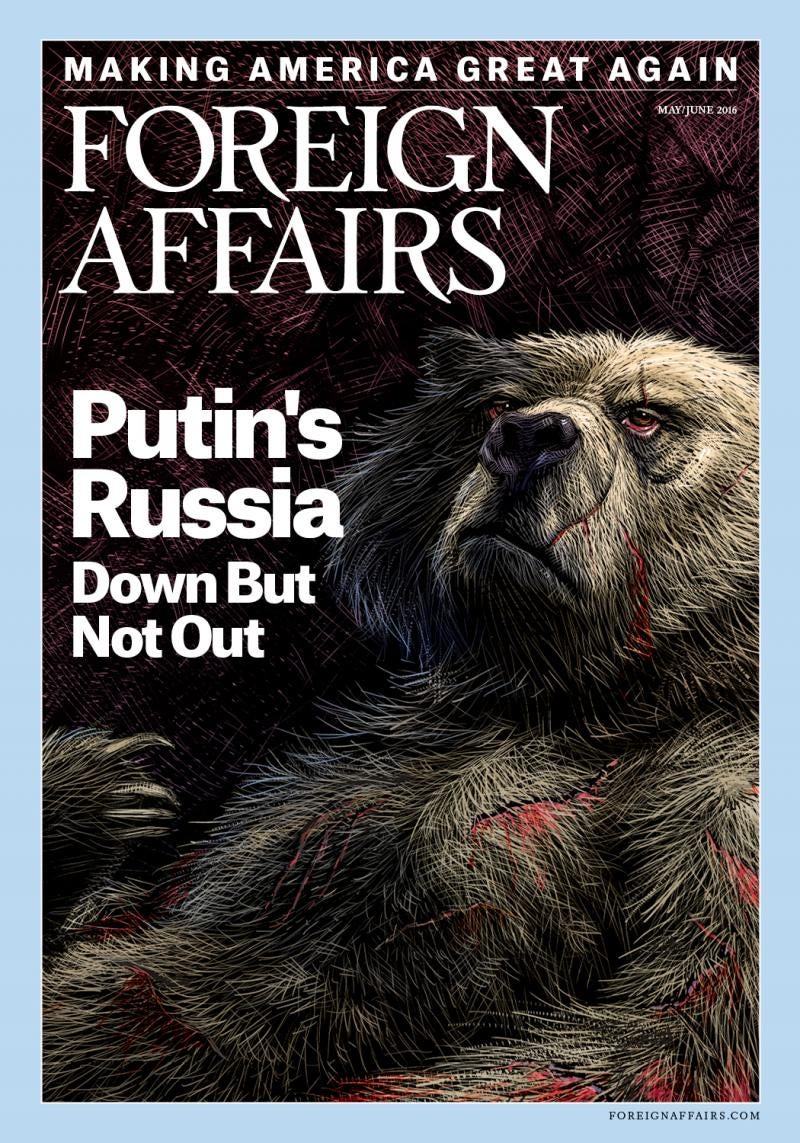
The cover title seems relatively harmless — “Putin’s Russia: Down But Not Out.” But check out the image of the bear — it’s bloodied and still relatively menacing, despite being bruised and battered — check out the red, bloodshot eyes and the sharp claws. Definitely not someone you’d want to mess with, even after a few shots of vodka.
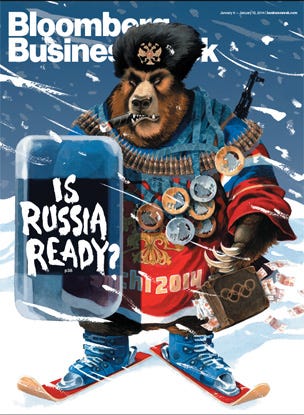
And Foreign Affairs is not the only magazine to go the full bear with the cover. Ahead of the Sochi Winter Olympics in 2014, Bloomberg BusinessWeek went with what has to be the scariest, most menacing Russia bear that’s ever appeared on the cover of a magazine. The magazine shows a malevolent bear on a pair of skis wearing a Russian hockey jersey, armed to the teeth (literally), with the headline: “Is Russia Ready?”
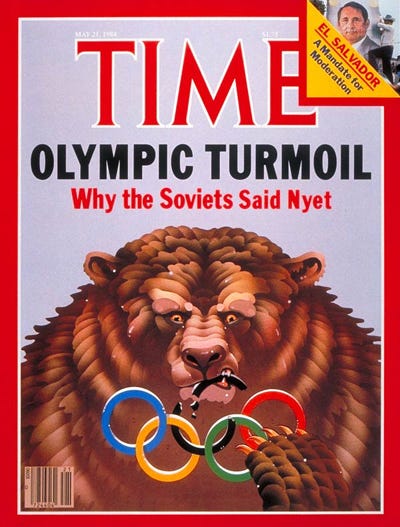
This Olympic cover immediately calls to mind a cover story TIME ran on Russia (then the Soviet Union) ahead of the 1984 Los Angeles Summer Olympics — “Olympic Turmoil: Why the Soviets Said Nyet.” Here you have a menacing (and slightly psychotic-looking) Russian bear chewing on the Olympic rings:
There are other options, of course, if you don’t want to go with the anthropomorphic bear. In late 2014, The Economist pulled off a story about “Russia’s Wounded Economy” after Western sanctions and falling oil prices — it showed a bear stalking through the wintry, Siberian snow with bloody footprints:

But you probably want to emphasize either the claws or teeth of the Russian bear, right? So here’s a terrifying image of a Russian bear “welcoming” U.S. President Barack Obama to Moscow:

OPTION 2: Go with Vladimir Putin
The next best choice after using the Russian bear is the image of Vladimir Putin. After all, in the minds of most Western readers, Putin is Russia and Russia is Putin.
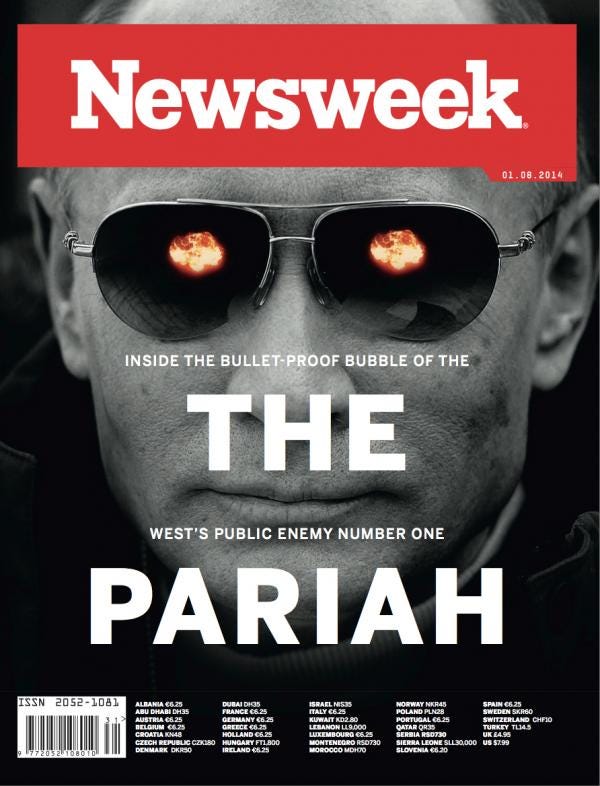
If you’re ready to head down this road, then an image of an evil James Bond villain, hatching a diabolical plot to take over the world, might work. This 2014 Newsweek cover of Putin, showing him and the menacing sunglasses, is a classic:
To play up the Soviet spy background of Putin, you could try using an image of him wearing sunglasses in a grim-looking Red Square (Gray Square!):
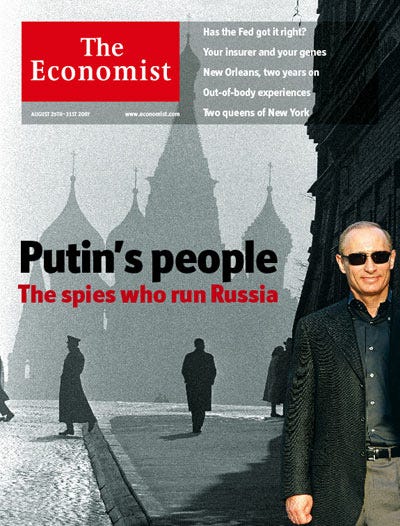
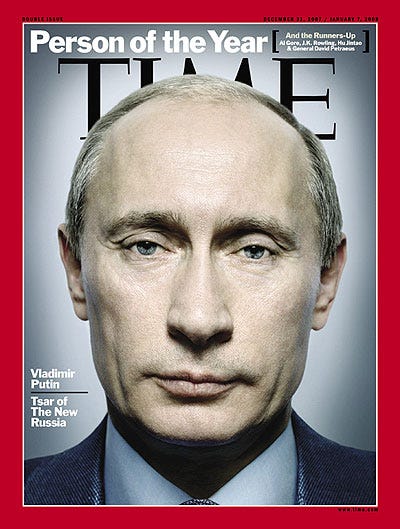
A variant of the James Bond villain look is the classic “moody Putin” look that’s been around for almost a decade. This image somehow captures the Western perception of Russia as a vast, unsmiling wasteland full of snow, ice and a vast moral void. Who better to run that country than an unsmiling dictator? What started it all was this TIME magazine cover naming Putin as “Person of the Year”:
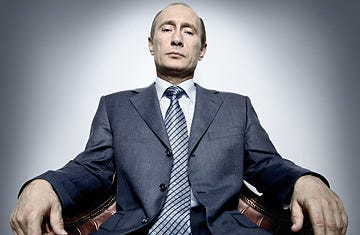
From there, the moody, unsmiling Putin image took off. Pull your camera angle back from the close-up of Putin’s face and you get this — “the unsmiling tsar”:
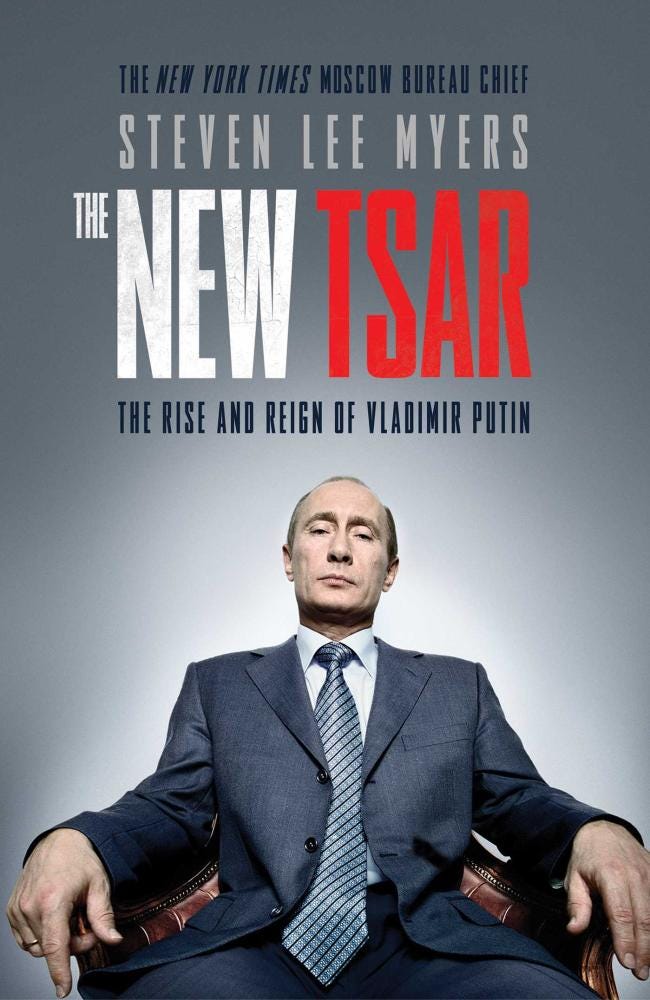
Which, of course, led to the cover of this 2015 book by Steven Lee Myers of the New York Times:
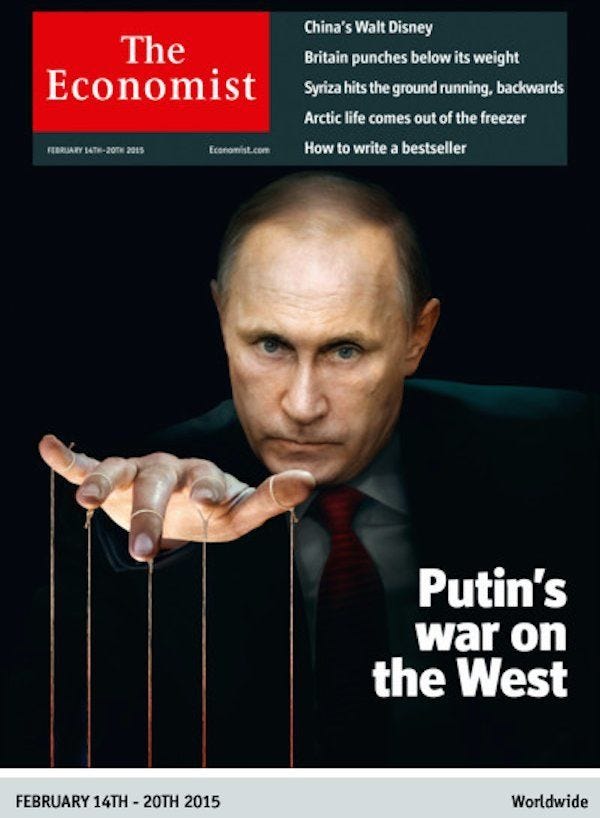
Of course, the moody, unsmiling, sour-looking Putin can be updated to make him look like a gangster:
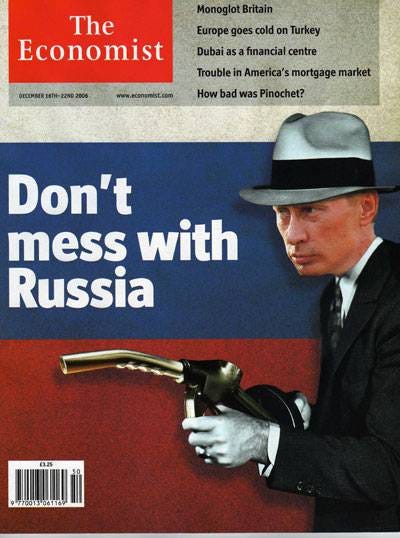
Or a Mario Puzo-style mafia don:
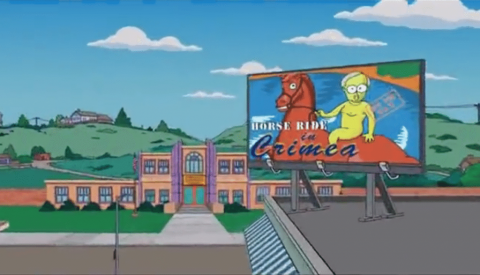
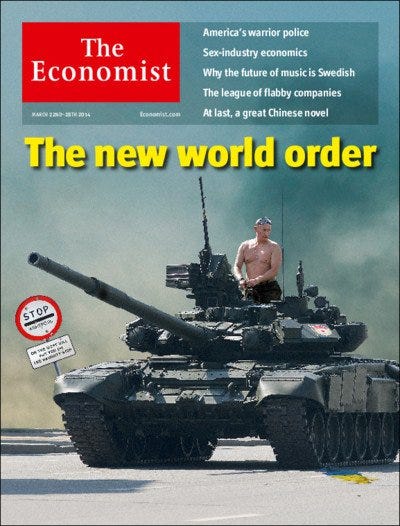
If you really want to grab the reader’s attention, though, go for the shirtless Putin. The shirtless Vladimir Putin is a classic Internet meme, of course. (Google: Shirtless Putin hummingbird hamster) The meme of a shirtless Putin doing manly things is so popular that “The Simpsons” even used the image of a completely naked Putin on horseback (bareback?) around the time of the Crimea crisis:
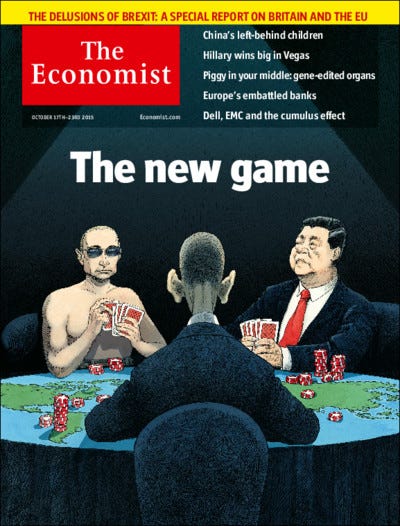
Look long enough, and you start to see images of shirtless Vladimir Putins Photoshopped on top of everything. So it’s perhaps no big surprise that the shirtless Vladimir Putin has ended up on the cover of a few major magazines, including this classic Economist cover where he’s shirtless on top of a Russian tank:
And shirtless while playing poker:
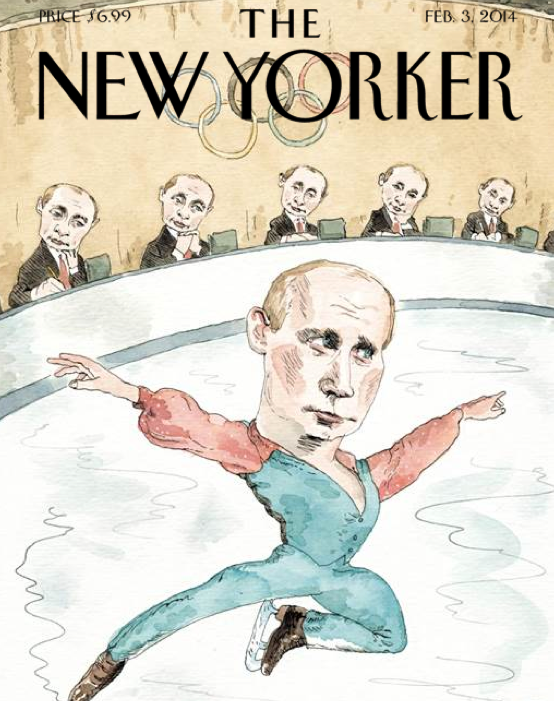
But, if you want an image of Putin, and you also want to keep things classy, how about a mashup of Putin and a classic symbol of Russian culture, like ballet or ice skating? In 2014, The New Yorker pulled off a cover of Putin, pirouetting through the air during the Sochi Winter Olympics, while a bunch of Putin yes-man clones give him top marks for his performance:
And, here’s another cover featuring Putin as an ice skater, this time from The Economist:
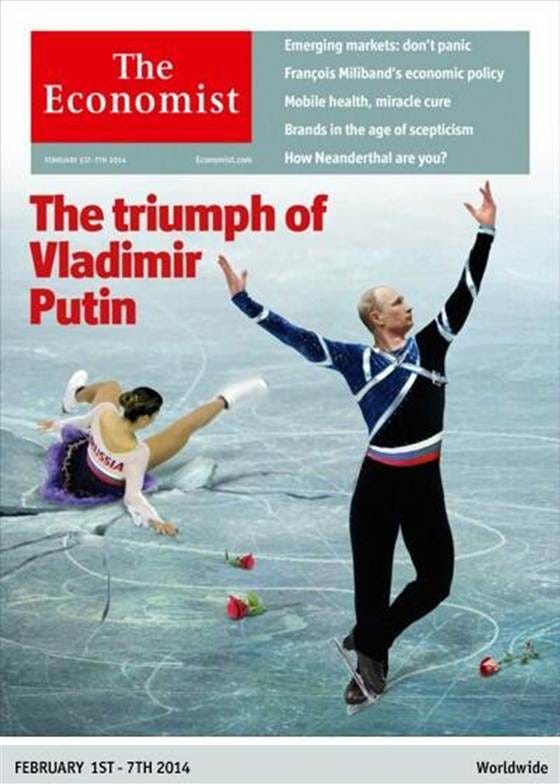
But here’s the twist — note the fallen Russian figure skater on the ice and the suggestion that the Sochi Olympics were basically a giant personal ego project for Putin. (Also note the subtext of the imagery — whereas Putin usually opts for “macho” sports like hunting, swimming and hockey, this cover shows him as a slightly effeminate ice skater. Look at the hands!!!)
OPTION 3: Go with a classic image of Russia, slightly twisted
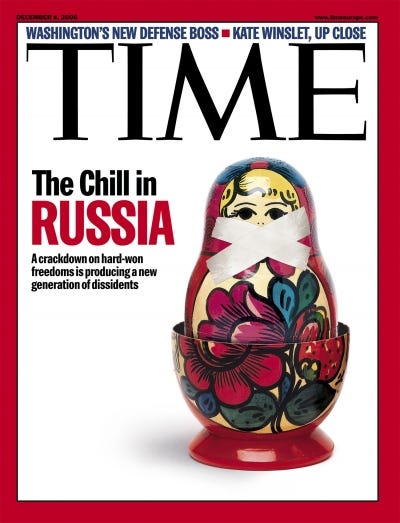
If you’re tired of using the Russian bear image and you’re concerned that putting Vladimir Putin on the cover of your magazine might create a few unsavory possibilities for your editorial team (Russian spies! Russian mafia! Russian hooligans!), there’s the old standby — the matryoshka image. This, of course, conveys the enigmatic nature of Russia — the old “riddle inside an enigma wrapped in a mystery” of Winston Churchill:
But why stop there? To convey the threatening nature of all things Russia, maybe it’s just easier just to come out and show the Russian missiles, tanks, weapons and troops directly:
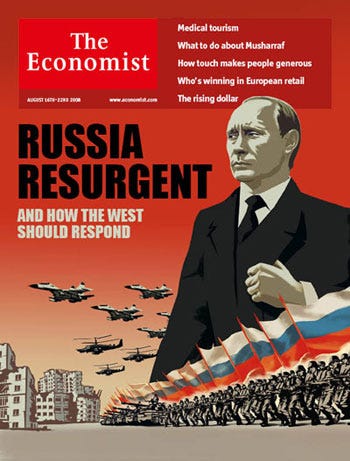
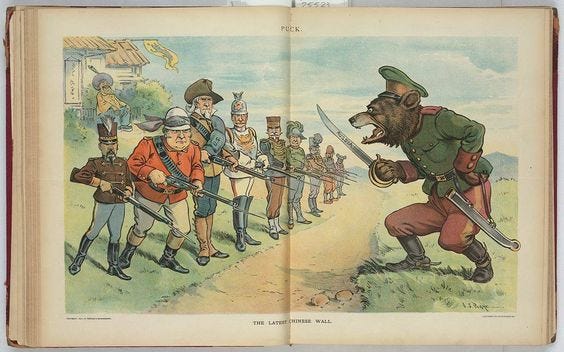
What all these magazine covers have in common, of course, is their Russophobia. These magazine covers are not so much different from the images that appeared a hundred years ago, when Russia really was an enigma unknown to the West. In fact, the image of Russia as a big, clumsy and aggressive state dates all the way back to the 16th century, and not much seems to have changed since then.
There’s always been a sense in Western media circles that a giant power in the middle of the Eurasian landmass posed a threat to someone — and maybe to everyone:
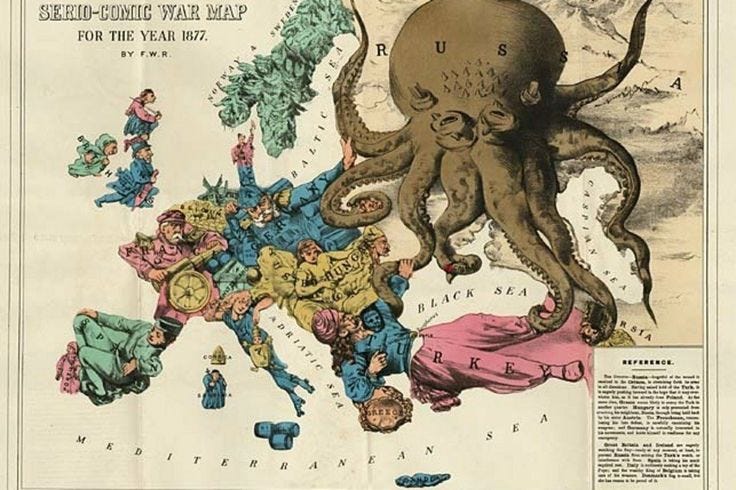
Although, in all fairness, the image of the Russian bear is probably preferable to the image of the Russian octopus:
Which leads to the obvious question — Are these images of Russia from 100 years ago really so much different from the images appearing today in Western mass media?
At a time when the Kremlin has called on the Culture Ministry to investigate anti-Russian propaganda and Russophobia in the West, this question isn’t very hard to answer.
Dominic Basulto is the author of the new book Russophobia.
Excavating America’s Forgotten History of Political Repression
A review of Brad Schreiber’s Revolution’s End
By Kara Dellacioppa | Dissident Voice | October 28, 2016
America is a Haunted House.
– Peter Levenda, author of Sinister Forces
There is probably no other historical era more misunderstood by Americans than the 1960s and 1970s. From the political assassinations of major political figures and political assassinations of ordinary civil rights and antiwar activists to the emergence of government secret intelligence programs designed to monitor and ultimately crush dissent in the United States, most Americans remain vaguely, if at all, aware of how this hidden history impacts our lives today. And this lack of awareness has unfortunately allowed for these same forces to deal some crushing blows to our “democracy.”
The American public learned of the FBI’s Cointelpro and the CIA’s Operation CHAOS and MKUltra through the Senate Hearings on government intelligence abuses led by Senator Frank Church in 1975 as well as through the work of independent journalists after the break-in of FBI offices in Media Pennsylvania in 1971.1 These government and journalistic investigations brought to light an array of systematic abuses of government authority against Americans, partially illuminating the covert and ruthless attacks against the movements of the era.
The Johnson administration’s failure to deliver on its promises of genuine and meaningful civil rights reforms led to a series of urban riots beginning in Harlem in 1964 and were followed by those in Watts, Detroit and Newark as well as in a host of other cities across the country. These riots terrified the establishment and prompted the government to create programs designed to federalize local police departments rather than address the underlying social problems that gave way to the riots in the first place.2 Through the Law Enforcement Assistance Act of 1965 and the subsequent Omnibus Safe Streets Crime bill signed by President Lyndon B. Johnson in 1968, the Law Enforcement Assistance Administration (LEAA) was created as a mechanism to launch an unprecedented “War on Crime.”3 The purpose of the LEAA was ostensibly “violence prevention. ” The LEAA funded the creation and training of SWAT teams in Los Angeles in order to destroy the Black Panther Party and other perceived political threats. The LEAA funded “anti-violence” research in prisons and hospitals and worked alongside the CIA’s MK ULTRA program engaging in such delightful activities as drug experimentation, surgical, and chemical lobotomies on prisoners and psychiatric patients. LEAA funds also went into the school system and developed testing of young black children to “predict” whether or not these children would become violent in the future.4 (For more information of how the LEAA funded projects in schools that led to the psychiatric drugging of Black and poor children, please see the work of psychiatrist Peter Breggin).
The other widely misunderstood factor in the development of America’s police state is the relationship between the deepening of America’s involvement in a genocidal enterprise called the Vietnam War and the growth and over-determination of the American National Security State on political life in the US. While it is a fact that the United States lost the Vietnam war, the lessons learned by the military/intelligence establishment were employed in future counter-insurgency campaigns in El Salvador and Iraq and in the United States as well.5
 This is where Brad Schreiber’s Revolution’s End: The Patty Hearst Kidnapping, Mind Control, and the Secret History of Donald DeFreeze and the SLA comes in. Revolution’s End is a careful examination of the relationships among various government intelligence, police and prison agencies that colluded to create a synthetic terror group called the Symbionese Liberation Army (SLA). Their assassination of Oakland School Superintendent Marcus Foster and subsequent kidnapping of heiress and closet revolutionary Patricia Campbell Hearst dominated the news cycle for years. While other researchers of the shadow state have examined the SLA and the Patty Hearst trial in depth such as Paul Krassner and Mae Brussell, Schreiber’s exposure of government involvement in the creation of the SLA is nothing short of explosive.
Schreiber was handed a folder full of documents from Dick Russell, the legendary journalist and author of The Man Who Knew Too Much. These documents came from private investigators working on Patricia Hearst’s defense team including the private detective and former Las Vegas police officer Lake Headley who was hired by Dr. L.S. Wolfe, father of slain SLA member Willie Wolfe. Schreiber utilizes the contents of that file to great effect. They include startling facts such as Patti Hearst’s pre-SLA relationship with Donald Defreeze (the petty thief, turned LAPD informant, turned provocateur and fake revolutionary). Using a college friend’s student ID, Hearst was allowed to visit Defreeze in prison at the Vacaville Psychiatric Unit as a part of a project called the Black Cultural Association (BCA). BCA was ostensibly a rehabilitative project but in effect it was a behavior modification program run by Colston Westbrook, a former CIA officer who worked with Pacific Architects and Engineers, a known CIA front company that was responsible for building the prison interrogation centers (PICS) in Vietnam as part of the CIA’s deplorable Phoenix program. The Phoenix program was a covert CIA coordinated program of counter-insurgency/counter-subversion against the South Vietnam’s civilian population.6 And here lies one of Schreiber major achievements, exposing a direct link between the Vietnam pacification program as Phoenix was euphemistically coined, and America’s pacification program at home.
The BCA received many visits from a prison rights group largely associated with another shady “revolutionary” movement of the era The Venceremos Organization, a Maoist group based out of Stanford and at the time led by English Professor H. Bruce Franklin. Venceremos had originally had a Chicano leadership but this leadership was displaced in the wake of the split of the Bay Area Revolutionary Union (BARU). BARU included H. Bruce Franklin and Bob Avakian. Having formed the organization after the destruction of Students for a Democratic Society (SDS), Franklin and Avakian split over disagreements about the role of armed struggle in the United States. Venceremos, was, along with the August 7th Guerrilla movement, the bases from which the SLA drew its white cadre. In the last few years before the dissolution of Venceremos, many of its members became involved with the United Prisoners Union (UPU) created by Popeye Jackson.7 It is within these circles that Patti Hearst becomes connected with Vacaville and Defreeze. During the visits to Vacaville, Patty Hearst was able to carry on a sexual relationship with Defreeze with the blessing of Westbrook. As Schreiber tells it, as Defreeze starts to become more unhinged as his treatments continue at the hands of the Vacaville prison authorities, he gradually changes his identity to that of Cinque, the Black revolutionary. He speaks of violence and kidnapping to Hearst. She becomes understandably unnerved and breaks off the relationship with Defreeze. Here according to Schreiber begins the plotting of revenge against Hearst. Importantly, Schreiber points out that Vacaville as a psychiatric hospital was a way station for inmates going on to serve their sentences in other facilities. The vast majority of them were passing through receiving their “treatment” and then moving on. Defreeze, in contrast, stayed at Vacaville for well over a year which was highly unusual. Defreeze’s situation even caught the attention of “thorn in the side of the CIA” Congressman Leo Ryan who investigated Defreeze’s case and the prison authorities use of mind control experiments.
Defreeze, a failed criminal, who couldn’t find consistent work to take care of his children and who had been handled by the forces of the state for a number of years was sent on a mission at the behest of Colston Westbrook, to assassinate the first Black superintendent of a public school district in the United States, Dr. Marcus Foster.
Schreiber points out that the political targeting of Marcus Foster was beyond bizarre. Foster’s assassination has never been fully explained. SLA members Russ Little and Joe Remiro were convicted of the crime but Schreiber reveals that it was Nancy Ling Perry and Patricia Soltysik along with Cinque (Defreeze) that actually riddled Foster’s body with nine cyanide tipped bullets. Schreiber speculates that the reason that Foster was targeted by Westbrook was that public schools were coming under attack for doing too well a job at educating Black and other minority children. After his election in 1966, Governor Reagan’s California launched a crusade against political activism in schools regarding them (along with the California prisons) as a breeding ground for radicalism.8
Schreiber casts Donald Defreeze in a rather compassionate light. A failed criminal, Defreeze like thousands of others, was recruited by the LAPD to become an informant and provocateur. This is the story of thousands of others who are pressured with time in prison for noncooperation. Or if they were in prison, they often were threatened with chemical or physical psychosurgery or indefinite solitary confinement. Yes, many did it for the money but as Schreiber points out Defreeze hardly earned a living from what was paid to him by the LAPD’s Criminal Conspiracy Section (CCS).
The one revelation that nearly made me fall out of my chair as I was reading it was the revelation that according to Schreiber’s research, the SLA was created within the California Department of Corrections (CDC) as an interracial prison gang that would spy on the other gangs and provide intelligence to the leadership of the CDC. There were chapters of the prison SLA at San Quentin, Vacaville, and Soledad. Inmate Robert Hyde, a long term prisoner, was pressured to become the head of the prison SLA and he was told to inform on any legal action inmates were planning against the CDC regarding abuses against prisoners. Hyde decided that becoming an informant inside the prison was a death wish so he refused. Eventually Hyde appeals to the FBI for help. At a certain point, Hyde was informed that there was to be an SLA formed outside of the prison to infiltrate dissident groups. Schreiber then discusses the effect of the assassination of George Jackson and the effect that it had on the climate inside the California prison system.
Schreiber provides many other fascinating insights into the formation and eventual destruction of the SLA. He points out that most of the left viewed the SLA with great suspicion, accusing the SLA of having been created by the CIA. So their mission to infiltrate the left was largely a failure. However, in the Bay Area, there were many in the urban poor communities that helped hide them from the police. Schreiber highlights how the SLA was able to artfully manipulate the media into broadcasting their communiques including the demand that William Randolph Hearst fund the People in Need (PIN) program. Hearst spent millions to fund this food distribution program that led to chaotic scenes of distribution workers tossing palettes of food off of truck beds to angry and hungry people.
On the fateful night of May 17th 1974 in a house in South Central Los Angeles, located, as Schreiber points out, a mere 3 miles from the epicenter of the Watts Riots, six SLA members lost their lives. Nancy Ling Perry, Camille Hall, and Patricia Soltysik died from gunshots wounds. Angela Atwood and Willie Wolfe died from smoke inhalation. Defreeze reportedly died from a self-inflicted gunshot wound. Schreiber goes into the serious inconsistencies of the official reports of the SLA deaths. His research shows that, in fact, the SLA members were not given a chance to come out alive. Nancy Ling Perry, it would later be shown, was shot in the back presumably as she was trying to turn herself in. He also found evidence that incendiary/explosive devices were thrown into the house by the LAPD. Given the secret origins of the SLA and Defreeze’s relationship with the LAPD and the CDC, it is very plausible that the LAPD had decided ahead of time that there would be no peaceful resolution to the standoff.
Lastly, Schreiber makes a critical point that the live television broadcast of the police shootout and bombing of the South Central Los Angeles SLA hideout was the introduction of the LAPD SWAT team to America’s night time television viewing audience. The live broadcasting of the LAPD destruction of the SLA could be seen as a terrifying prelude to our current War on Terror.
Revolution’s End is a remarkable book. However, it would have been even better if Schreiber had included some of the documents he cites. More thorough footnoting would have improved it as well. However, footnoting would have made it a less readable book. I hope that Schreiber (if he hasn’t already) made copies of the documents he possesses and donates them to a local university or library. The information age has inundated the public with information/disinformation overload. And due to increasing government restrictions with regard to the Freedom of Information Act (FOIA), documents like these are becoming more difficult to get your hands on and they are just too precious for any one person to keep to themselves.
Revolution’s End is a highly readable book and I highly recommend it to anyone interested in unearthing the secret history of government repression in America. Schreiber had to decide where to go in-depth. His focus on the background of Defreeze and Westbrook are laudable choices as is his focus on the assassination of Dr. Marcus Foster. There are many threads of research that can and should be followed up on including Congressman Leo Ryan and his research into the mind control experiments in prisons, and the post SLA creation New World Liberation Front (NWLF) which according to Schreiber was credited with many more domestic bombings than the Weather Underground. One wonders what shadowy origins the NWLF had. Schreiber’s book is a great contribution to the study of the government repression and the shadow state. Importantly, it has the capacity to inspire people, especially young people, to learn about this history in depth and allow this history to inform their analysis of what is happening today.
- United States Senate. Final Report of the Select Committee to Study Government Operations with Respect to Intelligence Activities, United States Senate, (94th Congress, Second Session, Report No. 94-755) Government Printing office; April 23, 1976.
- Horne, Gerald. 1997. The Fire this Time: The Watts Riots and the 1960s. De Capo Press.
- Thompson, Heather Ann. Blood in the Water: The Attica Prison Uprising of 1971 and Its Legacy. New York: Pantheon Book. p. 18-21.
- Breggin, P. R. and Breggin, G. R. (1994). The War Against Children: How the Drugs, Programs, and Theories of the Psychiatric Establishment Are Threatening America’s Children with a Medical ‘Cure’ for Violence. New York: St. Martin’s Press.
- Valentine, Douglas. 2016. The CIA as Organized Crime: How Illegal Operations Corrupt America and the World. New York, NY: Clarity Press.
- Valentine, Douglas. 2000. The Phoenix Program. iUniverse: Lincoln, NE.
- For a fascinating inside look at the rise and fall of Venceremos at Stanford, see Max Crawford’s The Bad Communist, a thinly veiled “fictional” account of Crawford’s time with Venceremos at Stanford. It includes detailed of the gruesome murder of Black Panther Fred Bennett supposedly at the hands of James Carr at the Venceremos training compound in the Santa Cruz Mountains. After the book was published in 1979, Crawford exiled himself to Paris for a while to escape the heat generated after he published his book.
- Rosenfeld, Seth. 2012. Subversives: The FBI’s War on Student Radicals and Reagan’s Rise to Power. New York: NY, Farrar, Giroux, and Strauss.
Kara Z. Dellacioppa is chair of the sociology department at California State University, Dominguez Hills. She is the author of This Bridge Called Zapatismo: Building Alternative Political Cultures in Mexico City, Los Angeles, and Beyond (Lanham, MD: Lexington Books, 2009) and co-editor of Cultural Political and Resistance in the 21st Century: Community-Based Social Movements and Global Change in the Americas (Palgrave, 2011).
“Palestinian Art Behind the Bars,” 1984 publication on Palestinian prisoners’ culture of liberation

Samidoun Palestinian Prisoner Solidarity Network
The following historical booklet of the Palestinian prisoners’ movement was originally released in 1984 in English and Arabic by the Palestinian Prisoners’ Committee, based in Damascus, Syria, and is now being made available online for download and distribution by Samidoun Palestinian Prisoner Solidarity Network.
While focusing on depictions of Palestinian art created inside Israeli prisons – often on pillowcases, with smuggled and secreted materials, and removed covertly from the prison walls – the booklet also contains facts and descriptions about the situation faced by Palestinian prisoners in 1984.
Some of the art in this book was also featured in the Made In Palestine exhibition, which debuted in 2003 at the Station Museum in Houston, Texas. Its curator, James Harithas, was introduced to the broad spectrum of Palestinian art by featured artist Samia Halaby, whose new book of artwork commemorating the massacre of Kufr Qassem is soon to be released. (Some of the artists featured here are also included in Halaby’s work, Liberation Art of Palestine, which traces prisoners’ art as part of the overarching stream of liberation art produced by Palestinian artists in the movement.) Zuhdi al-Adawi, one of the artists featured in the booklet, traveled to New York City in 2006 for the opening of the exhibition. The film, Crayons of Askalan, also features some of these works and the story of Palestinian prisoner artists.
The booklet contains excerpts from the London Sunday Times’ 1977 investigation into torture in Israeli prisons, the same investigation that helped to bring the torture of Rasmea Odeh and Palestinian women prisoners to a Western audience. It includes an overview of the various prisons were Palestinian political prisoners were held at the time of publication in 1984, the forms of torture used under interrogation, living conditions in prisons, medical mistreatment and prisoners’ resistance. It ends with a call to people around the world to take action to support Palestinian prisoners, “form support committees everywhere,” and “unite all efforts to help secure the just demands of these prisoners and condemn the inhumane Zionist practices,” a call to action that remains just as critical today as it was 32 years ago.
The book is available for view and download below in PDF.
Download PDF (Palestinian Art Behind the Bars, 1984)
Obama Warned to Defuse Tensions with Russia
Consortium News | October 2, 2016
A group of ex-U.S. intelligence officials is warning President Obama to defuse growing tensions with Russia over Syria by reining in the demonization of President Putin and asserting White House civilian control over the Pentagon.
ALERT MEMORANDUM FOR: The President
FROM: Veteran Intelligence Professionals for Sanity
SUBJECT: PREVENTING STILL WORSE IN SYRIA
We write to alert you, as we did President George W. Bush, six weeks before the attack on Iraq, that the consequences of limiting your circle of advisers to a small, relatively inexperienced coterie with a dubious record for wisdom can prove disastrous.* Our concern this time regards Syria.
We are hoping that your President’s Daily Brief tomorrow will give appropriate attention to Saturday’s warning by Russia’s Foreign Ministry spokesperson Maria Zakharova: “If the US launches a direct aggression against Damascus and the Syrian Army, it would cause a terrible, tectonic shift not only in the country, but in the entire region.”
Speaking on Russian TV, she warned of those whose “logic is ‘why do we need diplomacy’ … when there is power … and methods of resolving a problem by power. We already know this logic; there is nothing new about it. It usually ends with one thing – full-scale war.”
We are also hoping that this is not the first you have heard of this – no doubt officially approved – statement. If on Sundays you rely on the “mainstream” press, you may well have missed it. In the Washington Post, an abridged report of Zakharova’s remarks (nothing about “full-scare war”) was buried in the last paragraph of an 11-paragraph article titled “Hospital in Aleppo is hit again by bombs.” Sunday’s New York Times totally ignored the Foreign Ministry spokesperson’s statements.
In our view, it would be a huge mistake to allow your national security advisers to follow the example of the Post and Times in minimizing the importance of Zakharova’s remarks.
Events over the past several weeks have led Russian officials to distrust Secretary of State John Kerry. Indeed, Foreign Minister Sergey Lavrov, who parses his words carefully, has publicly expressed that distrust. Some Russian officials suspect that Kerry has been playing a double game; others believe that, however much he may strive for progress through diplomacy, he cannot deliver on his commitments because the Pentagon undercuts him every time. We believe that this lack of trust is a challenge that must be overcome and that, at this point, only you can accomplish this.
It should not be attributed to paranoia on the Russians’ part that they suspect the Sept. 17 U.S. and Australian air attacks on Syrian army troops that killed 62 and wounded 100 was no “mistake,” but rather a deliberate attempt to scuttle the partial cease-fire Kerry and Lavrov had agreed on – with your approval and that of President Putin – that took effect just five days earlier.
In public remarks bordering on the insubordinate, senior Pentagon officials showed unusually open skepticism regarding key aspects of the Kerry-Lavrov deal. We can assume that what Lavrov has told his boss in private is close to his uncharacteristically blunt words on Russian NTV on Sept. 26:
“My good friend John Kerry … is under fierce criticism from the US military machine. Despite the fact that, as always, [they] made assurances that the US Commander in Chief, President Barack Obama, supported him in his contacts with Russia (he confirmed that during his meeting with President Vladimir Putin), apparently the military does not really listen to the Commander in Chief.”
Lavrov’s words are not mere rhetoric. He also criticized JCS Chairman Joseph Dunford for telling Congress that he opposed sharing intelligence with Russia, “after the agreements concluded on direct orders of Russian President Vladimir Putin and US President Barack Obama stipulated that they would share intelligence. … It is difficult to work with such partners. …”
Policy differences between the White House and the Pentagon are rarely as openly expressed as they are now over policy on Syria. We suggest you get hold of a new book to be released this week titled The General vs. the President: MacArthur and Truman at the Brink of Nuclear War by master historian H. W. Brands. It includes testimony, earlier redacted, that sheds light on why President Truman dismissed WWII hero Gen. Douglas MacArthur from command of U.N. forces in Korea in April 1951. One early reviewer notes that “Brands’s narrative makes us wonder about challenges of military versus civilian leadership we still face today.” You may find this new book more relevant at this point in time than the Team of Rivals.
The door to further negotiations remains ajar. In recent days, officials of the Russian foreign and defense ministries, as well as President Putin’s spokesman, have carefully avoided shutting that door, and we find it a good sign that Secretary Kerry has been on the phone with Foreign Minister Lavrov. And the Russians have also emphasized Moscow’s continued willingness to honor previous agreements on Syria.
In the Kremlin’s view, Russia has far more skin in the game than the U.S. does. Thousands of Russian dissident terrorists have found their way to Syria, where they obtain weapons, funding, and practical experience in waging violent insurgency. There is understandable worry on Moscow’s part over the threat they will pose when they come back home. In addition, President Putin can be assumed to be under the same kind of pressure you face from the military to order it to try to clean out the mess in Syria “once and for all,” regardless how dim the prospects for a military solution are for either side in Syria.
We are aware that many in Congress and the “mainstream” media are now calling on you to up the ante and respond – overtly or covertly or both – with more violence in Syria. Shades of the “Washington Playbook,” about which you spoke derisively in interviews with the Atlantic’s Jeffrey Goldberg earlier this year. We take some encouragement in your acknowledgment to Goldberg that the “playbook” can be “a trap that can lead to bad decisions” – not to mention doing “stupid stuff.”
Goldberg wrote that you felt the Pentagon had “jammed” you on the troop surge for Afghanistan seven years ago and that the same thing almost happened three years ago on Syria, before President Putin persuaded Syria to surrender its chemical weapons for destruction. It seems that the kind of approach that worked then should be tried now, as well – particularly if you are starting to feel jammed once again.
Incidentally, it would be helpful toward that end if you had one of your staffers tell the “mainstream” media to tone down it puerile, nasty – and for the most part unjustified and certainly unhelpful – personal vilification of President Putin.
Renewing direct dialogue with President Putin might well offer the best chance to ensure an end, finally, to unwanted “jamming.” We believe John Kerry is correct in emphasizing how frightfully complicated the disarray in Syria is amid the various vying interests and factions. At the same time, he has already done much of the necessary spadework and has found Lavrov for the most part, a helpful partner.
Still, in view of lingering Russian – and not only Russian – skepticism regarding the strength of your support for your secretary of state, we believe that discussions at the highest level would be the best way to prevent hotheads on either side from risking the kind of armed confrontation that nobody should want.
Therefore, we strongly recommend that you invite President Putin to meet with you in a mutually convenient place, in order to try to sort things out and prevent still worse for the people of Syria.
In the wake of the carnage of World War II, Winston Churchill made an observation that is equally applicable to our 21st Century: “To jaw, jaw, jaw, is better than to war, war, war.”
* In a Memorandum to President Bush criticizing Colin Powell’s address to the UN earlier on February 5, 2003, VIPS ended with these words: “After watching Secretary Powell today, we are convinced that you would be well served if you widened the discussion … beyond the circle of those advisers clearly bent on a war for which we see no compelling reason and from which we believe the unintended consequences are likely to be catastrophic.”
For the Steering Group, Veteran Intelligence Professionals for Sanity
William Binney, former Technical Director, World Geopolitical & Military Analysis, NSA; co-founder, SIGINT Automation Research Center (ret.)
Fred Costello, Former Russian Linguist, USAF
Mike Gravel, former Adjutant, top secret control officer, Communications Intelligence Service; special agent of the Counter Intelligence Corps and former United States Senator
Matthew Hoh, former Capt., USMC, Iraq & Foreign Service Officer, Afghanistan (associate VIPS)
Larry C. Johnson, CIA & State Department (ret.)
John Kiriakou, former CIA counterterrorism officer and former senior investigator, Senate Foreign Relations Committee
Linda Lewis, WMD preparedness policy analyst, USDA (ret.) (associate VIPS)
Edward Loomis, NSA, Cryptologic Computer Scientist (ret.)
Ray McGovern, former US Army infantry/intelligence officer & CIA analyst (ret.)
Elizabeth Murray, Deputy National Intelligence Officer for Middle East, CIA (ret.)
Todd Pierce, MAJ, US Army Judge Advocate (ret.)
Coleen Rowley, Division Counsel & Special Agent, FBI (ret.)
Kirk Wiebe, former Senior Analyst, SIGINT Automation Research Center, NSA, (ret.)
Robert Wing, former Foreign Service Officer
Ann Wright, U.S. Army Reserve Colonel (ret) and former U.S. Diplomat
American Pravda: The Destruction of TWA Flight 800

Reconstruction of TWA Flight 800. Credit: Wikimedia Commons
By Ron Unz • Unz Review • September 26, 2016
Some years ago as I became increasingly aware of the severe dishonesty of our mainstream media on all sorts of controversial topics, I began telling a joke to a few of my friends.
Suppose, I would say, that I happened to be out walking one pleasant afternoon in Palo Alto, and suddenly heard a gigantic explosion in the general direction of Mountain View, soon followed by a huge pillar of smoke rising towards the sky. Being busy with my own work, I might have no time to bother investigating, and merely wondered what surprising story the front pages of my morning newspapers would reveal as the cause behind those dramatic events. But when I eagerly opened those papers the following day, mention of the explosion was nowhere to be found, either on Page One or anywhere else, even in my own local San Jose Mercury News. So unless I somehow persuaded myself that I had simply imagined the whole thing, I would henceforth stop believing anything I read—or failed to read—in my once-trusted news outlets.
I thought my allegorical fable rather amusing, and repeated it on a number of occasions. But quite recently I came across a rough counterpart in real life, a remarkable tale that had almost completely escaped my attention for over twenty years.
When I used to recall the leading events of 1996, what came to mind was Bill Clinton’s triumphant reelection campaign in the wake of the Oklahoma City bombing and political overreach by Newt Gingrich’s Congressional Republicans. Perhaps there had also been some sort of plane crash on the East Coast, though none of the details were sharp or memorable in my mind. But in fact, the sudden mid-air explosion of TWA Flight 800 on a New York to Paris route was actually voted the top national news story of that year, ranking above the presidential campaign, while the 230 fatalities made it by far New York’s worst disaster of the twentieth century, and the second worst airline tragedy in American history to that date. Indeed, some journalists at the time suggested that the resulting media coverage had eclipsed that of any other transportation calamity since the sinking of the Titanic almost a century earlier.
I had almost forgotten the story of that doomed airliner when I opened my morning edition of the New York Times in mid-July 2013 and read a short review in the Arts Section, favorably discussing a new television documentary presenting the “conspiracy theory” that the plane had been destroyed by a missile rather than by an accidental fuel tank explosion as the government investigation had firmly concluded at the time, a verdict strongly affirmed by both the news and editorial pages of the Times. I had recently published “Our American Pravda” and an eminent mainstream academic who appreciated my piece soon dropped me a note pointing to a website discussion of the details of the plane crash, about which I knew nothing. Being preoccupied with other matters, I could only glance at the material, which shocked me, but now that I’ve gone back and spent some time on the topic, the story turns out to be a truly remarkable one.
The outline of facts is hardly complicated. Soon after taking off from New York’s JFK Airport on July 17, 1996, TWA Flight 800 suddenly exploded in the air just off Long Island. So enormous a loss of life naturally produced an immediate scrambling of numerous federal agencies to investigate the cause, and with widespread fears of terrorism, the FBI launched the largest, most complex investigation in its entire history, deploying some 500 field agents to the area. The investigators soon gathered a copious quantity of seemingly consistent evidence.
Large numbers of local witnesses were immediately interviewed by the swarm of federal agents, with 278 of them reporting that they saw a streak of light, much like a missile, shoot up into the sky in the direction of the aircraft just before the huge explosion. Employees at the local FAA radar installation immediately reported to the government that they had seen what appeared to be a missile closing with the airliner just before it exploded, and other installations produced similar radar records. When tests were eventually performed on the plane wreckage, traces of explosive chemicals were found, exactly the sort used in the warhead of a missile, as well as some reddish-orange chemical residue that a laboratory later identified as likely missile exhaust propellant. An enormous effort was made to locate every possible piece of the wreckage, and for many of these, the contours of the damage indicated an initial explosion external to the plane. Almost immediately after the disaster, a bidding-war allegedly broke out between the national television networks for an amateur home-video showing a missile striking and destroying TWA 800, with the tape eventually being sold for more than $50,000 and briefly broadcast on the MSNBC cable news channel before reportedly being seized as evidence by FBI agents. In addition, a local resident provided a still photo taken at the time showing what seemed to be a missile rising toward the aircraft.
Based on all this initial evidence, many of the early news stories reported that the plane had probably been destroyed by a missile, with widespread speculation about whether the calamity was due to terrorist action or instead accidental “friendly fire” from one of the U.S. naval warships operating in the vicinity. Given the extreme sensitivity of the topic, government officials urged the media to keep an open mind until the full investigation was completed. However, the public debate sometimes turned rancorous, with some individuals soon alleging that a government cover-up was in the works. Eventually, the CIA was brought into the investigation, given its tremendous expertise in certain matters.
After more than a year of detailed research, the government investigation finally concluded that no missile could possibly have been involved, with all the eyewitnesses having been misled by what amounted to an optical illusion caused by the explosion of the aircraft. That explosion itself had been entirely spontaneous, probably caused by a random spark igniting one of the gas tanks. Given the controversy in the case, the CIA helpfully produced a computer animation showing the official reconstruction of the events, which was endlessly broadcast by our news media to explain the disaster to the public. The simulation showed the jetliner spontaneously exploding in mid-air, with no external cause, and just to further clarify matters, the CIA animators also inserted an explanatory message in large text: “There Was No Missile.” The New York Times, and nearly all our other mainstream media repeatedly echoed this same simple conclusion in all their stories and headlines.
The vast majority of our sheep-like population absorbed the simple media message “No Missile” and went back to watching their football games and celebrity music videos, being greatly relieved to know that well-maintained 747 jumbo jets flown by leading national airlines can occasionally explode in mid-air without any external cause.
However, various disgruntled “conspiracy theorists” refused to accept these conclusions, and returned to their “crazy missile conspiracy theories,” thereby earning the hearty ridicule of the entire mainstream media, led by the New York Times. These conspiratorial suspicions even extended to the U.S. navy, which had apparently been staging military exercises in the near vicinity of the calamity, exercises that some claimed including the test-firing of anti-aircraft missiles. Indeed, a local resident later provided a home video clearly showing a missile being fired in that exact same area a few days earlier during previous naval exercises.
The entire remarkable history of this incident is persuasively set forth in a excellent twentieth-anniversary book published earlier this year by investigative journalist Jack Cashill, who has been following the case since the late 1990s, having co-authored a previous book in 2003 and also produced an earlier 2001 television documentary Silenced, now available in its entirely on YouTube.
In addition, the 2013 television documentary by a former CBS producer, whose favorable review by the New York Times marked my first introduction to the topic, was discussed at length and substantially excerpted by NPR‘s Amy Goodman at Democracy Now!
http://www.democracynow.org/embed/story/2013/6/20/did_us_govt_lie_about_twa
Cashill is strongly affiliated with conservative publications, while someone like Goodman clearly leans toward the left, but the question of whether an American jetliner was destroyed by a missile, and the facts then covered up by the government is a non-ideological matter, so their perspectives seem almost identical.
For anyone having less than absolute faith in the official pronouncements of our government and our media, the likely reality of what happened is hardly difficult to guess, and for those who currently maintain such naivete, I suspect it will quickly dissipate if they choose to watch the documentaries or read the books. But the loss of TWA Flight 800 is surely of no great importance to our country. Accidents do happen. A large and energetic military, eager to test its latest missile weapons, perhaps carelessly and fatally crossed paths with hundreds of unlucky travelers on their way to Paris. Some 30,000 Americans die each year in fatal car crashes, and risks are inevitable in our modern industrial society.
However, from a broader perspective, I believe that the truly horrifying aspect of the incident is the tremendous ease with which our government and its lapdog media managed to so utterly suppress the reality of what had happened—an American jumbo jet shot down by a missile—and did so although this occurred not in some obscure, faraway foreign land, but within the very sight of Steven Spielberg’s home in the exclusive Hamptons, on a flight that had just departed New York City, and despite such overwhelming physical evidence and hundreds of direct eye-witnesses. The successful cover-up is the important story constitutes a central subtext in all of the books and documentaries on the disaster
Given the eyewitness testimony and other factors, it is hardly surprising that many of the initial media stories either directly referred to a missile strike or at least mentioned it as one of the main possibilities, and indeed there is some evidence that top government leaders initially assumed a terrorist attack. But President Bill Clinton was locked in the middle of his reelection campaign, and while the slaughter of Americans by terrorists might unify a nation, disasters brought about by careless military action would surely have had the opposite political impact. So it seems likely that once terrorism was ruled out and the American military believed responsible, a direct order quickly came down from the highest levels to make the missile and all evidence supporting it disappear, with all our supposedly independent federal agencies, especially the FBI, bowing to that primary directive.
As part of the standard investigation, all the debris were gathered and stored at a hangar for examination, but FBI agents were discovered spiriting away some of the most tell-tale pieces, or even caught in the wee hours of the morning hammering them into a shape that would suggest an internal rather than an external explosion. The amateur video showing the missile strike was only briefly broadcast by a cable news channel before being seized by government agents. When an investigative journalist acquired debris containing apparent missile residue and passed it along to a producer at CBS News, the evidence was quickly confiscated, with the journalist and his wife even being arrested, prosecuted, and convicted for violating an obscure law enacted to prohibit bystanders from removing souvenirs from the scene of a disaster; the veteran CBS producer who accepted the material was vilified as a “conspiracy theorist” and soon forced out of her job, her career destroyed. The written FBI reports of 278 eyewitness statements describing the missile attack were completely ignored, and in a number of cases, later statements were actually fabricated, falsely suggesting that crucial witnesses had revised or recanted their earlier testimony.
These particular examples only scratch the surface of the massive amount of coordinated government fraud and deception that was marshalled to make a missile strike seen by hundreds of witnesses officially disappear from the historical record, and transform the destruction of TWA Flight 800 into a rather mysterious and spontaneous mid-air explosion. The New York Times in particular became the primary mouthpiece of the official “See No Missile” party-line, repeatedly denigrating and ridiculing all those who resisted this total rewriting of the facts and history.
This gatekeeper role of the Times in the cover-up became particularly crucial once the high-profile figure of Pierre Salinger entered the controversy. Salinger ranked as a full-fledged member of the political-media establishment elite, having served as President Kennedy’s press secretary and one of the most visible public figures in Camelot, then briefly as an appointed U.S. Senator from California before becoming a prize-winning journalist and the Paris Bureau Chief for ABC News. Himself half-French by birth, he had many connections to the leadership of that country, which was galvanized by the large number of French victims on the flight. French intelligence became involved, quickly acquiring some of the same voluminous missile-related evidence suppressed by its US counterpart, and passed him the information. Cashill notes that Salinger was a loyal Democrat, and perhaps as a consequence he sat on the story until after Clinton was safely reelected in November, then attempted to break it, publishing a long expose in Paris Match, one of France’s highest-circulation popular magazines.
If Salinger had hoped his prestigious standing and long journalistic record would insulate him from attacks, he was sorely mistaken, and instead the threat his stature and credibility posed to the cover-up unleashed an unprecedented barrage of insult, ridicule, and invective, with the New York Times running 18 consecutive articles attacking him, and America’s leading news magazines, Time and Newsweek adding their own denunciations. Such remarkable vilification may have partly been aimed at dissuading any other prominent figures from similarly breaking ranks and following Salinger’s lead in exposing the true facts, and if so, the effort succeeded and the cover-up held.
Prior to Salinger’s regime disloyalty, he had regularly appeared on leading American television news broadcasts and his opinions were treated with the great deference accorded to a highly-respected elder statesman; afterward he was purged and blacklisted, shunned by our elite media as a “conspiracy nut.” Indeed, upon his death a few years later, the disloyalty he had shown to his establishment colleagues seriously tainted his NYT obituary, which closed by describing the “strange turn” he had taken in advocating theories based upon “discredited” evidence.
I don’t doubt that numerous other prominent figures quietly took the lesson of Salinger’s defenestration to heart, much as high-ranking Soviet leaders noted the dire implications of questioning Stalin’s pronouncements. Indeed, I personally know of at least a couple of individuals prominently situated in our current elite establishment whose private views on various controversial topics would surely rank as “utterly conspiratorial” but who remain extremely reluctant to have those views become generally known.
Or take another example, even closer to me. My old friend Bill Odom, the three-star general who had run the NSA for Ronald Reagan, clearly ranked in the upper reaches of the DC national security establishment in the early 2000s, serving as Director of National Security Policies at the Hudson Institute and an adjunct professor at Yale. Yet his strongly discordant views on the Bush response to 9/11 and the preparations for the Iraq War caused him to be totally blacklisted from major media access, reduced to publishing his dissenting opinions on an obscure website or in the pages of small, socialistic quarterlies.
When naive individuals suggest that maintaining a large government conspiracy in America is simply impossible because “somebody would have talked” perhaps they should consider the implications of this incident, which occurred so close to the media capital of the world. And if they ever decide to trust Wikipedia on any remotely controversial topic, they should consult the 10,000 word Wikipedia article on TWA Flight 800, comparing that exhaustive presentation with the simple facts provided in this article, or the wealth of additional information in the numerous books and documentaries upon which my treatment was based.
The old Soviet Union was notoriously reluctant to ever acknowledge serious government errors, but its propaganda machinery was of mediocre quality, routinely ridiculed both in the West and among its own citizens. Surely, their Politburo members and Pravda editors would have been green with envy at how easily our own American Regime and its media minions suppressed the true story of TWA Flight 800, shot down by a missile just twelve minutes after it departed JFK Airport in New York City.
The Façade of “Humanitarian Intentions” in Libya
Review of Paolo Sensini’s book, Sowing Chaos: Libya in the Wake of Humanitarian Intervention
By Edward Curtin | Global Research | August 10, 2016
It is rare for a historian to write a history of a significant issue and bring it into the present time; even rarer when the work coincides with the reemergence of that issue on the world stage. Paolo Sensini has done just that with Sowing Chaos: Libya in the Wake of Humanitarian Intervention (Clarity Press, 2016). It is a revelatory historical analysis of the exploitation and invasion of Libya by colonial and imperialistic powers for more than a century.
It is also timely since the western powers, led by the United States, have once again invaded Libya (2011), overthrown its government, and are in the process (2016) of creating further chaos and destruction by bombing the country for the benefit of western elites under the pretext of humanitarian concern.
 As with the history of many countries off the radar of western consciousness, Libyan history is a tragic tale of what happens when a country dares assert its right to independence – it is destroyed by violent attack, financial subterfuge, or both.
Although an Italian and Italy has a long history of exploiting Libya, a close neighbor, Sensini stands with the victims of colonial and imperial savagery. Not an armchair historian, he traveled to Libya during the 2011 war to see for himself what was true. Despite his moral stand against western aggression, his historical accuracy is unerring and his sourcing impeccable. For 234 pages of text, he provides 481 endnotes, including such fine sources as Peter Dale Scott, Patrick Cockburn, Michel Chossudovsky, Pepe Escobar, and Robert Parry, to name but a few better known names.
His account begins with Italy’s 1911 war against Libya that “Francesco Saverio Nitti charmingly described …. as the taking of a ‘sandbox’.” The war was accompanied by a popular song, “Tripoli, bel suol d’amore” (Tripoli, beauteous land of love). Even in those days war and love were synonymous in the eyes of aggressors.
This war went on until 1932 when the Sanusis’s resistance was finally crushed by Mussolini. First Italy conquered the Ottoman Turks, who controlled western Libya (Tripolitania); then the Sanusis, a Sunni Islamic mystical militant brotherhood, who controlled eastern Libya (Cyrenaica). This Italian war of imperial aggression lasted 19 years, and, as Sensini writes, “was hardly noticed in Italy.”
I cannot help but think of the U.S. wars against Afghanistan and Iraq that are in their 15th and 13th years respectively, and counting; they are not making a ripple on the placid indifference of the American people.
Sensini presents this history clearly and succinctly. Most of the book is devoted to the period following the 1968 overthrow of King Idris by the Free Unionist Officers, led by the 27 year old captain Mu’ammar Gaddafi. This bloodless coup d’état by military officers, who had all risen from the poorer classes, was called “Operation Jerusalem” to honor the Palestinian liberation movement. The new government, The Revolutionary Command Council (RCC), had “three key themes …. ‘freedom, socialism, and unity,’ to which we can add the struggle against western influences within the Arab world, and, in particular, the struggle against Israel (whose very existence was, according to Gaddafi, a confirmation of colonialization and subjugation).”
Sensini explains the Libyan government under Gaddafi, including his world theory that was encapsulated in his “Green Book” and the birth of what was called “Jamahiriyya” (State of the Masses). Gaddafi called Libya the “Socialist People’s Libyan Arab Jamahiriyya.”
Under Gaddafi there was dialogue between Christians and Muslims, including the establishment of diplomatic relations with the Holy See, and visits from Eastern Orthodox and Anglican religious leaders. Fundamentalist Islamic groups criticized Gaddafi as a heretic for these moves. Gaddafi described Islamists as “reactionaries in the name of Islam.” His animus toward Israel remained, however, due to the Palestinian issue. He promoted women’s rights, and in 1996 Libya “was the first country to issue an international arrest warrant with Osama bin Laden’s name on it.”
He had a lot of enemies: Israel, Islamists, al Qaeda, the western imperial countries, etc. But he had friends as well, especially among the developing countries.
A large portion of the book concerns the U.S./NATO 2011 attack on Libya and its aftermath. This attack was justified and sanctioned by UN Resolutions 1970 (2/26/11) and 1973 (3/17/11). These resolutions were prepared by the work of the International Commission on Intervention and State Sovereignty (ICISS) that in 2000-2001 produced a justification for powerful nations to intervene in the internal affairs of any nation they chose. Termed the “Responsibility to Protect” (R2P), it justified the illegal and immoral “humanitarian” attack on Libya in 2011. The ICISS, based in NYC, was founded by, among others, the Carnegie Corporation, the Simons, Rockefeller, William and Flora Hewitt, and John D. and Catherine MacArthur foundations, elite moneyed institutions devoted to American interventions throughout the world.
When the US/NATO attacked Libya, they did so despite the illegality of the intervention (an Orwellian term) under the UN Resolutions that prohibit arming of ‘rebels’ who do not represent the legal government of a country. On March 30, 2011 the Washington Post, a staunch supporter of US aggression, reported an anonymous government source as saying that “President Obama has issued a secret finding that would authorize the CIA to carry out a clandestine effort to provide arms and other support to Libyan opposition groups.” None of the mainstream media, including the Washington Post, noted the hypocrisy of reporting illegal activities as if they were legal. The law had become irrelevant.
The Obama administration had become the opposite of the Kennedy administration. Whereas JFK, together with Dag Hammarskjold the assassinated U.N. Secretary General, had used the UN to defend the growing third world independence movements throughout the world, Obama has chosen to use the UN to justify his wars of aggression against them. Libya is a prime example.
Sensini shows in great detail which groups were armed, where they operated, and who they represented. The US/NATO forces armed and supported all sorts of Islamist terrorists, including the Libyan Islamic Fighting Group (LIFG), led by Abu al-Laith al Libby, a close Afghan associate of Osama bin Laden, and al Qaeda’s third in command.
“These fanatical criminals (acclaimed as liberators by the mainstream media worldwide) were to form Libya’s emerging ruling class. These were people tasked to ensure a democratic future for Libya. However, the ‘rebel’ council of Benghazi did what it does best – ensuring chaos for the country as a whole, under a phantom government and a system of local fiefdoms (each with a warlord or tribal chief). This appears to be the desired outcome all along, and not just in Libya.”
Sensini is especially strong in his critical analysis of the behavior of the corporate mass media worldwide in propagandizing public opinion for war. Outright lies – “aligning its actions with Goebbels’ famous principle of perception management” and the Big Lie (thanks to Edward Bernays, the American father of Public Relations) – were told by Al Jazeera, Al Arabiya, and repeated by the western media, about Gaddafi allegedly slaughtering and raping thousands of Libyans. Sensini argues persuasively that Libya was a game-changer in this regard.
Here, the mass media played the part of a military vanguard. The cart, as it were, had been put before the horse. Rather than obediently repackaging and relaying the news that had been spoon fed to them by military commanders and Secretaries of State, the media were called upon actually to provide legitimation for armed actors. The media’s function was military. The material aggression on the ground and in the sky was paralleled and anticipated by virtual and symbolic aggression. Worldwide, we have witnessed the affirmation of a Soviet approach to information, enhanced to the nth degree. It effectively produces a ‘deafening silence’ – an information deficit. The trade unions, the parties of the left and the ‘love-thy-neighbor’ pacifists did not rise to this challenge and demonstrate against the rape of Libya.
The US/NATO attack on Libya, involving tens of thousands of bombing raids and cruise missile, killed thousands of innocent civilians. This was, as usual, explained away as unfortunate “collateral damage,” when it was admitted at all. The media did their part to downplay it. Sensini rightly claims that the U.S./NATO and the UN are basically uninterested in the question of the human toll. “The most widely cited press report on the effects of the NATO sorties and missile attacks on the civilian population is most surely that of The New York Times. In ‘Strikes on Libya by NATO, an Unspoken Civilian Toll’, conveniently published after NATO’s direct intervention had ceased. The article is truly a fine example of ‘embeddedness’:”
While the overwhelming preponderance of strikes seemed to hit their targets without killing noncombatants, many factors contributed to a run of fatal mistakes. These included a technically faulty bomb, poor or dated intelligence and the near absence of experience military personnel on the ground who could direct air strikes. The alliances apparent presumption that residences thought to harbor pro Gaddafi forces were not occupied by civilians repeatedly proved mistaken, the evidence suggests, posing a reminder to advocates of air power that no war is cost or error free.
The use of words like “seemed” and “apparent,” together with the oft used technical excuse and the ex post facto reminder are classic stratagems of the New York Times’ misuse of the English language for propaganda purposes.
Justifying the killing, President Obama “explained the entire campaign away with a lie. Gaddafi, he said, was planning a massacre of his own people.”
Hillary Clinton, who was then Secretary of State, was aware from the start, as an FOIA document reveals, that the rebel militias the U.S. was arming and backing were summarily executing anyone they captured: “The State Department and Obama were fully aware that the U.S.-backed ‘rebel’ forces had no such regard for the lives of the innocent.”
Clinton also knew that France’s involvement was because of the threat Gaddafi’s single African currency plan posed to French financial interests in Francophone Africa. Her joyous ejaculation about Gaddafi’s brutal death – “We came, we saw, he died” – sick in human terms, was no doubt also an expression of relief that the interests of western elites, her backers, had been served.
It is true that Gaddafi did represent a threat to western financial interests. As Sensini writes, “Gaddafi had successfully achieved Libya’s economic independence, and was on the point of concluding agreements with the African Union that might have contributed decisively to the economic independence of the entire continent of Africa.”
Thus, following the NATO attack, Obama confiscated $30 billion from Libya’s Central Bank. Sensini references Ellen Brown, the astute founder of the Public Banking Institute in the U.S., who explains how a state owned Central Bank, as in Libya, contributes to the public’s well-being. Brown in turn refers to the comment of Erica Encina, posted on Market Oracle, which explains how Libya’s 100% state owned Central Bank allowed it to sustain its own economic destiny. Encina concludes, “Hence, taking down the Central Bank of Libya (CBL) may not appear in the speeches of Obama, Cameron and Sarkozy [and Clinton] but this is certainly at the top of the globalist agenda for absorbing Libya into its hive of compliant nations.”
In five pages Sensini tells more truth about the infamous events in Benghazi that resulted in the deaths of US Ambassador Christopher Stevens and three American colleagues than the MSM has done in five years. After the overthrow of Gaddafi, in 2012 Stevens was sharing the American “Consulate” quarters with the CIA. Benghazi was the center of Sanusi jihadi fundamentalism, those who the US/NATO had armed to attack Gaddafi’s government. These terrorists were allied with the US. “Stevens’s task in Benghazi,” writes Sensini, “now was to oversee shipments of Gaddafi’s arms to Turkish ports. The arms were then transferred to jihadi forces engaged in terrorist actions against the government of Syria under Bashar al-Assad.” Contrary to the Western media, Sensini says that Stevens and the others were killed, not by the jihadi extremists supported by the US, but by Gaddafi loyalists who had tried to kill Stevens previously. These loyalists disappeared from the Libyan and international press afterwards. “The reports now focused on al-Qaida, Islamists, terrorists and protesters. No one was to mention either Gaddafi … or his ghosts.”
The stage for a long-term Western intervention against terrorists, who were armed by the US/NATO, was now set. The insoluble disorder of a vicious circle game meant to perpetuate chaos was set in motion. Sensini’s disgust manifests itself when he says, “Given its record of lavish distribution of arms to all and sundry in Syria, the USA’s warning that, in Libya, arms might reach ‘armed groups outside the government’s control’ is beneath contempt.”
Sowing Chaos: Libya in the Wake of Humanitarian Intervention is a superb book. If you wish to understand the ongoing Libyan tragedy, and learn where responsibility lies, read it. If the tale it tells doesn’t disgust you, I’d be surprised.
In closing, I would be remiss if I didn’t mention that former Congresswoman Cynthia McKinney, a stalwart and courageous truth teller, has written a fine forward where she puts Libya and Sensini’s analysis into a larger global perspective. As usual, she pulls no punches.
Copyright © Edward Curtin, Global Research, 2016
Who killed Vladimir Petukhov?

Farida Islamova, widow of murdered mayor Vladimir Petukhov
OffGuardian | September 17, 2016
However much the likes of the Guardian try to portray Mikhail Borisovich Khodorkovsky as a champion of freedom who suffered under the yoke of government oppression before escaping tyranny for the freedom of the West, the fact remains he was and is more Capone than Solzhenitsyn; a greedy robber-baron and willing tool of US hegemony, who exploited his country’s darkest hour, cheated his workforce and eventually served a well-deserved term in prison for fraud, tax-evasion and money-laundering, before scuttling out of his mother-land to live the life of a celebrated “pro-democracy” exile.
It’s less widely understood that there are even darker things being laid at his door than corruption, theft and opportunistic lying for profit. Murder for example. But yes, in 2015, Russian Interpol put Khodorkovsky on a wanted list in connection with the murder of a Siberian city mayor in 1998.
Vladimir Petukhov was the first mayor of oil-rich Nefteyugansk. Popular locally and considered to be a man of the people, he was shot dead on his way in to work, June 26, 1998. A subsequent criminal investigation described the killing as an assassination, and implicated two members of Khodorkovsky’s Yukos Oil Company in a plot to be rid of the Mayor.
A court eventually sentenced Alexei Pichugin to life in prison for multiple murders and attempted murders. His boss Khodorkovsky was not accused of, or prosecuted for, any involvement, though many have claimed he may have known more than he claimed. According to Pravda :
In May 1998 Petukhov accused Yukos of tax evasion, which resulted in the shortage of funds in the local budget to pay wages to employees of state-run enterprises. The mayor went on a hunger strike demanding chairmen of municipal and district tax offices be dismissed from their positions and a criminal case against Yukos be filed on counts of tax evasion.
Vladimir Petukhov was shot dead on June 26 on his way to work.
Local residents took to the streets soon after the assassination of their mayor. Many attempted to seize the local office of Yukos. The Office of the Prosecutor General of the Russian Federation brought assassination charges against an employee of Yukos’s security service, Aleksei Pichugn, only in 2005.
Petukov’s wife, Farida Islamova was and is convinced Mikhail Borisovitch was involved in the plot to murder her husband, and for many years she has been trying to have him brought to justice. She has even written a book – Khodorkovsky, who killed my Husband?, given an English language translation in 2014. In it she says:
Vladimir Petukhov, Mayor of Nefteyugansk, was shot down on his way to work, not far from the municipal administration building. The killer fired several submachine gun bursts from the cover of nearby bushes. Later on, the investigators would find 18 empty cases at the crime scene. In the face of such fire-power, the unarmed security man, Vyacheslav Kokoshkin, was helpless, he himself took several bullets, has never recovered from his wounds… At that time he was only 30 years old, and still today lives with one of these bullets – a sort of a message from Khodorkovsky – in his body…..
Vladimir Petukhov died in the hospital several hours after the attempt. That was a planned contract assassination…
Unsurprisingly, Farida has had little success in getting the English-language media to take interest in her story. No mainstream outfit has covered her book. Her wait for justice drags on as the western media continues to fete Mikhail Borisovich, embezzler of state funds, tax-evader and suspected murderer, as a symbol of the values they hold most dear.
Then again – maybe that’s not as stupid as it first sounds.
Featured Video

Houthis Don’t Have to Conquer Saudi Arabia to Make It Pay
or go to
Aletho News Archives – Video-Images
From the Archives
Newly Released FBI Docs Shed Light on Apparent Mossad Foreknowledge of 9/11 Attacks
By Whitney Webb | MintPress News | May 17, 2019
NEW YORK — For nearly two decades, one of the most overlooked and little known arrests made in the aftermath of the September 11 attacks was that of the so-called “High Fivers,” or the “Dancing Israelis.” However, new information released by the FBI on May 7 has brought fresh scrutiny to the possibility that the “Dancing Israelis,” at least two of whom were known Mossad operatives, had prior knowledge of the attacks on the World Trade Center. … continue
Blog Roll
 Aletho News
- MEP blasts ‘Euro-Gestapo’ for lecturing Russia on democracy
- Syria May Send Troops to Saudi Arabia Amid War with Ansar Allah
- UK whines about losing billions to ‘Putin tax’
- Baghaei to Rubio: Distorted narratives cannot erase US record of broken commitments
- Houthis Don’t Have to Conquer Saudi Arabia to Make It Pay
- MOE: Nearly 22,000 Students and Education Workers Killed
- Guterres in Islamabad: Genocide, cowardice, and the cage of Imran Khan
- Johnson, Marandi say Yemen holds upper hand over Saudi Arabia
- False flags won’t save aggressors, Iran FM spokesman says
- The Makkah Pact Enters Into Force: The End of American Dominance or Its New Form?
- If Americans Knew
- Report claimed Mark Levin used by Israeli government to influence Trump
- Over 2,000 Gazans have died awaiting medical evacuation amid Israel’s continued siege
- How a U.S. Diplomat Suppressed and Altered Reports Critical of Israel
- 5 Palestinians Die from Israeli Strikes in Gaza as Relentless Attacks Continue
- Report: Ceasefire Slows Killing but Leaves Devastation Intact
- Country Music Singer Zach Bryan Breaks Attendance Record at Robert Kraft’s Gillette Stadium While Wearing ‘Free Palestine’ Shirt for Second Night in a Row
- Three years of death and devastation: Israel’s war on Gaza in pictures
- Why Hamas believed the status quo was more dangerous than its 7 October gamble
- Debunking Israel’s latest list of ‘terrorist’ journalists in Gaza
- In Gaza, focus is on survival, “every step is a struggle” – Daily Update
- No Tricks Zone
- New Study: 50 Years Of The Most Aggressive ‘Net Zero’ Policies Can Only Affect The Global Climate By 0.03°C
- US September “Heat” Was No Record…Many Records Set Decades Ago
- Latest European Green Energy Debacle; Portugal’s Largest Flagship Solar Park Insolvent!
- Green Energy Debacle: German Expert Professor Fritz Vahrenholt Warns Of Severe Economic And Social Consequences
- Two More Paleo Reconstructions Affirm Meters-Higher Sea Levels Across Ireland, Brazil 7000-6000 Years Ago
- New Study: Earth And Venus Surface Warmth Largely Explained By Convection And Lapse Rate, Not CO2 Or Radiation
- 2025 Nature Paper Claiming Worsening Global Drought Gets RETRACTED …Heavily Flawed
- New Study: ‘Global Drought Shows No Detectable Recent Acceleration Under Climate Warming’
- Economic Masterminds: German Socialists Suggest Taxing Productivity Gains Stemming From Using AI
- The South China Sea Has Not Been Cooperating With The Climate Change Narrative


