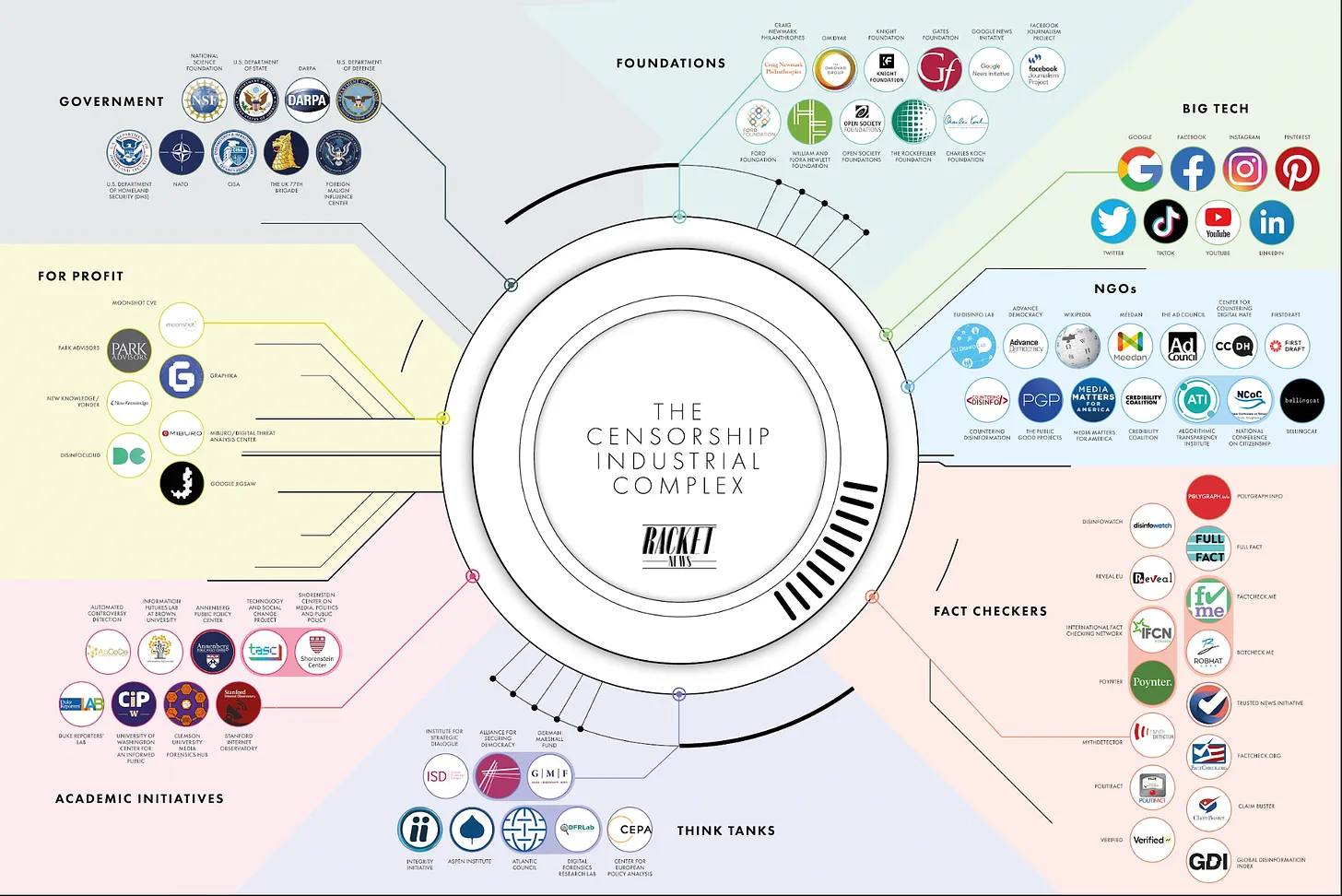
Spending Bill Proposals Include Provisions To Limit Elements of The Censorship Industrial Complex
By Didi Rankovic | Reclaim The Net | July 20, 2023
There is currently an unprecedented legal battle raging in the US between several state attorneys general, a judge who is siding with them, versus a court of appeals that is reluctant; and there’s the activities of the White House that prompted it all.
It’s the case of serious accusations leveled at the Biden administration and major social platforms of colluding to suppress free speech; and even though the developments in the lawsuit so far give some reason for optimism, those in Congress who are vocal about the need to separate the state and “the Church of Big Tech,” as it were, are not resting easy.
Whether or not the First Amendment case results in a resounding victory for the anti-censorship side in the battle, some Republicans are trying to make sure that there is actual legislation in place, rather than only a possible precedent set by a court ruling, to protect speech.
Currently, this is happening in the form of two House spending bills (here and here) that concern the likes of the State Department and the Department of Homeland Security (DHS) – but not exclusively – which basically seek to “defund state-driven censorship,” i.e., these federal agencies’ collusion efforts with Big Tech, the extent of which is shockingly documented in the Twitter Files.
One proposal is to ban the DHS and a group known as the Global Engagement Center from banding together to police online speech.
It comes as Congress is considering the National Defense Authorization Act (NDAA) that is approved every year. A provision would now prevent the Department of Defense (DoD) from bankrolling organizations like NewsGuard, the Global Disinformation Index, and Graphika Technologies.
The wording of the bill is stark: if passed, the Pentagon (DoD) would be banned from giving money to groups that, “advise the censorship or blacklisting of news sources based on subjective criteria or political biases” – doing so under the guise of combating “misinformation,” “foreign propaganda,” and/or performing “fact checking.”
Similar provisions can be found in the House bill drafts that cover the said agencies, but also the Executive Office of the President, the Justice Department, the FBI – and many more.
The Global Engagement Center, meanwhile, is singled out as effectively the kingpin in what the bills refer to as the “censorship industrial complex.”
House Republicans Consider Holding Mark Zuckerberg in Contempt of Congress Over Failure To Disclose Censorship Docs
By Cindy Harper | Reclaim The Net | July 18, 2023
According to sources relaying information to Fox, Chairman of the House Judiciary Committee, Jim Jordan, a Republican representative from Ohio, is contemplating levying contempt charges against Meta’s CEO, Mark Zuckerberg. The move may transpire as early as next week.
The center of the brewing controversy lies in Meta’s failure to disclose internal correspondences pertaining to its censorship policies. Ever since his rise to the helm of the influential House Judiciary Committee earlier this year, Jordan has been relentless in his pursuit of Meta’s internal documents. This scrutiny has intensified following the Republican takeover of the House of Representatives in January.
Meta found itself on the receiving end of a subpoena from the Jordan-led Judiciary Committee back in February, demanding documentation related to the company’s censorship practices. Jordan reiterated his request in May, indicating that Meta’s response to the subpoena was inadequate and lacked the required internal communications among the company’s employees.
The letter from Jordan stated, “Meta’s rolling productions to date have not included material the Committee knows is, or has reason to believe may be, in the company’s possession and that is responsive to the subpoena […] If Meta fails to comply in full with the subpoena’s demands, the Committee may be forced to consider the use of one or more enforcement mechanisms.”
In his plea, Jordan specifically asked Meta to divulge any records that involve “internal meeting notes or discussions of government statements, requests, referrals, or recommendations related to content moderation, including certain documents commemorating findings and/or recommendations regarding whether to apply enforcement actions to purported disinformation.”
When FOX Business approached a Meta spokesperson for comment, they responded, “We have shared over 50,000 pages of documents in response to the committee’s request and have made nearly a dozen current and former employees available to discuss external and internal issues. We look forward to continuing to work with the committee moving forward.”
Nonetheless, a source with firsthand knowledge claims that none of the supplied documents or responses contain the specific internal communications requested by Jordan.
Mental Health Round-Ups: The Next Phase of the Government’s War on Thought Crimes
By John & Nisha Whitehead | The Rutherford Institute | July 18, 2023
Get ready for the next phase of the government’s war on thought crimes: mental health round-ups and involuntary detentions.
Under the guise of public health and safety, the government could use mental health care as a pretext for targeting and locking up dissidents, activists and anyone unfortunate enough to be placed on a government watch list.
If we don’t nip this in the bud, and soon, this will become yet another pretext by which government officials can violate the First and Fourth Amendments at will.
This is how it begins.
In communities across the nation, police are being empowered to forcibly detain individuals they believe might be mentally ill, based solely on their own judgment, even if those individuals pose no danger to others.
In New York City, for example, you could find yourself forcibly hospitalized for suspected mental illness if you carry “firmly held beliefs not congruent with cultural ideas,” exhibit a “willingness to engage in meaningful discussion,” have “excessive fears of specific stimuli,” or refuse “voluntary treatment recommendations.”
While these programs are ostensibly aimed at getting the homeless off the streets, when combined with advances in mass surveillance technologies, artificial intelligence-powered programs that can track people by their biometrics and behavior, mental health sensor data (tracked by wearable data and monitored by government agencies such as HARPA), threat assessments, behavioral sensing warnings, precrime initiatives, red flag gun laws, and mental health first-aid programs aimed at training gatekeepers to identify who might pose a threat to public safety, they could well signal a tipping point in the government’s efforts to penalize those engaging in so-called “thought crimes.”
As the AP reports, federal officials are already looking into how to add “‘identifiable patient data,’ such as mental health, substance use and behavioral health information from group homes, shelters, jails, detox facilities and schools,” to its surveillance toolkit.
Now, through the use of red flag laws, behavioral threat assessments, and pre-crime policing prevention programs, the groundwork is being laid that would allow the government to weaponize the label of mental illness as a means of exiling those whistleblowers, dissidents and freedom fighters who refuse to march in lockstep with its dictates.
Of course, this is all part of a larger trend in American governance whereby dissent is criminalized and pathologized, and dissenters are censored, silenced, declared unfit for society, labelled dangerous or extremist, or turned into outcasts and exiled.
Red flag gun laws (which authorize government officials to seize guns from individuals viewed as a danger to themselves or others), are a perfect example of this mindset at work and the ramifications of where this could lead.
As The Washington Post reports, these red flag gun laws “allow a family member, roommate, beau, law enforcement officer or any type of medical professional to file a petition [with a court] asking that a person’s home be temporarily cleared of firearms. It doesn’t require a mental-health diagnosis or an arrest.”
With these red flag gun laws, the stated intention is to disarm individuals who are potential threats.
While in theory it appears perfectly reasonable to want to disarm individuals who are clearly suicidal and/or pose an “immediate danger” to themselves or others, where the problem arises is when you put the power to determine who is a potential danger in the hands of government agencies, the courts and the police.
Remember, this is the same government that uses the words “anti-government,” “extremist” and “terrorist” interchangeably.
This is the same government whose agents are spinning a sticky spider-web of threat assessments, behavioral sensing warnings, flagged “words,” and “suspicious” activity reports using automated eyes and ears, social media, behavior sensing software, and citizen spies to identify potential threats.
This is the same government that keeps re-upping the National Defense Authorization Act (NDAA), which allows the military to detain American citizens with no access to friends, family or the courts if the government believes them to be a threat.
This is the same government that has a growing list—shared with fusion centers and law enforcement agencies—of ideologies, behaviors, affiliations and other characteristics that could flag someone as suspicious and result in their being labeled potential enemies of the state.
For instance, if you believe in and exercise your rights under the Constitution (namely, your right to speak freely, worship freely, associate with like-minded individuals who share your political views, criticize the government, own a weapon, demand a warrant before being questioned or searched, or any other activity viewed as potentially anti-government, racist, bigoted, anarchic or sovereign), you could be at the top of the government’s terrorism watch list.
Moreover, as a New York Times editorial warns, you may be an anti-government extremist (a.k.a. domestic terrorist) in the eyes of the police if you are afraid that the government is plotting to confiscate your firearms, if you believe the economy is about to collapse and the government will soon declare martial law, or if you display an unusual number of political and/or ideological bumper stickers on your car.
Let that sink in a moment.
Now consider the ramifications of giving police that kind of authority in order to preemptively neutralize a potential threat, and you’ll understand why some might view these mental health round-ups with trepidation.
No matter how well-meaning the politicians make these encroachments on our rights appear, in the right (or wrong) hands, benevolent plans can easily be put to malevolent purposes.
Even the most well-intentioned government law or program can be—and has been—perverted, corrupted and used to advance illegitimate purposes once profit and power are added to the equation.
The war on terror, the war on drugs, the war on illegal immigration, the war on COVID-19: all of these programs started out as legitimate responses to pressing concerns and have since become weapons of compliance and control in the government’s hands. For instance, the very same mass surveillance technologies that were supposedly so necessary to fight the spread of COVID-19 are now being used to stifle dissent, persecute activists, harass marginalized communities, and link people’s health information to other surveillance and law enforcement tools.
As I make clear in my book Battlefield America: The War on the American People and in its fictional counterpart The Erik Blair Diaries, we are moving fast down that slippery slope to an authoritarian society in which the only opinions, ideas and speech expressed are the ones permitted by the government and its corporate cohorts.
Constitutional attorney and author John W. Whitehead is founder and president of The Rutherford Institute. His most recent books are the best-selling Battlefield America: The War on the American People, the award-winning A Government of Wolves: The Emerging American Police State, and a debut dystopian fiction novel, The Erik Blair Diaries. Whitehead can be contacted at staff@rutherford.org. Nisha Whitehead is the Executive Director of The Rutherford Institute. Information about The Rutherford Institute is available at www.rutherford.org.
Jim Jordan Calls on FBI Director To Amend Testimony on FBI’s Social Media “Misinformation” Censorship
By Dan Frieth | Reclaim The Net | July 19, 2023
Jim Jordan, Chairman of the House Judiciary Committee, has raised questions regarding the veracity of FBI Director Christopher Wray’s recent testimony on the bureau’s role in curbing social media “misinformation.”
Jordan, along with Rep. Mike Johnson, who chairs the Subcommittee on the Constitution and Limited Government, have sent a letter to Wray offering him a chance to clarify his statements which appeared to be contradicted by information possessed by the committee and federal court findings.
We obtained a copy of the letter for you here.
Wray had previously stated that the FBI’s emphasis was on thwarting harmful disinformation stemming from foreign adversaries. He had stressed that the bureau doesn’t influence or control social media content, but instead may alert media companies about particular content. The decision of further action, according to Wray, remained within the purview of the respective social media companies.
However, Jordan and Johnson drew attention to Wray’s testimony conflicting with a federal court ruling in Missouri v. Biden. The ruling stated that the FBI had flagged domestic speech as potential misinformation and had significantly urged social media platforms to take specific content-related actions. The court had recently impeded key agencies of the Biden administration from liaising with social media companies, citing potential First Amendment breaches.
Jordan and Johnson also highlighted the court’s finding that the FBI did not attempt to distinguish the origin of misinformation reports related to the 2020 election. The court criticized the FBI for misleading social media platforms about the Hunter Biden laptop story.
The congressional duo also underscored their findings that the FBI had followed up with social media companies and asked for updates regarding flagged accounts. They also suggested that the FBI provided unsolicited advice on whether content would infringe the companies’ terms of service.
Bank’s reasons for booting Nigel Farage revealed
RT | July 18, 2023
UK bank Coutts dropped British politician Nigel Farage as a customer not because his accounts contained insufficient funds but because his social and political views were incompatible with its “values,” according to a 40-page dossier compiled by the bank and seen by the UK Telegraph on Tuesday.
While admitting “there is no evidence of regulator or legal censure of [Farage],” the document concluded Farage was no longer “compatible with Coutts given his publicly-stated views that were at odds with our position as an inclusive organization.”
“This was not a political decision, but one centered around inclusivity and purpose,” the file stated, recommending the UKIP founder be put on a “glide path” to debanking as soon as his mortgage deal concluded – even though he was described as “professional, polite and respectful” in his dealings with Coutts.
While searching for a legitimate reason to drop him, Coutts apparently tried to leverage Farage’s “Russian connections,” only to find he did not have any. The file discussed his appearances on RT, where he was last a guest in 2017, alongside a claim about receiving payment from the Russian network that the bank admitted was bogus, and lamented that his comments about the conflict in Ukraine “fall short of endorsement” of the Russian position.
The bank ultimately settled on reputational risk. Farage “presents a material and ongoing reputational risk to the bank” as he is “regularly (almost constantly) the subject of adverse media,” the document explained, citing dozens of unfavorable news articles, including many from partisan sources like Hope Not Hate and Labour Movement for Europe.
The populist “is seen as xenophobic and racist” and a “disingenuous grifter” who promotes values that “do not align with the bank’s,” the dossier stated, referring to comments that were “distasteful and appear increasingly out of touch with wider society,” reportedly including tweets expressing his belief that the UK should leave the European Convention on Human Rights. His friendships with former US president Donald Trump and Serbian tennis champion Novak Djokovic were also brought up as liabilities.
When Farage revealed last month that Coutts had closed his account without giving a reason, the bank claimed his balance had fallen below the minimum amount required to maintain an account. The dossier, which he obtained through a subject access request, thoroughly contradicts the bank’s statement, explaining that his “economic contribution is now sufficient to retain on a commercial basis.”
Farage described the file to the Telegraph as a “Stasi-style surveillance report” that “reads rather like a pre-trial brief drawn up by the prosecution in a case against a career criminal,” noting the word “Brexit” appears 86 times and that Coutts found no fault with him before Brexit became an issue in 2016.
DISCUSSING THE UK ONLINE SAFETY BILL WITH AMY PEIKOFF
Computing Forever | July 14, 2023
The Online Safety Bill: https://bills.parliament.uk/bills/3137
Follow Amy Peikoff: https://dontletitgo.com/
Bitchute: https://www.bitchute.com/channel/J8ygO5SbU3L1/
Twitter: @AmyPeikoff
Ukraine Jails Senior Orthodox Cleric, Russia Demands Release
By Kyle Anzalone | The Libertarian Institute | July 17, 2023
A senior figure in the Ukrainian Orthodox Church (UOC) was placed in pretrial detention. Cleric Metropolitan Pavlo is facing charges for voicing opinions deemed too pro-Russian.
A Kiev court ordered Pavlo to jail on Saturday. The cleric’s bail was nearly $900,000, and he could remain in pretrial detention for a month. The judge claimed Pavlo violated a court order by contacting a witness in his trial. Pavlo, who is also known as Petro Lebid, says he did not know that the person was a witness.
On April 1, Pavlo was placed under house arrest. Though initially only scheduled for a month, his house arrest has been extended several times. The charges against Pavlo include inciting hatred and justifying the Russian war in Ukraine.
On Saturday, Moscow demanded Kiev release Pavlo. Russian Foreign Ministry spokeswoman Maria said, “We demand strict compliance by the Kiev regime with its international legal obligations, the immediate release of Metropolitan Pavlo, who is suffering from a serious illness, and the provision of proper medical care for him.” She added that the arrest was “yet another manifestation of political arbitrariness and lawlessness [by Kiev.]”
Ukrainian President Volodymyr Zelensky has waged a culture war. The UOC has been a primary target of the “derussification” campaign. On December 1, Zelensky announced that Kiev would attempt to expel all religious institutions with ties to Russia, arguing the move would make “it impossible for religious organizations affiliated with centers of influence in the Russian Federation to operate in Ukraine.”
Kiev further ratcheted up the campaign to erase the UOC by seizing the assets and placing travel bans on several of the church’s top officials. Additionally, a series of raids by Ukrainian police targeted the UOC.
Zelensky’s derussification campaign has extended far beyond the UOC. Kiev has nationalized the media, renamed public places named for Russian historical figures, banned books printed in Russian and outlawed political parties representing Ukraine’s ethnic Russians.
An Illustrious Censorship Institute
Harvard’s “Berkmen Klein Center for Internet & Society”
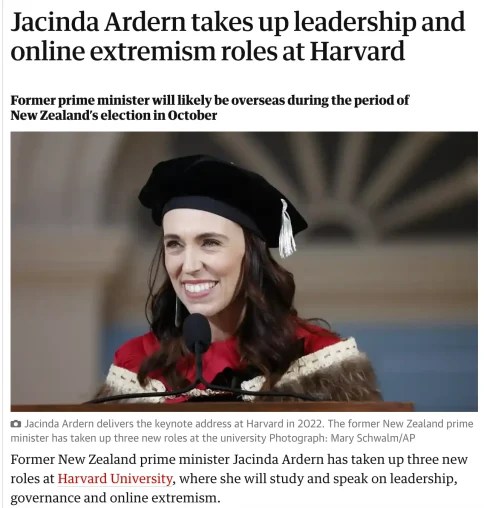
Former New Zealand Tyrant Jacinda Ardern delivering keynote address at Harvard
By John Leake | Courageous Discourse | July 17, 2023
A friend recently sent me a flagrantly political New York Times Editorial by Kate Klonick, “an associate professor of law at St. John’s University who studies law and technology, including the governance of online speech by private platforms.”
In her Opinion, Professor Klonick asserts:
No feat of rhetoric could disguise the flagrantly political nature of the federal court ruling on July 4 that restricted the Biden administration’s communications with social media platforms — but Judge Terry A. Doughty, who wrote the opinion, did his best to cover his tracks. The 155-page opinion, which could hinder the government’s efforts to counter false and misleading online speech about issues like election interference and vaccine safety, is laced with lofty references to George Orwell and quotations from Benjamin Franklin and Thomas Jefferson, making it more reminiscent of a civics essay than a federal judicial opinion.
Two things immediately came to mind as I read this essay:
1). Gramsci’s “Long March Through the Institutions” is now complete, having now made its way through the law department as St. John’s University. Words can’t express how disheartening I found this.
2). Professor Klonick should spend less time pontificating about “online speech” and “vaccine safety” and more time studying civics.
The trouble with lawyers like her is that they don’t understand the SPIRIT of the First Amendment. Because humans are mortal and human affairs are unstable and subject to powerful external forces, the state can always point to innumerable threats (real, perceived, and exaggerated) against which it invokes Emergency Power to reduce or suspend constitutional rules in order “to protect” the citizenry from itself and from foreigners.
James Madison, the author of the U.S. Constitution, recognized that in the grand scheme of human affairs, an overgrown executive posed a greater threat to the citizenry than the unfettered expression of free speech, which will often contain errors.
After reading Professor Klonick’s flagrantly political editorial, I pondered the question: how does the New York Times go about curating columnists like her—that is, a person with a distinguished academic resume who is willing to advocate America’s baleful new censorship regime?
A little Googling revealed that she is is on leave from St. John’s for 2022-2023 serving as a Visiting Scholar at the Rebooting Social Media Institute at Harvard University. An examination of this Institute revealed that it’s a project of Harvard’s Berkman Klein Center for Internet & Society, which recently announced that “Former New Zealand leader Jacinda Ardern joins Berkman Klein Center as Knight Tech Governance Leadership Fellow.”
Her appointment is a notable example of how many prominent public figures who advocated or imposed COVID-19 vaccine mandates “fell upward” by landing plum positions at America’s most prestigious academic institutions after public backlash against their policies and conduct. During her tenure as New Zealand Prime Minister, Ardern imposed some of the most draconian lockdowns and vaccine mandates in the world. In the spring of this year, as New Zealanders grew weary of her tyranny, she resigned and was shortly thereafter offered a job a Harvard.
A little research of financial supports of the Berkman Klein center resulted in this list of donors, which includes the Gates Foundation, George Soros’s Open Society Foundation, Microsoft, USAID, and the World Economic Forum.
And so we see how easy it is to capture men and women who have demonstrated great ambition, ability, and success in their careers, but who have no real interest in or understanding of Constitutional government.
Australian Communications Minister Michelle Rowland Tries To Justify New Censorship Law

By Cindy Harper | Reclaim The Net | July 17, 2023
Australian Communications Minister Michelle Rowland is trying to push back against claims by Coalition MPs that the proposed upcoming legislation would lead to an Orwellian “Ministry of Truth.”
The newly proposed legislation aims to strengthen the Australian Communications and Media Authority’s (ACMA) abilities to manage digital platforms that are seen to propagate “misinformation and disinformation.” However, critics rightly know that the move will threaten the very essence of free speech.
Despite these assurances, skeptics like Coalition communication spokesman David Coleman argue that the regulator will inevitably need to form an opinion on what constitutes misinformation to ensure platforms comply with the new legislation.
“For government to start defining what can and cannot be said in a democracy is hugely concerning. This bill would allow that to happen,” Coleman said, to the Sydney Morning Herald.
The proposed bill gives ACMA the authority to collect information from digital platforms about how they adhere to existing codes.
Moreover, ACMA will have the power to introduce a new “code” for companies that repeatedly fail to address so-called misinformation and disinformation or establish an industry-wide “standard” requiring the removal of harmful content.
Failing to adhere to these standards will carry significant penalties. These include substantial fines, either $6.88 million or 5% of a company’s global turnover, whichever amount is higher.
This policy approach is not without its opponents. Critics argue the broad definitions of misinformation and disinformation as material that is “false, misleading or deceptive” and “reasonably likely to cause serious harm” could be abused by political subjectivity, potentially stifling legitimate views.
Coleman expresses concern over potential self-censorship by digital platforms due to fear of incurring hefty fines. The proposed legislation, in his view, could lead to the suppression of Australians’ authentic opinions. The exemptions within the bill for professional news content, authorized electoral content, and satirical material do little to assuage such fears.
Meta, the parent company of Facebook and Instagram, also expressed apprehensions about the bill’s potential to chill legitimate political expression online, due to the potential for imposing “binding standards” with severe penalties.
Despite previous attempts to increase ACMA powers by the former Morrison government in March 2022, draft legislation was never released. Rowland asserts the Albanese government’s openness to “constructive suggestions” to enhance the bill and is holding public consultations for feedback. However, the opposition has yet to take a formal stance on the legislation.
Featured Video

Ivermectin and iodine
or go to
Aletho News Archives – Video-Images
From the Archives
UN declares war on ‘dangerous’ conspiracy theories
‘World is not secretly run by elites’
Free West Media | August 5, 2022
UNESCO says it is seriously concerned about the increase in “disinformation” and “conspiracy theories”. And they plan to put an end to it through a network of informants.
“Conspiracy theories can be dangerous,” the UN agency warned. “Often they ignore scientific evidence and polarize society with dire consequences. This has to stop.”
Unesco’s director-general warned that “conspiracy theories” could cause damage to people as well as to their health. “They reinforce misconceptions about the pandemic, reinforcing stereotypes that can fuel violence and violent, extremist ideologies,” said Audrey Azoulay.
The UN agency has launched a campaign to help people identify, debunk and report “conspiracy theories” to prevent them from spreading further.
This campaign is being carried out in collaboration with the European Commission, Twitter and the World Jewish Congress. The UN has created a toolkit to “debunk” such theories and smear anyone who dares to claim that governments are not fair and transparent.
The UN also warned that George Soros, the Rothschilds and Israel should not be linked to “alleged conspiracies”.
World events “are not secretly manipulated behind the scenes by powerful players with malicious intent,” the UN agency maintained.
And if anyone therefore comes across someone who believes that the world elite is plotting to consolidate power or direct events, then that person needs to take action. According to the UN agency, when meeting a “conspiracy theorist”, under no circumstances should one enter into a discussion. … continue
Blog Roll
 Aletho News
- Taking the Houthis at Their Word: The Bill Saudi Arabia Doesn’t Want to Read
- Trump claims he would have bombed Ho Chi Minh City to win Vietnam War
- Russia shows Europe that prolonging the Ukraine war is pointless
- There is cautious optimism about ending the Ukraine War – Part 2
- Ukrainian air alert app hacked with fake nuclear warnings
- Ivermectin and iodine
- Congratulations climate skeptics — you are a ‘Hybrid weapon of war’ and a growing public health threat
- ‘The Arab Vote’: How Israeli Racism Has Ruined Their Elections
- Israel forces Palestinians in Gaza to choose between assassination alone or death with their families: Report
- US Approves Sale of 500 Patriot Missiles to Ukraine, Deliveries May Take Years
- If Americans Knew
- Israel Hires Trump Fundraising Vendor for ‘Persuasion Pilot’
- Jordan’s Christians are citizens, not guests
- The 100-year-old Zionist plan to steal southern Lebanon
- Tucker Carlson: Netanyahu pushing Trump to launch nuclear strike on Iran within days
- Israeli Politician Who Said It’s ‘Morally’ Right To Kill Babies in Gaza Wins Knesset Seat
- Mike Rogers Campaign Spokesperson Is a Registered Agent for Israel, Documents Show
- Book Review: A guide to how the media sanitized Israel’s genocide in Gaza
- DAILY UPDATE: Latest essential news on Palestine, Israel, & region
- Israel Revoked Entry Permits of Brad Lander and Other US Jews After West Bank Olive Harvest Detention
- Houston Activists Are Working to Disrupt the Flow of Weapons to Israel
- No Tricks Zone
- Germany’s Green Energy Transition Becoming Increasingly Expensive…Another 6 Trillion Euros!
- Sudden Stratospheric Warming, Powerful El Niño Combination May Lead To Extreme Europe Cold, Energy Crisis!
- Two New Studies Find Thwaites Glacier Melt Cannot Be Driven By Human Activity Or A Warming Ocean
- E-Cars Reduce CO2 Emissions By Only 41% Compared To Internal Combustion Engine Vehicles
- Predictions Made By Renowned Climate Professor Over Past Decades Have Been Proven To Be Poor
- New Study Suggests Large Regions Of The Pacific Ocean Have Been Cooling For The Last 80 Years
- Germany’s Green Energy Debacle: High Energy Costs Force Kahla Porzellan to Close After 182 Years!
- New Study: 50 Years Of The Most Aggressive ‘Net Zero’ Policies Can Only Affect The Global Climate By 0.03°C
- US September “Heat” Was No Record…Many Records Set Decades Ago
- Latest European Green Energy Debacle; Portugal’s Largest Flagship Solar Park Insolvent!