UK Government’s Case for Masks in Classrooms Accidentally Reveals They’re a Terrible Idea
By Will Jones | The Daily Sceptic | January 6, 2022
The Government on Wednesday published the evidence informing its recent controversial decision to recommend all secondary school pupils wear face masks in classrooms.
The new document from the Department for Education (DfE) explains that the decision “has been taken on the recommendation of UKHSA and is based on a range of evidence”. It says the Government has “balanced education and public health considerations, including the benefits in managing infection and transmission, against any educational and wider health and wellbeing impacts from the recommended use of face coverings”.
While conceding that the “direct COVID-19 health risks to children and young people are very low” – and rejecting SAGE’s advice to recommend masks in primary school classrooms (yes, really) – it claims that “the balance of risks for secondary classrooms has changed at this point in time, in accordance with the evolving evidence and the phase of the pandemic”.
The document summarises its evidence as follows:
Face coverings can be effective in contributing to reducing transmission of COVID-19 in public and community settings. This is informed by a range of research, including randomised control trials, contact tracing studies, and observational studies – assessed most recently by UKHSA, described in a review conducted in November 2021. The review’s conclusions were broadly in line with those of a previous Public Health England review; however, the addition of randomised control trials and substantially more individual-level observational studies increases the strength of the conclusions and strengthens the evidence for the effectiveness of face coverings in reducing the spread of COVID-19 in the community, through source control, wearer protection, and universal masking.
In fact, though, the UKHSA review from November 2021 found no high quality studies (except, it claims, the ONS study, which really isn’t high quality). Of the two randomised controlled trials (RCTs) that have been done and which were cited by the UKHSA, the one from Denmark found no statistically significant reduction in COVID-19 incidence from surgical masks (the study didn’t look at cloth masks) while the Bangladesh mask study found no benefit from cloth masks and the reported benefit from surgical masks was just 11%, with a 95% confidence interval that included zero. The UKHSA review also considered 23 observational studies, which it said had “mixed” results and many of which were of low quality and small.
This does not seem a strong basis to claim a large effect for mask wearing. A recent more comprehensive review (which included earlier evidence for other flu-like viruses) by Ian Liu, Vinay Prasad and Jonathan Darrow for the Cato Institute, entitled “Evidence for Community Cloth Face Masking to Limit the Spread of SARS‐CoV‑2: A Critical Review“, concluded that: “More than a century after the 1918 influenza pandemic, examination of the efficacy of masks has produced a large volume of mostly low- to moderate-quality evidence that has largely failed to demonstrate their value in most settings.”
That is a better summary of the evidence than the DfE managed.
Needless to say, the DfE gives the propaganda value of masking a nod: “It can be a visible outward signal of safety behaviour and a reminder of COVID-19 risks.”
Notably, there is no mention in this document of the potential harms of wearing a mask for an extended period, such as the impact on breathing, the heart, or the skin. Contamination gets a brief mention, though it’s quickly dismissed:
Face masks and coverings will become highly contaminated with upper respiratory tract and skin micro-organisms. Disposal of single-use face coverings could theoretically pose a risk of transmission for inappropriately discarded face coverings, but it is very likely that the reduction in transmission risk due to reduced droplet and aerosol emissions from wearing a face covering significantly outweighs any potential for enhanced risk of transmission through inadvertent contact with a contaminated face covering. This is likely to hold regardless of duration that the face covering is used.
The reference provided for these claims is a SAGE document from September 2020, “Duration of Wearing of Face Coverings.” This is an interesting document, but it can scarcely be said to support the claims the DfE is making. On harms from masks, for example, it says:
Neither surgical masks nor face coverings are designed for use for extended periods. Wearing a face covering for an extended period can maintain a higher moisture level around the face which can be uncomfortable for some people and may increase the likelihood of skin complaints. Masks will become highly contaminated with upper respiratory tract and skin micro-organisms. A review of the downsides of face masks and face coverings (by Bakhit et al) found 20 studies reporting irritation and discomfort from using masks. Participants in studies with surgical or cloth masks reported difficulty breathing (12%-34%), facial irritation and discomfort (11-35%). More serious symptoms of headache, acne, rashes were associated with use of N95 and goggles. A study among healthcare workers (by Han et al) associates acne with extended duration of wearing. …
In a clinical study of extended wearing (by Chughtai et al), 124/148 participants reported at least one problem associated with mask use including pressure on face, breathing difficulty, discomfort, trouble communicating with the patient and headache. …
Measurements of heart rate during activity (by Li et al) showed significantly lower rates with a surgical mask compared to N95. In a study (by Fikenzer et al) of healthy young male volunteers surgical masks and FFP2/N95 respirators, both had a significantly marked negative impact on pulmonary capacity (FEV, PEV and PEF) while wearing the mask (with a spirometry mask) during exercise.
The DfE document omits to mention any of these issues. It does, however, include some recognition of the negative impact on education. It mentions a survey conducted by the Department in March 2021 that found “80% of pupils reported that wearing a face covering made it difficult to communicate, and more than half felt wearing one made learning more difficult (55%)”. It also mentions a DfE survey from April 2021 that found “almost all secondary leaders and teachers (94%) thought that wearing face coverings has made communication between teachers and students more difficult, with 59% saying it has made it a lot more difficult”. It adds:
Research into the effect of mask wearing on communication has found that concealing a speaker’s lips led to lower performance, lower confidence scores, and increased perceived effort on the part of the listener. Moreover, meta-cognitive monitoring was worse when listening in these conditions compared with listening to an unmasked talker. A survey of impacts on communication with mask wearing in adults reported that face coverings negatively impact hearing, understanding, engagement, and feelings of connection with the speaker. People with hearing loss were impacted more than those without hearing loss. The inability to see facial expressions and to read lips have a major impact on speech understanding for those with hearing impairments. The worse the hearing, the greater the impact of the mask.
What about the evidence for the claims the document does make – that it is “very likely” that the transmission reduction from wearing a mask “significantly outweighs any potential for enhanced risk of transmission through inadvertent contact with a contaminated face covering” and that “this is likely to hold regardless of duration that the face covering is used”. This is what the cited SAGE document says:
There is a lack of good evidence relating to the wearing of face coverings, with very little data relating to duration of wearing. In particular we suggest that the following aspects would benefit from further research:
• Effectiveness of face coverings as a source control after longer duration wearing, including analysis of the influence of moisture on the performance of different types of face coverings.
• Analysis of the potential risk of transmission due to contaminated face coverings (during and after removal).
• Assessment of the prevalence of skin complaints associated with face coverings, including an understanding of the factors that contribute and potential mitigation.
• Analysis of user acceptability of face coverings for long duration use in different settings.
In other words, there was no good evidence on the things the DfE is claiming are “likely” or “very likely”, or on much else really.
The DfE also carried out its own analysis of the impact of masks in schools.
DfE has also undertaken initial observational analysis based on data reported by 123 secondary schools that implemented face coverings during a 2-3-week period in the autumn term 2021, compared to a sample of similar schools that did not. The preliminary findings demonstrate a potential positive effect in reducing pupil absence due to COVID-19.
What did it find? It found that COVID-19 absences fell by 0.6% more (absolute reduction) in secondary schools that used face masks compared to similar schools that did not over a 2-3-week period, which amounts to an 11% relative reduction.
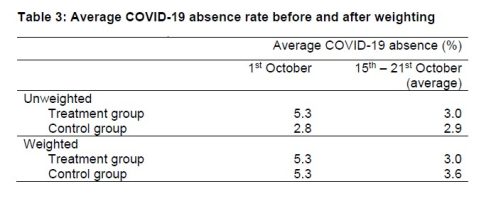
In a weighted sample of secondary schools that did not use face masks, the average COVID-19 absence rate fell by 1.7 percentage points from 5.3% on October 1st 2021 to 3.6% in the third week of October. This is equivalent to a 32% decrease.
In secondary schools that did use face coverings (either face coverings only or a combination of face masks and additional communications e.g. providing more communications to parents but not introducing any further measures such as increased testing), the average COVID-19 absence rate fell by 2.3 percentage points from 5.3% on October 1st 2021 to 3.0% in the third week of October. This is equivalent to a 43% decrease.
At surface level, this suggests that COVID-19 absence fell by 0.6 percentage points more (an 11% relative difference) in secondary schools that used face masks compared to similar schools that did not over a 2-3-week period.
However, the study had numerous limitations, which made the finding a “non-statistical and unknown clinical significant” reduction, i.e., it may just be chance.
There is a level of statistical uncertainty around the result. The analysis is non-peer reviewed and with the current sample size, shows a non-statistical and unknown clinical significant reduction in infection in a short follow up period, including that a ‘false positive’ (i.e. finding that face coverings saw reduced absence when the finding is actually by chance) would emerge around 15% of the time; a 5% threshold is widely used to declare statistical significance in academic literature.
Therefore, further work should be done to extend the analysis in terms of scope: for example, looking at different statistical methodologies, capturing different and longer treatment time periods and controlling for a wider number of school and local area variables to ensure this is a consistent finding.
The statistical uncertainty around the result was such that the 95% confidence interval for the effect size included zero (note in the below the upper CI is positive).

What’s more, the control group of 1,192 schools that didn’t use masks were very different to the 123 treatment schools which did, so that the above findings only emerged after significant weighting was added to the control group schools using a process the document calls “entropy balancing”.
Exploration of the data showed that the control and treatment group had differing characteristics, so weights for the control group schools were calculated using entropy balancing.
Prior to this weighting, the non-mask schools actually had lower average absence rates throughout the study period – though the treatment schools reduced more from their higher starting point.
Prior to weighting, the mean absence rate of the control group increases across the treatment period, whereas the mean absence rate of the treatment group decreases. However, the absence rates in the control group remain lower overall than those in the treatment group.
All-in-all, not exactly robust, compelling evidence of the benefits of masking, particularly given all the well-documented harms, which the document itself either sets out or cites other documents which do.
The document at one point hints at what I suspect is the real reason masks were brought back into classrooms: “In a Unison survey of support staff, 71% said face coverings in secondary school classrooms are an important safety measure.” Conservative MP Jonathan Gullis wrote in the Times this week that: “Face masks have been a central demand of teaching unions.” Sounds vey much like politics rather than science to me. (See this recent Daily Sceptic article by Ben Irvine on the role the teaching unions played in forcing the Government to lockdown in March 2020.)
When are we going to stop harming our young people with pointless interventions to deal with a virus that poses no threat to them and let them live normal lives again?
Stop Press: Oxford Professor of Evidence Based Medicine Carl Heneghan tells Julia Hartley-Brewer he is unimpressed by the Government’s “evidence” for masking in classrooms.
The Shadowy CIA Data Firms Behind the Creation of Digital Vaccine Passport IDs
Daily Veracity | December 17, 2021
In January 2021, tech giants such as Microsoft, Oracle, and MITRE Corporation announced their launch of the Vaccination Credential Initiative (VCI) in partnership with healthcare companies.
On their website, the VCI describes itself as an alliance of private and public organizations dedicated to the development of the ‘issuance of verifiable health credentials’ bound to an individual digital identity.
The VCI idea depends upon a common platform from which digital wallets can be created, and on the VCI website they call for “participating organizations to commit to implementing, testing, and refining the SMART Health Cards Framework within their sphere of influence.”
According to VCI, their ‘SMART Health Cards’ are meant to “work across organizational and jurisdictional boundaries.”
SMART health cards as of now include a person’s name, gender, birth date, phone number, and email address, as well as vaccination status. Developers hope, however, that these cards will eventually become all-encompassing universal digital identities that reside within a universal digital wallet.
Josh Mandel, one of the main developers behind VCI’s SMART health cards system, said once that a complete universal digital identity is ‘essential’ to the effort of creating digital vaccination passes.
On their website, the group uses the term ‘digital wallet’ often and notes that SMART Health Cards could soon be used as digital IDs for all activities, including travel and every purchase an individual makes during commercial activity.
According to the ‘about’ section on their website, the group’s members section includes corporations like Amazon, Microsoft, Google, Apple, and the MITRE Corporation.
Along with the MITRE Corporation, one of the groups listed in the governance section on the website is the Commons Project Foundation, which is the main backer of the VCI and also hosts the VCI website.
The Commons Project Foundation also describes itself as a ‘private and public alliance.’
Listed on the leadership board of the Commons Project Foundation is the President of the Rockefeller Foundation, the Global Head of Performance at BlackRock, the senior managing director at the Blackstone Group, and Julie Gerberding, the former director of the CDC. Gerberding once wrote an op-ed in Time Magazine calling for an ‘International Pandemic Surveillance Network.’
There are many other heads of multilateral development banks (MDBs), former Goldman Sachs partners, UN advisers, and other multinational corporations listed on their assembly.

With the help of the World Economic Forum and the Rockefeller Foundation, the Commons Project Foundation runs the Common Trust Network. Like the Vaccination Credential Initiative and the Commons Project Foundation, the Commons Trust Network describes itself as a ‘private and public alliance.’
The World Economic Forum’s website lists the CEO and CMO of the Commons Project Foundation as Paul Meyer and Bradley Perkins respectively. Following his career at the US Center for Disease Control, Perkins was on the advisory board for the RAND Corporation, and his Partner Paul Meyer wrote President Clinton’s speeches while attending Yale.
In partnership with the World Economic Forum and the Rockefeller Foundation — as well as an almost endless list of corporations and government agencies — the Commons Project Foundation created the CommonPass.
According to the World Economic Forum’s website, just like the VCI, the Commons Project Foundation seeks to “develop and launch a standard global model to enable people to securely document and present their COVID-19 status to facilitate international travel and border crossing.”
The site states that their ‘CommonPass‘ is powered by their “CommonTrust Network™ Registry and VCI™ Directory.” and will allow individuals to document their “COVID-19 status to satisfy country or state entry requirements,” and “access lab results and vaccination records when you need it.”
Dutch Police Sick Attack Dogs On Anti-Lockdown Protesters
Is this what a ‘free’ country is supposed to look like?
By Steve Watson | Summit News | January 3, 2022
Shocking video emerged Sunday of police in Holland beating anti-lockdown protesters with batons and sending in dogs to maul the dissenters.
Massive amounts of people turned out to protest hard lockdown restrictions which were put back into place by the Dutch government before Christmas.
Everything except essential stores has been shut down in the country until at least Jan. 14.
The restrictions dictate that gatherings of more than two people are illegal, so the government sent in the riot police.
Watch:
Covid passport microchip developer says chipping humans is happening “whether we like it or not”
By Ken Macon | Reclaim The Net | January 3, 2022
Towards the end of last year, tech start-up Dsruptive Subdermals announced a microchip installed under the skin that can be scanned to reveal Covid vaccination status.
The technology was criticized, with many calling it “invasive.”
In an interview with Express, the company’s managing director doubled down on the technology and told critics the technology was here to stay.
The technology is a pre-programmed and scannable implant about the size of a grain of rice. It stores the vaccination information, displaying a person’s Covid-19 vaccine passport when scanned.
Speaking to Express, Hannes Sjobald, the company’s managing director, said: “This technology exists and is used whether we like it or not.
“I am happy that it is brought into the public conversation.
“New technologies must be broadly debated and understood.
“Smart implants are a powerful health technology.
“That is what we are building at Dsruptive and our goal is to transform healthcare on a global scale.”
Sjobald said the technology makes the vaccine passports more “accessible.”
“This means it is always accessible for me or for anyone else, really, who wants to read me.
“For example, if I go to the movies or go to a shopping center, then people will be able to check my status even if I don’t have my phone.”
Related:
Supreme Court to Hold Special Session on Legal Challenges to Biden Vaccine Mandates
By Michael Nevradakis, Ph.D. | The Defender | January 3, 2022
The U.S. Supreme Court on Jan. 7 will convene a special session to hear oral arguments in two cases related to the Biden administration’s COVID vaccine mandates.
The two cases pertain to the mandates imposed on private businesses with 100 or more employees, and healthcare facilities participating in the Medicare or Medicaid programs.
The Supreme Court announced Dec. 22, 2021, it would hold a special session to hear both cases, following a series of decisions in lower courts that successively implemented and lifted injunctions against the two mandates.
In both disputes, the formal legal question at hand pertains to whether the federal government can continue enforcing the mandates while legal challenges against them work their way through the judicial system.
In the first instance, the 6th Circuit Court of Appeals, in a 2-1 ruling Dec. 17, 2021, lifted an injunction against Biden’s vaccine mandate for private businesses previously issued by the 5th Circuit Court of Appeals.
The mandate is now set to come into force on Jan. 4, though the Occupational Safety and Health Administration (OSHA) announced it will not begin enforcement of the rule until Jan. 10. The mandate, if and when it is enforced, will impact an estimated 84 million U.S. workers.
Immediately following the 6th Circuit Court ruling, 27 states and several business groups, companies and ministries submitted applications to the Supreme Court seeking an emergency stay.
Two of these requests, one filed by a trade group and the other by a group of states led by Ohio, were formally accepted for oral argument.
These groups were joined by more than 170 Republican lawmakers who on Dec. 30, 2021, jointly filed an amicus brief with the Supreme Court arguing OSHA has no legal authority to impose a vaccine mandate on private businesses.
The Supreme Court, via Justice Brett Kavanaugh — whose jurisdiction includes the 6th Circuit — asked the Biden administration to submit a response to the legal challenges by Dec. 30, 2021.
In its response, Solicitor General Elizabeth B. Prelogar argued the Biden administration possesses the authority, under federal law, to impose the mandate and the Supreme Court should not block a program that will save thousands of lives.
The Supreme Court will also hear arguments pertaining to Biden’s vaccine mandate for healthcare workers at facilities that receive federal Medicare or Medicaid funding. This rule is estimated to impact more than 17 million workers across the U.S.
In this instance, it was the Biden administration that filed an emergency request with the court, requesting it be allowed to temporarily enforce the healthcare worker mandate, which is currently blocked in 24 states following a series of injunctions issued by lower courts.
A brief filed with the Supreme Court by 14 Republican-led states described the mandate as “plainly unlawful.”
The Centers for Medicare & Medicaid Service, which oversees the healthcare mandate, announced Dec. 29, 2021, it will begin enforcing the mandate in the 26 states where it is not blocked.
A modified enforcement timeline accompanied this announcement: Healthcare workers will now be required to receive the first dose of a COVID vaccine by Jan. 27, and the second dose by Feb. 28.
The Supreme Court’s move to hold oral arguments in deciding whether or not to issue an emergency stay is considered unusual. Typically, such cases are placed on the “shadow docket” and are decided without a full briefing or a presentation of oral arguments.
In this instance though, the Supreme Court may seek to alleviate the uncertainty which exists among employers and workers who remain unsure as to whether they are subject to a mandate or not.
It remains unclear whether a decision by the Supreme Court to uphold the injunctions against the healthcare worker mandate will impact all 50 states or only the 24 where the mandate is currently blocked.
Any emergency stay issued by the Supreme Court would not constitute a final ruling regarding either case, but would freeze the enforcement of the two mandates until legal challenges make their way through the federal appeals courts before, most likely, ending up in the Supreme Court for a full hearing.
Separate Biden administration mandates pertaining to such categories as federal contractors and military personnel also have been challenged legally.
In the most recent such example, Judge James “Wesley” Hendrix of the U.S. District Court for the Northern District of Texas ruled against a mask and vaccine mandate for participants in federal Head Start programs. The rules were set to take effect by the end of January.
Texas Attorney General Ken Paxton described the ruling as “a win for the children of Texas.”
However, the Supreme Court will not examine any of these other Biden administration mandates in the Jan. 7 special session.
While the Supreme Court previously rejected requests for emergency stays against state-level vaccine mandates, the court is also viewed as one that is skeptical of the power of federal agencies to issue mandates relating to COVID countermeasures.
This stance was evident, for instance, when the court lifted a moratorium on evictions imposed by the Centers for Disease Control and Prevention, on the basis it was outside the agency’s authority.
Notably, a well-known Supreme Court decision from 1905, Jacobsen v. Massachusetts, which, according to proponents of vaccine mandates, sets a legal precedent for their legality, actually pertains to state-level mandates.
This argument was made by the state of Arizona in its lawsuit against the OSHA mandate, as previously reported by The Defender.
The lack of a federal-level precedent may therefore weigh into the justices’ decision.
Michael Nevradakis, Ph.D., is an independent journalist and researcher based in Athens, Greece.
© 2022 Children’s Health Defense, Inc. This work is reproduced and distributed with the permission of Children’s Health Defense, Inc. Want to learn more from Children’s Health Defense? Sign up for free news and updates from Robert F. Kennedy, Jr. and the Children’s Health Defense. Your donation will help to support us in our efforts.
UK plans to test EVERY school child TWICE this week
… so what happens when you run 7 million lateral flow tests in five days? And are you ready for the “new wave” of “cases” it will likely produce?
OffGuardian | January 3, 2022
New plans, announced before Christmas, will require every secondary school pupil in the UK to take an on-site Covid test when school resumes after the Christmas break.
The government plans, allegedly to “monitor” Covid infection in students, go on to suggest that every child should receive a follow-up test 3-4 days later.
The tests being used are lateral flow tests, which have repeatedly been shown to be completely unreliable, and can test positive using apple juice or coca-cola.
There are roughly 3.5 million school pupils aged 11-16 in the UK and they plan to test them all twice.
If just 2% of them test positive just once, the media will scream about 140,000 new “cases” of Covid in children.
Further, the “recommendations” suggest children should then continue to be tested twice a week, every week, or “more frequently if asked to do so”:
Secondary, college and university students and education staff and early years staff should then continue to test themselves twice a week, and more frequently if they are specifically asked to do so, such as in the event of an outbreak.
At least 7 million lateral flow tests per week, every week.
It’s not hard to see where it goes from there, with the headlines blaring that lack of social distancing over the holidays gave rise to a “fourth wave” (or would it be fifth? I’ve lost count).
I would start preparing for a new lockdown, if I were you.
Lukashenko Told You It Was a Psychosis TWO YEARS Ago

Anti-Empire | January 3, 2022
The entire interwebs are ablaze with the term “mass formation psychosis”. Since a smart Ph.D. visited Joe Rogan everyone and their grandmother are now reading up on it, and emitting into the ether how the COVID panic (hysteria) is nothing but a mass psychosis. That is great. Except that it is January freaking 2022.

It has been a psychosis for nearly TWO YEARS now. It has been evident it is nothing but brain rot in the heads of excitable idiots this whole time. Aleksandr Lukashenko, a Belarusian potato farmer, and a much less educated man than Dr. Robert Malone, diagnosed it as a “psychosis” and an “info-demic” way back in March 2020.
“Despite some criticism on my part, I call this coronavirus nothing other than a psychosis, and I will never deny that, because I’ve gone through many situations of psychosis together with you, and we know what the results were.
“Coronavirus is yet another psychosis, which will benefit some people and will harm others.”
Doesn’t it seem to you that the powerful forces of the world would like to remake the world, without a ‘war’(Emmanuel Macron has already called it a war), through this so-called ‘corona-psychosis’, or ‘info-demic’? Many people are asking: ‘what will happen after the pandemic?’”
Some need the permission of a PhD to start thinking, preferably a PhD they saw on a massive media outlet like Rogan.* Others, like Lukashenko have their common sense.

*Who is on record as saying that without lockdowns you would have had more COVID deaths.
Former Ontario privacy chief says never trust the government with coronavirus cell phone tracking
By Ken Macon | Reclaim The Net | December 31, 2021
Ontario’s former privacy commissioner Ann Cavoukian has warned that the government cannot be trusted with cellphone tracking amid the pandemic. The warning came after it was revealed last week that a federal agency has been using cellphone data to track the movements of Canadians since the beginning of the pandemic.
“It concerns me enormously that this would enable the government to collect more and more information,” Ann Cavoukian told The Epoch Times.
“I do not want to [see] a trend where the government is consistently doing this and starting now. You can’t trust the government.”
Last week, the Public Health Agency of Canada (PHAC) confirmed it has been using cellphone data to analyze movements for the purposes of pandemic policies. The agency plans to continue with the data analysis until 2026, expanding it to other health issues.
“In March 2020, [Prime Minister Justin] Trudeau said that tracking cell phone users was not being considered. Well, they did it, PHAC’s been doing it, and they want to do it even more,” Cavoukian said.
“[Officials] say ‘as soon as the emergency is over, we’re going to return to privacy.’ They don’t. The privacy invasive measures that are introduced during emergencies, pandemics, etc., often continue well after the emergency is over,” she added.
According to the former privacy commissioner, who served from 1997 to 2014, PHAC kept the data collection a secret because “they know people do not want their mobile devices tracked.”
Cavoukian was particularly concerned with the PHAC partnering with other unknown data providers, like the Communications Research Center (CRC).
“In partnership with CRC, PHAC has been producing report summaries to look at how movement trends of the Canadian population have changed over the course of the pandemic, including identifying new patterns to help direct public health messaging, planning and policy development,” PHAC said in a statement to The Epoch Times.
The agency insisted that it did not “receive or collect any individual mobility data” and that it has not stored or acquired individual level data.
On December 16, the PHAC posted a Research for Proposal for a contractor that could “provide it with a steady flow de-identified cell phone data,” reported The Epoch Times.
In a statement, the agency said it “requires access to cell-tower/operator location data that is secure, processed, and timely in addition to being adequately vetted for security, legal, privacy and transparency considerations to assist in the response to the COVID-19 pandemic.”
According to Cavoukian the language in the RFP “reflects an intention to collect this data and retain it.”
She is concerned that the de-identification of data could be done so poorly that it could easily be re-identified.
“At the very least, the Privacy Commissioner’s Office should be all over this, and saying we need to examine exactly what measures you introduced to do this and how you’re going to protect privacy and de-identify data such that it cannot be re-identified,” she said.
“Examine this from end to end. Look under the hood.”
Featured Video

No Vote, No Representation, No State: Democracy, Israeli Style
or go to
Aletho News Archives – Video-Images
From the Archives
Sanctions, War and the Policy of Dual Containment
By SASAN FAYAZMANESH | March 17, 2008
It is now nearly three decades since the Unites States adopted the policy of dual containment of Iran and Iraq. While much has been written about the containment of Iraq, there has been very little in-depth analysis of this policy when it comes to Iran. In a book that is going to be released on March 31, 2008, entitled The United States and Iran: Sanctions, Wars and the Policy of Dual Containment (Routledge), I attempt to address this shortcoming by investigating when and why the US policy of containment of Iran came about, how it evolved, and where it stands today.[1] To the extent that Israel has been involved in US policy making, the study will also include the role that Israel has played in the containment of Iran. Also, since the fate of Iran has been inextricably linked to that of Iraq, occasionally the investigation will overlap with the containment of Iraq.
The policy of dual containment of Iran and Iraq originated during the Carter Administration, but it was not until the Clinton Administration that the expression “dual containment” became popular. … continue
Blog Roll
 Aletho News
- Elmo Sold mRNA Jabs to Your Toddler. Now They Are “Off-Label.”
- British state targets Palestine Action with yet another crooked trial
- Americans are paying the price to preserve Israel’s nuclear hegemony
- Resistance factions are necessary to ensure a permanent US Iraq withdrawal
- How Israel destabilizes the Middle East: Denying sovereignty and the right to exist
- Europe’s Establishment Is Embracing War – and Losing Voters
- NATO chief advocates war of aggression
- No Vote, No Representation, No State: Democracy, Israeli Style
- Zionist Bought Senate Blocks Information About American Citizens Killed By Israel
- While Gaza dominates the UN, these are the people keeping it alive
- If Americans Knew
- Israeli Soldiers Abduct At Least 22 Across Occupied West Bank
- Eight Palestinians Killed in Israeli Attacks on Gaza
- Israeli former leaders and security chiefs threaten legal action over ‘Jewish terrorism’
- Israel map in LA Times ad includes all land from the river to the sea
- Inside Lebanon’s 200-page dossier on Israeli war crimes
- Flydubai, genocide, settler violence, Trump abuse of power to deport – Daily Update
- Counting Antisemitic Incidents: What the ADL Audit Reveals — and Obscures
- Mamdani releases plan to combat antisemitism and hate crimes in New York City
- Iran’s Revolutionary Guards Publish Letter to the American People
- DMFI launches $1 million ad campaign supporting Virginia’s Elaine Luria
- No Tricks Zone
- Green Energy Debacle: German Expert Professor Fritz Vahrenholt Warns Of Severe Economic And Social Consequences
- Two More Paleo Reconstructions Affirm Meters-Higher Sea Levels Across Ireland, Brazil 7000-6000 Years Ago
- New Study: Earth And Venus Surface Warmth Largely Explained By Convection And Lapse Rate, Not CO2 Or Radiation
- 2025 Nature Paper Claiming Worsening Global Drought Gets RETRACTED …Heavily Flawed
- New Study: ‘Global Drought Shows No Detectable Recent Acceleration Under Climate Warming’
- Economic Masterminds: German Socialists Suggest Taxing Productivity Gains Stemming From Using AI
- The South China Sea Has Not Been Cooperating With The Climate Change Narrative
- Energy Crisis: Germany Enters Heating Season With Historically Low Gas Reserve Fill Levels
- New Study: The Antarctic Ice Sheet Gained Mass From 2020-2024 Due To Staggering Snow And Ice Accumulation
- Study: Ocean Heating Rates From Thousands Of Years Ago ‘Dwarf’ Modern Ocean Heating Rates

