Spain’s Top Court Rules That Lockdown Was Unconstitutional
By Paul Joseph Watson | Summit News | July 14, 2021
Spain’s top court has ruled that the country’s national COVID-19 lockdown was unconstitutional following a lawsuit filed by the populist Vox party.
“While leaving intact most of the state of emergency’s terms, the court said that the key articles ordering the population off the streets except for shorts trips for shopping and unavoidable commutes for work and other official business were unconstitutional,” reports the Associated Press.
“According to TVE, the ruling said that the limitations on movement violated citizens´ basic rights and therefore the state of emergency was insufficient to give them constitutional backing. The six magistrates said that a state of exception, which does allow the government to suspend basic rights, would have been necessary.”
During the first six weeks of the lockdown, stay at home measures were so strict that Spaniards weren’t even allowed to go outside to exercise or walk their dogs.
In one case, police were called after a neighbor spotted two brothers playing soccer in their own back yard.
As we previously highlighted, Spain’s lockdown laws were so draconian that at one point authorities briefly told citizens that wearing masks while swimming in the sea was mandatory.
For many months during hot weather, wearing masks in every outdoor setting, even on beaches, was compulsory.
People were also issued fines of €2,000 euros for “disrespecting” a police officer during lockdown.
Numerous instances of police beating people for not wearing masks also emerged, while protesters at one point freed a woman from police arrest while cops were trying to handcuff her for not wearing a face covering.
Early on during the first lockdown, police helicopters fitted with loudspeakers were also used to aggressively order beachgoers to go home.
The Spanish government many now face multiple lawsuits as a result of the lockdown being declared unlawful.
Court Document Shows FBI Used At Least 12 Informants to Entrap Men In Gretchen Whitmer Kidnapping Plot
By Eric Striker | National Justice | July 12, 2021
Defense lawyers yesterday filed a brief detailing the FBI’s extensive role in a Michigan militia’s plot to supposedly kidnap Gretchen Whitmer.
The document, obtained by National Justice, severely undermines the narrative prosecutors and FBI agents have constructed against the six defendants in USA v. Fox, et al, who are accused of multiple serious crimes related to organized terrorism.
In a motion to compel disclosure, lawyers for Kaleb Franks are asking the court to force the government to identify their informants by name, their criminal and mental health histories, and how much money they were rewarded for infiltrating and setting up the defendants.
According to the brief, prosecutors have already identified at least 12 paid informants who were involved in driving the kidnapping plot forward by their Confidential Human Source (CHS) numbers. These informants worked in conjunction with undercover FBI agents, revealing that the small Wolverine Watchmen militia had over a dozen government infiltrators pressuring them into engaging in violent criminal activity.
In the case of Franks, his lawyers cite exculpatory evidence showing that when presented with the idea of kidnapping the Governor, he told government agents that he was “not cool” with the idea and that he only attended a training camp — which was also organized by the FBI — just for the fresh air, fellowship and training.
Franks, who previously struggled with heroin addiction but provided help to his community by getting clean and becoming a professional drug counselor, never intended to break the law. Lawyers accuse the FBI of setting a “hide and seek” standard, where Franks is guilty simply because he was unable to avoid FBI informants that were committing crimes and working together to pressure individual men into doing illegal things.
According to the testimony of Special Agent Hank Impola, who led the investigation, the men in the Wolverine Watchmen expressed negative feelings when Adam Fox, a homeless man informants convinced to think kidnapping Governor Whitmer was a good idea, broached the subject. An informant put on the stand even testified that the men alleged to be at the center of the plot stressed that they did not want to break the law.
Lawyers for the defense have been able to identify payment to at least one infiltrator for his work in propelling the plot forward, a whopping sum of $54,000 dollars. Some of the other informants, mostly ex or current criminals, have been employed as government snitches for decades, including one man who became an informant in 1985 after obtaining information that was later used against his cellmate in prison.
With federal snitches having already confessed to hosting the “training” events where the plot was allegedly concocted, the entrapment defense is growing stronger by the day.
Prosecutors are already scrambling to save their case, primarily by withholding evidence, conscripting the mainstream media to meddle in the case, and even indicting one of their own crucial informants.
Lawyers are also complaining that the FBI and US Attorney are engaging in malicious compliance in the discovery process by deliberately overwhelming them with countless copies of the same pieces of audio and video evidence in hopes of wasting their time and running up the legal fees of the accused.
In another court filing, lawyers are asking for a change of venue due to the media’s role in poisoning the public against the defendants. The defense is also working to suppress a number of pieces of evidence that were outside of the scope of the FBI’s search warrants.
What is now clear is that the Michigan militia plot was not an act of legitimate law enforcement, but instead a political stunt to aid Democrats in a swing state a month before a presidential election.
The Approaching Storm
By CJ Hopkins | Consent Factory Inc. | July 14, 2021
So, it looks like GloboCap isn’t going to be happy until they have fomented the widespread social unrest — or de facto global civil war — that they need as a pretext to lock in the new pathologized totalitarianism and remake whatever remains of society into a global pseudo-medicalized police state, or that appears to where we’re headed currently. We appear to be heading there at breakneck speed. I don’t have a crystal ball or anything, but I’m expecting things to get rather ugly this Autumn, and probably even uglier in the foreseeable future.
Yes, friends, a storm is coming. It has been coming for the last 16 months. And GloboCap is steering right into it. I, and many others like me, have been tracking its relentless advance like a self-appointed International Pathologized-Totalitarian Hurricane Center (you know, like the one in Miami, except all the meteorologists are “conspiracy theorists”). We have documented all the propaganda, the lies, the manipulation of statistics, the abrogation of constitutional rights, the New Normal goon squads, the corporate censorship, and all the rest of the roll-out of the new official ideology and the totalitarian measures deployed to enforce it.
Our efforts have not been in vain, but they have not been successful enough to change the course events are now taking … a course of events that has always been clear, a course that every totalitarian movement needs to take to get where it’s going. You can’t remake entire societies into quasi-totalitarian systems without civil unrest, chaos, rioting, war, or some other form of cataclysm. Brainwashing the masses is all fine and good, but, at some point, you need to goad the people who are resisting your new totalitarian “reality” into getting unruly, so you can crack down on them, and transform them into official enemies, which appears to be what is happening currently.
GloboCap is dialing up the totalitarianism, and they are rubbing it in our faces. Here in New Normal Germany, government officials are openly barking out Goebbelsian slogans like “NO FREEDOM FOR THE UNVACCINATED!” and “THE UNVACCINATED ARE A DANGER TO SOCIETY!” All over Europe, including the UK, where “Freedom Day” is fast approaching, pseudo-medical social-segregation systems are being implemented. In France, Greece, and many other countries, people who refuse to be “vaccinated” are being stripped of their jobs and otherwise punished. In the USA, where the Unvaccinated are also being segregated, New Normal goon squads are going door-to-door, bullying “vaccine hesitant” families into conforming to the new official ideology.
And so on … I’m tired of citing the facts. They do not make the slightest difference to the vast majority of New Normals, anyway. As I’ve noted in several previous columns, these people have surrendered their rationality, and have been subsumed into a totalitarian movement, which has become their perceptual and social “reality,” which their “sanity” now depends upon defending, so the facts mean absolutely nothing to them.
And you already know the facts.
Yes, you. Us. The others. The Unvaccinated. The “Covid deniers.” You don’t really think any hardcore New Normals have made it this far into this column, do you? They haven’t. If they stumbled into it on the Internet and accidentally started to read it, their brains switched off in the opening paragraph … literally, neurologically, switched off. They recognized it as a threat to their “reality” and instantly erased it from their consciousness, or they reported it to the proper authorities, perhaps the FBI, the Bundesnachrichtendienst, or Facebook, or some other global corporation.
This is what it has come to, folks … people are reporting other people’s “thoughtcrimes” to global corporations and the law enforcement agencies of “democratic” governments in the hopes of destroying or damaging their lives, or, at the very least, getting them censored, or otherwise erased from public view.
As I noted in my previous column, our societies have been torn apart. We’re living in two mutually hostile “realities,” a state which cannot continue indefinitely. The problem for us (i.e., the Unvaccinated) is, we probably constitute somewhere around 20 to 25 percent of the population, so we are massively outnumbered by New Normals. The problem for the New Normals is that 20 to 25 percent of the population is way too many people to imprison or otherwise remove from society.
Thus, their plan is to make our lives as miserable as possible, to segregate us, stigmatize us, demonize us, bully, and harrass us, and pressure us to conform at every turn. They are not going to put us on the trains to the camps. GloboCap is not the Nazis. They need to maintain the simulation of democracy. So they need to transform us into an underclass of “anti-social conspiracy theorists,” “anti-vaxxer disinformationists,” “white-supremacist election-result deniers,” “potentially violent domestic extremists,” and whatever other epithets they come up with, so that we can be painted as dangerously unhinged freaks and cast out of society in a way that makes it appear that we have cast out ourselves.
This process is already well underway, and it’s only going to get more intense, which will inevitably lead to social unrest. The hardcore “Unvaccinated” are not going to go quietly. Again, this isn’t Nazi Germany. There are too many of us who are already resisting. They can segregate us, ban us from travelling, blackout our protests, censor us, deplatform us, cancel our bank accounts, and otherwise harass us, but they cannot forcibly disappear us. So, they are going to keep goading us until we lose it. We have demonstrated incredible discipline so far, but eventually, we’re going to run out of patience. It’s going to get messy. People will get hurt.
Which, of course, is exactly what GloboCap wants. Nothing will make them happier than if we turn ourselves into the “violent extremists” they have been conjuring into existence for the last five years. They desperately need us to become those “extremists” before we “embolden” too many others with our “disinformation,” “vaccine hesitancy,” “election result denial,” and general distaste for the whole global-capitalist ideological program.
Unfortunately, they are probably going to get their wish.
What we need is an organized, global campaign of classic, non-violent civil disobedience, but they are not going to give us time to organize that. They are going to keep the pressure on, and crank up the pace, and the official propaganda, and the absurdity, and the confusion, and the ever-changing rules, and the mass hysteria, and the blatant lies, until we start flipping out in restaurants, and in pubs, and schools, and on public transportation, and segregated New Normal establishments start getting nocturnally vandalized, or worse, and other forms of “direct action” are taken.
At which point, game over, because they will have won. We will be the “extremists” they warned themselves about, and they’ll be able to do whatever they want with us, and our former (now New Normal) friends will applaud, or just look away in silence.
Or … I don’t know, maybe I’m wrong. Maybe some New Normals are still reading this essay, and can still, at this late stage, regain their senses. Maybe we can still avoid the storm, and the full implementation of “New Normal Reality.” I know, I’m probably a hopeless idealist, but let me tell you a quick anecdote before I let you go.
I’ve been kind of nudging, or politely badgering, Glenn Greenwald, who I respect, and have always respected, to grow a pair and at least speak out against the totalitarian features of the New Normal movement. Glenn is totally on board with the official Covid narrative, and has made it clear that he has no interest in using his investigative-journalism skills to investigate that official narrative. Despite that, I have continued to nudge him, and politely prod him, and otherwise urge him, to maybe post a few critical words, or raise a few investigative-journalist questions, about the most flagrant official propaganda campaign in the history of official propaganda campaigns and the blatantly totalitarian actions of governments all over the world.
For example, I posted this on Twitter recently.

Shortly thereafter — and I’m sure this was just a coincidence, because Glenn doesn’t follow the Consent Factory — he tweeted this bit of New Normal blasphemy:

So, apparently, it is, in fact, still possible for people who believe the official Covid narrative as if it were the Word of God to speak out against some aspect of it, or just politely question the logic of it, or otherwise stop behaving like a bunch of mindlessly obedient “Good Germans” as a new iteration of totalitarianism is rolled out right in front of their eyes.
Yes, I know. I’m clutching at straws, but I have this crazy faith in people. On top of which, I’m getting old, so I am not looking forward to the street-fighting part of this as much as I would have 30 or 40 years ago.
Oh, and, I almost forgot, to all my friends in the New Normal UK … have a lovely Freedom Day!
#
France’s mandatory ‘health pass’ with government-issued QR codes is the start of a dystopian nightmare

A police officer checks a woman’s self-certified note for being out near the Notre-Dame Cathedral in Paris on April 15, 2020. © THOMAS COEX / AFP
By Rachel Marsden | RT | July 14, 2021
President Macron’s announcement that citizens must adhere to a Covid-19 vaccination schedule, or pay for nose-swab tests every 2-3 days to live any semblance of a normal life, is the final nail in the coffin of civil liberties.
In the dead of summer, just a couple of days before the July 14 Bastille Day national holiday, when many French citizens had tuned out and left the big cities for some respite from a long stretch of sanitary restrictions – including months of curfews – French President Emmanuel Macron took advantage of the lull to drop a bomb on their lives that few were expecting.
From July 21, a health pass including a government QR code will be necessary for those over the age of 12 to access bars, restaurants, cinemas, gyms, swimming pools, museums, shopping centers, and any other venues capable of holding at least 50 people. Employees of these venues are included, if they want to keep their jobs.
The government will issue people a QR code to activate the pass by only two means: pricey PCR or antigenic nose-swab tests that Macron says will have to be paid out of pocket starting in October, or a full course of two jabs of the Covid-19 vaccination, which he also said will be the subject of a new round of third doses, starting in September.
What’s particularly stunning is that there is little recognition of acquired immunity – as though our immune systems are virtually useless. There is no way for someone who has recovered from Covid-19 to obtain a QR code as the result of a blood test proving the presence of adequate post-infection antibodies conferring immunity. The government considers their naturally acquired protection invalid and wants those who already have proven antibodies to take at least one dose of the vaccine.
The system does allow those who have a QR code from a positive Covid-19 PCR test up to six months old to obtain the health pass, after which they are then expected to take the shot as well – all this despite ample research indicating lasting immunity in previously infected individuals.
By shoehorning everyone into just two government-defined camps – compliant vaccinated individuals who will be allowed to live normally, and the unvaccinated non-compliant who will be denied access, despite the fact that both are capable of catching and transmitting the disease – it feels like the public health crisis is being used to implement a new dystopian system that permits tracking of everyone who wants to participate in everyday life.
And, as of September 15, healthcare workers who aren’t fully vaccinated “won’t be able to work and won’t be paid,” according to health minister Olivier Veran.
So much for France’s motto of “Liberty, equality, fraternity.” Liberty no longer exists when the government decides with a flash of a QR code generated at its whim whether you can live normally or not.
And while Macron was adamant about maintaining solidarity and equality among citizens by not singling out either the most vulnerable fatsos or the elderly for restrictions at the height of the pandemic – choosing instead to lock down the entire country – he now has no qualms about treating Covid victims with natural immunity, and those who simply don’t think that vaccination is the right decision for them, as second-class citizens who can rot at home with no access to daily life.
Fraternity? Pitting the vaccinated against the anti-vaccinated – with Macron treating the former as the ‘good’ citizens and the other as the ‘bad’ in his official narrative – has been adopted far too easily and uncritically by many. These people fail to see that vaccination status is a false dichotomy that effectively herds every single citizen into a single camp: those with a QR code issued and mandated by the government. It just so happens that those who refuse the QR code have to be unvaccinated by definition. Therefore, anyone who is resistant to the implementation of this new government tracking system should oppose any attempt to divide society by personal medical decisions and support individual choice of all – including the unvaccinated.
This destruction of fundamental freedoms is all the more striking at a time when Covid deaths and hospitalizations are incredibly low. First this crisis was about saving the hospitals, then it was about saving lives, then it became about reducing cases, and now that sound you hear are the goalposts being dragged again to make it all about preventing some potential future event.
It all seems like a system is now being implemented that will last well beyond Covid-19. If that thought doesn’t wake up the French, who last hit the streets en masse for months on end to protest a rise of a few cents in the price of gas, then it’s because the government they so distrusted has now successfully managed to co-opt and neutralize them.
Now is the time to take a stand against this continuing erosion of our freedoms. But how many French are even still awake?
Rachel Marsden is a columnist, political strategist and host of an independently produced French-language program that airs on Sputnik France. Her website can be found at rachelmarsden.com
Tennessee vaccinations turn political: Dems denounce state halting programs that Republicans say bypassed parents
RT | July 14, 2021
After Republican lawmakers voiced concerns that Tennessee health authorities were directly targeting schoolchildren for Covid-19 vaccinations, the state halted the program – and came under fire from outraged Democrats.
The state Department of Health (TDH) is halting “adolescent outreach” for all vaccines, not just Covid-19, the Tennessean daily newspaper reported on Tuesday, citing “internal report and agency emails” they obtained. This includes Covid-19 vaccination drives on school property and reminders for teens to get their second dose of the jab.
Postcards and reminder emails will be sent to parents, so that they won’t be “potentially interpreted as solicitation to minors,” according to a TDH report cited by the Nashville-based daily.
The decision was reportedly made by Health Commissioner Dr. Lisa Piercey personally, and comes after the Monday firing of Dr. Michelle Fiscus, which the paper described as “Tennessee’s former top vaccine official.”
Fiscus claimed the decision was due to pressure from Republican state lawmakers who had embraced “misinformation” about Covid-19 vaccines. She also complained to CNN about a “toxic” environment at work.
At a legislative hearing in June, some GOP lawmakers accused TDH of circumventing parents and pressuring minors to get the vaccine using the school environment. Some conservatives said Fiscus was pushing to vaccinate teens without parental knowledge or approval, using what is known as the Mature Minor Doctrine, which typically says children 15 or older can consent to medical treatment.
According to the Tennessean, TDH Chief Medical Officer Dr. Tim Jones told staff they should conduct “no proactive outreach regarding routine vaccines” and “no outreach whatsoever regarding the HPV [Human papillomavirus] vaccine.” All school vaccination information should come from the Department of Education instead.
The paper’s report caused widespread outrage among Democrats. Former first daughter turned public health advocate Chelsea Clinton called the policy change “horrifying” with potentially “tragic consequences,” and insisted there was “no reasonable or moral defense” of it.
“Trumpism and right-wing anti-science extremism is harming and killing Americans,” declared Mother Jones writer David Corn, while Howard Fineman of the Yale School of Medicine called Republicans “pro-death & anti-science.”
“Does Tennessee really want kids not to be vaccinated against measles, mumps or meningitis,” Congressman Ted Lieu (D-California) wondered on Twitter.
“We’ve governed by nut-jobs with the intellectual skill sets of five year olds on sugar highs,” lamented Obama administration staffer and Democrat candidate for Congress Christopher Hale, who pointed out the halting of outreach applies to polio vaccines as well.
“They’re now, like, pro-polio?” tweeted MSNBC host Rachel Maddow.
However, the CDC recommends polio vaccinations starting at two months, with subsequent doses through age six. Measles-Mumps-Rubella (MMR) vaccines are typically given starting at 12 months, while the CDC recommends meningitis shots starting at age 11. None of these would apply to school outreach to teens.
The Tenneseean report did include a statement by TDH spokesperson Sarah Tanksley, who said the agency was responding to “an intense national conversation that is affecting how many families evaluate vaccinations in general.”
“Tennessee is on solid footing when it comes to childhood immunizations and will continue to keep information and programming in place for parents,” Tanksley said. “We are simply mindful of how certain tactics could hurt that progress.”
Covid-19 vaccinations at schools are being discontinued in part because of low demand, she added, but also “out of an abundance of caution” because they were “perceived by some to give the wrong impression regarding parental consent.”
“While the location may change, the effort to vaccinate individuals who choose to receive it continues,” Tanksley said.
YouTube censors public Lake Forest School District board meeting where parents opposed mask mandates
By Tom Parker | Reclaim the Net | July 13, 2021
YouTube has scrubbed a public Lake Forest High School District 115 board meeting from its platform after numerous parents at the meeting spoke out against required masking.
Ben Bradley, a news anchor and investigative reporter for WGN TV News, tweeted: Our understanding is that people reported the content to youtube as a violation of its terms, which triggered the removal while youtube reviews.”
Twitter user Harriet Smith Martin said “numerous parents spoke against required masking” at the meeting and added that the video was removed before she had finished listening to it.
“The video was up as of 10:30 or so last night (I was watching it.),” she tweeted. “When I went back to finish listening this morning, it was gone.”
Under its far-reaching “medical misinformation” policy, YouTube prohibits a wide range of claims about masks including claims that “wearing a mask is dangerous or causes negative physical health effects,” that “wearing a mask causes oxygen levels to drop to dangerous levels,” or that “masks do not play a role in preventing the contraction or transmission of COVID-19.”
As a result of this policy, numerous public debates and meetings on mask mandates have been censored by the tech giant.
In May, a public Shawnee Mission School District board meeting was removed under similar circumstances. The meeting was open to public comment and parents urged the district to remove mask mandates. YouTube flagged these comments as “misinformation” and removed the video.
A few days after this video was removed, YouTube deleted a Georgia mom’s testimony against mask mandates during a school board meeting. YouTube again claimed that the video violated its medical misinformation rules.
Video producer Matt Orfalea censored again for calling out YouTube censorship
By Tom Parker | Reclaim the Net | July 13, 2021
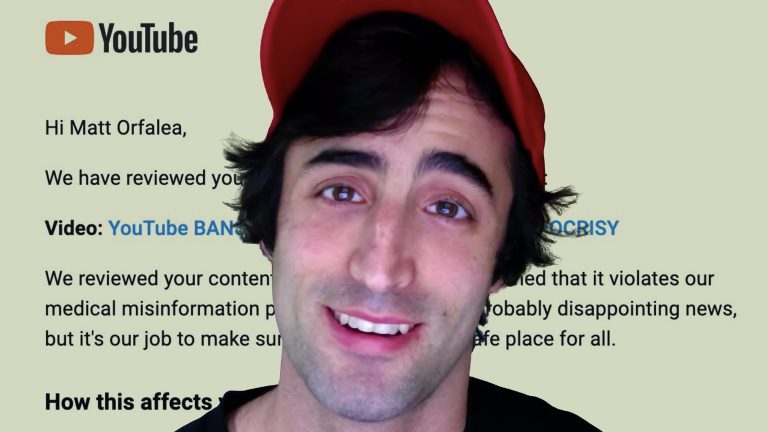
After he published a video discussing YouTube’s censorship last month, video producer Matt Orfalea was censored and had his channel demonetized. Now, YouTube has targeted Orfalea once again and removed another video where he and his guest, independent journalist Alison Morrow, called out the tech giant’s censorship.
In the video, which is titled “YouTube BANS Reporter Exposing YouTube HYPOCRISY,” Orfalea and Morrow recapped the escalating YouTube censorship they have both faced.
This censorship began in June when Orfalea’s YouTube channel was suspended for uploading what he described as “unpublished rough cuts” of a video highlighting YouTube’s censorship of ivermectin.
Orfalea was then demonetized in July after YouTube flagged a seven year old, 13 second parody video for allegedly violating its “violent criminal organizations” policy. After facing backlash, YouTube admitted “error” but did not re-monetize his videos.
A few days after Orfalea was demonetized, he was a guest on Morrow’s channel in a video where she highlighted how mainstream media outlets are allowed to violate YouTube’s “medical misinformation” policy without facing sanctions. This video was censored and then reinstated after YouTube faced pushback for taking it down.
In the “YouTube BANS Reporter Exposing YouTube HYPOCRISY” video, Morrow suggested that her video may have been removed because of Orfalea’s guest appearance and speculated that YouTube’s artificial intelligence (AI) could be flagging people that have previously been sanctioned by YouTube and then censoring videos from other creators that associate with those that have been flagged.
“This is just a perfect example of what’s happening now,” Orfalea added. “Where we have this caste system, this blatant double standard… so clearly, as you’ve described, this is not about protecting viewers from misinformation, this is about allowing, you know, some privileged class of journalists… corporate media and allow them to say things without being challenged.”
Shortly after Orfalea posted this video where he and Morrow criticized YouTube for its censorship, YouTube took it down for allegedly violating the platform’s “medical misinformation” rules.
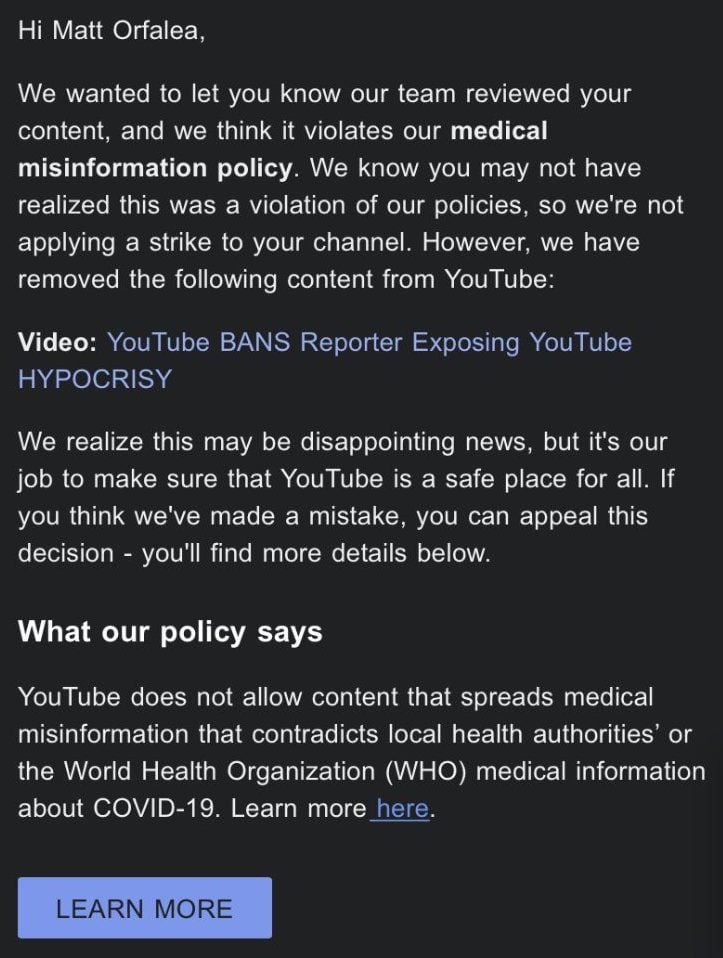
Orfalea appealed but YouTube rejected the appeal and told him: “We reviewed your content carefully, and have confirmed that it violates our medical misinformation policy.”
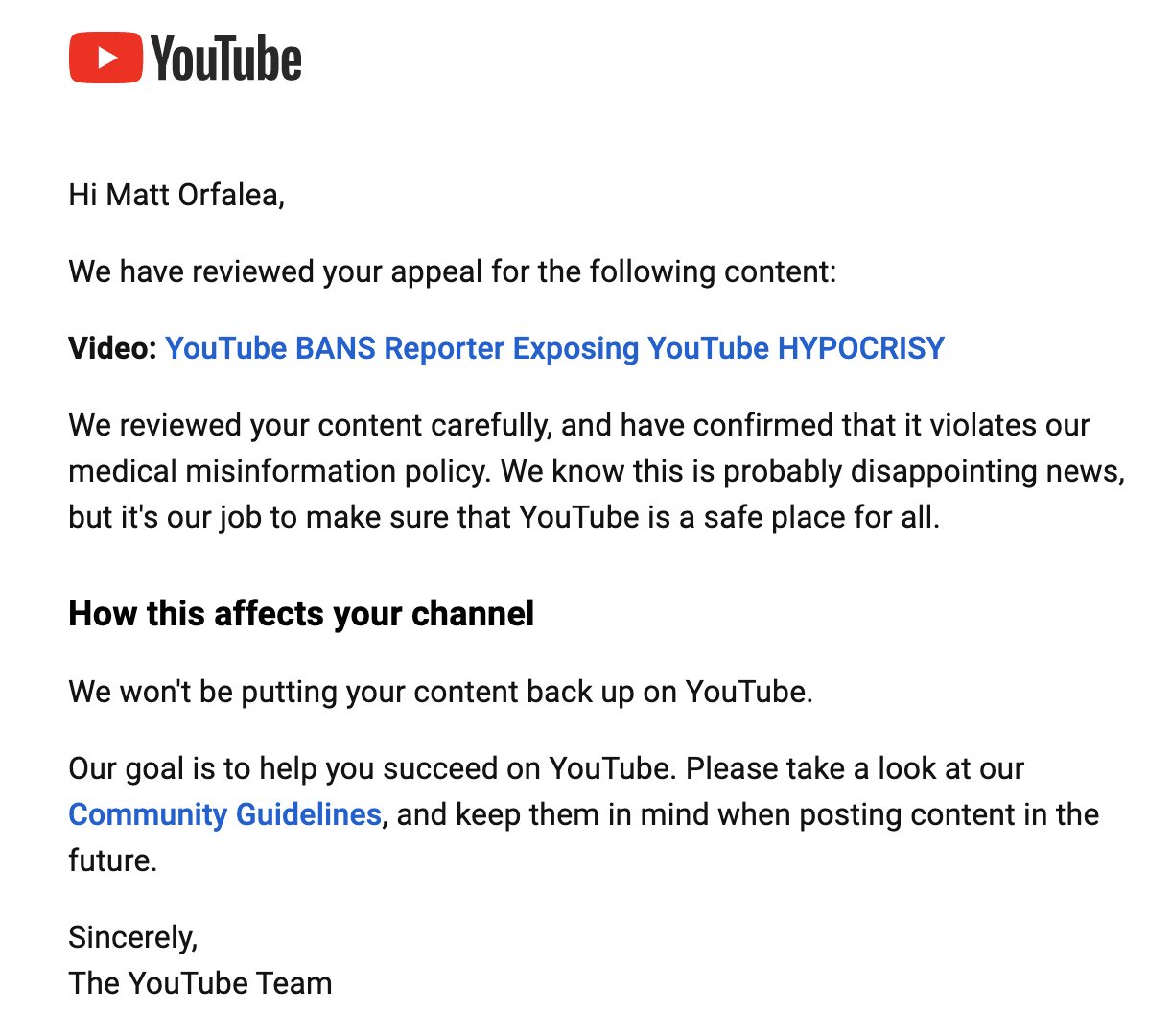
“I’ve been dealing with this insanity for almost a full month now,” Orfalea said after YouTube rejected his appeal. “YT reinstated Alison’s video. So they should reinstate my video, referencing hers, too!”
YouTube’s consistent targeting of Orfalea is reflective of the double standard on YouTube between independent creators and mainstream media outlets that he called out in this now-censored video.
Independent creators are 20x less likely to top coronavirus search results, 14x less likely to be recommended on election related content, and 10x less likely to top search results for some other newsworthy events.
YouTube’s CEO Susan Wojcicki has also admitted that the platform’s recommendation algorithm was changed in response to the media’s radicalization theory and said the platform won’t recommend YouTubers for breaking news.
Related: 🛡 Big Tech’s double standard on “conspiracy theories” when they come from mainstream media
Since the 8th of March, There Have Been 9,484 *Fewer* Deaths Than Normal
By Noah Carl | Lockdown Sceptics | July 13, 2021
Today the ONS announced that there were 8,808 deaths in England and Wales in the week ending 2nd July 2021. This is 118 more than the previous week, but still 5.2% below the five-year average. Here’s the chart from the ONS:
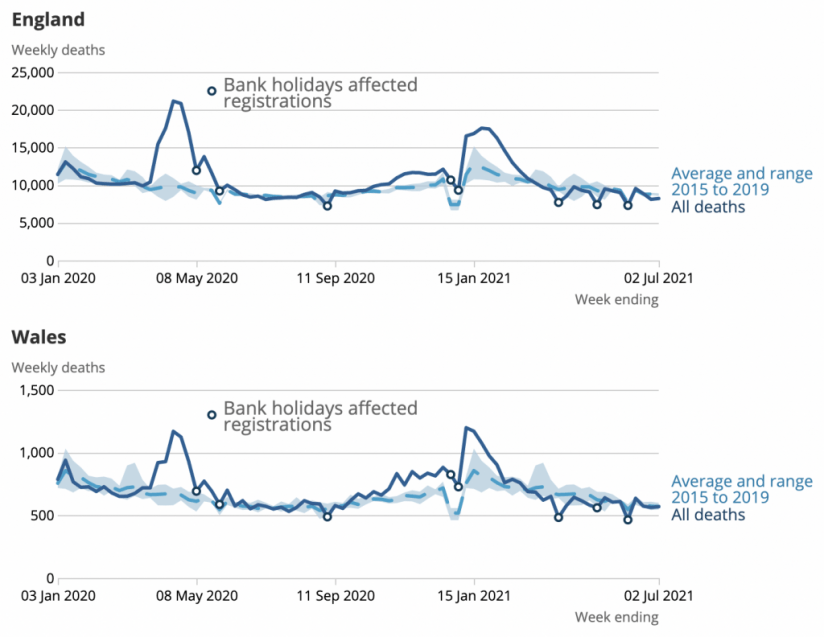
Deaths in England and Wales have now been below the five-year average for 14 of the past 17 weeks. Over that time, there were 9,484 fewer deaths than you’d expect based on the average of the last five years. And recall that, due to population ageing, the five-year average understates the expected number of deaths. Hence the true level of “negative excess mortality” is even greater.
The number of deaths registered in the week ending July 2nd was below the five-year average in seven out of nine English regions. (Only the North East and North West saw positive excess deaths.) Compared to the five-year average, weekly deaths were 10.7% lower in the East of England, and a remarkable 12.1% lower in the South East.
The fact that “negative excess mortality” has now persisted for three consecutive months supports the hypothesis that deaths were “brought forward” by the pandemic.
It’s been widely noted that the link between cases and deaths has weakened substantially in recent weeks, thanks to the build up of population immunity. Although the number of daily infections has surpassed 20,000, the number of daily deaths remains in the low double digits. However, the situation is actually even more positive: measured by excess deaths, the pandemic hasn’t taken any lives since early March.
Democrat Groups Plan to ‘Fact Check’ Private SMS Messages
By Paul Joseph Watson | Summit News | July 12, 2021
Groups allied with the Biden administration are planning on working directly with cellphone network providers to ‘fact check’ private SMS messages if they contain “misinformation about vaccines.”
The revelation is made in a Politico article which explains how the White House is preparing to characterize “conservative opponents of its Covid-19 vaccine campaign as dangerous and extreme.”
The decision to ramp up the information war against vaccine skeptics was made after conservatives showed resistance to the Biden administration’s plan to go “door-to-door” to increase vaccination rates.
“Biden allied groups, including the Democratic National Committee, are also planning to engage fact-checkers more aggressively and work with SMS carriers to dispel misinformation about vaccines that is sent over social media and text messages,” states the report. “The goal is to ensure that people who may have difficulty getting a vaccination because of issues like transportation see those barriers lessened or removed entirely.”
The prospect of the DNC and other government-affiliated groups having access to Americans’ private text messages represents a chilling surveillance dystopia.
Interfering with and trying to ‘fact check’ people’s personal conversations is also utterly demented.
Recall that ‘fact-checkers’ infamously declared the Wuhan lab leak hypothesis to be a “debunked conspiracy theory” at the start of the pandemic, only to be forced into a humiliating reversal later on.
In doing so, they may have helped facilitate one of the biggest cover-ups in modern history, so what business such groups have in snooping on people’s private SMS messages is anyone’s guess.
YouTube deletes channel of Spain’s political party, VOX
Deleted with no recourse
By Didi Rankovic | Reclaim the Net | July 12, 2021
YouTube has deplatformed Spain’s fast-rising conservatives gathered around VOX, currently the second-largest opposition party in the country’s parliament.
A notice on the party’s now-deleted channel reads that it was terminated over multiple copyright infringement claims.
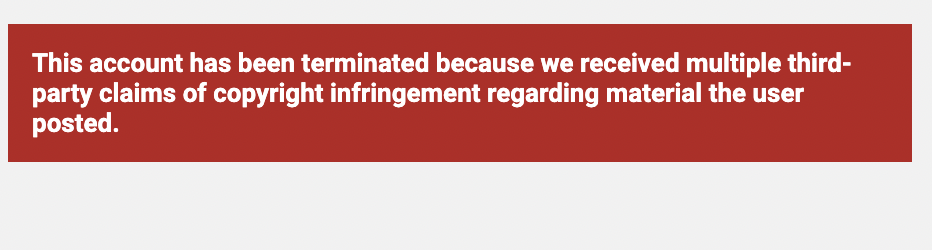
The videos in question have been backed up on AltCensored, a platform set up to keep record of content deleted by YouTube or self-censored on the platform.
Often branded in mainstream Western media as an “extreme-right” and an “Islamophobic” party, VOX earlier this year gained more ground with a strong showing in regional elections in Catalonia, where they took the role of conservative leaders it the local parliament.
VOX, on the other hand, maintains that its goal is to defend Spanish values and way of life, advocate for a smaller state apparatus, and protect privacy from government intrusion.
However, YouTube’s termination notice doesn’t mention any content contentious per se, but rather unspecified alleged copyright infringement. While it isn’t clear what the exact reason for the deletion of the YouTube channel is, it isn’t uncommon for the giant’s copyright rules to be abused as a way to achieve unrelated goals.
False copyright claims can be used for anything from unmasking identities, extorting money, to simply blocking content somebody doesn’t like.
Until the mystery of what exactly prompted YouTube to kick VOX off the platform, what’s certain is that this isn’t the first time the party has had trouble on Big Tech owned social media. In May, Francisco Jose Contreras, a VOX MP, got locked out of Twitter for stating that “a man cannot get pregnant.”
The temporary ban came after Contreras shared a link to a story about a man who had “given birth to his child.”
“That’s a lie. A man cannot get pregnant. A man has neither uterus nor ovaries,” Contreras commented at the time. Twitter then suspended him for spreading “hatred.”
Featured Video
No Vote, No Representation, No State: Democracy, Israeli Style
or go to
Aletho News Archives – Video-Images
From the Archives
Sanctions, War and the Policy of Dual Containment
By SASAN FAYAZMANESH | March 17, 2008
It is now nearly three decades since the Unites States adopted the policy of dual containment of Iran and Iraq. While much has been written about the containment of Iraq, there has been very little in-depth analysis of this policy when it comes to Iran. In a book that is going to be released on March 31, 2008, entitled The United States and Iran: Sanctions, Wars and the Policy of Dual Containment (Routledge), I attempt to address this shortcoming by investigating when and why the US policy of containment of Iran came about, how it evolved, and where it stands today.[1] To the extent that Israel has been involved in US policy making, the study will also include the role that Israel has played in the containment of Iran. Also, since the fate of Iran has been inextricably linked to that of Iraq, occasionally the investigation will overlap with the containment of Iraq.
The policy of dual containment of Iran and Iraq originated during the Carter Administration, but it was not until the Clinton Administration that the expression “dual containment” became popular. … continue
Blog Roll
 Aletho News
- No Vote, No Representation, No State: Democracy, Israeli Style
- Zionist Bought Senate Blocks Information About American Citizens Killed By Israel
- While Gaza dominates the UN, these are the people keeping it alive
- New Report: “Scholasticide and Genocide in Gaza: Assessment, Testimonies and Legal Analysis”
- ‘THAAD Delusion’: Iran war exposes US missile shield limits – The Atlantic
- Moscow issues warning to NATO over Russian exclave
- Yes, the Iran war has destroyed Trump’s presidency
- The fallacy of US delusions about Iran’s economic collapse
- Hezbollah denies Syria cell link, warns of Israeli plan to sow discord
- The legacy of US sanctions, war, and occupation in Iraq
- If Americans Knew
- Mamdani releases plan to combat antisemitism and hate crimes in New York City
- Iran’s Revolutionary Guards Publish Letter to the American People
- DMFI launches $1 million ad campaign supporting Virginia’s Elaine Luria
- US Senate blocks resolution seeking report on Americans killed by Israel
- Israeli Attacks Kill Ten Palestinians in Gaza
- Massacre at Minab: The School That Became a Grave
- Israeli media: The IDF Shows It Doesn’t Turn a Blind Eye; It Actively Emboldens Settler Havoc
- As settlers ravage West Bank, Israeli forces kill 10 in Gaza – Daily Update
- New Report: “Scholasticide and Genocide in Gaza: Assessment, Testimonies and Legal Analysis”
- Ex-Biden officials are desperate for a Gaza scapegoat
- No Tricks Zone
- Green Energy Debacle: German Expert Professor Fritz Vahrenholt Warns Of Severe Economic And Social Consequences
- Two More Paleo Reconstructions Affirm Meters-Higher Sea Levels Across Ireland, Brazil 7000-6000 Years Ago
- New Study: Earth And Venus Surface Warmth Largely Explained By Convection And Lapse Rate, Not CO2 Or Radiation
- 2025 Nature Paper Claiming Worsening Global Drought Gets RETRACTED …Heavily Flawed
- New Study: ‘Global Drought Shows No Detectable Recent Acceleration Under Climate Warming’
- Economic Masterminds: German Socialists Suggest Taxing Productivity Gains Stemming From Using AI
- The South China Sea Has Not Been Cooperating With The Climate Change Narrative
- Energy Crisis: Germany Enters Heating Season With Historically Low Gas Reserve Fill Levels
- New Study: The Antarctic Ice Sheet Gained Mass From 2020-2024 Due To Staggering Snow And Ice Accumulation
- Study: Ocean Heating Rates From Thousands Of Years Ago ‘Dwarf’ Modern Ocean Heating Rates

