A recipe for disaster
By Pseudonym de Plume | The Conservative Woman | June 14, 2021
1. Mix together some natural pathogens and government science to develop highly infectious coronasauce. Reduce coronasauce until it’s as thick as thieves.
2. Take one patent system which facilitates rent-seeking. Add coronasauce testing kits and coronasauce ‘antidote’.
3. Indemnify coronasauce ‘antidote’ manufacturers from liability, creating toxic brew of moral hazard.
4. Apply coronasauce to the public and baste with hysteria. (Side recipe: create hysteria from fraudulent PCR test data).
5. Exploit monopolistic licensing system to coerce medical doctors into compliance against their better judgment and pricked consciences. And Hippocratic oath.
6. Vigorously suppress mitigating treatment options to justify emergency consumption of coronasauce ‘antidote’.
7. Isolate and discard voices of reason using the Trusted News Initiative.
8. Inject coronasauce ‘antidote’ into every human on the planet initially twice, but aim for ad infinitum*.
9. Profit**
* If a bitter aftertaste of depopulation is experienced, see Build Back Better recipe for soothing utopianism.
**Enjoy your wages of sin while you can. A banquet of consequences may follow.
Poll shows 79% of Democrats support employers forcing workers to get Covid-19 jabs
RT | June 13, 2021
A new poll shows that Democrats and Republicans are just about as divided on an employee’s right to choose whether to get vaccinated against Covid-19 as they are on a woman’s right to choose whether to abort her unborn child.
Nearly 80% of Democrats agreed that employers should be able to force their workers to get Covid-19 shots, according to a CBS News-YouGov poll released on Sunday. In contrast, only 39% of Republicans approved of giving businesses such authority over their employees’ medical choices. The overall response was 56-44 in favor of forced jabs.
Supporters of the two major parties are more split on vaccine choice than on Covid-19 inoculation in general. While 95% of Democrats have already been vaccinated or are at least considering it, 71% of Republicans are on board or thinking about taking the jab, the poll showed.
That result suggests some improvement in vaccine acceptance in the past two months. A Monmouth University poll released in mid-April indicated that 43% of Republicans don’t intend to get vaccinated against the virus. In the CBS News-YouGov survey, 29% of Republicans said they had ruled out the shots. Overall, only 18% of respondents said they won’t get vaccinated, while 71% said they had either already gotten a jab or planned to do so. The other 11% were undecided.
The issue of employer-mandated vaccination is heating up, as a Texas judge on Saturday issued the nation’s first federal court ruling on whether workers can be ordered to receive Covid-19 shots.
The judge dismissed a lawsuit against the Houston Methodist hospital system, in which employees argued that they faced wrongful termination of their jobs for refusing to receive Covid-19 vaccines. The ruling, which will likely be appealed, affirmed the hospital system’s right to mandate vaccination, even though the three inoculations available in the US have received only emergency use authorization, not full FDA approval.
Ironically, while Democrats are pro-choice on abortion, it’s Republicans who favor individual choice on vaccination. A Pew Research Center poll released last month showed that 80% of Democrats and 35% of Republicans said abortion should be legal.
Americans are increasingly comfortable with various activities as the country emerges from the Covid-19 pandemic. For instance, 72% of respondents said they’re comfortable with going to a workplace, up from 57% in March. And 71% said they’re fine with gatherings of friends, up from 43% three months ago.
Those who won’t get vaccinated are the boldest about returning to pre-pandemic activities, with 59% saying they’re comfortable going to large events, compared with 45% of all respondents. Among those who are fully vaccinated – and therefore presumably the most protected from infection – only 42% were willing to risk the crowds at a large event.
While 56% approved of employer-mandated vaccines, even more wanted forced jabs when their own safety might be at risk. Asked what large event venues, airlines and cruise ships should do, 65% of respondents called for mandatory worker vaccinations, and 57% agreed with making customers get their shots or be shut out.
YouTube censors Dr Noorchashm, a retired cardiac surgeon with a PhD in immunology, for “misinformation”
By Christina Maas | Reclaim the Net | June 13, 2021
Fox News’ Tucker Carlson slammed YouTube for removing his interview with a cardiology and immunology expert who said immunizing young people who have recovered from COVID is a mistake.
Dr. Hooman Noorchashm appeared on Tucker Carlson’s Fox News show where he said that vaccinating the youth was risky, calling it “a colossal error in public health judgment.” Dr. Noorchashm is a retired cardiac surgeon and Harvard Medical School professor, who also holds a PhD in immunology.
According to Noorchashm, young people should not be vaccinated, because of the fact that most of them have already been infected with the virus and recovered, meaning they already have antibodies. Additionally, young people are at a low risk of dying from the virus.
“If a person does not need or stand to benefit from a vaccine, or any medical treatment, they should not be given it because it only opens the door to harm,” he said.
“In addition, we’re doing something unprecedented during this pandemic, which is that we’re vaccinating people in the middle of an outbreak where a lot of people are either asymptomatically infected or have had recent infections.
“And that’s just a recipe for disaster as the data is bearing out.”
On Friday night’s show, Carlson explained that Noorchashm uploaded their exchange on YouTube, which was removed for violating the Google-owned platform’s policy on COVID-19 misinformation.
“Other parents have an absolute right to know these facts,” Carlson said. “But the tech monopolies would no longer allow that discussion.”
The video he uploaded on YouTube was taken down on Friday. YouTube sent him an email stating: “Our team has reviewed your content and unfortunately we think it violates our misinformation policy. We have removed the following content from YouTube.”
The doctor took to Twitter to announce the censorship, saying the video was removed because he was “contradicting expert consensus.” He then added that “in America one can no longer express a dissenting professional opinion or a personal experience.”
Carlson said: “For reasons that we can’t know for certain but are clearly sinister and certainly incompatible with the functioning democracy, Big Tech will no longer allow any questions about vaccines, even from Harvard trained immunologists, who are quoting government data.”
“They censor everything but happy talk and propaganda about vaccines, period,” he added before proceeding to give other cases of censorship of experts that have appeared on his show.
Mozilla suggests regulators issue laws that curb recommendations of “conspiracy theory videos”
Mozilla flirts with censorship as it flounders for a purpose
By Didi Rankovic | Reclaim the Net | June 12, 2021
Mozilla Foundation used to do one thing, and do it well: lead the development of the free and open source Firefox browser. Sadly, that browser, once with a huge chunk of the market and representing a revolutionary step up from Microsoft’s Internet Explorer, is falling by the wayside as Google’s Chrome has taken over.
Chrome and the giant behind it are riddled with (un)answered questions and concerns about privacy and safety; while Mozilla has always touted itself as the opposite, an organization that is all about promoting those values.
Why then, when Mozilla these days feels the need to “take on” a Google property, is the story not about all the drawbacks of using Chrome and promoting the use of Firefox? Why is Mozilla instead virtue signaling by joining the “war on misinformation” and calling out Google’s YouTube?
And of all the things YouTube can be criticized for, Mozilla chooses the way videos that it feels fall into the conspiracy theory category are recommended on the platform.
A blog post published in a section of the website that could be dubbed, “mozillasplaining,” talks about the well-known fact that YouTube’s massive revenues come from its advertising business model that requires more clicks and engagement to grow. Not to mention that Mozilla’s own (in truth, non-existent) “business model” depends directly on the hundreds of millions of dollars of Google money it receives each year through a search deal.
Perhaps that is why the post doesn’t go into the nature of the advertising business itself, which is one of the murkiest parts of the web today, or criticize the recommendation algorithm per se – but instead wants it to be tweaked in a way that would prevent “hatred and conspiracies” from surfacing in people’s YouTube app.
“Users can quickly fall prey to a domino effect, where one conspiracy video leads to another,” says the post, making bold claims such as that watching videos it deems to contain “hateful” content can lead people to radicalization. Neither terms are defined at any point in the write-up.
As for solutions – Mozilla wants its audience to share stories of YouTube recommendation algorithms “leading them astray.”
And – it would also like “regulators (to) step in and issue laws that begin to curb this.”
Related: 🛡 The fall of Mozilla
Biden DOJ’s proposal to stop surveilling members of the press appears to only apply to traditional media
By Didi Rankovic | Reclaim the Net | June 12, 2021
Despite the fact that US [proclaimed] President Biden publicly denounced the practice carried out by his predecessor’s administration to obtain information about journalistic sources through court orders as “simply wrong” – his own Department of Justice (DoJ) continued with the same policy, reports have revealed.
The news that the Trump era DoJ was getting communications records from a number of journalists and only informing them later concerned those employed by the Washington Post, the New York Times, and CNN. But then the New York Times said the new DoJ was doing it, too – just as Biden was blasting Trump for the very same practice.
Backed into a corner like this, the DoJ said late last week that it would from now on stop seeking “compulsory legal process in leak investigations to obtain source information from members of the news media doing their jobs.”
But while on the face of it this looks like a welcome step forward in ensuring a greater degree of freedom to journalists, observers are noticing some possible loopholes in the language used to announce the apparent policy shift.
Not only is the limitation of protecting reporters only while they are “doing their job” insufficiently precise, but a major question remains unanswered: who, to the Biden administration, qualifies as a member of “news media” these days? The new, updated guidelines do not provide this definition.
And the fear is that independent journalists of the digital era: bloggers, newsletter authors, owners of YouTuber channels, might be left in the cold – as the seemingly improved new policy undoubtedly applies to traditional media like CNN and the New York Times. Until further clarification, or cases of surveillance that reveal what the policy is, as things stand, it remains unknown how the DoJ will treat this type of journalism.
The update in question refers to the guidelines that came into force in the US in 1970, when the government decided that freedom of the press cannot be “broader than the freedom of the news media to investigate and report the news.”
For that reason, the DoJ of the time decided to protect members of the news media from some law enforcement tools such as subpoenas and court orders – in case those would “unreasonably impair newsgathering activities.”
Tony Blair Suggests Unvaccinated Should Remain Under Lockdown Restrictions
Says June 21st date can only be met if two groups are treated differently
By Paul Joseph Watson | Summit News | June 11, 2021
Former British Prime Minister Tony Blair implied that those who choose not to be vaccinated should be discriminated against by remaining under lockdown restrictions if the UK’s June 21st “freedom day” is to be accomplished.
During an interview with ITV News, Blair was asked if he would delay the June 21st deadline, when all social distancing, mask mandates and other lockdown rules are supposed to come to an end.
Blair said that if the data suggested the June 21st date was at risk, the government should “look again at distinguishing between those people who are vaccinated and those people who aren’t because it really makes no sense to treat the two groups as if they’re the same.”
The former Labour leader then attempted to offer a rebuttal to those who would describe this as discrimination, but only succeeded in affirming that he is advocating for discrimination against the unvaccinated.
“If someone simply chooses not to get vaccinated, I mean frankly that’s their choice, you’re not discriminating against them, they’ve chosen not to do it,” said Blair.
In other words, Blair is suggesting that people who haven’t taken the vaccine should be punished by remaining under lockdown rules while the rest of the population gets their freedoms back.
Blair’s agenda in advocating discrimination against the unvaccinated isn’t surprising given that he has been aggressively pushing the use of vaccine passports for almost a year.
Back in January, Blair asserted that Britain should take the lead in presiding over a global vaccine passport system.
“It’s going to be a new world altogether,” Blair proclaimed, adding “The sooner we grasp that and start to put in place the decisions [needed for a] deep impact over the coming years the better.”
YouTube bans Senator Ron Johnson for seven days over hydroxychloroquine video
Another elected official censored by the tech giant
By Tom Parker | Reclaim the Net | June 11, 2021
YouTube has removed one of Senator Ron Johnson where he criticized health agencies for their rejection of hydroxychloroquine and banned him from uploading to the platform for seven days.
In the removed video, Johnson shared his support of both Operation Warp Speed, which fast-tracked the development of COVID-19 vaccines, and early coronavirus treatments.
“I thought it was brilliant the way the Trump administration squeezed all of the economic efficiencies out of producing the vaccine, but I think we’re still going to need early treatments,” Johnson said in the video.
He added that “world-renowned experts… have come to a different conclusion than our health agencies” and said the health agencies had “pretty well sabotaged the ability for many doctors to even consider hydroxychloroquine, ivermectin, or other of these multi-drug generic repurpose drug approaches here.”
Johnson’s comments follow a recent study that stated hydroxychloroquine, azithromycin, and zinc can increase COVID survival rates by almost 200%.
But even with the publication of this study, YouTube insisted that what Johnson said violated its “medical misinformation” policies “which don’t allow content that encourages people to use hydroxychloroquine or ivermectin to treat or prevent the virus.”
“YouTube’s ongoing COVID censorship proves they have accumulated too much unaccountable power,” Johnson told Fox News. “Big Tech and mainstream media believe they are smarter than medical doctors who have devoted their lives to science and use their skills to save lives. They have decided there is only one medical viewpoint allowed, and it is the viewpoint dictated by government agencies. How many lives will be lost as a result? How many lives could have been saved with a free exchange of medical ideas?”
Johnson is the latest of several elected officials to be censored by Big Tech for discussing hydroxychloroquine with Brazilian President Jair Bolsonaro and US President Donald Trump also being censored for talking about the drug.
Outside of elected officials, numerous doctors have been censored by the tech giants for advocating for hydroxychloroquine.
And despite more evidence becoming available that vindicates those who were censored by Big Tech, the tech giants continue to stand by their rigid policies that prohibit support of hydroxychloroquine.
I’m on a ‘hit list’ Kiev allows to silence dissent & journalism. That’s all you need to know about Ukrainian ‘democracy’
By Eva Bartlett | RT | June 12, 2021
Address issues which Ukraine, the West’s client state, does not like and you could end up on a ‘hit list’. Because that’s apparently how flourishing democracies roll…
Last week, photojournalist Dean O’Brien participated in a United Nations meeting to give his perspective on the war in Donbass, Ukraine’s breakaway region in the east. Shortly after the discussion, O’Brien came under fire from the Ukrainian embassy in the UK.
However, smears from Ukrainian officials are nothing compared to what the controversial ‘enemies of Ukraine’ database, the Mirotvorets (Peacekeeper) website, could bring.
In May, O’Brien and I discussed this hit list, noting that we were both on it, with photos of us published on the witch-hunt website.
“It’s a website called ‘Peacemaker.’ It’s anything but, really. It seems to be a hit list, a target for journalists or anybody that goes against the grain in Ukraine. If you’re reporting on them, they see you as some kind of threat and put you on this list,” he said.
The platform was created in 2014, shortly after Crimea was reabsorbed by Russia and the Kiev government’s military campaign in eastern Ukraine was launched. As TASS noted in 2019, Mirotvorets “aims to identify and publish personal data of all who allegedly threaten the national security of Ukraine. In recent years, the personal data of journalists, artists or politicians who have visited Crimea, Donbass, or for some other reason have caused a negative assessment of the authors of the site, have been blacklisted by Peacemaker.”
Talking about the horrors that Donbass civilians endure under Ukrainian shelling is, according to this rationale, a threat to Ukraine’s national security. As is going to Crimea, maintaining that Crimeans chose to be a part of Russia (or, as many in Crimea told me, to return to Russia) and criticising the influence neo-Nazis wield in Kiev.
“The most worrying thing is that they seem to be able to get a hold of people’s passports, visas,” O’Brien told me. “The fact that they can get ahold of your passport photo, your visa photocopies, these can only come from official government offices in Ukraine. This is a governmental website, it’s been discussed in parliament, to close it down. They’re not interested in closing it down. This website is kind of like a hit list, really.”
That might seem like an exaggeration, but people listed on Mirotvorets have been targeted and even killed.
A report by the Foundation for the Study of Democracy titled “Ukrainian War Crimes and Human Rights Violations (2017-2020)” gave the example of a Ukrainian journalist assassinated in 2015 after his personal details were published on the website.
“A few days before his death, Oles Buzina’s details, including his home address, had been posted on the Canadian-based Mirotvorets website, created with the initiative of Anton Gerashchenko, the Ukrainian deputy minister of internal affairs. The people listed on it are recommended for liquidation and arrest, and the total number of people listed are in the tens of thousands.
According to many experts, it was the listing on the site and the publication of the home address that prompted the murder of Oles Buzina, Oleg Kalashnikov, and many other opposition figures by members of the Ukrainian ‘death squads’.
Back in 2015, Georgiy Tuka, who participated in the creation and operation of the site, stated that, of the people listed on the site, “more than 300 were either arrested or destroyed,” the report states.
When in April 2015 the Ukrainian parliament’s Commissioner for Human Rights Valeriya Lutkovskaya launched an effort to shut the list down, the then-adviser to Minister of Internal Affairs Anton Gerashchenko threatened her position and stated that the work of the site was “extremely important for the national security of Ukraine.” He said that “anyone who does not understand this or tries to interfere with this work is either a puppet in the hands of others or works against the interests of national security.”
So the website remains active, with Ukraine’s security service reportedly stating that it did not see any violations of Ukrainian law in the activities of the Mirotvorets website.
Ukrainian President Volodymyr Zelensky, too, has refused to have the website shut down, ironically claiming that it’s wrong to interfere with the work of websites and the media.
Let’s remember that in Ukraine, untold numbers of journalists, activists and civilians have been imprisoned, and killed, for their crimes of voicing criticism of the government and neo-Nazi groups.
Ukraine isn’t the only country to host such a hit list. Although Stop the ISM (International Solidarity Movement) – the project of crazed US-based journalist, Lee Kaplan – named activists, including myself, for our crimes of reporting on Israel’s brutal bombardment of Gaza in 2008/09, the website has since changed format and is far less detailed. But cached versions show the extent of its insanity, including a clear call for our murders:
“ALERT THE IDF MILITARY TO TARGET ISM
“Number to call if you can pinpoint the locations of Hamas with their ISM members with them. Help us neutralise the ISM that is now definitely a part of Hamas since the war began.”
Others on the kill list were named for their crimes of reporting Israel’s systematic abuse and killing of Palestinians. Their personal details, including passport information, were published.
An article on this heinous website noted: “The dossiers are openly addressed to the Israeli military so as to help them eliminate ‘dangerous’ targets physically, unless others see to it first.”
Although arguably that website was the project of one lunatic and their allies, the fact that for many years it stayed active and called for the murders of international peace activists speaks volumes on America’s own values.
I’m sure these two hit-list examples are not isolated ones. Quite likely, there are similar lists targeting journalists reporting on the crimes of other countries. But they are the height of absurdity, and fascism: targeting people whose reporting aims to help persecuted civilians.
Meanwhile in Donbass, Ukraine reportedly continues its shelling of civilian areas. Recently in Gorlovka, a northern city hammered by Ukrainian bombing over the years, a mine blew off part of a woman’s leg as she gathered mushrooms.
In spite of the hit list, journalists, rightly, continue to report on these war crimes.
Eva Bartlett is a Canadian independent journalist and activist. She has spent years on the ground covering conflict zones in the Middle East, especially in Syria and Palestine (where she lived for nearly four years).
At G7, Joe Biden and Boris Johnson sign charter committing to defend against “disinformation”
A sign of more censorship to come?

By Tom Parker | Reclaim the Net | June 10, 2021
At the 2021 G7 summit, an annual meeting attended by seven wealthy democracies, US President Joe Biden and UK Prime Minister Boris Johnson signed a charter that vows to collectively defend against a series of “new and old challenges” including “disinformation.”
The charter is a “revitalized” version of the original 1941 Atlantic Charter declaration that was released by US President Franklin D. Roosevelt and UK Prime Minister Winston Churchill on August 14, 1941 and provided a broad statement of US and British World War II aims.
This new version of the charter says that it will build on “the commitments and aspirations set out eighty years ago,” affirm the US and UK’s “ongoing commitment to sustaining our enduring values and defending them against new and old challenges,” and counter “the efforts of those who seek to undermine our alliances and institutions.”
It contains eight broad commitments with the third commitment containing a pledge against disinformation.
“We oppose interference through disinformation or other malign influences, including in elections, and reaffirm our commitment to debt transparency, sustainability and sound governance of debt relief,” the charter states.
We obtained a copy of the new Atlantic Charter for you here.
This new version of the Atlantic Charter doesn’t detail how the duo plan to fight what they deem to be disinformation but follows both countries signaling that they plan further crackdowns on online content based on censorship buzzwords such as disinformation and “misinformation.”
During a recent press briefing, White House Press Secretary Jen Psaki told reporters “the President’s view is that the major platforms have a responsibility related to the health and safety of all Americans to stop amplifying untrustworthy content, disinformation, and misinformation, especially related to COVID-19, vaccinations, and elections.”
She added: “His view is that there’s more that needs to be done to ensure that this type of misinformation; disinformation; damaging, sometimes life-threatening information is not going out to the American public.”
In the UK, efforts to censor disinformation are coming through a new draft “Online Safety Bill” which intends to block social media sites in the country if they fail to take down disinformation or “legal but harmful content.”
Poland wants to end political censorship online
Poland is one of the few countries pushing to support free speech on monopoly platforms
By Dan Frieth | Reclaim the Net | June 10, 2021
According to Poland’s Prime Minister Mateusz Morawiecki, Big Tech corporations have amassed so much power that they control politics, and the solution is for governments around the world to introduce laws limiting that power.
Polish legislators are working on a bill that would make it illegal for online platforms to censor content that does not break Poland’s laws.
“Today, who sets these rules is really the master of destiny for society and for nation-states,” Morawiecki said in a recent interview with Newsweek. “So today, platforms and communication networks and intellectual property are even more important than the land and the buildings and the technology assembly lines and all the materials that go into creating these digital realms.”
The PM argued for a new approach focused on protecting the power of governments, as well as the well-being of society, accounting for the way the internet and social media has transformed the social, political, and economic environment.
“These dynamics do not make it easier to grasp the elements of the moving parts of the complicated interdependent economic jigsaw puzzle that is our modern age,” Morawiecki said.
“And this is why it is so much more difficult to understand who sets the rules today, because it is no longer the governments that can have this competence over the setting of the rules.
“Huge international corporations in the area of the digital world, in particular, are setting the rules very often that are suitable for themselves, which may not always be a social good.
“This is another form of dominance over the rest of the sectors they operate in, but it may also create dominance over other areas of the lives of citizens in a society.
“And this is why states should now be very active in eliminating censorship and eliminating monopolistic powers of those companies, as well. And this is one of the reasons we started to work on this anti-censorship regulation.”
Morawiecki and members of his political party PiS (Law and Justice Party) are pushing for the introduction of a new legislation to push back against Big Tech. They recently proposed a bill that would allow the government to fine social media companies for censoring legal speech in Poland. Additionally, the legislation would allow social media users in Poland to appeal censorship they deem unfair to the Free Speech Council, which will be formed when the bill passes. A social media platform found guilty of removing legal speech could be fined as much as $13.35 million.
In February, Hungary’s Justice Minister Judit Varga said she was working on a new law to “regulate the domestic operations of large tech companies.” She argued that mainstream online platforms “limit the visibility of Christian, conservative, rightwing opinions,” adding that the “power groups behind global tech giants” are so powerful that they can influence national elections.
In February, Poland’s Justice Minister Sebastian Kaleta echoed the conservative Hungarian government’s sentiments, saying the Polish government was focusing on protecting conservatives.
“We see that anonymous social media moderators often censor opinions which do not violate the law but are just criticism of leftists’ agenda,” he told the Financial Times. “This creates important risks of infringing freedom of speech.”
Morawiecki added that the new legislation is being discussed in parliament, and the government is not only looking at domestic legislation but also discussing it with the European Commission (the legislative arm of the European Union).
“We are in discussion with the European Commission in two aspects of this area. One is vis-à-vis the freedom of speech and eliminating the censorship issue,” said the Polish PM.
“The other one is in taxing companies where they do business—so not letting them go to tax havens like Luxembourg or Cyprus or Switzerland, and not paying taxes at all or very little taxes paid in these other tax haven countries, because I think that Big Tech companies minimizing their tax burden this way is not sustainable for our economies.”
Featured Video
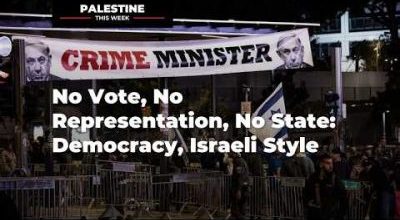
No Vote, No Representation, No State: Democracy, Israeli Style
or go to
Aletho News Archives – Video-Images
From the Archives
Sanctions, War and the Policy of Dual Containment
By SASAN FAYAZMANESH | March 17, 2008
It is now nearly three decades since the Unites States adopted the policy of dual containment of Iran and Iraq. While much has been written about the containment of Iraq, there has been very little in-depth analysis of this policy when it comes to Iran. In a book that is going to be released on March 31, 2008, entitled The United States and Iran: Sanctions, Wars and the Policy of Dual Containment (Routledge), I attempt to address this shortcoming by investigating when and why the US policy of containment of Iran came about, how it evolved, and where it stands today.[1] To the extent that Israel has been involved in US policy making, the study will also include the role that Israel has played in the containment of Iran. Also, since the fate of Iran has been inextricably linked to that of Iraq, occasionally the investigation will overlap with the containment of Iraq.
The policy of dual containment of Iran and Iraq originated during the Carter Administration, but it was not until the Clinton Administration that the expression “dual containment” became popular. … continue
Blog Roll
 Aletho News
- No Vote, No Representation, No State: Democracy, Israeli Style
- Zionist Bought Senate Blocks Information About American Citizens Killed By Israel
- While Gaza dominates the UN, these are the people keeping it alive
- New Report: “Scholasticide and Genocide in Gaza: Assessment, Testimonies and Legal Analysis”
- ‘THAAD Delusion’: Iran war exposes US missile shield limits – The Atlantic
- Moscow issues warning to NATO over Russian exclave
- Yes, the Iran war has destroyed Trump’s presidency
- The fallacy of US delusions about Iran’s economic collapse
- Hezbollah denies Syria cell link, warns of Israeli plan to sow discord
- The legacy of US sanctions, war, and occupation in Iraq
- If Americans Knew
- Mamdani releases plan to combat antisemitism and hate crimes in New York City
- Iran’s Revolutionary Guards Publish Letter to the American People
- DMFI launches $1 million ad campaign supporting Virginia’s Elaine Luria
- US Senate blocks resolution seeking report on Americans killed by Israel
- Israeli Attacks Kill Ten Palestinians in Gaza
- Massacre at Minab: The School That Became a Grave
- Israeli media: The IDF Shows It Doesn’t Turn a Blind Eye; It Actively Emboldens Settler Havoc
- As settlers ravage West Bank, Israeli forces kill 10 in Gaza – Daily Update
- New Report: “Scholasticide and Genocide in Gaza: Assessment, Testimonies and Legal Analysis”
- Ex-Biden officials are desperate for a Gaza scapegoat
- No Tricks Zone
- Green Energy Debacle: German Expert Professor Fritz Vahrenholt Warns Of Severe Economic And Social Consequences
- Two More Paleo Reconstructions Affirm Meters-Higher Sea Levels Across Ireland, Brazil 7000-6000 Years Ago
- New Study: Earth And Venus Surface Warmth Largely Explained By Convection And Lapse Rate, Not CO2 Or Radiation
- 2025 Nature Paper Claiming Worsening Global Drought Gets RETRACTED …Heavily Flawed
- New Study: ‘Global Drought Shows No Detectable Recent Acceleration Under Climate Warming’
- Economic Masterminds: German Socialists Suggest Taxing Productivity Gains Stemming From Using AI
- The South China Sea Has Not Been Cooperating With The Climate Change Narrative
- Energy Crisis: Germany Enters Heating Season With Historically Low Gas Reserve Fill Levels
- New Study: The Antarctic Ice Sheet Gained Mass From 2020-2024 Due To Staggering Snow And Ice Accumulation
- Study: Ocean Heating Rates From Thousands Of Years Ago ‘Dwarf’ Modern Ocean Heating Rates

