A Domestic Terrorism Law? War on Dissent Will Proceed Full Speed Ahead
By Philip Giraldi | Strategic Culture Foundation | January 28, 2021
President Joe Biden has already made it clear that legislation that will be used to combat what he refers to as “domestic terrorism” will be a top priority. That means that his inaugural speech pledge to be the president for “all Americans” appears to apply except for those who don’t agree with him. Former Barack Obama CIA Chief John Brennan, who is clearly in the loop on developments, puts it this way in a tweet where he describes how the new Administration’s spooks “are moving in laser-like fashion to try to uncover as much as they can about [the] insurgency” [that includes] “religious extremists, authoritarians, fascists, bigots, racists, nativists, even libertarians.”
The United States Constitution’s Bill of Rights, which includes freedom of speech and association, has been under siege for some time now. Government has always used its assumed powers conferred by a claimed state of emergency to deprive citizens of their rights. During the American Civil War Abraham Lincoln imprisoned critics of the conflict. Woodrow Wilson’s First World War administration brought in the Espionage Act, which has since been used to convict whistleblowers without having to present the level of evidence that would be required in a normal civil trial. During the Second World War, Franklin D. Roosevelt erected concentration camps that imprisoned Japanese Americans whose only crime consisted of being Japanese.
But perhaps the greatest attack on the Bill of Rights is more recent, the Patriot and Military Commissions Acts that were passed into law as a consequence of the “Global War on Terror” launched by President George W. Bush in the wake of 9/11. Together with the secretive Foreign Intelligence Surveillance Act (FISA), which includes a court designed to speed up the warrant approval process, ordinary citizens found themselves on the receiving end of surveillance for which there was little or no justification in terms of probable cause. The FISA process was even notoriously abused in the national security apparatus attempt to derail the campaign of Donald Trump. The tools are in place for ever more government mischief and no one should doubt that the Democrats are just as capable of ignoring constitutional safeguards as the Republicans have been.
What makes the current state of war against “terrorism” so dangerous is that the national security apparatus has been politicized while the government has learned that labeling someone or some entity terrorist or even a “material supporter of terrorism” is infinitely elastic. That is precisely why Secretary of State Mike Pompeo has frequently called out opponents and attached to them the terrorist label, since it then permits other steps that might otherwise be challenged.
And there is also the fact that the playing field has changed since the First and Second World Wars. The government has technical capabilities that were never dreamed of in most of the twentieth century. Edward Snowden and other whistleblowers have demonstrated how the government routinely ignores constitutional limits on its ability to interfere in the lives of ordinary citizens. Not only that, it can monitor the lives of millions of Americans simultaneously, giving the police and intelligence agencies the power to mount “fishing expeditions” that literally invade the phones, computers and conversations of people who have not been guilty of any crime.
The authorizations that already exist will be further weaponized to go after dissidents as identified by the new regime. A bill introduced by House intelligence committee chair Adam Schiff “would take existing War on Terror legislation and simply amend it to say we can now do that within the U.S.” It would be combined with previous legislation, including former president Barack Obama’s infamous 2012 National Defense Authorization Act, which allows the military to indefinitely detain American citizens suspected of terrorism without a trial. Obama and Brennan also assumed an illegal and unconstitutional right to act as judge, jury and executioner-by-drone of American citizens overseas. Given those precedents, a bill like Schiff’s would free the national security community’s hands even more.
The new body of legislation would mean increased secret legal surveillance, suppression of free speech, indefinite incarceration without charges, torture, and perhaps even assassination. If it sounds like totalitarianism it should. There ought to be particular concern that the plan of the Biden Administration to go after so-called domestic terrorists will be this generation’s version of either Pearl Harbor or 9/11. The incident that took place at the Capitol Building on January 6th (already being referred to as 1/6 in some circles) has been exaggerated beyond all recognition and is now being regularly referred to as an “insurrection,” which it was not, by both politicians and the mainstream media. The language used to vilify what are alleged to be “right wing” and “white supremacist” enemies of the state is astonishing and the technology is keeping pace to turn the United States and other countries into police states to ensure that citizens will do the bidding of government.
To cite only one example of how technology can drive the process, Biden has several times threatened to initiate and enforce something like a nationwide lockdown to defeat the coronavirus. Can he do it? Yes, the tools are already in place. Facial recognition technology is highly developed and deployable in the numerous surveillance cameras that are being installed. Wrist bands are being developed overseas that are designed to compel compliance with government dictates on pandemic measures enforcement. If you have been told to stay home and are instead walking the dog your wrist band will tell the police and they will find and arrest you.
And, as the old saying goes, the Revolution is already beginning to devour its own children. Universities and schools are insisting that teachers actively support both publicly and privately the new “equity and diversity” order while police departments are purging themselves of officers suspected of being associated with conservative groups, meaning that something like a loyalty test might soon become common. Recently the Defense Department has begun intensive monitoring of the social media of military personnel to identify dissenters, as is already done in some large companies with their employees. The new Director of National Intelligence hardliner Avril Haines has already confirmed that her agency will participate in a public threat assessment of QAnon, which she has described as America’s Greatest Threat.
Haines has also suggested that intelligence agencies will “look at connections between folks in the U.S. and externally and foreign” while Biden on his first full day in office has pledged to thoroughly investigate claims about Russian hacking of U.S. infrastructure and government sites, the poisoning of Putin critic Alexei Navalny, and the story that Russia offered the Taliban bounties to kill U.S. troops in Afghanistan. It could be Russiagate all over again, with a claimed foreign threat being used to conceal civil rights violations being committed by the federal government at home.
And, of course, the new policies will reflect the biases of the new rulers. Right wing “terror” will be targeted even though the list of actual right-wing driven outrages is embarassingly short. Groups like Black Lives Matter will be untouchable in spite of their major role in last year’s rioting, arson, looting and violence that caused $2 billion damage and killed as many as thirty because they are in all but name part of the Democratic Party. Antifa, which rioted in Portland last week, will also get a pass – the media routinely describes leftist violence as “mainly peaceful” and only sometimes concedes that some “property damage” occurred.
It is Trump supporters and conservatives in general who are being shown the exit door, to include calls for “deprogramming them”. The Washington Post’s Zionist harpy Jennifer Rubin recently declared that “We have to collectively, in essence, burn down the Republican Party. We have to level them because if there are survivors, if there are people who weather this storm, they will do it again.” She also echoed calls for making them unemployable, “I think it’s absolutely abhorrent that any institution of higher learning, any news organization, or any entertainment organization that has a news outlet would hire these people.”
As the notably clueless Secretary of State Condoleezza Rice said in 2006 while Lebanon was getting bombed and shelled by Israel, “We are seeing the birth pangs of a new Middle East…” so too are we Americans seeing something new and strange emerging from the ruins of Trumpdom. It will not be pretty and after it is over Americans will enjoy a lot fewer liberties, that is for sure.
A third French lockdown could drive fed-up French away from Macron towards rising Le Pen
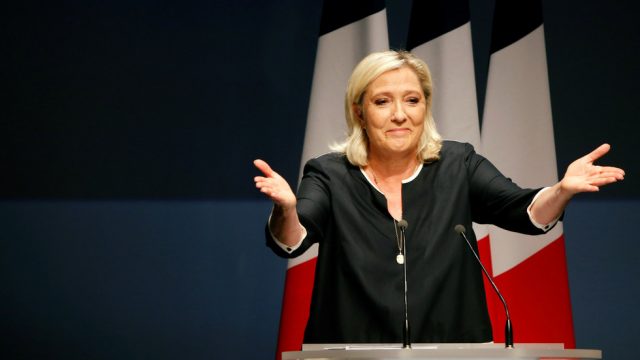
Marine Le Pen at an end of summer annual address in Frejus, France September 15, 2019 © REUTERS/Jean-Paul Pelissier
By Rachel Marsden | RT | January 28, 2021
A new poll shows that if the French presidential election was held today, populist National Rally leader Marine Le Pen would beat French President Emmanuel Macron – at least in the first round of voting.
While there’s no reason for Macron to start panicking, he’s nonetheless at a critical crossroads as he faces a decision over whether to lock down the country once again and risk triggering chaos.
Much is being made in the worldwide press of the new Harris Interactive poll indicating that Le Pen currently leads Macron by a score of 26-27 percent to 23-24 percent in a head-to-head, first-round presidential matchup.
It’s not exactly a shock poll, and closely mirrors the first round of the actual faceoff between Macron and Le Pen in 2017 that saw Macron lead Le Pen by only three percent. Macron still won massively in the second round, 66 percent to 34 percent, as voters who favored candidates in the first round all held their noses and voted for Macron in order to block Le Pen. And because of that phenomenon, conventional wisdom suggests that Le Pen simply can’t ever win a French presidential election.
Unless, of course, all hell breaks loose and voters decide that their priority is to get rid of those they perceive as destroying France, at any cost. It’s the same kind of sentiment that swept Donald Trump into the White House and has left permanent marks on American society in Trump’s wake via the radicalization of those who feel that the establishment spent his entire four-year term refusing to accept their electoral choice to the point that it wasn’t a stretch for them to believe that the same establishment would have rigged Trump’s reelection.
Macron finds himself staring down the possibility of what the French call a general “ras-le-bol” – that is, the French being totally fed up with him and his team, to the point of casting whatever vote would be required to replace him in the second round. That would still require a massive shift of 30 percent of Macron voters in the last election’s second round to choose Le Pen. But, given the increasingly dire economic and social crisis facing the country, anything seems possible.
A lot will depend on the next few weeks. Macron is under pressure from sanitary advisers who are encouraging him to adopt a preventative lockdown to avoid hospitals from being overwhelmed by Covid-19 patients. A third lockdown would mean that the economy would take yet another hit, while the French are growing increasingly fed up with nearly a year of government-imposed restrictions on their lives and livelihoods. Already under a 6pm curfew and with some businesses by now closed for months, Macron apparently feels that there’s a growing possibility of civil unrest. And he has good reason to fear, as 38 percent of French citizens are against a third national lockdown, according to an Elabe poll.
Macron can’t keep asking all of French society to fall on their swords for a virus that kills mainly the elderly and people with preexisting problems, all while watching the government roll out the vaccine at the pace of an escargot. The fact that hospitals still risk being overwhelmed a year into the pandemic is a sign of government ineptitude. They could have built hundreds more hospitals within the past year. Instead of offering any other solution, they prefer to just keep downloading their failures onto the backs of the citizens by asking them to lock themselves up at home and tolerate going broke and mad so the government can save face.
Into this breach storms Marine Le Pen, saying on FranceInfo this week: “Lockdown is the last solution when you’ve failed with all the others. Why did the government not take advantage of the last lockdown, which required a lot of sacrifices from the French, to test massively and get ahead of the epidemic?” She added: “We have the feeling that the government has nothing under control, that it spends its time chasing the virus. To be ahead of the game, certain systems need to be generalized, in particular the massive analysis of wastewater, or even sequencing.”
Le Pen echoes the frustration of the French with the government’s go-to solution to its own insufficiencies being repeated lockdowns. When the government handouts dry up – and they soon will – businesses that have been forced by the government to close for months under pandemic pretext will simply fail, and along with them so will the livelihoods of many voters.
And while Macron clearly has a sense that he’s needed to move further right to block a Le Pen rise by adopting measures to better control immigration and Islamist extremism, those measures will amount to pointless window-dressing if he allows the lockdown bulldozer to destroy the social and economic foundation of the country.
So Macron has a choice to make in the coming days. And it may very well decide his presidential fate.
Rachel Marsden is a columnist, political strategist and host of an independently produced French-language program that airs on Sputnik France. Her website can be found at rachelmarsden.com
Russia’s Ombudswoman Gets Requests to Protect Baltnews, Sputnik Latvia Reporters
Sputnik – 28.01.2021
Russian Human Rights Commissioner Tatyana Moskalkova has received requests from journalists who work with Baltnews and Sputnik Latvia media outlets, asking to protect their rights to freedom of speech, Moskalkova’s office told Sputnik on Thursday, adding that work on the requests is already underway.
“There are such [requests]. We are already working on them”, the office said.
In December, several Russian-speaking journalists working in Latvia, including those who wrote articles for the Baltnews and Sputnik Latvia outlets, have been accused of violating EU sanctions.
Their apartments were searched, with them being put under the condition to not leave the country. Sputnik Latvia and Baltnews are part of the Rossiya Segodnya International Information Agency, whose director-general, Dmitry Kiselev, is on the EU sanctions list.
The Russian Foreign Ministry says that the EU sanctions are individual and concern only Kiselev and thus could not apply to all individuals and entities that work with the agency, especially those who work as freelance journalists. According to Moscow, Latvia uses EU sanctions as an excuse to justify its “punitive campaign” against Russian media.
6 Warning Signs from Biden’s First Week in Office
By Kit Knightly | OffGuardian | January 27, 2021
It’s been a busy first week for the 46th President [sic] of the United States, there are the 20,000 troops occupying the capitol city to organise, as well as the totally unprecedented show-trial of his immediate predecessor.
You know, usual democracy type stuff.
On top of that, Biden has now signed at least 37 executive orders in his first week. The record for any President, and more than the previous four presidents combined.
What do these orders, or any of his other moves, tell us about the future plans of the recently “elected” administration? Nothing good, unfortunately.
1. VACCINATION PASSPORTS
I still remember people claiming the introduction of vaccination passports (or immunity passes or the like) was just a “conspiracy theory”, the paranoid fantasy of fringe “covidiots”. All the way back in December, when they were getting fact-checked by tabloid journalists who can’t do basic maths.
These days they are rebranded as “freedom certificates” which are “divisive, politically tricky and probably inevitable”.
Many countries are already preparing to roll it out, including Iceland the UK and South Africa. Biden’s “Executive Order on Promoting COVID-19 Safety in Domestic and International Travel” adds the US to this list:
International Certificates of Vaccination or Prophylaxis. Consistent with applicable law, the Secretary of State, the Secretary of HHS, and the Secretary of Homeland Security (including through the Administrator of the TSA), in coordination with any relevant international organizations, shall assess the feasibility of linking COVID-19 vaccination to International Certificates of Vaccination or Prophylaxis (ICVP) and producing electronic versions of ICVPs.
2. CABINET APPOINTMENTS
Biden’s cabinet is praised as the “most diverse” in history, but will hiring a few non-white people really change the decades-old policies of US Imperialism? It certainly doesn’t look like it.
His pick for Under Secretary of State is Victoria Nuland, a neocon warmonger and one of the masterminds of the Maidan coup in Ukraine in 2014. She is married to Robert Kagan, another neocon warmonger, co-founder of the Project for a New American Century and senior fellow at the Brookings Institute and one of the masterminds behind the 2003 invasion of Iraq.
The incoming Secretary of State, Antony Blinken, is also an inveterate US Imperialist, arguing for every US military intervention since the 1990s, and criticised Trump’s decision to withdraw from Syria.
Biden’s pick for Defence Secretary is the first African-American ever appointed to this role, but former General Lloyd Austin is hardly going be some kind of “progressive” voice in his cabinet. He’s a career soldier who retired from the military in 2016 to join the board of Raytheon Technologies, an arms manufacturer and military contractor.
As “diverse” as this cabinet may be in skin colour or gender… there is most certainly no “diversity” of opinion or policy. There are very few new faces and no new thoughts.
So, it looks like we can expect more of the same in terms of foreign policy. A fact that’s already been displayed in…
3. IRAQ…
Despite heavy resistance from the military and Deep State, Donald Trump wanted to end the war in Iraq and pledged to pull American troops out of the country. This was one of Trump’s more popular policies, and during the campaign Biden made no mention of intending to reverse that decision.
Then, on the very day of Biden’s inauguration, ISIS conducted their deadliest suicide bombing for over three years, and suddenly the situation was too unstable for the US to leave, and Biden is being forced to “review” Trump’s planned withdrawal.
The Iraqi parliament has made it clear it wants the US to take its military off their soil, so any American forces on Iraqi land are technically there illegally in contravention of international law. But that never bothered them before.
4. … AFGHANISTAN…
Turns out the US can’t withdraw from Afghanistan either. Last February Trump signed a deal with the Taliban that all US personnel would leave Afghanistan by May 2021.
Joe Biden has already committed to “reviewing” this deal. Sec. Blinken was quoted as saying that Biden’s admin wanted:
“to end this so-called forever war [but also] retain some capacity to deal with any resurgence of terrorism, which is what brought us there in the first place”.
As a great man once said, nothing someone says before the word “but” really counts. The US will not be withdrawing from Afghanistan, and if there is any public pressure to do so, the government will simply claim the Taliban broke their side of the deal first, or stage a few terrorist attacks.
5. … AND SYRIA
Far from simply continuing the on-going wars, there are already signs Biden’s “diverse” team will look to escalate, or even start, other conflicts.
Syria was another theatre of war from which Donald Trump wanted to extricate the United States, unilaterally ordering all US troops from the country in late 2019.
We now know the Pentagon ignored those orders. They lied to the President, telling Trump they had followed his orders… but not withdrawing a single man. This organized mutiny against the Commander-in-Chief of the US Armed Forces was played for a joke in the media when it was finally revealed.
There will be no need for any such duplicity now that Biden is in the Oval Office, he was a vocal critic of the decision to withdraw, claiming it gave ISIS a “new lease of life”. Indeed, within two days of his being sworn in a column of American military vehicles was seen entering Syria from Iraq.
6. DOMESTIC TERRORISM
We called this before the inauguration. They made it just too obvious. Before the dirty footprints had been cleaned from Nancy Pelosi’s desk it was clear where it was all going.
Within 24 hours of being sworn in as president, Biden had ordered a “review of the threat posed by domestic terrorism”.
As usual, the press are laying down the covering fire for this. Talking heads have been busily comparing MAGA voters to al Qaida in television interviews. The Washington Post and New Yorker journal have cut-and-paste pieces about this supposed threat. Politico published an article titled “Biden vowed to defeat domestic terrorism. The how is the hard part”, which outlines what Biden could do:
Direct the Justice Department, FBI and National Security Council to execute a top-down approach prioritizing domestic terrorism; pass new domestic terrorism legislation; or do a bit of both as Democrats propose a crack down on social media giants like Facebook for algorithms that promote conspiracy laden posts.
That last part is key. The “crack down on social media” part, because the anti-Domestic Terrorism legislation will likely be very focused on communication and so-called “misinformation”.
Alexandra Ocasio-Cortez has publicly called for a congressional panel to “rein in” the media:
We’re going to have to figure out how we rein in our media environment so you can’t just spew disinformation and misinformation,”
And who will be the target of these crack downs and new legislations? Well, according John Brennan (ex-head of the CIA and accomplished war criminal), practically anybody:
They’re casting a wide net. Expect “extremist”, “bigot” and “racist” to be just a few of the words which have their meanings totally revised in the next few months. “Conspiracy theorist” will be used a lot, too.
Further, they are moving closer and closer toward the “anyone who disagrees with us is literally insane” model. With many articles actually talking about “de-programming” Trump voters. The Atlantic suggests “mental hygiene” would cure the MAGA problem.
Again AOC is on point here, clearly auditioning for the role of High Inquisitor, claiming that the new Biden government needs to fund programs that “de-radicalise” “conspiracy theorists” who are on the “spectrum of radicalisation”.
*
As I said at the beginning, it’s been a busy week for Joe Biden, but you can sum up his biggest policy plans in one short sentence: More violence overseas, less tolerance of dissent and strict clampdowns on “misinformation”.
How progressive.
‘Where is the line between global business & attempts to control society?’ Putin asks Davos, calling out Big Tech
RT | January 27, 2021
Technology giants have become powerful rivals to governments, but there are doubts over the benefits for society of their monopoly positions, Russia’s President Vladimir Putin told the annual World Economic Forum, on Wednesday .
“Where is the line between a successful global business, in-demand services and consolidation of big data – and attempts to harshly and unilaterally govern society, replace legitimate democratic institutions, restrict one’s natural right to decide for themselves how to live, what to choose, what stance to express freely?” Putin wondered.
“We’ve all seen this just now in the US. And everybody understands what I’m talking about,” he added.
The Russian leader was apparently referring to the crackdown by Big Tech corporations like Twitter, Facebook, Google, Apple and Amazon, mostly on Donald Trump and his supporters, during the recent presidential election in the US. The companies, which, according to some critics, sided with Democratic candidate Joe Biden, blocked President Trump’s social media accounts over accusations of inciting violence, with the same being done to many pages of groups and individuals who’d backed him.
However, one-sided bias claim voiced by some might be an overestimation – the accounts of Democrats supporters were also subject to restrictions, but on a much smaller scale.
Conservative Twitter-like platform Parler was also forced offline, and now there are calls to block the Telegram app as well.
These events have shown that Big Tech companies “in some areas have de facto become rivals to the government,” Putin said.
Billions of users spend large parts of their lives on the platforms and, from the point of view of those companies, their monopolistic position is favorable for organizing economic and technological processes, the Russian president explained. “But there’s a question of how such monopolism fits the interest of society,” he stressed.
#TheGreatReopening – #SolutionsWatch
Corbett • 01/27/2021
Podcast: Play in new window | Download | Embed
Yes, #TheGreatReopening is happening as we speak. No, it will not be televised (or even YouTubed). Find out the details as James highlights the resistance movements that are rising up around the world on this week’s edition of #SolutionsWatch.
Watch on Archive / BitChute / LBRY / Minds / YouTube or Download the mp4
SHOW NOTES
The Uprising Has Begun (New World Next Week)
30,000 Italian Restaurants Defy Lockdown Rules / Hugo talks #lockdown
100’s Of Polish Business’s To DEFY Lockdown / Hugo Talks #lockdown
“BURN IT DOWN!” – Anti-Lockdown RIOTS Lead To Covid Testing Facility Being TORCHED In Netherlands!
Ontario barbershop reopens despite provincial lockdown using loophole
Unmasked COVID protesters try, fail to place Canadian mayor under citizen’s arrest
What You Need to Know About Making a Citizen’s Arrest
Taking a Stand: Sheriffs, Local Officials, and Rule of Law VS. Covid Dictators
Left, Khaps, Gender, Caste: The solidarities propping up the farmers’ protest
Freedom Airway – #SolutionsWatch
Fact check: PCR testing and viral genetic sequencing serve different purposes
Wisconsin Senate greenlights measure to kill governor’s statewide mask mandate & ALL Covid-related emergency orders
RT | January 27, 2021
Wisconsin’s Republican-controlled Senate has voted to end Governor Tony Evers’ face mask order, with lawmakers arguing the government overstepped its authority by extending emergency mandates without approval from the legislature.
The state Senate voted 18-13 to pass the joint resolution on Tuesday, deeming the Democratic governor’s emergency health orders “unlawful.” The bill applies not only to Evers’ most recent declaration last week, but to “all actions of the governor and all emergency orders” issued throughout the pandemic, including the statewide requirement for mask-wearing in public.
Wisconsin Republicans have blasted the emergency mandates as unconstitutional, with GOP state Senator Duey Stroebel arguing on Tuesday that “It is not ok or normal or inevitable or necessary to indefinitely suspend the lawmaking process.”
“There is no such thing as a perpetual emergency.”
Before it becomes law, the measure must also pass through Wisconsin’s State Assembly, where the GOP carries a 58-30 majority. The lower chamber is set to take up the bill on Thursday, which, if passed, would mark the first pandemic-related action taken by the legislature since April.
While Evers has insisted he has legal authority to issue multiple emergency declarations, arguing the threat of the virus changes over time, Republicans say he should have secured approval from lawmakers after his first mandate expired in May.
“Legislative oversight is rendered useless if the governor ignores the temporal limitations on the emergency powers by continuously reissuing emergency declarations for the same emergency,” the Senate resolution states, adding that Evers had “no authority” to impose mandates unilaterally after May 11, 2020.
Under Wisconsin law, legislators can halt a governor’s health emergency through a majority vote, which cannot be vetoed.
“Are we going to start saying that seatbelts, taking off your seatbelt, is a sign of independence? And therefore flying through a windshield when you get in an accident is the utmost way to exercise your liberty?” Larson said.
Democratic lawmakers have denounced the GOP-led effort to kill the mask order, which Milwaukee Senator Chris Larson called a “basic test of what government is supposed to do.”
Two Republican Senators, Rob Cowles and Dale Kooyenga, joined Democrats across the aisle in opposing the measure, with Kooyenga arguing that while he agrees Evers has exceeded his legal authority, he believes the resolution would prolong school closures. Cowles, meanwhile, said he is concerned the bill will send the “wrong message” about masks.
“I’m coming from the science point of view and from the healthcare point of view and I can’t imagine making it worse for the people who have worked their butts off to try to make this better in the healthcare community,” he said.
The new Senate resolution comes after Wisconsin’s highest court shot down Evers’ stay-at-home order in May, deeming it “unlawful, invalid, and unenforceable,” however the governor has nonetheless continued to renew other emergency measures since.
The Republican drive to end Evers’ sweeping health mandates mirrors similar efforts in other states, such as in Michigan, where the state Supreme Court ruled that Governor Gretchen Whitmer had no authority to extend emergency orders beyond April 30, when the state’s first mandate expired. Similar to arguments by the Wisconsin GOP, Michigan’s Republicans also insisted any further orders would need approval from the state house.
Reflecting the Authoritarian Climate, Washington Will Remain Militarized Until At Least March
The idea of troops in US streets for an extended period of time – an extreme measure even when temporary – has now become close to a sacred consensus
By Glenn Greenwald | January 26, 2021
Washington, DC has been continuously militarized beginning the week leading up to Joe Biden’s inauguration, when 20,000 National Guard troops were deployed onto the streets of the nation’s capital. The original justification was that this show of massive force was necessary to secure the inauguration in light of the January 6 riot at the Capitol.
But with the inauguration over and done, those troops remain and are not going anywhere any time soon. Working with federal law enforcement agencies, the National Guard Bureau announced on Monday that between 5,000 and 7,000 troops will remain in Washington until at least mid-March.
The rationale for this extraordinary, sustained domestic military presence has shifted several times, typically from anonymous U.S. law enforcement officials. The original justification — the need to secure the inaugural festivities — is obviously no longer operative.
So the new claim became that the impeachment trial of former President Trump that will take place in the Senate in February necessitated military reinforcements. On Sunday, Politico quoted “four people familiar with the matter” to claim that “Trump’s upcoming Senate impeachment trial poses a security concern that federal law enforcement officials told lawmakers last week requires as many as 5,000 National Guard troops to remain in Washington through mid-March.”
The next day, AP, citing “a U.S. official,” said the ongoing troop deployment was needed due to “ominous chatter about killing legislators or attacking them outside of the U.S. Capitol.” But the anonymous official acknowledged that “the threats that law enforcement agents are tracking vary in specificity and credibility.” Even National Guard troops complained that they “have so far been given no official justifications, threat reports or any explanation for the extended mission — nor have they seen any violence thus far.”
It is hard to overstate what an extreme state of affairs it is to have a sustained military presence in American streets. Prior deployments have been rare, and usually were approved for a limited period and/or in order to quell a very specific, ongoing uprising — to ensure the peaceful [de-]segregation of public schools in the South, to respond to the unrest in Detroit and Chicago in the 1960s, or to quell the 1991 Los Angeles riots that erupted after the Rodney King trial.
Deploying National Guard or military troops for domestic law enforcement purposes is so dangerous that laws in place from the country’s founding strictly limit its use. It is meant only as a last resort, when concrete, specific threats are so overwhelming that they cannot be quelled by regular law enforcement absent military reinforcements. Deploying active military troops is an even graver step than putting National Guard soldiers on the streets, but they both present dangers. As Trump’s Defense Secretary said in response to calls from some over the summer to deploy troops in response to the Black Lives Matter and Antifa protests: “The option to use active duty forces in a law enforcement role should only be used as a matter of last resort, and only in the most urgent and dire of situations.”
Are we even remotely at such an extreme state where ordinary law enforcement is insufficient? The January 6 riot at the Capitol would have been easily repelled with just a couple hundred more police officers. The U.S. is the most militarized country in the world, and has the most para-militarized police force on the planet. Earlier today, the Acting Chief of the Capitol Police acknowledged that they had advanced knowledge of what was planned but failed to take necessary steps to police it.
Future violent acts in the name of right-wing extremism, as well as other causes, is highly likely if not inevitable. But the idea that the country faces some sort of existential armed insurrection that only the military can suppress is laughable on its face.
Recall that ABC News, on January 11, citing “an internal FBI bulletin obtained by ABC News,” claimed that “starting this week and running through at least Inauguration Day, armed protests are being planned at all 50 state capitols and at the U.S. Capitol.” The news outlet added in highly dramatic and alarming tones:
The FBI has also received information in recent days on a group calling for “storming” state, local and federal government courthouses and administrative buildings in the event President Donald Trump is removed from office prior to Inauguration Day. The group is also planning to “storm” government offices in every state the day President-elect Joe Biden will be inaugurated, regardless of whether the states certified electoral votes for Biden or Trump.
None of that happened. There was virtually no unrest or violence during inauguration week — except for some anti-Biden protests held by leftist and anarchist protesters that resulted in a few smashed windows at the Oregon Democratic Party and some vandalism at a Starbucks in Seattle. “Trump supporters threatened state Capitols but failed to show on Inauguration Day,” was the headline NBC News chose to try to justify this gap between media claims and reality.
This threat seems wildly overblown by the combination of media outlets looking for ratings, law enforcement agencies searching for power, and Democratic Party operatives eager to exploit the climate of fear for a new War on Terror.
But now is not a moment when there is much space for questioning anything, especially not measures ostensibly undertaken in the name of combatting white-supremacist right-wing extremism — just as no questioning of supposed security measures was tolerated in the wake of the 9/11 attack. And so the scenes of soldiers on the streets of the nation’s capital, there in the thousands and for an indefinite period of time, is provoking little to no concern.
What makes this all the more remarkable is that a mere seven months ago, a major controversy erupted when The New York Times published an op-ed by Sen. Tom Cotton (R-AR) which, at its core, advocated the deployment of military troops to quell the social unrest, protests and riots that erupted over the summer after the killing in Minneapolis of George Floyd. To justify the deployment of National Guard and active duty military forces, Cotton emphasized how many people, including police officers, had been seriously maimed or even killed as part of that unrest:
Outnumbered police officers, encumbered by feckless politicians, bore the brunt of the violence. In New York State, rioters ran over officers with cars on at least three occasions. In Las Vegas, an officer is in “grave” condition after being shot in the head by a rioter. In St. Louis, four police officers were shot as they attempted to disperse a mob throwing bricks and dumping gasoline; in a separate incident, a 77-year-old retired police captain was shot to death as he tried to stop looters from ransacking a pawnshop. This is “somebody’s granddaddy,” a bystander screamed at the scene.
(Cotton’s claim that police officers “bore the brunt of the violence” was questionable, given how many protesters were also killed or maimed, but it is true that numerous police officers were attacked, including fatally).
Cotton acknowledged that the central cause of the protests was a just one, noting they were provoked by “the wrongful death of George Floyd.” He also strongly affirmed the right of people to peacefully protest in support of that cause, accusing those justifying the violence of “a revolting moral equivalence of rioters and looters to peaceful, law-abiding protesters,” adding: “A majority who seek to protest peacefully shouldn’t be confused with bands of miscreants.”
But he insisted that, absent military reinforcements, innocent people, principally ones in poor communities, will suffer. “These rioters, if not subdued, not only will destroy the livelihoods of law-abiding citizens but will also take more innocent lives,” Cotton wrote, adding: “Many poor communities that still bear scars from past upheavals will be set back still further.”
The backlash to the publication of this op-ed was immediate, intense, and, at least in my memory, unprecedented. Very few people were interested in engaging the merits of Cotton’s call for a deployment of troops in order to prove the argument was misguided.
Their view was not that Cotton’s plea for soldiers in the streets was misguided, but that advocacy for it was so obscene, so extremist, so dangerous and repugnant, that the mere publication of the op-ed by The Paper of Record was an act of grave immorality.
“I’ll probably get in trouble for this, but to not say something would be immoral. As a black woman, as a journalist, I am deeply ashamed that we ran this,” pronounced the paper’s Nikole Hannah-Jones in a now-deleted tweet. The New York Times Magazine writer Taffy Brodesser-Akner posted a multi-tweet denunciation that compared Cotton to an anti-Semite who “says, ‘The Jew is a pig,’” argued that “hatred dressed up as opinion is not something I have to withstand,” and concluded with this flourish: “I love working at the Times and most days of the week I’m very proud to be part of its mission. But tonight, I understand the people who treat me like I work at a tobacco company.”
Former NYT editor and Huffington Post editor-in-chief Lydia Polgreen announced, also in a now-deleted tweet: “I spent some of the happiest and most productive years of my life working for the New York Times. So it is with love and sadness that I say: running this puts Black @nytimes staff – and many, many others – in danger.” That publication of the Cotton op-ed “puts Black New York Times staff in danger” became a mantra recited by more journalists than one can list.
Two editors — including the paper’s Editorial Page editor James Benett and a young assistant editor Adam Rubenstein — were forced out of their jobs, in the middle of a pandemic, for the crime not of endorsing Cotton’s argument but merely airing it. Media reports attributed their departure to a “staff revolt.” The paper itself appended a major editor’s note: “We have concluded that the essay fell short of our standards and should not have been published.” In addition to alleged flaws in the editorial process, the paper also said “the tone of the essay in places is needlessly harsh and falls short of the thoughtful approach that advances useful debate.”
There is a meaningful difference between deploying National Guard troops and active duty soldiers on American streets. But both measures are extraordinary, create a climate of militarization, have a history of resulting in excessive force against citizens engaged in peaceful protest and constitutionally protected dissent, and present threats and dangers to civil liberties far beyond ordinary use of law enforcement.
Why was the idea of troops in American streets so grotesque and offensive in June, 2020 but so normalized now? Why were these troops likely to indiscriminately arrest and murder black reporters and other journalists over the summer but are now trusted to protect them? And what does it say about the current climate, and the serious dangers it poses, that the public is being trained so easily to acquiesce to extreme measures in the name of domestic security?
We are witnessing the media and their public treat what ought to be regarded with great suspicion as not only normal but desirable, all through the manipulation of fears and inflation of threats. That does not bode well for those who seek to impede the imminent attempt to begin a new domestic War on Terror.
Massachusetts Flu Shot Requirement Abandoned
The Highwire with Del Bigtree | January 22, 2021
Elizabeth Brehm, part of ICAN’s legal team, joins Del for an update on yet another win, a statewide influenza vaccine mandate that was withdrawn after being served with a lawsuit from our lawyers. Winning!
“I do everything my TV tells me to do” – That’s why we’re hurtling towards the Great Reset
THE DAILY EXPOSE • JANUARY 18, 2021
If the current pandemic of dictatorial tyranny sweeping across the world has taught us anything, it is that the majority of humanity has been so well trained to obey authority that it is now incapable of free thought and afraid to ask questions. Never before have we seen such docile conformance to words echoing from the speakers of a television screen as when the Prime Minister of the UK announced in March 2020 that he had “one simple instruction” for the British people… ”You must stay at home”. But Mr Johnson spoke through the ‘telescreen’, and the nation listened.
Within an instant the UK economy came to a halt, without question, all because a man, in a suit, on the TV said it should. Hundreds of thousands of businesses closed their doors to customers and staff. Schools and nurseries closed their doors to children, which in turn lead to parents being unable to work because they could not find care for their children. Unless of course the man, in a suit on the TV told them that there job was deemed essential, in which case it was fine to send their children to school and go out to work.
“Three weeks” was what the man, in a suit, on the TV said the country needed “to flatten the curve,”. But three weeks turned into five weeks, which turned into eight weeks, which turned into fourteen weeks. I wonder how many would have complied for so long with an instruction given to them by a man, in a suit, on the TV if it had not been for another man, in a suit, on the TV promising to subsidize up to eighty percent of their wages for sitting at home and not working?
Sounds great doesn’t it, sitting at home and still being paid. The people so eager to accept this scheme most likely didn’t realise that A) it was not the man, in a suit, on the TV paying these wages, it was in fact the British taxpayer. B) They would have to pay this money back in the future via higher taxes, and C) that’s only if they still had a job to pay those taxes as the only purpose of this scheme was to delay everyone’s unemployment to ensure that they complied. It was never about making sure you were going to be okay and have a job to go back to, it was about making sure you were complicit in the destruction of the job market as we know it, in order to bring in the new age of AI.
We bet the authorities could not believe their luck at how easy it was to get the vast majority of every man and woman in the land to obey an instruction that was emitted via the telescreen, and boy have they made the most of it ever since.
On the 3rd April 2020, Professor Jonathan Van Tam, deputy chief medical officer for England, told the British public via the ‘telescreen’ that he had spoke with a colleague in Hong Kong who had carried out an evidence review for the World Health Organisation and stated they “were of the same mind that there is no evidence that the general wearing of face masks by the public affects the spread of a disease in our society, what matters right now is social distancing. In terms of the hard evidence, we do not recommend face masks for general wearing by the public.”
Yet fast forward four months and the Government enforced the wearing of face coverings in all indoor public settings. However we did not instantly see a swarm of face nappy clad folk outdoors for over a week, and why was that? Because the man, in a suit, on the TV said this would not come into force for another week. That week came and went and on the day of enforcement there was not a smile to be seen. But what does that say about the majority of the British public and their acquiescence to authority. Not wearing a face covering because they genuinely thought it would work in the “fight against the virus”, but wearing it because a man, in a suit, on the TV said they would be subject to a £200 fine if they refused to do so. We know this to be true because they would have worn the face covering from the moment it was announced they were required otherwise.
Fast forward another few months and we were told by Professor Jonathan Van Tam, again via the ‘telescreen’ that he did not think there would “come a moment when we can have a big party and throw our masks and hand sanitiser and say ‘that’s it, it’s behind us’ like the end of the war? No I don’t.” Insisting that the wearing of face masks “may persist for many years and that may be a good thing”.
The contractions on the wearing of face masks alone should have been enough for the British public to wake up and question why they were partaking in the destruction of the world as they knew it, unknowingly bringing in a “new normal” and a chance for the globalists to fast forward their “great reset” agenda. But disappointingly it has yet to be the case.
Instead we are now stuck in a cycle of stay at home, protect the NHS, save lives, repeat. Whenever a man, in a suit, on the TV appears on the British public’s ‘telescreen’s’ they stand to attention and hang on every word that echoes from the speaker. We don’t hold much hope that this will change anytime soon, instead we are stuck firmly on the road to the ‘Great Reset’ and we’re hurtling towards it at a few hundred miles per hour.
They do everything their TV tells them to do…but do you?
Unelected Biden/Harris Regime to Wage War on Civil Liberties
By Stephen Lendman | January 26, 2021
On Friday, White House press secretary Jennifer Psaki said the following:
The Biden/Harris regime “will confront (violent extremism) with the necessary resources and resolve (sic).”
“We are committed to developing policies and strategies (to) confront this threat (sic).”
Biden’s DNI will conduct a “comprehensive threat assessment, coordinated with the FBI and DHS on domestic violent extremism (sic).”
“As a part of this, the NSC will undertake a policy review effort to determine how the government can share information better about this threat, support efforts to prevent radicalization, disrupt violent extremist networks and more (sic).”
“(R)elevant parts of the federal government (will be involved) to enhance and accelerate efforts to address DVE (domestic violent extremism) (sic).”
“This focus (will address) evolving threats, radicalization, the role of social media, opportunities to improve information sharing, operational responses and more (sic).”
“The January 6th assault on the Capitol and the tragic deaths and destruction that occurred underscored what we have long known.”
“The rise of domestic violent extremism is a serious and growing national security threat (sic).”
“Congress should immediately pass legislation to make domestic terrorism a federal crime (sic).”
At a time when the only domestic and foreign threats are invented, not real, the stage is set for making the repressive Domestic Terrorism Prevention Act the law of the land.
Much more of the same likely coming is reminiscent of what happened post-9/11 — the mother of all US sponsored false flags to that time.
In its immediate aftermath, Bush/Cheney launched a war OF terror on invented enemies at a time when no real ones existed.
Abroad it was against nonthreatening Afghanistan, Yemen and Iraq.
At home, it was against Muslims and other invented enemies of the state because no real ones existed then or now.
It was against fundamental constitutional law by trampling on the Bill of Rights.
The 2001 Patriot Act created the crime of domestic terrorism for the first time.
It unlawfully targeted anti-war global justice demonstrations, environmental and animal rights activists, civil disobedience for justice denied, and dissent for the same reason.
Does the Biden/Harris regime intend more of the same to eliminate what remains of greatly eroded freedoms?
Supported by media press agents, nonviolent pro-Trump Capitol Hill protesters are considered “domestic terrorists (sic).”
Rent-a-mob anti-Trump extremists bussed in for what happened on January 6 are considered freedom fighters by elements in Washington wanting remaining ones eliminated altogether — including speech, media and academic freedoms, along with the right of public assembly to petition US authorities for redress of legitimate grievances.
Big Media are on board for what may end a free and open society in the US — cheerleading for what demands denunciation.
The NYT called for addressing “domestic terrorism” that will target its victims, not state and Big Media supported perpetrators against Trump and others opposed to how US dark forces operate.
Biden/Harris regime DNI-designee Avril Haines should be confronted and challenged for supporting targeted assassinations, torture, and other lawless actions.
Victoria Nuland for under secretary of state for political affairs is an unindicted war criminal.
So are others nominated by Biden for high level posts, figures likely to be involved in perpetrating domestic and/or foreign state terrorism against US enemies.
The neocon/CIA linked Washington Post expressed support for combating domestic and foreign terrorism — that’s committed by the US and its imperial partners, not innocent victims falsely blamed for what they had nothing to do with.
Biden/Harris are beginning their tenure with a bang against, not for, what just societies hold dear.
Perhaps before their tenure ends, today’s America may no longer exist.
What replaces it may be full-blown tyranny — on the phony pretext of combatting threats to national security that exist only in the nation’s capital by hardline extremists running things.
When Fascism Comes, It Will Be Wearing a Mask
By Ron Paul | January 25, 2021
Almost immediately after his inauguration, President Joe Biden began creating new government dictates via executive orders. Many of these executive orders concern coronavirus, fulfilling Biden’s promise to make ramping up a coronavirus-inspired attack on liberty a focus of his first 100 days.
One of Biden’s executive orders imposes mask and social distancing mandates on anyone in a federal building or on federal land. The mandates also apply to federal employees when they are “on-duty” anywhere. Members of the military are included in the definition of federal employees. Will citizens of Afghanistan, Iraq, and other countries where US troops are or will be “spreading democracy” be happy to learn the troops shooting up their towns are wearing masks and practicing social distancing?
Another one of Biden’s executive orders forces passengers on airplanes, trains, and other public transportation to wear masks.
Biden’s mask mandates contradict his pledge to follow the science. Studies have not established that masks are effective at preventing the spread of coronavirus. Regularly wearing a mask, though, can cause health problems.
Biden’s mask mandates are also an unconstitutional power grab. Some say these mandates are an exercise of the federal government’s constitutional authority to regulate interstate commerce. However, the Constitution gives Congress, not the president, the power to regulate interstate commerce. The president does not have the authority to issue executive orders regulating interstate commerce absent authorization by a valid law passed by Congress. The Founders gave Congress sole law-making authority, and they would be horrified by the modern practice of presidents creating law with a “stroke of a pen.”
Just as important, the Commerce Clause was not intended to give the federal government vast regulatory power. Far from giving the US government powers such as the power to require people to wear masks, the Commerce Clause was simply intended to ensure Congress could protect free trade among the states.
Biden also signed an executive order supporting using the Defense Production Act to increase the supply of vaccines, testing supplies, and other items deemed essential to respond to coronavirus. The Defense Production Act is a Cold War relic that gives the president what can fairly be called dictatorial authority to order private businesses to alter their production plans, and violate existing contracts with private customers, in order to produce goods for the government.
Mask and social distancing mandates, government control of private industry, and some of Biden’s other executive actions, such as one creating a new “Public Health Jobs Corps” with responsibilities including performing “contact tracing” on American citizens, are the type of actions one would expect from a fascist government, not a constitutional republic.
Joe Biden, who is heralded by many of his supporters as saving democracy from fascist Trump, could not even wait one day before beginning to implement fascistic measures that are completely unnecessary to protect public health. Biden will no doubt use other manufactured crises, including “climate change” and “domestic terrorism,” to expand government power and further restrict our liberty. Under Biden, fascism will not just carry an American flag. It will also wear a mask.
Copyright © 2021 by RonPaul Institute
Featured Video
Anthrax War – CBC The Passionate Eye
or go to
Aletho News Archives – Video-Images
Book Review
Shattered Dreams: The HPV Vaccine Exposed (2019)
By Christina England – 30 Q&As – Book Review & Summary
Lies are Unbekoming | September 4, 2026
… Gardasil received FDA fast-track approval in 2006, Cervarix followed in 2009, and Gardasil 9 was approved in December 2014 with more than double the aluminium adjuvant content of the original. The commercial context is specific. Merck was about to lose patent protection on Zocor and faced $18 billion in Vioxx injury claims from a cardiovascular drug the company had marketed while suppressing its own data showing a five-times increase in heart attacks. Analysts projected the global HPV vaccine market at $4 billion by 2011, contingent on government-funded national programs for teenage girls. The 1986 National Childhood Vaccine Injury Act had already granted manufacturers complete liability immunity. By 2013, Japan had withdrawn its HPV vaccine recommendation after cataloguing severe adverse reactions in hundreds of girls. No Western government followed. The establishment position across the UK, US, Australia, and most of Europe held, and still holds, that the vaccines are safe and effective, that reported injuries are coincidental, and that cervical cancer prevention justifies the program. The book was published into this position, not against a vacuum.
Shattered Dreams sits alongside Mary Holland’s The HPV Vaccine On Trial and Viera Scheibner’s foundational vaccination work as part of the documented record on what has been done to a generation of teenage girls under the banner of cancer prevention. The full summary unpacks three specific findings: that Merck used the aluminium adjuvant itself as the “placebo” control in 92.5% of trial subjects, making it structurally impossible to detect excess reactions from the adjuvant; that Dr. Sin Hang Lee found HPV DNA fragments bound to aluminium in every one of sixteen Gardasil samples tested, and in the blood and spleen of a New Zealand girl six months after her third dose; and that in every country with high vaccination coverage, including Australia, the UK, Norway, and Sweden, cervical cancer rates have stopped declining and started rising specifically in the vaccinated cohort. Martínez-Lavín’s 2017 calculation puts the number needed to seriously harm with Gardasil 9 at 140, and the number needed to vaccinate to prevent one case at 1,757. Thirteen young women are seriously harmed for every one who benefits. The vaccine was approved on the basis of trials that could not detect what the trials were supposed to detect, and it is still being given to twelve-year-olds today. … Read full review
Blog Roll
 Aletho News
- Georgia’s Largest Healthcare System Will Fire Employees Who Refuse Flu Vaccine
- The Five-Year Fuel Crisis: Why the World Economy Is Paying for a War It Thinks Is Ending
- Trump’s Big Bluff on Iran
- Swiss scammed out of millions by Ukraine-linked call centers – media
- Germany facing potential ‘violent conflict’ with Russia – spy chief
- Ukraine’s EU neighbors reject new plea from Kiev – Politico
- British Transport Police Facial Recognition Trial Scanned 926,912 People With Zero Arrests
- House Bill Would Ban Federal Use of Flock ALPR Data
- Can a Spice Rival a Drug? 10 Head-to-Head Trials Put It to the Test.
- The oil routes around Hormuz face their own chokepoints
- If Americans Knew
- “We See Our Homes Now From A Satellite, Like Strangers”
- Watch “Gaza: Doctors Under Attack”, originally censored by BBC
- NAZA: Israeli embassies in UK and US promote rival documentary to challenge Gaza genocide allegations
- David Ellison appoints Israeli to lead merged Paramount-Warner studios
- Turkish Red Crescent helps elderly Gaza man walk again after Israel confiscates his prosthetic limb
- Four Palestinians Killed in Israeli Attacks in Gaza
- Two Palestinian youths killed and village razed as Israeli attacks on West Bank continue
- Two more Christian women victims of Israeli raids on Gaza
- Cruelty, Deprivation, Indignity: A Journalist’s 22 Months in Israeli Prison
- New IDF Website Frames Slain Gaza Journalists as Terrorists
- No Tricks Zone
- Latest European Green Energy Debacle; Portugal’s Largest Flagship Solar Park Insolvent!
- Green Energy Debacle: German Expert Professor Fritz Vahrenholt Warns Of Severe Economic And Social Consequences
- Two More Paleo Reconstructions Affirm Meters-Higher Sea Levels Across Ireland, Brazil 7000-6000 Years Ago
- New Study: Earth And Venus Surface Warmth Largely Explained By Convection And Lapse Rate, Not CO2 Or Radiation
- 2025 Nature Paper Claiming Worsening Global Drought Gets RETRACTED …Heavily Flawed
- New Study: ‘Global Drought Shows No Detectable Recent Acceleration Under Climate Warming’
- Economic Masterminds: German Socialists Suggest Taxing Productivity Gains Stemming From Using AI
- The South China Sea Has Not Been Cooperating With The Climate Change Narrative
- Energy Crisis: Germany Enters Heating Season With Historically Low Gas Reserve Fill Levels
- New Study: The Antarctic Ice Sheet Gained Mass From 2020-2024 Due To Staggering Snow And Ice Accumulation

