Maimed Yellow Vest Protestors: Worse Than Getting Shot
By Tim Kirby | Strategic Culture Foundation | May 2, 2019
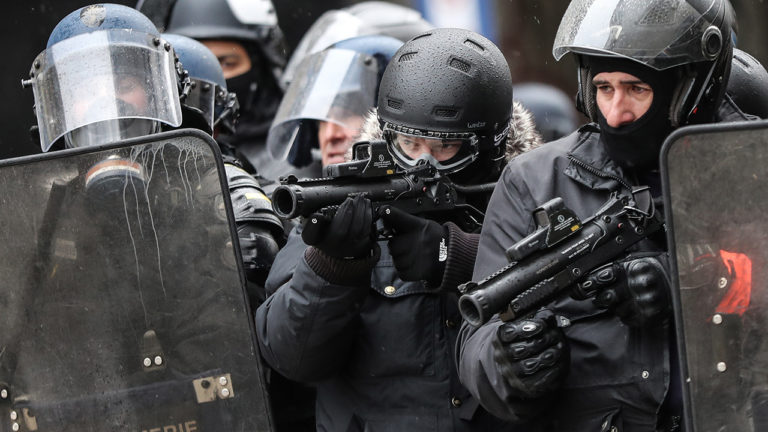
The French marched off to war in 1914 in glorious lines of infantry in baby blue coats and bright red trousers to be mowed down by the finest technology the Industrial Revolution had to offer. For us now it is easy to see how insane this was and how flawed the understanding of both the commoners and even the experts was in terms of how combat and war actually worked at the time. This naive view of modern tactics certainly applies to street conflicts we are seeing in France as part of the Yellow Vest protests. The so-called non-lethal (and less-lethal) arms of the French authorities gives them a tactical advantage far beyond that of any assault rifle.
Thanks to the media we have become accustomed to video of protestors getting sprayed by water or having their ranks dispersed thanks to tear gas, leaving everyone wet or coughing respectively but otherwise unharmed. However this humane picture does not meet up with the realities of this civilian vs. cop style warfare.
If we are to take the Yellow Vest protestors at their word then at least 22 of them have lost an eye (from “less-lethal” Flash-ball guns) and 5 have had their hands blown off with 154 being “seriously injured”. Obviously the protestors will want to maximize their statistics but there are plenty of videos from the various actions/demonstrations showing horrible injuries which are too numerous to all be fakes. So the numbers may be off but the overall general tendencies of these injuries do occur from the French authorities in the Human Rights defending EU is a proven fact. The simple reality is that despite a nice marketing phrase non-lethal weapons cripple and on occasion kill.
In order to understand the tactical advantage that non-lethal weapons offer the government (not the individual police but the state itself) we need to put aside our emotional response to seeing French people having their limbs blown off. We have to not jump into ranting about the flagrant hypocrisy of the EU when it comes to human rights and rationally break down how the conflicts between Yellow and Blue vests could look if the arms situation were different.
Scenario A: What if the Yellow Vests were armed?
If the organizers of the Yellow Vests (all movements are organized by someone regardless of what the media tells you) were able to arm their masses with rifles this would indeed lead to horrific short-term violence that would leave a permanent stain on French history. Often hundreds or thousands of protestors are met by dozens of police and handfuls of soldiers, if the protestors were on par with their adversaries in terms of guns, then their numerical advantage would shatter the police’s will to fight.
No policemen are going to fight to the last man against a force 20 times their number, which they may partially agree with dying for nothing, nor will they open fire with tanks in the centers of their own cities. Human psychology would allow them to kill foreigners in some distant country in this manner but not at home.
In this instance of near certain death from pure numbers the police would either “stay home” or possibly switch sides overtly or covertly.
Obviously a full civil war could start from this situation, but in a street warfare sense, escalating from protest to actual hot war is technically a winning scenario as it advances them closer to attaining/changing power.
Scenario B: What if the police fought like an army?
One key component of many Color Revolutions is getting the “bad leader” to be blamed for some sort of direct use of lethal bloody media-friendly massacre. If the French police actually used assault rifles against the protestors this would demonize them to the point of justifying a Revolution. This would not just cause a civil conflict but be a national call to arms to join it, which would be a bad move on the state’s part.
Furthermore, only sociopaths can fire rifles into unarmed crowds (who are not posing a direct threat) of people who speak their own language (i.e. their own “kind”). If the French police just decided to give the order to shoot them all, then in this instance many of the French police would find rifle and bayonet worthless as they would have no desire to shoot.
The result would be a handful of deaths from each protest but the utter collapse of legitimacy of the state and possible “retreats” of police forces unwilling to fire on “their own”.
Scenario C: The “non-lethal” reality we see today.
Psychologically it is much easier for the French police to use non-lethal (in their minds) weapons against the protestors. In the subconscious mind of the policeman he can justify shooting into masses much easier with this type of weapon because in theory it “shouldn’t” kill anyone and if it does it was an “accident”. This is much easier on our psyche and morals than shooting someone in the chest with a Lebel Rifle.
Research by the University of Cambridge supports this tendency. They found that police are far more likely to use force when it is supposedly from non-lethal weapons. This non-lethal status of weapons like tasers (which can and do kill people all the time) makes them so much easier to apply on the populace especially when the subconscious of the police officer tells him that, the guy he fried the other day with a taser died as an accident, one in every so many thousand people just has a weak heart.
So looking at non-lethal weapons tactically they offer the massive psychological advantage of being able to attack without an attack registering in the conscience of the user. As stated above they are also very media and propaganda friendly when anyone who dies from them is just “an accident” giving the government the ability to retain legitimacy while gouging out they eyes of its own populace. Real guns fail at both of these points completely.
Conclusion:
One bizarre irony in our strange postmodern times is that if the Yellow Vests were actually being shot at by real guns and being killed they would be far closer to achieving some sort of systemic change. Being mutilated by all sorts of gadgets and devices of one sort or another makes it easy for the police to do their job psychologically without generating the levels of sympathy and horror from live rounds hitting the innocent that the protestors need to shatter or change the system.
The French Flash-Ball gun should be made the symbol for the EU for it provides crushing repression of the masses with great PR spin to make it seem humane and caring. It is for our safety after all that they use these right?
‘Warrantless & Suspicionless’: US Border Searches of Devices Illegal – Lawsuit
Sputnik – May 1, 2019
The number of US government searches of travelers’ cellphones and laptops at airports and border crossings has almost quadrupled since 2015, according to a federal lawsuit filed Tuesday by the Electronic Frontier Foundation (EFF) and the American Civil Liberties Union (ACLU).
“Today’s electronic devices contain vast quantities of highly personal information that the Supreme Court has repeatedly held requires a warrant to be searched in other contexts,” the suit, which was filed in the US District Court of Massachusetts, states. “The border search context is no different.”
Tuesday’s filing follows a September 2017 lawsuit by the ACLU and the EFF against the Department of Homeland Security. The 2017 case was filed on behalf of 10 US citizens and one lawful US permanent resident whose smartphones and laptops were searched without warrants or probable cause at the US border, according to the ACLU. The lawsuit filed Tuesday also refers to the “warrantless and suspicionless searches” of the 11 plaintiffs in the 2017 case based on new information gathered by the ACLU and the EFF.
In May 2018, the court found that the plaintiffs in the case could sue the Department of Homeland Security for violating their First and Fourth Amendment rights, which protect freedom of speech and bar unreasonable searches and seizures, respectively.
“This is a win for constitutional rights at the border,” ACLU attorney Esha Bhandari said in a press release at the time. “The court has rightly recognized the severity of the privacy violations that travelers face when the government conducts suspicionless border searches of electronics. We look forward to arguing this case on the merits and showing that these searches are unconstitutional.”
Since the court ruled in May 2018 to reject the government’s request to dismiss the lawsuit, the US Customs and Border Protection (CBP) and US Immigration and Customs Enforcement (ICE) were forced to provide documents about how “warrantless and suspicionless” searches of electronic devices are conducted for their deposition testimony, according to the ACLU. In addition, CBP and ICE officials discussed — under oath — their warrantless search policies with the ACLU and the EFF, according to a press release by the ACLU.
Based on the new information provided by the officials, the ACLU and EFF decided to file a motion Tuesday, asking the judge to rule in favor of the plaintiffs without a trial. In the filing, it is revealed that US border officers searched the smartphones and other electronic devices of more than 33,000 travelers last year, which is almost four times the the number of searches from just three years ago.
In addition, the new information reveals that CBP and ICE officials search travelers’ devices for “general law enforcement purposes, such as looking for potential evidence of illegal activity beyond violations of immigration and customs law.” They look for violations of laws governing tax filing, bankruptcy, environmental regulations and consumer protection, according to the filing.
“They may even conduct searches of electronic devices when the subject of interest is someone other than the traveler, such as when the traveler is a US citizen and ICE is seeking information about a suspected undocumented immigrant; when the traveler is a journalist or scholar with foreign sources who are of interest to the US government; or even when the traveler is the business partner of someone under investigation,” the filing states, alleging that even friends or family members of targeted travelers may be subject to warrantless searches as well.
Furthermore, the government agencies allow officers to save information from travelers’ electronic devices and share it with state, local and foreign government entities as they please.
“Crossing the US border shouldn’t mean facing the prospect of turning over years of emails, photos, location data, medical and financial information, browsing history, or other personal information on our mobile devices. That’s why we’re asking a federal court to rule that border agencies must do what any other law enforcement agency would have to do in order to search electronic devices: get a warrant,” the ACLU concluded in a Tuesday press release.
Florida cites Poway shooting to pass controversial anti-Semitism bill
RT | April 30, 2019
Just days after the fatal shooting at a California synagogue, the Florida Senate passed an anti-Semitism bill that critics say will criminalize any criticism of Israel.
The bill prohibits anti-Semitism in Florida public schools and universities, and defines it broadly as any speech that makes stereotypical depictions of Jews, Holocaust denial, inciting of violence or explicit expressions of racial hatred – as well as “criticizing the collective power of the Jewish community.”
Such a broad definition could be used to outlaw the pro-Palestinian Boycott, Divestment and Sanctions (BDS) Movement, critics have pointed out, arguing that the bill violates the freedom of speech guaranteed by the First Amendment of the US Constitution.
BDS campaigns for businesses to desist from enterprise with Israeli companies until certain demands are met by the Israeli government in regards to rights and territories for Palestinians.
The Senate bill has been sent to the desk of Governor Ron DeSantis, a Republican who was elected in the 2018 mid-terms.
One woman was killed and three other people injured in the Saturday attack at the Chabad of Poway, a suburb of San Diego, California. The 19-year-old gunman targeted the synagogue during the week of Passover, and was arrested after his AR-15 jammed during the attack.
The shooting came six months after the attack on the Tree of Life synagogue in Pittsburgh, Pennsylvania, that killed 11 and injured seven.
Both attacks have been cited by gun control advocates and pro-Israel activists in support of their respective causes. Last week, a federal judge blocked a 2017 Texas law that would have prohibited state employees and contractors to engage in BDS, saying it “threatens to suppress unpopular ideas” and would “manipulate the public debate through coercion rather than persuasion.”
Must The US Save Synagogues at the Expense of The Constitution?
By Eve Mykytyn | April 29, 2019
Jane Eisner wrote an editorial in the Forward yesterday entitled “Spare Me your Thoughts and Prayers. The US Has Betrayed Its Jews.” Her thesis is that by abiding by a “perverted, outdated, self-serving view” of the constitution, the government has failed in its “oblig[ation] to ensure that citizens have the freedom to live lives of dignity, equality and security.”
Specifically she blames the Second Amendment right to bear arms which she claims “was not meant to turn America into a killing field,” and the freedom of speech clause of the First Amendment which she opines, “was not meant to allow a few powerful, private corporations to ignore their civic responsibilities to prevent incitement and promote social harmony.”
Ms Eisner dismissively allows that “scholars” have noted that the Constitution was drafted to define rights as “negative rights.” She bemoans the lack of emphasis on “positive rights,” that would make it the duty of the “government to ensure that citizens have the freedom to live lives of dignity, equality and security.”
Perhaps Ms Eisner has failed to read the Constitution which sets forth the various powers of the federal government and then in its amendments makes clear its intent that the government interfere with its citizens to the least extent possible. The Ninth and Tenth Amendments specifically grant nonenumerated rights and powers to the States or the people. Importantly, even the 14th Amendment which has expanded certain rights of citizens is phrased in the negative. “No State shall make or enforce any law which shall abridge the privileges or immunities of citizens… ; nor … deprive any person of life, liberty, or property, without due process of law; nor deny to any person … the equal protection of the laws.”
Nowhere is there a positive obligation placed on the government to ensure that its citizens “live lives of dignity, equality and security.” Instead the constitution prescribes equality under the law and protection from government interference. Understanding this makes axiomatic the right to own a gun or to allow speech that Ms Eisner does not like.
Yet, Eisner claims the federal government has totally failed in its “central” job to “protect its people.” From what constitutional or other law does Eisner derive this “central job?” Would a government attempt to prevent attacks on what Eisner calls “vulnerable minorities (her list – Jews, African Americans or Muslims or gays and lesbians or random children in a school.) by eliminating guns and free speech deprive all of us of liberties?
The United States has existed for 240 years with our constitution and its particular blend of rights and obligations. Ms Eisner’s apparently seeks to add additional restrictions in order to ensure the safety of the Jews. This is a dangerous route. The framers (of the Constitution and its Amendments) were wise enough to understand that positive obligations placed on the government must be balanced by the burdens they place on individual freedom. If we were to enact some version of Eisner’s ‘dignity and security’ we would be inviting the government to control more aspects of our lives.
Neither private citizens nor corporations are obliged to let everyone speak nor to police other’s speech. Of course some may plan nefarious deeds on Facebook, but information canned is published in other ways. The shooter in Poway, John Ernest, posted his manifesto on pastebin. In addition, allowing speech that Ms Eisner does not like may defuse anger rather than cause shootings. Christopher Poole, creator of 4chan, said he was often thanked for providing an outlet to vent frustrations, “an outlet to say what they can’t say in real life.”
Perhaps the constitution Eisner wants might be more appropriate for Israel. After all, Rabbi Yosef Berger, has said that “[the shooting] is clearly Hashem telling the Jews to come home, to return to Jerusalem because “the sanctity of Israel can protect the Jews.” Israel has made clear that it considers itself the homeland of the Jewish people. Jews who want safety at the expense of the United States’ cherished constitutional rights might be happier in a country not committed to the US Constitution.
Why is Maria Butina in Prison?
By Ron Paul | April 29, 2019
Russian gun rights activist and graduate exchange student Maria Butina was sentenced to 18 months in prison last week for “conspiracy to act as a foreign agent without registering.” Her “crime” was to work to make connections among American gun rights activists in hopes of building up her organization, the Right to Bear Arms, when she returned to Russia.
She was not employed by the Russian government nor was she a lobbyist on Putin’s behalf. In fact the Putin Administration is hostile to Russian gun rights groups. Nevertheless the US mainstream media and Trump’s Justice Department are treating her as public enemy number one in a case that will no doubt set the dangerous precedent of criminalizing person-to-person diplomacy in the United States.
The Foreign Agent Registration Act (FARA) was passed in 1938 under pressure from the FDR Administration partly to silence opposition to the US entry into World War II. While a handful of cases were prosecuted during the war, between 1966 and 2015 the Justice Department only brought seven FARA cases for prosecution.
Though very few cases have been brought on FARA violations, one of them was against Samir Vincent, who was paid millions of dollars by Saddam Hussein to lobby for sanctions relief without registering. He got off with a fine and “community service.”
Millions of dollars in unregistered payments from Saddam Hussein gets no jail time, while Butina gets 18 months in prison for privately promoting a cause most Americans support! How is this justice? The US Justice Department is not even as tough on illegals who commit capital crimes in the US!
Unfortunately Maria Butina was in the wrong place at the wrong time. With the rise of the “Russiagate” hysteria, Butina’s case was seen as a useful tool by Democrats to push the idea that President Trump was put into office by the Russians. Plus, many of them are also hostile to our Second Amendment and to the National Rifle Association. So it was a perfect storm for Butina.
Sadly, conservatives are mostly silent on this miscarriage of justice. They are also caught up in the idea that America can only be great if it goes abroad seeking monsters to destroy.
Also, a new Cold War is very profitable to the military industrial complex and Butina serves an important propaganda purpose. The media is an all-to-willing participant in this farce.
Even though Trump has been exonerated by a Mueller investigation that didn’t even view the Butina case as worth investigating, the President has been silent on her persecution. This is similar to his sudden silence on Wikileaks now that Julian Assange may be facing an eternity in a US supermax prison.
As author James Bamford wrote recently in an excellent New Republic article on the Butina case, the national security agencies are also eager to get another notch in their belts and the Russian gun activist was low-hanging fruit for their ambitions.
Non-interventionists believe strongly in citizen-to-citizen diplomacy as a way of avoiding war and conflict overseas. Exchange students, international business ventures, tourism, and just communicating with others is such an important way to thwart the plotting of the warmongers who lurk in all governments.
I am saddened to see that the United States has made such a hostile move toward peaceful foreign citizens seeking friendship with Americans. When citizens are no longer allowed to engage in diplomacy we are left with only the state. And the state loves war.
For NYT, Israel Is Always Nearing ‘Apartheid,’ but Never Quite Gets There
By Gregory Shupak | FAIR | April 26, 2019
Following Benjamin Netanyahu’s re-election as Israeli prime minister earlier this month, the New York Times’ editorial board (4/11/19) wrote:
Under Mr. Netanyahu, Israel is on a trajectory to become what critics say will be an apartheid state like the former South Africa—a country in which Palestinians will eventually be a majority, but without the rights of citizens.
A harsh criticism? Actually, the paper has been saying that Israel/Palestine could “become” an apartheid state for the better part of two decades. It ran a piece in 2003 (1/29/03) arguing that
if Israel does not give up the territories, it will face a choice: relinquish either democracy or the ideal of a Jewish state. Granting Palestinians in the territories the right to vote would turn Israel into an Arab state with a Jewish minority. Not allowing them to vote would result in a form of permanent apartheid.
For almost 20 years, the paper has suggested that Israel/Palestine risks devolving into an apartheid state if it continues to rule over Palestinians in the territories—Gaza, the West Bank and East Jerusalem—who cannot choose their rulers. This population includes approximately 4.75 million occupied Palestinians—320,000 in East Jerusalem, 2.8 million in the rest of the West Bank and 1.8 million in besieged Gaza—to say nothing of the millions of Palestinian refugees who cannot return to their homes and participate in elections because the people who put on those elections won’t let them.
That situation has remained the same, not only for the period that the Times has been publishing material saying the arrangement might someday add up to apartheid, but since 1967. Yet the Times persists in characterizing Israeli apartheid as a hypothetical future development. The paper acknowledges that governing millions of Palestinians but denying them the vote is a form of apartheid, so there’s no justification for saying, after nearly 52 years of such disenfranchisement, that that will eventually constitute apartheid, but for some unspecified reason doesn’t yet at this point.
Tom Friedman’s Groundhog Day
New York Times columnist Thomas Friedman appears to be having a Groundhog Day experience: He keeps waking up, looking at Israel’s ethnocracy, and saying that if it continues to be apartheid, it will become apartheid. In 2002 (10/16/02), he commented:
If you think it is hard to defend Israel on campus today, imagine doing it in 2010, when the colonial settlers have so locked Israel into the territories it can rule them only by apartheid-like policies.
2010 came and went, and the “apartheid-like” conditions remained, but Friedman persisted in treating Israeli apartheid as a mere possibility, writing (2/1/11) of the 2011 protests in Egypt:
If Israelis tell themselves that Egypt’s unrest proves why Israel cannot make peace with the Palestinian Authority, then they will be talking themselves into becoming an apartheid state — they will be talking themselves into permanently absorbing the West Bank and thereby laying the seeds for an Arab majority ruled by a Jewish minority between the Mediterranean Sea and the Jordan River.
A year later (8/1/12), Friedman said:
It is in Israel’s overwhelming interest to test, test and have the US keep testing creative ideas for a two-state solution. That is what a real US friend would promise to do. Otherwise, Israel could be doomed to become a kind of apartheid South Africa.
Two years after that (2/11/14), Friedman said that “Israel by default could become some kind of apartheid-like state in permanent control over… 2.5 million Palestinians.” Even in this so-called criticism of Israel, Friedman does the state a favor by acting as though the West Bank Palestinians are the only ones disenfranchised by Israel, overlooking the refugees and Gaza, even as Israel continues to control the latter. (He also appears to leave out Palestinian Jerusalemites.)
Evidence for Already-Existing Apartheid
As Friedman and his paper kept predicting that Israel/Palestine could turn into an apartheid entity, evidence mounted that it is exactly that. For example, United Nations special rapporteur John Dugard found in 2007 that “elements of the [Israeli] occupation constitute forms of colonialism and of apartheid, which are contrary to international law.” He went on to say that at the checkpoints throughout the West Bank and surrounding Jerusalem,
a [Palestinian] person may be refused passage through a checkpoint for arguing with a soldier or explaining his documents…. Checkpoints and the poor quality of secondary roads Palestinians are obliged to use, in order to leave the main roads free for settler use, result in journeys that previously took 10 to 20 minutes taking 2 to 3 hours…. In apartheid South Africa, a similar system [was] designed to restrict the free movement of blacks —the notorious “pass laws.”
Another UN special rapporteur, Richard Falk, noted in 2010 that “among the salient apartheid features of the Israeli occupation” are “discriminatory arrangements for movement in the West Bank and to and from Jerusalem,” as well as
extensive burdening of Palestinian movement, including checkpoints applying differential limitations on Palestinians and on Israeli settlers, and onerous permit and identification requirements imposed only on Palestinians.
A March 2017 report by the UN Economic and Social Commission for Western Asia concluded that “Israel has established an apartheid regime that dominates the Palestinian people as a whole.”
That July, however, Friedman (7/12/17) continued to treat Israeli apartheid as something that might happen down the road, wishing that President Trump had admonished Netanyahu in a meeting between the two:
Bibi, you win every debate, but meanwhile every day the separation of Israel from the Palestinians grows less likely, putting Israel on a “slippery slope toward apartheid,” as former Israeli Prime Minister Ehud Barak recently warned.
Last September (9/19/18), Friedman was still worried about this supposedly theoretical scenario:
Without some dramatic advance, there is a real chance that whatever Palestinian governance exists will crumble, and Israel will have to take full responsibility for the health, education and welfare of the 2.5 million Palestinians in the West Bank. Israel would then have to decide whether to govern the West Bank with one legal authority or two, which would mean Israel would be choosing between bi-nationalism and apartheid, both disasters for a Jewish democracy.
Netanyahu, Friedman went on to say, has failed to offer “any new, or old, ideas on how to separate from the Palestinians to avoid the terrible choices of bi-nationalism and apartheid.”
Erasing Palestinians
Setting aside the troubling assertion that Israelis and Palestinians living as equals would be not only a “disaster,” but as bad a “disaster” as apartheid, Friedman ignored the fact that just two months earlier, the Knesset had passed the Nation State Law that defined Israel as the national homeland of the Jewish people. The law asserted that “the realization of the right to national self-determination in Israel is unique to the Jewish people,” even though 20 percent of the population living inside Israel is not Jewish; encouraged “the development of Jewish settlement” and vowed that the state will “promote its establishment and consolidation.” It declared that “the state’s language is Hebrew,” deprecating Arabic, the first language of roughly half the people under that state’s control.
The Nation State Law demonstrates that the bad faith, future tense descriptions of Israeli apartheid are overly narrow, in that they focus exclusively on the Palestinian territories that Israel has occupied since 1967. Yet on the Israeli-held side of the Green Line, Palestinians are systematically discriminated against.
It’s not only the occupation that make Israel/Palestine apartheid. It’s the Israeli state’s foundational principles and actions: driving two-thirds of the indigenous Palestinian population from their homes at its birth, subsequently making more than 2 million of them refugees, and then denying their right to return, despite its being mandated under international law.
Meanwhile, Jewish people anywhere on Earth are given the right to immigrate, because Israeli leaders want to maintain a demographic advantage. They pursue this goal—with decisive help from their sponsors in Washington—through their longstanding operational policy mantra: maximum land, minimum Arabs.
Not even three full days after the New York Times’ most recent brooding about how Israel might “become” an apartheid state, Israel’s Supreme Court approved the demolition of 500 Palestinian homes in Jerusalem. Is it apartheid yet?
Israeli NGO Demands Israel Revoke BDS Founder’s Residency
teleSUR | April 28, 2019
The Israeli human rights group, Betzalmo, has called on Israel’s Attorney General and Minister of Interior to cancel BDS-founder Omar Al-Barghouti’s residency status, Arutz Sheva reported Sunday.
According to a letter that was dated for April 24, 2019, the Israeli NGO argued how it was possible that Barghouthi could be denied entry into the United States, but not in Israel, which is the country he is calling on the world to boycott.
“A recent law authorizes the Minister of the Interior, with the approval of the Attorney General, to revoke residency for anyone who harms state security or violates allegiance to the state, or endangers public peace,” Betzalmo stated. “Undoubtedly Barghouti’s leadership of the boycott movement against all citizens of the State of Israel severely harms the State of Israel and is a blatant breach of allegiance, as well as a threat to Israel’s security and defense by pushing for an arms embargo against Israel.”
The Israeli NGO said “in addition, the BDS movement collaborates with terrorist organizations, so there is undoubtedly an indirect link between Mr. Barghouti and terrorist organizations.”
Betzalmo CEO Shai Glick also released a statement in which he corroborated the claims in the letter that was dated for April 24.
“The State of Israel is a democratic and liberal state, but it must, in the name of democracy and liberalism, defend itself and its citizens. A determined struggle against the boycott constitutes true defense of the citizens of the State of Israel.” Glick said. “We cannot demand from our allies in the world to prevent the entry of a boycott activist and to prevent conferences of boycott organizations, while allowing those leading BDS activists residency in Israel, giving them State benefits and a platform. We are certain that the Interior Minister and the Attorney General will act with determination and immediately revoke Mr. Barghouti’s residency so he will be able to disseminate his toxic teaching only outside Israel.”
Barghouti was previously denied entry in to the United States, despite having the necessary documentation to enter the country.
The Boycott, Divestment and Sanctions movement (BDS) is a global campaign that has called for the economic boycott of Israel until it meets its “obligations under international law.”
Butina Case Creates ‘Pretty Dangerous Situation’ for All Foreign Nationals
Sputnik – April 27, 2019
On Friday, 30-year-old Russian national Maria Butina was sentenced in a US federal court to 18 months in prison for conspiring to act as a “foreign agent.” However, even though the government agreed with Butina’s case, it twisted her sentencing in such a way as to nullify her plea deal and give her more time behind bars.
Judge Tanya Chutkan gave Butina 18 months in a US prison for actions she said were “sophisticated and penetrated deep into political organizations,” threatening US national security. In practice, this means that Butina will serve another nine months, having been imprisoned since her July arrest.
The former American University grad student pleaded guilty last month to one count of conspiring to act as an unregistered foreign agent as part of a plea deal negotiated late last year. She sought immediate deportation to Russia following her sentencing, but the Daily Beast reported that won’t happen until her prison sentence is completed.
“She looked shocked the whole time,” Sputnik News analyst Nicole Roussell told Radio Sputnik’s Loud and Clear Friday, noting that most people, including Butina’s attorneys, expected her to be sentenced to time served and be expelled. “She’s served nine months, and a lot of that has been in solitary confinement. This is for someone who — as the judge noted — never had any [prior convictions], is clearly hard-working, intelligent, had 24 letters of character and recommendation on her record. The judge noted a ton of positive stuff about her during the sentencing hearing, so it was definitely a little bit of a shock to see that [the judge] went entirely with the side of the prosecution and gave the full 18 months, meaning she has nine more in prison.”
Butina spoke before the court Friday, saying, “My parents discovered my arrest on the morning news they watch in their rural house in a Siberian village,” she said. “I love them dearly, but I harmed them morally and financially. They are suffering from all of that. I destroyed my own life as well. I came to the United States not under any orders, but with hope, and now nothing remains but penitence.”
Butina’s charge stems from her political lobbying work with the National Rifle Association — work the government says required her to register under the Foreign Agents Registration Act (FARA), an obscure measure dating to the 1930s that’s been revived in recent years in the interests of prosecuting foreign nationals and repressing alternative news sources. Sputnik, as well as RT, Xinhua and CGTN, have all been required to register under FARA due to their associations with the governments of other countries.
However, Butina isn’t associated with the Russian government and didn’t act on its behalf. She noted in a February interview that she never attempted to conceal her actions because she didn’t believe she was doing anything wrong.
“Anyone who thinks that someone who wasn’t Russian would be in this situation is fooling themselves,” Butina’s lawyer, Robert Driscoll, told Roussell Friday.
Roussell recalled Judge Chutkan saying to Butina in the courtroom: “No doubt you have suffered greatly due to the national atmosphere, including salacious details proven to be untrue.”
“So she noted these things, and yet, went ahead and just agreed” with the prosecution, ignoring that those “salacious details” had been given to reporters by the prosecution, the most notorious of which was that she’d traded sex for information and political connections, Roussell said. Becker noted that such a charge would never be levied against a male suspect.
“I think it would apply very broadly to very large numbers of people,” Driscoll told reporters Friday. “The government’s theory that you act as an agent whenever you do anything for a foreign official — I think that is an extremely broad interpretation that can apply not only to people like Maria, but to other people. I think it’s something that should be looked at. I think anyone who is a foreign national in this country should be exceedingly concerned by the government’s position in this case and what they did here.”
“This is a little bit different than some of the cases we’ve seen,” Roussell told hosts Brian Becker and John Kiriakou. “When some of these FARA regulations started to be prosecuted, what, two years ago, we were all a little bit shocked — very shocked, actually — because this was a statute that had not really ever been regulated, hadn’t really been criminally prosecuted. But even when they started to prosecute those FARA charges, it was for people who… there was a real case against them, even if it was something that was clearly politically motivated.”
“In this case, she never lied; she never stole documents; she never funnelled money to the NRA; she cooperated; she was an extroverted student interested in political discourse,” Roussell noted.
“The irony of this case is, the government believed her,” Roussell said.
“When we look at the record, when we look at what was said, she wasn’t a spy. She was not an agent of the Russian government, in the sense of ‘secret agent.’ She was more of an agent in the sense of a principal agent,” Driscoll said, noting that “if I buy you some opera tickets, I’m your agent.”
“When we entered into the plea agreement, the understanding was that if she cooperated she would get a downward departure motion, but the government’s decision not to try to apply guideline, and then jack up a base offense level, essentially took away the departure motion with their left hand while offering it with their right,” Driscoll said. “So, the substantive effect of the departure motion was probably nil.”
In other words, while promising Butina it would decrease the amount of time she would be sentenced to serve, the federal government chose to charge her with a more serious crime, increasing the amount of time she could possibly serve and then applying the deal from there, resulting in more time in prison for Butina than before.
Roussell said the precedent set by the case has “far-reaching implications.”
“Maria could not have been prosecuted under civil FARA, which is the one that everyone knows about through [Paul] Manafort and other cases, because she had no knowledge of the statute,” Driscoll explained to Roussell. “In order to be criminally prosecuted under FARA, you need to have a willful violation.”
“So, because of her lack of knowledge, she ended up being charged with a more serious crime under the foreign agent statute. I think it’s an area that’s ripe for reform. If you take it seriously and literally, the government’s position in this case, and applied it to other circumstances, you really end up in a pretty dangerous situation. Not only for foreign nationals here, but I think for Americans abroad doing similar activities, I think would not be thrilled with this,” Driscoll explained.
Butina’s lawyer also noted that, while Judge Chutkan invoked special counsel Robert Mueller’s Russiagate investigation, his client was wholly unconnected to any events described in that report.
“She had nothing to do with the Mueller investigation. The Mueller team was aware of Maria, they were aware of this case, they interviewed her as part of her cooperation, and obviously she didn’t appear anywhere in the Mueller report. I found it curious that that was mentioned, that what she did was during the time of Russian election interference, it was alleged by the judge, when in fact, had she been involved in any of that, I would imagine that special counsel Mueller would have mentioned it somewhere in his 400 pages if she had anything to do with it,” Driscoll said. “But he did not.”
Third Federal Court Blocks Anti-BDS Law as Unconstitutional
ACLU | April 25, 2019
AUSTIN — A federal court in Texas today blocked a state law requiring government contractors to certify that they are not engaged in boycotts of Israel or companies that do business in Israel or territories controlled by Israel, ruling that the law violates the First Amendment. The ruling came in a case brought by the American Civil Liberties Union and the ACLU of Texas on behalf of four Texans, as well as a separate case brought by the Council on American-Islamic Relations.
“This is now the third time a federal court has blocked an anti-BDS law on First Amendment grounds,” said Brian Hauss, staff attorney with the ACLU’s Speech, Privacy, and Technology Project. “Whatever their views on the BDS movement, members of Congress and state legislators should heed this strong message from the courts: The right to boycott is alive and well in the United States and any attempt to suppress it puts you squarely on the wrong side of the Constitution.”
The ACLU’s lawsuit was brought on behalf of four people who were forced under the law to choose between signing the certification or forgoing professional opportunities and losing income: John Pluecker, a freelance writer who lost two service contracts from the University of Houston; George Hale, a reporter for KETR who was forced to sign the certification against his conscience in order to keep his job; Obinna Dennar, a Ph.D. candidate at Rice University, who was forced to forfeit payment for judging at a debate tournament; and Zachary Abdelhadi, a student at Texas State University, who has had to forego opportunities to judge high school debate tournaments.
In his ruling, United States District Judge Robert Pitman stated that the law “threatens ‘to suppress unpopular ideas’ and ‘manipulate the public debate through coercion rather than persuasion’” and that “no amount of narrowing its application will cure its constitutional infirmity.”
Federal courts in Arizona and Kansas also blocked similar state anti-boycott laws in First Amendment challenges brought by the ACLU and ACLU affiliates in the respective states. In January 2018, a federal district court preliminarily enjoined an anti-boycott law in Kansas, holding that the First Amendment protects citizens’ right to “band together” and “express collectively their dissatisfaction with the injustice and violence they perceive, as experienced both by Palestinians and Israeli citizens.” In September, a district court enjoined a similar anti-boycott law in Arizona.
The ACLU takes no position on boycotts of Israel or of any other foreign country, but it has long defended the right to boycott, which is protected under the First Amendment.
The court’s opinion can be found here: https://www.aclutx.org/sites/default/files/4-25-19_bds_order.pdf.
As US Government Strangles Iran’s Economy, Google ‘Suffocates’ Iranian Media
Sputnik – April 25, 2019
The recent shutdown of PressTV and HispanTV’s YouTube and Gmail accounts are more examples of the continued effort by the US government to silence Iranian media outlets, Alex Rubinstein, a journalist for MintPress News, told Sputnik.
“I think that this is part of a larger trend of cracking down on Iranian media,” Rubinstein told Radio Sputnik’s By Any Means Necessary on Wednesday. “Just as this was happening, the United States was saying that we want to bring down Iranian oil exports to zero. Well, it seems like they’re also trying to bring down Iranian expression down to zero through these kinds of moves.”
“It’s a message which both strangles their economy and also suffocates their voice,” he added.
Google barred PressTV and HispanTV, an Iranian Spanish-language outlet, from accessing their respective YouTube and Gmail accounts without notice and without an explanation detailing what Google policies were violated, the outlets recently reported.
Although content from both outlets is still viewable, the organizations are unable to upload new content.
Israeli media outlets have speculated that the order was handed down by Google after HispanTV issued a report claiming imprisoned Palestinians were being used for medical experiments.
“On its face, that sounds like that could be questionable,” Rubinstein said of the speculation. “But there have been a number of other outlets to carry this report, and it wasn’t like they were pulling this information out of thin air — it came from a Palestinian politician in Israel… he made this allegation, and they were citing him properly.”
The journalist told hosts Eugene Puryear and Sean Blackmon that while it’s unclear what initiated Google’s action, it seems in line with the behavior of tech companies vying to “stifle Iranian media” at the behest of the US government.
“These tech companies are basically extensions of the US empire. You look at all that’s going on with NATO and the US government trying to push back on Chinese 5G — well, the point of that is that [the US] can’t spy so well if [the 5G grid is] Chinese,” Rubinstein said.
“The American government has a dominance over these companies, and we see that with the ban on PressTV, and we see that with the other countries that have been targeted, which are primarily Russia and Venezuela.”
“It’s hard to imagine that this is just a coincidence,” he added.
Earlier this month, after the US formally designated Iran’s Islamic Revolutionary Guard Corps a terrorist organization, popular photo and video-sharing platform Instagram began banning pages belonging to various Iranian military officials. The site later explained that the move was in line with the US’ designation.
“I understand to have a policy against spreading terrorist messages on a social media platform… but we didn’t see these crackdowns for terrorist organizations like the Free Syrian Army, or any of the other supposedly moderate rebels in Syria,” Rubinstein told Blackmon.
“We see them [crackdowns] for the supposed terrorist that are enemies of the United States… It seems like the tech companies are all too happy to follow in lockstep.”
See also:
Google’s Campaign Against Iranian Media Outlets Sets ‘Dangerous Precedent’
Facebook Takes Down Iranian Media Pages in Continued War on Alternative News
France seeks source of damaging leak on Yemen war
Press TV – April 25, 2019
French authorities have been searching for a government employee who they believe has leaked damaging information about France’s role in the Saudi-led war on Yemen to the media, a report says.
In mid-April, the new investigative media outlet Disclose published a report that contained a classified 15-page note from the French military intelligence service (DRM) revealing that the two Arab countries had deployed French weaponry in their aggression against Yemeni.
The leaked note, which was provided to the government in October 2018, contained lists of French-manufactured tanks, armored vehicles, fighter jets, helicopters, howitzers, ammunition, and radar systems sold to both Saudi Arabia and the UAE.
The use of French weapons in Yemen contradicts previous public statements from Paris, which has repeatedly asserted that these weapons are used only in a limited manner and in “defensive” operations only. Back in January, French Armed Forces Minister Francoise Parly said during an interview on the France Inter radio station that she was “not aware that any (French) arms are being used in this conflict.”
Citing unnamed informed sources on Wednesday, AFP reported that an investigation into the “compromise of national defense secrecy” had been opened by prosecutors on December 13 last year after a complaint by the ministry of the armed forces.
The AFP report did not say when the note was leaked.
The sources also said that France’s domestic intelligence agency, the DGSI, was leading the probe, which concerned the compromise of information involving a government employee and a third party.
Disclose disagrees
Disclose argued that the note was “of major public interest.”
“The confidential documents revealed by Disclose and its partners are of major public interest, that bring to the attention of citizens and their representatives what the government wanted to conceal,” AFP quoted an editorial for Disclose and its partners as saying.
Additionally, Geoffrey Livolsi, the founder of Disclose, said at least three journalists who had taken part in the preparation of the website’s investigative report had been called in for a hearing to be conducted by the DGSI in May.
“This judicial investigation has only one objective: to know the sources that allowed us to do our job. It is an attack on the freedom of the press and the protection of the sources of journalists,” he said.
The French weapons in action
The report revealed that Leclerc tanks, a main battle tank built by the Nexter, and Mirage 2000-9 fighter jets sold in the 1990s to the UAE were being used in the war on Yemen.
Furthermore, 48 CAESAR artillery guns, manufactured by the Nexter group, were being used along the Saudi-Yemen border by the Saudi-led coalition.
Nexter Systems is a French state-owned manufacturer of weapons, based in Roanne, Loire.
According to the DRM document, French-made Cougar transport helicopters and the A330 MRTT refueling plane have been seen in action, and two French ships are serving in the crippling blockade of Yemeni ports which has led to unprecedented food and medical shortages in impoverished Yemen.
The classified note also contained a map estimating that over 430,000 Yemenis live within the range of French artillery weapons on the Saudi-Yemeni border. It further estimated that French weapons have resulted in civilian casualties.
France, the third-biggest arms exporter in the world, is a large provider of various kinds of weapons to Saudi Arabia and the UAE.
The French government has so far resisted pressure from rights groups to stop the lucrative arms trade with the two Persian Gulf countries, denying that the weapons were being used against the Yemenis.
Saudi Arabia and a number of its regional allies, most notably the UAE, launched the devastating campaign against Yemen in March 2015. According to the Armed Conflict Location and Event Data Project (ACLED), a nonprofit conflict-research organization, the war has so far claimed the lives of about 56,000 Yemenis.
Apart from France, the United States, Britain, and other Western countries have faced criticism over arms sales to the Saudi regime and its partners.
Gitmo Destroyed Our Constitutional Order
By Jacob G. Hornberger | FFF | April 23, 2019
Sunday’s Washington Post carried an article about the suicide of former Peruvian President Alan García, who Peruvian officials had charged with official corruption while he was in office. The article posited the possibility that García committed suicide because under Peru’s judicial system, he would have faced up to three years in pretrial detention without actually being indicted, which the Post said was “a term unthinkable in many democracies, even for suspects facing overwhelming evidence of the most heinous crimes.”
What the Post did not point out is that indefinite detention without a trial is not unthinkable in the United States. Instead, thanks to the Pentagon and the CIA, indefinite detention has now become a core feature of America’s criminal-justice system. As the Post implies, it is also a hallmark of tyranny.
Among the potential acts of tyranny with which our American ancestors were most concerned was the power of the federal government to keep people in jail indefinitely without a trial. That was why the Constitution, which called into existence a government of limited powers, did not delegate such a power to federal officials. It’s also why the American people enacted the Fifth, Sixth, and Eighth Amendments, which expressly guaranty the rights of trial by jury, a speedy and public trial, bail, and protection from cruel and unusual punishments.
The Pentagon and the CIA destroyed those rights with the establishment of their prison, torture program, and “judicial” center at Guantanamo Bay, Cuba. Today, there are people at Gitmo who have been languishing for more than a decade, denied the benefits of trial by jury, a speedy and public trial, and bail.
This shouldn’t surprise us. In the long sordid history of the U.S. national-security establishment and its infamous regime-change operations in foreign countries, it has always stood for installing dictatorships into power, preferably military ones. By their very nature, military establishments almost always lean conservative, viewing procedural protections as nothing more than “technicalities” that permit guilty people to go free. Thus, the last thing that military regimes are going to do is honor and respect the principles enunciated in the U.S. Bill of Rights.
An example was the U.S.-inspired coup in Chile in 1973, where the regime of military Gen. Augusto Pinochet had his national-security state forces round up some 50,000 people, incarcerate them, rape them, torture them, and murder or disappear around 3,000 of them. No trial by jury. No bail. Fearful of the power of the Chilean national security establishment, the Chilean federal courts went silent, as did the Chilean legislature.
The same thing happened in the CIA’s coup in Guatemala some 20 years before that. The CIA succeeded in ousting the democratically elected president of the country, Jacobo Arbenz, and installed a brutal military general in his stead, who proceeded to round up, torture, and kill people without a trial.
We saw it with Iran, when a CIA coup in 1953 ousted the democratically elected prime minister, Mohammad Mossadegh, and restored the brutal tyranny of the Shah. While the Shah wasn’t a military general, his U.S.-supported rule was every bit as tyrannical as that of any military general. Indefinite detention and torture, without the benefit of a trial, were hallmarks of his brutal rule, which came to an end in 1979 when the Iranian people revolted against it.
We see it today in the military dictatorship in Egypt. Indefinite detention and torture, without trial. All fully supported by the Pentagon, the CIA, and most of the rest of the federal government.
Therefore, it shouldn’t surprise us that the Pentagon and the CIA established this same type of system in Cuba, where the ruling leftist communist regime, ironically enough, engages in indefinite detention and torture without trial as well. In fact, don’t forget that that is why our ancestors demanded that the Bill of Rights be enacted — they were certain that federal officials would do the tyrannical acts proscribed by the Amendments. What the Pentagon and the CIA have done in Cuba is a confirmation of the concerns that motivated Americans to enact the Bill of Rights.
One irony in all this, of course, is that U.S. military officials and CIA officials take an oath to support and defend the U.S. Constitution. But it’s obvious that the oath is nothing more than a lie. After all, the reason that the Pentagon and the CIA established their prison and torture center in Cuba was precisely to avoid the provisions of the Constitution. Their very aim was to establish a Constitution-free zone, one in which they could keep people jailed forever and torture them to their heart’s content and never have to bring them to trial.
It’s a sad and pathetic legacy of the decision after World War II to convert the U.S. government from a limited-government republic to a national-security state, a type of governmental structure that is inherent to totalitarian regimes, one in which government officials wield tyrannical powers. That’s why it’s not enough to close the Pentagon’s and CIA’s imperialist prison and torture center in Cuba. To restore freedom and justice to our land, it’s also necessary to restore a limited-government republic to ensure that this type of dark tyranny never afflicts our nation again.
Featured Video

Houthis Don’t Have to Conquer Saudi Arabia to Make It Pay
or go to
Aletho News Archives – Video-Images
From the Archives
Newly Released FBI Docs Shed Light on Apparent Mossad Foreknowledge of 9/11 Attacks
By Whitney Webb | MintPress News | May 17, 2019
NEW YORK — For nearly two decades, one of the most overlooked and little known arrests made in the aftermath of the September 11 attacks was that of the so-called “High Fivers,” or the “Dancing Israelis.” However, new information released by the FBI on May 7 has brought fresh scrutiny to the possibility that the “Dancing Israelis,” at least two of whom were known Mossad operatives, had prior knowledge of the attacks on the World Trade Center. … continue
Blog Roll
 Aletho News
- MEP blasts ‘Euro-Gestapo’ for lecturing Russia on democracy
- Syria May Send Troops to Saudi Arabia Amid War with Ansar Allah
- UK whines about losing billions to ‘Putin tax’
- Baghaei to Rubio: Distorted narratives cannot erase US record of broken commitments
- Houthis Don’t Have to Conquer Saudi Arabia to Make It Pay
- MOE: Nearly 22,000 Students and Education Workers Killed
- Guterres in Islamabad: Genocide, cowardice, and the cage of Imran Khan
- Johnson, Marandi say Yemen holds upper hand over Saudi Arabia
- False flags won’t save aggressors, Iran FM spokesman says
- The Makkah Pact Enters Into Force: The End of American Dominance or Its New Form?
- If Americans Knew
- Report claimed Mark Levin used by Israeli government to influence Trump
- Over 2,000 Gazans have died awaiting medical evacuation amid Israel’s continued siege
- How a U.S. Diplomat Suppressed and Altered Reports Critical of Israel
- 5 Palestinians Die from Israeli Strikes in Gaza as Relentless Attacks Continue
- Report: Ceasefire Slows Killing but Leaves Devastation Intact
- Country Music Singer Zach Bryan Breaks Attendance Record at Robert Kraft’s Gillette Stadium While Wearing ‘Free Palestine’ Shirt for Second Night in a Row
- Three years of death and devastation: Israel’s war on Gaza in pictures
- Why Hamas believed the status quo was more dangerous than its 7 October gamble
- Debunking Israel’s latest list of ‘terrorist’ journalists in Gaza
- In Gaza, focus is on survival, “every step is a struggle” – Daily Update
- No Tricks Zone
- New Study: 50 Years Of The Most Aggressive ‘Net Zero’ Policies Can Only Affect The Global Climate By 0.03°C
- US September “Heat” Was No Record…Many Records Set Decades Ago
- Latest European Green Energy Debacle; Portugal’s Largest Flagship Solar Park Insolvent!
- Green Energy Debacle: German Expert Professor Fritz Vahrenholt Warns Of Severe Economic And Social Consequences
- Two More Paleo Reconstructions Affirm Meters-Higher Sea Levels Across Ireland, Brazil 7000-6000 Years Ago
- New Study: Earth And Venus Surface Warmth Largely Explained By Convection And Lapse Rate, Not CO2 Or Radiation
- 2025 Nature Paper Claiming Worsening Global Drought Gets RETRACTED …Heavily Flawed
- New Study: ‘Global Drought Shows No Detectable Recent Acceleration Under Climate Warming’
- Economic Masterminds: German Socialists Suggest Taxing Productivity Gains Stemming From Using AI
- The South China Sea Has Not Been Cooperating With The Climate Change Narrative

