Massacre in New Zealand
By Stephen Lendman | March 16, 2019
It’s too soon to know if Friday’s mass shootings at Christchurch, New Zealand’s Al Noor Mosque and Linwood Islamic Center were terrorist attacks, false flag deception, or something else – the country an unlikely location for either type incident.
It experienced few similar ones throughout its modern history. In 1985, Greenpeace’s Rainbow Warrior vessel was sunk by French intelligence.
Friday’s incident was the deadliest in New Zealand since the 1943 Featherston prisoner of war camp riot, resulting in 49 deaths.
It was the first mass shooting in the country since the 1997 Raurimu massacre. A gunman killed six, wounding four others with a sawed-off 12-gauge single-barreled shotgun – found not guilty by reason of insanity at trial.
Mass shooting terrorist attacks and false flags occurred numerous times in the US and Europe.
A recent US mass shooting happened in Aurora, Illinois last month, a gunman killing six, injuring a dozen others. Reportedly he was a former worker at a plant where the incident took place.
A separate early March Chicago mass shooting in a privately owned bar killed six individuals, wounding others. Gunfire reportedly followed a fight.
The above two incidents were neither terrorist or false flag attacks. The most recent major mass shooting in the US occurred last October in Pittsburgh – killing 11, wounding six others inside the city’s Squirrel Hill neighborhood Tree of Life synagogue.
The Christchurch, NZ toll included at least 49 killed, around 50 others injured – both mosques four miles from each other, indicating multiple gunmen involved.
A white male/Australian national suspect was arrested and charged with murder, identified as 28-year-old Brenton Harrison Tarrant, three others taken into custody, New Zealand Police Commissioner Mike Bush, saying:
“We have had no other threats since we responded to this incident. No agency had any information (about what appears to have been a) well-planned event,” adding:
“We never assume that there aren’t other people involved. At this point, we are not looking for any other persons.”
According to police, two improvised explosive devices (IEDs) were found attached to a vehicle, now defused.
During Friday prayers, police responded to reports of live fire in the city’s center. Residents were advised to stay off streets until resolution of what went on.
Police tweets said: Officers “respond(ed) to reports of shots fired in central Christchurch at around 1:40pm.”
“In response to a serious ongoing firearms incident in Christchurch, all Christchurch schools have been placed into lockdown. Police urge anyone in central Christchurch to stay off the streets and report any suspicious behavior immediately to 111.”
New Zealand Prime Minister Jacinda Ardern said alleged perpetrators held “extremist views,” adding:
“This is one of New Zealand’s darkest days. Many of those affected may be migrants, maybe refugees… They are us… The perpetrator is not.”
Authorities called what happened a terrorist incident, perhaps so, perhaps a false flag, perhaps something else.
The shootings were reminiscent of what happened on February 25, 1994. Kananist Baruch Goldstein, a Brooklyn born physician turned racist killer, massacred 29 Palestinian worshippers, wounding scores more at the Cave of the Patriarchs, serving as a mosque.
He died violently during the incident, overwhelmed and beaten to death by survivors. According to political scientist Ian Lustick, “(b)y mowing down Arabs he believed wanted to kill Jews, Goldstein was re-enacting part of the Purim story.”
Reportedly, the New Zealand gunman charged with murder published a 74-page manifesto, praising Trump and convicted Norwegian white supremacist Anders Breivik.
He live-streamed the attack on Facebook with a bodycam, ghoulishly showing his handiwork.
An AFP digital investigation determined that the video was genuine, including matching screenshots of the mosque he attacked.
Video footage showed him parking his car next to the mosque, exiting with a rifle, picking up a second one, entering the compound, firing repeatedly at worshipers inside.
The shooter’s Facebook, Instagram, and Twitter accounts were taken down, a Facebook statement saying:
“Police alerted us to a video on Facebook shortly after the livestream commenced and we quickly removed both the shooters Facebook and Instagram accounts and the video.”
New Zealand’s Interior Ministry spokesman said the video may be classified as objectionable content, illegal to share, calling it “disturbing and…harmful for people to see.”
Australian Prime Minister Scott Morrison called the shooter’s manifesto a “work of hate.” It praised Trump as “a symbol of renewed white identity and common purpose.”
It objected to New Zealand’s immigration policies, multiculturalism, and what it called “decaying” white, European, Western culture.
One report said shootings occurred at three locations. Police Commissioner Bush named the above two mosques, saying “(w)e are unsure if there are any other locations outside of… areas that are under threat.”
A tweet added that police are working “at a number of scenes.” According to New Zealand and Australian police, the shooter charged with murder was not on a terrorist watch list. Authorities had no reason to believe he was dangerous.
The Friday incident is an ongoing story, more information likely to be known ahead.
Stephen Lendman’s newest book as editor and contributor is titled “Flashpoint in Ukraine: How the US Drive for Hegemony Risks WW III.”
May and Merkel Fiddle While Their Unions Burn
By Tom LUONGO | Strategic Culture Foundation | 16.03.2019
When it was reported by John Petley of the Bruges Group that German Chancellor Angela Merkel had, in effect, written the Brexit withdrawal agreement Theresa May has now twice had turned down by her parliament it should have come as no shock to anyone closely following the Brexit drama.
Uncorroborated? Sure. Most likely true. Of course.
The European Union doesn’t want Brexit to happen. And if it were to happen it would only be acceptable to them if it looks like the deal Mrs. May put before the House of Commons twice only to be rebuked by historic margins.
This was not a version of Brexit anyone had in mind. Not the softest-minded Labour voter and especially not the sovereignty-minded Leave voter of the Nigel Farage persuasion.
It was, in short, a betrayal of all things fundamentally nationalist.
For the past week I’ve been watching a lot of British Parliament as it debates, and I use that word very loosely, the situation Mrs. May and the MP’s themselves have put the country in. And, in a word, it is shameful.
May and Merkel both miscalculated terribly on what the British people would accept. It’s obvious that both only thought in terms of the kind of political leverage they could bring to bear on the House of Commons which would eventually force them to cave to supposed horror-show of a ‘No-Deal’ Brexit.
Make no mistake, the horror show would mostly fall on Germany – whose banking system, already teetering on collapse thanks to other rifts forming within the currency bloc – and export-driven economy would suffer from the Brits having more control over the exchange rate of the pound versus the euro.
A lower pound would be the first result of a no-deal Brexit. Good for long-suffering British manufacturing and bad for Germany’s, since the UK is Germany’s biggest export market.
Economically and philosophically, no-deal is the best deal for the UK But don’t tell that to the MP’s who are scared to death of it.
But what’s most important about all of this is that it is all just a symptom of a much deeper problem, the unwieldy nature of the European Union itself.
Germany and the elites who have pushed this project, the unelected financiers I like to call The Davos Crowd, are dead set against anything that obstructs its completion.
The wave of nationalist political fervor racing across the continent is, however, a consequence of their trying to form a political and fiscal union that far exceeds the original mandate sold to voters when they joined.
And that is threatening to tear Mrs. Merkel’s union to pieces. This is why she and her posse in Brussels are so committed to screwing the British people. They have to send the right message to Italy and Hungary. It’s why they want $39 billion.
It’s why they are using the non-issue of the Irish border to tie the UK into the customs union and single market forever. But, make no mistake, just like Merkel’s horrific treatment of Greece was seen as unconscionable by people across Europe in 2015 they are looking at how the Brits are being treated and are equally as appalled.
Merkel, Juncker et.al. all saw the divisions within the Labour and Conservative parties that have resulted from their planning and thought them to be assets. But they aren’t. Maybe in the short-run it will get them what they want, another moment to kick the can down the road a little bit further.
But in the long-run all it is doing is setting up for another round of Brexit in the future with a much less plastic set of circumstances. Because, as I said earlier, they have miscalculated. The British people are fed up with them and with their own government.
The Labour party is squealing out of both sides of its mouth trying to get themselves out of the corner they’ve painted themselves into. Because they can read the polls. And what was a solid Labour lead in the winter has become a solid Tory lead in the Spring.
Because as split as the Tories are, voters understand that there are more of them trying to implement their will than there are Labour MP’s. And that counts for something.
Mrs. May has made a mess of things thinking she could shoe horn a terrible deal through parliament that would satisfy the EU while blowing up the traditional two-party system in the House of Commons.
And this is why I say to hardened cynics who think these people are all-powerful that they aren’t. They are smart but they aren’t clever. They do the same thing that has worked before and run the same playbook. Brexit looks exactly like the Greek debt talks.
Merkel didn’t update her playbook for 2018. It wasn’t a short-term negotiation. It was a three-year process that tried the patience of 66 million Brits. And they have seen the real face of the EU and many more of them want no part of it.
Merkel and Juncker are trying to hold onto their manufactured leverage over the Brits to, in turn, hold onto a Union that is in the process of failing. May and her cabinet are trying to hold onto a relationship with the EU while the UK itself is now in danger of failing.
The Scots are pushing for independence to stay in the EU. Wales is beginning to consider it. Northern Ireland doesn’t like being anyone’s Trojan Horse.
They have thoroughly underestimated the will of the people and it will cost them what little cache they have left with voters. Remember, confidence lost in the institutions of government begets a loss of confidence in the money and their ability to manage it.
If you want a catalyst for a European sovereign debt crisis, look no further than Brexit now or the downstream effects of a delayed Brexit later.
If an extension is approved by the EU and given to the Brits, Euroskeptics will go from commanding a projected 32-33% of a 705 seat European Parliament to possibly 35-36% of a larger one that includes the Brits.
Because if Brexit is delayed and betrayed do you think Remainers will be elected en masse? Or do you think Farage et.al. will not storm into Brussels mad as hell?
Merkel and May may have won this battle using their useful idiots like Anna Soubry and Ian Blackford but they will lose the war as the rest of Europe comes to terms with being frog-marched towards a future they neither want, signed up for or are willing to pay for anymore.
No wonder the Yellow Vests keep showing up every weekend.
Bipartisan Attacks on the Second Amendment
By Ron Paul | March 11, 2019
The House of Representatives recently passed legislation that would expand the national background check system to require almost everyone selling firearms, including private collectors who supplement their incomes by selling firearms at gun shows, to perform background checks on the potential buyers. The bill has a section purporting to bar creation of a national firearms registry. However, the expanded background check system will require the government to compile lists of those buying and selling guns. In other words, it creates a de facto national gun registry.
Similar to the experience with other types of prohibition, making it more difficult to legally buy a gun will enhance the firearms black market. Criminals, terrorist, and even deranged mass shooters will thus have no problem obtaining firearms.
It is no coincidence that the majority of mass shootings take place in “gun-free zones,” where shooters know their targets will be unarmed. This shows that any law making it more difficult for Americans to own and carry firearms makes us less safe. If Congress really wanted to reduce the incidence of gun violence, it would repeal the Gun-Free School Zones Act. This law leaves children easy prey for mass shooters by mandating that public schools be “gun-free zones.”
A nationwide system of gun registration could be a step toward national gun confiscation. However, antigun bureaucrats need not go that far to use the expanded background check system to abuse the rights of gun owners. Gun owners could find themselves subject to surveillance and even harassment, such as more intensive screening by the Transportation Security Administration, because they own “too many” firearms.
Republican control of the White House and the Senate does not mean our gun rights are safe. Republicans have a long history of supporting gun control. After the 1999 Columbine shooting, many Republicans, including many who campaigned as being pro-Second Amendment, eagerly cooperated with then-President Bill Clinton on gun control. Some supposedly pro-gun Republicans also tried to pass “compromise” gun control legislation after the Sandy Hook shooting.
Neoconservative Senator Marco Rubio has introduced legislation that uses tax dollars to bribe states to adopt red flag laws. Red flag laws allow government to violate an individual’s Second Amendment rights based on nothing more than a report that the individual could become violent. Red flag laws can allow an individual’s guns to be taken away without due process simply because an estranged spouse, angry neighbor, or disgruntled coworker tells police the individual threatened him or otherwise made him feel unsafe.
President Trump has joined Rubio in wanting the government to, in Trump’s words, “take the guns first, go through due process second.” During his confirmation hearing, President Trump’s new Attorney General William Barr expressed support for red flag laws. California Senator and leading gun control advocate Dianne Feinstein has expressed interest in working with Barr to deprive gun owners of due process. It would not be surprising to see left-wing authoritarians like Feinstein work with right-wing authoritarians like Barr and Rubio on “compromise” legislation containing both a national red flag law and expanded background checks.
My years in Congress taught me that few politicians can be counted on to protect our liberties. Most politicians must be pressured to stand up for freedom by informed and involved pro-liberty citizens That is why those of us who understand the benefits of liberty must remain vigilant against any attempt to erode respect for our rights, especially the right to defend ourselves against private crime and public tyranny.
French MPs approve anti-riot bill amid Yellow Vest protests, rights watchdog sounds alarm
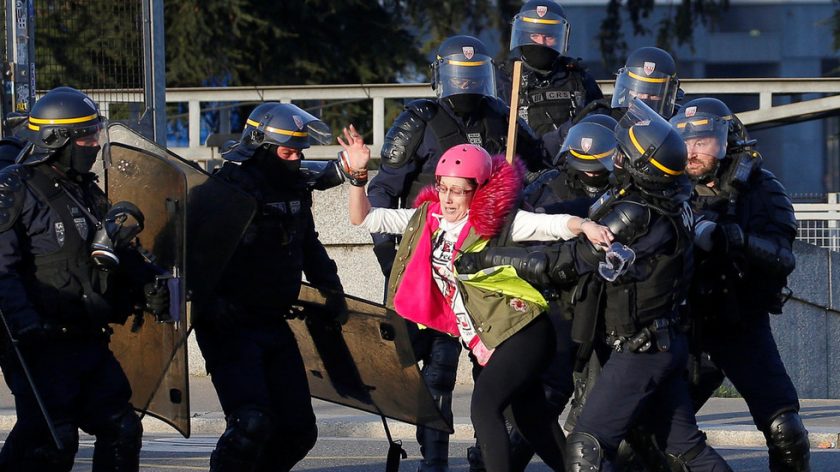
A protester is pushed back by police during a demonstration of the “yellow vests” movement in Nantes, France, February 16, 2019. © REUTERS/Stephane Mahe
RT | March 13, 2019
The upper house of the French parliament has greenlighted a bill giving police broad powers to quell unrest. It comes as a rights watchdog warned of civil liberties being undermined in France due to crackdowns on protest.
Following hours of tense debate on Tuesday, the French Senate approved an anti-hooligan (‘anti-casseurs’) bill by a margin of 210 votes to 115.
The bill has courted widespread controversy, having been denounced as “liberticide” by the left, and hailed as a “the law of protections” by the French Interior Minister Christophe Castaner.
The government insists that the legislation will allow to distinguish between law-abiding protesters and violent rioters, while providing protection for both law enforcement and Yellow Vest demonstrators. Speaking ahead of the vote on Tuesday, Castaner defended the bill, saying that it “safeguards the right to demonstrate,” while brushing off concerns that it encroaches on civil freedoms.
“This text does not include an ounce of arbitrariness,” he said.
His view has not been shared by many among the opposition.
Senator Jerome Durain of the center-left Socialist Party (PS) slammed the draft as “useless, imprecise and dangerous,” arguing that it will only foment the unrest.
“The dramatization of the situation does not serve anyone,” Durain said.
The bill, which was first introduced in parliament last year, has already received backing from the National Assembly, France’s lower house. While the National Assembly overwhelmingly supported the bill in February, the vote saw an unprecedented number of abstentions within French President Emmanuel Macron’s own La Republique En Marche (LREM) party. Some 50 LREM lawmakers chose not to approve the bill and one MP, Matthieu Orphelin, went as far as to desert the party ranks altogether in the wake of the vote.
Many took issue with the provisions of the bill that prohibit protesters from wearing masks at rallies and allow police to single out and ban certain “troublemakers” from attending the ‘acts.’
The Yellow Vest protests have been marred by violence from both sides. While the French authorities blame radicals for inciting violence, protesters accuse the police of disproportionate use of force that has resulted in limbs getting torn off, eyes lost and other life-changing injuries for demonstrators who were caught up in the clashes.
In the run-up to the bill’s adoption, the head of the Defenseur des Droits de l’Homme (Defender of Human Rights) body, Jacques Toubon, called for change to the ham-fisted policing methods employed by the state, which he said was a legacy of the state of emergency imposed after a spate of Islamist-inspired terrorist attacks in November 2015. The state of emergency was lifted in 2017, but it has weakened the French legal system by giving police more leeway to crack down on rights and freedoms under the pretext of protecting national security, Toubon argued.
It “helped lay the foundations for a new legal order, based on suspicion, in which fundamental rights and liberties have been somewhat weakened,” Toubon said, calling it a “poisoned pill” that “gradually contaminated our common law, undermining the rule of law as well as the rights and freedoms.”
The law will now be referred to the Constitutional Council, which will ensure none of its points violate the constitution. Some lawmakers said they are placing hope on the Council to erase or modify the most troubling provisions.
“We are now relying on the Council to purge this text of all its unconstitutionality,” Maryse Carrere of the social-liberal The Radical Movement (MR) said.
Read more:
Yellow Vest protester tipped out of wheelchair onto ground by police (VIDEO)
No, Dual Loyalty Isn’t Okay
Many in congress and the media won’t discuss loyalty to Israel
By Philip Giraldi • Unz Review • March 12, 2019
The Solons on Capitol Hill are terrified of the expression “dual loyalty.” They are afraid because dual loyalty means that one is not completely a loyal citizen of the country where one was born, raised and, presumably, prospered. It also suggests something more perverse, and that is dual citizenship, which in its present historic and social context particularly refers to the Jewish congressmen and women who just might be citizens of both the United States and Israel. There is particular concern over the issue at the moment because a freshman congresswoman Ilhan Omar has let the proverbial cat out of the bag by alluding to American-Jewish money buying uncritical support for a foreign country which is Israel without any regard to broader U.S. interests, something that everyone in Washington knows is true and has been the case for decades but is afraid to discuss due to inevitable punishment by the Israel Lobby.
Certainly, the voting record in Congress would suggest that there are a lot of congress critters who embrace dual loyalty, with evidence that the loyalty is not so much dual as skewed in favor of Israel. Any bill relating to Israel or to Jewish collective interests, like the currently fashionable topic of anti-Semitism, is guaranteed a 90% plus approval rating no matter what it says or how much it damages actual U.S. interests. Thursday’s 407 to 23 vote in the House of Representatives on a meaningless and almost unreadable “anti-hate” resolution was primarily intended to punish Ilhan Omar and to demonstrate that the Democratic Party is indeed fully committed to sustaining the exclusive prerogatives of the domestic Jewish community and the Jewish state.
The voting on the resolution was far from unusual and would have been unanimous but for the fact that twenty-three Republicans voted “no” because they wanted a document that was only focused on anti-Semitism, without any references to Muslims or other groups that might be encountering hatred in America. That the congress should be wasting its time with such nonsense is little more than a manifestation of Jewish power in the United States, part of a long-sought goal of making any criticism of Israel a “hate” crime punishable by fining and imprisonment. And congress is always willing to play its part. Famously, American Israel Public Affairs Committee (AIPAC) official Steven Rosen once boasted that he could take a napkin and within 24 hours have the signatures of 70 Senators on it, reflective of the ability of the leading pro-Israel organization to impel the U.S. legislature to respond uncritically to its concerns.
Ilhan Omar has certainly been forced to apologize and explain her position as she is under sustained attack from the left, right and center as well as from the White House. One congressman told her that “Questioning support for the US-Israel relationship is unacceptable.” Another said “there are many reasons to support Israel, but there is no reason to oppose Israel” while yet another one declared that all in Congress are committed to insuring that the “United States and Israel stand as one.”
But Omar has defended herself without abandoning her core arguments and she has further established her bona fides as a credible critic of what passes for U.S. foreign policy by virtue of an astonishing attack on former President Barack Obama, whom she criticized obliquely in an interview Friday, saying “We can’t be only upset with Trump. His policies are bad, but many of the people who came before him also had really bad policies. They just were more polished than he was. That’s not what we should be looking for anymore. We don’t want anybody to get away with murder because they are polished. We want to recognize the actual policies that are behind the pretty face and the smile.” Presumably Omar was referring to Obama’s death by drone program and his destruction of Libya, among his other crimes. Everything she said about the smooth talking but feckless Obama is true and could be cast in even worse terms, but to hear the truth from out of the mouth of a liberal Democrat is something like a revelation that all progressives are not ideologically fossilized and fundamentally brain dead. One wonders what she thinks of the Clintons?
The Democrats are in a tricky situation that will only wind up hurting relationships with some of their core constituencies. If they come down too hard on Omar – a Muslim woman of color who wears a head covering – it will not look good to some key minority voters they have long courted. If they do not, the considerable Jewish political donations to the Democratic Party will certainly be diminished if not slowed to a trickle and much of the media will turn hostile. So they are trying to bluff their way through by uttering the usual bromides. Senator Kristin Gillibrand of New York characteristically tried to cover both ends by saying “Those with critical views of Israel, such as Congresswoman Omar, should be able to express their views without employing anti-Semitic tropes about money or influence.” Well, of course, it is all about Jews, money buying access and obtaining political power, with the additional element of supporting a foreign government that has few actual interests in common with the United States, isn’t it?
As Omar put it, “I want to talk about the political influence in this country that says it is OK for people to push for allegiance to a foreign country…” She also tweeted to a congressional critic that “I should not be expected to have allegiance/pledge support to a foreign country in order to serve my country in Congress or serve on committee.” Gilad Atzmon, a well known Jewish critic of Israel, observed drily that “How reassuring is it that the only American who upholds the core values of liberty, patriotism and freedom is a black Muslim and an immigrant…”
But such explicatory language about the values that Americans used to embrace before Israel-worship rendered irrelevant the Constitution clearly made some lightweights from the GOP side nervous. Megan McCain, daughter of thankfully deceased “Bomb, bomb, bomb, bomb, bomb Iran” Senator John McCain appears on a mind numbing talk-television program called The View where she cried as she described her great love for fellow Israel-firster warmonger former U.S. Senator Joe Lieberman as “like family,” before launching into her own “informed” analysis: “I take the hate crimes rising in this country incredibly seriously and I think what’s happening in Europe is really scary. On both sides it should be called out. And just because I don’t technically have Jewish family that are blood-related to me doesn’t mean that I don’t take this seriously and it is very dangerous, very dangerous… what Ilhan Omar is saying is very scary to me.”
The New York Times also had a lot to say, covering the story on both its news and op-eds pages daily. Columnist Michelle Goldberg, who is usually sensible, criticizes Omar because of her “minimizing the legacy of the holocaust” and blames her because “she’s committed what might be called, in another context, a series of microaggressions — inadvertent slights that are painful because they echo whole histories of trauma.” In other words, if some Jews are indeed deliberately corrupting American politics on behalf of Israel and against actual U.S. interests using money to do so it is not a good idea to say anything about it because it might revive bad historical – or not so historical – memories. It is perpetual victimhood employed as an excuse for malfeasance on the part of Jewish groups and the Jewish state.
Another Times columnist Bret Stephens also takes up the task of defenestrating Omar with some relish, denying that “claims that Israel… uses money to bend others to its will, or that its American supporters ‘push for allegiance to a foreign country” are nothing more than the “repackage[ing] falsehoods commonly used against Jews for centuries.” He attributes to her “insidious cunning” and “anti-Jewish bigotry” observing how “she wraps herself in the flag, sounding almost like Pat Buchanan when he called Congress “Israeli-occupied” territory.” And it’s all “… how anti-Zionism has abruptly become an acceptable point of view in reputable circles. It’s why anti-Semitism is just outside the frame, bidding to get in.” He concludes by asking why the Democratic Party “has so much trouble calling out a naked anti-Semite in its own ranks.”
Stephens clearly does not accept that what Omar claims just might actually be true. Perhaps he is so irritated by her because he himself is a perfect example of someone who suffers from dual loyalty syndrome, or perhaps it would be better described as single loyalty to his tribe and to Israel. Review some of his recent columns in The Times if you do not believe that to be true. He has an obsession with rooting out people that he believes to be anti-Semites and believes all the nonsense about Israel as the “only democracy in the Middle East.” In his op-ed he claims that “Israel is the only country in its region that embraces the sorts of values the Democratic Party claims to champion.” Yes, a theocratic state’s summary execution of unarmed protesters and starving civilians while simultaneously carrying out ethnic cleansing are traditional Democratic Party programs, at least as Bret sees it.
People like Stephens are unfortunately possessors of a bully pulpit and are influential. As they are public figures, they should be called out regarding where their actual loyalties lie, but no one in power is prepared to do that. Stephens wears his Jewishness on his sleeve and is pro-Israel far beyond anyone else writing at The Times. He and other dual loyalists, to be generous in describing them, should be exposed for what they are, which is the epitome of the promoters of the too “passionate attachment” with a foreign state that President George Washington once warned against. If the United States of America is not their homeland by every measure, they should perhaps consider doing Aliyah and moving to Israel. We genuine Americans would be well rid of them.
Philip M. Giraldi, Ph.D., is Executive Director of the Council for the National Interest, a 501(c)3 tax deductible educational foundation that seeks a more interests-based U.S. foreign policy in the Middle East. Website is www.councilforthenationalinterest.org, address is P.O. Box 2157, Purcellville VA 20134 and its email is inform@cnionline.org.
Israelis ‘undergo Jewish DNA test before being allowed to marry’
MEMO | March 12, 2019
Israel’s rabbinate “has been performing genetic testing on Israelis from the former Soviet Union, to check if they are ‘genetically Jewish’ as a condition for marriage registration”, according to Ynet.
The new site reported that “at least 20 couples have come forward after having been asked to undergo the procedure in the past year.”
“Although the existence of such tests was initially denied by Interior Minister Aryeh Deri, Ashkenazi Chief Rabbi David Lau admitted to having requested that some couples prove their Jewish status,” Ynet added, noting that “Lau claimed those were isolated incidents and there was no coercion.”
Ynet’s investigation revealed that “the complicated procedure was undertaken not only by the couples themselves but also by their relatives.”
“In one instance, a young woman who went to the rabbinate before her wedding was asked to conduct a DNA test along with her mother and her aunt, in order to eliminate the possibility that her mother was adopted,” the article stated.
“The young woman was told that if she refused the request, her marriage application would be denied,” Ynet added. “The rabbinate has control over Jewish religious rites in Israel.”
“According to the evidence accumulated by Ynet, these instances are examples of what appears to be a growing phenomenon where those applying to register for marriage, are being asked to undergo genetic testing if they want to have their requests granted,” the paper stated.
“Unfortunately, there are immigrants who, despite their eligibility under the Law of Return, are not defined as Jews according to Halacha,” said Lau in response. “In a few cases, there are those who claim to be Jews, but don’t possess the necessary documents to confirm it…or we find contradictions between their statements and what we would uncover about them”.
“In these cases we suggest undergoing DNA tests that would strengthen their claims,” he said. “It’s never forced upon anyone and only used to assist applicants in the research process.”
The Final Version of the EU’s Copyright Directive Is the Worst One Yet
By Cory Doctorow | EFF | February 13, 2019
Despite ringing denunciations from small EU tech businesses, giant EU entertainment companies, artists’ groups, technical experts, and human rights experts, and the largest body of concerned citizens in EU history, the EU has concluded its “trilogues” on the new Copyright Directive, striking a deal that—amazingly—is worse than any in the Directive’s sordid history.
Goodbye, protections for artists and scientists
The Copyright Directive was always a grab bag of updates to EU copyright rules—which are long overdue for an overhaul, given that it’s been 18 years since the last set of rules were ratified. Some of its clauses gave artists and scientists much-needed protections: artists were to be protected from the worst ripoffs by entertainment companies, and scientists could use copyrighted works as raw material for various kinds of data analysis and scholarship.
Both of these clauses have now been gutted to the point of uselessness, leaving the giant entertainment companies with unchecked power to exploit creators and arbitrarily hold back scientific research.
Having dispensed with some of the most positive versions of the Directive, the trilogues have also managed to make the (unbelievably dreadful) bad components of the Directive even worse.
A dim future for every made-in-the-EU platform, service and online community
Under the final text, any online community, platform or service that has existed for three or more years, or is making €10,000,001/year or more, is responsible for ensuring that no user ever posts anything that infringes copyright, even momentarily. This is impossible, and the closest any service can come to it is spending hundreds of millions of euros to develop automated copyright filters. Those filters will subject all communications of every European to interception and arbitrary censorship if a black-box algorithm decides their text, pictures, sounds or videos are a match for a known copyrighted work. They are a gift to fraudsters and criminals, to say nothing of censors, both government and private.
These filters are unaffordable by all but the largest tech companies, all based in the USA, and the only way Europe’s homegrown tech sector can avoid the obligation to deploy them is to stay under ten million euros per year in revenue, and also shut down after three years.
America’s Big Tech companies would certainly prefer not to have to install these filters, but the possibility of being able to grow unchecked, without having to contend with European competitors, is a pretty good second prize (which is why some of the biggest US tech companies have secretly lobbied for filters).
Amazingly, the tiny, useless exceptions in Article 13 are too generous for the entertainment industry lobby, and so politicians have given them a gift to ease the pain: under the final text, every online community, service or platform is required to make “best efforts” to license anything their users might conceivably upload, meaning that they have to buy virtually anything any copyright holder offers to sell them, at any price, on pain of being liable for infringement if a user later uploads that work.
News that you’re not allowed to discuss
Article 11, which allows news sites to decide who can link to their stories and charge for permission to do so, has also been worsened. The final text clarifies that any link that contains more than “single words or very short extracts” from a news story must be licensed, with no exceptions for noncommercial users, nonprofit projects, or even personal websites with ads or other income sources, no matter how small.
Will Members of the European Parliament dare to vote for this?
Now that the Directive has emerged from the Trilogue, it will head to the European Parliament for a vote for the whole body, either during the March 25-28 session or the April 15-18 session—with elections scheduled in May.
These elections are critical: the Members of the European Parliament are going to be fighting an election right after voting on this Directive, which is already the most unpopular legislative effort in European history, and that’s before the public gets wind of these latest changes.
Let’s get real: no EU political party will be able to campaign for votes on the strength of passing the Copyright Directive—but plenty of parties will be able to drum up support to throw out the parties that defied the will of voters and risked the destruction of the Internet as we know it to pour a few million Euros into the coffers of media companies and newspaper proprietors—after those companies told them not to.
There’s never been a moment where your voice mattered more
Watch this space. We will be working with allies across the EU to make this upcoming Parliamentary vote into an issue that every Member of the European Parliament is well-informed on, and we’re going to make sure that every MEP knows that the voters of Europe are watching them and taking note of how they vote.
All that it takes is for you to speak up. Over four million Internet users have signed the petition against the Directive. If you can do that, you can pick up the phone and call your MEP. Tell them why you’re against the Directive, what it means for you, and what you expect your representatives to do in the forthcoming plenary vote. It really is the last chance to make your voice heard.
French ophthalmologists demand Macron ban rubber bullets as eye injuries spread like ‘EPIDEMIC’

RT | March 10, 2019
France is experiencing an “epidemic” of eye injuries as police repeatedly deploy golf-ball-sized rubber bullets, France’s top ophthalmologists say, urging President Macron to halt use of the projectiles.
As the Yellow Vest protests enter their 17th consecutive week, the debate around the government’s alleged use of excessive force continues to gain momentum. On Saturday, the French newspaper Journal du Dimanche published a letter to President Macron written by the country’s 35 leading ophthalmologists, in which they asserted that the police’s use of rubber bullets has led to an “epidemic of serious eye injuries.”
Many people risk losing their vision, doctors say, hinting that the current dismal developments are no coincidence as rubber balls fly with great force and are often directed inaccurately. The letter, which demands “a moratorium” on using rubber bullets, was actually written in early February but only made public a month later to make sure the recipient gets the message, according the newspaper.
French riot police have become notorious for using hand-held guns, locally known as defence-ball launchers or Flash-Balls, during the protests that been ongoing since November.
The currently deployed model – named LBD 40 – fires 40mm foam projectiles, roughly the size of a golf ball. Rubber bullets have apparently become the police’s primary means of combating unruly crowds, and have been deployed more than 13,000 times, according to local officials.
The controversial weapon has landed the French government in hot water as reports of people losing their eyes in skirmishes with police began to surface. More than 20 protesters have lost eyes, five hands have been partially or entirely torn off, and one person lost their hearing as a result of a TNT-stuffed GLI F4 stun grenade.
The legal status of rubber-ball guns has been repeatedly questioned by human rights associations and politicians in France and abroad. In early February, France’s top administrative court, however, refused to ban the police from using the hand-held launchers.
Meanwhile, the country’s interior security code allows police to use force to dispel violent crowds but only when no other means suffice.
On Wednesday, UN High Commissioner for Human Rights Michelle Bachelet called for a “full investigation” of France’s excessive use of force towards the Yellow Vests who, according to her words, demand a “respectful dialogue.”
Government figures show that over 2,000 protesters and over 1,000 police officers have been injured since protests broke out in November.
Brussels Shows Its Fear of Euroskeptics
By Tom LUONGO | Strategic Culture Foundation | 10.03.2019
Hungarian Prime Minister Viktor Orban has been under fire from the European Union for years for his opposition to German Chancellor Angela Merkel’s open immigration policy.
A policy which she herself has had to pull back on. And no matter how far Merkel has changed her stance and acceded to the reality of the damage her policy has created, Orban is still guilty of the sin of non-compliance.
Actually, he’s guilty of a whole lot more than that. Because Orban has not only stepped on the third-rail of European politics he’s stomped up and down while taking a massive dump on it.
That third-rail, of course, is naming names. Naming the very person who controls so much of EU policy through his co-opting large swaths of the European parliament.
That person, of course, is George Soros.
Now there is a push, ahead of May’s European Parliamentary elections, to kick Orban’s dominant Fidesz party out of the European People’s Party (EPP), a nominal center-right coalition and the largest single party within the EU parliament.
And with each victory over Soros Orban grows even bolder. After a successful re-election campaign predicated on the slogan, “Don’t Let Soros Win,” Orban has banned Soros’ major NGO, Open Society Foundation, as well as forced out his Central European University.
But his biggest sin was equating outgoing European Commission President Jean-Claude “When things get tough you have to lie” Juncker with Soros’ attempts to weaken Hungary’s border.
His reward for this, and building a border fence which thwarts Soros and Merkel’s tactic of tying immigrants in the host country in legal limbo for years by being inset from Hungary’s actual border, has been an Article 7 procedure opened up against Hungary for not abiding by the EU’s position on human rights.
Poland is in similar hot water with Merkel but thanks to one of the few reasonable things within the EU’s framework, each country can use the other to veto the actual censuring and concomitant removal of voting rights within the Union that comes with the full application of Article 7.
But this article isn’t really about Orban’s latest troubles with the faux democrats within the EU parliament. It’s about how scared those people are of the rise in Euroskeptics like Orban across the continent ahead of May’s elections.
Orban’s potential expulsion from the EPP is just another symptom of this fear. Recently, France’s Marine Le Pen, found out that the trial against her for tweeting out images of ISIS beheadings back in 2015, will go forward with the potential of landing her in jail for three years.
This is not much different than the kidnapping charge Sicilian prosecutors tried to bring against Italy’s Deputy Prime Minister, Leader of Lega and all-around bad boy Matteo Salvini in Italy. This was a lame attempt to split Italy’s Euroskeptic coalition and keep it focused on internal trivialities versus mounting a real challenge in May’s elections.
The same is true now for Le Pen. Her National Rally party is polling within the margin of error of President Emmanuel Macron’s En Marche with a real chance to send a plurality of French Euroskeptic MEPs to Brussels in a couple of months.
Merkel is struggling with the same thing. And even though support for Alternative for Germany (AfD) has waned in recent polling, down to just 13%, don’t underestimate the voters’ desire to send a strong message to Brussels by voting in stronger numbers for the new or alternative parties rather than how they would vote for them at home.
We’ve seen this in the past with UKIP who shocked everyone in the last European elections in 2014 with the size of the vote for them. It never translated into domestic momentum as typical prisoner’s dilemma concerns are more prevalent in Britain’s majoritarian voting system.
But for the EU parliament where the two-party system doesn’t hold sway and the direct benefits are harder to make a case to voters for, it’s much more likely voters will loosen up a little and throw their support for a smaller, less established party.
And that, along with some serious miscalculations about Brexit which I’ll get to in a minute, has the power elite in European political circles very scared. So scared that they are willing to devote serious resources in Quixotic endeavors of dubious value.
Expelling Orban from the EPP will only give him more strength. It will only give Euroskeptics more ammunition. Orban, like Salvini, revels in being the outsider. He’ll use it to rally others across Eastern Europe and pull a few more seats into that orbit.
According to the latest polling, which you can find an up-to-date tally of here, Euroskeptic parties will take between 215 and 225 seats out of the 705 up for grabs, assuming Britain actually leaves and doesn’t stand for MEP elections, which at this point doesn’t look likely.
If reports are true that Prime Minister Theresa May cut a deal with Merkel in July of last year on the withdrawal agreement. And if that agreement was structured so as to ease the way for the U.K. to rejoin the EU later are true, then there is no way Mrs. May will be able to forestall Brexit on WTO terms at this point, even if it takes another 90 days to do so.
A report from the Bruges Group, since taken down, had the details (see link above). And we’ll know if this is the case if suddenly Theresa May agrees to step aside as Prime Minister just after March 29th whether or not Britain leaves.
Because she will have either failed to scuttle Brexit and be sacrificed to save the Tories. Or she steps aside for a true Brexiteer in the event of Parliament voting for an extension.
We’ll know this was the case if she does so.
Lots of ifs, I know, but right now everyone is doing the Juncker-Two-Step, lying and cajoling to maintain the status quo and continue forward towards further European integration.
Mario Draghi at the European Central Bank did his part, going full dove for the rest of 2019 to keep markets from imploding.
And if Brexit is settled on WTO terms that opens up their worst nightmare going forward.
Watch Viktor Orban smile the smile of the just at that point.
YouTube terminates Middle East Observer after almost 10 years online

Middle East Observer | March 9, 2019
After almost 10 years online, over 250 videos, almost 13,000 subscribers, and about 8 million total video views, YouTube has terminated the Middle East Observer (MEO) channel on its platform.
Although perhaps MEO became best known for its video translations of regional political actors such as Sayyed Hassan Nasrallah, its work was certainly not limited to that. Middle East Observer sought to provide its viewers with reliable English translations on politics, religion, and culture from the Middle East more broadly, with a particular focus on media from key states such as Lebanon, Syria, Iraq, Qatar, Saudi Arabia and Iran.
The termination of MEO’s channel came after several months of seemingly routine ‘violation’ emails sent to us by YouTube, the taking down of various videos of ours (most of which were uploaded several years ago) and the imposition of ‘channel strikes’ accompanied by emails about how we could better uphold its rather vague and in many ways hegemonic ‘Community Guidelines’. We gradually realised that no matter what measures we took, it would not satisfy YouTube’s ‘Guidelines’, as the platform’s architecture and policies increasingly moved towards the censorship of alternative news and views.
This censorship process against MEO began several years earlier, when YouTube deactivated our ability to monetise the absolute majority of our videos, classifying them as “Non-advertiser friendly”. Needless to say, this demonetisation regime has increasingly been criticised by many observers and major ‘YouTubers’ in recent years. They argued that the “Non-advertiser friendly” label was deeply ideological, as it worked to effectively censor (no funds = less ability to produce content) alternative and non-mainstream narratives while continuing to portray YouTube as a democratic and transparent media platform.
To bypass reliance on YouTube advertising revenue, we tried various options over the years, the last of which being an up-until-now successful experience on Patreon (here’s our page), where after only a few months 17 of our global viewers/readers joined the highly flexible crowd sourcing platform to fund our work and keep it going. Truly without their support we would not have been able to continue producing translations consistently (by all means support us to help us expand our work too).
Nevertheless, we believe that the termination of our channel today is a great blow to the coverage on YouTube of voices, news, and perspectives found on Arab and Islamic media that are rarely covered – or even purposefully silenced – by Western mainstream media.
YouTube’s message today is clear: the production, uploading, and viewing of genuinely critical and alternative ideas and viewpoints is not welcome.
Thankfully we at MiddleEastObserver.net have been anticipating this scenario for many years, and especially in the last 6 months. For now, these are the best ways to continue to follow and support our work:
– Support us financially (even with $1/month) on Patreon
– You won’t miss out on any content if you subscribe to our Website Mailing List
– We will now be uploading our video content on our Daily Motion channel
– Like our Facebook page
– Follow us on Twitter
Best wishes,
Middle East Observer
Over 30 New York scholars and activists spied on by former Mossad agents

Palestine Legal | February 28, 2019
NEW YORK — Palestine Legal confirmed today that a 2017 attempt to scare New Yorkers believed to support boycotts for Palestinian rights with bogus ‘cease and desist’ letters was the work of ex-Mossad agents. The Mossad is Israel’s foreign spy agency.
The New Yorker’s Adam Entous reported on how a private Israeli intelligence firm called Psy-Group spied on supporters of Palestinian rights. “The company said that its operatives drew up lists of individuals and organizations to target,” wrote Entous.
The article profiles UC Berkeley lecturer Hatem Bazian, who was targeted by Psy-Group along with eight other Palestinian rights activists.
Before expanding to California, the campaign initially targeted boycott supporters on college campuses in New York, according to the article.
One such attempt was the now-defunct blacklist website outlawbds.com, whose operatives sent dozens of fake letters threatening students, professors and grassroots activists with “legal proceedings” if they did not “cease and desist” from supporting boycotts, divestment and sanctions (BDS) for Palestinian rights. The New Yorker article identifies Psy-Group as the operators of the site.
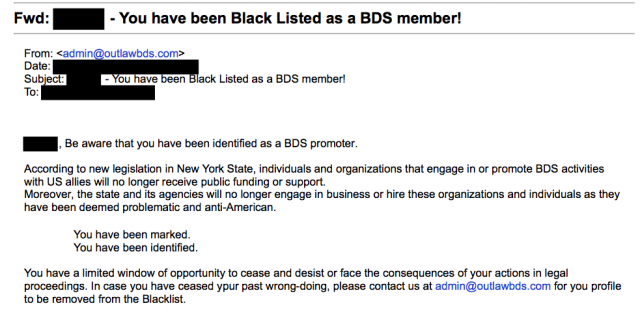
Screenshot of Psy-Group email
“It’s scary to think that ex-Mossad agents were behind this spying,” said senior staff attorney Radhika Sainath, who advised over 30 individuals targeted by the letters. “The Mossad itself has a history of surveilling, sabotaging and assassinating Palestinian activists around the world.”
The people targeted by former Israeli intelligence agents with Psy-Group include faculty at Columbia University, New York University, multiple City University of New York (CUNY) campuses as well Black, Jewish, and Palestinian volunteers from groups such as Adalah-NY and Jewish Voice for Peace.
“It is disgraceful that professors and students in American public universities are being spied on and intimidated by the former agents of a foreign nation,” said CUNY professor Sarah Schulman, who was targeted by Psy-Group. “Fortunately, the commitment of grassroots Americans to Palestinian rights is increasing everyday, and no level of threatening covert operations can stop it.”
Though outlawbds.com and Psy-Group no longer exist, the tactics and methods they employed —anonymous blacklisting websites, fake profiles used to target or influence people, and smear campaigns—are all still in use by other anti-Palestinian groups, some of which potentially share information with the Israeli government. The largest example is the blacklist site Canary Mission, which has targeted hundreds of students and faculty who advocate for Palestinian rights.
While it is unclear what relationship Psy-Group had with active Israeli intelligence or government agencies, coordinating with a foreign government to secretly spy on people in the US may violate federal laws. The Israeli government has itself encouraged and funded such activities to covertly undermine the movement for Palestinian rights.
Ex-Candidate Renois: Movement Demanding President Resignation to Repeat in Haiti
Sputnik – 07.03.2019
The US Embassy continues to support Haiti’s President Jovenel Moise despite an unprecedentedly large-scale protest movement and corruption charges against him. According to one of the opposition leaders, former presidential candidate Clarence Renois, US support is not enough to reassure the protesters.
Renois told Sputnik that if protests continue, the only option the US has to help President Moise retain power may be direct intervention. While Frantz Voltaire, director of the International Centre for Information and Documentation on Haiti, the Caribbean and the Afro-Canadian community noted that the incumbent president was elected with American support, while observers suspected the United States of manipulating the election.
Since the political crisis that broke out in Haiti on 7 February as a result of clashes between law enforcement and demonstrators, 26 people have died and 77 have been wounded in the country, according to the Inter-American Commission on Human Rights (IACHR).
Opponents of President Jovenel Moise have demanded his resignation and accused the president primarily of embezzlement of funds from Petrocaribe, a loan provided to Haiti by Venezuela.
“The Petrocaribe Foundation has launched an investigation. Venezuela has allocated several billion dollars in accordance with its assistance program to Haiti. These funds, unfortunately, were used for other purposes. The companies signed large contracts, but the projects were not implemented,” Frantz Voltaire told Sputnik.
“According to Haiti’s Superior Court of Auditors’ report, Jovenel Moise, who owns several companies, took advantage of these contracts. […] The president’s name appears on the list of suspects in this loud corruption scandal.”
Nevertheless, despite the unpopularity of President Moise, the American ambassador to Haiti, Michele Sison, expressed official support for the president, stressing that the United States recognises the legitimacy of Jovenel Moise’s government:
“We have always underscored, in our statements as well as our diplomatic conversations… our belief in the legitimacy of Haiti’s institutions and its elected officials,” Sison said in February.
According to opposition party leader Clarence Renois, it’s “opportunistic support”, since the non-recognition of the incumbent president could aggravate the crisis.
“If a major popular movement demanding the resignation of the president, like last week, will repeat, the US support will not change anything. The United States can’t decide on the current government.”
A similar situation occurred in 2004. “The US government supported the incumbent president [Jean-Bertrand Aristide — Sputnik] and the protest movement prevailed, overthrowing him. One-time support does not guarantee durable power,” Renois stressed.
“Youth groups and associations are dissatisfied with US policy in Haiti and often openly show their anger […] At such demonstrations, young people say that the US has too much influence.”
The Director of the International Centre for Information and Documentation on Haiti, the Caribbean and the Afro-Canadian Community, Frantz Voltaire, also noted an increase in anti-American sentiment.
“Fair or not, but the election of Jovenel Moise as the President of the Republic is attributed to the Americans. As in the case of his predecessor, Michel Martelly, it is believed that this president was imposed by the United States. And this is not only the opinion of society. Brazilian analyst Ricardo Seintenfus in his book, published two years ago, accused the United States of manipulating elections.”
According to Frantz Voltaire, in recent years, scandals associated with Western NGOs have badly damaged the reputation of the United States. The press spoke particularly negatively about the Clinton Foundation.
“There is a feeling of resentment towards American politicians. After the [2010] earthquake, it is not known where the international aid was directed. Bill Clinton has been accused of having promised a lot, but nothing has been done.”
“International aid was distributed by the US and NGOs, and, in both cases, it is not known where these funds went. There was no audit, no additional verification.”
According to data provided by the Associated Press, 33% of the $379 million collected for rebuilding Haiti was kept by the US government. According to CounterPunch magazine, of every dollar collected by the United States, only 42 cents was sent to NGOs to assist Haiti after the earthquake.
Featured Video

Houthis Don’t Have to Conquer Saudi Arabia to Make It Pay
or go to
Aletho News Archives – Video-Images
From the Archives
Newly Released FBI Docs Shed Light on Apparent Mossad Foreknowledge of 9/11 Attacks
By Whitney Webb | MintPress News | May 17, 2019
NEW YORK — For nearly two decades, one of the most overlooked and little known arrests made in the aftermath of the September 11 attacks was that of the so-called “High Fivers,” or the “Dancing Israelis.” However, new information released by the FBI on May 7 has brought fresh scrutiny to the possibility that the “Dancing Israelis,” at least two of whom were known Mossad operatives, had prior knowledge of the attacks on the World Trade Center. … continue
Blog Roll
 Aletho News
- MEP blasts ‘Euro-Gestapo’ for lecturing Russia on democracy
- Syria May Send Troops to Saudi Arabia Amid War with Ansar Allah
- UK whines about losing billions to ‘Putin tax’
- Baghaei to Rubio: Distorted narratives cannot erase US record of broken commitments
- Houthis Don’t Have to Conquer Saudi Arabia to Make It Pay
- MOE: Nearly 22,000 Students and Education Workers Killed
- Guterres in Islamabad: Genocide, cowardice, and the cage of Imran Khan
- Johnson, Marandi say Yemen holds upper hand over Saudi Arabia
- False flags won’t save aggressors, Iran FM spokesman says
- The Makkah Pact Enters Into Force: The End of American Dominance or Its New Form?
- If Americans Knew
- Report claimed Mark Levin used by Israeli government to influence Trump
- Over 2,000 Gazans have died awaiting medical evacuation amid Israel’s continued siege
- How a U.S. Diplomat Suppressed and Altered Reports Critical of Israel
- 5 Palestinians Die from Israeli Strikes in Gaza as Relentless Attacks Continue
- Report: Ceasefire Slows Killing but Leaves Devastation Intact
- Country Music Singer Zach Bryan Breaks Attendance Record at Robert Kraft’s Gillette Stadium While Wearing ‘Free Palestine’ Shirt for Second Night in a Row
- Three years of death and devastation: Israel’s war on Gaza in pictures
- Why Hamas believed the status quo was more dangerous than its 7 October gamble
- Debunking Israel’s latest list of ‘terrorist’ journalists in Gaza
- In Gaza, focus is on survival, “every step is a struggle” – Daily Update
- No Tricks Zone
- New Study: 50 Years Of The Most Aggressive ‘Net Zero’ Policies Can Only Affect The Global Climate By 0.03°C
- US September “Heat” Was No Record…Many Records Set Decades Ago
- Latest European Green Energy Debacle; Portugal’s Largest Flagship Solar Park Insolvent!
- Green Energy Debacle: German Expert Professor Fritz Vahrenholt Warns Of Severe Economic And Social Consequences
- Two More Paleo Reconstructions Affirm Meters-Higher Sea Levels Across Ireland, Brazil 7000-6000 Years Ago
- New Study: Earth And Venus Surface Warmth Largely Explained By Convection And Lapse Rate, Not CO2 Or Radiation
- 2025 Nature Paper Claiming Worsening Global Drought Gets RETRACTED …Heavily Flawed
- New Study: ‘Global Drought Shows No Detectable Recent Acceleration Under Climate Warming’
- Economic Masterminds: German Socialists Suggest Taxing Productivity Gains Stemming From Using AI
- The South China Sea Has Not Been Cooperating With The Climate Change Narrative

