Project Raven: Using US Spies and Spying Tactics, UAE Snooped on Entire World
Sputnik – 30.01.2019
Thousands of documents and emails reveal that NSA surveillance techniques were central to the UAE’s efforts to monitor opponents.
In an exclusive report, Reuters has documented the work of ‘Project Raven’ — an operation run by the government of the United Arab Emirates, in which former US intelligence agency staff have spied on other governments, human rights activists and even US citizens.
The article primarily focuses on former NSA intelligence analyst Lori Stroud, the only Project operative willing to be named — eight others spoke on the condition of anonymity.
Stroud spent a decade at the NSA, first as military service member 2003 — 2009, then agency contractor for tech giant Booz Allen Hamilton 2009 — 2014. Her specialism was hunting for vulnerabilities in foreign government computer systems — such as China’s — and assessing what data could and should be stolen.
Her glittering career at the agency would be scuppered via an intriguing chain of events, kickstarted in 2013 when she recommended none other than Edward Snowden — then a Dell technician — be promoted to her team.
A mere two months later, Snowden infamously fled the US and passed on thousands of pages of top secret program files to journalists. Stroud and her team were unofficially blamed for enabling the massive security breach, and they became persona non grata at the agency.
Job Opportunity
In the wake of the scandal, Marc Baier, a former colleague of Stroud’s at NSA Hawaii, offered her the opportunity to work for CyberPoint, a US contractor. She was told the job involved counterterrorism work in cooperation with the Emiratis, but little else — although she was assured the project was approved by the NSA, and accepted the offer in May 2014.
A fortnight later, Stroud was in Abu Dhabi, one of over a dozen former US intelligence veterans working under the auspices of Project Raven — their primary task surveillance of citizens critical of the UAE’s ruling monarchy. They would use techniques invented and perfected by the US intelligence community, including a resource called ‘Karma’, which was employed to hack into hundreds of dissidents’ phones and computers. The team also investigated targets’ friends, relatives and associates, placing them under close surveillance too.
The work also involved monitoring social media for negative comments, which Stroud occasionally found difficult.
“Some days it was hard to swallow, like [when you target] a 16-year-old kid on Twitter. But it’s an intelligence mission, you are an intelligence operative. I never made it personal,” she told Reuters.
Raven’s targets eventually evolved to militants in Yemen, and foreign governments including Iran, Qatar and Turkey, all bitter enemies of UAE. On top of employing their existing knowledge of intelligence tactics, the American operatives also developed new software to carry out infiltration and monitoring tasks. An Emirati operative would usually “press the button” on an attack however, in order to give the former US spy agency staff “plausible deniability”.
Moreover, using fake identities and Bitcoin, the Project anonymously rented servers around the world, allowing them to launch attacks from a network of machines that couldn’t be traced back to its true origin.
Human Wrongs
Fake identities also played a role in the targeting of several individuals, including UK journalist and activist Rori Donaghy, who’d authored articles critical of the UAE’s human rights record. The Emiratis were acutely aware spying on Donaghy could harm diplomatic relations with its Western allies, and stressed the need for extreme caution, suggesting Project operatives “ingratiate [themselves] to the target by espousing similar beliefs”.
Posing as a single human rights activist, staff emailed Donaghy asking for his help to “bring hope to those who are long suffering”, managing to convince him to download software that would make messages “difficult to trace.” In reality, the malware allowed the Emiratis to continuously monitor Donaghy’s email account and Internet browsing. The surveillance against Donaghy remained a top priority for the Emirates until 2015, when he learned his email had been hacked.
Prominent Emirati activist Ahmed Mansoor was another key target — he’d criticized the country’s ruling elite for years over the war in Yemen, treatment of migrant workers and detention of political opponents. Evidence the Project collected on him was compiled in a PowerPoint presentation — it would later be used in a secret trial in 2017, which saw him sentenced to 10 years in solitary confinement.
Along the way, staff were told the NSA approved of and was regularly briefed on Raven’s activities — but in 2016, the Emiratis moved responsibility for Project Raven to UAE cybersecurity firm DarkMatter, but the former US spies remained. It would not be long before their mission began to involve the targeting of fellow Americans for surveillance, activity which not only raised serious ethical questions for all involved, but made their activities illegal in their home country.
While Stroud praises the lack of “bull****” red tape” and “limitations” in her work for Project Raven, she also alleges she helped create an policy detailing how data on Americans accidentally harvested by the team’s activities should be deleted, she said after its supposed implementation she kept on finding such information in the organization’s data stores.
At the same time, the Emiratis began hiding an increasing number of sections of Project Raven from the view of the Americans on the team.
Tough Questions
In 2016, FBI agents began questioning American Project Raven employees who’d reentered the US, in particular whether they’d spied on US citizens and shared sensitive information with the Emiratis — Stroud was among them, having been approached at Virginia’s Dulles airport as she was preparing to head back to the UAE after a trip home. She says she refused to tell them “jack”.
However, one morning in spring 2017 Stroud noticed a passport page of an American was in the Project system, and emailed supervisors to complain. She was told the data had been collected by mistake and would be deleted — but her concerns not allayed, she began searching a targeting request list usually limited to Emirati staff, which she was able to access because of her role as lead analyst.
She saw security forces had sought surveillance against two other Americans, and questioned her bosses on the find — their response was a rebuke, on the basis she wasn’t meant to be able to process such information. Days later, she came upon three more American names on the hidden targeting queue — all journalists.
When Stroud kept raising questions, she was put on leave, her phones and passport confiscated. She was allowed to return to her homeland after two months, whereupon she contacted the FBI agents who confronted her at the airport. The Bureau is now investigating Project Raven’s activities — but Stroud’s contributions are limited in specifics, as she claims to not remember the names of the Americans she came across in the files.
Colombia Witnesses Murder of 17th Social Leader in 2019
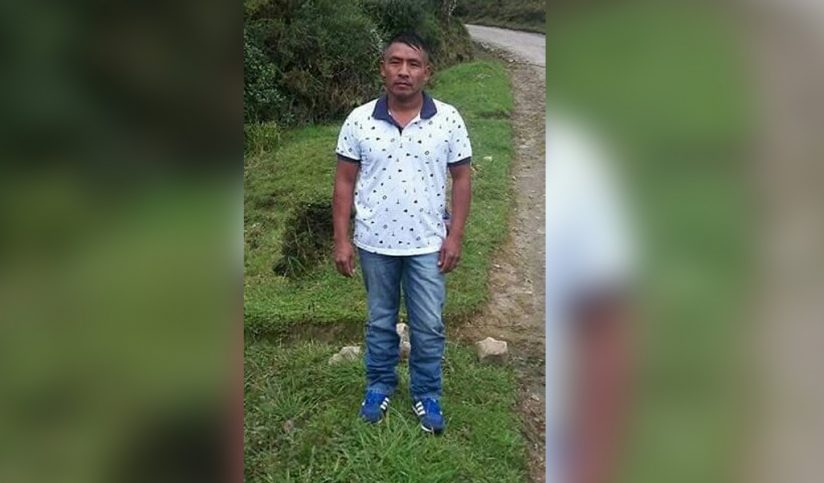
Dilio Corpus Guetio, a Campesino leader was murdered in Colombia, making it 17th murder in 2019. | Photo: Twitter / @Paola_teleSUR
teleSUR | January 30, 2019
A Colombian Campesino leader Dilio Corpus Guetio, 44, who was a member of Asocordillera (Mountain Area Association of Campesino Workers) and also a member of the local Campesino Guard militia was shot to death Tuesday.
Corpus Guetio left his home in the municipality of Suarez in the department of Cauca, in southwest Colombia, at around six in the morning for work. On the way armed men from a car shot him several times.
“The murderers were in a van which hit him and made him lose control of his bike. At that point, they got out of the car to get close to Dilio, who was already injured and he was shot repeatedly, killing him,” said a representative from the United National Federation of Agricultural Unions (FENSUAGRO).
Studies for Development and Peace, Indepaz, say that within the 29 days of 2019, 16 social leaders have been killed in Colombia, excluding Corpus Guetio.
Dilio was known for his work monitoring rural areas and protecting the territory and its inhabitants. His murder case has been registered in the village of Santa Barbara, his place of work.
This week another community leader from Cuca, Jose Jair Orozco, 52, was also assassinated.
Colombian Attorney General Nestor Humberto Martinez said in early January that the greatest number of Colombians murdered over the past two years since the signing of the peace agreement have been social leaders who serve on Communal Action Boards (JAC).
JACs began in the 1950s and are local-level councils where citizens decide upon, plan and develop community projects based on their own needs. The majority of JACs are in rural areas and members include mainly low-income Campesino, Indigenous, and Afro-Colombian members of society.
According to Martinez, the assassinations of JAC leaders is “passively systematic.” The attorney general said that those responsible are paramilitary groups “such as the “Gulf Clan” that works on behalf of narco traffickers and “Los Caparrapos” he added.
Indigenous people made up 13 percent of those killed and farmers 10 percent. Union leaders and social leaders, Afro-Colombians and LGBTI population were the other main murder victims.
GILETS JAUNES: Civilians in Police Crosshairs as Macron Adopts Totalitarian State-Practices to Suppress Dissent
By Vanessa Beeley | 21st Century Wire | January 29, 2019
A 30-year-old volunteer fireman who joined the Gilets Jaunes protests in Bordeaux, France on the 12th January 2019, is in a coma after being shot in the back of the head by an LBD or “flashball” bullet fired by French security forces who are brutally suppressing public demonstrations in most major French cities. Olivier Beziade is a father of three who now has a “very serious brain injury” and is in an induced coma. As violence radiates across France, western media locks down and fails to report comprehensively or fairly on Police infractions against protestors.
The following is the video of this event, during which one of the police officers appears to say “they (protestors) don’t know it’s us” and instructs his colleagues to “pick up the casings”, after Beziade had been gunned down and was lying face down on the street.
WATCH:
The Gilets Jaunes or Yellow Vests
The Gilets Jaunes (GJs) or Yellow Vest movement began officially on the 18th November 2018 but according to some analysts this people’s initiative was being ignited long before and is a product of successive French government marginalisation of important sectors of the French population. Thomas Flichy de Neuville, academic and historian, wrote very recently about the socio-political alarm bells that preceded the Gilets Jaunes by at least five years.
In 2013, a deputy from the Pyrenees Atlantique department of France, Jean Lassalle, spent 8 months walking around France. He covered 5000 km on foot and spoke with the “forgotten” French people. Lassalle reported that the lasting impression from his experience was that most of those he encountered had a desire to “turn the tables, that they had had enough on many levels”.
Lassalle’s report was submitted to the presidents of the assemblees in April 2014. Lassalle warned that nine out of ten people in France were ready to “explode”, three out of ten were ready to mobilise if and when the “explosion” took place. Lassalle prophesied that “Les réseaux sociaux sont prêts à agir comme une arme formidable de mobilisation” “social media is ready to to act as a formidable weapon of mobilisation”.
According to Flichy, the one problem with Lassalle’s ground breaking report was that he predicted the imminent eruption of dissent “it is ten minutes before midnight”, Lassalle wrote. Nothing transpired as predicted in 2015 and the 196 page report was consigned to the archives, its prescient contents forgotten as France buried itself in a foreign intervention quagmire in Syria, Yemen and Mali and ignored the gathering storm at home.

GJ protestors being tear gassed in Bordeaux, January 12th 2019. (Photo: Nicolas Duffaure)
In 2014, Christophe Guilluy, a geographer, wrote a book entitled “La France Peripherique” which investigated the demographics of major French cities and highlighted the problems of wealthy, opulent city centers compared to the marginalised and poor suburbs where 60% of the “forgotten” population resided. Guilluy concluded that many of these communities would ultimately vote for more right wing or nationalist political parties in search of an antidote for their deteriorating living conditions.
Guilluy’s work is particularly relevant when we consider that the match to the touchpaper for the GJs was the hike in fuel prices by President Macron’s government. While this is not the sole reason for the unrest we see today, nationwide in France, it is an important factor for 60% of a population, many of whom subsist on the minimum wage (SMIC) – if those people travel 20km to work every day, they will spend 250 euros per month which is a quarter of the SMIC. It is easy to see why these people reacted so forcefully against a fuel tax that would impact them the most.
Why the Gilet Jaune? Analyst and author, based in France, Diana Johnstone put it most succinctly in an article for Unz Review :
“Every automobile in France is supposed to be equipped with a yellow vest. This is so that in case of accident or breakdown on a highway, the driver can put it on to ensure visibility and avoid getting run over. [..] The costume was at hand and didn’t have to be provided by Soros for some more or less manufactured “color revolution”. The symbolism was fitting: in case of socio-economic emergency, show that you don’t want to be run over.”
The GJs have distanced themselves from politics and politicians to protect their grass-roots identity. The leadership structure is horizontal, no leaders or identity politics. The spokespeople are not practiced public speakers, they are people from every walk of life and they represent a wide spectrum of French society. The manifesto is varied depending upon regional collectives but most demands nationwide appear to be in synch with minor differences.
One such manifesto was published by a number of media outlets in December 2018 and it listed a number of demands for reform in the economic, political, health and social security and environmental sectors. This manifesto also addressed the issue of Macron’s neoliberal foreign policy and included a call to end “France’s participation in foreign wars of aggression and exit from NATO” and to “cease pillaging and interfering – politically and militarily – in Francafrique which keeps Africa poor. Immediately repatriate all French soldiers. Establish relations with African states on an equal peer-to-peer basis”

Forces of “law and order” on the streets of Bordeaux during Acte X of GJ protests, 12/1/2019. (Photo: Nicolas Duffaure)
The fundamental message of the GJs is that they simply can’t make ends meet. The cost of living keeps going up and salaries keep being squeezed. The Government needs to listen to its people and to change course. Most europeans reading this will feel empathy with this expression of desperation. There has been a cover-up in France by the government and the media. These calls for help have been muted, filtered and ignored by the state-aligned media and government officials for some time now.
Macron’s government has used Climate Change and global warming as a damoclean sword brandished over the heads of the malcontent to distract them from their misery – suggesting the future of the planet outweighs the trivia of feeding your children or avoiding homelessness – the push back from the GJs was swift, while they may cherish their environment and are ecologically aware “they are more worried about the end of the month than the future of the world.”
In some cases, early on in the protests, the GJs are being systematically dehumanized. Gerard Darminin, the budget minister, described the GJs as the “peste brune – the brown plague” meaning fascists. In the dozens of interviews I have listened to, not one GJ has expressed a sentiment that could even remotely be described as right wing or fascist. The GJs are an apolitical collective with a focus on socio-economic issues that directly affect their ability to survive in modern France which, in their view, is drifting dangerously away from the vision of a Republic that most of the demonstrators have grown up with.

Ingrid Lavavasseur, leading GJ candidate for May European Parliament elections. (Photo: Twitter)
In an effort to give their concerns and the movement a greater platform from which to challenge Macron, the GJs have recently nominated 10 candidates for the May 2019 European Parliament elections and are hoping to expand the list to 79 candidates. Leading contender is Ingrid Lavavasseur, a care worker raising two children alone in Normandy who believes that Macron’s government “despises the little people”.
The government response has been largely dismissive, repressive, condemnatory and increasingly inflammatory. Instead of “maintaining order” through genuine negotiation and reform, Macron appears to have unleashed an escalation of police violence against demonstrators which will provoke the GJs further, increasing dissent and the potential for counter-reactionary measures against the state.
Interior Ministry, State and Media Reaction to Gilets Jaunes

Christophe Castaner, Interior Minister. (Photo: Nicolas Messyasz)
Macron’s first choice Interior Minister was the socialist mayor of Lyons, Gerard Collomb who resigned his post in October 2018, despite Macron’s entreaties for him to stay, citing “immense difficulties” facing his successor. Collomb was replaced by Christophe Castaner as head of national police forces, among other responsibilities. Former socialist and with a degree in criminology, Castaner’s reputation is somewhat tarnished by his connections to a Marseilles mafioso, Christian Oraison, in the 1970s.
French Prime Minister, Edouard Phillippe introduced a new law to “better protect the right to demonstrate” in January 2019. Protestors who are labelled falsely as “agitators” “insurrectionists” or who demand that “President Macron resign” will effectively be collectively reprimanded by a law that introduces measures of heavy punishment of demonstration organisers whose time and place has not been given the official stamp of approval.
500 complaints against Castaner for restricing the right to protest were submitted to the Court of Cassation but were dismissed by Public Prosecutor, Francois Molins, who stated that he would not be prosecuting Castaner for his remarks that “participants in the GJ protests were complicit with those who had resorted to violence”.

Bordeaux police gather for GJ protests January 2019. (Photo: Nicolas Duffaure)
Castaner has consistently defended the police squads and their use of disproportionate force against unarmed demonstrators by claiming that the GJs are the ones to instigate violence, the police are acting in self-defense. The mounting number of cases of civilian mutilation and wounding by heavily armed police officers suggest that Castaner is distorting the truth.
Castaner’s only concession has been to equip the police forces with body cameras so they can record their own violations of the use of “proportionate force” in the maintenance of law and order. Doubts must be cast on the willingness of a police force already facing 100s if not thousands of claims against them, to provide the evidence that will further incriminate them. When Castaner was pressed to comment on the violence being meted out against civilians by the police, he responded:
I don’t know of one policeman or one gendarme who has attacked the Gilets Jaunes, on the other hand, I know many police or gendarmes who have taken defensive measures to defend the Republic, the order of the Republic – you know there is no “liberty” without public order [..] but naturally I have never seen a gendarme or a police officer attack a demonstrator or a journalist, on the contrary I have seen demonstrators systematically attack our security forces and journalists.

Police arrest a protestor. (Photo: Gilets Jaunes Facebook page)
Castaner is one of the chief promoters of the draconian and controversial “Loi Anti Casseurs – Anti-Breakers (looters) law”. Those who oppose adoption of the law have claimed it will further erode freedom of speech and liberty of expression in France. The law proposes security perimeters around protests, facial recognition, bag searches, body searches, 2-4 years in prison if found guilty of violence against the police and up to Euros 7,500 ($ 8580) fines for those who violate the law. It is worth noting that Castaner himself admits that the number of “casseurs” nationwide are negligible, numbering between “150 – 200/300 across all regions of France”.
#Bordeaux La presse qui se protège comme elle peut des tirs de flashball et lancés de projectiles #GiletsJaunes #ActeIX #Acte9 #12janvier #12janvier2019 pic.twitter.com/cVcS1ricXl
— Stéphanie Roy (@Steph_Roy_) January 12, 2019
The law states that protestors who hide their faces will be targeted – this measure is controversial as most protestors and journalists are forced to cover their heads and faces to protect themselves against tear gas and the risk of mutiliation by “flashball” rubber bullets or “grenades d’encerclement”” which contain 25g of TNT and can release hundreds of 10g rubber pellets at close range if used incorrectly, by the security forces. Macron’s government sees these measures as essential to crack down on violence against the state, the GJs will perceive it as a further instrument of oppression by the state against its own people. So far, 200 ammendments have been made to the law by those who are alarmed by the increased totalitarian measures being imposed upon France and its people by Macron’s ministers.
French state-aligned media and UK corporate media have followed Castaner’s narrative lead with little deviation, the following short clip from a report by France’s TF1 demonstrates the disinformation being presented about the GJs and the police violence. The TF1 presenter denies any police infractions and praises them for their “sang froid”, their composure.
After initially distancing himself from the protests, perhaps in the vain hope they would fizzle out, on the 10th December Macron finally appeared before his people on TV. During the broadcast an apparently chastened Macron agreed to delay the fuel tax hike, he offered an extra 100 Euros per month for minimum wage earners and tax cuts for pensioners among other measures. Even the Economist described Macron’s 10 billion-euro concession package as an attempt to buy off his critics. The broadcast was watched by a staggering 21m people. The reaction was mixed, perhaps 50% of the GJs and their supporters seeing it as an attempt to keep the people quiet rather than a genuine effort to change course and address the long-standing issues that had generated the protests in the first place.
Macron’s later New Year 2019 address to the nation which followed a terrifying increase in the violence seen on the streets of Paris and across France, was a much more aggressive affair. Having failed to appease the “crowds” with a few unconvincing political crumbs, Macron seemed to have decided to adopt the hardline approach. “These days I have seen unthinkable things and heard the unacceptable” Macron stated. Macron even took on the few opposition politicians who dared to empathise with the protestors. Macron berated those who pretend to “speak for the people”, calling them “spokespersons for hateful crowds” and denounced “those who have mingled with the Yellow Vest protesters to spread hate speech about “police forces, journalists, Jews, foreigners, homosexuals” as a “negation of France”. I am yet to find a recording of a GJ spreading hate speech about any of the factions mentioned by Macron.
Macron’s other concession was the so called “Grand Debate”, a series of town hall meetings where representatives of the communes and departments across France would meet to present grievances on behalf of their constituents and the GJs. In reality, anyone wearing a yellow vest in the vicinity of the meetings may be fined Euros 135 ( $154). At some meetings road blocks were erected some way from the meeting place and identity papers of drivers were photographed, anyone wearing a yellow vest was told to go back. So, from day one, the Grand Debate called to address the concerns raised by the GJs deemed the GJs as persona non grata.
On the 18th January 2019, a Grand Debate was held in Souillac, south-west France. One of the attending Mayors gave an interview to a local media outlet after the debate had finished. Rene Revol, Mayor of Grabels (Department 34) said the meeting was nothing more than a “masquerade”, a farce, an election campaign for Macron. Gilets Jaunes were forbidden and threatened with fines if they were caught in the vicinity wearing their vests. Road blocks were set up on all roads leading to the venue. Security forces surrounded Macron’s cavalcade. Mayors were able to speak only if chosen by government ministers or Prefets – effectively controlled discourse. The meeting was ostensibly called to address the issues of the people. Nothing was discussed and the “people” were banned.
State Sanctioned Violence and Repression

Record of some of the appalling injuries inflicted upon unarmed civilians by police forces across France. (Photo: Desarmons.net)
Since the beginning of December the violence witnessed on the streets of cities across France has escalated dramatically. One French independent journalist, David Dufresnes, has been recording all infractions committed by police and security forces and tweeting them to the Interior Ministry while giving interviews to a huge number of French media channels to raise awareness of the police brutality during peaceful protests. In the tweet below, infraction number 362 dated 26/1/2019, an off duty soldier is reported to be hit in the head by a police LBD40 rubber bullet as he is leaving a restaurant in Montpelier on his way to the nightclub with two of his colleagues.
allo @Place_Beauvau – c’est pour un signalement – 362
Montpellier, #ActeXI : un militaire, 25 ans, en permission sérieusement blessé à la tête. #LBD40
26/01/19, vers 22h30
Source:https://t.co/vaM1RbbuGz pic.twitter.com/oHXYewtma0
— David Dufresne (@davduf) January 27, 2019
Dufresnes has recorded 157 injuries to the head including 18 who have lost an eye, fractures of the jaw and comas in the most severe cases. 11 hand injuries, in 4 cases resulting in the loss of a hand. 8 back injuries, 28 injuries to the upper body, 40 lower limb injuries, 3 injuries to the genital area, 48 unspecified injuries and 55 cases of intimidation, insults, repression of press freedom infractions. One eighty-year-old was murdered on the 1st December 2018 in Marseilles – Zineb Redouane was killed when a tear gas grenade was thrown in her face by the security forces. According to Dufresnes this is the list of the more serious injuries, an estimated 2000 – 3000 more GJs have been “lightly” injured during the protests since November 2018.

Chart produced by independent journalist, David Dufresnes and Mediapart showing injuries received by GJs and civilians from Police weapons and brutality during protests.
Dufresnes argues that the police have already lost control of the situation and can no longer be legitimately claiming to “maintain law and order”. In one interview Dufresnes points out that the use of 10,000 tear gas grenades on one day of protests points to a “panic” situation among the security forces. During “Acte XI” of the protests on the 26th January the elderly man, Eric, in the photo below was hit on the head by a police truncheon in Marseilles. He has three fractures and is forced to eat only liquid food from the left side of his mouth for three weeks, according to his brother.

Two students were recently inteviewed by independent French media channel, Mediapart. Antoine Boudinet lost his right hand when a GLIF4 grenade exploded close to him in Bordeaux, December 2018. Lola Villabriga was hit in the face by a LBD40 flashball bullet which triple-fractured her jaw in Biarritz, also December 2018.

Lola Villabriga, student, her jaw was fractured when she was hit in the face by a “flashball” bullet, December 2018 in Biarritz next to Antoine Boudient, student, who lost a hand during protests in Bordeaux December 2018.
Boudinet was actually taking part in a “climate” march which joined with the GJ march at one point during the protests. Boudinet has submitted a claim against Christophe Castaner for the police use of the GLIF4 grenade which has disabled him for life. Boudinet clearly states that he holds Castaner and the Interior Ministry responsible for the arms used by the police – “when such arms are available, it is certain that at some moment something will happen and there will be an incident. Explosives should never be thrown at people”

Villabriga had been standing on a bench filming the protests when she was hit by the flashball bullet. She describes a protest that was 100% peaceful, “there was no chaos at all. The use of force was totally disproportionate”. Villabriga suffered a triple fracture of her jaw, she has undergone one operation and a second operation is foreseen in the future to remove the metal pins. Commenting on Castaner’s denial of police brutality, Villabriga told the presenter:
“This is absolute denial (from Castaner) which I find totally alarming to see that we are ignored while what happened to us is so terrible. Nobody has come to talk to us.”
Watching the interviews, including one with Dominique Rodtchenki Pontonnier, a mother whose two sons were terribly injured by a GLIF4 grenade, one son losing three fingers in the blast – I was struck by the trauma and shock on the faces of the guests. At one point we are shown the film of the moment Pontonnier’s son is hit and is screaming that he has lost his hand. Boudinet is visibly shaken by the video, he explains that it brings back the memories of the moment he realised that he had been mutilated by the GLIF4 grenade fired by police into unarmed crowds of people that included children and families.
There is utter disbelief during the interview that France has been so rapidly reduced to a violent police state and that the trust between state and people has been so profoundly damaged. Another guest, Anaelle, a volunteer medic, describes the “profound lack of respect and complete rupture of dialogue” between state and people. All guests are horrified at the weapons being deployed to maintain “law and order”.

Record of injuries from police use of disproportionate force against unarmed civilians during GJ protests. (Photo: Desarmons.net)
Meanwhile, Interior Minister, Castaner maintains that the use of the Flashball bullet is necessary because:
“… in the face of extreme violence we need the means to defend ourselves and the simple fact of having a uniform (presence) for a long time has prevented the violence because the people respect that. Now there are people who come to provoke, to attack and to aggress, even to kill. If we consider what happened on the Champs Elysee or at the Arc De Triomphe, according to statements I have studied, there is a desire to kill members of the security forces, therefore they need to be able to defend themselves”

The moment GJ spox, Jerome Rodrigues, is targeted first by a GLIF4 grenade before being hit in the eye by a LBD40 Flashball bullet. Acte XI, 26th January 2019. (Photo: Twitter)
Paris, 26th January 2019, the forces of “law and order” targeted one of the GJ’s most popular spokespeople, Jerome Rodrigues, while he was filming events during the GJ march. During Rodrigues’ live video we can hear him cautioning GJs to withdraw from the scene as elements of the Black Bloc have arrived. Rodrigues does not want the GJs to get caught up in the Black Bloc violence. As he continues filming we see the police forces advancing but not confronting the few members of the Black Bloc who are responsible for much of the looting and damage to shops and buildings during the weekly protests. Instead, the police appear to open fire on the retreating GJs including Rodrigues who is suddenly struck down.
The following video shows the moments after Rodrigues is targeted first by a GLIF4 grenade and then by a Flashball bullet to the eye (according to later testimony from Rodrigues from his hospital bed).
WATCH:
Rodrigues is treated by the volunteer medics at the scene before being rushed to hospital. Two days after the incident, Rodrigues posted a live video to his Facebook page, from his hospital room. He calls for peace and calm, no violent reactions from the GJs. He feels that he was deliberately targeted by the police and this had also been claimed by a number of eye witnesses to the attack. Rodrigues also reminds people that his mutilation is one of many and that he should not be singled out among the GJs who have suffered at the hands of the police. Rodrigues urges GJs back onto the streets for Acte XII, Saturday 2nd February. It remains to be seen where the escalation of violence will progress from here as popular support for the GJs grows across France.
Rodrigues’ poster for Acte XII reads “The powerful will stop dominating when the little people stop crawling”

Weapons used to “Maintain Law and Order”

Chart taken from the website of ACAT, an NGO arguing against increase in repressive laws in France, showing the weapons deployed by France during crowd control compared to other EU countries, November 2017.
The above chart shows the weapons used by French security forces against unruly crowds. There is a clear recommendation of steps and maintenance of proportionate force which is outlined in the national police instruction chart, below. Journalist, David Dufresnes, has clarified that the LBD40 Flashball rubber bullets and the GLIF4 grenade “d’encerclement” are not used anywhere else in Europe because of the risks to human life involved.

The National Police in France should be following the recommendations shown in the infograph above. Step one: demand for the crowd to disperse followed by two clear announcements of the intention to use “force”. First level of force: firearms are strictly prohibited at this stage. Truncheons, water canon and hand thrown tear gas grenades. Level two of force: GLIF4 grenades and grenade launchers. Level three of force: if the police are met with violence. LBD40 Flashball bullets, grenade launchers firing non-metal projectiles and flashball bullets.
‘I’ll lose my eye’: Prominent Yellow Vest activist suffers HORRIFIC injury in Paris protests https://t.co/f6kEybZfal… #YellowVests #Paris YellowVest activist #Jerome #Rodrigues hit in the eye with one of the controversial rubber bullets used by French riot police #GiletJaunes pic.twitter.com/bswrYUUVy4
— C-Store News (@CStoreNews_) January 27, 2019
What we are seeing, from the footage that is being released, is the police bypassing the recommended steps and progressing almost immediately to the use of disproportionate force and the apparent deliberate targeting of unarmed protestors among the GJs. This is panic crowd control with horrifying consequences. More than 80,000 police are deployed to maintain order during the nationwide GJ marches every weekend. A mix of the BAC (Brigade Anti Criminalite) and the CRS (general reserve of the French national police) are the most prevalent security forces who police the marches.
Many appear not to have been properly trained in the use of the weapons provided to them. The LBD40 Flashball bullet should never be fired at head height, for example, yet we consistently see police officers standing and firing from the shoulder into crowds of Gilets Jaunes. On the saturday that Rodrigues was targeted, I took screenshots from the Ruptly TV live video coverage of the Paris marches which clearly show one police officer pointing a target out to another officer who fires the weapon at head height ten seconds later. The velocity of the Flashball bullet is ten times that of a paintball, its capacity to mutilate at close quarters has been proven by the horrifying injuries circulating on social media.

A recent article in the media outlet, Liberation, has revealed that a police report highlighted the risks of using the GLIF4 grenade for crowd control but the grenade is still being used by police in France. The GLIF4 contains 25g of TNT explosive, emits 165 decibels upon explosion which has permanently deafened one protestor and has caused inner ear problems for others. The GLIF4 can contain CS gas in powder form or 10g rubber pellets, lethal at close quarters with potential to tear into limbs and shred hands.
This report was picked up by journalist, David Dufresne, who highlighted the following paragraph:
Liberation had access to a Police scientific laboratory report carried out on this wound ( and submitted to the enquiry) before the Gilets Jaunes movement. The report concludes that the high risk of the (GLIF4) grenade has been underestimated by French authorities and the manufacturer. The Interior Minister (Christophe Castaner) still chose to use the grenades until “stocks were exhausted” without specifying the number of grenades remaining in stock.
The cavalier manner in which Castaner has put the lives of French civilians at risk must be considered reckless at best, criminally negligent at worst.
The following video is a compilation of just a few of the police infractions and violent responses to the GJ protests across France.
WATCH:
Conclusion – Chaos Strategy Unleashed?

Alexandre Langlois, police violence and the Gilets Jaunes.
Alexandre Langlois, General Secretary of the Police Syndicate, VIGI, has accused Macron’s government of stoking confrontation and of favouring repression over dialogue. In a series of public interviews, Langlois blames the hierarchy within the Interior Ministry for the “manipulation” of the police forces already hugely under pressure and experiencing a climbing suicide rate since Macron’s rise to power in France. According to Langlois, the “hierarchy” direct the police working during the marches from remote control centers which disable the police’s ability to analyse events on the ground and avoid dangerous confrontation or provocation. Langlois demonstrates that this system has led to situations that have increased pressure on both the police and the Gilets Jaunes.
Langlois warns that Police are being forced to work blind. The state is pushing for confrontation and it is not avoiding repressive measures that will only increase the chances of violence not reduce them. Langlois laments the 75 suicides of police officers since Macron was elected, 17 since Castaner took over from Collomb who resigned after pressure from Langlois and his syndicate to address the issue of high suicide rates among the national police forces – “we called for the resignation of Collomb, now Castaner should go” .
The dismantlement of the “renseignments generaux” (RG – police intelligence branch) under Sarkozy in 2008 has contributed to the problems in 2019 according to Langlois. Langlois believes the RG would have developed relationships with GJ organisers and worked with them to ensure peaceful demonstrations. The police have been deliberately distanced from the people in order to enable the violence we are seeing since the 1st December 2018. Langlois stresses that many of the Police sympathise with the GJs but that the government is pushing the police to oppose the GJs which can only lead to catastophic consequences if allowed to continue.
Effectively the Gilets Jaunes have exposed Macron and his government for what it is. Macron is the President who was elected by the globalists, the capitalists and the ruling elite to protect their interests. A book recently published, authored by Francois-Xavier Bourmand, entitled “Emmanuel Macron the Banker who would be King” has investigated the corporatocracy who ensured Macron’s election win in order to expand their interests globally and to convert France from Republic into Plutocracy at the expense of the “dispensables”, the “little people”.
During one confrontation with a citizen at one of the Grand Debates, Macron is asked why he has failed his pre-election promise of “no more SDF (homeless) on the streets of France – 580 SDF died on the streets of France in 2018. Rather than show compassion for the poverty-stricken and homeless, Macron defends his policies with accountant-speak, informing the audience that the elite must be protected in order to provide jobs for the “poor”.
If indeed Macron’s coterie in government are pushing for confrontation between the people and the security forces and introducing increasingly repressive measures to up the pressure on the protestors rather than trying to defuse matters, it is really ten minutes before midnight in France. The insanity of Macron supporting the “uprising” in Venezuela while sanctioning vicious reprisals against his own people at home is glaringly obvious to all but Macron and his backers. That is because Macron is doing his job and his job is to manufacture the conditions in which the privileged, wealthy ruling elite can thrive and further their globalist ambitions which includes military adventurism and resource theft from target nations that include Venezuela and Syria.
Violence will escalate in France because it is state-sanctioned. Unless the police wake up to their manipulation by the state and join forces with the GJs there is a risk of a serious confrontation in the very near future. However, as historian Diana Johstone has said “For all the lamented decline in the school system, the French people today are as well-educated and reasonable as any population can be expected to be. If they are incapable of democracy, then democracy is impossible.”. There is still hope that the wave of discontent generated by the GJs may still bring down the globalist power structure and replace it with something more allied to the principles of the Republic of France.
***
Vanessa Beeley is an independent journalist, peace activist, photographer and associate editor at 21st Century Wire.
The US Senate Just Quietly Advanced A Free Speech Busting Anti-BDS Bill
By Whitney Webb | Mint Press News | January 29, 2019
WASHINGTON — In an evening vote that garnered essentially no national media coverage, the U.S. Senate voted last night to advance the “Strengthening America’s Security in the Middle East Act of 2019” – sometimes called the “anti-BDS bill” for its component that would allow state and local governments to punish companies or individuals who support the non-violent Boycott, Divest, Sanctions movement aimed at promoting Palestinian rights and ending Israeli apartheid and military occupation of the West Bank. The bill was, notably, numbered S.1 — the Senate’s first legislative act of its 2019-20 session.
Numerous rights groups, politicians and civil rights advocates have accused this measure of violating freedom of speech and setting a dangerous precedent for the private political activism of American citizens, all on behalf of a foreign country.
The bill was adopted by the Senate in a vote of 74 in favor to 19 against, with seven abstentions. The bill had previously been blocked by Senate Democrats by a 56-44 vote as part of their objection to acting on legislation during the government shutdown. However, many of those Democratic senators who had previously blocked the bill ultimately voted in support of the measure. In order to become law, the measure would still need to pass the Democrat-run House of Representatives. However, given the amount of support for the measure among Democrats and the power of the Israel lobby, the bill stands a considerable chance of passing the House.
Some commentators have paid particular attention to how Democratic senators considered to be 2020 hopefuls voted on the bill. Several confirmed and likely contenders for the upcoming Democratic nomination voted “No” – including Senators Elizabeth Warren (D-MA), Kirsten Gillibrand (D-NY) and Bernie Sanders (I-VT). However, Cory Booker (D-NJ) and Kamala Harris (D-CA), whose private courting of the Israel lobby was the subject of a recent MintPress News report, abstained from voting. Another notable abstention was Republican Senator Rand Paul (R-KY), who had previously threatened to filibuster a key component of the bill last year, preventing its passage during the previous Congress.
Punishing organized dissent
The bill includes several measures that were promoted by the Israel lobby last year but did not make it through the previous Congress. These include the “Ileana Ros-Lehtinen United States-Israel Security Assistance Authorization Act of 2019” which would give a record-breaking $38 billion to Israel over the next 10 years, and which ultimately failed to pass after Sen. Paul threatened a filibuster against it. That bill also requires Congress to give at least $3.8 billion to Israel every subsequent year after the initial 10 years.
Other measures in the bill include the “Caesar Syria Civilian Protection Act of 2019” — which imposes more sanctions on Syria and has been described as a “rebuttal” to President Trump’s proposed Syria troop withdrawal, which Israel also opposes – and the “The United States-Jordan Defense Cooperation Extension Act,” which would also give money to Israel. Some analysts have long asserted that U.S. security assistance to Jordan and other regional countries such as Egypt is aimed at securing regional support for Israeli and American geopolitical objectives in the Middle East.
Yet, the most controversial part of the bill by far is the “Combating BDS Act of 2019,” which would authorize state and local governments to retaliate commercially against entities that support BDS, such as by halting business with or refusing to contract or hire companies or individual citizens who either actively participate in or support the movement. A previous version of the bill included possible jail time as punishment for supporting a boycott of Israel or Israeli settlements, their violation of international law notwithstanding.
Some have asserted that the current text of the bill would mean that these same retaliatory measures would apply to boycotts targeting any country considered an “ally” by the U.S. government – Saudi Arabia, for example – if that boycott was not explicitly sanctioned by Washington. Others, such as Senior Legislative Counsel to the American Civil Liberties Union (ACLU) Kathleen Ruane, have asserted that the bill “sends a message to Americans that they will be penalized if they dare to disagree with their government.” The ACLU also argued via Twitter that “states don’t have the ‘right’ to punish individuals for participating in political boycotts the government doesn’t agree with, which this bill encourages them to do.”
Such concerns over similar laws enacted at the state level led two federal courts to rule that “anti-BDS” laws were unconstitutional for their restriction on the right to free speech. However, the bill the Senate just advanced both ignores and nullifies those court rulings by attempting to shield anti-BDS legislation at the state level from future legal challenges. However, as a recent MintPress report noted, the effort to protect anti-BDS state legislation through the passage of national legislation is unlikely to work.
A frighteningly slippery slope
The fact that the Senate just voted in favor of a bill to nullify the right of American citizens to engage in political speech that is opposed by the U.S. government should be headline news across the country. However, mention of the vote has been notably absent from American mainstream news outlets Tuesday morning. One would think that left-leaning news networks, ever eager to criticize the Republican Party, would be quick to cover how the Republican-controlled Senate just voted to restrict American political speech if it deviates from the government’s own position. Yet the fact that the bill itself has several co-sponsors from the Democratic Party, and is strongly supported by the powerful Israel lobby, has apparently helped to earn their silence.
While the bill’s relation to the BDS movement – and, by extension, the Israel/Palestine conflict – makes it a polarizing and largely partisan issue, all Americans, regardless of political affiliation or their views on Israel/Palestine, should be gravely concerned about not just the bill itself but the precedent it would set should it become law. By encouraging retaliation by the State against American citizens for making decisions about what to buy and what not to buy in their private lives, a dangerous and chilling precedent has been approved by 74 U.S. Senators in order to shield a foreign country from criticism and the consequences of grassroots activism. Under the guise of preventing “anti-Semitism,” this bill represents a fraught, Orwellian overreach by Congress into the private lives of all Americans and their right to make politically-motivated decisions.
If passed, it will not take much for the U.S. government to use this precedent to silence Americans’ political speech when it comes to domestic matters. Consider how the government would react if conservatives chose to boycott or push for divestment from U.S. companies that profit from abortion? What if anti-war activists chose to boycott or push for divestment from U.S. companies that profit from our wars abroad? This slope is as slippery as they come and the fact that a sizeable majority in the Senate has chosen to target a certain political movement should sound alarm bells for all Americans who care about free speech, regardless of their views on Israel/Palestine or their position on the political spectrum.
Whitney Webb is a staff writer for MintPress News and a contributor to Ben Swann’s Truth in Media. Her work has appeared on Global Research, the Ron Paul Institute and 21st Century Wire, among others. She has also made radio and TV appearances on RT and Sputnik. She currently lives with her family in southern Chile.
Florida bill would censor info on Israel-Palestine in schools, colleges
By Alison Weir | If Americans Knew | January 25, 2019
Three Florida state lawmakers have introduced a bipartisan bill that uses a new, Israel-centric definition of “anti-Semitism” that experts say would censor information about Israel-Palestine in Florida public schools and colleges.
The bill’s sponsor is Republican Mike Caruso of Palm County. The co-sponsors are Democrat Michael Grieco of Miami Beach and Republican Anthony Sabatini of Lake County.
Israel partisans are promoting such bills around the United States at both the state and federal level. The bills are part of an international effort to use an Israeli created redefinition of anti-Semitism to prohibit and even at times criminalize the dissemination of negative facts about Israel.
Entitled “HB 371 Discrimination In Florida K-20 Public Education System,” the bill contains a section on what it calls “anti-Semitism” that is virtually identical to a bill already passed in South Carolina.
Legislation using using the same Israel-centric definition has been introduced in the U.S. Congress.
Section #7 of the Florida bill states that “a public K-20 educational institution must take into consideration anti-Semitism when determining if a practice or act was discrimination on the basis of religion. For purposes of this section, the term ‘anti-Semitism’ means all of the following…” The bill then lists 13 actions that are “anti-Semitic.” Nine of them concern Israel.
The standard, dictionary definition of anti-Semitism, discrimination or hostility against Jews, says nothing about Israel.
The new, Israel-centric definition of anti-Semitism was first formulated by an Israeli government minister in 2004. The official then assisted in procuring the adoption of this formulation in the United States. Israel partisan Hannah Rosenthal adopted it in the U.S. State Department in 2010.
‘Poses threat to free speech’
Numerous analysts oppose the bills on the basis that they violate freedom of speech and academic inquiry.
The Miami New Times reports that the ACLU of Florida plans to track the bill’s progress to ensure that it doesn’t silence political speech. An ACLU Florida spokesperson said that addressing anti-Semitism and all forms of religious discrimination “is crucial, but it does not justify silencing constitutionally protected speech. All Floridians have the right to free speech without the threat of government interference.”
The national American Civil Liberties Union (ACLU) has a record of opposing such legislation, stating that it poses “a serious threat to the First Amendment free speech rights of those on campus who may hold certain political views.”
In a letter of opposition to the federal bill, the ACLU stated: “The First Amendment prevents the federal government from using its great weight to impose severe penalties on a person simply for sharing a political viewpoint critical of Israel.”
An ACLU analysis points out that “anti-Semitic harassment is already illegal under federal law.” The new legislation “does not change that fact, but its overbreadth makes it likely that it will instead silence criticism of Israel that is protected by the First Amendment.”
The article, entitled “The Latest Attack on Free Speech in the Israel-Palestine Debate,” states that there is a “disturbing surge of government-led attempts to suppress the speech of people on only one side of the Israel-Palestine debate. The trend manifests on college campuses, in state contracts, and even in bills to change federal criminal law, but the impact is the same: Those who seek to protest, boycott, or otherwise criticize the Israeli government are being silenced.”
The authors conclude: “These efforts to censor criticism of the Israeli government and advocacy for Palestinian rights do a disservice to the real problem of anti-Semitism in the United States.”
‘Affront to academic freedom’
One of the individuals who helped write the Israel-centric definition, attorney Kenneth Stern, has written that imposing it on campuses is “unconstitutional and unwise.” According to Stein, applying the definition to colleges “is a direct affront to academic freedom.”
Mike Caruso, sponsor of the Florida bill, is serving his first term in the Florida legislature after an extremely close election, winning with a 32-vote margin out of about 80,000 votes cast.
He represents Palm Beach County, known as a particularly pro-Israel area of Florida; approximately one third of the residents are Jewish and there are frequent pro-Israel events in the area. The local Jewish Federation website features a prominent announcement for the 2019 convention of the Israeli American Council, which advocates for Israel.
Recent related legislation
The U.S. House of Representatives earlier this month passed a bill that would force President Trump to appoint a special envoy who would monitor criticism of Israel.
The position was created in 2005 as part of the effort for the U.S. to adopt the Israel-centric definition. The bill has not yet gone to the Senate.
The first Senate bill of 2019, S.1, would finalize a $38 billion package to Israel, the largest military aid package in U.S. history. Attempts to move the bill to a quick vote have stalled while Congress debates the government shutdown.
The bill is sponsored by Florida Senator Marco Rubio, whose major backers include pro-Israel advocates Norman Braman, a Florida businessman, Paul Singer, and casino magnate Sheldon Adelson.
A companion bill, H.R.336, has been introduced in the U.S. House of Representatives.
Alison Weir is executive director of If Americans Knew, president of the Council for the National Interest, and author of Against Our Better Judgment: The Hidden History of How the U.S. Was Used to Create Israel.
Charges do not relate to ‘Russian collusion’, says Roger Stone, pleads not guilty
RT | January 25, 2019
Released on bail after the early morning arrest in Florida, political operative Roger Stone said the charges against him are false and “politically motivated” and categorically denied any connection with WikiLeaks or Russia.
“I am falsely accused of making false statements during my testimony before the House Intelligence Committee. That is incorrect,” he said at the steps of the Fort Lauderdale, Florida courthouse on Friday morning.
Stone said 22 FBI agents arrived at his home “at the crack of dawn” though he was willing to surrender peacefully, adding that he intends to plead not guilty.
“There is no circumstance whatsoever under which I will bear false witness against the president,” he said. “I look forward to being fully and completely vindicated.”
Asked if anyone in the Trump campaign asked him to contact WikiLeaks during the 2016 US presidential election, Stone replied, “No.”
Asked if he had any contact with Russians, he said, “Categorically not.”
Stone described himself as one of President Donald Trump’s “oldest friends” and a “fervent supporter.” He advised the Trump presidential campaign at the outset, but parted ways with it in August 2015.
The 24-page indictment published on Friday accuses him of witness tampering, obstruction of justice and making false statements to Congress – all in the course of special counsel Robert Mueller’s “Russiagate” investigation that started in May 2017.
Asked by reporters if he would ask or accept a pardon from Trump, Stone said the only pardon he ever advocated is for Marcus Garvey – the black political activist jailed in the 1920s by the predecessor of the FBI on charges of mail fraud, so he could be deported to Jamaica.
Silence of the Lambs: The Case of Marzieh Hashemi
By Rannie Amiri | CounterPunch | January 25, 2019
In the wake of the outcry after the abduction and murder of Saudi journalist Jamal Khashoggi—in a foreign country and under the directive of a rogue Crown Prince—one would think the threshold to condemn the detention of an American journalist in the United States without charge or trial would be quite low. Unfortunately, it has proven to be nearly insurmountable.
Marzieh Hashemi, a US citizen and anchorwoman of Iran’s English-language news station, PressTV, had been held under these circumstances for 10 days beginning shortly after her arrival to St. Louis Lambert International Airport Jan. 12 to work on a documentary on the Black Lives Matter movement. She was finally released, again without charge, on Wed Jan. 23.
Hashemi was purportedly an alleged material witness in an as-yet unspecified investigation. She was forced to remove her headscarf and offered pork to eat, both against the tenets of her religion, before being transferred to Washington, D.C. to an unknown location.
As such, the muted response of those organizations whose primary purpose is to stand for press freedoms and human rights and against religious intolerance was rather remarkable.
The Committee to Protect Journalists “expressed concern” in their statement on the situation but simultaneously found it necessary to add that, “Iran routinely jails journalists” as if to provide pretext for the US to do likewise.
The Council on American-Islamic Relations (CAIR), the self-proclaimed largest US Muslim civil rights advocacy organization, called on the Department of Justice to merely “explain” why an American citizen living in Iran was deprived of her religious and due process rights. Indeed, CAIR’s national executive director politely asked law enforcement officials to just “clarify” the matter.
The incarceration of Hashemi was nowhere to be found on the Reporters Without Borders action page. Even the American Civil Liberties Union was seemingly mum on the case despite its salient “No Charges? No Trials? No Justice” article on Indefinite Detention.
The FBI and federal officials confirmed Hasehemi was not accused of or charged with any crime although little else is being said. The allowance that a witness may be so held if they are considered a flight risk, unwilling to respond to a subpoena or testify in a criminal proceeding of vital importance is more properly debated in legal circles (never mind that the myriad of legal experts routinely appearing on the various US cable news channels have not said anything on Hashemi but had the time to speak at length about CNN’s Jim Acosta’s ban from White House press briefings). However, the circumstances of Hashemi’s detention, that she is employed by an Iranian television station and in the context of the bellicose rhetoric adopted by Secretary of State Mike Pompeo and National Security Advisory John Bolton against Iran, made her confinement more than suspect.
Regardless of the legal ramifications and precedent set, the silence of groups and organizations regarding her ill-treatment and custody set an equally dangerous one. It highlights what little courage it takes to condemn atrocities committed abroad by foreign governments yet the mistreatment of an American journalist on domestic soil by US authorities will go unchecked.
It is this duplicitous, timid, half-hearted-to-absent response which requires “explanation” and “clarification” for us all.
Fatah: No elections in Gaza while its under Hamas rule
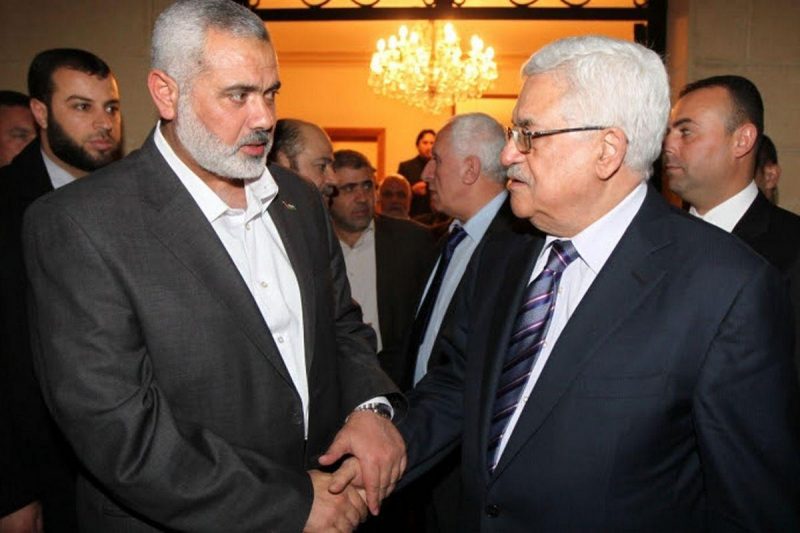
Chief of Hamas’ Political Bureau Ismail Haniyeh (L) and Palestinian Authority leader Mahmoud Abbas (R)
MEMO | January 24, 2019
Member of Fatah Revolutionary Council Mowfaq Matar said yesterday that “the elections will not be held in Gaza as long as it is controlled by Hamas,” Al-Resalah newspaper reported.
Speaking to Al-Resalah, he said: “It is impossible to hold elections there without a united government and united judicial and security authorities to supervise the elections based on the basic law.”
Meanwhile, Matar reiterated that his movement would never accept a national unity government with Hamas “before ending the coup and handing over its power.”
He noted that Hamas would not be part of a potential government reshuffle, stating that the leadership of the Palestinian Authority is to issue a statement next Wednesday that would answer many questions about the government reshuffle and holding the elections.
In December 2018, Abbas announced the dissolution of the Palestinian parliament and announced his plan to carry out elections in the Palestinian territories. Later on, Fatah announced its precondition for the elections, which exclude the Gaza Strip.
Hamas announces terms for new Palestinian elections
MEMO | January 24, 2019
Hamas yesterday announced that it will only agree for elections to be held if they are for presidential, legislative and the PLO national council in parallel.
A senior Hamas official who also serves as deputy speaker of the PLC, Ahmed Bahr said Hamas hope this will renew legitimacy and rotate power “on the basis of genuine political partnership and agreements signed by the Palestinian factions”.
A member of Hamas’ political bureau, Khalil Al-Hayya, said during a local conference in Gaza that the movement refuses to only hold parliamentary elections.
“The president’s term has been extended for 14 years and needs renewal. Members of the current National Council have been appointed to the council and do not represent the Palestinian national situation,” he said.
Al-Hayya said that Hamas “is ready to hold comprehensive Palestinian elections immediately away from the policies of exclusiveness, exclusion and selfishness.”
The Palestinian President Mahmoud Abbas announced on 22 December the dissolution of the Legislative Council and called for legislative elections within six months.
The last Palestinian parliamentary elections took place in 2006 and were won by Hamas.
On Sunday, Abbas met in Ramallah with the Palestinian Central Elections Commission (CEC), announcing his support for providing all that is needed to hold new legislative elections “as soon as possible”.
Councils have cut services but spend millions on CCTV

TruePublica | January 23, 2019
Most people in the UK think quite wrongly that they live in a country where freedom and privacy is the basic right of all citizens. The UK currently holds the record for the largest number of CCTV cameras per person. Although Britain contains only contains 1 per cent of the world’s population, its citizens are watched by 20 per cent of the world’s CCTV cameras. Research in 2013 estimated that there are up to six million cameras in the UK, and the network is expected to expand even further, which according to a recent report it has achieved. But there’s more.
To add to worries of illegal state surveillance – “the risk potential for intrusion on citizens has significantly increased both by lawful operators of surveillance camera systems and those individual or state actors who seek to hack into systems,” Surveillance Camera Commissioner Tony Porter said.
In addition, we should not forget the Automatic Number Plate Recognition (ANPR) system. ANPR is one of the largest non-military databases in the UK, with around 9,000 cameras nationally that captures between 25 million and 40 million pieces of data per day, while up to 20 billion “read” records are held.
Porter described this activity as “formidable”, saying:
“The nature of its capabilities to intrude on privacy by building patterns of travel and the provision of imagery should not be underestimated.”
“I firmly believe that this system needs legislative oversight and that the Government should place this system on a statutory footing.”
It is estimated that there are over half a million CCTV cameras in London alone where the average person is photographed or videoed approximately 300 times every single day.
And if mass state surveillance, much of which has been deemed illegal by the highest courts in the land is of concern, then diverting much needed public funds from important social support programmes to surveillance is utterly appalling.
Reported in The Times is an article about how councils are now spending millions of pounds spying on residents despite cutting services in almost every other area.
“Local authorities in England have spent more than three-quarters of a billion pounds on CCTV over the past decade, an increase of 17 per cent a year since 2010. Over the same period councils have reduced spending on street cleaning by 12 per cent, food safety by 16 per cent, trading standards by 32 per cent and libraries by 35 per cent.
Critics said the increase in spending on CCTV while other departments had their budgets cut was “offensive”.”
Big Brother Watch Director, Silkie Carlo, said:
“Research consistently shows that public cameras are ineffective at deterring, preventing or even solving crime, but that too much CCTV does curb citizens’ freedom. The UK is already one of the most surveilled nations in the world, with six million CCTV cameras recording us every day. Surveillance is no substitute for policing and this will prove to be a terrible waste of money.”
Pompeo the Warmonger Supports Authoritarian Regimes
By Brian CLOUGHLEY | Strategic Culture Foundation | 20.01.2019
On January 2 US Secretary of State Mike Pompeo visited Brazil, and his Department noted that in discussions with Foreign Minister Ernesto Araujo they “highlighted the importance of working together to address regional and global challenges, including supporting the people of Venezuela, Cuba, and Nicaragua in restoring their democratic governance and their human rights.” Pompeo declared that the US and Brazil “have an opportunity to work alongside each other against authoritarian regimes.”
From this we gather that Pompeo is a strong advocate of democratic governance and will always make it clear that the United States supports unfortunate people living in countries having “authoritarian regimes.” It is apparent he must believe in the Universal Declaration of Human Rights which states that “everyone has the right to freedom of thought, conscience and religion.”
Unfortunately it transpired that Pompeo is a selective supporter of democracy and freedom of religion, because after he left Brazil and went to the Middle East he voiced vigorous support for despots who rule countries in a manner that is undeniably authoritarian.
In a speech in Cairo on January 10 Pompeo threatened Iran and declared that “Nations are rallying to our side to confront the regime like never before. Egypt, Oman, Kuwait, and Jordan have all been instrumental in thwarting Iran’s efforts to evade sanctions.” It must be gratifying for him that these nations have joined the US in its crusade against Iran, three of them being hereditary monarchies and one run by a non-regal martinet.
Oman, for example, is “an absolute monarchy by male primogeniture. The Sultan, Qaboos bin Said al Said, has been the hereditary leader of the country since 1970.” Freedom House notes that “The regime restricts virtually all political rights and civil liberties, and imposes criminal penalties for criticism and dissent… Political parties are not permitted, and the authorities do not tolerate other forms of organized political opposition.”
In Jordan “the monarch holds wide executive and legislative powers, including the appointment of the prime minister and all seats of the senate. The monarch approves and dismisses judges; signs, executes or vetoes all laws; and can suspend or dissolve parliament.”
The leader of Kuwait, the Amir, according to the CIA Factbook, is “chosen from within the ruling family, confirmed by the National Assembly; the prime minister and deputy prime ministers are appointed by the Amir.” In this autocracy, according to Human Rights Watch, there are “no laws prohibiting domestic violence or marital rape… a man who finds his mother, wife, sister or daughter in the act of adultery and kills them is punished by either a small fine or no more than three years in prison.”
Pompeo wants “democratic governance and human rights” in Venezuela, Cuba, and Nicaragua. Why not in Oman, Jordan and Kuwait?
The only one of Pompeo’s countries not ruled by a supreme monarch is Egypt, whose president is Field Marshal Abdel Fattah al-Sisi who “was elected in May 2014, almost a year after he removed his elected predecessor, the Muslim Brotherhood’s Mohammed Morsi, from office in a coup.” Sisi “won a second four-year-term in March 2018 against a sole minor opposition candidate. Human rights lawyer Khalid Ali and former prime minister Ahmad Shafiq withdrew from the race, and the former armed forces chief of staff Sami Anan was arrested.”
In his warmongering anti-Iran, anti-Syria speech Pompeo announced that his visit to Egypt was “especially meaningful for me as an evangelical Christian, coming so soon after the Coptic Church’s Christmas celebrations” and visited the Cathedral of the Nativity of Christ and the Al-Fattah Al-Alim mosque where he praised Egypt’s “freedoms here in this houses [sic] of worship, these big, beautiful, gorgeous buildings where the Lord is clearly at work.”
He ignored Amnesty International’s statement that in Egypt “the authorities continued to violate the right to freedom of religion by discriminating against Christians.” His own Department recorded that last year “Irrespective of religion, authorities also did not apply equal protection to all citizens and sometimes closed churches, in violation of the law, according to multiple sources.”
The bigotry of the Egyptian regime and its clerics was epitomised on January 13 when Al Azhar University which is responsible for “a national network of schools with approximately two million students” expelled a female student for being hugged by a male friend. The scandal was revealed in a video clip which “showed a young man carrying a bouquet of flowers kneeling before a young woman and then hugging her in what appeared to be a marriage proposal.” According to a University spokesman this violates “the values and principles of society”. There was not a word from Pompeo, that self-declared admirer of Egyptian places of worship where “the Lord is clearly at work.”
Pompeo continued his tour of the region, and next day, as he landed in Saudi Arabia, the Egyptian regime announced that for the seventh time it had extended its state of emergency which “allows authorities to take exceptional security measures, including the referral of terrorism suspects to state security courts, the imposition of curfews and the confiscation of newspapers.” This would be supported in Saudi Arabia where, as chronicled by Freedom House, the “absolute monarchy restricts almost all political rights and civil liberties. No officials at the national level are elected. The regime relies on extensive surveillance, the criminalization of dissent, appeals to sectarianism, and public spending supported by oil revenues to maintain power. Women and religious minorities face extensive discrimination in law and in practice.”
This discrimination was highlighted by the New York Times on January 13 when it published an Op-Ed by Alia al-Houthlal that implored Pompeo to ask Saudi Prince Mohammad bin Salman to release her sister, the women’s rights activist, Loujain al-Houthlal, who is imprisoned in Riyadh. Ms Alia al-Houthlal wrote that her sister had been tortured in prison, and that a close associate of bin Salman, Saud al-Qahtani, who has been named in connection with the murder of Mr Jamal Khashoggi [brutally killed in the Saudi consulate in Istanbul on October 2 last year], was present at several torture sessions.
The Times reported that Pompeo began his conversation with bin Salman, the de facto ruler of Saudi Arabia, by saying “I want to talk to you about a couple of places we’ve been. We think we learned a lot along the way that will be important going forward.” There was no mention of the torture of Loujain al-Houthlal or any other gross violations of human rights in Saudi Arabia where the regime continues to “repress peaceful activists and dissidents, harassing writers, online commentators and others who exercised their right to freedom of expression by expressing views against government policies.”
There was none of that embarrassing stuff. It was all skated over, with Pompeo saying only that “we spoke about human rights issues here in Saudi Arabia – women activists. We spoke about the accountability that – and the expectations that we have. The Saudis are friends, and when friends have conversations, you tell them what your expectations are.”
Pompeo’s expectations include joint action with the Saudi regime and other Middle East autocracies to “counter Iranian malign influence,” which he regards as an even higher priority than “working against authoritarian regimes” in Latin America, which Washington is determined to dominate. Pompeo’s objections to authoritarianism are highly selective, for in his Cairo speech he confined himself to describing Iran “malevolent,” and “oppressive” while denouncing “Iranian expansion” and “regional destruction,” which is a trifle ironic, coming from a Secretary of State whose military devastated Iran’s neighbours, Iraq and Afghanistan.
Pompeo’s ethical approach is decidedly ambiguous and his moral flexibility would attract the admiration of a trampoline gymnast. His Cairo speech was titled “A Force for Good: America’s Reinvigorated Role in the Middle East,” but it is apparent that reinvigoration is confined to plans for destruction of Iran, in which Washington will be assisted by Pompeo’s friends — the Middle East’s authoritarian regimes.
Featured Video

Houthis Don’t Have to Conquer Saudi Arabia to Make It Pay
or go to
Aletho News Archives – Video-Images
From the Archives
Newly Released FBI Docs Shed Light on Apparent Mossad Foreknowledge of 9/11 Attacks
By Whitney Webb | MintPress News | May 17, 2019
NEW YORK — For nearly two decades, one of the most overlooked and little known arrests made in the aftermath of the September 11 attacks was that of the so-called “High Fivers,” or the “Dancing Israelis.” However, new information released by the FBI on May 7 has brought fresh scrutiny to the possibility that the “Dancing Israelis,” at least two of whom were known Mossad operatives, had prior knowledge of the attacks on the World Trade Center. … continue
Blog Roll
 Aletho News
- MEP blasts ‘Euro-Gestapo’ for lecturing Russia on democracy
- Syria May Send Troops to Saudi Arabia Amid War with Ansar Allah
- UK whines about losing billions to ‘Putin tax’
- Baghaei to Rubio: Distorted narratives cannot erase US record of broken commitments
- Houthis Don’t Have to Conquer Saudi Arabia to Make It Pay
- MOE: Nearly 22,000 Students and Education Workers Killed
- Guterres in Islamabad: Genocide, cowardice, and the cage of Imran Khan
- Johnson, Marandi say Yemen holds upper hand over Saudi Arabia
- False flags won’t save aggressors, Iran FM spokesman says
- The Makkah Pact Enters Into Force: The End of American Dominance or Its New Form?
- If Americans Knew
- Report claimed Mark Levin used by Israeli government to influence Trump
- Over 2,000 Gazans have died awaiting medical evacuation amid Israel’s continued siege
- How a U.S. Diplomat Suppressed and Altered Reports Critical of Israel
- 5 Palestinians Die from Israeli Strikes in Gaza as Relentless Attacks Continue
- Report: Ceasefire Slows Killing but Leaves Devastation Intact
- Country Music Singer Zach Bryan Breaks Attendance Record at Robert Kraft’s Gillette Stadium While Wearing ‘Free Palestine’ Shirt for Second Night in a Row
- Three years of death and devastation: Israel’s war on Gaza in pictures
- Why Hamas believed the status quo was more dangerous than its 7 October gamble
- Debunking Israel’s latest list of ‘terrorist’ journalists in Gaza
- In Gaza, focus is on survival, “every step is a struggle” – Daily Update
- No Tricks Zone
- New Study: 50 Years Of The Most Aggressive ‘Net Zero’ Policies Can Only Affect The Global Climate By 0.03°C
- US September “Heat” Was No Record…Many Records Set Decades Ago
- Latest European Green Energy Debacle; Portugal’s Largest Flagship Solar Park Insolvent!
- Green Energy Debacle: German Expert Professor Fritz Vahrenholt Warns Of Severe Economic And Social Consequences
- Two More Paleo Reconstructions Affirm Meters-Higher Sea Levels Across Ireland, Brazil 7000-6000 Years Ago
- New Study: Earth And Venus Surface Warmth Largely Explained By Convection And Lapse Rate, Not CO2 Or Radiation
- 2025 Nature Paper Claiming Worsening Global Drought Gets RETRACTED …Heavily Flawed
- New Study: ‘Global Drought Shows No Detectable Recent Acceleration Under Climate Warming’
- Economic Masterminds: German Socialists Suggest Taxing Productivity Gains Stemming From Using AI
- The South China Sea Has Not Been Cooperating With The Climate Change Narrative

