Why Liberal Jews in Israel and the US have made Lara Alqasem a Cause Celebre
By Jonathan Cook | The National | October 15, 2018
An American student of Palestinian descent detained in Israel’s airport for nearly a fortnight has become an unexpected cause celebre. Lara Alqasem was refused entry under legislation passed last year against boycott activists, and Israeli courts are now deciding whether allowing her to study human rights at an Israeli university threatens public order.
Usually those held at the border are swiftly deported, but Ms Alqasem appealed against the decision, becoming in the process an improbable “prisoner of conscience” for the boycott cause.
The Israeli government, led by strategic affairs minister Gilad Erdan, claims that the 22-year-old is a leader of the growing international boycott, divestment and sanctions (BDS) movement. Activists like Ms Alqasem, he argues, demonise Israel.
Two lower courts have already ruled against the student. Israel’s supreme court has postponed her deportation until Wednesday while it reconsiders the evidence. But refusing to go quietly, Ms Alqasem is attracting increasing international attention to her plight.
So far Israeli officials have shown only that Ms Alqasem once belonged to a small Palestinian solidarity group at a Florida university that backed boycotting a hummus company over its donations to the Israeli army.
Under pressure, Ms Alqasem has disavowed a boycott of Israel, citing as proof her decision to enroll in a masters programme in Hebrew University in Jerusalem.
Given the blanket hostility in Israel to the boycott movement, Ms Alqasem has found a surprisingly wide array of allies in her legal struggle.
Members of the small Zionist-left Meretz party visited her and demanded she be allowed to attend the course, which began on Sunday.
Ami Ayalon, a retired head of the Shin Bet, the secret police that oversees security checks at Israel’s borders, warned that the agency was now “a problem for democracy” in repeatedly denying foreigners entry.
Vice-chancellors of eight Israeli universities sent a letter of protest to the government and 500 academics at Hebrew University submitted a petition decrying Ms Alqasem’s incarceration.
The solidarity has been unprecedented – and perplexing.
Israeli officials control entry not only to Israel but also to the occupied Palestinian territories. For decades, foreigners with Arab-sounding names – like Ms Alqasem – have been routinely harassed or turned back at the borders, with barely a peep from most on the Israeli left.
And over the same period, Israel has stripped many thousands of Palestinians from the occupied territories of the right to return to their homeland after living abroad. These abuses, too, have rarely troubled consciences in Israel.
So what makes Ms Alqasem’s case different? The answer confers little credit on liberal Israelis.
Israel’s universities are worried that the academic boycott has highlighted their long-term complicity in Israel’s occupation and is gradually eroding their international standing. Joint research projects with foreign universities are in jeopardy, as is their lucrative income from programmes they wish to expand for overseas students.
The universities want to co-opt Ms Alqasem as a poster girl for academic freedom in Israel.
They hope she will provide cover for their guilty secret: that they have stood by, or actively assisted, as Israel made a mockery of academic freedom for Palestinians under occupation. Research shows that Israel’s universities have strong ties to the nation’s military, which regularly attacks Palestinian places of learning and limits Palestinians’ freedom to study by enforcing strict movement restrictions.
Jewish liberals in Israel and the US, meanwhile, are concerned at the entrenchment of the Israeli far-right’s rule. In recent weeks, a wave of Israeli and American Jewish activists have been detained and questioned at the border over their politics.
Those liberals desperately need to draw a red line, halting the expansion of racial profiling into political forms of profiling that undermine their own status. If the courts uphold the fundamental rights of Ms Alqasem, their own rights will be more secure too.
That was why progressive Jewish leaders in the US added their own voices last week, signing a petition calling for Ms Alqasem to be allowed to study in Israel.
But the case has shone a light not only on the self-interested opportunism of Israeli liberals but also on the hypocrisy of leaders of progressive American Jewish communities.
Ms Alqasem was identified as a boycott activist via a McCarthyite website called Canary Mission, which has murky ties to the Israeli government.
Since it launched in 2014 under the slogan “If you’re racist, the world should know”, the site has built an online database profiling thousands of US academics and students, including Jewish ones, critical of Israel.
Its aim is to terrify US academia into silence on Israel. The site explicitly threatens to send letters to prospective employers accusing its targets – those who show solidarity with Palestinians – of being antisemitic.
Until recently, this blacklist had passed largely unremarked outside pro-Palestinian circles. But since its role in helping Israeli officials bar Jewish and non-Jewish activists became clear, interest in its provenance has grown.
This month the Forward, an American Jewish publication, unmasked several of Canary Mission’s major donors. They include the communal funds of Jewish federations representing liberal communities in San Francisco and Los Angeles.
The trail leads back to a shadowy registered charity in Israel called Megamot Shalom, which aims to “protect the image of the state of Israel”.
Simone Zimmerman, an American Jewish peace activist who was detained at the border by Israeli officials in August, lamented that the American Jewish establishment’s secret support for Canary Mission “reeks of hypocrisy and betrayal”.
Supposedly liberal Jewish institutions in Israel and the US wish to be seen battling racism and aiding good causes, including the rights of a Palestinian-American student after she repudiated a boycott of Israel.
But covertly they support and finance projects intended to silence criticism of Israel and enforce the oppression of Palestinians they say they want to help.
Ms Alqasem has been turned into a pawn in the struggle between Jewish liberals and Israeli ultra-nationalists. Israel’s continuing violations of the wider rights of Palestinians – to enter and freely move around their homeland, and to receive an education – are simply not part of the discussion.
Pages purged by Facebook were on blacklist promoted by Washington Post
By Andre Damon | WSWS | October 13, 2018
Media outlets removed by Facebook on Thursday, in a massive purge of 800 accounts and pages, had previously been targeted in a blacklist of oppositional sites promoted by the Washington Post in November 2016.
The organizations censored by Facebook include The Anti-Media, with 2.1 million followers, The Free Thought Project, with 3.1 million followers, and Counter Current News, with 500,000 followers. All three of these groups had been on the blacklist.
In November 2016, the Washington Post published a puff-piece on a shadowy and up to then largely unknown organization called PropOrNot, which had compiled a list of organizations it claimed were part of a “sophisticated Russian propaganda campaign.”
The Post said the report “identifies more than 200 websites as routine peddlers of Russian propaganda during the election season, with combined audiences of at least 15 million Americans.”
The publication of the blacklist drew widespread media condemnation, including from journalists Matt Taibbi and Glenn Greenwald, forcing the Post to publish a partial retraction. The newspaper declared that it “does not itself vouch for the validity of PropOrNot’s findings regarding any individual media outlet.”
While the individuals behind PropOrNot have not identified themselves, the Washington Post said the group was a “collection of researchers with foreign policy, military and technology backgrounds.”
PropOrNot, which remains active on Twitter, publicly gloated about Facebook’s removal of the pages on Thursday. “Russian propaganda is VERY VERY MAD about their various front outlets & fellow travellers getting suspended by @Facebook &/or @Twitter,” it wrote. The tweet tagged The Anti Media and The Free Thought Project, and included a Russian flag emoji next to an emoji depicting feces.
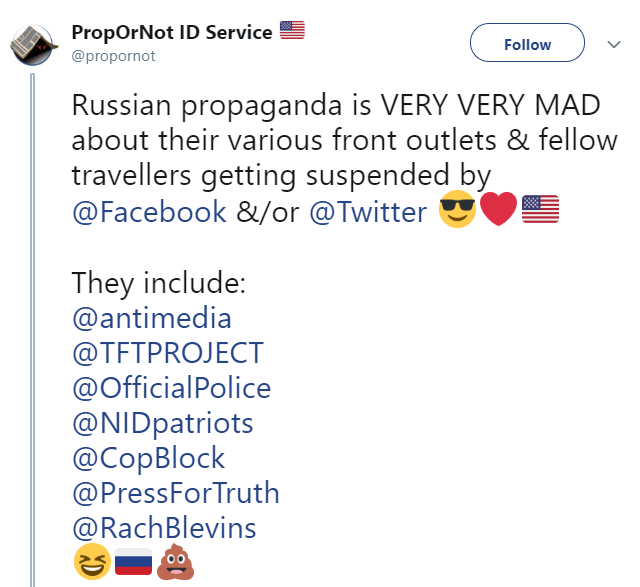
PropOrNot did not attempt to reconcile its own narrative that the targeted organizations were front groups for the Kremlin with Facebook’s official claim that they operated independently of any government but sought to “stir up political debate” for financial motives. This is because both accusations are hollow pretexts for political censorship.
In a separate post, PropOrNot added: “Well, look at that… @Facebook removed some of the most important gray/black Russian propaganda outlets from their platform! Bravo @Facebook – better late than never, so a BIG thank you for this.”
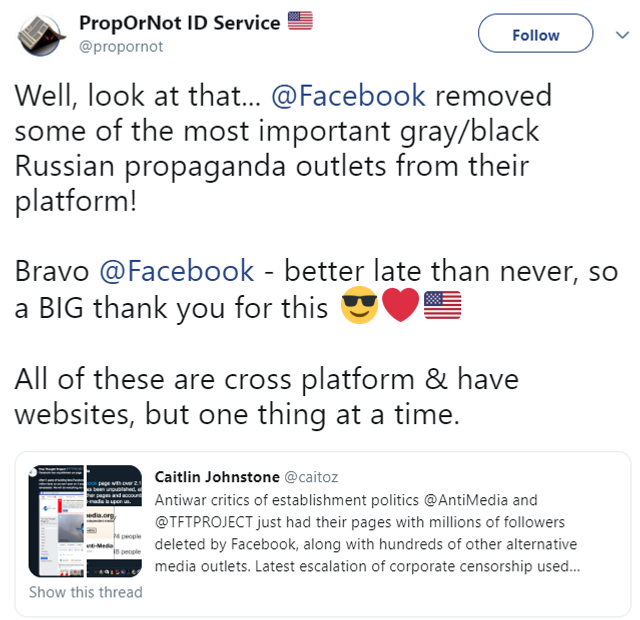
It added, ominously: “All of these [organizations] are cross platform & have websites, but one thing at a time.”
These comments by PropOrNot make clear where the censorship measures supervised by the US government and implemented by the internet companies are going. While these organizations still “have websites,” the authorities are handling “one thing at a time.”
The clear implication is that censorship will not end with Google’s manipulation of its search platform or the removal of accounts by Facebook and Twitter. The ultimate aim is the total banning of oppositional news web sites.
The publication of the PropOrNot blacklist and its promotion by the Washington Post helped trigger a wave of censorship measures against oppositional news sites by the major technology companies, working at the instigation of the US intelligence agencies and leading politicians.
Last year, the World Socialist Web Site reported that it an other sites, including Global Research, Counterpunch, Consortium News, WikiLeaks and Truthout, saw their search traffic plunge after search giant Google implemented a change to its search ranking algorithm.
In the subsequent period, search traffic to these sites has fallen even further. Search traffic to Counterpunch has fallen by 39 percent, and Consortium News has fallen by 51 percent.
These developments confirm the analysis made by the World Socialist Web Site in its open letter to Google alleging that it was censoring left-wing, anti-war and socialist websites.
“Censorship on this scale is political blacklisting,” the letter declared. “The obvious intent of Google’s censorship algorithm is to block news that your company does not want reported and to suppress opinions with which you do not agree. Political blacklisting is not a legitimate exercise of whatever may be Google’s prerogatives as a commercial enterprise. It is a gross abuse of monopolistic power. What you are doing is an attack on freedom of speech.”
On Tuesday, Google admitted in an internal document that it and other technology companies had “gradually shifted away from unmediated free speech and towards censorship and moderation.” The document stated that an aim of the censorship was to “increase revenues” under conditions of growing government and commercial pressure.
The document acknowledged that such actions constitute a break with the “American tradition that prioritizes free speech for democracy.”
Danish Bill Proposes 12 Years in Prison for ‘Pro-Russia’ Opinion
Sputnik – October 13, 2018
Danish lawmakers have gone on the offensive against interference in public debate, sparking criticism that a new proposal, which could entail criminal liability for expressing opinions similar to those of Moscow, may become a step toward silencing public debate.
According to a bill brought forward in local parliament, Danes could face a jail term if they voice dissent over the government’s position on Russia.
The proposal, which is said to be meant to “strengthen efforts against illegal influence from foreign intelligence services,” would introduce criminal penalties for perceived “meddling” in public debates and attempts to influence decision-making. Crimes committed during an election campaign would entail a maximum prison term of 12 years.
Berlingske, the country’s oldest newspaper, has bashed the bill, claiming that it would narrow the scale of political conversation in Denmark.
Berlingske’s Flemming Rose argues that the law could be stretched to the point where a Danish director is targeted for changing a burnt-out light bulb following the advice of a foreign intelligence agent.
He also warns that a Danish subject could face punishment for sharing an opinion in the local media that anti-Russia sanctions damage the country or attempting to publicly downplay concerns over the Russia-led Nord Stream 2 pipeline project (Denmark has so far failed to give its approval of the pipeline passing through its territorial waters).
The bill is understood to mean an attempt to influence public opinion in Denmark and concrete decisions in both the private and public sectors as it targets legitimate opinions that can be taken to be propaganda.
This comes at a time when Russia is facing a flurry of accusations from Western countries that it had hacked doping agencies and other international organizations in a bid to influence public opinion. Russia has vehemently dismissed the allegations as “spy mania.”
Banned alternative media speak to RT after mass Facebook purge
RT | October 13, 2018
Some 800 anti-establishment accounts and pages have been yanked from Facebook in a sweeping crackdown the social media giant framed as a fight against spammers. RT talked to those who were targeted in the cleansing.
Among the hundreds of pages and accounts Facebook and Twitter took down were those both on the political left and right, ranging from conspiracy theorists and police brutality watchers, to news outlets with non-mainstream angles, While their content could be at times described as controversial, the bulk of the banished pages boasted large followings and outreach.
RT spoke to some of the voices silenced by the Facebook move. Here is what they had to say.
Jason Bassler, The Free Thought Project, 3.1mn followers
The Free Thought Project bills itself as a “hub for free thinking conversations.” Both its Facebook and Twitter accounts were shut down in the pre-midterms purge. Jason Bassler, who co-founded the project in 2013, told RT that what Facebook did is an act of political censorship and has nothing to do with its stated goal to clean up its platform from spam.
“If that was just spam, if that was just irrelevant garbage they wouldn’t be so threatening, they would not ban us, they would not care, we would not have been on their radar.”
By spinning the story as a fight against unworthy news trash, Facebook itself is misleading users with its own version of fake news, he said: “This is nothing more than political censorship and trying to eradicate certain political ideologies.”
Nicholas Bernabe, founder of The Anti-Media, 2.1mn followers
Nicholas Bernabe, blogger and entrepreneur behind the independent news aggregator The Anti-Media, believes that “the most troubling” thing in Facebook’s treatment of media pages is that tech giants are now trying to police cultural dialogue by posing as politically neutral.
“That could actually be perceived as Facebook itself meddling in elections, because we are only a few weeks away from the midterms and they go and target 800 politically-oriented media pages for deletion.”
He added that the majority of the banned pages held “very anti-establishment, very anti-authoritarian views,” that appealed to those whose take on election is very different from what mainstream media has to offer.
Matt Savoy, The Free Thought Project, 3.1mn followers
It is hard to overestimate the implications for those that were swept up in the purge, Matt Savoy of The Free Thought Project said. Many of the affected websites will be out of business and “thousands of people will be out of work.”
“This is like a death blow. Facebook was a source of how we were able to get our links out and drive traffic to the website, and we no longer have it. The few remaining employees that we have, they are going to be gone.”
Journalists did not have any time to prepare for the looming crackdown, Savoy said, and at first the staff thought it was a mere glitch.
Matt Bergman, Punk Rock Libertarians, 190,000 followers
Matt Bergman, who founded the Punk Rock Libertarians in 2010, told RT that his ‘The Daily Liberator’ podcast was taken down from Facebook without any explanation. Bergman’s own account was also briefly suspended, as well as those of other page admins.
The purge is the result of the pressure Congress put on Mark Zuckerberg, and its first targets were independent outlets “right of the dial,” since it’s easier to get away with banning relatively small outlets than major channels like RT, he argued.
“Their terms of service agreement is probably a million words long. Nobody has ever read it all the way through and I would think that if they wanted to they can ban CNN, they can ban you guys, if they wanted to, they can ban anybody.”
Bergman said he is filing an appeal in a bid to restore the account.
Dan Dicks, Investigative Journalist, 350,000 followers
Vancouver-based investigative journalist Dan Dicks, who writes for The Press for Truth, said the Facebook crackdown was “clearly political” as it saw tech companies assuming the role of “the gatekeepers of political thought.”
“What we are dealing with here today is the silencing of anybody who goes against the status quo right now, does not matter right or left side of the political spectrum.”
Conspiracy theorist Alex Jones, expunged from Facebook and Twitter, might have been “the first domino to fall,” but now the crackdown has widened to affect smaller outlets that vie for minds of the people on par with mainstream media, he said.
The crackdown on anti-establishment voices will come back to bite Facebook, UK Labour Party activist and political theorist Dr. Richard Barbrook argued.
Facebook and other tech companies who feel compelled to impose more “traditional media censorship” are likely to see a mass exodus from their platforms, he believes.
“The problem is if they are doing it too much, people would be gone somewhere else, where they don’t have network effects working against them,” Barbrook told RT.
Catalan Parliament Passes Resolution to Abolish Monarchy in Spain
Sputnik – 11.10.2018
The resolution was proposed by the regional branch of the Spanish Podemos party, Catalunya en Comu-Podem, which has 8 mandates out of 135 in the Catalan parliament. A total of 69 lawmakers supported the resolution, while 57 parliamentarians voted against and four abstained. The voting was aired on the parliament’s website.
In particular, the resolution condemns the position of King Felipe VI of Spain during the Catalan independence crisis and his address to the nation on October 3 last year, which “justified violence” at polling stations during the referendum.
The document also calls for adherence to republican values and to “abolition the outdated and anti-democratic institution of monarchy.”
On October 1, 2017, Catalonia held an independence vote, which resulted in over 90 percent of those who voted backing the region’s autonomy. Madrid objected to the referendum and refused to recognize its results.
In late October, Madrid imposed direct rule over Catalonia and dissolved the regional parliament, after the Catalan government proclaimed the region’s independence.
‘Free Speech’: Trump Campaign Defends WikiLeaks’ Release of Hacked DNC Emails
Sputnik – 11.10.2018
A lawsuit filed in September by two donors and an ex-employee from the Democratic Party alleged that President Donald Trump’s team had purportedly conspired with Russia to release emails ostensibly stolen from the servers of the Democratic National Committee.
In a motion to dismiss a new lawsuit, the Trump campaign, represented by lawyers from the firm Jones Day, turned to Section 230 of the Communications Decency Act to state that WikiLeaks couldn’t be held “liable” for publishing Democratic National Committee (DNC) emails because the whistleblowing website served as an “intermediary” for other parties’ information.
“A website that provides a forum where ‘third parties can post information’ is not liable for the third party’s posted information. Since WikiLeaks provided a forum for a third party (the unnamed “Russian actors”) to publish content developed by that third party (the hacked emails), it cannot be held liable for the publication,” the motion read.
Presenting the 32-page legal filing, the lawyers also maintained that any alleged agreement between the website and the Trump campaign to leak those emails couldn’t be considered a “conspiracy” due to the fact that WikiLeaks’ posting of the messages was not a crime, while a “conspiracy is an agreement to commit an unlawful act,” the lawyers claimed.
They further added that the campaign couldn’t be held legally responsible for the publication of the DNC emails on WikiLeaks.
The lawyers appealed to the First Amendment, which protects the right to “disclose information – even stolen information – so long as (1) the speaker did not participate in the theft and (2) the information deals with matters of public concern.”
“At a minimum, privacy cannot justify suppressing true speech during a political campaign. The First Amendment ‘has its fullest and most urgent application to speech uttered during a campaign for political office’. It leaves voters ‘free to obtain information from diverse sources in order to determine how to cast their votes,’” the filing read.
The motion was submitted in response to a civil lawsuit brought against the Trump campaign by one ex-employee from the Democratic Party and two donors, who alleged that the leaked emails had revealed “identifying information.”
While the Trump campaign’s lawyers leapt to the defense of the website in their brief, the current administration has previously blasted WikiLeaks for releasing classified documents, with then-CIA director Mike Pompeo – now the secretary of state – dismissing the platform as a “hostile non-state intelligence service” in 2017.
In July 2018, Special Counsel Robert Mueller, who is leading the investigation into the alleged Russian meddling in the 2016 election, announced indictments against 12 Russian nationals, claiming that they were posing as Guccifer 2.0, the entity that took credit for the hack of the DNC.
According to the indictment, they used a website run by an organization, “that had previously posted documents stolen from US persons, entities, and the US government,” in an apparent allusion to WikiLeaks.
WikiLeaks, which was accused by Trump’s Democratic rival in the election, Hillary Clinton, of acting as a “fully owned subsidiary of Russian intelligence” after publishing emails leaked from the DNC servers during the campaign, has denied any efforts to meddle in the 2016 election in the United States, as well as conspiring with Russia.
Both Washington and Moscow have repeatedly dismissed claims of collusion to influence the outcome of the vote.
The Two Brett Kavanaugh Stories
By Philip M. GIRALDI | Strategic Culture Foundation | 11.10.2018
There were two simultaneous Brett Kavanaugh stories. Together, as part of the confirmation process regarding his nomination as Supreme Court Justice, they revealed how political discourse in the United States has reached a new low, with debate over the man’s possible predilection to make judgments based on his own preferences rather than the US Constitution being ignored in favor of the politically motivated kabuki theater that was deliberately arranged to avoid that issue and instead go after his character.
Consider first of all, his flaws as a candidate. He was regularly framed as a “conservative,” but what did that mean in the context of his career? Some of the critics are referring to his time spent as a government lawyer, specifically for the George W. Bush Administration, where he was a supporter of wide executive authority in the context of the war against terror while others point to his decisions and writings during his time as a US Circuit judge from 2006 until the present. That meant essentially that Kavanaugh then supported and apparently continues to support what is now referred to as the John Yoo doctrine, named after the Department of Justice lawyer who penned the memo that made the case for the president to act unilaterally to do whatever is required in national security cases even if there be no direct or immediate threat. Yoo specifically argued that the president, by virtue of his office, is not bound by the War Crimes Act. This theory of government, also more broadly dubbed the unitary executive, was popularized by Yoo, fellow government lawyer Jay Bybee and Eric Posner of the University of Chicago.
For those who find Kavanaugh unacceptable in terms of his judicial philosophy, this repudiation of the constitutional principle of three branches of government that check each other was enough to disqualify him from a position on the Supreme Court, principally as it impacts on both the first and second articles of the constitution by granting to the president the authority to both begin and continue a war on his own recognizance. It also means that the president on his own authority can suspend first and fourth amendment rights to freedom of speech and association as well as freedom from illegal search. He supported, for example, the government’s “right” to conduct mass searches of private data such as was conducted by the NSA. Kavanaugh supports government authority to legitimize incarceration without trial and to order assassinations and torture. Kavanaugh is also on record as favoring limiting the public’s right to use the courts to redress government overreach.
But curiously enough, or perhaps not so curiously, Kavanaugh was treated with kid gloves on those critical issues, basically because both major parties are now supportive of the unitary executive concept even if they would not admit that to be the case. Bill Clinton launched cruise missiles attacks on Sudan and Afghanistan on his own authority and involved the US in a war in the Balkans. George W. Bush did the same in approving torture and expanding the war on terror to Iraq and also globally, while Barack Obama attacked both the Syrian and Libyan governments and assassinated US citizens abroad, all acts of war or war crimes carried out without a congressional declaration of war or without any real pushback by the judiciary.
The failure of Congress to carry out its duty to review Kavanaugh’s ability or lack thereof to interpret the constitution impartially was the more important story line in the confirmation process but it was ignored by the media. The other narrative that ran simultaneously, the purely political attempt made by the Democrats and some Republicans to destroy Kavanaugh as a person through the exploitation of random claims of sexual assault dating from more than thirty-five years ago, was an attempt to discredit the candidate that everyone knew right from the beginning could not be substantiated.
This all means that the important issue of Kavanaugh’s likely comportment as a judge was subjected to too little inquiry while his character as evidenced by tales from his past life received far too much attention. Ironically, the media, which has been frantically searching for an explanation for the breakdown of democracy in the United States, has been pillorying the Russians and more recently the Chinese for outside interference in the process, while ignoring the intense public dissatisfaction with the government it has been allowed to have by the Establishment, which is exemplified by the dystopic reality demonstrated by Kavanaugh. Some Americans would have rejected him based on his merits as a judge, but the case was not clearly made. Many instead came to view him as a victim of a vicious personal campaign and that was apparently enough to win confirmation, at least as reckoned by the calculus of those in Congress who cast the actual votes. In either case, the system failed to produce a good result and we only have our polarized and dysfunctional government to blame for that failure.
‘Murder, torture, sexual assault’ – MI5 & informants authorized to commit crimes in UK, court hears
RT | October 5, 2018
MI5 informants have been granted legal cover to commit crimes within the UK that may include murder, a tribunal into British security services’ alleged criminality has heard.
The policy, allegedly in place since the early 1990s, would potentially allow the Security Service to authorize participation in “murder, torture, sexual assault or other grave criminality” if they believed it was in the public interest, claimed Ben Jaffey QC, representing an alliance of human rights groups.
Speaking to the Investigatory Powers Tribunal (IPT), Thursday, Jaffey, argued that the practice has enabled British security services to conceal widespread illegal activity from both agents and informants within the UK.
Known within intelligence circles as ‘the third direction,’ the policy was acknowledged for the first time in a British court when Jaffrey’s clients, including Privacy International and Reprieve, claimed that the practice was unlawful on human rights grounds.
It had earlier been revealed that British intelligence agents, namely MI6, were allowed to commit crime overseas. Thursday’s hearing was the first time authorized criminality from the security services within Britain had been claimed.
MI5’s policy would be illegal if it breaches human rights, such as the ban on the use of torture, Jaffey told the secretive IPT tribunal.
“This is a case where the agencies are able to self-grant themselves a practical immunity from the criminal law,” Jaffrey argued.
The policy would have been in place when MI5 agents were active in Northern Ireland, which in the early 90s was still witnessing The Troubles, a low-level sectarian war.
The UK government’s official guidelines state that there is no immunity from prosecution for agents who participate in criminality. Despite this, Jaffrey said that police and prosecutors were unaware of the details of the crime due to the secrecy of the policy.
The revelation is the latest embarrassment for the government during the IPT tribunal, a similar policy – the so-called ‘James Bond clause’ – was exposed earlier in the proceedings.
Following the hearing, Maya Foa, director of Reprieve, said: “We want to know if it’s government policy to let MI5 agents get away with serious crimes such as torture and murder.” She urged the government, if this is their policy, to “inform MPs and the public, and open the policy to legal and parliamentary scrutiny.”
Featured Video

When Israel Is Mighty
or go to
Aletho News Archives – Video-Images
From the Archives
US murdering 1 million Iraqis is democracy, Iran giving yogurt to Iraq is “domination”
By Ali Salaam | American Herald Tribune | July 31, 2017
The New York Times, owned by the Zionist Jewish supremacist Ochs-Sulzberger family, has no problem with Iraqi suffering as long as Iran is not the one behind it.
The Iraq War was a genocide of the Iraqi people by Zionist supremacists in the Bush administration. Over 1 million innocent people were killed based on a lie. American soldiers died in an Israeli war and now an average of 22 soldiers commit suicide every day because their consciences cannot cope with the fact they committed crimes in an illegal war that served no purpose other than to benefit Israel, not America.
Benjamin Netanyahu, Prime Minister of the Zionist regime, once said “We are benefiting from one thing, and that is the attack on the Twin Towers and Pentagon, and the American struggle in Iraq.”
Paul Wolfowitz had his sights on Iraq since his time in the first Bush administration. Former Israeli official and Bush administration official Richard Perle had his eyes on Iraq since at least his authorship of the Clean Break white paper. The Zionist regime had their eyes on Iraq since the 1980s when strategist Oded Yinon wrote his white paper in support of dividing the Arab-Muslim world along ethnic and sectarian lines. The global Zionist lobby has had their eyes on Iraq since Theodor Herzl stated that Eretz Israel’s true borders go from the Nile River in Egypt to the Euphrates River in Iraq. … continue
Blog Roll
 Aletho News
- MEP blasts ‘Euro-Gestapo’ for lecturing Russia on democracy
- Syria May Send Troops to Saudi Arabia Amid War with Ansar Allah
- UK whines about losing billions to ‘Putin tax’
- Baghaei to Rubio: Distorted narratives cannot erase US record of broken commitments
- Houthis Don’t Have to Conquer Saudi Arabia to Make It Pay
- MOE: Nearly 22,000 Students and Education Workers Killed
- Guterres in Islamabad: Genocide, cowardice, and the cage of Imran Khan
- Johnson, Marandi say Yemen holds upper hand over Saudi Arabia
- False flags won’t save aggressors, Iran FM spokesman says
- The Makkah Pact Enters Into Force: The End of American Dominance or Its New Form?
- If Americans Knew
- Report claimed Mark Levin used by Israeli government to influence Trump
- Over 2,000 Gazans have died awaiting medical evacuation amid Israel’s continued siege
- How a U.S. Diplomat Suppressed and Altered Reports Critical of Israel
- 5 Palestinians Die from Israeli Strikes in Gaza as Relentless Attacks Continue
- Report: Ceasefire Slows Killing but Leaves Devastation Intact
- Country Music Singer Zach Bryan Breaks Attendance Record at Robert Kraft’s Gillette Stadium While Wearing ‘Free Palestine’ Shirt for Second Night in a Row
- Three years of death and devastation: Israel’s war on Gaza in pictures
- Why Hamas believed the status quo was more dangerous than its 7 October gamble
- Debunking Israel’s latest list of ‘terrorist’ journalists in Gaza
- In Gaza, focus is on survival, “every step is a struggle” – Daily Update
- No Tricks Zone
- New Study: 50 Years Of The Most Aggressive ‘Net Zero’ Policies Can Only Affect The Global Climate By 0.03°C
- US September “Heat” Was No Record…Many Records Set Decades Ago
- Latest European Green Energy Debacle; Portugal’s Largest Flagship Solar Park Insolvent!
- Green Energy Debacle: German Expert Professor Fritz Vahrenholt Warns Of Severe Economic And Social Consequences
- Two More Paleo Reconstructions Affirm Meters-Higher Sea Levels Across Ireland, Brazil 7000-6000 Years Ago
- New Study: Earth And Venus Surface Warmth Largely Explained By Convection And Lapse Rate, Not CO2 Or Radiation
- 2025 Nature Paper Claiming Worsening Global Drought Gets RETRACTED …Heavily Flawed
- New Study: ‘Global Drought Shows No Detectable Recent Acceleration Under Climate Warming’
- Economic Masterminds: German Socialists Suggest Taxing Productivity Gains Stemming From Using AI
- The South China Sea Has Not Been Cooperating With The Climate Change Narrative

