Israeli company wins contract to monitor Europe’s coasts
MEMO | November 1, 2018
The Israeli defence contractor Elbit Systems Ltd has won a contract worth up to $68 million to monitor much of Europe’s coastline.
Elbit Systems, an Israeli tech firm which specialises in defence, security and commercial systems, said today that the framework contract consists of the provision of maritime unmanned aircraft system (UAS) to the European Maritime Safety Agency (EMSA) in order to help monitor extensive coastlines and vast areas of sea to identify any potential hazards and suspicious activities.
In cooperation with CEiiA, the Centre of Engineering and product development in Portugal, Elbit will lease and operate its unmanned long-range surveillance system, the Hermes 900 Maritime Patrol system, as well as its ground control station. The contract is for a two-year period with the option of renewal for an additional two years.
“Having been selected by the European Union authorities is yet another vote of confidence in the Hermes 900 by following additional contract awards for this UAS in Europe, Asia Pacific, Latin America and Israel,” said Elad Aharonson, the general manager of Elbit Systems’ ISTAR Division.
In recent months, numerous Israeli companies and contractors have been winning contracts in various industries worldwide, ranging from defence to surveillance and technological advancement. In October, Israeli companies signed purchase agreements with the United Nations for the provision of water and security service to UN forces in Africa. Israel also won a $777 million contract for the supply of India’s missile defences, as well as being revealed as a lead exporter of tools for spying on civilians being used by dictatorships or authoritarian governments around the world.
Such deals and multi-million dollar contracts over a variety of regions are seen as not only a benefit to the Israeli economy but also the reliability of its services and the subsequent potential increase of its international credibility.
Read:
Israel has become a leading exporter of tools for spying on civilians
gab.com & the Great Purge on the Horizon
By Kit Knightly | OffGuardian | October 30, 2018
gab.com is an alternative social network, set up and launched in 2016. It’s founder, Andrew Torba, stated he wanted to create a home for free speech, and counter what he perceived as “liberal bias” on other platforms, such as Twitter and Facebook.
Two days ago, their website was taken down. This was in response to being blocked by PayPal, and then having their server space taken away by their hosting service. gab’s founder posted this statement on their stripped-down website.
Why did this happen?
Because Robert Bowers, the alleged gunman at the synagogue shooting in Pittsburgh, had a gab account and posted some things about “the jews” on it.
Is it right, or sensible to punish a platform for the (alleged) actions of ONE user out of 100,000s? And is that really what’s going on?
Robert Bowers also had a Twitter account. And a Facebook page. Neither of these platforms has faced punishment, or censure, from any quarter.
Cesar Sayoc – the alleged MAGABomber – also had a twitter account and allegedly sent threatening messages to some public figures on it. Again, Twitter has not been blocked by PayPal.
In fact, Twitter and Facebook – though occasionally criticised for “not doing enough to combat hate”, have never been blocked, or threatened in any way. Even though Twitter hosted countless pro-ISIS accounts, regularly cited in the media.
So clearly, it can be reasoned, PayPal et al are not only responding to the alleged statements of Robert Bowers. There is a deeper agenda at work.
In fact, this isn’t the first time larger internet companies have tried to stymie gab’s existence. When they were first launched, in 2016, Apple denied them a place in their app store because they allegedly allowed pornography to be posted. When gab installed a filter to block people posting pornography, Apple again denied them access to the app store, this time for breaching their “hate speech” regulations. Google Play did the same in 2017 (reminder – Google allowed ISIS to release their own app on their marketplace).
Early this year a cross-university study conducted on gab (and other “alt-right” sites) found that gab.com used “free speech as shield to protect their “alt-right” views”. (I’m not sure what, if anything, that sentence really means. Surely free speech is a shield protecting all speech? Isn’t that the point?)
In April this year VICE magazine ran an article headlined “Gab Is the Alt-Right Social Network Racists Are Moving to”. It was resoundingly negative about the site, painting it as nothing but a home for racism and “conspiracy theorists”, despite the owner’s protestations that gab is all about free speech, and that anyone is free to join.
Logically, the emergence of networks like gab was inevitable. The internet has always been that way, you shut down one hallway and four more are forced open. Look at Piratebay, notionally banned, yet available through a million different proxies that spring up faster than governments can shut them down.
Social media has undergone unprecedented purges this year. Alex Jones was banned across virtually every mainstream platform. Hundreds of Facebook pages and Twitter accounts were shut down on spurious grounds – allegations of being “Kremlin backed” or “Iran bots”fly around, without any supporting evidence ever being released to the public. This summer, Twitter blocked millions of “fake accounts” (we covered that here).
These actions aren’t independent, either. Alex Jones was banned from multiple platforms, all within 24 hours. Just earlier this month, Facebook unpublished over 800 pages, whilst twitter blocked the accounts of the same pages… all on the same day. Clearly, the companies are either coordinating with each other (possibly in breach of anti-trust laws), or are receiving directions from the same source – almost certainly the government.
In that climate, new platforms were always going to emerge. It’s the classic “Well then I’m gonna build my own theme park, with blackjack and hookers” situation.
YouTube is increasingly corporate, controlled and fake. Demonetising user videos and adding more and more advertisements… so dtube and bitchute open. Twitter censors your free-speech, so we’ll start up a platform where you can say what you want.
Twitter and Facebook both saw their stock-prices tumble as a result of their respective “purges”. So, is the anti-gab movement simply a case of mega-corporations protecting their monopoly by shutting down a budding rival? Is this all just about control of the market and money?
Unfortunately, it seems not. Like the vast majority of media roll-outs, it seems this is a convergence of interests – financial on the one hand, and political on the other.
The push to ban the “alt-right” – or, the even broader term – “hate speech” has been on-going for several years now. It will inevitably pick up in the wake of the events of this week.
Within hours, predictable voices were discussing the “necessary limitations on free speech”:
The #Pittsburgh synagogue terror attack is a reminder of the necessary limits of free speech. Hate speech leads to acts of hatred.
— GeorgeMonbiot (@GeorgeMonbiot) October 28, 2018
Today, CNN ran this piece: “Big Tech made the social media mess. It has to fix it”.
Paul Mason, writing in the New Statesman, argued that YouTube needs to censor all the “alt-right” on their platform.
It’s a two-step process – having first established the need to “limit” hate speech, we can then move on to defining what “hate speech” really means.
They’ve started on that already. Criticising George Soros is “anti-semitic” now. As is the term “neocons”:
Speaking of anti-Semitic dog whistles. It’s not only “globalists” and “George Soros.” “Neocon” is often used the same way–by haters on both the left and the right. https://t.co/DWci2PCZES
— Max Boot (@MaxBoot) October 29, 2018
What else will be deemed hate speech? What does “hate speech” really mean? The simple answer to that is: Whatever they want it to mean.
It seems like there’s a purge coming, you can feel it in the wind. A purge motivated by the greed of multinational companies wielding power that rivals nations, and fuelled by the fascistic need of the “powers-that-shouldn’t-be” to limit and control our existence…just because they can.
It is both authoritarian power grab, and a manifestation of corporate greed. It’s amazing how often those two things come together.
Kit Knightly is co-editor of OffGuardian. The Guardian banned him from commenting. Twice. He used to write for fun, but now he’s forced to out of a near-permanent sense of outrage.
Facebook bans 80+ ‘Iranian-linked’ accounts it says masqueraded as US citizens
RT | October 27, 2018
Facebook deleted 82 accounts, pages and groups, which it claims operated from Iran to wage an online propaganda campaign while posing as US citizens and posting memes on “politically charged topics.”
The suspended accounts engaged in “coordinated inauthentic behavior” on Facebook and Instagram, posting about things like “race relations, opposition to the president, and immigration,” Head of Cybersecurity Policy Nathaniel Gleicher wrote on company’s website on Friday. At least one of the removed pages had about 1.02 million followers.
Facebook admitted that it failed to find any ties between the deleted accounts and the Iranian government, though. “We can’t say for sure who is responsible,” Gleicher stated.
The social network revealed samples of content, created by the accounts it flagged as Iranian bots. They appear to be propagating strong pro-liberal and left-wing views, and are directed against President Donald Trump. One of them calls Trump “the worst, most hated president in American history.” Another displays a message in support of Trump critic, NFL athlete Colin Kaepernick, known for his controversial anti-police-brutality protests.
According to the tech giant, the accounts masqueraded as US citizens, and in some cases as UK citizens. Some of their efforts appear to be rather small-scale, as less than $100 was reportedly spent on running two ads on Facebook – one before the 2016 presidential election, and another one last January. The now-banned accounts also hosted a total of seven events between 2016 and 2018. Facebook can’t confirm if any of them “actually occurred,” and says that some of the events “appear to have been planned to occur only online.” One of them said events garnered the attention of 110 people, and two events received no interest at all.
Facebook and other big tech companies, like Twitter and Google, have been pressured by the government to step up their efforts to combat the ‘propaganda campaigns’ and ‘election meddling’ allegedly unleashed by Iran and Russia. In August, Facebook banned 652 “inauthentic” accounts and groups it linked to Tehran and Moscow. Twitter did the same by banning 284 accounts allegedly “originated” from Iran.
Both Iran and Russia have repeatedly denied the allegations of any attempts to interfere in US domestic affairs. Last week, Iran dismissed the accusation of trying to influence voters ahead of the US midterm election as “false” and caused by an “unknown illusion.”
Furthermore, Foreign Minister Mohammad Javad Zarif claimed that Twitter had targeted legitimate Iranian accounts in the course of its anti-bot campaign. “Twitter has shuttered accounts of real Iranians, [including] TV presenters and students, for supposedly being part of an ‘influence op,’” he wrote last month.
Facebook also received criticism earlier this month when it wiped out more than 800 political and alt-media accounts with millions of followers in the course of a purge. The company said that all the affected accounts were linked with “unauthentic” activities. However, their authors insist that Facebook is simply using the ‘unauthentic behavior’ excuse for censorship.
Appeals Court: Police can violate our rights without fear of being sued
MassPrivateI | October 23, 2018
For those of you that claim we don’t live in a police state, I give you this recent Michigan Appeals Court ruling.
In 2015, Deputy James Dawson went to Joshua Brennan’s home and knocked on his door trying to obtain a breath sample. When Brennan did not answer, Dawson spent an hour and a half knocking at his doors and windows.
Officer Dawson also put crime-scene tape over Brennan’s security cameras to conceal his actions and used his siren and cruiser lights in an attempt to rouse him.
When Brennan finally opened his door, officer Dawson forced him to take a breathalyzer and arrested him for a probation violation even though he blew a 0.000.
All of this was done without a warrant. (Warrantless breathalyzer tests was not a condition of Brennan’s probation.)
If you think, it is obvious to any reasonable person that his rights were violated. Then you don’t know how the Sixth Circuit Court of Appeals interprets the Constitution.
The fact that this even went to an Appeals Court, speaks volumes about our justice system but I digress.
Let’s get back to the ruling; judge John Nalabandian said that officer Dawson did violate Brennan’s Fourth Amendment rights by searching him without a warrant. All is good so far, right?
Not quite, Nalabandian went on to say “police actions that violate the Constitution do not lead to liability.”
The court also ruled that since officer “Dawson’s implied license was not clearly established” and because of that old police standby, “deficient training” he cannot be sued.
To say that the court’s reasoning is frustrating is an understatement. The court said that because “Wilson and Clare County were not on actual or constructive notice that the deputy training was deficient they could not be liable.”
Does anyone really think police are held to a higher standard when they constantly use the “deficient training” excuse?
If you are upset by the court’s ruling that police are not liable for violating the Constitution I warn you – it only gets worse.
Citizens must prove to judges that violating out rights is unlawful
According to the Sixth Circuit and this speaks volumes about our justice system “the plaintiff bears the burden of proving that the right was so well settled that every reasonable official would understand that what he is doing is unlawful.”
In other words, citizens must prove to a “reasonable official” [judge] that a police officer violating the Constitution is unlawful.
The Sixth Circuit claimed that since the Hardesty v. Hamburg Twp. ruling did not set a limit on how long a police officer can harass people at their homes Brennan cannot sue the police. Even though they admitted that “absent a warrant a police officer has no greater license to remain on the property than a Girl Scout or trick-or-treater.”
The ruling repeatedly admits that “Dawson arguably violated the Constitution.” but states for a second time that “even if a government official violated a constitutional right, that official is entitled to qualified immunity.”
The Sixth Circuit refused to view the “constitutionality of the officer’s conduct or the continuing viability of Hardest and Turk.”
Not only did the Appeals court rule that Brennan cannot sue the police for violating his rights but they dismissed his unlawful arrest claim as well.
Only one judge, Karen Moore dissented and agreed like any “reasonable official” should, saying Brennan’s rights were violated and the officer could be sued.
Why is the media silent when rulings as egregious as this are taking place across the country?
Proving to “reasonable officials” that violating our rights is unlawful? America is fast on its way to becoming a police state.
Facebook Shuts Down Dozens of Alleged Pro-Bolsonaro Accounts in Brazil
Sputnik – 23.10.2018
Facebook has shut down 68 pages and 43 accounts linked to the Brazilian marketing group Raposo Fernandes Associados (RFA); the social media site claims that the firm violated its spam policies.
“The people behind RFA created pages using fake accounts or multiple accounts with the same names, which violates our Community Standards. They then used those pages to post massive amounts of clickbait,” the statement reads.
A local newspaper, O Estado de S. Paulo, called the blocked accounts the largest network supporting Brazil’s right-wing presidential candidate Jair Bolsonaro, who will face off against his leftist rival Fernando Haddad in the Sunday runoff election.
The US social media giant argued that its decision to remove these pages was based on their behavior, rather than their content.
The newspaper said it exposed the pro-Bolsonaro network in a joint investigation with Avaaz, a US-based activist website, which claimed that the blocked pages had generated 12.5 million interactions in the past month.
Purge of alt-media by FB is ‘us pushing back, just a beginning’ – censorship insider
RT | October 23, 2018
An employee of a leading Washington DC think tank has reportedly taken credit for the resent purge of alternative media by Facebook and Twitter, claiming it to be necessary to fight against ‘fake news’ from Russia and China.
In the latest act of apparent censorship of political speech online, US-based tech giants this month shut down hundreds of user accounts. Some belonged to well-established alternative media outlets with hundreds of thousands of followers, like The Free Thought Project or The Anti Media. A senior fellow at the German Marshall Fund, a leading think tank advocating US global supremacy, seems to have at least partially taken credit for this.
“Russia, China, and other foreign states take advantage of our open political system,” Jamie Fly said.
“They can invent stories that get repeated and spread through different sites. So we are just starting to push back. Just this last week Facebook began starting to take down sites. So this is just the beginning.”
The remarks were cited by Jeb Sprague, a visiting faculty member in sociology at the University of California-Santa Barbara, in a story he co-authored for The Gray Zone Project, an outlet known for criticism of online censorship.
Sprague said Fly made the comments to him during a lunch break at a conference on Asian security organized by Stiftung Wissenschaft und Politik in Berlin, Germany.
According to the account, Fly complained that any person with an email can set up an account on social media and potentially reach a wide audience. He predicted a long, global struggle to fix the situation.
Fly started his career in US political circles as an adviser to the George W. Bush administration. He was also a foreign policy and national security consultant for Senator Marco Rubio, when he was trying to secure the 2016 presidential nomination from the Republican Party. For four years he headed the Foreign Policy Initiative, a pro-Israeli think tank founded by neoconservative figures Bill Kristol, Dan Senor, and Robert Kagan.
In the last few years, Fly showed up as an expert on social media and ‘Russian disinformation’ on various outlets to speak about alleged Russian interference in the 2016 presidential election in the US. Among other things he teamed up with Laura Rosenberger, the head of the Alliance for Securing Democracy, the organization behind the Hamilton 68 dashboard, a tool that purports to show Russian online interference on Twitter, based on monitoring a number of undisclosed accounts and applying a secret methodology to analyze the data.
According to Sprague, Fly also stated that he was working with the Atlantic Council in the campaign to purge alternative media from social media platforms like Facebook. The social media network has partnered with the Atlantic Council’s Digital Forensic Research Lab (DFRLab) to root out ‘fake news’ on its platform. The think tank is not unlike the German Marshall Fund in terms of the policies it furthers, with some commenters simply calling it ‘NATO’s PR branch’.
Danish Journalist Slams Bill Effectively ‘Criminalizing Attitudes Critical of NATO’
Sputnik – October 21, 2018
An influential Danish politician has proposed a bill which would allow the government to prosecute Facebook users for posting opinions suspected of being ‘hostile to NATO’ or too similar to those of Russia. Speaking to Sputnik, Lars Jorgensen, a veteran Danish sociologist, journalist and long-time NATO researcher, outlined the proposal’s perils.
Last week, Soren Pind, a Danish Left-Liberal Party politician and former minister of education and justice, pitched a bill threatening up to 12 years of prison time for Danes accused of collaborating with Russian intelligence services or making statements which conflict with the official position of authorities during election campaigns.
Silencing Critics
Speaking to Sputnik Germany about Mr. Pind’s proposal, which is now up for debate among lawmakers, Danish journalist and Homo Sociologicus contributor Lars Jorgensen said that unfortunately, the parliament probably won’t be an obstacle.
“The Danish government has the support of Western countries for [the bill’s] implementation,” Jorgensen explained. “The bill effectively allows for the criminalization of attitudes which are critical of NATO. Another important point is the one allowing the government to say that you are cooperating with foreign intelligence services. As a Danish citizen, as a critical sociologist, I must now fear being accused of collaborating with foreign intelligence services, even if this is something I do not do,” he stressed.
Jorgensen’s fears are not unsubstantiated, given the number of articles critical of the Western alliance which are available on his website and Facebook pages, which have already faced censorship. “My Facebook account was blocked for months,” the journalist complained. “Later it was deactivated. I had about 4,000 friends there, including academics from all over the world.” Facebook, Jorgensen said, never adequately responded to his concerns.”I am a researcher with a critical view of NATO,” Jorgensen said. “At present, we don’t have many critical voices regarding NATO [in Denmark]. I studied the history of the alliance in detail, and communicate with a large circle of experts and specialists.”
This research has provided him with insights “destroying” NATO’s positive image, Jorgensen said. “It shows that what we are being told about the war in Yugoslavia is an absolute lie. The same goes for Libya, and Syria. For NATO and the political and corporate forces standing behind them, it’s very important to silence critical voices like myself,” the independent journalist noted.
Unfortunately, Jorgensen complained, Pind’s controversial bill has seen little attention from the Danish press, and even less criticism. The mainstream Danish media’s attitudes are fully in line with those of NATO, the journalist said.
“All of Denmark’s newspapers are controlled by large media groups. They would never allow me to speak to them, like I am speaking to you for this interview,” Jorgenson noted. Denmark, he lamented, has a deficit of alternative media. “If you were to look at materials about Syria in the Danish mainstream media, you would find that they are even wilder and more embellished than in the US. They are complete fiction. On the other hand, if you look at the authentic reports from Syria, as I have done, and listen to ordinary people, they all ask the same question: why is the British government supporting terrorists in Syria?”
Another part of the problem lies in the weak state of left and anti-war politics in Denmark, Jorgenson said, pointing out that a tiny communist newspaper was the first to even report on Pind’s bill or the dangers it poses to free speech.
Defense Against ‘Russian Influence’?
In the bill’s official wording, it is stated that the proposal is about the criminalization of collaboration with foreign intelligence services, or providing foreign agents with an opportunity to influence public opinion. Citing Norwegian intelligence, the bill speaks of a growing likelihood of “Russian campaigns to exert influence posing a growing threat to Denmark,” with Copenhagen said to be “very likely” to become a “target of such campaigns by Russia.”
Last week, Berlingske newspaper columnist Flemming Rose attacked the bill, which targets television, radio, newspapers, and other media, as well as internet and social media-based publications, pointing to a lack of a minimum threshold on what can be legally sanctioned. Criticizing the bill’s absurdity, Rose argued that it could be stretched to the point where Danish journalists are targeted for ‘changing a burnt-out lightbulb’ if it is demonstrated that they did so following the advice of foreign intelligence.
Earlier this month, the US, the Netherlands, the UK and several other Western powers accused Russian intelligence services of carrying out cyberattacks against a host of governments and international organizations. Moscow dismissed the claims as paranoid “spy mania.” Denmark’s parliamentary committee for defense head Nasser Khader suggested that Denmark should attack organizations suspected of being affiliated to the Russian government in cyberspace.
See also:
Danish Bill Proposes 12 Years in Prison for ‘Pro-Russia’ Opinion
Leaked Google Secret Memo Admits Abandonment of Free Speech for ‘Safety And Civility’
Russia Insider | October 18, 2018
Despite leaked video footage showing top executives declaring their intention to ensure that the rise of Trump and the populist movement is just a “blip” in history, Google has repeatedly denied that the political bias of its employees filter into its products.
But the 85-page briefing, titled “The Good Censor,” admits that Google and other tech platforms now “control the majority of online conversations” and have undertaken a “shift towards censorship” in response to unwelcome political events around the world.

Talk about Russian, er, Jewish, meddling in our ‘democracy’ … Sergey Brin, Billionaire founder of Google
Examples cited in the document include the 2016 election and the rise of Alternative for Deutschland (AfD) in Germany.
Responding to the leak, an official Google source said the document should be considered internal research, and not an official company position.
The briefing labels the ideal of unfettered free speech on the internet a “utopian narrative” that has been “undermined” by recent global events as well as “bad behavior” on the part of users. It can be read in full below.
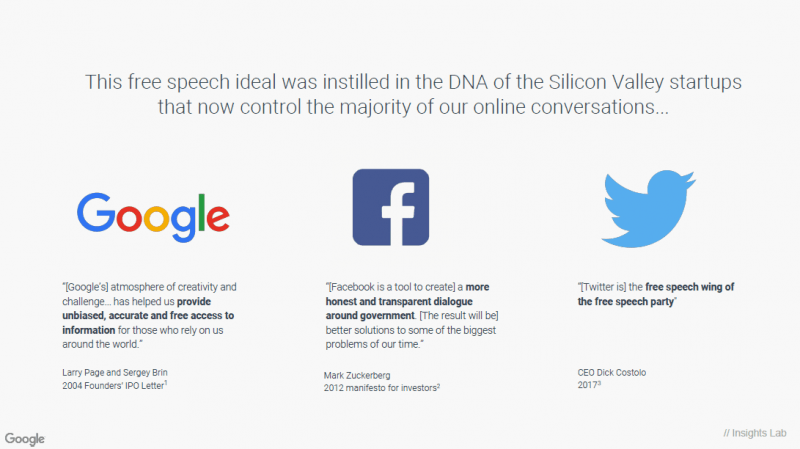
It acknowledges that major tech platforms, including Google, Facebook and Twitter initially promised free speech to consumers. “This free speech ideal was instilled in the DNA of the Silicon Valley startups that now control the majority of our online conversations,” says the document.
The briefing argues that Google, Facebook, YouTube and Twitter are caught between two incompatible positions, the “unmediated marketplace of ideas” vs. “well-ordered spaces for safety and civility.”
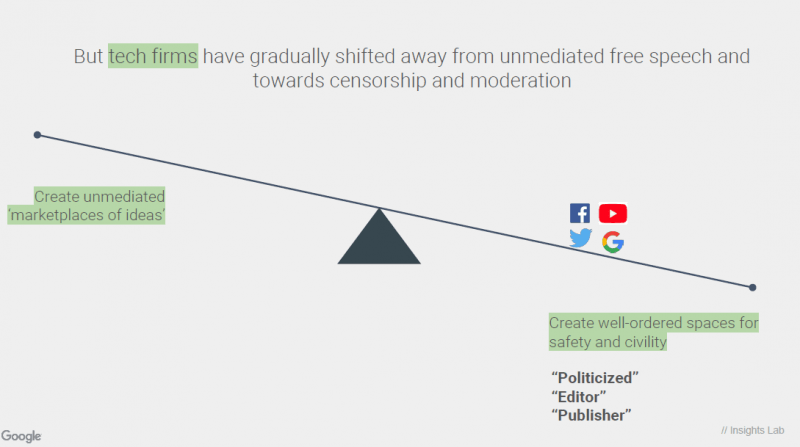
The first approach is described as a product of the “American tradition” which “prioritizes free speech for democracy, not civility.” The second is described as a product of the “European tradition,” which “favors dignity over liberty and civility over freedom.” The briefing claims that all tech platforms are now moving toward the European tradition.
The briefing associates Google’s new role as the guarantor of “civility” with the categories of “editor” and “publisher.” This is significant, given that Google, YouTube, and other tech giants publicly claim they are not publishers but rather neutral platforms — a categorization that grants them special legal immunities under Section 230 of the Communications Decency Act. Elsewhere in the document, Google admits that Section 230 was designed to ensure they can remain neutral platforms for free expression.
Trump, Conspiracy Theorist
One of the reasons Google identifies for allegedly widespread public disillusionment with internet free speech is that it “breeds conspiracy theories.” The example Google uses? A 2016 tweet from then-candidate Donald Trump, alleging that Google search suppressed negative results about Hillary Clinton.
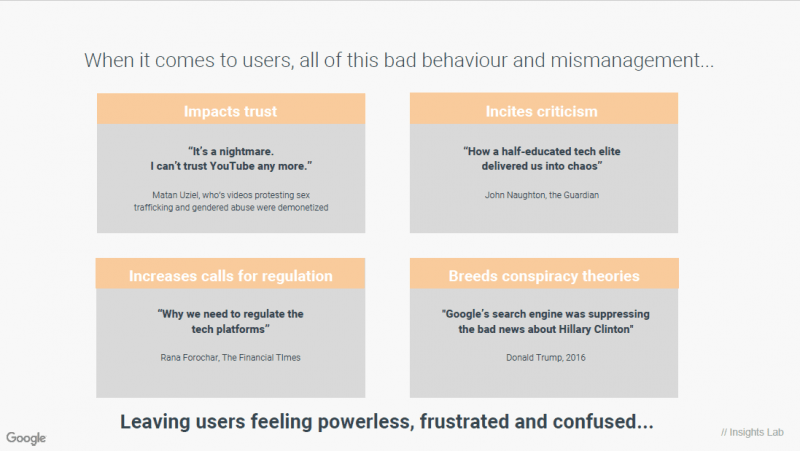
At the time, Google said that it suppressed negative autocomplete suggestions about everybody, not just Clinton. But it was comparatively easy to find such autocomplete results when searching for Bernie Sanders or Donald Trump. Independent research from psychologist Dr. Robert Epstein also shows that Google search results (if not autocomplete results) did indeed favor Clinton in 2016.
Twice in the document, Google juxtaposes a factoid about “Russian interference” in American elections with pictures of Donald Trump. At one point, the document admits that tech platforms are changing their policies to pre-empt congressional action on foreign interference.
The document did not address the fact that, according to leading psychologists, the impact of foreign “bots” and propaganda on social media has a negligible impact on voters.
From Suggestions to Company Policy
It is unclear for whom the “Good Censor” was intended. What is clear, however, is that Google spent (or paid someone to spend) significant time and effort to produce it.
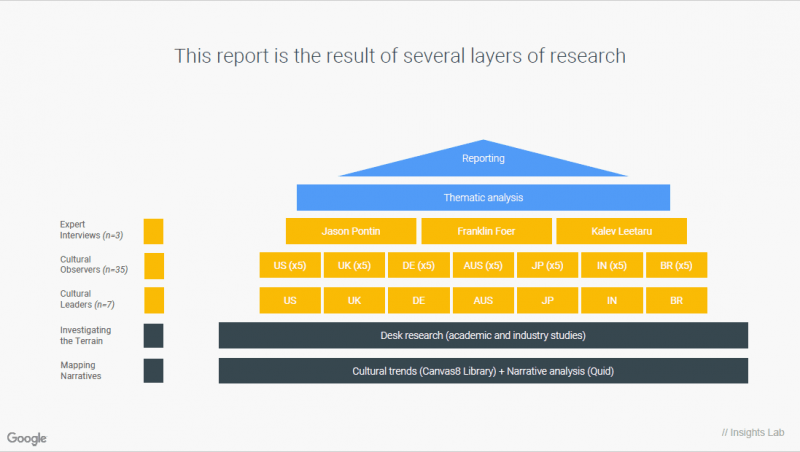
According to the briefing itself, it was the product of an extensive process involving “several layers of research,” including expert interviews with MIT Tech Review editor-in-chief Jason Pontin, Atlantic staff writer Franklin Foer, and academic Kalev Leetaru. 35 cultural observers and 7 cultural leaders from seven countries on five continents were also consulted to produce it.
What is also clear is that many of the briefing’s recommendations are now reflected in the policy of Google and its sibling companies.
For example, the briefing argues that tech companies will have to censor their platforms if they want to “expand globally.” Google is now constructing a censored search engine to gain access to the Chinese market.
The document also bemoans that the internet allows “have a go commenters” (in other words, ordinary people) to compete on a level playing field with “authoritative sources” like the New York Times. Google-owned YouTube now promotes so-called “authoritative sources” in its algorithm. The company did not specifically name which sources it would promote.
Key points in the briefing can be found at the following page numbers:
- P2 – The briefing states that “users are asking if the openness of the internet should be celebrated after all” and that “free speech has become a social, economic, and political weapon.”
- P11 – The briefing identifies Breitbart News as the media publication most interested in the topic of free speech.
- P12 – The briefing says the early free-speech ideals of the internet were “utopian.”
- P14 – The briefing admits that Google, along with Twitter and Facebook, now “control the majority of online conversations.”
- P15 – Section 230 of the Communications Decency Act is linked to Google’s position as a platform for free expression. Elsewhere in the document (p68), Google and other platforms’ move towards moderation and censorship is associated with the role of “publisher” – which would not be subject to Section 230’s legal protections.
- PP19-21 – The briefing identifies several factors that allegedly eroded faith in free speech. The election of Donald Trump and alleged Russian involvement is identified as one such factor. The rise of the populist Alternative fur Deutschland (Alternative for Germany) party in Germany – which the briefing falsely smears as “alt-right” – is another.
- PP26-34 – The briefing explains how “users behaving badly” undermines free speech on the internet and allows “crummy politicians to expand their influence.” The briefing bemoans that “racists, misogynists, and oppressors” are allowed a voice alongside “revolutionaries, whistleblowers, and campaigners.” It warns that users are “keener to transgress moral norms” behind the protection of anonymity.
- P37 – The briefing acknowledges that China – for which Google has developed a censored search engine – has the worst track record on internet freedom.
- P45 – After warning about the rise of online hate speech, the briefing approvingly cites Sarah Jeong, infamous for her hate speech against white males (Google is currently facing a lawsuit alleging it discriminates against white males, among other categories).
- P45 – The briefing bemoans the fact that the internet has until recently been a level playing field, warning that “rational debate is damaged when authoritative voices and ‘have a go’ commentators receive equal weighting.”
- P49 – The document accuses President Trump of spreading the “conspiracy theory” that Google autocomplete suggestions unfairly favored Hillary Clinton in 2016. (Trump’s suspicions were actually correct – independent research has shown that Google did favor Clinton in 2016).
- P53 – Free speech platform Gab is identified as a major destination for users who are dissatisfied with censorship on other platforms.
- P54 – After warning about “harassment” earlier in the document, the briefing approvingly describes a 27,000-strong left-wing social media campaign as a “digital flash mob” engaged in “friendly counter-commenting.”
- P57 – The document juxtaposes a factoid about Russian election interference with a picture of Donald Trump.
- P63 – The briefing admits that when Google, GoDaddy and CloudFlare simultaneously withdrew service from website The Daily Stormer, they were “effectively booting it off the internet,” a point also made by the Electronic Frontier Foundation and the FCC in their subsequent warnings about online censorship.
- P66-68 – The briefing argues that Google, Facebook, YouTube and Twitter are caught between two incompatible positions, the “unmediated marketplace of ideas” vs. “well-ordered spaces for safety and civility.” The first is described as a product of the “American tradition” which “prioritizes free speech for democracy, not civility.” The second is described as a product of the “European tradition,” which “favors dignity over liberty and civility over freedom.” The briefing claims that all tech platforms are now moving toward the European tradition.
- P70 – The briefing sums up the reasons for big tech’s “shift towards censorship,” including the need to respond to regulatory demands and “expand globally,” to “monetize content through its organization,” and to “protect advertisers from controversial content, [and] increase revenues.”
- P74-76 – The briefing warns that concerns about censorship from major tech platforms have spread beyond the right-wing media into the mainstream.
Read The Good Censor in full below. Alternative download option available here.
The Good Censor – GOOGLE LEAK by on Scribd.
The People ‘Stopping Election Interference’ Are the Ones Who Are Actually Rigging the Election
By Daisy Luther | Organic Prepper | October 15, 2018
Last week, Mark Zuckerberg made the media rounds to give a rather shady explanation of why Facebook suddenly closed hundreds of incredibly popular pages in what’s being called The Alternative Media Purge. Zuckerberg accused the closed pages, many of which had millions of fans, of spreading “political spam.”
Ironically, many of the pages that were shut down had absolutely nothing to do with politics or elections, unless you include the fact that they recommended skipping the entire circus. None of these pages were accused of being “the Russians,” who were the scapegoat of the last surprise presidential election results. A couple of the things that many of the pages did have in common, incidentally, were an anti-war outlook and a police watchdog mentality.
But as far as making the election more resistant to interference, the result of the Alternative Media Purge is the diametric opposite. People will now only get one side of the story.
The alternative media changed everything during the last presidential election.
When Donald Trump announced his candidacy for president, much of the world snickered. Who was this reality television star to take on part of the Clinton Empire? There was no way, people scoffed, that Trump could possibly win.
It’s a proven fact that Hillary Clinton was in cahoots with the mainstream media throughout her candidacy. And the reason it’s proven is that organizations like Wikileaks released the evidence of it in a series of emails with her campaign manager and people like Donna Brazile of CNN. Brazile finally publicly admitted that she’d done so and that it was her “job to make all our Democratic candidates look good.”
The alternative media jumped on this story, as well as many other questionable emails that were divulged by Wikileaks, while the mainstream pretended that none of this was happening. And the mainstream did very little to cover the Democratic National Convention, during which the nomination was stolen from Bernie Sanders, who – if we’re being honest – probably would have had a much better chance of beating Trump than the notoriously unlikable Clinton. Here’s my coverage of it at the time.
The alternative media, never a fan of the goings-on in Clintonland, from the Haiti scandal all the way back to the “suicide” of Vince Foster in Arkansas, jumped on these stories as well as stories about her debatable health.
The fact that we had a robust alternative media at the time meant that these stories were heard. At the same time, the mainstream media was busy painting Donald Trump as a neo-Nazi fascist who hated minorities and would nuke somebody the day he got into office.
Now, imagine there had been no alternative media during that election.
If we hadn’t have had an alternative media telling other stories – enough stories that people were able to get a fuller picture of who both of these candidates really were – things might have turned out entirely differently. And while that would be all right with any number of people who loathe Donald Trump, would it have been a “fair” election?
Let’s look back even further at the candidacy of Congressman Ron Paul back in 2012. Dr. Paul was an incredible candidate with a glowing political resume, but he didn’t get the time of day. There was a media blackout on his candidacy and finally, he was forced to withdraw from the race. Many of us were budding alternative journalists at that time learned a valuable lesson during that election – what we were doing was important. There needed to be an option instead of letting the mainstream media present the only options and information to people.
By the time the 2016 election rolled around, those disappointed in how Dr. Paul was treated were determined that it would not happen again. That a candidate with a background full of sordid scandals would not get through an election cycle unscathed, painted as a glowing Madonna who would save us all.
So… during the fierce battle between Clinton and Trump, both sides of the story were told and told loudly.
Alternative journalists engaged the power of social media to connect with people who wanted to know more and they did it to such a degree that everything changed. Clinton, originally the front-runner, was suddenly in the fight of her life against a candidate that most people had considered a joke.
And that’s when everyone started blaming the Russians.
In a shocking article, the Washington Post printed a long list of websites that they claimed were run by “the Russians.” Many of these sites were run by folks I know personally who are decidedly not Russians, but simply bloggers who wanted to share the truth as they identified it. (This article was removed from WaPo – I’m guessing due to threats about legal action by many of the site owners accused of working for Russia.)
Although investigation after investigation has been undertaken, there’s still no proof that Russia tampered with the election, nor that they colluded with Donald Trump.
Years later, the Washington Post sticks to their story with headlines like “Without the Russians, Trump Wouldn’t Have Won.” In the piece, they admitted that there isn’t any official proof and they cited Buzzfeed.
While the intelligence agencies are silent on the impact of Russia’s attack, outside experts who have examined the Kremlin campaign — which included stealing and sharing Democratic Party emails, spreading propaganda online and hacking state voter rolls — have concluded that it did affect an extremely close election decided by fewer than 80,000 votes in three states. Clint Watts, a former FBI agent, writes in his recent book, “Messing with the Enemy,” that “Russia absolutely influenced the U.S. presidential election,” especially in Michigan and Wisconsin, where Trump’s winning margin was less than 1 percent in each state.
We still don’t know the full extent of the Russian interference, but we know its propaganda reached 126 million people via Facebook alone. A BuzzFeed analysis found that fake news stories on Facebook generated more social engagement in the last three months of the campaign than did legitimate articles: The “20 top-performing false election stories from hoax sites and hyperpartisan blogs generated 8,711,000 shares, reactions, and comments on Facebook.” Almost all of this “fake news” was either started or spread by Russian bots, including claims that the pope had endorsed Trump and that Hillary Clinton had sold weapons to the Islamic State. (source)
Buzzfeed ? Isn’t that where you go to take a quiz to find out what kind of potato you are?
That leads us to Facebook’s potential election interference
Last week, as I mentioned, hundreds of Facebook pages were shut down without warning. Many of these sites also lost their Twitter accounts on the same day. This is reminiscent of last month’s attack on Alex Jones.
Anyone who disagrees with the establishment is being abruptly silenced.
Zuckerberg and friends are saying that this is so that we can be sure we don’t have election interference in the midterms… but what they’re really doing is interfering in the elections themselves.
They’ve gloated about everything from “featuring Facebook pages that spread disinformation less prominently so that fewer people potentially see them” to [purging] “559 politically oriented pages and 251 accounts, all of American origin, for consistently breaking its rules against “spam and coordinated inauthentic behavior.”
The pages which have been removed or shadowbanned have run the gamut of political philosophies, but the fact is, people like Mark Zuckerberg, the folks at Google, and Jack Dorsey of Twitter are deciding which information gets to be seen. They’re deciding whether something is “disinformation” or truth. They’re deciding if people who have spent years building a following get to still reach the people who opted to follow them.
Because Facebook reaches more than 2 billion people each day, this is a problem of epic proportions.
I believe that it is Facebook itself that is tampering with the election by manipulating what they want people to see. If the alternative media changed everything in the 2016 election due to the availability of more information, Facebook will change future elections due to their manipulation of the information users are allowed to see.
If you are conservative or antiwar or anti-overreaching-government or libertarian, you’re now persona non grata. Even if you aren’t in the minority, you’ll be made to feel like you are in the giant echo chamber of “approved media.” If you support a different candidate than Big Tech, prepare to be marginalized, silenced, and ignored. That holds true whether you opt for anyone other than their “choice.” They WILL control the outcome of the presidential election the next time around.
If you really want to see what election interference looks like, you’re getting a live demonstration right now.
First Le Pen, now Melenchon? Another Macron critic has headquarters raided

RT | October 16, 2018
Former French presidential candidate Jean-Luc Melenchon’s home has been raided by police, as part of an investigation into alleged misuse of EU funds that also targeted political firebrand and Macron critic Marine Le Pen.
The leader of France’s left-wing La France Insoumise (France Unbowed) livestreamed the unannounced intrusion on Facebook, vowing to exact revenge on France’s Minister of Justice Nicole Belloubet for the raid, which targeted his home as well as his party’s headquarters.
“Nicole Belloubet, are you proud of what you are doing? Have you forgotten everything: who are you, who I am? So you have no dignity? All shots are allowed?” he said during the livestream.
“You do not know what you’re up against – a political force, not an isolated person. We will make you pay politically.”
Melenchon then urged his supporters to meet at the head office of France Unbowed in Paris for an impromptu rally. Police reportedly seized phones and computers from the headquarters as part of their investigation.
The searches are believed to be part of an ongoing probe into fraudulent claims to the EU to cover for fictitious staff members. Melenchon is also under scrutiny for alleged financial irregularities during his 2017 presidential campaign.
Marine Le Pen, the leader of France’s right-wing National Rally, was targeted by a similar EU funds probe last year. Le Pen dismissed the allegations made against her as political persecution.
A raid on National Rally’s headquarters in February 2017, which came amid the French presidential election, was slammed by the party as a “media operation whose sole purpose is to try to disrupt the smooth running of the [Le Pen’s] presidential election campaign.”
Both Melenchon and Le Pen have been fierce critics of French President Emmanuel Macron, who triumphed over the two politicians in last year’s presidential election.
In September, Melenchon led a rally against Macron’s newly-signed labor reforms, describing the demonstration as necessary to prevent a “social coup d’etat” aimed at French workers.
Self-Censorship: Where The Real Damage Is Being Done

By Caitlyn Johnstone | Medium | October 15, 2018
I was going to write another article today about a different topic, but I backed down because I didn’t think I could deliver the kind of fiery, forceful, unmitigated argument it would need to be without risking getting banned from social media and blogging platforms.
The article I was planning on writing, which you’ll just have to imagine now, would have been titled “ ‘Assange Can Leave Whenever He Wants!’ No, Idiot, He Can’t.” The feature image was going to be a screen shot of a blue-checkmarked empire loyalist named Greg Olear tweeting the infuriatingly dopey argument that Assange is free to just waltz out the embassy doors whenever he wants, so therefore he isn’t actually being imprisoned by an Orwellian power establishment for publishing authentic documents about powerful people. Never mind the fact that you can say exactly the same thing about literally anyone under political asylum; they are all free to leave the political asylum they’ve been granted at any time, and pointing this out is just describing the thing that political asylum is. Never mind the fact that a UN panel ruled that Assange is being arbitrarily detained by the threat of imprisonment. Never mind that the same US government which tortured Chelsea Manning is currently openly pursuing Assange’s arrest because of his publications, making the assertion that he’s “free to leave” the same as saying he’s “free” to jump off a cliff. People don’t want to believe that their government imprisons journalists, so whenever Assange is in the news you see this argument making the rounds.
It would have been a firecracker of an article, but when it came time to write it, I backed down. I’d generally rather scrap an article than write something tepid and boring that won’t make any impact, so the risk of losing access to my platforms outweighed my desire to write what I’d planned on writing.
I’ve been self-censoring more and more lately, especially since the latest round of coordinated cross-platform silencing of multiple alternative media outlets the other day. Back in August I had my Twitter account temporarily deleted when I said the world will be better off without John McCain and a bunch of #Resistance accounts mass reported me; Twitter cited “abusive behavior” as its justification. The only reason my account was restored was because there was a large objection from many high-profile journalists and activists who understand the dangers of internet censorship, and I’m not willing to gamble that I’d get that lucky should something similar happen again. Being able to disrupt establishment narratives on a high-traffic website like Twitter outweighs the benefits of speaking in an unmitigated way.
And that ultimately is precisely the point. If the social engineers can make an example of a few dissident voices in the public eye, everyone else will rein in their own speech and behavior to avoid the same fate. The overall effect of this phenomenon is actually far more effective in suppressing dissident speech than the overt censorship is by itself, because self-censorship actually silences exponentially more anti-establishment opinions. For every one voice you crack down on overtly, a thousand more silence themselves out of self-preservation, not saying things they would otherwise say and not doing things they would otherwise do.
Meanwhile empire loyalists know that they can consistently get away with saying anything they want with total impunity. The other day for example I criticized the fawning media accolades that professional Atlantic Council propagandist Eliot Higgins has been receiving lately, and he responded by calling me “Grotbags”, an obese witch character from a nineties children’s television show. The joke being, you see, that I am overweight, and I am also a woman, so I am therefore similar to the character Grotbags. Ha ha ha. Eliot has been repeating this hilarious joke for months with zero consequences. He also made headlines back in June with his repeated public invitation for people who disagree with him on Twitter to suck his balls, also with zero consequences.
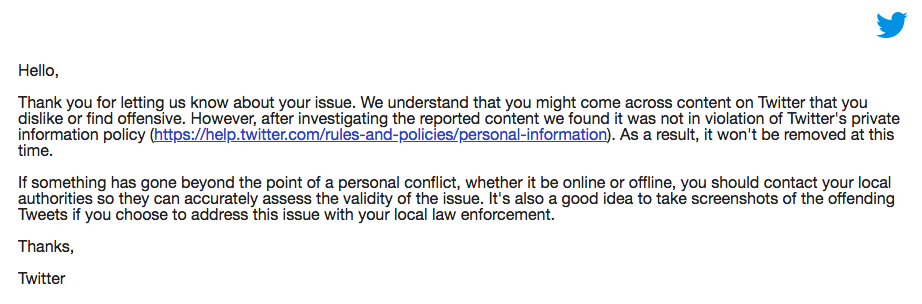
After my August Twitter suspension a #Resistance account publicly doxxed me, posting my home address, phone number and other information. I didn’t make a public ordeal out of it at the time because I obviously didn’t want to draw attention to it, but I did report it because I wanted it deleted. I was not expecting Twitter Support to reject my report, especially after they had me jump through a bunch of hoops to prove that I did in fact live where the doxxer was saying I lived, but they did.
“We understand that you might come across content on Twitter that you dislike or find offensive,” Twitter wrote back. “However, after investigating the reported content we found it was not in violation of Twitter’s private information policy. As a result, it won’t be removed at this time.”
I see this routinely across all platforms; some accounts act without any fear of consequences, others seem primed for hair-trigger suspension. The bias is distinctly slanted in the favor of those who support CIA/CNN narratives and attack anyone who speaks out of alignment with the agendas of the US-centralized empire.
So while we are mitigating our speech more and more, the Eliot Higginses of the new media environment consistently get away with all manner of abusive behavior without any repercussions. We’re fighting a media war in which we are not just outnumbered and outgunned, but are increasingly forced to fight with one arm tied behind our backs. The only thing we have going for us at this point is that authenticity is attractive and oligarchic funding can’t buy creativity or inspiration.
So anyway, there’s my confession that I have been caving to self-censorship to avoid being de-platformed. Rather than denying it, I think it’s best that we all admit to it when we do it and call it what it is, because it’s an unseen part of the people’s media rebellion that is generally overlooked and under-appreciated. I haven’t really figured out what to do about it beyond that, but in my experience drawing the light of attention to these things is always a good idea.
Featured Video

When Israel Is Mighty
or go to
Aletho News Archives – Video-Images
From the Archives
US murdering 1 million Iraqis is democracy, Iran giving yogurt to Iraq is “domination”
By Ali Salaam | American Herald Tribune | July 31, 2017
The New York Times, owned by the Zionist Jewish supremacist Ochs-Sulzberger family, has no problem with Iraqi suffering as long as Iran is not the one behind it.
The Iraq War was a genocide of the Iraqi people by Zionist supremacists in the Bush administration. Over 1 million innocent people were killed based on a lie. American soldiers died in an Israeli war and now an average of 22 soldiers commit suicide every day because their consciences cannot cope with the fact they committed crimes in an illegal war that served no purpose other than to benefit Israel, not America.
Benjamin Netanyahu, Prime Minister of the Zionist regime, once said “We are benefiting from one thing, and that is the attack on the Twin Towers and Pentagon, and the American struggle in Iraq.”
Paul Wolfowitz had his sights on Iraq since his time in the first Bush administration. Former Israeli official and Bush administration official Richard Perle had his eyes on Iraq since at least his authorship of the Clean Break white paper. The Zionist regime had their eyes on Iraq since the 1980s when strategist Oded Yinon wrote his white paper in support of dividing the Arab-Muslim world along ethnic and sectarian lines. The global Zionist lobby has had their eyes on Iraq since Theodor Herzl stated that Eretz Israel’s true borders go from the Nile River in Egypt to the Euphrates River in Iraq. … continue
Blog Roll
 Aletho News
- MEP blasts ‘Euro-Gestapo’ for lecturing Russia on democracy
- Syria May Send Troops to Saudi Arabia Amid War with Ansar Allah
- UK whines about losing billions to ‘Putin tax’
- Baghaei to Rubio: Distorted narratives cannot erase US record of broken commitments
- Houthis Don’t Have to Conquer Saudi Arabia to Make It Pay
- MOE: Nearly 22,000 Students and Education Workers Killed
- Guterres in Islamabad: Genocide, cowardice, and the cage of Imran Khan
- Johnson, Marandi say Yemen holds upper hand over Saudi Arabia
- False flags won’t save aggressors, Iran FM spokesman says
- The Makkah Pact Enters Into Force: The End of American Dominance or Its New Form?
- If Americans Knew
- Report claimed Mark Levin used by Israeli government to influence Trump
- Over 2,000 Gazans have died awaiting medical evacuation amid Israel’s continued siege
- How a U.S. Diplomat Suppressed and Altered Reports Critical of Israel
- 5 Palestinians Die from Israeli Strikes in Gaza as Relentless Attacks Continue
- Report: Ceasefire Slows Killing but Leaves Devastation Intact
- Country Music Singer Zach Bryan Breaks Attendance Record at Robert Kraft’s Gillette Stadium While Wearing ‘Free Palestine’ Shirt for Second Night in a Row
- Three years of death and devastation: Israel’s war on Gaza in pictures
- Why Hamas believed the status quo was more dangerous than its 7 October gamble
- Debunking Israel’s latest list of ‘terrorist’ journalists in Gaza
- In Gaza, focus is on survival, “every step is a struggle” – Daily Update
- No Tricks Zone
- New Study: 50 Years Of The Most Aggressive ‘Net Zero’ Policies Can Only Affect The Global Climate By 0.03°C
- US September “Heat” Was No Record…Many Records Set Decades Ago
- Latest European Green Energy Debacle; Portugal’s Largest Flagship Solar Park Insolvent!
- Green Energy Debacle: German Expert Professor Fritz Vahrenholt Warns Of Severe Economic And Social Consequences
- Two More Paleo Reconstructions Affirm Meters-Higher Sea Levels Across Ireland, Brazil 7000-6000 Years Ago
- New Study: Earth And Venus Surface Warmth Largely Explained By Convection And Lapse Rate, Not CO2 Or Radiation
- 2025 Nature Paper Claiming Worsening Global Drought Gets RETRACTED …Heavily Flawed
- New Study: ‘Global Drought Shows No Detectable Recent Acceleration Under Climate Warming’
- Economic Masterminds: German Socialists Suggest Taxing Productivity Gains Stemming From Using AI
- The South China Sea Has Not Been Cooperating With The Climate Change Narrative

