Institutionalizing Intolerance: Bullies Win, Freedom Suffers When We Can’t Agree to Disagree

By John W. Whitehead | The Rutherford Institute | August 06, 2018
“Whoever would overthrow the liberty of a nation must begin by subduing the freeness of speech.” ― Benjamin Franklin
What a mess.
As America has become ever more polarized, and those polarized factions have become more militant and less inclined to listen to—or even allow for the existence of—other viewpoints, we are fast becoming a nation of people who just can’t get along.
Here’s the thing: if Americans don’t learn how to get along—at the very least, agreeing to disagree and respecting each other’s right to subscribe to beliefs and opinions that may be offensive, hateful, intolerant or merely different—then we’re going to soon find that we have no rights whatsoever (to speak, assemble, agree, disagree, protest, opt in, opt out, or forge our own paths as individuals).
In such an environment, when we can’t agree to disagree, the bullies (on both sides) win and freedom suffers.
Intolerance, once the domain of the politically correct and self-righteous, has been institutionalized, normalized and politicized.
Even those who dare to defend speech that may be unpopular or hateful as a constitutional right are now accused of “weaponizing the First Amendment.”
On college campuses across the country, speakers whose views are deemed “offensive” to some of the student body are having their invitations recalled, being shouted down by hecklers, or forced to hire costly security details.
It’s not just college students who have lost their taste for diverse viewpoints and free speech.
In Charlottesville, Va., in the wake of a violent clash between the alt-right and alt-left over whether Confederate statues should remain standing in a community park, City Council meetings were routinely “punctuated with screaming matches, confrontations, calls to order, and even arrests,” making it all but impossible for attendees and councilors alike to speak their minds.
On Twitter, President Trump has repeatedly called for the NFL to penalize players who take a knee in protest of police brutality during the national anthem, which clearly flies in the face of the First Amendment’s assurance of the right to free speech and protest (especially in light of the president’s decision to insert himself—an agent of the government—into a private workplace dispute).
On Facebook, Alex Jones, the majordomo of conspiracy theorists who spawned an empire built on alternative news, has been banned for posting content that violates the social media site’s “Community Standards,” which prohibit posts that can be construed as bullying or hateful.
Even the American Civil Liberties Union, once a group known for taking on the most controversial cases, is contemplating stepping back from its full-throated defense of free (at times, hateful) speech.
The most controversial issues of our day—gay rights, abortion, race, religion, sexuality, political correctness, police brutality, et al.—have become battlegrounds for those who claim to believe in freedom of speech but only when it favors the views and positions they support.
“Free speech for me but not for thee” is how my good friend and free speech purist Nat Hentoff used to sum up this double standard.
This haphazard approach to the First Amendment has so muddied the waters that even First Amendment scholars are finding it hard to navigate at times.
It’s really not that hard.
The First Amendment affirms the right of the people to speak freely, worship freely, peaceably assemble, petition the government for a redress of grievances, and have a free press.
Nowhere in the First Amendment does it permit the government to limit speech in order to avoid causing offense, hurting someone’s feelings, safeguarding government secrets, protecting government officials, insulating judges from undue influence, discouraging bullying, penalizing hateful ideas and actions, eliminating terrorism, combatting prejudice and intolerance, and the like.
On paper—at least according to the U.S. Constitution—we are technically free to speak.
In reality, however, we are only as free to speak as a government official—or corporate entities such as Facebook, Google or YouTube—may allow.
Free speech is no longer free.
What we have instead is regulated, controlled speech, and that’s a whole other ballgame.
Remember, the First Amendment is a steam valve. It allows people to speak their minds, air their grievances and contribute to a larger dialogue that hopefully results in a more just world.
When there is no steam valve—when there is no one to hear what the people have to say—frustration builds, anger grows and people become more volatile and desperate to force a conversation.
Silencing unpopular viewpoints with which the majority might disagree—whether it’s by shouting them down, censoring them, muzzling them, or criminalizing them—only empowers the controllers of the Deep State.
Even when the motives behind this rigidly calibrated reorientation of societal language appear well-intentioned—discouraging racism, condemning violence, denouncing discrimination and hatred—inevitably, the end result is the same: intolerance, indoctrination and infantilism.
So where does that leave us?
We’ve got to do the hard work of figuring out how to get along again.
Frankly, I agree with journalist Bret Stephens when he says that we’re failing at the art of disagreement.
According to Stephens, “to disagree well you must first understand well. You have to read deeply, listen carefully, watch closely. You need to grant your adversary moral respect; give him the intellectual benefit of doubt; have sympathy for his motives and participate empathically with his line of reasoning. And you need to allow for the possibility that you might yet be persuaded of what he has to say.”
Instead of intelligent discourse, we’ve been saddled with identity politics, “a safe space from thought, rather than a safe space for thought.”
Safe spaces.
That’s what we’ve been reduced to on college campuses, in government-run forums, and now on public property and on the internet.
The problem, as I make clear in my book A Government of Wolves: The Emerging American Police State, is that the creation of so-called safe spaces—where offensive ideas and speech are prohibited—is just censorship by another name, and censorship breeds resentment, and resentment breeds conflict, and unresolved, festering conflict gives rise to violence.
Charlottesville is a prime example of this.
Anticipating the one-year anniversary of the riots in Charlottesville on August 12, the local city government, which bungled its response the first time around, is now attempting to ostensibly create a “safe space” by shutting the city down for the days surrounding the anniversary, all the while ramping up the presence of militarized police, in the hopes that no one else (meaning activists or protesters) will show up and nothing (meaning riots and brawls among activists) will happen.
What a mess.
Constitutional attorney and author John W. Whitehead is founder and president of The Rutherford Institute. His new book Battlefield America: The War on the American People (SelectBooks, 2015) is available online at http://www.amazon.com. Whitehead can be contacted at johnw@rutherford.org.
The Deep State Intends To Destroy Alex Jones—Don’t Let Them
By Paul Craig Roberts | Institute For Political Economy | August 6, 2018
Fabricated, unwarranted lawsuits are being used in an effort to shut down Alex Jones who raises too many issues that those who rule us do not want raised. At times Alex can be over the top, but overall he has spread a lot of awareness of events that otherwise would have received no notice.
There is no doubt whatsoever of William Binney’s expertise and integrity. This hour long interview with him is posted on Info Wars, not on CNN, BBC, MSNBC, NPR, or Fox News. It is not printed in the Wall Street Journal, the New York Times or the Washington Post.
William Binney developed the NSA’s spy capability and left the agency over its misuse. In this interview—https://www.infowars.com/bill-binney-in-his-own-words-a-collaborative-conspiracy-to-subvert-the-us-government/ — you will learn many things, such as the reason that it is strictly impossible that Hillary’s emails were hacked by the Russians or anyone else; they were downloaded on a thumb drive. You will learn that it is common practice for the US Department of Justice (sic), the FBI, and the so called “security agencies” to frame totally innocent people. You will learn that the entire federal intelligence and legal apparatus is corrupt beyond belief and cannot in any way be trusted.
This is the kind of information that Alex Jones brings to us, and it is the reason the deep state is determined to destroy Alex Jones, just as it attempted to destroy William Binney and still hopes to destroy Snowden and Assange.
Anti-Semitism and the suppression of truth
By Gilad Atzmon | August 5, 2018
Jewish power, as I define it, is the power to silence opposition to Jewish power. The scandal over the alleged anti-Semitism within the Labour party provides a perfect example. The Labour Party is accused of being “an existential threat to British Jews” (no more no less) because the NEC, its ruling body, defined antisemitism for the Labour party, without clearly including in its definition criticism of Israel.
In its definition for its own code, the Labour party adopted the problematic IHRA working definition of antisemitism but omitted the following ‘examples of anti-Semitism’ included with the IHRA:
§ Accusing Jewish people of being more loyal to Israel than their home country,
§ Claiming that Israel’s existence as a state is a racist endeavor,
§ Requiring higher standards of behaviour from Israel than other nations, and
§ Comparing contemporary Israeli policies to those of the Nazis.
According to Labour’s ruling body, these examples may not be treated as anti -Jewish bigotry without clear evidence of anti-Semitic intent. This treatment is the proper one according to most reasonable minds.
Since some Diaspora Jews admit to being more loyal to Israel than to their home country, it would be a bit problematic to accuse a goy of hatefulness for repeating what many Jews openly declare. Since the new racist Israeli National Bill has been duly approved by the Knesset, it would be bizarre to accuse a Labour Party member of anti-Jewish bigotry for saying that Israel is a racist endeavour.
Although such an accusation may well be accurate, it runs afoul of the omitted examples in the IHRA definition exactly because the definition is designed to suppress criticism of Israel and its politics. Last week, the Guardian published a wide range of Jewish writers and their views of the IHRA definition in the context of the current Labour ‘anti-Semitism’ crisis. Some of the views expressed are insightful and deserve close attention.
Antisemitism, according to Stephen Sedley, a law scholar and a former judge, is “hostility towards Jews as Jews. This straightforward definition is at the disposal of any institution or organisation that needs it. It places no prior restrictions on the form antisemitism may take.”
Sedley comes to a conclusion that the IHRA definition with examples exists “to neutralise serious criticism of Israel by stigmatising it as a form of antisemitism.” Sedley’s view in this context fits nicely with the definition of Jewish power above.
Sedley points out that The UK government, which has adopted the “working definition” including the examples, was warned by the Commons home affairs select committee in October 2016 that in the interests of free speech it ought to adopt an explicit rider that it is not antisemitic to criticise the government of Israel … without additional evidence to suggest anti-Semitic intent.” Sedley emphasises that this recommendation “was ignored.”
Geoffrey Bindman, a QC, solicitor and a legal scholar agrees with Sedley’s criticism. Bindman also refers to the recommendations of the all-party Commons home affairs select committee that the IHRA definition should only be adopted if qualified by caveats making clear that it is not anti-Semitic to criticise the Israeli government without additional evidence to suggest anti-Semitic intent. “Unfortunately the caveats were omitted when the definition was approved by the UK government.”
These men make clear that the IHRA definition is a faulty definition. The British government should reconsider its use of this definition. The other bodies and institutions that were pushed to adopt this non-universalist text would do well to drop it.
Sedley’s opinion is that even though the UK has adopted the IHRA definition, Brits are not forbidden by law from telling the truth about Israel’s being a racist state. This is because Britain also has the “Human Rights Act [that] enacts article 10 of the European Convention on Human Rights, guaranteeing the right of free expression.” According to Sedley “whatever criticism the IHRA’s ‘examples’ may seek to suppress, both Jews and non-Jews in the UK are entitled, without being stigmatised as antisemites, to contend that a state that by law denies Palestinians any right of self-determination is a racist state, or to ask whether there is some moral equivalence between shooting down defenceless Jews in eastern Europe and unarmed Palestinian demonstrators in Gaza.”
Geoffrey Bindman argues that the IHRA definition and examples are “poorly drafted, misleading, and in practice have led to the suppression of legitimate debate and freedom of expression. Nevertheless, clumsily worded as it is, the definition does describe the essence of anti-Semitism: irrational hostility towards Jews.”
Here Bindman opens Pandora’s box. If anti-Semitism is irrational hostility toward Jews simply for being Jews, then the IHRA definition together with its clauses treats even rational and reasonable opposition to Israeli politics as ‘irrational hatred.’ This presents a dangerous precedent and an Orwellian turn for British society. It suggests that Britain is a free country no more. In Britain in 2018, those who oppose a certain type of evil, racist politics are labelled ‘irrational haters’ (anti-Semites). Clearly Labour’s NEC attempted to fix this problem by requiring a finding of hateful intent at the core of certain so-called anti-Semitic behaviour. This reasonable requirement led to an irrational reaction by Jewish institutions and an aggressive response.
It is difficult to judge whether the Guardian’s choices to defend the IHRA were made as a genuine attempt to represent the Zionist side. Perhaps the Guardian was making a desperate attempt to provide its readers with some comic relief: like the British Chief Rabbi and 68 additional British rabbis who were upset by Labour‘s slight deviation from the IHRA definition, Reform Rabbi Laura Janner-Klausner also expressed her dissatisfaction with the party of the workers.
“If the Labour party wanted to prioritise anti-Semitism by choosing a bespoke definition then it could have listened to the full diversity of the Jewish community,” Janner-Klausner wrote. But why does anyone need to follow the Rabbis or self-appointed Jewish ‘representative bodies’ for that matter? If anti-Semitism is racism, then we all ought to oppose anti-Semitism as we do any form of racism: universally. And if anti-Semitism is a piece of our universal concern with racism, then we all should be equally involved in opposing it. This is similar to the line of thought that was, I believe, at the core of the American Civil Rights Movement. It was a universal call that had a universal appeal. It aimed to protect the many not just the few. This is pretty much the opposite of the IHRA definition that is concerned with one people only.
In that regard, it is of note that Labour’s NEC was not attempting to define what anti-Semitsm means to Jews. NEC defined what anti-Semitsm means for the Labour party and in accordance with Labour values.
Keith Kahn-Harris, a London sociologist not known for his sophistication also contributed to the Guardian’s panel. He reiterated my definition of Jewish power, probably without realising it. “It’s certainly true that the IHRA definition does tightly constrain anti-Israel and anti-Zionist speech, but it doesn’t make it impossible.” I guess that Kahn-Harris is saying that IHRA definition allows support of Palestine as long as the speaker can successfully zigzag around Jewish sensitivities. Maybe you can talk about Palestinian suffering as long as you avoid mentioning Israel. “It might have been possible to see the IHRA definition as a challenge to pro-Palestinian activists to be more creative in their language: after all, whether or not you think Israel is acting just like the Nazis, saying so is predictable, lazy and cliched.” I would advise Khan Harris that living for 70 years as a stateless refugee in Lebanon or being imprisoned in Gaza by an Israeli siege is more than enough. Palestinians and their supporters do not need this ‘extra challenge.’ What they want is to make their plight known and to be able to talk truth to power. Even to describe, for instance, an equivalence between two nationalist, racist and expansionist political ideologies that were fermented around the same time and even collaborated for a while. And this is exactly what the IHRA is there to prevent.
The Real “Fake News” From Government Media
By Scott Lazarowitz | ActivistPost | July 31, 2018
Facebook has announced its campaign against “fake news.” But, according to some workers’ own admission, conservatives are being censored.
And Google also wants to censor “fake news.” But Google also was shown to treat conservative websites, but not liberal ones, as “fake news.”
The same thing seems to be going on with Twitter. And again, conservatives are complaining.
But who is to decide what is “fake news”? Who will be Facebook and Google’s sources for real news?
In 2013 the U.S. Senate considered a new a shield law to protect journalists. In the lawmakers’ attempts to narrow the definition of a journalist, some Senators including Sen. Dianne Feinstein only wanted to include reporters with “professional qualifications.”
“Professional” publications such as the New York Times, the “Paper of Record,” would apparently be protected.
So one can conclude that the New York Times can be a source of “real” news for Facebook or Google, despite all the Times‘ errors, screw-ups, and corrections, right?
According to one NYT former reporter, the Times has been a “propaganda megaphone” for war. Also a partner with the CIA to promote Obama’s reelection bid.
Or CNN, “The Most Trusted Name in News” which wins its own “fake news” awards with its errors, screw-ups and corrections.
During the 2016 U.S. Presidential campaign, there were collusions between then-CNN contributor and DNC operative Donna Brazile, who was outed by WikiLeaks in her giving candidate Hillary Clinton questions in advance for a CNN Town Hall.
Other emails that were leaked to WikiLeaks informed us that reporters obediently followed instructions from the Hillary Clinton campaign on how to cover the campaign. These include reporters from the New York Times such as Maggie Haberman who said the campaign would “tee up stories for us,” and Mark Leibovich, who would email Clinton flunky Jennifer Palmieri for editing recommendations.
And Politico reporter Glenn Thrush asked Clinton campaign chairman John Podesta for approval of stories on Clinton. Thrush was then hired by the New York Times. After Thrush was then suspended from NYT over allegations of sexual misconduct, the Times ended the suspension, stating that while Thrush had “acted offensively,” he would be trained to behave himself. Hmm.
But all this from the 2016 campaign reminded me of the “JournoLists,” the group of news journalists who participated in a private forum online from 2007-2010. The forum was to enable news reporters to discuss news reporting and political issues in private and with candor, but also, it was revealed, to discuss ways to suppress negative news on then-2008 presidential candidate Barack Obama.
For instance, according to the Daily Caller, some members of the group discussed their criticism of a 2008 debate in which Obama was questioned on his association with the controversial Rev. Jeremiah Wright. The Nation‘s Richard Kim wrote that George Stephanopoulos was “being a disgusting little rat snake.” The Guardian‘s Michael Tomasky wrote that “we all have to do what we can to kill ABC and this idiocy.”
Spencer Ackerman, then with the Washington Independent and now of the Daily Beast, wrote, “If the right forces us all to either defend Wright or tear him down, no matter what we choose, we lose the game they’ve put upon us. Instead, take one of them — Fred Barnes, Karl Rove, who cares — and call them racists.”
The Nation‘s Chris Hayes wrote, “Our country disappears people. It tortures people. It has the blood of as many as one million Iraqi civilians — men, women, children, the infirmed — on its hands. You’ll forgive me if I just can’t quite dredge up the requisite amount of outrage over Barack Obama’s pastor.”
(But has Hayes criticized Obama’s assassination program, or Obama’s bombings or the blood on Obama’s hands? Just askin’)
In an open letter, according to the Daily Caller, several of the JournoList members called the ABC debate a “revolting descent into tabloid journalism,” because of the moderators’ legitimate questions on Rev. Jeremiah Wright.
So, in today’s Bizarro World, objectively questioning a candidate on a controversial issue is now “tabloid journalism,” but making things up like “Trump-Russia collusions” and repeating the propaganda over and over – that’s not “tabloid journalism.”
The JournoLists also included reporters from Time, the Baltimore Sun, the New Republic, Politico, and Huffington Post.
Now, are those the sources of “real news” that Facebook, Google and Twitter want to rely upon to combat “fake news”?
And who exactly were the “JournoLists” promoting? Obama?
Regarding Obama’s own crackdown on actual journalism, Fox News reporter James Rosen was accused by the feds of being a “co-conspirator” with State Department leaker Stephen Jin-Woo Kim in violating the Espionage Act. Rosen’s correspondences with Kim were seized by Obama’s FBI, along with Rosen’s personal email and phone records. The FBI also used records to track Rosen’s visits to the State Department.
Apparently, then-attorney general Eric Holder went “judge-shopping” to find a judge who would approve subpoenaing Rosen’s private records, after two judges rejected the request.
Commenting on James Rosen and the FBI’s abuse of powers, Judge Andrew Napolitano observed that “this is the first time that the federal government has moved to this level of taking ordinary, reasonable, traditional, lawful reporter skills and claiming they constitute criminal behavior.”
And there was the Obama administration’s going after then-CBS News investigative reporter Sharyl Attkisson, possibly for her reporting on Benghazi and Fast and Furious. Attkisson finally resigned from CBS news out of frustration with the company’s alleged pro-Obama bias and with CBS’s apparently not airing her subsequent reports.
In 2013 CBS News confirmed that Attkisson’s computers had been “accessed by an unauthorized, external, unknown party on multiple occasions.” In 2015 Attkisson sued the Obama administration, claiming to have evidence which proves the computer intrusions were connected to the Obama DOJ.
In Attkisson’s latest lawsuit update, after her computer was returned to her following the DOJ Inspector General’s investigation, her forensics team now believes her computer’s hard drive was replaced by a different one.
Now back to “fake news.”
After Donald Trump locked up the Republican Presidential nomination in May, 2016, there were significant events in the next two months. Fusion GPS and former British spy Christopher Steele colluded to get opposition research on behalf of Hillary Clinton, the FBI applied for a FISA warrant to spy on Trump campaign associates, and Donald Trump, Jr., Paul Manafort and Jared Kushner had a possibly set-up meeting with a Russian lawyer at Trump Tower.
Also within that same period, the DNC claimed that its computers were hacked but the DNC wouldn’t let FBI investigate. The Washington Post published an article claiming, with no evidence presented, that “Russian government hackers” took DNC opposition research on Trump.
It was very shortly after the November, 2016 Presidential election that the Washington Post published an article on a “Russian propaganda effort to spread ‘fake news’ during the election.” To escalate the media’s censorship campaign perhaps?
The campaign against “fake news” coincided with Obama minions at FBI, DOJ and CIA apparently panicking over a possible Trump presidency and their allegedly abusing their powers to attempt to take down Trump.
So the news media seem to be on a crusade to fabricate “Trump-Russia collusions” and repeat it over and over, and to vilify, ignore and squash actual investigative research and reporting on what exactly the FBI and DOJ bureaucrats have been doing. Call such real investigative reporting “fake news,” “conspiracy theory,” and so forth.
In the end, Facebook, Twitter and Google might want to reconsider relying on the mainstream news media led by the New York Times, the Washington Post and CNN, and instead include citizen journalists and non-government-sycophant media to provide news and information.
UCLA law professor Eugene Volokh has noted that the Founders generally viewed the freedom of the Press to apply to every citizen to print, publish or express accounts of events. We really need to highlight that kind of old-fashioned, honest journalism.
Chile: Activists Protest Against Dictatorship Killers’ Parole

teleSUR | August 1, 2018
Human rights activists in Chile are protesting a Supreme Court decision to release former Judge Gamaliel Soto, three former military soldiers and a police officer involved in the torture and disappearance of 31-year-old Eduardo Alberto Gonzalez Galeno in 1973.
The demonstrators gathered in front of the court in Valparaiso holding pictures of people forcibly disappeared during the military dictatorship headed by Augusto Pinochet, including Gonzalez Galeno, director of the Hospital of Cunco in Araucania, on September 14, 1973.
Soto had been sentenced to ten years for his involvement in ordering Gonzalez Galeno’s kidnapping, but Chile’s Second Chamber of the Supreme Court decided on Tuesday to grant him parole.
The three military soldiers, Jose Quintanilla Fernandez, Hernan Protillo Aranda and Felipe Gonzalez Astorga, as well as police officer Manuel Perez Santillan, all convicted of crimes against humanity, were also released as a result of an appeal to the country’s highest court, according to Nodal.
Their release was welcomed by the group’s legal defence, arguing that good behavior and the fact that they served half of their sentence were sufficient reason for their release.
Witnesses said Gonzalez Galeno was accused of being a member of the Revolutionary Left Movement (MIR) during his captivity by the military dictatorship headed by military general Augusto Pinochet and, subsequently, beaten and disappeared.
Human rights lawyer Nelson Caucoto decried the court’s decision to release the men, stating there was no justification to grant parole: “We must take into account that parole is justified only by people who have been rehabilitated.
“It does not make sense to grant people freedom to live alongside others if they have not recognized the gravity of their crimes, nor have shown repentance beyond the fulfillment of certain formalities.”
Caucoto also said granting parole to people convicted of crimes against humanity, as in this case, violates the international agreements that Chile is a signatory to.
Zionist Inquisition in full cry
Their quarry: anti-racist Labour leader Jeremy Corbyn; their weapons: anti-semitism smears; their purpose: to oust Corbyn and replace him with a compliant pro-Israel stooge
By Stuart Littlewood | Dissident Voice | July 30, 2018
The row over anti-Semitism has erupted yet again in the UK Labour Party, as predicted a few months ago by Miko Peled, the Israeli general’s son, who warned that:
… they are going to pull all the stops, they are going to smear, they are going to try anything they can to stop Corbyn…. the reason anti-Semitism is used is because they [the Israelis] have no argument….
So Israel’s pimps at Westminster, never happy unless they’re telling everyone what to think and say, are frantically insisting that the Labour Party adopts the discredited International Holocaust Remembrance Alliance (IHRA) definition of anti-Semitism in its unedited entirety and incorporates it into the party’s code of conduct. Many party members believe they have blown up the matter out of all proportion simply to settle their long-standing score – as Peled says – with the Labour leader Jeremy Corbyn, a genuine anti-racist, champion of Palestinian rights and critic of Israel.
This is what the IHRA definiition says:
Antisemitism is a certain perception of Jews, which may be expressed as hatred toward Jews. Rhetorical and physical manifestations of antisemitism are directed toward Jewish or non-Jewish individuals and/or their property, toward Jewish community institutions and religious facilities.
It includes these eleven “contemporary examples of anti-semitism”:
- Calling for, aiding, or justifying the killing or harming of Jews in the name of a radical ideology or an extremist view of religion.
- Making mendacious, dehumanising, demonising, or stereotypical allegations about Jews as such or the power of Jews as collective — such as, especially but not exclusively, the myth about a world Jewish conspiracy or of Jews controlling the media, economy, government or other societal institutions.
- Accusing Jews as a people of being responsible for real or imagined wrongdoing committed by a single Jewish person or group, or even for acts committed by non-Jews.
- Denying the fact, scope, mechanisms (e.g. gas chambers) or intentionality of the genocide of the Jewish people at the hands of National Socialist Germany and its supporters and accomplices during World War II (the Holocaust).
- Accusing the Jews as a people, or Israel as a state, of inventing or exaggerating the Holocaust.
- Accusing Jewish citizens of being more loyal to Israel, or to the alleged priorities of Jews worldwide, than to the interests of their own nations.
- Denying the Jewish people their right to self-determination, e.g., by claiming that the existence of a State of Israel is a racist endeavor.
- Applying double standards by requiring of it a behavior not expected or demanded of any other democratic nation.
- Using the symbols and images associated with classic antisemitism (e.g., claims of Jews killing Jesus or blood libel) to characterise Israel or Israelis.
- Drawing comparisons of contemporary Israeli policy to that of the Nazis.
- Holding Jews collectively responsible for actions of the state of Israel.
Jewish community leaders are furious that Labour’s ruling body, the National Executive Committee, disagrees with 4 of these examples and refuses to include them in the party’s new code of conduct. The NEC, of course, is mindful that the code must be enforceable across half-a-million members with differing opinions, many of whom are tired of the constant whining. An emergency motion orchestrated by the Jewish lobby, forcing the NEC to take on board the whole IHRA package with all its examples and humiliating Corbyn in the process, was supposed to be considered yesterday but is now postponed till September.
The NEC explains its omissions by saying accusations of dual nationality are wrong rather than anti-semitic. It strikes out altogether the idea that calling the state of Israel “a racist endeavour” is anti-semitic, no doubt for the simple reason that it is racist. Israelis have for decades practised apartheid, casting their non-Jew population as second-class citizens, and now it’s enshrined in their new nationality laws, in black and white. What’s more, Israel’s illegal occupation has denied Palestinians their right to self-determination for the last 70 years. The NEC also chooses not to forbid the use of symbols and images associated with classic anti-semitism and comparing Israeli policy to that of the Nazis unless there’s evidence of anti-semitic intent.
Sounds reasonable, you might think. But 68 rabbis have accused the Labour leadership of acting “in the most insulting and arrogant way” by leaving out or modifying those controversial bits. In a letter to The Guardian they say it’s not the Labour Party’s place to re-write it.
The arrogance is theirs, I think. Here’s why. The House of Commons Home Affairs Select Committee recommended adoption of the IHRA definition of anti-Semitism subject to the inclusion of two caveats:
(1) It is not antisemitic to criticise the Government of Israel, without additional evidence to suggest antisemitic intent.
(2) It is not antisemitic to hold the Israeli Government to the same standards as other liberal democracies, or to take a particular interest in the Israeli Government’s policies or actions, without additional evidence to suggest antisemitic intent.
The Government agreed but dropped the caveats saying they weren’t necessary. Subsequently the IHRA definition has run into big trouble, being condemned by leading law experts as “too vague to be useful” and because conduct contrary to the IHRA definition is not necessarily illegal. They warn that public bodies are under no obligation to adopt or use it and, if they do, they must interpret it in a way that’s consistent with their statutory obligations and with the European Convention on Human Rights, which provides for freedom of expression and freedom of assembly.
IHRA definition of anti-Semitism is deeply flawed
Crucially, freedom of expression applies not only to information or ideas that are favourably received or regarded as inoffensive, but also to those that “offend, shock or disturb the State or any sector of the population” – unless they encourage violence, hatred or intolerance. Calling Israel an apartheid state or advocating BDS against Israel cannot properly be characterized as anti-Semitic. Furthermore, any public authority seeking to apply the IHRA definition to prohibit or punish such activities “would be acting unlawfully”.
The right of free expression, as Labour’s Zio- Inquisitors ought to know, is now part of UK domestic law by virtue of the Human Rights Act. Furthermore the 1986 Education Act established an individual right of free expression in all higher education institutions. Then there’s Article 19 of the Universal Declaration of Human Rights which bestows on everyone “the right to freedom of opinion and expression; this right includes freedom to hold opinions without interference and to seek, receive and impart information and ideas through any media and regardless of frontiers”. As always, such rights are subject to limitations required by law and respect for the rights of others.
So the IHRA definition is a minefield. It’s not something a sane organisation would incorporate into its Code of Conduct – certainly not as it stands. It contravenes human rights and freedom of expression. But when did the Israel lobby ever care about other people’s rights?
The whole fuss borders on the farcical when you ask what anti-Semitism means. Who are the Semites anyway? Everyone avoids this question like the plague. Why? It’s embarrassing. DNA research shows that most of those living today who claim to be Jews are not descended from the ancient Israelites at all and the Palestinians have more Israelite blood. So they are the real Semites. Research by Johns Hopkins University School of Medicine, published by the Oxford University Press in 2012 on behalf of the Society of Molecular Biology and Evolution, found that the Khazarian Hypothesis is scientifically correct, meaning that most Jews are Khazars. The Khazarians converted to Talmudic Judaism in the 8th Century and were never in ancient Israel.
Probably no more than 2% of Jews in Israel are actually Israelites. So even if you believe the propaganda myth that God gave the land to the Israelites, He certainly didn’t give it to Netanyahu, Lieberman and the other East European thugs who rule the apartheid state.
As former Israeli Director of Military Intelligence, Yehoshafat Harkabi wrote: “It would be a tragic irony if the Jewish state, which was intended to solve the problem of anti-Semitism, was to become a factor in the rise of anti-Semitism. Israelis must be aware that the price of their misconduct is paid not only by them but also Jews throughout the world.”
Well, that tragic irony has come to pass. As has been suggested before, so-called anti-Semitism is a matter best resolved by the Jewish ‘family’ itself. There’s no reason to bother Corbyn or the Labour Party with it.
The Pentagon, the CIA, and the NSA Are in Charge
By Jacob G. Hornberger – FFF – July 27, 2018
The U.S. mainstream press can easily recognize the dominant and influential role that the military plays in society, so long as they are referring to countries like Pakistan and Egypt. Unfortunately, the same reporters and commentators turn a blind eye to the similar phenomenon here in the United States.
For example, the Washington Post writes: “When not in power, [Pakistan’s generals] have exerted outsize control over foreign policy, the economy, and local politics.” The New York Times writes: “Even during civilian rule, the country’s generals have wielded enormous power, setting the agenda for the country’s foreign and security policies…. As prime minister, Mr. Sharif ran afoul of the military early on by trying to assert control over foreign and defense policy, which is seen as the army’s domain.”
It’s the same in Egypt. Newsweek points out that after the military coup that ousted democratically elected President Mohammed Morsi from office, “The army stepped in…. Five years on from the coup, the military government — led by general-turned-president Abdel Fattah el-Sisi — has established a firm grip on the nation….”
Meanwhile, not surprisingly, the U.S. government is flooding the Egyptian military with hundreds of millions of dollars that the IRS has forcibly taken from the American people.
What the mainstream media and, unfortunately, all too many Americans, fail to recognize is that the Egyptian, Pakistani, and American governments all have a fundamental governmental principle in common: All three are national-security states and, consequently, in all three regimes the military and intelligence sections of the government play the dominant role within the government and within society.
What is a national-security state? It is a type of government that has a vast and permanent military-intelligence establishment. Secrecy is a core element, with threats of severe punishment on anyone who discloses secrets of the regime.
The most important principle of a national-security state is, not surprisingly, a concept called “national security.” Everything revolves around recognizing and eradicating threats to “national security.” There is no established definition of “national security.” The military and the intelligence forces wield the omnipotent and non-reviewable power to determine who and what constitutes a threat to ”national security” and the omnipotent and non-reviewable power to eradicate it.
In Pakistan and Egypt, the entire national-security establishment is subsumed in what is simply referred to as “the military.” In the United States, the national-security establishment is divided principally into three parts: the vast military establishment, led by the Pentagon, the CIA, and the NSA. I say “principally” because to a certain extent the FBI, over time, has been absorbed into the national-security establishment.
What many Americans fail to realize is that the United States wasn’t always a national-security state. When the Constitution called the federal government into existence, the federal government was a limited-government republic. The size of the army was extremely small and there was no CIA, NSA, or FBI. There was no concept of “national security.” Transparency, not secrecy, characterized the republic.
That all changed after World War II. Americans were told that in order to successfully confront America’s World War II partner and ally, the Soviet Union, in a “cold war,” it would be necessary to convert the federal government from a limited-government republic into a national-security state, which is what the Soviet Union was.
That’s how America ended up with essentially the same type of governmental system that exists in Pakistan and Egypt. It’s also how the country ended up with such programs as assassination, torture, indefinite detention, mass surveillance, and denial of due process, none of which existed when the federal government was a limited-government republic.
What many Americans also fail to recognize is that it’s the national-security establishment that is really the part of the federal government that is in charge, especially when it comes to foreign policy. That’s why President Trump was unable to pull U.S. troops out of Syria after expressing a desire to do so — the Pentagon wouldn’t permit it. It’s also why he was unable to release the CIA’s long-secret JFK records last fall, as he announced he was going to do and as the law required — the CIA wouldn’t permit it. It’s why Americans continue to be saddled under a regime that engages in mass secret surveillance, no different in principle from that which exists in Pakistan and Egypt — the NSA will not permit the federal courts to interfere with its surveillance operations. It’s why no congressional candidate would ever dare to call for a dismantling of military installations or projects in his district — the Pentagon as well as the local press would skewer him.
When it comes to enforcing the Constitution, the U.S. Supreme Court and the federal judiciary are permitted to maintain an appearance of being ultimately in charge but only up to a certain point. That’s why there are people in Guantanamo Bay who have now been incarcerated by the Pentagon and the CIA for 14 years without a trial.
A book that every American should read is National Security and Double Government by Michael J. Glennon, professor of law at Tufts University. Glennon explains perfectly how the U.S. national-security state works compared to nations like Pakistan and Egypt.
In those countries, the control of the national-security establishment is direct, while in the United States it is indirect. Here, the Pentagon, the CIA, and the NSA permit the president, the Congress, and the judiciary to appear to be in control of the federal government. But as Glennon shows, it’s just a veneer. The real control lies with the part of the government that wields the largest amount of force, and that part consists of the Pentagon, the CIA, and the NSA.
Recall what George Washington is reputed to have said, “Government is not reason. It is not eloquence. It is force.” But not all parts of the government are equal. Some wield more force than others. It is undeniable that the national-security part of the government wields the most force of all.
If anyone in Washington, D.C., had doubts about the overwhelming power of the U.S. national-security establishment, such doubts came to an end on November 22, 1963, when President Kennedy was assassinated after taking on the military and the CIA. (See FFF’s book JFK’s War with the National Security Establishment: Why Kennedy Was Assassinated by Douglas Horne and my new video-podcast series “The National-Security State’s Assassination of John F. Kennedy.) Kennedy had reputedly vowed to tear the CIA into a thousand pieces, to end the racket of the Cold War, to withdraw all U.S. troops from Vietnam, and to normalize relations with Russia, Cuba, and the rest of the communist world, all of which, needless to say, was considered heresy to the national-security establishment. Suddenly, after Dallas, it dawned on everyone in Washington that there was a new sheriff in town, one that would not countenance any threat to the power of the national-security establishment and, of course, to its existence, just like in Pakistan and Egypt. That’s undoubtedly a lesson that President Trump himself is now learning.
High Crimes and Misdemeanors – Not by Trump but Obama and Democrats
By Ajamu Baraka | Black Agenda Report | July 25, 2018
 Increasing evidence emerges that confirms what ex-CIA analyst Ray McGovern suggests was a classic off-the-shelf intelligence operation initiated during the last year of Obama’s presidency against the Trump campaign by employees of, and others associated with, the CIA, FBI, and the NS. Yet the public is being counseled to ignore possible proof of state misconduct.
The historic and unprecedented timing of Special Counsel Robert Mueller’s indictment of twelve Russia military intelligence officers on the eve of Trump’s meeting with Putin, was clearly meant to undercut Trump’s authority. This still did not pique the journalistic curiosity of an ostensibly independent press to at least pretend to question the possible motivation for these indictments at such a specific moment. Instead of critical questions, Democrats, along with the corporate liberal media, flipped the script and suggested that those questioning the allegations of Russian manipulation of the 2016 U.S. elections, which supposedly included the active or tacit support of the Trump campaign, was ipso-facto evidence of one’s disloyalty to the state — if not also complicit with implementing the Russia inspired conspiracy.
This narrative has been set and is meant to be accepted as veracious and impermeable to challenges. Powerful elements of the ruling class, operating with and through the Democratic party in an attempt to secure maximum electoral success, decided that Trump’s alleged collusion with Russia shall be the primary narrative to be utilized by Democrats — from the increasing phony opposition represented by the Sanders wing of the party, to the neoliberal, buck-dancing members of the Congressional Black Caucus. All are expected to fall in line and do the ruling class’s bidding.
When Trump met with the arch-enemy Vladimir Putin in Helsinki and didn’t declare war on Russia for conspiring against Clinton, charges of treason were splashed across the headlines and editorial pages of the elite press with some of the loudest denunciations coming from Black liberals.
Not being at war with Russia, at least not in the technical sense, was just one of those inconvenient facts that didn’t need to get in the way of the main objective, which was to smear Trump.
And while evidence of collusion continues to surface, it’s actually not between Trump and the Russians, rather it’s between intelligence officials in the Obama administration and the Clinton campaign. The latest revelation of this evidence was reported by John Solomon in, The Hill, a Washington insider publication. According to Solomon, former FBI attorney Lisa Page gave testimony to the House Judiciary committee that seemed to confirm the partisan intentions of Peter Strzok and other high officials in the agency.
Page was one of the authors of the infamous text messages between her and Peter Strzok (the two were also in a personal relationship at the time) while they both worked together at the FBI. The texts soon became the objective of endless speculation ever since they were revealed last summer. Exchanges shared between Strzok and Page during the 2016 campaign season, appear to point to Strzok’ participation in a vast conspiracy to gather intelligence on the Trump campaign and then to undermine his presidency on the unexpected chance of his election.
“There’s no big there there.”
Two days after Deputy Attorney General Rod Rosenstein named Mueller as special counsel, Strzok, who at that time was the lead investigator on the Russia probe texted, “There’s no big there there.”
Peter Strzok wasn’t just a minor bureaucrat with the bureau, as some outlets tried to imply in their coverage of the issue. He was the Chief of the FBI’s Counterespionage Section, and lead investigator into Clinton’s use of a personal server. He then led the FBI’s investigation of Russia interference as the Deputy Assistant Director of Counterintelligence Division until he was replaced in the summer of 2017.
Page confirmed that the no “there there” was in fact the quality of the Russia investigation. This means that a special counsel was appointed even though key FBI officials knew that there wasn’t anything there.
Page’s testimony provides strong confirmation that the decision by Deputy Attorney General Rod Rosenstein to name Mueller as special counsel, who then brought in Strzok to lead the Russia-gate team, was not an objective, innocent affair. In actuality, it points to criminal use of the government’s counterintelligence capabilities to engage in a partisan manipulation of the electoral process.
Some liberals, and even some radicals, pose questions like, “Even if those officials engaged in questionable activity, why should that be of concern for progressive forces, especially since this presidency represents the forefront of a neo-fascist movement in the U.S?”
There are three interconnected reasons why progressives should be concerned:
First: The normalization of the assault on bourgeois democracy: If elements of the capitalist class, in coordination with the major intelligence agencies, can successfully conspire to undermine and/or control an individual duly elected by the processes of U.S. democracy, as flawed as it may be, what does it suggest for a strategy that sees the electoral arena as a primary space for advancing progressive candidates and oppositional movements?
The ruling class will go to great depths to maintain power: The fact that elements of the ruling class are prepared to undermine a member of their own class because that individual represents social forces that the financial and corporatist elite have determined are a threat to their interests must make us question “What would happen if a true radical was able to win high office? We are already seeing the effects as so-called progressives and radicals are aligning with and supporting these elements due to their shared hatred for Trump is still largely a reactionary approach that contains no long-term strategy for building and sustaining actual power.
Second: By aligning politically with the U.S. based transnational ruling class that sees Trump as a threat to their interests, liberals and some left forces have abandoned positions and left them to the radical right, with the objective result of providing support for the very same narrow, racist, U.S.-centric, and proto-fascist forces that liberals and the left claim to be opposed to.
The critique and rejection of NATO, supporting de-escalation of tensions with Russia, exposing hegemony of finance capital, revealing the anti-democratic nature of the European Union, opposing international “trade” agreements like the Trans-Pacific Partnership and trans-Atlantic Investment Partnership, demanding that U.S. forces withdraw from Syria and questioning the role of Saudi Arabia in spreading right-wing Wahhabism throughout the world, are now positions taken up by the right because the imperial left has aligned itself with the agenda of transnational capital and its imperialist objectives in lieu of presenting a people’s agenda.
Third: Consequently, the criticism of Trump’s foreign policies, including approaches on North Korea and Russia by Democrats, is coming from positions to the right of Trump! The result is a political environment in which the possibility of escalating military conflicts with Russia, Iran or even at some point with China, is becoming a more normalized and realistic possibility.
The Clinton News Network (CNN) along with MSNBC, the Washington Post and New York Times are desperately trying to salvage the underlying theme of the assault on the Trump administration: that it’s supposed collusion with foreign sources, specifically the Russians, may have had a significant impact on why Clinton lost the election. And they also hold that any deviation from that declaration by Trump and his administration are just attempts at obstruction of justice.
With the revelations about the role and activities of Peter Strzok and Lisa Page, the Comey leak to the press, with the express purpose to create a pretext for the appointment of a special counsel, the placing of an FBI informant in the Trump campaign, the role of Andrew McCabe in covering up for his subordinates and leaking classified information to the press, the “primary narrative” of the Democrat party and liberals is starting to unravel.
Abuse of state power is nothing new.
This would not be the first time that powerful unelected elements in the state have moved to manipulate political outcomes based on an agenda that the public had no knowledge of or even to remove a president. People have forgotten or didn’t make the correct connection that the famous source of information that brought down Richard Nixon, Bernstein’s and Woodman’s “deep throat” was Mark Felt, the Associate Director of the FBI!
And like the question raised to Nixon and Watergate then, but will only be raised by the Black Agenda Report today is, “What did Obama know and when did he know it?”
Ajamu Baraka is the national organizer of the Black Alliance for Peace and was the 2016 candidate for vice president on the Green Party ticket. His latest publications include contributions to Jackson Rising: The Struggle for Economic Democracy and Self-Determination in Jackson, Mississippi. He can be reached at: Ajamubaraka.com
Israel challenges the world: I am an Apartheid state, what are you going to do about it?
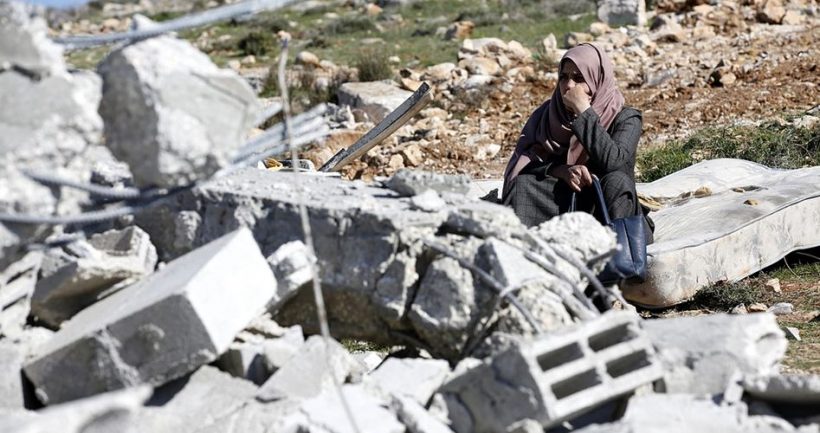
By Professor Kamel Hawwash | MEMO | July 23, 2018
Remember the date, 19 July 2018 is when Israel’s pretense of democracy, the Knesset passed the Nation State Bill, which could more aptly be called, the “Jewish State Apartheid Law” where Jews dominate the Israeli Palestinian Arabs who are lesser than them, even if they are citizens. I deliberately did not say Israeli Jews because the law gives all rights in historic Palestine to Jews, not only in Israel but across the world, including those Jews that do not identify with the state.
My mother, who was born in Jerusalem before Israel was created, has no rights in the Holy city or her homeland but a Jewish lady with no connection to Israel can “return”, to a place she does not come from. The invaders, since they were not invited into our homeland, have enshrined the right to have my Palestinian homeland as theirs in law and also annulled my mother’s right to return, which is enshrined not in state but in international law. I can hear cries of “this is the Jewish homeland because we were here thousands of years ago”, really? If Jews – and it is only Zionists – believe they are entitled to return after thousands of years -which I reject – then how can they deny Palestinians the right to return after 71 years? In fact UN resolution 194 enshrined in international law gives Palestinians the Right of Return but there is no reference in international law to Jews having a “right to return” to historic Palestine.
Let me be clear, I am not denying Jewish, Christian or Muslim connection to holy sites in historic Palestine. However, Palestinians reject the notion of singling Jews out for a “right of return” to our homeland now and forever. No other people are afforded the right to a freehold on a plot of land forever and Jews should be no different.
Israel’s prime minister pushed the adoption of this bill now as he sees an opportunity to make major wins while US President Trump is in office and has given Israel carte blanche to implement any policies it wishes.
“A hundred and twenty-two years after [the founder of modern Zionism Theodore] Herzl made his vision known, with this law we determined the founding principle of our existence,” Benjamin Netanyahu said, adding that this is a “defining moment” for Israel. “Israel is the nation state of the Jewish people, and respects the rights of all of its citizens.”
What Netanyahu did not tell us was where exactly are the borders of this state? What rights do its non-Jewish but indigenous Palestinian citizens have within its internationally recognised borders? Netanyahu and supporters of Israel should remember that the 20 per cent “minority” that they form would not have been a minority if it had not been for the ethnic cleansing of 750,000 of their brothers and sisters in 1948. Had they not been forced out through Jewish terror, their numbers would have been equal if not larger than the Jewish Israelis that now reside in historic Palestine. It would have been Jews that formed the minority.
Netanyahu also failed to explain the status of the occupied Palestinians who are not afforded citizenship in this state. What rights do they have? They are not citizens of Israel or Palestine.
Much has been written since the Nation State Law was approved, but there has been insufficient outrage. The law has mostly been seen at worst as “controversial”. Israel has challenged the world to say no to state racism and Apartheid but the world has only expressed concern that the law could impede the now long dead peace process and wait for it, the two-state solution. Netanyahu challenged the world and the world is not ready for a fight for basic equality between citizens of a state.
Through its silence, the world arguably agrees that historic Palestine is homeland only for Jews. It agrees that the indigenous Palestinians have no rights, except those that the Jewish state agrees to give them out of the goodness of its heart and only if Israeli Jews agree. Jews can build settlements only for Jews and admissions committees can decide whether to allow the people whose land it is, the Palestinians, to live amongst them. They can decide whether Palestinian children can play in kindergartens with Jewish children and whether they can swim together in one pool.
By confirming “United Jerusalem” as their eternal capital, Israeli Jews can decide for how long Al-Aqsa Mosque can remain, majestically from a Palestinian point of view, on the “Jewish Jerusalem” skyline. Who can forget the image of the notorious Palestinian hater and so called US Ambassador David Friedman beaming as he held a poster showing a Jewish temple in place of the Dome of the Rock?
Perhaps the US has already obtained assurances from some Arab and Muslim leaders that since Muslims already have two holy mosques in Makkah and Madina and Jews do not have one, that it would be acceptable to give Al-Haram Al-Sharif up for that purpose. After all it seems protection from the Iranian “threat” carries a heavy price. The installation of the Jewish temple could be part of the “deal”. I of course do not know if that is the case, but we live in bizarre times.
Israel has already curtailed the calling of the Muslim call for prayer, the Athan, because it disturbs the illegal Jewish settlers. Now, the language in which the call is made, Arabic, has been demoted from an official language of the state to having “a special status”. Another attack on the indigenous Palestinians.
If Israel was not a racist endeavour when created, it is now most certainly a racist state, unless of course a new definition of racism has been created which gives exception to the self-proclaimed Jewish state. A racist state deserves to be criticised, ostracised and isolated until it repents and removes all its racist laws. This law is only one of tens of laws that already discriminate against non-Jews.
However, what is most bizarre is that confirmation by Israel that it is a racist entity through the passing of the law could, according to the so called IHRA definition of anti-Semitism label as anti-Semites anyone daring to call it a racist or Apartheid entity.
There is no excuse for the world’s lack of action against racist Israel.
How can the US, the land of the free, support it now? The Zionist and Israel apologist Trump trio of Greenblatt, Kushner and Friedman have not issued any statement on this law. They, especially Greenblatt who is effectively tweeting for Israel, helped Israel with recognition of Jerusalem as Israel’s capital and are working to deny Palestinian refugees their right to return. Their vision for peace almost supports the rapid implementation of the new law rather than condemn it.
The EU has, true to form, talked the talk but not walked the walk, expressing concern but no condemnation.
The Palestinian leadership has sleepwalked into this, typically with no strategy to counter it. The appropriate response to the passing of the law in the early hours of the 19th of July should have been for the PLO to declare an end to the disastrous Oslo Accords, to dissolve the Palestinian Authority with an immediate effect including an end to the immoral security coordination with the Apartheid state. The PLO has been mandated to de-recognise Israel by its Palestine National Council. That time has come. How can the Palestinians continue to recognise an Apartheid state which also denies all their rights and then sit with its representatives to negotiate a two-state solution which this law prohibits?
It is time for the Palestinians to review their struggle and adopt a call for equal rights for all who inhabit historic Palestine and a return for the refugees to their homes. The struggle would continue until these rights are realised.
All states, but particularly those that claim to be western style democracies, should have severed relations with Apartheid Israel, including those Arab states that have established relations with it.
As for the rest of those that support Israel both as individuals and organisations, enough is enough. This Israel is not a state that anyone can support or declare a friend. In particular, “friends of Israel” groups in UK political parties should shut themselves down or rename themselves appropriately as “Friends of Apartheid Israel”. That is what it should say on the tin. Honourable and Right Honourable members should then resign from these racism-supporting groups and instead join the BDS movement.
If Apartheid Israel is tolerated, next it will be Apartheid Myanmar and the door will be open for other states to court Apartheid. For the sake of our children let us not allow racism to be tolerated anywhere.
Featured Video

When Israel Is Mighty
or go to
Aletho News Archives – Video-Images
From the Archives
US murdering 1 million Iraqis is democracy, Iran giving yogurt to Iraq is “domination”
By Ali Salaam | American Herald Tribune | July 31, 2017
The New York Times, owned by the Zionist Jewish supremacist Ochs-Sulzberger family, has no problem with Iraqi suffering as long as Iran is not the one behind it.
The Iraq War was a genocide of the Iraqi people by Zionist supremacists in the Bush administration. Over 1 million innocent people were killed based on a lie. American soldiers died in an Israeli war and now an average of 22 soldiers commit suicide every day because their consciences cannot cope with the fact they committed crimes in an illegal war that served no purpose other than to benefit Israel, not America.
Benjamin Netanyahu, Prime Minister of the Zionist regime, once said “We are benefiting from one thing, and that is the attack on the Twin Towers and Pentagon, and the American struggle in Iraq.”
Paul Wolfowitz had his sights on Iraq since his time in the first Bush administration. Former Israeli official and Bush administration official Richard Perle had his eyes on Iraq since at least his authorship of the Clean Break white paper. The Zionist regime had their eyes on Iraq since the 1980s when strategist Oded Yinon wrote his white paper in support of dividing the Arab-Muslim world along ethnic and sectarian lines. The global Zionist lobby has had their eyes on Iraq since Theodor Herzl stated that Eretz Israel’s true borders go from the Nile River in Egypt to the Euphrates River in Iraq. … continue
Blog Roll
 Aletho News
- Huckabee aide goes to ‘unusual lengths’ to portray ‘Israel’ positively
- Trump Announces Diesel Supply Deal With Putin Following Phone Call
- MEP blasts ‘Euro-Gestapo’ for lecturing Russia on democracy
- Syria May Send Troops to Saudi Arabia Amid War with Ansar Allah
- UK whines about losing billions to ‘Putin tax’
- Baghaei to Rubio: Distorted narratives cannot erase US record of broken commitments
- Houthis Don’t Have to Conquer Saudi Arabia to Make It Pay
- MOE: Nearly 22,000 Students and Education Workers Killed
- Guterres in Islamabad: Genocide, cowardice, and the cage of Imran Khan
- Johnson, Marandi say Yemen holds upper hand over Saudi Arabia
- If Americans Knew
- Gaza ceasefire exists in name only, say more than 100 organizations
- Nearly 2 Million in Gaza Need Urgent Shelter Assistance as Winter Looms: IOM Chief Warns
- Suppressing Palestinian resistance: US charity under fire for AI monitoring of Gaza classrooms
- Thousands Are Held in Israeli Torture Camps. This Is What Happens Inside
- Israel puts Gaza’s sick, injured, newborn in peril – Daily Update
- Report claimed Mark Levin used by Israeli government to influence Trump
- Over 2,000 Gazans have died awaiting medical evacuation amid Israel’s continued siege
- How a U.S. Diplomat Suppressed and Altered Reports Critical of Israel
- 5 Palestinians Die from Israeli Strikes in Gaza as Relentless Attacks Continue
- Report: Ceasefire Slows Killing but Leaves Devastation Intact
- No Tricks Zone
- New Study: 50 Years Of The Most Aggressive ‘Net Zero’ Policies Can Only Affect The Global Climate By 0.03°C
- US September “Heat” Was No Record…Many Records Set Decades Ago
- Latest European Green Energy Debacle; Portugal’s Largest Flagship Solar Park Insolvent!
- Green Energy Debacle: German Expert Professor Fritz Vahrenholt Warns Of Severe Economic And Social Consequences
- Two More Paleo Reconstructions Affirm Meters-Higher Sea Levels Across Ireland, Brazil 7000-6000 Years Ago
- New Study: Earth And Venus Surface Warmth Largely Explained By Convection And Lapse Rate, Not CO2 Or Radiation
- 2025 Nature Paper Claiming Worsening Global Drought Gets RETRACTED …Heavily Flawed
- New Study: ‘Global Drought Shows No Detectable Recent Acceleration Under Climate Warming’
- Economic Masterminds: German Socialists Suggest Taxing Productivity Gains Stemming From Using AI
- The South China Sea Has Not Been Cooperating With The Climate Change Narrative

