‘Unprecedented institutional clash’: Italy fails to form govt over anti-EU economic minister
RT | May 27, 2018
Italy’s PM-designate Giuseppe Conte said he’s given up on attempts to form a government after President Sergio Mattarella rejected his candidacy for economy minister. The country may now face a new election by the end of 2018.
“President [Mattarella] has received Prof. Giuseppe Conte …. who returned the mandate given to him on May 23 to form the government. The president has thanked him for his effort in fulfilling this task,” Ugo Zampetti, an official within the presidential administration, told RAI. After the talk, Mattarella said that he was going to make a decision on the new parliamentary vote in the country in the coming hours.
The president had summoned Conte to his office in order to find a way to break the two-months-long deadlock on forming the coalition government after a similar meeting on Friday ended fruitlessly.
The candidacy for economy minister has been the main stumbling block for the creation of the new cabinet in the country. The anti-establishment Five Star Movement (M5S) and its rightist coalition ally Lega Nord, which won the most parliamentary seats in the March vote, insist on having Paolo Savona in the vital role.
M5S was outraged by Mattarella’s decision, with 5-star leader Luigi Di Maio calling it “an institutional clash without precedent” in a Facebook live video.
“What’s the point of going to vote if it’s the ratings agencies that decide?” Di Maio fumed.
Paolo Savona is a distinguished economist who served as the industry minister in 1993-94 and also worked at the Bank of Italy. But Mattarella has been refusing to appoint the 81-year-old due to concerns over his criticism of euro, the EU and Germany’s economic policies. In a book, which Savona co-authored in 2015, he argued that Italy should have a “plan B” to leave the eurozone with minimum damage if the situation calls for it.
Earlier on Sunday, Savona made a public statement to clarify his views, saying that he stands for “a different Europe, stronger, but more equal.” He said that he believes Italy’s debt should be reduced through targeted investment and stimulation of the economy, but not austerity or tax cuts.
Israel bill seeks to criminalise documentation of soldiers’ actions
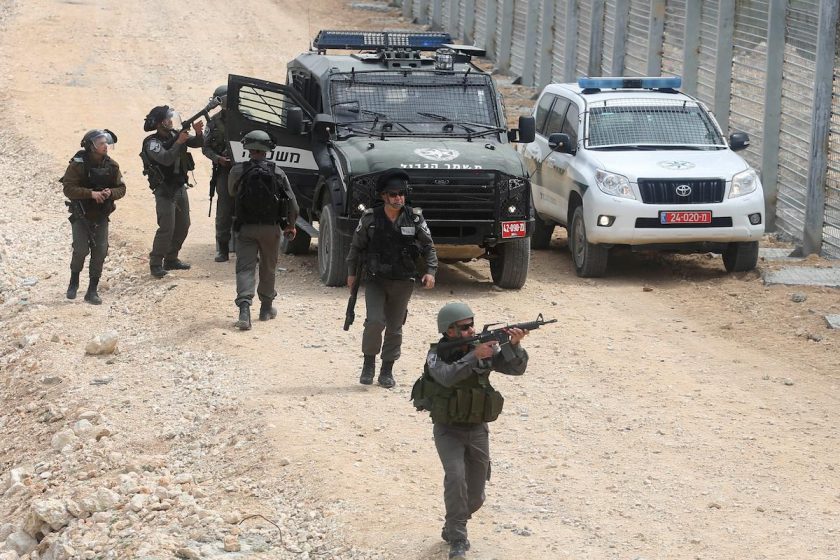
Israeli forces disrupt a Palestinian protest against Israeli occupation of Palestinian lands in Bethlehem, West Bank on March 30, 2017. (Issam Rimawi – Anadolu Agency )
MEMO | May 25, 2018
The Israeli Ministerial Committee for Legislation will discuss, Sunday, a bill that would prohibit the documentation of Israeli soldiers’ human rights violations against Palestinian citizens.
On Thursday, Israel Hayom explained that the chairman of Yisrael Beiteinu bloc in the Knesset, Robert Ilatov, proposed the bill with the support of his party’s leader, Israeli Defence Minister Avigdor Lieberman.
The bill states, “anyone who shoots a video or a photo, or records soldiers while they are doing their job, with the aim of disturbing the morale of soldiers and citizens, will be sentenced to five years imprisonment. In case this is done with the aim of destabilising the state’s security, the perpetrator will be sentenced to ten years imprisonment.”
In addition, the bill prohibits the sharing of photographs or recorded content on social media or in the media.
Israeli MP Ilatov asserted that his proposal comes as part of an attempt to respond to the movement of left-wing activists in exposing Israeli practices against Palestinian citizens in the West Bank and the Gaza Strip.
He justified his proposal by saying,
Israel has long been facing a disturbing phenomenon; that of the documentation of Israeli army soldiers, by video shooting or audio recordings by organisations that are hostile to Israel and supportive of the Palestinians, such as B’Tselem, Machsom Watch, Breaking the Silence, BDS and other organisations
He claimed that “the majority of these organisations receive support from associations and governments with anti-Israel agenda, and that they are using these contents to jeopardise Israel and its security.”
He added, “It is unreasonable for an activist or leftist organisation, supported by a foreign entity, to be granted the freedom to document soldiers while doing their duties. The best conditions must be provided for the soldiers to do their duty without worrying about any activist or organisation publishing their photos to intimidate them.”
Read also:
Congressional bill would apply Israel-centric definition of antisemitism to campuses

By Alison Weir | If Americans Knew | May 25, 2018
A group of US lawmakers from both houses of Congress introduced legislation on Wednesday to apply an Israel-centric definition of anti-Semitism to the American educational system. If passed, this would likely be used to to censor information on Israel-Palestine on U.S. campuses.
The basic formulation on which the definition is based was originally created by an Israeli official in 2004. Versions have since been inserted into various entities both internationally and in the U.S., where a definition created in Europe in 2005 was adopted by an Israel partisan in the State Department in 2010. This definition is now called “the State Department definition” of antisemitism. It is this version that the current law would apply to U.S. campuses. (For more information see this.)
The current legislation (H.R.6421 & S.2940) is entitled “A bill to provide for the consideration of a definition of anti-Semitism for the enforcement of Federal antidiscrimination laws concerning education programs or activities.” (Text here) The short title is ‘‘Anti-Semitism Awareness Act of 2018.’’
A similar bill, “Anti-Semitism Act of 2016,” was supported by the American Israel Public Affairs Committee (AIPAC), the Anti-Defamation League (ADL), the Jewish Federations of North America, and the Simon Wiesenthal Center but was not enacted.
Legal experts have warned that such bills would violate the First Amendment. Palestine Legal points out:
The redefinition of antisemitism is so broadly drawn—and its examples so vague—that any speech critical of Israel or supportive of Palestinian rights could conceivably fall within it. For example, a human rights supporter who speaks out for Palestinian rights, citing reports by such bodies as the United Nations or Amnesty International regarding Israeli human rights abuses, could be labeled antisemitic for applying a double standard by requiring of Israel behavior not expected or demanded of others.
If U.S. government entities adopt and apply this overbroad re-definition of antisemitism to censor political viewpoints critical of Israel, they would likely violate the First Amendment.
The American Civil Liberties Union (ACLU) stated that the 2016 bill posed “a serious threat to the First Amendment free speech rights of those on campus who may hold certain political views.”
The ACLU stated: “The First Amendment prevents the federal government from using its great weight to impose severe penalties on a person simply for sharing a political viewpoint critical of Israel.”
In some cases legislators may not be fully aware of what the bill contains and how it can be used. A press release from Eastern Washington Congresswoman Cathy McMorris Rodgers fails to inform the public that the definition is a nontraditional one that when applied to campuses will likely restrict certain factual statements about a foreign country.
The Times of Israel reports that other co-sponsors of the bill are Rep. Ted Deutch (D-Florida), Rep Jerrold Nadler, (D-New York), Rep. Peter Roskam, (R-Illinois), Rep. Doug Collins, (R-Georgia), Sen. Tim Scott, (R-South Carolina), and Sen. Bob Casey (D-Pennsylvania). The previous bill had 23 co-sponsors.
Similar legislation is also being introduced in state legislatures around the country, with South Carolina recently passing it. While most South Carolina state legislators considered the bill an insignificant gesture, their action made headlines in Israel, where it was seen as a major breakthrough for the country.
Alison Weir is executive director of If Americans Knew, president of the Council for the National Interest, and author of “Against Our Better Judgment: The Hidden History of How the U.S. Was Used to Create Israel.”

Click image to see video. Hannah Rosenthal adopted the new definition while she served as Antisemitism Envoy in the State Department.
‘Ukraine war on free speech coordinated with US’
RT | May 24, 2018
There is no independent policy in Kiev, they do everything in conjunction with the US, and new sanctions against Russian media reinforce those suspicions, executive editor of 21st Century Wire.com Patrick Henningsen told RT.
Ukraine has blocked access to the websites of Russian news organizations by including them on a sanctions list that is in sync with the US Treasury. RIA Novosti-Ukraine and Sputnik with the agencies’ resources are banned for three years.
RT: How do you view these sanctions against Russian media organizations? Is there a violation of freedom of speech?
Patrick Henningsen: I think you could make that argument anywhere in the world. We should make that argument anywhere in the world. This is clearly a political move; this also follows a pattern of targeting foreign media in countries like the US with its insistence that RT America employees register as foreign agents, etc. There have been similar attacks on PressTV in the UK, taking them off Eutelsat as well in Europe in 2012. It is definitely a war on free speech. But it is also an effort by the US; it seems very much a coordinated US effort to control public opinion, to control narratives. If you look at it in a wider scope, it is really about the management of information.
RT: Why are they doing it now?
PH: I think the timing is essential. I think we are seeing this at the very exact time you are seeing an escalation of tensions, and combat and military activities by Kiev in the Donbass. This would make sense. If a war is to escalate or if fighting is to escalate, the first thing you would like to do is to cut off any sources of opposition information. And certainly, they might view any Russian media outlets in Ukraine as a potential source of sympathetic narratives towards the people of Donbass and Luhansk. That doesn’t surprise me at all. In the wake of any war, if you look at history, one of the first targets will be media, right before the tensions are escalating or the war is beginning, this is the first thing you will see.
RT: Do you think will there be international reaction to this?
PH: In America, there are a lot of people cheering this on. Certainly, the government and the mainstream press and corporate media in America will look at this as a great thing. They need to get the Russians out because Russians only produce propaganda – this is how the narrative goes. This is why this is kind of a disturbing trend. The scope of discourse is being limited under the guise of national security. This is what the US is endorsing in Ukraine. So, one would except the US would follow suit within its own borders because… Kiev is acting as an agent of the US. And everybody is accusing the US favorite or installed, some like say, government in Kiev as being a puppet of the US. These actions only reinforce those suspicions. Clearly, there is no independent policy in Kiev, they are doing everything in conjunction with the US…
Egypt demolished 3,600 Sinai buildings in three months: Report
MEMO | May 22, 2018
The Egyptian army has “vastly expanded” the destruction of homes, commercial buildings and farms in Egypt’s North Sinai region since 9 February 2018, a report by Human Rights Watch (HRW) said today.
Since 2014 the Egyptian government has pursued plans to create a buffer zone along its border with Gaza on the pretext that fighters and weapons are being smuggled through the tunnels that connect the peninsula to the Strip.
Activists have said this war on terror is better described as a war on civilians. Between July 2013 and August 2015 the Egyptian Army demolished at least 3,250 buildings to this effect, according to HRW.
In late 2017 authorities resumed demolitions with the view to creating another buffer zone around Al-Arish airport following a missile attack on an air base and military helicopter. On 9 February 2018 the Egyptian military intensified this military campaign with the launch of “Operation Sinai” which they said would rid the region of terrorism once and for all.
Under this operation demolitions have escalated. By analysing a time series of satellite imagery HRW has revealed that the military destroyed at least 3,ooo homes – the largest number since the 2014 campaign began – in just two months. Homes of alleged terrorists, activists and their relatives in North Sinai’s largest city Al-Arish have also been set on fire and then demolished.
There has been no judicial oversight of the demolitions and the government has cut electricity and water of the houses they are evicting to force people to leave.
According to the report residents were given between 24-48 hours warning to evict, no assistance for moving to temporary housing, no process to appeal compensation decisions or for destruction of or damage to farmland.
Middle East Director at HRW Sarah Leah Whitson said: “Turning people’s homes into rubble is part of the same self-defeating security plan that has restricted food and movement to inflict pain on Sinai residents.”
The Egyptian army claims it is protecting people from militants, but it’s absurd to think that destroying homes and displacing lifelong residents would make them safer.
The demolitions and forced evictions have exacerbated an already dire humanitarian situation in North Sinai, according to HRW, which has calculated that 420,000 residents in North Sinai have been in urgent need of humanitarian assistance since “Operation Sinai” began. With the destruction of farms entire extended families have lost their livelihoods.
Because it is illegal to enter Sinai without a permit, the lack of journalists and human rights workers there means there is an information blackout on the atrocities committed.
Yes, Virginia, There is a Deep State
By Thomas L. Knapp | The Garrison Center | May 20, 2018
Since the “Russiagate” probe began, US president Donald Trump and his supporters have used lots of bandwidth raging against what they refer to as the “Deep State.” Does the Deep State exist? If so, what is it, and are its forces arrayed specifically against Donald Trump and his administration?
Yes, the Deep State exists — probably more so at one end of its numerous definitions and less so at the other, but to some degree at both ends.
At the seemingly more benign end, the Deep State is simply what one might think of as the “permanent government” — the army of bureaucrats and functionaries whose careers span multiple administrations. Like all career employees of large organizations as groups, they tend to fear and resist change, and their sheer mass has an inertial effect. They energetically do things the old way and drag their feet on new things.
At the end dismissed by mainstream commentators as “conspiracy theory,” the Deep State is an invisible second government which acts in a coordinated manner to protect its prerogatives and advance its interests and favored policies versus changes supposedly demanded by “the people” via their elected representatives in Congress and the presidency. The premier example of this view is the claim that John F. Kennedy was assassinated by the CIA and the military industrial complex because (in one version) he was about to get the US out of Vietnam.
If that end of the spectrum sounds crazy to you, consider:
Former FBI attorney Lisa Page and former FBI deputy counterintelligence chief Peter Strzok, while working on a pre-election investigation into alleged collusion between Donald Trump’s presidential campaign and the Russian government, exchanged text messages with incendiary content such as “there’s no way [Trump] gets elected — but I’m afraid we can’t take that risk.”
In mid-May, it emerged that an FBI informant approached two or three (reports vary) advisers to Trump’s campaign during the same period to pry into those advisers’ alleged ties to the Russian government.
Is President Trump stretching the reports we’ve seen when he tweets “Reports are there was indeed at least one FBI representative implanted, for political purposes, into my campaign for president. It took place very early on, and long before the phony Russia Hoax became a ‘hot’ Fake News story?”
Well, maybe. But not by much. On any fair reading, those two stories combined do look a lot like the second definition of Deep State skulduggery. The FBI was meddling in — acting to influence or in extremis overturn — a US presidential election (sound familiar?). The messages between Page and Strzok color that meddling as intentional Bureau political action, not as incidental investigative fallout which just happened to touch on the election.
While I disagree with President Trump on most issues, it’s hard to disagree with him when he rails against a transparently political witch hunt that has dragged on for more than a year visibly and for months before that beneath the surface. The Deep State is real. And dangerous.
Thomas L. Knapp (Twitter: @thomaslknapp) is director and senior news analyst at the William Lloyd Garrison Center for Libertarian Advocacy Journalism (thegarrisoncenter.org).
Israeli police break activist’s leg while in custody: Report
Press TV – May 20, 2018
Activists say Israeli police have brutally beaten an Arab-Israeli NGO worker after arresting him at a Haifa demonstration, which landed him in hospital with a broken leg.
Jafar Farah, the CEO of the Mossawa Center, was one of the 21 people arrested on Friday during a demonstration against the May 14 Israeli carnage in the Gaza Strip.
Footage of Farah’s arrest shows him being escorted away from the protest on his own feet and in handcuffs.
However, the police said the activist is now hospitalized, without providing further details on his condition.
Farah’s relatives and Adalah, an organization dedicated to Palestinian legal rights in Israel, accused the police of breaking the campaigner’s leg while in custody.
Adalah said in a statement that the Israeli police had dealt with the Haifa demonstration “like a war,” beaten those who attempted to escape and denied the detainees access to lawyers for over an hour after their arrest.
“All the detainees were handcuffed for the entire night and kept sitting on the police station floor. Many of them experienced serious bruising to their wrists. Adalah considers these arrests to be illegal, as the police violence in Haifa was unprecedented and unprovoked,” the statement read.
Additionally, the Mossawa Center said on Facebook that Farah had been assaulted while in police custody and is now in Bnai Tzion Hospital with a broken leg.
Israeli policemen arrest a protester in Haifa on May 18, 2018.
Israeli lawmaker Ilan Gilon said he had passed an urgent question to Public Security Minister Gilad Erdan regarding Farah’s arrest.
“I demand to know if police brutality led to the broken leg by Jafar Farah,” he said on Facebook. “The idea that a protester leaves his home to use his democratic right and is taken to an interrogation because of that, and as it ends it turns out his limbs are broken, is a thought that makes my blood run cold.”
In a Twitter post, Merav Michaeli, another Israeli lawmaker, called Farah “a partner in the struggle for equality and peace,” condemning his “frightening” treatment at the hands of policemen.
Member of the Knesset (MK) Ayman Odeh, who met the Haifa detainees, said police forces brutally oppressed the protest without any explanation.
He said Israeli Prime Minister Benjamin Netanyahu’s regime “wants to silence any voice of resistance and dissent coming from here, to silence any voice that embarrasses it and its actions.”
MK Aida Touma-Suleiman also spoke against the Israeli police clampdown on Haifa demonstrators, saying, “the attempts to scare and silence people will fail again!”
“The violence exerted on protesters was unchecked. Interrogators continued to beat up the detainees after they were arrested without any explanation or justification. As a result, some of them were injured. Jafar Farah’s leg was broken,” she added.
Israeli forces killed at least 65 Palestinians during protests near the Gaza fence on the eve of the 70th anniversary of the Nakba Day (the Day of Catastrophe), which coincided this year with the US embassy relocation from Tel Aviv to occupied Jerusalem al-Quds.
More than 2,700 Palestinians were also wounded as the Israeli forces used snipers, airstrikes, tank fire and tear gas to target the demonstrators.
The UN Human Rights Council (UNHRC) convened on Friday, demanding an “independent, international commission of inquiry” into the Gaza killings and denouncing “the disproportionate and indiscriminate use of force” by Israeli forces against Palestinians.
Israeli officials angry with UN rights council
The move infuriated Israeli officials, with the minister of military affairs claiming that the council had become a “cheerleader for terrorists.”
In a post on his Twitter account on Saturday, Avigdor Lieberman rejected the probe into the Gaza killings. He had earlier urged Tel Aviv and the US to immediately withdraw from the UNHRC.
Netanyahu also railed against the UNHRC, saying the Geneva-based body had backed terrorism by launching the Gaza investigation.
“There is nothing new under the sun. An organization that calls itself a council for human rights has once again proven that it is hypocritical and biased” and that its “purpose is to harm Israel and support terror,” the Israeli premier said.
Making Excuses for Russiagate
By Daniel Lazare | Consortium News | May 18, 2018
The best evidence that Russia-gate is sinking beneath the waves is the way those pushing the pseudo-scandal are now busily covering their tracks. The Guardian complains that “as the inquiry has expanded and dominated the news agenda over the last year, the real issues of people’s lives are in danger of being drowned out by obsessive cable television coverage of the Russia investigation” – as if the Guardian’s own coverage hasn’t been every bit as obsessive as anything CNN has come up with.
The Washington Post, second to none when it comes to painting Putin as a real-life Lord Voldemort, now says that Special counsel Robert Mueller “faces a particular challenge maintaining the confidence of the citizenry” as his investigation enters its second year – although it’s sticking to its guns that the problem is not the inquiry itself, but “the regular attacks he faces from President Trump, who has decried the probe as a ‘witch hunt.’”
And then there’s the New York Times, which this week devoted a 3,600-word front-page article to explain why the FBI had no choice but to launch an investigation into Trump’s alleged Russian links and how, if anything, the inquiry wasn’t aggressive enough. As the article puts it, “Interviews with a dozen current and former government officials and a review of documents show that the FBI was even more circumspect in that case than has been previously known.”
It’s Nobody’s Fault
The result is a late-breaking media chorus to the effect that it’s not the fault of the FBI that the investigation has dragged on with so little to show for it; it’s not the fault of Mueller either, and, most of all, it’s not the fault of the corporate press, even though it’s done little over the last two years than scream about Russia. It’s not anyone’s fault, evidently, but simply how the system works.
This is nonsense, and the gaping holes in the Times article show why.
The piece, written by Matt Apuzzo, Adam Goldman, and Nicholas Fandos and entitled “Code Name Crossfire Hurricane: The Secret Origins of the Trump Investigation,” is pretty much like everything else the Times has written on the subject, i.e. biased, misleading, and incomplete. Its main argument is that the FBI had no option but to step in because four Trump campaign aides had “obvious or suspected Russian ties.”
‘At Putin’s Arm’
One was Michael Flynn, who would briefly serve as Donald Trump’s national security adviser and who, according to the Times, “was paid $45,000 by the Russian government’s media arm for a 2015 speech and dined at the arm of the Russian president, Vladimir V. Putin.” Another was Paul Manafort, who briefly served as Trump’s campaign chairman and was a source of concern because he had “lobbied for pro-Russia interests in Ukraine and worked with an associate who has been identified as having connections to Russian intelligence.” A third was Carter Page, a Trump foreign-policy adviser who “was well known to the FBI” because “[h]e had previously been recruited by Russian spies and was suspected of meeting one in Moscow during the campaign.” The fourth was George Papadopoulos, a “young and inexperienced campaign aide whose wine-fueled conversation with the Australian ambassador set off the investigation. Before hacked Democratic emails appeared online, he had seemed to know that Russia had political dirt on Mrs. Clinton.”
Seems incriminating, eh? But in each case the connection was more tenuous than the Times lets on. Flynn, for example, didn’t dine “at the arm of the Russian president” at a now-famous December 2015 Moscow banquet honoring the Russian media outlet RT. He was merely at a table at which Putin happened to sit down for “maybe five minutes, maybe twenty, tops,” according to Green Party presidential candidate Jill Stein who was just a few chairs away. No words were exchanged, Stein says, and “[n]obody introduced anybody to anybody. There was no translator. The Russians spoke Russian. The four people who spoke English spoke English.”
The Manafort associate with the supposed Russian intelligence links turns out to be a Russian-Ukrainian translator named Konstantin Kilimnik who studied English at a Soviet military school and who vehemently denies any such connection. It seems that the Ukrainian authorities did investigate the allegations at one point but declined to press charges. So the connection is unproven.
Page Was No Spy
The same goes for Carter Page, who was not “recruited” by Russian intelligence, but, rather, approached by what he thought were Russian trade representatives at a January 2013 energy symposium in New York. When the FBI informed him five or six months later that it believed the men were intelligence agents, Page appears to have cooperated fully based on a federal indictment filed with the Southern District of New York. Thus, Page was not a spy but a government informant as ex-federal prosecutor Andrew C. McCarthy has pointed out – in other words, a good guy, as the Times would undoubtedly see it, helping the catch a couple of baddies.
As for Papadopoulos, who the Times suggests somehow got advance word that WikiLeaks was about to dump a treasure trove of Hillary Clinton emails, the article fails to mention that at the time the conversation with the Australian ambassador took place, the Clinton communications in the news were the 30,000 State Department emails that she had improperly stored on her private computer. These were the emails that “the American people are sick and tired of hearing about,” as Bernie Sanders put it. Instead of spilling the beans about a data breach yet to come, it’s more likely that Papadopoulos was referring to emails that were already in the news – a possibility the Times fails to discuss.
FBI ‘Perplexed’
One could go on. But not only does the Times article get the details wrong, it paints the big picture in misleading tones as well. It says that the FBI was “perplexed” by such Trump antics as calling on Russia to release still more Clinton emails after WikiLeaks went public with its disclosure. The word suggests a disinterested observer who can’t figure out what’s going on. But it ignores how poisonous the atmosphere had become by that point and how everyone’s mind was seemingly made up.
By July 2016, Clinton was striking out at Trump at every opportunity about his Russian ties – not because they were true, but because a candidate who had struggled to come up with a winning slogan had at last come across an issue that seemed to resonate with her fan base. Consequently, an intelligence report that Russia was responsible for hacking the Democratic National Committee “was a godsend,” wrote Jonathan Allen and Amie Parnes in Shattered, their best-selling account of the Clinton campaign, because it was “hard evidence upon which Hillary could start to really build the case that Trump was actually in league with Moscow.”
Not only did Clinton believe this, but her followers did as well, as did the corporate media and, evidently, the FBI. This is the takeaway from text messages that FBI counterintelligence chief Peter Strzok exchanged with FBI staff attorney Lisa Page.
Andrew McCarthy, who has done a masterful job of reconstructing the sequence, notes that in late July 2016, Page mentioned an article she had come across on a liberal web site discussing Trump’s alleged Russia ties. Strzok texted back that he’s “partial to any women sending articles about nasty the Russians are.” Page replied that the Russians “are probably the worst. Very little I finding redeeming about this. Even in history. Couple of good writers and artists I guess.” Strzok heartily agreed: “f***ing conniving cheating savages. At statecraft, athletics, you name it. I’m glad I’m on Team USA.”
The F’ing Russian ‘Savages’
This is the institutional bias that the Times doesn’t dare mention. An agency whose top officials believe that “f***ing conniving cheating savages” are breaking down the door is one that is fairly guaranteed to construe evidence in the most negative, anti-Russian way possible while ignoring anything to the contrary. So what if Carter Page had cooperated with the FBI? What’s important is that he had had contact with Russian intelligence at all, which was enough to render him suspicious in the bureau’s eyes. Ditto Konstantin Kilimnik. So what if the Ukrainian authorities had declined to press charges? The fact that they had even looked was damning enough.
The FBI thus made the classic methodological error of allowing its investigation to be contaminated by its preconceived beliefs. Objectivity fell by the wayside. The Times says that Christopher Steele, the ex-MI6 agent whose infamous, DNC and Clinton camp paid-for opposition research dossier turned “golden showers” into a household term, struck the FBI as “highly credible” because he had “helped agents unravel complicated cases” in the past. Perhaps. But the real reason is that he told agents what they wanted to hear, which is that the “Russian regime has been cultivating, supporting and assisting TRUMP for at least 5 years” with the “[a]im, endorsed by PUTIN, … [of] encourage[ing] splits and divisions in [the] western alliance.” (which can be construed as a shrewd defensive move against a Western alliance massing troops on Russian borders.)
What else would one expect of people as “nasty” as these? In fact, the Steele dossier should have caused alarm bells to go off. How could Putin have possibly known five years before that Trump would be a viable presidential candidate? Why would high-level Kremlin officials share inside information with an ex-intelligence official thousands of miles away? Why would the dossier declare on one page that the Kremlin has offered Trump “various lucrative real estate development business deals” but then say on another that Trump’s efforts to drum up business had gone nowhere and that he therefore “had had to settle for the use of extensive sexual services there from local prostitutes rather than business success”? Given that the dossier was little more than “oppo research” commissioned and funded by the Democratic National Committee and the Clinton campaign, why was it worthy of consideration at all?
The Rush to Believe
But all such questions disappeared amid the general rush to believe. The Times is right that the FBI slow-walked the investigation until Election Day. This is because agents assumed that Trump would lose and that therefore there was no need to rush. But when he didn’t, the mood turned to one of panic and fury.
Without offering a shred of evidence, the FBI, CIA, NSA, and Director of National Intelligence James Clapper issued a formal assessment on Jan. 6, 2017, that “Putin ordered an influence campaign in 2016 aimed at the US presidential election … [in order] to undermine public faith in the US democratic process, denigrate Secretary Clinton, and harm her electability and potential presidency.”
The New Yorker reports that an ex-aide to John McCain hoped to persuade the senator to use the Steele dossier to force Trump to resign even before taking office. (The ex-aide denies that this was the case.)
When FBI Director James Comey personally confronted Trump with news of the dossier two weeks prior to inauguration, the Times says he “feared making this conversation a ‘J. Edgar Hoover-type situation,’ with the FBI presenting embarrassing information “to lord over a president-elect.”
But that is precisely what happened. When someone – most likely CIA Director John Brennan, now a commentator with NBC News – leaked word of the meeting and Buzzfeed published the dossier four days later, the corporate media went wild. Trump was gravely wounded, while Adam Schiff, Democratic point man on the House Intelligence Committee, would subsequently trumpet the Steele dossier as the unvarnished truth. According to the Times account, Trump was unpersuaded by Comey’s assurances that he was there to help. “Hours earlier,” the paper says, “… he debuted what would quickly become a favorite phrase: ‘This is a political witch hunt.’”
The Times clearly regards the idea as preposterous on its face. But while Trump is wrong about many things, on this one subject he happens to be right. The press, the intelligence community, and the Democrats have all gone off the deep end in search of a Russia connection that doesn’t exist. They misled their readers, they made fools of themselves, and they committed a crime against journalism. And now they’re trying to dodge the blame.
Daniel Lazare is the author of The Frozen Republic: How the Constitution Is Paralyzing Democracy (Harcourt Brace, 1996) and other books about American politics.
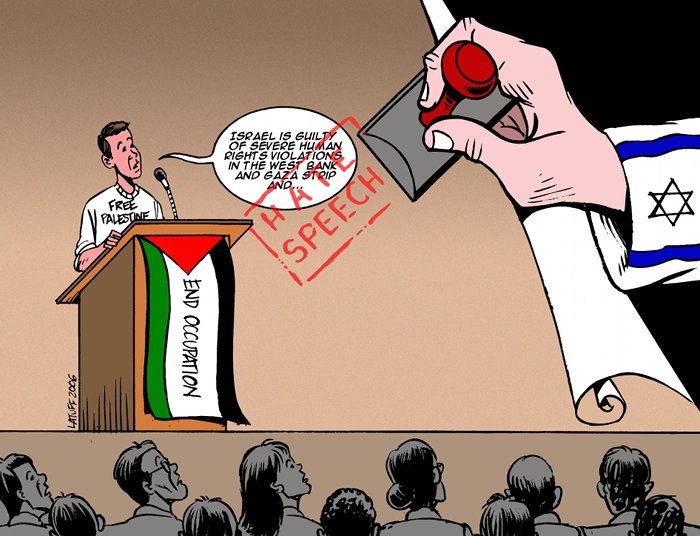
Rights group: Israel arrested 500 Palestinians over Facebook posts
Reporting Israeli crimes against Palestinians is considered by Israeli judiciary incitement of terror.
Days of Palestine | May 9, 2018
Palestinian Prisoners’ Centre (PPC) said yesterday that Israel had arrested 500 Palestinians, including women and children, as a result of their social media posts, Al-Resalah newspaper reported.
PPC spokesman Riyadh Al-Ashqar said that the Israeli occupation began arresting Palestinians because of their social media posts following the start of the Jerusalem Intifada claiming such uploads incite terror against Israel.
Israel is using its recently formed “Cyber Unit” to monitor Palestinian social media posts, the centre said.
This unit, Al-Ashqar said, classifies any post that glorifies Palestinian martyrs, discloses Israeli crimes, supports resistance or mentions the words and phrases including “martyr” and “intifada” as “incitement of terror”.
In the recent years, Al-Ashqar said, Israeli occupation courts have issued hundreds of sentences against Palestinians on the ground of incitement on social media.
The sentences ranged between months and years in prison, house arrests or bans from using social media platforms and mobile phones. The terms were handed down to men, women and children.
Featured Video

When Israel Is Mighty
or go to
Aletho News Archives – Video-Images
From the Archives
US murdering 1 million Iraqis is democracy, Iran giving yogurt to Iraq is “domination”
By Ali Salaam | American Herald Tribune | July 31, 2017
The New York Times, owned by the Zionist Jewish supremacist Ochs-Sulzberger family, has no problem with Iraqi suffering as long as Iran is not the one behind it.
The Iraq War was a genocide of the Iraqi people by Zionist supremacists in the Bush administration. Over 1 million innocent people were killed based on a lie. American soldiers died in an Israeli war and now an average of 22 soldiers commit suicide every day because their consciences cannot cope with the fact they committed crimes in an illegal war that served no purpose other than to benefit Israel, not America.
Benjamin Netanyahu, Prime Minister of the Zionist regime, once said “We are benefiting from one thing, and that is the attack on the Twin Towers and Pentagon, and the American struggle in Iraq.”
Paul Wolfowitz had his sights on Iraq since his time in the first Bush administration. Former Israeli official and Bush administration official Richard Perle had his eyes on Iraq since at least his authorship of the Clean Break white paper. The Zionist regime had their eyes on Iraq since the 1980s when strategist Oded Yinon wrote his white paper in support of dividing the Arab-Muslim world along ethnic and sectarian lines. The global Zionist lobby has had their eyes on Iraq since Theodor Herzl stated that Eretz Israel’s true borders go from the Nile River in Egypt to the Euphrates River in Iraq. … continue
Blog Roll
 Aletho News
- When Will This White House Madness End?
- Huckabee aide goes to ‘unusual lengths’ to portray ‘Israel’ positively
- Trump Announces Diesel Supply Deal With Putin Following Phone Call
- MEP blasts ‘Euro-Gestapo’ for lecturing Russia on democracy
- Syria May Send Troops to Saudi Arabia Amid War with Ansar Allah
- UK whines about losing billions to ‘Putin tax’
- Baghaei to Rubio: Distorted narratives cannot erase US record of broken commitments
- Houthis Don’t Have to Conquer Saudi Arabia to Make It Pay
- MOE: Nearly 22,000 Students and Education Workers Killed
- Guterres in Islamabad: Genocide, cowardice, and the cage of Imran Khan
- If Americans Knew
- Gaza ceasefire exists in name only, say more than 100 organizations
- Nearly 2 Million in Gaza Need Urgent Shelter Assistance as Winter Looms: IOM Chief Warns
- Suppressing Palestinian resistance: US charity under fire for AI monitoring of Gaza classrooms
- Thousands Are Held in Israeli Torture Camps. This Is What Happens Inside
- Israel puts Gaza’s sick, injured, newborn in peril – Daily Update
- Report claimed Mark Levin used by Israeli government to influence Trump
- Over 2,000 Gazans have died awaiting medical evacuation amid Israel’s continued siege
- How a U.S. Diplomat Suppressed and Altered Reports Critical of Israel
- 5 Palestinians Die from Israeli Strikes in Gaza as Relentless Attacks Continue
- Report: Ceasefire Slows Killing but Leaves Devastation Intact
- No Tricks Zone
- New Study: 50 Years Of The Most Aggressive ‘Net Zero’ Policies Can Only Affect The Global Climate By 0.03°C
- US September “Heat” Was No Record…Many Records Set Decades Ago
- Latest European Green Energy Debacle; Portugal’s Largest Flagship Solar Park Insolvent!
- Green Energy Debacle: German Expert Professor Fritz Vahrenholt Warns Of Severe Economic And Social Consequences
- Two More Paleo Reconstructions Affirm Meters-Higher Sea Levels Across Ireland, Brazil 7000-6000 Years Ago
- New Study: Earth And Venus Surface Warmth Largely Explained By Convection And Lapse Rate, Not CO2 Or Radiation
- 2025 Nature Paper Claiming Worsening Global Drought Gets RETRACTED …Heavily Flawed
- New Study: ‘Global Drought Shows No Detectable Recent Acceleration Under Climate Warming’
- Economic Masterminds: German Socialists Suggest Taxing Productivity Gains Stemming From Using AI
- The South China Sea Has Not Been Cooperating With The Climate Change Narrative

