With presidential elections announced in Venezuela, the US State Department moved quickly to declare that the contest was illegitimate and that its results would not be recognised. But less than a year ago the tune was quite different, as a cursory look through State Dept. briefings and press releases will show. We also examine how political developments from the past year have led to the current scenario, and how US demands for “free and fair” elections are not only arrogant and hypocritical but also misleading.
We begin by taking a look at what the US State Department was constantly saying less than a year ago. We could equally document the statements of the OAS and its secretary Luis Almagro, the Venezuelan opposition, US-allied regional governments, or the mainstream media. But it is easier to just go to the source. Sadly, when it comes to Venezuela, none of the mainstream actors and media will deviate from the State Department.
As violent opposition protests raged on in the Spring of 2017, there were repeated calls for immediate elections:
“President Maduro […] should hold elections as soon as possible.” (March 29)
“We call for the government of Venezuela to […] hold elections as soon as possible” (March 30)
“We […] echo the Venezuelan people’s calls for prompt elections” (April 10)
“We call again upon the Government of Venezuela to […] hold prompt elections” (April 18)
“It’s the Venezuelan people who should decide Venezuela’s future, which is why we once again call on the Venezuelan authorities to promptly hold free, fair, and transparent elections.” (May 2)
“…what people are asking for today, which is for national presidential elections to restore legitimacy to whomever might rule Venezuela moving forward.” (May 30)
“The United States has joined with a growing number of courageous democracies in our region to urge the Venezuelan Government to hold free elections” (June 20) (1)
US officials were adamant that elections were the only legitimate way forward.
“How is legitimacy defined in a democracy? Through elections.” (May 30)
“At the end of the day, it’s all about consensus. It’s about finding a way forward for Venezuelans to depolarize their situation, and the best way to do that is through elections.” (May 30)
“Venezuela needs consensus. It needs a genuine consensus or at least a legitimate path forward. That’s what elections provide.” (June 19)
So what happened since then to make the US no longer believe that elections should be held tomorrow? Maduro made a bold gambit of calling elections for a Constituent Assembly to solve the country’s problems. The Venezuelan opposition decided not to participate and vowed to stop those elections from taking place. They miserably failed, and on July 30 over 8 million people voted in what was a remarkable show of strength by chavismo.
From that point both the opposition and the US were trapped, unable to move on from their blunder. And soon cracks started to open. After months of violent protests claiming that the “dictatorship” was about to be overthrown, the opposition then turned to its supporters and asked them to go and vote in regional elections. The result was a disaster, with chavismo winning 18 out of 23 states. The opposition could not muster more than the usual vacuous claims of fraud, and then (mostly) boycotted the December municipal elections, which resulted in a chavista sweep of over 90% of the municipalities.
With the political momentum on its side, the government decided to schedule presidential elections for April 22. According to Jorge Rodríguez, head of the government’s delegation in the Dominican Republic dialogue, this date was agreed with the opposition MUD representatives. But with opposition figures more discredited than ever the US decided to pre-emptively unrecognise the vote, simply because an opposition victory is far from guaranteed.
In the end the main opposition parties followed suit in boycotting the election, but former Lara governor Henri Falcón broke ranks and registered as a candidate. The MUD promptly expelled him, and the US allegedly threatened him with sanctions to stop him from running. Ironically, as a former chavista, Falcón might be the ideal “moderate” opposition candidate to attract the votes of disaffected chavistas. But the imperial masters are past hedging their bets, they are all-in for regime change.
After talks with Falcón and the forces backing him, the vote was postponed to May 20. The MUD doubled down on their position that “there are no opposition candidates” in this election, and up to now there has been no reaction from the State Dept.. At the same time it is hard to read this as anything but a move to further sideline the MUD after they backed out of the dialogue to stick to the hardline coming from Washington.
“Free and fair” elections
We should also take a moment to refute the US assertions about elections not being “free and fair” and the presence of international observers. The “free and fair” demand means to discredit all previous electoral processes, whose results did not please the US. Nevertheless, as many people outside the mainstream media have explained, the Venezuelan voting system is as hard to fool as it gets. In all the elections where the opposition decided to take part they got to place their observers in every voting centre. Tens of thousands of audits took place to match the electronic and paper tallies, witnessed and approved by these opposition observers, and there has not been a single allegation of tampering with the vote count (2).
We could argue that the government makes use of state resources in its political campaigns. While this would hardly be exclusive to Venezuela, we should contend that the opposition has also made use of government resources, they just happened to come from the US government through its array of NED and USAID “democracy promoting”, “civil society building” programs, and that is just the overt part of it. Complaints about media coverage are also absurd when private media has the largest share of viewership and circulation and is overwhelmingly against the government, to say nothing about international media.
The demand for international monitoring is, at best, very dishonest from the State Department. First of all, despite the opposition walking away at the 11th hour, Maduro vowed to implement what had been agreed in the Dominican Republic dialogue, which included an open invitation for international observers to come to Venezuela for the upcoming election.
But that is not to say that previous elections did not have international observers. Organisations such as the Latin American Council of Electoral Experts (CEELA) have been present and endorsed the procedures, as well as other observers from multiple countries, Latin American and otherwise. The problem is that they do not dance to the tune of the US State Department.
It is absurd to claim that the presence of the OAS is a boost for fairness and transparency. We do not even have to look very far, just take the recent elections in Honduras. Massive, documented fraud allowed Juan Orlando Hernández to revert what was an irreversible trend in favour of his opponent. Having the US empire on your side will allow you to overrule statistics. This was so blatant that even the OAS and EU missions had to raise questions. But in the end Hernández was declared the winner, the State Dept. gave its approval and all these champions of democracy fell in line.
An even more shameful event took place in the Haiti presidential election of 2011. After the first round, the US (through the OAS), simply ordered the Haitian authorities to advance Michel Martelly to the second round, despite him not being one of the two most voted in the first round. They threatened to cut off all aid if this did not happen. So when these officials talk about the OAS as some guarantor of decency, not even they believe it themselves.
Democracy and elections
A small digression: we do not mean to equate democracy with elections like US officials constantly do in the above statements. The Venezuelan leaders have on occasion also fallen for this reductionism. Whether they believe it or not, it is the most obvious way to expose the western hypocrisy on the matter.
This reduction of democracy to voting has been one of the biggest triumphs of capitalist hegemony. People are effectively convinced that their entire political participation should be the single act of marking a cross on a ballot every 4 or 5 years. Politics is thus detached from the rest of society and “commodified” like everything else in capitalism, with campaigns becoming mere advertising shows and the wealthiest literally buying their influence.
The Bolivarian Revolution is revolutionary precisely because it challenged the inevitability of representative politics and opened new spaces for protagonist, participatory democratic experiments. From the communes to workers councils, even to the constituent processes, and despite the natural contradictions that have emerged, we have seen an expansion of democracy in its literal sense – popular power.
Hands Off Venezuela!
In the end it seems like the ideal scenario for the US would be something like the Yemeni model: a single, US-backed candidate on the ballot. With elections coming up this year in key US allied countries (Brazil, Colombia and Mexico), all of which have the potential to bring to power someone less friendly to US interests, the US cannot afford a defeat in Venezuela.
These arrogant, imperial demands that the Venezuelan elections should satisfy are just meant to provide cover for the growing threats and aggression against Venezuela, and the uncritical echo chamber that the media has become on this matter is a crucial asset. With suggestions of an upcoming oil embargo against Venezuela, at this point the goal is clearly to impose as much suffering as possible on the Venezuelans in order to topple the government.
For all its lofty rhetoric, the State Department is not looking out for the well-being of the Venezuelan people. Neither are its Venezuelan and regional puppets, nor the mainstream media, whose positions are simply State Dept. communiques with make-up. Standing up to these shameless imperialist attacks is essential if we wish to stand in solidarity with the Venezuelan poor and working-class, allowing them to freely choose their path, both in the upcoming elections and beyond.
Notes
(1) “Courageous” is not the first adjective that comes to mind regarding lapdogs
(2) A possible exception is the gubernatorial race in the state of Bolívar last October, where some electoral acts were circulated on social media showing a mismatch with regard to the electronic totals in the CNE website. But, perhaps because it would undermine the other constant claims of fraud, the opposition did not press the case.
March 7, 2018
Posted by aletho |
Civil Liberties, Deception, Timeless or most popular | Latin America, United States, Venezuela |
Leave a comment
In late February, Venezuela’s government began accepting presidential candidate registrations and announced a snap legislative election for April. The country’s opposition denounces the process as a sham and Maduro as a dictator, both of which may be true.
Oddly, a third voice — the US government — also weighed in. Per US state media outlet Voice of America, “the United States, which under President Donald Trump has been deeply critical of Maduro’s leadership in crisis-torn and economically suffering Venezuela, on Saturday rejected the call for an early legislative vote.”
Given the perpetual public pearl-clutching over alleged Russian meddling in the 2016 US presidential election, that’s some major league chutzpah.
The US State Department wants “‘a free and fair election’ involving full participation of all political leaders, the immediate release of all political prisoners, credible international observation and an independent electoral authority.
Let’s take that one at a time.
Participation of all political leaders? In some US states, it’s harder for a third party to get on a ballot than in, say, Iran.
The immediate release of all political prisoners? Last I heard, US president Donald Trump hadn’t pardoned (among others) Leonard Peltier.
Credible international observation? The US proper committed to admitting international election observers in the Organization for Security and Co-Operation in Europe’s 1990 Copenhagen Document, but many US states forbid international observers or, for that matter, local observers who aren’t affiliated with one of the two ruling parties.
Electoral authorities? The two ruling parties control them all and routinely use them to suppress threatened competition, as do pseudo-private entities like the Commission on Presidential Debates, which makes giant illegal (but government approved) in-kind contributions to the Republican and Democratic candidates in the form of televised candidate beauty pageants which exclude the opposition parties.
Writing in The Atlantic, veteran election meddler Thomas O. Mela — formerly of the US State Department, the US Agency for International Development, the National Democratic Institute and Freedom House — argues that election meddling is different when the US does it, because … well, “democracy.”
Mela asserts a “difference between programs to strengthen democratic processes in another country (without regard to specific electoral outcomes), versus efforts to manipulate another country’s election in order to sow chaos, undermine public confidence in the political system, and diminish a country’s social stability.”
The US government spends a lot of time and money (USAID’s budget alone is about one-tenth the budget of the entire Russian government) on foreign election meddling, and somehow “democracy” always gets interpreted as “whatever outcome the US government prefers at the moment.”
Perhaps we should get our own democratic house in order instead of, or at least before, presuming to tell the rest of the world how democracy does or should work.
Thomas L. Knapp (Twitter: @thomaslknapp) is director and senior news analyst at the William Lloyd Garrison Center for Libertarian Advocacy Journalism (thegarrisoncenter.org).
February 28, 2018
Posted by aletho |
Civil Liberties, Mainstream Media, Warmongering, Timeless or most popular | Freedom House, Latin America, National Democratic Institute, The Atlantic, United States, USAID, Venezuela |
Leave a comment
Twitter, YouTube and Facebook, accused of enabling US President Donald Trump’s rise to power through “Russian meddling,” are facing pressure to de-platform heretics. This has raised fears for the safety of free speech in the US.
At the Conservative Political Action Conference (CPAC) this past weekend, media crusader James O’Keefe headlined an hour-long panel on social media censorship, arguing that it targeted mostly conservatives.
“They really make sure you don’t see any differing views,” O’Keefe said at the panel.
Last week, the blogging platform Medium deleted a number of accounts, including those of Mike Cernovich, Jack Posobiec and Laura Loomer, described by The Hill as “prominent far-right figures.” The purge took place after Medium replaced a commitment to free speech in its terms of service in favor of fighting “online hate, abuse, harassment, and disinformation.”
Though Medium would not comment on individual account bans, it is notable that Cernovich’s account was deleted after he was named in a Newsweek article that blamed the “alt-right,” overseas social media bots and “Russians” for the ouster of Senator Al Franken (D-Minnesota) over sexual misconduct. Newsweek retracted the story after criticism that it could not be substantiated.
A number of YouTube creators have complained that the video platform has demonetized basically anything that isn’t deemed “family friendly,” including political dissent. Another crackdown followed the school shooting in Parkland, Florida, after the top-ranking video on the site featured accusations that some of the students were “crisis actors.”
Yet if YouTube simply censored any videos even referring to conspiracy theories, that would surely present a new problem. After all, wouldn’t it also undermine efforts to debunk them?
Conservative critics accuse the social media giants of being run by Democrats. There is certainly evidence pointing in that direction, from the involvement of Alphabet (Google’s parent company) CEO Eric Schmidt with Hillary Clinton’s 2016 campaign and the Obama presidency, to Twitter’s admission it censored the hashtags about WikiLeaks’ publication of revealing emails from Clinton’s campaign chief John Podesta in the run-up to the November 2016 vote. Those emails also revealed the commitment of several Facebook executives to get Clinton elected.
After Clinton lost to Trump, however, the three social media giants found themselves in the crosshairs of Congress. Many Republicans joined the chorus of Democrats accusing the social networks of enabling alleged “Russian” activity.
“You created these platforms… and now they’re being misused,” Senator Dianne Feinstein (D-California) told the executives of Facebook, Google, and Twitter during a hearing in October 2017. “And you have to be the ones who do something about it — or we will.”
So far, “doing something” seems to consist mostly of purging “Russian bots,” as identified by the either the social media companies themselves or an alliance of Democrats and neo-conservatives ousted from power by Trump, and now seeing Russians behind every hashtag.
Censorious actions also include what activists call “de-platforming” of people singled out for unacceptable or offensive opinions by the ad-hoc online mobs. For example, after the Florida school shooting angry Twitterati have successfully badgered a number of businesses into canceling discounts they previously offered to members of the National Rifle Association (NRA). Amazon also found itself under pressure to drop the “NRA TV” channel from its platform.
In a recent interview, former Google engineer James Damore speculated that the climate at social media companies have an atmosphere which resembles college campuses. Such locations which have also seen crackdowns on freedom of expression in recent times.
“It was very much like a college campus,” Damore told the Washington Examiner. “And they tried to make it like a college campus where you would live at Google essentially, where they have all your food and all the amenities, and once you start living there you aren’t able to disconnect, and so you feel like my words were a threat against your family. That was part of the fervor, I think.”
Damore was purged from Mountain View over a memo in which he questioned the company’s practices when it came to diversity.
While the social media companies may hope the lawmakers would be appeased by an occasional purge of unpopular voices, another danger is headed their way: the legacy media, is aiming to recapture its hold on audiences.
On Monday, CNN president Jeff Zucker addressed the Mobile World Congress in Barcelona. His thrust was that government should look into Google and Facebook “monopolies” if journalism is to survive.
“In a Google and Facebook world, monetization of digital and mobile continues to be more difficult than we would have expected or liked,” Zucker said, according to Variety. “I think we need help from the advertising world and from the technology world to find new ways to monetize digital content, otherwise good journalism will go away.”
Tempting as it would be to quip about CNN’s tenuous relationship with “good journalism.” At this time, doing so would be self-defeating as the chances are it would get one quicklybe a short-cut to getting purged from Google, Twitter or Facebook.
February 27, 2018
Posted by aletho |
Civil Liberties, Full Spectrum Dominance, Mainstream Media, Warmongering | Facebook, Google, Human rights, United States, YouTube |
Leave a comment
Hello,
Thank you for your account suspension appeal. We have decided to keep your account suspended based on our Community Guidelines and Terms of Service. Please visit http://www.youtube.com/t/community_guidelines for more information.
Sincerely,
The YouTube Team
Short and sweet from Google. I wrote to them (using their appeal form) last Thursday evening, asking for an explanation for the deletion of my channel. I was polite but firm and asked for a contact, a name, someone who I could speak with, just for the record mind as I know their subscriber interaction is run by AI now. Stop and think about that for a minute. A machine decided to delete the channel. I am then reduced to appealing to the same machine to have my intellectual property restored to me. We’re now living Blade Runner, Judge Dredd, Demolition Man and any other sci-fi flick about a dystopian future. Google denies this of course. The corporation admits using AI to scour videos for harmful content, but claims that decisions on banning channels are made by a person. I don’t believe them. My second strike was issued for an interview I did with Michael Rivero back in August 2015. Michael was telling me why he DID NOT believe that the shooting of two journalists in Virginia was a false flag attack. The interview was harmless. I immediately appealed (you can appeal community strikes). I pressed SUBMIT to send the appeal and was promptly emailed by Google to say that the appeal was rejected! That took seconds, it was like the email came back from them at the very second I submitted the appeal.
There could not have been any human involvement, it was so instantaneous. I am certain that nobody reviewed my appeal. It was undoubtedly a program. Just before writing this, I wrote to Google again, to challenge the above response. This time I was a little less cordial and reminded them/it, whatever the fuck it is, that I have legal remedies at my disposal. I insisted that the channel be restored and asked for the name and department of the person who a) took the decision to delete the channel and b) the name of the person who handled the appeal. They will not be able to provide me with any name of course. Maybe it’s HAL or Ed-209 or T-1000…….
I’m not going to flog a dead horse in terms of banging on and on about this. I won’t be boring the shite out of you constantly about Google, I promise. I just wanted to let you know that I had received a response of sorts from them. Anyway, enjoy the rest of your Sunday. Speak tomorrow. Sunday View can be heard on the homepage. It wasn’t a bad show today, there are some interesting stories in there.
Richie is the host of The Richie Allen Show and has enjoyed a long, and varied, broadcasting career.
February 27, 2018
Posted by aletho |
Civil Liberties, Full Spectrum Dominance | Google, YouTube |
Leave a comment
In the American police state, police have a tendency to shoot first and ask questions later.
In fact, police don’t usually need much incentive to shoot and kill members of the public.
Police have shot and killed Americans of all ages—many of them unarmed—for standing a certain way, or moving a certain way, or holding something—anything—that police could misinterpret to be a gun, or igniting some trigger-centric fear in a police officer’s mind that has nothing to do with an actual threat to their safety.
So when police in Florida had to deal with a 19-year-old embarking on a shooting rampage inside Marjory Stoneman Douglas High School in Parkland, Fla., what did they do?
Nothing.
There were four armed police officers, including one cop who was assigned to the school as a resource officer, on campus during that shooting. All four cops stayed outside the school with their weapons drawn (three of them hid behind their police cars).
Not a single one of those cops, armed with deadly weapons and trained for exactly such a dangerous scenario, entered the school to confront the shooter.
Seventeen people, most of them teenagers, died while the cops opted not to intervene.
Let that sink in a moment.
Now before your outrage bubbles over, consider that the U.S. Supreme Court has repeatedly affirmed (most recently in 2005) that police have no constitutional duty to protect members of the public from harm.
Yes, you read that correctly.
According to the U.S. Supreme Court, police have no duty, moral or otherwise, to help those in trouble, protect individuals from danger, or risk their own lives to save “we the people.”
In other words, you can be outraged that cops in Florida did nothing to stop the school shooter, but technically, it wasn’t part of their job description.
This begs the question: if the police don’t have a duty to protect the public, what are we paying them for? And who exactly do they serve if not you and me?
Why do we have more than a million cops on the taxpayer-funded payroll in this country whose jobs do not entail protecting our safety, maintaining the peace in our communities, and upholding our liberties?
Why do we have more than a million cops who have been fitted out in the trappings of war, drilled in the deadly art of combat, and trained to look upon “every individual they interact with as an armed threat and every situation as a deadly force encounter in the making?
I’ll tell you why.
It’s the same reason why the Trump Administration has made a concerted effort to expand the police state’s power to search, strip, seize, raid, steal from, arrest and jail Americans for any infraction, no matter how insignificant.
This is no longer a government “of the people, by the people, for the people.”
It is fast becoming a government “of the rich, by the elite, for the corporations,” and its rise to power is predicated on shackling the American taxpayer to a life of indentured servitude.
Cops in America may get paid by the citizenry, but they don’t work for us.
They don’t answer to us. They’re not loyal to us.
And they certainly aren’t operating within the limits of the U.S. Constitution.
That “thin, blue line” of loyalty to one’s fellow cops has become a self-serving apparatus that sees nothing wrong with advancing the notion that the lives—and rights—of police should be valued more than citizens.
The myth of the hero cop really is a myth.
Cops are no more noble, no more self-sacrificing, no braver and certainly no more deserving of special attention or treatment than any other American citizen.
This misplaced patriotism about police and, by extension, the military—a dangerous re-shifting of the nation’s priorities that has been reinforced by President Trump with his unnerving knack for echoing past authoritarian tactics—paves the way for even more instability in the nation.
Welcome to the American police state, funded by Corporate America, policed by the military industrial complex, and empowered by politicians whose primary purpose is to remain in office.
It’s a short hop, skip and a jump from the police state we’re operating under right now to a full-blown totalitarian regime ruled with the iron fist of martial law.
The groundwork has already been laid.
The events of recent years have only served to desensitize the nation to violence, acclimate them to a militarized police presence in their communities, and persuade them that there is nothing they can do to alter the seemingly hopeless trajectory of the nation.
The sight of police clad in body armor and gas masks, wielding semiautomatic rifles and escorting an armored vehicle through a crowded street, a scene likened to “a military patrol through a hostile city,” no longer causes alarm among the general populace.
Few seem to care about the government’s endless wars abroad that leave communities shattered, families devastated and our national security at greater risk of blowback. Indeed, there were no protests in the streets after U.S. military forces carried out air strikes on a Syrian settlement, killing 25 people, more than half of which were women and children.
And then there’s President Trump’s plans for a military parade on Veterans Day (costing between $10 million and $30 million) to showcase the nation’s military might. Other countries that feel the need to flex their military muscles to its citizens and the rest of the world include France, China, Russia and North Korea.
The question is no longer whether the U.S. government will be preyed upon and taken over by the military industrial complex. That’s a done deal.
It’s astounding how convenient we’ve made it for the government to lock down the nation.
Mind you, by “government,” I’m not referring to the highly partisan, two-party bureaucracy of the Republicans and Democrats.
As I point out in my book Battlefield America: The War on the American People, I’m referring to “government” with a capital “G,” the entrenched Deep State that is unaffected by elections, unaltered by populist movements, and has set itself beyond the reach of the law.
I’m referring to the corporatized, militarized, entrenched bureaucracy that is fully operational and staffed by unelected officials who are, in essence, running the country and calling the shots in Washington DC, no matter who sits in the White House.
This is the hidden face of a government that has no respect for the freedom of its citizenry.
February 26, 2018
Posted by aletho |
Civil Liberties, Militarism, Timeless or most popular | Human rights, United States |
Leave a comment
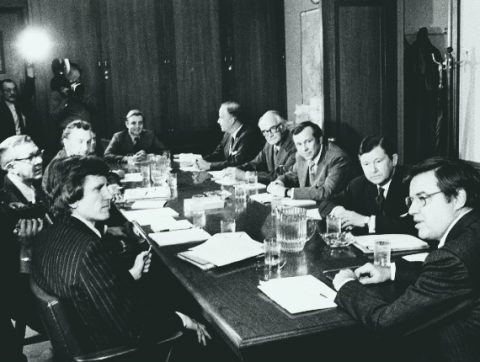
Dear Congress, Mr. President and the American public,
In 1975 the public learned that the National Security Agency had been collecting and analyzing international telegrams of U.S. citizens since the 1940s under secret agreements with all the major telegram companies. Years later, the NSA instituted another watch list program to intercept the international communications of key figures in the civil rights and anti–Vietnam War movements among other prominent citizens. Innocent Americans were targeted by their government. These actions were uncovered — and stopped — only because of a special Senate investigative committee known as the United States Senate Select Committee to Study Governmental Operations with Respect to Intelligence Activities, commonly known as the Church Committee.
We are former Church Committee members and staffers and write today as witnesses to history and as citizens with decades of collective experience in Congress, the federal courts, the executive branch and the intelligence community. We write today to encourage Congress to create a Church Committee for the 21st century — a special investigatory committee to undertake a thorough and public examination of current intelligence community practices affecting the rights of Americans and to make specific recommendations for future oversight and reform. Such a committee would work in good faith with the president, hold public and private hearings and be empowered to obtain documents. Such congressional action is urgently needed to restore the faith of citizens in the intelligence community and in our federal government.
The actions uncovered by the Church Committee in the 1970s bear striking similarities to the actions we’ve learned about over the past year. In the early 1970s, allegations of impropriety and illegal activity concerning the intelligence community spurred Congress to create committees to investigate those allegations. Our committee, chaired by Sen. Frank Church, was charged with investigating illegal and unethical conduct of the intelligence community and with making legislative recommendations to govern the intelligence community’s conduct. The bipartisan committee’s reports remain one of the most searching reviews of intelligence agency practices in our nation’s history.
Our findings were startling. Broadly speaking, we determined that sweeping domestic surveillance programs, conducted under the guise of foreign intelligence collection, had repeatedly undermined the privacy rights of U.S. citizens. A number of reforms were implemented as a result, including the creation of permanent intelligence oversight committees in Congress and the passage of the Foreign Intelligence Surveillance Act.
Even though our work was over 30 years ago, our conclusions seem eerily prescient today. For example, our final report noted:
We have seen a consistent pattern in which programs initiated with limited goals, such as preventing criminal violence or identifying foreign spies, were expanded to what witnesses characterized as “vacuum cleaners,” sweeping in information about lawful activities of American citizens. The tendency of intelligence activities to expand beyond their initial scope is a theme, which runs through every aspect of our investigative findings.
The need for another thorough, independent and public congressional investigation of intelligence activity practices that affect the rights of Americans is apparent. There is a crisis of public confidence. Misleading statements by agency officials to Congress, the courts and the public have undermined public trust in the intelligence community and in the capacity of the branches of government to provide meaningful oversight.
The scale of domestic communications surveillance the NSA engages in today dwarfs the programs revealed by the Church Committee. Thirty years ago, the NSA’s surveillance practices raised similar concerns as those today. For instance, Church explained:
In the case of the NSA, which is of particular concern to us today, the rapid development of technology in this area of electronic surveillance has seriously aggravated present ambiguities in the law. The broad sweep of communications interception by NSA takes us far beyond the previous Fourth Amendment controversies where particular individuals and specific telephone lines were the target.
As former members and staffers of the Church Committee, we can authoritatively say the erosion of public trust currently facing our intelligence community is not novel, nor is its solution. A Church Committee for the 21st century — a special congressional investigatory committee that undertakes a significant and public re-examination of intelligence community practices that affect the rights of Americans and the laws governing those actions — is urgently needed. Nothing less than the confidence of the American public in our intelligence agencies and, indeed, the federal government, is at stake.
Sincerely,
Counsel, advisers and professional staff members of the Church Committee, including
Chief Counsel Frederick A.O. Schwarz Jr.
Loch Johnson
John T. Elliff
Burt Wides
Jim Dick
Frederick Baron
Joseph Dennin
Peter Fenn
Anne Karalekas
Michael Madigan
Elliot Maxwell
Gordon Rhea
Eric Richard
Athan Theoharis
Christopher Pyle
February 25, 2018
Posted by aletho |
Civil Liberties, Corruption, Deception, Timeless or most popular | CIA, NSA, United States |
Leave a comment
Fads and scandals often follow a set trajectory. They grow big, bigger, and then, finally, too big, at which point they topple over and collapse under the weight of their own internal contradictions. This was the fate of the “Me too” campaign, which started out as an exposé of serial abuser Harvey Weinstein but then went too far when Babe.net published a story about one woman’s bad date with comedian Aziz Ansari. Suddenly, it became clear that different types of behavior were being lumped together in a dangerous way, and a once-explosive movement began to fizzle.
So, too, with Russiagate. After dominating the news for more than a year, the scandal may have at last reached a tipping point with last week’s indictment of thirteen Russian individuals and three Russian corporations on charges of illegal interference in the 2016 presidential campaign. But the indictment landed with a decided thud for three reasons:
— It failed to connect the Internet Research Agency (IRA), the alleged St. Petersburg troll factory accused of political meddling, with Vladimir Putin, the all-purpose evil-doer who the corporate media say is out to destroy American democracy.
— It similarly failed to establish a connection with the Trump campaign and indeed went out of its way to describe contacts with the Russians as “unwitting.”
— It described the meddling itself as even more inept and amateurish than many had suspected.
After nine months of labor, Special Prosecutor Robert Mueller thus brought forth a mouse. Even if all the charges are true – something we’ll probably never know since it’s unlikely that any of the accused will be brought to trial – the indictment tells us virtually nothing that’s new.
Yes, IRA staffers purchased $100,000 worth of Facebook ads, 56 percent of which ran after Election Day. Yes, they persuaded someone in Florida to dress up as Hillary Clinton in a prison uniform and stand inside a cage mounted on a flatbed truck. And, yes, they also got another “real U.S. person,” as the indictment terms it, to stand in front of the White House with a sign saying, “Happy 55th Birthday Dear Boss,” a tribute, apparently, to IRA founder Yevgeniy Prigozhin, the convicted robber turned caterer whose birthday was three days away. Instead of a super-sophisticated spying operation, the indictment depicts a bumbling freelance operation that is still giving Putin heartburn months after the fact.
Not that this has stopped the media from whipping itself into a frenzy. “Russia is at war with our democracy,” screamed a headline in the Washington Post. “Trump is ignoring the worst attack on America since 9/11,” blared another. “… Russia is engaged in a virtual war against the United States through 21st-century tools of disinformation and propaganda,” declared the New York Times, while Daily Beast columnist Jonathan Alter tweeted that the IRA’s activities amounted to nothing less than a “tech Pearl Harbor.”
All of which merely demonstrates, in proper backhanded fashion, how grievously Mueller has fallen short. Proof that the scandal had at last overstayed its welcome came five days later when the Guardian, a website that had previously flogged Russiagate even more vigorously than the Post, the Times, or CNN, published a news analysis by Cas Mudde, an associate professor at the University of Georgia, admitting that it was all a farce – and a particularly self-defeating one at that.
Mudde’s article made short work of hollow pieties about a neutral and objective investigation. Rather than an effort to get at the truth, Russiagate was a thinly-veiled effort at regime change. “[I]n the end,” he wrote, “the only question everyone really seems to care about is whether Donald Trump was involved – and can therefore be impeached for treason.
With last week’s indictment, the article went on, “Democratic party leaders once again reassured their followers that this was the next logical step in the inevitable downfall of Trump.” The more Democrats play the Russiagate card, in other words, the nearer they will come to their goal of riding the Orange-Haired One out of town on a rail.
This makes the Dems seem crass, unscrupulous, and none too democratic. But then Mudde gave the knife a twist. The real trouble with the strategy, he said, is that it isn’t working:
“While there is no doubt that the Trump camp was, and still is, filled with amoral and fraudulent people, and was very happy to take the Russians help during the elections, even encouraging it on the campaign, I do not think Mueller will be able to find conclusive evidence that Donald Trump himself colluded with Putin’s Russia to win the elections. And that is the only thing that will lead to his impeachment as the Republican party is not risking political suicide for anything less.”
Other Objectives of “Russiagate”
No collusion means no impeachment and hence no anti-Trump “color revolution” of the sort that was so effective in Georgia or the Ukraine. Moreover, while 53 percent of Americans believe that investigating Russiagate should be a top or at least an important priority according to a recent poll, figures for a half-dozen other issues ranging from Medicare and Social Security reform to tax policy, healthcare, infrastructure, and immigration are actually a good deal higher – 67 percent, 72 percent, or even more.
Summed up Mudde: “… the Russia-Trump collusion story might be the talk of the town in Washington, but this is not the case in much of the rest of the country.” Out in flyover country, rather, Americans can’t figure out why the political elite is more concerned with a nonexistent scandal than with things that really count, i.e. de-industrialization, infrastructure decay, the opioid epidemic, and school shootings. As society disintegrates, the only thing Democrats have accomplished with all their blathering about Russkis under the bed is to demonstrate just how cut off from the real world they are.
But Russiagate is not just about regime change, but other things as well. One is repression. Where once Democrats would have laughed off Russian trolls and the like, they’re now obsessed with making a mountain out of a molehill in order to enforce mainstream opinion and marginalize ideas and opinions suspected of being un-American and hence pro-Russian. If the RT (Russia Today) news network is now suspect – the Times described it not long ago as “the slickly produced heart of a broad, often covert disinformation campaign designed to sow doubt about democratic institutions and destabilize the West” – then why not the BBC or Agence France-Presse ? How long until foreign books are banned or foreign musicians?
“I’m actually surprised I haven’t been indicted,” tweets Bloomberg columnist Leonid Bershidsky. “I’m Russian, I was in the U.S. in 2016 and I published columns critical of both Clinton and Trump w/o registering as a foreign agent.” When the Times complains that Facebook “still sees itself as the bank that got robbed, rather than the architect who designed a bank with no safes, and no alarms or locks on the doors, and then acted surprised when burglars struck,” then it’s clear that the goal is to force Facebook to rein in its activities or stand by and watch as others do so instead.
Add to this the classic moral panic promoted by #MeToo – to believe charges of sexual harassment and assault without first demanding evidence “is to disbelieve, and deny due process to, the accused,” notes Judith Levine in the Boston Review – and it’s clear that a powerful wave of cultural conservatism is crashing down on the United States, much of it originating in a classic neoliberal-Hillaryite milieu. Formerly the liberal alternative, the Democratic Party is now passing the Republicans on the right.
But Russiagate is about something else as well: war. As National Security Adviser H.R. McMaster warns that the “time is now” to act against Iran, the New York Times slams Trump for not imposing sanctions on Moscow, and a spooky “Nuclear Posture Review” suggests that the US might someday respond to a cyber attack with atomic weapons, it’s plain that Washington is itching for a showdown that will somehow undo the mistakes of the previous administration. The more Trump drags his feet, the more Democrats conclude that a war drive is the best way to bring him to his knees.
Thus, low-grade political interference is elevated into a casus belli while Vladimir Putin is portrayed as a supernatural villain straight out of Harry Potter. But where does it stop? Libya has been set back decades, Syria, the subject of yet another US regime-change effort, has been all but destroyed, while Yemen – which America helps Saudi Arabia bomb virtually around the clock – is now a disaster area with some 9,000 people killed, 50,000 injured, a million-plus cholera cases, and more than half of all hospitals and clinics destroyed.
The more Democrats pound the war drums, the more death and destruction will ensue. The process is well underway in Syria, the victim of Israeli bombings and a US-Turkish invasion, and it will undoubtedly spread as Dems turn up the heat. If the pathetic pseudo-scandal known as Russiagate really is collapsing under its own weight, then it’s not a moment too soon.
Daniel Lazare is the author of several books including The Frozen Republic: How the Constitution Is Paralyzing Democracy (Harcourt Brace).
February 24, 2018
Posted by aletho |
Civil Liberties, Fake News, Full Spectrum Dominance, Mainstream Media, Warmongering, Militarism, Progressive Hypocrite, Russophobia, Timeless or most popular | Human rights, United States |
Leave a comment
YouTube operates a three strikes and you are out policy. Content creators are told that if they violate community standards three times, their channel and all its content will be deleted. Two weeks ago The Richie Allen Show received a strike. Incredibly, I was informed that I had violated the bullying and harassment guidelines. The video in question was of an interview I conducted with Wolfgang Halbig over two years ago about The Sandy Hook school shooting. There was nothing harassing about it, there was certainly no bullying. I repeatedly challenged Wolfgang in the interview and pressed him for evidence to support his theory. Nevertheless that was strike one. YouTube said that as punishment, I couldn’t live stream for three months. I don’t live stream anyway. But of course I was worried. I had been warned repeatedly, by commercial presenters and producers and former colleagues of mine, that the show would be targeted.
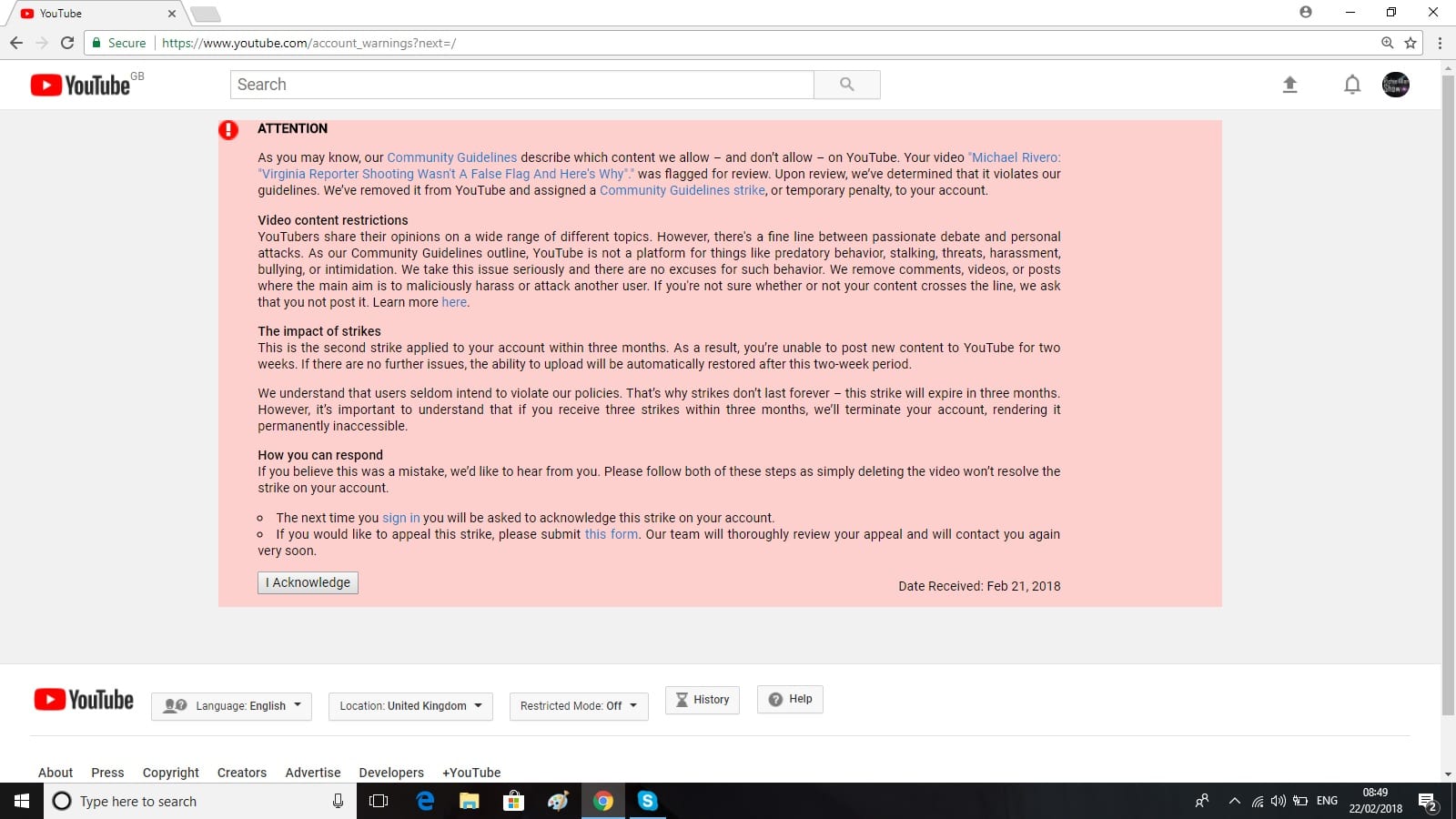
 Strike two came this morning. The offending video this time was an interview I did with Michael Rivero about the shooting of journalist Alison Parker and cameraman Adam Ward in Virginia in August 2015. Yes that’s right, YouTube has issued me with a community guideline strike for an interview I uploaded two and a half years ago. Get this, in the interview, Mike clearly states that he does not believe that the shooting was staged or a false flag. Mike talked about the background of the shooter Bryce Williams and what led him to murder the journalists. This morning, YouTube told me that the interview violated its guidelines on bullying and harassment. Again, there was no harassment or bullying. Mike went with the official story, as did I. Tough shit Paddy, that’s strike two. I was told today, that a third strike will see the channel deleted. A third strike is inevitable, as there are 1,400 interviews on the channel which was created in 2014. Oh and the punishment for strike two? We have been banned from uploading content to YouTube for the next three weeks.
This is fascism, this is tyranny, this is terrifying and we knew that this was coming didn’t we? Yes, there are other platforms but Google/YouTube is the only game in town. I could upload elsewhere, but those platforms don’t have the subscribers, it would be a waste of a lot of time for very little reward. The establishment knows this. This is why these monopolies were allowed to develop, so that they could come after shows like The Richie Allen Show when they felt like it. Over the last eighteen months, they have limited the reach of the channel by shadow banning it, in other words making it difficult for users to discover it. They even began demonetising the videos before they had even been published and then re-monetising them after they’d been watched over 5,000 times, meaning by the time the ads went on the vids, most people had watched them. I’ve talked about this and demonstrated it with photographic evidence. Now they’re about to delete the channel, the coup de grace.
 Now I mentioned that colleagues of mine in commercial TV/Radio had warned me that our channel would be specifically targeted. I’ve been warned time and again, but I knew it was coming anyway. Why The RA show specifically? The reason is simple. There is no other show like it in the independent media. We hold ourselves to the highest professional standards, our production values are second to none and uniquely, we put politicians, academics and other journalists on the air and ask them questions that they would never be asked on mainstream media. That has seen the show become the most listened to independent news show in Europe, the most downloaded podcast in news/politics on Podomatic and has seen us listed on Spotify and iheartradio.
Don’t call me arrogant. I am not now and never have been. I worked for and worked with the best producers and presenters in the world. I served my time and bring all that experience to bear on our show, it’s as simple as that. I am not important, the show is not and never has been about me. The information is the star, I’m just a gobby curmudgeonly Irishman, who learned his trade well. It’s always been about the amazing researchers who come on and share their discoveries and it is about getting their information to people who otherwise would be dismissive of conspiracy research. David Icke implicitly understood the importance of bringing mainstream production values to independent radio and the conspiracy research arena. We talked about it often and back in 2014, when he asked me to consider making my own show, produced edited and introduced by me and me alone, he said, “you can make alternative radio sound as good as or better than commercial radio.”
Of course beauty is in the eye of the beholder, ultimately the audience decides whether a show is any good or not, but there is overwhelming evidence here, that someone/something wants to make life very difficult for me, by removing our YouTube channel and deleting over 1,400 archived interviews. Google has served notice on The Richie Allen Show today, that there is no room for a professionally produced radio show, which asks uncomfortable questions and presents credible evidence that challenges the mainstream narrative.
February 23, 2018
Posted by aletho |
Civil Liberties, Full Spectrum Dominance | Human rights, YouTube |
Leave a comment
Canadians should prepare themselves for an onslaught of feel-good propaganda in the coming weeks as the world marks the 15th anniversary of one of the most horrific war crimes of the 21st century, the illegal invasion and occupation of Iraq by forces including the U.S., U.K., and Canada.
It will be disheartening to watch as liberal commentators from the Toronto Star and CBC engage in the most dishonest kind of smug, self-satisfied flag saluting, praising then-Liberal Prime Minister Jean Chretien for allegedly “declining” to sign on to the war. Yet the notion that Canada somehow decided not to be part of the Shock and Awe invasion of Iraq is a complete falsehood, and is well-documented elsewhere .
Lost within any of this self-congratulatory coverage will be the people of Iraq themselves, for whom 2018 marks 38 years of almost non-stop warfare and repression, during which they have endured hardships that are incomprehensible to most of us. The blood of the Iraqi people — millions of them killed, maimed, poisoned, irradiated, traumatized — is on the hands of many Canadian corporate, military, and political leaders who profited from weapons sales and political brinksmanship.
And while every Canadian government from Pierre Trudeau through to Justin Trudeau is in part responsible for this misery, no one has been held to account for aiding and abetting the crimes against humanity that have marked decades of aerial bombardment, the use of chemical and radioactive weapons (resulting in a massive spike in previously unseen birth defects), and an economic sanctions regime described by former UN inspectors as a “genocide.”
Was the price ‘worth it’?
Enforced throughout the 1990s in part with $1 billion in Canadian military muscle, those sanctions led to the monthly deaths of over 5,000 Iraqi children under the age of five, and provoked the high-profile resignations of UN humanitarian co-ordinators Denis Halliday and Hans Von Sponeck. When Halliday resigned in 1998, he stated: “I’ve been using the word ‘genocide’ because this is a deliberate policy to destroy the people of Iraq. I’m afraid I have no other view.”
What was one to make of a policy that deliberately targeted the importation of civilian goods that allegedly had “dual use,” from pencils and baby dolls to eyeglasses and shampoo? The equipment needed to fix electrical generating stations and water purification systems destroyed during the 1991 U.S. and Canadian bombing runs of Desert Storm was not permitted entry, so water-borne diseases ran rampant. The medicines needed to treat the spike in cancer (a result of tons of depleted uranium munitions dust that wound up in the Iraqi soil, air and water) didn’t get through either.
Bill Clinton’s secretary of state, Madeleine Albright, asked on the CBS program 60 Minutes if the sanctions-related deaths of a half million Iraqi children were worth it, famously replied, “We think the price is worth it.”
The people of Iraq were subjected to a Stalingrad-style siege, and while the general responsible for the Russian siege was charged as a war criminal at Nuremberg, Clinton now struts about the world stage as a self-styled “elder statesman” who runs a foundation where he paints himself as the second coming of Mother Theresa.
“In my life now, I am obsessed with only two things: I don’t want anybody to die before their time, and I don’t want to see good people spend their energies without making a difference,” Clinton crowed when the foundation began.
As Clinton continues to rake in obscene six-figure speaking fees for trotting out such tripe and basks in the “at least he wasn’t like Donald Trump” comparisons, New York oncologist Dr. Rafil Dhafir, who also believed no one should die before their time — especially in Iraq — remains behind the same prison walls that have marked his existence since his arrest 15 years ago this week for an alleged crime of compassion.
A crime of compassion
Dr. Dhafir was sentenced to 22 years for consciously violating the sanctions against the people of Iraq. Many individuals and groups who were not Muslim also violated the sanctions — fines were the worst punishment directed at a number of groups — yet Dhafir, as the driving force behind the Help the Needy Foundation, which provided millions in aid, was the only one to suffer such a fate. Needless to say, corporations that quietly went around the sanctions not for humanitarian goals, but to profit from their relationship with the Hussein dictatorship, did not face charges either.
Dhafir’s imprisonment began on the morning of February 26, 2003, when hundreds of federal agents swooped down on the community of Syracuse, New York. They knocked down his door, pointed a gun at his wife’s head, and ransacked his house, taking away any books related to Islam while leaving behind the Bible and tomes on American history.
Agents proceeded to terrorize patients at Dhafir’s clinic, and interrogated almost 150 primarily Muslim Help the Needy donors about how often they prayed, whether they had family in the Middle East, and whether they celebrated Christmas.
Cynically framed as a terrorism-related arrest as the U.S. prepared its invasion of Iraq, the first indictment of Dhafir contained 14 charges of violating sanctions. But when he refused a plea bargain, the government ratcheted up its already hyperbolic case, alleging an additional 45 alleged breaches of various financial laws related to the running of a charity as well as alleged Medicare fraud. The non-sanctions charges were speciously vague, and related to things like incorrectly filling out the complicated Medicare forms (many doctors refuse to treat Medicare patients as a result of their burdensome regulations, and even Medicare officials themselves appeared confused about them during the trial). Charges also arose from using another organization to issue Help the Needy’s tax receipts, a not uncommon practice. In any event, most such “white collar” cases, should they actually result in a trial, do not produce such serious consequences.
Refusing to be silent
As community members could testify, Dhafir was a hugely generous person, and opened his office not in Syracuse, where he could have made more money, but an hour away in Rome, New York, an under-served community. His reputation for providing interest-free loans, treating low-income patients, donating large chunks of money for schools and mosques, and assisting newcomers to the U.S. was legendary.
But Dhafir’s refusal to be silent in the face of genocide resulted in seven government agencies investigating Help the Needy and intercepting his mail, email, faxes and telephone calls, bugging his office and hotel rooms, combing through his trash, and also conducting physical surveillance. They were unable to find any evidence of terrorism links, yet the stench of such alleged associations infused the trial as a result of headline-grabbing outbursts from New York Governor George Pataki and Attorney General John Ashcroft.
After a six-week trial, Dhafir was convicted in February, 2005, though as the Syracuse New Standard pointed out, “The defense was forbidden during the trial to tell the jury that the government’s investigation of Dhafir had apparently begun as a terrorism hunt, nor was the defense allowed to argue that Dhafir had been selectively prosecuted for alleged crimes that are relatively common and do not usually result in criminal charges.”
Said former UN representative Denis Halliday: “I am stunned by the conviction of this humanitarian, especially as the US State Department breached its own sanctions to the tune of $10 billion. The policy of sanctions against Iraq undermined not only the UN’s own charter, but the Declaration of Human Rights and the Geneva Convention as well.”
During his time behind bars, Dhafir has developed a range of debilitating conditions, from an untreated hernia and diabetes, to chronic gout, significant back pain, and incipient cataracts. Even though he was originally sentenced to a medium-security prison within driving distance of his community, he was transferred to the notorious Communication Management Unit in Terre Haute, Indiana (a.k.a., “Little Guantanamo”), which was “home” to dozens of Muslims arrested as part of post-9/11 racial profiling paranoia. At the CMU, he could not have contact visits, his freedom to worship was severely limited, phone calls were rare, and he was harshly treated along with his fellow, isolated inmates.
When Barack Obama was getting ready to leave the White House, Dhafir, now aged 69, had the opportunity to apply for clemency, but declined to do so.
“How can an innocent person like me ask for this alleged commutation from a criminal, regardless of who she/he is?” he asked. While he is considering applying for non-medical compassionate release given his age and the fact that he has served so much time in prison, he watches as the world continues to treat the people of Iraq as a geopolitical punching bag and a $1 trillion economic opportunity. Indeed, Canadian companies are salivating at the chance to help “rebuild” the very infrastructure that they helped to destroy.
Dr. Dhafir, if forced to serve the remainder of his term, will not be released until he is 76 years of age. The lives of those he tried to save in Iraq — as well as the lives of patients who no longer had access to his compassionate and accessible medical services in New York State — are nameless victims to almost all of us, just some of the millions who have been sacrificed in the name of state security, war profiteers, and politicians addicted to militarism.
Further details of Dr. Dhafir’s case are available at www.dhafirtrial.net
February 22, 2018
Posted by aletho |
Civil Liberties, Subjugation - Torture, Timeless or most popular, War Crimes | Canada, Dr. Rafil Dhafir, Help the Needy, Human rights, United States |
Leave a comment
It seems that ‘the bots’ (especially the ‘Russian bots’) narrative is being used as a kind of defensive mechanism, journalist and human rights activist Mike Raddie told RT amid reports of a massive account purge on Twitter.
A crackdown on bot spam or dissent?
“The whole meme of the bots, especially the ‘Russian bots,’ is actually being used as a kind of defensive mechanism,” said Mike Raddie. “Whenever people criticize the corporate media in the West – we’ve done it with the Guardian – they come back and say, ‘oh, you’re part of a Russian bot army,’ or a typical question is, ‘what’s the weather like in St. Petersburg? Is it snowing in Moscow yet?’ So it’s a very useful meme for corporate journalists to deflect any kind of criticism, especially over hot topics such as Syria, Ukraine – things like this.”
A number of Twitter accounts are said to have been flagged over the past few days, in what many have speculated is part of the company’s efforts to clamp down on the much-touted army of Russian-controlled automated accounts, or “bots.” However, Twitter has yet to elaborate on the reported mass purge, which allegedly also targeted users with right-wing views – raising concerns of political censorship on the popular social media platform. The hashtag #TwitterLockOut began trending on the site shortly after the suspensions.
“If Twitter has begun this campaign of eliminating or blocking people that have different ideas than the company wants to portray or the message that they want to get out, I think it’s very harming to democracy and freedom of speech,” Christian Mancera, a lawyer and 2018 congressional candidate, told RT. “We have to keep every single channel of communication open, and just because a person has a conservative view doesn’t make that person an enemy, or make that person politically incorrect. So I hope that Twitter comes forward and clarifies.”
Although his own outlet’s Twitter account recently received a 12-hour suspension, allegedly for “criticizing a multi-billionaire,” Raddie suggested that most users who get hit with the ban hammer are likely victims of the company’s “crude algorithm,” and not singled out by an actual Twitter employee. However, he said the company’s recent behavior suggests that when Twitter “sees challenges, serious challenges, to the status quo, they’re likely to limit activity or even block accounts or delete accounts.”
Hunting for ‘Russian links’
Dragged in front of the US Senate last year as part of efforts to expose “Russian influence” in the 2016 presidential elections, Twitter initially revealed that it had identified 201 “Russia-linked” accounts operating on its platform. After Sen. Mark Warner (D-Virginia) expressed disappointment in the anticlimactic findings, Twitter raised its figure to 36,746.
As part of its autumn crackdown, Twitter banned an account owned by an African-American political activist from Atlanta – allegedly for her “links” to Russia. “This whole suppression of voices in using this Russian scare tactic is just way too far,” Charlie Peach, who has absolutely no ties to Russia, told RT back in October.
“In my lifetime I’ve never seen anything like this. I don’t remember the McCarthyism era, obviously, because I’m not that old, but my parents talked to me about it and things that were occurring at the time,” Peach told RT. “It ensures that the 1 percent continues to have a narrative and that anyone who opposes that are no longer allowed to speak. You look at CNN, MSNBC ‒ they gave us the Iraq War. This is what they do. The main media houses that run everything are the ones that continue to push the propaganda and make sure we’re shut down.”
In January, the US Senate Intelligence Committee published answers provided by Twitter, Facebook and Google in response to questions concerning Russia’s alleged use of social media to meddle with American democracy. In its written response, Twitter disclosed that it had identified nine accounts as being “potentially linked to Russia that promoted election-related, English-language content.” Of these nine nefarious accounts “potentially linked” to Russia, “the most significant use of advertising was by @RT_com and @RT_America. Those two accounts collectively ran 44 different ad campaigns, accounting for nearly all of the relevant advertising we reviewed,” according to Twitter. Conspicuously absent from Twitter’s written statement was the fact that the American tech giant traveled to Moscow to pitch a proposal for RT to spend huge sums on advertising for the US presidential election – an offer which RT declined.
‘Shadow ban’ controversy
More recently, in January, conservative journalism watchdog Project Veritas released undercover footage of current and former Twitter staff who appear to admit to silencing conservative voices using “shadow bans” – which block a user or their content from reaching a wider audience without their knowledge.
“We’re giving away an awful lot to these companies, but when they come out and publicly say they want to be the public forum for free speech, yet they’re censoring free speech and they are slanting what free speech can or cannot be heard, then there’s a problem,” Project Veritas executive director Russell Verney told RT.
Read more:
February 22, 2018
Posted by aletho |
Civil Liberties, Full Spectrum Dominance, Mainstream Media, Warmongering, Russophobia | Twitter, United States |
Leave a comment
Another terrible school shooting took place in Parkland, Florida last week and unfortunately many politicians and pundits have used the tragedy – as they often do – to push their own agenda. Many will use the tragedy to argue that Americans should be prohibited from owning guns. As if anti-gun laws would dissuade a disturbed or violent individual intent on causing harm. Those intent on mass murder don’t obey gun laws.
It’s unfortunate that while many are quick to demand that guns be taken away from peaceful Americans, they don’t seem to have much to say about guns when they’re in the hands of government authorities shooting innocent people. If we need any gun control, it is to get control of the guns in the hands of thousands of government employees who use them against innocent people with impunity.
For example, why do those calling for more gun control remain silent when armed federal agents raid Amish farms to stop them from selling raw milk? This shows the hypocrisy of those who call for restrictions on private firearms ownership while supporting the use of government violence as a means of controlling our lives.
Unfortunately there are many key questions lost in the race to score political points from the shooting.
Why does it always seem that the shooter in these mass killings has been on some kind of psychotropic drugs? As the New American magazine pointed out this week, at least ten high profile mass shootings have been committed by individuals who “were either on — or just recently coming off of — psychiatric medications.” The young killer in Florida was no different. According to his aunt, he had been on these medications to treat mental problems.
Why is no one questioning these medications – all of which come with labels warning of horrific side effects? Perhaps one reason they are ignored is that the pharmaceutical industry spends billions of dollars lobbying Congress.
Also, how is it possible that the FBI once again missed so many obvious clues that a violent person intent on causing massive harm to others was about to strike? Is the FBI actually this incompetent, or perhaps its focus was in other areas — like meddling in our own elections by presenting “evidence” they knew was flawed to the FISA court to get permission to spy on the Trump campaign?
We’ve heard many stories of how alert FBI field agents tried to alert their bosses before 9/11 that foreigners were taking flight lessons but were not interested in learning how to land the planes.
Is giving the federal government more power to spy on us – as they demand – the answer to stop these terrible crimes? Hardly!
Those who think that giving federal authorities greater surveillance powers might prevent mass shootings should consider that the FBI has been alerted that the latest school shooter had made Facebook posts and YouTube comments talking about his intention to be, as he put it, “a professional school shooter.” But the Bureau failed to properly investigate the tips. If the FBI fails to stop someone who openly boasts about their intentions on social media why should we believe that giving them the power to snoop on every American would increase our safety?
We cannot stop tragedies like this by banning guns. We need to look seriously into the psychotropic drugs that more and more Americans are being prescribed. We need to demand that our elected Representatives demand a real day of reckoning at the FBI. We need to keep focused and ignore those who politicize such events.
February 20, 2018
Posted by aletho |
Civil Liberties | FBI, Human rights, United States |
Leave a comment
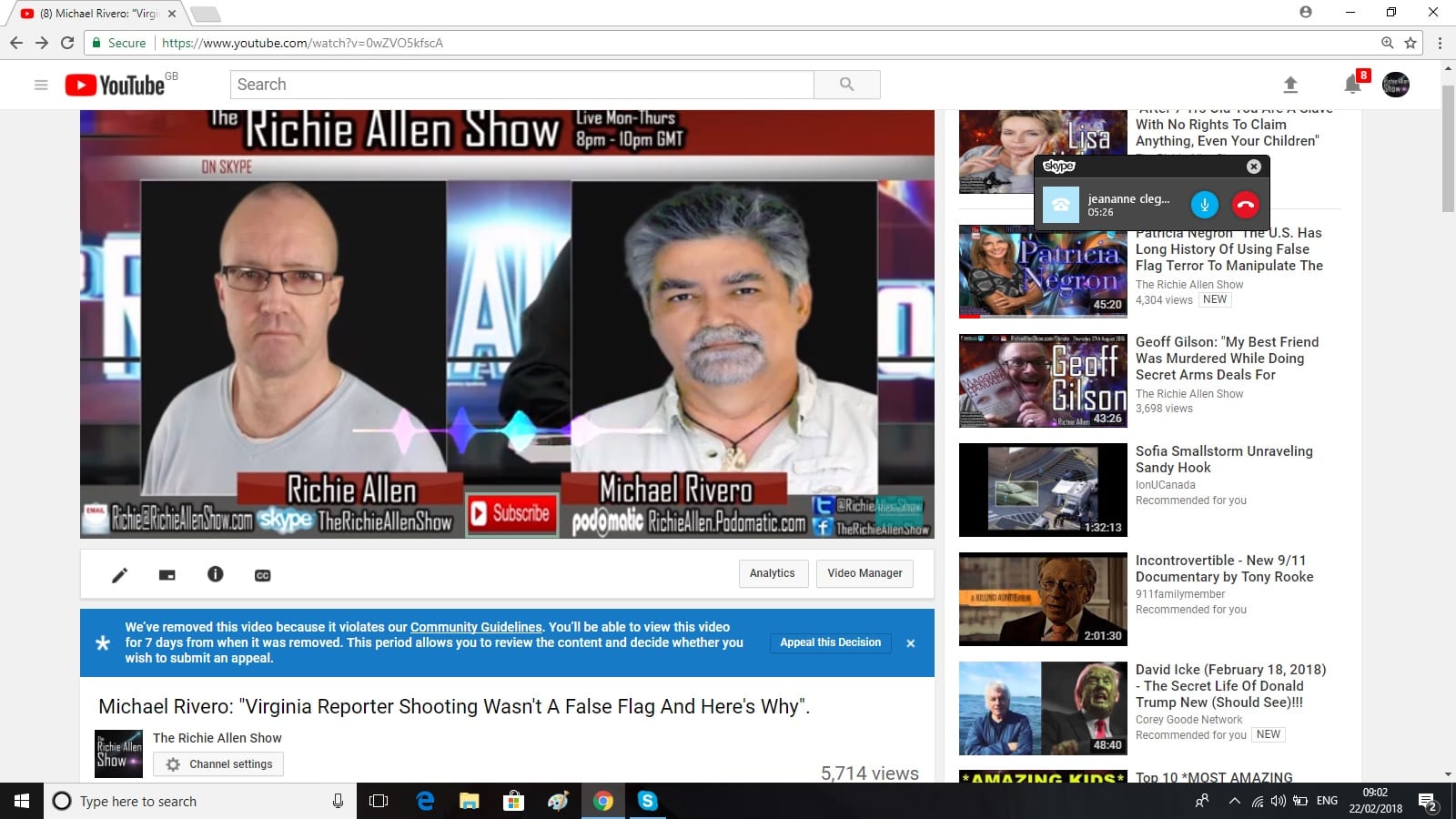 Strike two came this morning. The offending video this time was an interview I did with Michael Rivero about the shooting of journalist Alison Parker and cameraman Adam Ward in Virginia in August 2015. Yes that’s right, YouTube has issued me with a community guideline strike for an interview I uploaded two and a half years ago. Get this, in the interview, Mike clearly states that he does not believe that the shooting was staged or a false flag. Mike talked about the background of the shooter Bryce Williams and what led him to murder the journalists. This morning, YouTube told me that the interview violated its guidelines on bullying and harassment. Again, there was no harassment or bullying. Mike went with the official story, as did I. Tough shit Paddy, that’s strike two. I was told today, that a third strike will see the channel deleted. A third strike is inevitable, as there are 1,400 interviews on the channel which was created in 2014. Oh and the punishment for strike two? We have been banned from uploading content to YouTube for the next three weeks.
 Now I mentioned that colleagues of mine in commercial TV/Radio had warned me that our channel would be specifically targeted. I’ve been warned time and again, but I knew it was coming anyway. Why The RA show specifically? The reason is simple. There is no other show like it in the independent media. We hold ourselves to the highest professional standards, our production values are second to none and uniquely, we put politicians, academics and other journalists on the air and ask them questions that they would never be asked on mainstream media. That has seen the show become the most listened to independent news show in Europe, the most downloaded podcast in news/politics on Podomatic and has seen us listed on Spotify and iheartradio.
 Aletho News
