Endless war to mass surveillance: The White House effect
By Sam Sacks | RT | July 03, 2013
President Obama defended the spying scandal on his tour of Africa, and was joined by predecessor George W Bush, which highlighted how similar they have become by forgetting campaign promises while occupying the White House.
President Obama’s Africa trip is overshadowed by new allegations that the United States is committing widespread surveillance on its allies. The President defended these NSA programs saying that all countries are doing similar snooping.
“They’re going to be trying to understand the world better and what’s going on in world capitals around the world, from sources that aren’t available through the New York Times or NBC News,” he said in Tanzania this week.
He added, “I guarantee you that in European capitals, there are people who are interested in, if not what I had for breakfast, at least what my talking points might be, should I end up meeting with their leaders.”
Appropriately, just as President Obama was defending his administration against these spying scandals, he was joined in Africa by his predecessor, George W. Bush.
Presidents 43 and 44 met in Tanzania on Tuesday laying a wreath at the site of the 1998 American embassy bombings. They were together far, far away from the White House, an office currently dealing with the fallout from all its intelligence secrets being laid bare for the world to see. Secrets created by both Presidents Bush and Obama.
These two men couldn’t be more different. Barely of the same generation, they are from different socio-economic backgrounds, from different parts of the country, and from different intellectual backgrounds and professions. They had different upbringings, different hobbies, and different religious beliefs.
But they did hold the same office. And that’s why on Tuesday, in Tanzania, Bush and Obama looked more similar than ever before. It’s as though the White House took hold of these two very different men, chewed them up and spit them out into two monochromatic globs who forgot who they were before moving in to the highest office in the land. And most importantly forgot their ideals.
Remember, it was as a presidential candidate in 2008 that Barack Obama opposed mass domestic surveillance, saying: “I will provide our intelligence and law enforcement agencies with the tools they need to track and take out the terrorists without undermining our Constitution and our freedom. That means no more illegal wire-tapping of American citizens. No more national security letters to spy on citizens who are not suspected of a crime. No more tracking citizens who do nothing more than protest a misguided war. No more ignoring the law when it is inconvenient. That is not who we are.”
Edward Snowden’s leaks prove that now as President, Obama has thrown out all those campaign promises. Not only that, he’s expanded their global reach and justified this expansion by basically saying, “All countries are doing it so we have to also.”
This is what five years in the White House does to a person.
And remember, it was as a Senator in 2007 that Barack Obama supported legislation that would have protected journalists from heavy-handed subpoenas by the DOJ. It was called the Free Flow of Information Act, and it was directly opposed by George W. Bush in the White House. The legislation failed, and two years later, when Obama was in the White House, he made sure the legislation went nowhere, working actively to water it down. And then his Justice Department went to unprecedented lengths to target journalists at the AP and at Fox News.
And of course, one can only assume, that as a member of the Illinois Senate in 2002 when he spoke out so passionately against the Iraq War, that Barack Obama didn’t imagine a decade later he’d be at the helm of a global drone war targeting not just Afghanistan and Iraq, but also Pakistan, Yemen, and Somalia.
So, what causes the transformation? Maybe it’s what Eisenhower warned of in 1961 – the power of the military industrial complex. Maybe it’s the immense political pressure to keep the nation safe from terrorism. Maybe it’s the weight of responsibility of steering a world superpower. Maybe it’s a combination of all of these.
But the office has affected not just Obama and Bush, but also Clinton and George HW Bush and Reagan. All have used the force of our military around the world.
The only President who didn’t start his own conflict was Jimmy Carter more than 30 years ago. Carter also tried to ban extra-judicial assassinations. And today, he’s distinguished himself from both Bush and Obama, calling Snowden’s leaks “beneficial”.
But Carter was tossed out of the White House after only one-term. The Presidents who came later learned this lesson. And now, both of them two-term presidents meet in Africa. Bush, the man who created the machine, and Obama, the man who innovated it.
Both men shaped not by their political ideology, but by their time in the White House taking the reins of the American superpower and doing everything it takes – from war to mass surveillance – to hold on in a world that’s becoming more and more hostile to superpowers.
Obama Visits Mandela’s Old Cell, But Won’t Free His Own Political Prisoners
A Black Agenda Radio commentary by Glen Ford | July 3, 2013
President Barack Obama, a man of infinite cynicism, made a great show of going on pilgrimage to Nelson Mandela’s old prison cell on Robben Island, where the future first Black president of South Africa spent 18 of his 27 years of incarceration. With his wife and daughters in tow, Obama said he was “humbled to stand where men of such courage faced down injustice and refused to yield…. No shackles or cells can match the strength of the human spirit,” said the chief executive of the unchallenged superpower of mass incarceration, a nation whose population comprises only 5 percent of humanity, but is home to fully one-quarter of the Earth’s prison inmates.
True sociopaths, like the commander-in-chief who updates his Kill List every Tuesday, have no sense of shame, much less irony. Obama feigns awe at Mandela’s suffering and sacrifice in the prisons of apartheid South Africa, yet presides over a regime that, on any given day, holds 80,000 inmates in the excruciating torture of solitary confinement. During Nelson Mandela’s nearly three decades of imprisonment by the white regime, he spent a total of only about one week in solitary confinement. The rest of the time, despite often harsh treatment, backbreaking labor, and unhealthy conditions, Mandela and other political prisoners at Robben Island and other South African jails were typically housed together. Indeed, Mandela and his incarcerated comrades called the prisons their “university,” where they taught each other to become the future authorities over their jailers.
Racist South Africa’s treatment of Mandela and his co-revolutionists was downright benign and enlightened, compared to fate of U.S. prisoners who are deemed a threat to the prevailing order. At U.S. high security facilities, the slightest evidence that an inmate is of a political bent of mind is cause for him to be condemned to a solitary existence for decades – a social death alien to the human species. At California’s Pelican Bay and the state prison at Corcoran, thousands of inmates are held in isolation, 80 of them for more than 20 years, the very definition of barbarism. Yet, Obama journeys across oceans and continents to stand for a photo op in the cell of a prisoner whose ordeal was nowhere near as horrific as the standard fare for political prisoners in his own country.
On his trip to South Africa, Obama proclaimed that “the world is grateful for the heroes of Robben Island.” And, that’s certainly true, although it was a U.S. intelligence agent who lured Nelson Mandela into a trap in 1962 that ultimately led to his capture and imprisonment. Obama has no sympathy, however, for political prisoners of any race in his own country. Former Black Panther Herman Wallace is thought to be the longest-serving prisoner in solitary confinement in the United States, having spent 40 years alone in a cell in Louisiana’s notorious Angola Prison. Obama could free him at any time, but of course, he won’t. He could emancipate Black Panther captive Russell Maroon Shoatz, who has spent nearly 30 years in solitary, or Republic of New Africa political prisoner Mutulu Shakur or any and all of the scores of other aging political prisoners – people whose dedication to human freedom is no less than Mandela’s, yet have been subjected to far worse treatment at American hands. Instead, Obama has doubled the bounty on Shakur’s comrade and sister, Assata, in exile in Cuba. She might even be on Obama’s Kill List – which is the real and authentic legacy of this country’s First Black President.
Glen Ford can be contacted at Glen.Ford@BlackAgendaReport.com.
Related article
- Obama Falsely Asserts He Is Mandela Follower (alethonews.wordpress.com)
‘Restore the Fourth’: Reddit, Mozilla, thousands of people set for July 4 NSA spying protest
RT | July 3, 2013
Thousands of websites will launch a July 4 online protest against the NSA surveillance programs. Reddit, WordPress, and Mozilla will take part in the ‘Restore the Fourth’ campaign online, while live protests take place in cities across the US.
‘Restore the Fourth’ is aimed at restoring the fundamentals of the Fourth Amendment – the part of the Bill of Rights which protects citizens against unlawful searches and seizures. Participants will display an online banner which reads, “This 4th of July, we stand by the 4th Amendment and against the U.S. government’s surveillance of internet users.”
The campaign, which was spawned on Reddit, has the support of several privacy and press freedom advocacy organizations, including Mozilla, Free Press, the Electronic Frontier Foundation, the Freedom of the Press Foundation, and ColorOfChange.org.
The rally was largely organized by Fight for the Future – another non-profit agency which fights against internet censorship. The organization’s co-founder, Tiffiniy Cheng, said in a statement that “the NSA programs that have been exposed are blatantly unconstitutional, and have a detrimental effect on free speech and freedom of press worldwide.” The rally is expected to be Fight for the Future’s largest online mobilization since its actions against the Stop Online Piracy Act (SOPA).
But the protest doesn’t stop online. Organizers are planning live protests in dozens of US cities, including New York, Philadelphia, Boston, Washington, D.C., Los Angeles, San Francisco, Houston, and Atlanta. Doug MacArthur, a member of Restore the Fourth’s national board and moderator on Reddit’s r/news, expects between 10,000 and 20,000 people to take part in the protests in the nation’s larger cities.
MacArthur stressed the need for the protest, largely because mainstream media is failing to adequately cover the NSA leaks and what that means for everyday citizens.
“I think if you are on social media right now and political blogs, this might seem like it’s an issue that’s all over the political blogs. But if you turn on CNN or Fox or MSNBC, you’ll see that a lot of the more mainstream channels aren’t covering this as much as you might be assuming. So I really think it’s important we get more citizens aware of this issue,” he said, as quoted by Mashable.
Free Press CEO and President Craig Aaron echoed MacArthur’s sentiments. “We need to bring these government and corporate activities into the light of day, and the only way that will happen is if millions more people get involved and demand accountability, demand change, demand the truth,” he said in a Tuesday press conference.
However, it’s not just internet activists getting involved in the fight – one Hollywood celebrity has been very vocal in expressing his views on the NSA’s surveillance practices.
“How long do we expect rational people to accept using terrorism to justify and excuse endless executive and state power?” actor John Cusack said during a press conference announcing the protests. “Why are so many in our government, our press, our intellectual class afraid of an informed public?”
Cusack, who is a board member of the Freedom of the Press Foundation, complained that many of those defending the NSA surveillance programs are focusing on supposed character flaws of former NSA contractor Edward Snowden instead of questioning the program’s legality.
Harvey Anderson, senior vice president of business and legal affairs at Mozilla, agrees with Cusack. He said in a statement that the spotlight on Snowden is a “big distraction to avoid focusing on the invasions that have actually been occurring.” The lack of transparency about the surveillance programs “undermines the openness of the internet,” he added.
There has been a massive outcry against the surveillance practices since former NSA contractor Edward Snowden leaked sensitive information in May. In just three weeks, StopWatching.us has collected more than 531,000 signatures from people calling for Congress to fully disclose details about the NSA surveillance programs.
Snowden is currently held up in the international transit zone of Moscow’s Sheremetyevo airport. He is unable to travel as his passport is invalid. Washington has issued an extradition order against Snowden, calling for international cooperation in returning him to American soil.
The whistleblower has so far made asylum requests for more than a dozen countries, with ten nations already denying him refuge. Venezuela says it will consider Snowden’s request when it is received.
Related article
Bolivia’s Morales Dissed and Pissed as France, Portugal, and Austria Violate Diplomatic Immunity
By Dave Lindorff | This Can’t Be Happening | July 3, 2013
Those of us who have been saying that the US has become a weak, or at least more ordinary power among many in the world because of its military failures in Iraq and Afghanistan, and because of its economic decline, will have to recalibrate our analysis after watching the pathetic behavior of the leaders of Russia, Germany and France under pressure from the Obama administration not to allow Edward Snowden to gain asylum in those countries or even to escape his purgatory in Moscow’s Sheremetyevo Airport.
Last night, in an astonishing display of fawning obedience to the demands of US leaders, France and Germany first announced that they would not grant asylum to Snowden, despite broad popular support by French and German people for such an offer of aid to the embattled whistleblower. Then, France and Portugal abruptly refused to allow a Bolivian aircraft carrying the country’s president, Evo Morales, from a state visit with Russia’s Vladimir Putin, to land for refueling in their countries, saying that they were concerned he might be flying Snowden to asylum in Bolivia.
Although Spain said eventually it would allow the Morales plane to refuel in the Canary Islands, it did not have enough fuel to get there and had to be diverted to Vienna, where, astonishingly, it was then searched like a drug-smuggling flight over Bolivian protests. Snowden was not aboard. A furious Morales immediately blamed the US Department of State for the whole incident — a charge that no one has disputed, though of course the US is refusing to comment.
Aircraft carrying national leaders have absolute diplomatic immunity under international law and moreover, Bolivia would have the absolute right to grant Snowden amnesty, and to bring him to its territory, whether or not he had a valid passport. As the leader of a sovereign nation, Morales has every right to carry anyone he wants on his plane with him back to his country.
Bolivian President Evo Morales, forced under US pressure to land in Vienna to have his returning plane searched for Snowden, calls the blocking of his flight from Russia to Bolivia a “kidnapping,” and “act of aggression” and an “offense against all the whole Latin region.”
That France, Portugal and Austria would so violate such basic diplomatic rules suggests that the US (which of course has long demonstrated that it views diplomatic rules and international law as applying only to others, but not itself) has some powerful leverage to exert behind the scenes. The more so because this whole incident makes leaders like French President Francois Hollande, who only the day before had suggested his country might consider Snowden’s asylum appeal, look foolish, and because this aggressive and hostile action taken against the leader of a sovereign nation makes France, as well as Portugal and Italy, look pathetic and ridiculous at a time that public sentiment across Europe is solidly in support of Snowden. (An activist friend in Germany reports that sentiment there in support of Snowden and even of granting him asylum is “probably at about 80%,” and that is probably also true in France.)
This latest incident, which has incredibly not been protested either by Russia’s Putin, from whose country the disrupted flight originated, and who was Morales’ official host, also exposes Putin and Russia as being under America’s thumb. Who could have imagined Putin allowing a meeting of leaders in his own country to be so shamed by US intervention involving diversion and impoundment of a foreign leader’s return flight home without a loud protest and even some counter action. At a minimum the US ambassador should have been called in to be tongue-lashed by the Russian president. Yet even Russian state television station RT-TV, in its report on the halting of Morales’ plane and the unprecedented search of a state leader’s plane in Austria, carried no comment from Putin or the Russian government on the insult and outrage.
Has the US, with its incomprehensibly massive spy network, just demonstrated that it now has a power greater than its nuclear arsenal: a dossier perhaps on almost every leader in the world with which it is able to blackmail even the likes of Hollande, Merkel and Putin? It is hard to come up with another explanation for the way this incident played out.
We will have to see now whether Morales, a popular leader from an impoverished indigenous background who is clearly no coward and who is probably too clean to be blackmailed, will make good on his assertion made in Moscow that Snowden would be welcome in Bolivia. Russia could recover a modicum of its self-respect by flying him there on a Russian plane to avoid similar US-orchestrated interference. Venezuela’s new president, Nicolás Maduro, who has also spoken favorably of granting asylum status to the National Security Agency whistleblower, should also step up at this point. Since he is still in Russia, he could offer to bring Snowden back home with him, and dare the nations of Europe to try and stop him.
Europeans are pissed off already at the US, in the wake of National Security Agency leaker Snowden’s latest revelation that the US was aggressively spying on its European allies, both at their and the European Union’s embassies in Washington, and in Europe itself, gleaning not information about terrorism, but inside-track knowledge about trade negotiation positions and other areas of disagreement or negotiation.
Leaders in Germany, France, Italy, and other European countries are demanding that the US cease its spying on them, and give a “full accounting” of the spying that it has been engaging in. But given the steady stream of lies coming from the NSA, the Obama Administration, Secretary of State John Kerry, and other American sources, why should they believe anything they are being told? Most Europeans understand now that all this bluster from their leaders is just that: bluster.
Europe’s leaders have shown themselves to their own people to be sell-outs in the pocket of the US. As several commenters on the website of the German magazine Der Spiegel, which last week ran a cover expose about the NSA spying program directed against European leaders, have written, Germany’s and France’s leaders have sold out their countries and people by caving in to US demands. As one person wrote: “Our government has sold us out and is beyond help.”
To be sure there was a wave of tough talk only days earlier, with, for example, Martin Schulz, the president of the European parliament, saying that the NSA is like the Soviet-era KGB, and with leaders of countries like Ireland and Norway saying that they might consider amnesty for Snowden, but only if he could reach their soil first — a ludicrous requirement, since there is no international law requiring such silliness. Any country can grant asylum to any person it wishes, wherever that person may be at the moment. They cannot offer protection, of course, except in an embassy or in-country, but that’s different from just offering a grant of amnesty. Indeed, the mere fact that the US has cancelled Snowden’s passport doesn’t mean his passport cannot be respected as a travel document by another country. How, in fact, when you think about it, would a country know that a person’s passport had been “cancelled” unless the issuing nation had issued some kind of news release about it as the US did in Snowden’s case? There’s no international registry of global passports. Those records are held closely by each country and in fact are supposed to be secure. Bolivia, Venezuela, Ecuador, Norway, Ireland or any other country that had said at any point that it would be willing to accept Snowden, could stamp their visa on his passport and accept him on their planes. (Even the US Passport Office accepts an old, expired passport as an identity document when one is applying for a new one.)
After this abject display of rank servitude in the interest of the US Imperium by some of Europe’s most powerful nations, if little Bolivia and/or Venezuela don’t step up and show Europe how sovereign nations are supposed to act, it will be up to the people of Europe and Latin America to act.
Already, Latin nations seem to be rallying, with protests across the continent, and with Argentina’s President Cristina Fernández de Kirchner, Ecuador’s President Rafael Correa, and Cuba’s retired leader Fidel Castro expressing anger at the diversion of the Morales plane. An “urgent” Latin American leadership meeting is planned over the crisis, and if it is not just talk, this could indicate that the US may have overstepped in insulting a region that has been growing increasingly assertive about resisting US diktats.
Certainly, following the latest revelations in the Guardian, Der Spiegel, and elsewhere showing that the NSA has been vacuuming up data on millions of Europeans, and with former NSA and CIA director Michael Hayden stating publicly that the Fourth Amendment to the US Constitution — the one that at least used to protect Americans’ right to privacy and from government search and seizure — “is not an international treaty,” the anger among Europeans at US spying is swelling too, and with it, support for the embattled whistleblower Snowden.
We can only hope that the revelations of outrageous US intelligence abuses and violation of Europeans’ privacy rights will continue, that the rage against the US among ordinary European citizens will grow. We can only hope that with that growing rage, a desire to stick it to the US by protecting Snowden will grow too, until some European leader finally sees it as a popular or necessary move to offer him asylum.
This latest abomination in the treatment of Bolivia and its leader, which has shamed France, Portugal, Austria, Italy and Russia, will be a great test of how angry the peoples of those countries are about their leaders’ servile behavior towards the US.
Of course, we in the US should be the most outraged of all, but sadly, there is probably even less chance that a majority Americans will get angry at all this than that Europeans will.
Related article
Iran Calls on Egypt Army to Play Its Role, Respect People’s Vote
Al-Manar | July 2, 2013
Iran urged the Egyptian armed forces on Tuesday to play their role in supporting national dialogue and respecting the people’s vote.
Deputy Foreign Minister for Arab and African Affairs Hossein Amir-Abdullahian said on Tuesday that Tehran saw the involvement of Egyptian people in the domestic affairs of the country as a national asset, and that paying attention to the popular vote contributed to stability in Egypt.
The Iranian official also commented on the fact that President Mohammad Mursi was chosen through national election, warning the Egyptian people against foreign plots.
“Mohammad Morsi is the incumbent president based on the people’s vote,” Abdollahian told the official IRNA news agency.
He warned against division within Egypt. “Dividing the Egyptian nation yields no gain,” Abdollahian said, adding that respecting people’s vote was of utmost importance for Egypt’s stability.
The Egyptian army on Monday issued an ultimatum to Mursi, the country’s first democratically elected president, threatening to intervene in 48 hours and impose its own “road map” if the Islamist did not meet the demands of the people.
The army’s warning came just a day after millions of protesters took to the streets across Egypt, calling for Mursi to step down.
The Egyptian presidency rejected the ultimatum, insisting that Mursi would continue on his own path towards national reconciliation.
Brazil: Rousseff Offers Protesters a Plebiscite

Weekly News Update on the Americas | July 1, 2013
On June 24 Brazilian president Dilma Rousseff began a week of meetings with various groups—youths, unionists, campesinos, political party leaders, state governors, congressional leaders and Supreme Court members—in response to the massive protests that broke out in the middle of the month [see Update #1181]. Rousseff initially proposed a plebiscite on holding a constituent assembly to reform the Constitution, but she quickly dropped the idea. Instead, she proposed a plebiscite that would allow voters to choose from various options in three areas: public financing of political campaigns, methods of electing legislators and voting by party list. The vote would be held by October.
In a note published on June 28, former president Luiz Inácio Lula da Silva (2003-2011) supported Rousseff’s proposal, which he said “has the merit of breaking the impasse on this decisive question, which for decades has entered and left the national agenda without accomplishing significant changes.” Rousseff and Lula are both members of the center-left Workers Party (PT). The opposition parties oppose the plan, which some analysts think could open the way to the sort of political transformation that center-left presidents have carried out in other Latin American countries. In the opposition’s counter-proposal, the National Congress would develop a reform plan and the government would then hold a referendum allowing voters to accept or reject the entire project. (El País (Madrid) 6/28/13 from correspondent; La Jornada (Mexico) 6/29/13 from AFP, DPA, Notimex)
For its own part, the National Congress responded to the protests with legislation, much of which had been stalled for months. On June 26 the legislators voted down a constitutional amendment that would have limited federal prosecutors’ authority to investigate crimes; many protesters considered the amendment an effort by politicians to stymie corruption investigations. In addition, the Senate passed a bill making corruption a crime as serious as murder or rape; the Chamber of Deputies is expected to pass it later. The Chamber passed a bill allocating 75% of revenues from oil production to education programs and the remaining 25% to healthcare.
Meanwhile, the protests continued, although on a smaller scale than the week before. On June 26 some 50,000 people demonstrated in Brazil’s third largest city, Belo Horizonte in the eastern state of Minas Gerais, while Brazil’s soccer team was playing the Uruguayan team; the allocation of funds to international sports competitions rather than education and health has been a major grievance in the demonstrations. Hooded youths threw rocks at the police, who used tear gas to keep the protesters 3 km away from the city’s Mineirão stadium. According to the authorities a young man was seriously injured and at least 24 people were arrested; looting was reported, along with two fires and damage to dozens of stores. In Brasilia, protesters kicked soccer balls towards the police line at the Congress building. (La Jornada 6/27/13 from Reuters, AFP, DPA, Xinhua)
One of the main triggers of the mass protests was a series of small demonstrations early in June by the Free Pass Movement (MPL), a São Paulo-based organization fighting an increase in transit fares. MPL was the first group scheduled to meet with Rousseff on June 24. Before the meeting, they issued an open letter to the president saying they were surprised by the invitation since “social movements in Brazil always suffered repression and criminalization…. We hope that this meeting will mark a change of position by the federal government that will extend to other social struggles: to the indigenous peoples, who, like the Kaiowá-Guaraní and the Munduruku, have suffered various attacks from large landowners and the public power; to the communities affected by evictions; to the homeless; to the landless; and to the mothers whose children were murdered by the police in the peripheral neighborhoods.” (Adital (Brazil) 6/24/13)
Related article
- Brazil protesters give Rousseff tenuous truce (thestate.com)
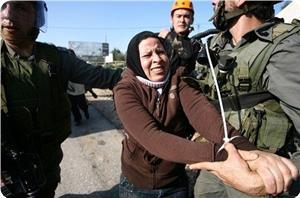
Report: 1,790 Palestinians Kidnapped, 16 Killed, In First Half of 2013
By Saed Bannoura | IMEMC & Agencies | July 1, 2013
The Ahrar Center for Detainees Studies and Human Rights have reported that Israeli soldiers kidnapped 1,790 Palestinians in the first six months of this year, including 300 who were kidnapped in June, and added that 16 Palestinians have also been killed by the Israeli military in six months.
The Ahrar Center said that dozens of women, children, elderly, legislators, intellectuals and journalists were among the kidnapped.
The center added that the arrests took place in every part of the occupied West Bank, including Jerusalem, in addition to 25 arrests in the Gaza Strip, including fishermen and five arrests at border terminals.
Most of the arrests have been carried out in the Hebron district, in the southern part of the West Bank. The second highest number of arrests was carried out in Jerusalem, followed by Nablus.
Ahrar said that February witnessed the largest number of arrests as the soldiers kidnapped 382 Palestinians, while 350 have been kidnapped in January, 300 in June, 263 in May, 259 in April and 236 in March.
The center further reported that the army also kidnapped 7 Palestinian legislators identified as Ahmad Attoun, Hatem Qfeisha, Abdul-Jabbar Foqaha, Imad Nofal, Basem Za’areer, Mahmoud Ramahi, and Mohammad Jamal An-Natsha.
Furthermore, Ahrar said that the army also kidnapped 33 women, including wives and relatives of political prisoners held by Israel, and that 17 of the kidnapped women are still imprisoned by Israel.
The Ahrar Center also said that 14 Palestinians, including 10 from the West Bank, and four from the Gaza Strip, have been shot and killed by the Israeli army since the beginning of this year, in addition to two Palestinian political prisoners who died in Israeli prisons.
Detainee Arafat Jaradat, 33, from Hebron, died of extreme torture by Israeli interrogators, and detainee Maisara Abu Hamdiyya, 64, died of an advanced stage of cancer resulting from the lack of medical treatment in Israeli prisons.
Four more Palestinians have been killed by Israeli military fire in the Gaza Strip.
Head of the Ahrar Center, Fuad Al-khoffash, stated that the center documented daily Israeli military invasions; daily arrests and assaults, and demanded the International Community to act against the ongoing and escalating Israeli violations.
Mass protests after Indian forces kill two in Kashmir
Press TV – June 30, 2013
Indian security forces have shot dead at least two people in the north of Indian-administered Kashmir, prompting huge anti-India protests.
An Indian police official said that soldiers surrounded a few houses in the village of Markondal in Bandipora District, about 25 kilometers (15.5 miles) north of the main city of Srinagar, before dawn on Sunday.
A teenage boy was killed during a search operation.
A second person was killed after the Indian army shot at local residents who were protesting the earlier deadly incident. According to witnesses, three other people were also wounded.
The killings triggered mass protests in the area. Angry demonstrators chanted slogans against the Indian army.
Reports coming out of Kashmir suggest that Indian authorities are considering imposing a curfew to defuse tensions in the region.
Kashmir lies at the heart of more than 65 years of hostility between India and Pakistan. Both countries claim the region in full but each only has control over a section of the territory.
Over the past two decades, the conflict in Kashmir has left over 47,000 people dead by the official count, although other sources say the death toll could be as high as 100,000.
Related article
- Singh visit prompts protests (morningstaronline.co.uk)
Featured Video

Why Hamas Really Attacked Israel on Oct. 7
or go to
Aletho News Archives – Video-Images
From the Archives
Confronting the Threat of Ethnic Bioweapons
By Tony Cartalucci – New Eastern Outlook – 29.11.2017
The United States Air Force’s 59th Medical Wing’s molecular biology branch recently was revealed to have been collecting specifically Russian RNA and synovial (connective) tissue samples, prompting fears in Russia of a possible US directed ethnic-specific bioweapons program. … continue
Blog Roll
 Aletho News
- Why Yemen Is Bombing Saudi Arabia’s Airports: The War Behind the Headlines
- Sally Rooney’s books pulled from UK over support for Palestine Action
- Bombs for Tel Aviv, Promises for Riyadh
- Israeli ad agency conducted vast global espionage campaign using online ads: Report
- Oct. 7 Forever Marks The Big Reveal: ‘We See You, Israel, We Revile You, We Reject You!’
- Meet the US generals and admirals advancing Israeli policy
- Israel’s Straw Widow Protocol: The Kill Zones Where Civilians Were Labelled ‘Terrorists’
- Leading Israeli Think Tank Publishes Psychotic Israeli ‘National Security’ Doctrine
- Are the United States and Israel in Decline-and-Fall Mode?
- Why Hamas Really Attacked Israel on Oct. 7
- If Americans Knew
- Israeli firm used online ads to run vast spy operation, researchers say
- No, the world zionist movement is not an antisemitic conspiracy theory
- Hundreds of IDF investigations into killings still have no public outcome, BBC Verify finds
- After Ashley Moody Epstein Probe, Donors Linked to Him Poured Money Into her Senate Campaign
- Worried about Russian meddling in UK politics? Wait till you see what Israel is up to
- Israeli settlers attack West Bank center for disabled children, church leader calls for int’l action
- Pulling Out Teeth Just to Live: How Israel Has Devastated Dental Care in Gaza
- Gaza’s “ceasefire” death toll passes 1,500 – Daily Update
- Activists Abused By Israel Return to New Freedom Flotilla Mission
- 60 Minutes won’t tell the full truth about Israeli settler violence
- No Tricks Zone
- New Study Suggests Large Regions Of The Pacific Ocean Have Been Cooling For The Last 80 Years
- Germany’s Green Energy Debacle: High Energy Costs Force Kahla Porzellan to Close After 182 Years!
- New Study: 50 Years Of The Most Aggressive ‘Net Zero’ Policies Can Only Affect The Global Climate By 0.03°C
- US September “Heat” Was No Record…Many Records Set Decades Ago
- Latest European Green Energy Debacle; Portugal’s Largest Flagship Solar Park Insolvent!
- Green Energy Debacle: German Expert Professor Fritz Vahrenholt Warns Of Severe Economic And Social Consequences
- Two More Paleo Reconstructions Affirm Meters-Higher Sea Levels Across Ireland, Brazil 7000-6000 Years Ago
- New Study: Earth And Venus Surface Warmth Largely Explained By Convection And Lapse Rate, Not CO2 Or Radiation
- 2025 Nature Paper Claiming Worsening Global Drought Gets RETRACTED …Heavily Flawed
- New Study: ‘Global Drought Shows No Detectable Recent Acceleration Under Climate Warming’

