As Donald Trump re-enters the White House on a pledge to end national security state overreach, the Federal Bureau of Investigation is still hiding critical details on the Russia conspiracy investigation that engulfed his first term.
In response to a Freedom of Information request filed by RealClearInvestigations in August 2022, the FBI on Dec. 31, more than two years later, released a heavily redacted copy of the document that opened an explosive and unprecedented counterintelligence probe of the sitting president as an agent of the Russian government.
The Electronic Communication, dated May 16, 2017, claimed to have an “articulable factual basis” to suspect that Trump “wittingly or unwittingly” was illegally acting on behalf of Russia, and accordingly posing “threats to the national security of the United States.” The FBI’s “goal,” it added, was “to determine if President Trump is or was directed by, controlled by, and/or coordinated activities with, the Russian Federation.” It additionally sought to uncover whether Trump and unnamed “others” obstructed “any associated FBI investigation” – a reference to Crossfire Hurricane, the initial FBI inquiry into the Trump campaign’s suspected cooperation with an alleged Russian interference plot in the 2016 election.
While Crossfire Hurricane, which was formally opened on July 31, 2016, had by that point focused on members of Trump’s orbit, the May 2017 probe was specifically targeted at the president himself during his fourth month in office. The investigation of Trump was undertaken at the behest of then-acting FBI director Andrew McCabe, one week after Trump had fired his former boss and mentor, James B. Comey.
According to the declassified document, McCabe’s decision was approved by FBI Assistant Director Bill Priestap, who had also signed off on the opening of Crossfire Hurricane; and Jim Baker, the FBI general counsel. Baker was a longtime friend of Michael Sussmann, a lawyer for the presidential campaign of Hillary Clinton, and a key figure in the dissemination of Clinton-funded disinformation to the FBI that falsely tied Trump to Russia. In his FBI role, Baker personally circulated the conspiracy theory, manufactured by “researchers” working with the Clinton campaign, that the Trump campaign and Russia were communicating via a secret server. After leaving the FBI, Baker served as deputy general counsel at Twitter, where he backed the company’s censorship of reporting on the contents of Hunter Biden’s laptop, based on yet another conspiracy theory that the laptop files were Russian disinformation.
Shown, the first two pages of a newly released document that opened an FBI probe of Donald Trump in May 2017. The remaining four pages are completely redacted, leaving unstated the FBI’s “articulable factual basis” on Page 1.
FBI via RealClearInestigations
As with Crossfire Hurricane, the May 2017 case was opened as a Foreign Agents Registration Act investigation, and also deemed a “Sensitive Investigative Matter” to reflect Trump’s status as the nation’s top public official. The FBI document indicates that it was launched as a full investigation, which would have granted investigators targeting Trump with sweeping surveillance powers.
While the declassified document records the FBI’s theory that then-President Trump might be involved in illegal – and potentially treasonous – behavior, the “articulable factual basis” for this suspicion is redacted. Only a few paragraphs of the six-page document have not been withheld.
Along with Crossfire Hurricane, the May 2017 counterintelligence probe was folded into the Special Counsel investigation led by Robert Mueller, who was appointed just one day after the FBI began portraying Trump internally as a possible Russian agent or conspirator. Mueller’s final report “did not establish that members of the Trump campaign conspired or coordinated with the Russian government in its election interference activities.”
Asked about his reasoning for opening the probe and related matters, McCabe, who now works as an on-air commentator at CNN, did not respond to RCI’s emailed questions by the time of publication.
Details about the FBI’s motivation can be gleaned, however, from other public disclosures.
According to a January 2019 account in the New York Times, which first revealed the FBI’s decision to investigate Trump, the Steele dossier – a collection of conspiracy theories funded by Trump’s rival, Hillary Clinton – was among the “factors” that “fueled the F.B.I.’s concerns.”
Just two days before McCabe opened the May 2017 probe, the FBI, via Justice Department official Bruce Ohr, renewed contact with dossier author Christopher Steele despite having terminated him as a source back in November 2016. As RCI’s Paul Sperry has previously reported, this sudden outreach to Steele right before the opening of a new Trump-Russia conspiracy investigation indicated that the FBI was seeking to re-engage the Clinton-funded British operative to help it build a case against the president for espionage and obstruction of justice. At the time, the FBI was still relying on Steele’s fabrications for its surveillance warrants against Trump campaign volunteer Carter Page. The following month, the FBI filed the last of its four FISA court warrants based on Steele’s material. The Justice Department has since invalidated two of those warrants on the grounds that they were based on “material misstatements.”
The FBI re-enlisted Steele despite possessing information that thoroughly discredited him. Five months before it newly sought Steele’s help to investigate the sitting president, the FBI interviewed Igor Danchenko, whom Steele had used as his dossier’s key “sub-source.” In that January 2017 meeting, Danchenko told FBI agents that corroboration for the dossier’s claims was “zero”; that he had “no idea” where claims sourced to him came from; and that the Russia-Trump rumors he passed along to Steele came from alcohol-fueled “word of mouth and hearsay.” The FBI had also been unable to corroborate any of Steele’s incendiary claims.
A previously disclosed document also shows that former CIA Director John Brennan – who insistently advanced the Trump/Russia conspiracy theory – informed then-president Barack Obama in July 2016 that the Clinton campaign was planning to tie Trump to Russia in order to distract attention from the controversy over Hillary Clinton’s use of a private email server while serving as secretary of state. By that point, the Clinton campaign was already paying for the fabricated reports produced by Steele, who made contact with the FBI as early as July 5.
Although the newly declassified document attempts to suggest that the FBI had actionable intelligence to suspect Trump of being a Russian agent, McCabe’s subsequent comments indicate that there was no such evidence on offer. Instead, McCabe has said his counterintelligence probe of Trump was primarily motivated by the president’s firing of Comey. In a February 2019 interview with CBS News, McCabe explained his thinking as follows: “[T]he idea is, if the president committed obstruction of justice, fired the director of the of the FBI to negatively impact or to shut down our investigation of Russia’s malign activity and possibly in support of his campaign, as a counter intelligence investigator you have to ask yourself, ‘Why would a president of the United States do that?’ So all those same sorts of facts cause us to wonder is there an inappropriate relationship, a connection between this president and our most fearsome enemy, the government of Russia.”
McCabe therefore had no evidence that Trump had a “connection” to Russia, and in fact could only “wonder” if there was one. Yet because Trump had fired Comey, whose FBI was already investigating Trump’s campaign for Russia ties and relying on the Clinton-funded Steele dossier in the process, McCabe decided that he had grounds to order an espionage investigation of the commander in chief.
With the official predicate for that May 2017 investigation still redacted by the FBI, McCabe’s public statements offer the only insider window into why it was opened. In all of the investigations related to alleged Russian interference to date, the Justice Department has pointedly avoided the question.
Despite inheriting McCabe’s probe – and debunking claims of a Trump-Russia conspiracy related to the 2016 election – Special Counsel Mueller made no mention of the Trump as Russian agent theory in his final report of March 2019. Without informing the public, the FBI closed down the Trump counterintelligence investigation the following month. The case’s closing Electronic Communication, which has previously been declassified in redacted form, states that the McCabe probe “was transferred to FBI personnel assisting” the Mueller team, and entailed the use of “a variety of investigative techniques.”
An inquiry led by Department of Justice Inspector General Michael Horowitz of the FBI’s conduct during Crossfire Hurricane also ignored McCabe’s decision to investigate Trump as an agent of Russia. And in a footnote in his final report of May 2023, John Durham – the Special Counsel appointed to launch a sweeping review of the Russia investigation – claimed that McCabe’s May 2017 probe was outside of his purview.
By contrast, when it comes to Crossfire Hurricane, Durham’s report concluded that the FBI did not have a legitimate basis to launch that investigation, repeatedly ignored exculpatory evidence, and buried warnings that Clinton’s campaign was trying to frame Trump as a Russian conspirator.
While the original Trump-Russia investigation has been discredited, the public remains in the dark about why the FBI launched a follow-up counterintelligence probe that targeted Trump while he was newly in the White House – and what ends it took to pursue it.
With Trump set to be inaugurated this month after vowing to clean up the nation’s premier law enforcement agency, the FBI will have a fresh opportunity to break its longstanding secrecy on the decision to investigate the sitting, and newly returning, president as an agent of Russia.
The incoming National Security Adviser Mike Waltz said the Trump administration would target Iran in the Middle East and crack down on pro-Palestian protesters in the US to support Israel.
In an interview with Mark Levin, Waltz explained the “philosophy” of the incoming administration for the Middle East. “The problems in the Middle East by and large originate from Tehran, not from Tel Aviv. We’re going to stand by and support our greatest ally in the Middle East,” he said. “We’re aligned from a national security, intelligence and values standpoint.”
Waltz described this policy as instituting a “complete philosophical, wholesale national security shift.”
“We’re going to align with our ally Israel, we’re going to realign the common interests of the Gulf Arab states with Israel in opposing Iran’s aggression, we’re going to reinstate maximum pressure, we’re going to stop them from selling their illegal oil that has been funding terrorism,” he said. Adding that the US military is “getting worn out shooting missile after missile from this ragtag bunch of Houthis. We’re going to get that under control.”
President Joe Biden has provided Israel with $22 billion in military aid since the October 7 attack. On Friday, Axios reported that Biden was planning to approve a final $8 billion arms sale to Israel. The current White House has also protected Tel Aviv at the UN Security Council and fought a war against the Houthis in Yemen to defend Israel.
Additionally, the Biden administration increased the Trump-era sanctions on Iran and refused to return to the Obama-era nuclear agreement. The White House deployed its most advanced air defense systems to Israel to protect it from a potential Iranian missile attack.
Still, Republicans in Washington and Israeli Prime Minister Benjamin Netanyahu have attacked Biden for not providing Israel with enough support. The current administration has pushed Tel Aviv to allow most aid into Gaza.
However, Tel Aviv has largely defied Washington’s requests to allow more aid into Gaza. In December aid shipments sunk to 71 trucks per day, far below the number, 500, aid agencies say is needed to prevent deaths of deprivation in Gaza. Gazan children have begun to freeze to death at night as their families shelter in tents.
CNN reports that the incoming administration will be more amenable to Israel’s policies of further restricting aid shipments to Gaza and will further cut deliveries once Trump returns to office.
Waltz went on to say the Trump administration would crack down on pro-Palestinian protesters. The US government will “look at mosques, individuals, universities, professors – you name it – that post a threat to the United States and are radicalizing individuals to harm the United States.” He continued referring to pro-Palestinian campus protesters, people “here on a student visa, with the privilege to study in our universities – you don’t get to protest and radicalize. You’re going to go back home real fast.”
Some of Trump’s America First supporters may view doubling down on US support for Israel as a violation of that policy. Waltz said he believes Trump will be convinced to follow through on the policy points he explained to Levin.
Deals, such as expanding the Abraham Accords, is “what gets President Trump so excited and that’s what makes all of these historic disagreements that have perpetuated for decades, if not centuries, smaller and smaller,” he explained.
On Monday, Trump made remarks to radio host Hugh Hewitt that would suggest Waltz is correct. “Well, I’m the best friend that Israel ever had. You look at what happened with all of the things that I’ve gotten, including Jerusalem being the capital, the embassy getting built,” he stated, adding the provision of military aid to Israel would be “uninterrupted” during his administration.
After nearly a decade in office, after attempts at photogenic diplomacy and tearful apologies, Justin Trudeau is stepping down as Canada’s Prime Minister, leaving behind a legacy as divisive as it is dramatic. To some, he was the poster child for progressive leadership, a leader who championed climate action and diversity while bringing Canada into the global spotlight. To others, he was an over-polished politician whose tenure was defined by censorship, economic mismanagement, and the weaponization of state power against his own citizens. His resignation marks the end of an era—one defined as much by lofty rhetoric as by policies that left a deep mark on civil liberties and public trust.
So, what’s Trudeau’s Canada after nearly ten years? A land of progressive aspirations or a dystopian Pinterest board?
Censorship: The Friendly Autocrat Edition
Few things capture Trudeau’s tenure better than his government’s legislative war on free speech. Let’s start with the dynamic duo of digital overreach:
Bill C-10: “Regulating the Unregulatable”
The saga of Bill C-10 began innocently enough. Trudeau’s government framed the bill as a noble effort to modernize the Broadcasting Act. After all, the law hadn’t been updated since 1991, back when Blockbuster was thriving and the internet was just a nerd’s dream. The goal, they said, was to “level the playing field” between traditional broadcasters and streaming giants like Netflix and YouTube.
Sounds fair, right? Not so fast.
The devil was in the details—or the lack thereof. The bill gave Canada’s broadcast regulator, the Canadian Radio-television and Telecommunications Commission (CRTC), sweeping authority to police online content. Originally, user-generated content like vlogs, TikTok dances, or indie films were supposed to be exempt. However, midway through the legislative process, Trudeau’s government quietly removed those exemptions. Suddenly, your cat video could be classified as “broadcast content,” giving bureaucrats the power to decide whether it met Canadian cultural standards.
Critics, including legal scholars and digital rights groups, raised the alarm. They argued that the bill’s language was so vague it could allow the government to dictate what Canadians saw, shared, or created online. The specter of state-controlled algorithms choosing what gets promoted on platforms was too close to censorship for comfort.
But the government dismissed the concerns, painting critics as alarmists. In Trudeau’s Canada, wanting clear limits on government power apparently made you a conspiracy theorist.
Bill C-36: Hate Speech or Debate Killer?
Not content to merely oversee what Canadians could create, Trudeau’s administration went a step further with Bill C-36, a supposed weapon against online hate speech. If Bill C-10 was about controlling the medium, this bill was about controlling the message.
What Did It Do?
Reintroduced a controversial section of Canada’s Human Rights Act, allowing people to file complaints over online hate speech.
Allowed courts to impose hefty fines and even jail time for offenders.
Gave the government the power to preemptively penalize individuals suspected of potentially committing hate speech—a sort of Minority Report approach to thought crime.
The problem? The bill’s definition of “hate” was so expansive that it could potentially criminalize unpopular or offensive opinions. The bill didn’t just target clear-cut incitements to violence; it targeted anything deemed likely to expose individuals to “hatred or contempt.” Critics feared that “hatred or contempt” could mean anything from political dissent to sharp critiques of government policies.
Even more alarming was the prospect of a “snitch culture.” The bill encouraged private citizens to report each other for suspected hate speech, potentially turning disagreements into legal battles.
David Lametti, Trudeau’s Justice Minister, defended the bill, claiming it struck the right balance between free expression and protection from harm. But when legal experts and civil liberties groups united in opposition, it became clear that balance was not the government’s strong suit.
The Financial Freeze Heard ‘Round the World
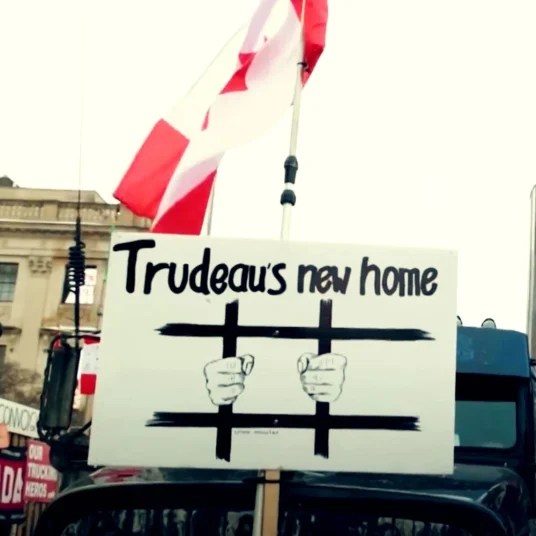
The Freedom Convoy protest of 2022
The Freedom Convoy—the moment when Canada went from polite protests and Tim Hortons to frozen bank accounts and police crackdowns.
In 2022, when truckers and their supporters descended on Ottawa to protest COVID-19 mandates, Trudeau didn’t meet them with dialogue or even his trademark smile-and-wave. Instead, he dusted off the Emergencies Act, something no prime minister had dared touch before. Overnight, financial institutions became Trudeau’s personal enforcers, freezing accounts of protesters and anyone who dared to support them.
Deputy Prime Minister Chrystia Freeland, Trudeau’s second-in-command at the time and a walking, talking LinkedIn connection to global elites, eagerly played bad cop. Under her direction, the financial clampdown turned Canada’s banking system into a political weapon. It wasn’t lost on critics that Freeland’s cozy ties to global financiers made the whole thing look like an international crackdown on dissent.
And what of the precedent? Trudeau’s message was clear: disagree with the government, and you might lose access to your life savings. It was a masterclass in how to turn financial systems into handcuffs, leaving civil liberties in tatters.
The Media Muzzle: Subsidizing Obedience
Also on the chopping block was journalistic independence. Trudeau’s government rolled out legislation forcing media outlets to register with a government body to qualify for funding. On the surface, this was marketed as a lifeline for struggling journalism. Because nothing says “press freedom” like reporters dependent on government handouts, right? It’s a classic move: offer financial aid with one hand and hold the leash with the other.
Critics were quick to point out the slippery slope. When the same entity paying the bills also sets the rules, the line between journalism and government PR gets blurry fast. Trudeau, of course, framed this as support for democracy, but the result was a media landscape nervously eyeing its next paycheck while tiptoeing around criticism of its benefactor.
Big Brother Gets a Twitter Account
Then came the surveillance. Under Trudeau’s watch, Canadian intelligence agencies dramatically expanded their social media monitoring. Initially, this was framed as a necessary tool against extremism. But “extremism,” much like “disinformation,” is a flexible term in the hands of those in power. Activists and protest groups—voices traditionally central to democratic discourse—suddenly found themselves under the microscope.
Imagine logging onto X to vent about a new housing policy, only to realize your tweet has been flagged by a government algorithm. The message was clear: dissent might not be illegal, but it was certainly inconvenient.
Disinformation: The Government’s New Buzzword
Trudeau’s pièce de résistance was his crusade against “disinformation.” This word became the Swiss Army knife of excuses, used to delegitimize critics and corral public opinion. Do you have a bone to pick with government policies? Disinformation. Questioning pandemic mandates? Disinformation. Unimpressed with Trudeau’s latest photo op? You guessed it—disinformation.
To hammer the point home, his administration launched a series of public awareness campaigns, ostensibly to educate Canadians about the perils of online misinformation. These campaigns, dripping with paternalistic condescension, often blurred the line between fact-checking and outright propaganda. The subtext was unmistakable: dissent, even if rooted in genuine concerns, was a threat to national cohesion.
Canada’s New Normal: The Fear of Speaking Freely
The cumulative effect of these policies wasn’t subtle. Everyday Canadians began censoring themselves, not out of respect for others but out of fear of stepping on the wrong bureaucratic toes. Content creators hesitated to tackle divisive topics. Activists wondered whether their next rally would land them on a government watchlist. What was once a robust marketplace of ideas began to resemble a sparsely stocked shelf.
And yet, Trudeau’s defenders remain loyal, arguing that his policies were noble attempts to safeguard society. However, as history has repeatedly shown, the road to censorship is paved with the promise of safety, but its destination is a society too scared to speak.
The Legacy of Controlled Speech
So what’s the verdict? Is Trudeau a misunderstood guardian of democracy, or is he the wolf who prowled under the guise of a shepherd? It’s hard to champion inclusivity and diversity when fewer voices are allowed to join the conversation. Canada may someday reckon with the full implications of these policies, but the damage is already visible.
And as Canadians tiptoe around their digital platforms, one question remains: how free is a democracy where everyone whispers?
Authorities in Germany have begun withdrawing gun ownership licenses from Alternative for Germany (AfD) members, who are deemed a “danger to public safety.”
So far, five AfD members have received a notice that their gun license would be revoked, while another member voluntarily returned his license after a revocation procedure was initiated. Another 51 cases are currently being examined by authorities, according to data released by the Saxony-Anhalt Interior Ministry in response to a request for information from the Left Party.
Hunters and sport shooters will also have their gun licenses canceled by authorities. In total, there are 74 members of the AfD in Saxony-Anhalt that hold a firearms license, with 49 registered as sport shooters and 25 as hunters.
The revocation of gun licenses comes after the Office of the Protection of the Constitution (BfV), Germany’s powerful domestic intelligence agency, classified the AfD as “certainly right-wing extremist.” With this designation, AfD members suddenly faced a litany of problems. For one, authorities could spy on their communications without any warrant; however, authorities could also seize their firearms, and members could also face issues with government employment.
The efforts to disarm AfD members won praise from the Left Party’s parliamentary group leader Eva von Angern.
“The first revocation notices show that, after individual examination, these people pose a threat to public safety,” she said to German news outlet Mitteldeutsche Zeitung.
The BfV is a highly politicized intelligence agency targeting domestic “threats” to the constitutional order, while critics contend it is designed to snuff out political opposition. The agency is currently monitoring AfD members in a number of states, including tapping their phones and surveilling their internet communications, all without a warrant. Currently, their membership in the party offers enough legal grounds to target what is the second-largest party in the country.
In 2023, the Gera Administrative Court ruled that the Thuringian Ministry of the Interior cannot revoke firearms licenses of AfD members in a blanket measure; however, it left the door open for individual cases.
Please help support us on Patreon, read our goals here: / truthstreammedia or SubscribeStar here: subscribestar.com/truthstreammedia
As context is very important for all videos, this message is to confirm that the purpose of this video is reporting on or documenting the content. Note that we make an effort to research for context and cite our sources as appropriate.
Copyright Disclaimer Under Section 107 of the Copyright Act 1976, allowance is made for “fair use” for purposes such as criticism, comment, news reporting, teaching, scholarship, and research. Fair use is a use permitted by copyright statute that might otherwise be infringing. Non-profit, educational or personal use tips the balance in favor of fair use.
As we previously reported would be the case, the celebration about the shutting down of the US government’s most overt censorship unit would be short-lived. The State Department is moving forward with plans to reassign employees and resources from a controversial office accused of stifling media into a newly created internal unit, as revealed by documents obtained by the Washington Examiner. This maneuver is already drawing criticism, with some alleging it is a thinly veiled attempt to rebrand and continue the disputed activities of the defunct office.
The Global Engagement Center (GEC), established in 2016 to counter foreign disinformation, faced fierce scrutiny from Republicans over claims it collaborated with groups like the Global Disinformation Index to target and demonetize right-leaning US media outlets.
In late 2024, Congress defunded the GEC, effectively shutting it down. Yet, a December 6 communication from the State Department to Congress outlined a plan to “realign” 51 GEC employees and nearly $30 million in funding into a new “Counter Foreign Information Manipulation and Interference Hub.”
Republicans are expected to investigate the matter closely, with concerns that the new hub could replicate the GEC’s controversial operations.
A Legacy of Controversy
The GEC claimed its mission was to counter foreign disinformation, but allegations of domestic overreach cast a long shadow. It funded initiatives like the Global Disinformation Index and NewsGuard, groups accused of pressuring advertisers to blacklist certain US media outlets.
These actions prompted legal challenges, including a December 2023 lawsuit by conservative outlets The Federalist and The Daily Wire, alongside the State of Texas.
Despite its closure, top officials from the GEC have already found new roles in the State Department.
The hub will report to the Under Secretary of State for Public Diplomacy and will inherit significant resources. According to the documents, $69 million previously allocated to the GEC will be redistributed across the State Department, with $29.4 million designated for the R/FIMI hub. This funding includes salaries, contract staff, and operational support. However, a source noted that, unlike the GEC, the new hub would lack grantmaking authority.
South Korean investigators renewed their call for the acting president to enforce an arrest warrant for impeached President Yoon Suk Yeol on Saturday following a tense standoff at Yoon’s compound.
On Friday, Yoon’s presidential security service, supported by soldiers, obstructed prosecutors from executing the warrant during a six-hour confrontation. The warrant was issued in connection with Yoon’s brief declaration of martial law on December 3, which marked the first time in South Korean history that an arrest warrant was issued for a sitting president.
The Corruption Investigation Office for High-Ranking Officials (CIO), which is leading the investigation, announced on Saturday that it had again urged Acting President Choi Sang-mok, who also serves as finance minister, to instruct the presidential security service to comply with the warrant.
When asked for a response, a finance ministry spokesperson declined to comment.
Additionally, the police have summoned Park Chong-jun, the chief of the presidential security service, for questioning on Tuesday, according to Yonhap news agency.
Warrant to shortly expire
A CIO official told reporters at a briefing on Tuesday that the current arrest warrant for Yoon is valid until January 6, adding that Yoon could be held at a police station or the Seoul detention center.
“The reason for the warrant is that there is a concern that the individual may refuse to comply with summons without justifiable reasons, and there is sufficient probable cause to suspect the commission of a crime,” the official explained.
Yoon Kab-keun, a lawyer for the impeached president, argued that the arrest warrant was “illegal and invalid” because the CIO lacked the legal authority to request it. Yoon’s legal team plans to seek an injunction from the Constitutional Court to block the warrant.
While the court has not provided further comments, it has also approved a search warrant for Yoon’s residence. Earlier attempts by the police to raid the presidential office were unsuccessful due to obstruction by the presidential security service.
Valid to execute?
Even though the warrant has been issued, it is unclear whether investigators and police will be able to execute it. The Presidential Security Service has previously refused to comply with three search warrants.
It said Tuesday that “security measures regarding the execution of the warrant will be carried out in accordance with lawful procedures,” in a statement to local media.
Both Yoon’s supporters and protesters demanding his removal have gathered outside his residence, with local media publishing images of confrontations between the two groups overnight.
“Up to 3,000 people will move to protest against the unfair and invalid arrest warrant,” stated an official from the largest pro-Yoon protest group.
According to local media, an immediate arrest or search of the presidential residence is considered unlikely, as investigators are expected to coordinate with the presidential security service.
Many analysts will be wondering what Trump will do about Russian sanctions when gets into the Oval office, although there is some optimism that he will try and reverse them. He is cautious not to get into a debate about this subject, which leads me to suspect that this will be one of the bombshells he will drop on the Biden administration which left him the small gift of signing off over a billion dollars of military aid to Ukraine. What almost no Americans understand though, which is largely the fault of mainstream media, is that these military spending sprees are really all about feeding a dual-purpose racket which really has nothing to do with the actual war in Ukraine, which everyone now admits Russia is winning. On one hand, it is of course pumping hundreds of millions of dollars into the 5 main arms manufacturers in the U.S. in a move which could arguably be called illegal state aid; on the other hand the kit which is sent to Ukraine from the U.S. – and the UK – is mainly being sold on a number of black markets, with only about 30 percent or thereabouts actually reaching Ukrainian troops. My own investigation has proved that the Zelensky cabal are selling off the heavy equipment like armoured personal carriers (APCs) and lorry loads of American made assault rifles to dealers in the international arms bizarre of Libya – where Middle Eastern terrorists, or their affiliates in the Sahel buy it at bargain prices.
And Trump certainly understands the racket and will want to stop it. Dropping the mother of all bombshells on the Biden legacy by scrapping the sanctions and blocking any more aid would be an effective way to do that.
But it’s the sanctions on Russia media which he should also give priority to, given that, with the state of western media being such a shambles, we had to rely on RT for example, in the UK and U.S., to ask the difficult questions and hold our administrations to account.
The recent news at the end of December that the EU is cracking down even further on Russia media and individuals who are active within it – journalists and others – is another parting shot which smacks of desperation. The West is under no illusions privately that it is losing the war in Ukraine and is wondering how it can tell a fairy tale story to its own voters so as to deflect blame with the sole purpose of staying in power. This is really what media sanctions are all about. Shutting down any narrative that could possibly hold you to account and expose the tawdry reality of the mess the West has made in Ukraine based on the military industrial complex gaining too much power and eating up elites in its path. The Biden administration will be remembered for this. A new dawn in just how much power these arms manufacturers have and what lengths they can go to, to get the big contracts. This will all come out in the Trump administration with documentaries about Biden and his son’s laptop and how Ukraine was a holiday camp for them to go to with empty suitcases and return with a few million dollars. Like a cash machine which keeps churning out cash due to a computer glitch. The lure of Ukraine and corrupt western elites is nothing new. But during Trump’s first term citizens of the West are going to see the dark side to the events which led up to Russia’s invasion. And it stinks.
Part of that racket, going back even to 2013 or 2014 was to try and shut down Russian media. In reality, it was simply RT which elites noticed was gaining popularity in many European countries from people who had lost all faith in their own media which had fallen into the grubby hands of the powerful elites and their dirty games long ago. It used to be the case that in Brussels, the hold that the powerful institutions had on journalists was so strong in such an abusive relationship that what we saw each day on TV and in the newspapers was pure EU propaganda on a scale that even the Soviet Union could not muster. There used to be however the contrast between Brussels and member states where the media were more robust and anti-establishment. But no more. Now the political journalists along with the defence correspondent in the UK for example are practically government propaganda agents who probably think they were journalists once. Their work is to keep the lies about Ukraine, as one example, flowing so that the public are distracted and can’t focus on what is under their nose. Sometimes the plain truth is so close to the person looking for it, that it can’t be seen. Distance is required. When RT operated in the UK, there was this certain environment which questioned more and provided an alternative viewpoint which was needed in any functioning democracy. Trump’s priority should be to finish the sanctions and adopt a more grown-up approach to resolving Ukraine as the Russians want a longer-term solution rather than quick fix buggerydoo. Ending the sanctions on Russian media would be a good message to western elites that have fed from the trough for so long with the lies which have been created that their time is up. Trump’s back.
US Senator Bernie Sanders has taken a swipe at Elon Musk over his defense of the H-1B immigration program, arguing that it only helps enrich billionaires who rely on cheap foreign labor while undermining ordinary Americans.
The H-1B visa program allows US companies to employ foreign workers in fields requiring advanced skills in fields such as technology, engineering, and medicine. It has been described as the only significant channel for foreign graduates to enter the US workforce, with the vast majority of approved petitions going to Indian nationals in recent years.
Both Musk and Vivek Ramaswamy, who US President-elect Donald Trump picked to lead his proposed ‘Department of Government Efficiency’ initiative (DOGE), have spoken out in support of the program. Musk, reportedly a former H-1B recipient, suggested that this type of visa “made America strong” by attracting foreign talent, while vowing to “go to war on this issue the likes of which you cannot possibly comprehend.”
Musk’s critics say the H-1B program has been of great benefit to his own companies – Tesla and SpaceX – as well as other big US corporations.
Writing on X on Thursday, Sanders, a self-described democratic socialist, joined the critics.
“Elon Musk is wrong. The main function of the H-1B visa program is not to hire ‘the best and the brightest,’ but rather to replace good-paying American jobs with low-wage indentured servants from abroad. The cheaper the labor they hire, the more money the billionaires make,” he wrote.
Sanders noted that from 2022 to 2023, the top 30 largest US companies using the program hired over 34,000 new employees under H-1B, while laying off at least 85,000 American workers.
“The H-1B program must be ended. Bottom line. It should never be cheaper for a corporation to hire a guest worker from overseas than an American worker,” he said.
In 2016, Trump, who is known for his hardline stance on immigration, called the scheme “very unfair” to American workers and said it should be ended.
In late December, however, Trump appeared to have changed his mind and expressed support for the program.
“I have many H-1B visas on my properties. I’ve been a believer in H-1B. I have used it many times. It’s a great program,” he said. Asked about the apparent flip-flop, Trump denied that he ever changed his mind, the New York Times reported.
Some of Trump’s biggest supporters, however, are critical of H-1B. Steve Bannon, a former White House chief strategist under Trump, called the program a “scam” that benefits “Silicon Valley’s sociopathic overlords.”
“It’s disgusting to talk about ‘high-skilled foreign workers’ while bringing in slave labor,” he said.
The Freedom Party of Austria (FPÖ) has demanded the immediate resignation of Chancellor Karl Nehammer, accusing him of clinging to a chancellorship that the electorate rejected in last September’s federal elections.
Michael Schnedlitz, the party’s General Secretary and a member of the National Council, claimed that Nehammer’s refusal to step aside poses a serious threat to the country’s political stability.
Speaking from Vienna, Schnedlitz decried what he characterized as an ongoing attempt by legacy parties to exclude the FPÖ — despite its first-place finish — from forming the next government.
Tensions reached a breaking point when the liberal NEOS party withdrew from the so-called “loser traffic light coalition” negotiations with Nehammer’s Austrian People’s Party (ÖVP) and the Social Democratic Party of Austria (SPÖ) on Friday.
After nearly 100 days of discussions, NEOS leader Beate Meinl-Reisinger announced that key differences between the ÖVP and SPÖ — reportedly the SPÖ’s aggressive tax policy — had made any workable agreement impossible. She stated that there was “no breakthrough” on important issues, adding that NEOS refused to think only as far as the “next election day.”
The collapse of these talks leaves Karl Nehammer’s claim to the chancellorship in jeopardy. Schnedlitz slammed Nehammer for, in his words, ignoring the FPÖ’s warnings about constructing a German-style “loser traffic light” government that, from the beginning, was destined to fail. Schnedlitz insisted that every hour Nehammer remains in office generates additional damage, calling upon him to face citizens immediately and to recognize that what truly motivates him is his own political survival.
“Should the Chancellor actor, who is on the ropes, now play even more games to form an unstable loser variant — either a two-way model with the SPÖ or a new loser traffic light with the Greens instead of NEOS — then I would like to make it clear to him: The people are fed up! It’s time for you to resign, Mr. Nehammer!” said Schnedlitz.
With the FPÖ currently polling at 35 percent and growing, there is a palpable sense that voters could severely punish the traditional parties if Austria heads back to the polls.
President Alexander Van der Bellen, too, has come under fire from Schnedlitz, who accused him of disregarding the popular vote by granting Nehammer the mandate to form a government. It was the Freedom Party that received the largest share of votes, yet Van der Bellen gave no invitation to FPÖ leader Herbert Kickl, claiming it was futile as the other parties had announced they would not entertain the idea of him leading the country.
The question that now hangs over Austrian politics is whether the president will persist in supporting Nehammer’s faltering attempts at coalition-building or open the door for the FPÖ, which by every indication would be willing — if not eager — to try forming a government.
The abrupt exit of the NEOS, which many believed was the linchpin of a viable coalition excluding the FPÖ, has sparked a number of possible scenarios. Some think the ÖVP and SPÖ might attempt to forge a grand coalition, though that razor-thin majority would lack resilience.
Others suggest a second traffic light, this time involving the Greens instead of the NEOS, might keep the FPÖ from governing but struggle to bridge ideological divides.
A third possibility, if Van der Bellen changes course, would invite Herbert Kickl to conduct coalition talks. Or, failing that, fresh elections may become unavoidable — an outcome that could see the Freedom Party bolster its support at the expense of the parties that kept it out.
President Trump has been very busy lately, driving leftist and Liberal Canadians utterly out of their minds by wickedly and hilariously trolling Prime Minister Justin Trudeau while simultaneously threatening a massive 25% tariff on the Canadian auto industry. With a solitary few taps of fingers on his phone, Trump cornered Canada by brewing an artisan Trumpian “threat to start some conversation” online. It went something like this: “Nice auto industry you got there. Would be a real shame if something happened to it!”
This “conversation starter,” which could also be rightly characterized as an existential death blow to the Canadian auto industry, forced Prime Minister Trudeau to hastily jet down to Mar-a-Lago. There, he unceremoniously flopped in his mission to mitigate damages, which has since been followed by the pilgrimage of several other notable Trudeau lightweights to continue the conversation. Maybe Mr. Wonderful will have better luck.
You could be forgiven if you thought the main lessons learned from this episode are that Canadians have a very fragile sense of humor, and that they bristle at being reminded how fully dependent the Canadian economy is on America. All of that is, of course, true. But if you thought that was the main event, you’d be wrong. The two main takeaways are that any industry that is being protected will, at some point, have an economic and policy moment of reckoning, along the lines of Herbert Stein: If something cannot go on forever, it will stop. And the second lesson is that it will likely play out in part, in real time on X. The Trump-Trudeau show, however, is just a shiny bauble. The real policy landmine in America is immigration, both legal and illegal.
This brings us to the H-1B visa issue in America, which is currently being “debated,” right in front of our eyes on X. On the surface, it seems to be a relatively simple philosophical debate; are you in favor of bringing in foreign workers for the jobs that Americans allegedly cannot do? Or do you favor policies that incentivize hiring Americans? Battle lines are even being drawn among conservative thought leaders and MAGA-adjacent personalities like Elon Musk, Vivek Ramaswamy, and others.
Bingo. And this is where it behooves the Trump administration to learn from the failed Canadian experience with our H-1B visa equivalent: the Temporary Resident Permit or TRP.
Officially, the TRP gives status to non-citizens or permanent residents (the last step before citizenship) to be legally in Canada for a temporary purpose. This can include international students, tourists, or foreign workers. (The TRP does not apply to visa-exempt countries.)
The final, glaring issue with both the H-1B and TRP is the undeniable fact that they are gateways to North America’s robust anchor baby (“birth tourism”) industry. In Canada, birth tourism, aided and abetted by almost nonexistent enforcement has added extra layers of stress to Canada’s already fiscally unsustainable socialized medical system.
“Temporary” programs in both Canada and America rarely benefit their existing populaces. More often than not, they habitually displace and punish the middle class. That’s a feature and not a bug. The H-1B acts in a similar fashion for skilled, white-collar workers. Moreover, as Milton Friedman famously said, “There is nothing more permanent than a temporary government program.” Here’s hoping the incoming Trump administration takes heed of Canada’s abject failure to rein in its permanent “temporary” population and reigns in the policies that more often than not, discriminate, decimate, and impoverish the native citizenry.
A Bill Gates-funded center has bred mosquitoes capable of injecting parasites into unsuspecting humans under the pretext of vaccinating against malaria. But are they truly harmless?
The Gates Foundation-backed Leiden University Medical Center in the Netherlands has developed a method of malaria vaccination using mosquitoes to deliver live-attenuated Plasmodium falciparum parasites.
The mosquitoes act as ‘flying syringes’ to deliver malaria vaccines – or potentially other substances. But concerns have been raised that recipients could be unaware of the process and be vaccinated without their consent.
How It All Began
In 2008, Gates pledged $168 million to develop a next-gen malaria vaccine. Jichi Medical University in Japan received funding to genetically modify mosquitoes that can pass a malaria vaccine protein into a host.
In 2016, Gates announced a joint $3.7-billion initiative with the British government to combat malaria.
By 2018, Gates-funded Oxitec was developing genetically-modified male mosquitoes whose offspring with wild females would die before adulthood.
In both cases, scientists raised concerns over the lack of comprehensive studies of environmental, health and ethical risks.
Once Pandora’s Box is Open, It Cannot be Closed
If issues of human consent and ethics are overlooked, insects could be used as ‘vectors’ for other biological agents.
But who guarantees they carry life-saving vaccines and not harmful pathogens? It would be impossible to verify the exact contents of the ‘flying syringes’.
Mosquitoes as Deadly Weapons
Insects have previously been studied as potential carriers of viruses and bacteria.
Nazi Germany reportedly developed malaria-carrying mosquitoes as bio-weapons at Dachau.
The Pentagon is said to have conducted similar studies in overseas bio-labs, including in Ukraine, according to assassinated Russian Lieutenant General Igor Kirillov.
Kirillov revealed that US biolabs in Ukraine studied viruses transmitted by mosquitoes, including dengue fever. That was also referenced in a lawsuit filed by Cubans following the 1981 dengue epidemic in the country, where the only area unaffected was around the US naval base in Guantanamo Bay.
Recycling was introduced, worldwide, as a tool to teach citizens to become compliant.
Forcing citizens to sort their rubbish into up to nine separate bags or boxes every week had absolutely nothing to do with ‘saving the planet’ and everything to do with teaching citizens (through a mixture of fines and shame) to behave ‘responsibly’ i.e. to do as they were told without looking too closely at the rationale of what they were being told to do.
The recycling never had anything to do with protecting the planet, of course. Most of the rubbish sorted, washed and collected in the UK was taken abroad, by lorry or ship or train, and burnt or dumped. It was, quite simply, impractical and not cost effective to recycle the material that had been collected. And, of course, collecting the sorted rubbish involved massive costs in terms of cash and pollution.
Today, the recycling business has reached an apogee of lunacy. Councils introduce ever more complex rules and fees. They refuse to take away much of the waste that is collected. And those wanting to take their rubbish to a ‘recycling’ centre will probably have to make an appointment and answer a host of questions.
It is no surprise that fly-tipping has become a major problem. The biggest causes of plastic in the sea are dumped fishing gear and plastic waste (much of it officially designated as recycled) which has been dumped by ships.
The good news, however, is that in Britain, recycling rates are falling. More and more people have become aware that the whole recycling movement was just another piece of manipulative trickery.
This site is provided as a research and reference tool. Although we make every reasonable effort to ensure that the information and data provided at this site are useful, accurate, and current, we cannot guarantee that the information and data provided here will be error-free. By using this site, you assume all responsibility for and risk arising from your use of and reliance upon the contents of this site.
This site and the information available through it do not, and are not intended to constitute legal advice. Should you require legal advice, you should consult your own attorney.
Nothing within this site or linked to by this site constitutes investment advice or medical advice.
Materials accessible from or added to this site by third parties, such as comments posted, are strictly the responsibility of the third party who added such materials or made them accessible and we neither endorse nor undertake to control, monitor, edit or assume responsibility for any such third-party material.
The posting of stories, commentaries, reports, documents and links (embedded or otherwise) on this site does not in any way, shape or form, implied or otherwise, necessarily express or suggest endorsement or support of any of such posted material or parts therein.
The word “alleged” is deemed to occur before the word “fraud.” Since the rule of law still applies. To peasants, at least.
Fair Use
This site contains copyrighted material the use of which has not always been specifically authorized by the copyright owner. We are making such material available in our efforts to advance understanding of environmental, political, human rights, economic, democracy, scientific, and social justice issues, etc. We believe this constitutes a ‘fair use’ of any such copyrighted material as provided for in section 107 of the US Copyright Law. In accordance with Title 17 U.S.C. Section 107, the material on this site is distributed without profit to those who have expressed a prior interest in receiving the included information for research and educational purposes. For more info go to: http://www.law.cornell.edu/uscode/17/107.shtml. If you wish to use copyrighted material from this site for purposes of your own that go beyond ‘fair use’, you must obtain permission from the copyright owner.
DMCA Contact
This is information for anyone that wishes to challenge our “fair use” of copyrighted material.
If you are a legal copyright holder or a designated agent for such and you believe that content residing on or accessible through our website infringes a copyright and falls outside the boundaries of “Fair Use”, please send a notice of infringement by contacting atheonews@gmail.com.
We will respond and take necessary action immediately.
If notice is given of an alleged copyright violation we will act expeditiously to remove or disable access to the material(s) in question.
All 3rd party material posted on this website is copyright the respective owners / authors. Aletho News makes no claim of copyright on such material.