An Israeli role in the Trump-Epstein files controversy?
By Robert Inlakesh | Al Mayadeen | January 2, 2026
Given the gravity of the newly emerging evidence about US President Donald Trump’s connections to the infamous Jeffrey Epstein, many questions are now being posed about the implications of this case on the American leader’s conduct. Of specific concern is whether the Israelis have any hand in influencing Washington in this matter.
Although the recent groundbreaking revelations, proving Jeffrey Epstein’s dealings with the Israeli regime, have been completely ignored by the Western corporate media, the facts are the facts. Long branded nothing more than “conspiracy theories”, leaked documents, first obtained by the Handala hacker group, prove that amongst other affiliations, the infamous child sex trafficker and financer had made efforts to help former Israeli Premier, Ehud Barak, to overthrow the then Syrian government.
These documents, reported upon only in the independent media, should raise alarm bells about just how far the Israeli rabbit hole goes. It is clear by now that Epstein himself was a staunch supporter of the Israeli regime, maintained close ties to it and its officials, even going as far as helping to draft op-eds for a former Israeli Prime Minister.
On the other hand, as more information emerges about Donald Trump’s relationship with the infamous pedophile financier, the potential implications for his role grow increasingly serious. Trump, for his part, has throughout this year decided to shrug off the Epstein Files issue, arguing that it is a “hoax” and snapping at reporters when the issue is brought up. The American President has also claimed that it is mainly Democrats who were guilty in this case, an allegation he makes when he isn’t labelling it a “Democrat hoax”.
Trump’s usual antics of pivoting to blame “the Democrats” aren’t paying off for him in this instance however, as his base quarrel with the facts that continue to emerge. For example, back in 2024, Trump had claimed that “I was never on Epstein’s plane”, only for this to be disproven later. More recently, it was revealed that he had been on board the child sex trafficker’s plane far more times than previously believed.
Evidently, there is not enough evidence to deem the US President actually guilty and lock him in jail, but the documents do indeed beg further questions to say the least. For example, a letter was recently released, handwritten by Epstein and addressed to convicted child molester Larry Nassar, in which he wrote of Trump that he ‘shares our love for young, nubile girls’.
There was even a document alleging that Trump and Epstein had raped a girl. Although the Department Of Justice (DOJ) has downplayed the claim, said to date back decades, the allegation is made more disturbing by reports that the alleged victim was later found dead. While there is no way to substantiate this accusation, it doesn’t exactly look good for the President.
There are currently countless theories being spread about the Trump-Epstein case, one of the most popular is that the US President was caught up in a blackmail scheme. For this specific allegation, there is no documented evidence. Yet, it is certainly a natural conclusion to come to.
At the very least, it would certainly suit Israeli interests to leverage the negative press surrounding the Epstein Files to push the President into conceding to further demands, or even use the issue as media coverage for their own aggressive actions.
Although this theory is currently unproven, if the Israeli intelligence or even US intelligence, had any knowledge of the Epstein Files, or had managed to collect incriminating material from the pro-Israeli child sex trafficker, they could certainly be willing to use that information to their benefit. The worst-case scenario here would be that the theories regarding Epstein being a Mossad agent, used to secure blackmail on power people, is true, then that would certainly mean that the US is in for a world of trouble.
Unproven theories aside, the evidence is certainly shocking and it is clear that Epstein did indeed have ties to Israelis, while Trump’s campaign was bankrolled by a who’s who of Zionist Billionaire’s, including the infamous Miriam Adelson. In less than a year, Trump had already bombed Iran, fought a small war against Yemen, cracked down on his own people’s First Amendment rights, while implementing a vision for Gaza that makes him the de facto dictator there and uses US forces to do the dirty work of the Israelis.
If anything, Donald Trump has shown himself to be an extremely weak President, one that is easily bullied into submission, so even without the Epstein Files, he has been willing to toss the American Constitution and International Law in the bin. All of this does beg the question as to whether the Israelis will be able to effectively weaponize the Epstein debacle to their favor and extract their demands.
The DOJ is flaunting the law on the Epstein Files. Why isn’t Pam Bondi in handcuffs?
By Alan Mosley |The Libertarian Institute | December 30, 2025
Congress’s newly minted Epstein Files Transparency Act—a bipartisan law co‑authored by Representatives Thomas Massie and Ro Khanna—was supposed to leave no room for discretion. It required Attorney General Pam Bondi, who serves President Donald Trump, to release all unclassified Justice Department records related to Jeffrey Epstein within thirty days. Trump signed the bill, but his Justice Department blew the deadline and produced only a small fraction of the documents, many of which were blacked out. The co‑authors have responded by drafting impeachment articles and exploring inherent contempt. Their outrage raises a broader question: why can the executive branch ignore the law with impunity, and why does this seem to happen over and over again?
The impetus for the transparency law lies in the horrific pattern of abuse that Epstein orchestrated for decades and the government’s failure to stop it. Even after survivor Maria Farmer told the FBI in September 1996 that Epstein was involved in child sex abuse, officials did nothing. The latest document release confirms that the bureau was tipped off a decade before his first arrest. Many of the new documents show that Epstein’s scheme went far beyond one man; the files include photographs of former presidents, rock stars, and royalty, and testimony from victims as young as fourteen. Campaigners say the heavy redactions and missing files—at least sixteen documents disappeared from the Justice Department website, including a photo of Donald Trump—betray the law’s intent. The omissions have fueled suspicions that the department is selectively protecting powerful clients rather than victims.
A law that leaves little wiggle room
In addition to the redactions, entire files vanished after the department’s release. Al Jazeera reported that at least sixteen documents disappeared from the Justice Department website soon after they were posted, including a photograph of Trump. Survivors expressed frustration: Maria Farmer said she feels redeemed by the disclosure yet weeps for victims the FBI failed to protect, and critics argue the department is still shielding influential individuals. The missing files underscore that Bondi’s partial compliance is not just tardy but potentially dishonest; the law obligates her to release names of government officials and corporate entities tied to Epstein, and removing those names is itself a violation.
The statute instructs the attorney general to release all unclassified Justice Department records about Epstein within thirty days. This covers everything from flight logs, travel records, names of individuals and corporate entities linked to his trafficking network, to internal communications about prosecutorial decisions and any destruction of evidence. It prohibits withholding information to avoid embarrassment, and allows redactions only to protect victims’ privacy, to exclude child sexual abuse imagery, or to safeguard truly classified national security information. Even then, the attorney general must declassify as much as possible and justify each redaction to Congress. These provisions make the statute stricter than a typical subpoena and leave little room for discretion.
Pam Bondi’s dodgy compliance
By December 19 the department had released tens of thousands of pages but withheld the bulk of the material. Observers noted that many records were heavily blacked out and that the department offered no written justifications for redactions. Deputy Attorney General Todd Blanche acknowledged that more documents would be released later, effectively moving the deadline. Massie and Khanna argued that this flouts the statute and have drafted impeachment articles and are weighing inherent contempt. Bondi’s department claims it can withhold materials under common‑law privileges, such as deliberative-process and attorney‑client privilege, even though the statute expressly demands release of “internal DOJ communications” and other decision‑making records. Critics argue that by invoking judge‑made privileges to avoid a law that overrides them, Bondi—who reports directly to Donald Trump—puts the president’s political interests ahead of statutory obligations.
Congress’ options, and why they seldom work
Congress has three enforcement tools: criminal contempt referrals, civil lawsuits, and inherent contempt arrests. The first two depend on the Justice Department, which is unlikely to prosecute its own leaders. Inherent contempt—a forgotten power to arrest defiant officials—has not been used since 1935, but Khanna says it is on the table. Past episodes illustrate why penalties are rare. Director of National Intelligence James Clapper lied to Congress about mass surveillance and faced no charges. CIA officials destroyed videotapes documenting torture, yet prosecutors declined to prosecute. FBI agents misused warrantless surveillance authorities, but no one has been held accountable. The pattern is clear: when officials break the rules, investigations are slow, referrals go nowhere, and political leaders quietly move on. As whistleblower attorney Jesselyn Radack noted, there is a double standard: government officials can lie to Congress with impunity while those who tell the truth are indicted. This inversion of accountability encourages lawlessness within the executive branch and chills those who might expose wrongdoing.
Legal experts note that Congress could also sue to compel disclosure or hold Bondi in criminal contempt, but because the Justice Department prosecutes contempt and is headed by the same officials refusing to comply, those routes are circular. The only truly independent remedy—directing the House sergeant at arms to arrest Bondi and hold her until she obeys—has not been used in nearly a century and would provoke a constitutional crisis. This institutional timidity emboldens agencies to treat congressional mandates as advisory and ensures that accountability remains elusive.
What accountability looks like
Khanna and Massie have urged Congress to impeach Bondi or her deputy, use inherent contempt to detain them, and refer the matter for prosecution. Those remedies would test whether Congress is willing to use dormant constitutional powers. Citizens who value liberty should demand action. The same government that lied about weapons of mass destruction, destroyed evidence of torture, and spied on millions now tells us that blacked‑out pages constitute transparency. Without accountability, the executive branch will continue to flout the law. Bondi may work for Trump, but the buck stops with the president who appointed her. If Congress and voters do nothing, future transparency laws will be meaningless, and the war state will remain healthy at our expense.
Accountability requires more than rhetoric. Congress must be willing to reclaim its constitutional prerogatives—by using inherent contempt, cutting funding, or refusing to confirm officials who flout the law. Voters should demand that elected representatives of both parties stop hiding behind national security and confront a Justice Department that acts as if it is above the law. The stakes extend beyond Epstein; they touch on foreign policy, civil liberties, and the very idea of self‑government. When a cabinet official appointed by the president can ignore a clear statutory mandate and the president remains silent, it signals that the executive branch believes itself sovereign. If we shrug, we will continue down the path where laws are for the governed, not the governors.
Citizens who value liberty and limited government should pay attention. When laws are ignored without consequence, the effect is to normalize lawlessness. The Massie–Khanna legislation was not meant to be a suggestion; it was a mandate that passed the House 427-1 and the Senate unanimously. If Congress does not enforce it, future transparency laws will be toothless, and the bureaucracy will continue to protect its own at the expense of truth. In the long run, a free society cannot survive if the government decides which laws apply to its friends and which apply to everyone else. Accountability is not partisan, it is a principle. Without it, injustice will remain healthy and unchallenged, and the rest of us will continue to pay the price.
The Epstein Saga: Chapter 4, Good Old Robert
By Lorenzo Maria Pacini | Strategic Culture Foundation | December 30, 2025
Epstein’s connections with British and Israeli intelligence were facilitated by a key figure known as Robert Maxwell, father of Ghislaine, Jeffrey’s wife.
Robert Maxwell was one of the most controversial media moguls of the 20th century: a Holocaust survivor who enlisted in the British army, he became a publishing tycoon, a Labour MP, and a figure at the center of financial scandals and alleged links to various secret services, including MI6 and Mossad. His biography intertwines his very poor origins, his meteoric rise, his relationships with heads of state, and, after his death at sea in 1991, the discovery of enormous fraud involving his companies’ pension funds.
Born Ján Ludvík Hyman Binyamin Hoch in 1923 in Slatinské Doly (now Solotvyno, Ukraine), then Czechoslovakia, into an Orthodox Yiddish-speaking Jewish family, he emigrated to Great Britain during World War II and fought in the British army.
After the war, he entered scientific publishing and founded Pergamon Press, transforming it into a major publisher of technical and academic texts, the basis of his future media empire.
By the 1980s, he controlled a vast empire: Maxwell Communication Corp, Pergamon, Macmillan, the Daily Mirror tabloid, and other publications in the UK and abroad, in direct competition with Rupert Murdoch.
He died on November 5, 1991, after falling from his yacht Lady Ghislaine off the coast of the Canary Islands. After his death, it emerged that he had diverted hundreds of millions of pounds from the Mirror Group’s pension funds to cover financial shortfalls.
So… He sold textbooks to American schools. He rubbed shoulders with kings, queens, presidents, and popes. And, away from the spotlight, he may have contributed to the activities of one of the world’s most secretive intelligence agencies, engaged in surveilling half the planet. To some, he was a brilliant innovator; to others, an unscrupulous impostor.
For his daughter Ghislaine—whose later life would become intertwined with that of sex trafficker Jeffrey Epstein—he was the man who opened the doors to high society and perhaps, unwittingly, to future ruin. Maxwell rose to the top to become a powerful media entrepreneur in the UK, building an empire comparable to that of Rupert Murdoch.
When he founded Pergamon Press, an academic publishing house specializing in history and science textbooks distributed in US schools, often criticized for a pro-Israel stance consistent with Maxwell’s strong Zionism, his competitors would not have expected such success.
In 1984, he bought the Daily Mirror, transforming it into a giant of popular journalism. At the height of his expansion, he controlled Maxwell Communication Corporation, Macmillan, Pergamon, and numerous international newspapers. Ghislaine, his favorite daughter, was educated at Oxford, prepared for the salons of the elite, and often at his side at social events in London and New York. Maxwell was photographed in the company of Queen Elizabeth, Prince Charles, Princess Diana, Margaret Thatcher, and even Mother Teresa. Other images show him alongside US Presidents George W. Bush and Donald Trump.
Several sources indicate that the British Foreign Office suspected Maxwell of being a double or triple agent, with links to MI6, the Soviet KGB, and the Israeli intelligence agency Mossad… My source, whom I consulted while writing this text, confirms his membership in the British services, with a key role in relations with companies and other agencies, particularly with regard to activities involving politicians (American but not only).
Maxwell moved with ease between the White House, the Kremlin, Downing Street, and the political leaders of France, Germany, and Israel, something that is not at all easy, nor “comfortable” to maintain.
In the 1960s, he served two terms as a Labour MP for Buckingham, while leading an extremely luxurious lifestyle. At his residence in Headington Hill, near Oxford, he organized lavish parties which, according to persistent rumors, were used as seductive traps to gather compromising information on influential figures.
The most serious allegations link him to the PROMIS software scandal, which we discussed in Chapter 3 of our Saga.
Originally a program of the U.S. Department of Justice, PROMIS was allegedly stolen, modified with an Israeli “back door,” and then distributed to numerous intelligence agencies, armed forces, and companies around the world, allowing Israel to monitor virtually every country that used it. According to various whistleblowers, including former Israeli agent Ari Ben-Menashe, Robert Maxwell allegedly served as the main global promoter of this digital Trojan horse. These allegations are partly corroborated by circumstantial evidence: strong support for Israel, business in sensitive sectors, close ties to Israeli leadership, and a state funeral in Israel in 1991, attended by Prime Minister Yitzhak Shamir, President Chaim Herzog, and senior intelligence officials, with public praise that Maxwell “did more for Israel than can be said.”
The last years of his life were marked by financial collapse. After his death, investigators discovered a £460 million hole in the Mirror Group’s pension fund. Maxwell had stolen his own employees’ pension savings to support an empire now submerged in debt. His sons Ian and Kevin Maxwell were arrested and charged with fraud (and later acquitted), while the British public exploded with anger at the betrayal of thousands of pensioners.
Overnight, Maxwell went from being a respected tycoon to a hated figure. Protesters renamed him “Robber Bob.”
On November 5, 1991, he disappeared from his 180-foot yacht off the Canary Islands. He was found dead a few hours later, face up in the ocean. The official version spoke of a heart attack followed by accidental drowning. His daughter, however, believed he had been murdered.
The autopsy revealed that Maxwell already suffered from serious heart and lung conditions.
He was given a state funeral in Israel, attended by then-Prime Minister Yitzhak Shamir and numerous intelligence officials.
Epstein met Ghislaine Maxwell in the 1990s, and their relationship began as a brief romantic affair before turning into a very intense professional and personal alliance. Ghislaine became Epstein’s chief assistant, managing his properties, organizing his staff, and playing a central role in recruiting victims for sexual abuse.
The ties with his father, Robert, were important from the outset, although perhaps even more so after his death: Epstein was introduced to Mr. Maxwell’s circle thanks to the family’s contacts and networks. A reconstruction reported by the Telegraph in 2022 claims that Epstein may have helped Robert Maxwell hide some of the money stolen from the Mirror Group’s pension funds using offshore channels.
Robert was instrumental in introducing Epstein to the world of Israeli intelligence, where he was also able to make his own way.
The source consulted, who comes from the world of intelligence, revealed to me that Ghislaine is also central to this story: following in her father’s footsteps, she made her way into British and Israeli intelligence, weaving relationships, cover stories, and favors for her beloved Jeffrey.
After all, what could be better than marrying the daughter of a “spy” with the guarantee of inheriting his “legacy”? Without Ghislaine, Epstein would not have had access to many of the VIPs with whom he established regular relationships, and above all, he would not have had the cover necessary to operate undisturbed for many years.
The Epstein Saga: Chapter 3, Those friends in the Secret Service
Someone has to do the dirty work
By Lorenzo Maria Pacini | Strategic Culture Foundation | December 28, 2025
One piece of information that emerged from the declassified material is seemingly marginal, but nonetheless colorful: a T-shirt from Mossad, one of Israel’s secret services. The press immediately began to label dear Jeffrey a secret agent, without further exploring the reasons for a T-shirt in the closet. While waiting for the next documents to be made public, we will now outline some interpretations regarding that ambiguous T-shirt.
Let’s start with some historical context. The idea that Epstein was connected to Mossad first arose in the 2000s in investigative and alternative circles, but it gained strength after his arrest in 2019 and, above all, after his death in prison, when the public struggled to explain how he had been able to operate almost undisturbed for decades. Commentators and journalists note that, historically, Israeli intelligence has used economic and political networks of influence, creating a context in which Epstein—rich, with access to global elites and involved in sexual blackmail—appears plausible as an “asset.”
Towards the end of 2025, several investigations based on the analysis of leaked or recently released documents—including House Oversight Committee materials and email archives—were revisited and discussed as evidence of repeated contacts between Epstein and Israeli circles, as well as travel patterns and financial flows considered atypical. CNN reported that journalists sifted through more than 23,000 pages of documents and thousands of email threads as part of this broader examination. According to commentators and newspapers that have republished these materials, they reveal “extensive collaboration with Israeli intelligence” or, at the very least, frequent interactions with figures linked to intelligence circles.
Numerous articles refer to personal and financial ties—meetings, communications, and alleged references to money transfers—between Epstein and high-level Israeli figures, particularly former Prime Minister Ehud Barak, as well as entries in diaries and emails that investigators say warrant attention. Common Dreams and some investigative series have highlighted recurring patterns of interaction between Epstein and Barak and have claimed that Israeli operatives or collaborators were long-time visitors to Epstein’s properties; however, the exact origin and interpretation of these documents remain disputed.
Proponents of the Mossad connection hypothesis describe Epstein as a recruited asset or honey trap operative tasked with gathering compromising material for leverage. This narrative, long present in various articles, has been further amplified by partisan commentators and media outlets. Some websites and opinion makers explicitly claim a connection to Mossad, arguing that Epstein’s network of relationships and the alleged presence of Israeli operatives in his residences are typical of intelligence practices.
Prominent Israeli figures have strongly rejected these claims. Former Prime Minister Naftali Bennett—who has stated that he had the Mossad under his direct command during his term—has called the idea that Epstein “worked for Israel or the Mossad” “categorically and totally false.” Mainstream publications such as Newsweek and Times of Israel have highlighted the lack of conclusive evidence indicating that Epstein was a formal Mossad agent and have warned against conspiracy theories, which are sometimes intertwined with anti-Semitic stereotypes.
The resonance of the issue has been uneven and often linked to different political orientations: some progressive investigative outlets have insisted on pursuing the story, while conservative figures and commentators have sometimes exploited the accusation for political purposes. Critics warn that this encourages conspiracy theories or anti-Semitic narratives to be used opportunistically. It should also be noted that Israeli politicians, including Benjamin Netanyahu, have on some occasions emphasized media coverage of Epstein’s ties to Israel for domestic political messages, making it more difficult to analyze the motivations.
But that’s not all.
Funds for all
On September 2, 2025, Congresswoman Anna Paulina Luna shook public opinion with explosive statements made after meeting with some of Jeffrey Epstein’s survivors during a press conference in Congress: “After speaking with Epstein’s victims today, it is clear that this story is much bigger than anyone could have imagined: rich and powerful people must go to prison. It is possible that Epstein was an asset of a foreign intelligence service.” Her words, captured on video, sparked a media storm: Was Epstein just a predator or something more? Was he perhaps an agent of the Israeli Mossad, tasked with ensnaring global elites for Zionist political purposes? The clues are disturbing and form a picture too coherent to be ignored. In 2025, amid leaks, transcripts, and denials, the time has come to address the issue openly.
The apparatus built by Epstein may still exercise influence on the upper echelons of power today. Steven Hoffenberg, his partner in the Towers Financial Ponzi scheme, went even further. Before his death in 2022, he told reporters that Epstein had confided in him about direct links to Mossad, attributing his wealth and access to high society circles to these contacts. Hoffenberg, who ended up in prison while Epstein remained free, had nothing to gain by lying, if anything, a score to settle.
Then there is the testimony of Maria Farmer, one of Epstein’s first victims (identified as Jane Doe 200 in court documents). Farmer described Epstein’s network as a “Jewish supremacist” blackmail scheme linked to the Mega Group, a private circle of pro-Israel billionaires. She also recounted episodes of racial abuse, pointing to Les Wexner as a central figure. Three independent voices—Ben-Menashe, Hoffenberg, and Farmer—all converge on the Mossad. Coincidence or hidden agenda?
The source of Epstein’s fortune remains unclear. How can a former college student become a billionaire with only one known client? Following the financial flows, the connection to Israel appears clear. Les Wexner, magnate of Victoria’s Secret and co-founder of the Mega Group, gave Epstein a $77 million New York mansion — equipped with a sophisticated surveillance system — as well as large sums of money. The Mega Group, created by Wexner and Charles Bronfman, is known for financing pro-Israel causes. Epstein’s financial career began in 1976 at Bear Stearns, thanks to Alan Greenberg, also a member of the Mega Group, despite Epstein having no credentials other than a background as a physics teacher. We are talking about $77 million.
Court documents indicate that Epstein received over 7,000 wire transfers, some linked to arms dealer Adnan Khashoggi, who in turn was associated with Mossad networks. Ben-Menashe claims that Epstein was involved in Israeli arms trafficking. A 2025 private investigation, conducted by hedge funds linked to the Epstein case, speculates that a substantial portion of his wealth came from Israeli funding. Not charity, but the financing of an intelligence operation.
Epstein’s circle looks like a list of intelligence targets. Former Israeli Prime Minister Ehud Barak visited Epstein’s residence dozens of times between 2013 and 2017, as records and photographs show. The two were also involved in founding Carbyne, a technology company with numerous former members of Israeli intelligence. Leaked emails show Epstein connecting Barak with Russian and Israeli figures. In 2004, Barak received $2 million from the Wexner Foundation for unspecified “research” activities. Barak denies any wrongdoing but admits that it was Shimon Peres who introduced him to Epstein.
Epstein possessed multiple passports—a typical feature of clandestine operations—and took refuge in Israel after the 2008 charges, before obtaining an extremely favorable plea bargain. In 2025, Tucker Carlson, during a very harsh speech, openly accused him of being a Mossad agent. Why would so many Israeli officials associate with a sex offender if he were not a strategic asset?
The 2008 plea bargain, which secured Epstein a lenient sentence, is perhaps the most revealing element. Former prosecutor Alexander Acosta later stated, “I was told that Epstein ‘belonged to intelligence’ and that I should drop it.” The agreement also protected accomplices in several states, safeguarding a network that victims, such as Virginia Giuffre, have described as a kompromat factory, with hidden cameras ready to record politicians and powerful figures in compromising situations. This practice is reminiscent of techniques attributed to Mossad, as in the Robert Maxwell operations (which we will discuss in the next “chapter” of our Epstein Saga).
Epstein’s death in 2019, officially classified as suicide, appears to many to be a cover-up, with speculation of unofficial involvement by Israeli intelligence services. In 2025, the DOJ and FBI’s statement on the absence of a “client list” under the Trump administration — which had promised revelations that never came — only reinforced suspicions.
The pieces fit together: Epstein, introduced through Zionist networks, built a blackmail system aimed at influencing political and media decision-makers in a pro-Israel direction. Alleged links to PROMIS software (according to some sources modified by the NSA and Mossad for monitoring) and Palantir, an advanced surveillance company, add further layers of unease. Journalist Whitney Webb speaks openly of a “joint CIA-Mossad operation.” Ian Carroll goes even further, linking this network to events such as the Kennedy assassination and 9/11, identifying a common thread in the Israeli services.
It is true: Epstein’s network also involved Russia and Saudi Arabia. However, the Israeli connections—Wexner, Barak, Maxwell, Mega Group—appear predominant. Is there a lack of definitive evidence? Perhaps. But the smoke is so thick that it is difficult to ignore the fire.
Epstein’s survivors have just announced their intention to publish their own list of names: “We know who abused us. We saw who came and went. This list will be led by survivors, for survivors.”
The state hesitated. The victims did not.
Of course, Israeli authorities reject all accusations. Alan Dershowitz, Epstein’s lawyer and a well-known supporter of Zionism, claims that Epstein would have laughed off the espionage allegations, arguing that he would have used such connections to get an even better deal. But these denials appear fragile in the face of testimony, financial flows, and political connections that all lead to the same conclusion: the Epstein operation has the flavor of an intelligence operation, and the trail leads straight to Tel Aviv.
The most damning evidence comes from those who knew Epstein from the inside, people who risked everything to speak out. Ari Ben-Menashe, a former Israeli intelligence officer, claims that Epstein and Ghislaine Maxwell ran a Mossad “honey trap” aimed at blackmailing the world’s elite. He claims to have met them in the 1980s while they were working in arms trafficking under the supervision of Robert Maxwell, Ghislaine’s father and a known Mossad collaborator who died in mysterious circumstances in 1991. Several Israeli prime ministers attended his funeral, with Shimon Peres delivering the eulogy. A mere coincidence? Hard to believe.
Zelensky demands more money from Western backers
RT | December 28, 2025
The West is not providing Ukraine with sufficient financial and military support, Ukraine’s Vladimir Zelensky has complained, despite Kiev’s backers having already approved massive aid packages and loans.
In a post on Telegram on Friday, Zelensky lamented that “air defense is not enough now, weapons are not enough now,” adding that “frankly, there is a constant shortage of money, in particular, for the production of weapons and, most importantly, drones,” even despite a recent decision by the EU to provide Kiev with a huge loan.
“We need to be strong at the negotiating table. To be strong, we need the support of the world – Europe and the United States of America,” Zelensky added.
The appeal for additional funding comes as the EU approved this month a loan of €90 billion ($105 billion) to Kiev for 2026-2027, which will cost European taxpayers €3 billion ($3.5 billion) annually in borrowing costs. In addition, the bloc failed to agree on using frozen Russian assets to assist Ukraine due to staunch opposition over overwhelming legal risks from several EU members, most notably Belgium, which holds most of the funds.
The loan is aimed at propping up the struggling Ukrainian economy, with the International Monetary Fund estimating that Ukraine will need approximately $160 billion for 2026 and 2027 combined. For 2026 alone, Ukraine’s parliament adopted a budget with a deficit of around $45 billion, or 18.5% of GDP. The financial conundrum has also been exacerbated by Ukraine’s endemic corruption.
On top of that, Mikhail Podoliak, a senior adviser to Zelensky, said this week that Ukraine cannot finance potential elections due to the budget deficit, stressing that Kiev should prioritize “militarization” efforts instead. Earlier this month, he also indicated that a vote could only take place provided the West steps in to cover the costs.
Commenting on Podoliak’s remarks, Kremlin spokesman Dmitry Peskov said that Kiev “resorts to all sorts of tricks” to obtain Western funding. Moscow has also warned the EU that any assistance for Kiev would be essentially covered by ordinary taxpayers.
The Epstein Saga: Chapter 1, Mr. Clinton
By Lorenzo Maria Pacini | Strategic Culture Foundation | December 24, 2025
A necessary introduction
I don’t usually write about these topics, but this time the matter is becoming interesting. The Epstein case is a Pandora’s box that reveals many power intrigues and the workings of certain geopolitical mechanisms currently in operation. For this reason, I will devote a series of articles – the Epstein Saga – to exploring some relevant aspects of this complicated affair.
First of all, it should be noted that the sources have been flawed, at least in part, from the outset. The files officially released by the US Department of Justice are mostly insignificant photographs, a large amount of .pdf files of what was found in Epstein’s residence; most of the files are obscured, with black stripes or squares concealing the identities and significant details of the material. This makes it very difficult to interpret the available material correctly and comprehensively.
The intent, however, is not to provide an exhaustive report on the entire affair—a task we gladly leave to investigative journalists—but rather to provoke reflection on the short- and long-term strategy behind this case.
The release of these files is part of a plan whose importance we still do not understand. It is a transformation taking place throughout the West, a transition from an old world of politics to a new one, through the fall of many masks.
The biggest problem, however, remains what will come next.
The context: what is happening these days
The most recent documents published on the Epstein case, in December 2025, include thousands of new records, photos, and investigative files from the Department of Justice and the House Oversight Committee. These documents contain images of prominent figures linked to Epstein, details of his travels and properties, grand jury transcripts, and investigative reports, including a 1996 FBI complaint about alleged child pornography and harassment. Many of the files have been heavily redacted to protect victims, but some pages have been completely blacked out, drawing criticism from both Democrats and Republicans for the lack of transparency.
Among the new revelations are photos of Epstein’s Little St. James Island, emails from his estate referring to high-profile figures, and a previously missing minute of video from his cell block before his death. The release also includes a transcript and audio recording of an interview with Ghislaine Maxwell, as well as additional court documents and flight logs. The Department of Justice has stated that several hundred thousand documents will be released in batches, with more expected in the coming weeks.
Some documents, including a photo associated with President Trump, were reportedly removed from the initial release, sparking further controversy and calls for full transparency. The latest batch of documents continues to fuel public and political debate about the responsibility and scope of Epstein’s network.
Hey, Bill!
The first person worth mentioning is former US President Bill Clinton.
In one photograph, he is sitting on a private jet, smiling relaxed and his face slightly flushed, while a young blonde woman is reclining on the armrest of his chair. In another shot, he appears reclining, shirtless, in a hot tub, his hands clasped behind his head; the face of the person next to him is covered by a black box. In other images, he is seen smiling next to Mick Jagger, wearing a shirt and elegant jacket. In yet another, he is swimming in a luxurious marble-lined indoor pool with Ghislaine Maxwell, a key figure in Jeffrey Epstein’s sex trafficking organization. And then, smiling again, he is wearing a decorated silk shirt and standing side by side with Epstein himself.
The powerful American Democratic leader is undoubtedly one of the most mentioned VIPs in the Epstein documents. In the quarter-century since leaving office, Clinton has worked carefully to put the personal scandals that marked his presidency behind him. Today, at 79, he leads the typical life of a former statesman: traveling the world for conferences and commemorations, writing memoirs and political novels, and continuing the work of his philanthropic foundation. But that is not enough to escape the serious allegations that Epstein’s files quietly reveal, namely less institutional aspects of Clinton’s personality, such as his penchant for extramarital affairs, rash decisions, and a certain impulsiveness.
Already in 2017, Clinton had been at the center of numerous allegations, from sexual harassment to non-consensual exhibitionism to rape, allegations that Clinton has always denied. But what about now, with the files of the Epstein case?
In his memoir published in 2024, Clinton wrote that he had only two “brief encounters” with Epstein: one in his Harlem office and one at the financier’s New York residence. Between 2002 and 2003, Clinton admitted to flying several times on Epstein’s jet with his staff and Secret Service escort to support his foundation’s activities. In exchange for the flight, he explained, he devoted “an hour or two” to conversations about politics and economics.
“That was the content of our conversations,” he wrote. “Although those trips allowed me to visit foundation projects, getting on Epstein’s plane was not worth the years of questions that followed.”
The section closes with a sentence that is perhaps more revealing than the images themselves:
“I wish I had never met him.”
The Department of Justice has announced that additional documents will be made public in the coming weeks. The political aims of the first tranche of disclosures, however, appear clear: to shift attention away from Trump’s possible involvement in the scandal and focus the spotlight on Clinton instead.
The release of the images is unlikely to end Clinton’s political difficulties related to her relationship with Epstein. For months, the Clintons have tried to avoid appearing directly before the House Oversight Committee as part of the Epstein investigation. Such a hearing would be exceptional: no former president has testified before Congress since 1983, when Gerald Ford did so during the bicentennial celebrations of the Constitution.
The publication of the photos could increase public pressure for the couple to participate openly in the investigation and reignite questions about Clinton’s version of events, according to which he was unaware of Epstein’s crimes and severed all ties after the first reports of the investigation emerged in 2005.
On several occasions, not only the allegations but also the accusers themselves have been brought to the forefront of the political scene: in 2016, less than two hours before the second presidential debate, Trump and his campaign manager, Stephen K. Bannon, organized an impromptu press conference with three women who claimed to have been discredited or ignored by the Clintons after reporting sexual harassment. In 2019, a few hours after Epstein’s death in his cell, Trump relaunched an unsubstantiated conspiracy theory on social media linking Clinton to the financier’s death. Since then, Trump has continued to claim that Clinton spent a lot of time on Epstein’s private island, an accusation that the former president has always denied and that has also been refuted by Susie Wiles, White House chief of staff, and Ghislaine Maxwell herself.
Bill Clinton’s presidency was marked by several high-profile scandals, the most notable of which was the Monica Lewinsky affair. In the late 1990s, Clinton, then president of the United States, was accused of having an inappropriate relationship with White House intern Monica Lewinsky. After months of denials, Clinton finally admitted to having had “inappropriate intimate contact” with Lewinsky, calling it a personal failure and an error in judgment. His initial denials under oath led to accusations of perjury and obstruction of justice, culminating in his impeachment by the House of Representatives in 1998. Clinton was acquitted by the Senate but remained deeply compromised by the scandal.
In addition to the Lewinsky affair, Clinton faced other controversies. The Whitewater scandal involved allegations of financial impropriety related to a failed real estate venture in Arkansas in which Clinton and his wife Hillary were investors. Although the investigation did not lead to criminal charges against the Clintons, it consumed much of Clinton’s second term and contributed to a climate of suspicion surrounding his administration.
Among Clinton’s accusers was Paula Jones, who filed a lawsuit against him in 1994 for sexual harassment. The former president settled the case out of court for $850,000 without admitting guilt. Other women, such as Kathleen Willey, have made similar allegations, although Clinton has always denied any wrongdoing.
However, it is not only Republicans who consider the allegations of sexual assault and harassment to be a political burden for Clinton. Even within the Democratic Party, although there has been no dramatic distancing, there has been a gradual attempt to relegate the former president to the background. His presence in election campaigns has been reduced compared to the past, with some candidates preferring to avoid him altogether. At the 2020 Democratic convention, Clinton appeared for less than five minutes in a pre-recorded speech broadcast before prime time. Four years later, he returned to the stage, speaking for 27 minutes, far exceeding the allotted time.
With the recent publication of the photographs, Clinton’s critics seem to have found a new foothold to reopen a chapter that the former president has long tried to close. And this is only the beginning of the uncovering of the rot present in the American Democratic world… as well as in the Republican one.
Bill Clinton is in the frame again, but this time it’s Trump who put him there
By Martin Jay | Strategic Culture Foundation | December 24, 2025
“The photos depict a web of unsavoury relationships and associations that complicate both Democratic efforts to keep the focus on Trump and the incumbent president’s desire to move on from the issue entirely,” reported the AP when the first major tranche of photos from the so-called Epstein files was released in mid-December.
Bill Clinton’s prominent appearance in the photos at least sheds some light on why Democrats, when in power, refused to lift the lid on the stinking Epstein affair—doing so would have been akin to shooting themselves in the foot, and Joe Biden obviously didn’t want to drop the Clintons in it.
Many might argue we shouldn’t be shocked to see Bill feature in this tawdry affair, given his reputation for an inability to control his carnal needs. The list of women he has been accused of assaulting is extensive, as are the lengths to which Hillary has gone to protect him.
Two things emerge from this latest batch of photos, which show Bill Clinton in close proximity to very young girls while spending time with Epstein. First, the Trump administration has decided that if the scandal is going to erupt, they might as well land the first political blow—and so they have reached for the lowest-hanging fruit: Bill. Second, the Clintons themselves will likely make a mockery of the entire corrupt U.S. political system by bypassing its legal institutions. They have already started this by ignoring congressional committee requests to appear and testify.
But in any case, the gloves are off. This is now outright war between Republicans and Democrats—and the latter will do everything in its power, using its deep contacts within institutions like the FBI, to get its hands on the Trump photos, which have, of course, been removed from the official release.
However, it is fair to say Clinton appears to have been even closer to Epstein than Trump was.
When Clinton was president, records show Epstein visited the White House multiple times. Later, after Clinton left office, Epstein assisted with some of the former president’s philanthropic efforts. Clinton flew multiple times on Epstein’s private jet, nicknamed the “Lolita Express,” including on a humanitarian trip to Africa in 2002 with disgraced actor Kevin Spacey and comedian Chris Tucker.
Even Democratic-leaning journalists in the U.S. note that Clinton’s personal weaknesses have always clashed with his public moralizing—and his association with Epstein serves as a stark reminder of that. This goes far beyond receiving oral sex from an intern in the Oval Office. It stretches back decades.
His 1992 campaign was rocked by rumours of an affair with Gennifer Flowers, which he denied at the time. His presidency was hit even harder when he was impeached in 1998 for lying under oath and obstructing justice after denying any sexual relationship with Monica Lewinsky. He ultimately acknowledged an “inappropriate” affair with her.
Currently, it seems the pressure from Democrats to release the files—whether genuine or not—has backfired, as the trove of photos reveals numerous images of Clinton and Epstein together. In fact, these pictures of the two hanging out as old friends are arguably more damaging than the ones in which a young girl’s face has been pixelated—supposedly a DOJ initiative to “protect minors or victims.” That framing alone is a clean shot designed to hit its target, and for now, it is Clinton in the frame, facing media wrath even from traditionally Democratic-leaning outlets like CNN. Recently, conservative CNN commentator Scott Jennings suggested the files should be renamed the “Clinton Files.”
Of course, simply being photographed next to Epstein is not a crime and could, in certain cases, reflect innocent proximity. A number of famous faces appear in the first batch of files—alongside Clinton and Prince Andrew, there are also shots of musicians Mick Jagger and Michael Jackson.
What’s important to note is that Bill Clinton is known to share the same sexual compulsions as Prince Andrew, whom a royal biographer recently remarked on a podcast “needed to have sex three times a day.” Epstein reportedly referred to Andrew as the only person as depraved as he was when it came to young women. Clinton, like Andrew, has a history that can’t be airbrushed away—and the photos of him with young girls are a genie that cannot be put back into the bottle. It stinks.
Naturally, that won’t stop Democrats from calling this stunt what it is: a well-timed smear ahead of the midterms, where Trump is expected to likely lose both houses of Congress. Failing quick-fix policies on the economy and foreign policy—which are having a doubly damaging effect—will hit Trump hard at the ballot box, potentially rendering him impotent in the second half of his term. How long he can maintain the farce that the Epstein story is empirically linked to the Democrats is uncertain, though it is worrying that a war in the Middle East against Iran looks increasingly likely to be used as a tool to deflect blame from his lacklustre performance as a populist leader—one struggling to help blue-collar Americans and restore the country’s former global hegemony.
EU country seizes gold and luxury watches from ex-Ukrainian prosecutor general – media
RT | December 23, 2025
The French authorities have seized gold bars, expensive watches, and other valuables from a former Ukrainian prosecutor general living in the country, according to local media.
A villa near Nice owned by Svyatoslav Piskun, who served as Ukraine’s top prosecutor in the 2000s, was reportedly raided in a joint Ukrainian-French operation last week. Details were reported on Monday by Ukraine’s Dzerkalo Tizhna (Weekly Mirror), citing a source familiar with the probe.
According to the outlet, Piskun failed to explain how he acquired 3kg of gold, roughly €90,000 ($106,000) in cash, and 18 luxury wristwatches valued at over $1 million. French authorities suspect him of money laundering, the outlet claimed.
Kiev’s State Investigation Bureau (DBR), which operates under the president’s office, reportedly requested and participated in the raid. Previous Ukrainian press reports suggest the action in France is linked to a case against oligarch Igor Kolomoysky, who has been held in pre-trial detention for over two years on multiple charges, including allegedly ordering a murder in 2003.
The oligarch, who played a key role in Vladimir Zelensky’s rise to power, as recently detailed in a special RT investigation, made widely-covered comments in November on a high-profile corruption scandal. He said Zelensky’s longtime associate, Timur Mindich, who was charged with running an extortion scheme, did not have the aptitude to be a criminal mastermind and was a patsy for the real perpetrators.
Earlier this month, Kolomoysky teased more remarks on the scandal during a court appearance, which was subsequently postponed twice. When proceedings occurred two weeks ago, he claimed Mindich was targeted by assassins in Israel – a claim Israeli authorities have not confirmed – with the hitman allegedly supplied with a weapon at the Ukrainian Embassy.
His lawyer announced that Kolomoysky would make statements on Tuesday – this time regarding the “approaches and methods” of the Western-backed Ukrainian agencies investigating Mindich and his alleged accomplices in the Ukrainian government.
RT published Part 2 of its Kolomoysky special last Thursday. You can read it here.
Ukrainian investigative journalist ‘kidnapped’ by draft officers
RT | December 23, 2025
A Ukrainian investigative journalist is reportedly missing after being seized by conscription officials days after filing a criminal complaint against his local city administration.
A video shared on the Facebook account of Aleksey Brovchenko, which went viral this week, was purportedly filmed by CCTV cameras at his home in Podgorodnoye in Dnepropetrovsk Region on Monday morning. It showed people in military and police uniforms apprehending a man and forcing him into a van despite a woman’s vocal objections – which the description called a “kidnapping.”
Brovchenko’s family said he was beaten earlier in the day and called police to file a complaint, but was instead taken away and has since been out of touch with them.
Last week, the journalist reported an “interesting situation” at a police station where he went to file a complaint against the town mayor for alleged fraud. He said officers accused him of being a draft dodger but let him go instead of transferring him to military officials – a move he described as a sign that “the police will soon switch to the side of the people.” Brovchenko’s reporting often highlights suspected abuses by conscription centers.
City head Andrey Gorb, whom the journalist had accused of wrongdoing, claimed on Tuesday that Brovchenko is a “fake journalist” who “did everything to derail the mobilization.” He thanked police and military officers “for doing their job.”
Military mobilization is a contentious issue in Ukraine, viewed by many as unfair due to corruption that allows the wealthy and powerful to evade mandatory service. Videos of what critics call abductions regularly go viral, even as officials downplay the so-called “busification” as not a serious problem.
Public resistance to recruiting also exacerbates existing issues with Ukrainian troop desertion. The Prosecutor General’s Office recently stopped reporting the number of cases against soldiers who have left their posts, a move critics say is an attempt to conceal the scale of the manpower drain.
Honduras: The Making of a Controlled Democracy

Zionist Organisation of America (ZOA) Praises Honduras’ Opening Diplomatic Mission In Jerusalem & Later Its Embassy. (Source: Zionist Organisation of America | ZOA)
21st Century Wire | December 22, 2025
Tegucigalpa — The streets of Honduras’ capital were tense as the results of the 2025 elections unfolded, a nation holding its breath amid suspicion, polarisation, and uncertainty. Beneath the visible turmoil lies a deeper story: for over a century, foreign powers have shaped Honduran politics, society, and culture, deliberately fracturing communities and weakening democratic institutions. Once a predominantly Catholic country with a cohesive social fabric, Honduras now grapples with divisions along religious, social, and racial lines, leaving its citizens vulnerable to manipulation and its democracy under strain.
Israel’s influence in Honduras extends far beyond diplomacy or military cooperation. Historical ties, dating back to the early 20th century with figures like Samuel Zemurray, established patterns of economic and political leverage to control Honduran leadership while advancing pro-Zionist objectives. In modern times, presidents, including Juan Orlando Hernández, have strengthened these ties through military cooperation, arms purchases, and symbolic gestures, such as relocating the Honduran embassy to Jerusalem in 2021. Israeli influence also penetrates civil society, promoting Zionist ideology, synagogue expansion, and religious conversion programs, including Protestant-to-Judaism conversions, that embed loyalty to Israeli interests within key segments of society. Four figures who held or effectively controlled the Honduran presidency, Juan Lindo, Ricardo Maduro, Juan Orlando Hernández, and Samuel Zemurray, have been Jewish or closely aligned with pro-Zionist interests, highlighting the deep historical roots of Israel’s influence in the country. These interventions reinforced a pro-Israel political bloc, cultivated an environment where dissent is socially penalised, and subtly shaped political allegiances, a dynamic clearly evident in the 2025 elections.
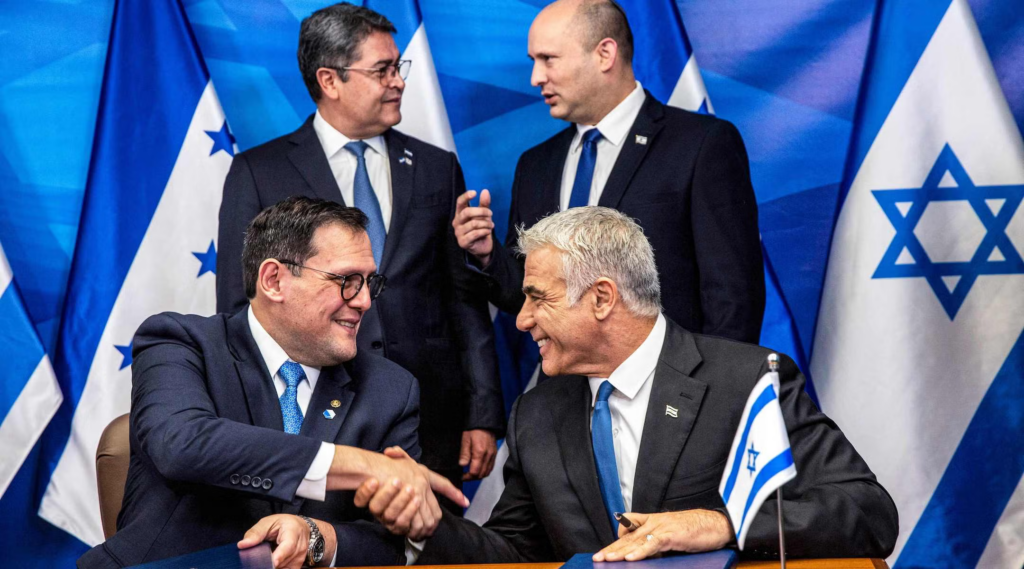
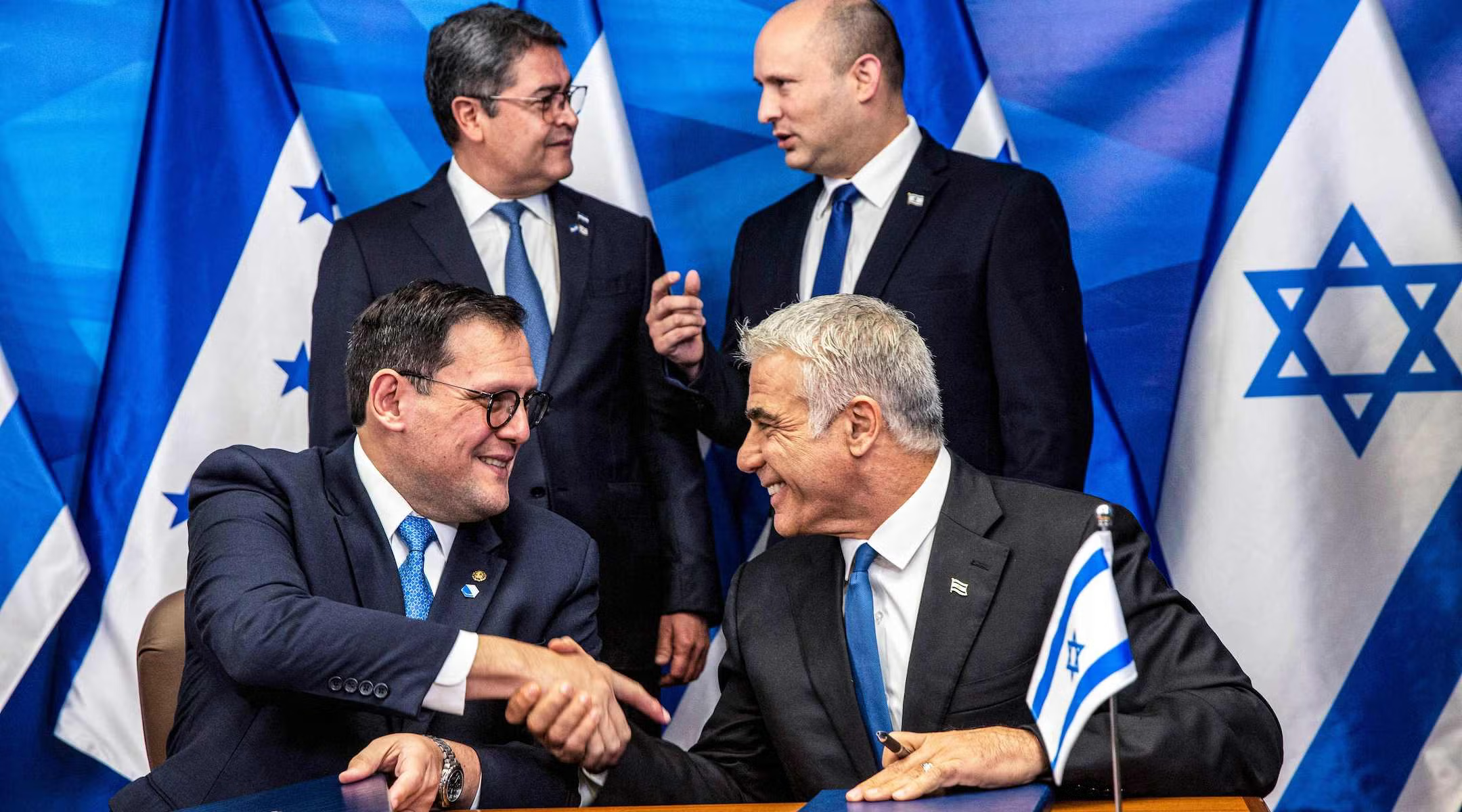
Israeli Foreign Minister Yair Lapid, right, shakes hands with his Honduran counterpart, Lisandro Rosales as Israeli Prime Minister Naftali Bennett, top right, speaks with Honduran President Juan Orlando Hernandez during the signing of bilateral agreements at the prime minister’s office in Jerusalem, June 24, 2021. (Source: Heidi Levine/AFP via Getty Images)
The CIA has complemented Israel’s long-term strategy by employing ostensibly humanitarian or religious NGOs, such as USAID, World Vision, and Church World Service (CWS), to fracture Honduran civil society. By promoting Protestantism over the historically cohesive Catholic majority and supporting programs that exploit divisions along religious, racial, and social lines, including tensions within the Garifuna community influenced by organisations such as OFRANEH, the CIA created fertile ground for ideological manipulation and elite control. Together, the actions of Israel and the CIA have destabilised Honduran society, skewed politics in favour of external interests, and amplified societal divisions. The 2025 elections starkly revealed these dynamics, exposing a democracy heavily shaped by decades of foreign intervention and manipulation.
While Honduras showed some symbolic independence, such as recalling its ambassador from Israel in November 2023, there is a strong case to argue that the deep structural influence of Israel and the U.S, reinforced over decades through military, economic, religious, and civil society channels, created a 2025 electoral landscape strongly favourable to a pro-Israel government, as confirmed by The Times of Israel. Nasry Asfura, promoted by President Trump, embodied this alignment, openly supporting Israeli interests and continuing policies that reinforced the country’s pro-Zionist orientation, making the elections less a contest of domestic politics and more a predictable outcome of long-term foreign influence.
Honduras is a nation under the shadow of powerful foreign influences, where politics, religion, and society have been quietly shaped for decades. The following article investigates how Israeli interests, CIA-backed NGOs, and elite manoeuvring have fractured communities, manipulated loyalties, and set the stage for the tensions that exploded during the 2025 elections…

Honduran President Juan Orlando Hernandez visits the Western Wall in Jerusalem, September 1, 2019 (courtesy Western Wall Heritage Foundation)
Hondurans Curiously Ambivalent On Palestinian Genocide
Thomas Tomczyk writes for PÄYÄ Magazine…
Hondurans have been mostly silent regarding the reported genocide taking place in Gaza over the past two years. The question is: Why such silence? Are Hondurans unaware of the massacres and starvation used against Palestinians in the occupied territories? Do they not care, or are they perhaps afraid of something? “To learn who rules over you, simply find out whom you are not allowed to criticise,” the saying goes.
There was one example of Hondurans protesting Israeli crimes against Palestinians during the Gaza war after the Hamas attack and Israeli stand-down operation of October 7. On October 23, 2023, dozens of Honduran Palestinians demonstrated in front of the Israeli Embassy in Tegucigalpa. Since then, the long-established and influential Arab Palestinian community has been mostly silent about the plight of their Palestinian relatives amid Israel’s escalating atrocities in Gaza and the West Bank.
There is certainly a disconnect, as the 300,000 members of Honduras’ Christian Palestinian community are the third and fourth generations to be born outside of Palestine. Their ancestors began arriving in Honduras from Palestine in the 1890s, and today their connection to and knowledge of Palestine and Israel is mostly superficial. Most Honduran Palestinians don’t know the full scale or nature of the barbarism inflicted on their compatriots who stayed behind and continue to face Israeli oppression, violence, discrimination and now genocide. A Honduran Palestinian businessman told me that many in his community are afraid of being accused of anti-Semitism and facing potential consequences. Simply acknowledging that a systematic genocide may be occurring in Gaza is viewed by some as anti-Semitic.
It is hard not to notice. Since October 2023, Israeli military actions have resulted in the deaths of many Christian civilians in Gaza who have nothing to do with Hamas. In October 2023 Israeli military bombed a Christian orthodox church and murdered 18 Christians. In December 2023, Israeli snipers executed two Palestinian women on the Gaza Holy Family Catholic church property. In July 2025, Israeli soldiers fired a tank shell at a cross of the same church, killing three and wounding a catholic priest. While this all fell on deaf ears in Honduras, it does seem that the Israelis don’t like Christians very much.
One person who spoke with concern about the plight of Palestinians was President Xiomara Castro. In November 2023, the Honduran government recalled its ambassador to Israel for consultations due to escalating massacres of Palestinian civilians in Gaza. President Castro described Israel’s actions in Gaza as genocide during a U.N. speech in September 2024. Still, words have not turned into actions. Honduras is nowhere near recognising Palestine as an independent state or moving its embassy from Jerusalem back to Tel Aviv. In fact, Honduras remains firmly in the pro-Zionist camp as it continues to support Israel’s military by purchasing 15 Black Mamba military vehicles. Pro-Zionist sentiment is strong in Honduras. Israeli flags are flown throughout the country. Hondurans increasingly wear the Star of David around their necks, and taxi drivers display the Israeli emblem on their vehicles. Honduran roots of Zionism and Judeophilia run deep, well over a century.
The country now counts three of its presidents to be Jewish: Juan Lindo, Ricardo Maduro and Juan Orlando Hernández. In fact, you could argue that there was a fourth Jewish president of Honduras who ruled the country from 1911 well into the 1950s. Samuel Zemurray, the Banana King, was responsible for the 1911 Honduran presidential coup that secured land and concessions for his United Fruit banana company. American mercenaries hired by Zemurray deposed President Miguel Dávila and made Honduras his “banana republic.” Zemurray installed his puppet, Manuel Bonilla, as president and received 20,000 acres of land in return. After President Bonilla’s death in 1913, Zemurray continued to be a virtual puppet master of several other Honduran presidents.
In 1947, the World Zionist Organisation tasked Zemurray with delivering Honduras’ U.N. vote in support of the creation of the state of Israel. Reportedly, in a personal phone call, Zemurray tried to bribe then-Honduran President Tiburcio Carías Andino. Because of pressure from the Honduran Palestinian community, Honduras abstained from voting for Israel. Since then, and with plenty of CIA help, Christian Zionism has made many inroads in Honduras. CIA fronts such as World Vision, USAID and Protestant Church World Service for many decades worked to undermine the cohesiveness of Honduran society.
Since the 1950s, the CIA, which some critics considered an Israeli-captured agency, promoted the establishment and expansion of Protestant churches in Latin America. The excuse given was that Protestants were more anti communist and a good alternative to the Liberation Theology preached in many Catholic parishes.
The percentage of Catholics in the country fell from 97% in the 1960s to 47% today. Protestant denominations undermined the Catholic cohesion of Honduran society. Religiously divided Honduras is much easier to manipulate, with one denomination pitted against another. Sixty years later, those Catholic-to-Protestant converts have not only become Zionists, but they are also actually converting to Judaism. According to El Heraldo, 37 families converted to Judaism and, in 2022, established Honduras’ first synagogue. The San Pedro Sula Mishkan Shlomo synagogue members advertise their plans to Judaise and convert thousands of Hondurans.
“The plan is for the expanded synagogue to be a six-story, shaped like a Star of David building and be able to accommodate 456 people. This would make it the biggest synagogue in Latin America.”
Ex-President Juan Orlando Hernández was key in the expansion of Judeophilia and Zionism in Honduras. Just in terms of economy, according School of the Americas, between 2013 and 2019, Honduras purchased $342 million in military and surveillance equipment from Israel. Basically, Honduras has been supporting Israel to the tune of around $5 million a month for that period. Road to conversion of Juan Orlando Hernández began in the early 1990s when he completed a one-year Mashav leaders course in Israel. Israel’s investment in JOH obviously paid off as he learned Hebrew, moved Honduras’ embassy to Jerusalem in 2021, and converted to Judaism with his entire family in 2021. The last one, right before going to a US jail for 45 years, was convicted of decade’s long drug and arms smuggling operation.
Honduras is likely getting set up for a rough ride. Israel funded military dictatorships where even the CIA would not venture. Israel trained and supplied arms to many bad actors that destabilised the region: the genocidal regime in Guatemala in the 1980s, Colombian drug smuggling death squads, Los Zetas drug lord Heriberto Lazcano. “Israel has given its soldiers practical training in the art of oppression and in methods of collective punishment. Some of those officers choose to make use of their knowledge in the service of dictators,” said Israeli general Mattityahu Peled.
“Honduras will likely become an increasingly polarized and violent society.”
There is also a growing Israeli pressure on the Honduran public by co-opting its anti-Gaza genocide sentiment into nebulous movements. The normally restrained Honduran Ministry of Foreign Affairs complained that Israeli Ambassador Nadav Goren meddled in internal Honduran affairs by meeting with Protestant church leaders preparing for the August 16 March for Peace and Democracy. “We express to the Honduran people our deep discomfort at their participation in said public event. The involvement of a diplomat not only ignores his limitations,” stated the Honduran ministry. There are plenty of other players seeking discord. Until its recent defunding by the Trump administration, San Pedro Sula was also home to the Hebrew Immigrant Aid Society (HIAS). The worldwide HIAS organisation does not assist Palestinians, Arabs or Christians in moving to Israel, but uses U.S. tax dollars to help move undocumented migrants through Honduras to the United States.
For decades, certain interest groups have promoted racial resentment —particularly among Black communities— while fostering a sense of guilt among white, European and Christian populations. In Honduras, this strategy is reflected in the 23-year-old movement known as the Fraternal Organisation of Honduran Blacks (OFRANEH), which has received funding from organisations such as American Jewish World Service and the Open Society Foundations, founded by George Soros. These groups have been involved in fermenting revolutions, protests and underhanded political activism around the world. Just as with organisations such as Black Lives Matter and ANTIFA, which were recently designated by the U.S. as a terrorist organisation, OFRANEH fosters division, racial tension, grievances and expectations of compensation in the historically well-integrated Garifuna community. Honduras, in the second quarter of the 21st century, will likely become an increasingly polarised and violent society. Powerful interest groups are working hard to implement this, and Roatan is increasingly a party to those tensions. In September 2025, OFRANEH conducted demonstrations in Cayos Cochinos, and in March 2025, there were protests in Diamond Rock. Tensions on Roatan are just starting to heat up.
FDA Won’t ‘Rubber-Stamp’ Pfizer mRNA Flu Vaccine Without Better Safety Data
By Michael Nevradakis, Ph.D. | The Defender | December 15, 2025
The U.S. Food and Drug Administration (FDA) likely won’t approve Pfizer’s mRNA flu vaccine unless the drugmaker produces data proving the product is safe for seniors, according to FDA Commissioner Marty Makary.
Makary told Fox News last month that the data from Pfizer’s recently completed Phase 3 clinical trial showed that adults 65 and older were at higher risk of several serious adverse events, including kidney failure and acute respiratory failure.
“We’re not just going to rubber-stamp new products that don’t work, that fail in a clinical trial,” Makary said. “It makes a mockery of science if we’re just going to rubber-stamp things with no data.”
Makary said the shot “failed in seniors” and the trial data “showed zero benefit” from the vaccine.
Karl Jablonowski, Ph.D., senior research scientist for Children’s Health Defense, said Makary’s comments signal a change in the way the FDA evaluates clinical trial data for vaccines.
“Makary’s FDA threw out the rubber stamp,” Jablonowski said. “The FDA, under different leadership, may have brushed off the lack of efficacy and Pfizer’s concerning safety data. A future administration may resurrect the rubber stamp. For the time being, this is Makary’s FDA.”
Last month, Pfizer published the results of its clinical trial in the New England Journal of Medicine (NEJM). However, the published results included data only for participants between 18 and 64. Data for participants 65 and older, published only on ClinicalTrials.gov, drew criticism from some scientists.
That data showed that elderly trial participants who received the mRNA vaccine had a significantly higher rate of death and several serious adverse events, including cancer, compared to participants who received the conventional non-mRNA flu shot.
This contrasts with Pfizer’s claims that the vaccine delivered “statistically superior efficacy” compared to the conventional flu shot, and that the frequency of serious adverse events was “similar” across the mRNA and non-mRNA groups.
“The disposition of the kidney and lung issues associated with the mRNA shot was concerning,” Jablonowski said.
Some experts noted that even among the 18-64 age group, adverse events were higher among trial participants who received the mRNA shot.
The only mention of the trial data for people 65 and over in the NEJM came in an accompanying editorial, which noted that this age group faces “the highest risk of hospitalization or death” from the flu.
Dr. Meryl Nass, a former internist and founder of Door to Freedom, said she was encouraged by Makary’s remarks. She said the FDA is legally required to license only those drugs that are proven to be safe and effective.
“This mandate is at least 70 years old,” Nass said. “What Makary is saying is already mandated by Congress. But the FDA has chosen to ignore that mandate due to politics, and Congress has failed to enforce it. Makary is actually obeying the law for the first time in decades regarding flu shots.”
Makary: annual mRNA vaccination ‘not based on science’
Makary told Fox News that past administrations rubber-stamped vaccine approvals even when safety data was questionable.
“That was the MO in the Biden administration with the eternal COVID booster approvals for young healthy kids,” Makary said.
The current administration will adopt a different approach to vaccine approvals, especially for children, Makary said.
“Recommending that a 6-year-old girl get another 70 mRNA COVID shots, one each year for the rest of her life, is not based on science,” Makary said.
Makary’s remarks came days after the release of a leaked memo in which Dr. Vinay Prasad, director of the FDA’s Center for Biologics Evaluation and Research, said changes are coming to the framework for evaluating flu vaccines.
“We will revise the annual flu vaccine framework, which is an evidence-based catastrophe of low quality evidence, poor surrogate assays, and uncertain vaccine effectiveness measured in case-control studies with poor methods. We will re-appraise safety and be honest in vaccine labels,” Prasad wrote in that memo.
Dr. Robert W. Malone, a member of ACIP and the committee’s influenza workgroup, told The Epoch Times that Prasad’s memo means “the entire influenza vaccine, annual vaccination enterprise is now subject to major disruption.”
In May, COVID-19 vaccine manufacturer Moderna withdrew its application for FDA approval of a combination mRNA flu and COVID-19 vaccine, after the FDA requested more clinical trials.
In June, the CDC’s vaccine advisers voted to stop recommending flu shots that contain thimerosal — a mercury-based preservative linked to neurodevelopmental disorders, including autism.
‘No one has figured out’ how to make mRNA shots safe
Makary’s statements came amid growing questions about the safety, efficacy and necessity of existing non-mRNA flu vaccines and waning uptake of the shots.
A Cleveland Clinic study published in April found that people who received the flu vaccine were 27% more likely to get the flu than those who didn’t.
Another study, published that month in JAMA Network Open, found that flu vaccines, whether given alone or in conjunction with COVID-19 shots, caused women to have longer menstrual cycles.
Endpoints News reported last month that public demand for flu vaccines is stalling and that “the general consensus among vaccine makers for Covid-19, flu and RSV is that dampening demand has shrunk sales.” Data from Eurostat indicate a decline in flu vaccine uptake in the European Union.
Research into mRNA-related platforms is also facing growing scrutiny. In August, the U.S. Department of Health and Human Services cancelled nearly $500 million in funding for mRNA vaccine research.
“With regard to mRNA injections, no one has figured out how to make them safe,” Nass said. “mRNA shots provide an unknown dose, and they can be ‘the gift that keeps on giving,’ because we don’t know how to shut off the production of mRNA-coded proteins. We probably never will.”
Nass added that while FDA rules require that a specific dose be established for every drug, “somehow this rule has never applied to mRNA vaccines.”
“I believe the mRNA platform is irrevocably flawed for this reason alone, although there are other toxicities involved that also make the platform problematic,” Nass said.
A growing number of scientists have called for the suspension or withdrawal of the administration of mRNA vaccines and products.
This article was originally published by The Defender — Children’s Health Defense’s News & Views Website under Creative Commons license CC BY-NC-ND 4.0. Please consider subscribing to The Defender or donating to Children’s Health Defense.
How Israel hijacked US politics, media and tech – without Americans even realizing

By Maryam Qarehgozlou | Press TV | December 20, 2025
When tech billionaire Larry Ellison was tapped to help oversee TikTok’s US operations, the move immediately drew scrutiny over the Oracle co-founder’s longstanding ties with the Israeli regime and how it could sharpen censorship of pro-Palestinian content on the platform.
Oracle’s ascendance came after the US Supreme Court upheld a law banning TikTok earlier this year, positioning the company as the frontrunner to take control of the Chinese-owned app.
Under the arrangement, Oracle would serve as the “secure cloud provider,” storing US user data and controlling the recommendation algorithm, an authority Washington framed as necessary to counter alleged Chinese “manipulation.”
But while the campaign against TikTok was outwardly led by China hawks, pro-Israel contractors, and the powerful Zionist lobby in Washington, played a central role in shaping the political pressure that made Oracle an obvious choice for the takeover.
Pro-Palestine advocates point out that a deeper motivation has been to silence the overwhelming pro-Palestinian opinions and sentiments on TikTok, where users have in great detail documented Israel’s genocidal war on Gaza and challenged American-Israeli narratives about it.
The platform has become a key outlet for unfiltered footage from Gaza, including scenes of devastation, civilian casualties, and global solidarity campaigns.
Research from Northeastern University has consistently shown that pro-Palestinian posts dwarf pro-Israel content—most recently, in September 2025, by a ratio of roughly 17 to 1.
This imbalance reflects TikTok’s younger user base—Gen Z and millennials—who increasingly reject Washington’s and Tel Aviv’s deceptive and deeply manipulative positions.
Israel’s leadership understands the stakes. Benjamin Netanyahu recently described social media as a decisive “weapon” in modern warfare, calling the TikTok sale “the most important purchase” for securing influence over US public opinion.
Oracle’s deep alignment with Israeli interests has only heightened concerns. The company had already tightened its grip over aspects of TikTok’s operations while openly embracing a pro-Israel agenda and, as an Intercept investigation revealed, suppressing pro-Palestine activism within its own ranks.
Oracle CEO Safra Catz, an Israeli-American and longtime supporter of the Zionist project, made her stance bluntly clear, telling an Israeli business outlet: “For employees, it’s clear: if you’re not for America or Israel, don’t work here—this is a free country.”
Ellison, a major funder of Israeli causes and a close ally of Donald Trump, has long been celebrated by the US political establishment.
Trump—who placed him in the front row at his inauguration—famously hailed him as “one of the most serious players in the world.”
In 2017, Ellison made the largest single donation in the history of the so-called “Friends of the Israel Forces,” a US-based organization tied to the Israeli military responsible for genocidal attacks across Gaza and the occupied West Bank.
Oracle’s material support for Israel extends far beyond philanthropy. In 2021, the company opened a $319 million data center in occupied al-Quds, providing cloud services to Israeli banks, health institutions, and military units.
Immediately after Israel launched its genocidal assault on Gaza on October 7, 2023, Oracle publicly declared its support for the regime even as hospitals and schools were bombed.
Catz instructed that the message “Oracle Stands with Israel” be displayed across all company screens in more than 180 countries.
The company has also actively participated in Israel’s digital propaganda efforts. Following the outbreak of the war on Gaza, Oracle and the Israeli regime officials developed “Words of Iron,” a project designed to amplify pro-Israel content while whitewashing horrendous war crimes and countering critical narratives on TikTok, Instagram, and Twitter.
In February 2024, Oracle collaborated with the Israeli military’s cyber department on a hackathon seeking “tech solutions” for rehabilitating illegal settlements near Gaza.
Around the same time, Oracle donated medical and environmental supply bags worth half a million dollars to Israeli occupation forces.
Oracle’s political lobbying worked in tandem with its technological support. Last summer, Catz joined a closed-door meeting with US senators to push for continued weapons shipments to Israeli-occupied territories.
Later that year, Oracle partnered with Rafael Advanced Defense Systems—one of Israel’s major weapons manufacturers—on an AI program to provide “warfighters with quick, actionable insights in the battlespace.”
While Israel escalated its bombing and invasion of Gaza, some Oracle employees reported that the company was actively curtailing internal support for Palestinians.
Oracle’s charitable matching program quietly removed organizations such as Medical Aid for Palestinians and UNRWA from its list of eligible beneficiaries, effectively blocking workers from directing matched funds toward humanitarian relief.
Ellison and Catz are hardly outliers; they are part of a broader pattern of influential Zionist figures holding disproportionate power across US political, financial, media, academic, tech, and cultural institutions.
Although only about 2 percent of the US population identifies as Jewish, Jewish and Zionist representation among American elites is significantly higher—a trend that has shaped US foreign policy, cultural production, and the sustained alignment with Israel’s violent occupation.
Below is a list of influential Zionist figures who occupy key positions across these sectors.
Jews in American politics
In February 2021, less than a month after former US President Joe Biden’s inauguration, the Israeli daily The Jerusalem Post celebrated the new president’s appointments of 15 Jewish politicians.
“US President Joe Biden has appointed a strong, experienced team for his new administration. Among them are a minyan and a half of Jews. Indeed, I wonder if there has ever been a more Jewish US administration,” columnist Shlomo Maital wrote in the article.
The article added that “a vigorous American presence in world affairs, spearheaded by the Jewish A-Team, is in Israel’s long-term interest, more than an ‘America first’ administration that made the US largely irrelevant in global affairs.”
Secretary of State Anthony Blinken, CIA Deputy Director David Cohen, Attorney General Merrick Garland, and Director of National Intelligence Avril Haines were among the Jewish members of Biden’s administration holding influential positions.
The list also included Chief of Staff Ronald Klain, Office of Science and Technology Policy Director Eric Lander, Deputy Health Secretary Rachel Levine, and Secretary of Homeland Security Alejandro Mayorkas.
Other key figures were NSA Cybersecurity Director Anne Neuberger, Deputy Secretary of State Wendy Sherman, Treasury Secretary Janet Yellen, COVID-19 Coordinator Jeff Zients, and CDC Director Rochelle Walensky.
Also serving in senior economic and political roles were Jared Bernstein, a member of the Council of Economic Advisors, and Douglas Emhoff, husband of Vice President Kamala Harris.
As Secretary of State, Blinken was a central public and diplomatic defender of US support for Israel during the initial phase of the Gaza genocide — pressing allies, coordinating arms transfers, and publicly backing negotiations framed to protect the Israeli regime while offering limited humanitarian concessions for the besieged people of the Gaza Strip.
According to rights groups and activists, his steady diplomatic backing helped shield Israeli genocidal actions from stronger, public US rebukes.
Yellen’s Treasury enforced and expanded financial pressure instruments, such as sanctions that the US uses against Iran and other supporters of the Palestinian resistance.
The Treasury under Yellen issued targeted sanctions on Iran’s petroleum and petrochemical sectors.
Cohen, as Under Secretary for Terrorism and Financial Intelligence (Treasury), also designed and executed sanctions that targeted Iran’s oil, petrochemical, and financial sectors.
He is widely described in reporting and policy bios as the administration’s “sanctions guru.”
As Deputy Director of the CIA (and acting director briefly), Cohen brought his sanctions experience into targeting work against Iran — shaping covert disruption tools in addition to Treasury levers.
These unilateral sanctions form a core non-military lever in the US hawkish toolkit.
A Lancet study in August found a significant link between sanctions and higher mortality. The US and EU sanctions were associated with over 564,000 deaths annually from 1971 to 2021 in 152 countries.
It is similar to the global mortality burden associated with armed conflict.
Children under 5 years faced about an 8-9 percent higher death risk, and adults aged 60-80 years had about a 2-3 percent higher risk.
The study found the strongest effects for unilateral, economic, and US sanctions, but none from UN sanctions.
Trump’s first term also included many Jewish officials in senior roles. Jared Kushner, his son-in-law and senior advisor, was among the most influential, alongside Elliot Abrams, Special Representative for Venezuela and later Iran, and David Friedman, Ambassador to the Israeli-occupied territories.
Other key figures included Jason Greenblatt, Special Representative for International Negotiations on Palestine; Steve Mnuchin, Secretary of the Treasury; Stephen Miller, Senior Advisor for Policy; Gary Cohn, Director of the White House National Economic Council; Reed Cordish, Assistant to the President for Intragovernmental and Technology Initiatives; and Avrahm Berkowitz, Deputy Advisor to the President.
Additional senior officials were Rod Rosenstein, Deputy Attorney General; Elan Carr, Special Envoy to Monitor and Combat Antisemitism; Ellie Cohanim, Deputy Special Envoy for the same office; Jeffrey Rosen, Attorney General; Morgan Ortagus, State Department spokesperson; David Shulkin, Secretary of Veterans Affairs; and Lawrence Kudlow, Director of the National Economic Council.
Also serving in high-level positions were Ivanka Trump, the president’s daughter and advisor, who was raised Christian but converted to Orthodox Judaism to marry Kushner in 2009; John Eisenberg, National Security Council Legal Counsel; Ezra Cohen-Watnick, Acting Under-Secretary of Defense for Intelligence; and Len Khodorkovsky, Deputy Secretary of State and Senior Advisor to the US Special Representative for Iran.
Several senior Jewish members of the Trump administration played central roles in reshaping US policy in ways strongly favorable to the Israeli regime.
Kushner was the architect of the Abraham Accords, the normalization agreements between Israel and several Arab states — including the UAE, Bahrain, Morocco, and Sudan.
Kushner also helped push forward the administration’s West Asia so-called “Peace to Prosperity” plan, which embraced long-standing Israeli positions on expansion of illegal settlements in the West Bank, and occupation of Palestine.
David Friedman, the Ambassador to Israeli-occupied territories, used his position and strongly supported recognizing occupied al-Quds as Israel’s capital, encouraged the relocation of the US embassy from Tel Aviv to al-Quds, and backed Israel’s claim to West Bank settlements.
His diplomatic messaging consistently pushed Washington toward formally accepting Israeli control over the occupied territories.
Jason Greenblatt, Trump’s envoy for Israeli-Palestinian negotiations, worked closely with Friedman and Kushner.
He was one of the primary US officials promoting the idea that settlement expansion was not an obstacle to peace. His role helped shift the State Department’s language away from the traditional American view of settlements as “illegitimate,” aligning it more closely with Israeli regime positions.
Lawrence Kudlow and Gary Cohn, who headed the National Economic Council at different times, supported the administration’s economic components of West Asia policy, including aid packages tied to normalization and economic incentives designed to complement Kushner’s diplomatic agenda.
Elan Carr and Ellie Cohanim, from the State Department’s antisemitism office, advanced aggressive messaging on global antisemitism that often intertwined with defending the Israeli regime’s genocidal and apartheid policies. Their public diplomacy helped cast any criticisms of Israel in terms of antisemitism, influencing international discussions.
After re-entering the White House for a second term in January, Trump once again packed his inner circle with vocal Jewish and Zionist loyalists, many of whom stand out for their unprecedented hostility toward the Palestinian people and their basic rights.
Trump stacked his advisory ranks with a mix of familiar figures and newer faces who exert outsized influence over his relationship with the Jewish community in the US and in the occupied territories.
Among them are Will Scharf, White House staff secretary; Stephen Miller, White House deputy chief of staff for policy and homeland security adviser; Steve Witkoff, US special envoy to West Asia; Howard Lutnick, secretary of commerce; Boris Epshteyn, Trump’s personal senior counsel; Elizabeth Pipko, national spokesperson for the Republican Party; Lee Zeldin, administrator of the Environmental Protection Agency; and Laura Loomer, an extremist influencer who operates as an unofficial loyalty enforcer within Trump’s political orbit.
Ivanka Trump and her husband were notably absent from much of Trump’s 2024 campaign and announced two years ago that they had stepped back to support Trump “outside the political arena.”
However, as one of Trump’s former top aides alongside Kushner—who played a central role in brokering the Abraham Accords and now runs a multibillion-dollar private equity fund bankrolled by the governments of Saudi Arabia, the United Arab Emirates, and Qatar—many speculate that the couple’s influence, particularly Kushner’s, will persist throughout Trump’s presidency.
This influence is expected to be especially pronounced in shaping the administration’s interference in West Asian affairs, as has already witnessed during the so-called Gaza “truce deal.”
Miller, one of Trump’s most hardline advisers on immigration during his first term, was instrumental in shaping some of the administration’s controversial policies, including the travel ban targeting seven Muslim-majority countries and the policy that separated the children of undocumented migrants from their parents at the border.
Pipko is an avowed Zionist and stated following her appointment that “supporting Israel is in the best interest of the United States.”
She has also attacked pro-Palestinian protests on US college campuses, singling out demonstrations at her alma mater, Harvard.
In an interview with Ynet News, she dismissed the protests as “awful” and “disgusting.”
Loomer, who has described herself as “a proud Islamophobe,” ran an online campaign in August that pressured the US State Department into halting visa issuance for children from Gaza in desperate need of medical care amid Israel’s genocidal war on the besieged Strip.
Zionist donors heavily underwrote Trump’s 2024 presidential campaign.
Miriam Adelson, a casino magnate with an estimated net worth of $35 billion and a prominent Zionist mega-donor, spent more than $100 million to propel Trump back into the White House.
She is the widow of Sheldon Adelson, one of the most prolific financiers of illegal Israeli settlements in history.
Miriam Adelson is herself a settler, born and raised in the occupied Palestinian territories, and has been a vocal champion of the regime’s settler-colonialism.
She is closely associated with the ideology of neo-Zionism, which advocates not only the permanent retention of occupied Palestinian land but also the expansion of the occupation through annexation of Palestine and neighboring countries.
Ivy League presidents
The Ivy League is a group of eight elite private universities located in the northeastern United States. They include Brown, Columbia, Cornell, Dartmouth, Harvard, Princeton, the University of Pennsylvania, and Yale.
At present, five of these institutions are led by Jewish presidents.
Their Jewish and Zionist identities have become most visible amid the wave of pro-Palestine university encampments that swept campuses across the United States.
Beginning at Columbia University on April 17, 2024, pro-Palestinian students established encampments on at least 80 college and university campuses nationwide, demanding that their institutions disclose investments tied to Israeli-occupied territories and divest from financial and cultural entities that support Israel’s occupation of Palestine.
These demands were raised in the context of the ongoing genocide in Gaza, the killing of tens of thousands of Palestinians—most of them women and children—and the continuation of the violent ethnic cleansing of Palestinians from their land.
The protests echoed a call from Palestinian civil society for the Boycott, Divestment, and Sanctions (BDS) of Israel.
The largely peaceful demonstrations, however, were met overwhelmingly with force. Police crackdowns resulted in mass arrests and injuries, actions frequently ordered by the students’ own university administrators and, in some cases, backed by faculty members.
After taking office in January, Donald Trump signed an executive order to “combat antisemitism,” directing federal agencies to explore avenues for deporting pro-Palestinian activists, including student protesters—a demand to which many universities, including Ivy League institutions, readily capitulated.
Christopher Ludwig Eisgruber, a Jewish-American who has served as Princeton University’s 20th president since July 2013, ordered the removal of a major pro-Palestinian encampment on Cannon Green, citing preparations for commencement, and has repeatedly resisted demands that Princeton divest from the Israeli regime.
In April 2024, when police—acting on authorization from university administrators—arrested dozens of students during pro-Palestinian protests, including at Princeton, Eisgruber warned that those students would face disciplinary action that could “extend to suspension or expulsion.”
Alan Garber, another Jewish academic leader, was appointed president of Harvard University in August 2024 after serving as interim president since January 2 of that year.
He succeeded Claudine Gay, who was forced to resign after being accused by members of Congress of failing to adequately condemn and combat “anti-Semitism” on Harvard’s campus during pro-Palestine encampments.
Under Garber’s leadership, Harvard shared information with the US Department of Homeland Security in response to its request for the disciplinary records of international students and records of pro-Palestinian activity.
Sian Leah Beilock, the president of Dartmouth College, is another Jewish leader within the Ivy League.
She faced sharp criticism for her decision to call in police to dismantle a pro-Palestinian encampment on campus on May 1 of last year.
Mike Kotlikoff, who is also Jewish, assumed permanent leadership of Cornell University in March, as universities faced unprecedented pressure from the Trump administration over pro-Palestinian student protests.
In November 2024, while serving as Cornell’s interim president, a leak revealed that Kotlikoff had suppressed academic freedom after criticizing a pro-Palestinian professor’s planned course on the Gaza genocide in an internal email.
The course, Gaza, Indigeneity, Resistance, was set to be taught by Eric Cheyfitz, who is also Jewish.
Cheyfitz, the Ernest I. White Professor of American Studies and Humane Letters and a scholar of Indigenous studies, wrote in the course description that it would examine how Indigenous peoples have been engaged “in a global resistance against an ongoing colonialism.”
He further stated that the course would “present a specific case” of the ongoing genocidal war as “settler colonialism in Palestine with a particular emphasis on the International Court of Justice finding ‘plausible’ the South African assertion of ‘genocide’ in Gaza.”
Kotlikoff wrote in an email to another professor that he “personally finds the course description to represent a radical, factually inaccurate, and biased view of the formation of […] Israel and the ongoing conflict.”
Kotlikoff replaced Martha Pollack, who is also Jewish, and stepped down amid sweeping pro-Palestinian protests across US college campuses.
During the protests, Pollack expressed disappointment with student demonstrators and warned that if they refused to dismantle their encampments, “more temporary suspensions… are forthcoming.”
Christina Paxson, who converted to Judaism after marriage, serves as president of Brown University.
Last year, for the second time during her tenure, Paxson rejected divestment from 10 companies identified by a student-led pro-Palestine initiative as facilitating “the Israeli occupation of Palestinian Territory.”
Hollywood
It is widely documented that Jewish people are overrepresented in Hollywood relative to their share of the overall population.
Jews account for roughly 2 percent of the American population, yet various estimates suggest they have historically comprised a far higher proportion of key industry roles, including studio executives, writers, and actors.
Some discussions cite figures of 20 percent or higher in certain sectors of the entertainment industry.
Jewish entrepreneurs were instrumental in founding most of the major film studios during Hollywood’s so-called Golden Age.
These figures include Adolph Zukor, founder of Paramount Pictures; William Fox, founder of the Fox Film Corporation; Louis B. Mayer and Marcus Loew, co-founders of Metro-Goldwyn-Mayer (MGM); Harry, Albert, Sam, and Jack Warner, the brothers behind Warner Bros; Carl Laemmle, a founder of Universal Pictures; and Harry and Jack Cohn, founders of Columbia Pictures.
In more recent decades, prominent Jewish executives have continued to occupy influential positions in the entertainment industry.
They include Bob Iger, chief executive officer of The Walt Disney Company; Adam Aron, CEO of AMC Entertainment; Jon Feltheimer, CEO of Lionsgate; Shari Redstone, president and CEO of National Amusements; David Zaslav, CEO of Warner Bros. Discovery; and influential film producer and former Sony Pictures head Amy Pascal.
For years, activists and some academics have warned that this concentration of power has helped shape an industry culture that frequently aligns with pro-Israel narratives, whitewashing Zionist crimes while marginalizing or excluding Palestinian perspectives.
Jewish Hollywood power brokers, they say, used their influence in the mid-20th century to mobilize cultural support for the Zionist project, portraying settler violence as “Jewish self-defense” in early films and theatrical productions.
By contrast, Palestinian narratives are routinely sidelined. Palestinian films are often excluded from major festivals and streaming platforms, while Israeli atrocities are frequently framed in ways that downplay or obscure Palestinian suffering.
Even films and documentaries that seek to center Palestinian humanity and lived experience have become a subject of sustained controversy within the industry.
Finding mainstream Hollywood productions that portray Palestinians in a balanced, non-dehumanizing manner remains difficult, as decades of output have either perpetuated negative stereotypes or erased Palestinian perspectives altogether.
The few films that do offer more nuanced or humanizing depictions of Palestinians are typically independent productions or international co-productions, often directed by Palestinian filmmakers working outside the Hollywood studio system.
Meanwhile, public support for Palestinian rights or criticism of the Israeli regime or its backers has increasingly carried professional consequences in Hollywood.
Actors and industry professionals—both Jewish and non-Jewish—have faced reprisals ranging from being dropped by agents to losing roles, contributing to a pervasive “silencing effect.”
In December 2023, two months into Israel’s genocidal war on Gaza, actress Melissa Barrera, a star of the Scream franchise, was fired from the next installment after posting on social media about Israel’s real-life horror show in the Gaza Strip.
Barrera was not alone. In November of the same year, actress Susan Sarandon was dropped by United Talent Agency (UTA) after speaking at a pro-Palestinian rally.
Actor Mark Ruffalo also faced backlash during Israel’s May 2021 assault on Gaza, when he was pressured to apologize for using the term “genocide.”
Top 50 Billionaires
The latest rankings of the world’s wealthiest individuals highlight a notable trend: of the top 50 billionaires globally, at least 12 are Jewish, showcasing their considerable influence across technology, finance, and investments.
Leading the pack is Larry Ellison, co-founder of Oracle, whose fortune stands at $213.7 billion, making him the third richest person in the world.
Close behind is Mark Zuckerberg, CEO of Meta Platforms, which includes Facebook, Instagram and WhatsApp, with a net worth of $202.4 billion and a world rank of 4.
The search engine giants Larry Page and Sergey Brin, co-founders of Google, are ranked 6th and 7th, respectively, with fortunes of $157.8 billion and $150.7 billion.
Other prominent Jewish billionaires in the top 50 include Steve Ballmer of Microsoft ($127.7 billion, rank 9), Michael Dell of Dell Technologies ($113.5 billion, rank 12), and media mogul Michael Bloomberg of Bloomberg LP ($104.7 billion, rank 16).
Stephen Schwarzman, a major figure in investments, ranks 28th with $50.4 billion, while Jeff Yass, active in trading and investments, holds $49.6 billion at rank 29.
Luxury fashion also sees Jewish representation through Gerard Wertheimer and Alain Wertheimer, owners of Chanel, both holding $41.5 billion and sharing world rank 38.
The Miriam Adelson & family, tied to the casino industry, are valued at $34.9 billion, ranking 49.
The overwhelming majority are based in the United States, dominating technology and investment sectors, and heading companies that shape global information flows.
But beyond wealth, their power has had devastating consequences for Palestinians.
Meta and Oracle, for example, have been implicated in censoring Palestinian voices online, shaping narratives in favor of Israeli policies while silencing dissent.
Google, Microsoft, and Dell Technologies have enabled the Israeli military’s genocidal war on Gaza over the past two years, providing cloud infrastructure, AI, and technology services that the regime has used to target Palestinian civilians.
This concentration of wealth and technological control underscores not only the disproportionate influence of Jewish billionaires in the US tech world but also raises profound questions about the ways these platforms and services are weaponized in geopolitics—always aligning with US and Israeli agendas to the detriment of human rights.
Sport teams owners
Ownership patterns across major US professional sports leagues reveal a striking concentration of power among a small group of ultra-wealthy Jewish stakeholders, many of whom hold openly pro-Zionist political positions or have backed policies hostile to Palestinian advocacy.
In the National Basketball Association (NBA), estimates indicate that roughly 40 percent of franchises are majority-owned by individuals or groups with Jewish backgrounds—far exceeding their approximate 2 percent share of the US population.
An additional five teams include Jewish minority stakeholders, underscoring a level of influence that extends well beyond ownership into league governance and political positioning.
Out of 30 NBA teams, 12 are majority-owned by Jewish stakeholders.
These include Anthony Ressler (Atlanta Hawks); Gabe Plotkin and Rick Schnall (Charlotte Hornets); Jerry Reinsdorf (Chicago Bulls); Dan Gilbert (Cleveland Cavaliers); Miriam Adelson (Dallas Mavericks); Joe Lacob and Peter Guber (Golden State Warriors); Herbert Simon (Indiana Pacers); Micky Arison (Miami Heat); Marc Lore (Minnesota Timberwolves); Steve Ballmer (Los Angeles Clippers); Joshua Harris and David Blitzer (Philadelphia 76ers); and Mat and Justin Ishbia (Phoenix Suns).
Teams with Jewish minority owners include the Jacobs family (Sacramento Kings), Larry Tannenbaum (Toronto Raptors), George Kaiser (Oklahoma City Thunder), Oliver Weisberg (Brooklyn Nets), and Larry Fink (New York Knicks).
For four decades, the NBA itself has been led by two commissioners—David Stern (1984–2014) and Adam Silver (2014–present)—both of whom presided over eras marked by close alignment with US foreign policy narratives and repeated controversies related to Palestine.
The league has faced sustained criticism for suppressing or sanitizing Palestinian references under political pressure.
In 2017, the NBA removed “Palestine—occupied territory” from an official website list following a complaint from Israel’s sports minister.
A year later, the league apologized after a fan-voting list for the All-Star Game included “Occupied Palestine,” blaming an outsourced firm after Israeli officials demanded its removal.
Senior NBA figures, including Commissioner Adam Silver, along with current and former players, have participated in high-profile trips to Israeli-occupied territories, meeting with Israeli regime officials and engaging in public relations efforts to normalize occupation.
Meanwhile, players who expressed solidarity with Palestinians faced swift backlash.
Former NBA star Dwight Howard said he was pressured to delete a “Free Palestine” tweet in 2014 after receiving multiple calls, including one from the commissioner’s office.
This concentration of ownership and political alignment is not limited to basketball.
In the National Football League (NFL), 11 of the league’s 32 teams are owned by individuals or families with controlling Jewish stakes, including Arthur Blank (Atlanta Falcons), David Tepper (Carolina Panthers), Jim Irsay (Indianapolis Colts), Mark Davis (Las Vegas Raiders), Stephen Ross (Miami Dolphins), the Wilf family (Minnesota Vikings), Robert Kraft (New England Patriots), Steve Tisch (New York Giants), Jeffrey Lurie (Philadelphia Eagles), the Glazer family (Tampa Bay Buccaneers), and Josh Harris and Mitchell Rales (Washington Commanders).
Major League Baseball (MLB) shows similar patterns.
Eight of its 32 teams are majority-owned by Jewish stakeholders—David Rubenstein (Baltimore Orioles), Jerry Reinsdorf (Chicago White Sox), Bruce Sherman (Miami Marlins), Mark Attanasio (Milwaukee Brewers), Steve Cohen (New York Mets), the Fisher family (Oakland Athletics), Stuart Sternberg (Tampa Bay Rays), and the Lerner family (Washington Nationals).
Six additional teams have Jewish minority owners or executives, including Tom Werner (Boston Red Sox), David Blitzer (Cleveland Guardians), Stan Kasten and Peter Guber (Los Angeles Dodgers), and Lester Crown (New York Yankees).
Several teams without Jewish majority owners—including the New York Yankees, San Francisco Giants, Los Angeles Dodgers, and Toronto Blue Jays—are run by Jewish presidents or senior executives.
Across leagues, Jewish owners and executives with strong pro-Israel views have helped shape institutional responses that activists warn would marginalize Palestinian voices while reinforcing US and Israeli political narratives.
Federal Reserve
Beyond sports and entertainment, Jewish financiers have played central roles in US monetary power structures.
Paul Moritz Warburg, a German-Jewish banker from Kuhn, Loeb & Co., was a key architect of the US Federal Reserve System.
From 1987 to 2014, the Federal Reserve was chaired consecutively by Alan Greenspan, Ben Bernanke, and Janet Yellen— three Jewish individuals overseeing periods of aggressive financial intervention that disproportionately benefited Wall Street while entrenching US global dominance.
Other influential Jewish figures include Emmanuel Goldenweiser, who supervised early Federal Reserve Board operations, and Stanley Fischer, who later served as vice chair.
Media, advertising, adult entertainment
Jewish Americans have also been influential across a wide spectrum of media, advertising, and public relations industries, sectors that play a decisive role in shaping political narratives, as well as adult entertainment businesses.
In the advertising and public relations world, influential Jewish executives include Richard Edelman, CEO of the global PR firm Edelman; Carl Spielvogel, co-founder of the major agency Backer & Spielvogel; Ronn Torossian, founder of 5W Public Relations; and Marian Salzman, a senior advertising and communications executive and trend expert.
Torossian, an American public relations executive, is a prominent and controversial figure in the far-right Zionist movement, known for his leadership of the recently re-launched Betar USA organization.
Betar USA, under Torossian’s leadership, has been using inflammatory rhetoric and calling for violence. In response to a social media post about Palestinian children killed in the Israeli genocidal war on Gaza, the group’s account commented, “Not enough. We demand blood in Gaza!”
Betar has been involved in identifying and circulating lists of pro-Palestinian protesters for deportation.
Digital media platforms have also been dominated by Jews with allegiance to the Tel Aviv regime.
Susan Wojcicki was an American business executive who was the chief executive officer of YouTube from 2014 to 2023.
Human rights and digital media advocacy groups, such as the organization 7amleh, have denounced YouTube’s policies and blatant bias against Palestinian voices and in favor of Israeli narratives.
In November 2015, Wojcicki and other Google representatives met with Israeli Deputy Foreign Minister Tzipi Hotovely to establish a mechanism for monitoring and removing Palestinian content deemed “inflammatory” by the apartheid regime in Tel Aviv.
In adult entertainment, prominent founders and executives include Michael Lucas, the founder and CEO of Lucas Entertainment, one of Manhattan’s largest gay adult film companies.
Last year, the adult film producer faced intense backlash after bragging about writing his name on a missile to be dropped in Gaza in a post on social media.
Several adult entertainment stars have since vowed to boycott working with Lucas and his company over the “reprehensible” post.
Taken together, the American landscape reveals not a coincidence but a pattern: a dense web of political power, corporate control, cultural influence, and financial leverage that consistently converges to protect Israel from accountability while suppressing Palestinian voices.
Disguised under the language of “security,” “shared values,” and “combating antisemitism,” US institutions have been mobilized by the powerful Zionist lobby to normalize occupation, whitewash mass killings, and criminalize solidarity with the oppressed.
The result, according to activists, is a manufactured consensus in which Israel’s crimes are laundered through American power centers, and dissent is treated as a threat.
As Gaza is starved, bombed, and erased in real time, this alignment exposes the moral bankruptcy of an order that privileges loyalty to a settler-colonial regime over international law, human rights, and basic human life, they warn.
Featured Video

“Historic Russia”: The Land Putin Will Not Give Back
or go to
Aletho News Archives – Video-Images
Book Review
Why the War on Conspiracy Theories Is Bad Public Policy
By Kevin Barrett • Unz Review • February 1, 2019
 A Review of Conspiracy Theories and Other Dangerous Ideas by Cass Sunstein (based on an earlier paper co-authored with Adrian Vermeule); In Defense of Troublemakers: The Power of Dissent in Life and Business by Charlan Nemeth; and Conspiracy Theories and the People Who Believe Them, edited by Joseph E. Uscinski
On January 25 2018 YouTube unleashed the latest salvo in the war on conspiracy theories, saying “we’ll begin reducing recommendations of borderline content and content that could misinform users in harmful ways—such as videos promoting a phony miracle cure for a serious illness, claiming the earth is flat, or making blatantly false claims about historic events like 9/11.”
At first glance that sounds reasonable. Nobody wants YouTube or anyone else to recommend bad information. And almost everyone agrees that phony miracle cures, flat earthism, and blatantly false claims about 9/11 and other historical events are undesirable.
But if we stop and seriously consider those words, we notice a couple of problems. First, the word “recommend” is not just misleading but mendacious. YouTube obviously doesn’t really recommend anything. When it says it does, it is lying. … continue
Blog Roll
 Aletho News
- “Historic Russia”: The Land Putin Will Not Give Back
- How the Cambridge Analytica scandal still haunts Mark Zuckerberg
- The Ongoing Cancellation Campaign Against a Dissenting Academic in Norway
- Yemen and ‘the Houthis’: Challenging Sami Hamdi’s Narrative
- No, Christians did not invent Zionism
- AIPAC-led lobbying network opens branches in Cypriot, Greek parliaments
- Araghchi blasts ‘parasitic’ alliance as US taxpayers pay for Israel’s war on Iran
- Easy fix for Europe’s chaos? Stop fueling war against Russia
- Putin’s key remarks on peace talks and Europe’s ‘schizophrenia’
- Trita Parsi: Israel Set a Trap for Total War in the Region
- If Americans Knew
- Damning report shows the media must confront its failures on Gaza
- BBC senior broadcaster speaks out on Gaza coverage
- Netanyahu vows vast West Bank invasion in response to 20-minute skirmish that left 2 Israeli soldiers and 2 Palestinian fighters dead
- Tied up and tortured: Israel using US-made electroshock weapons on Palestinian detainees
- The outsourced risk: how newsrooms rely on Gaza’s freelancers without protecting them
- Gaza bakeries forced to shut as Israel blocks flour shipments
- Gaza’s breast cancer patients face a deadly wait for treatment amid Israel’s genocide
- DAILY UPDATE: Latest essential news on Palestine, Israel, & region
- The Israel Lobby’s Changing Fortunes
- AIPAC has become such a political liability that it’s shifting to a more “nimble” approach to buying politicians
- No Tricks Zone
- E-Cars Reduce CO2 Emissions By Only 41% Compared To Internal Combustion Engine Vehicles
- Predictions Made By Renowned Climate Professor Over Past Decades Have Been Proven To Be Poor
- New Study Suggests Large Regions Of The Pacific Ocean Have Been Cooling For The Last 80 Years
- Germany’s Green Energy Debacle: High Energy Costs Force Kahla Porzellan to Close After 182 Years!
- New Study: 50 Years Of The Most Aggressive ‘Net Zero’ Policies Can Only Affect The Global Climate By 0.03°C
- US September “Heat” Was No Record…Many Records Set Decades Ago
- Latest European Green Energy Debacle; Portugal’s Largest Flagship Solar Park Insolvent!
- Green Energy Debacle: German Expert Professor Fritz Vahrenholt Warns Of Severe Economic And Social Consequences
- Two More Paleo Reconstructions Affirm Meters-Higher Sea Levels Across Ireland, Brazil 7000-6000 Years Ago
- New Study: Earth And Venus Surface Warmth Largely Explained By Convection And Lapse Rate, Not CO2 Or Radiation

