Establishment alarmed as Trump threatens to gut US ‘democracy promotion’ racket
RT | March 7, 2018
The foreign policy establishment in Washington is crying foul after the Trump administration proposed to cut funding for organizations responsible for “promoting democracy abroad,” often in the guise of color revolutions.
The 2019 State Department budget request cuts the National Endowment for Democracy (NED) budget and separates it from the National Democratic Institute (NDI) and the International Republican Institute (IRI). Funding for the institutes would be moved to the State Department, where NDI and IRI would have to compete with private contractors, according to the Washington Post columnist Josh Rogin, who described the proposal as “an assault not only on their organizations but also on the pro-democracy mission they are dedicated to.”
“If implemented, the proposal would gut the program, force crippling layoffs and the symbolic meaning would also be shattering, sending a signal far and wide that the United States is turning its back on supporting brave people who share our values,” NED President Carl Gershman told Rogin.
“The work our government does to promote democratic values abroad is at the heart of who we are as a country,” Senator John McCain (R-Arizona), chairman of the IRI’s board of directors, told Rogin. The NDI board is chaired by former Secretary of State Madeleine Albright.
McCain actually wrote a letter protesting the proposal to the Office of Management and Budget in December. It was signed by four other senators, including McCain’s close ally Lindsey Graham (R-South Carolina) and Marco Rubio (R-Florida).
Trump’s people “just don’t believe it’s America’s business to push democracy abroad,” Rogin concluded.
His article quickly made the rounds of the Washington establishment circles, where it received praise from former CIA agent and failed presidential candidate Evan McMullin and New Republic columnist Jeet Heer. Nicholas Burns, who served as State Department spokesman under Albright, said the revelations will “make your blood boil.”
.@joshrogin: The Trump administration’s assault on democracy promotion can be expected to continue. Dictatorships are presenting their model as preferable for the developing world. Human rights abuses are rising. Basic freedoms are under attack. https://t.co/IRDT91JZAt
— Evan McMullin (@Evan_McMullin) March 5, 2018
2. Democracy promotion in foreign policy had genuine bipartisan support from Carter to Obama. Trump has broken that consensus.
— Jeet Heer (@HeerJeet) March 6, 2018
This will also make your blood boil. The State Department is giving up on our historic support for democracy promotion that none other than Ronald Reagan pioneered. https://t.co/uQOpWnolme
— Nicholas Burns (@RNicholasBurns) March 5, 2018
It was Burns’s tweet in particular that attracted derision from critics of US foreign policy, such as journalists Glenn Greenwald, Chris Floyd and Jon Schwarz, and former diplomat Peter Van Buren:
This is the kind of blatant, jingoistic historical revisionism that the Trump era has made fashionable again. The idea that the US had been devoted to “democracy promotion” before Trump – and that this was pioneered by tyrant-hugging Reagan – is simply laughable: https://t.co/JrVqWt3CP7
— Glenn Greenwald (@ggreenwald) March 6, 2018
Oh, Mr. Burns, do tell us more about Reagan’s “democracy promotion” with Rios Montt. And did Reagan have a special aide to follow behind him and mop up the innocent blood dripping – pouring – from his hands? Oh, tell us the glorious story, Mr. Burns!
— Chris Floyd (@empireburlesque) March 6, 2018
The confusing thing about Harvard, Yale, etc. is that the job of people working there in the hard sciences actually is to describe reality accurately, whereas the job of many humanities professors like Nicholas Burns is to lie about reality https://t.co/e5EQhQfL5O
— Jon Schwarz (@schwarz) March 6, 2018
Nicky, Nicky… no more day drinking unless you’re going on CNN. Democracy promotion in Nicaragua, Salvador, Guatemala, Lebanon… or maybe Iraq 3x, Afghanistan, Somalia, Pakistan, Libya? What ARE you talking about? https://t.co/D3t2TknjzS
— Peter Van Buren (@WeMeantWell) March 6, 2018
As well as a number of rank-and-file Twitterati:
Libya thanks you for their US installed democracy. The slave market was a bit of a surprise and the fact that there are three waring factions all claiming to be the government, but I’m sure you know what’s best.
— Kropotkin (@DoctorKropotkin) March 7, 2018
Democracy! Promoted! pic.twitter.com/hXnhJsHuxi
— B (@balvertos) March 7, 2018
The NED was founded in 1983, under the Reagan administration. It is theoretically a non-governmental organization, though the bulk of its funding is provided by the US government and American taxpayers. The status has given NED and its institutes plausible deniability against accusations that the US has been meddling in the politics of other countries.
“A lot of what we do today was done covertly 25 years ago by the CIA,” one of the endowment’s founders, Allen Weinstein, told the Washington Post in September 1991.
One example is the wave of “color revolutions,” starting from Serbia in 2000 to the “Arab Spring” revolts of 2011. Ukraine was subjected to this twice, in 2004 and in 2014. During the unrest in Kiev in November 2004, The Guardian’s Ian Traynor described the process, while heaping praise on the people behind it.
“The operation – engineering democracy through the ballot box and civil disobedience – is now so slick that the methods have matured into a template for winning other people’s elections,” Traynor wrote. “The Democratic party’s National Democratic Institute, the Republican party’s International Republican Institute, the US state department and USAid are the main agencies involved in these grassroots campaigns as well as the Freedom House NGO and billionaire George Soros’s open society institute.”
Though campaigns funded by all these external actors are more astroturf than grassroots, there were few objections, as it was all in the name of democracy.
Traynor concluded his 2004 story by saying the “places to watch” were Moldova and Central Asia. Sure enough, the former Soviet republic of Kyrgyzstan went through a “Pink revolution” in February 2005, while the “Grape revolution” took place in Moldova in April 2009.
The Washington establishment’s obsession with democracy may also be explained by the belief that any non-democratic government is automatically anti-Western, as Luis Fleischman of the neoconservative Center for Security Policy argued last month.
If the regime is pro-American, however, it doesn’t matter whether it’s actually democratic or not. On Tuesday, the director of the Foundation for Defense of Democracies Mark Dubowitz tweeted that “inclusive authoritarianism” might be a better fit for Middle Eastern countries, as long as they were “tolerant, respectful of individual liberties & minority rights & pro-American.”
Btw, I said a more “inclusive authoritarianism” *might* be better alternative. Tolerant, respectful of individual liberties & minority rights & pro-American. I suggested should be discussed. So spare me the invective & explain why worse than failed M/E democracies. https://t.co/yQJWKQ5V3z
— Mark Dubowitz (@mdubowitz) March 7, 2018
Read more:
NYPD Exposed: Hundreds of Officers Who Lied, Assaulted People Kept Jobs
Sputnik – 05.03.2018
Secret files leaked from the New York Police Department (NYPD) have revealed that more than 300 NYPD officers who lied, cheated, stole from or assaulted civilians from 2011 through 2015 were allowed to stay on the force.
BuzzFeed News published an expose Monday based on information garnered from filtering through hundreds of pages of secret international NYPD files that were leaked to the news organization by an anonymous source. The file content was fact-checked by making more than 100 phone calls, interviewing prosecutors, reviewing court records and even visiting officers’ homes.
At least 50 staffers allegedly lied on official reports or under oath and 38 were found guilty of using excessive force by an internal police tribunal. In addition, 57 staffers were found guilty of driving under the influence of alcohol and 71 were charged with ticket-fixing, a practice in which public officials dismiss or destroy traffic tickets to help family members or friends. One officer even threatened to kill someone, while another sexually harassed a fellow officer. At least 24 of the staffers were allegedly involved in harassing students or selling drugs in schools.
According to BuzzFeed, one officer in the Bronx was accused of atrociously beating a man with his police baton after the victim verbally insulted him in 2009. The man ended up with a deep wound that required 12 staples to close. The same officer was also accused of wrongly arresting another individual, assaulting a third and falsifying evidence against a fourth. In response to his actions, the officer was forced to forgo 45 vacation days. However, he remains on patrol, earning close to $120,000 a year.
In fact, all of the cops who faced disciplinary hearings for their actions were allowed to keep their jobs at their regular salaries, only being assigned “dismissal probations” by police commissioners, making them ineligible for promotion. However, that probation period usually lasted for only a year, according to the documents. Bill Bratton and Ray Kelly were named as the NYPD commissioners between 2011 and 2015.
According to BuzzFeed, the documents were kept out of the public record through the use of a state law to protect “personal records.”
New York is one of only three states, along with Delaware and California, that has such a law allowing police misconduct records to remain hidden from the public.
“The department is not interested in terminating officers that don’t need to be terminated. We’re interested in keeping employees and making our employees obey the rules and do the right thing,” Kevin Richardson, deputy commissioner of the department advocate’s office, told BuzzFeed News in a recent statement.
“But where there are failing that we realize this person should be separated from the department, this police commissioner and the prior police commissioner have shown a willingness to do that,” he added.
Richardson also added that since he joined the department in 2014, he has tried to improve the process by reassessing the penalties given to officers guilty of misconduct.
Pentagon wants more money to develop its own hypersonic nukes, just like Russia’s
RT | March 3, 2018
The Pentagon may not be surprised by the new Russian hypersonic missiles – but why not use them as a pitch for more money? A military budget about 10 times that of Russia is not enough, according to the DARPA director.
Asked by a gathering of journalists on Thursday if the United States is spending enough on its own hypersonic missile program, Steven Walker, the director of the Pentagon’s Defense Advanced Research Projects Agency (DARPA), replied, “I would say no.”
“The dollars that were allocated in this budget were great, but they were really focused on adding more flight tests and getting some of our offensive abilities further down the line into operational prototypes,” he said. “We do need an infusion of dollars in our infrastructure to do hypersonics.”
Separate statements made on the same day by Pentagon spokesman Dana White exuded a bit more confidence – and far less concern – about how well the US arsenal stacks up against Russia’s.
“We’ve been watching Russia for a long time. We’re not surprised,” White said, following Russian President Vladimir Putin’s State of the Nation address, which highlighted Russia’s new nuclear arsenal – including hypersonic missiles that have a nearly unlimited range and are capable of outmaneuvering missile defense systems.
“America is moving forward to modernize our nuclear arsenal and make sure our capabilities aren’t being matched,” White insisted.
Since taking office, President Donald Trump, with help from the Republican-controlled Congress, has added more than $200 billion to the projected levels of defense spending for fiscal years 2017 through 2019 – a sum more than twice the size of Russia’s entire defense budget, which totalled an estimated at $69.2 billion in 2016. Washington’s projected military expenditures for fiscal year 2018 is set at $700 billion.
A fair part of that money apparently gets lost to wasteful spending and sloppy accounting. An internal audit leaked to the press in February found that a large Pentagon agency failed to properly keep track of more than $800 million in constructions projects. Plans for a full audit will set the department back another $367 million in 2018.
In 2016, it was reported that the Pentagon had intentionally buried an internal study that exposed $125 billion in administrative waste amid fears Congress would use the explosive findings as an excuse to slash the defense budget.
And while Pentagon officials beg for more money to counter Russian hypersonic technology, there seems to be plenty of cash – $1.4 trillion, to be exact – to pay for Lockheed Martin’s defect-riddled F-35.
Convention provokes rage against NDP machine
By Yves Engler · March 1, 2018
They came, mostly young people, to fight for justice. They came to support the rule of international law, to help solve a longstanding injustice through non-violent means; they came to tell an oppressed people you have not been forgotten; they came to do what is right for a left wing political party; they came to speak truth to power.
And how did the left wing party respond? By using the “machine” — orders from on high, backroom arm-twisting, opaque block voting and procedural manoeuvring — to prevent debate. Silence in class!
While NDP insiders probably feel they dodged the “Palestine Resolution” bullet at their recent convention, many party apparatchiks may come to regret their undemocratic moves. Their naked suppression of debate might stir rage against the machine they’ve proved to be. At a minimum it has provoked many to ask why.
Why, when the Palestine Resolution was endorsed unanimously by the NDP youth convention and by over 25 riding associations, did the powers that be not want it even discussed?
Given the resolution mostly restated official Canadian policy, except that it called for “banning settlement products from Canadian markets, and using other forms of diplomatic and economic pressure to end the occupation” one can only assume that the party machine either supports the indefinite Israeli occupation of Palestinian land or has some sort of problem with boycotts and economic sanctions. Clearly the NDP is not against boycotts and economic sanctions in principle since they’ve recently supported these measures against Russia, Venezuela and elsewhere.
If, after a half-century of illegal occupation, one can’t call for boycotting Israeli settlement goods, then when? After a century? Two?
Or is the problem the particular country to be boycotted? Does the NDP hierarchy believe that anti-Semitism can be the only possible motivation for putting economic pressure on Israel to accept a Palestinian state? Or perhaps it is simply a worry that the dominant media would attack the party?
Whatever the ideological reason the bottom line is the Palestine Resolution was buried to ensure it wouldn’t be discussed. When its proponents sought to push it up the priority list at an early morning session before the main plenary, the party hierarchy blocked it. In a poorly publicized side room meeting they succeeded 200 to 189. NDP House Leader Guy Caron mobilized an unprecedented number of current and former MPs, including Murray Rankin, Randall Garrison, Craig Scott, Tracey Ramsey, Alexandre Boulerice, Hélène Laverdière, Nathan Cullen and others, to vote against debating the most widely endorsed foreign policy resolution at the convention (Niki Ashton was the only MP to support re-prioritizing the Palestine Resolution.)
Apparently, the party leadership discussed how to counter the resolution at two meetings before the convention. In a comment on a Guardian story about the need for the NDP to move left, Tom Allen, a staffer for Windsor Tecumseth NDP MP Cheryl Hardcastle, describes “panicked” planning to defeat the resolution. “As for the part about the ‘party establishment (being) easily able to deflect challenges from the left.’ I would respectfully submit that this is wrong. As an NDP staffer I can tell you that it wasn’t easy at all this time and, especially with regards to the ‘Palestinian Resolution,’ which required a great deal of panicked last minute organizing to defeat (and only then by a close margin).”
Why would the party establishment risk turning off so many young activists, exactly the sort of member new leader Jagmeet Singh claims he wants to attract?
A quick look at some of the more prominent supporters of shutting down debate suggests an answer.
Victoria area MPs (defence critic) Randall Garrison and (justice critic) Murray Rankin who voted against debating the Palestine Resolution are members of the Canada Israel Inter-Parliamentary Group and took a Centre for Israel and Jewish Affairs paid trip to Israel in 2016. After the IDF slaughtered 2,200 Palestinians in Gaza in the summer of 2014, Rankin offered words of encouragement to an emergency fundraiser for Israel.
Party foreign critic Hélène Laverdière, who voted to suppress the Palestine Resolution, took a paid trip to the American Israel Public Affairs Committee’s conference in Washington in 2016 and participated in a Jewish National Fund event in Israel.
British Columbia liaison and critic for democratic institutions, Nathan Cullen also voted against debating the Palestine Resolution. “I am strongly in support of Israel”, Cullen bellowed in a 2016 statement about how people should be allowed to criticize that country. In 2014-15 Cullen’s office took in Daniel Gans through CIJA’s Parliamentary Internship Program, which pays pro-Israel university students $10,000 to work for parliamentarians (Gans then worked as parliamentary assistant to NDP MP Finn Donnelly). In 2014 Cullen met representatives of CIJA Pacific Region to talk about Israel, Iran and other subjects. According to CIJA’s summary of the meeting, “Mr. Cullen understood the importance of a close Canada-Israel relationship.”
Maybe the loudest anti-Palestinian at the convention was former president of the Ontario NDP and federal council member Janet Solberg. Unsatisfied as a settler in Toronto, Solberg pursued a more aggressive colonial experience when she moved to historic Palestine as a young adult.
Just before the convention the President of the Windsor-Tecumseh Federal NDP, Noah Tepperman, sent out an email to all riding associations calling on them to oppose Palestine resolutions. In it he claimed, “boycotts based on religion, nationality or place of origin directly contravene the spirit of inclusiveness to which we in the NDP are committed.” He further alluded to an anti-Jewish agenda by connecting the different solidarity resolutions to “a backdrop of already-high-and-rising antisemitism here in Canada as well as abroad.” But, Tepperman sits on the board of the Windsor Jewish National Fund, which is an openly racist organization.
The truth is pro-Israel-no-matter-what-it-does NDP members in positions of power within the party won a narrow battle. How the war goes will depend on the lessons learned by those seeking a party that’s an instrument of real change, that fights against all forms of racism and oppression.
Lessons learned from ‘Republic of NGOs’
By Yves Engler · February 25, 2018
Imagine living in a country where the entire social services sector is privatized, run by “charities” that are based in other countries and staffed by foreigners who get to decide whether or not you qualify for assistance.
Welcome to Haiti, the “Republic of NGOs.”
As salacious details about Oxfam officials hiring Haitian girls for sex make headlines, the media has downplayed NGOs lack of accountability to those they purportedly serve. Even less attention has been devoted to the role so-called non-governmental organizations have played in undermining the Haitian state and advancing wealthy countries’ interests.
According to a series of news reports, Oxfam UK’s Haiti director hired prostitutes and organized orgies at a charity run villa set up after the devastating 2010 earthquake. Some of the girls may have been as young as 14 and Oxfam representatives traded aid for sex. Oxfam UK leaders tried to keep the issue quiet when it emerged in 2011, which enabled a number of the perpetrators to join other NGOs operating internationally.
Since the earthquake there have been innumerable stories of NGOs abusing their power or pillaging funds raised for Haitians. In an extreme case, the US Red Cross built only six houses with the $500 million they raised for Haiti after the earthquake.
While impoverished Haitians get short shrift, NGOs respond to the interests of their benefactors. After the UN occupation force brought cholera to Haiti in October 2010, Oxfam and other NGOs defended the Washington-France–Canada instigated MINUSTAH (Mission des Nations Unies pour la stabilisation en Haïti). In response to Haitians protesting the UN’s role in the cholera outbreak, Oxfam spokeswoman Julie Schindall, told the Guardian “if the country explodes in violence, then we will not be able to reach the people we need to.” At the same time Médecins Sans Frontières’ head of mission in Port-au-Prince, Stefano Zannini, told Montreal daily La Presse, “our position is pragmatic: to have learnt the source at the beginning of the epidemic would not have saved more lives. To know today would have no impact either.”
Of course that was nonsense. Confirming the source of the cholera was medically necessary. At the time of these statements UN forces were still disposing their sewage in a way that put Haitian life at risk. Protesting UN actions was a way to pressure MINUSTAH to stop their reckless sewage disposal and generate the resources needed to deal with a cholera outbreak that left 10,000 dead and one million ill.
Worse than deflecting criticism of the UN’s responsibility for the cholera outbreak, NGOs put a progressive face on the invasion/coup that initiated MINUSTAH. Incredibly, many NGOs justified US Marines taking an elected President from his home in the middle of the night and dumping him 10,000 km away in the Central African Republic. On March 25, 2004 Oxfam Québec and a half dozen other Canadian government-funded NGOs defended Canada’s (military, diplomatic and financial) role in the ouster of thousands of elected officials, including President Jean-Bertrand Aristide, before the Standing Committee on Foreign Affairs. Marthe Lapierre of Development and Peace stated: “We’re not talking about a situation where a rebel group suddenly orchestrated Aristide’s departure. We’re talking about a situation where the Aristide government, since 2000, had gradually lost all legitimacy because of involvement in activities such as serious human rights violations and drug trafficking, but also because it was a profoundly undemocratic government.” Oxfam Québec regional director Carlos Arancibia concurred: “I fully agree with the analysis presented by others. It’s important to understand that things went off the rails starting in the year 2000, with the election.”
(After they lost the May 2000 legislative elections the opposition claimed that the electoral Council should have used a different voting method, which would have forced eight Senate seats to a runoff. Aristide’s Fanmi Lavalas party would likely have won the runoff votes, but the US/Canada backed opposition used the issue to justify boycotting the November 2000 presidential election, which they had zero chance of winning. For its part, Washington used the election dispute to justify blocking aid to the country. Even without the disputed senators, Fanmi Lavalas still had a majority in the senate and even when seven of the eight Lavalas senators resigned the aid embargo and effort to discredit the elections continued.)
At the time of the coup most of Haiti’s social services were run by NGOs. A Canadian International Development Agency report stated that by 2004, “non-governmental actors (for-profit and not-for-profit) provided almost 80 percent of [Haiti’s] basic services.” Amongst other donor countries, the Canadian government channelled its “development assistance” through NGOs to shape the country’s politics. According to CIDA, “supporting non-governmental actors contributed to the creation of parallel systems of service delivery. … In Haiti’s case, these actors [NGOs] were used as a way to circumvent the frustration of working with the government … this contributed to the establishment of parallel systems of service delivery, eroding legitimacy, capacity and will of the state to deliver key services.” As intended, funding NGOs weakened the Aristide/René Préval/Aristide governments and strengthened the US/France/Canada’s hand.
Highly dependent on western government funding and political support, NGOs broadly advanced their interests.
The Oxfam “sex scandal” should shine a light on the immense, largely unaccountable, power NGOs continue to wield over Haitian affairs. In a decent world it would also be a lesson in how not to use “aid” to undermine democracy.
America Needs a 21st Century Church Committee
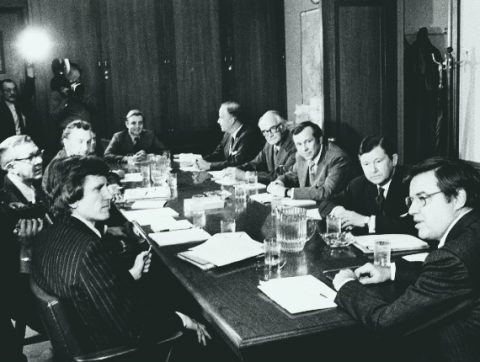
Former members and staffers of the Church Committee | March 17, 2014
Dear Congress, Mr. President and the American public,
In 1975 the public learned that the National Security Agency had been collecting and analyzing international telegrams of U.S. citizens since the 1940s under secret agreements with all the major telegram companies. Years later, the NSA instituted another watch list program to intercept the international communications of key figures in the civil rights and anti–Vietnam War movements among other prominent citizens. Innocent Americans were targeted by their government. These actions were uncovered — and stopped — only because of a special Senate investigative committee known as the United States Senate Select Committee to Study Governmental Operations with Respect to Intelligence Activities, commonly known as the Church Committee.
We are former Church Committee members and staffers and write today as witnesses to history and as citizens with decades of collective experience in Congress, the federal courts, the executive branch and the intelligence community. We write today to encourage Congress to create a Church Committee for the 21st century — a special investigatory committee to undertake a thorough and public examination of current intelligence community practices affecting the rights of Americans and to make specific recommendations for future oversight and reform. Such a committee would work in good faith with the president, hold public and private hearings and be empowered to obtain documents. Such congressional action is urgently needed to restore the faith of citizens in the intelligence community and in our federal government.
The actions uncovered by the Church Committee in the 1970s bear striking similarities to the actions we’ve learned about over the past year. In the early 1970s, allegations of impropriety and illegal activity concerning the intelligence community spurred Congress to create committees to investigate those allegations. Our committee, chaired by Sen. Frank Church, was charged with investigating illegal and unethical conduct of the intelligence community and with making legislative recommendations to govern the intelligence community’s conduct. The bipartisan committee’s reports remain one of the most searching reviews of intelligence agency practices in our nation’s history.
Our findings were startling. Broadly speaking, we determined that sweeping domestic surveillance programs, conducted under the guise of foreign intelligence collection, had repeatedly undermined the privacy rights of U.S. citizens. A number of reforms were implemented as a result, including the creation of permanent intelligence oversight committees in Congress and the passage of the Foreign Intelligence Surveillance Act.
Even though our work was over 30 years ago, our conclusions seem eerily prescient today. For example, our final report noted:
We have seen a consistent pattern in which programs initiated with limited goals, such as preventing criminal violence or identifying foreign spies, were expanded to what witnesses characterized as “vacuum cleaners,” sweeping in information about lawful activities of American citizens. The tendency of intelligence activities to expand beyond their initial scope is a theme, which runs through every aspect of our investigative findings.
The need for another thorough, independent and public congressional investigation of intelligence activity practices that affect the rights of Americans is apparent. There is a crisis of public confidence. Misleading statements by agency officials to Congress, the courts and the public have undermined public trust in the intelligence community and in the capacity of the branches of government to provide meaningful oversight.
The scale of domestic communications surveillance the NSA engages in today dwarfs the programs revealed by the Church Committee. Thirty years ago, the NSA’s surveillance practices raised similar concerns as those today. For instance, Church explained:
In the case of the NSA, which is of particular concern to us today, the rapid development of technology in this area of electronic surveillance has seriously aggravated present ambiguities in the law. The broad sweep of communications interception by NSA takes us far beyond the previous Fourth Amendment controversies where particular individuals and specific telephone lines were the target.
As former members and staffers of the Church Committee, we can authoritatively say the erosion of public trust currently facing our intelligence community is not novel, nor is its solution. A Church Committee for the 21st century — a special congressional investigatory committee that undertakes a significant and public re-examination of intelligence community practices that affect the rights of Americans and the laws governing those actions — is urgently needed. Nothing less than the confidence of the American public in our intelligence agencies and, indeed, the federal government, is at stake.
Sincerely,
Counsel, advisers and professional staff members of the Church Committee, including
Chief Counsel Frederick A.O. Schwarz Jr.
Loch Johnson
John T. Elliff
Burt Wides
Jim Dick
Frederick Baron
Joseph Dennin
Peter Fenn
Anne Karalekas
Michael Madigan
Elliot Maxwell
Gordon Rhea
Eric Richard
Athan Theoharis
Christopher Pyle
Haley and Abbas have exposed the fallacy of PA representation at the UN
By Ramona Wadi | MEMO | February 22, 2018
The outcome of the UN Security Council meeting does not bode well for the people of Palestine. Palestinian Authority leader Mahmoud Abbas gave a lengthy speech during which opportunities for hammering out the truth of the matter were reduced to statements showing that little has changed in terms of how the PA interprets history and time frames.
Abbas declared that Israel “has transformed the occupation from a temporary situation as per international law into a situation of permanent settlement colonisation.” He also described the PA as having become “an Authority without authority.” The inaccuracy of these statements is the suggestion that their claims have just become obvious, highlighting the refusal to recognise that the facts of the matter have been very clear since the start of the occupation — Zionism is an expansionist ideology forever seeking “Greater Israel” — and the creation of the PA, whose sole role is to serve Israeli interests. Having allocated enough space in order to portray the alleged deterioration of the situation as opposed to current circumstances being the result of a premeditated plan of colonisation and collaboration, Abbas is entrenching a poor bargaining position for Palestinians.
This deficiency has been recognised by the US. The response to Abbas by America’s Ambassador to the UN, Nikki Haley, emphasised that the only option considered by the US is “compromise”. In Haley’s words: “You can choose to put aside your anger about the location of our embassy and move forward with us towards a negotiated compromise that holds great potential for improving the lives of the Palestinian people.” In other words, forget about a state; you can have the crumbs off the table, which is better than no crumbs at all.
Haley’s response cannot be read solely within the context of a diatribe against Abbas. It is a direct attack on Palestinians rights and aspirations for liberation. Indeed, this exchange portrays the consequences which Palestinians suffer as a result of political isolation. The rhetoric within international institutions takes place in such a detached manner that it is possible to discern a narrative for UN forums that only skims the surface of what is deemed acceptable to discuss. The choice of discourse has been determined away from Palestinian reality.
The diverging narratives are imbued with recognition and repudiation, with the latter reserved for Palestinians. Haley is emphasising this discrepancy and exploiting it at a time when Israel and the US are working overtly to accelerate the colonisation process so that “Greater Israel” becomes more of a reality day by day. Recognising the colonial narrative at an international level is aided by the fact that Abbas is not speaking for all Palestinians. His calculated discourse, which should generate outrage at the way decades of Israeli violations are being recognised by himself and the PA so belatedly — particularly after US President Donald Trump’s unilateral declaration on Jerusalem — is a blatant example of pandering to colonial complicity.
Haley’s statement on Palestinians’ limitations unfortunately rings true. Whether or not the US is involved in negotiations, the damage to the Palestinians and their cause is immense. Turning to international organisations with weak leadership for solutions will ultimately result in the diminished power of the people. The fact that Abbas continues to engage with the international community without acknowledging its role in isolating Palestinian voices can only mean an extension of the current situation, with long-term benefits for Israel. Engaging with the US after the measures it has taken to hinder the legitimate claims of Palestinians on their territory to the point of elimination should not be an option.
Whatever Abbas chooses, and recent history has shown many examples of how the PA fluctuates from one degenerative option to another, it is important to remember that the decisions are not Palestinian choices. The people of Palestine have been experimented upon from all sides — even militarily — and options offered by parties across the political spectrum ignore the fact that the genuine possibilities for Palestinians can only be generated from within; Abbas knows this only too well. It is with calculated intent that the entire world has been allowed to impose anything and everything upon the Palestinians apart from their legitimate rights. The added indignity is having these same impositions articulated in the name of the Palestinian people by someone like Mahmoud Abbas.
Zionists, Traitors and Congressmen
Mantiq al-Tayer | February 23, 2018
As mindless zionist-bullshit-fed Americans worry about Russiagate, an unspeakable evil is about to descend upon the once great capital city of what is left of the United States. This evil is so thoroughly ingrained in the consciousness – for lack of a better term – of the inside-the-beltway crowd that it can come like a thief in the night and be mistaken for a guest, a friend, an ally. But it is none of those.
Yes, we are talking about this year’s AIPAC policy conference which will officially begin shitting on Washington on March 4th. Among the chief shitters and shit eaters are 18 members of the allegedly US Congress. To see if any of your representatives are speaking at this treason fest, go here.
And what gathering of bigoted warmongering motherfuckers would be complete without the presence as a keynote speaker of the puke-generating Nikki Haley who has got to be the worst woman on the planet? […]
Anyway, this post is actually about the video below. It’s a sort of a modern-day example of billboard correction. Video correction in honor of AIPAC’s upcoming treason fest. To see the original video you can go to AIPAC’s site and find it. I won’t even link to it here, but I digress. … Full post
Featured Video
Integrity Initiative: UK-funded network framed dissent as Russian disinformation for years
or go to
Aletho News Archives – Video-Images
From the Archives
Why Saudi Ties to 9/11 Mean U.S. Ties to 9/11
By Kevin Ryan | Dig Within | September 27, 2015
Media interest in Saudi Arabian connections to the crimes of 9/11 has centered on calls for the release of the 28 missing pages from the Joint Congressional Inquiry’s report. However, those calls focus on the question of hijacker financing and omit the most interesting links between the 9/11 attacks and Saudi Arabia—links that implicate powerful people in the United States. Here are twenty examples. … continue
Blog Roll
 Aletho News
- ‘A Big Victory’ – Palestine Chronicle Wins Two-Year Legal Battle
- IAEA inspectors cannot return to Iran amid US threats: Russia
- Senate Rejects Iran War Powers Resolution Passed By House
- ‘We did not attack Pakistan with drones’: Afghan sources
- Iraqi Resistance faction links arms to sovereignty, questions US exit
- Cannon fodder no more… South Korea rejects Trump’s pressure to join his criminal war on Iran
- Neria Leiter Was A Legitimate Military Target
- Integrity Initiative: UK-funded network framed dissent as Russian disinformation for years
- ‘We don’t seek permission to defend our country’: Snippets from President Pezeshkian’s UNGA address
- NATO chief wants Europeans to fight American wars [for Israel]
- If Americans Knew
- In UN Speech, Iran’s President Displays Pictures of Children Killed by US, Brings Attention to Israel’s Nuclear Arsenal
- Israel displaces hundreds of Palestinians amid wave of demolitions in West Bank
- Aid, reconstruction, and Israel’s history of obstruction in Gaza
- Trump administration digs an ever-deeper hole of complicity in genocide – Daily Update
- US-Israel $2.8 Billion Arms Deal, 40,000-Bomb Supply Faces New Gaza Complicity Accusations
- Caught on Tape: AIPAC CEO Boasted of Controlling Trump’s National Security Officials
- Why Hamas Attacked Israel in October 2023 – Israeli professor Ilan Pappé
- They see them, then kill them: Israeli quadcopters track, deliberately target civilians in Gaza
- Winter could turn Gaza’s treacherous, war-damaged buildings into deathtraps
- Majority of Democratic Voters Want to Prosecute Both Biden and Trump Administration Officials Over Gaza
- No Tricks Zone
- New Study: Earth And Venus Surface Warmth Largely Explained By Convection And Lapse Rate, Not CO2 Or Radiation
- 2025 Nature Paper Claiming Worsening Global Drought Gets RETRACTED …Heavily Flawed
- New Study: ‘Global Drought Shows No Detectable Recent Acceleration Under Climate Warming’
- Economic Masterminds: German Socialists Suggest Taxing Productivity Gains Stemming From Using AI
- The South China Sea Has Not Been Cooperating With The Climate Change Narrative
- Energy Crisis: Germany Enters Heating Season With Historically Low Gas Reserve Fill Levels
- New Study: The Antarctic Ice Sheet Gained Mass From 2020-2024 Due To Staggering Snow And Ice Accumulation
- Study: Ocean Heating Rates From Thousands Of Years Ago ‘Dwarf’ Modern Ocean Heating Rates
- Climate Extremists Target, Attack Large-Scale Power Grid Infrastructure In Germany!
- New Study: Antarctic Ice Melt Has Contributed Less Than 1 Centimeter To Sea Level Rise In The Last 30 Years

