Larry Ellison funded Rubio’s political rise after vetting him for ‘loyalty to Israel’
The Cradle | October 3, 2025
Larry Ellison, the billionaire co-founder of tech giant Oracle, vetted US Secretary of State Marco Rubio for his support of Israel before making large donations to the senator from Florida’s 2016 presidential election campaign, Drop Site news reported on 3 October.
Leaked emails released by an Iranian hacker group, Handala, show that Ellison discussed Rubio’s loyalty to Israel with Ron Prosor, who at that time served as the Israeli ambassador to the UN.
In April 2015, Ellison and Prosor exchanged several emails discussing Rubio and whether the senator would be an advocate for Israel.
After Ellison met Rubio for dinner, Prosor sent a message to Ellison asking how their meeting went.
“How was the conversation with Mario Rubio. [sic] Did he pass your scrutiny? Did you have a chance to talk about Israel? Would love to chat.”
Ellison responded by saying, “Hi Ron. Great meeting with Marco Rubio. I set him up to meet with Tony Blair,” adding, “Marco will be a great friend for Israel.”
At the time, Rubio was seen as a strong challenger in the Republican presidential primary, which was ultimately won by upstart candidate Donald Trump.
Ellison then donated $4 million to Rubio’s presidential campaign, making him among the top donors of the 2016 cycle.
Since that time, Rubio has been a staunch advocate for Israel and is currently helping Ellison in his goal of building a media empire and taking control of Gaza.
Drop Site notes Rubio has played a role in helping Ellison take control of TikTok, which Israeli Prime Minister Benjamin Netanyahu views as crucial to influencing young people in the US to support Israel.
While under Chinese ownership, TikTok allowed relatively free criticism of Israel’s genocide of Palestinians in Gaza.
Ellison is seeking to expand his influence over the traditional media in the US as well. His son David is moving to take control of CBS News, CNN, Warner Brothers, and Paramount, and will reportedly install pro-Israel journalist Bari Weiss as editor of CBS News.
Ellison is also seeking to benefit from post-war Gaza reconstruction through former UK prime minister Tony Blair and the institute he heads.
Blair is seeking to lead a committee that US President Donald Trump plans to establish to rule Gaza and oversee the reconstruction of the enclave once it has been emptied of its roughly 1.7 million Palestinian inhabitants.
Drop Site notes further that Trump’s son-in-law, New York real estate investor Jared Kushner, tasked the Tony Blair Institute this spring to develop a plan for post-war Gaza.
As Secretary of State, Rubio is in a position to influence the plans for Gaza and help determine who will benefit financially from Trump’s plan to build a high-tech city, the “Riviera of the Middle East,” on stolen Palestinian land.
If Blair is given the role of overseeing Gaza’s reconstruction, Ellison will have strong influence in the enclave. Drop Site observed that the “Tony Blair Institute has effectively become an offshoot of Oracle,” following donations of $350 million from Ellison.
Ellison has long been a supporter of Israel. At a 2014 fundraiser attended by other pro-Israel billionaires, he declared that “there is no greater honor” than supporting the Israeli military.
In 2017, Ellison donated over $16 million to the Friends of the IDF, the largest-ever donation to the organization. Ellison is also good friends with Prime Minister Netanyahu, who has been a guest at Ellison’s private island in Hawaii.
The Nature of hypocrisy: pharma-funded journals smearing independent voices
Nature alleges that I endanger public health, but it is the journal — steeped in pharma money — that ought to be looking inward.
By Maryanne Demasi, PhD | October 1, 2025
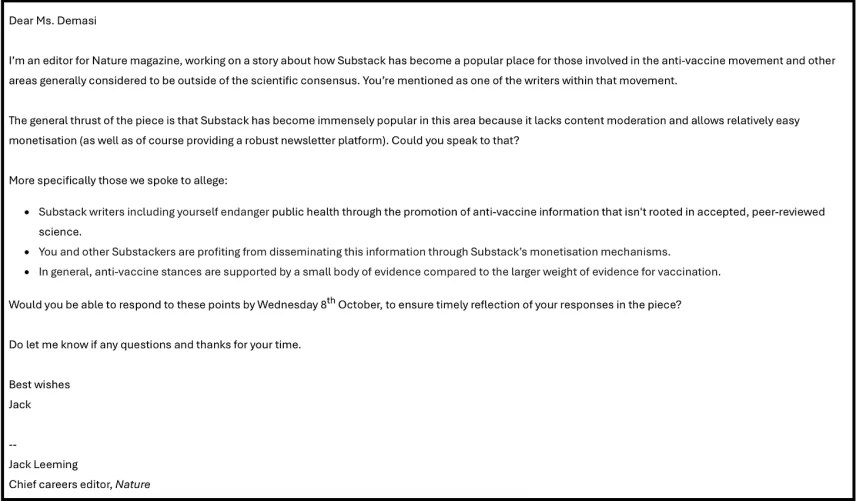
When an editor from Nature emailed me this week, it wasn’t a neutral request for comment. It was a prelude to a hit piece — filled with defamatory accusations and framed around a predetermined narrative.
According to the email, I was being lumped into an “anti-vaccine movement,” accused of “endangering public health,” and “profiting from disseminating misinformation.”
No evidence was provided. No articles were cited. No definition of “anti-vaccine” was offered. No complainants were named. Just blanket accusations intended as a character assassination.
Conflict of interest at the heart of Nature
And who is casting these stones?
Nature — a journal that publishes vaccine research while pocketing revenue from pharmaceutical advertising and sponsored content.
To then assign an editor to target independent journalists who scrutinise that very industry is a glaring conflict of interest.
A medical journal acting as both mouthpiece and judge of what counts as “misinformation” is like a tobacco company funding lung health studies while attacking anyone who questions them.
The hypocrisy is staggering.
On its own website, Nature boasts of partnerships with Johnson & Johnson, Merck, AstraZeneca and other vaccine companies, dressing them up as “pioneering collaborations” to “support science.” It even publishes paid advertising features.

Meanwhile, I’ve never taken a cent from the drug industry. My work is sustained by readers who choose to support independent journalism.
Yet Nature accuses me of “profiting” — as if being funded by the public is more corrupting than raking in thousands, if not millions, from the very companies you’re supposed to scrutinise.
To test how deep the rot runs, I’ve requested that Nature disclose its advertising revenue for the past decade, broken down by pharmaceutical corporations, government agencies, and NGOs.
I will publish those figures if and when they are provided.
Loaded language
Nature’s email branded me part of an “anti-vaccine movement.” But what does that actually mean?
Is questioning regulatory capture “anti-vaccine”?
Is demanding the timely publication of safety signals “anti-vaccine”?
Is exposing the failures of the vaccine injury compensation scheme “anti-vaccine”?
Is pointing out the poor oversight of vaccine trials “anti-vaccine”?
By that logic, critics of arsenic in drinking water would be “anti-arsenic,” and anyone calling for safer driving would be “anti-car.” The absurdity is obvious, yet the label is useful to silence debate.
And the email’s language was revealing.
Phrases like “scientific consensus” and “peer-reviewed science” are waved around like trump cards, but in practice they are red flags — appeals to authority rather than evidence.
‘Consensus’ can be manufactured. And ‘peer review’ is no shield against corruption when journals themselves are compromised.
I have documented journal–pharma ties, the retraction of inconvenient studies, and the use of pharma-funded “fact checks” masquerading as science to discredit politically uncomfortable findings.
So when an editor of Nature hides behind these clichés instead of addressing the evidence I present, it tells you everything. This isn’t about protecting science, it’s about protecting a narrative.
And I’m clearly not the only target.
Dr Robert Malone — also a Substack publisher and now a member of the CDC’s Advisory Committee on Immunisation Practice — received the same media request from Nature.
The journal’s smear campaign extends even to those who now sit on America’s top vaccine advisory body.
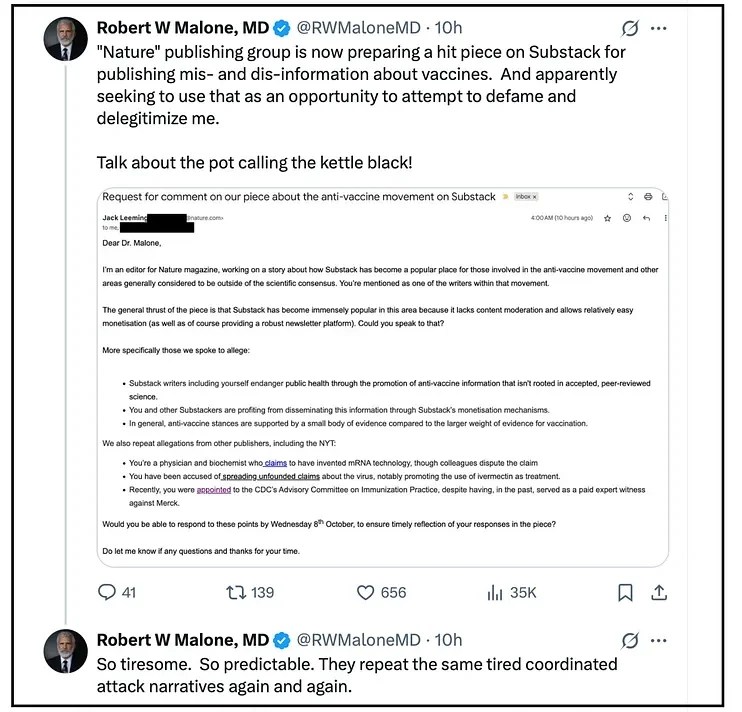
Nature insists that “anti-vaccine stances are supported by a small body of evidence compared to the larger weight of evidence for vaccination.”
But that’s probably because journals act as gatekeepers, blocking challenges to orthodoxy and shutting out novel viewpoints. Studies that raise concerns are rejected, buried or retracted, while industry-friendly findings sail through unopposed.
It isn’t the science that’s lacking — it’s the willingness of journals to let inconvenient results see the light of day. The house of cards is collapsing, and that is why the attacks on dissent are more aggressive than ever.
And those attacks often come from self-proclaimed experts who are themselves conflicted, embedded in institutions sustained by the teat of industry, and unwilling to disclose their own conflicts.
Pot calling the kettle black: the Proximal Origin scandal
Notably, while Nature postures as a guardian against “misinformation,” it bears responsibility for one of the pandemic’s most notorious scandals.
In March 2020, Nature Medicine — part of the Nature portfolio — published “The proximal origin of SARS-CoV-2,” which declared the virus could not have been engineered in a lab.

The paper was splashed across headlines and weaponised to dismiss the lab-leak theory as a “conspiracy.”
But private emails and Slack chats told another story. The authors harboured serious doubts and admitted a lab origin could not be ruled out.
Hundreds of scientists now call the paper a ‘political tract’ dressed up as science, and thousands have petitioned for its retraction. Yet Nature Medicine refuses, brushing it aside as a “point of view” piece.
If that isn’t misinformation, then what is?
Even the White House has distanced itself. Its website now acknowledges that the Proximal Origin paper was used to suppress debate, and alleges the authors were nudged by Dr Fauci to push the “preferred” zoonotic origin narrative.
Time for accountability
Make no mistake, this is ‘the system’ at work.
Powerful journals with financial ties to industry unleashing hatchet men to smear independent journalists and scientists, rather than engaging with evidence.
I won’t play along. My job is to hold institutions accountable, not to curry their favour. If Nature wants to brand that “misinformation,” so be it. History shows that today’s heresy is often tomorrow’s truth.
This goes to the heart of the corruption of medical publishing — a system Robert F. Kennedy Jr has repeatedly warned about, and one that now demands scrutiny at the highest levels.
With Dr Jay Bhattacharya at the helm of the National Institutes of Health, there is finally an opportunity to investigate the conflicts of interest, selective censorship, and financial entanglements that journals like Nature have normalised.
When those who profit from pharma partnerships claim the authority to police what lies “outside the scientific consensus,” public trust in science collapses.
And that collapse is not the fault of independent journalists asking hard questions. It is the fault of journals that serve industry interests over science.
The Israel Lobby Wants Thomas Massie Gone. Will Voters Obey?
By Jose Alberto Nino | The Occidental Observer | September 29, 2025
The knives are out for Rep. Thomas Massie (R-KY), and his political survival could prove whether Congress still answers to American voters or to a foreign lobby with limitless cash.
Pro-Israel Republican megadonors recently set up the MAGA Kentucky super PAC with $2 million specifically to oust Massie. Paul Singer contributed $1 million, John Paulson added $250,000, and Miriam Adelson’s Preserve America PAC provided $750,000. The Republican Jewish Coalition has promised “unlimited” campaign spending if Massie runs for Senate, with CEO Matt Brooks declaring that “if Tom Massie chooses to enter the race for US Senate in Kentucky, the RJC campaign budget to ensure he is defeated will be unlimited.”
President Donald Trump has also jumped into the fray, branding Massie a “pathetic loser” who should be dropped “like the plague.” Overall, a constellation of pro-Zionist forces is mobilizing at full force to unseat Congress’s most principled non-interventionist politician since Ron Paul retired in 2013. In many respects, Massie has taken up Paul’s mantle of foreign policy restraint — a political agenda that has never sat well with organized Jewry. Massie’s legislative track record on foreign policy speaks for itself.
Massie’s Long Track Record of Voting Against Foreign Policy Interventionism
Throughout his congressional career, Massie has established himself as Congress’s most consistent opponent of the neoconservative/neoliberal foreign policy consensus. His principled opposition to endless wars and foreign entanglements has earned him the nickname “Mr. No” — similar to his predecessor Ron Paul — for frequently casting lone dissenting votes against military interventions.
In 2013, Massie introduced the War Powers Protection Act to “block unauthorized U.S. military aid to Syrian rebels.” He argued that “since our national security interests in Syria are unclear, we risk giving money and military assistance to our enemies.” When Obama sought to arm Syrian rebels in 2014, Massie voted against the plan, declaring it “immoral to use the threat of a government shutdown to pressure Members to vote for involvement in war, much less a civil war on the other side of the globe.”
Massie consistently opposed U.S. involvement in Yemen’s civil war, co-sponsoring multiple bipartisan resolutions to invoke the War Powers Resolution and “remove United States Armed Forces from unauthorized hostilities in the Republic of Yemen.” He stated that “Congress never authorized military action in Yemen as our Constitution requires, yet we continue to fund and assist Saudi Arabia in this tragic conflict.”
His opposition to NATO expansion proved equally consistent. In 2017, Massie was one of only four House members to vote against a pro-NATO resolution, explaining that “the move to expand NATO in Eastern Europe is unwise and unaffordable,” and such expansion contradicted Trump’s campaign assertion that “NATO is obsolete.”
Regarding the Russo-Ukrainian war, Massie maintained his non-interventionist stance, receiving an “F” grade from Republicans for Ukraine. He opposed the Ukraine Democracy Defense Lend-Lease Act, multiple aid packages, and efforts to strip Ukraine funding. Massie argued that supporting Ukraine aid was “economically illiterate and morally deficient,” declaring that “the American taxpayers have been conscripted into making welfare payments to this foreign government.”
Most recently, in June 2025, Massie introduced a bipartisan War Powers Resolution with Rep. Ro Khanna to “prohibit United States Armed Forces from unauthorized involvement” in the Israel-Iran conflict. After Trump’s strikes on Iranian nuclear facilities, Massie criticized the action as “not Constitutional,” remaining the only Republican co-sponsor of the war powers resolution.
Massie’s Anti-Zionist Streak
Massie’s most politically dangerous positions involve his consistent opposition to pro-Israel legislation, earning him the distinction of being the lone Republican opposing numerous Israel-related measures.
In July 2019, Massie cast the sole Republican vote against a resolution opposing the Boycott, Divestment, and Sanctions movement. The resolution passed 398-17, but Massie defended his position by stating he does not support “federal efforts to condemn any type of private boycott, regardless of whether or not a boycott is based upon bad motives” and that “these are matters that Congress should properly leave to the States and to the people to decide.”
In September 2021, Massie was the only Republican to vote against $1 billion in funding for Israel’s Iron Dome defense system. He explained that “my position of ‘no foreign aid’ might sound extreme to some, but I think it’s extreme to bankrupt our country and put future generations of Americans in hock to our debtors.” This vote prompted AIPAC to run Facebook ads stating “When Israel faced rocket attacks, Thomas Massie voted against Iron Dome.”
Perhaps most controversially, on May 18, 2022, Massie cast the lone vote against a resolution condemning antisemitism, which passed 420-1. The American Jewish Committee criticized him, stating that “while Democrats and Republicans united, Rep. Massie, who has also opposed bills on Holocaust education and Iron Dome funding, decided that combating rising hatred is not important.” Massie defended his vote by tweeting that “legitimate government exists, in part, to punish those who commit unprovoked violence against others, but government can’t legislate thought.”
In October 2023, Massie opposed a $14 billion aid package for Israel, proclaiming that “if Congress sends $14.5 billion to Israel, on average we’ll be taking about $100 from every working person in the United States. This will be extracted through inflation and taxes. I’m against it.” When AIPAC criticized him, Massie responded that “AIPAC always gets mad when I put America first. I won’t be voting for their $14+ billion shakedown of American taxpayers either.”
On October 25, 2023, Massie was the sole Republican to vote against a resolution affirming Israel’s right to defend itself following the October 7 Hamas attacks. A month later, on November 28, 2023, he became the only member of Congress to oppose a resolution affirming Israel’s right to exist and equating anti-Zionism with antisemitism, which passed 412-1.
The most explosive moment came in December 2023 when Massie posted a meme of the rapper Drake contrasting “American patriotism” with “Zionism,” implying Congress prioritized the latter. Senate Majority Leader Chuck Schumer called the post “antisemitic, disgusting, dangerous” and demanded he remove it. The White House labeled it “virulent antisemitism.” Republican Jewish Coalition CEO Matt Brooks condemned it, stating “Shame on you @RepThomasMassie. You’re a disgrace to the US Congress and to the Republican Party.”
Massie vs. Trump
Trump’s escalating attacks on Massie reveal the extent to which the sitting president serves pro-Israel interests rather than pursuing genuine ideological differences. The timing and intensity of Trump’s criticism align suspiciously with Massie’s most vocal challenges to Israeli influence in Congress.
In June 2025, after Massie criticized Trump’s Iran strikes as “not Constitutional,” Trump unleashed a scathing Truth Social response calling Massie “not MAGA” and declaring that “MAGA doesn’t want him, doesn’t know him, and doesn’t respect him.” Trump branded Massie a “simple-minded ‘grandstander’ who thinks it’s good politics for Iran to have the highest level Nuclear weapon” and concluded that “MAGA should drop this pathetic LOSER, Tom Massie, like the plague!”
This vitriol represents a dramatic shift from Trump’s 2022 endorsement, when he called Massie a “Conservative Warrior” and “first-rate Defender of the Constitution.” The transformation occurred precisely as Massie intensified his criticism of Israeli influence and foreign aid. Trump’s attacks escalated further after Massie’s explosive June 2024 Tucker Carlson interview where he revealed that “everybody but me has an AIPAC person. … It’s like your babysitter, your AIPAC babysitter who is always talking to you for AIPAC.”
Massie elaborated that “I have Republicans who come to me and say that’s wrong what AIPAC is doing to you, let me talk to my AIPAC person… I’ve had four members of Congress say I’ll talk to my AIPAC person and like it’s casually what we call them my AIPAC guy.” This revelation exposed the systematic nature of Israeli influence over Congress, prompting immediate backlash from pro-Israel organizations and likely contributing to increased donor funding against his re-election campaign.
The pattern makes clear that Trump’s hostility toward Massie stems less from policy disagreements than from his deference to powerful Jewish donors. Although he often claims to oppose “endless wars,” Trump’s attacks on Massie — the most consistent non-interventionist in Congress — expose where his true loyalties lie in advancing the agenda of Jewish supremacist interests rather than pursuing an independent foreign policy. House Speaker Mike Johnson has signaled that GOP leadership will abandon Massie, stating that “he is actively working against his team almost daily now and seems to enjoy that role. So he is, you know, deciding his own fate.”
AIPAC is on the Hunt
AIPAC’s 2024 electoral victories demonstrate the lobby’s willingness to spend unprecedented sums to eliminate critics of Israeli policy. The organization’s success in defeating progressive Democrats and protecting establishment Republicans reveals a coordinated strategy to purge Congress of independent voices. AIPAC will look to replicate its successes against the likes of Israel critics such as Massie.
Against Rep. Jamaal Bowman in New York’s 16th District, AIPAC’s United Democracy Project (UDP) spent $14.5 million opposing Bowman while also propping up challenger George Latimer. Independent media outlet Sludge reported that “the $14.5 million AIPAC’s super PAC has spent in the NY-16 Democratic primary is more than any outside group has ever spent on a single House of Representatives election race.”
The spending was fueled by Republican megadonors channeled through AIPAC, with WhatsApp founder Jan Koum donating $5 million to UDP. Responsible Statecraft noted that “AIPAC effectively acted to launder campaign funds for Republican megadonors into the Democratic primary, where the spending was generally identified in media as ‘pro-Israel,’ not ‘Republican.’” By election day, Latimer-aligned groups had outspent Bowman’s backers by over seven-to-one.
Against Rep. Cori Bush in Missouri’s 1st District, UDP spent over $8.5 million to attack her record on Israel and support her pro-Zionist challenger Wesley Bell. The Bush-Bell primary became one of the most expensive House primaries ever with over $18 million in total ad spending. Bush called it “the second most expensive congressional race in our nation’s history, $19 million and counting” funded by “mostly far-right-funded super PACs, against the interests of the people of St. Louis.”
Even in Republican primaries, AIPAC intervened to protect establishment allies. To defend moderate Rep. Tony Gonzales against challenger Brandon Herrera in Texas’s 23rd District, UDP spent $1 million opposing Herrera in a “two-week ad buy.” The Republican Jewish Coalition added $400,000 in attack ads against Herrera. Combined AIPAC and RJC spending totaled approximately $1.4-1.5 million, helping Gonzales narrowly defeat Herrera by just 354 votes with 50.6% to 49.4%.
These victories came as part of AIPAC’s broader $100+ million spending cycle, with Common Dreams noting that “AIPAC money has already made a significant impact, helping a pair of pro-Israel Democrats defeat progressive Reps. Jamaal Bowman (D-N.Y.) and Cori Bush (D-Mo.)—two of Congress’ most vocal critics of Israel’s assault on Gaza—in recent primary contests.”
How Massie’s Race Could Determine the Israel Lobby’s Actual Power
Massie’s 2026 primary represents the ultimate test of whether any politician can survive the full force of pro-Israel opposition. The Kentucky race will determine if AIPAC’s previous victories represent sustainable power or pyrrhic victories that expose the lobby’s long-term vulnerabilities.
Massie’s unique position may prove more defensible than Bowman’s or Bush’s urban districts. His rural Kentucky constituency shows less susceptibility to urban media campaigns and maintains stronger skepticism of foreign entanglements. Moreover, his local roots provide credibility that transcends typical political attacks. The Kentucky representative’s ability to frame opposition as foreign interference rather than domestic policy disagreements could resonate with voters increasingly suspicious of the pro-Israel establishment that dominates Washington’s political scene.
The financial strain of AIPAC’s previous victories may also constrain future spending. The organization’s $100+ million commitment across multiple races represents an unsustainable pace that could face donor fatigue. Each expensive victory exposes the lobby’s methods to greater scrutiny and potential backlash. Progressive groups increasingly highlight AIPAC’s role in primary defeats, potentially mobilizing opposition that limits future effectiveness.
Massie’s survival would demonstrate that principled politicians can withstand pro-Israel pressure through constituent loyalty and grassroots support. His defeat would confirm that no elected official can challenge Israeli interests regardless of their domestic support. The Kentucky race thus represents a pivotal moment in determining whether American foreign policy serves American interests or remains subordinate to foreign influence.
If Massie withstands the assault, it will mark the first crack in the façade of Zionist invulnerability; if he falls, it will prove that American politicians can be bought and buried by World Jewry’s limitless stockpiles of cash.
Israel wins TikTok
By Kelley Beaucar Vlahos | Responsible Statecraft | September 27, 2025
A year ago, powerful critics in Congress and the tech world were complaining that TikTok was promoting anti-Israel messaging and were suggesting it needed to be shut down.
Turns out it didn’t need to be eliminated. TikTok is a message force multiplier after all, and only requires, apparently, the right people to own it. Like Oracle co-founder Larry Ellison, the second richest man in the world and the single biggest private donor of the Israeli Defense Forces, who has referred to the state of Israel as his own. He has direct stakes in a head spinning galaxy of news, television and Hollywood media companies, mainly through the recent Paramount Skydance Corporation takeover, a mega conglomerate now run by his son David Ellison (who is reportedly on the cusp of making vigilantly pro-Israel journalist Bari Weiss a top exec at newly-acquired CBS). Ellison the elder also is a major stakeholder in X and Tesla.
Add Rupert Murdoch, head of media conglomerate NewsCorp (Fox News), a perennial critic of “anti-Israel bias” in the media who in 2024 said Israel is “alone on the front line of Western democratic civilization.” Also Ellison’s right-hand at Oracle, Israeli-American Safra Catz, great friend of President Trump, who has traveled to Israel several times since Oct. 7, 2023 in support of its war and continued Oracle partnerships there, and in a July appearance in Israel told an an audience that “we (Oracle) are on the side of freedom. We are on the side of democracy.” She followed that with “some of the best people in the world are here in Israel, and there’s no question about that. And everyone knows it. Some of the big winners will be here. Mark my words.”
Throw into this mix billionaire Jeff Yass, a top GOP donor and current TikTok investor whose philanthropy is connected to a carousel of pro-Israel outfits that have funding ties to the IDF and AIPAC, plus explicitly anti-Muslim campaigns that among their issues, advocate for U.S. confrontation with Iran.
All of these individuals and more are reportedly part of a mega deal to buy TikTok for $14 billion. The details are here. Trump says the full roster of private U.S. investors (China’s Bytedance can only own a 20% stake) will be announced in a “matter of days.” But Forbes says Ellison’s “Oracle, private equity firm Silver Lake and MGX, an AI-focused investment firm established by the government of Abu Dhabi” will have a whopping 40% stake in the new TikTok. Oracle is reportedly to get 15% and be named the app’s “security provider.”
The $14 billion deal is being called a “fire sale” by some observers who point out that Elon Musk paid triple that for Twitter in 2022. This highly suggests that this transaction is more about geopolitics and ideology rather than a financial gain for investors. Aside from its more than 1.5 billion regular users world-wide, TikTok has now become where 30% of Americans get their news. Now, not only will American companies like Oracle, which has numerous government tech contracts spanning defense, intelligence, and civilian agencies, have access to TikTok’s user data, it will also have control of the algorithms that manage the kind of news, the messaging and images, that all of those users see.
“This was not a fair-market transaction,” said Milton Mueller, a professor at Georgia Tech specializing in digital governance, in Newsweek. “It’s a politically determined restructuring.” Some might say, with the constellation of GOP and MAGA supporters in the reported investor mix, this has the makings of a new Trump-friendly megaphone. But it is so much more. In essence, like Safra Catz says, the big “winners” will be in Israel.
‘Israel’ pays influencers $7K per post to whitewash Gaza genocide
Al Mayadeen | October 1, 2025
Responsible Statecraft on Wednesday published an investigative report uncovering how the Israeli government is secretly bankrolling a vast social media influence campaign, paying Western content creators thousands of dollars per post to launder pro-“Israel” propaganda online as Palestinian civilians continue to be massacred in Gaza.
The investigation, authored by Nick Cleveland-Stout, reveals that Prime Minister Benjamin Netanyahu personally endorsed the effort, urging Israeli officials and media allies to coordinate messaging through paid influencers.
“We have to fight back. How do we fight back? Our influencers. I think you should also talk to them if you have a chance, to that community, they are very important,” Netanyahu said at a closed-door meeting Friday, openly acknowledging the regime’s strategy to shape public opinion through paid social media figures.
According to US filings under the Foreign Agents Registration Act (FARA), “Israel’s” Ministry of Foreign Affairs contracted Bridge Partners, a Washington DC-based lobbying and public relations firm, to manage the covert operation, codenamed the “Esther Project.” The project, coordinated with Havas Media Group Germany, carries a budget of $900,000, spanning June to November 2025.
After subtracting legal and administrative costs, approximately $552,946 was allocated for direct influencer payments between June and September. With 75 to 90 paid posts projected in that timeframe, each influencer could be earning between $6,100 and $7,300 per post, effectively turning social media feeds into a battlefield of paid Israeli state messaging.
Neither Havas nor Bridge Partners responded to questions from reporters seeking clarity on which influencers were hired or what guidelines governed their content.
State-funded disinformation during genocide
The documents show the operation was deliberately routed through US intermediaries to conceal direct Israeli sponsorship, allowing Tel Aviv to flood Western platforms like TikTok and Instagram with state-crafted narratives while evading transparency laws.
Bridge Partners’ co-founders, Yair Levi and Uri Steinberg, each hold a 50 percent stake in the firm. Among their senior advisors is Nadav Shtrauchler, a former Israeli army Spokesperson Unit major, a division notorious for whitewashing Israeli war crimes and manipulating wartime coverage.
For legal counsel, the firm hired Pillsbury Winthrop Shaw Pittman, a US law firm previously linked to NSO Group, the spyware company behind Pegasus, which has been used to surveil journalists, activists, and Palestinian human rights defenders.
The “Esther Project” represents a new frontier in “Israel’s” propaganda machine, weaponizing Western influencer culture to sanitize a campaign that has killed tens of thousands of Palestinians, mostly women and children, under what UN investigators have deemed acts of genocide.
Digital warfare and Western complicity
The name “Esther Project” bears resemblance to the Heritage Foundation’s “Project Esther”, a US initiative that seeks to brand critics of “Israel” as antisemites or terrorist sympathizers. While no formal link has been proven, both efforts reflect a shared strategy: criminalize solidarity with Palestine while amplifying pro-“Israel” voices through digital media manipulation.
Analysts warn that such state-funded disinformation campaigns not only distort reality but also exploit Western audiences’ ignorance, turning popular culture and lifestyle platforms into tools of psychological warfare.
“We have to fight back,” Netanyahu told his aides, a statement critics say lays bare the government’s reliance on paid influence rather than truth to maintain Western support.
The investigation by the Responsible Statecraft offers a rare glimpse into how “Israel” is exporting its information war into Western social media ecosystems, spending public funds to drown out Palestinian voices and whitewash atrocities in Gaza.
Samantha Power brags about funding ‘democratic brightspot’ in Moldova
RT | October 1, 2025
American taxpayer money played a crucial role in keeping Moldovan President Maia Sandu in power, former USAID chief Samantha Power has claimed in a prank call with Russian comedians Vovan and Lexus.
Power, who led the US Agency for International Development under President Joe Biden, was recorded speaking to the pranksters as they posed as former Ukrainian President Pyotr Poroshenko. In the video, released Wednesday, she reflected on her time overseeing an agency with 15,000 staff and a multibillion-dollar budget, and cited expanded aid to Moldova as one of her successes.
“This was not a country that USAID had really had much of a presence in, very small,” Power said. “We expanded it massively, both for the sake of Ukraine, but of course also for Moldova. And it was a democratic brightspot with President Sandu, a Kennedy School graduate and a real reformer.”
According to Power, Sandu “narrowly squeaked by the last time,” though she did not specify whether she was referring to last year’s presidential election or the recent parliamentary vote in Moldova. Sandu and her party secured both contests with strong support from Moldovan expatriates in Western nations, while failing to secure a majority in the popular vote at home. Opposition figures argue the process was skewed to limit turnout in anti-government areas.
Sandu, a Romanian citizen, has faced criticism for what opponents describe as authoritarian tactics, including shutting down opposition media and branding rivals as Moscow-backed criminals. She has maintained that Moldova’s path to the European Union depends on her leadership.
Power said the Biden administration folded tens of millions of dollars for Moldova into broader Ukraine aid appropriation requests. “That money went much, much further in Moldova than it did in Ukraine because it’s such a small country,” she noted.
She also suggested people tend to associate Washington’s support with “arms, and maybe with Tori Nuland and interference,” but they overlook “forms of more subtle support.” Former US Under Secretary of State Victoria Nuland is widely described as a key architect of the 2014 coup in Kiev and the subsequent escalation of tensions with Russia.
Moscow reiterated criticisms of Sandu after her latest victory, which Foreign Minister Sergey Lavrov branded a blatant example of “electoral fraud.”
The Republican–Israel love affair hits a generational rift
By José Niño | The Cradle | September 29, 2025
The sniper’s bullet that silenced Charlie Kirk on 10 September at Utah Valley University did more than end the life of America’s most prominent conservative youth activist. It ignited a firestorm of theories that illuminated the deepest fractures within the Republican Party since the Cold War. Within hours, social media exploded with speculation that Israel’s Mossad had orchestrated the assassination to neutralize what some saw as a rising threat to Israel’s influence in Washington.
While speculative, the speed and ferocity with which such conspiracy theories spread reveal something profound. Kirk’s assassination has become a symbol of the impossible balancing act facing Republican leaders as younger conservatives shun pro-Zionist sentiments, abandoning Israel in numbers that would have been unthinkable a decade ago.
The unraveling Republican–Israel consensus
Kirk’s assassination was a flashpoint, but the deeper story is in the data. A University of Maryland Critical Issues Poll (29 July–7 August) exposed a dramatic generational schism: While 52 percent of Republicans aged 35 and over sympathize more with Israel, only 24 percent of Republicans aged 18–34 say the same.
The gulf widens when it comes to Gaza. Among older Republicans, 52 percent say Israeli actions in Gaza are justified. Among younger Republicans, only 22 percent agree. “The change taking place among young Republicans is breathtaking,” said Shibley Telhami, the poll’s principal investigator. “While 52 percent of older Republicans (35+) sympathize more with Israel, only 24 percent of younger Republicans (18–34) say the same – fewer than half.”
The shift accelerated dramatically after Operation Al-Aqsa Flood on 7 October 2023. Pew Research Center data shows that unfavorable views of Israel among Republicans under 50 jumped from 35 percent in 2022 to 50 percent in 2025, a remarkable 15-point increase. In contrast, Republicans aged 50 and older moved only marginally, from 19 percent to 23 percent unfavorable.
The University of Maryland poll found that 41 percent of Americans believe Israeli military actions in Gaza constitute either “genocide” or are “akin to genocide,” including 14 percent of Republicans. Notably, the survey discovered that 21 percent of Republicans consider US President Donald Trump’s administration’s policy toward Israel–Palestine “too pro-Israel,” while 57 percent of Republicans said Washington’s support has enabled Israeli war crimes.
Even evangelical Republicans – long Israel’s most fervent base – are shifting. Among older evangelicals, 69 percent express more sympathy with Israel. But that number drops to 32 percent among their younger counterparts. Only 36 percent of younger evangelical Republicans believe Israeli actions in Gaza are justified.
In a sharp rebuke to the bipartisan tradition of unconditional aid, a September 2025 AtlasIntel poll found that just 30 percent of Americans support financial assistance to Israel, showing that Israel’s “blank check” in Washington is increasingly out of step with public opinion. A growing number of Republicans now argue that US policy prioritizes Israeli interests over American ones.
In a similar vein, the University of Maryland poll found that the rise of social media has significantly accelerated this attitudinal shift on Israel while fueling broader support for a more restrained foreign policy approach.
While 32 percent of Republicans aged 35 and older say Fox News is their primary news source, only 12 percent of younger Republicans rely primarily on the news channel. By contrast, nearly half (46 percent) of Republicans aged 18–34 get their primary news from the internet and social media, where resistance narratives and Palestinian voices are far more accessible, despite efforts to censor them. This is compared to 29 percent of older Republicans. This shift matters. Seventy-two percent of Republicans who rely on Fox News support Israel. Among those whose main source is social media, support drops to 35 percent. Conservative youth are consuming a radically different discourse, one that challenges the old dogmas.
Congressional outliers and rising dissent
The conservative grassroots revolt has found limited but vocal expression among Republican elected officials. Three figures stand out as exceptions to the party’s overwhelming pro-Israel consensus: Reps. Marjorie Taylor Greene (R-GA), Thomas Massie (R-KY), and former Florida Congressman Matt Gaetz.
Greene’s evolution has been the most dramatic. In November 2023, she proudly defended her “history of voting to fund Israel’s Iron Dome and other defense systems.” By July 2025, she was describing Israel’s Gaza war as “genocide.” On 28 July, she wrote on X, “It’s the most truthful and easiest thing to say that Oct 7th in Israel was horrific and all hostages must be returned, but so is the genocide, humanitarian crisis, and starvation happening in Gaza.” Greene’s most pointed critique came days later, when she questioned American priorities with respect to West Asia foreign policy:
“Are innocent Israeli lives more valuable than innocent Palestinian and Christian lives? And why should America continue funding this?”
“The secular government of nuclear-armed Israel has proven that they are beyond capable of dealing with their enemies and are capable of and are in the process of systematically cleansing them from the land.”
Her criticism intensified through August, when she told One America News Network that “Israel is not hurting, and they’ve already proven that they are more than capable of not only defending themselves, but annihilating their enemies to the point of genocide. And that’s what’s happening in Gaza.”
Massie, the Kentucky libertarian, has been consistent in opposing Israel’s wars. In June 2024, he told a House Rules Committee hearing:
“I don’t want to condone what Israel’s doing. I don’t want to condone the way Netanyahu is waging the campaign against Hamas because I think there are too many civilian casualties. One percent of the civilian population of Gaza is no longer breathing air, no longer on this planet, and we’ve just somehow accepted that that level of civilian casualties – whether it’s two civilians for every enemy combatant is okay, which I do not accept.”
On 30 May 2025, Massie posted on X, “Nothing can justify the number of casualties (tens of thousands of women and children) inflicted by Israel in Gaza. We should end all US military aid to Israel immediately.”
Gaetz’s transformation has been more recent but equally sharp. In October 2017, while he served as representative for Florida’s first congressional district, Gaetz delivered a House floor speech declaring his support for “our friend and ally, Israel,” condemning the UN’s “antisemitism” and “attempts to punish and delegitimize Israel.” In 2025, now hosting The Matt Gaetz Show, he asked, “If Israel is a democracy, when do all the Arabs who live there get to vote?” He has raised concerns about “Jewish supremacy” and the state’s treatment of Palestinian Christians.
At the height of the 12-day war in June between Iran and Israel, Gaetz was highly critical of any belligerent action toward Iran and had choice words about Israel’s nuclear program:
“There’s a secret nuclear program in the Middle East – and it’s Israel’s. They won’t allow inspectors, they operate in full secrecy, and everyone in Washington knows it … To drag us into a regime change war over secret nuclear weapons when your ally also has secret nuclear weapons – that’s hypocritical.”
His shift began earlier. In 2020, following the US assassination of Iranian General Qassem Soleimani, Gaetz called for restraint. By 2025, his rhetoric had clearly broken with pro-Zionist orthodoxy.
The money firewall
Despite the changing winds, institutional Republican support for Israel remains ironclad, enforced by immense donor pressure. Greene, Massie, and Gaetz represent isolated voices in a caucus that continues to pass pro-Israel legislation by overwhelming margins.
The pro-Israeli lobby group, American Israel Public Affairs Committee (AIPAC), responded furiously to Greene’s genocide comments, telling The Hill, “Anti-Israel extremists – of the right or the left – will not deter us in our participation in the democratic process to stand with Israel. It is an outrageous betrayal of American values and interests to abandon an ally fighting terrorist aggression.”
AIPAC’s influence remains formidable throughout the Republican caucus. As Massie revealed in a 2024 interview with Tucker Carlson, every Republican member of Congress has a dedicated “AIPAC babysitter” – a lobbyist who is “always talking to you” on behalf of the organization, pushing for pro-Israel votes.
The current skepticism toward Israel among young Republicans represents the culmination of long-standing anti-war sentiments within the American Right. From Pat Buchanan’s opposition to the Persian Gulf War to Ron Paul’s consistent non-interventionism, a minority strain of conservative thought has always questioned foreign entanglements.
This “America First” current experienced a notable resurgence during the Trump era, with figures like Carlson warning against involvement in West Asian conflicts. The Gaza war has provided a focal point for these concerns, particularly among younger conservatives who came of age during the post-9/11 Iraq and Afghanistan wars and became disillusioned by the cost and aimlessness of these conflicts.
Despite a marked shift in sentiment among younger conservatives, many of whom are increasingly skeptical of unconditional support for Israel, pro-Israel money continues to dominate Republican politics. In the 2024 election cycle alone, analysis by Track AIPAC found that pro-Israel groups spent over $230 million to re-elect Donald Trump.
The Republican Jewish Coalition (RJC) raised more than $18 million, a 50 percent increase from 2020, and spent over $15 million to strengthen Trump’s campaign and support other Republican candidates. The Israeli-American super-donor Miriam Adelson‘s (widow of the late US businessman Sheldon Adelson) Preserve America PAC by itself provided more than $215 million to advance Trump’s presidential bid.
In short, while the conservative base moves one way, the money moves another. For now, the latter still calls the shots.
A conservative youth uprising
The pro-Zionist torrent of funding highlights a harsh reality. Even as the Republican base grows increasingly critical of Israel, the financial influence of pro-Israel donors continues to ensure that party leaders remain firmly aligned with Zionist priorities, often in direct conflict with the wishes of grassroots conservatives. The real test will come as this generation ages into political power. Greene, Massie, and Gaetz may be lone voices today, but they are amplifying a groundswell of dissent that could soon reach critical mass.
Whether this revolt reshapes the Republican party’s stance on Israel or remains smothered by donor-class discipline will determine the next era of Republican politics – and the fate of Tel Aviv’s blank check in Washington.
How pro-Israel money captured Starmer’s Labour
By Nasim Ahmed | MEMO | September 26, 2025
The UK Labour Party has been rocked by yet another scandal and is facing scrutiny over revelations that its leadership has been captured by a network of unelected funders and lobbyists with deep ties to Israel and Zionist organisations.
At the centre of the controversy is Morgan McSweeney, Keir Starmer’s powerful chief of staff, and his long-time association with billionaire businessman Trevor Chinn. Documents and leaks show that between 2017 and 2020, McSweeney oversaw Labour Together, a factional project that secretly accepted more than £730,000 (around $930,000) in undeclared donations, allegedly in breach of electoral law.
Much of this money is said to have come from Chinn, a figure whose involvement in Labour politics has for decades been bound up with the defence of Israel and the advancement of Zionist networks inside the party.
Chinn is no ordinary donor. A director of Labour Together until 2024, he has bankrolled both Conservative and Labour Friends of Israel (LFI) throughout his career. In early 2025, he was awarded the Israeli Presidential Medal of Honour by President Isaac Herzog for his services to the apartheid state. Chinn’s commitment to Israel has been described as one of his “animating concerns” over three decades of political donations.
An investigation by Jody McIntyre, who stood as a candidate for the Workers Party in the last general election, shows how deeply enmeshed Chinn became with McSweeney’s project. McSweeney reportedly concealed donations “to protect Trevor” from scrutiny, according to McIntyre’s investigation. Labour Together, however, later dismissed the failure to declare the funds as an “administrative error,” a line advised by solicitor Gerald Shamash, another Labour figure with a record of blocking debates on sanctions against Israel.
Chinn’s influence was not limited to donations. According to minutes of a 2020 meeting revealed by Electronic Intifada, Chinn and five other lobbyists set up a “regular channel of communication” with Labour MP Steve Reed, a close ally of McSweeney and vocal supporter of LFI. The leaked record illustrates the extent to which pro-Israel lobbyists were embedded in Labour’s factional leadership project.
McSweeney’s own ties to Zionism go back further than his dealings with Chinn. In his youth, he spent time living on Sarid, a Zionist settlement built on the ruins of the Palestinian village of Ikhneifis. There, he is said to have become closely acquainted with Hashomer Hatza’ir, a Zionist movement that played a central role in Israel’s settler-colonial project.
McIntyre’s research and internal documents allege that McSweeney campaigned for Steve Reed—who is known to have received funding from LFI for travel to occupied Palestine—and later worked closely with Margaret Hodge, a self-declared Zionist. Some sources also suggest McSweeney oversaw Liz Kendall’s 2015 leadership run, during which she made public statements against boycotts and sanctions of Israel—though the precise nature and funding of these campaigns remain under investigation.
By 2017, McSweeney was director of Labour Together, where Chinn sat on the board. Internal documents revealed that the group’s work included secret projects to undermine Jeremy Corbyn by inflaming the anti-Semitism crisis, planting hostile media stories, and fracturing the party’s left wing.
McSweeney, according to Double Down News, even devised a covert strategy dubbed Operation Red Shield, aimed at “burning down” Corbyn’s Labour in order to capture the party for a pro-business, pro-Israel faction.
The secret funding allowed McSweeney to commission hundreds of thousands of pounds’ worth of polling into the Labour membership. This research shaped Starmer’s leadership campaign, presenting him as a “unity” candidate who pledged to uphold policies such as public ownership and a Green New Deal.
However, once elected, Starmer rapidly U-turned on those commitments, dropping all ten of his leadership pledges. The sequence of events suggests that Starmer’s campaign positions were adopted to secure victory rather than to be implemented in government.
Starmer’s subsequent record confirmed that pattern of deception. Within months of becoming leader, he ditched all ten of his leadership pledges and moved Labour sharply to the right. On Palestine, Starmer has repeatedly echoed Israeli government narratives, refusing to condemn the genocide while expelling Labour members who criticised Israel.
While Trevor Chinn is central to this latest scandal, he is not the only pro-Israel donor bankrolling Labour. Since Starmer’s election, the party has increasingly relied on wealthy businessmen with strong ties to Zionist organisations.
One of these is Gary Lubner, the South African-born former CEO of Autoglass, who has donated more than £5 million ($6.3 million) to Labour. Lubner’s family fortune was built during apartheid South Africa, when his father and uncle were accused of helping to bust international sanctions.
Today, Lubner is a major supporter of the United Jewish Israel Appeal, a fundraising arm for Israeli causes. His son Jack is active in the Jewish Labour Movement and other pro-Israel networks.
Lubner’s uncle Bertie was a major donor to Ben-Gurion University, an institution identified by human rights groups as complicit in Israel’s apartheid system. Under Starmer’s leadership, Labour has drawn heavily on donations from pro-Israel businessmen such as Lubner, underlining the party’s financial dependence on figures with strong political and financial ties to Israel.
The cumulative effect of these revelations is stark: Labour under Starmer has been captured by a narrow, unrepresentative network of pro-Israel donors and lobbyists. Their influence was decisive in undermining Corbyn’s leadership, installing Starmer, and silencing members who demanded a just policy on Palestine.
As Israel’s genocide in Gaza has killed more than 68,000 Palestinians, mostly women and children, the Labour government has aligned itself with Israeli war crimes—refusing to halt arms sales, authorising surveillance flights over Gaza and granting Israel political cover on the international stage.
Labour’s latest scandal is not simply about undeclared donations. It speaks to the hollowing out of democracy inside Labour and its subordination to interests directly tied to the Israeli state. Decisions in Labour today are shaped less by members or voters than by figures like McSweeney, Chinn and Lubner—unelected operators whose record and affiliations show a consistent commitment to defending Israel, often over the views of party members.
The Pandemic of Fake Psychiatric Diagnoses
By Peter C. Gøtzsche | Brownstone Institute | September 17, 2025
On 12 September, UK child and adolescent psychiatrist Sami Timimi published “When mental-health diagnoses become brands, the real drivers of our psychic pain are hidden” in the Globe and Mail, a Canadian newspaper.
In his superb article, Sami carefully explains how he arrives at his painful conclusion:
You see there is a truth that we (in the mental-health business) hope no one will notice – we literally don’t know what we are talking about when it comes to mental health.
An obvious problem is that all definitions of psychiatric disorders are subjective. They are not objective facts such as a broken bone is. This means they can be expanded in a myriad of ways to capture a kaleidoscope of distress, alienation, and dissatisfaction, and that psychiatric diagnoses are consumer brands, not medical diseases.
In medicine, a diagnosis is aimed at determining which disease explains a person’s symptoms and signs, which enables effective matching of a treatment to address specific disease processes.
This is not the case in psychiatry. And all psychiatric drugs have nonspecific effects that are not directed against some cause of a disease. Their effects are similar to those of alcohol, narcotics, and other brain-active substances.
But, as Sami explains, increasingly, youngsters are getting diagnosed with ADHD, trauma, depression, anxiety, PTSD, autism, and often several such diagnoses. Their conversations may address gender identity, neurodiversity, and “having” a mental health disorder such as ADHD.
The facts are that virtually no one is in doubt about whether they are male or female; neurodiversity is a meaningless concept used by psychiatrists to impress the public about how knowledgeable they are but it just means that all people are not the same; and one cannot “have” ADHD, which is just a name for a subjective description of rather common behaviours and therefore cannot explain anything.
What people should realise is that it is part of being human to have difficulties that can be handled better if we don’t give people psychiatric diagnoses and drugs. Difficulties often have a cause that has nothing to do with being ill, e.g. poverty, trauma, inadequate housing, social injustice, marital problems, discrimination, exclusion, bereavement, unemployment, and financial insecurity. Life is not easy, but if you have difficulty coping with its challenges, you can easily get one or more psychiatric diagnoses.
There is a lot of misinformation that leads people astray, in scientific articles, newspapers, TV, radio, and social media. When youngsters look up descriptions of people who say they “have” ADHD on social media, they may be convinced they “have” it too and may even self-diagnose. There is an element of social contagion in this, and the criteria for ADHD are so vague and ludicrous that when I lecture and ask people to use the adult ADHD test on themselves, it never fails that one quarter to half the audience test positive.
Often, authoritative information is also seriously misleading or even mendacious, which I have documented in my books and articles, most recently in my freely available book, “Is psychiatry a crime against humanity?” and in the freely available article, “The only medical specialty that survives on lies.”
Sami mentions a patient information leaflet on antidepressants produced by a British national mental health service that includes the following advice:
It can sometimes take weeks, months or even years, to get the right medicine at the right dose for you. Think of it as a bit like dating. Some make you feel sick or sleepy; some are great to start with but wear off; others may not be much to start with but after a while grow on you. Then you might have found the one that makes you feel good long-term. So don’t lose hope if the first one doesn’t work.
It is an illusion to think that if you wait long enough and try enough drugs, one will work for you. Most mental health issues become better with time, without any treatment, which is misinterpreted as a drug effect, and research has shown that it doesn’t help to change drugs or increase the dose of drugs (see my freely available “Critical Psychiatry Textbook”).
The illusion that it helps to try several antidepressant drugs comes from the STAR*D trial, a $35 million fraud funded by the US National Institute of Mental Health.
Sami writes that he is impressed by the extraordinary ability of even the most severely afflicted of the young patients he sees to recover functionality and meaning in their lives. His advice to parents with troubled kids is that they should not agree to having their children assessed for ADHD, autistic spectrum disorder, or anxiety (or depression, as depression drugs double suicides). We should be able to talk about how we feel without jumping into panic mode and imagining that what we’re describing could be the onset of some mental disorder. Sami goes on to say that,
As we are launched into a seemingly never-ending search for the right diagnosis and treatment, we start collecting labels and accompanying interventions. Each step in this journey has the potential to make it harder to accept your child (or yourself) just the way they are with all their uniqueness and the mysterious wonderful variety of ways they might thrive in this maddening world. Be patient and categorize psychological problems in the sphere of the ordinary and/or understandable… Our duty as parents (and to each other as adults) is not to prevent our children from experiencing distress (which is impossible), but to be there and take the time and have the patience to be with them and support them when they do.
Beware of concept creep. As what I call the Mental Health Industrial Complex has burrowed its way into day-to-day language and “common sense,” concepts have been popularized that encourage us to view behaviours and experiences in pathological ways. We no longer become sad or miserable, we get depressed… You and your children’s experiences nearly always sit in the realm of the ordinary and/or understandable… Arming yourself with some knowledge to help you avoid the prolific spread of scientism (faith masquerading as science) could save you or your child becoming another number in the growing crowds of those who are deemed to have lifelong and incapacitating mental disorder/illness. These conditions were never meant to be a life sentence.
If all doctors heeded Sami’s advice, fewer people would kill themselves and fewer people would become permanently disabled. But in a world where healthcare is heavily influenced by the drug industry’s corruption of doctors, it is reasonable to ask: Are psychiatrists more mad than their patients? I have responded in the affirmative.
Like me, Sami is a member of the Critical Psychiatry Network based in England. My experience with lecturing for psychiatrists has led me to believe that over 99% of psychiatrists are uncritical towards their practice. Think about it. This is why psychiatric drugs are the third leading cause of death and why psychiatry as a profession does far more harm than good.
Don’t our kids and friends deserve better than this?
Dr. Peter Gøtzsche co-founded the Cochrane Collaboration, once considered the world’s preeminent independent medical research organization. In 2010 Gøtzsche was named Professor of Clinical Research Design and Analysis at the University of Copenhagen. Gøtzsche has published more than 97 over 100 papers in the “big five” medical journals (JAMA, Lancet, New England Journal of Medicine, British Medical Journal, and Annals of Internal Medicine). Gøtzsche has also authored books on medical issues including Deadly Medicines and Organized Crime.
Another Canadian Antisemite
By David Skrbina | The Occidental Observer | September 19, 2025
As a small break from the tedium of the Charlie Kirk fiasco, here’s a little news item from Canada that didn’t quite make its way into the broader MSM. On Monday September 15, CBC Radio broadcast a French-language television program Sur le Terrain (‘On the Ground’), hosted by Christian Latreille, that covered Marco Rubio’s latest visit to Israel. Their correspondent in Washington was a female reporter, Elisa Serret, who has served as a national correspondent for the CBC for over 10 years. By all accounts, she is an experienced and well-respected journalist.
At one point in the program, Latreille asked Serret why Americans “have such difficulty distancing themselves from Israel, even in the most difficult moments”—such as in the midst of an ongoing genocide. She replied:
My understanding, and that of multiple analysts here in the United States, is that it is the Israelis, the Jews, that heavily finance American politics. There is a big machine behind them, making it very difficult for Americans to detach themselves from Israel’s positions. It is really the money here in the United States. The big cities are run by Jews. Hollywood is run by Jews.
Well. What impudence: to speak some truth, live, to a national television audience. Predictably, the Canadian Jewish Lobby jumped all over this incident. The Centre for Israel and Jewish Affairs (CIJA) declared that “antisemitism is absolutely unacceptable” and called for “immediate and unequivocal condemnation from all relevant [Canadian] leaders.” In an online statement, the group said that “Antisemitism is corroding the fabric of society”; they demanded that the CBC “take concrete steps to ensure that neither such comments—nor the systemic issues that enabled them to be aired—are ever allowed again on Canadian airwaves.” The B’nai Brith of Canada said it was “deeply irresponsible and dangerous,” calling her remarks “textbook antisemitic conspiracy theories.” They demanded an on-air retraction stating that the comments were “false, hateful, and unacceptable.”
Also predictably, Canadian authorities immediately caved in to pressure. Writing on X, Heritage Minister Steven Guilbeault said “The words used last night were pernicious antisemitic tropes and have absolutely no place on Canadian airwaves.” A few hours later, the CBC released a statement saying that Serret’s analysis “led to stereotypical, antisemitic, false, and harmful allegations against Jewish communities.” Conservative deputy leader and Jewish lesbian Melissa Lantsman called for her to be fired. Serret was, of course, promptly “relieved of her duties until further notice.” The Canadian Jewish Lobby, it seems, has nearly as much power internally as the US Jewish Lobby has here.
We can understand the Lobby’s reaction—it definitely makes things look bad for the Jews. “Antisemitic” (yes, thankfully), “harmful” (yes), “hurtful” (yes)… but “false”? That is, was she wrong? Did Serret speak some actual truth, or was it all just “trope”? Let’s walk through each of her assertions.
First: “Israelis/Jews heavily finance American politics.” This is undeniably true. According to a 2020 report by Jewish researcher Gil Troy, American Jews provide a huge proportion of political donations: around 25% for Republicans and 50% or more for Democrats. Indeed, the Democrats are particularly captive to Jewish money; other sources claim that their Jewish share runs “as much as 60%,” “over 60%,” up to 70% of “large contributions,” and perhaps as high as 80-90% for certain elections.[1] Such figures are surely underestimates, given how much dark money and laundered donations make their way into politicians’ pockets.
But Republicans are obviously not free from such influence. Trump received considerable funding from wealthy Jews, including the likes of Bernie Marcus (deceased), Miriam Adelson (Sheldon Adelson’s wife; Adelson is deceased), Carl Icahn, Paul Singer, Robert Kraft, Steve Witkoff, Howard Lutnik, Jacob Helberg, Bill Ackman, Ron Lauder, and Marc Rowan. Most notably, in the latter phases of last year’s election, Miriam Adelson made good on her pledge of $100 million to Trump’s campaign.
Let there be no doubt: Jews are the dominant donors in American politics for both parties, and this is a key factor underlying the subservient compliance of our elected officials.
Second: “a big machine.” The US Jewish Lobby is indeed a big machine, centered on the American Israel Public Affairs Committee, or AIPAC. AIPAC has its own political action committee (the “AIPAC PAC”) to make donations, and its own super-PAC, the United Democracy Project (UDP); jointly, these two components spent at least $125 million in the last election cycle. AIPAC has minders or staff members in the offices of nearly every Congressman, and it works to defeat unfriendly legislators—most recently, Cori Bush and Jamaal Bowman. Other influential Jewish groups include the American Jewish Committee (AJC), the Anti-Defamation League (ADL), the Council of Presidents (COP), the Union for Reform Judaism (URJ), the Orthodox Union (OU), and the Jewish Agency for Israel (JAFI). Other groups such as the Southern Poverty Law Center (SPLC) receive considerable Jewish funding and thus work to serve Jewish interests. Additionally, we have “liberal” Jewish organizations like Jewish Voices for Peace (JVP) and J-Street that work to advance Jewish aims. A big machine indeed.
Third: “very difficult for Americans to detach.” Most Americans, especially the young, are increasingly moving toward anti-Israel and even anti-Jewish views. US approval for Israeli actions in Gaza recently hit a new low of 32%, down from 50% early in the conflict. Only 9% of those 18-34 approve of the actions, showing a notable “detachment” among American youth. A recent poll showed that 30% of Americans believe that “Jews have too much power.” And perhaps most notoriously, a 2023 survey found that 20% of American youth believe that the Holocaust was “a myth.” The American people, especially the youth, do not find it very hard to detach from the Israeli megalith.
American politicians, however, are another story. Having been heavily funded, and even pre-selected, to be pro-Israel and pro-Jewish, Congressmen routinely vote 80%, 90%, even 100% in favor of Jewish interests. Apart from a few renegades in the US House, like Thomas Massie and Rashida Tlaib, Congress is thoroughly unable to detach from Jewish interests. The two major parties, who disagree on nearly every other point, readily find common ground when it comes to Jewish and Israeli concerns.
The only real “detachment” problem in the US today is the one from Jewish money in politics. Excluding such money would be obvious in any rational governmental system. Unfortunately today in the US, we are governed by an irrational system, one in which the process of change is corrupted and blocked by the same money that creates the problem in the first place. In other words, wealthy Jews, who now effectively control Congress and the Executive branch, will naturally stop any efforts to reform the system in such a way that might decrease their power. They control both the system and the means to change the system; this is political corruption beyond belief, and it suggests that only governmental collapse or civil war will improve things.
Fourth: “it is really the money.” Yes, as noted above. American Jews own or control as much as 50% of the $175 trillion in total personal wealth in this country. They comprise half or more of the richest Americans, including the new #1, Larry Ellison, who recently clocked in at $390 billion[2] and is now buying up media. If the 6 million or so Jewish-Americans own or control, say, $90 trillion, this yields a staggering average of $15 million in assets for every Jewish man, woman, and child. The average Jewish family of four thus holds about $60 million in wealth. Little wonder that they can afford such hefty political donations.
Fifth: “the big cities are run by Jews.” Serret has overreached here a bit. Of the 50 largest cities in the US, only three have Jewish mayors: San Francisco (Daniel Lurie), Louisville (Craig Greenberg), and Minneapolis (Jacob Frey). But several other large cities have significant Jewish populations and thus are certainly run in accord with their interests, including New York (10.8% Jewish, for the larger metropolitan area), Miami (8.7%), Philadelphia (6.8%), Boston (5.2%), Los Angeles (4.7%), Washington DC (4.7%), and Baltimore (4.1%). (I would note that, based on empirical and anecdotal evidence, for any demographic unit in which Jews exceed even 1%, they certainly dominate political and economic activities.) Additionally, there are a number of Jewish governors, and they clearly have influence over the major cities in their respective states: Jared Polis (Colorado); J. B. Pritzker (Illinois); Josh Green (Hawaii); Josh Shapiro (Pennsylvania); Josh Stein (North Carolina); and Matt Meyer (Delaware). On the other hand, there are large cities with relatively few Jews, including Indianapolis, Memphis, and Austin. Thus, it is something of a mixed bag, but Jewish interests unquestionably dominate in New York, LA, Miami, DC, Philly, San Francisco, and Boston.
Sixth: “Hollywood is run by Jews.” Nothing more need be said. Actually, it would have been better if Serret had said, “American media is run by Jews”; we can infer that this is what she meant. One need only look at the largest media conglomerates: Disney/ABC, run by Bob Iger, Alan Horn, and Alan Braverman; Warner Discovery, run by David Zaslav; NBC/Universal, run by Mark Lazarus, Bonnie Hammer, and via Comcast, Brian Roberts; and Paramount, run by Shari Redstone. Furthermore, the new Skydance/Paramount corporation will be run by billionaire Larry Ellison’s son, David, and his new management team includes Jeff Shell, Josh Greenstein, and Dana Goldberg. Case closed. This lock on American media, which includes news and entertainment, explains why most Americans are utterly unaware of the situational dominance by Jews. Very little truth slips out; and when it does, as in this case, the censors and “editors” step in to squelch the story and contain the damage.
Elisa Serret is a heroine. We owe her much gratitude for her few seconds of truth-telling on a national media stage. For now, the Jews have black-bagged her, but we can only hope that she reemerges stronger than before—perhaps as a new media star in North America, perhaps as a new, strong voice in defense of truth, honesty, and justice.
David Skrbina, PhD, is a retired professor of philosophy. For more on his work and writings, see www.davidskrbina.com
Notes
[1] Cited in Washington Post (13 Mar 2003, p. A1); Jewish Power in America (2008) by R. Feingold, p. 4; The Hill (30 Mar 2004, p. 1); Passionate Attachment (1992) by Ball and Ball, p. 218—respectively.
[2] Ellison regularly swaps places with Elon Musk, depending on the vagaries of the stock market. If one man owns nearly half a trillion dollars, we can easily see how 6 million Jews might own $80 or $90 trillion.
EU plans to seize €170bn of Russia’s frozen funds – FT
RT | September 17, 2025
Brussels is pressing ahead with a plan to use €170 billion of Russia’s frozen sovereign assets to back “reparation loans” for Ukraine, the Financial Times has reported. The EU faces growing pressure to find additional funding for Kiev as US cuts back its support.
Moscow has condemned the asset freeze and warned that any seizure of its money would amount to “theft.”
Western nations froze an estimated $300 billion in Russian funds after the escalation of the Ukraine conflict in 2022 – some €200 billion of which is held by Brussels-based clearinghouse Euroclear. The funds have accrued billions in interest, and the West has explored ways to use this revenue to finance Ukraine. While refraining from outright seizure, the G7 last year backed a plan to provide Kiev with $50 billion in loans to be repaid using the profits generated by the funds. The EU pledged $21 billion.
European Commission chief Ursula von der Leyen has proposed going further by creating a ‘reparation loans’ mechanism, which she described as urgently needed to finance Kiev.
People familiar with discussions said the plan involves channeling cash balances from Russia’s immobilized assets into EU-issued bonds, with the proceeds transferred to Ukraine in tranches. Brussels argues the system would provide Kiev with immediate support while sidestepping a formal seizure.
A second option under consideration would involve creating a special-purpose vehicle to manage the loans, which could also allow non-EU partners to take part.
Of the funds frozen at Euroclear, about €170 billion has already matured and now sits as cash on the clearinghouse’s books, the sources said.
The plans have already drawn objections from member states. Belgium, Germany, and France have warned that dipping into the principal risks breaking the law and undermining confidence in the euro.
Brussels is under pressure to cover a significant portion of Ukraine’s needs as Washington holds back on new aid, the FT wrote. According to a US note circulated among G7 capitals and cited by the outlet, members were urged to consider seizing the sovereign assets principal “innovatively” to fund Ukraine.
Moscow warned that any attempt to use the assets “will not go unanswered.”
Featured Video

“Historic Russia”: The Land Putin Will Not Give Back
or go to
Aletho News Archives – Video-Images
Book Review
Why the War on Conspiracy Theories Is Bad Public Policy
By Kevin Barrett • Unz Review • February 1, 2019
 A Review of Conspiracy Theories and Other Dangerous Ideas by Cass Sunstein (based on an earlier paper co-authored with Adrian Vermeule); In Defense of Troublemakers: The Power of Dissent in Life and Business by Charlan Nemeth; and Conspiracy Theories and the People Who Believe Them, edited by Joseph E. Uscinski
On January 25 2018 YouTube unleashed the latest salvo in the war on conspiracy theories, saying “we’ll begin reducing recommendations of borderline content and content that could misinform users in harmful ways—such as videos promoting a phony miracle cure for a serious illness, claiming the earth is flat, or making blatantly false claims about historic events like 9/11.”
At first glance that sounds reasonable. Nobody wants YouTube or anyone else to recommend bad information. And almost everyone agrees that phony miracle cures, flat earthism, and blatantly false claims about 9/11 and other historical events are undesirable.
But if we stop and seriously consider those words, we notice a couple of problems. First, the word “recommend” is not just misleading but mendacious. YouTube obviously doesn’t really recommend anything. When it says it does, it is lying. … continue
Blog Roll
 Aletho News
- BRITAIN’S WARNING: PREPARE FOR WAR
- “Historic Russia”: The Land Putin Will Not Give Back
- How the Cambridge Analytica scandal still haunts Mark Zuckerberg
- The Ongoing Cancellation Campaign Against a Dissenting Academic in Norway
- Yemen and ‘the Houthis’: Challenging Sami Hamdi’s Narrative
- No, Christians did not invent Zionism
- AIPAC-led lobbying network opens branches in Cypriot, Greek parliaments
- Araghchi blasts ‘parasitic’ alliance as US taxpayers pay for Israel’s war on Iran
- Easy fix for Europe’s chaos? Stop fueling war against Russia
- Putin’s key remarks on peace talks and Europe’s ‘schizophrenia’
- If Americans Knew
- An error has occurred; the feed is probably down. Try again later.
- No Tricks Zone
- Two New Studies Find Thwaites Glacier Melt Cannot Be Driven By Human Activity Or A Warming Ocean
- E-Cars Reduce CO2 Emissions By Only 41% Compared To Internal Combustion Engine Vehicles
- Predictions Made By Renowned Climate Professor Over Past Decades Have Been Proven To Be Poor
- New Study Suggests Large Regions Of The Pacific Ocean Have Been Cooling For The Last 80 Years
- Germany’s Green Energy Debacle: High Energy Costs Force Kahla Porzellan to Close After 182 Years!
- New Study: 50 Years Of The Most Aggressive ‘Net Zero’ Policies Can Only Affect The Global Climate By 0.03°C
- US September “Heat” Was No Record…Many Records Set Decades Ago
- Latest European Green Energy Debacle; Portugal’s Largest Flagship Solar Park Insolvent!
- Green Energy Debacle: German Expert Professor Fritz Vahrenholt Warns Of Severe Economic And Social Consequences
- Two More Paleo Reconstructions Affirm Meters-Higher Sea Levels Across Ireland, Brazil 7000-6000 Years Ago

