Enforcing UK surveillance powers may cost over £1bn, 7 times original estimate
RT | March 30, 2016
Online surveillance on the scale proposed in the UK government’s Investigatory Powers Bill could end up costing more than £1.2 billion, over seven times the Home Office’s highest estimate.
A Danish digital rights group told British MPs the government’s estimated cost of rolling out a new system for spying on internet users is too low and could only cover “a small part” of the population.
Denmark recently suspended plans to introduce a similar internet surveillance program after an official study by Ernst & Young (EY) found set-up costs would be much higher than originally projected.
The IT-Political Association of Denmark said in written evidence to the committee scrutinizing the Investigatory Powers Bill that Britain should expect a similarly high price tag.
“Based on the new cost information from Denmark, it seems unlikely that the Home Office budget can cover a sufficiently effective ICR implementation, unless only a small part of the British population is subjected to [ICRs].”
The revised bill, published last month, ignored criticism from MPs by expanding the most controversial powers.
The new legislation requires internet companies to collect and store everyone’s web browsing history for 12 months, and gives security services the power to hack into citizens’ computers and smartphones.
Home Secretary Theresa May estimates the Home Office would need to compensate internet companies between £130.6 million and £164.4 million to start new data systems capable of gathering and storing the public’s Internet Connection Records (ICRs).
In addition, the government projects running costs of £4.4 million to £5.6 million over 10 years.
However, the EY study from Denmark suggests costs could be exponentially higher. EY found the cost of building computer systems capable of collecting and storing ICRs would be about £19 per person.
If this figure is the same for the UK, with its 64.6 million population, it adds up to a hefty £1.2 billion price tag.
Liberal Democrat peer Paul Strasburger, who sits on the committee, called on the government to “scrap this bad idea.”
“This news about the real cost should be the final nail in the coffin for ICRs.
“The Danes found that it was about as useful as a chocolate teapot for catching criminals or preventing terrorism, and anyway it is very easy for the bad guys to evade.
“What’s worse is that collecting everyone’s data would put every British internet user at risk of having their most intimate information stolen by hackers, thieves, and blackmailers,” Strasburger concluded.
The Mirror reports a Home Office spokesperson as claiming the Danish model is not comparable to the plan outlined in the Investigatory Powers Bill.
The Home Office said an updated figure would be published before the bill is passed, but could not give a date.
The Rise of the Jewish Policy Elite: Meritocracy, Myth and Power
By James Petras :: 03.26.2016
Introduction:
Obama’s nomination of Merrick Garland to the Supreme Court marks a continuation and deepening of the lopsided ethno-religious representation in the US judicial system. If Garland is appointed, Jewish justices will comprise 45% of the Court, even though they represent less than 2% of the overall population.
Roman Catholics comprise the other 55% of the Court – even though they represent approximately 30% of the population. Protestants (historically the authors and signers of the country’s foundational documents, and the major confessional group) are totally absent from this august body of jurists.
Equally important the increasing power of Jewish justices on the Supreme Court is accelerating: Counting Garland, two of the last three appointments (67%) have been Jews.
In the first half of the 20th century in the US, progressive Jews and civil libertarians decried what they termed WASP (white Anglo-Saxon Protestant) exclusivity, privilege and discrimination, citing their domination of the Supreme Court and their ‘over-representation’ throughout the elite centers of power. Having totally displaced and replaced the dreaded WASPS, there is nary a word from the plethora of civil rights groups and Jewish organizations claiming to be concerned with issues of discrimination and exclusion. Perhaps the marginalized WASP population lacks any qualified jurists among their scores of millions, an ethno-cultural degeneration unique in US history or perhaps the last few WASPs appointed to the Supreme Court turned out to be among the most ardent and independent defenders of citizen rights, to the chagrin of numerous Administrations.
Nevertheless, if a rare individual should dare to raise the issue of nepotism and the exercise of narrow political considerations in the choice of Supreme Court nominees, the factious response is that ‘it’s all about merit’. Meaning, among the thousands of WASP graduates of the top law schools with academic awards and publications in prestigious journals, no qualified candidate can be found to address this lack of representation.
But scholarship and originality may not be of much merit: A brief perusal of the legal publications of Elena Kagan and Merrick Garland reveals meager, mediocre and pedestrian articles and monographs. In the case of Kagan, her rise to power was facilitated by her relationship with the former (and heartily voted out of office) Harvard President ‘Larry’ Summers, who appointed her Dean of the Law School despite her lack of quality publications. Summers, as Harvard President, led a raucous and bullying campaign against any academic critics Israeli policies during his abruptly abbreviated tenure in office.
Clearly the problem of ethno-religious nepotism is not confined to Jews, it was an abuse practiced by WASP elites and others before them. Nor does such nepotism benefit the average wage and salaried Jews, who have to struggle side-by-side with their Gentile compatriots to make a living and exercise their rights.
However, nepotism or ethno-religious favoritism has become an acute problem now when exclusive control of the Supreme Court compounds the growing problems of abuse in other spheres of the power structure – political, economic and mass communications. This imbalance has profound repercussions on everything from US overseas wars of aggression to the everyday struggle of Americans faced with deepening inequalities and the shredding of the social contract.
Historically, and particularly among progressive and leftist critics, what was referred to as the “Jewish Problem” was a multifaceted issue that revolved around the persecution of resident Jews by anti-Semitic regimes and within Christian majority cultures. Various solutions included the granting of citizenship rights following the French Revolution, socio-cultural assimilation, the development of socialism or separation and re-settlement in Palestine through the Zionist movement. Today the major issue has turned into an ‘American Problem’: how a powerful ethno-religious elite can use its multi-faceted power to secure (and create) strategic positions in the state while excluding contenders, repressing critics and actively promoting policies in the interest of a foreign state, Israel.
Not all Jewish appointees and elected officials explicitly follow the extremist position of the most aggressive Zionist organizations, especially the self-styled ‘Presidents of the Major American (sic) Jewish Organizations’… but… nor do they openly object to Israeli-First activities or try to block them – for fear of ostracism and retribution – with the calumny of ’self-hating Jew’ unlikely to promote one’s career or social life.
Chosen People: The Myth of Meritocracy and the Practice of Mediocrity
To deal with the rise of Israel-First individuals to positions of power in the US, it is essential to analyze the all-pervasive claims of meritocracy, the argument that their influence is based on their ‘universally acclaimed’ achievements, intelligence and superiority far beyond their elite rivals. The argument of ‘unique merit’ blends smoothly with traditional Talmudic and contemporary Israeli-chauvinist belief that Jews are ‘the Chosen People of God’, destined to prevail over the inferior ‘others’.
The meritocratic argument is partly based on circular arguments contending that the disproportionate number of Jewish billionaires means they are more brilliant in business; that pro-Israel dominance within the US corporate mass media proves that Jewish media moguls are smarter and Israel is a righteous state . . . and the rise of Israel-Firsters in government, academia and finance reflects their higher intelligence, greater work ethic and accomplishments.
It is with the latter that we have to deal, because the significance of higher grades, diplomas from prestigious universities and piles of academic awards has to be proven on the ground. It is not simply the achievement of high individual positions and great wealth that matter, but how the policies formulated and practices pursued by these elite individual have affected the lives of 330 million Americans, the nation, its prestige, welfare and moral authority.
If we use these alternative ‘evidence-based’ criteria, we find a huge disparity between high levels of academic achievement and disastrous performance when in public office.
We can cite the Federal Reserve chairman, Alan Greenspan’s deregulatory policies, which led to the greatest financial crash since the Great Depression and his successor, Benjamin Bernanke, who presided over the trillion-dollar bailout of Wall Street banks while millions of American’s lost their homes. Both attended elite institutions, both secured numerous prestigious awards . . . and both imposed disastrous policies on the American nation and people – with complete impunity for their monumental mistakes, while American workers continue to suffer.
Treasury Department
Stuart Levey was the first Undersecretary for Terrorism and Financial Intelligence within the US Treasury Department (a position created by AIPAC and tailored specifically for Levey). He graduated from Harvard College summa cum laude and magna cum laude. While Stu Levey was racing around the US and the rest of the world enforcing the economic sanctions against Iran (which he authored in line with Israeli directives), narco-terrorists from Mexico, Central America, Colombia and Peru were freely washing hundreds of billions of dollars a year in US banks. Meanwhile, Saudi Arabian officials who funded jihadi terrorists were never prosecuted or sanctioned – even after attacks within the US.
Levey’s successor, David Cohen (who else!) followed the same policy. Multi-national banks and corporations, which had corrupted officials, swindled investors, evaded taxes and laundered illicit funds were never investigated, let alone charged. Cohen devoted his time and effort, at Israel’s behest, enforcing sanctions against Iran and endeavoring to sabotage any US-Iran nuclear negotiations.
Foreign Policy
From the Clinton era through the George W. Bush and Obama regimes, the US engaged in a series of wars against predominantly secular governments in Muslim countries, which had been opposed to Israel’s brutal occupation of Palestine.
Key policymakers in the design and execution of US war policy were prominent Jews bristling with diplomas from the most prestigious universities.
These ’scholars’, the ‘cream’ of US academe, blatantly falsified the pretexts for the US’ disastrous thirteen-year war (and counting) in Iraq, the lost (15-plus year) war in Afghanistan, the invasion and destruction of Libya and Syria. Their brilliant plans have led directly to the rise of ISIS throughout the region and the displacement of tens of millions of civilians in the Middle East, West Asia and North Africa.
Due credit must be given to the midwives of the 21st Century wars of foreign conquest and domestic decay: Standing out among the principle architects of these foreign policy disasters is Elliott Abrams, BA and Doctor of Jurisprudence, Harvard University. Abrams had been officially censored for lying directly to the US Congress about his role in the Iran-Contra scandal under President Ronald Reagan in the 1980s. During that administration, Elliot directed US official support for the dictatorial regimes in Nicaragua, Guatemala, El Salvador and Honduras where over 250,000 Central American civilians were massacred. The new millennium wiped clean his tawdry slate of crimes against humanity and he was appointed a leading National Security Advisor under President George W. Bush 2002-2009. In this role, he fabricated ‘evidence’ linking the secular government of Iraq to the fundamentalist Al Qaeda and he served as a transmission belt channeling false Israeli ‘intelligence’ that Iraq possessed banned weapons of mass destruction. No weapons were ever found – a ‘mere detail of history’, according to his partner, Paul Wolfowitz. These blatant lies pushed to Bush Administration to invade and destroy Iraq.
While Elliot Abrams was strategically placed in the Bush/Cheney White House, his partners in deception, Paul Wolfowitz and Douglas Feith controlled Middle East policy at the Pentagon. This dream team of Abrams, Wolfowitz and Feith formed the powerful Israel-First Troika responsible for the military policies which systematically destroyed Iraq’s state apparatus, decimating its civil society, fragmenting the country and precipitating gruesome ethno-religious wars and the rise of ISIS. This ‘Troika’ has never been held responsible for the deaths of over one million Iraqis – but credit should be given to the ‘meritorious’.
Dr. Paul Wolfowitz received his BA from Cornell and PhD from the University of Chicago. In the 1980’s, early in his government career he temporarily lost security clearance for having passed confidential documents to Israeli agents. Despite this ‘youthful indiscretion’ (or act of treason), Wolfowitz became Deputy Defense Secretary under President George W. Bush (2001-2005). In this position, he was one of the earliest and most forceful advocates for military interventions against Iraq, Syria, Iran, Lebanon and Libya. He persuaded the American Congress and the Bush Administration that the invasions of Afghanistan and Iraq would be short and self-financing. He glowingly predicted that the wars would ‘pay for themselves’ in terms of looted natural resources and ‘re-construction’ contracts. In fact, the wars in Iraq and Afghanistan have cost tens of thousands of US military casualties, over a trillion dollars in military expenditures and they continue over 13 years (Iraq), and 15 years (Afghanistan) with no end in sight but completely devastated societies spewing millions of refugees and thousands of terrorists.
Equally luminous in academic credentials, the third of the ‘Israel-First Troika’, Douglas Feith received his BA from Harvard (magna cum laude), and JD (magna cum laude). He worked closely with Israeli intelligence officials fabricating out of whole cloth the myth of Saddam’s quest for ‘yellow cake’ uranium to construct Iraqi nuclear weapons of mass destruction pushing the US into war against Iraq.
Feith set up a cozy nest at the Pentagon, the ‘Office of Special Plans’ (OSP), which served as a base of operations for Israeli operatives. One thoroughly disgusted former Pentagon official described the flow of Israeli officials in and out of OSP as resembling ‘a brothel on Saturday night’.
One of Feith’s crowning achievements was the destruction of the Iraqi Baath Party and administrative apparatus, which included the entire police force, the army and public administration, education, and even the huge public health system. Virtually all qualified Iraqi officials were either fired or ‘disappeared’. The result was the total breakdown of essential services, the pillage of the national and historic patrimony and decimation of civil and secular Iraqi society. Even the most fabulous archeological treasures of Mesopotamia were destroyed or looted for American and European collectors. Feith’s level of meddling and disastrous policies led the colorful US General Tommy Franks to describe the Harvard ‘JD’ as “the dumbest fucking guy on the planet”.
Hovering on the periphery of the ‘Troika’ was the ‘mysterious’, veteran manipulator, Richard Perle. With his BA from the University of Southern California and MA from Princeton (and no military experience), Perle was qualified to push for serial US wars on Israel’s behalf, starting with Iraq and moving on to all other countries which had traditionally supported the rights of the Palestinian people. He was a key member of the US Defense Policy Board under the Bush Administration and the front ideologue for invading Iraq. His second ‘job’ was strategic adviser to Israeli Prime Ministers Ariel Sharon and Benyamin Netanyahu. Perle pushed for US military intervention to effect ‘regime change’ in Syria and Iran as well as Libya.
Beyond the warrior ‘troika’ and shadowy Mr. Perle, there is Dr. Dennis Ross who received his BA and PhD from UCLA and taught at Harvard’s Kennedy School of Government. Ross and fellow uber-Zionist, Martin Indyk, founded the American Israel Public Affairs Committee (AIPAC) the most influential lobby on Middle East policy and a virtual ‘king-maker’ in Washington. He was President Bill Clinton’s ‘Middle East Coordinator’, ensuring that Israel’s land grabs in the occupied territories were unimpeded, and indeed justified and funded by the US taxpayer. His notoriety in promoting the brutal and illegal confiscation of Palestinian property earned him the title as ‘Israel’s lawyer’ even among his most pro-Israel colleagues.
Ross made sure that Israel would not be bound to the Camp David agreements even as President Clinton claimed the negotiations as his landmark achievement in diplomacy. AIPAC, under Ross and Indyk, lobbied long and hard for the US invasion of Iraq; it backed Israel’s invasion of Lebanon and justified the expansion of apartheid style ‘Jews only’ colonial settlements in the occupied Palestinian West Bank.
During the Obama Presidency, Ross served as Special Adviser for the Persian Gulf and Southwest Asia to Secretary of State Hilary Clinton. In this capacity, he actively opposed diplomatic negotiations with the government of Iran or the Taliban in Afghanistan.
Ross’ partner, Martin Indyk received his PhD from the Australian National University and served as Deputy Research Director and co-founder of AIPAC (1982-85). This, the most powerful lobby in Washington, serves exclusively as a political fifth column for the Israeli Foreign Office. Indyk was founding Director of the Washington Institute of Near East Policy (WINEP), a barnyard of ideological propagandists for Israel. When President Clinton appointed (the Australian, Israeli, US citizen) ‘Marty’ Indyk as US Ambassador to Israel, serious questions came up about his transfers of confidential documents to Israel. He thus became the first Ambassador stripped of security clearance. Israel Lobby pressures led to reinstated security clearance for Indyk who was subsequently named Assistant Secretary of State for Near Eastern Affairs. As a mouthpiece for Israel’s interests, Indyk has pushed to ‘contain’ Iraq (through bombing) and Iran (through economic sanctions).
Throughout his career, Indyk sabotaged peace negotiation between Israel and Palestine and he undermined any early diplomatic resolution of the Iraq-US conflict, which might have prevented the disastrous war. His meddling on Israel’s behalf has cost the US treasury hundreds of billions of dollars in lost trade with Iran. Despite his clear record of ’service to Israel’ and ‘disservice to the US’, President Obama appointed Indyk as US (sic) Special Envoy for Israel-Palestine Negotiations (2013-2014). In this supposedly ‘diplomatic’ role he failed to protect even one acre of Palestinian farmland among the hundreds seized by Israel for the illegal establishment of many ‘Jews Only’ enclaves the occupied West Bank.
Economic Policy – More Mediocrity, Less Meritocracy
Jack Lew, Secretary of the Treasury (2013-2016) heads an ethno-Chauvinist quintet dictating US foreign and domestic economic policy (with Michael Froman, Chief Trade Negotiator; ‘Penny’ Pritzer, Secretary of Commerce; Lawrence Summers, Director of National Economic Council and Janet Yellen, head of the Federal Reserve Bank). Lew pushed policies favoring the wealthiest 1% along with his co-religionist Michael Froman, while millions of Americans were plunged into poverty and stagnation. Their policies include Free Trade Agreements in Europe, Asia and Latin America which have led to the relocation of US MNC overseas, massive job losses at home, further deepening inequalities and degrading work conditions and wages. Recently, in his stellar public career, Jack Lew was investigated for lying to the US Congress about the national debt, the size and growth of which he deliberately understated. Thanks to his ‘backers’, he was never charged . . . Of course, Lew has his BA from Harvard and JD from Georgetown, which accounts for his success on behalf of the leisure class.
Penny Pritzer, Obama’s Secretary of Commerce (2013-2016) received her BA from Harvard and JD and MBA from Stanford. She is a Chicago billionaire, who served as National Financial Chairperson of for Barack Obama’s 2008 Presidential campaign, and was National Chair of his 2012 campaign. Pritzer has been major player among prominent Chicago Jews ensuring that ‘their candidate’ Obama ‘got it right’ on US-Israel relations. Despite having been fined $460 million by the US Treasury Department for predatory banking (Pritzker’s, Superior Bank of Chicago had fleeced millions of poor and middle class household mortgage holders and investors of billions of dollars of their assets), a grateful Obama named Penny Pritzker as his Secretary of Commerce. She quickly teamed up with Froman and Lew in promoting the ‘free trade’ agreements that have thoroughly undermined US regulations protecting labor and the environment. Billionaire Pritzker and her partners have been fabulously successful in globalizing profits for the elite while ’socializing’ the cost of corporate flight abroad onto the backs of the US working and middle classes.
Dr. Michael Froman, Obama’s Chief Trade Negotiator, has a BA from Princeton, a JD from Harvard and PhD from Oxford. Prior to heading up Trade, Froman served under ‘Bill’ Clinton in Treasury and was a National Security adviser to President Obama. He actively pushed for Obama’s program of expansive domestic police state surveillance. He is also the principal author and promoter of the Trans-Pacific Partnership, which includes eleven Pacific nations and is designed to marginalize and encircle China . . . This is a ‘trade’ partnership, which may jeopardize the profits of over 500 major US MNC with investments in China and the US multi-hundred-billion-dollar trade relation. Froman is one of the major architects of Obama’s ‘pivot to Asia’, which has heightened military tensions and threatens the entire West Coast economies heavily dependent on China trade.
Not to be outdone by other luminaries in the ‘economic quintet’, Lawrence Summers had been President at Harvard University until he was booted out by a resounding “no confidence vote” by the faculty – despite the efforts of Zionist academics and trustees who stuck by their ‘golden boy’. Summers, along with co-religionist Alan Greenspan (it has been so hard to find any competent Gentiles to steer the US economy), was one of the prime authors of the deregulatory financial policies leading to the 2008-09 financial-economic crash. This crushing success caused double-digit unemployment, three million household foreclosures and forced a trillion dollar bank bailout down the gagging throats of the US taxpayers.
Summers led the charge on the successful repeal of the New Deal, Glass-Steagall Act, a venerable depression era legislation designed to prevent banks from speculating with their depositors’ savings – which the banks promptly did after the repeal.
As Under-Secretary of Treasury in 1993, Deputy-Secretary in 1995 and Treasury Secretary in 1999, the Harvard and MIT-diploma-laden Summers advised the vodka-soaked ‘experts’ around Boris Yeltsin to ‘privatize the Russian economy’ – resulting in the pillage by gangster-oligarchs of over $500 billion dollars in public properties, banks and natural resources and providing significant profits for a score of Harvard-based ‘advisers’.
As President of Harvard, he attributed the absence of women scholars in science, mathematics and engineering to their lack of ‘high-end’ intellectual capacity (ignoring centuries of ingrained discrimination) and he trivialized the academic work of Afro-American scholar, Cornel West, causing him to leave and join Princeton. His denigration of a major African-American scholar was in line with his views on Africa while at the World Bank where he advocated shipping toxic waste because, ‘I’ve always thought that the under-populated countries in Africa were vastly under-polluted.”
After alienating women and African Americans, Summers spearheaded a vitriolic attack on any and all campus critics of the state of Israel. He targeted student leaders of the peaceful Boycott, Divestment and Sanctions movement as ‘anti-Semites’ or ’self-hating Jews’, using the University Presidential bully platform to silence opponents of his pro-Israel politics. Eventually, he was ousted from office by an overwhelming faculty vote ostensibly for his financial ‘conflict of interests’ related to his Yeltsin-era dealings with mega-swindler Andrei Shleifer whose shady deals in Russia’s privatization orgy made some Harvard officials very wealthy.
Self-promoted, academic spokesman for the American worker, Robert Reich received his JD at Yale Law School and taught at Harvard. He served as Labor Secretary under Clinton (1993-97). During Reich’s tenure, labor union membership steeply declined, laws prohibiting worker organizing were tightened and the minimum wage became a minimum survival wage. Reich hung on to his Cabinet position even after the North American Free Trade for the Americas (NAFTA} was approved destroying over two million once secure American manufacturing jobs. He hung on as President Clinton carpet bombed the renowned worker self-managed factories of Yugoslavia. He kept his luxurious office in Washington after Clinton bombed Sudan’s principle factory for the production of vaccines and antibiotics leaving millions of children and adults without basic vaccines and medicines. Reich kept ‘mum’ even as Haiti was invaded and a harsh neo-liberal anti-worker agenda was imposed to permit the democratically elected President Aristide to return to office.
While domestic inequalities deepened and economic deregulation extended, Reich remained in office. Reich ignored Israeli violence against Palestinian labor unions and workers, backing Clinton’s “carnal relation” with Tel Aviv.
After years of devastation against workers at home and abroad, Reich left Washington for a cushy $243,000-a-year appointment at UC Berkeley where he ‘teaches’ two hours a week assigning his own op-ed columns in the mass media as ‘reading material’. When not engaged in such strenuous scholarship, Reich has managed to churn out books ‘critical of neo-liberalism, inequality and social justice’. ‘Crying all the way to the bank’, this intellectual for the oppressed worker has to manage the $40,000 he is paid for each 45 minute speech on the lecture circuit. On an hourly basis, Reich earns 6 times more than the average US corporate CEOs he denounces.
Conclusion
From our discussion it is clear that there is a profound disparity between the stellar academic achievements of Israel-First officials in the US government and the disastrous consequences of their public policies in office.
The ethno-chauvinist claim of unique ‘merit’ to explain the overwhelming success of American Jews in public office and in other influential spheres is based on a superficial reputational analysis, bolstered on degrees from prestigious universities. But this reliance on reputation has not held up in terms of performance – the successful resolution of concrete problems and issues. Failures and disasters are not just ‘overlooked’; they are rewarded.
After examining the performance of top officials in foreign policy, we find that their ‘assumptions’ (often blatant manipulations and misrepresentations) about Iraq were completely wrong; their pursuit of war was disastrous and criminal; their ‘occupation blueprint’ led to prolonged conflict and the rise of terrorism; their pretext for war was a fabrication derived from their close ties to Israeli intelligence in opposition to the findings US intelligence. Their sanctions policy toward Iran has cost the US economy many billions while their pro-Israel policy cost the US Treasury (and taxpayers) over $110 billion over the last 30 years. Their one-sided ‘Israel-First’ policy has sabotaged any a ‘two-state’ resolution of the Palestinian-Israeli conflict and has left millions of Palestinians in abject misery. Meanwhile, the disproportionate number of high officials who have been accused of giving secret US documents to Israel (Wolfowitz, Feith, Indyke and Pollard etc.) exposes what really constitutes the badge of “merit” in this critical area of US security policy.
The gulf between academic credentials and actual performance extends to economic policy. Neo-liberal policies favoring Wall Street speculators were adopted by such strategic policymakers as Alan Greenspan, Ben Bernanke and Lawrence Summers. Their ‘leadership’ rendered the country vulnerable to the biggest economic crash since the Great Depression with millions of Americans losing employment and homes. Despite their role in creating the conditions for the crisis, their ’solution’ compounded the disaster by transferring over a trillion dollars from the US Treasury to the investment banks, as a taxpayer-funded bailout of Wall Street. Under their economic leadership, class inequalities have deepened; the financial elite has grown many times richer. Meanwhile, wars in the Middle East have drained the US Treasury of funds, which should have been used to serve the social needs of Americans and finance an economic recovery program through massive domestic investments and repair of our collapsing infrastructure.
The trade policies under the leadership of this ‘meritocratic’ elite – formerly called the ‘Chosen People’ – have been an unmitigated disaster for the majority of industrial workers, resulting in huge trade deficits and the deskilling of low paid service employment – with profound implications for future generations of American workers. It is no longer a secret that an entire generation of working class Americans has descended into poverty with no prospects of escape – except through narcotics and other degradation. On the ‘flip side’ of the ‘winners and losers’, US finance capital has expanded overseas with acquisition and merger fees enriching the 0.1% and the meritocratic officials happily rotating from their Washington offices to Wall Street and back again.
If economic performance were to be measured in terms of the sustained growth, balanced budgets, reductions in inequalities and the creation of stable, well-paying jobs, the economic elite (despite their self-promoted merits) have been absolute failures.
However, if we adopt the alternative criteria for success, their performance looks pretty impressive: they bailed out their banking colleagues, implemented destructive ‘free’ trade agreements, and opened up overseas investment opportunities with higher rates of profits than might be made from investing in the domestic economy.
If we evaluate foreign policy ‘performance’ in terms of US political, economic and military interests, their policies have been costly in lives, financial losses and military defeats for the nation as a whole. They rate ’summa cum lousy’.
However if we consider their foreign policies in the alternative terms of Israel’s political, economic and military interests, they regain their ’summa cum laudes’! They have been well rewarded for their services: The war against Iraq destroyed an opponent of Israel’s ethnic cleansing of Palestine. The systematic destruction of the Iraqi civil society and state has eliminated any possibility of Iraq recovering as a modern secular, multi-ethnic, multi-confessional state. Here, Israel made a major advance toward unopposed regional military dominance without losing a soldier or spending a shekel! The Iran sanctions authored and pushed by Levey and Cohen served to undermine another regional foe of Israeli land grabs in the West Bank even if it cost the US hundreds of billions in lost profits, markets and oil investments.
By re-setting the criteria for these officials, it is clear that their true academic ‘merit’ correlates with their success policies on behalf of the state Israel, regardless of how mediocre their performances have been for the United States as a state, nation and people. All this might raise questions about the nature of higher education and how performance is evaluated in terms of the larger spheres of the US economy, state and military.
What we suggest is that degrees from prestigious universities and the highest awards have prepared academic high achievers to serve the elites but not the workers; to empower the financiers but not the producers. These years of training and achievement have certainly not prevented destructive foreign loyalties from undermining the greater society, nor have they taught basic civic virtues and egalitarian values. Prestigious universities recruit and train graduates in the mold of the dominant elites and increasingly narrow ethno-classes. They purge, intimidate and marginalize effective critics of Wall Street and of the State of Israel – the two major success markers that derive from an increasingly insulated ethno-chauvinist power configuration. I would rather question if the disproportionate rise to the top of academia, government and finance hierarchies by pro-Israel Jews has less to do with their effective practical knowledge and democratic values and more to do with their affiliation with the political and economic power that revolves around ‘the 1%’ and is played out, first in academia and then in the larger political and economic spheres to the detriment of the vast majority.
Whatever intrinsic intelligence may exist can be blinded and distorted by an irrational doctrine of racial-ethnic superiority: the results have been stupid and destructive policies imposed by self-congratulatory, self-contained collectivities – with absolutely no accountability for their failures.
Epilogue
The prestigious degrees and awards may account for the appointments – but they don’t explain the complete absence of any evaluations, or firings or even punishment for failed policies. There have been no consequences for the authors of broken economies, impoverished workers, prolonged losing wars, lies and fabrications of data leading to war and the passing of confidential state documents. Why have they continued to receive promotions in the face of policy failures? Why the revolving doors of appointments to the World Bank, positions in the ‘best’ universities (to the exclusion of real independent scholars) and the lucrative seats in investment banks after their policies have shredded the domestic economy?
Don’t the deaths and maiming of millions of Iraqis, Palestinians, Syrians and, Libyans and the tens of millions of desperate refugees, resulting from their foreign policies, warrant a pause in their continued hold on power and prestige, if not outright condemnation for crimes against humanity?


Roman Catholics comprise the other 55% of the Court – even though they represent approximately 30% of the population. Protestants (historically the authors and signers of the country’s foundational documents, and the major confessional group) are totally absent from this august body of jurists.
Equally important the increasing power of Jewish justices on the Supreme Court is accelerating: Counting Garland, two of the last three appointments (67%) have been Jews.
In the first half of the 20th century in the US, progressive Jews and civil libertarians decried what they termed WASP (white Anglo-Saxon Protestant) exclusivity, privilege and discrimination, citing their domination of the Supreme Court and their ‘over-representation’ throughout the elite centers of power. Having totally displaced and replaced the dreaded WASPS, there is nary a word from the plethora of civil rights groups and Jewish organizations claiming to be concerned with issues of discrimination and exclusion. Perhaps the marginalized WASP population lacks any qualified jurists among their scores of millions, an ethno-cultural degeneration unique in US history or perhaps the last few WASPs appointed to the Supreme Court turned out to be among the most ardent and independent defenders of citizen rights, to the chagrin of numerous Administrations.
Nevertheless, if a rare individual should dare to raise the issue of nepotism and the exercise of narrow political considerations in the choice of Supreme Court nominees, the factious response is that ‘it’s all about merit’. Meaning, among the thousands of WASP graduates of the top law schools with academic awards and publications in prestigious journals, no qualified candidate can be found to address this lack of representation.
But scholarship and originality may not be of much merit: A brief perusal of the legal publications of Elena Kagan and Merrick Garland reveals meager, mediocre and pedestrian articles and monographs. In the case of Kagan, her rise to power was facilitated by her relationship with the former (and heartily voted out of office) Harvard President ‘Larry’ Summers, who appointed her Dean of the Law School despite her lack of quality publications. Summers, as Harvard President, led a raucous and bullying campaign against any academic critics Israeli policies during his abruptly abbreviated tenure in office.
Clearly the problem of ethno-religious nepotism is not confined to Jews, it was an abuse practiced by WASP elites and others before them. Nor does such nepotism benefit the average wage and salaried Jews, who have to struggle side-by-side with their Gentile compatriots to make a living and exercise their rights.
However, nepotism or ethno-religious favoritism has become an acute problem now when exclusive control of the Supreme Court compounds the growing problems of abuse in other spheres of the power structure – political, economic and mass communications. This imbalance has profound repercussions on everything from US overseas wars of aggression to the everyday struggle of Americans faced with deepening inequalities and the shredding of the social contract.
Historically, and particularly among progressive and leftist critics, what was referred to as the “Jewish Problem” was a multifaceted issue that revolved around the persecution of resident Jews by anti-Semitic regimes and within Christian majority cultures. Various solutions included the granting of citizenship rights following the French Revolution, socio-cultural assimilation, the development of socialism or separation and re-settlement in Palestine through the Zionist movement. Today the major issue has turned into an ‘American Problem’: how a powerful ethno-religious elite can use its multi-faceted power to secure (and create) strategic positions in the state while excluding contenders, repressing critics and actively promoting policies in the interest of a foreign state, Israel.
Not all Jewish appointees and elected officials explicitly follow the extremist position of the most aggressive Zionist organizations, especially the self-styled ‘Presidents of the Major American (sic) Jewish Organizations’ . . . but… nor do they openly object to Israeli-First activities or try to block them – for fear of ostracism and retribution – with the calumny of ’self-hating Jew’ unlikely to promote one’s career or social life.
Chosen People: The Myth of Meritocracy and the Practice of Mediocracy
To deal with the rise of Israel-First individuals to positions of power in the US, it is essential to analyze the all-pervasive claims of meritocracy, the argument that their influence is based on their ‘universally acclaimed’ achievements, intelligence and superiority far beyond their elite rivals. The argument of ‘unique merit’ blends smoothly with traditional Talmudic and contemporary Israeli-chauvinist belief that Jews are ‘the Chosen People of God’, destined to prevail over the inferior ‘others’.
The meritocratic argument is partly based on circular arguments contending that the disproportionate number of Jewish billionaires means they are more brilliant in business; that pro-Israel dominance within the US corporate mass media proves that Jewish media moguls are smarter and Israel is a righteous state . . . and the rise of Israel-Firsters in government, academia and finance reflects their higher intelligence, greater work ethic and accomplishments.
It is with the latter that we have to deal, because the significance of higher grades, diplomas from prestigious universities and piles of academic awards has to be proven on the ground. It is not simply the achievement of high individual positions and great wealth that matter, but how the policies formulated and practices pursued by these elite individual have affected the lives of 330 million Americans, the nation, its prestige, welfare and moral authority.
If we use these alternative ‘evidence-based’ criteria, we find a huge disparity between high levels of academic achievement and disastrous performance when in public office.
We can cite the Federal Reserve chairman, Alan Greenspan’s deregulatory policies, which led to the greatest financial crash since the Great Depression and his successor, Benjamin Bernanke, who presided over the trillion-dollar bailout of Wall Street banks while millions of American’s lost their homes. Both attended elite institutions, both secured numerous prestigious awards . . . and both imposed disastrous policies on the American nation and people – with complete impunity for their monumental mistakes, while American workers continue to suffer.
Treasury Department
Stuart Levey was the first Undersecretary for Terrorism and Financial Intelligence within the US Treasury Department (a position created by AIPAC and tailored specifically for Levey). He graduated from Harvard College summa cum laude and magna cum laude. While Stu Levey was racing around the US and the rest of the world enforcing the economic sanctions against Iran (which he authored in line with Israeli directives), narco-terrorists from Mexico, Central America, Colombia and Peru were freely washing hundreds of billions of dollars a year in US banks. Meanwhile, Saudi Arabian officials who funded jihadi terrorists were never prosecuted or sanctioned – even after attacks within the US.
Levey’s successor, David Cohen (who else!) followed the same policy. Multi-national banks and corporations, which had corrupted officials, swindled investors, evaded taxes and laundered illicit funds were never investigated, let alone charged. Cohen devoted his time and effort, at Israel’s behest, enforcing sanctions against Iran and endeavoring to sabotage any US-Iran nuclear negotiations.
Foreign Policy
From the Clinton era through the George W. Bush and Obama regimes, the US engaged in a series of wars against predominantly secular governments in Muslim countries, which had been opposed to Israel’s brutal occupation of Palestine.
Key policymakers in the design and execution of US war policy were prominent Jews bristling with diplomas from the most prestigious universities.
These ’scholars’, the ‘cream’ of US academe, blatantly falsified the pretexts for the US’ disastrous thirteen-year war (and counting) in Iraq, the lost (15-plus year) war in Afghanistan, the invasion and destruction of Libya and Syria. Their brilliant plans have led directly to the rise of ISIS throughout the region and the displacement of tens of millions of civilians in the Middle East, West Asia and North Africa.
Due credit must be given to the midwives of the 21st Century wars of foreign conquest and domestic decay: Standing out among the principle architects of these foreign policy disasters is Elliott Abrams, BA and Doctor of Jurisprudence, Harvard University. Abrams had been officially censored for lying directly to the US Congress about his role in the Iran-Contra scandal under President Ronald Reagan in the 1980s. During that administration, Elliot directed US official support for the dictatorial regimes in Nicaragua, Guatemala, El Salvador and Honduras where over 250,000 Central American civilians were massacred. The new millennium wiped clean his tawdry slate of crimes against humanity and he was appointed a leading National Security Advisor under President George W. Bush 2002-2009. In this role, he fabricated ‘evidence’ linking the secular government of Iraq to the fundamentalist Al Qaeda and he served as a transmission belt channeling false Israeli ‘intelligence’ that Iraq possessed banned weapons of mass destruction. No weapons were ever found – a ‘mere detail of history’, according to his partner, Paul Wolfowitz. These blatant lies pushed to Bush Administration to invade and destroy Iraq.
While Elliot Abrams was strategically placed in the Bush/Cheney White House, his partners in deception, Paul Wolfowitz and Douglas Feith controlled Middle East policy at the Pentagon. This dream team of Abrams, Wolfowitz and Feith formed the powerful Israel-First Troika responsible for the military policies which systematically destroyed Iraq’s state apparatus, decimating its civil society, fragmenting the country and precipitating gruesome ethno-religious wars and the rise of ISIS. This ‘Troika’ has never been held responsible for the deaths of over one million Iraqis – but credit should be given to the ‘meritorious’.
Dr. Paul Wolfowitz received his BA from Cornell and PhD from the University of Chicago. In the 1980’s, early in his government career he temporarily lost security clearance for having passed confidential documents to Israeli agents. Despite this ‘youthful indiscretion’ (or act of treason), Wolfowitz became Deputy Defense Secretary under President George W. Bush (2001-2005). In this position, he was one of the earliest and most forceful advocates for military interventions against Iraq, Syria, Iran, Lebanon and Libya. He persuaded the American Congress and the Bush Administration that the invasions of Afghanistan and Iraq would be short and self-financing. He glowingly predicted that the wars would ‘pay for themselves’ in terms of looted natural resources and ‘re-construction’ contracts. In fact, the wars in Iraq and Afghanistan have cost tens of thousands of US military casualties, over a trillion dollars in military expenditures and they continue over 13 years (Iraq), and 15 years (Afghanistan) with no end in sight but completely devastated societies spewing millions of refugees and thousands of terrorists.
Equally luminous in academic credentials, the third of the ‘Israel-First Troika’, Douglas Feith received his BA from Harvard (magna cum laude), and JD (magna cum laude). He worked closely with Israeli intelligence officials fabricating out of whole cloth the myth of Saddam’s quest for ‘yellow cake’ uranium to construct Iraqi nuclear weapons of mass destruction pushing the US into war against Iraq.
Feith set up a cozy nest at the Pentagon, the ‘Office of Special Plans’ (OSP), which served as a base of operations for Israeli operatives. One thoroughly disgusted former Pentagon official described the flow of Israeli officials in and out of OSP as resembling ‘a brothel on Saturday night’.
One of Feith’s crowning achievements was the destruction of the Iraqi Baath Party and administrative apparatus, which included the entire police force, the army and public administration, education, and even the huge public health system. Virtually all qualified Iraqi officials were either fired or ‘disappeared’. The result was the total breakdown of essential services, the pillage of the national and historic patrimony and decimation of civil and secular Iraqi society. Even the most fabulous archeological treasures of Mesopotamia were destroyed or looted for American and European collectors. Feith’s level of meddling and disastrous policies led the colorful US General Tommy Franks to describe the Harvard ‘JD’ as “the dumbest fucking guy on the planet”.
Hovering on the periphery of the ‘Troika’ was the ‘mysterious’, veteran manipulator, Richard Perle. With his BA from the University of Southern California and MA from Princeton (and no military experience), Perle was qualified to push for serial US wars on Israel’s behalf, starting with Iraq and moving on to all other countries which had traditionally supported the rights of the Palestinian people. He was a key member of the US Defense Policy Board under the Bush Administration and the front ideologue for invading Iraq. His second ‘job’ was strategic adviser to Israeli Prime Ministers Ariel Sharon and Benyamin Netanyahu. Perle pushed for US military intervention to effect ‘regime change’ in Syria and Iran as well as Libya.
Beyond the warrior ‘troika’ and shadowy Mr. Perle, there is Dr. Dennis Ross who received his BA and PhD from UCLA and taught at Harvard’s Kennedy School of Government. Ross and fellow uber-Zionist, Martin Indyk, founded the American Israel Public Affairs Committee (AIPAC) the most influential lobby on Middle East policy and a virtual ‘king-maker’ in Washington. He was President Bill Clinton’s ‘Middle East Coordinator’, ensuring that Israel’s land grabs in the occupied territories were unimpeded, and indeed justified and funded by the US taxpayer. His notoriety in promoting the brutal and illegal confiscation of Palestinian property earned him the title as ‘Israel’s lawyer’ even among his most pro-Israel colleagues.
Ross made sure that Israel would not be bound to the Camp David agreements even as President Clinton claimed the negotiations as his landmark achievement in diplomacy. AIPAC, under Ross and Indyk, lobbied long and hard for the US invasion of Iraq; it backed Israel’s invasion of Lebanon and justified the expansion of apartheid style ‘Jews only’ colonial settlements in the occupied Palestinian West Bank.
During the Obama Presidency, Ross served as Special Adviser for the Persian Gulf and Southwest Asia to Secretary of State Hilary Clinton. In this capacity, he actively opposed diplomatic negotiations with the government of Iran or the Taliban in Afghanistan.
Ross’ partner, Martin Indyk received his PhD from the Australian National University and served as Deputy Research Director and co-founder of AIPAC (1982-85). This, the most powerful lobby in Washington, serves exclusively as a political fifth column for the Israeli Foreign Office. Indyk was founding Director of the Washington Institute of Near East Policy (WINEP), a barnyard of ideological propagandists for Israel. When President Clinton appointed (the Australian, Israeli, US citizen) ‘Marty’ Indyk as US Ambassador to Israel, serious questions came up about his transfers of confidential documents to Israel. He thus became the first Ambassador stripped of security clearance. Israel Lobby pressures led to reinstated security clearance for Indyk who was subsequently named Assistant Secretary of State for Near Eastern Affairs. As a mouthpiece for Israel’s interests, Indyk has pushed to ‘contain’ Iraq (through bombing) and Iran (through economic sanctions).
Throughout his career, Indyk sabotaged peace negotiation between Israel and Palestine and he undermined any early diplomatic resolution of the Iraq-US conflict, which might have prevented the disastrous war. His meddling on Israel’s behalf has cost the US treasury hundreds of billions of dollars in lost trade with Iran. Despite his clear record of ’service to Israel’ and ‘disservice to the US’, President Obama appointed Indyk as US (sic) Special Envoy for Israel-Palestine Negotiations (2013-2014). In this supposedly ‘diplomatic’ role he failed to protect even one acre of Palestinian farmland among the hundreds seized by Israel for the illegal establishment of many ‘Jews Only’ enclaves the occupied West Bank.
Economic Policy – More Mediocrity, Less Meritocracy
Jack Lew, Secretary of the Treasury (2013-2016) heads an ethno-Chauvinist quintet dictating US foreign and domestic economic policy (with Michael Froman, Chief Trade Negotiator; ‘Penny’ Pritzer, Secretary of Commerce; Lawrence Summers, Director of National Economic Council and Janet Yellen, head of the Federal Reserve Bank). Lew pushed policies favoring the wealthiest 1% along with his co-religionist Michael Froman, while millions of Americans were plunged into poverty and stagnation. Their policies include Free Trade Agreements in Europe, Asia and Latin America which have led to the relocation of US MNC overseas, massive job losses at home, further deepening inequalities and degrading work conditions and wages. Recently, in his stellar public career, Jack Lew was investigated for lying to the US Congress about the national debt, the size and growth of which he deliberately understated. Thanks to his ‘backers’, he was never charged . . . Of course, Lew has his BA from Harvard and JD from Georgetown, which accounts for his success on behalf of the leisure class.
Penny Pritzer, Obama’s Secretary of Commerce (2013-2016) received her BA from Harvard and JD and MBA from Stanford. She is a Chicago billionaire, who served as National Financial Chairperson of for Barack Obama’s 2008 Presidential campaign, and was National Chair of his 2012 campaign. Pritzer has been major player among prominent Chicago Jews ensuring that ‘their candidate’ Obama ‘got it right’ on US-Israel relations. Despite having been fined $460 million by the US Treasury Department for predatory banking (Pritzker’s, Superior Bank of Chicago had fleeced millions of poor and middle class household mortgage holders and investors of billions of dollars of their assets), a grateful Obama named Penny Pritzker as his Secretary of Commerce. She quickly teamed up with Froman and Lew in promoting the ‘free trade’ agreements that have thoroughly undermined US regulations protecting labor and the environment. Billionaire Pritzker and her partners have been fabulously successful in globalizing profits for the elite while ’socializing’ the cost of corporate flight abroad onto the backs of the US working and middle classes.
Dr. Michael Froman, Obama’s Chief Trade Negotiator, has a BA from Princeton, a JD from Harvard and PhD from Oxford. Prior to heading up Trade, Froman served under ‘Bill’ Clinton in Treasury and was a National Security adviser to President Obama. He actively pushed for the Obama’s program of expansive domestic police state surveillance. He is also the principal author and promoter of the Trans-Pacific Partnership, which includes eleven Pacific nations and is designed to marginalize and encircle China . . . This is a ‘trade’ partnership, which may jeopardize the profits of over 500 major US MNC with investments in China and the US multi-hundred-billion-dollar trade relation. Froman is one of the major architects of Obama’s ‘pivot to Asia’, which has heightened military tensions and threatens the entire West Coast economies heavily dependent on China trade.
Not to be outdone by other luminaries in the ‘economic quintet’, Lawrence Summers had been President at Harvard University until he was booted out by a resounding “no confidence vote” by the faculty – despite the efforts of Zionist academics and trustees who stuck by their ‘golden boy’. Summers, along with co-religionist Alan Greenspan (it has been so hard to find any competent Gentiles to steer the US economy), was one of the prime authors of the deregulatory financial policies leading to the 2008-09 financial-economic crash. This crushing success caused double-digit unemployment, three million household foreclosures and forced a trillion dollar bank bailout down the gagging throats of the US taxpayers.
Summers led the charge on the successful repeal of the New Deal, Glass-Steagall Act, a venerable depression era legislation designed to prevent banks from speculating with their depositors’ savings – which the banks promptly did after the repeal.
As Under-Secretary of Treasury in 1993, Deputy-Secretary in 1995 and Treasury Secretary in 1999, the Harvard and MIT-diploma-laden Summers advised the vodka-soaked ‘experts’ around Boris Yeltsin to ‘privatize the Russian economy’ – resulting in the pillage by gangster-oligarchs of over $500 billion dollars in public properties, banks and natural resources and providing significant profits for a score of Harvard-based ‘advisers’.
As President of Harvard, he attributed the absence of women scholars in science, mathematics and engineering to their lack of ‘high-end’ intellectual capacity (ignoring centuries of ingrained discrimination) and he trivialized the academic work of Afro-American scholar, Cornel West, causing him to leave and join Princeton. His denigration of a major African-American scholar was in line with his views on Africa while at the World Bank where he advocated shipping toxic waste because, ‘I’ve always thought that the under-populated countries in Africa were vastly under-polluted.”
After alienating women and African Americans, Summers spearheaded a vitriolic attack on any and all campus critics of the state of Israel. He targeted student leaders of the peaceful Boycott, Divestment and Sanctions movement as ‘anti-Semites’ or ’self-hating Jews’, using the University Presidential bully platform to silence opponents of his pro-Israel politics. Eventually, he was ousted from office by an overwhelming faculty vote ostensibly for his financial ‘conflict of interests’ related to his Yeltsin-era dealings with mega-swindler Andrei Shleifer whose shady deals in Russia’s privatization orgy made some Harvard officials very wealthy.
Self-promoted, academic spokesman for the American worker, Robert Reich received his JD at Yale Law School and taught at Harvard. He served as Labor Secretary under Clinton (1993-97). During Reich’s tenure, labor union membership steeply declined, laws prohibiting worker organizing were tightened and the minimum wage became a minimum survival wage. Reich hung on to his Cabinet position even after the North American Free Trade for the Americas (NAFTA} was approved destroying over two million once secure American manufacturing jobs. He hung on as President Clinton carpet bombed the renowned worker self-managed factories of Yugoslavia. He kept his luxurious office in Washington after Clinton bombed Sudan’s principle factory for the production of vaccines and antibiotics leaving million of children and adults without basic vaccines and medicines. Reich kept ‘mum’ even as Haiti was invaded and a harsh neo-liberal anti-worker agenda was imposed to permit the democratically elected President Aristide to return to office.
While domestic inequalities deepened and economic deregulation extended, Reich remained in office. Reich ignored Israeli violence against Palestinian labor unions and workers, backing Clinton’s “carnal relation” with Tel Aviv.
After years of devastation against workers at home and abroad, Reich left Washington for a cushy $243,000-a-year appointment at UC Berkeley where he ‘teaches’ two hours a week assigning his own op-ed columns in the mass media as ‘reading material’. When not engaged in such strenuous scholarship, Reich has managed to churn out books ‘critical of neo-liberalism, inequality and social justice’. ‘Crying all the way to the bank’, this intellectual for the oppressed worker has to manage the $40,000 he is paid for each 45 minute speech on the lecture circuit. On an hourly basis, Reich earns 6 times more than the average US corporate CEOs he denounces.
Conclusion
From our discussion it is clear that there is a profound disparity between the stellar academic achievements of Israel-First officials in the US government and the disastrous consequences of their public policies in office.
The ethno-chauvinist claim of unique ‘merit’ to explain the overwhelming success of American Jews in public office and in other influential spheres is based on a superficial reputational analysis, bolstered on degrees from prestigious universities. But this reliance on reputation has not held up in terms of performance – the successful resolution of concrete problems and issues. Failures and disasters are not just ‘overlooked’; they are rewarded.
After examining the performance of top officials in foreign policy, we find that their ‘assumptions’ (often blatant manipulations and misrepresentations) about Iraq were completely wrong; their pursuit of war was disastrous and criminal; their ‘occupation blueprint’ led to prolonged conflict and the rise of terrorism; their pretext for war was a fabrication derived from their close ties to Israeli intelligence in opposition to the findings US intelligence. Their sanctions policy toward Iran has cost the US economy many billions while their pro-Israel policy cost the US Treasury (and taxpayers) over $110 billion over the last 30 years. Their one-sided ‘Israel-First’ policy has sabotaged any a ‘two-state’ resolution of the Palestinian-Israeli conflict and has left millions of Palestinians in abject misery. Meanwhile, the disproportionate number of high officials who have been accused of giving secret US documents to Israel (Wolfowitz, Feith, Indyke and Polland etc.) exposes what really constitutes the badge of “merit” in this critical area of US security policy.
The gulf between academic credentials and actual performance extends to economic policy. Neo-liberal policies favoring Wall Street speculators were adopted by such strategic policymakers as Alan Greenspan, Ben Bernanke and Lawrence Summers. Their ‘leadership’ rendered the country vulnerable to the biggest economic crash since the Great Depression with millions of Americans losing employment and homes. Despite their role in creating the conditions for the crisis, their ’solution’ compounded the disaster by transferring over a trillion dollars from the US Treasury to the investment banks, as a taxpayer-funded bailout of Wall Street. Under their economic leadership, class inequalities have deepened; the financial elite has grown many times richer. Meanwhile, wars in the Middle East have drained the US Treasury of funds, which should have been used to serve the social needs of Americans and finance an economic recovery program through massive domestic investments and repair of our collapsing infrastructure.
The trade policies under the leadership of this ‘meritocratic’ elite – formerly called the ‘Chosen People’ – have been an unmitigated disaster for the majority of industrial workers, resulting in huge trade deficits and the deskilling of low paid service employment – with profound implications for future generations of American workers. It is no longer a secret that an entire generation of working class Americans has descended into poverty with no prospects of escape – except through narcotics and other degradation. On the ‘flip side’ of the ‘winners and losers’, US finance capital has expanded overseas with acquisition and merger fees enriching the 0.1% and the meritocratic officials happily rotating from their Washington offices to Wall Street and back again.
If economic performance were to be measured in terms of the sustained growth, balanced budgets, reductions in inequalities and the creation of stable, well-paying jobs, the economic elite (despite their self-promoted merits) have been absolute failures.
However, if we adopt the alternative criteria for success, their performance looks pretty impressive: they bailed out their banking colleagues, implemented destructive ‘free’ trade agreements, and opened up overseas investments opportunities with higher rates of profits than might be made from investing in the domestic economy.
If we evaluate foreign policy ‘performance’ in terms of US political, economic and military interests, their policies have been costly in lives, financial losses and military defeats for the nation as a whole. They rate ’summa cum lousy’.
However if we consider their foreign policies in the alternative terms of Israel’s political, economic and military interests, they regain their ’summa cum laudes’! They have been well rewarded for their services: The war against Iraq destroyed an opponent of Israel’s ethnic cleansing of Palestine. The systematic destruction of the Iraqi civil society and state has eliminated any possibility of Iraq recovering as a modern secular, multi-ethnic, multi-confessional state. Here, Israel made a major advance toward unopposed regional military dominance without losing a soldier or spending a shekel! The Iran sanctions authored and pushed by Levey and Cohen served to undermine another regional foe of Israeli land grabs in the West Bank even if it cost the US hundreds of billions in lost profits, markets and oil investments.
By re-setting the criteria for these officials, it is clear that their true academic ‘merit’ correlates with their success policies on behalf of the state Israel, regardless of how mediocre their performances have been for the United States as a state, nation and people. All this might raise questions about the nature of higher education and how performance is evaluated in terms of the larger spheres of the US economy, state and military.
What we suggest is that degrees from prestigious universities and the highest awards have prepared academic high achievers to serve the elites but not the workers; to empower the financiers but not the producers. These years of training and achievement have certainly not prevented destructive foreign loyalties from undermining the greater society, nor have they taught basic civic virtues and egalitarian values. Prestigious universities recruit and train graduates in the mold of the dominant elites and increasingly narrow ethno-classes. They purge, intimidate and marginalize effective critics of Wall Street and of the State of Israel – the two major success markers that derive from an increasingly insulated ethno-chauvinist power configuration. I would rather question if the disproportionate rise to the top of academia, government and finance hierarchies by pro-Israel Jews has less to do with their effective practical knowledge and democratic values and more to do with their affiliation with the political and economic power that revolves around ‘the1%’ and is played out, first in academia and then in the larger political and economic spheres to the detriment of the vast majority.
Whatever intrinsic intelligence may exist can be blinded and distorted by an irrational doctrine of racial-ethnic superiority: the results have been stupid and destructive policies imposed by self-congratulatory, self-contained collectivities – with absolutely no accountability for their failures.
Epilogue
The prestigious degrees and awards may account for the appointments – but they don’t explain the complete absence of any evaluations, or firings or even punishment for failed policies. There have been no consequences for the authors of broken economies, impoverished workers, prolonged losing wars, lies and fabrications of data leading to war and the passing of confidential state documents. Why have they continued to receive promotions in the face of policy failures? Why the revolving doors of appointments to the World Bank, positions in the ‘best’ universities (to the exclusion of real independent scholars) and the lucrative seats in investment banks after their policies have shredded the domestic economy?
Don’t the deaths and maiming of millions of Iraqis, Palestinians, Syrians and, Libyans and the tens of millions of desperate refugees, resulting from their foreign policies, warrant a pause in their continued hold on power and prestige, if not outright condemnation for crimes against humanity?
Netanyahu’s links to French fraud mastermind exposed
Press TV – March 26, 2016
A report has exposed Israeli Prime Minister Benjamin Netanyahu’s shady relations with a French individual considered by French prosecutors as the “brain” behind one of the biggest frauds in history.
According to a recent report by French news website Mediapart, which was obtained by Israeli newspaper Haaretz, Netanyahu has had affiliations with French national Arnaud Mimran.
Mimran, along with his partners, is accused of stealing between 300 million to 1.6 billion euros in a fraud case commonly referred to in Europe as “the scam of the century.”
The report said that since the early 2000s, the Mimran family has loaned Netanyahu, then Israel’s finance minister, a spacious apartment on Avenue Victor Hugo, in the heart of Paris’ 16th Arrondissement.
Mimran is free on a bail of 100,000 euros after spending 10 months in jail awaiting indictment on charges including extortion in a different case.
The trial of Mimran, who denies all of the allegations against him, will begin in Paris on May 2.
Police are also probing his possible involvement in other cases, including the mysterious murder of his ex-wife’s billionaire father Claude Dray.
This week, Mediapart journalist Fabrice Arfi published the photograph of Mimran relaxing with Netanyahu on the French Riviera.
In a series of articles slated to be published over the coming weeks, whose details were shared with Haaretz, Mediapart will say that Mimran has benefited from wide-ranging connections that have delayed his trial until now.
The name of Netanyahu appears first among such connections as revealed by Mediapart.
“From the evidence I have collected it is clear the Mimran family regularly donated money to the Likud movement in France, and Arnaud Mimran took care to tirelessly cultivate this connection,” Arfi wrote in reference to the ruling and Netanyahu’s party in Israel.
Throughout 2000s, Mimran was suspected of many crimes. He was convicted of tax offenses in France in the late 1990s.
In 2000, three years before a vacation with Netanyahu in Monaco, he was investigated on suspicion of insider trading in the United States and agreed, together with his partners, to pay a fine of 1.2 million dollars.
According to the current indictment, Mimran and his partners stole at least 282 million euros from the European Union over the course of 10 months, from the summer of 2008 to the spring of 2009. He also accused of stealing 1.6 billion euros from the French republic’s coffers.
One of Mimran’s partners, who was arrested and will stand trial alongside Mimran, is Marco Mouly, a Tunisian Jew with a long history of misconduct.
Hillary Clinton: Iran poses threat to Israel
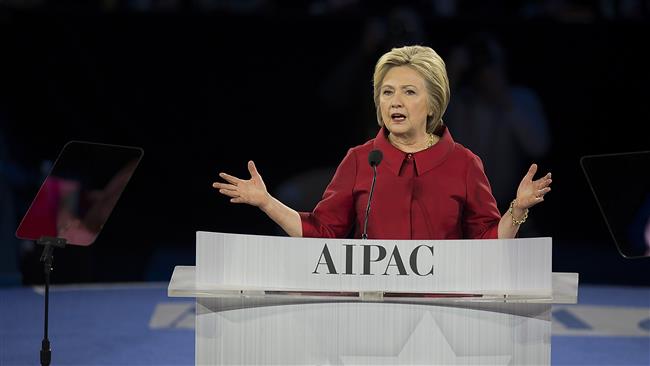
Democratic presidential candidate Hillary Clinton speaks during the 2016 AIPAC Policy Conference in Washington, DC, March 21, 2016. (AFP photo)
Press TV – March 21, 2016
US Democratic presidential candidate Hillary Clinton said in a speech to an influential Zionist lobby group in Washington that Iran still posed a threat to Israel and needed to be closely watched.
Speaking on Monday to the annual policy conference of the American Israel Public Affairs Committee (AIPAC), Clinton also criticized her Republican rival Donald Trump for having a “neutral” stance on Israel.
She said American leaders needed to show loyalty to Israel and “anyone who doesn’t understand that has no business being our president.”
“This is a serious danger and demands a serious response,” Clinton said, declaring that sanctions must be placed against the country. “We must work closely with Israel and other partners to cut off the flow of money and other arms from Iran to Hezbollah” she added.
Many of the US presidential candidates, in particular Clinton, receive large campaign funding from wealthy Jewish donors who have strong ties to the far-right wing in Israel, experts say.
“Clinton is heavily favored by the Israel lobby because she is quite clear about her intention to pursue the war policies of several presidential predecessors,” said Mark Dankof, who is also a broadcaster and pastor in San Antonio, Texas.
“She is getting very, very strong backing from the Israeli lobby and is getting more money from the defense industry than any other candidate in this race,” Dankof told Press TV earlier this month.
On Sunday, activists gathered outside the building where the annual AIPAC conference was being held to protest America’s financial support for Israel.
The US government is pressured to serve Israel’s interests due to the influence of the powerful Zionist lobby in the United States. The pro-Israel pressure groups actively work to steer US foreign policy in favor of Israel.
‘Turkey and EU make refugees a matter of bargaining – a violation of int’l treaties’
RT | March 19, 2016
The EU countries will receive educated and skilled people, and those who are not skilled and educated, they will remain in Turkey, Yasar Yakis, former Foreign Minister and a former ambassador to the UN Office in Vienna, Egypt, and Saudi Arabia, told RT.
RT: Why do you think that the “one in, one out” Turkish-EU refugee plan isn’t feasible? Who stands to benefit from this plan?
Yasar Yakıs: Both sides are going to benefit, but Turkey was in a position where it couldn’t do anything else but ask the cooperation of the European countries. Theoretically, one may think of a scenario whereby the EU could have closed their doors and not let any refugee come in from Turkey. Turkey, by trying to cooperate with the EU and with the initiative taken by Angela Merkel, at least they decided to share the responsibility of Turkey, open the doors, but of course with certain conditions, and this condition is “one in, one out.” But this doesn’t solve several problems that will entail such a decision. One of them is that the refugees who do not come from Syria, who come from distant countries, Afghanistan and the other countries, why on earth would Turkey accept them if they are already in European Union countries to receive also the refugees coming from the third countries… In my opinion, the deal shouldn’t have covered the refugees originating from countries other than Syria.
Second, since this Syrian crisis we do not see any light at the end of the tunnel; the Syrian crisis will continue for some time. Therefore, if there is nobody readmitted from Greece, the EU will be entitled to refuse any additional refugees coming from Turkey and going to the European Union countries, whereas Turkey will continue to receive refugees from Syria…
Third, the EU will receive refugees on the basis of a selection. That is to say, Syrian refugees having arrived in Turkey will submit their demand to be admitted as a refugee in the EU countries, and the EU countries will look at the qualification of the person. If they agree to receive, they will receive. It means they will receive educated and skilled people, and those who are not skilled and educated, they will remain in Turkey. For these reasons, it will work against Turkey’s interests in the long run.
RT: During the Brussels summit, ministers are also going to debate doubling the deal for the refugee crisis to €6 billion. Turkey was earlier accused of “blackmailing” and “holding the EU to ransom”, for example by UKIP’s Farage, Hungary’s Orban, by demanding money to stop the flood of migrants. How do you view such accusations?
YY: First of all, there are restrictions stemming from the international documents, international treaties, which forbid to make the life of the refugees a question of bargaining. What Turkey and the EU are doing is a violation of the international treaties that all the European countries have signed, and also Turkey has signed. This is one thing.
Secondly, the money that was allocated to Turkey will not be paid to Turkey. Turkey will have to submit to the EU projects. These projects will be financed by the EU – the money will not enter the Turkey’s treasury. There is another difficulty there. And if it is not spent in conformity with the EU relations, then the EU will be entitled to stop the payment.
RT: You said that certain EU member countries may find excuses not to implement the visa-free travel agreement with Turkey. Why do you think so? Why do you think the plan has been stalling so far? Who is being insincere here, Turkey or the EU?
YY: Both sides are sincere, but there are of course always ways for not abiding by the promise. There are two reasons for that. One is the number of the conditions that the EU put in order to start the negotiations. There were 72 conditions that Turkey had to fulfill, and 19 of them were fully fulfilled until recently. And something like 7 of them there was no progress at all. Now we have to see, whether Turkey will be fully compliant with all the 72 conditions.
Secondly, many countries were reluctant and they agreed to the deal only upon the pressure coming from Germany, and they will find other excuses in order not to abide by it. Greek Cypriots may be one of them. There are a lot of EU countries that are not satisfied with Turkey’s human rights records – fundamental rights of freedom. And they say that Turkey should not be given such concessions.
Thirdly, there are countries like France, who say that a refugee deal is one thing, Turkish accession process is another thing. Both of these two things should be assessed, evolve, and should continue to function according to their own rule without interacting between themselves.
RT: Is Turkey ready to accept even more migrants in exchange for visa-free regime with the EU and some €6 billion? Or maybe Europe will see the price tag rising, as Turkey keeps asking for money?
YY: The EU is not monolith, which means that they do not speak with the same language – all of them, 28. They all have different views, which differ slightly form the others. Many countries are looking for excuses, either for not giving money, or for abiding by these international treaties, which bans making the refugee deal a question of bargaining between the sending countries and receiving countries.
Thirdly, for the political reasons, like Greek Cypriots and other countries, as well, they are looking for excuses not to let Turkey’s accession process to the EU to continue. It cannot continue forever. It will be due to the two reasons stemming from Turkey, or stemming from the EU.
RT: Turkey says it’s fighting terrorists in its Kurdish areas, but human rights groups are concerned that civilians are being killed in the crackdown. Do you think civilian causalities can be, are justified by the fight against terror?
YY: For me no civilian causalities are justified. You have to take from the standpoint of a family, who sent their 22-year-old son to the military service, and this young man is fighting there. If you ask this family: “Do you agree that this fight against Kurds should continue, but you may also lose your son?” Most probably in many cases he will say: “No, I want my son! I want that my son’s life should not be given away in exchange of something, which is beyond my family’s concern. Of course, there are also some families in Turkey that say ‘for the security of my country I will sacrifice my son.’ But the majority will say ‘no.’
RT: Has Turkey’s international reputation suffered due to its crackdown on Kurds in Diyarbakir, Cizre etc.? And has Erdogan chosen the right strategy here?
YY: Turkey’s human rights record is going down. Turkey lost a lot of altitude in its international relations. Erdogan’s policy on the crackdown – I have to take it from the beginning. I appreciated it very much President Erdogan’s initiative to solve this Kurdish problem – at that time it was called ‘democratization project’ – so this was a very courageous, bold decision taken by President Erdogan… It is a pity now that this process has collapsed. I wish that Turkey should find one way of resuming the negotiations and continue this process…
GOP senators introduce new Iran sanctions bill
Press TV – March 17, 2016
A group of US Republican senators has introduced legislation to impose new sanctions against Iran over what legislators have described as Tehran’s support for terrorism and human rights violations.
The legislation, which was introduced on Thursday by Senator Kelly Ayotte, aims to impose harsher sanctions on Iran’s economy.
The bill is sponsored by Senator Marco Rubio and Senators Mark Kirk, Dan Coats and Cory Gardner as well as Senate Majority Leader Mitch McConnell.
Several other Republican senators have also signed on the new bill, dubbed the “Iran Terrorism and Human Rights Sanctions Act of 2016.”
The bill’s co-sponsors include Senator Ted Cruz, a Republican presidential candidate, and Senators John Cornyn, Rob Portman, Pat Roberts, Ben Sasse, Tom Cotton, Jerry Moran, Johnny Isakson and Lisa Murkowski.
The senators have accused Iran of supporting terrorism in the Middle East and committing human rights abuses.
“I reject our current posture of willful ignorance and inaction towards Iran’s terrorist activities, illegal missile testing, funding Assad’s war, and human rights abuses,” said Kirk, a strong supporter of Israel and advocate of Iran sanctions.
“The Administration’s response cannot once again be it’s ‘not supposed to be doing that’ as Iran continues to walk all over US foreign policy and the international community,” he said.
The Obama administration has advised the Republican-dominated Senate not to impose more sanctions on Iran after the historic nuclear agreement between Tehran and the world powers.
With the Iran Sanctions Act expiring at the end of this year, GOP senators are trying their best to reauthorize and impose more sanctions on Tehran on the pretext of terrorism, human rights issues, and ballistic missile tests.
Iran and the five permanent members of the UN Security Council – the United States, Britain, Russia, China, France as well as Germany started implementation of the deal, dubbed the Joint Comprehensive Plan of Action, on January 16.
After JCPOA went into effect, all nuclear-related sanctions imposed on Iran by the European Union, the Security Council and the US were lifted.
Iran in return has put some limitations on its nuclear activities. The nuclear agreement was signed on July 14, 2015 following two and a half years of intensive talks.
Does Congress Represent American Citizens or Israeli Settlers?
By Anthony Bellchambers – Global Research – March 15, 2016
1. Congress comprises the House of Representatives with 435 members plus 100 members in the Senate. So altogether Congress has 535 voting members. The US Constitution provides that in the majority of foreign policy decisions, and also in domestic legislation, any decision or proposal by the elected president, or the White House, must be ratified by Congress otherwise it cannot proceed. The foregoing is not in dispute.
2. AIPAC the American Israel lobby, aka the American Zionist Committee, has a reported 100,000 members across the United States plus the support of some 50 million, or so, Evangelicals, otherwise known as Christian Zionists, in the Bible Belt of Middle America. They represent between 16 to 20% of the US electorate. Put another way, about 80% of Americans are not members of AIPAC or any other Zionist organisation.
3. The Israel lobby has but one agenda, which is to support with military and civil aid the 5 or 6 million inhabitants of a foreign state in the Middle East. That aid is currently estimated to be in the region of US$6 billion every 12 months, sourced from taxpayers’ funds.
4. Who funds and controls AIPAC? The short answer is: the Lobby is funded by individual American Zionists and business enterprises. These financiers are closely allied to the Israeli government currently headed by the Likud Party leader, Binyamin Netanyahu. They control AIPAC through their paid executives whose brief is to ensure that the majority in Congress support the Likud Political Zionist agenda.
5. Correctly, AIPAC and the entire Israel lobby should legally be designated, as a ‘Foreign Agent’ representing a foreign state. It remains a matter for conjecture why this provision within the law has never been implemented in this case. AIPAC was not established and is not in existence to support, or for the benefit of, the government or people of the United States.
6. AIPAC’s influence over Congress is achieved by ensuring that wherever possible no candidate for the House or Senate will be elected, or reelected, unless that candidate specifically confirms his/her support for AIPAC’s agenda of Political Zionism.
7. The result is that the Israeli government effectively controls AIPAC the Israel lobby, which then has an undue influence over Congress that, in turn, either empowers or disempowers the elected President in the White House.
8. It’s known as ‘DAS’ (Democracy American Style) but, in reality is the political and economic control of the state by an unelected oligarchy. It is certainly not ‘democracy’ in any meaningful sense in that in America today, the elected representatives of the people apparently seek to serve the interests of a foreign state before the interests of their own constituents
The Clintons’ $93 Million Romance with Wall Street: a Catastrophe for Working Families, African-Americans, and Latinos
By Richard W. Behan | CounterPunch | March 16, 2016
For 24 years Bill and Hillary Clinton have courted Wall Street money with notable success. During that time the New York banks contributed:
* $11.17 million to Bill Clinton’s presidential campaign in 1992.
*$28.37 million for his re-election in 1996.
*$2.13 million to Hillary Clinton’s senatorial campaign in 2002.
*$6.02 million for her re-election in 2006.
*$14.61 million to Hillary Clinton’s presidential campaign in 2008.
*$21.42 million to her 2016 campaign.
The total here is $83.72 million for the six campaigns,i ii disbursed from eleven congenial banks: Goldman Sachs, Citigroup, UBS, Bank of America/Merrill Lynch, Wells Fargo, Barclay’s, JP Morgan Chase, CIBC, Credit Suisse, Deutsche Bank, and Morgan Stanley.iii iv
Then there were the speeches. Sixteen days after leaving the White House in 2001, Mr. Clinton delivered a speech to Morgan Stanley, for which he was paid $125,000. That was the first of many speeches to the New York banks. Over the next fourteen years, Mr. Clinton’s Wall Street speaking engagements earned him a total of $5,910,000:v
*$1,550,000 from Goldman Sachs.
*$1,690,000 from UBS.
*$1,075,000 from Bank of America/Merrill Lynch.
*$770,000 from Deutsche Bank.
*$700,000 from Citigroup
After she resigned as Secretary of State in 2012 Hillary Clinton took to the lecture circuit as well. Some of her income has come to light during the current presidential campaign—the infamous $675,000 she was paid for three speeches to Goldman Sachs. That disclosure, however, belittles her financial achievement and the scope of her audiences. She also addressed the Bank of America/Merrill Lynch, Morgan Stanley, Deutsche Bank, UBS, Ameriprise, Apollo Management Holdings, CIBC, Fidelity Investments, and Golden Tree Asset Management. In doing so she earned another $2,265,000.vi
No other political couple in modern history has enjoyed so much money flowing to them from Wall Street for such a long time—$92.57 million over a quarter century.
During a CNN forum on February 3, Anderson Cooper wondered if Goldman Sachs’ $675,000 might impact her prospective presidential decisions. Defending her integrity with undisguised indignation, she described her independence from the banks:
Anybody who knows me, who thinks that they can influence me, name anything they’ve influenced me on. Just name one thing. I’m out here every day saying I’m going to shut them down, I’m going after them. I’m going to jail them if they should be jailed. I’m going to break them up.vii
Her campaign website confirms her fierce determination to oversee the banks and hold them strictly to account. “Wall Street must work for Main Street,” the website claims, outlining her program for “Wall Street Reform:”
Veto Republican efforts to repeal or weaken Dodd-Frank
Tackle dangerous risks in the big banks and elsewhere in the financial system.
Hold both individuals and corporations accountable when they break the law.viii
$675,000 might be insufficient to elicit Ms. Clinton’s sympathetic ear, but a quarter century of accepting tens of millions of dollars is not so easily dismissed. It would likely have some impact on the Clintons’ sense of gratitude and certainly on their social, cultural, and political environments.
Over that period of time, while one of them or the other held public office almost continuously, the couple accumulated a net worth of $125 million.ix x Measured by family wealth, this inserted the couple into the top 1% of American families by a factor of 16 ($7.88 million is the threshold).
The Clintons found that stratum of society agreeable. In New York, their home upon leaving the White House, they moved easily among other multimillionaires, the celebrated, wealthy, and accomplished people of the city. Lloyd Blankfein, Robert Rubin, and Henry Paulson are examples, CEOs of the benefactor Wall Street banks. The couple could scarcely avoid adopting the mindset, language, values, and political perspectives of the people who now constituted their peer group.
Breaking up banks, jailing the lawless executives, forcing Wall Street to work for Main Street: Hillary Clinton’s stern proclamations of impartial law enforcement and strict regulation are difficult to take seriously.
Wall Street doesn’t. One bank executive assured his clients, “We continue to believe Clinton would be one of the better candidates for financial firms.” He was quoted in a CNN Money article, “Wall Street Isn’t Worried about Hillary Clinton’s Plan,” which stated,
Hillary Clinton unveiled her big plan to curb the worst of Wall Street’s excesses…. The reaction from the banking community was a shrug, if not relief.xi
There is good reason for the banks’ sanguine view. Over the 24 years of the romance, the Clintons first reoriented their political party, gave it a new name, the New Democratic Party, and put it at Wall Street’s service. Then they engineered financial opportunities for the New York banks of immense value—running into the hundreds of billions. And through the years as President, Senator, and Secretary of State the Clintons supported Wall Street’s interests at every necessary turn and without fail.
In the early 1990s, chairing the Democratic Leadership Council, Bill Clinton ushered in the centrist, triangulating New Democratic Party, explicitly to be more business-friendly—and to attract the financial support of corporate America. Wall Street supported his 1992 campaign handsomely, and Bill Clinton became the first president under the new banner. Hillary Clinton was at his side, a de facto minister-without-portfolio.
When he appointed Robert Rubin of Goldman Sachs as Secretary of the Treasury Department, Clinton established a precedent. For the next 24 years every Administration would find Wall Street executives to serve in the position. The New York banks became the primal clients of the New Democratic Party.
But the working families of America and the African-American and Hispanic communities—the party’s historic constituencies—were betrayed and abandoned, deprived of effective representation in Washington. The Clintons’ political campaigns over the next decades became monumental hypocrisies, Bill donning sunglasses to play his saxophone for Arsenio Hall, Hillary visiting black churches to hug the parishioners. They speak warmly to the traditional constituencies with carefully scripted political rhetoric, currying their favor, depending on them for electoral victory, but effectively obscuring the truth of their betrayal.
The traditional constituencies were not only betrayed, but targeted. On taking office Mr. Clinton announced, “The era of big government is over.” On that cue he co-opted two issues long
used by Republicans to mask their party’s racism: “welfare” and “crime.” To address the issues two laws were passed in Clinton’s first term that savaged the betrayed constituencies.
The first was The Personal Responsibility and Work Opportunity Reconciliation Act. It fulfilled Clinton’s promise to “end welfare as we know it,” and the punishing effects it set in motion have yet to abate. Since the end of the Clinton Administration, poverty in the U.S. has nearly doubled: “… the number of Americans living in high-poverty areas rose to 13.8 million in 2013 from 7.2 million in 2000, with African-Americans and Latinos driving most of the gains.”xii
To show how tough on crime he could be, Clinton next guided The Violent Crime Control and Law Enforcement Act of 1994 through Congress. A flurry of prison construction quickly followed, an industry of private for-profit prisons took hold and flourished, and a skyrocketing population mostly of young black males soon filled them, most frequently charged with drug offenses, non-violent and victim-free.
Sixteen years later the effects of the law were described in a searing book: The New Jim Crow: Mass Incarceration in the Age of Colorblindness.
The author of the book is a distinguished legal scholar and human rights activist, Michelle Alexander.
Ms. Alexander well understands how the Clintons and their creation, the New Democratic Party, left working families and communities of color without a political voice. And no one addresses the tragedy more forcefully. Her latest work is an article, “Black Lives Shattered,” in the February 29, 2016 issue of The Nation. She details how the two Clinton laws have devastated African-American families and sent millions—particularly those young black males—to prison. In the article’s caption, she asks, The Clinton’s legacy has been the impoverishment of black America—so why are we still voting for them?
The online version of her article carries a different title, Why Hillary Clinton Doesn’t Deserve the Black Vote . Her compelling case is abbreviated in the subtitle:
From the crime bill to welfare reform, policies Bill Clinton enacted—and Hillary Clinton supported—decimated black America.
When pressed, and with limited enthusiasm Hillary Clinton now apologizes for the laws, suggesting they are no longer quite so appropriate.
But she has not, cannot, and unquestionably will not mention two other laws passed at the bidding of President Clinton’s Treasury Secretary, Robert Rubin.
These laws enriched the Wall Street banks by hundreds of billions of dollars, but they too devastated working families, African-Americans, and Latinos.
The first was The Financial Services Modernization Act of 1999, repealing the Glass-Steagall legislation of 1933. Now it was legal once more for financial institutions to mix commercial and investment banking. Goldman Sachs et al. could now use depositor’s funds, insured by the Federal Deposit Insurance Corporation, to buy up “subprime” mortgages, the high-interest debt obligations of typically low-income, black, and Latino families.
The next law was The Commodity Futures Modernization Act. Now Goldman Sachs et al. could transform packages of those “subprime” mortgages into complicated derivatives called “mortgage-backed-obligations,” have them fraudulently rated as AAA investments, and sell them around the world, without limit, without restriction, without regulation, at immense profit.
For eight years the bubble inflated, and then it collapsed in the last year of George Bush’s Administration. Real estate values plummeted. The stock market was hammered. So was the U.S. economy. And so tragically were many low-income, African-American, and Latino families. $13 trillion in household wealth vaporized. Nine million workers lost their jobs. Five million families were evicted from their homes.xiii
This is what the Clinton Administration, and the New Democratic Party, had wrought.
The banks were caught with hundreds of billions in mortgage-backed derivatives still in the pipeline, the market values of which were dropping like stones. Wall Street’s prospective losses were horrific; bankruptcies loomed. But George Bush’s Treasury Secretary was the obligatory Wall Streeter: Mr. Hank Paulson, recently CEO of Goldman Sachs. In a heartbeat Mr. Paulson rammed through Congress The Emergency Economic Stabilization Act of 2008. It was known as the “Troubled Asset Relief Program,” and it handed Mr. Paulson $700 billion of taxpayers’ money to buy the near-worthless securities from the banks.
Hillary Clinton, now the U.S. Senator from New York, voted for the bill, telling a New York radio station the next day, “I think the banks of New York..are probably the biggest winners in this.”xiv
Eagerly, Mr. Paulson started buying, typically paying the banks half again the market value of the “troubled assets.”xv But a presidential campaign was underway, and soon he would have to stop.
Barack Obama, overcoming Hillary Clinton in the primaries, was elected as the second president from the New Democratic Party. Mr. Obama’s campaign contributions from Wall Street:
*Goldman Sachs: $1,034,615
*JP Morgan Chase: $847,855
*Citigroup: $755,057
*Morgan Stanley: $528,182
The total here is $3.7 million.xvi (Hillary Clinton’s campaign, apparently thought more likely to succeed, was supported with $14.6 million from the banks.xvii)
President Obama’s choice of Wall Street bankers to head his Treasury Department was Mr. Timothy Geithner, lately the president of the Federal Reserve Bank of New York. Mr. Geithner wasted no time in resuming the “troubled asset” purchases, and his execution of the program was no less profitable for the banks than Mr. Paulson’s.xviii
Wall Street’s grip on the New Democratic Party, however, and its influence in the Obama Administration, appeared in the Department of Justice as well. Mr. Eric Holder joined the Administration from the law firm of Covington Burling, which represents in Washington most of the Wall Street banks. Charged with prosecuting their criminal behavior, Mr. Holder found the banks “too big to fail.” Instead of criminal indictments and lawsuits, then, Mr. Holder negotiated with each of the banks a financial penalty to be paid from corporate funds. No corporate executives were jailed, no personal fines levied, no records of criminal conduct filed, no salaries reduced, no bonuses denied.
Today the Wall Street banks are larger and more powerful than ever, and Mr. Holder has returned to Covington Burling. President Obama, however—of the New Democratic Party—has provided no similar relief to the brutalized working families and communities of color. Their struggles continue, the crime and welfare laws have not been repealed, and the title of a recent study tells the tragic truth: During Obama’s Presidency Wealth Inequality has Increased and Poverty Levels are Higher.xix
Because of the Clintons’ romance with Wall Street and their corrupt New Democratic Party, the New York bankers and the Clintons are richer today. Others—betrayed, abandoned, savaged—are not.
Notes
i“Two Clintons. 41 years. $3 Billion,” Washington Post, November 19, 2015
ii“Occupy Hillary Clinton’s Wall Street Speeches,” Huffpost Politics, February 28, 2016
iii“Hillary Clinton. Top 20 Contributors, 1999-2002,” http://www.opensecrets.org/politicians/contrib.php/type==C&cid..
iv“Hillary Clinton, Jeb Bush Still Favorites of Wall Street Banks,” Huffpost Politics, October 22, 2015
v“$153 Million in Bill and Hillary Speaking Fees, Documented,” Robert Yoon, CNN, Updated February 6, 2016.
vi“Hillary Clinton Made More in 12 Speeches to Big Banks That Most of Us Earn in a Lifetime,” https://theintercept.com/2016/01/08/hillary-clinton-earned-more-from-12-speeches-to-big-banks-than-most-americans-earn-in-their-lifetime/
vii“Clinton Defends Wall Street Speeches at CNN Town Hall,” Time, February 4, 2016
viiiFrom Hillary Clinton’s campaign website, under “Wall Street Reform,” http://hillaryclinton.com/issues/wall-street
ix“Hillary Clinton net worth: $45 Million,” http://www.celebritynetworth.com/
x“Bill Clinton net worth: $80 Million,” http://www.celebritynetworth.com/
xi“Wall Street Isn’t Worried about Hillary Clinton’s Plan,” CNN Money, October 8, 2015.
xii“Poverty Has Nearly Doubled Since 2000 in America,” International Business Times, August 9, 2015
xiii“Wall Street Reform: Wall Street must work for Main Street,” http://hillaryclinton.com/issues/wall-street
xiv“Hillary Clinton’s Tough Talk on Wall Street,” http://www.thedailybeast.com/articles/2015/11/13/hillary-clinton..
xv“Troubled Asset Relief Program,” Wikipedia
xvi“Barack Obama. Top Contributors, 2008 Cycle,” http;//www.opensecrets.org/pres08/contrib.php/cid=…
xviiWashington Post, “Two Clintons. 41 Years. $3 Billion”
xviiiSee Bailout: An Inside Account of How Washington Abandoned Main Street While Rescuing Wall Street, by Neil Barofsky, passim.
Richard W. Behan lives in Corvallis, Oregon. He can be reached at: rwbehan@comcast.net.
Larry Silverstein designed NEW WTC-7 in April of 2000
“Lucky Larry” STILL bragging about his crimes of 9/11/2001
By Kevin Barrett | Veterans Today | March 15, 2016
Larry had the new WTC-7 designed and ready-to-go 17 months before he “pulled” the old one
He may just be a Silver-stein. But “Lucky Larry” sets the gold standard for chutzpah.
Latest example: In the above video, Silverstein says of the new WTC-7, which replaced the one he famously confessed to demolishing on 9/11/01:
We got the designs. And the first design meeting was in April of 2000. And construction began shortly thereafter, in 2002.
One slight problem: If he hadn’t been planning the illegal, un-permitted, homicidal demolitions of WTC-7 and the entire World Trade Center complex that took place on September 11th, 2001, there would have been no point to any such design meeting back in April, 2000 … and no opportunity for beginning construction of a new WTC-7 in 2002.
With the supreme chutzpah that has become his trademark, Silverstein breezes over the demolitions of 9/11/2001 as if they were not even worth remarking on, instead going straight from his new-WTC-7 design meeting in April 2000 to the beginning of construction in 2002.
Memo to Donald Trump: If you’re looking for people who were wildly celebrating the murder of 3,000 people on September 11th, 2001, that would include not only the famous dancing Israelis, but also Larry “Pull It” Silverstein.
In 2001, “Lucky Larry,” who had previously owned only WTC-7, orchestrated a deal with his fellow-ultra-Zionist Lewis Eisenberg, Chairman of the mobbed-up NY Port Authority, and another Zionist extremist billionaire, Frank Lowy, to sell the entire WTC complex to Silverstein and backers on a 100-year lease. The deal was finalized in July, 2001, and Larry took possession of the buildings … and security arrangements. But first, he hard-balled his insurers into doubling the terror insurance coverage and changing the terms to “instant cash payout.”
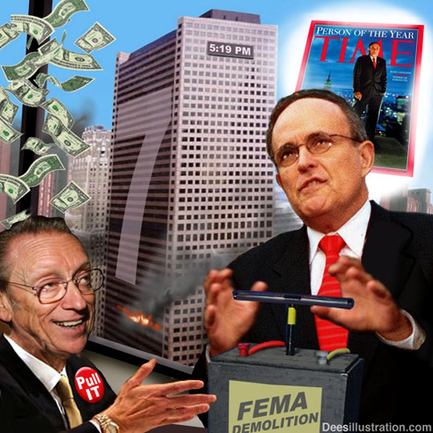
On September 11th, Larry hit the jackpot. The condemned-for-asbestos and largely vacant Twin Towers, with their obsolete communications infrastructure and money-hemorrhaging balance sheet, were both demolished for free – with 3,000 people inside.
Larry should have been at the Windows on the World restaurant at the top of the North Tower, just like every other day. Fortunately, he tells us, his wife reminded him of a dermatologist appointment. His daughter, who always took breakfast with him, made a similarly lame excuse. Both survived … and prospered … while everyone above the 91st floor, including everyone who showed up to have breakfast at Windows on the World, died miserable deaths.
Lucky Larry indeed.
Larry’s luck held out when he demanded double indemnity – on the basis that he had been “victimized” by two completely separate and unrelated terrorist attacks, namely the two planes – and got it, to the tune of 4. 5 billion dollars. That’s a hefty cash-payout return on a relatively minor investment. (Silverstein put up less than 15 million of his own money to buy the WTC, and his backers had added a little over 100 million.)
Even after video proof emerged that he had confessed to “pulling” (i.e. demolishing) WTC-7, he still somehow evaded the hangman’s noose.
Then he went back to court to ask for more than $10 billion more – this time not from his own insurers, but from those of the airlines he falsely blamed for the demolitions that he himself had conducted.
But even the mobbed-up 9/11-complicit Zionist judge, Alvin Hellerstein, had had enough. For the full (satirical) story, check out my article:
But that didn’t stop not-quite-so-Lucky Larry from trying to steal another 500 million from the federal government through an EB-5 visa scam.
Then last month, Larry’s inimitable chutzpah resurfaced when he said that his first thought on looking at the plans for the new South Tower was “it looks like it’s going to topple, it’s going to fall over.” At least if you “pull” on it hard enough, it might. Right, Larry?
Larry’s chutzpah is so monumental that it became the basis of an annual award. See:
Whatever will this unbelievable character do next?
Will someone finally arrest him?
Will we ever see him swing from the gallows?
Or will Lucky Larry’s luck hold out until he finally dies of natural causes, leaving his heirs billions of blood-stained dollars with which to conduct more outrageous Zionist mischief?
Featured Video

Death Spikes & Rising Cancer In Our Youth Explained
or go to
Aletho News Archives – Video-Images
From the Archives
Politicians lie
By Mazin Qumsiyeh | Popular Resistance | August 18, 2013
There is no way to say this truth nicely: Politicians lie. That includes Japanese, American, Egyptian, Israeli, and Palestinian politicians! Is there something more common sense than that? Yet, so many citizens around the world believe their own politicians or wistfully acknowledge lies but think it is part of the job needed to run things. They believe even when politicians contradict themselves blatantly. This phenomenon is rather remarkable. It is a dissonance and disconnect from reality that many seem oblivious to. It is very dangerous because it can lead to accepting rationales for going to war. These can be deadly wars that lead to millions of lives lost as happened in what was called World War 1 and WW2. Even when incredible and declassified evidence abound, politicians continue to lie and old mythologies refuse to die. Here are just a few of the countless lies told to us over the past few decades… continue
Blog Roll
 Aletho News
- RSF military group defects, joins Sudanese army: State media
- Ireland goalkeeper refuses to play ‘Israel’ as squad weighs boycott
- China pushes back against US on Cuba, Iran
- Ukrainian Soldiers, Potential Mercenaries: Have Gun, Will Travel!
- Burnham’s UN debut… A masterclass in British disinformation
- Iran flights continue despite US aviation sanctions
- Global Tipping Points Lead the World Into a State of Entropy
- The day-after at the White House: USA and Xi Jinping
- The Geopolitical Balance in the Red Sea: The UAE Being Displaced by New Players
- Iraqi resistance group vows to stage airport sit-ins over Iran aerial blockade
- If Americans Knew
- Deconstructing Netanyahu’s pants-on-fire UN rant – Daily Update
- Trump betrayed voters with his campaign lies and prioritized a foreign country once he took office
- Netanyahu calls Israel’s war in Gaza ‘opposite of genocide’ in UN speech to near-empty hall
- Settler Kidnappings: Torture, Sexual Abuse and Terrorisation of Palestinian Abductees as Israel Deepens Annexation of West Bank
- Gaza winter nears as 162,000 tents become unusable, raising fears of humanitarian crisis
- Netanyahu says, “It’s the opposite of genocide”; UN says Gaza economy is world’s ‘most severe crisis on record’ – Daily Update
- Israel’s US-Backed Assault on Gaza Has Created the ‘World’s Most Severe Economic Crisis on Record’: UN
- ‘Protecting U.S. Citizens’… From Israel
- ‘This is where I live now, the back of a truck’: a day in the life of a grandmother in Gaza
- In UN Speech, Iran’s President Displays Pictures of Children Killed by US, Brings Attention to Israel’s Nuclear Arsenal
- No Tricks Zone
- New Study: Earth And Venus Surface Warmth Largely Explained By Convection And Lapse Rate, Not CO2 Or Radiation
- 2025 Nature Paper Claiming Worsening Global Drought Gets RETRACTED …Heavily Flawed
- New Study: ‘Global Drought Shows No Detectable Recent Acceleration Under Climate Warming’
- Economic Masterminds: German Socialists Suggest Taxing Productivity Gains Stemming From Using AI
- The South China Sea Has Not Been Cooperating With The Climate Change Narrative
- Energy Crisis: Germany Enters Heating Season With Historically Low Gas Reserve Fill Levels
- New Study: The Antarctic Ice Sheet Gained Mass From 2020-2024 Due To Staggering Snow And Ice Accumulation
- Study: Ocean Heating Rates From Thousands Of Years Ago ‘Dwarf’ Modern Ocean Heating Rates
- Climate Extremists Target, Attack Large-Scale Power Grid Infrastructure In Germany!
- New Study: Antarctic Ice Melt Has Contributed Less Than 1 Centimeter To Sea Level Rise In The Last 30 Years

