Obama’s Latin American Legacy
Re-Militarizing Honduras
By NICK ALEXANDROV | CounterPunch | February 13, 2015
Nearly a decade ago, a keen observer of Honduras produced a damning analysis of the country. “In a very real sense, Honduras is a captured state,” he began. “Elite manipulation of the public sector, particularly the weak legal system, has turned it into a tool to protect the powerful,” and “voters choose mainly between the two major entrenched political parties, both beholden to the interests of individuals from the same economic elite.” The situation required a “strategy that will give people the means to influence public policy,” the report concluded.
Its author was James Williard, the U.S. chargé d’affaires in Honduras in 2005. In the following years, Manuel Zelaya, the Honduran president from 2006-2009, formulated a strategy like the one Williard mentioned. The country’s rulers reacted by toppling Zelaya in June 2009, manipulating the feeble legal system to justify his overthrow. Washington feigned outrage, but then recognized the marred November 2009 national election, its 2013 follow-up—and heaped supplies on the military. About “half of all U.S. arms exports for the entire Western Hemisphere” went to Honduras in 2011, Martha Mendoza disclosed, referring to the $1.3 billion in military electronics that “neither the State Department nor the Pentagon” would explain.
Zelaya had planned to conduct a poll the day of the coup, to see whether the public desired a referendum on constitutional reform that November. “Critics said it was part of an illegal attempt by Mr. Zelaya to defy the Constitution’s limit of a single four-year term for the president,” New York Times reporter Elisabeth Malkin wrote immediately after the ouster.
That was the official line. But U.S. Ambassador Hugo Llorens had a different take. “The fact is we have no hard intelligence suggesting any consideration”—let alone effort—“by Zelaya or any members of his government to usurp democracy and suspend constitutional rule,” he wrote five days before the coup. Zelaya’s “public support” then was somewhere “in the 55 percent range,” with the poll’s as high as 75%. These figures signaled the nightmare. “Zelaya and his allies advocate radical reform of the political system and replacement of ‘representative democracy’ with a ‘participatory’ version modeled on President Correa’s model in Ecuador,” Llorens panicked.
He need not have. Repression crushed the hope of reform, and today’s Honduras recalls its 1980s death-squad heyday. The Constitution Zelaya allegedly violated dates from that era, and “contained perverse elements such as military autonomy from civilian control,” Michelle M. Taylor-Robinson explains, adding that “during the 1980s the military chief negotiated defense policy directly with the U.S. government and then informed the Honduran president of what was decided.”
General Gustavo Álvarez Martínez helmed the army until 1984. “Trained in Argentina, as he rose to power he openly declared to U.S. Ambassador Binns that he admired the Argentine methods used during the murderous Dirty Wars there and planned to use the same techniques in Honduras,” Jennifer Harbury notes. Álvarez wasn’t kidding. He proceeded to form Battalion 316, whose members the CIA and other U.S. intelligence agencies trained. One of its targets was union leader German Pérez Alemán. Battalion hit men forced him into a car on a busy street near Tegucigalpa’s airport, then killed him with torture. Journalist Oscar Reyes was another victim. “He was strung up naked and beaten ‘like a piñata,’” Harbury writes, while his wife, Gloria, “was given electrical shocks to the genitals that damaged her internal organs.”
Reagan dealt with Álvarez by awarding him the Legion of Merit in 1983. Now a new generation continues the Battalion’s work. “In the ’80s we had armed forces that were excessively empowered. Today Honduras is extremely similar,” activist Bertha Oliva stated, emphasizing that “the presence of the U.S. in the country was extremely significant” then, and is now. “Military personnel now control state institutions that in the 1990s were taken from them,” added Héctor Becerra, Director of the Honduran Committee for Free Expression.
One example is the Public Order Military Police (PMOP, in Spanish), first deployed weeks before the 2013 election. That October 10, it “raided the home of Marco Antonio Rodriguez, Vice President of SITRAPANI (National Child Welfare Agency Workers’ Union),” then “broke down the doors” of seasoned activist Edwin Robelo Espinal’s home a few weeks later, human rights group PROAH reported. Several legislators opposed the law creating the PMOP. A top Honduran human rights official declared it unconstitutional. But not only was its champion, ex-Congressman Juan Orlando Hernández, allowed to retain his position—he’s now president.
And “since taking office in January 2014 [he] has presided over several deployments of soldiers and expanded the PMOP,” the Security Assistance Monitor points out. PROAH reviews some case studies in citizen security, like one “where the police have been complicit in the kidnapping and torture of two fishermen, and another where soldiers were directly responsible for the torture of two miners.” A former police agent, in a sworn statement, described other experiments in sadism “that implicate top level commanders of the national security forces,” according to TeleSUR. A “woman was taken to a security house in the exclusive Trejo neighborhood, interrogated for 48 hours, hanged and disappeared,” for example. The agent also recounted how his team had abducted three gang members, who “were tortured and killed. They were then decapitated and their bodies appeared in different parts of the city. A different head was placed on each body to make it more difficult to identify the person killed.”
International policy expert Alexander Main writes that U.S. support for Honduran militarization has been not only “tacit”—seen in “the steady increase of U.S. assistance to national armed forces” since the coup—but also “direct.” A DEA Foreign-deployed Advisory Support Team (FAST), for example, “set up camp in Honduras to train a local counternarcotics police unit” from 2011-2012. U.S. and Colombian Special Forces later instructed “a new ‘elite’ police unit called the Intelligence Troop and Special Security Group” (TIGRES, in Spanish). When $1.3 million vanished in a drug raid last year, evidence emerged implicating dozens of TIGRES members. It seems the training paid off.
We can say the same of U.S. efforts to shape Honduran society. The “military simply did not exist in any institutionalized form” there for much of the 20th century, Kirk Bowman observes. This situation changed after the U.S. and Honduran governments signed a Bilateral Treaty of Military Assistance in May 1954. We see the outcomes today. The journalists gunned down by passing assassins, the poor farmers stalked and murdered for defending their land—this is as much a part of Obama’s Latin America legacy as his celebrated Cuba thaw.
Nick Alexandrov lives in Washington, DC. He can be reached at: nicholas.alexandrov@gmail.com.
Kejriwal sworn in as New Delhi chief minister
Press TV – February 14, 2015
Arvind Kejriwal, the leader of the Aam Aadmi Party (Common Man Party), has taken the oath as the chief minister of India’s capital city of New Delhi.
The swearing-in ceremony took place at Delhi’s Ramlila Maidan on Saturday in front of thousands of supporters of the Aam Aadmi Party, which won 67 out of the 70 seats in the February 7 elections of the city’s state assembly.
During the open-air ceremony, Manish Sisodia, Kejriwal’s associate, was also sworn in as deputy chief minister along with five other ministers.
In an address to the crowd, Kejriwal vowed to tackle graft in Delhi and end its “VIP culture”.
“I will make Delhi corruption-free within five years. If somebody asks for a bribe, don’t say no. Just take your mobile out of your pocket and record it on your phone. You then come and give it to me. We will take the toughest action against the offenders,” he said.
In 2013, the 46-year-old former civil servant was also sworn in as Delhi’s chief minister, but he resigned after 49 days in a row over an anti-corruption bill.
An estimated 67-percent turnout was recorded at Delhi’s 70-seat legislative assembly elections, which was widely considered as a test of the popularity of Indian Prime Minister Narendra Modi. India’s ruling Bharatiya Janata Party (BJP) came second in the polls with only three seats.
In May 2014, the BJP won 274 seats in the 543-seat lower house of parliament, the Lok Sabha. However, the ruling party lacks a majority in the Asian country’s upper house.
The Indian premier needs to win most of the state elections over the next four years in order to gain control of both houses of parliament, where he is attempting to push through reforms to revive the country’s economy.
Big Sugar’s scandalous sweetheart deal with public health experts exposed
RT | February 12, 2015
British public health experts issuing guidance on obesity receive hundreds of thousands of pounds from the sugar industry, an investigation has found.
Funding from companies including Coca-Cola, PepsiCo and Nestlé has flowed into scientific research bodies such as the UK’s Scientific Advisory Committee on Nutrition (SACN) and the Medical Research Council (MRC) for over a decade.
Scientists whose work was at least partly funded and sometimes fully funded by the sugar industry include Professor Susan Jebb, the government’s obesity tsar.
Leading scientists blamed the government’s funding cuts for forcing researchers into the arms of Big Sugar, while one doctor told RT the findings were “disturbing.”
The report comes at a time when medical experts say daily guidelines on sugar intake are misleading, with the average Briton consuming two to three times the World Health Organization’s (WHO) recommended limit.
According to the BMJ’s investigation, one government-funded organization, the MRC’s Human Nutrition Research unit in Cambridge, received an average of £250,000 a year for the past decade from Big Sugar.
Other scientists received consultancy fees from Boots, Coca-Cola, Mars, Cereal Partners UK and Unilever. They have also sat on advisory boards for Coca-Cola, the Food and Drink Federation and the Institute of Grocery Distributors, the report claims.
Nutrition scientist Susan Jebb, who is the UK government’s adviser on obesity, received £1.37 million in industry funding between 2004 and 2015, according to the investigation.
This money came from food and retail companies including Cereal Partners UK, which operates under the Nestlé brand, Rank Hovis McDougal, Sainsbury’s, Coca-Cola’s Beverage Institute for Health and Wellbeing and Unilever.
In a statement published via the Science Media Centre, Jebb rejected the BMJ’s investigation.
“It refers to a series of studies in which I was involved which included funding from industry. None of these involve research into the effects of sugar on health,” she said.
“I have received no personal remuneration from any of these projects. All have been conducted according to all the MRC governance arrangements for working with industry and the industry involvement has been declared.”
Dr Aseem Malholtra, a cardiologist and Science Director at the medically led Action on Sugar, told RT the findings were “disturbing.”
“I think it’s quite disturbing. I think the public would be appalled that the people advising them on what they eat are receiving money from the food industry.”
“We know that biased funding for research is one of the root causes of problems within healthcare at the moment. Whether it’s food industry funding or pharmaceutical funding.”
Malholtra said the average UK citizen consumes 2-3 times the WHO’s recommended sugar intake.
“The labeling of sugar remains extremely misleading. The guidelines’ daily amount doesn’t distinguish between added sugars and what’s intrinsic to the product,” he said.
“The current sugar labeling suggests one could consume 22 teaspoons of sugar a day as part of your daily amount. The WHO advice is for 6 teaspoons per day.”
“My question is: what are the scientists doing turning a blind eye?”
Former SACN chair Alan Jackson blamed the government’s research funding cuts for pushing scientist towards industry money.
Universities are estimated to have lost over £460 million in government research funding between 2009-10 and 2012-13, a financial burden which has seen them turn to business for over £2 billion over the past decade.
Jackson said scientists were encouraged by the government to develop a “mixed portfolio of support” for their research which explicitly included help from industry.
“So most, if not all, researchers will have some form of industry support and funding and hence have potential conflicts of interest,” he told the BMJ.
“By the very nature of its complex roots and wide interdisciplinary engagement nutrition has particular vulnerabilities in this regard, but it is by no means unique to nutrition.”
READ MORE: Child obesity looms large, with 1/3 of European teenagers overweight
Loretta Lynch: She’s Black, and That’s All the Black Caucus Cares About
A Black Agenda Radio commentary by Glen Ford
An important aspect of the Age of Obama will soon come to a close with the departure of Eric Holder, the first Black U.S. attorney general. Holder’s record in office makes up a great part of the Obama legacy – which, after six years turns out to be scarcely any different than what could have been expected from any center-right white corporate Democrat. Like former president Bill Clinton, whose Wall Street dominated administration deregulated the banks and set the stage for the economic meltdown, eight years later. Obama’s first act in office was to bring back Bill Clinton’s Wall Street wrecking crew. So, in a sense, Obama is actually a protégé of Bill Clinton, and will likely be succeeded in office by Hillary Clinton.
Obama’s and Eric Holder’s most singular contribution to American political economy is having articulated the concept of banks being Too Big to Fail, or to jail. Back in the late Eighties and early Nineties, one-third of the nation’s savings and loan institutions did fail, and over a thousand individual executives were prosecuted, with a large proportion of them sent to prison. But, Eric Holder’s Justice Department has specialized in protecting big banks and defending the Lords of Capital.
At this late date, with his exit probably only weeks away, Eric Holder is trying to put a final spin on his legacy by demanding that some of the world’s biggest banks, including JP Morgan Chase and Citigroup, plead guilty to a felony for manipulating foreign currency prices. Of course, not a single living, breathing banking executive would be branded a felon. Rather, the banks, as institutions would bear the shame. But, institutions have no shame, and cannot be jailed, and the banks will not be prevented from continuing to deal in foreign currency trading and all the other money streams they have manipulated, with impunity. However, Eric Holder will ride off into the sunset of a multi-million dollar corporate law practice claiming that he finally busted a bank for felonious conduct.
The Pavlovian Black Caucus
Meanwhile, the ridiculously ineffectual Congressional Black Caucus is circling its wagons around Holder’s replacement, Black New York federal prosecutor Loretta Lynch. Lynch last month told a Senate committee that she fully supports the practice of civil forfeiture, which allows police to confiscate people’s money and property on mere suspicion of involvement in illegal activity. Even Eric Holder has advanced some very limited reforms to civil forfeiture, but Loretta Lynch appeared gung ho about the seizures. The Black Caucus, in an uproar, denounced Republican libertarian Senator Rand Paul for saying he’d vote against confirming Lynch because of her position on civil forfeiture, and he sniped that Lynch ought to be a little more concerned about poor people, who are more likely to have their cash seized by the cops. Black Caucus chairman G.K. Butterfield, one of the most pro-corporate members of the Caucus, fumed that Rand Paul was using civil forfeiture as an excuse to “keep an African American legal scholar” from heading the Justice Department. But, of course, the Congressional Black Caucus has adopted no position at all on the pros and cons of civil forfeiture. They have no opinion. All they care about is that a Black Democrat get the attorney general’s job – and that they get to hold on to theirs.
See also:
Loretta Lynch is Condoleeza Rice With A Law Degree
By Bruce A. Dixon
In private practice Loretta Lynch was a “white collar crime specialist” keeping banksters, tax evaders and money launderers out of jail. She did exactly that at Obama’s Justice Department, passing get out of jail cards in the biggest money laundering cases in history. She’s pro-death penalty, against legalizing weed or demilitarizing cops, sees no evil in drone murder, war crimes or runaway surveillance. And she’s the next Attorney General.
Careful what you say: Your Samsung TV might be listening
RT | February 9, 2015
Samsung has come under fire from privacy campaigners after it emerged the company’s new smart TVs are capable of listening to your conversations.
Viewers hoping to take advantage of the voice activation feature have been warned by Samsung not to disclose personal information because voice recordings can be captured and transmitted to unidentified third parties.
Privacy campaigners have compared the TV sets to ‘telescreens’ – televisions which also act as surveillance cameras in George Orwell’s dystopian novel 1984. Electronic Frontier Foundation activist Park Higgins compared Samsung’s privacy policy to the famous book in a tweet on Sunday. It has already received 14,000 retweets.
Samsung insists it takes consumer privacy seriously, but did not name the third party which translates speech to text.
The issue was first highlighted by the Daily Beast, which warned readers not to talk about incriminating matters such as “tax evasion” and “drug use” in front their TV sets.
Hidden away in Samsung’s privacy policy is a single sentence which may change the way you behave in front of your TV: “Please be aware that if your spoken words include personal or other sensitive information, that information will be among the data captured and transmitted to a third party.”
The privacy policy goes on to warn: “In addition, Samsung may collect and capture voice commands and associated texts so that we can provide you with Voice Recognition features and evaluate and improve the features.”
The technology is designed to enable viewers to control their TV by using only their voice.
Even viewers who do not activate the voice recognition feature are still at risk of being snooped on, as the machine continues to collect data through its microphones. The only way to stop a Samsung smart TV from eavesdropping on your conversation is to disable voice recognition data collection in the settings menu.
Samsung claims it collects transcribed voice data in order to improve the technology’s features.
An investigation last year by consumer magazine Which? found that smart TVs made by LG, Samsung, Sony, Panasonic, and Toshiba track people’s viewing habits – something consumers agree to when they accept the TV’s terms and conditions.
Users who choose not to accept their TV’s terms and conditions may end up reverting to a not-so-smart television. While Toshiba and LG block internet access and apps, Samsung reportedly stops customers from using the TV at all.
Sony is the only manufacturer which blocks the tracking of television usage without restricting other functions.
Samsung has responded to the public backlash against its privacy policy, claiming it takes such concerns “very seriously.”
“If a consumer consents and uses the voice recognition feature, voice data is provided to a third party during a requested voice command search. At that time, the voice data is sent to a server, which searches for the requested content then returns the desired content to the TV,” the company said.
150 People Reported Disappeared in Piedras Negras, Mexico
teleSUR | February 7, 2015
Over 150 people have been reported disappeared in the small city of Piedras Negras in the northern border Mexican state of Coahuila in the last 18 months, of which at least 60 have been attributed to elite police forces, according to a lawyer overseeing the cases.
Families of victims and their lawyers accused state government of creating special forces that have carried out arbitrary detentions, tortures and enforced disappearances across Coahuila during the last six years.
The creation of elite police forces, which in the past have been sent to the U.S. for special training by the FBI, is not new in Mexico. These types of forces have been accused of acting as death squads for the government and have sometimes carried out assassinations ordered by organized crime gangs.
“Special units of the army and navy, assassins trained by armed forces deserters and civilians trained by foreign security forces operate in Mexico as death squad,” Proceso published in June of 2013. The Mexican magazine based this assertion on a book published by 0federal lawmaker Ricardo Monreal Avila, which was edited by the congress’ lower house.
Influential newspaper Excelsior in November of last year wrote that, “The special forces created in the states (of Mexico) are under scrutiny due to human rights issues.”
The daily based in Mexico City added that, “these elite police groups have been accused of carrying out enforced disappearances, kidnappings, extortion and torture.”
Excelsior said that “it should be noted that in spite of the negative reputation of these forces in various states, which sometimes receive special training by U.S., Colombian or Israeli elite groups, more states and Mexico City are in the process of integrating elite groups to (allegedly) fight organized crime.”
The newspaper went on to say that the United Nations has questioned the work of special intelligence units in Baja California and Tamaulipas, due to the high number of crimes they have committed against innocent people.
On Friday, the La Jornada newspaper reported that attorney Denise Garcia told reporters that the non-governmental organization United Families has documented 150 cases of disappearances in the last 18 months in Piedras Negras alone.
“In at least 60 of those cases there is evidence that the Special Arms and Tactics Group (GATE) participated in them, as well as other similar types police units that were created by the former Governor Humberto Moreira and which still exist today under the governorship of his brother Ruben,” she said.
Garcia said the 51 people that were disappeared by GATE were later found alive, but all of them, she added, were tortured to confess crimes they did not commit, including drug trafficking, and today they remain jailed under false charges.
These groups have no accountability, Garcia explained, and they don’t report their operations nor their arrests, which is a clear violation of human rights.
“GATE and other special police units work under the recognition and support of the government, despite that many of them are [not] even legally constituted,” she said.
García said they act as illegal death squads, they travel in unmarked vehicles with no license plates, they are masked and commit many other irregularities.
The worst thing, she added, is that “we have denounced these issues to the federal government and the National Human Rights Commission (CNDH), which respond with indifference.”
See also:
Al-Qaeda, Saudi Arabia and Israel
By Robert Parry | Consortium News | February 4, 2015
The disclosure that convicted al-Qaeda operative Zacarias Moussaoui has identified leading members of the Saudi government as financers of the terrorist network potentially reshapes how Americans will perceive events in the Middle East and creates a risk for Israel’s Likud government which has forged an unlikely alliance with some of these same Saudis.
According to a story in the New York Times on Wednesday, Moussaoui said in a prison deposition that he was directed in 1998 or 1999 by Qaeda leaders in Afghanistan to create a digital database of the group’s donors and that the list included Prince Turki al-Faisal, then Saudi intelligence chief; Prince Bandar bin Sultan, longtime Saudi ambassador to the United States; Prince al-Waleed bin Talal, a prominent billionaire investor; and many leading clerics.
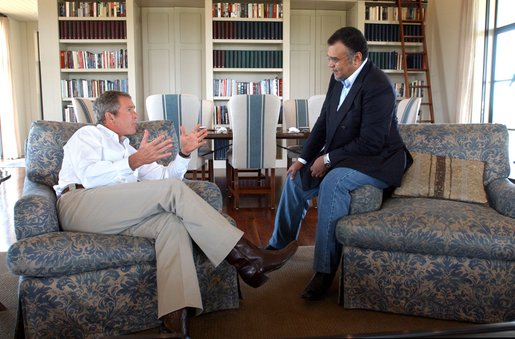
Prince Bandar bin Sultan, then Saudi ambassador to the United States, meeting with President George W. Bush in Crawford, Texas. (White House photo)
“Sheikh Osama wanted to keep a record who give money,” Moussaoui said in imperfect English — “who is to be listened to or who contributed to the jihad.”
Although Moussaoui’s credibility came under immediate attack from the Saudi kingdom, his assertions mesh with accounts from members of the U.S. Congress who have seen a secret portion of the 9/11 report that addresses alleged Saudi support for al-Qaeda.
Further complicating the predicament for Saudi Arabia is that, more recently, Saudi and other Persian Gulf oil sheikdoms have been identified as backers of Sunni militants fighting in Syria to overthrow the largely secular regime of President Bashar al-Assad. The major rebel force benefiting from this support is al-Nusra Front, al-Qaeda’s affiliate in Syria.
In other words, the Saudis appear to have continued a covert relationship with al-Qaeda-connected jihadists to the present day.
The Israeli Exposure
And, like the Saudis, the Israelis have sided with the Sunni militants in Syria because the Israelis share the Saudi view that Iran and the so-called “Shiite crescent” – reaching from Tehran and Baghdad to Damascus and Beirut – is the greatest threat to their interests in the Middle East.
That shared concern has pushed Israel and Saudi Arabia into a de facto alliance, though the collaboration between Jerusalem and Riyadh has been mostly kept out of the public eye. Still, it has occasionally peeked out from under the covers as the two governments deploy their complementary assets – Saudi oil and money and Israeli political and media clout – in areas where they have mutual interests.
In recent years, these historic enemies have cooperated in their joint disdain for the Muslim Brotherhood government in Egypt (which was overthrown in 2013), in seeking the ouster of the Assad regime in Syria, and in pressing for a more hostile U.S. posture toward Iran.
Israel and Saudi Arabia also have collaborated in efforts to put the squeeze on Russia’s President Vladimir Putin, who is deemed a key supporter of both Iran and Syria. The Saudis have used their power over oil production to drive down prices and hurt Russia’s economy, while U.S. neoconservatives – who share Israel’s geopolitical world view – were at the forefront of the coup that ousted Ukraine’s pro-Russian President Viktor Yanukovych in 2014.
The behind-the-scenes Israeli-Saudi alliance has put the two governments – uncomfortably at times – on the side of Sunni jihadists battling Shiite influence in Syria, Lebanon and even Iraq. On Jan. 18, 2015, for instance, Israel attacked Lebanese-Iranian advisers assisting Assad’s government in Syria, killing several members of Hezbollah and an Iranian general. These military advisors were engaged in operations against al-Qaeda’s Nusra Front.
Meanwhile, Israel has refrained from attacking Nusra Front militants who have seized Syrian territory near the Israeli-occupied Golan Heights. One source familiar with U.S. intelligence information on Syria told me that Israel has a “non-aggression pact” with these Nusra forces.
An Odd Alliance
Israel’s odd-couple alliances with Sunni interests have evolved over the past several years, as Israel and Saudi Arabia emerged as strange bedfellows in the geopolitical struggle against Shiite-ruled Iran and its allies in Iraq, Syria and southern Lebanon. In Syria, for instance, senior Israelis have made clear they would prefer Sunni extremists to prevail in the civil war rather than Assad, who is an Alawite, a branch of Shiite Islam.
In September 2013, Israel’s Ambassador to the United States Michael Oren, then a close adviser to Israeli Prime Minister Benjamin Netanyahu, told the Jerusalem Post that Israel favored the Sunni extremists over Assad.
“The greatest danger to Israel is by the strategic arc that extends from Tehran, to Damascus to Beirut. And we saw the Assad regime as the keystone in that arc,” Oren told the Jerusalem Post in an interview. “We always wanted Bashar Assad to go, we always preferred the bad guys who weren’t backed by Iran to the bad guys who were backed by Iran.” He said this was the case even if the “bad guys” were affiliated with al-Qaeda.
And, in June 2014, speaking as a former ambassador at an Aspen Institute conference, Oren expanded on his position, saying Israel would even prefer a victory by the brutal Islamic State over continuation of the Iranian-backed Assad in Syria. “From Israel’s perspective, if there’s got to be an evil that’s got to prevail, let the Sunni evil prevail,” Oren said.
Skepticism and Doubt
In August 2013, when I first reported on the growing relationship between Israel and Saudi Arabia in an article entitled “The Saudi-Israeli Superpower,” the story was met with much skepticism. But, increasingly, this secret alliance has gone public.
On Oct. 1, 2013, Israeli Prime Minister Netanyahu hinted at it in his United Nations General Assembly speech, which was largely devoted to excoriating Iran over its nuclear program and threatening a unilateral Israeli military strike.
Amid the bellicosity, Netanyahu dropped in a largely missed clue about the evolving power relationships in the Middle East, saying: “The dangers of a nuclear-armed Iran and the emergence of other threats in our region have led many of our Arab neighbors to recognize, finally recognize, that Israel is not their enemy. And this affords us the opportunity to overcome the historic animosities and build new relationships, new friendships, new hopes.”
The next day, Israel’s Channel 2 TV news reported that senior Israeli security officials had met with a high-level Gulf state counterpart in Jerusalem, believed to be Prince Bandar, the former Saudi ambassador to the United States who was then head of Saudi intelligence.
The reality of this unlikely alliance has now even reached the mainstream U.S. media. For instance, Time magazine correspondent Joe Klein described the new coziness in an article in the Jan. 19, 2015 issue.
He wrote: “On May 26, 2014, an unprecedented public conversation took place in Brussels. Two former high-ranking spymasters of Israel and Saudi Arabia – Amos Yadlin and Prince Turki al-Faisal – sat together for more than an hour, talking regional politics in a conversation moderated by the Washington Post’s David Ignatius.
“They disagreed on some things, like the exact nature of an Israel-Palestine peace settlement, and agreed on others: the severity of the Iranian nuclear threat, the need to support the new military government in Egypt, the demand for concerted international action in Syria. The most striking statement came from Prince Turki. He said the Arabs had ‘crossed the Rubicon’ and ‘don’t want to fight Israel anymore.’”
Though Klein detected only the bright side of this détente, there was a dark side as well, as referenced in Moussaoui’s deposition, which identified Prince Turki as one of al-Qaeda’s backers. Perhaps even more unsettling was his listing of Prince Bandar, who had long presented himself as a U.S. friend, so close to the Bush Family that he was nicknamed “Bandar Bush.”
Moussaoui claimed that he discussed a plan to shoot down Air Force One with a Stinger missile with a staff member at the Saudi Embassy in Washington, at a time when Bandar was the ambassador to the United States.
According to the New York Times article by Scott Shane, Moussaoui said he was assigned to “find a location where it may be suitable to launch a Stinger attack and then, after, be able to escape,” but that he was arrested on Aug. 16, 2001, before he could carry out the reconnaissance mission.
The thought of anyone in the Saudi embassy, then under the control of “Bandar Bush,” scheming with al-Qaeda to shoot down George W. Bush’s Air Force One is shocking, if true. The notion would have been considered unthinkable even after the 9/11 attacks, which involved 15 Saudis among the 19 hijackers.
After those terror attacks which killed nearly 3,000 Americans, Bandar went to the White House and persuaded Bush to arrange for the rapid extraction of bin Laden’s family members and other Saudis in the United States. Bush agreed to help get those Saudi nationals out on the first flights allowed back into the air.
Bandar’s intervention undercut the FBI’s chance to learn more about the ties between Osama bin Laden and the 9/11 perpetrators by giving FBI agents only time for cursory interviews with the departing Saudis.
Bandar himself was close to the bin Laden family and acknowledged having met Osama bin Laden in the context of bin Laden thanking Bandar for his help financing the jihad project in Afghanistan during the 1980s. “I was not impressed, to be honest with you,” Bandar told CNN’s Larry King about bin Laden. “I thought he was simple and very quiet guy.”
The Saudi government claimed to have broken ties with bin Laden in the early 1990s when he began targeting the United States because President George H.W. Bush had stationed U.S. troops in Saudi Arabia, but – if Moussaoui is telling the truth – al-Qaeda would have still counted Bandar among its supporters in the late 1990s.
Bandar and Putin
Bandar’s possible links to Sunni terrorism also emerged in 2013 during a confrontation between Bandar and Putin over what Putin viewed as Bandar’s crude threat to unleash Chechen terrorists against the Sochi Winter Olympics if Putin did not reduce his support for the Syrian government.
According to a leaked diplomatic account of a July 31, 2013 meeting in Moscow, Bandar informed Putin that Saudi Arabia had strong influence over Chechen extremists who had carried out numerous terrorist attacks against Russian targets and who had since deployed to join the fight against the Assad regime in Syria.
As Bandar called for a Russian shift toward the Saudi position on Syria, he reportedly offered guarantees of protection from Chechen terror attacks on the Olympics. “I can give you a guarantee to protect the Winter Olympics in the city of Sochi on the Black Sea next year,” Bandar reportedly said. “The Chechen groups that threaten the security of the games are controlled by us.”
Putin responded, “We know that you have supported the Chechen terrorist groups for a decade. And that support, which you have frankly talked about just now, is completely incompatible with the common objectives of fighting global terrorism.”
Bandar’s Mafia-like threat toward the Sochi games – a version of “nice Olympics you got here, it’d be a shame if something terrible happened to it” – failed to intimidate Putin, who continued to support Assad.
Less than a month later, an incident in Syria almost forced President Barack Obama’s hand in launching U.S. air strikes against Assad’s military, which would have possibly opened the path for the Nusra Front or the Islamic State to capture Damascus and take control of Syria. On Aug. 21, 2013, a mysterious sarin attack outside Damascus killed hundreds and, in the U.S. media, the incident was immediately blamed on the Assad regime.
American neocons and their allied “liberal interventionists” demanded that Obama launch retaliatory air strikes even though some U.S. intelligence analysts doubted that Assad’s forces were responsible and suspected that the attack was carried out by extremist rebels trying to pull the U.S. military into the civil war on their side.
Yet, pushed by the neocons and liberal war hawks, Obama nearly ordered a bombing campaign designed to “degrade” the Syrian military but called it off at the last minute. He then accepted Putin’s help in reaching a diplomatic solution in which Assad agreed to surrender his entire chemical weapons arsenal, while still denying any role in the sarin attack.
Later, the Assad-did-it case crumbled amid new evidence that Sunni extremists, supported by Saudi Arabia and Turkey, were the more likely perpetrators of the attack, a scenario that became increasingly persuasive as Americans learned more about the cruelty and ruthlessness of many Sunni jihadists fighting in Syria. [See Consortiumnews.com’s “The Mistaken Guns of Last August.”]
Targeting Putin
Putin’s cooperation with Obama to head off a U.S. military strike in Syria made the Russian president more of a target for the American neocons who thought they finally had reached the cusp of their long-desired “regime change” in Syria only to be blocked by Putin. By late September 2013, a leading neocon, National Endowment for Democracy President Carl Gershman, announced the goal of challenging Putin and recognizing his sore point in Ukraine.
Taking to the Washington Post’s op-ed page on Sept. 26, 2013, Gershman called Ukraine “the biggest prize” and an important step toward ultimately ousting Putin. Gershman wrote, “Ukraine’s choice to join Europe will accelerate the demise of the ideology of Russian imperialism that Putin represents. … Russians, too, face a choice, and Putin may find himself on the losing end not just in the near abroad but within Russia itself.” [See Consortiumnews.com’s “Neocons’ Ukraine-Syria-Iran Gambit.“]
However, in early 2014, Putin was obsessed with Bandar’s implicit threat of terrorism striking the Sochi Olympics, thus distracting him from the “regime change” – being pushed by NED and neocon Assistant Secretary of State for European Affairs Victoria Nuland – next door in Ukraine.
On Feb. 22, 2014, putschists, spearheaded by well-organized neo-Nazi militias, drove elected President Viktor Yanukovych and his government from power. Putin was caught off-guard and, in the resulting political chaos, agreed to requests from Crimean officials and voters to accept Crimea back into Russia, thus exploding his cooperative relationship with Obama.
With Putin the new pariah in Official Washington, the neocon hand also was strengthened in the Middle East where renewed pressure could be put on the “Shiite crescent” in Syria and Iran. However, in summer 2014, the Islamic State, which had splintered off from al-Qaeda and its Nusra Front, went on a rampage, invading Iraq where captured soldiers were beheaded. The Islamic State then engaged in gruesome videotaped decapitations of Western hostages inside Syria.
The Islamic State’s brutality and the threat it posed to the U.S.-backed, Shiite-dominated government of Iraq changed the political calculus. Obama felt compelled to launch airstrikes against Islamic State targets in both Iraq and Syria. American neocons tried to convince Obama to expand the Syrian strikes to hit Assad’s forces, too, but Obama realized such a plan would only benefit the Islamic State and al-Qaeda’s Nusra Front.
In effect, the neocons were showing their hand – much as Israeli Ambassador Oren had done – favoring the Sunni extremists allied with al-Qaeda over Assad’s secular regime because it was allied with Iran. Now, with Moussaoui’s deposition identifying senior Saudi officials as patrons of al-Qaeda, another veil seems to have dropped.
Complicating matters further, Moussaoui also claimed that he passed letters between Osama bin Laden and then Crown Prince Salman, who recently became king upon the death of his brother King Abdullah.
But Moussaoui’s disclosure perhaps cast the most unflattering light on Bandar, the erstwhile confidant of the Bush Family who — if Moussaoui is right — may have been playing a sinister double game.
Also facing potentially embarrassing questions is Israeli Prime Minister Netanyahu, especially if he goes through with his planned speech before a joint session of Congress next month, attacking Obama for being soft on Iran.
And, America’s neocons might have some explaining to do about why they have carried water not just for the Israelis but for Israel’s de facto allies in Saudi Arabia.
~
Investigative reporter Robert Parry broke many of the Iran-Contra stories for The Associated Press and Newsweek in the 1980s. You can buy his latest book, America’s Stolen Narrative, either in print here or as an e-book (from Amazon and barnesandnoble.com).
Cops Are Scanning Social Media to Assign You a “Threat Rating”
By Matt Agorist | The Free Thought Project | December 16, 2014
Police State, USA — Imagine the following scenario: You are on your way home from work, driving down the road, when you notice police lights in your rear view mirror. You are being pulled over.
As you sit there, on the shoulder, adrenaline rushing, simultaneously angry and nervous, the police officer, in his patrol car behind you, is sizing you up based on an algorithm that determines your “threat rating.”
Online activity, purchases, and “comments that could be construed as offensive,” all contribute to your threat score.
The officer enters your license plate into a mobile application on his laptop. In a matter of seconds, this application crawls over billions of records in commercial and public databases, including all available social media engagement, recent purchases and “any comments that could be construed as offensive.” The application then determines if your “threat rating” is green, yellow, or red.
Imagine that you are one of our informed and frequent readers and understand the importance of police accountability and are unafraid to voice your completely peaceful, yet strong opinion about police misconduct. Imagine that you left a comment on facebook this morning about a particular officer’s misconduct; imagine that it is this particular officer who just pulled you over.
Your rating just came back red.
Up until this point, you have never committed a crime, you have never been violent, you have never even so much as run a stop sign. However, this police officer now knows that you made a comment about him punching the (insert handcuffed and helpless victim example here) on facebook, and he literally sees red (your threat rating).
What happens next? Does a routine traffic stop for driving 10 miles over the speed limit morph into a situation in which you now have a Smith and Wesson M&P 9mm pistol with Streamlight TLR-2s laser site being aimed just above your left ear?
Do you receive multiple erroneous citations because this officer now has access to your personal life? Do you get cited where the officer would have otherwise let someone else go?
Or, maybe you are a cop or a judge, or the mayor, but this application confuses you with someone else and marks you as “red,” then what? What if you are driving someone else’s car?
The reality is, that any number of unimaginable things can and would happen next. And now, thanks to a particularly ominous product, by a company named Intrado, and the Orwellian nature of police in this country, those unimaginable situations are now a reality.
Intrado is one of many corporations thriving here in the US, from the creation and growth of the police industrial complex. The hypothetical “application” mentioned in the above scenario is a real product of Intrado, called Beware. Police departments nationwide have been purchasing and using this application since 2012.
Intrado is one of many companies who cater to the police state, giving police these ostensibly helpful tools which actually erode civil rights and leave a huge opening for corruption and abuse.
Private companies are currently, and have been acquiring large portions of your tax dollars from federal grants. These funds are in return being used to build and implement actual “Pre-crime” technologies.
No, not the psychic-based sci-fi pre-crime like in Minority Report, but actuary based mathematical and statistical assessments designed with the explicit goal to reduce future instances of criminality. This means that instead of sentencing people for crime already committed, sentences based on these risk assessments are instead sentencing people for crimes that they, or people like them, might commit.
In a society that claims justice to be blind, how does judging someone on what they might do fit in to the idea of freedom? The answer to that question is simple, it doesn’t.
Even if these “threat ratings” showed a statistical correlation to actually lower some instances of crime, which we have not seen, it’s not the right way to go about policing a people. Reason Magazine’s Peter Suderman sums this logic up quite eloquently:
By a roughly similar logic, we could lock up everyone—or even just everyone with the right risk profile, regardless of what crimes they have or have not already committed—from a high crime neighborhood, and call it a success when crime goes down.
The notion that this “surveillance grid” approach by police and their higher-ups, is for the safety of the people, is a total farce. It does little to nothing to protect society from a rogue criminal. What it does do, however, is protect the government by deeming large groups of people enemies of the state; regardless of whether or not the individuals in these arbitrary groups are peaceful or have committed a crime.
The bright side of this Orwellian nightmare of a total police state that locks us up for crimes we didn’t commit, is that it’s preventable. All we have to do is show this information to those who have yet to see the encroaching blue leviathan that is Orwell’s proverbial “boot stamping on a human face — forever.”
In fact we’ve already seen well informed communities stop their police departments from obtaining such equipment. The city council of Bellingham, Washington, recently rejected a proposed purchase of the Beware “threat rating” system.
Despsite the Bellingham police department receiving a $25,000 federal grant to cover most of the $36,000 annual cost of Beware, the citizens still said “nay.” At a mandatory hearing about the purchase from Intrado, Bellingham citizens discovered how Beware worked and opposed the purchase. … Full article
Sabino Romero’s Widow Testifies Amidst Threats

Sabino’s widow, Lucia Martinez de Romero, testified at court today (Aporrea)
By Lucas Koerner | Venezuelanalysis | February 2, 2015
Caracas – Dozens of activists gathered outside the Ministry of Justice in the capital today in solidarity with Lucia Martinez de Romero, the widow of assassinated indigenous Yukpa leader Sabino Romero. Today she testified in the trial of Angel Antonio Romero Bracho, (aka “Manguera”) accused of murdering the indigenous chief or “cacique”.
Lucia herself also suffered multiple gunshot wounds the night of March 3, 2013 when her husband was shot and killed by hired assassins reportedly acting in the service of wealthy cattle ranchers.
Lusby Portillo, 66, Coordinator of the Zulia-based Homo Et Nature Society, explained what is at stake in today’s proceedings:
“Today there is a trial against the physical murderer, who shot and killed [Sabino] and wounded Lucia Martinez. Five police officers from Machiques have already been tried and given seven years of prison… They gave them seven years, because there was influence on the part of the cattle ranchers, who paid so that the court would decide a minimum sentence of seven years”.
Portillo is one of the principal activists to have followed the case over the past 23 months. He told Venezuelanalysis that many indigenous activists feared that a miscarriage of justice would take place unless supporters continued to draw attention to the case. One witness today also noted that the family of Manguera began to threaten Lucia before she was due to testify.
“If we let our guard down, if we don’t protest, if we don’t make movies, if we don’t write articles, if we don’t get the word out, these courts are going to give Manguera ten, eleven years, and then within two or three years he can go free with all of the benefits…So we are demanding thirty years of prison [for Manguera], and we’re also demanding that the trial against the five police officers be annulled, that there be a new trial, and that… the intellectual actors… the cattle ranchers who financed [the murder], who are millionaires, go to trial.”
Land Struggles
In the leadup to his assassination, Rabino spearheaded a series of occupations by Yukpa campesinos of the expansive rancher haciendas established on their ancestral land in Sierra de Perijá, which were returned to them by the current socialist government under the Constitution. According to Portillo, these lands were violently confiscated by the government of dictator Juan Vicente Gomez in 1930, driving the Yukpa people into the mountains. When they subsequently attempted to retake their lands, as Sabino would do over eighty years later, they were brutally massacred by the cattle ranchers.
For indigenous rights activist Tibisay Maldonado, 52, however, this struggle goes much further back than eighty years.
“We are active in the organization National Front for Land Struggle, because, even though we are from Caracas we are from the city, this problematic of the land, this plundering from 500 years ago. We are the inheritors of a dispossession, of an invasion 500 years ago, and the indigenous peoples remain in resistance, and we must stand with them”.
Amid Trial, Impunity Continues for Murder of 8 other Yukpa Leaders
Portillo went on to criticize what he described as “impunity” for the hired killers of indigenous leaders and their intellectual and financial backers.
“Of the Yukpa [leaders] killed over the question of land, who are nine up until now, only the case of Sabino has been taken to the courts, but the [case of the] other eight murdered [leaders] has not been investigated nor brought to trial…Besides trial for [the case of] Sabino, there also needs be trials for the other eight Yukpa who were assassinated.”
Nonetheless, for Leonardo Dominguez, the problem goes well beyond these nine assassinated leaders, encompassing the issues of paramilitary violence in Venezuela writ large;
“This is something that is practiced in Colombia. These are new crimes in Venezuela. So I think the laws need to stipulate a decent punishment for this murderer to mark a precedent, because enough is enough. There have already been 359 campesinos assassinated at the hands of the hitmen, plus workers’ leaders, plus popular leaders. We want peace, but we believe peace is achieved through struggle. If you want peace, prepare for war,” he said.
A Test for the Revolution
For those present outside the Ministry of Justice, today’s trial represents a fundamental test of the Bolivarian government’s commitment to defending indigenous rights.
“Socialism has two paths,” warns Dominguez..”Either we’re with the indigenous people or we’re with the murderers.”
Despite the challenges faced by the Yupka people, including the relative inaction of the government, Jessy Rojas, 20, of Urbano Aborigen, is nevertheless hopeful. She stated that there had been a “fair amount of gains” for indigenous people under the Bolivarian Revolution, including the trial of Sabino’s murderer.
“In the past, there generally weren’t trials for indigenous cases. In the past, there wasn’t this openness to discussing indigenous issues in the capital”.
According to Jessy, these historic gains are propelling young activists to take the struggle evern further.
“This is the moment to demand,” she asserted.
The case has been adjourned until February 13th.
Good News! US Corporations Won’t Have to Pay for Nuclear Disasters in India
By Jim Naureckas | FAIR | January 27, 2015
“US, India Move Forward on Nuclear Energy Deal” read the headline at the top of USA Today’s front page (1/26/15). Moving forward–that sounds good, doesn’t it? The subhead was “Obama makes progress on the 1st day of his 3-day visit”–making progress also generally being seen as a good thing.
Online, the headline was “Obama, India’s Modi Cite Nuclear Investment Breakthrough” (1/25/15). And who doesn’t like a “breakthrough”?
The article itself had the same positive spin, beginning with its lead:
President Obama and Indian Prime Minister Narendra Modi said Sunday they reached “a breakthrough understanding” in freeing up US investment in nuclear energy development in India, as Obama began a three-day visit to India.
Not only is it a “breakthrough understanding,” it’s also going to be “freeing up” investment. In these word choices, USA Today is saying it wants you to know that this is good news.
But what is the news? Here’s how the paper’s Mandakini Gahlot summarizes the agreement:
Picking up from a stalled 2008 civil nuclear agreement between the two countries, the deal would allow US firms to invest in energy in India. It also resolves a dispute over US insistence on tracking fissile material it supplies to the country and over Indian liability provisions that have discouraged US firms from capitalizing on the agreement.
“Indian liability provisions”–what does that mean? The only further explanation USA Today gives is a paraphrase of the White House view that the agreement “resolves the US concerns on both tracking and liability.” In other words, it doesn’t explain much.
You get a much fuller picture from a story in the Mumbai-based newspaper Indian Express (1/26/15), which explains that the problem is with Indian law:
India’s Civil Liability for Nuclear Damage Act, 2010, has a simple purpose: to make sure that victims of a nuclear accident can get quick compensation, without having to prove the plant operator was negligent, and irrespective of who was at fault…. Section 17b of CLiNDA says the plant operators…can claim compensation from their equipment suppliers if the accident resulted as a result of “equipment or material with patent or latent defects.” And Section 46 makes both suppliers and operators liable to be sued by accident victims.
This is in conflict with the international rules that the US nuclear industry has arranged for itself when marketing its products abroad:
In the US, the law allows victims to file damages claims against operators, suppliers and designers. However, when US firms started selling abroad, they pushed for the concept of legal channeling, which left only operators liable.
These corporations–who have the political backing of the US government–have succeeded in getting international conventions to agree that “no one other than operators can be held responsible” in the event of a nuclear catastrophe. The suppliers want assurances that these international conventions, and not Indian law, will be applied in the wake of such an event.
The “breakthrough” between Obama and Modi seems to be an agreement that the law will be “tweaked” to let US corporations off the hook in case of a devastating accident. For example, suppliers of nuclear equipment could be redefined as “contractors” and therefore not be liable under Indian law.
Of course, if USA Today explained that Obama had gotten the Indian prime minister to find a loophole that would allow US corporations to avoid having to compensate victims of nuclear disasters that they contributed to, that would be harder to present as a “good news!” story.
Ukrainian Oligarch Fugitives Wanted by Interpol, Pay Bribes for Israeli Citizenship
By Richard Silverstein | Tikun Olam | January 27, 2015
Galey Tzahal (Army Radio) reported today that Israel welcomed with open arms two Ukrainian oligarchs wanted by Interpol for serious crimes. The suspects, Yuri Borisov and Eduard Stavitsky, are suspected of embezzlement and money-laundering in Ukraine. They flew into Ben Gurion airport and received Israeli entry visas. Borisov’s visa was approved for the purposes of medical treatment, though it’s not clear what, if anything ails him except his criminal predicament. Borisov fled Israel immediately after the arrest of Yisrael Beitenu MK Faina Kirschenbaum, but stayed long enough (about a month) to get citizenship and passports for him and his entire family.
They were granted citizenship despite the fact that one of them isn’t Jewish and both are wanted fugitives and suspected criminals. These matters should make them automatically ineligible for citizenship.
The United States had asked Interpol to apprehend Borisov, former CEO of a Ukrainian oil company, on suspicion that he embezzled at least $40-million (the article uses the word “billion” but that seems an error) in U.S. foreign aid intended for Ukraine. An Israeli private investigator believes Borisov’s visa was granted so quickly because a cash bribe was offered to an Interior Ministry official.
It should be mentioned that Gideon Saar was the minister at the time this happened. Coincidentally, he resigned within the past few months under a pall. Some said he was about to be charged with an unspecified crime. That still has not happened.
The second Ukrainian oligarch, Edward Stavitsky, arrived a few months ago and is still residing in Herzliya. He is a former Ukrainian energy minister. As he was fleeing, Ukrainian police raided his home, where they allegedly found $4.5-million in cash, millions in luxury watches, and kilograms of gold bullion. Stavitsky earned Israeli citizenship even though he is Christian, not Jewish.
The Israeli private investigator told Galey Tzahal that Israel has become the destination of choice for fugitive oligarchs.
Featured Video

AIDS Inc. by Gary Null (2007)
or go to
Aletho News Archives – Video-Images
From the Archives
Clash of Civilization, Iran Part II
By Jamal Kanj – Intifada-Palestine.com – January 14, 2011
Israel’s survival kit is: perpetuate conflict, insecurity to rationalize collective hate and finally playing victim.
Devoid of conflict, Israel implodes internally; without hate, Zionism loses its justification; and playing eternal victim to continue blackmailing the West. Absence of this holy trinity, Israel ceases to exist.
From its inception, the house of Zion has mastered exploiting adversarial powers to advance Israel’s cause. For instance, their influence over the Democratic Party in the US began with President Truman’s bid for 2nd term election in 1948.
Responding to strong opposition from Secretary of State General George Marshall and Department experts urging against recognition of Israel, President Truman replied: “I’m sorry gentlemen but I have to answer to hundreds of thousands [Jewish voters] who are anxious for the success of Zionism. I do not have hundreds of thousands of [voting] Arabs among my constituents”
Zionists influence over liberal American politics was matched with the doctrinal school of Conservative theoreticians aligning the Republican Party’s platform with Israel’s objectives. The Neoconservative Zionists, coined Zioncons, invented the “Clash of Civilization” concept to fight Israel’s wars. … continue
Blog Roll
 Aletho News
- Pro-Palestine protesters arrested outside UK’s ruling Labour Conference in Liverpool
- Mauritius denies landing permit to flight from Israel, forcing cancellation: Tour operator
- Israeli finance minister calls for genocidal war on West Bank, annexation of south Lebanon
- 12 Things Your Psychiatrist Was Trained Not to Tell You
- From Unipolar Universalism to Multipolar Civilizational Distinctiveness
- RSF military group defects, joins Sudanese army: State media
- Ireland goalkeeper refuses to play ‘Israel’ as squad weighs boycott
- China pushes back against US on Cuba, Iran
- Ukrainian Soldiers, Potential Mercenaries: Have Gun, Will Travel!
- Burnham’s UN debut… A masterclass in British disinformation
- If Americans Knew
- Israel forces Gazans to live in constant peril – Daily Update
- Deconstructing Netanyahu’s pants-on-fire UN rant – Daily Update
- Trump betrayed voters with his campaign lies and prioritized a foreign country once he took office
- Netanyahu calls Israel’s war in Gaza ‘opposite of genocide’ in UN speech to near-empty hall
- Settler Kidnappings: Torture, Sexual Abuse and Terrorisation of Palestinian Abductees as Israel Deepens Annexation of West Bank
- Gaza winter nears as 162,000 tents become unusable, raising fears of humanitarian crisis
- Netanyahu says, “It’s the opposite of genocide”; UN says Gaza economy is world’s ‘most severe crisis on record’ – Daily Update
- Israel’s US-Backed Assault on Gaza Has Created the ‘World’s Most Severe Economic Crisis on Record’: UN
- ‘Protecting U.S. Citizens’… From Israel
- ‘This is where I live now, the back of a truck’: a day in the life of a grandmother in Gaza
- No Tricks Zone
- New Study: Earth And Venus Surface Warmth Largely Explained By Convection And Lapse Rate, Not CO2 Or Radiation
- 2025 Nature Paper Claiming Worsening Global Drought Gets RETRACTED …Heavily Flawed
- New Study: ‘Global Drought Shows No Detectable Recent Acceleration Under Climate Warming’
- Economic Masterminds: German Socialists Suggest Taxing Productivity Gains Stemming From Using AI
- The South China Sea Has Not Been Cooperating With The Climate Change Narrative
- Energy Crisis: Germany Enters Heating Season With Historically Low Gas Reserve Fill Levels
- New Study: The Antarctic Ice Sheet Gained Mass From 2020-2024 Due To Staggering Snow And Ice Accumulation
- Study: Ocean Heating Rates From Thousands Of Years Ago ‘Dwarf’ Modern Ocean Heating Rates
- Climate Extremists Target, Attack Large-Scale Power Grid Infrastructure In Germany!
- New Study: Antarctic Ice Melt Has Contributed Less Than 1 Centimeter To Sea Level Rise In The Last 30 Years

