Shocking report exposes how US defense contractors have wasted trillions through fraud and corruption
By Kit Klarenberg | RT | September 15, 2021
The newly released ‘Profits of War’ report from Brown University has revealed in staggering detail the full extent of the corruption unleashed by Washington’s profligate defense spending during the 20-year War on Terror.
It notes that since the start of the intervention in Afghanistan in October 2001, Pentagon spending has totalled $14 trillion, with the US war budget increasing between 2002 and 2003 by more than the entire military spending of any other country. Between one-third and one-half of that total was pocketed by defense firms, which provided logistics and reconstruction, private security services and weapons – along the way, these contractors habitually engaged in “questionable or corrupt business practices,” including fraud, abuse, price-gouging and profiteering.
Wartime conditions meant standard contract processes were circumvented – bidders, bids, and subsequent delivery weren’t subject to significant oversight, so fleecing the Pentagon was extremely easy, particularly for well-connected companies with government ties.
Lockheed Martin, Boeing, General Dynamics, Raytheon, and Northrop Grumman have in recent years been awarded between a quarter to a third of all Pentagon contracts. It’s surely no coincidence that four of the past five US Defense Secretaries previously worked at one of the ‘big five’.
A key focus of the report is Halliburton, which was awarded an open-ended contract without competition, to provide a wide array of support for US soldiers overseas, including setting up and managing military bases, maintaining equipment, catering, and laundry services. A 2003 internal Pentagon review found the company had dramatically overcharged for basic goods and services to the tune of tens of millions, and conducted faulty work on bases that put soldiers at risk.
In some cases, Halliburton billed Washington for services it didn’t actually provide – in 2009, it was determined the number of meals for which it charged the Pentagon was up to 36 percent greater than the true figure. In others, the company’s reckless conduct had fatal consequences. The report documents how, from 2004 to 2008, at least 18 military personnel in Halliburton-built bases across Iraq were electrocuted due to sub-par installations.
It took the death of a Green Beret who was electrocuted while showering for Congress to launch an investigation into the issue, with a resultant review revealing that the wider building was found to have “serious electrical problems” almost a year before he died, but Halliburton did nothing to remedy the situation – not least because its contract didn’t oblige the firm to “[fix] potential hazards.” The company was also found to have employed untrained or inexperienced electricians to do work at a lower rate, while billing Washington for fees provided by professionals.
Despite criminal investigations being launched by the FBI, Justice Department, and Pentagon Inspector General during the mid-00s into Halliburton’s activities in Iraq, not a single employee was ever penalized, its government contracts only multiplied thereafter, and a civil servant who’d raised numerous concerns about the company’s conduct was demoted.
The firm’s insulation from prosecution may well be explained by Vice President Dick Cheney serving as its CEO between 1995 and 2000 – he still held stock options worth millions, and had received millions of thousands of dollars more in deferred compensation for his role, when the War on Terror began.
Cheney was also instrumental in the privatization of US warfare more widely. In 1992, under his direction as Defense Secretary, the Pentagon paid the parent company of Halliburton $3.9 million to produce a report on how private contractors could provide logistics in overseas theaters of conflict.
Numerous examples of fraud, waste, and abuse in Afghanistan are also documented in ‘Profits of War’, including a US-appointed economic task force spending $43 million on a gas station that was never used, $150 million on lavish living quarters for economic advisors, and $3 million for patrol boats for the Afghan police that were also never used.
A cited Congressional investigation found a significant portion of the $2 billion in transportation contracts splurged by Washington ended up as kickbacks to warlords, police officials, or even the Taliban, sometimes as much as $1,500 per vehicle, or up to half a million dollars for each large convoy of 300 trucks. In 2009, then-Secretary of State Hillary Clinton stated such “protection money” was one of the group’s major sources of funding.
Smaller contractors weren’t always bulletproof though. Custer Battles, a firm founded by a former Army Ranger and an ex-CIA operative in the aftermath of 9/11, was awarded a contract – its first ever – to guard Baghdad airport, and collect old Iraqi currency so it could be destroyed. The firm’s chiefs had no experience in airport security, employed security guards with no prior training, didn’t hire translators who spoke Arabic, and acquired no security dogs to detect explosives.
Its operatives also went on a shooting spree in the city of Umm Qasr, firing on civilian cars and crowded minibuses, and only stopping when local authorities and a British military unit intervened. Mercifully, no one was injured or killed – no disciplinary actions arose either, as the staffers bribed witnesses to keep quiet.
Custer’s CEO was paying himself $3 million annually, and company staff on-the-ground lived in supreme luxury, their complexes replete with swimming pools, air conditioning and wireless internet – meanwhile, US troops often stayed in tents and abandoned buildings. In 2004, a consultant to the firm came across an internal document that exposed gross overcharges, provision of fake leases and bills, and use of false front companies by Custer. The company was barred from receiving any further US government contracts, and fined a meagre $10,000.
Still, those repercussions are positively seismic when one considers no major US defense contractor has to date ever suffered significant financial or criminal consequences for their work – or lack thereof – during the War on Terror. What’s more, there’s no indication any lessons have been learned in Washington – quite the opposite, in fact. The report notes the sector has “ample tools at its disposal to influence decisions over Pentagon spending going forward.”
Foremost is a vast and extremely well-funded lobbying effort. Defense contractors have provided $285 million in campaign contributions since 2001, with a special focus on presidential candidates, Congressional leadership, and members of the armed services and appropriations committees. Moreover, these firms have spent $2.5 billion on lobbying since 9/11, each employing over 700 lobbyists annually over the past five years on average, more than one for every member of Congress.
Many of these lobbyists, the report states, have passed through a “revolving door” from jobs in Congress, the Pentagon, National Security Council and other agencies key to determining the size and scope of the US military budget. Company chiefs openly brag about their effective purchase of lawmakers – in October 2001, Harry Stonecipher, then-Vice President of Boeing, declared that “any member of Congress who doesn’t vote for the funds we need to defend this country will be looking for a new job after next November.”
With the War on Terror now seemingly over, “exaggerated estimates of the military challenges posed by China have become the new rationale of choice” for defense contractors, as they seek to bloat the already unbelievably voluminous US defense budget even further.
In 2019, the National Defense Strategy Commission published a scaremongering report, which proposed three to five percent annual growth in the Pentagon budget to address the purported threat of China. Ever since, those figures have become a mantra for hawks in government, think tanks and the media – as the report notes, nine of the 12 members of the Commission had direct or indirect ties to the arms industry.
One can’t help but be reminded of President Eisenhower’s farewell address, in which he offered a prophetic – and clearly unheeded – warning about the ever-growing power of the defense sector.
“We have been compelled to create a permanent armaments industry of vast proportions. Added to this, three and a half million men and women are directly engaged in the defense establishment. We annually spend on military security alone more than the net income of all US corporations,” he reflected. “The total influence – economic, political, even spiritual – is felt in every city, every statehouse, every office of the federal government…We must guard against the acquisition of unwarranted influence, whether sought or unsought, by the military-industrial complex.”
By Kit Klarenberg, an investigative journalist exploring the role of intelligence services in shaping politics and perceptions.
CDC Gives Incoming Refugees Nobel Prize-Winning Ivermectin
By Kelen McBreen | InfoWars | September 3, 2021
All Middle Eastern, Asian, North African, Latin American, and Caribbean refugees entering the U.S. since 2019 have been prescribed ivermectin.
The CDC recommendation advises doctors working for the International Organization for Migration (IOM), who screen refugees in their home countries, and American doctors who treat them when they arrive to prescribe both ivermectin and albendazole.
Since the CDC guidance was released pre-Covid, naysayers will point out the ivermectin was prescribed for parasites and not for Covid-19, and presume the drug probably doesn’t work against viral infections.
Ivermectin’s creators won a Nobel Prize in Medicine in 2015 for the drug’s ability to battle infections caused by roundworm parasites.
As Tokyo, Japan’s top health official Dr. Haruo Ozaki recently explained, “In Africa, if we compare countries distributing ivermectin once a year with countries which do not give ivermectin… I mean, they don’t give ivermectin to prevent Covid, but to prevent parasitic diseases… but anyway, if we look at Covid numbers in countries that give ivermectin, the number of cases is 134.4 per 100,000, and the number of death is 2.2 in 100,000.”
He continued, “Now, African countries which do not distribute ivermectin: 950.6 cases per 100,000 and 29.3 deaths per 100,000. I believe the difference is clear.”
Several studies show ivermectin actually is effective at treating Covid-19, but what this information truly exposes is the current media and government demonization campaign against it.
Despite media cries of “people eating horse paste” and several stories about an increase in poison control calls from people misusing the drug, the CDC has been giving it to refugees for at least two years.
By the way, a Fox 9 Minnesota story lists possible symptoms of an ivermectin “overdose” as “nausea, vomiting, diarrhea, decreased consciousness, hallucinations, seizures, coma, and death.”
However, not a single person in the United States has died from a Covid-related ivermectin overdose.
Plus, the majority of people resorting to the horse version of ivermectin are doing so because the attacks on the drug have convinced many doctors and pharmacies not to prescribe or carry it.
The establishment is even upset that celebrities like top podcast host Joe Rogan and “Cheers” star Kirstie Alley have touted the drug as helping them defeat Covid.
The CDC is obviously aware that the drug is safe for people to use as its physicians prescribe it to refugees just as tens of thousands of doctors across the U.S. are now giving it to patients for Covid.
So, why is mainstream media and a government agency like the FDA scaring Americans out of a treatment that could help them with the virus?
The FDA’s website explains, “Certain animal formulations of ivermectin such as pour-on, injectable, paste, and ‘drench,’ are approved in the U.S. to treat or prevent parasites in animals. For humans, ivermectin tablets are approved at very specific doses to treat some parasitic worms, and there are topical (on the skin) formulations for head lice and skin conditions like rosacea.”
Well, no doctors are prescribing ivermectin animal formulations to their patients, and the government and media both know this.
Perhaps it’s because the FDA, which is “virtually controlled by Pfizer” according to President Trump, is currently developing their own Covid drug to be taken twice a day alongside their vaccine.
Merck, the company that produces ivermectin, is also developing a drug to treat Covid which will make them much more money than the cheap antiviral ivermectin.
On June 9, Merck revealed that the U.S. government is paying the company $1.2 billion to supply 1.7 million courses of the new drug to federal government agencies.
Or, it could be that the Covid vaccines still being used under Emergency Use Authorization would no longer have that emergency approval if a legitimate low-risk treatment were available.
Follow the money and stop paying attention to establishment media.
Top US generals lined their pockets off Afghanistan war
Press TV – September 4, 2021
The top generals who commanded American forces in Afghanistan have amassed fortunes from their postings there despite their disastrous conduct in the occupied country.
Eight American generals leading foreign forces in Afghanistan, including United States Army General Stanley McChrystal, who sought and supervised the 2009 American troop surge, went on to serve on more than 20 corporate boards, according to US media.
In an article titled, “Corporate boards, consulting, speaking fees: How US generals thrived after Afghanistan,” published by Stars and Stripes, the publication reveals how top generals amassed clout despite the failure of the American offensive in Afghanistan.
A review of company disclosures and other releases conducted by the specialized medium showed that the top Americans generals who led the mission in Afghanistan had thrived in the private sector after leaving the war zone.
They have amassed influence within businesses, at universities and in think tanks, in some cases selling their experience in a conflict that left millions of people dead and displaced, and costing the United States more than $2 trillion and concluded with the restoration of Taliban rule, the report said.
Meanwhile, the debate remains hot in the United States over what was the mission and who benefited from the 20-year war against the impoverished country.
A compilation of data from lobbying disclosures archived at Open Secrets, a US-based research group tracking money in US politics, showed that Lockheed Martin, Raytheon, General Dynamics, Boeing and Northrop Grumman were the top 5 military contractors who received $2 trillion dollars in public funds from 2001 and 2021.
Retired Gen. Joseph F. Dunford Jr., who commanded American forces in Afghanistan in 2013 and 2014, joined the board of Lockheed Martin last year. Retired Gen. John R. Allen, who preceded him in Afghanistan, is president of the Brookings Institution, which has received as much as $1.5 million over the last three years from Northrop Grumman.
Amazon, “Economic Terrorism” and the Destruction of Competition and Livelihoods
By Colin Todhunter | OffGuardian | August 30, 2021
Global corporations are colonising India’s retail space through e-commerce and destroying small-scale physical retail and millions of livelihoods.
Walmart entered into India in 2016 with a US$3.3 billion take-over of the online retail start-up Jet.com. This was followed in 2018 with a US$16 billion take-over of India’s largest online retail platform, Flipkart. Today, Walmart and Amazon control almost two thirds of India’s digital retail sector.
Amazon and Walmart have a record of using predatory pricing, deep discounts and other unfair business practices to attract customers to their online platforms. A couple of years ago, those two companies generated sales of over US$3 billion in just six days during Diwali. India’s small retailers reacted by calling for a boycott of online shopping.
If you want to know the eventual fate of India’s local markets and small retailers, look no further than what US Treasury Secretary Steven Mnuchin said in 2019. He stated that Amazon had “destroyed the retail industry across the United States.”
AMAZON’S CORPORATE PRACTICES
In the US, an investigation by the House Judiciary Committee concluded that Amazon exerts monopoly power over many small- and medium-size businesses. It called for breaking up the company and regulating its online marketplace to ensure that sellers are treated fairly.
Amazon has spied on sellers and appropriated data about their sales, costs and suppliers. It has then used this information to create its own competing versions of their products, often giving its versions superior placement in the search results on its platform.
The Institute for Local Self-Reliance (ILSR) published a revealing document on Amazon in June 2021 that discussed these issues. It also notes that Amazon has been caught using its venture capital fund to invest in start-ups only to steal their ideas and create rival products and services.
Moreover, Amazon’s dominance allows it to function as a gatekeeper: retailers and brands must sell on its site to reach much of the online market and changes to Amazon’s search algorithms or selling terms can cause their sales to evaporate overnight.
Amazon also makes it hard for sellers to reduce their dependence on its platform by making their brand identity almost invisible to shoppers and preventing them from building relationships with their customers. The company strictly limits contact between sellers and customers.
According to the ILSR, Amazon compels sellers to buy its warehousing and shipping services, even though many would get a better deal from other providers, and it blocks independent businesses from offering lower prices on other sites. The company also routinely suspends sellers’ accounts and seizes inventories and cash balances.
The Joint Action Committee against Foreign Retail and E-commerce (JACAFRE) was formed to resist the entry of foreign corporations like Walmart and Amazon into India’s e-commerce market. Its members represent more than 100 national groups, including major trade, workers’ and farmers’ organisations.
JACAFRE issued a statement in 2018 on Walmart’s acquisition of Flipkart, arguing that it undermines India’s economic and digital sovereignty and the livelihoods of millions in India. The committee said the deal would lead to Walmart and Amazon dominating India’s e-retail sector. It would also allow them to own India’s key consumer and other economic data, making them the country’s digital overlords, joining the ranks of Google and Facebook.
In January 2021, JACAFRE published an open letter saying that the three new farm laws, passed by parliament in September 2020, centre on enabling and facilitating the unregulated corporatisation of agriculture value chains. This will effectively make farmers and small traders of agricultural produce become subservient to the interests of a few agrifood and e-commerce giants or will eradicate them completely.
Although there was strong resistance to Walmart entering India with its physical stores, online and offline worlds are now merged: e-commerce companies not only control data about consumption but also control data on production and logistics. Through this control, e-commerce platforms can shape much of the physical economy.
What we are witnessing is the deliberate eradication of markets in favour of monopolistic platforms.
BEZOS NOT WELCOME
Amazon’s move into India encapsulates the unfair fight for space between local and global markets. There is a relative handful of multi-billionaires who own the corporations and platforms. And there are the interests of hundreds of millions of vendors and various small-scale enterprises who are regarded by these rich individuals as mere collateral damage to be displaced in their quest for ever-greater profit.
Thanks to the helping hand of various COVID-related lockdowns, which devastated small businesses, the wealth of the world’s billionaires increased by $3.9tn (trillion) between 18 March and 31 December 2020.
In September 2020, Jeff Bezos, Amazon’s executive chairman, could have paid all 876,000 Amazon employees a $105,000 bonus and still be as wealthy as he was before COVID. Jeff Bezos – his fortune constructed on unprincipled methods that have been well documented in recent years – increased his net wealth by $78.2bn during this period.
Bezos’s plan is clear: the plunder of India and the eradication of millions of small traders and retailers and neighbourhood mom and pop shops.
This is a man with few scruples. After returning from a brief flight to space in July, in a rocket built by his private space company, Bezos said during a news conference:
I also want to thank every Amazon employee and every Amazon customer because you guys paid for all of this.”
In response, US congresswoman Nydia Velazquez wrote on Twitter:
While Jeff Bezos is all over the news for paying to go to space, let’s not forget the reality he has created here on Earth.”
She added the hashtag #WealthTaxNow in reference to Amazon’s tax dodging, revealed in numerous reports, not least the May 2021 study ‘The Amazon Method: How to take advantage of the international state system to avoid paying tax’ by Richard Phillips, Senior Research Fellow, Jenaline Pyle, PhD Candidate, and Ronen Palan, Professor of International Political Economy, all based at the University of London.
Little wonder that when Bezos visited India in January 2020, he was hardly welcomed with open arms.
Bezos praised India on Twitter by posting:
Dynamism. Energy. Democracy. #IndianCentury.”
The ruling party’s top man in the BJP foreign affairs department hit back with:
Please tell this to your employees in Washington DC. Otherwise, your charm offensive is likely to be waste of time and money.”
A fitting response, albeit perplexing given the current administration’s proposed sanctioning of the foreign takeover of the economy, not least by the unscrupulous interests that will benefit from the recent farm legislation.
Bezos landed in India on the back of the country’s antitrust regulator initiating a formal investigation of Amazon and with small store owners demonstrating in the streets. The Confederation of All India Traders (CAIT) announced that members of its affiliate bodies across the country would stage sit-ins and public rallies in 300 cities in protest.
In a letter to PM Modi, prior to the visit of Bezos, the secretary of the CAIT, General Praveen Khandelwal, claimed that Amazon, like Walmart-owned Flipkart, was an “economic terrorist” due to its predatory pricing that “compelled the closure of thousands of small traders.”
In 2020, Delhi Vyapar Mahasangh (DVM) filed a complaint against Amazon and Flipkart alleging that they favoured certain sellers over others on their platforms by offering them discounted fees and preferential listing. The DVM lobbies to promote the interests of small traders. It also raised concerns about Amazon and Flipkart entering into tie-ups with mobile phone manufacturers to sell phones exclusively on their platforms.
It was argued by DVM that this was anti-competitive behaviour as smaller traders could not purchase and sell these devices. Concerns were also raised over the flash sales and deep discounts offered by e-commerce companies, which could not be matched by small traders.
The CAIT estimates that in 2019 upwards of 50,000 mobile phone retailers were forced out of business by large e-commerce firms.
Amazon’s internal documents, as revealed by Reuters, indicated that Amazon had an indirect ownership stake in a handful of sellers who made up most of the sales on its Indian platform. This is an issue because in India Amazon and Flipkart are legally allowed to function only as neutral platforms that facilitate transactions between third-party sellers and buyers for a fee.
UNDER INVESTIGATION
The upshot is that India’s Supreme Court recently ruled that Amazon must face investigation by the Competition Commission of India (CCI) for alleged anti-competitive business practices. The CCI said it would probe the deep discounts, preferential listings and exclusionary tactics that Amazon and Flipkart are alleged to have used to destroy competition.
However, there are powerful forces that have been sitting on their hands as these companies have been running amok.
In August 2021, the CAIT attacked the NITI Aayog (the influential policy commission think tank of the Government of India) for interfering in e-commerce rules proposed by the Consumer Affairs Ministry.
The CAIT said that the think tank clearly seems to be under the pressure and influence of the foreign e-commerce giants.
The president of CAIT, BC Bhartia, stated that it is deeply shocking to see such a callous and indifferent attitude of the NITI Aayog whch have remained a silent spectator for so many years when:
…the foreign e-commerce giants have circumvented every rule of the FDI policy and blatantly violated and destroyed the retail and e-commerce landscape of the country but have suddenly decided to open their mouth at a time when the proposed e-commerce rules will potentially end the malpractices of the e-commerce companies.”
Of course, money talks and buys influence. In addition to tens of billions of US dollars invested in India by Walmart and Amazon, Facebook invested US$5.5 billion last year in Mukesh Ambani’s Jio Platforms (e-commerce retail). Google has also invested US$4.5 billion.
Since the early 1990s, when India opened up to neoliberal economics, the country has become increasingly dependent on inflows of foreign capital. Policies are being governed by the drive to attract and retain foreign investment and maintain ‘market confidence’ by ceding to the demands of international capital which ride roughshod over democratic principles and the needs of hundreds of millions of ordinary people. ‘Foreign direct investment’ has thus become the holy grail of the Modi-led administration and the NITI Aayog.
The CAIT has urged the Consumer Affairs Ministry to implement the draft consumer protection e-commerce rules at the earliest as they are in the best interest of the consumers as well as the traders of the country.
Meanwhile, the CCI probably will complete its investigation within two months.
Colin Todhunter specialises in development, food and agriculture and is a Research Associate of the Centre for Research on Globalization in Montreal.
Afghanistan Withdrawal Is Hurting Its Profits. It’s Funding a Pro-War Think Tank.
BY SARAH LAZARE | IN THESE TIMES | AUGUST 25, 2021
On August 12, the military contractor CACI International Inc. told its investors that the U.S. withdrawal from Afghanistan is hurting its profits. The same contractor is also funding a think tank that is concurrently arguing against the withdrawal. This case is worth examining both because it is routine, and because it highlights the venality of our “expert”-military contractor feedback loop, in which private companies use think tanks to rally support for wars they’ll profit from.
The contractor is notorious to those who have followed the scandal of U.S.-led torture in Iraq. CACI International was sued by three Iraqis formerly detained in Abu Ghraib prison who charge that the company’s employees are responsible for directing their torture, including sexual assault and electric shocks. (The suit was brought in 2008 and the case is still ongoing.)
In 2019, CACI International was awarded a nearly $907 million, five-year contract to provide “intelligence operations and analytic support” for the U.S. Army in Afghanistan.
During an August 12 earnings call, CACI International noted repeatedly that President Biden’s withdrawal from the 20-year Afghanistan War harmed the company’s profits. John Mengucci, president and CEO of CACI International, said, “we have about a 2 percent headwind coming into FY 2022 because of Afghanistan.” A “headwind” refers to negative impacts on profits.
Afghanistan was mentioned 16 times throughout the call — either in reference to the dent in profits, or to assure investors that other areas of growth were offsetting the losses. For example, Mengucci said, “We’re seeing positive growth in technology and expect it to continue to outpace expertise growth, collectively offsetting the impact of the Afghanistan drawdown.”
Similar themes were repeated in an April 22 earnings call, where the company lamented the “headwinds” posed by the Afghanistan withdrawal. (Industry and defense publications have picked up on this theme, but framed it in the company’s terms, by emphasizing the offsets to its losses.)
Despite CACI International’s clear economic interest in continuing the war, on the August 12 call, company officials were careful not to editorialize about the Biden administration’s decision. The closest they came was a cautious statement from Mengucci: “At least as of today we’ve watched the administration make the decision to completely exit Afghanistan by 9 – 11 and all I can say is they’re executing on that decision.”
But CACI International does not have to broadcast its positions on the war: Instead, it is funding a think tank that has been actively urging the Biden administration not to leave Afghanistan.
CACI International is listed as a “corporate sponsor” of the Institute for Study of War, which describes itself as a “non-partisan, non-profit, public policy research organization.” Dr. Warren Phillips, lead director of CACI International, is on the board of the think tank. (Other funders include General Dynamics and Microsoft.)
When it comes to the U.S. withdrawal from Afghanistan, however, the think tank is extremely partisan. In an August 20 paper, the think tank argued that “Russia, China, Iran, and Turkey are weighing how to take advantage of the United States’ hurried withdrawal.”
Jack Keane, a retired four star general and board member of the Institute for Study of War, meanwhile, has been on a cable news blitz arguing against the U.S. withdrawal from Afghanistan, as reported by Ryan Grim, Sara Sirota, Lee Fang and Rose Adams for The Intercept. (The Intercept noted CACI’s International’s backing of the think tank.)
Kimberly Kagan, founder and president of the Institute for the Study of War, told Fox News on August 17 that the U.S. withdrawal could cause Afghanistan to become the “second school of jihadism.” She warned, “It is not clear that the Taliban, which seeks international recognition and legitimacy, is going to want to tolerate or encourage direct attacks on the U.S. from al Qaeda or other extremist groups based in Afghanistan.”
The think tank’s backing from a military contractor was not discussed in these media appearances.
The case of CACI International is not unique. The Intercept notes, “Among the other talking heads who took to cable news segments or op-ed pages without disclosing their defense industry ties were retired Gen. David Petraeus; Rebecca Grant, a former staffer for the Air Force secretary; Richard Haass, who worked as an adviser to then-Secretary of State Colin Powell; and former Secretary of State Condoleezza Rice.”
This cacophony of voices matters because Biden is facing a media uproar over the withdrawal. Pundits and mainstream press outlets that have been ignoring civilian deaths for years are suddenly expressing moral outrage at their hardships now that the war is ending. While there are legitimate concerns about the fate of Afghans as the Taliban seizes control, the vast majority of the firestorm stems from a reflexively pro-war perspective, in favor of the indefinite extension of an occupation that has proven brutal and lethal for civilians. The overwhelming effect is to send the message to Biden, and any future presidents, that they should think twice before withdrawing from a war, lest they have a media revolt on their hands.
But this outcry didn’t materialize out of nowhere. Think tank “experts,” whose organizations are financed by the very companies profiting from the war, play a key part. They are trotted out in front of cameras and quoted in major media outlets, presented as above-the-fray observers. They are well-financed, polished and groomed precisely for moments like these. And the companies financing them get to launder their own objectives through institutions that are seen as respectable, academic and rigorous. It’s a grotesque system that is functioning as it was designed.
In its August 12 call, CACI International simply acknowledged the company’s economic interests out loud.
Who Is ‘The Real Anthony Fauci’?
By Robert F. Kennedy, Jr. | Children’s Health Defense | August 25, 2021
 Today, Dr. Anthony Fauci is a household hero to half of America. Drug companies, government officials and the pharma-funded corporate media invoke his name to justify lockdowns, masks and experimental vaccines. The other half do not look on him favourably.
A recent editorial in a leading medical journal urged Congress to make it a felony to publicly criticize Dr. Fauci.
Encouraging his own deification, Dr. Fauci has declared that all those who questioned his pronouncements are “anti-science.”
But who is Dr. Fauci really?
In my new book, I show that Dr. Fauci has done little to earn the sobriquet “America’s Doctor.”
Instead, he has survived 50 years as the J. Edgar Hoover of public health by consistently prioritizing Big Pharma profits over the welfare of his countrymen, and through mercenary homage to the chemical and agricultural industry, the military industrial complex, the intelligence apparatus and all the other pushers of pills, potions, powders, poisons, pricks and the police state.
During more than a year of painstaking and meticulous research, I unearthed a shocking story that obliterates the obsequious media’s spin on Dr. Fauci … and that will alarm every American — Democrat or Republican — who cares about democracy, our Constitution and the future of our children’s health.
In my book I reveal how Fauci:
- has been the principal architect of “agency capture” — the subversion of democracy by a drug industry that manipulates regulators like sock puppets.
- failed dismally over his 50-year career with the National Institute for Allergy and Infectious Diseases (NIAID) to address the cause, to prevent or cure the exploding epidemics of allergies and chronic disease that Congress charged him with curtailing. The chronic disease pandemic is his enduring legacy. Those ailments now debilitate 54 percent of American children compared to 6 percent when he joined NIAD.
- repeatedly used fraud, bullying, intimidation, dissembling and falsified science to win approval for worthless and deadly drugs and vaccines.
- sabotaged safe and effective off-patent therapeutic treatments for AIDS while promoting deadly chemotherapy drugs that almost certainly caused more deaths than HIV.
- transformed NIAD from a public health regulator into an incubator for pharmaceutical drugs for which he and his trusted deputies often file patents and collect royalties. Dr. Fauci has claimed Moderna vaccine patent rights worth billions of dollars for NIAD and hand-picked at least four of his NIAD underlings to receive $150,000 annually from royalties.
- exercises dictatorial control over the army of “knowledge-and-innovation” leaders who appear nightly on TV to parrot his orthodoxies and “debunk” his opponents who run his crooked clinical trials globally and who populate the “independent” federal panels that approve and mandate drugs and vaccines — including the committees that allowed the Emergency Use Authorization of COVID-19 vaccines.
- violated federal law to allow his pharma partners to sacrifice and kill hundreds of impoverished and dark-skinned children and orphans in the U.S and Africa as lab rats in deadly experiments with toxic AIDS and cancer chemotherapies.
- repeatedly concocted and weaponized fraudulent pandemics, including bird flu (2005), swine flu (2009) and Zika (2015-2016), in order to sell novel vaccines.
- partnered with the Pentagon and intelligence agencies to conduct “gain-of-function” experiments to breed pandemic superbugs in poorly regulated labs in Wuhan, China and elsewhere, under conditions that virtually guaranteed the escape of weaponized microbes like SARS-CoV-2.
That’s just the short list.
Dr. Fauci and his band of pharma and Silicon Valley profiteers — working with corrupted politicians, captured federal agencies and the bought and brain-dead mainstream media — have used the COVID pandemic to mint billions from vaccines and other profitable medicines.
His disastrous mismanagement ran up one of the biggest COVID death counts among all nations.
Dr. Fauci has led the crusade to suppress functional remedies like Ivermectin and hydroxychloroquine which could have avoided 80 percent of the deaths and hospitalizations from COVID and ended the pandemic overnight.
We need to stop Dr. Fauci and the coup d’état against the Constitution, human rights and liberal democracy globally.
Because this book threatens their trillion-dollar vaccine enterprise, Dr. Fauci and his allies in the medical cartel, the media and military will hurl fierce criticism and use censorship — to debunk and silence “The Real Anthony Fauci.”
With your help, this book can play a transformational role in exposing Dr. Fauci as a charlatan and quack and in showing the world that Dr. Fauci, far from being a healer, is one the most noteworthy mass murderers in human history.
It is my hope that this book will motivate — and mobilize — millions more advocates for truth, health and democracy.
“The Real Anthony Fauci” publication date is Nov. 9. By pre-ordering your copy today, you’ll help push the book to bestseller status, diminishing the powers of the censors to silence me. Thank you.
Facebook names government-funded CBC’s Radio-Canada as “fact-checker” for Canadian election
By Tom Parker | Reclaim The Net | August 23, 2021
Facebook has revealed that Radio-Canada, a French-language news service owned by the government-funded Canadian Broadcasting Corporation (CBC), will be serving as a “fact-checker” for the 2021 Canadian election campaign.
Facebook made the announcement as part of its Canadian Election Integrity Initiative and revealed that Radio-Canada’s “Les Décrypteurs,” a team that fact-checks “false information” and “disinformation,” has been added to the program since the last federal election.
Not only is a service that’s owned by a public broadcaster that receives over $1 billion in annual funding from the Canadian federal government being given the power to act as an arbiter of truth for Facebook during a federal election but the appointment also follows CBC admitting to several major factual errors in its own reporting via its public corrections and clarifications page.
Some of CBC’s self-admitted errors this year include incorrectly describing the AstraZeneca vaccine as 100% effective in preventing the severe outcomes of COVID-19 in multiple stories, incorrectly stating that Saskatchewan Health Minister Paul Merriman had contracted COVID-19, and incorrectly reporting the Royal Canadian Mounted Police (RCMP) had fatally shot a women in Edmundston, New Brunswick.
In addition to CBC receiving government funding and having a public history of major errors, CBC also sued the Conservative Party, the opposition to the current ruling Liberal Party, during the last Canadian federal election in 2019 for using CBC footage in its ads. The lawsuit was ultimately dismissed but critics argued that it was an example of CBC’s bias against the Conservatives.
More recently, journalist and best selling author Candice Malcolm highlighted the disparity in CBC’s coverage of Canadian Prime Minister Justin Trudeau and Conservative leader Erin O’Toole:
“Just last week the CBC ran an article framing Conservative Leader Erin O’Toole as an anti-vaxxer over his stance on mandatory vaccines for the civil service. O’Toole supports vaccines and encourages all federal employees to get vaccinated, with the small caveat that he would make accommodations for those who fail to get the shot.
This is nearly identical to Trudeau’s position. A federal memo on vaccines similarly discusses alternatives and accommodations for those who do not get vaccinated.
And yet, CBC’s report read like a Liberal news release.
“O’Toole has come out against mandatory vaccinations for federal public servants,” read one headline.
“Trudeau pushed to make mandatory vaccination an election issue Friday calling the Conservative opposition to it ‘irresponsible’ and ‘dangerous,’” read another CBC headline.”
Members of Facebook’s fact-checking program can have a significant influence over the total number of clicks posts generate because their fact-checks can result in a warning label being appended to posts. According to Facebook CEO Mark Zuckerberg, these warning labels cut clicks through to content by 95%.
Award-winning former Toronto Star reporter Richard J. Brennan responded to the news by tweeting: “First off, when did Facebook give a damn about giving its members accurate info? And secondly, CBC should mind its own store.”
Michael Campbell, host of Canada’s top-rated syndicated business radio show MoneyTalks, added: “Now I know I’ve entered the Twilight Zone.”
Vaccine safety evidence
Vaccine Truth | July 20, 2021
We are not “anti-VAXers.” We were vaccinated because we believed we were being told the truth. Now we know better.
Unfortunately, the current gene-based vaccines (all vaccines on the US market today) were rushed to market without proper testing. They are dangerous and appear to have killed over 30,000 previously healthy Americans so far and disabled an equivalent number.
The Phase 3 trials were structured so that the results looked good because they were allowed to exclude unfavorable data (such as Maddie de Garay, a 12-year old girl who participated in the Pfizer trial and who is now permanently paralyzed due to the vaccine). People with a bad first reaction were allowed to drop out which doesn’t reflect the reality of “full vaccination” requirements of workplaces and schools.
We should stop the current gene-based vaccines ASAP. The risk/benefit justification isn’t there for any age group due to the poor safety profile of these vaccines compared with the alternatives.
Based on analysis of VAERS death data for vaccine deaths and CDC death data for COVID deaths, the younger you are, the less sense vaccination makes. If early treatments didn’t work at all, the toxicity of the current vaccines would only make sense for those over 30 (based data to date). However, the vaccines are too toxic and don’t meet the <50 deaths stopping criteria that we’ve used for the past 30 years, so they should never be used because we have better alternatives available today that can achieve the same goals.
We should never be giving vaccines that disable or kill previously healthy people in huge numbers if safer alternatives are available that can achieve all the same objectives.
Why would anyone in America choose to have lipid nanoparticles which deliver a toxic protein into your brain and where the long term effects are unknown, when safer alternatives are available? What parent would choose to experiment on their kids this way when safer and more effective options are available?
It is tragic that schools are requiring students to be vaccinated in order to attend classes. I’ve asked our top universities for the risk-benefit analysis to justify this action and have received nothing. If the vaccines were perfectly safe, no analysis would be needed. But they aren’t.
The rate of severe life-changing side effects appears to be well in excess of 25,000 people (the number reported disabled is comparable to the number dead). The fact that Facebook groups of vaccine victims had 200,000 users suggests that more than 1 in 1,000 are suffering from significant long-term impacts; people with minor temporary reactions have little incentive to seek out and sign up for a vaccine side-effects group.
People who claim “the clinical trials showed no significant side effects so it must be safe” have a tough time explaining how these facebook groups were so large before they were deleted. If you think the vaccines are so safe, show me the severity analysis of the 200,000 people there. These groups don’t appear with the influenza vaccine. You never see neurological effects like this in such high volume with a safe vaccine.
Some have cited the emergence of the Delta variant as changing the math to favor vaccination even if the vaccine is unsafe. But the case fatality rate (CFR) of the Delta variant is only 0.1 percent compared to the CFR of 1.9 percent for the original virus (alpha) according to UK government data. The argument that the lower CFR of delta is due to the higher number of vaccinated people isn’t very credible since the Eta variant has a 2.7 percent CFR.

Early treatments are a more effective and safer option than the current vaccines. We can achieve all of the objectives of the current vaccination program (herd immunity, eradication of the virus, re-opening our economy, ditching of masks) with fewer deaths and near zero serious side effects. In addition, we would have less problem with variants since variants are less likely to be generated if everyone is naturally immune. So why not promote early treatments? Why not give them a try for a month while we hit the pause button on the vaccines? Would that be so bad?
Allowing natural infection will impart broad natural immunity. We should instruct the population how to treat early with early treatment protocols as soon as they believe they are infected. People should have the drugs on-hand so that treatment can be started without delay after speaking with their doctor. This results in superior risk reduction in terms of fewer fatalities and side effects compared to the current vaccines.
There was never a need for masking or social distancing as COVID is very treatable when treated early. Nobody has to die or be hospitalized. We can get to herd immunity quickly this way. The key is to treat the virus early with a proven early treatment cocktail of repurposed drugs, adding novel antivirals if/when available.
Unfortunately, the NIH has unethically suppressed all early treatments in order to push the vaccine narrative. This is clear with the publication of a systematic review of ivermectin, the highest level of evidence possible. Yet the NIH and WHO pretend that it never happened. It isn’t even acknowledged that the systematic review came out. There has never been a peer-reviewed systematic review that was later overturned. This is why they are the top of the evidence pyramid.
Early treatments were never funded. When evidence came in they worked, the NIH ignored it. The corruption at the NIH and FDA should be corrected by Congress. Now.
To prove the point about the unethical suppression of early treatments, I offered $2M to anyone who could show that the NIH got it right. Nobody stepped forward.
Similarly, I offered $1M to anyone who could show that the vaccines are safe. No takers, not even the drug companies.
If a safe sterilizing vaccine can be developed, we should test it adequately for safety before deploying it. We should not cut corners on safety again; with early treatments, there is no need to rush this.
Major medical journals have lost objectivity in publishing papers that go against the “safe” narrative. For example, the NEJM rejected a Letter to the Editor pointing out a flaw in a paper showing vaccines were safe for pregnant women. The Letter showed an alarming statistic. The NEJM refused to reveal their reasoning for the rejection. Three editors quit a journal after a peer-reviewed paper was published that showed that vaccination may cause more harm than good. Those who quit provided no evidence that the paper was in error.
The censorship of legitimate medical information on social networks must end. These networks are the new “public square” and should be regulated so that people are free to express their opinions to anyone who chooses to listen. There should be heavy monetary penalties for suppressing medical information that has the potential to save lives. Social networks should be required to compensate all those people who have been harmed by their actions.
Never again should we deploy a vaccine on the American public without proper testing and without informed consent. Databases such as V-SAFE that track safety data should be made transparent. Am I the only person who thinks that is a problem?
VAERS reporting should be required and the VAERS system should be modernized so that it is easy to use and results in records with consistent field coding. There should be a smaller lag time to get records into the database, all false reports should be 100% enforced as a criminal act, and the safety signal monitoring should be much stronger.
The cost-benefit analysis of the current gene-based vaccines for anyone of any age is at best a wash according to the scientific literature (new paper published June 24, 2021). This peer-reviewed paper looked at the real cost-benefit analysis and concluded that “This lack of clear benefit should cause governments to rethink their vaccination policy.” As far as I know, this is the most optimistic of all the papers looking at actual death rates of COVID vs. the vaccine. All the other ones are even worse for the vaccine.
Independent analysis by a statistician friend shows a similar effect. Like me, Mathew has no axe to grind here, just trying to get at the truth of the risk/benefit for the current vaccines. His conclusion: “More importantly, I also still disagree with the mass vaccination program. In particular, nearly all lives saved are in the high risk group. While vaccinating those in the low risk group might decrease spread into the high risk group, that’s asking young healthy people to act as human shields.
I also believe that when the vaccine deaths and adverse events are finally tallied and compared to either a ring vaccination strategy or combination ring vaccination and early treatment strategy, the current plan will look quite foolish and possibly even nefarious.”
Since the focus today is on getting kids vaccinated, I ran the numbers in the VAERS database for 20-24 year olds and 25-29 year olds. In both age ranges, the number of deaths caused by the vaccine outnumber the number of deaths saved. The vaccines caused 1.89 deaths per 100,000 (ages 25-29) and 1.74 deaths per 100,000 (ages 20-24).
This means the vaccines are net killing machines since they kill more people than they save (.3 to 1.0 lives per 100K saved according to the most recent CDC presentation). My calculations are in the body of this document and the calculations show no net benefit for any age group based on real-world data from the US and UK.
The comparison is even more extreme if we tell kids to ignore the current CDC advice and use an early treatment program. In that case, we can reduce the death rate by more than two orders of magnitude from COVID, so that the number of lives saved by the vaccine is fewer than 1 in 10M. This means the vaccines need to be less toxic than the influenza vaccine (which has a death rate of 1 in 10M) in order to be considered. They are not even close to that. Not by a country mile.
For older people, the numbers don’t work out either. We looked at the UK data for <50 and >50 and we found that the absolute death rate is very small for <50 group. There was a high relative risk reduction, but the absolute deaths were small. If the vaccine kills more than 1 in 1 million, it’s game over for the vaccine being useful. For age >50, the UK data shows that even if the vaccines killed nobody, it is not beneficial. So when you factor the death rate of the vaccines and early treatment as the other option, the case is extremely lopsided.
In short, because the current vaccines are so dangerous and early treatment is so effective (relative risk reduction of 100 or more with no permanent side effects), there is no reasonable case that can be made for vaccinating any age group.
Although we just looked at deaths in the analysis above, the same can be true for other side effects as well: the range and intensity of side effects from the vaccine dwarf anything seen in natural COVID. It’s even a more stark contrast when early treatment is added to the mix.
Long term, untreated vax patients and untreated COVID patients are virtually identical in terms of symptoms (thanks to Ram Yogendra for that insight). By vaccinating patients, we are essentially giving a portion of those vaccinated long hauler COVID.
The case numbers in the UK (one of the most heavily vaccinated countries) are now climbing. It suggests we should have listened to the arguments of Geert Vanden Bossche, one of the most famous scientists in the vaccine field, which are further clarified in this excellent video by Chris Martenson which points out that there are really only two ways out of the pandemic: a sterilizing vaccine (using the complete virus as the antigen) or allowing infection and treating with early treatment leading to natural immunity.
The Yellow Card system in the UK showed a similar safety signal. Independent analysis of that data by an expert in medical evidence concluded that the vaccines are unsafe for use in humans. It wasn’t a close call. The death rates from the vaccines are far greater than any absolute risk reduction.
This is taken from a very long article. Read the rest here: docs.google.com
The Cyber Espionage State of Israel
By Vladimir Platov – New Eastern Outlook – 10.08.2021
After several dozen international publications, including The Washington Post and The Guardian, simultaneously reported in mid-July on a major investigation by Amnesty International and Forbidden Stories over Israel’s Pegasus spyware, another scandal over Israeli cyber-spying activities erupted.
According to the articles, not only Israel itself but also dozens of governments used Israeli technology to hack the phones of politicians, journalists, opposition activists, and human rights activists. Tens of thousands of phones were tapped. A direct trace is also evident in Israel’s complicity in the cyber-surveillance of the murdered Saudi journalist Jamal Khashoggi, hence the responsibility for the events that happened to him. The investigation contains a great deal of information about human rights abuses in many regions of the world through programs developed by Israel and, in particular, by the NSO Group, but this is only the tip of the iceberg. It has become apparent to everyone that not only government services are engaged in cyber espionage in Israel but, in addition to the NSO Group, there are other Israeli companies competing with each other: they manufacture similar products and supply them to those who commit similar crimes. There are also technologies possessed exclusively by the Israeli security and intelligence agencies, which provide their services to Israel’s close friends, including several Arab states.
As the British publication Al-Quds-Al-Arabi stresses, “the current scandal could be much more severe if all information about Israel’s activities in providing repressive regimes with electronic and non-electronic means of espionage is made public, not to mention the scale of international involvement in its crimes. First, they are cybercrimes, later escalating into actual prosecution, abuse, and imprisonment, often to the point of intentional homicide.”
It is now clear to all: even by Israeli standards, Pegasus technology is a weapon since the license to sell it is a permit for “arms trade” issued by the Export Control Department of the Israeli Ministry of Defense. According to information published in recent years, Israeli security forces have used the program to spy on Palestinian and Arab residents and to control politicians inside Israel and in many countries worldwide. For instance, in the list of phone numbers tracked by the Pegasus spyware, one of the numbers of Emmanuel Macron, the numbers of former French Prime Minister Édouard Philippe and 14 ministers of the country have already been identified since 2017, as Le Monde wrote. According to The Washington Post, 14 heads of state were tracked through Pegasus, including South African President Cyril Ramaphosa, Iraqi President Barham Salih, King Mohammed V of Morocco, Imran Khan, Prime Minister of Pakistan, and others.
Accordingly, it is pretty understandable that in addition to whoever Israel sold a license to use the Pegasus spyware, the Jewish State also had every opportunity to control the behavior of foreign politicians using this spyware. And this justifies the natural demand of any foreign public for a detailed report from Tel Aviv on such illegal activities against foreign nationals.
However, there also have been other revelations of the use of cyber spyware to spy on foreign politicians before. So, in 2014, John Kerry, then serving as US Secretary of State, became a victim of unauthorized wiretapping during his Middle East tour, as reported by the German Spiegel, citing its own sources.
At the end of 2020, the Citizen Lab, University of Toronto, published a report that disclosed the hacking of the iPhones of dozens of Al Jazeera TV Channel employees using technology developed in Israel.
Modern warfare is increasingly moving into cyberspace. With its innovative and well-funded technology and active military intelligence apparatus, Israel is one of the most advanced players in cyber warfare. Israel’s energetic participation in these wars has long been no secret, as has the fact that it was Israel that was behind the Stuxnet, Duku, and Flame attacks on Iran a few years ago. According to articles published by The Washington Post, Israel had something to do with the May 2020 cyberattack on the Iranian port of Shahid Rajaee in Bandar Abbas, the Hormozgan Province, which disabled computers tracking ship and truck traffic at the port located in the strategic area of the Strait of Hormuz in the Persian Gulf.
The fact that Israel has become a leading exporter of civilian spying equipment was revealed back in 2018 by a Haaretz study covering 15 countries. This study showed that Israeli spyware allows almost total control and even command over cell phones: detecting their location, recording phone conversations, photographing areas near the phone, reading and writing text messages and emails, downloading applications, and infiltrating existing applications, accessing photos, clips, calendar reminders, and contact lists. And all this in complete secrecy.
Privacy International has been publishing research on the international trade in espionage technology since 1995. The latest report notes the tremendous growth of the industry, in which some three dozen Israeli firms are now very active. International data shows that Israel accounts for up to 20% of the global cyber market, and investments in Israeli startups in this industry account for more than 20% of the total amount in the world. The Israel Defense Forces (IDF), in turn, played the role of a business hothouse as their technology intelligence units grew and their graduates applied their knowledge to a multitude of startups.
Unit 8200, also known as the Central Collection Unit of the Intelligence Corps, sometimes referred to as the Israeli SIGINT National Unit (ISNU), covers the offensive spectrum of military use of cyber capabilities. It reports to the Israeli Military Intelligence (AMAN). It has rather strong operational capabilities and close ties with its US counterpart, the NSA. According to some estimates, more than 5,000 soldiers are assigned to Unit 8200, enabling the latter to conduct offensive cyber operations worldwide.
Tracking Israeli exports of spy devices is hampered by the fact that in many cases, they are not exported from Israel; many companies prefer to register abroad or work there for a variety of reasons: cheap labor, favorable taxation policies, greater secrecy, weak government regulation and the desire to disguise the Israeli origin of systems to penetrate markets in hostile countries.
For example, Circles Technologies, one of the leading companies operating in Europe, has created a product that uses the weakness of the cellular network to find devices. A phone number can be determined as to which cellular cell it is connected to and approximately where it is located.
Another system, widespread in the Israeli cyber industry, focuses on gathering information from social media. These are non-aggressive systems that are not under the control of the Ministry of Defense. They concentrate on open-source information and analyze it in a way that concludes big data. In Latin America, for example, there is little trace of Israeli activity. Still, AP news agency investigations show that in 2015 an Israeli company, Verint, set up a $22 million monitoring base in Peru capable of tracking satellite, wireless and fixed-line communications with 5,000 targets and recording conversations simultaneously.
Notably, Israel was a member of the fifth United Nations Group of Governmental Experts (UNGGE) on Information and Telecommunications and the Geneva Dialogue on Responsible Behavior in Cyberspace, thus establishing acceptable behavior norms for the cyberspace. Israel is also a signatory to the Convention on Cybercrime of the Council of Europe (2019) and has established bilateral cooperative relationships (e.g., with the United States in 2016, Bulgaria in 2018, and Australia in 2017). Therefore, the discovery of offenses using the Pegasus spyware imposes a special responsibility on Israel.
As the British Al-Quds-Al-Arabi publication stresses, Israel is committing cybercrimes, and it is time to bring it to justice. The latest scandal is the perfect opportunity to do just that.
Vladimir Platov is an expert on the Middle East.
Pro-Israel group secures ‘stunning’ victory in US primary election
MEMO | August 5, 2021
![US Shontel Brown on 1 August 2021 [Michael M. Santiago/Getty Images]](https://i1.wp.com/www.middleeastmonitor.com/wp-content/uploads/2021/08/Shontel-Brown.jpg?resize=1200%2C800&quality=85&strip=all&zoom=1&ssl=1) The Democratic primary election in the US state of Ohio on Tuesday saw pro-Israel Shontel Brown defeat progressive Nina Turner in a hotly contested race that has left a bitter after taste. It’s alleged that votes were tipped in favour of Shontel with outside money poured in by the pro-Israel Political Action Committee (PAC) Democratic Majority for Israel (DMFI).
The Democratic primary election in the US state of Ohio on Tuesday saw pro-Israel Shontel Brown defeat progressive Nina Turner in a hotly contested race that has left a bitter after taste. It’s alleged that votes were tipped in favour of Shontel with outside money poured in by the pro-Israel Political Action Committee (PAC) Democratic Majority for Israel (DMFI).
According to research group tracking money in US politics, OpenSecrets, DMFI, one of many pro-Israel Super PAC, raised nearly $6.5 million in funds to back their preferred candidate.
It’s claimed that DMFI, which has multiple ties to the American Israel Public Affairs Committee (AIPAC), spent more than $1.9 million on TV ads, digital ads, and mailers that were either pro-Brown or anti-Turner. American news agency, Brick House publication reported that this sum is more than the $1.7 million than the Brown campaign had disclosed spending on the race as of its final spending filing, which covers through July.
In her concession speech, Turner blamed what she called “evil money”, which is thought to be a reference to the outside spending in the race from DMFI and other groups that secured her defeat in a close primary.
Ohio’s 11th congressional district is a safe Democrat seat which means that Brown, favoured by pro-Israel right-wing members of her party, is the likely candidate to become a member of Congress for Ohio. The election was triggered by the resignation of Marcia Fudge, who has been appointed to the position of housing secretary by President Joe Biden.
Turner is an outspoken progressive who came to national prominence as a Bernie Sanders surrogate. She was predicted to win the race. But her surprise defeat has left a bitter after taste. “I am going to work hard to ensure that something like this doesn’t happen to another progressive candidate again,” she said. “We didn’t lose this race, evil money manipulated and maligned this election.”
Like fellow progressives within the Democrat party, Turner has called for conditioning US aid to Israel to “align with significant advances in human rights,” while Brown has said she supports continuing to give Israel $3.8 billion annually in military aid without any strings under a $38 billion aid package approved by former US President Barack Obama in 2016.
Brown thanked her “Jewish brothers and sisters” during her victory remarks, according to a report in the Haaretz. She described how her 2018 trip to Israel gave her insight into the importance of the US-Israel relationship.
Following Brown’s victory, DMFI congratulated the councilwomen saying that it was a “stunning upset” and that the pro-Israel group was “proud to have supported her successful campaign.”
Bill to give Israel billions of dollars passes House, now on to Senate
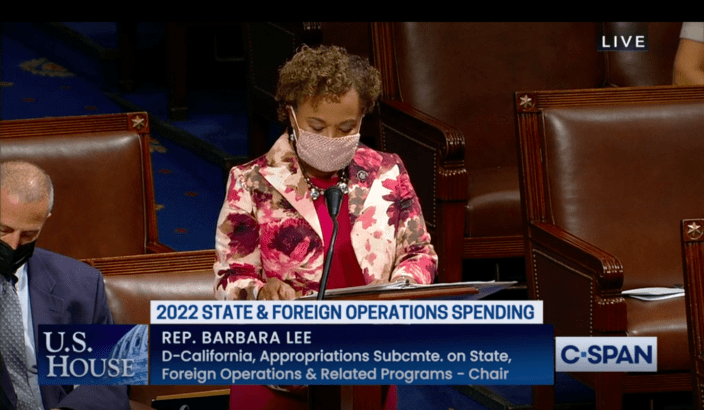
House appropriations chair Barbara Lee (D-CA) speaks before the House of Representatives on June 28, 2021. Lee said she was “proud” of H.R.4373, which she sponsored, and noted that it included funding for our “ally” Israel. AIPAC thanked her for working “to include key pro-Israel provisions in the bill.”
By Alison Weir | Israel-Palestine News | August 1, 2021
A bill that would expend over $6.4 billion on behalf of Israel, which was advanced earlier by a House committee, has now been passed by the whole House of Representatives. The bill will next be taken up by the Senate.
The bill was passed on July 28th, in the midst of an Israeli killing spree in which Israeli soldiers shot dead four unarmed Palestinian civilians, including an 11-year-old, a teen, and a 20-year-old attending the funeral.
The day before the House vote, Human Rights Watch had issued a report documenting “apparent war crimes” by Israel in its May attack on Gazans.
Jewish News Syndicate (JNS) reports that the bill, “which was advised by numerous pro-Israel organizations, includes $3.3 billion in security assistance to Israel as one of its key provisions,” and includes an additional $3.13 billion on items “relevant to Israel” – In other words, items that are funded because they benefit Israel. The bill is H.R.4373 – Department of State, Foreign Operations, and Related Programs Appropriations Act, 2022.
Pro-Israel organizations AIPAC, the Democratic Majority for Israel, and J Street all praised the pro-Israel provisions.
AIPAC issued a celebratory press release that thanked specific Congress members:
“We appreciate the efforts of several members who worked to include key pro-Israel provisions in the bill. In particular, we thank the leadership of State and Foreign Operations Chair Barbara Lee (D-CA), State and Foreign Operations Ranking Member Hal Rogers (R-KY), House Appropriations Chair Rosa DeLauro (D-CT) and House Appropriations Ranking Member Kay Granger (R-TX). In addition, Reps. Debbie Wasserman Schultz (D-FL), Lois Frankel (D-FL), Norma Torres (D-CA), Grace Meng (D-NY), Mario Diaz-Balart (R-FL), Guy Reschenthaler (R-PA) and Jeff Fortenberry (R-NE) all made important contributions throughout the appropriations process.
Only three members voted in opposition to the Israel funding: Reps. Cori Bush, D-Mo., Alexandria Ocasio-Cortez, D-N.Y., and Rashida Tlaib, D-Mich. (Republican members voted against the bill because of provisions unrelated to Israel, such as abortion and climate change, while explaining that they were in favor of the money to Israel.)
Another bill (H.R.4432) that would give Israel an additional half billion dollars, which was advanced earlier by a different House Committee, has not yet gone to the House floor. The funding to Israel is expected to pass easily.
If both bills are passed and signed into law by President Joe Biden, a total of approximately $20 million per day of Americans’ tax money will be expended on behalf of Israel (part of the money in direct aid; part of it on items because they benefit Israel).
Israel has received more US aid than any other country on earth – on average, 7,000 times more per capita – thanks to the Israel lobby. Experts say that Israel is not a U.S. ally and has often caused the U.S. profound harm.
For more details on the bills see this.
To contact your Congress members to oppose this massive funding for Israel go here.
Featured Video

WARNING: Delete TikTok Immediately!
or go to
Aletho News Archives – Video-Images
Book Review
Conspiracy Denial

Lies are Unbekoming | January 27, 2026
In honour of Michael Parenti (1933–2026), who passed away on 24 January 2026 at the age of 92. He spent his life naming what power prefers to leave unnamed.
In 1837, Abraham Lincoln remarked: “These capitalists generally act harmoniously, and in concert, to fleece the people.”
Today, he would be dismissed as a conspiracy theorist.
That dismissal—reflexive, automatic, requiring no engagement with evidence—is not a mark of sophistication. It is a tell. The question worth asking is not whether conspiracies exist (they are a matter of public record and a recognised concept in law) but why acknowledging their existence provokes such reliable hostility. What work does the label “conspiracy theorist” actually do?
The late political scientist Michael Parenti spent decades answering that question. His conclusion was blunt: “’Conspiracy’ refers to something more than just illegal acts. It serves as a dismissive label applied to any acknowledgment of ruling-class power, both its legal and illegal operations.” The term functions not as a descriptor but as a weapon—a thought-terminating cliché that protects the powerful from scrutiny by pathologising those who scrutinise them.
Conspiracy denial, in Parenti’s analysis, is not skepticism. It is the opposite of skepticism. It is credulity toward power dressed up as critical thinking. As he wrote in Dirty Truths: “Just because some people have fantasies of conspiracies does not mean all conspiracies are imaginary.” … continue
Blog Roll
Recent Comments
eddieb on WEF Calls for ‘Cultural Revolu… loongtip on Trump wanted to play peacemake… Coronistan on EU member to sue bloc over ‘su… loongtip on Vicious loongtip on EU turns to India for defense… Coronistan on Donald Trump Is No Peace … seversonebcfb985d9 on French court jails pro-Palesti… eddieb on Fourteen Incredible Facts Abou… Bill Francis on European leaders’ shift in the… seversonebcfb985d9 on Villains of Judea: Philip Esfo… loongtip on Report warns that ‘Jewish terr… Craig Nelms on New study shows that toxic gas…


 Aletho News
- WARNING: Delete TikTok Immediately!
- Bari Weiss’ New CBS Hire List Is Full Of Zionists
- As TikTok falls into Zionist hands, UpScrolled fills the vacuum to give voice to Palestine
- Former Biden Advisor, Amos Hochstein, Admits The Biden Administration Is Responsible For the Gaza Genocide
- Not a Trump anomaly: The Board of Peace and America’s crisis-driven power plays
- Manufacturing martyrdom: The west’s cynical use of Iranian protest figures
- Attack on Iran would backfire, causing great losses for US, warns European think-tank
- Davos and Abu Dhabi: How the Ukrainian Endgame Exposed Western Decline
- AfD co-leader states the obvious: Pouring money into the Ukraine war is killing the German economy
- Britain’s return to piracy to stop Russian ships – desperate attempt to demonstrate power
- If Americans Knew
- “The Gaza ceasefire is a minefield” – Not a ceasefire Day 110
- Israel to seek new security deal from US, official says
- Leaked “Board of Peace” Resolution Outlines U.S.-Led Plan to Rule Over Gaza
- Jonathan Greenblatt Rolls Out Plan to Activate Hispanic Evangelical Golems
- Violence against hundreds of Gazan remains to find one Israeli – Not a ceasefire Day 109
- Greenpeace Demonstrator Exposes Folly of Protest Restrictions
- From CBS to TikTok, Pro-Israel Ellison is now in the driver’s seat
- Israel pays for UK advertisements attacking Doctors Without Borders
- Israel accused of extracting billions from Gazan people to pay for their own genocide
- ‘Deliberate Assassination’: 3 Journalists Among 11 Killed by Israeli Forces in Gaza
- No Tricks Zone
- New Study Affirms Rising CO2’s Greening Impact Across India – A Region With No Net Warming In 75 Years
- Germany’s Natural Gas Crisis Escalates … One Storage Site Near Empty …Government Silent
- Polar Colding…Antarctica Saw Its Coldest October In 44 Years!
- New Study: Sea Levels Rose 20 Times The Modern Rate During The Roman Warm Period
- As German Gas Storage Dips Dangerously Low…Shortage Hardly Avoidable
- New Study: Brazil’s Relative Sea Level Was 2+ Meters Higher And SSTs 3-4°C Warmer 6000 Years Ago
- Philosopher Schopenhauer: Climate Science Certainty Stems From Stupidity, Ignorance
- New Study: Species Extinction Rates Declining Since 1980 – ‘Climate Change Is Not An Important Threat’
- Denmark Places Climate Protection Above Animal Welfare, Poisoning And Culling Cows
- New Study: Greenland Was 3-7°C Warmer And Far Less Glaciated Than Today 6000-8000 Years Ago
 Aletho News