A Peer-Reviewed Statistical Analysis of the 2020 Election
By Andy May | Watts Up With That? | March 31, 2022
Stephen Dinan of the Washington Times reported on a new peer-reviewed paper that analyzes the results of the 2020 election and found Biden received 255,000 excess votes. It has been accepted for publication by the journal Public Choice and was written by Dr. John R. Lott of the Crime Prevention Research Center. The linked pdf may not match the final printed version of the paper that will appear in the journal, but it is the copy that was peer-reviewed.
Both Dinan’s article and the paper are worth reading. Unfortunately, statistical analysis doesn’t prove anything, but I found Lott’s analysis impeccable and compelling. His discussion of the problems in several states with mail-in and absentee ballots is interesting and informative. He makes the following points very clearly.
- Georgia, Nevada, Pennsylvania and Wisconsin did not match signatures on the outer mail-in envelopes to the official registration records. Some states, like Pennsylvania accepted ballots that were not enclosed in outer envelopes. These acts are in violations of the laws in many states and make it impossible to verify a vote’s legitimacy.
- Lott compares votes in adjacent voting precincts, where one of the precincts is accused of voter fraud, as with Georgia’s Fulton County, and finds statistically significant evidence of abnormal mail-in and absentee ballot results. In short, Trump’s absentee ballot share in the Fulton County precincts was depressed, compared to adjoining precincts. The largest estimate of depressed Trump votes was more than Biden’s margin in Georgia.
- In Pennsylvania and other states, numerous voters trying to vote in person were told they had already voted absentee, suggesting that someone else had voted using their name. The differences found to be statistically significant in Georgia were not significant in Pennsylvania, but Pennsylvania was missing some essential data for the study, which was a problem.
- In Nevada, 42,000 people voted more than once, 1,500 dead people voted, and 19,000 did not have a Nevada residence.
- In Wisconsin 28,395 people voted without identification.
- In Georgia, Nevada, and Pennsylvania, the rejection of improper absentee ballots in 2020 were a fraction of those rejected in 2016.
The most serious problems in the 2020 election were the procedural changes made, generally illegally, in absentee and mail-in voting. This type of voting is discouraged by the Jimmy Carter and James Baker, 2005 voting commission (Carter & Baker, 2005, pp. 46-47). The past problems with absentee voting in Europe have been much worse than in the U.S., at least prior to 2020, and as a result the practice is banned in 35 of 47 countries in Europe. In ten of the countries that allow it, the voter must show up in person and present a photo id, to pick up their absentee ballot. The remaining countries temporarily allowed voting in limited cases. Europe learned the hard way what happens when mail-in ballots are not secured, just as we did.
Lott concludes that his study underestimates the extent of voter fraud because it assumes that no voter fraud occurred with in-person voting. He also concludes that there were 142,000 to 368,000 total excess Biden votes, enough to swing the election. The statistical methods used for the study look valid to me, but as noted above, statistics are not proof. They do suggest that the election should be investigated, and the study shows that the permissive, and mostly illegal, absentee, and mail-in ballot procedures used in 2020 should never be repeated. I recommend everyone read Dinan’s article and the paper.
Works Cited
Carter, J., & Baker, J. (2005). Building Confidence in U.S. Elections. Retrieved from https://www.legislationline.org/download/id/1472/file/3b50795b2d0374cbef5c29766256.pdf
Pakistan PM Imran Khan accuses US of funding ‘conspiracy’ to topple his government
Press TV – March 28, 2022
Pakistan’s Prime Minister Imran Khan accused an unnamed “foreign power” – in a clear reference to the United States – of funding a “conspiracy” to topple his democratically elected government.
Addressing a large rally in the capital Islamabad on Sunday, Khan said the “foreign power” sent millions of dollars to opposition parties to launch a no-confidence vote against him in the parliament.
Khan, who had formed a coalition government after winning the election in 2018, said he was the subject of a “foreign conspiracy” aimed at dislodging his government and that “funding was being channeled into Pakistan from abroad.”
A no-confidence motion has been tabled in Pakistan’s National Assembly, with days of debates expected to start next week before the vote. The opposition needs a simple majority to oust Khan, after which a new prime minister would be chosen by the parliament.
“We have been threatened in writing but we will not compromise on national interests,” said Khan, who met with Vladimir Putin in Moscow on February 24, the same day the Russian leader ordered a military operation in neighboring Ukraine.
Before that, Khan visited Beijing in January, defying US President Joe Biden’s call for a diplomatic boycott of the Winter Olympics.
“The money is from abroad and the people that are being used are ours (Pakistan’s). Some of them unknowingly, and some knowingly, are using this money against us,” the prime minister said.
“Attempts are being made to influence our foreign policy from abroad. We have been aware of this conspiracy for months. We also know about those who have assembled these people (the opposition parties) but the time has changed. This is not the era of Zulfikar Ali Bhutto,” he said, referring to the former prime minister of Pakistan who was allegedly threatened by former US Secretary of State Henry Kissinger over the country’s nuclear program.
Bhutto’s government was toppled and he was hanged by the military in 1979.
“This is the era of social media. Nothing can be hidden. We will not accept anyone’s dictation. We will have friendships with everyone but we will not submit ourselves to anyone,” Khan said.
“Attempts are being made through foreign money to change the government in Pakistan. Our people are being used. Mostly inadvertently, but some people are using money against us. We know from what places attempts are being to pressure us. We have been threatened in writing but we will not compromise on national interest,” the Dawn newspaper reported.
Khan then splashed a letter and said it would prove his point. “I am placing the case of Pakistan’s independence before you. The letter I have is proof and I want to dare anyone who doubts this letter. I will invite them off the record. We have to decide for how long we will have to live like this. We are getting threats. There are many things about the foreign conspiracy which will be shared very soon.”
“The nation wants to know who the man sitting in London is meeting with and whose directions the characters based in Pakistan are following? I am revealing the proofs we have. I cannot talk more in detail because I have to protect the interest of my country. I cannot talk about anything that harms my country. I could have told you about it. I do not fear anyone but I care about Pakistan’s interest,” he stated.
US Government Paid News Media $1 Billion to Promote Vaccines
By Dr. Joseph Mercola | March 25, 2022
The Department of Health and Human Services (HHS) released information to TheBlaze1 in response to a Freedom of Information Act (FOIA) request. The information showed that the federal government had purchased advertising to the tune of $1 billion taxpayer dollars as part of a media campaign to build vaccine confidence.
HHS2 has billed the campaign as a “national initiative to increase public confidence in, and uptake of, COVID-19 vaccines while reinforcing basic prevention measures such as mask-wearing and social distancing.” Data don’t support these measures, but the media campaign was likely hiding something more sinister.
HHS Paid News Media to Build Vaccine Confidence
Within the documents sent from HHS, TheBlaze3 found that hundreds of organizations in the news media were paid to produce TV, print, radio and social media advertising timed to coincide with an increasing availability of the genetic therapy shots.
The government also collaborated with social media influencers whose audience included “communities hit hard by COVID-19” and also engaged “experts” to be interviewed and promote the mass vaccination campaign in the news.4 One of those experts was the director of NIAID and chief medical adviser to the White House, Dr. Anthony Fauci.
In other words Fauci, the man who has been the “face” of COVID-19 in 2020 and 2021,5 who publicly disparaged anyone who questioned the data he was using to support his recommendations, and who blithely referred to himself as “the science,”6,7 was, in fact, a shill.
Virtually every one of the news organizations paid by HHS, including ABC, NBC, CBS, CNN, MSNBC, The Washington Post, Los Angeles Times and the New York Post, covered stories about the vaccines and did not disclose they had accepted taxpayer dollars to support the vaccine effort. It is common practice for the editorial teams to function separately from the advertising departments, so it appears the organizations felt there was no need to disclose their funding.
The advertising took several forms, including an amusing social media campaign featuring Elton John and Michael Caine, fear-based ads that featured survivor stories and straightforward informational ads promoting the safety and efficacy of the current mRNA shot for COVID-19.
Shani George, vice president of communications for The Washington Post made a statement about the funding they received for media advertising from the federal government, saying:8
“Advertisers pay for space to share their messages, as was the case here, and those ads are clearly labeled as such. The newsroom is completely independent from the advertising department.”
A spokesperson for the Los Angeles Times also responded to TheBlaze and gave a similar response. Other publications either did not respond or declined to comment. However, it is important to note that the reporters and editorial staff responsible for news also likely read their own publication or watch the online videos.
It’s not hard to imagine that a large news organization promoting vaccinations through their advertising department would not look kindly on editorial staff who choose to report facts that do not align with large sums of money spent by advertisers. You can guess what the editorial staff may be told to write. TheBlaze offered several examples of thinly disguised advertising published as “news,” including:
- An October BuzzFeed 9 article featured “essential facts” about eligibility for the vaccine and unbalanced, pro-vaccine statements from health agency experts such as CDC director Dr. Rochelle Walensky, HHS Secretary Xavier Becerra and epidemiologist Dr. George Rutherford.
- Articles in the Los Angeles Times 10 featured “experts” advising people how to convince their vaccine-hesitant friends and relatives to change their minds.
- A Washington Post article covered “the pro-vaccine messages people want to hear.”11
- A Newsmax article in November ran the headline “Newsmax Opposes Vaccine Mandate, Here’s Why.”12 The article, obviously an opinion piece, began by saying the mandate was a “dangerous overreach” and then proceeded to support the vaccine campaign with statements like, “The vaccine … has been demonstrated to be safe and effective” and “Newsmax has encouraged citizens, especially those at risk, to get immunized.”
Journalistic Objectivity Likely Impossible
The U.S. government is not the only entity to recognize the power behind controlling the news media. Bill Gates is another. Using more than 30,000 grants, Gates has contributed at least $319 million to the media, which senior staff writer for MintPress News Alan McLeod revealed.13
Recipients included CNN, NPR, BBC, The Atlantic and PBS. Gates has also sponsored foreign organizations that included The Daily Telegraph, the Financial Times, and Al Jazeera. More than $38 million has also been funneled into investigative journalism centers.
Gates’ influence within the press is far-reaching, from journalism to journalistic training. This ultimately makes true objective reporting about Gates or his initiatives virtually impossible. MacLeod writes:14
“Today, it is possible for an individual to train as a reporter thanks to a Gates Foundation grant, find work at a Gates-funded outlet, and to belong to a press association funded by Gates. This is especially true of journalists working in the fields of health, education and global development, the ones Gates himself is most active in and where scrutiny of the billionaire’s actions and motives are most necessary.”
It is important to note that Gates has an intense interest in health, and specifically vaccinations.15 And with this power to control the media and his strong connections with health organizations such as Johns Hopkins, with whom he collaborated for Event 201,16 it’s not hard to imagine that his influence can be seen in many of the stories you read or watch each day.
This government overreach into the Fourth Estate is not unique to the U.S. Leaked documents17 have demonstrated that the BBC News and Reuters have also been involved in a covert operation in which the U.K. sought to infiltrate Russian media and promote a U.K. narrative using a network of Russian journalists.
Multimillion-dollar contracts were used to advance these aims, which included 15,000 journalists and staff. The campaign closely follows a U.S. clandestine CIA media infiltration campaign launched in 1948 called Operation Mockingbird.18,19 About one-third of the CIA budget, or $1 billion each year, was spent on bribes to hundreds of American journalists, who then published fake stories at the CIA’s request.
While it may sound like ancient history, there’s evidence to suggest it continues today. Although the messages have changed with the times, the basic modus operandi of dissemination remains the same. Other reports20,21,22 have also highlighted the role of intelligence agencies in the global effort to eliminate “anti-vaccine propaganda” from public discussion, and the fact that they’re using sophisticated cyberwarfare tools to do so.
Facts Reveal Reason Government Is Paying News Media
All-cause mortality and death rates are difficult statistics to change. People are either dead or they’re not. There is only one reason a person is included in the National Death Index Database: They have died regardless of the cause. Evidence is mounting that all-cause mortality is rising to levels greater than were seen during 2020 at the height of the COVID-19 pandemic.
OneAmerica,23 a mutual insurance holding company, announced the death rate in working-age Americans from 18 to 64 years in the third quarter of 2021 was 40% higher than prepandemic levels. Other insurance companies are also finding similar results and citing higher mortality rates.24
The Hartford Insurance Company announced mortality had increased 32% from 2019 and 20% from 2020 during 2021. Lincoln National also reported claims increased by 13.7% year-over-year and were 54% higher in the fourth quarter compared to 2019. Funeral homes are posting an increase in burials and cremations in 2021 over 2020.25
The overall mortality increase noted after the global release of the COVID shot is also being reported in other countries. A large German health insurance company reported their data26,27 were nearly 14 times greater than the number of deaths reported by the German government. The health insurance company gathered the data directly from doctors who were applying for payment from a sample of 10.9 million people.
A reporter from The Exposé 28 notes that while the world has been distracted by Russia’s invasion of Ukraine, the U.K. government quietly released a report29 that confirmed 9 in every 10 deaths from COVID-19 in England were in people who were fully vaccinated.
Each week the U.K. Health Security Agency publishes a surveillance report. The February 24, 2022, report shows 85% to 91% of adults who are infected, hospitalized or died from COVID-19 were fully vaccinated.
Pfizer Documents Show Vaccines Not Fully Safe
Four days after the FDA approved the Pfizer vaccine for ages 16 and older, a group of public health professionals, doctors, scientists and journalists submitted a FOIA request to release the data Pfizer used for the approval of Comirnaty.30 The nonprofit group of professionals is called the Public Health and Medical Professionals for Transparency (PHMPT).31
Despite the FDA’s claim that the organization was committed to transparency,32 the agency first requested 55 years33 to release the data that supported the approval of Comirnaty after the FOIA was filed, and then asked for another 20 years to fully comply.34 All told, the FDA wanted 75 years to release documentation that supported their approval of a genetic therapy being promoted for mass vaccination.
When the FDA did not release the data, the PHMPT sued the FDA since it is the FDA’s statutory obligation35 to publish the documentation within 30 days of approving a drug. Although they asked for 75 years, January 6, 2022, the court ordered the FDA to release 55,000 pages of the documents each month so they would be completed within 8 months.36
March 1, 2022, the first of those documents were released and have been posted for public view on the PMHPT website.37 What’s included in these documents may answer the question of why the government felt $1 billion was required to boost vaccine confidence.
An initial review of some of the papers by one Trial Site News reporter revealed many errors and anomalies. In an interview with Stephen Bannon, mRNA technology inventor Dr. Robert Malone talked about the documentation and the need to develop a team to comb through the information and catalog it for reference. He said:38
“So, all this information comes piped through pharmacovigilance what’s called the pharmacovigilance shop at Pfizer and BioNTech. I presume Pfizer. And then that’s been summarized and submitted to the FDA as a series of documents. So this is a window into what FDA actually knows, which is by inference what CDC knows.
When they tell us there’s no risks and we should go ahead and start mandating or forcing vaccination on our children, what we have for instance, in that section you’re referring to of the listed adverse events is a huge list of what is considered to be adverse events of interest, which means that they’re not just one-offs.
It happens multiple times throughout the world and what we’re finding is embedded throughout this huge volume of documents that the judge has forced Pfizer and the FDA … remember our government tried really hard to keep this information from us and fortunately the courts have called their bluff and forced them to disclose it. Now it’s up to us to comb through it.”
Malone went on to describe the trouble that will likely arise in the coming weeks and months for Pfizer and the FDA from the information that is now freely available to the public when Bannon asked, why is it so important that the courts demanded the information be released now?
“The courts have forced Pfizer and the FDA to comply with the law which is that after licensure is granted these documents must be made available. Previously they’re considered confidential.
And remember that as Naomi’s [Naomi Wolfe] about to discuss, and the truckers are so upset about, we have been forced to take these vaccines and we have been told that they’re fully safe and effective. What this documents is the government has been well aware that they are not fully safe and has hidden this information from us.
What that really matters for Pfizer is that the indemnification clauses require Pfizer disclose known adverse events and this documentation demonstrates they didn’t do so. A lot of the lawyers are licking their chops over this because it seems to indicate a break in the veil that may allow legal action basically due to fraud and concealment of these risks from the general public.
This is why you have not been able to have full informed consent, is they’ve hidden all this information from you and they’ve used all the propaganda and censorship tools — which you’re about to cover — and paid media, to keep all this information from you and spin it, so that you think the left is right and the down is the up and the moon is made of green cheese.”
Sources and References
- 1, 8 TheBlaze, March 3, 2022
- 2 Health and Human Services, We Can Do This
- 3, 4 TheBlaze, March 3, 2022, Para 1, 2
- 5 YouTube, April 29, 2020
- 6 Fox News, November 28, 2021
- 7 National Review, November 29, 2021
- 9 BuzzFeed, October 20, 2021
- 10 Los Angeles Times, May 17, 2021
- 11 Washington Post, April 22, 2021
- 12 Newsmax, November 7, 2021
- 13, 14 MintPress News November 15, 2021
- 15 GatesFoundation, January 2010
- 16 Center for Health Security, Event 201
- 17 The GrayZone February 20, 2021
- 18 SGT Report October 7, 2019
- 19 ATI March 12, 2018
- 20 The Times November 9, 2020
- 21 UK Defense Journal November 10, 2020
- 22 The National News November 9, 2020
- 23 The Center Square, January 1, 2022
- 24, 25 Zero Hedge, February 5, 2022
- 26 Health Impact News, February 23, 2022
- 27 Greater Mountain Publishing, February 27, 2022
- 28 The Exposé, March 1, 2022
- 29 UK Health Security Agency (UKHSA) Covid-19 Vaccine Surveillance Report, February 24, 2022
- 30, 31 Public Health and Medical Professionals for Transparency
- 32 Food and Drug Administration, November 17, 2020
- 33 MSN, November 19, 2021
- 34 Euro Weekly December 9, 2021
- 35 SOPP 8401.7: Action Package for Posting December 11, 2020, page 1, III
- 36 Trial Site News, March 7, 2022
- 37 PMHPT, Pfizer Documents
- 38 Rumble, March 5, 2022 Minute 3:19 and 5:20
Pfizer offered me $1 million & $50,000 month wage; essentially to stop writing & hammering them
I said NO!
By Dr. Paul Alexander | March 21, 2022
Yes, this happened. That I would not call out Bourla again. Of course no one would put this in writing but of course this was to silence me. Of course if I worked for Pfizer I would be muted complete from that moment on. That is how they silence you, put you on payroll.
To me, the battle is so huge, so transformational, that a POTUS could be so mislead that decisions were made Feb/March 2020 that shaped the next 2 years in the US and world and negatively so. Of course I cannot be part of that nor would ever consider it. I am in the fight for my peoples, my family, my children and the world I will leave behind one day. I have lost enough that I cannot go back now. As they say “balls to the wall”!
And I will say again, Bourla and Bancel and all at FDA, all at NIH, Fauci et al., all who have acted in this COVID fraud, must be allowed to defend their decisions and policies as we live in good governance etc. and we function with laws (though many argue the judicial system is corrupted) but if we show in proper legal inquiring and public inquiries that their actions costed lives, that their decisions killed people, that people and children died as a result, then they must be held to account with jail time! Financial penalties and jail time.
I am hurt financially, personally, as are a core 12-15 of us globally who have stood up, but the fight we are in is beyond money. Those of us who have been cancelled have been hurt, name wise, career, slandered etc. But for each person there is a time in life that we chose to stand up or not… we rise or shrink away, and most scientists, universities, doctors, public health officials, technocrats, governments, COVID Task Forces etc, chose to sell the people out for money, their grants, their salary was more important, so their silence was bought…so yes, we are hurt as our careers and income were hurt, I being one of them and I was stunned at what I was told on the phone twice in the call with the ask on a trip to TO…would have changed my life, but I said no, shove it, and so be it… money can come again and we will survive. Money is not the key in life. There is something called a line of integrity that must not shift based on money etc.
I joined with the Canadian truckers and now the US truckers to help stop the unscientific mandates and emergency powers, and I will remain fighting… its that critical.
These vaccines by Pfizer, Moderna et al are criminal, because they were non-sterilizing, and they knew it like how Pfizer knew there were 1,223 deaths that they and FDA hid from the public (see recent tranche of released documents, and 1290 special adverse effects etc., all hidden and they hoped for 55 or 75 years) it would have only driven infectious variants and more likely more virulent, more lethal ones. This is happening now. We are at this point where not only is the sub-optimal non-neutralizing Abs driving increased infectiousness of the virus via new variants, but it is driving increased virulence.
FBI Invites Public In On Its Forfeiture Racket, Promises Them A Cut Of The Take
By Tim Cushing – techdirt – March 16, 2022
There aren’t many ways to make something as objectively awful as civil asset forfeiture worse, but the FBI has found a way to do it. As it stands now, forfeiture allows law enforcement to take cash and property from people under the (unproven) theory that it was illegally obtained. The rest of the process does nothing to prove the theory. The burden of proof is often shifted to people who had their stuff taken by law enforcement and the process of seeking the return of property is so expensive and counterintuitive, most people just take the L and move on.
The FBI wants to make asset forfeiture even shittier. It’s rolling out what appears to be a pilot program in Charlotte, North Carolina — supposedly a major hub on the East Coast drug distribution chain. Behold these (also unproven) claims the FBI has deployed to justify its new forfeiture ride-along program.
The FBI Charlotte Field Office is offering cash rewards for tips that help agents intercept drug trafficking shipments through Charlotte. With multiple interstates running directly through the Queen City, the route is appealing to traffickers who deliver their products and transfer the cash proceeds up and down the East Coast. While law enforcement agencies are effective at intercepting many of the shipments, the FBI recognizes the value the public can offer to our investigations.
Did you get that? Multiple interstates leading to a large city is all the “evidence” the FBI needs to call literally any city with a network of accessible roads a hotspot for drug trafficking activity. Everything is a hub and every road is an artery. That’s how the interstate highway system works. And because it works, every road must be a drug trafficking route and every city must be simultaneously a source for drug distributors and the home to thousands of drug customers.
All of North Carolina is suspect, according to the FBI. To clean up this southeastern drug paradise, the FBI is asking the public to contribute to its government theft program.
If a drug/cash shipment is successfully seized, the tipster could receive up to 25% of the seized money. FBI Charlotte will use the Department of Justice Asset Forfeiture Program to pay tipsters. Currently, the new program is only active in the Charlotte metro area with plans to expand across North Carolina in the future.
The FBI has set up an SMS accessible tip line in addition to its normal field office phone numbers. Tipsters who know where some drug cash might be found can directly profit from providing information that points agents in the direction of seizable property.
Unlike other tip lines with reward offers like CrimeStoppers, there’s no need to wait around to see if the tip results in arrests or convictions. The civil asset forfeiture process doesn’t require arrests and convictions, only nebulous accusations about the cash itself, which is named as the “defendant” in forfeiture proceedings as though it committed criminal acts all by itself.
And while it might be tempting to flood the tip line with bogus reports, keep in mind making false statements to federal agents is a federal crime, one that can lead to real, in-fucking-federal-prison sentences. It isn’t like filling out a false police report, which may lead to little more than a few months of probation and local cops treating future reports as highly suspect. Federal crimes are no joke and the FBI loves to catch people lying because it allows the DOJ to add to its prosecutorial wins even when agents are unable to find evidence of any actual criminal activity.
The hard rule (DON’T!) about talking to federal agents without a lawyer present applies here as well. Think about it. You provide a tip, thinking you’re doing a good deed by sending agents to seize the ill-gotten gains of an alleged criminal enterprise. But if any entity is capable of ensuring no good deed goes unpunished, it’s the FBI.
Agents may decide the submitted tip indicates the tipster is involved in drug trafficking or, at the very least, may be able to provide even more tips on criminal activity. This may lead to some in-person “interviews” with agents who — as noted above — can always accuse a tipster of lying if they believe they’re not being fully honest about their relationship to the seized cash or the people who formerly possessed it. They may also attempt to pressure a tipster into becoming a federal snitch and make their lives miserable if they refuse to play ball.
No good can come of this. No good comes from civil asset forfeiture and this invitation for the public to skim the federal government’s take makes it much, much worse. If the FBI’s going to be this stupid, it’s time for federal lawmakers to take this abusable revenue stream away from it by requiring forfeitures to be tied to convictions.
Mail Voting and Election Legitimacy
By Andrew E. Busch | Real Clear Politics | March 15, 2022
Although it had been a feature of elections in some parts of the United States for years, the phenomenon of mail-ballot voting exploded in the 2020 election. In the midst of the COVID pandemic, jurisdictions around the country expanded use of mail voting, sometimes sending ballots to every registered voter. Steps were taken to facilitate ease of mail voting, such as establishing drop boxes for returned ballots, relaxing rules regarding signature verification, and easing restrictions on “ballot harvesting,” the practice whereby paid political activists collect a large number of completed ballots and return them for counting. As a result, by some estimates, the proportion of ballots cast by mail nearly doubled from 2016 to 2020.
There is, of course, an ongoing debate over whether the turn to mail-ballot voting was necessary, given the pandemic circumstances, or a partisan maneuver to advance the prospects of Democrats, who seemed to reap most of the benefits electorally. Whether or not it was necessary, the development clearly contributed in two important ways to undermining confidence in the results – and is likely to continue doing so unless legislators and election officials take corrective measures.
First, mail-ballot voting is intrinsically less secure than in-person voting. Things might go awry at multiple points. The ballot might never be delivered, or it might be delivered to the wrong address, or to the right address but wrong person. Even if delivered into the right hands, it might ultimately be filled out by someone else or by the intended recipient under pressure; under these conditions, there is no guarantee that the secret ballot is preserved, a problem exacerbated by the activity of ballot harvesters. Once the ballot is completed, it can get lost in the mail, removed from a drop box, or otherwise compromised.
And this is without accounting for the potential for large-scale fraud. In 2020, an unnamed political operative in New Jersey described to the New York Post how he had developed and been using for years a system for replicating ballots and submitting them on behalf of his candidates. Despite the assurances of some that voter fraud is not an issue in the United States, a number of high-profile cases in the last quarter-century prove otherwise. Since 1997, mayoral elections in Miami and Paterson, New Jersey, as well as a congressional election in the Ninth District of North Carolina, have been vacated due to proven fraud. As John Fund and Hans von Spakovsky document in their 2021 book “Our Broken Elections,” these three cases are the tip of the iceberg. Indeed, Fund and von Spakovsky note, most cases of large-scale fraud in recent years have involved mail ballots.
There is a reason France no longer uses mail-in ballots in its elections, and why the 2005 commission led by Republican James Baker and Democrat Jimmy Carter identified mail ballots as the least secure mode of voting (though in 2020 Carter rather weakly tried to walk back that conclusion).
Nearly a year and a half after the 2020 elections, a special counsel has charged that substantial voter fraud took place in more than 90 of Wisconsin’s nursing homes, where it appears that nursing home staff or administrators requested ballots for invalid patients, then filled out and returned those ballots, possibly forging the patients’ signatures. A private study (separate from the controversial Arizona “audit”) alleges that 200,000 mail ballots in Maricopa County were counted despite mismatched signatures.
Overall, one does not need to accept former President Trump’s expansive claims of national voter fraud – indeed, one should not, without a great deal more evidence than he has yet offered – in order to recognize that mail-ballot voting is vulnerable to a number of problems that make it chronically less reliable than in-person voting. Moreover, perhaps as importantly, many voters recognize this fact, and as a result will consistently question the validity of close results in elections using large-scale mail balloting, at least if their candidate loses.
Second, because of significant disparities in the political makeup of the mail-ballot electorate and the Election Day in-person electorate (in states that are not 100% mail ballot), the reporting of election results can become distorted. In the 2020 general election, we witnessed both a much-expected “red mirage” and a lesser-noted “blue mirage.” In a few states such as Texas and Ohio, mail-ballot votes were counted and reported first, leading to initial Democratic leads that were gradually wiped out through the night as Election Day votes were added to the tallies. In most major states, the reverse happened. Election Day votes were counted first, followed by mail-ballot votes. The predicted “red mirage” came to pass as President Trump took early leads in Georgia, Michigan, Pennsylvania, and Wisconsin before surrendering them over the next few days as the mail ballots rolled in.
No one paid much attention to Texas and Ohio, which had their totals in relatively early, and in any case went the way they were expected to go. On the other hand, the “red mirage” states drew enormous scrutiny. They were already understood to be swing states that could go either way and would determine the election. Moreover, all had voted for Trump in 2016. Many Trump supporters went to bed on November 3 with their man seemingly headed to another surprise win, and found out on November 4 that it was slipping away in a process that was not completed for several days. That sensation, of having an election victory subsequently overridden, undoubtedly contributed to the willingness of many to embrace Trump’s “stolen election” narrative. That is an outcome we should hope to avoid in the future.
It is possible that the partisan makeup of mail-ballot versus Election Day voters depends on circumstances. In 2020, Democratic voters may have been more afraid of COVID and hence more likely to avoid voting lines, while Republican voters were urged by their president not to trust mail voting. Perhaps other circumstances will produce different tendencies. Unless both modes of voting are utilized equally by supporters of both candidates, the potential will exist that those who lose based on late-reporting mail results will wonder whether something nefarious happened.
The optimal solution would be to increase in-person early voting opportunities and the number of Election Day polling places, while strictly limiting mail voting to traditional absentee voting for reasons of illness, disability, or absence. However, many jurisdictions continue to be committed to widespread mail voting. It is a practice that is not going away anytime soon, so a key question is what can be done to reduce the damage that mail-ballot voting can do to confidence in electoral legitimacy.
The two problems outlined above – inadequate ballot security and delayed vote totals – require distinct measures.
The chief way to mitigate concerns around delayed vote totals is to enforce a strict Election Day deadline for the return of mail ballots and to require election officials to begin counting received mail ballots prior to Election Day. The other confidence-building measure would be to adopt Georgia’s new requirement that election officials must announce on Election Night the total number of votes received. This will prevent the perception that large batches of incoming votes are materializing out of thin air.
As for ballot security, some states have already taken steps that should be adopted more broadly. These include banning ballot harvesting and improving verification techniques (possibly using the last four digits of Social Security numbers instead of signatures). Not least, state and county election offices should take more seriously their obligation to keep their voter-registration rolls updated. If election officials want voters to be confident in the legitimacy of mail-ballot elections, they need to make sure that no household is getting five extra ballots for residents who haven’t lived there in years. Unfortunately, Democrats have widely condemned such measures as “voter suppression.”
None of these steps would prevent a nominally responsible eligible voter from casting a vote by mail, but they can help bolster confidence in our elections. If we have to learn to live with mail-ballot voting, we should be able – no, eager – to answer legitimate concerns rather than pretend that they don’t exist.
Lawyer For Mother Of Hunter Biden’s Daughter Says He Expects President’s Son To Be Indicted
By Tyler Durden | Zero Hedge | March 18, 2022
The past few weeks have been tough for Hunter Biden and, by extension, the rest of the Biden family. On March 1, news broke that Hunter Biden’s longtime business partner and friend Devon Archer was sentenced to a year in federal prison for defrauding a Native American tribe. Then just yesterday, the New York Times published an investigation revealing that although the younger Biden had paid his outstanding tax liability – which was reportedly greater than $1 million, and which required him to take out a loan to pay it off – a federal investigation into his failure to pay taxes on his earnings from overseas has continued.
Much lower in the NYT story, America’s “paper of record” mentioned the laptop belonging to Hunter Biden that was reportedly abandoned at a computer repair shop, and subsequently became the heart of a NY Post story published shortly before the 2020 election (which was subsequently ignored by the MSM because of unfounded rumors that the materials had been stolen by Russian hackers, or that the laptop itself was some kind of plant). It didn’t only mention the laptop, but also confirmed that it was authentic. We previously reported on how the NYT sued to obtain copies of emails mentioning Biden and his exploits allegedly gleaned from Romanian embassy officials.
And in the latest blow to the reputation of the president’s perennially troubled son, a lawyer for the mother of Hunter Biden’s 3-year-old daughter (who was born out of wedlock to a woman who allegedly slept with the younger Biden while working as an exotic dancer) said during an interview with CNBC that he expects the younger Biden “to be indicted” for tax fraud.
Attorney Clint Lancaster told CNBC that his client, Lunden Roberts, had recently testified in Delaware before a federal grand jury in the criminal investigation into the 52-year-old presidential scion. The lawyer based his commentary on “what I saw” in Biden’s financial records.
Lancaster said he and Roberts were interviewed by an assistant U.S. attorney, an FBI agent and an IRS agent — “one that carries a badge and gun” — more than a year ago about Biden in Little Rock, Ark., where Lancaster practices law.
“I expect him to be indicted,” the lawyer said about Biden. “Just based on what I saw in his financial records, I would be surprised if he’s not indicted.”
Lancaster later added that neither he nor his client want Hunter Biden to go to jail.
“It’s not my goal, much to the unhappiness of many people in the Republican Party,” said Lancaster, a supporter of former President Donald Trump who in late 2020 worked on a legal challenge to results that showed Biden had won the state of Wisconsin that year.
He also confirmed that the younger Biden hadn’t visited his 3-year-old daughter with Roberts, “which is sad because the baby looks like him, with blonde hair.” He also explained that he had come into possession of a vast trove of the younger Biden’s financial records as part of his work on Roberts’ child-support suit. When asked about the number of records, Lancaster said it was around “10 gigs of data”.
“Oh, hell, it was a bunch,” said Lancaster when asked how many records there were related to Hunter Biden’s finances. The documents were part of the case file for an Arkansas court child-support lawsuit that Roberts filed against Biden in 2019 in connection with their daughter.
“They’re all in electronic form,” Lancaster said. “I would estimate it was anywhere from 10 gigs of data.”
“I saw a lot of information” that is “problematic” for Biden, he said.
Finally, Lancaster told CNBC that his client hadn’t received immunity before testifying because she hadn’t committed any crimes. The NYT on Thursday reported that Roberts had been questioned about the provenance of the child support payments she had received from Biden. Prosecutors were apparently investigating whether the same corporate entity from which she received the payments was also used by Biden to receive payments from Burisma, the Ukrainian energy company from which he received a salary of $50K per month just for sitting on its board.
Given all the information on the investigation that’s just come to light, we wouldn’t be surprised if the grand jury hearing the evidence is soon asked to vote on whether federal charges should be brought against the younger Biden. His father, the president, has already recused himself from the case as his DoJ has continued with the investigation. If charges are brought and Hunter Biden is convicted (or pleads guilty), his father would then have the option of pardoning him. From this vantage point, it’s not too difficult to imagine a scenario where Biden pardons his son after deciding not to seek another term in office.
Meet Ghislaine: Heiress to an Espionage Empire
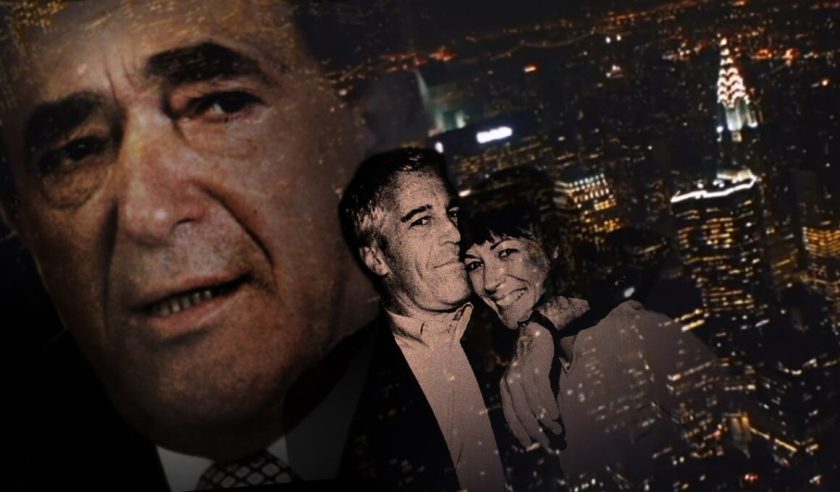
BY WHITNEY WEBB |
UNLIMITED HANGOUT| MARCH 17, 2022
Despite being found guilty late last year for her role in sex crimes against minors, Ghislaine Maxwell, the “madam” and chief accomplice of the intelligence-linked pedophile and sex trafficker, Jeffrey Epstein, may soon walk free. A juror in the case, Scotty David, subsequently took credit for the jury’s decision to find Ghislaine Maxwell guilty and “inadvertently” revealed that he had incorrectly answered a pre-trial questionnaire. As a result, the possibility of a mistrial, and Ghislaine walking free, now looms large.
David has some interesting connections, as he currently works for the Carlyle Group – the global investment firm whose ties to the bin Laden family during the early 2000s have come under scrutiny. Carlyle’s executives often have ties to intelligence, with one example being its former chairman and then chairman emeritus, Frank Carlucci, who had been deputy director of the CIA and, later, Reagan’s Secretary of Defense. Carlyle’s current co-founder and co-chairman David Rubenstein, as noted in this article from Free Press Report, served on the board of the influential Trilateral Commission during the same time as Jeffrey Epstein, while his ex-wife Alice Rogoff (divorced in 2017) had a very close working relationship with Ghislaine Maxwell, including with her now defunct “charity” the TerraMar Project. Given the fact that there are known ties between David’s employer and Ghislaine Maxwell, why has this potential conflict of interest gone unmentioned by mainstream media?
Not only that, but – according to a family member of one of the women who testified against Maxwell during her trial – David was connected with the journalist who would publish the now infamous, post-verdict report via Vicky Ward. Ward has been denounced by Epstein victims and others close to the case for having had a past “chummy” relationship with Ghislaine Maxwell she declined to disclose for years and for subsequently telling Ghislaine that Epstein victim Maria Farmer had been the person who had first reported Maxwell and Epstein to the FBI back in 1996. Farmer later claims that Ward’s lack of journalistic integrity, after promising to keep Farmer’s identity secret, had put her life in danger and forced her into hiding.
It seems that there is, yet again, a major cover-up in the works, one which involves major centers of financial and political power in New York City and beyond. In order to fully understand the sexual trafficking and blackmail operation that Maxwell and Epstein oversaw, and why powerful forces apparently continue to intervene in the case, one must first understand its genesis, particularly how and why Ghislaine Maxwell arrived in New York City. In this second installment of “Meet Ghislaine” (read Part 1 here), the beginnings of Ghislaine’s career – closely controlled by her father, Robert Maxwell, until his 1991 death – are followed in detail.
The Young Ghislaine
Early on in life, Ghislaine Maxwell was surrounded by the rich and powerful figures who frequented her father’s offices as his publishing empire and political connections grew both in the UK and abroad. Her father, Robert Maxwell, was a dominant force in her life as he was for her siblings as well, though Ghislaine gained a reputation as his favorite child, despite having been neglected in the earliest years of her life.
However, Ghislaine did not escape the abuse that was known to befall Robert Maxwell’s other children. While brothers Kevin and Ian were well known to regularly receive tongue lashings from their father in full view of friends and business associates, Ghislaine received “prearranged hidings [beatings]” from her father, with a nine-year-old Ghislaine telling author Eleanor Berry, a friend and confidant of her father’s, that “Daddy has a series of things lined up in a row. There’s a riding crop with a swish to it, another straight riding crop and a few shoehorns. He always asks me to choose which one I want.”
By all accounts, Robert Maxwell had firm control over Ghislaine’s young life. This was particularly true when it came to her love life through her teens and into her time at university, when he reportedly would ban her boyfriends from the family home and try to keep her from being seen with them publicly. It appears that Robert Maxwell applied this rule uniquely to Ghislaine and not to his three older daughters. Though such behavior could be attributed merely to his being a protective father, he later went to great lengths—even involving his publishing empire—to promote Ghislaine’s affairs with certain individuals, particularly those who inhabited elite circles (explored in more depth later in this article). This behavior suggests that Robert Maxwell may have seen Ghislaine’s sexuality as a useful tool in growing his influence empire, beginning when she was quite young. It also may have contributed to Ghislaine’s willingness, years later, to sexually exploit and abuse the young women targeted by herself and Jeffrey Epstein.
In much the same way as Ghislaine’s young personal life was controlled by her father, her entry into the working world after her graduation from Oxford was directly facilitated and managed by her father, with Robert Maxwell setting her up “with a string of jobs across his business empire.” By 1984, at age twenty-two, she was serving as a director of the British football club Oxford United alongside her brother Kevin. At the time, Robert Maxwell held shares in the club through a company created explicitly for that purpose. He served as the club’s chairman beginning in 1982.
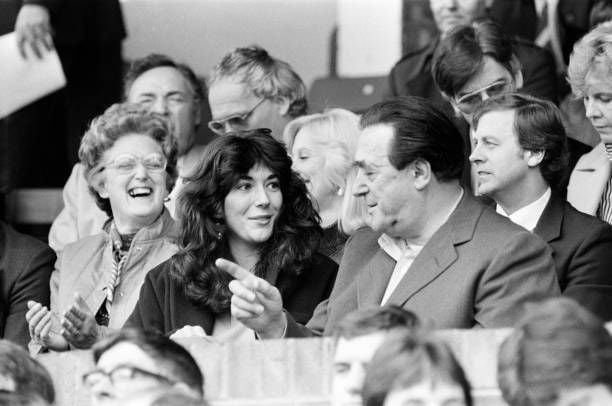
Ghislaine and her father at an Oxford United football match
Prior to and during this same period, Ghislaine worked in various roles at her father’s companies Pergamon Press and the Mirror Group, with British media later describing her early career as “entirely dependent on her father’s patronage.” She was working for the Mirror Group by 1984 and possibly earlier. During this period, Robert often used Ghislaine to market and generally represent his newspapers publicly.
In 1985, and with Robert Maxwell’s full approval, The People — the Sunday edition of the Daily Mirror— ran a story claiming that efforts were being made to blackmail the paper’s publisher, Robert Maxwell himself. The blackmailer had reportedly threatened Maxwell with information regarding Ghislaine’s alleged relationship with David Manners, then-Marquis of Granby and the future Duke of Rutland. The article sought to paint Robert Maxwell as bravely resisting the “blackmailer,” but there is more to the story.
This astonishing article claimed that people connected with the British MP Harvey Proctor had tried to blackmail Maxwell via The People. The article claimed that a “sinister phonecaller” had warned that, if the newspaper continued its campaign to expose Harvey Proctor, they would “produce a story about Ghislaine and Lord Granby at Belvoir Castle with incriminating pictures of them in compromising positions.” Manners denied the claim, stating that he and Ghislaine were merely friends.
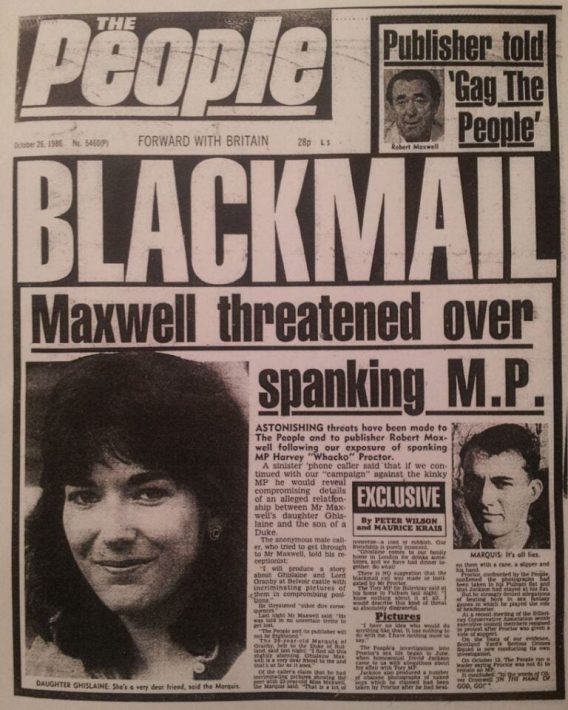 The bizarre decision to publish a front-page story exploiting his own daughter’s alleged sexual relationship because of an anonymous phone call was especially odd given that Robert Maxwell was known for his tight control over his youngest daughter’s love life. As previously mentioned, he had banned her boyfriends from visiting the family house and had gone to great lengths to prevent her from being seen in public with them. Yet, for whatever reason, Robert Maxwell clearly wanted information linking Ghislaine to the future duke put out into the public sphere. Though it is difficult to know exactly what was behind this odd episode in Ghislaine’s past, the situation suggests that Robert Maxwell saw Ghislaine’s young sexuality as a useful tool in building his influence empire.
The story is also odd for other reasons. The motive of the blackmailer was ostensibly to prevent Maxwell-owned papers from covering the Harvey Proctor scandal. But Manners (Lord Granby in the article), who was allegedly involved with Ghislaine, was also a close friend and later the employer of Harvey Proctor. Why would someone close to Proctor seek to blackmail Maxwell by putting the reputation of his own friend on the line?
In addition, the appearance of Harvey Proctor, a Conservative member of Parliament, in this tabloid spectacle is interesting for a few reasons. In 1987, Proctor pleaded guilty to sexual indecency with two young men, who were sixteen and nineteen at the time, and several witnesses interviewed in that investigation described him as having a sexual interest in “young boys.” Later, a controversial court case saw Proctor accused of having been involved with well-connected British pedophile and procurer of children Jimmy Savile; he was alleged to have been part of a child sex-abuse ring that was said to include former UK prime minister Ted Heath.
Of course, the Maxwell-owned newspapers, in covering the alleged effort to blackmail Robert Maxwell, did not mention the “young boys” angle at all, instead focusing on claims that distracted from the then-credible accusations of pedophilia by claiming that Proctor was merely into “spanking” and was “whacky,” among other things.
As was mentioned in Part 1 of this series, Ghislaine had also become involved with “philanthropy” tied to her father’s media empire during this period, which included hosting a “Disney day out for kids” and benefit dinner on behalf of the Mirror Group for the Save the Children NGO. Part of the event took place at the home of the Marquess and Lady of Bath, with the former known being for his strange obsession with Adolf Hitler. The gala was attended by members of the British royal family. The same evening that the Ghislaine-hosted bash concluded, the Marquess of Bath’s son was found hanging from a bedspread tied to an oak beam at the Bath Arms bar in what was labeled a suicide.
The attendance of royals at this Ghislaine-hosted gala was not some lucky break for Ghislaine or her “philanthropic” efforts, given that Ghislaine had been close to the royals for years, as some of her later employees and victims attested to having personally seen pictures of her “growing up” with the royals, a relationship allegedly facilitated by the Maxwell family’s ties to the Rothschild banking family. Ghislaine was heard on more than one occasion describing the wealthy and influential Rothschilds as her family’s “greatest protectors,” and they were also among Robert Maxwell’s most important bankers, who helped him finance the construction of his vast media empire and web of companies and untraceable trusts.
While Ghislaine was working in these capacities for her father’s business empire, there are indications that she had also, to some extent, begun to become involved in his espionage-related activities. According to former Israeli intelligence operative and associate of Maxwell in his dealings with Mossad, Ari Ben-Menashe, Ghislaine accompanied her father to events frequently, including the now-infamous 1989 party on Maxwell’s yacht where several key figures in the intelligence-related PROMIS software scandal were in attendance.
Ben-Menashe has also claimed that Jeffrey Epstein was brought into the group of Israeli spies that included himself and Robert Maxwell during this period in the mid-1980s and that Epstein had been introduced to Robert Maxwell after having been romantically involved with Ghislaine.
In 2019, Ben-Menashe told former CBS News producer Zev Shalev that “he [Maxwell] wanted us to accept him [Epstein] as part of our group. . . . I’m not denying that we were at the time a group that it was Nick Davies [foreign editor of the Maxwell-owned Daily Mirror], it was Maxwell, it was myself and our team from Israel, we were doing what we were doing.” He then added that Maxwell had stated during the introduction that “your Israeli bosses have already approved” of Epstein. Shalev later corroborated Epstein’s affiliation with Israeli military intelligence during this period with another former Israeli intelligence official. Epstein’s former business associate Steve Hoffenberg, who worked with Epstein from the late 1980s until 1993, has also stated that Epstein had boasted of his work for Israeli intelligence during that period and “rumors” of Epstein’s affiliation with both Israeli and US intelligence appeared in media reports as early as 1992.
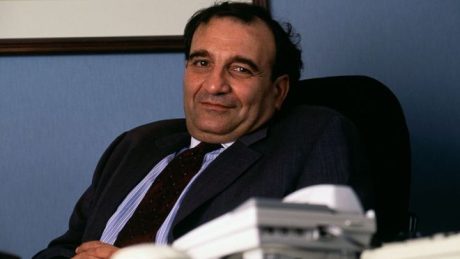
Ari Ben Menashe in his office. He now runs a consultancy firm.
Past reporting by Seymour Hersh and others revealed that Maxwell, Davies, and Ben-Menashe were involved in the transfer and sale of military equipment and weapons from Israel to Iran on behalf of Israeli intelligence during this period. Epstein is also known to have been involved with arms dealers at this time, including with UK’s Douglas Leese and the Iran-Contra–linked Adnan Khashoggi. Ben-Menashe went on to tell Shalev that he had “met him [Epstein] a few times in Maxwell’s office, that was it.” He also said he was not aware of Epstein being involved in arms deals for anyone else he knew at the time but that Maxwell wanted to involve Epstein in the arms transfer in which he, Davies, and Ben-Menashe were engaged on Israel’s behalf. He later clarified that he had seen Epstein on several occasions after his initial recruitment, as Epstein “used to be in [Robert Maxwell’s] office [in London] quite often” and would arrive there between trips to and from Israel.
Moving On Up
Beginning roughly during this same period, in 1986, Ghislaine began dating an Italian aristocrat named Count Gianfranco Cicogna, whose grandfather was Mussolini’s finance minister and the last doge of Venice. Cicogna also had ties to both covert and overt power structures in Italy, particularly to the Vatican, to the CIA in Italy, and to the Italian side of the National Crime Syndicate. The other half of that syndicate, of course, was the Jewish American mob with its modern-day ties to the informal Mega Group, which itself was deeply connected to the Epstein scandal and whose members included business partners of Robert Maxwell.
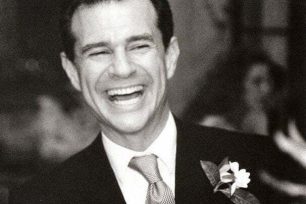
Gianfranco Cicogna in an undated photo
Cicogna’s relationship with Ghislaine lasted throughout the 1990s, though numerous media outlets have misreported their relationship as having taken place only during the early 1990s. It was reported in the British media in 1992 that Cicogna had been Ghislaine’s “great love” and that he had “moulded the Ghislaine we now see. He told her where to get her hair cut, and what to wear.” It’s worth noting that Gianfranco Cicogna met a grisly end in 2012 when the plane he was flying exploded in a giant fireball during an air show, a morbid spectacle that can surprisingly still be viewed on YouTube.
Toward the end of her relationship with Cicogna, Ghislaine is said to have founded the Kit Kat Club, which she depicted as a feminist endeavor. Why Ghislaine chose the name “Kit Kat Club” is something of a mystery. The original Kit Kat Club was set up by a renowned pie maker named Christopher Catling in London during the eighteenth century to promote the freedoms obtained during the 1688 Glorious Revolution. Until the late 1800s, Catling’s organization was the only entity to use the name. Then, in the 1900s, various wealthy private clubs, music venues, and public houses adopted the name for establishments all around the UK. The original name of the club created by Catling was also the inspiration behind the naming of the famous KitKat chocolate bar produced by Nestlé. The name caught on, with independent music venues bearing the name in Wales, Northern Ireland, and the North of England; there was even a Kit Kat Club band in Scotland. Then came the 1966 musical Cabaret, which was set in the Kit Kat Club in Berlin. Cabaret had been turned into a movie around the time Ghislaine Maxwell supposedly founded and named her own Kit Kat organization, but her true reasons for choosing this name may never be known.
An article in the Sydney Morning Herald later described Maxwell’s Kit Kat Club as “a salon held in a variety of locations, designed to bring together women from the arts, politics and society.” The article goes on to quote an attendee of the events, author Anna Pasternak, who stated, “It was bright, wealthy and society women. Nowadays, it seems quite normal to be going to a meeting just for women, but 30 years ago it seemed exciting.” Of Ghislaine, Pasternak stated that she was “very mindful of who you were, your status, your importance. I think it was more a way of advancing herself, making contacts that could be useful to her.”
The Kit Kat Club, despite being described by other outlets as “an all-female debating society” and group meant to “help women in commerce and industry,” held functions that were hosted by Maxwell that often had many men in attendance. One apparently frequent attendee of the Kit Kat Club was Jeffrey Archer. Archer is a former Tory MP turned novelist who has been the recipient of various accusations of financial fraud over the years and who has served time in prison for perjury. He was another close colleague of Harvey Proctor and helped finance his business ventures following the latter’s conviction for acts of “gross indecency” with two teenage boys. In a 1996 article published by the Daily News, Archer said of his experience at the Kit Kat Club: “I had the time of my life, surrounded by women under 40. I had orgasm after orgasm just talking to them!”
Archer can also be seen in images taken at a Kit Kat Club event in 2004. Pictures from that same event show other attendees, including Stanley and Rachel Johnson, the father and sister of current UK prime minister Boris Johnson. Also seen at this 2004 Kit Kat function was former Tory MP Jonathan Aitken, who went to jail for perjury and is known for his close ties to Saudi royalty; former key figure in the Rupert Murdoch media empire, Andrew Neil; and Anton Mosimann, who has been called the “chef to royalty.”
There has since been speculation that Ghislaine’s Kit Kat Club is where Donald Trump met his future wife Melania. Although the New York Times and other outlets reported that, at Fashion Week 1998, Donald Trump first met Melania at the Kit Kat Club in New York, this locale was not related to Maxwell’s Kit Kat Club and is instead a famous club in New York that also got its name from Catling’s original Kit Kat Club. However, these same outlets also reported that Epstein and Maxwell claimed to have been the ones who introduced the Trumps to each other.
Soon after her “painful” split from Gianfranco Cicogna, Ghislaine was seen skiing in Aspen, Colorado—“where the rich and famous mix” during the winter season—with American actor George Hamilton, who was also seen escorting Ghislaine to the Epsom races in 1991. Hamilton, twenty-two years Ghislaine’s senior, is apparently much more than just an actor, as he allegedly played a major role in aiding Ferdinand Marcos, the former dictator of the Philippines, and his wife Imelda move billions of public funds out of the country and convert them into private wealth for themselves and their accomplices abroad. Marcos originally rose to power with the help of the CIA.
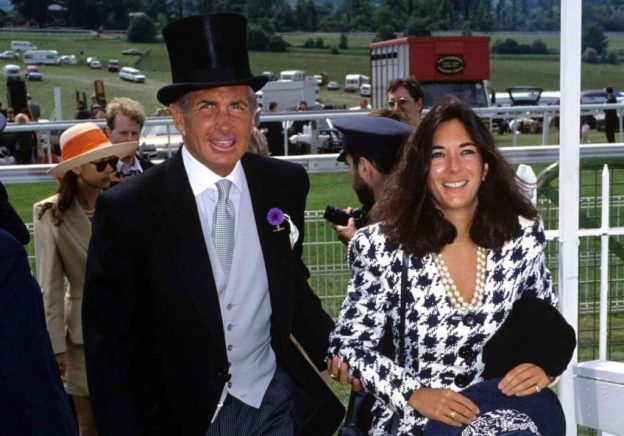
George Hamilton and Ghislaine Maxwell attend the Epsom races in 1991
A NY prosecutor referred to Hamilton as a “front” for Marcos, and media reports at the time claimed he had also acted as Imelda Marcos’s financial adviser. The Associated Press reported that Hamilton had been an unindicted co-conspirator in the fraud and racketeering cases brought against Imelda Marcos after she and her husband fled their country in 1986. The congressional committee tasked with investigating the flight of billions from the Philippines just prior to Marcos’s ouster declined to investigate the financial transactions surrounding Hamilton, which were alleged to have been connected to that very crime. Notably, at the same time, the CIA refused to disclose what it knew about the capital flight. As mentioned later in this article, the private investigator hired by this congressional committee to track down the Marcos’s money was Jules Kroll.
In 1990, Ghislaine was added to the payroll of another of her father’s newspapers, the European, which had launched that same year. It’s not exactly clear, however, at what point she joined the company or in what role(s) she served. A website recently set up by Ghislaine’s siblings following her July 2020 arrest for sexual crimes related to minors states that she developed and created “advertising opportunities” in the newspaper’s supplement during her time there. This same year, she moved to the United States, first to Los Angeles after being “offered a small part in a movie” that was being filmed there.
Coming to America
During the late 1980s, Robert Maxwell’s media empire began to falter as he had overextended his finances by making massive purchases, including Macmillan publishing among many others. Part of the reason behind his rapid, and arguably hasty, expansion was related to his rivalry with fellow media baron Rupert Murdoch. Another factor was his desire to become ever more wealthy and powerful. Former British ambassador to the US Peter Jay, who had also served as Maxwell’s chief of staff, later said that these purchases were partially motivated by Maxwell being “offended and upset that he was seen as merely a printer. . . . He was determined to go and demonstrate to the world that he was a publisher as well.”
Given Robert Maxwell’s ties to intelligence and the role some of his media assets played in espionage-related affairs, such as the arrest of Israeli nuclear whistleblower Mordechai Vanunu, it is possible if not likely that some of these acquisitions during this period were motivated by more than just his ego. Indeed, some of the companies Maxwell purchased or created during this period played a role in his sale of the bugged PROMIS software, acting as fronts for Israeli intelligence in the process.
In the lead-up to the 1990s, some of Maxwell’s companies became increasingly linked to organized criminal activities, such as those of Russian mobster Semion Mogilevich, and to the effort of Bulgarian intelligence to plunder Western technology known as Neva. Some of the companies Maxwell created to operate the Neva program were also used as cover for Israeli intelligence. The ties between this Maxwell-operated web of companies to the interconnected worlds of intelligence and organized crime grew under the umbrella corporation known as Multi-Group. The FBI later referred to Multi-Group, cofounded by Maxwell, as giving rise to a global criminal syndicate that came to control a large percentage of the profits from major industries, including oil, telecommunications, and natural gas. The Maxwell model for moving and laundering money between a web of Eastern and Western banks was at the core of the criminal enterprise that lurked within the Multi-Group web of companies.
Years later, the FBI’s foremost counterintelligence expert, John Patrick O’Neill, described Robert Maxwell as being “at the heart of the global criminal network” and that his lasting contribution to the world was having been “the man who set in motion a true coalition of global criminals” through the creation of Multi-Group. O’Neill died in the attacks of September 11, 2001. His death was not only convenient for those constructing the official narrative of the attacks, as he had been the top expert in the FBI on Al-Qaeda and Osama bin Laden, but it was also convenient for those who took the reins of Maxwell’s criminal enterprises in New York after Maxwell’s 1991 demise. Indeed, in the late 1990s, O’Neill had told author Gordon Thomas that he “had staff still trying to unravel the links from Maxwell’s legacy,” particularly his organized crime links and their operation in New York.
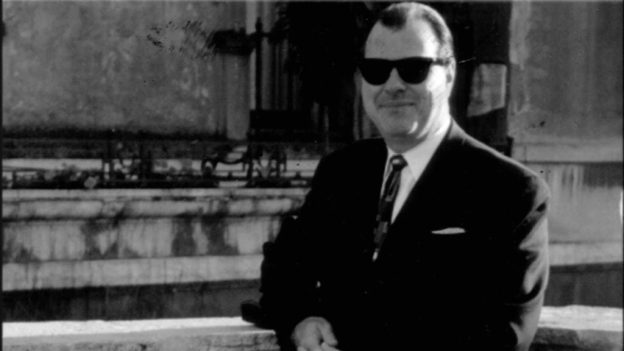
John P. O’Neill, the FBI counterintelligence expert, was the Bureau’s top expert on Osama bin Laden and was also attempting to track down the vestiges Robert Maxwell’s crime-linked enterprises in New York City before his death on September 11, 2001.
Robert Maxwell’s foothold in New York, which led to his establishing links to the city’s criminal underworld, appear to have gotten underway when he purchased Macmillan. He had little trouble raising money for a grander entry into New York business and society, despite his well-known past financial chicanery that had earned him the nickname “the bouncing Czech.” Investment banks such as Lehman Brothers, Rothschild Inc., Salomon Brothers, and Goldman Sachs lined up to represent and help finance Maxwell and his ever-growing web of businesses and corporate entities. Some speculated at the time that some of the funds Maxwell raised during this period and for this purpose had originated in the Soviet Union, where he had considerable connections, including to the KGB. There is also the possibility that some of the funds included proceeds from Maxwell’s sale of bugged PROMIS software to governments around the world.
Despite having opened a considerable new stream of revenue through Multi-Group and its legitimate and illegitimate businesses, years of financial fraud and stock-buying schemes caught up with Robert Maxwell’s empire, which began rapidly imploding in early 1991. In what is often considered a bizarre move by observers, given Maxwell’s dire financial situation and the poor state of the newspaper, Maxwell decided to expand his presence in New York by buying the New York Daily News in March 1991. However, Gordon Thomas later reported that the paper’s previous owners, the Chicago Tribune Group, had offered Maxwell $60 million to take over the floundering paper. Regardless of the true story behind his acquisition of the paper, he chose to put his daughter Ghislaine in charge of “special projects” shortly after becoming its owner. That position, per London’s Sunday Times, “provided her with her entree to the power base of the city.”
In addition to her new role in charge of “special projects” for the paper, Ghislaine was also made managing director of a “ready-made” company based in New York and created by her father, Maxwell Corporate Gifts. The New York Post later described the company as Ghislaine’s “own fiefdom.” Little is otherwise known about Maxwell Corporate Gifts, with the Maxwell family subsequently describing the company as “a business that supplied long-term service awards for companies.” In 2021, Ghislaine’s siblings published a short biography of their sister that asserted that Ghislaine had founded Maxwell Corporate Gifts in the mid-1980s after her graduation from Oxford and before her move to the US. Their claim is at odds with past media reports that predate Ghislaine’s infamy by several years and even decades. It is also possible, however, that the entity’s creation preceded by several years its use by Ghislaine and her father in New York.
Because few or no public records remain accessible regarding the company’s activities, we can only speculate about its activities. Given that the creation of the company coincided with the Maxwells’ entry into New York as well as the fact that Robert Maxwell’s ambition to expand his influence throughout the city was quite clear at the time, it was most likely a part of the growing Maxwell influence network in the city. New York media outlets subsequently claimed that Robert Maxwell saw himself as “the patriarch of a dynasty that would wield financial and political power on a global scale” and that he additionally saw New York as where they would truly make their mark.
After buying the New York Daily News, and despite his mounting financial problems, Maxwell received such positive attention in New York City that it surprised even him. According to an anecdote from Robert Pirie, investment banker and the then-president of Rothschild Inc.:
After he bought the Daily News, I picked him up at his boat. He liked Chinese food, so I decided to take him to Fu’s, which is the best Chinese restaurant in the city. As we drove up First Avenue, people would recognize him, and open their car doors and come out and shake his hand. At Fu’s, the entire restaurant got up on its feet and started clapping. He was overwhelmed. He told me, “In my whole life in London, no one’s ever acted like this. I’m here a month and look what’s happening.”
This type of reception throughout the city led Maxwell to become even more determined to expand his presence there. He hired a “group of prominent consultants and lawyers to help him make his way in America.” These included former senator Howard Baker and former senator John Tower as well as Republican Party consultant and high-profile public relations executive Robert Keith Gray. The inclusion of these three men in advising Maxwell on his entry into the United States is highly significant, but each is important for a different reason.
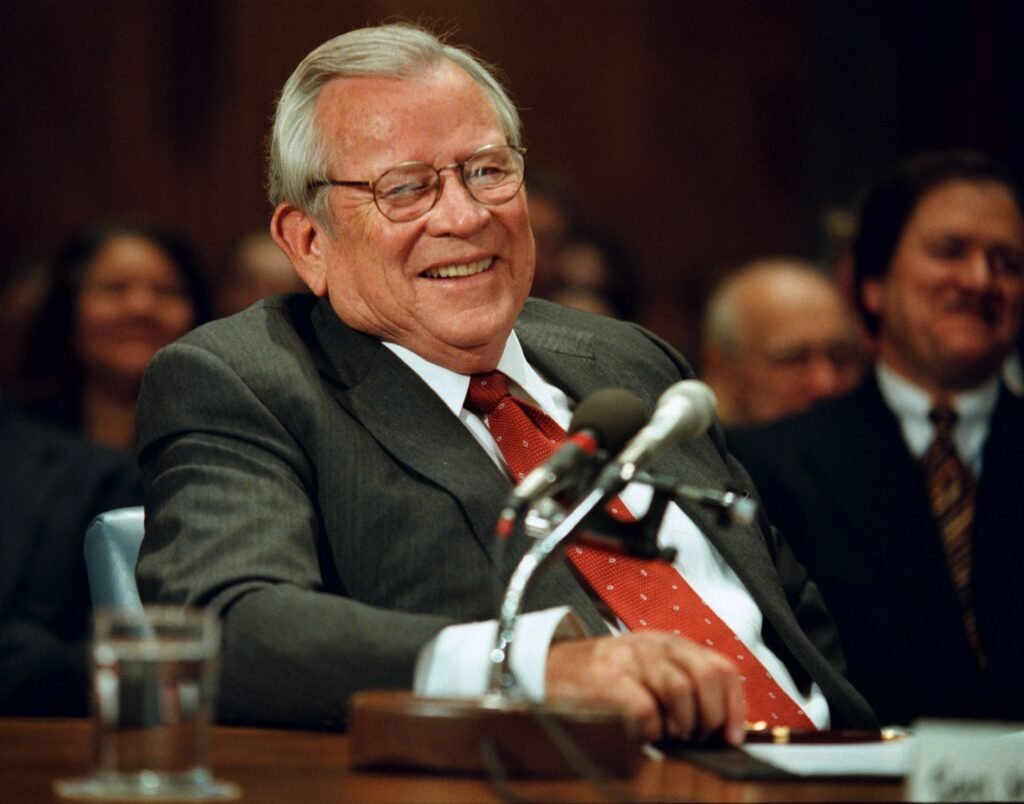
Tennessee senator Howard Baker, best known for being the vice-chairman of the Senate Watergate Committee and subsequently Reagan’s chief of staff after the Iran-Contra scandal, had become Robert Maxwell’s business partner in 1991 in a venture called Newstar. Newstar focused on expanding investment opportunities for Americans in the former Soviet Union and was described by Richard Jacobs, who cofounded the company with Baker, as “an international merchant banking, investment and advisory company.” Jacobs also stated that Robert Maxwell was one of the major shareholders in the company. Newstar was just one of several companies that Maxwell used to enrich himself through privatizing assets of the former Soviet Union. Baker also attempted to recruit other respected public figures into Maxwell’s empire.
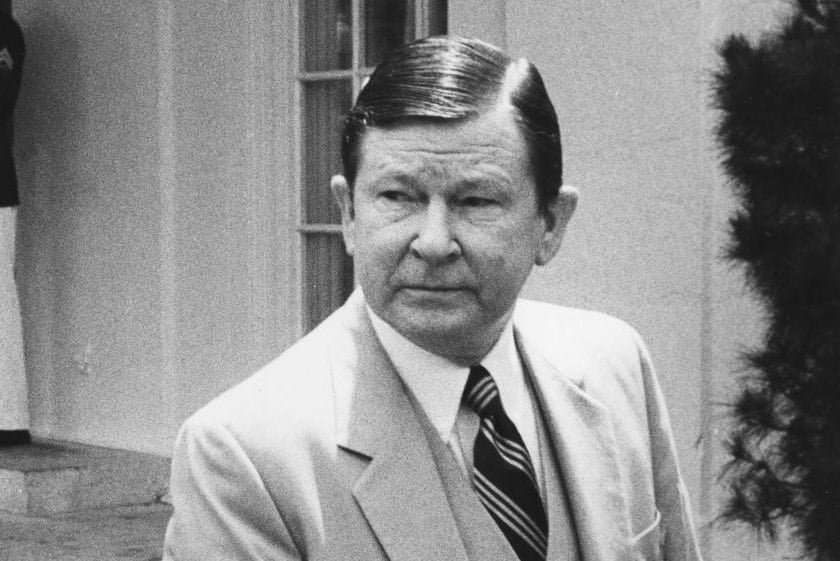
It appears that Maxwell first encountered Baker through his years-long relationship with Senator Tower, with whom Baker had had a decades-long partnership in the Senate. Maxwell had first gotten close to Tower years earlier, at Henry Kissinger’s behest, with the intention of advancing the Mossad goal of installing PROMIS software on the computers of top-secret US laboratories tied to the nuclear weapons program. It was Maxwell who placed Tower on the Mossad payroll, prompted his involvement in the Iran-Contra deal, and later added him to his own payroll via the company Pergamon-Brassey, which appears to have been strongly related to both the PROMIS scandal and the Bulgarian-led Neva program. Tower died just months before Maxwell, in early 1991, as the result of a suspicious plane crash, which at the time reportedly made Robert Maxwell fear for his own life.
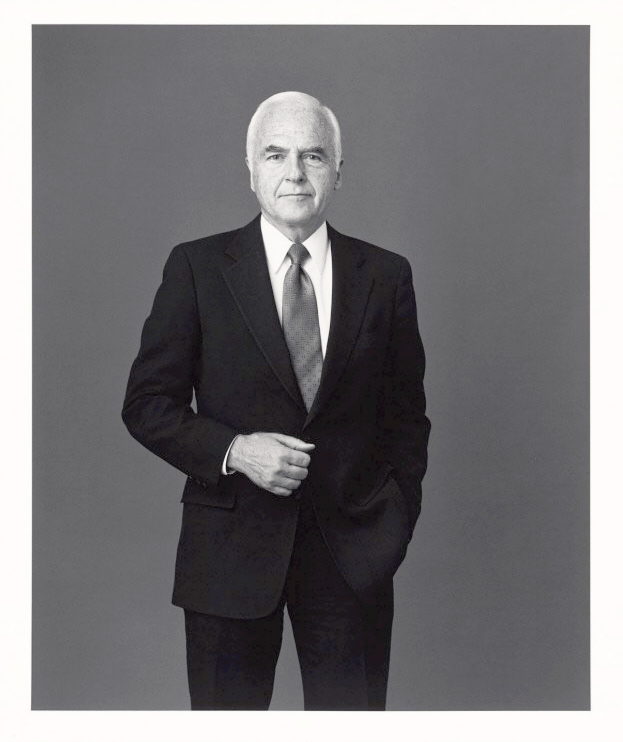
Robert Keith Gray is perhaps the key to unlocking the truth about Robert Maxwell’s plans and ambitions for his future in New York City. Gray was a smooth operator, having worked on major presidential campaigns and as the top executive at the public relations firm Hill and Knowlton. Less known is the fact that Gray had extensive ties to US intelligence and also to a handful of call girl and sexual-blackmail rings that encircled the Watergate scandal of the Nixon presidency and the more obscure Koreagate scandal of the same era. He was also tied, through connections in his home state of Nebraska, to figures involved in the Franklin Scandal. One common thread throughout the sexual blackmail scandals that were linked in some way to Gray was the Georgetown Club, owned by South Korean intelligence asset Tongsun Park and whose president was Robert Keith Gray at the time when it was used by CIA and other intelligence-linked figures to acquire sexual blackmail. John Tower was a member of the Georgetown Club during this period, as were many other prominent politicians and power brokers in Washington, DC.
During the period where he sought these men’s advice about how to grow his influence in New York, Robert Maxwell was also eager to get closer to George H. W. Bush—then the US president—with whom he had cultivated a relationship decades earlier. The Bush White House later became embroiled in the pedophile, blackmail, and sex-trafficking scandal that enveloped former Washington lobbyist Craig Spence, a network later shown by journalist Nick Bryant to have been at the core of the Franklin Scandal network. The alleged contact Spence had at the Bush White House was former National Security Advisor Donald Gregg. Gregg denied these reports, and the story was quickly memory holed. In 1989 Spence was found dead in a Boston hotel room and his death was quickly ruled a “suicide.”
Soon after Robert Maxwell’s effort to expand his footprint in New York, which author Gordon Thomas alleges involved Maxwell’s desire to become “king” of the city, he was being “courted” by Edgar Bronfman, Laurence Tisch, and other “luminaries of the New York Jewish community.” Bronfman and Tisch were among the founding members of the informal Mega Group, founded that same year by Leslie Wexner and Edgar Bronfman’s brother Charles. Charles Bronfman had previously teamed up with Maxwell in 1989 in an ill-fated attempt to purchase the Jerusalem Post. In a previous report that I wrote for MintPress News, I noted how many Mega Group members, including Wexner and the Bronfmans, had clear ties to organized crime networks and/or intelligence (as was the case for Tisch). Maxwell himself, as explored in this article and Part 1 of this series, checked these boxes as well.
The Mega Group’s existence was not revealed to the public until seven years later, in 1998. At that time, it underwent a very public reveal in the Wall Street Journal, and the names of its most prominent members were disclosed. Given that Robert Maxwell was cozy with this network and was being “courted” by them the year of its founding and that he had died long before the publication of the Wall Street Journal article, it is worth considering the possibility that Maxwell himself was a Mega Group member and that the only reason his name was not included in the WSJ’s disclosure of the group is because he was no longer alive. Support for this thesis can be adduced in the subsequent team-up of sexual-blackmail influence operator Jeffrey Epstein, who had been a financial adviser to Wexner since 1987 and his money manager since 1990, and Ghislaine Maxwell, Robert Maxwell’s favorite daughter.
While Wexner is often considered to be an Ohio business mogul, he had become increasingly active in New York in the 1980s, particularly its real estate market, especially following his involvement with Epstein. For over a decade and up until the early 2000s, Epstein was frequently referred to in the press as a real estate mogul or “property developer,” and some of these early articles, including one that named Ghislaine as the “mysterious business queen” of social circles that spanned New York and London, also discussed allegations that Epstein was involved with both the CIA and Israel’s Mossad.
Rising from the Ashes
At the end of October 1991, Robert Maxwell contacted private investigator Jules Kroll and arranged a meeting to see if he could hire Kroll to investigate a “conspiracy” to ruin him financially and destroy his empire. Kroll told Maxwell he would take the case.
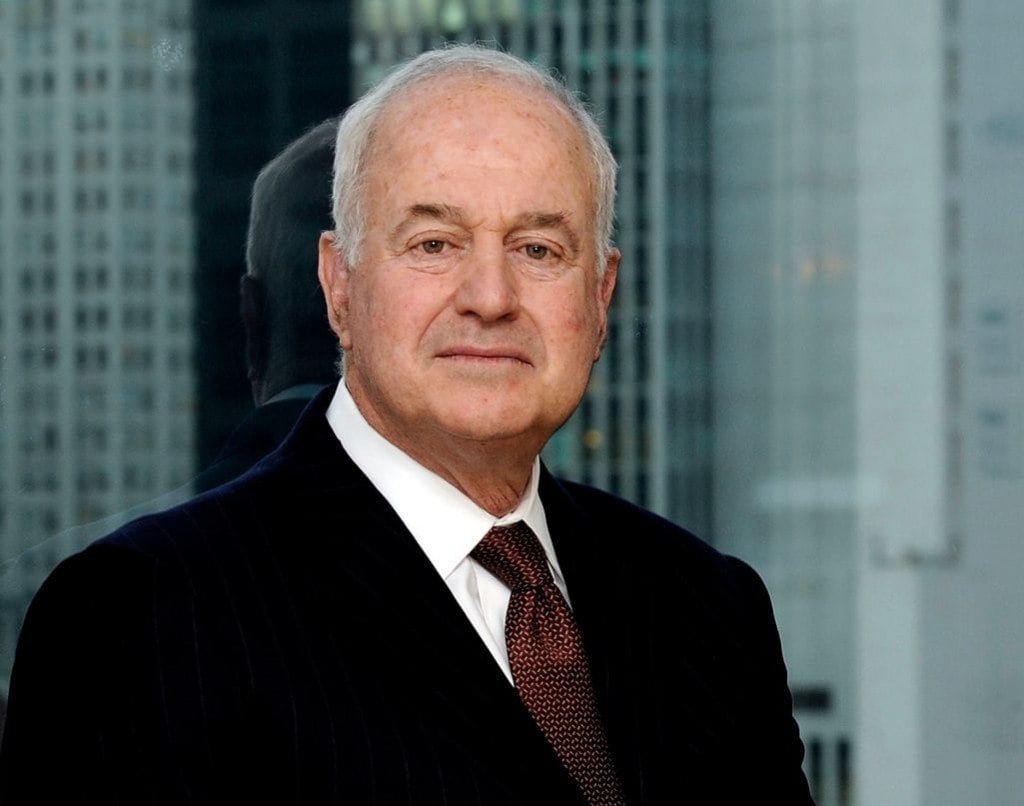
Jules Kroll’s involvement in this matter is significant for several reasons but chiefly because of the ties of his firms to US and Israeli intelligence. Kroll Associates, founded by Jules Kroll in 1972, became known as “the CIA of Wall Street” and was later alleged by French intelligence to have been used as an actual front for the CIA. The reasoning behind this nickname and such claims is partially related to the company’s penchant for hiring former CIA and FBI officers as well as former operatives of Britain’s MI6 and Israel’s Mossad. The successor company to Kroll Associates, K2 Intelligence, has similar hiring practices. In 2020, former Kroll Associates employee Roy Den Hollander was accused of murdering the son of New York judge Esther Salas at their family home just as Salas was due to preside over a case involving ties between Jeffrey Epstein and Deutsche Bank.
At the time that Robert Maxwell hired Kroll, the brother of then US president and former CIA director George H. W. Bush—Johnathan Bush—was on its corporate advisory board. Soon afterward, Kroll became employed by Bill Clinton in his first presidential campaign and later was hired to manage security for the World Trade Center in New York after the 1993 bombing. In addition, Kroll had been hired to investigate how money had been spirited out of the Philippines by the Marcos family. As previously mentioned, Ghislaine’s friend George Hamilton had played a significant role in that affair.
Furthermore, just weeks before 9/11, Kroll hired John P. O’Neill, with the involvement of Jerome Hauer—also a Kroll employee at the time, who would be one of the few, and possibly the only, high-ranking Kroll employee to die in the attacks. As previously noted, O’Neill was seeking to unravel “Maxwell’s legacy” in New York criminal networks at the time of his death on September 11, 2001. A report from January of that year noted that federal investigators were still trying to determine “how much of her [Ghislaine’s] father’s fortune is buried in the offshore trusts he used so freely for the benefit of his family.”
Kroll was unable to give Robert Maxwell the information he had wanted before Maxwell died under suspicious circumstances on his yacht in November 1991. Though media reports often say that his death was most likely a suicide, many biographers, investigators, and even Maxwell’s own family assert that he was murdered, having hit the end of the line in terms of his usefulness to those who had empowered his legal and illegal activities over the years. Ghislaine herself claims it was a group of “Mossad renegades” who took her father’s life.
Soon after news of Robert Maxwell’s death spread, his wife Betty Maxwell, accompanied by Ghislaine, headed to his place of death—his yacht, then located near the Canary Islands. As mentioned in Part 1, journalist John Jackson, who was present when Ghislaine and Betty boarded the yacht shortly after Robert’s death, claims that it was Ghislaine who “coolly walked into her late father’s office and shredded all incriminating documents on board.” Ghislaine denies the incident, though Jackson has never retracted his claim, which was reported in a 2007 article published in the Daily Mail. If Jackson is to believed, it was Ghislaine—out of all of Robert Maxwell’s children—who was most intimately aware of the incriminating secrets of her father’s financial empire and espionage activities. Betty Maxwell subsequently claimed that Ghislaine had been the child she chose to accompany her because she spoke Spanish and could help more than her other children in communicating with local authorities.
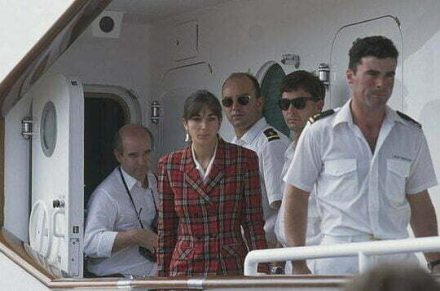
Ghislaine aboard the Lady Ghislaine shortly after her father’s death
Following her father’s death, Ghislaine publicly claimed to know next to nothing of his affairs and to have no money herself, despite it being well known that her father had created numerous trusts in the Lichtenstein tax haven that were meant to fund the Maxwell family for “generations.” A New York detective who interviewed Ghislaine in Manhattan while trying to trace her father’s assets later stated:
She came in dressed in sackcloth and ashes. It was pathetic. She said she had no money. Yet here was this expensive lawyer arguing with us in a room so air conditioned we couldn’t hear what he said. In between claiming she had no money, you couldn’t but help warming to her, she was so solicitous. We hadn’t had any lunch and she was recommending restaurants here and there and where to stay and go shopping, and slipping in from time to time how she never had anything to do with her father’s affairs.
Another investigator said that “It is entirely possible, and we didn’t have the resources to check, that Maxwell could have siphoned off money from some of his 400 companies in America to her. She was living on something.”
In 1992, Ghislaine repeated the claims that she was destitute but promised her family would soon make a comeback. That year, she told Vanity Fair, “I’m surviving—just. But I can’t just die quietly in a corner. . . . I would say we’ll be back. Watch this space.” As I previously reported, it was during this same period that the Maxwell siblings were openly attempting to rebuild their father’s empire and legacy, which potentially included his intelligence activities.
It later emerged that during this period and the years that followed, Ghislaine had shifted from being dependent on her father to being “entirely dependent” on Jeffrey Epstein for her “lavish lifestyle.” Some acquaintances of Ghislaine have since claimed that “she started working for him [Epstein] immediately after her father died.”
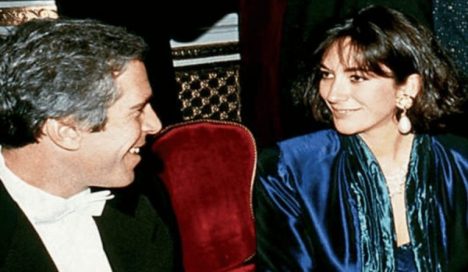
Ghislaine and Jeffrey Epstein at a 1991 memorial event for her father at the Plaza Hotel
Ghislaine and Jeffrey Epstein’s public relationship began in 1991 during a tribute dinner at the Plaza Hotel held in Robert Maxwell’s honor, where Epstein sat at the same table with Ghislaine and Betty. According to media reports, this was Ghislaine’s “first step in publicly announcing her deep affection for him [Epstein].” The choice of the Plaza would prove to be ironic given that Ghislaine and Epstein were launching an extensive sexual-blackmail operation that would go on for well over a decade. The hotel had previously been the site of a sexual-blackmail operation involving the infamous lawyer Roy Cohn and his mentor, the liquor magnate Lewis Rosenstiel.
The Plaza Hotel was purchased in 1988, not long after Cohn’s death, by Cohn’s protégé, Donald Trump, who had become close to Jeffrey Epstein beginning in 1987, when the two men, along with Tom Barrack, used to frequent New York nightlife hotspots together. The Plaza subsequently became the site of numerous parties attended by underage girls hoping to become “models.” Both Epstein and Trump, during this period and beyond, were known for their efforts to purchase, control, or have significant access to a variety of modeling agencies. Epstein was known to use the promise of modeling opportunities to either recruit or lure in young victims to his and Maxwell’s sexual-trafficking enterprise. Regarding Epstein, Trump stated in 2002: “I’ve known Jeff for 15 years. Terrific guy. He’s a lot of fun to be with. It is even said that he likes beautiful women as much as I do, and many of them are on the younger side.” Years later, Trump claimed to have had a falling out with Epstein over the latter’s behavior at Trump’s Mar-a-Lago resort in Florida.
In the year that followed his first public appearance with Ghislaine, Epstein was treated by both the press and those close to Ghislaine as her father reincorporated, with various media reports stating and/or quoting their associates comparing Epstein directly to Robert Maxwell. Some of these reports, as early as 1992, also openly discussed the possibility that Epstein, like Robert Maxwell, was working for Israeli intelligence as well as the CIA.
Reports throughout the 1990s would say that Ghislaine’s role in Epstein’s businesses was “nebulous” yet central, and she would later be described as having the role of “consultant.” Her own web of businesses was described “as opaque as her father’s,” and one described her as an “internet operator.” When asked about her work by reporters, she would refuse to confirm the nature of her businesses or even their names. The “internet operator” claim seems to be related to the “substantial interest” she possessed in the tech company founded in the 1990s by her twin sisters, Christine and Isabel, which produced the Magellan search engine. During this same period, Ghislaine and Epstein courted Microsoft executives, including Bill Gates, which led to a close relationship between Microsoft and Magellan and Isabel Maxwell’s subsequent business, CommTouch, which had deep ties to Israel’s national-security and intelligence apparatus.
Ghislaine and Epstein, as most now know, were also operating a sexual-trafficking and sexual-blackmail operation that involved the sexual abuse of minors, who were used to seduce and entrap powerful individuals, particularly Democratic politicians. Furthermore, the pair’s ties to intelligence have subsequently emerged and are alleged, including by eyewitnesses, to have begun in the 1980s with the direct involvement of Robert Maxwell. As noted in this article, Robert Maxwell at the time of his death was attempting to become “king” of New York high society.
Given the context surrounding the circumstances during which the Ghislaine-Epstein sexual-blackmail operation developed and launched, as detailed here, it appears more than plausible that this operation not only benefited certain intelligence agencies but also the organized crime–linked Mega Group and the Maxwell family itself. Ultimately, the activities that Ghislaine undertook alongside Epstein, as well as those of her siblings, fulfilled Robert Maxwell’s reported desire to become “the patriarch of a dynasty that would wield financial and political power on a global scale.” However, like the rise and fall of her father, Ghislaine’s power and influence was not meant to last.
In this light, it appears that the sexual-blackmail activities of these two individuals was an operation seeking to not only influence US policy on behalf of a foreign entity (as well as domestic entities such as the CIA) but to influence powerful individuals for the benefit of the Maxwell family itself as well as the organized crime web in which Robert Maxwell enmeshed his business interests in the latter years of his life.
To continue to claim that Ghislaine Maxwell’s activities were only performed to please Jeffrey Epstein who only sought to financially extort certain individuals for his personal gain is dishonest when faced with the facts of the matter and the context in which their operations took place. It also belittles the experiences of those who survived sexual abuse at the hands of both Ghislaine Maxwell and Jeffrey Epstein, as the continued cover-up of their complex dealings means that justice will never be served for their enablers, while the names of those they unduly influenced will never become public. It is a revelation that those in power must prevent the public from understanding at all costs, lest Americans realize that the United States has long been a country ruled by backdoor dealings, illicit intelligence operations, and blackmail.
Whitney Webb has been a professional writer, researcher and journalist since 2016. She has written for several websites and, from 2017 to 2020, was a staff writer and senior investigative reporter for Mint Press News. She currently writes for The Last American Vagabond.
Featured Video
Seyed M. Marandi: Toward Total War in the Middle East
or go to
Aletho News Archives – Video-Images
From the Archives
The Geopolitics behind the War in Yemen (I)
By Mahdi Darius NAZEMROAYA | Strategic Culture Foundation | 30.03.2015
The United States and the Kingdom of Saudi Arabia became very uneasy when the Yemenese or Yemenite movement of the Houthi or Ansarallah (meaning the supporters of God in Arabic) gained control of Yemen’s capital, Sanaa/Sana, in September 2014. The US-supported Yemenite President Abd-Rabbuh Manṣour Al-Hadi was humiliatingly forced to share power with the Houthis and the coalition of northern Yemenese tribes that had helped them enter Sana. Al-Hadi declared that negotiations for a Yemeni national unity government would take place and his allies the US and Saudi Arabia tried to use a new national dialogue and mediated talks to co-opt and pacify the Houthis.
The truth has been turned on its head about the war in Yemen. The war and ousting of President Abd-Rabbuh Manṣour Al-Hadi in Yemen are not the results of «Houthi coup» in Yemen. It is the opposite. Al-Hadi was ousted, because with Saudi and US support he tried to backtrack on the power sharing agreements he had made and return Yemen to authoritarian rule. The ousting of President Al-Hadi by the Houthis and their political allies was an unexpected reaction to the takeover Al-Hadi was planning with Washington and the House of Saudi. … continue
Blog Roll
 Aletho News
- HE SAVED LIVES. NOW HE FACES PRISON.
- Israeli lobby seeks to bind US fate to ‘Israel’: Araghchi
- Pakistan-Iran talks secure LNG shipment to Islamabad through Hormuz
- Black Sea grain crisis puts global wheat supplies under pressure
- IRGC air defenses destroy another US MQ-1 drone over Strait of Hormuz
- Imran Khan’s entire immediate family detained in Pakistan ahead of mass protest demanding his release
- EU nation detains former presidential frontrunner
- Leaked: Britain’s Sham Conviction Of Hashim Thaci
- Seyed M. Marandi: U.S. Strike Imminent – Toward Total War in the Middle East
- Russia Voted Under Fire. Washington Is Loading the Tankers.
- If Americans Knew
- Israeli Attacks in Gaza Kill at Least Seven Palestinians Over Three Days, including Woman and Child
- Trump’s militarization of Washington DC as he pursues Israel’s war against Iran
- Why Israel Fears This Searing New Documentary
- Huckabee aide solicited cash gifts from Israelis
- This isn’t sci-fi, AI is already killing people
- ‘The Most Brutal Thing’: Investigation Reveals Execution of Elderly Woman in Rafah
- Inside Israel’s ‘soft’ ethnic cleansing plan for Gaza through the eyes of its victims
- New online database tracks pro-Israel political donations in the United States
- Israeli president pardons soldier convicted for killing wounded Palestinian
- Singer Ed Sheeran says his ‘heart broken’ by Gaza devastation, addresses Macklemore controversy
- No Tricks Zone
- 2025 Nature Paper Claiming Worsening Global Drought Gets RETRACTED …Heavily Flawed
- New Study: ‘Global Drought Shows No Detectable Recent Acceleration Under Climate Warming’
- Economic Masterminds: German Socialists Suggest Taxing Productivity Gains Stemming From Using AI
- The South China Sea Has Not Been Cooperating With The Climate Change Narrative
- Energy Crisis: Germany Enters Heating Season With Historically Low Gas Reserve Fill Levels
- New Study: The Antarctic Ice Sheet Gained Mass From 2020-2024 Due To Staggering Snow And Ice Accumulation
- Study: Ocean Heating Rates From Thousands Of Years Ago ‘Dwarf’ Modern Ocean Heating Rates
- Climate Extremists Target, Attack Large-Scale Power Grid Infrastructure In Germany!
- New Study: Antarctic Ice Melt Has Contributed Less Than 1 Centimeter To Sea Level Rise In The Last 30 Years
- Fear Of Debate: Alarmist German Climate Scientist Calls On Mainstream Media To Discredit Skeptic Voices
 Aletho News
