Tel Aviv hiding evidence of ethnic cleansing of Palestinians from public: Israeli media

The Cradle | August 22, 2022
According to a report by Hebrew newspaper Haaretz released on 22 August, Tel Aviv has been working through its defense ministry to hide historical documents related to the founding of the state of Israel, from the Israeli public.
The founding of Israel in 1948, known throughout the Arab world as the “Nakba,” or catastrophe, involved the ethnic cleansing and mass expulsion of Palestinians from their land by ultra-nationalist Jewish gangs.
These gangs were later integrated into the Israeli military.
The documents contain details on Israel’s killing of civilians, as well as the erasure of entire Palestinian villages. Israel is undergoing “a systematic process to conceal evidence of the Nakba,” Haaretz reveals.
The report states that efforts to hide these documents have been carried out by the Directorate of Security of the Defense Establishment, a secret department in the Israeli Defense Ministry known as the Malmab, “whose work and budget are secret.”
Members of the Malmab reportedly “worked without any legal authority, even in some cases [hiding] documents that the military censor had previously allowed to be published,” Haaretz revealed.
The report also details that government officials, including members of the Israeli Knesset, who by law are allowed access to such archives, were barred from viewing the documents in question.
A settlement was reached in which the Israeli Treasury would send requests in order for archived documents to be examined for disclosure. The Malmab apparatus would then search through them thoroughly to determine if they can be published alongside Israel’s accessible archives, despite already being accessible by Israeli law.
Haaretz reported that the Malmab were also working to hide documents relating to Tel Aviv’s nuclear program.
“If the state admitted … that the documents were hidden without authority, why did it not insist on their immediate disclosure?” the report asks.
The report concludes by saying that Israel has to “get rid of the twisted habit it has adopted of concealing its past from the public … the public has the right to know the history of the country in which it lives, and also to discover its less pleasant aspects.”
Despite the events of the Nakba being common historical knowledge, Israel’s attempt to hide these documents represents its policy of trying to control the perception of the Israeli public.
Israel is known to have attempted hiding the atrocities of its past.
On 8 July, Hebrew media revealed the existence of a mass grave under the parking lot of a tourist attraction in Israel, where the bodies of dozens of Egyptian soldiers burned alive by Israeli forces were buried during the 1967 Arab–Israeli War, also known as the Six-Day War.
For over five decades, Tel Aviv kept the secret of the mass grave, never attempting to return the bodies to their homeland.
Additionally, Israel has been secretly building a nuclear arsenal for several decades – owning around 40 to 800 nuclear warheads which it denies having – while criticizing Tehran over its nuclear program.
MEET THE EX-CIA AGENTS DECIDING FACEBOOK’S CONTENT POLICY
By Alan Macleod | MintPress News | July 12, 2022
It is an uncomfortable job for anyone trying to draw the line between “harmful content and protecting freedom of speech. It’s a balance”, Aaron says. In this official Facebook video, Aaron identifies himself as the manager of “the team that writes the rules for Facebook”, determining “what is acceptable and what is not.” Thus, he and his team effectively decide what content the platform’s 2.9 billion active users see and what they don’t see.
Aaron is being interviewed in a bright warehouse-turned-studio. He is wearing a purple sweater and blue jeans. He comes across as a very likable, smiley person. It is not an easy job, of course, but someone has to make those calls. “Transparency is incredibly important in the work that I do,” he says.
Aaron is CIA. Or at least he was until July 2019, when he left his job as a senior analytic manager at the agency to become senior product policy manager for misinformation at Meta, the company that owns Facebook, Instagram and WhatsApp. In his 15-year career, Aaron Berman rose to become a highly influential part of the CIA. For years, he prepared and edited the president of the United States’ daily brief, “wr[iting] and overs[eeing] intelligence analysis to enable the President and senior U.S. officials to make decisions on the most critical national security issues,” especially on “the impact of influence operations on social movements, security, and democracy,” his LinkedIn profile reads. None of this is mentioned in the Facebook video.
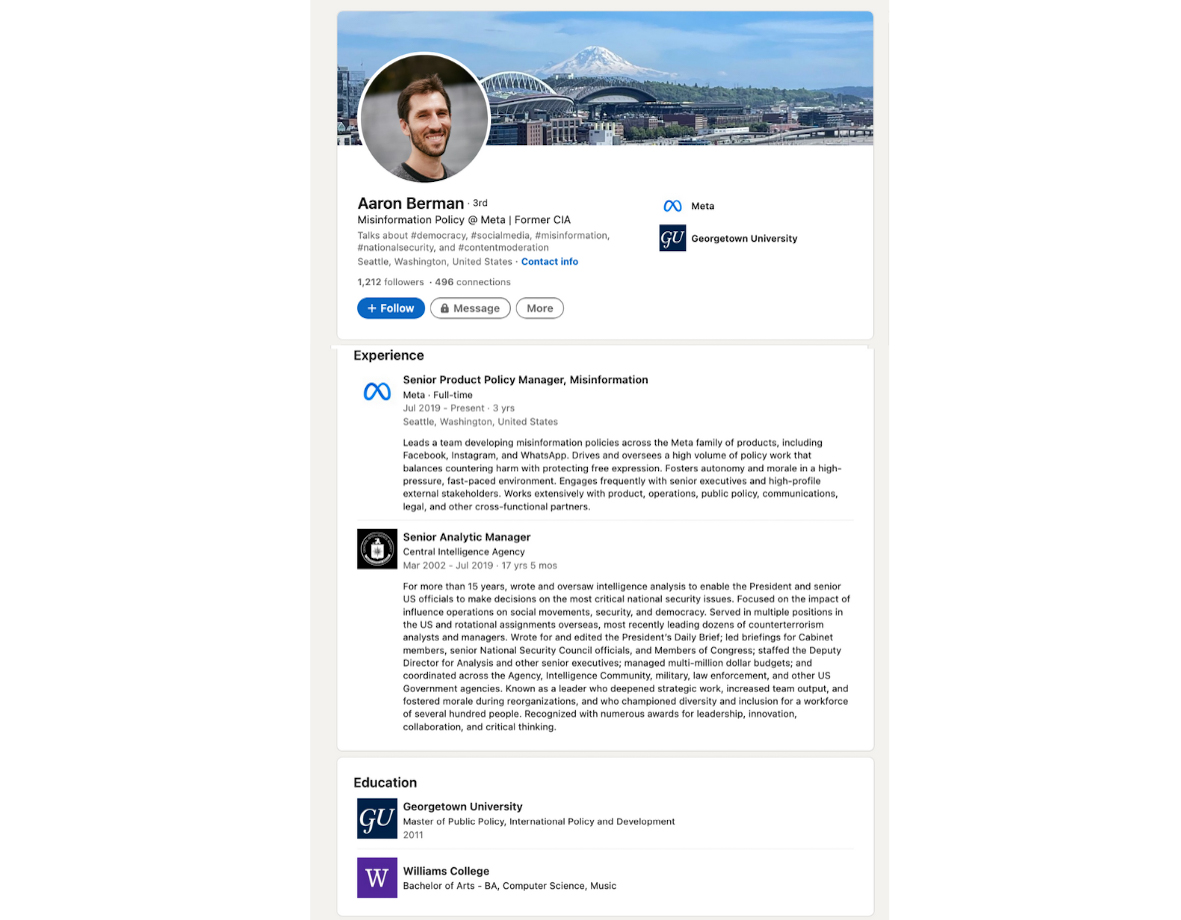
Berman’s case is far from unique, however. Studying Meta’s reports, as well as employment websites and databases, MintPress has found that Facebook has recruited dozens of individuals from the Central Intelligence Agency (CIA), as well as many more from other agencies like the FBI and Department of Defense (DoD). These hires are primarily in highly politically sensitive sectors such as trust, security and content moderation, to the point where some might feel it becomes difficult to see where the U.S. national security state ends and Facebook begins.
In previous investigations, this author has detailed how TikTok is flooded with NATO officials, how former FBI agents abound at Twitter, and how Reddit is led by a former war planner for the NATO think tank, the Atlantic Council. But the sheer scale of infiltration of Facebook blows these away. Facebook, in short, is utterly swarming with spooks.
TRUST ME, BRO
In a political sense, trust, safety and misinformation are the most sensitive parts of Meta’s operation. It is here where decisions about what content is allowed, what will be promoted and who or what will be suppressed are made. These decisions affect what news and information billions of people across the world see every day. Therefore, those in charge of the algorithms hold far more power and influence over the public sphere than even editors at the largest news outlets.
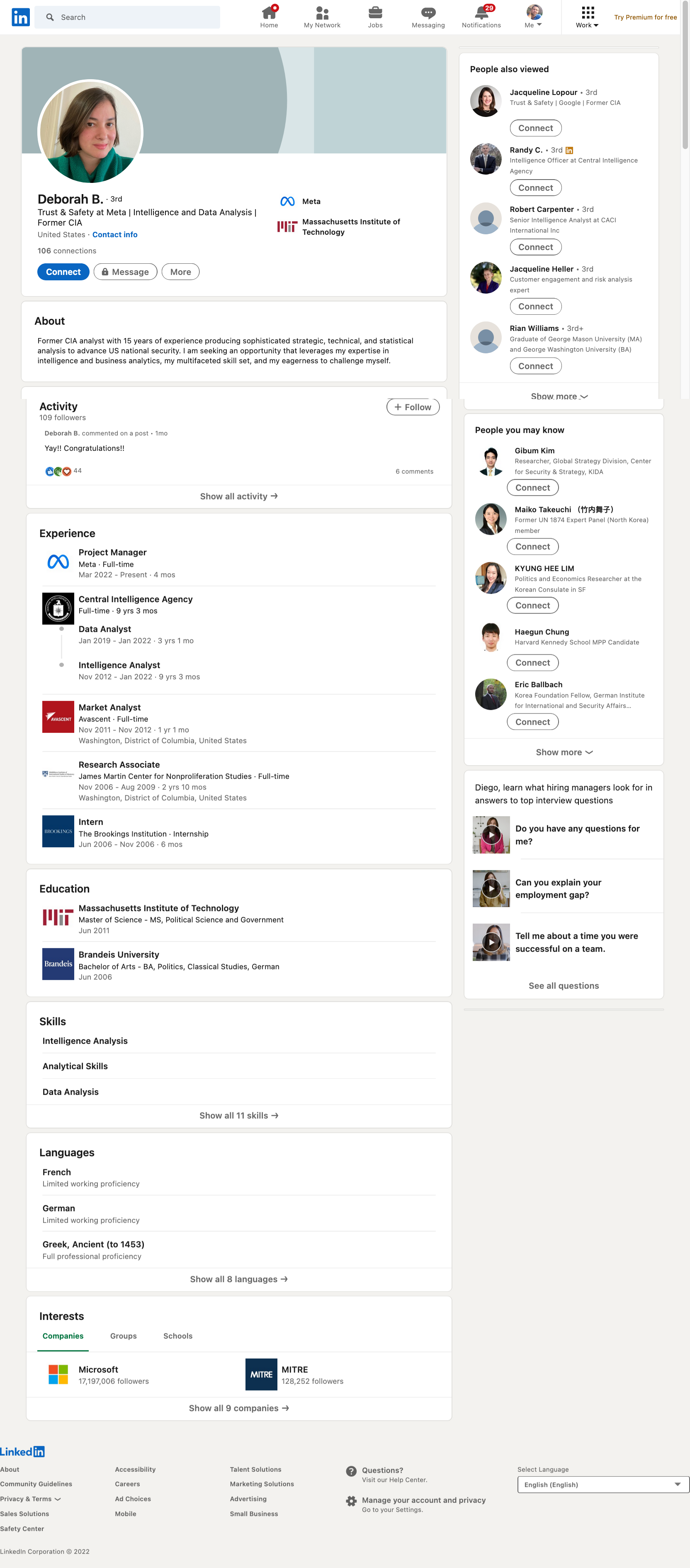
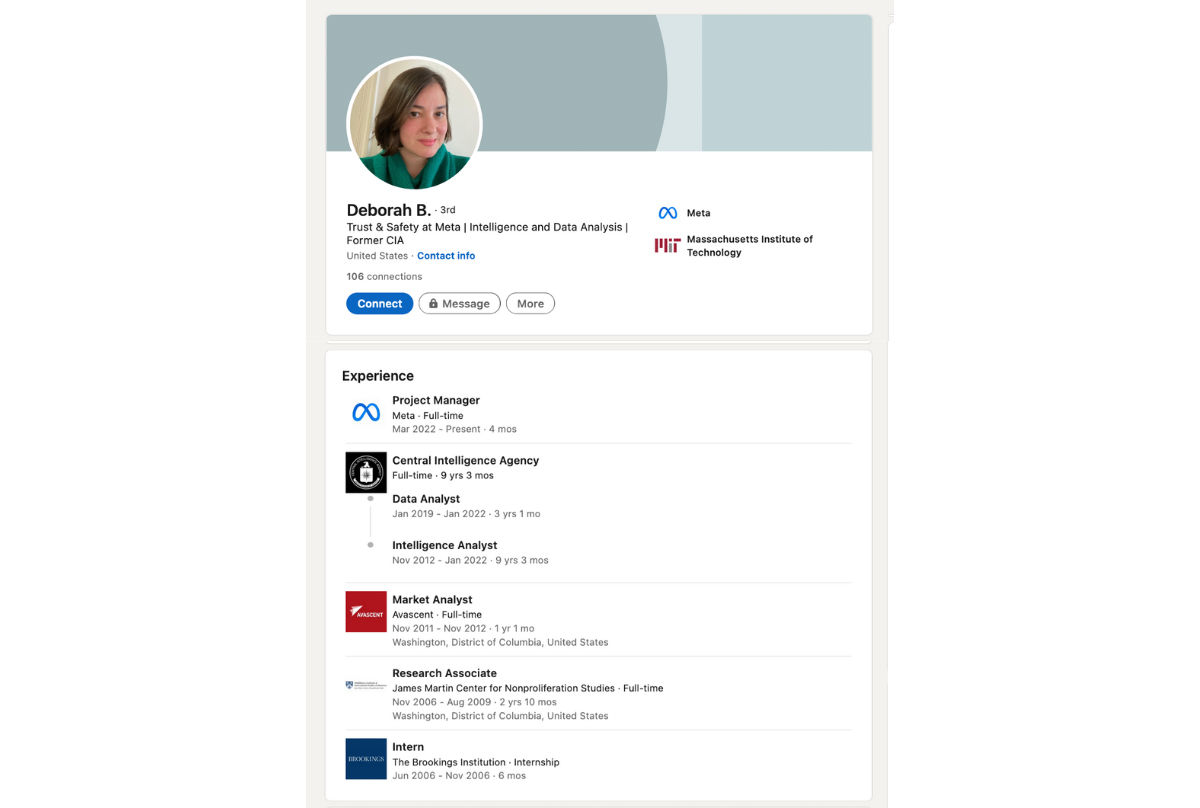
There are a number of other ex-CIA agents working in these fields. Deborah Berman, for example, spent 10 years as a data and intelligence analyst at the CIA before recently being brought on as a trust and safety project manager for Meta. Little is known about what she did at the agency, but her pre-agency publications indicate she was a specialist on Syria.
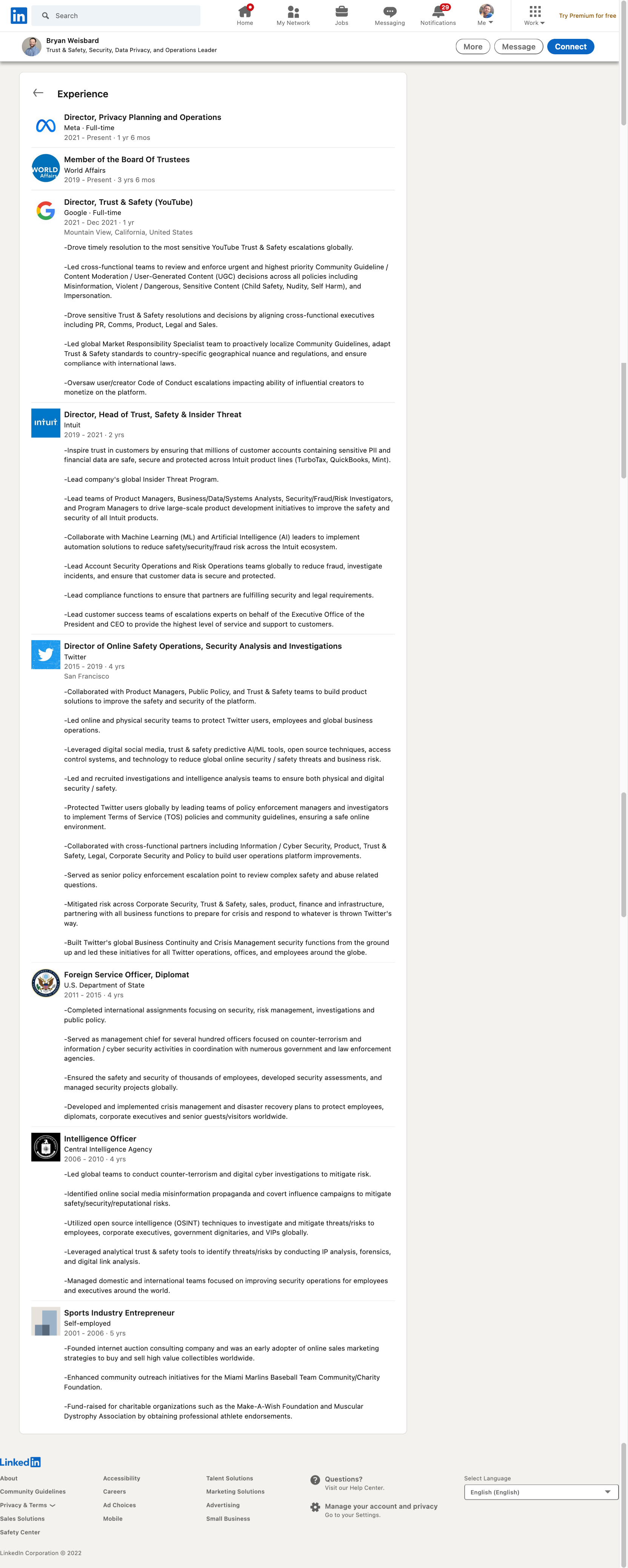
Between 2006 and 2010, Bryan Weisbard was a CIA intelligence officer, his job entailing, in his own words, leading “global teams to conduct counter-terrorism and digital cyber investigations,” and “Identif[ying] online social media misinformation propaganda and covert influence campaigns”. Directly after that, he became a diplomat (underlining how close the line is between those two professions), and is currently a director of trust and safety, security and data privacy for Meta.
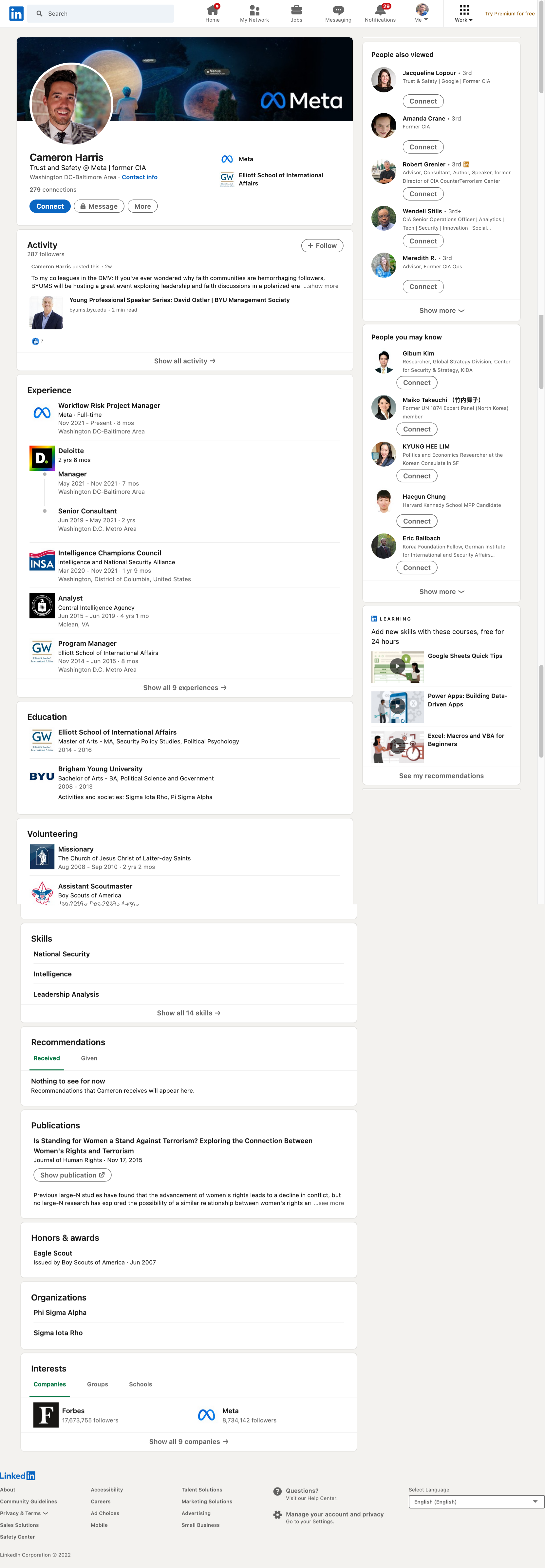
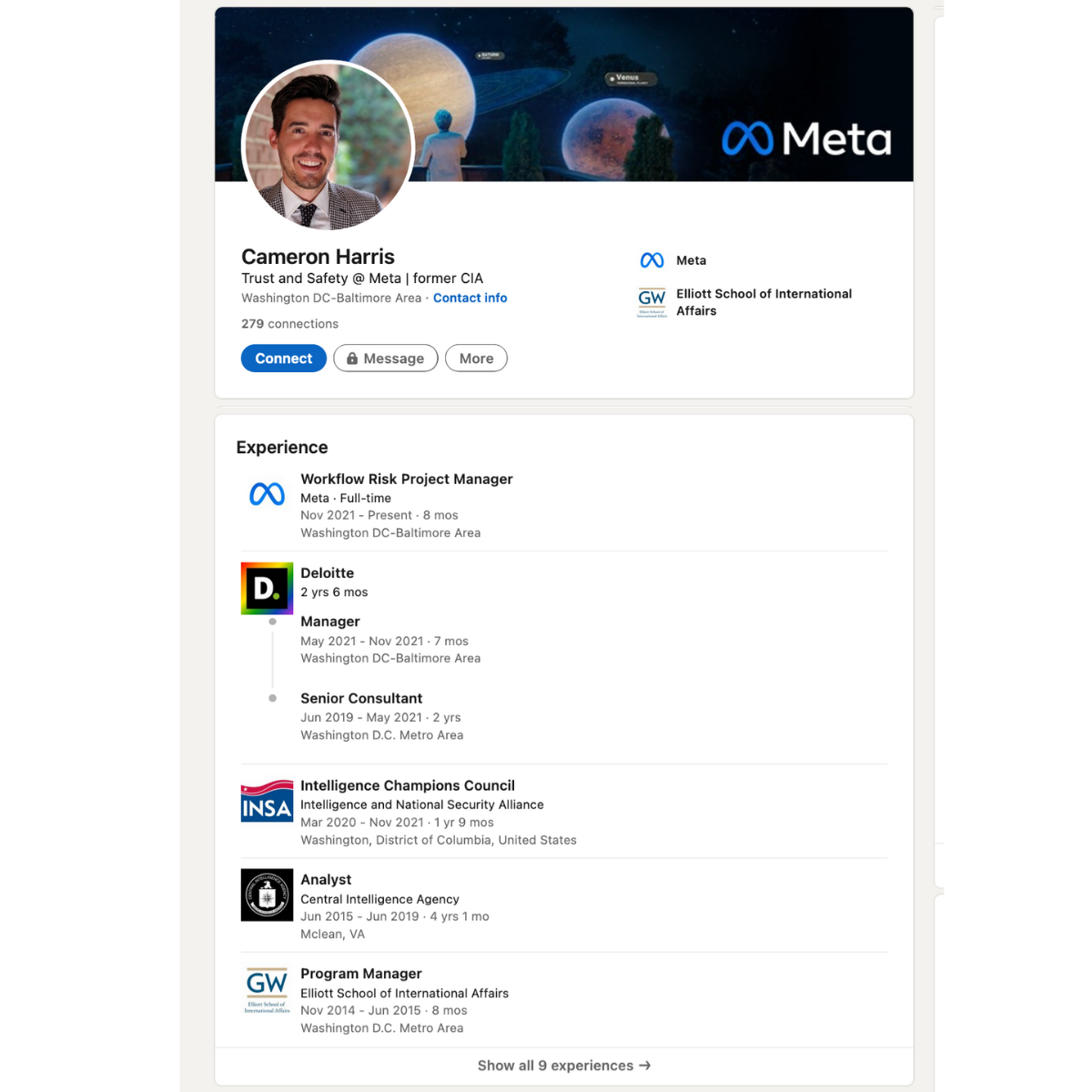
Meanwhile, the LinkedIn profile of Cameron Harris – a CIA analyst until 2019 – notes that he is now a Meta trust and safety project manager.
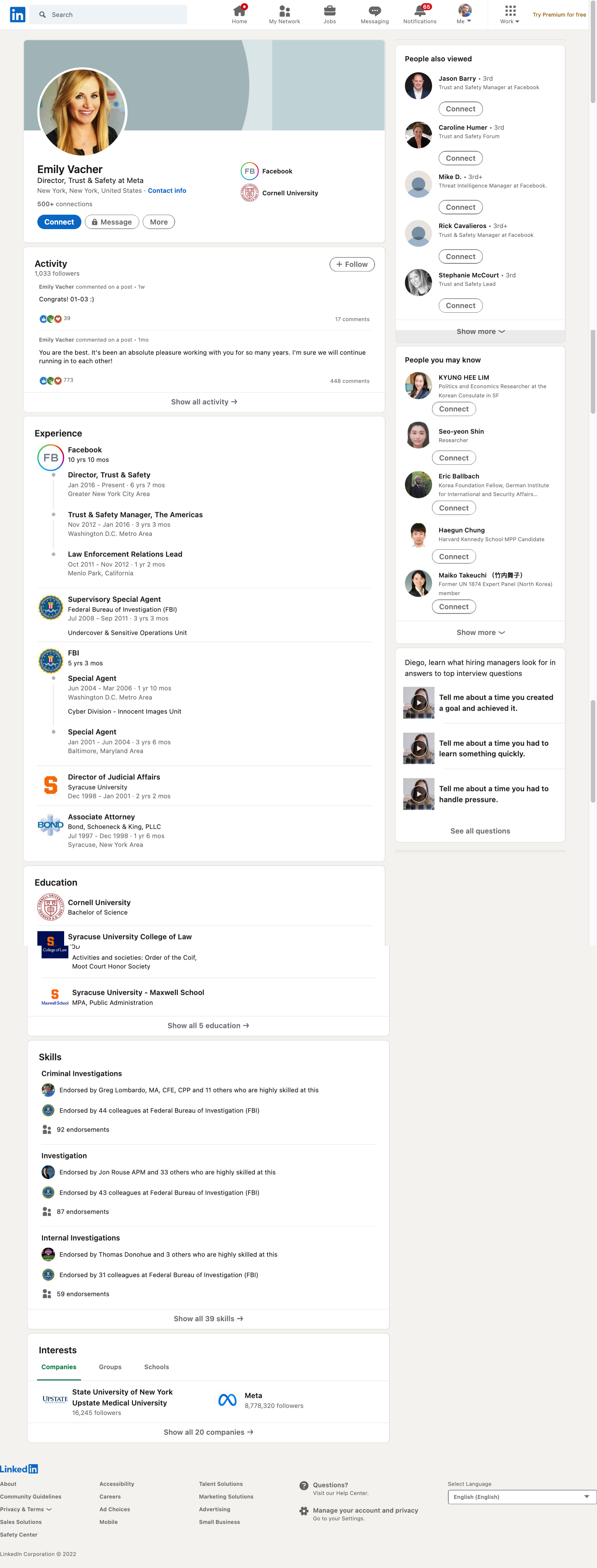
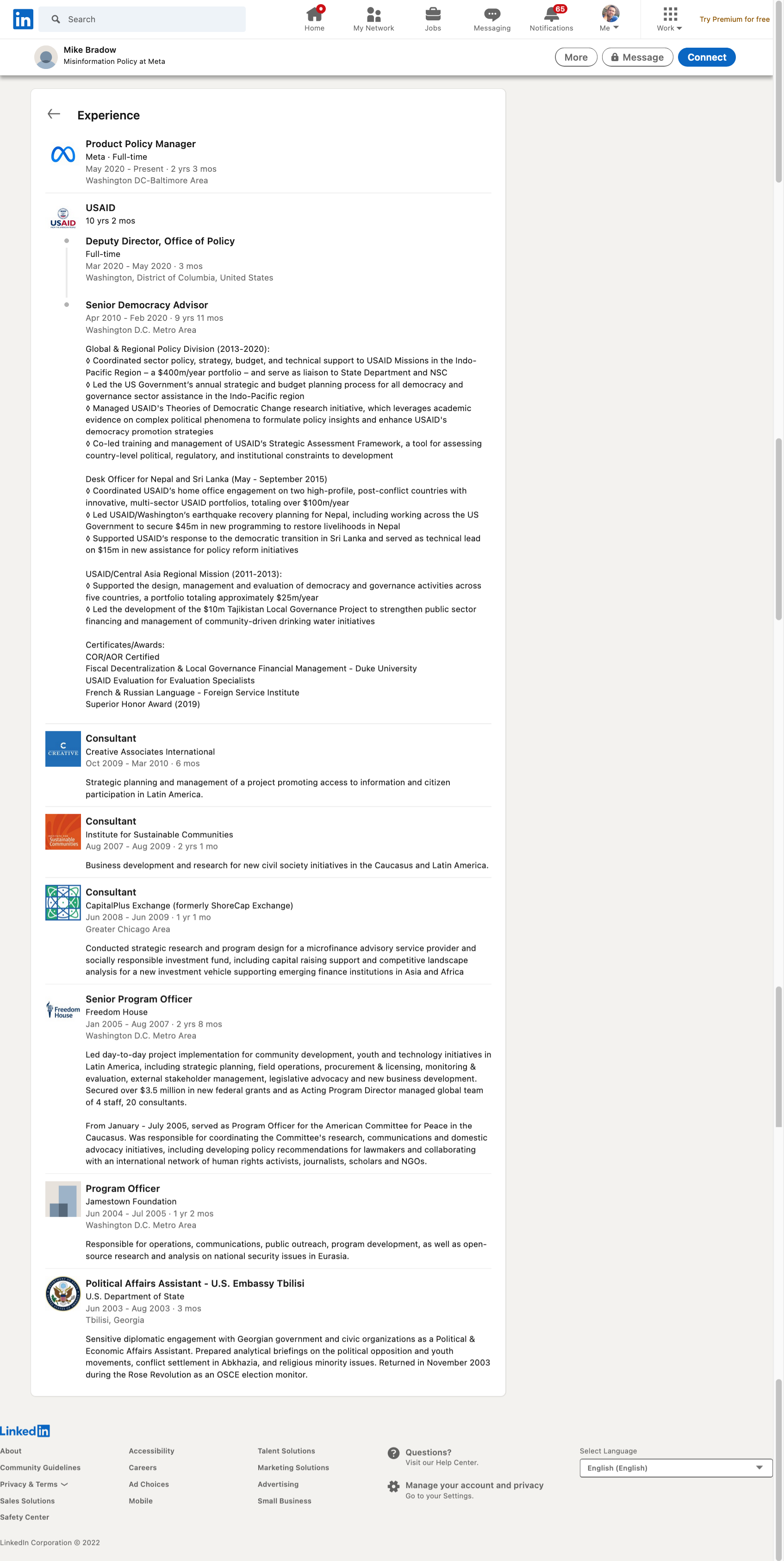
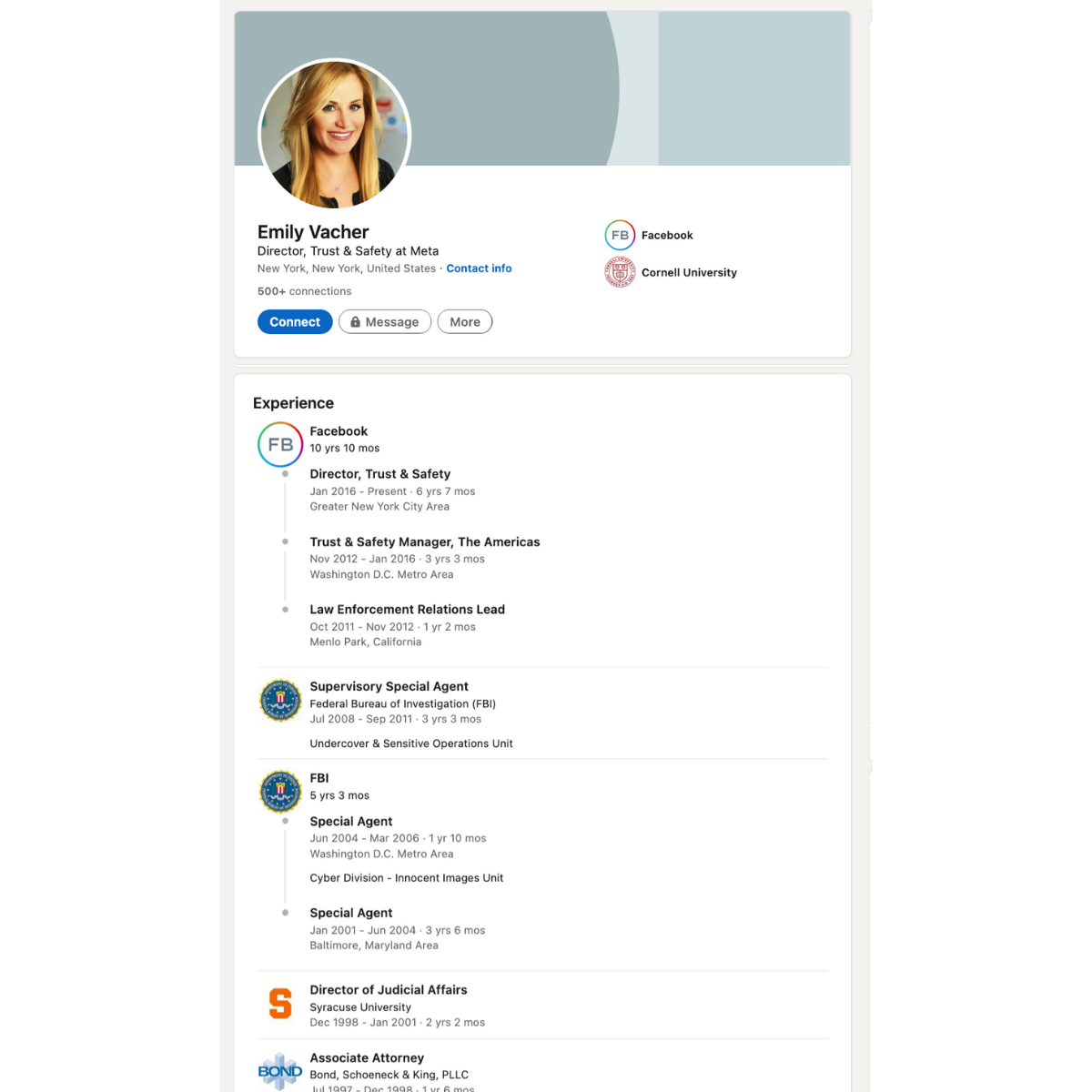
Individuals from other state institutions abound as well. Emily Vacher was an FBI employee between 2001 and 2011, rising to the rank of supervisory special agent. From there she was headhunted by Facebook/Meta, and is now a director of trust and safety. Between 2010 and 2020, Mike Bradow worked for USAID, eventually becoming deputy director of policy for the organization. USAID is a U.S. government-funded influence organization which has bankrolled or stage managed multiple regime change operations abroad, including in Venezuela in 2002, Cuba in 2021, and ongoing attempts in Nicaragua. Since 2020, Meta has employed Bradow as a misinformation policy manager.
Others have similar pasts. Neil Potts, a former intelligence officer with the U.S. Marine Corps, is vice president of trust and safety at Facebook. In 2020, Sherif Kamal left his job as a program manager at the Pentagon to take up the post of Meta trust and safety program manager.
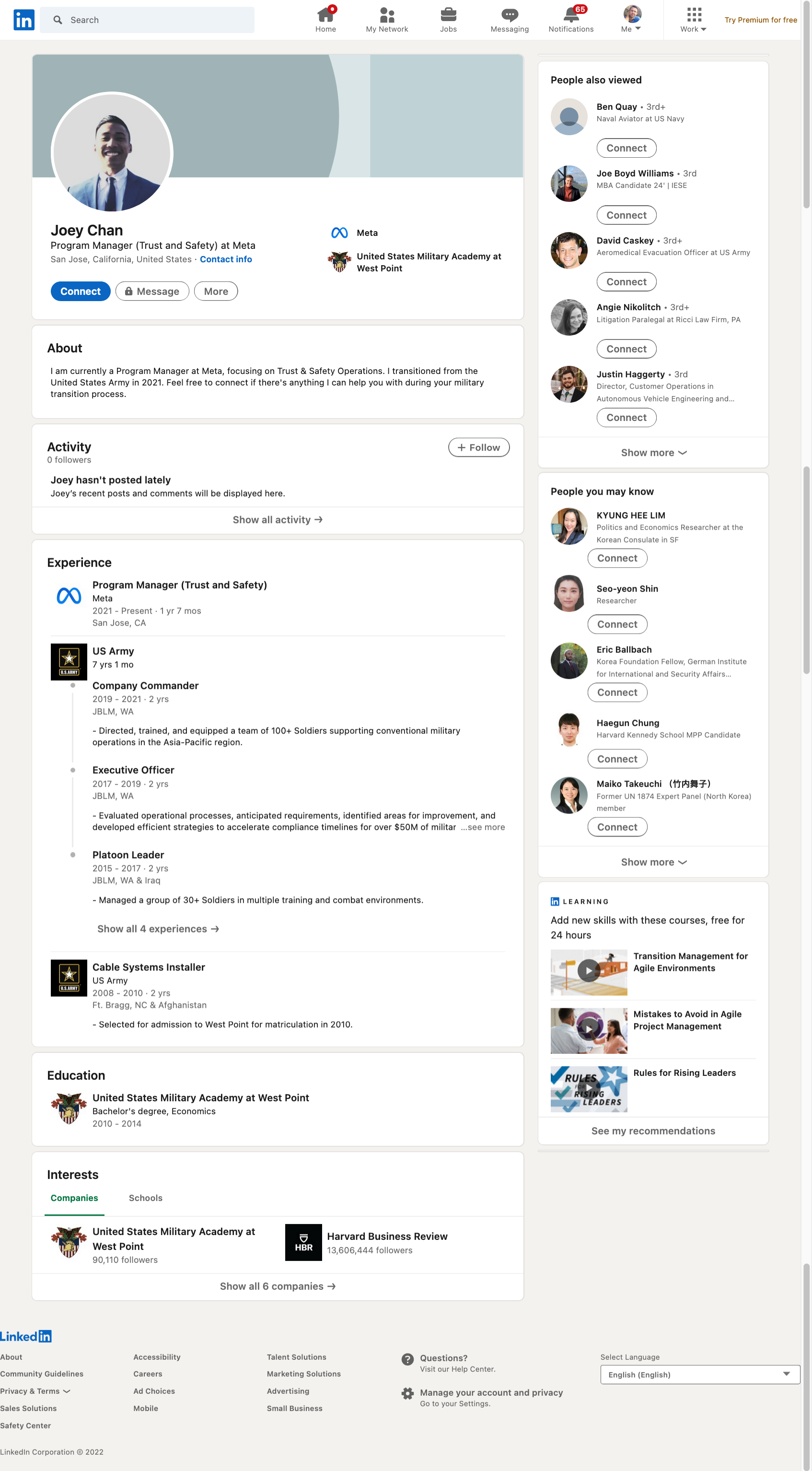
Joey Chan currently holds the same trust and safety post as Kamal. Until last year, Chan was a U.S. Army officer commanding a company of over 100 troops in the Asia Pacific region.
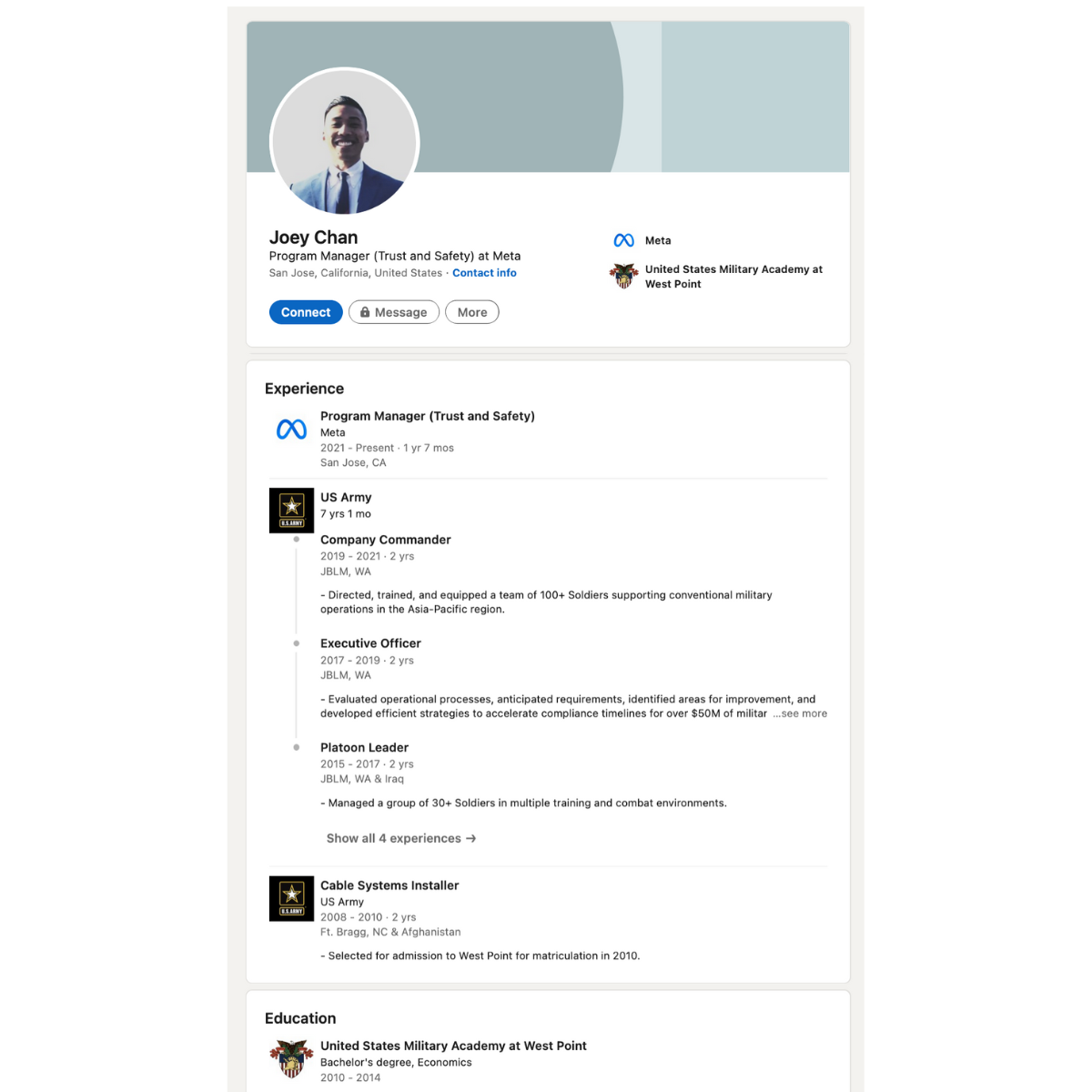
None of this is to say that any of those named are not conscientious, that they are bad people or bad at their job. Vacher, for example, helped design Facebook’s amber alert program, notifying people to missing children in their area. But hiring so many ex-U.S. state officials to run Facebook’s most politically sensitive operations raises troubling questions about the company’s impartiality and its proximity to government power. Meta is so full of national security state agents that at some point, it almost becomes more difficult to find individuals in trust and safety who were not formerly agents of the state.
Despite its efforts to brand itself as a progressive, “woke” organization, the Central Intelligence Agency remains deeply controversial. It has been charged with overthrowing or attempting to overthrow numerous foreign governments (some of them democratically elected), helping prominent Nazis escape punishment after World War Two, funnelling large quantities of drugs and weapons around the world, penetrating domestic media outlets, routinely spreading false information and operating a global network of “black sites” where prisoners are repeatedly tortured. Therefore, critics argue that putting operatives from this organization in control of our news feeds is deeply inappropriate.
One of these critics is Elizabeth Murray, who, in 2010, retired from a 27-year career at the CIA and other U.S. intelligence organizations. “This is insidious,” Murray told MintPress, adding,
I see it as part of the gradual and sinister migration of ambitious young professionals originally trained (with CIA’s virtually unlimited, U.S.-taxpayer funded pot of resources) to surveil and target ‘the bad guys’ during the so-called Global War on Terror of the post-9-11 era.”
MintPress also contacted Facebook/Meta for comment but has not received a response.
ARM’S LENGTH CONTROL
Some may ask what the big fuss is. There is a limited pool of individuals with the necessary skills and experience in these new tech and cybersecurity fields, and many of them come from government institutions. Casinos, after all, regularly hire card sharks to protect themselves. But there is little evidence that this is a poacher-turned-gamekeeper scenario; Facebook is certainly not hiring whistleblowers. The problem is not that these individuals are incompetant. The problem is that having so many former CIA employees running the world’s most important information and news platform is only one small step removed from the agency itself deciding what you see and what we do not see online – and all with essentially no public oversight.
In this sense, this arrangement constitutes the best of both worlds for Washington. They can exert significant influence over global news and information flows but maintain some veneer of plausible deniability. The U.S. government does not need to directly tell Facebook what policies to enact. This is because the people in decision-making positions are inordinately those who rose through the ranks of the national security state beforehand, meaning their outlooks match those of Washington’s. And if Facebook does not play ball, quiet threats about regulation or breaking up the company’s enormous monopoly can also achieve the desired outcomes.
Again, this article is not claiming that any of the named individuals are nefarious actors, or even that they are anything but model employees. This is a structural problem. Put another way, if Facebook were hiring dozens of managers from Russian intelligence agencies like the FSB or GRU, everybody would recognize the inherent dangers. It should be little different when it hires individuals from the CIA, an organization responsible for some of the worst crimes of the modern era.
FROM STATE INTELLIGENCE TO PRIVATE INTELLIGENCE
Facebook has also hired a plethora of ex-national security state officers to run its intelligence and online security operations. Until 2013, Scott Stern was a targeting officer at the CIA, rising to become chief of targeting. In this role, he helped select the targets for U.S. drone strikes across South and West Asia. Today, however, as a senior manager of risk intelligence for Meta, “misinformation” and “malicious actors” are his targets. Hopefully he is more accurate at Facebook than at the CIA, where the government’s own internal assessments show that at least 90% of Afghans killed in drone strikes were innocent civilians.
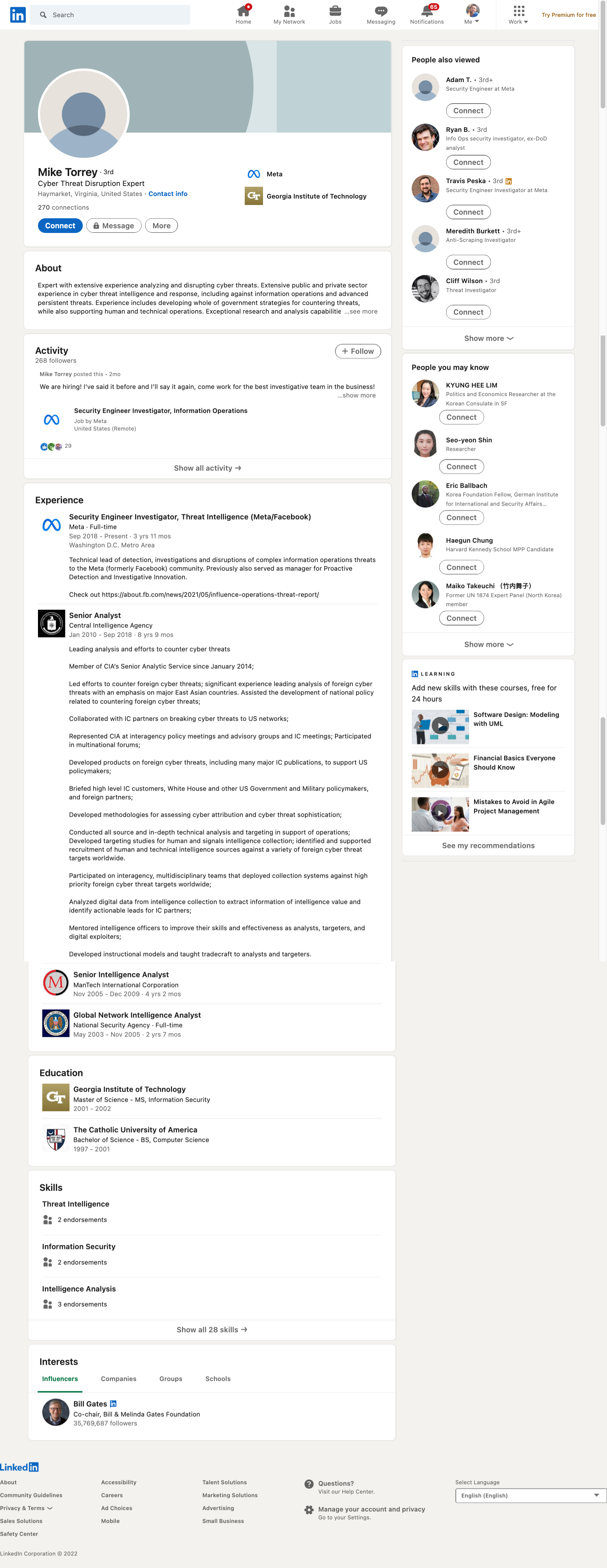
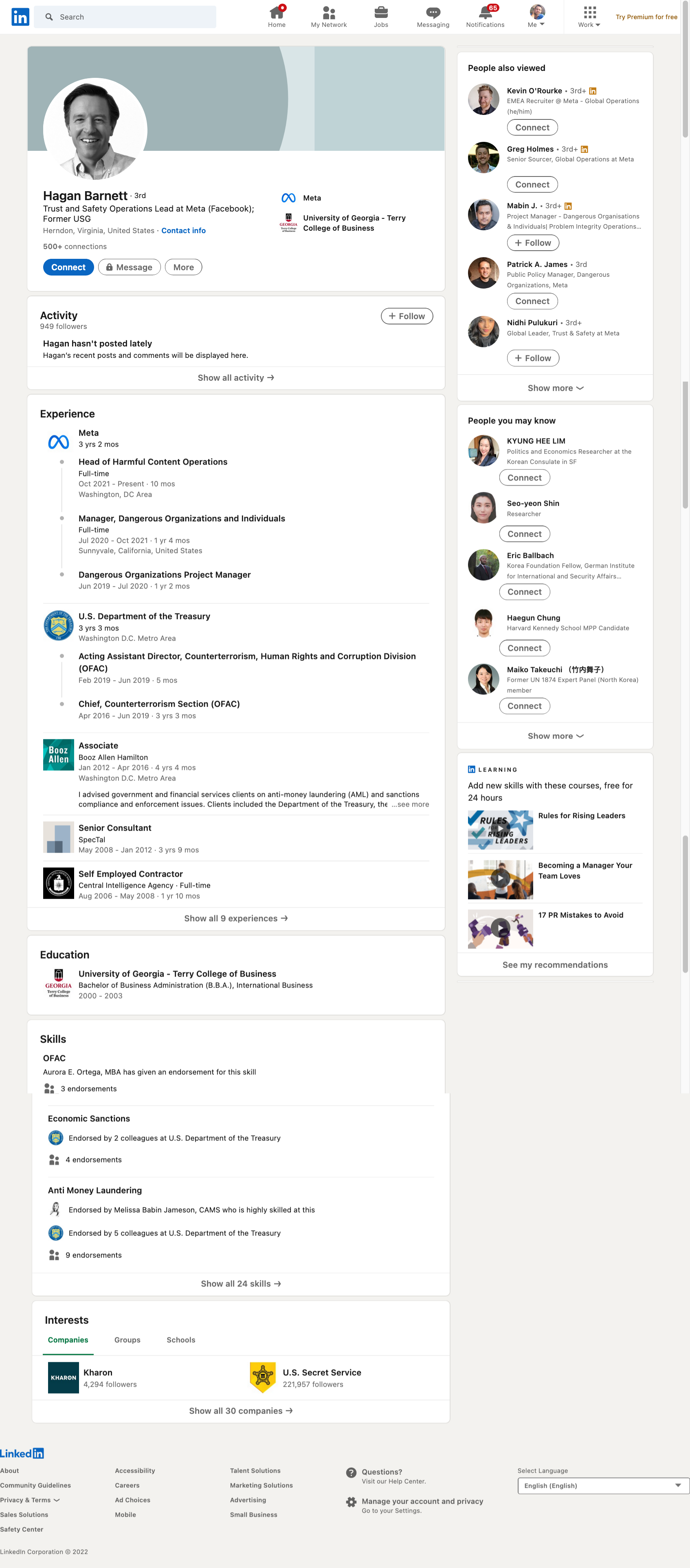
Other former CIA men at Facebook include Mike Torrey, who left his job as a senior analyst at the agency to become Meta’s technical lead of detection, investigations and disruptions of complex information operations threats, and former CIA contractor Hagan Barnett, who is now head of harmful content operations at the Silicon Valley giant.
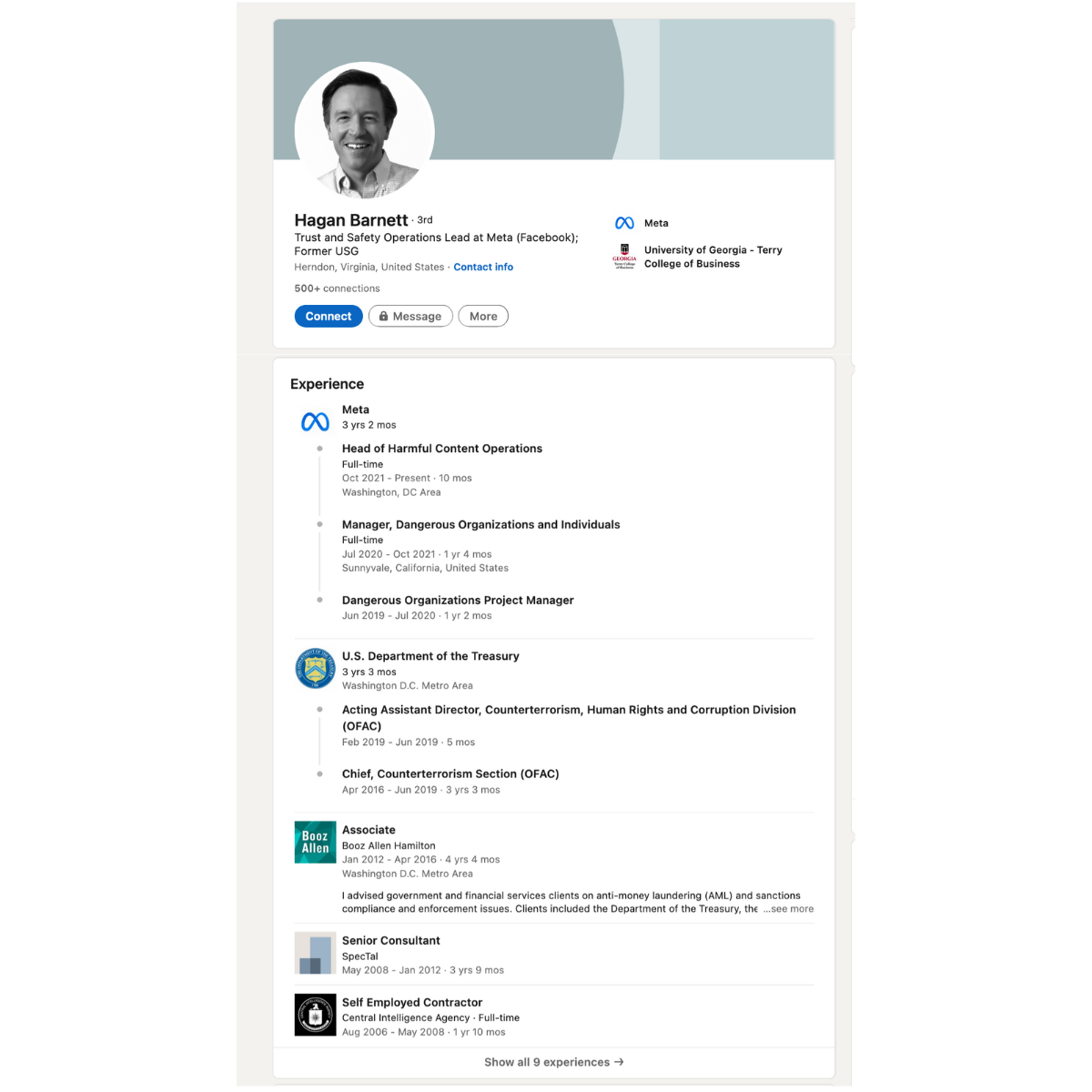 Meta’s intelligence and online security team includes individuals from virtually every government agency imaginable. In 2015, Department of Defense intelligence officer Suzanna Morrow left her post to become director of global security intelligence for Meta. The FBI is represented by threat investigations manager Ellen Nixon and head of cyber espionage investigations Mike Dvilyanski. Facebook’s influence operations policy manager Olga Belogolova had stints at the State Department and the Office of the Secretary of Defense.
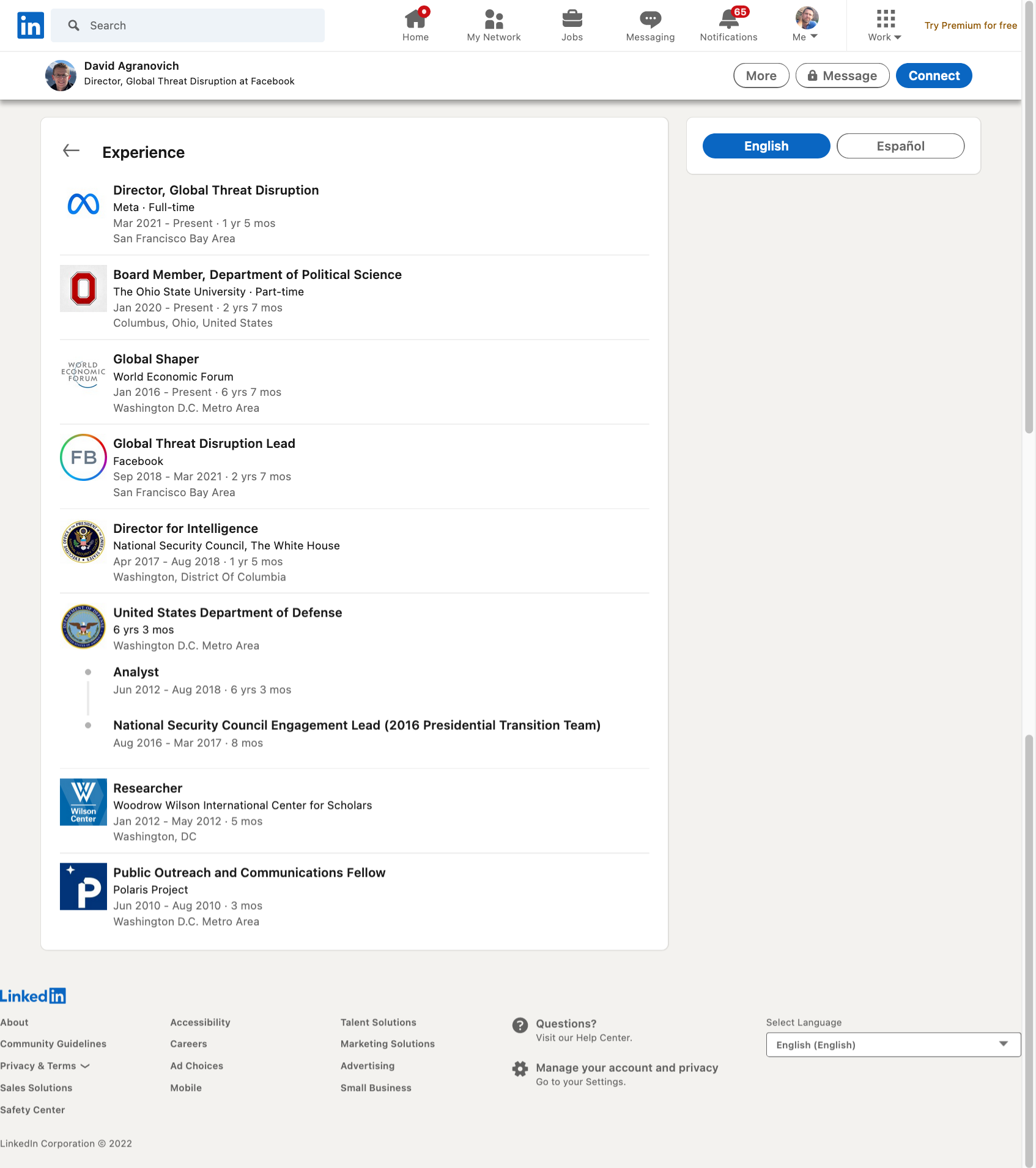
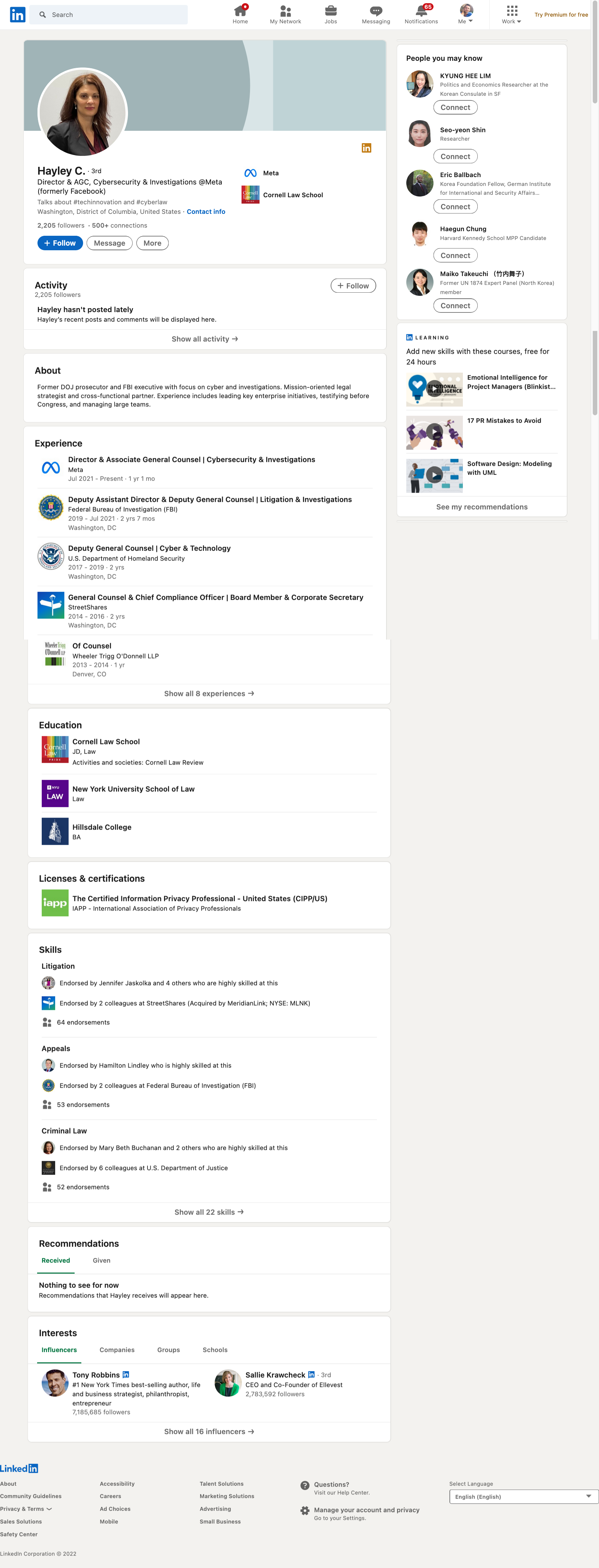
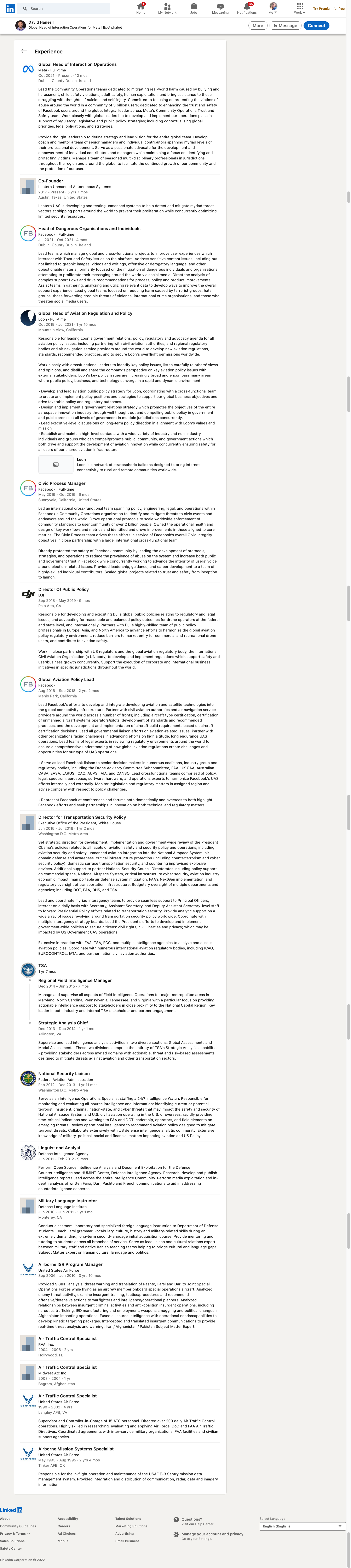
Before Meta, David Agranovich and Nathaniel Gleicher both worked for the National Security Council. Agranovich is director of global threat disruption at Facebook while Gleicher is head of security policy. Hayley Chang, director and associate general counsel for cybersecurity and investigations, worked formerly for both the FBI and Department of Homeland Security. And Meta’s global head of interaction operations, David Hansell, was once an Air Force and Defense Intelligence Agency man.

One of Meta’s most outwardly-facing employees is its global threat intelligence lead for influence operations, Ben Nimmo, a character MintPress has covered before. Between 2011 and 2014, he served as NATO’s press officer, moving the next year to the Institute for Statecraft, a U.K. government-funded propaganda operation aimed at spreading misleading information about enemies of the British state. He was also a senior fellow at the Atlantic Council, NATO’s semi-official think tank.
Perhaps then, it is not surprising that Facebook never seems to find U.S. government influence operations online – they are part of one!
CYBER WAR, CYBER WARRIORS
While Meta has not unmasked any nefarious U.S. government action, it regularly uncovers what it claims are foreign disinformation campaigns. According to a recent Facebook report, the top five locations of coordinated inauthentic behavior between 2017 and 2020 on its platform are Russia, Iran, Myanmar, the United States and Ukraine. However, it was at pains to note that American operations were driven by fringe far-right elements, white supremacists and conspiracy theorists, and not the government.
This is despite the fact that it is now well-established that the Pentagon fields a clandestine army of at least 60,000 people whose job is to influence public opinion, the majority of them doing so from their keyboards. A Newsweek exposé from last year called it “The largest undercover force the world has ever known,” adding,
The explosion of Pentagon cyber warfare, moreover, has led to thousands of spies who carry out their day-to-day work in various made-up personas, the very type of nefarious operations the United States decries when Russian and Chinese spies do the same.”
Newsweek warned that this army was likely breaking both U.S. and international law by doing so, explaining that,
These are the cutting-edge cyber fighters and intelligence collectors who assume false personas online, employing ‘nonattribution’ and ‘misattribution’ techniques to hide the who and the where of their online presence while they search for high-value targets and collect what is called ‘publicly accessible information’—or even engage in campaigns to influence and manipulate social media.”
As far back as 2011, The Guardian was reporting on this enormous cyber force, whose job it was to “secretly manipulate social media sites by using fake online personas to influence internet conversations and spread pro-American propaganda.” Yet the ex-military and ex-CIA officials Facebook employs do not seem to have found any trace of their former colleagues’ at work on the platform.
DIGITALLY SWINGING ELECTIONS
Since its beginnings in 2004, Facebook has grown to become a massive global empire and by far the most important news distributor the planet has ever known. The company boasts almost 3 billion active users, meaning that nearly 2 in 5 people worldwide use the platform. A recent 12-country study suggested that around 30% of the entire world gets its news via their Facebook feeds. This gives whoever is in charge of curating those feeds and controlling those algorithms inestimable power. It also represents a serious national security threat for all other countries, especially those that might wish to take a path independent from the United States. That those people are in large part former spooks makes this threat all the more perilous.
This is far from a hypothetical quandary. In November, less than a week before the country’s election, Facebook took the decision to delete hundreds of pages and accounts belonging to individuals and groups that supported the Nicaraguan Sandinista party – a longtime U.S. target for regime change. These included many of the nation’s most influential journalists and media outlets. Considering that around half of the country uses the platform for news and entertainment, the decision could barely have been more intrusive, and was likely designed to try to swing the election towards the pro-U.S. candidate.
Facebook claims that those accounts were bots engaged in “inauthentic behavior.” When those individuals migrated on to Twitter, recording videos identifying who they were to show they were not bots, Twitter immediately deleted those accounts too, in what was dubbed a coordinated attempt at suppression.
The individual behind this attempt was the aforementioned Ben Nimmo, who co-authored an unconvincing report, full of questionable assumptions and allegations. This included an insinuation that accounts following a pattern of activity whereby their Facebook usage levels peaked in the morning and afternoon and dwindled to almost nothing after midnight Nicaragua time suggested they were bots.
Facebook was also used by right-wing Cubans to attempt a U.S.-backed color revolution against the ruling Communist government last year.
Giving any individual or group that much control over the airwaves of communication raises huge questions about national security and sovereignty – doubly so when those individuals are so intimately connected to the U.S. national security state.
When asked what the public’s reaction would be to the news of such an intimate connection between Facebook her former employer, Murray stated that she was unsure whether many would be bothered:
I would like to think that the American public would strenuously object. However the CIA and other agencies have worked over many decades to cultivate a positive – indeed almost glamorous – image in the eyes of the vast majority of the public, mostly through TV series, Hollywood films, and favorable media coverage – so sadly my guess is that the vast majority of the public probably believes that these are the folks who should be in charge.”
However, she said, the news would likely land a very different way in countries that have been the target of Washington’s ire. “As you’re no doubt aware, the CIA has an atrocious public reputation in most parts of the world,” she added.
SPOOKS IN EVERY DEPARTMENT
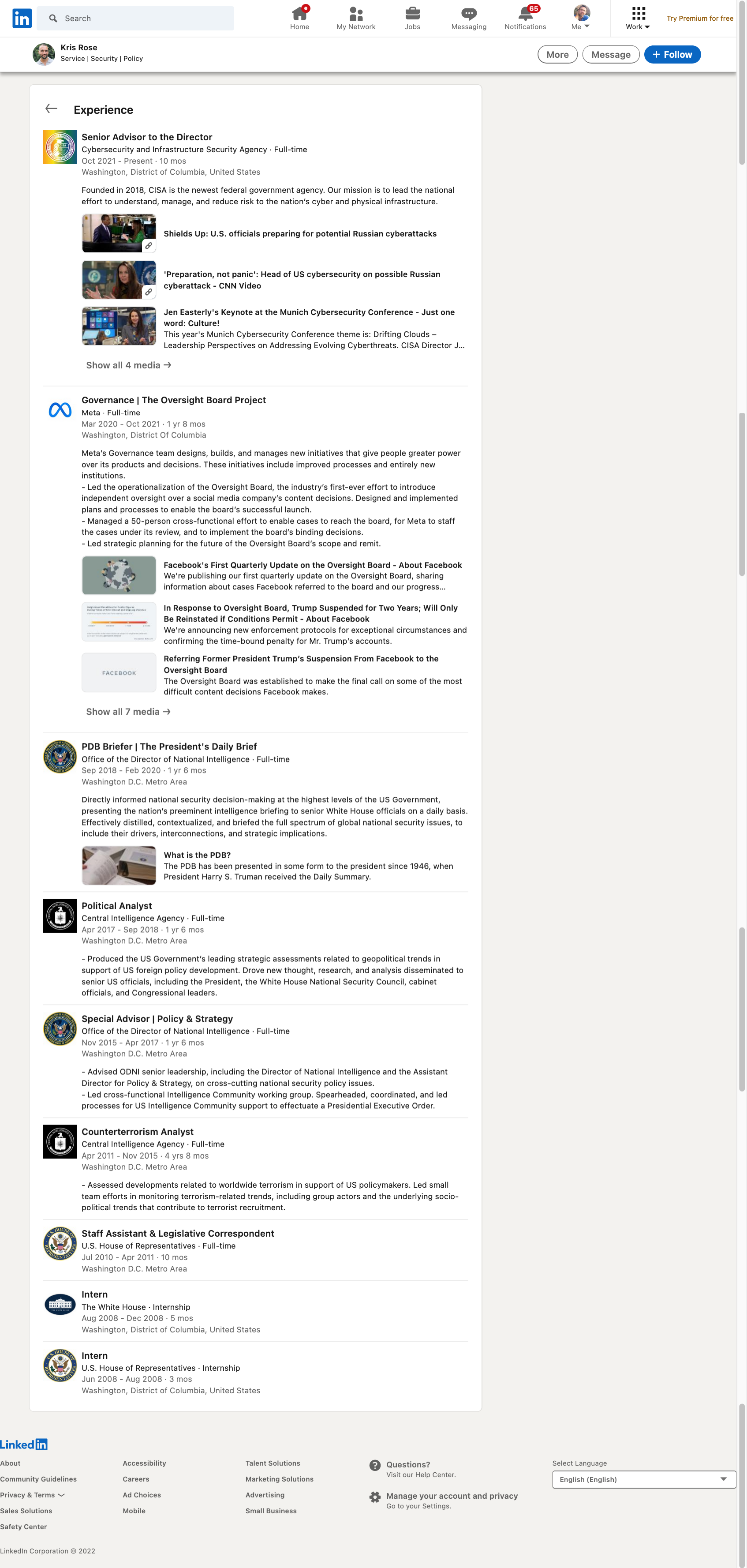
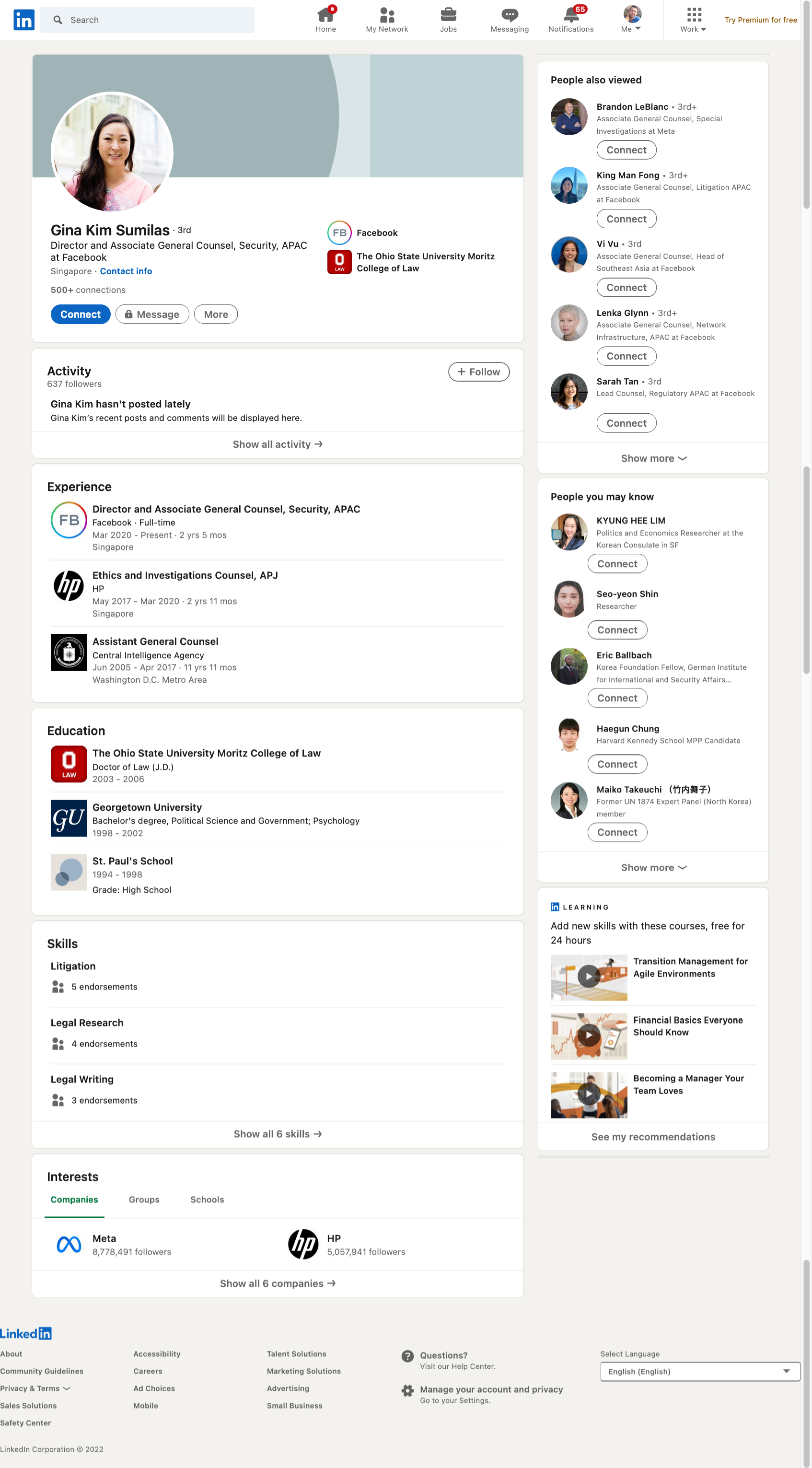
MintPress has found former representatives of the U.S. national security state in virtually every politically sensitive department at Facebook. This includes even higher levels. Between 2020 and 2021, Kris Rose was a member of Meta’s governance oversight board – the group responsible for the overall direction of the platform. He left his job at the Director of National Intelligence as the president’s daily brief writer to take up the role. Before that, he had spent six years at the CIA as a political and counterterrorism analyst. Meanwhile, Gina Kim Sumilas, Facebook’s director and associate general counsel for the Asia Pacific region, spent nearly twelve years in the CIA before moving into the tech private sector.
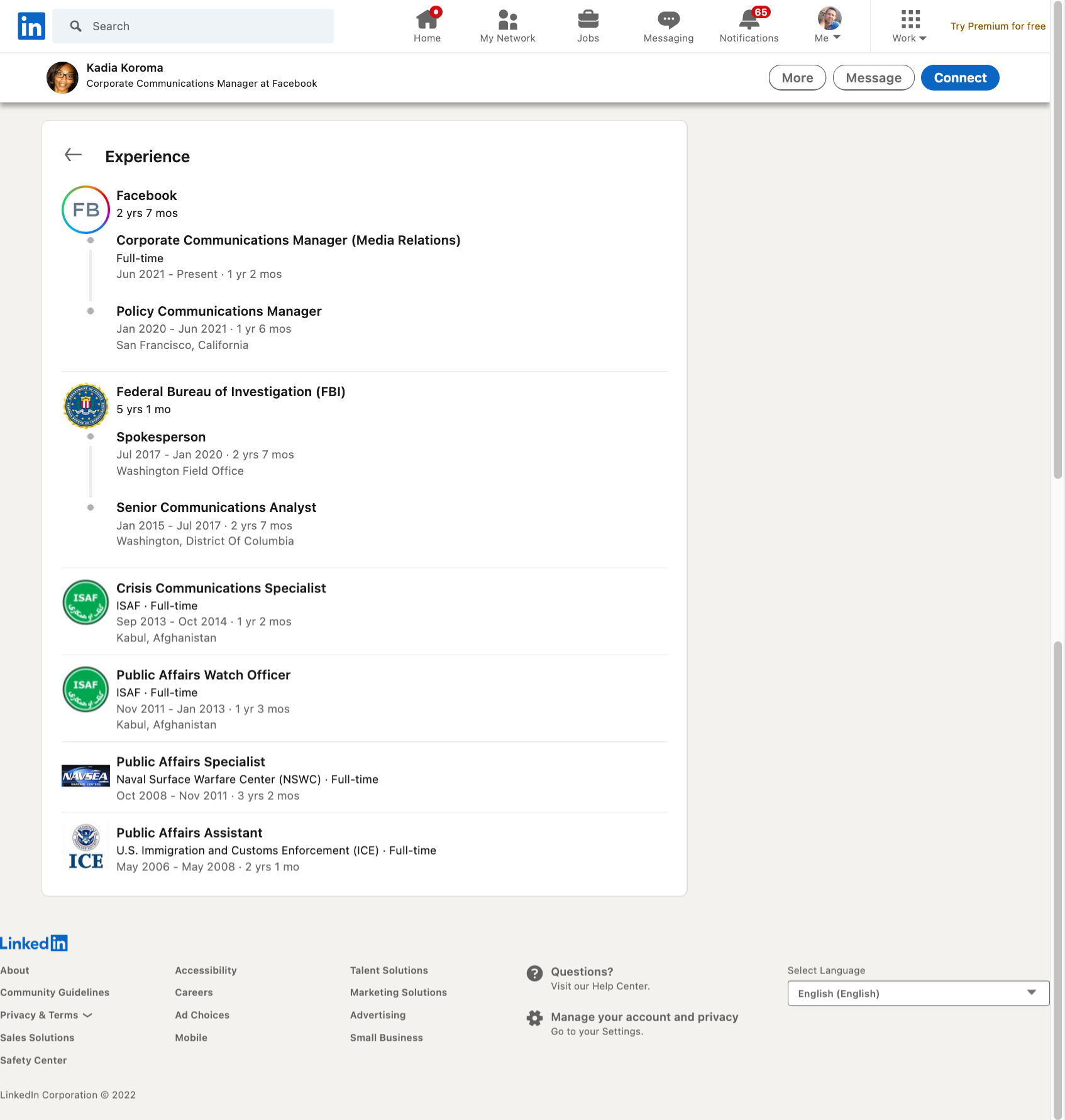
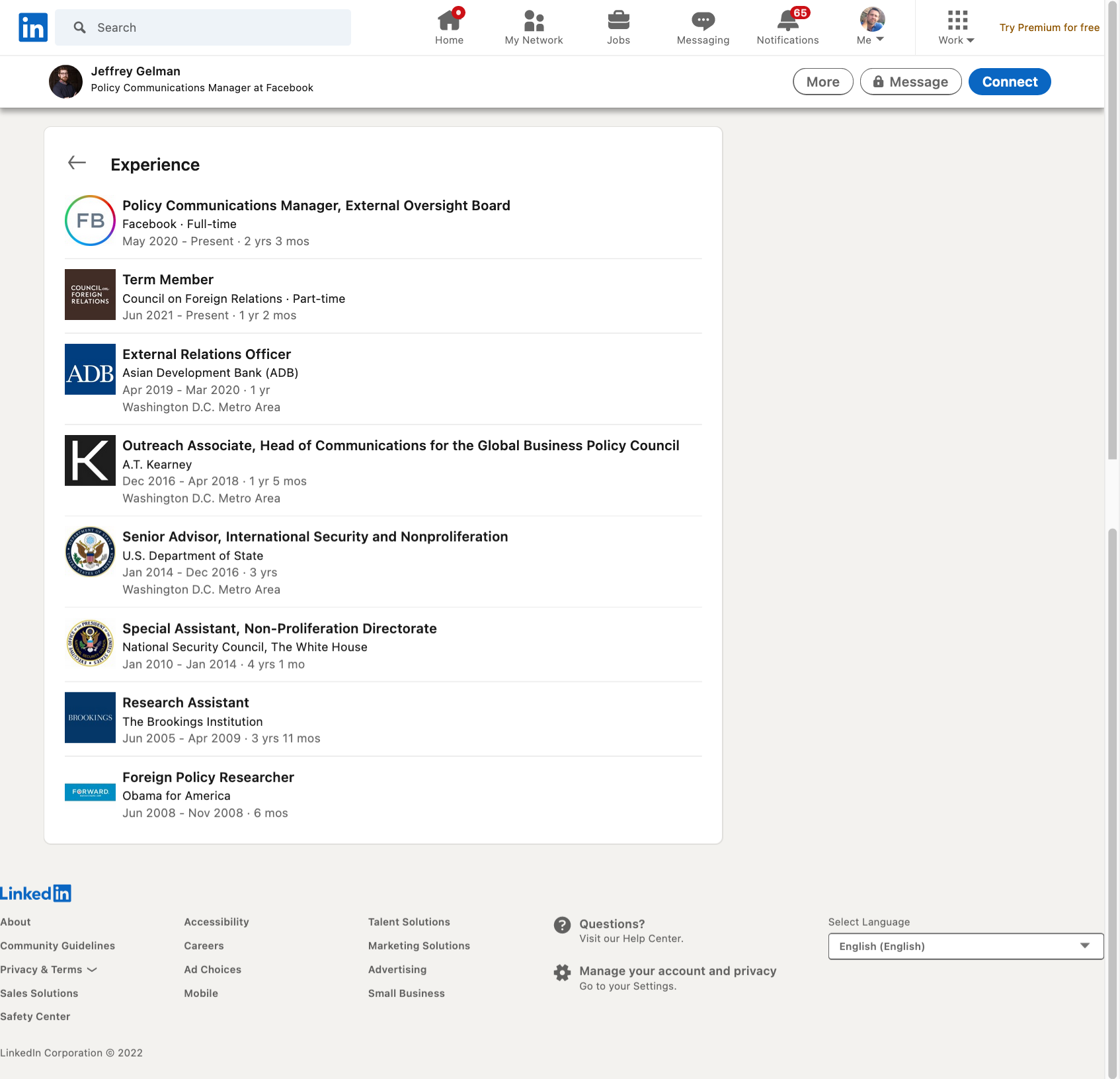
There is also considerable overlap with the U.S. government in the company’s front facing staff. Kadia Koroma, for instance, was plucked from her position as an FBI spokesperson in January 2020 to become media relations manager at Facebook. Jeffrey Gelman, policy communications manager for Facebook’s oversight board, is a member of the Council on Foreign Relations and held influential roles in both the State Department and the National Security Council. And executive communications spokesman Kevin Lewis spent many years in the White House as President Obama’s spokesperson.
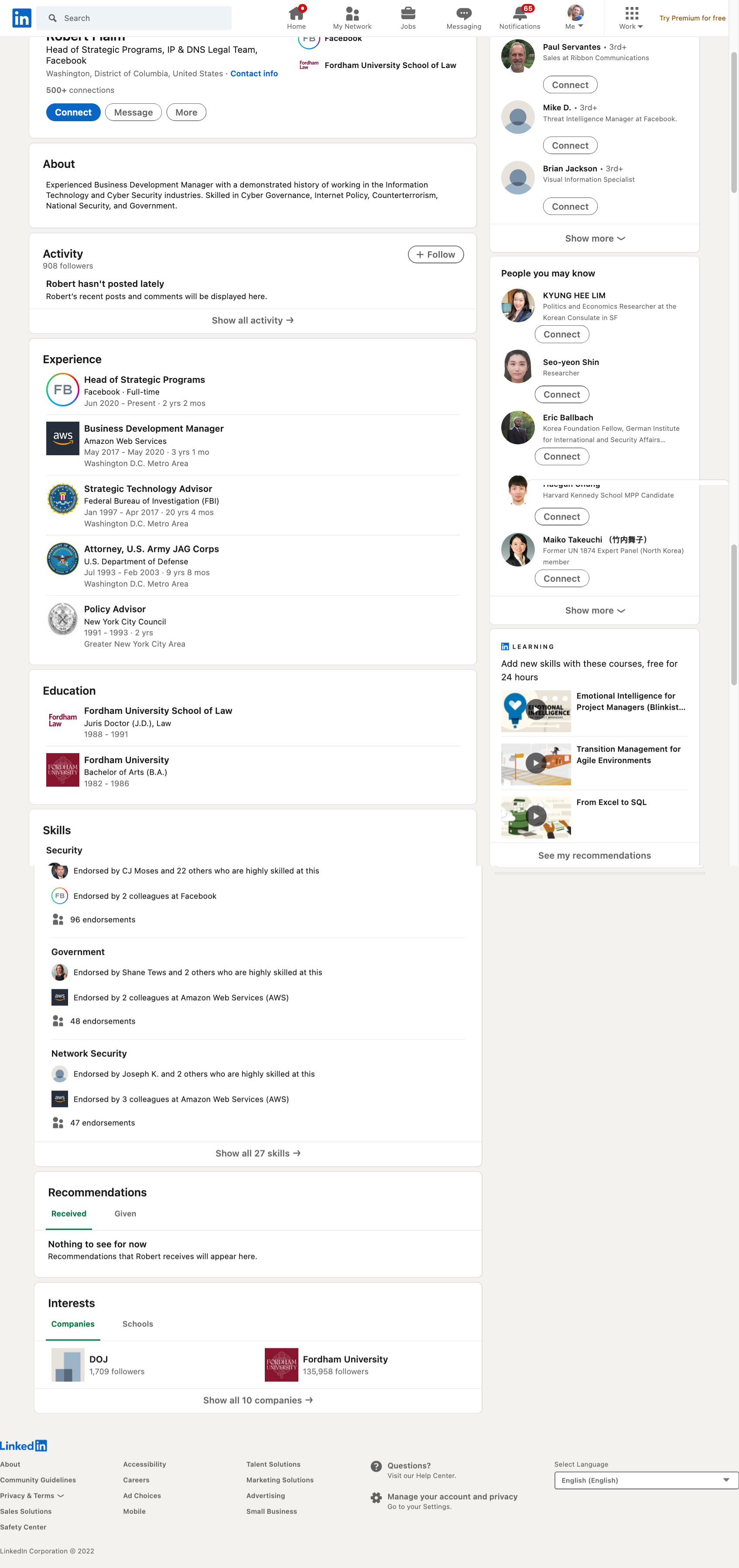
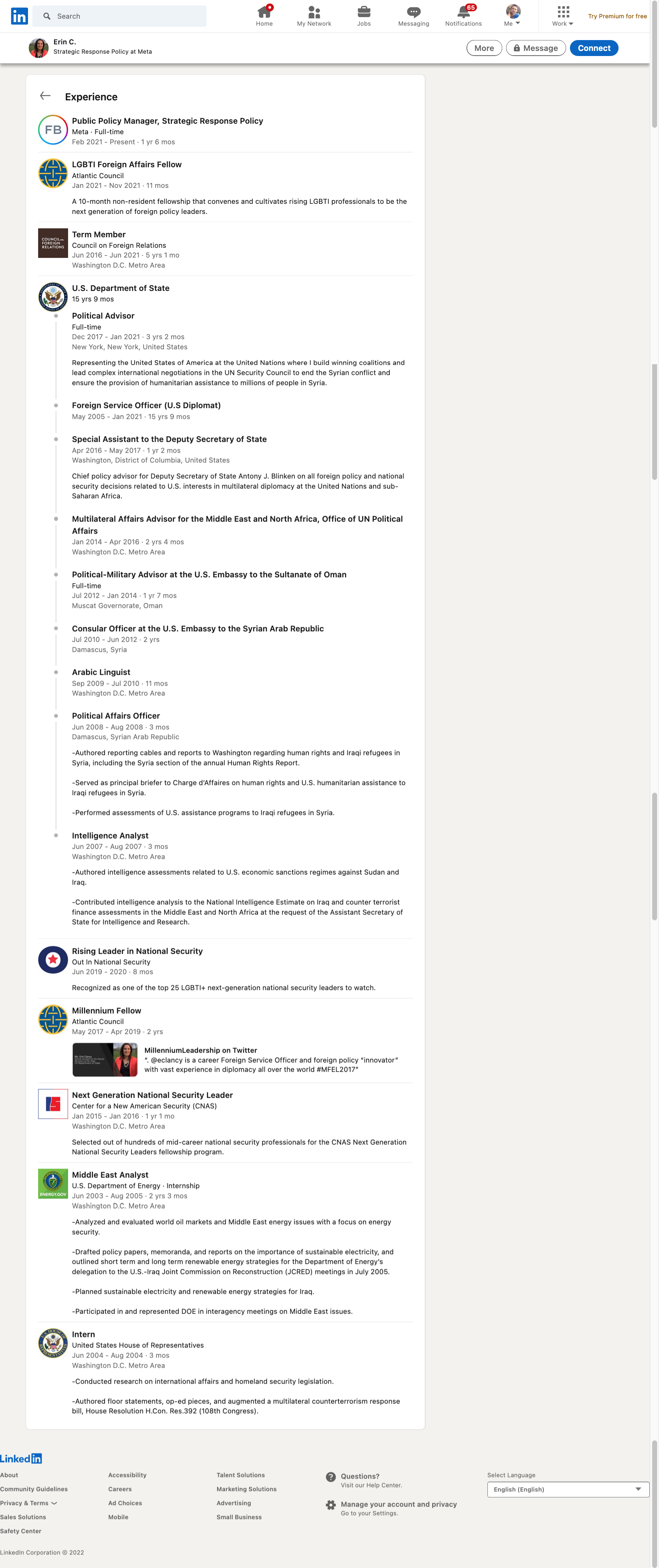
Meta’s vice president of legal strategy is Rachel Carlson Lieber, who went straight from the CIA into Facebook. Her first role at the Silicon Valley giant was as head of the North America regulatory and strategic response, a department that continues to feature a number of former state officials. This includes head of strategic programs, Robert Flaim, who spent more than twenty years as an FBI, and Erin Clancy, who left a 16-year career at the State Department to become a manager of strategic response policy.
Clancy’s official work centered around U.S. policy in the Middle East. Her own bio boasts that she worked on the U.S. sanctions regime placed on Iraq and Sudan. She also worked at the U.S. Embassy in Damascus at the time of the Arab Spring and the beginning of the Syrian Civil War. It is known that she also coordinated closely with the White Helmets, a controversial aid organization that some have alleged is far too close to Al-Qaeda and its affiliates. Even after her Facebook appointment, Clancy moonlighted as a member of the Council on Foreign Relations and as a fellow at the Atlantic Council, the hawkish body that serves as NATO’s brain trust.
Why are these national security state officials so attractive to Meta? One reason, Murray explained, is financial. “By snagging a CIA employee a company can save a considerable sum,” she said, explaining that, “The individual has likely undergone extensive professional training (at taxpayer expense) and probably has a security clearance,” something that is difficult, expensive and time-consuming to obtain in private sector work. Therefore, companies dealing with matters of state secrecy (such as defense contractors) have historically courted both current and former officers to fill their ranks, enticing them with much higher salaries than they can receive in government service.
“What is new (or at least newly known to us!) is that now these professionals are being sought after by social media companies like Facebook, Google and others who are now heavily into monitoring, surveilling, and censoring content, and then sharing data about users with U.S. government entities,” Murray added.
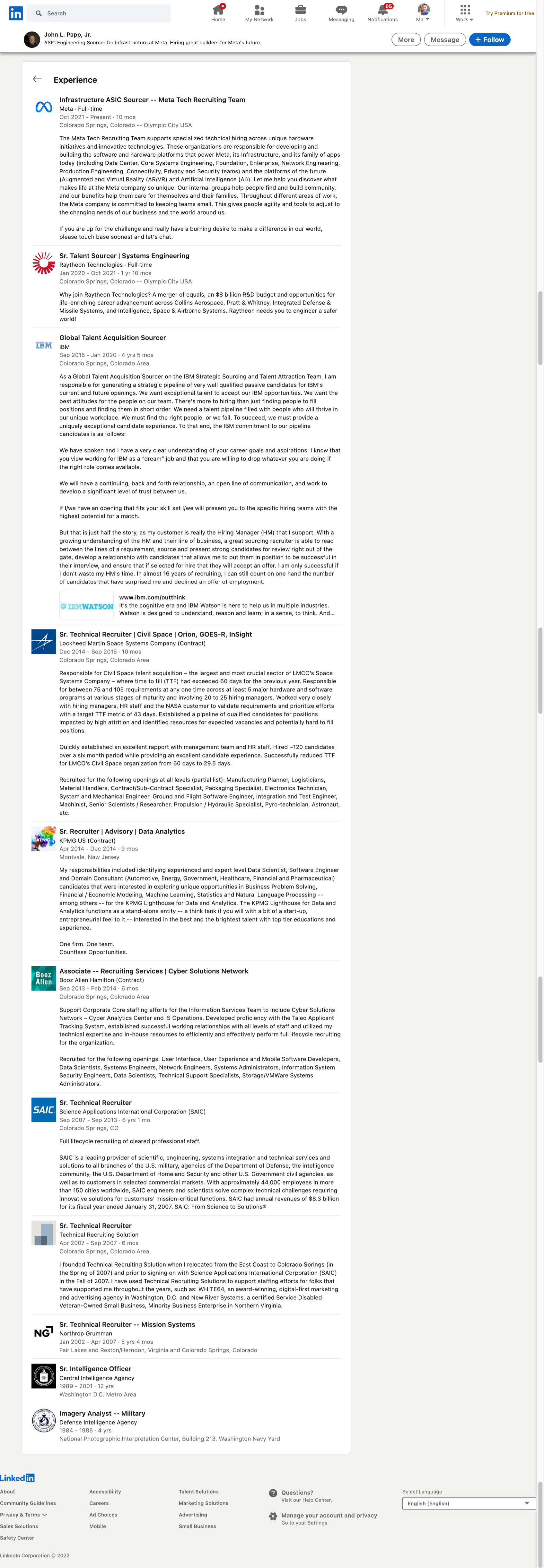
Such is the need for these individuals in these fields that private companies often hire former national security agents to do the recruiting for them. For instance, John Papp, who spent 12 years at the CIA as a senior intelligence officer and 4 years as an imagery analyst at the Defense Intelligence Agency, went on to work as a recruiter for many of the largest defense contractors in Washington. These included Booz Allen Hamilton, Raytheon, Northrop Grumman, IBM and Lockheed Martin. Today, he works as a recruiter for Meta.
Perhaps unsurprisingly, Meta also employs former spooks for their internal security operations. The company’s vice president, chief security officer is Nick Lovrien, a former counterterrorism operations officer at the CIA, while its head of insider protection is ex-CIA operational psychologist and “undercover officer” Nicole Alford.
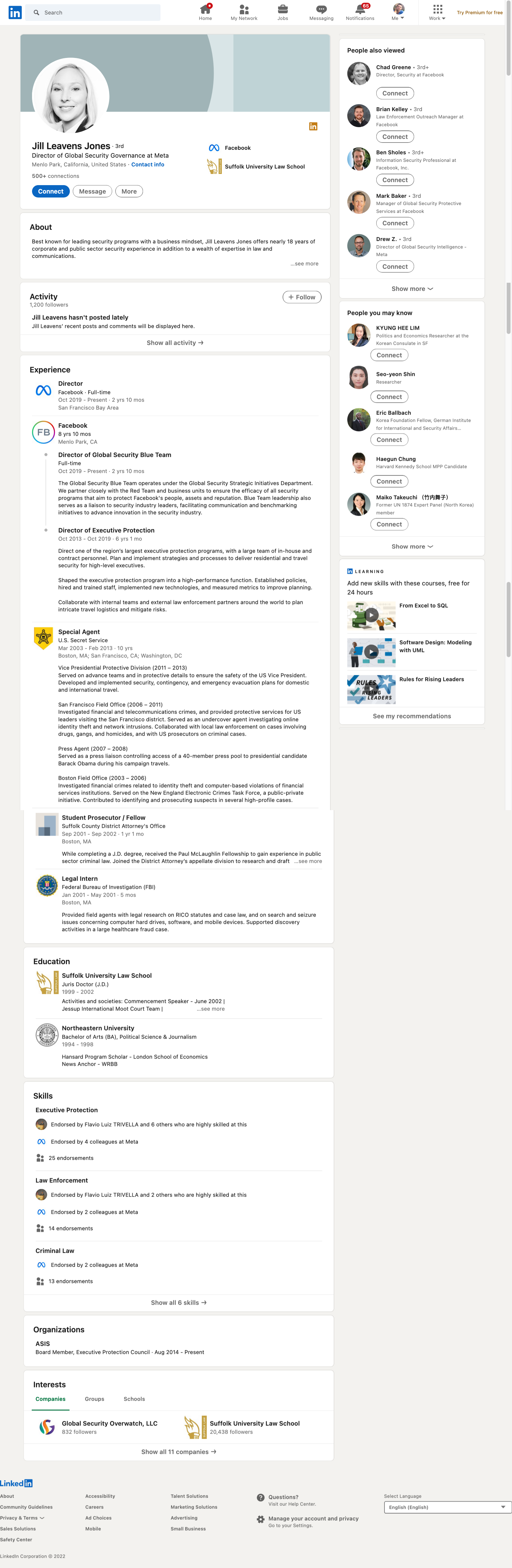
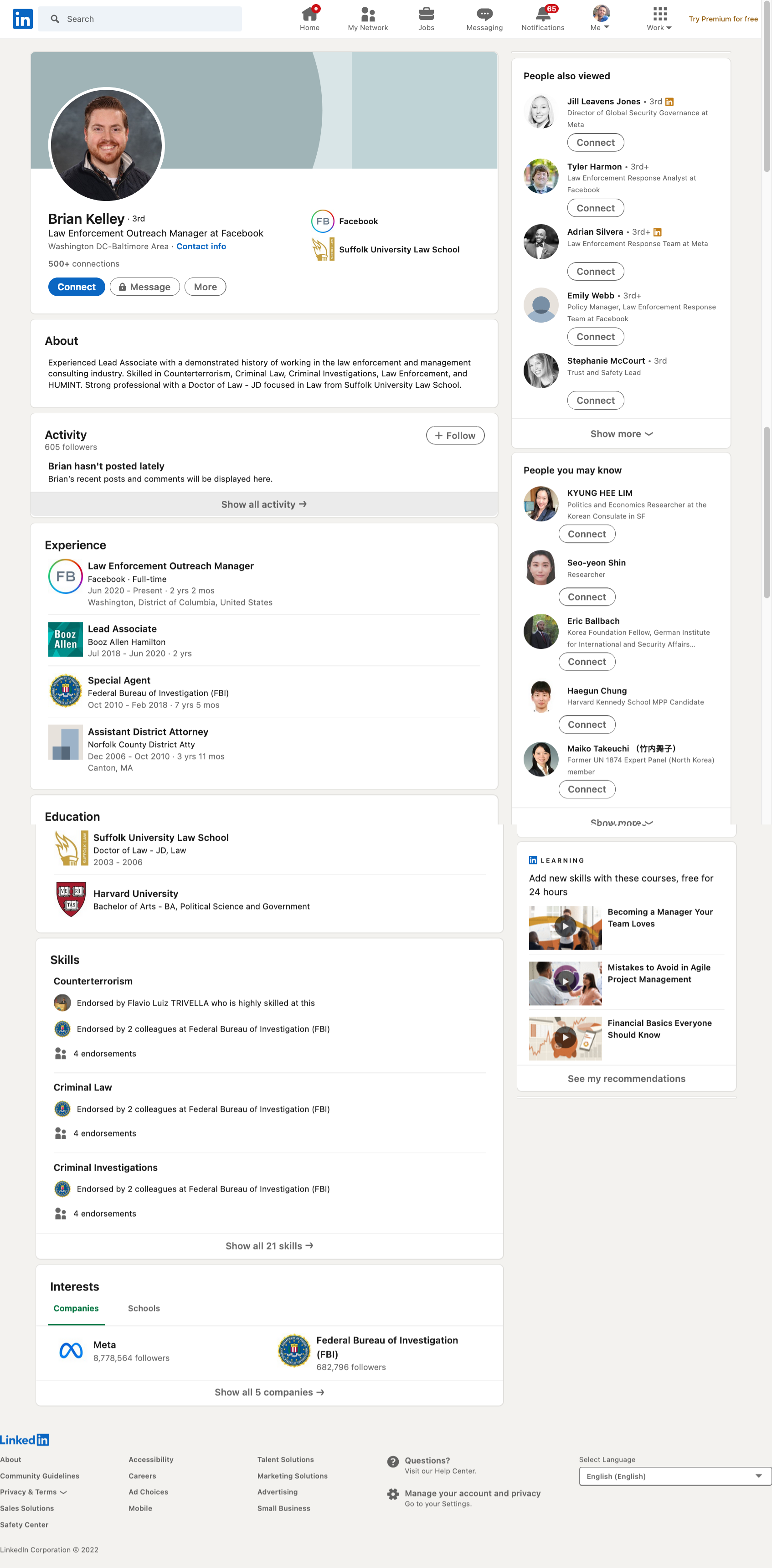
Meanwhile, Meta’s director of global security governance – the individual reportedly responsible for the personal safety of Facebook co-founder Mark Zuckerberg – is Jill Leavens Jones. Jones left her job as a U.S. Secret Service special agent to take the appointment. And director of global security operations Alexander Carrillo continued on as a lieutenant commander in the Coast Guard for several months after his appointment at Facebook. The company also hires former feds to work directly with law enforcement on legal issues. One example of this is former FBI special agent Brian Kelley.
A LONG PATTERN OF INFILTRATION
45 years ago, legendary journalist Carl Bernstein released an investigation documenting how the CIA had managed to infiltrate U.S. and global media. The CIA had placed hundreds of agents into newsrooms and had convinced hundreds more reporters to collaborate with them. These included individuals at some of the most influential outlets, including The New York Times. The CIA needed to do this clandestinely because any attempt to do so openly would harm the effectiveness of the operation and provoke stiff public resistance. But by 2015, there was barely a murmur of disapproval when Reuters announced that it was hiring 33-year veteran CIA manager and director Dawn Scalici as a global director, even when the company announced that her primary responsibility was to “advanc[e] Thomson Reuters’ ability to meet the disparate needs of the U.S. government.”
Facebook, however, is vastly more influential than the New York Times or Reuters, reaching billions of people daily. In that sense, it stands to reason that it would be a prime target of any intelligence organization. It has become so big and ubiquitous that many consider it a de facto public commons and believe it should no longer be treated as a private company. Considering who is making many of the decisions on the platform, that distinction between public and private entities is even more blurry than many presume.
Alan MacLeod is Senior Staff Writer for MintPress News. After completing his PhD in 2017 he published two books: Bad News From Venezuela: Twenty Years of Fake News and Misreporting and Propaganda in the Information Age: Still Manufacturing Consent, as well as a number of academic articles.
FBI Unit Leading Mar-a-Lago Probe Earlier Ran Discredited Trump-Russia Investigation
By Paul Sperry | RealClearInvestigations | August 18, 2022
The FBI division overseeing the investigation of former President Trump’s handling of classified material at his Mar-a-Lago residence is also a focus of Special Counsel John Durham’s investigation of the bureau’s alleged abuses of power and political bias during its years-long Russiagate probe of Trump.
The FBI’s nine-hour, 30-agent raid of the former president’s Florida estate is part of a counterintelligence case run out of Washington – not Miami, as has been widely reported – according to FBI case documents and sources with knowledge of the matter. The bureau’s counterintelligence division led the 2016-2017 Russia “collusion” investigation of Trump, codenamed “Crossfire Hurricane.”
Although the former head of Crossfire Hurricane, Peter Strzok, was fired after the disclosure of his vitriolic anti-Trump tweets, several members of his team remain working in the counterintelligence unit, the sources say, even though they are under active investigation by both Durham and the bureau’s disciplinary arm, the Office of Professional Responsibility. The FBI declined to respond to questions about any role they may be taking in the Mar-a-Lago case.
In addition, a key member of the Crossfire team – Supervisory Intelligence Analyst Brian Auten – has continued to be involved in politically sensitive investigations, including the ongoing federal probe of potentially incriminating content found on the abandoned laptop of President Biden’s son Hunter Biden, according to recent correspondence between the Senate Judiciary Committee and FBI Director Christopher Wray. FBI whistleblowers have alleged that Auten tried to falsely discredit derogatory evidence against Hunter Biden during the 2020 campaign by labeling it Russian “disinformation,” an assessment that caused investigative activity to cease.
Auten has been allowed to work on sensitive cases even though he has been under internal investigation since 2019, when Justice Department Inspector General Michael Horowitz referred him for disciplinary review for his role in vetting a Hillary Clinton campaign-funded dossier used by the FBI to obtain a series of wiretap warrants to spy on former Trump campaign adviser Carter Page. Horowitz singled out Auten for cutting a number of corners in the verification process and even allowing information he knew to be incorrect slip into warrant affidavits and mislead the Foreign Intelligence Surveillance Act court.
In congressional testimony this month, Wray confirmed that “a number of” former Crossfire Hurricane team members are still employed at the bureau while undergoing disciplinary review. In the meantime, Wray has walled off the former Russiagate investigators only from participating in FISA wiretap applications, according to the sources.
Sen. Chuck Grassley, the ranking Republican on the Senate Judiciary Committee, has asked Wray for copies of recent case files and reports generated by Auten and whether he is included among the team the FBI has assembled to determine which of the seized Trump records fall within the scope of its counterespionage investigation and which fall outside of it.
Some former FBI officials worry that Auten, a top bureau expert on Russia and nuclear warfare, will have a hand in analyzing the boxes of documents agents seized from Trump’s home on Aug. 8 to help determine if any of the alleged Top Secret material he kept there might have been compromised, potentially putting national security at risk.
“It is a disgrace that Auten is still even employed by the bureau,” said 27-year FBI veteran Michael Biasello. “I would substitute other analysts and agents.”
An examination of the bureau agents involved in the Mar-a-Lago raid reveals other connections between them and FBI officials who played key roles in advancing the Russiagate hoax.
Sources told RealClearInvestigations that Jay Bratt, the top counterintelligence official in Justice’s national security division, who happens to be a Democratic National Committee donor, has been coordinating the Mar-a-Lago investigation with Alan Kohler, who heads the FBI’s counterintelligence division.
Kohler replaced Bill Priestap in that post after Priestap stepped down from the bureau amid criticism of his role in the Russiagate probe. Kohler had worked at FBI headquarters under Priestap, specializing in countering Russian intelligence threats.
Before that, he worked in London as the FBI’s liaison with British intelligence and law enforcement. The sources say Kohler was close to Stefan Halper, an academic and longtime FBI contractor whom the bureau ran as an informant in a failed effort to suborn Trump campaign officials. He also worked closely with Stephen Somma, a lead case agent in the Crossfire Hurricane probe whom Horowitz said was “primarily responsible” for some of the worst misconduct in the FISA warrant abuse scandal. Somma is a counterintelligence investigator in the FBI’s New York field office, where he has been reassigned to the China desk.
In 2019, Kohler was promoted to special agent in charge of the counterintelligence division at the FBI’s Washington field Office, where he worked alongside then-assistant agent-in-charge Timothy Thibault, who was reassigned by Wray just days prior to the Mar-a-Lago raid, after whistleblowers raised questions about political bias. They asserted that Thibault, who has taken aim at Trump and Republicans on social media, worked with Auten to falsely discredit evidence of alleged money laundering and other activities against Hunter Biden and prevent agents from investigating them.
The Washington field office’s counterintelligence division is now run by Anthony Riedlinger, who previously worked at FBI headquarters as a section chief under Priestap. Some of the agents involved in the raid on Trump’s home came from that Washington field office, according to the sources and FBI case documents.
Bratt, the top counterintelligence official at Justice, traveled to Mar-a-Lago in early June and personally inspected the storage facility while interacting with both Trump and one of his lawyers. Trump allowed the three FBI agents Bratt brought with him to open boxes in the storage room and look through them. They left with some documents. After leaving, Bratt made a request to Trump’s lawyer for increased security at the facility and asked to see surveillance footage from the security cameras. The lawyer complied with the requests. Months went by before the Justice Department took the politically explosive step of sending FBI agents unannounced to Trump’s home, seizing documents, photos, and other items not just from the storage facility but from multiple rooms on the property, including the former president’s office.
Former assistant FBI director Chris Swecker said the search warrant that agents obtained is quite wide-ranging. He pointed out that it authorized the seizure of any information in any form related to “national defense information,” which he said “does not necessarily include classified material.”
“This is a huge, broad search warrant and a huge, broad investigation leveled against the former president,” Swecker said.
What’s more, he said the physical search of the former president’s residence was far more sweeping than first reported and included unsupervised snooping in several dozen bedrooms, as well as numerous storage rooms and closets, including those of the former first lady. FBI agents took numerous boxes and containers of documents and other material, including several binders of photos and even three passports held by the former president.
Although Attorney General Merrick Garland has said that the DOJ seeks to “narrowly scope any search that is undertaken,” details of the warrant reveal agents had the authority to seize entire boxes of records – including those potentially covered by attorney-client privilege and executive privilege – if just a single document inside the container were marked with a classified marking.
Agents were allowed to also seize any containers or boxes “found together with” ones containing classified papers, according to ATTACHMENT B (“Property to be seized”) of the warrant. In addition, the FBI agents were given the authority to confiscate “any government and/or presidential records created between Jan. 20, 2017, and Jan. 20, 2021,” which covers Trump’s full term in office. That meant they were able to take any item related to the Trump administration.
All told, dozens of boxes and containers were removed from Trump’s residence, very few of which actually contained classified information, the sources said.
According to Federal Election Commission records, Bratt has given exclusively to Democrats, including at least $800 to the Democratic National Committee. The sources said he is close to David Laufman, whom he replaced as the top counterintelligence official at Justice. An Obama donor, Laufman helped oversee the Russiagate probe, as well as the Clinton email case, which also involved classified information.
A Senate investigator told RCI that Laufman was the “mastermind” behind the strategy to dust off and “weaponize” the rarely enforced statutory relic – the Foreign Agents Registration Act – against Trump campaign officials, a novel legal move that the investigator noted is similar to the department’s current attempts to enforce the Presidential Records Act against Trump – which is a civil, not a criminal, statute – by invoking the Espionage Act of 1917.
Laufman signed off on the wiretapping of Trump campaign adviser Carter Page, which the Department of Justice inspector general determined was conducted under false pretenses involving doctored email, suppression of exculpatory evidence, and other malfeasance.
Suddenly resurfacing as a media surrogate for the Justice Department defending the Mar-a-Lago raid, Laufman has been a key source for stories by the Washington Post, CNN, and other outlets.
On CNN, for instance, he claimed the documents seized from Trump’s storage were “particularly stunning and particularly egregious,” and their discovery “completely validates the government’s investigation” into the former president – though he quickly added, “Whether this investigation transforms into an outright criminal prosecution remains to be seen.”
Swecker said that there is strong reason to fear that the FBI’s counterintelligence division might politicize this case.
“For sure, the FBI has dug themselves into a huge hole because of how they handled the Clinton (email) case and then Crossfire Hurricane and Hunter Biden,” Swecker said. “Myself and many of my colleagues think they are treading on very thin ice here.”
“Unfortunately,” he added, “you can’t recuse an entire FBI division.”
Patel: ‘It’s Just Insane’
Former federal prosecutor and Trump administration official Kash Patel said the FBI may have a personal interest – and a potential conflict – in seizing the records stored by Trump.
He noted that Trump in October 2020 authorized the declassification of all the investigative records generated from the FBI’s Crossfire Hurricane as well as the Clinton email investigation, codenamed “Midyear Exam,” and he said that the FBI may have confiscated some of those records in its raid, ensuring they won’t be made public. In addition, he said, the agency may be digging for other documents to try to justify, retroactively, their questionable, politically-tinged 2016 opening of the Trump-Russia “collusion” case, which came up embarrassingly short on evidence.
“Tragically, the same FBI characters that were involved in Russiagate are the same counterintel guys running this ‘national security investigation’ against Trump,” said Patel, who deposed Crossfire Hurricane team members as a former House Intelligence Committee investigator.
Patel noted that the Horowitz report indicated FBI analyst Auten hid exculpatory information about Trump’s adviser Page from other investigators and the FISA court, which should be more than enough to keep him at arm’s length from other investigations involving Trump.
“And to top it all off, this guy admits [to Horowitz’s investigators] he’s unrepentant about his role in making up the biggest hoax in election history, and Wray still lets him be a supervisor at the FBI,” he said. “It’s just insane.”
The Justice Department’s national security division has ultimate authority over the grand-jury probe of Trump for possible violations of the Espionage Act, including alleged mishandling of classified material – the same statutes invoked in the Clinton email investigation. (In that case, in contrast, the FBI never searched the former secretary of state’s Chappaqua, N.Y., mansion, where she set up an unsecured basement server to send and receive at least 110 classified emails and where she also received government documents by fax.)
Former FBI counterintelligence official and lawyer Mark Wauck said he is troubled by signs that the same cast of characters from the Russiagate scandal appears to be involved in the Mar-a-Lago investigation.
“If these people, who were part of a major hoax that involved criminal activity and displays of bias and seriously flawed judgment, are still involved, then that’s a major scandal,” he said in an interview.
Is That True Or Did You Hear It On The BBC?
By Paul Homewood | Not A Lot Of People Know That | August 19, 2022
 I have just bought this book, which includes some good stuff on the BBC’s climate lies and misinformation.
I have only read the first couple of chapters, but I would thoroughly recommend it.
This is the Amazon summary:
… not only does the BBC diligently protect power from scrutiny, it attacks and attempts to discredit those who dare to challenge the status quo.
Formed in 1922 by the British establishment, the BBC has always been a reliable ally of ultra-wealthy and powerful interests. Indeed, the broadcaster occupies a pivotal position within an international corporate-political alliance which promotes only those narratives which consolidate the ‘global order.’
Using multiple examples of BBC reporting, the author argues that the tax-payer funded broadcaster is a proxy which acts on behalf of a tiny, but very powerful clique – a role which compels it to pump out disinformation on an industrial scale, misleading all those who consume its content.
The book includes sections on:
- Climate Change
- Brexit
- COVID
- Trump
- NHS
Sedgwick’s premise is an interesting one that the BBC has always protected the establishment. One implication from this is that this same establishment has morphed over the years, from a reactionary one of the past to the left wing, big government, global world order one of today.
How We Have Been Misled About Antidepressants
By Joanna Moncrieff | Brownstone Institute | August 18, 2022
Our umbrella review that revealed no links between serotonin and depression has caused shock waves among the general public, but has been dismissed as old news by psychiatric opinion leaders. This disjunction begs the questions of why the public has been fed this narrative for so long, and what antidepressants are actually doing if they are not reversing a chemical imbalance.
Before I go on, I should stress that I am not against the use of drugs for mental health problems per se. I believe some psychiatric drugs can be useful in some situations, but the way these drugs are presented both to the public and among the psychiatric community is, in my view, fundamentally misleading. This means we have not been using them carefully enough, and crucially, that people have not been able to make properly informed decisions about them.
Much public information still claims that depression, or mental disorders in general, are caused by a chemical imbalance and that drugs work by putting this right. The American Psychiatric Association currently tells people that: “differences in certain chemicals in the brain may contribute to symptoms of depression.” The Royal Australian & New Zealand College of Psychiatrists tells people: “Medications work by rebalancing the chemicals in the brain. Different types of medication act on different chemical pathways.”
In response to our paper finding that such statements are not supported by evidence, psychiatric experts have desperately tried to put the genie back in the bottle. There are other possible biological mechanisms that could explain how antidepressants exert their effects, they say, but what really matters is that antidepressants ‘work.’
This claim is based on randomised trials that show that antidepressants are marginally better than a placebo at reducing depression scores over a few weeks. However, the difference is so small that it is not clear it is even noticeable, and there is evidence that it may be explained by artefacts of the design of the studies rather than the effects of the drugs.
The experts go on to suggest that it does not matter how antidepressants work. After all, we do not understand exactly how every medical drug works, so this should not worry us.
This position reveals a deep-seated assumption about the nature of depression and the action of antidepressants, which helps to explain why the myth of the chemical imbalance has been allowed to survive for so long. These psychiatrists assume that depression must be the result of some specific biological processes that we will eventually be able to identify, and that antidepressants must work by targeting these.
These assumptions are neither supported nor helpful. They are not supported because, although there are numerous hypotheses (or speculations) other than the low serotonin theory, no consistent body of research demonstrates any specific biological mechanism underpinning depression that might explain antidepressant action; they are unhelpful because they lead to overly optimistic views about the actions of antidepressants that cause their benefits to be overstated and their adverse effects to be dismissed.
Depression is not the same as pain or other bodily symptoms. While biology is involved in all human activity and experience, it is not self-evident that manipulating the brain with drugs is the most useful level at which to deal with emotions. This may be something akin to soldering the hard drive to fix a problem with the software.
We normally think of moods and emotions as being personal reactions to the things going on in our lives, which are shaped by our individual history and predispositions (including our genes), and are intimately related to our personal values and inclinations.
Therefore we explain emotions in terms of the circumstances that provoke them and the personality of the individual. To override this common-sense understanding and claim that diagnosed depression is something different requires an established body of evidence, not an assortment of possible theories.
Models of drug action
The idea that psychiatric drugs might work by reversing an underlying brain abnormality is what I have called the ‘disease-centred’ model of drug action. It was first proposed in the 1960s when the serotonin theory of depression and other similar theories were advanced. Before this, drugs were implicitly understood to work differently, in what I have called a ‘drug-centred’ model of drug action.
In the early 20th century, it was recognised that drugs prescribed to people with mental disorders produce alterations to normal mental processes and states of consciousness, which are superimposed onto the individual’s preexisting thoughts and feelings.
This is much the same as we understand the effects of alcohol and other recreational drugs. We recognise that these can temporarily override unpleasant feelings. Although many psychiatric drugs, including antidepressants, are not enjoyable to take like alcohol, they do produce more or less subtle mental alterations that are relevant to their use.
This is different from how drugs work in the rest of medicine. Although only a minority of medical drugs target the ultimate underlying cause of a disease, they work by targeting the physiological processes that produce the symptoms of a condition in a disease-centred way.
Painkillers, for example, work by targeting the underlying biological mechanisms that produce pain. But opiate painkillers may work in a drug-centred way too, because, unlike other painkillers, they have mind-altering properties. One of their effects is to numb emotions, and people who have taken opiates for pain often say they still have some pain, but they do not care about it anymore.
In contrast, paracetamol (so often cited by those defending the idea that it does not matter how antidepressants work) does not have mind-altering properties, and therefore although we may not fully understand its mechanism of action, we can safely presume it works on pain mechanisms, because there is no other way for it to work.
Like alcohol and recreational drugs, psychiatric drugs produce general mental alterations that occur in everyone regardless of whether they have mental health problems or not. The alterations produced by antidepressants vary according to the nature of the drug (antidepressants come from many different chemical classes – another indication that they are unlikely to be acting on an underlying mechanism), but include lethargy, restlessness, mental clouding, sexual dysfunction, including loss of libido, and numbing of emotions.
This suggests they produce a generalised state of reduced sensitivity and feeling. These alterations will obviously influence how people feel and may explain the slight difference between antidepressants and placebo observed in randomised trials.
Influences
In my book, The Myth of the Chemical Cure, I show how this ‘drug-centred’ view of psychiatric drugs was gradually replaced by the disease-centred view during the 1960s and 70s. The older view was erased so completely that it seemed people simply forgot that psychiatric drugs have mind-changing properties.
This switch did not occur because of scientific evidence. It occurred because psychiatry wanted to present itself as a modern medical enterprise, whose treatments were the same as other medical treatments. From the 1990s, the pharmaceutical industry also started to promote this view, and the two forces combined to insert this idea into the minds of the general public in what has to go down as one of the most successful marketing campaigns in history.
As well as wanting to align with the rest of medicine, in the 1960s the psychiatric profession needed to distance its treatments from the recreational drug scene. Best-selling prescription drugs of the period, amphetamines and barbiturates, were being widely diverted onto the street (the popular ‘purple hearts’ were a mixture of the two). So it was important to emphasise that psychiatric drugs were targeting an underlying disease, and to gloss over how they might be changing people’s ordinary state of mind.
The pharmaceutical industry took up the baton following the benzodiazepine scandal in the late 1980s. At this time it became apparent that benzodiazepines (drugs like Valium- ‘mother’s little helper’) caused physical dependence just like the barbiturates they had replaced. It was also clear they were being doled out by the bucket load to people (mostly women) to medicate away the stresses of life.
So when the pharmaceutical industry developed its next set of misery pills, it needed to present them not as new ways of ‘drowning one’s sorrows,’ but as proper medical treatments that worked by rectifying an underlying physical abnormality. So Pharma launched a massive campaign to persuade people that depression was caused by a lack of serotonin that could be corrected by the new SSRI antidepressants.
Psychiatric and medical associations helped out, including the message in their information for patients on official websites. Although marketing has died down with most antidepressants no longer on patent, the idea that depression is caused by low serotonin is still widely disseminated on pharmaceutical websites and doctors are still telling people that it is the case (two doctors have said this on national TV and radio in the UK in the last few months).
Neither Pharma nor the psychiatric profession has had any interest in bursting the chemical imbalance bubble. It is quite clear from psychiatrists’ responses to our serotonin paper that the profession wishes people to continue under the misapprehension that mental disorders such as depression have been shown to be biological conditions that can be treated with drugs that target the underlying mechanisms.
We haven’t worked out what those mechanisms are yet, they admit, but we have plenty of research that suggests this or that possibility. They do not want to contemplate that there might be other explanations for what drugs like antidepressants are actually doing, and they do not want the public to do so either.
And there is good reason for this. Millions of people are now taking antidepressants, and the implications of discarding the disease-centred view of their action are profound. If antidepressants are not reversing an underlying imbalance, but we know that they are modifying the serotonin system in some way (though we are not sure how), we have to conclude they are changing our normal brain chemistry – just like recreational drugs do.
Some of the mental alterations that result, such as emotional numbing, may bring short-term relief. But when we look at antidepressants in this light we immediately understand that taking them for a long time is probably not a good idea. Although there is little research on the consequences of long-term use, increasing evidence points to the occurrence of withdrawal effects which can be severe and prolonged, and cases of persistent sexual dysfunction.
Replacing the serotonin theory with vague assurances that more complex biological mechanisms can explain drug action only continues the obfuscation, and enables the marketing of other psychiatric drugs on equally spurious grounds.
Johns Hopkins, for example, is telling people that ‘untreated depression causes long-term brain damage’ and that ‘esketamine may counteract the harmful effects of depression.’ Quite apart from the damage to people’s mental health by being told they have, or will soon get brain damage, this message encourages the use of a drug with a flimsy evidence base and a worrying adverse effect profile.
The serotonin hypothesis was inspired by the desire of the psychiatric profession to regard its treatments as proper medical treatments and the need of the pharmaceutical industry to distinguish its new drugs from the benzodiazepines that, by the late 1980s, had brought the medicating of misery into disrepute.
It exemplifies the way that psychiatric drugs have been misunderstood and misrepresented in the interests of profit and professional status. It is time to let people know not only that the serotonin story is a myth, but that antidepressants change the normal state of the body, brain and mind in ways that may occasionally be experienced as useful, but may be harmful too.
Joanna Moncrieff is a Professor of Critical and Social Psychiatry at University College London, and works as a consultant psychiatrist in the NHS. She researchers and writes about the over-use and misrepresentation of psychiatric drugs and about the history, politics and philosophy of psychiatry more generally. She is currently leading UK government-funded research on reducing and discontinuing antipsychotic drug treatment (the RADAR study), and collaborating on a study to support antidepressant discontinuation. In the 1990s she co-founded the Critical Psychiatry Network to link up with other, like-minded psychiatrists. She is author of numerous papers and her books include A Straight Talking Introduction to Psychiatric Drugs Second edition (PCCS Books), published in September 2020, as well as The Bitterest Pills: The Troubling Story of Antipsychotic Drugs (2013) and The Myth of the Chemical Cure (2009) (Palgrave Macmillan). Her website is https://joannamoncrieff.com/.
Are They Essentially Erasing Most Of The Internet?
By Michael Snyder | End Of The American Dream | August 14, 2022
What I am about to share with you is incredibly alarming, and so I hope that you will share this article as widely as you can. The Internet has made it possible for us to communicate directly with one another on an absolutely massive scale. For many years it truly served as a very robust “marketplace of ideas”, and it was not difficult to find a multitude of viewpoints on just about any topic that you could possibly imagine. Unfortunately, things have completely changed. As you will see in this article, much of the Internet has essentially been erased at this point. If you don’t understand what I am talking about, just keep reading.
For most of us, search engines are the primary tools that we use to find information on the Internet.
When they originally came on the scene, search engines could generally be trusted to present information in a neutral manner. The most relevant information was supposed to come up first, and less relevant information was supposed to be pushed farther down the listings.
Of course bias eventually started to creep in, and that was extremely unfortunate. Certain sources of information were purposely elevated while other disfavored sources of information were purposely suppressed.
But what if I was to tell you that we have now gotten to a point where the vast majority of the information on any particular topic is being purposely excluded altogether?
I know that this may sound crazy, and so I am going to take some time and prove it to you.
Google is the most prominent search engine in the world, and so let’s start there. Go to Google and do a search for “Donald Trump” and look at the top of the page to see how many “results” you get.
I just did that, and it says that there are about 451,000,000 results.
That should be plenty of information, because nobody would ever have the time to go through 451,000,000 results.
But the truth is that the search engine doesn’t actually give us that many results.
Scroll down and go to page 2. For me, it still says that there are about 451,000,000 results.
Most people would stop there, and the big search engines know this.
But I want you to try something. Just keep going to the next page for as long as you can.
For me, everything looks the same until I get to page 12. At the top of the page, it says “Page 12 of about 118 results”.
Wow.
Needless to say, 118 results is a far smaller number than 451,000,000, and the vast majority of the 118 results that I have been given come from corporate media sources that generally have similar opinions of Trump.
At the bottom of page 12, there is a message that will seemingly allow me to pull up the rest of the 451,000,000 results. This is what it says…
In order to show you the most relevant results, we have omitted some entries very similar to the 118 already displayed.
If you like, you can repeat the search with the omitted results included.
That sounded good to me, and so I clicked on the link.
But it didn’t give me 451,000,000 results.
Instead, I can now click through 40 pages of results that mostly come from corporate media sources and that’s it.
The top of page 40 says “Page 40 of about 398 results”, and there is absolutely no option to go farther.
Do you understand what this means?
All but 398 of the 451,000,000 potential results have been purposely excluded.
You may be tempted to believe that this is just because Donald Trump is such a controversial figure.
So let’s try an example that is completely and utterly uncontroversial.
Let’s try putting the term “quilting” into Google.
I just did that, and the top of page 1 tells me that there are about 228,000,000 results.
And it keeps telling me that there are about 228,000,000 results until I get to page 26.
Once I get to page 26, the top of the page tells me that there are only 258 results.
But once again I am given the option of repeating the search with the omitted results included by clicking a link at the bottom of the page.
I just did that, and now I have been given 42 pages of results.
At the top of page 42, it tells me that there are only 414 results and it will not allow me to go any farther.
No matter what you search for, the pattern will always be the same.
You will only be given hundreds of results, and those results will generally be from certain types of sources.
Bing is the second largest search engine, and they do things a little differently.
If you do a search for “Donald Trump” on Bing, it will tell you that there are 194,000,000 results.
But for me, once I got to page 14 I noticed that they started to give me the same results on each page over and over again.
For dozens of pages, it was just the same results.
Do they really think that people wouldn’t notice?
Try it for yourself. Go to Bing and type in “Donald Trump” and just keep scrolling through the pages and you will notice this very odd pattern.
So at this point, the largest search engines are purposely restricting the amount of information that they give us.
And the vast majority of the listings that they do come up with are generally from certain types of sources that they wish to promote.
Yes, it is still possible to find truly independent sources of information, but it is becoming much more difficult to do so.
For example, once this article has been discovered by the search engines you will be able to find it if you type in the exact title.
But the vast majority of people just type in a single word or a short phrase when they are searching for something online, and those searches are going to be overwhelmingly dominated by certain types of sources.
In other words, the big tech companies have essentially put you and me in a box at this point.
We are going to be repeatedly fed information that they want us to consume.
As for everything else, what we are not allowed to find may as well not even exist.
Facebook, Twitter and the other big social media platforms do the same thing. They promote the things they want you to see, and they suppress information that they want you to avoid.
The information that they are keeping from us is still out there, but at this point the tech giants have pretty much been successful in essentially deleting most of the Internet for the vast majority of the population.
The inspiration for this article was a great YouTube video that was produced by a guy named Jimmy Corsetti. I would encourage you to share his video with everyone that you can, because he does a great job of breaking all of this down.
I still believe that search engines and social media platforms could be such helpful tools if they would just present information to us in a neutral way.
My hope is that many people that work in the tech industry will read this and that it will inspire them to push for reform.
Trying to greatly restrict the amount of information that we have access to is fundamentally wrong.
A vibrant “marketplace of ideas” is essential for any free society, and right now our “marketplace of ideas” is dying right in front of our eyes.
Trump Dismisses Reports of FBI Raid for Nuclear Documents as ‘Hoax’
Samizdat – 12.08.2022
Former US President Donald Trump dismissed on Friday a report that the FBI raided his Mar-a-Lago residence in order to search for classified nuclear weapons documents.
“Nuclear weapons issue is a Hoax, just like Russia, Russia, Russia was a Hoax, two Impeachments were a Hoax, the Muller investigation was a Hoax and much more. Same sleazy people,” Trump wrote. He also questioned why the FBI would not allow his lawyers to be present during the agency’s inspection, suggesting that they “planted” evidence.
The Washington Post had reported Thursday that the intention of the raid at Trump’s Florida resort was to recover nuclear weapons documents that the former president illegally removed from the White House.
The Justice Department also requested the same day for a judge to unseal the FBI search warrant in order to refute Republican claims of a political attack. Attorney General Merrick Garland also revealed that he had personally approved the search.
On Monday, the FBI raided Trump’s Mar-a-Lago residence in Florida as part of a probe focused on classified materials the former president allegedly took with him after leaving office.
Trump condemned the raid and characterized it is as a continuation of the political witch hunt by Democrats and the establishment to prevent him to run in the 2024 US presidential election and reverse their policies.
Trump also said the raid shows that the US justice system has been weaponized to act against the Democrats’ political opponents and added that investigators have not found any wrong doing despite probing him for years.
Featured Video

Broke Princes: Saudi Arabia’s Powder Keg
or go to
Aletho News Archives – Video-Images
From the Archives
A sample of vaccine and injectable medication tragedies during my lifetime
This is what happens when you demand speedy production in an era of politicized regulation
By Meryl Nass, MD | February 12, 2022
All these tragedies have been due to failures of testing or failures in manufacturing processes. Most occurred before vaccine manufacturers were given virtually complete protection from liability in 1987.
With the duration of patent exclusivity determining how much new products earn, products are rushed to market as quickly as possible, most using a shortened path for FDA review. Recalls and market removals of approved products are much more common than they used to be. We can only expect more of these disasters in the future, especially if the products are mandated for everyone. … continue
Blog Roll
 Aletho News
- Broke Princes: Saudi Arabia’s Powder Keg
- Albania’s Crisis: Rama, Israeli Investments and the Demand for Accountability
- Hezbollah Categorically Denies Syrian Accusations: We Aim at Confronting Israeli Enemy, Not Undermining Syria’s Stability
- Trump claims funding to Israel ending in 2026 as merger of Israeli–US armies looms
- Iran Weathering The Storm, But Saudi Arabia Is Sinking
- Sunk Ships Don’t Sail Home: Why Peace Won’t Save the Oil Market and War Will Wreck It
- No Cossacks at the gates, fix Italy instead – opposition leader to Meloni
- The Pits: Zelensky’s torture chamber network in the public eye
- Moscow mocks Kiev’s language hypocrisy exposed by ‘torture chamber’ scandal
- Military ‘torture chamber’ triggers new scandal in Kiev
- If Americans Knew
- An error has occurred; the feed is probably down. Try again later.
- No Tricks Zone
- New Study: The Net Fossil Fuel Contribution To Rising Atmospheric CO2 Has Been Zero For 500 Years
- Germany’s Green Energy Transition Becoming Increasingly Expensive…Another 6 Trillion Euros!
- Sudden Stratospheric Warming, Powerful El Niño Combination May Lead To Extreme Europe Cold, Energy Crisis!
- Two New Studies Find Thwaites Glacier Melt Cannot Be Driven By Human Activity Or A Warming Ocean
- E-Cars Reduce CO2 Emissions By Only 41% Compared To Internal Combustion Engine Vehicles
- Predictions Made By Renowned Climate Professor Over Past Decades Have Been Proven To Be Poor
- New Study Suggests Large Regions Of The Pacific Ocean Have Been Cooling For The Last 80 Years
- Germany’s Green Energy Debacle: High Energy Costs Force Kahla Porzellan to Close After 182 Years!
- New Study: 50 Years Of The Most Aggressive ‘Net Zero’ Policies Can Only Affect The Global Climate By 0.03°C
- US September “Heat” Was No Record…Many Records Set Decades Ago