ICAN Sues CDC to Stop Hiding V-Safe Data from the Public
Informed Consent Action Network | December 29, 2021
The FDA and CDC have now made crystal clear that their promise of transparency with regard to COVID-19 vaccines was hogwash. As everyone now knows, the FDA has asked a federal judge to give it at least 75 years to produce the pre-authorization/licensure safety data. And we now know with certainty, federal health authorities similarly want to hide the post-authorization/licensure safety data.
The FDA and CDC have admitted their existing safety monitoring program, VAERS, was incapable of determining causation and therefore unreliable. The CDC has therefore deployed a new safety monitoring system for COVID-19 vaccines called v-safe, and now claims that these “vaccines are being administered under the most intensive vaccine safety monitoring effort in U.S. history.”
V-safe is a smartphone app that allows vaccine recipients to “tell CDC about any side effects after getting the COVID-19 vaccine.” The purpose of the app “is to rapidly characterize the safety profile of COVID-19 vaccines when given outside a clinical trial setting.” Data submitted to v-safe is “collected, managed, and housed on a secure server by Oracle,” a private computer technology company. Although the CDC has “access to the individualized survey data,” Oracle can only access “aggregate deidentified data for reporting.” Meaning, based on the CDC’s own documentation, the data submitted to v-safe is already available in deidentified form (with no personal health information) and could be immediately released to the public.
ICAN, through its attorneys, therefore asked in three FOIA requests that the CDC produce the deidentified data from the v-safe program in the same form in which Oracle can currently access it. The agency acknowledged that “v-safe data contains approximately 119 million medical entries” but denied producing that data because the “information in the app is not de-identified.” The CDC had apparently not read its own documentation regarding v-safe. But ICAN’s attorneys had and so they administratively appealed this decision and, at the same time, to leave no doubt what was being requested, submitted another request to the CDC that sought all data deidentified after it was submitted to the v-safe app (in other words, in the form that the agency made known that Oracle has the data). Incredibly, the CDC administratively closed this request stating it was duplicative of the original request.
Meaning, the first request was denied by the CDC because the CDC claimed it requested data that was deidentified when entered into the app, but then the CDC closed the second request (which was identical to the first request except for making clear it was seeking data deidentified at any point – before or after it was entered into the app) by claiming the second request was duplicative of the first request! The CDC is plainly playing games. It clearly does not want the v-safe data released.
The public should have immediate access to all v-safe data in deidentified form. Despite the fact that this deidentified data already exists, that it is already in the hands of a private company, and that the CDC has never objected to its production, the CDC has so far failed to produce it to ICAN or to the American public – the same people being mandated to take this liability-free product. But don’t worry, ICAN will not rest until this data is made public and so today has commenced a lawsuit against the CDC and HHS demanding that a court compel them to release this data.
You can read this lawsuit here.
Victoria government lied about who had access to Covid contact tracing data
By Didi Rankovic | Reclaim The Net | December 28, 2021
The government of the Australian state of Victoria not only decided to deliberately keep citizens in the dark about court rulings exposing the fact the privacy of their data collected by contact tracing apps can be compromised – but is now doubling down.
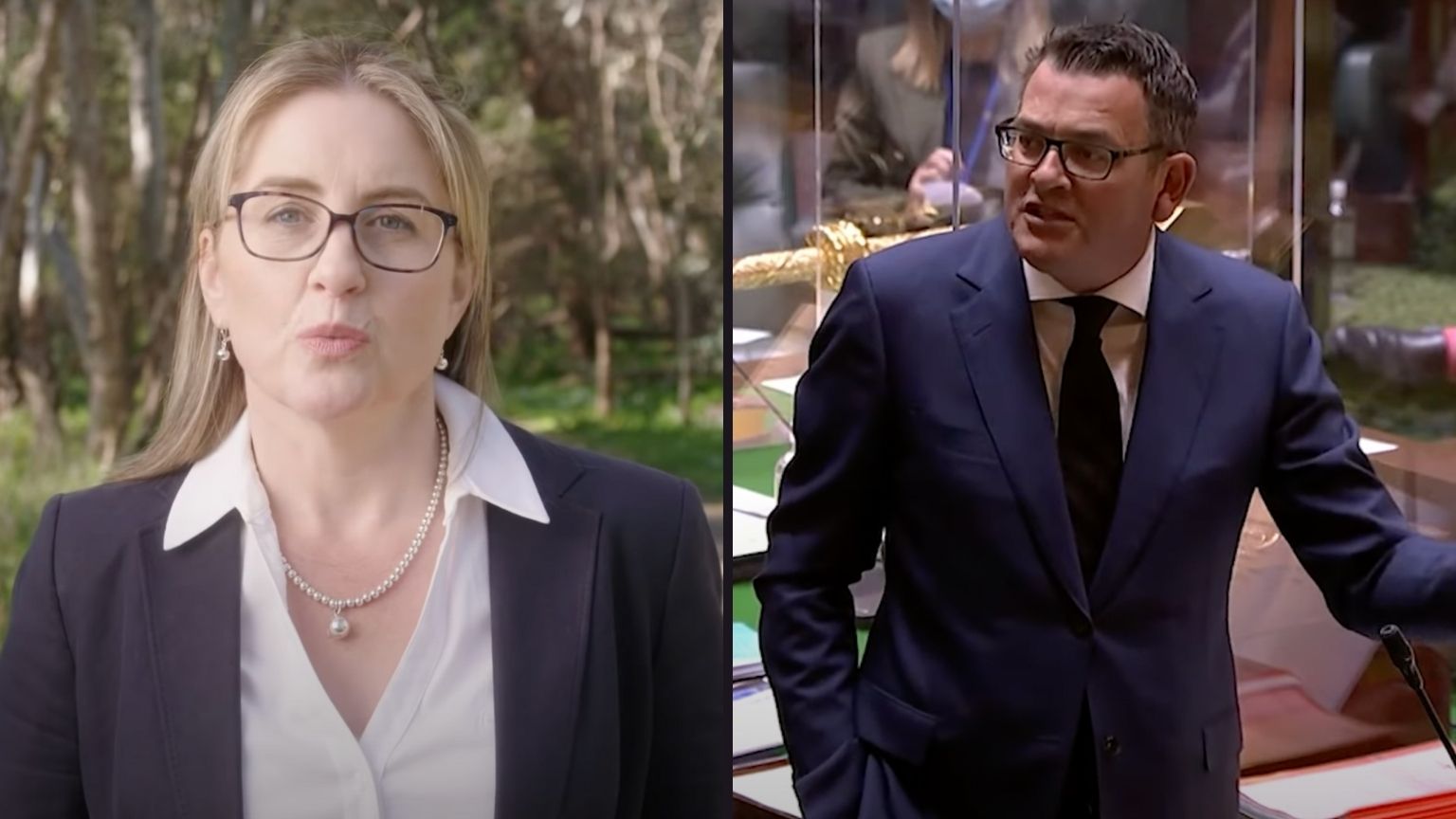
And the way the state’s Acting Premier Jacinta Allan, who has currently taken over while Premier Dan Andrews is being investigated for “concealing treason and fraud,” chose to defend the failure to inform people about matters pertaining to sensitive private information about them was to say the government was – shielding them from misinformation.
Australian media say the attempts to hide the truth have been made repeatedly, and Allan’s logic in defending the move is that if revealed, the Supreme Court’s secret ruling that said the data was not “absolutely protected” would have given rise to a “baseless scare campaign” as media reporting the facts would have caused “fear and misinformation.”
She did not clarify what type of “misinformation and fear” was expected to arise from the truth.
“The decision was taken in the balance of providing confidence in the Victorian community that this wasn’t a matter that needed to have that level of misinformation spread about it,” Allan said on Tuesday of the way the multiple levels of deceit had been handled.
This Supreme Court finding came to light after the Herald Sun reported that despite explicit promises of information safety, and its use only for health purposes, this was a lie – and one ongoing for two years.
Instead of making contact tracing data available only in order to fight the epidemic, it was also available to law enforcement, and authorities like the WorkCover agency.
It was precisely that agency’s demands to be given access to tracing app data that launched the legal case, when the Department of Health asked the court to order WorkCover to stop.
Another revelation is that the state’s Covid commander Jeroen Weimar petitioned the court to keep the case secret for five years. He tried to persuade the court that maintaining Victorians’ trust in the tracing system was what really matters – at the same time downplaying the importance of the citizens’ right to know their data can be shared, despite assurances from Covid tracers that this was not possible.
Asked if it was right to hide from the public the truth about the safety of their data – and the fact a court case was unfolding financed by their tax money, Allan said, “They don’t deserve a fear campaign, they don’t deserve misinformation,” and added that their data “will be protected.”
Shadow Attorney-General Matt Bach sees the scandal differently:
“People should be shocked and appalled. We should never become accustomed to this level of dishonesty.”
Biggest pandemic lie: PCR tests accurately detect cases and deaths
By Joel S Hirschhorn | December 28, 2021
As of this Friday, December 31 the ubiquitous and infamous PCR test used universally by the public health and medical establishments is gone, according to a CDC declaration issued last July.
To all of the propaganda victims of the pandemic collusion mafia, now is the time (belatedly) to face facts. A huge fraction of all the fear-producing data in COVID cases, hospitalizations and deaths are sheer crap. From the very beginning in early 2020 there were experts who said that the PCR test should not have been so used universally as a way to detect and document COVID infection and disease.
You may have noticed that there has been no coverage of this rather important act by CDC in the leftist mainstream media. Why not? Because now they have to admit that massive false positive results from PCR tests have produced totally unreliable data. These PCR tests had the capability of calling the common flu or cold COVID. And so much of the time they were run at very high cycles to create false positives.
FDA has other approved tests for COVID that will be used.
The larger point after two pandemic years is that the public should better appreciate just how easy it has been for public health, medical and public policy establishments to totally lie about virtually all aspects of the pandemic.
It started with PCR testing and continues to this day with COVID vaccines. If you were stupid enough to trust testing, then you probably remain stupid enough to trust everything said about vaccines and boosters as ways to curb the pandemic. And add on masking, lockdowns and school closings to the BIG LIES endlessly promoted by Big Media, Big Government and Big Pharma.
And now keep believing, if you remain gullible, that omicron is a huge health threat.
Starting with my book Pandemic Blunder I have worked endlessly to be a truth-teller. But it is not easy to combat the disinformation and lies from all the powerful forces determined to instill fear so that governments can coerce and control the public.
Though I prefer to focus on COVID deaths, there are reasons why these data are also problematic. So many have died with COVID but not from COVID.
Hospitals have utterly failed to effectively prevent COVID related deaths, now over 830,000 and that will surely reach 1 million by the end of March. Why? Because severely ill, late-stage COVID patients in ICUs are not being saved by current hospital protocols. Those patients got to that point because the government prevented wide use of generic medicines for early home treatment and even now for late-stage COVID.
Everywhere I look I see widespread dishonesty, incompetence and corruption. These have produced widespread suffering in all aspects of lives. Time for the revolution. If you have enough critical thinking capability to see all the many lies from the powerful, especially the evil Fauci.
What really happened at Simpsonwood and why it matters today
By Steve Kirsch | December 27, 2021
If you read my story about RFK Jr. and how he became an anti-vaxxer, it mentions the Simpsonwood transcripts.
There is a book, “Evidence of harm” that talks about what happened there in detail. Some people think the author wasn’t sure who was telling the truth. That’s not true. The book author takes an objective viewpoint, leaving it to the reader to determine who was telling the truth. If your brain is working, it’s easy to figure out.
Basically, Simpsonwood was a meeting where the CDC was scrambling to figure out how to cover up the “signal” caused by thimerosal in vaccines.
Here is the original Verstraeten study which shows the connection with autism. RR=7.6 is huge. It means mercury causes autism.
Here is a transcript of the Simpsonwood meeting which was held to figure out what to do about the paper.
It’s a long read, so this excerpt gives you the highlights in a much shorter amount of time. The key thing was the study by Verstraeten. Version #3 was presented at that meeting.
This web page describes each version of the Verstraeten study. Search for “A “SIGNAL” DISAPPEARS ACROSS FIVE GENERATIONS OF STUDY.” In that section they’ll talk about a signal that “won’t go away.” They basically massaged the numbers to make the association “go away” so they wouldn’t have to admit making a mistake which would be a PR disaster.
In short, the CDC was more interested in covering their ass (making the signal go away) than protecting kids.
That was all 20 years ago. Why is this relevant today?
Because it shows the agency was corrupt 20 years ago and they haven’t changed. Today, they can ignore all the deaths in VAERS saying “there is no causality.” Bullshit. This is why they don’t debate any of us.
In 2002, the doctors knew that the mercury in thimerosal disappeared from the blood quickly. But it wasn’t until later (in a study by Burbacher in April 2005) that it was discovered where all the mercury went to: your brain. Paul Offit and RFK Jr. knew this.
Yet, fifteen years later the CDC is still lying to the public about the same issue.
Here’s the lie on the CDC website today:

Sure, it’s true that Thimerosal doesn’t stay in your blood a long time; but it’s not true that it doesn’t stay in your body a long time. In fact, it stays in your brain for the rest of your life (unless you use some special methods to remove it over time using chelation). They are not admitting established facts even today. They are still hiding that it stays in your body forever.
Was the Brubaker study wrong about the mercury going into your brain? Nope. It’s been confirmed 21 times. Here’s the most recent review showing that the mercury in thimerosal goes into your brain, confirming what we knew 15 years ago: 22 studies showing ethyl- and methylmercury cross the blood-brain barrier using the same LAT system:
In total, these studies indicate that ethylmercury-containing compounds and Thimerosal readily cross the BBB, convert, for the most part, to highly toxic inorganic mercury-containing compounds, which significantly and persistently bind to tissues in the brain, even in the absence of concurrent detectable blood mercury levels.
So the CDC is clearly lying to the public 15 years later about what happened back then, even after the science is completely settled.
And of course, Wikipedia doesn’t acknowledge this either (see the Disproven autism hypothesis).
So the lesson here is this:
- They covered up the dangers of thimerosal back in 2000… the five generations of the Verstraeten study shows that.
- But more importantly, and more clearly, they are still covering up the dangers of thimerosal today, claiming it leaves your body when they know it doesn’t. It is obvious to anyone doing a literature search.
So, do you think they are levelling us now about the safety of the COVID vaccines?
Answer: Of course not.
Health agency spied on millions during Covid lockdowns
RT | December 26, 2021
Canada’s Public Health Agency has admitted to secretly tracking location data from at least 33 million mobile devices to analyze people’s movements during Covid-19 lockdowns.
The agency earlier this year collected data, including geolocation information from cell-towers, “due to the urgency of the pandemic,” a PHAC spokesperson told the National Post, essentially confirming a report by Blacklock’s Reporter. The tracking data was allegedly only used to evaluate the effectiveness of lockdown measures and identify possible links between the movement of people and the spread of Covid-19.
PHAC obtained the information, which was “de-identified and aggregated,” through an outside contractor, Canadian telecommunications giant Telus. The contract ran from last March to October, and PHAC said it no longer had access to the data after the deal expired.
However, the agency plans to similarly track the movements of citizens over the next five years toward such ends as preventing the spread of other infectious diseases and improving mental health. PHAC last week posted a notice to prospective contractors seeking anonymous mobile data dating as far back as January 2019 and running through at least May 2023.
Critics argued that government tracking of citizens is likely more extensive than has been revealed and may become more troublesome in the years ahead.
“I think that the Canadian public will find out about many other such unauthorized surveillance initiatives before the pandemic is over—and afterwards,” privacy advocate David Lyon told the Post. He noted, too, that “de-identified” data can easily be “re-identified.”
Author Julius Reuchel said the tracking initiative smacks of a surveillance state spying on citizens “for your safety.” Another author, Paul Alves, said that with its new contract, PHAC will have direct access to all mobile location data, and expressed fear that “contact tracing will no longer require permission or a warrant.”
The apartheid regime’s Christmas propaganda and oppression of Palestinian Christians

By Denijal Jegic | Press TV | December 26, 2021
As people around the world are celebrating Christmas, occupied Palestine, the birthplace of Christianity, remains under brutal Israeli apartheid. Meanwhile, the Israeli regime targets Western Christians with Zionist propaganda.
Zionist propaganda
The Israeli propaganda apparatus “Hasbara” has long invested large amounts of money and significant PR efforts in legitimizing the Zionist settler-colony in the eyes of its international audiences. In portraying the colony as a democracy with alleged human rights and co-existence between various religions, the Israeli regime has attempted to whitewash its genocidal oppression of Palestinians in the eyes of the West. The propaganda attempts have been successful to a large degree, as many Christians in the West either ignore the Palestinian plight, or provide outright support to the apartheid regime.
Evangelical Zionists in the United States have been amongst the most radical supporters of Israel. Christian tourism has contributed to the colony’s economy. This year again, Zionist politicians and officials have extended their holiday greetings to “Christian friends” around the world.
Such greetings are packed with colonial propaganda and appropriation of history. Israeli PM Naftali Bennett published a video on Christmas Eve this year from occupied Jerusalem, connecting the “ancient land” and the Bible to the current colony in his address to Christians. Bennett, who previously bragged about how many Arabs he killed in his life, lied that the colony provided “religious freedom, tolerance, and prosperity in a region where Christians are routinely persecuted.” The illusion that Israel offered religious freedom and that Christians outside of the colony are persecuted is widespread in the West. Bennett claimed that Israel is the “only one place” that “protects Christian life” and thanked his audience for “fighting for the state of Israel.”
While such proclamations further add to the positive image of the colony in the West, they stand in stark contrast to the reality on the ground.
The plight of Palestinian Christians
In fact, the world’s oldest Christian communities are victims of Israel’s genocidal settler-colonialism.
As a result of Israel’s ongoing ethnic cleansing campaign, the Christian population in Palestine has sharply declined throughout the decades. Places of significant importance for Christians are cut off from the outside world. The town of Bethlehem, the birthplace of Jesus, is surrounded by the apartheid wall.
Besides suffering under the structures of the apartheid regime, Palestinian Christians are also oftentimes prevented from exercising their religion. While foreign visitors may access Palestinian churches, the Palestinian right to worship is tightly controlled by the apartheid regime. Depending on where they live, Palestinians require permits issued by the apartheid authorities to attend Mass in churches. This year again, Palestinian Christians from Gaza applied for permits to travel to Bethlehem to attend prayers. Their requests were either rejected or outright ignored.
Palestinians are harassed by apartheid authorities on holy days, such as Easter and Christmas. This year on Easter, apartheid authorities escalated their ethnic cleansing campaign by expelling Palestinians in Sheikh Jarrah (East al-Quds) from their homes. This Christmas again, hundreds of Palestinians were injured by occupation forces when they protested against settlement expansion in the West Bank.
Israeli violence has always extended beyond the borders of historic Palestine. The Israeli colonial regime has a history of targeting indigenous Christians in the region. It has done so during its military occupation and numerous wars in Lebanon and its continuous attacks on Syria. During last year’s Christmas celebrations, the Israeli regime invaded the Lebanese airspace to conduct airstrikes on Syria from there, killing several people.
The fallacy of a religious war
The Israeli regime is terrorizing Palestinians of all religions, but has been trying to portray the settler-colonial conquest as a “conflict” that is allegedly religious in its nature. Exploiting traditional Orientalism and anti-Muslim sentiments that are prevalent in Western cultures, the Israeli rhetoric has long focused not only on portraying Palestinian resistance – and oftentimes the very Palestinian existence as such – as anti-Jewish, but the regime has also tried to identify all Palestinians as Muslims to better advance its Islamophobic dichotomy and to frame the Palestinian struggle for freedom and liberation as a religious movement. It is the religious frame and the anti-Muslim prejudice amongst Israel’s backers that allows the apartheid regime to advance its goals. It is thus not surprising that the Israeli project is highly popular among the far-right and fascists around the world.
Of course the Palestinian struggle was never a sectarian one and many leading figures of Palestinian resistance have been Christians. Nor should the religion of colonized people determine the solidarity and support they receive from the outside world.
After all, destroying the cultural diversity of the region and dividing the population according to sectarian and ethnic lines have been long established practices of imperialist and colonialist forces.
Numerous Palestinian Christian leaders have appealed to Christians around the world to not turn a blind eye toward the continuous oppression and exploitation of Palestine. The Palestinian Archbishop of the Greek Orthodox Church in al-Quds, Atallah Hanna, himself a crucial figure in the Palestinian resistance, has repeatedly affirmed that al-Quds (Jerusalem) and the holy sites will remain Palestinian. The Archbishop reminded Christians around the world that while streets and squares in Western cities are decorated with lights and Christmas trees, there would be no point in celebrating Christmas if they do not pay attention to what is happening in Palestine. He called upon all churches to urgently defend Palestine. The archbishop has reportedly been poisoned by Israeli authorities, but survived the attack.
The racist ideology of Zionism targets people of all religious affiliations who stand in the way of the settler-colonial conquest. This is, unfortunately, more often than not ignored internationally, and particularly by Western Christians. This year again, many Christians in the West celebrate the birth of Jesus without talking about the struggle in Palestine.
Denijal Jegic is a writer and researcher, currently based in Beirut, Lebanon. He holds a PhD in American studies.
VIDEO:
Not just Muslims, Christian Palestinians suffer apartheid as well

While the Christians across the world are celebrating Christmas, the Palestinian Christians are enduring systematic apartheid In their homeland.
Leaked files expose Syria psyops veteran astroturfing BreadTube star to counter Covid restriction critics
BY KIT KLARENBERG AND MAX BLUMENTHAL · THE GRAYZONE · DECEMBER 24, 2021
By covertly recruiting popular YouTube influencer Abigail Thorn to counter growing opposition to UK gov’t Covid restrictions, psy-ops pros are bringing home the tactics they honed in the Syrian dirty war.
Leaked documents have revealed a state-sponsored influence operation designed to undermine critics of the British government’s coronavirus policies by astroturfing a prominent founder of the BreadTube clique of “anti-fascist” YouTube influencers.
The project aims to conduct psychological profiling on British citizens dissenting against policies such as mandatory vaccination and lockdowns, then leverage the data to establish a YouTube channel that portrays these critics as dangerous “superspreaders” of “disinformation.”
Designed “to curb the influence of pseudoscience material online, with specific emphasis on Coronavirus-related ‘anti-vaxxing’ sentiment,” the operation is run by the UK’s Royal Institution, and dubbed “Challenging Pseudoscience.”
Its top patron is Charles, the Prince of Wales, next in line to the British throne, who recently hit out at supposed “conspiracy theories” surrounding COVID-19 vaccines. The organization received a substantial cash injection in 2020 from the UK government’s Culture Recovery Fund earmarked for video production.
Leaked files obtained by The Grayzone indicate that the Royal Institution has enlisted the services of Valent Projects, a “social change” communications firm founded by a public relations operative previously involved in the UK Foreign Office’s campaign for violent regime change in Syria. Valent has also been sponsored by the US Agency for International Development (USAID), a US intelligence cut-out, for a project aimed at “investigating disinformation.”
Valent’s central role in the operation highlights the trend of information warfare specialists bringing the techniques they honed against targets like the Syrian government back home to the West, where increasingly unpopular governments confront masses of citizens ever-bristling at coronavirus restrictions.
As in Syria, where communications firms like Valent created, trained and instrumentalized media organizations to further regime change objectives, they have covertly recruited a famed British YouTube influencer to lend their carefully calculated messaging campaign an authentic flavor.
According to internal documents, Valent plans to design a “mass appeal social media campaign fronted and owned by prominent social media figure Abigail Thorn,” the founder of Philosophy Tube. Valent’s research on British citizens who reject official policy on COVID-19 “will be used to devise a campaign that utilises YouTuber Abigail Thorn’s existing platform to achieve a measurable cognitive shift in the target audience,” the files state.

Boasting over one million subscribers to her YouTube channel and more than 7000 Patreon supporters, Thorn has established a potent vehicle for any communications campaign. She is also a core member of BreadTube, an assortment of left-branded social media influencers that has attracted intense establishment interest for its purported ability “to pop YouTube’s political bubbles to create space for deradicalisation.”
While top BreadTubers are best known for employing memes and theatrical ploys to counter right-wing narratives, they have also dedicated intense energy to attacking the anti-imperialist left as “tankies” engaged in a secret “red-brown alliance” with right-wing extremists.
In his book, “BreadTube Serves Imperialism: Examining the New Brand of Internet Pseudo-Socialism,” socialist organizer Caleb Maupin likened BreadTube to the “counter-gangs” deployed by British and US intelligence to infiltrate and dismantle insurgent forces from Kenya to Southeast Asia.
BreadTube “speaks in the name of left-wing sounding ideals. In reality, it is likely serving one section of the American ruling elite and the intelligence agencies,” Maupin wrote.
The covert relationship between BreadTube’s Abigail Thorn, Valent Projects, and the Royal Institute appears to validate Maupin’s thesis.
“It does not surprise me at all to find out there is documented evidence that the British Royal Family and an intelligence contractor is bankrolling the work of Abigail Thorn,” Maupin told The Grayzone. “It lines up with everything I have observed about her and the BreadTube trend overall.”
Maupin continued, “BreadTube’s ‘socialism’ is not really socialism, it is mobilizing young liberals to keep dissident elements in line. It’s securing the rule of British and American corporations over the planet by trying to silence those who get in its way.”
The national security establishment’s favorite socialists
Since launching Philosophy Tube in 2013, Abigail Thorn’s YouTube channel boasts over 7000 paying Patreon fans and well over one million YouTube subscribers. By probing complex philosophical and political issues in a highly accessible, engaging manner and deploying elaborate, artisanal audio and visual effects, she has emerged as a social media celebrity. A lengthy profile video produced by the BBC refers to her as “one of the most high-profile transgender figures in the UK.”
Thorn is among the most prominent figures within the loosely knit collective of YouTube influencers known as BreadTube. Inspired by the title of anarchist Peter Kropotkin’s tract, The Conquest of Bread, BreadTube advances a hyper-identitarian, imperialism-friendly interpretation of socialist politics that has earned its creators enthusiastic promotion from establishment interests.
The New York Times, for example, published a lengthy 2019 profile of a young man named Caleb Cain who supposedly “fell down the alt-right rabbit hole” on YouTube. Cain claimed he was de-radicalized through exposure to videos by Thorn and other popular BreadTubers like Natalie Wynn of Contrapoints. During the Trump era, as the Google-owned YouTube implemented a raft of stringent speech codes, it began amplifying BreadTube influencers through its algorithm.
Other popular BreadTube figures include Vaush, a video gamer from Beverly Hills, California named Ian Koshinski. Known for his superficial understanding of Marxism, crude invective against Trump supporters (“they disappear, or we all do”), female high school athletes who complain about being forced to compete against biological males (“sorry you fucking suck, dumb bitch”), and imprisoned journalist Julian Assange (“I want Assange to die in a CIA black site just because it would trigger all the worst people on Twitter”), the self-described “libertarian socialist” has earned the moniker “Vaush Limbaugh” from his critics.
Then there is Shaun, a British BreadTuber whose recent attack on left-wing political comedian Jimmy Dore’s criticisms of government Covid restrictions contained echoes of the “Challenging Pseudoscience” project prepared for Thorn by intelligence-related outfits. Shaun’s arguments relied heavily on statements by official experts and US government bodies like the FDA and CDC. While Dore has been limited by YouTube’s sweeping speech codes, Shaun’s viral video appears to have benefited from an algorithmic boost.
“All the key signs of infiltration are there,” Caleb Maupin said of BreadTube. “Since when does US mainstream media highlight the work of Marxist revolutionaries? Why are people who seem so unfamiliar with basic elements of socialist ideology suddenly elevated to the position of respected experts by the algorithms? Why do their foreign policy views seem to line up so closely with the US State Department? I have had no doubt they were being covertly supported by powerful entities with goals other than overthrowing capitalism.”
Unlike some fellow BreadTubers, Thorn comes across as amiable and trustworthy, fostering a personal bond with her viewers and regularly publishing thank you notes to patrons, listing them each by name. These qualities have attracted support for Philosophy Tube by both public and private backers.
Thorn’s April 2021 dismantling of the politics of right-wing culture warrior Jordan Peterson has racked up almost two million views and was sponsored by Curiosity Stream, a US media streaming service. The video opens with a black screen disclosing the support provided by the company and claiming Thorn would donate her fee to the feminist campaign group, Sisters Uncut. The video is also emblazoned with YouTube’s “paid promotion” logo.
Yet no such disclaimer referring to support from the Royal Institution can be found on any of her other uploads. And that may be because the Covid campaign was intended to be covert.
Astroturf campaign seeks to achieve ‘measurable cognitive shift’
The “Challenging Pseudoscience” operation designed for Thorn was launched in February 2021 by liberal science journalist Angela Saini. The author of several popular titles and a forthcoming book on “the origins of patriarchy,” she is also part of The Lancet Covid-19 Commission’s Task Force on Global Health Diplomacy.
The commission’s chief, Peter Daszak, a zoologist who serves as president of the US-based NGO known as EcoHealth Alliance, was forced to resign in June over conflict of interest issues.
In the years leading up to the outbreak of Covid-19, Daszak worked extensively on bat coronaviruses and gain of function research at the Wuhan Institute of Virology. His organization received tens of millions in funding from the Pentagon’s Defense Threat Reduction Agency, a division “[countering] weapons of mass destruction and improvised threat networks.” In December 2019, Daszak warned that coronaviruses can “get into human cells,” one can “manipulate them in the lab pretty easily,” and “you can’t vaccinate against them.”
The host of Saini’s project, the Royal Institute, was founded in 1799 by British scientists of the day “with the aim of introducing new technologies and teaching science to the general public.” Landed gentry and royalty have always occupied the Institution’s highest levels. Queen Elizabeth II’s cousin, Field Marshal Prince Edward, the Duke of Kent, has served as president since 1976.
The files indicate that the Royal Institution enlisted the services of Valent Projects, a communications firm “[working] with clients in the UK and all over the world to counter disinformation and strengthen the bonds between people.”
Valent was founded by Amil Khan, a former Reuters and BBC reporter who officially left journalism “to help good causes navigate the new information landscape.”
From February, Valent Projects proposed a “two-phase” project to “develop an understanding of the psychological drivers behind the generation and spread of anti-vaxxer narratives.” It planned to exploit this data “to develop and test public messaging responses.”
The findings would “inform other programming by Challenging Pseudoscience… as well as other stakeholders including the science community and concerned governments and public health bodies.”
In the campaign’s first phase, extensive online interviews were to be conducted, along with “ethnographic research” to secure “comprehensive understanding of the key online audiences driving anti-vaxxing mis/disinformation around the Coronavirus pandemic.”

Valent Projects then planned to “draw together insights” from these findings, developing “comprehensive audience profiles” – including “demographic information” – to design a “mass appeal social media campaign fronted and owned by prominent social media figure Abigail Thorn,” who runs online channel Philosophy Tube.
Valent indicated its intent to exploit Philosophy Tube’s sizable platform to “achieve a measurable cognitive shift [emphasis added] in the target audience.”
Reaching the intended viewers was forecast to be a significant task in itself, however. Valent noted most Philosophy Tube viewers are within the 18 to 35 age range, but “existing research” suggested the “most prolific consumers of pseudoscience material” were over the age of 45.
The firm felt the “best topic to address this issue is probably along the lines of ‘the thing about expertise’ [sic].” Fittingly, in August 2020 Thorn uploaded a video, “Who’s afraid of the experts?” Featuring comedian Adam Conover of the popular show, “Adam Ruins Everything,” the 45 minute-long defense of the scientific consensus on the HIV/AIDS debate is the first result in any search for the term “vaccine” on Philosophy Tube’s channel.
The leaked documents thus expose what had long been suspected by critics of BreadTube: the popular social media collective has been instrumentalized by powerful interests with connections to Western intelligence agencies.
An astroturfed information warfare campaign hiding in plain sight
Multiple requests for comment from The Grayzone to Abigail Thorn’s agent and Angela Saini have gone unanswered.
When quizzed about the leaked files on Twitter, Valent Projects CEO Amil Khan flew into a rage, angrily asserting they were “obtained through hacking and then doctored,” in the manner of “classic doxing,” and threatened legal action against this journalist for publicizing them.
Khan later pumped out a series of tweets aimed at controlling the damage of his imminent exposure. In one, he falsely claimed that a co-author of this piece would publish their reporting in “Russian state affiliated media.”
Yet when challenged about his claim of doctoring, Khan did not respond.
Subsequent requests for clarity on which elements of the documents were maliciously altered and how that might have taken place have also gone unanswered. But evidence of the secret project’s existence was hiding in plain sight.
For example, Valent Projects lists the Royal Institution on its website as a client. An accompanying writeup notes it “developed and implemented a data-led behaviour change campaign [emphasis added] aimed at understanding and working with the psychological drivers behind anti-vaxer sentiment in the UK” for the organization.
Similarly, a post on the company’s official LinkedIn page refers to an “analysis of tens of thousands of UK-based social media users “posting/sharing anti-vax content online” it conducted for Countering Pseudoscience, which would “be used to inform ethnographic research designed to understand ‘why’ people hold these views.” In other words, a specific programming strand outlined in the documents.

From Valent Projects’ LinkedIn page
Moreover, none other than Abigail Thorn was guest-of-honor at Challenging Pseudoscience’s launch event in February, “Vaccines: Warriors and Worriers,” which featured a debate on “how vaccines work, why people are skeptical despite the evidence, and how disinformation about vaccines spreads online.”

Abigail Thorn of Philosophy Tube participating in the Royal Institution’s “Vaccines: Warriors and Worriers” event
Also on the event’s panel were an immunologist named Zania Stamataki and Marianna Spring, the BBC’s first “specialist disinformation reporter.” She has repeatedly perpetuated falsehoods about the size of anti-lockdown protests in 2020 and nature of their participants. In a bizarre experiment, she furthermore personally set up numerous “fake troll” accounts on assorted online platforms that “engaged” with “misogynistic” content, allegedly for academic purposes.
In May, Thorn published a characteristically ornate video, “Ignorance & Censorship,” which touched on the topic of “disinformation” and vaccines. The next month, Challenging Pseudoscience convened a similarly named panel discussion, “Misinformation or Censorship.”
Then, the newly-launched Challenging Pseudoscience podcast shared two prior Royal Institution debates – the aforementioned Vaccines: Warriors and worriers, and “Disinformation and how to counter it,” which featured none other than Amil Khan as a speaker. It would be entirely unsurprising if this deluge was a coordinated effort.
A wide-ranging, long-running, cross-platform propaganda campaign involving multiple actors requires substantial resources. Until 2020, however, the Royal Institution struggled financially despite its royal patronage and elite trustees.
The organization has been forced to rent out its grand central London headquarters for conferences, corporate bashes and weddings. To plug a multimillion pound budget deficit in late 2015, the Royal Institution auctioned off treasured first editions of works by Charles Darwin, Isaac Newton and other eminent scientists. The fire sale prompted the BBC to ask whether the organization was on the verge of collapse.
Miraculously though, in October 2020, the Institution received hundreds of thousands of pounds from the UK government’s £1.57 billion Culture Recovery Fund “to help face the challenges of the coronavirus pandemic and ensure it has a sustainable future.”
An accompanying press release noted the Royal Institution had over the course of the pandemic “[developed] a successful programme of weekly science talks online” broadcast via its “well-established” YouTube channel, which today boasts 1.11 million subscribers. The cash injection would “increase the number of livestreamed science talks” hosted by the organization, and help it develop “new digital content.”
Valent Projects staffer Hamish Falconer has disclosed that the “exciting” Challenging Pseudoscience campaign has also received “generous support” from the Open Society Foundations of CIA-adjacent billionaire George Soros.
As the Washington Post’s David Ignatius reported in 1991, Soros was at the heart of a network of “overt operators” helping US intelligence carry out “spyless coups” against former Soviet satellite states.
In July 2021, Soros teamed up with fellow billionaire Bill Gates to purchase a UK-based Covid-19 test developer for $41 million.
Three months later, as Alex Rubinstein documented for The Grayzone, Soros partnered with tech oligarch Reid Hoffmann to found Good Information Inc, a social media censorship operation marketed under the aegis of “countering disinformation.”
Hamish is the son of Charlie Falconer, a longtime friend and former roommate of former UK Prime Minister Tony Blair. Following Blair’s May 1997 election victory, Falconer senior was elevated to the unelected House of Lords, and served in a series of high-ranking government posts throughout his pal’s tenure.
Along the way, he applied “huge pressure” to Attorney General Lord Goldsmith to change his view that invading Iraq would be illegal. His intervention may have played a decisive role in greenlighting the war of aggression.

Valent founder “embedded into terrorist organizations,” ran Syria psy-ops for armed extremists
Hamish Falconer’s hiring at Valent Projects in March 2021 highlights the firm’s deep ties to the UK’s intelligence apparatus. At the time, he was ostensibly on leave from the UK Foreign Office.
Khan trumpeted Falconer’s hire on LinkedIn, declaring that “he brings the action end to our work – experimenting and innovating with digital influence for good.” Having met in Pakistan “over a decade ago,” the pair “have not stopped talking and comparing notes since.”
Falconer’s spartan online résumé sheds little light on his professional history, noting only a spell at the UK government’s Department for International Development, followed by a seven-month gap, before he joined the Foreign Office as a ‘Diplomat’ until August 2020.
No detail is offered either on where Falconer has been posted, or what his role entailed at any point. He is a graduate of Yale University’s Maurice R. Greenberg World Fellows Program, named for the AIG founder who nearly became CIA director. The Greenberg fellows program identifies and grooms prospective future influencers, including no shortage of US-backed would-be coup leaders. Among the most famous alumni of the program is jailed Russian opposition figure Alexey Navalny.
The Greenberg program’s profile of Falconer states, “he has led the Foreign Office’s Terrorism Response Team, UK efforts to start a peace process in Afghanistan and served in Pakistan and South Sudan,” and served a stint at the National Crime Agency – London’s equivalent of the FBI.
Counter-terror is not a stated Foreign Office purview, but just one of “three core areas of focus” for the UK foreign intelligence service MI6. It may just be a coincidence the agency’s spies typically pose as ‘diplomats’ overseas.
By contrast, Khan’s activities between December 2008, when he left his position as ‘hostile environments reporter’ for the BBC, and October 2017, when he joined elite UK national security think tank Chatham House as an ‘associate fellow’ – the next entry on his public CV – can be pieced together with much greater certitude, but still only approximately.

Valent Projects founder Amil Khan
A leaked document indicates that he first crossed paths with Falconer while managing a ‘countering violent extremism’ propaganda campaign for the UK government in Islamabad. The file relates to a Foreign Office funded effort to train “articulate Syrian armed and civilian grassroots opposition entities,” and promote them to “Syrian and international audiences” as a credible alternative to the government of Bashar al-Assad.
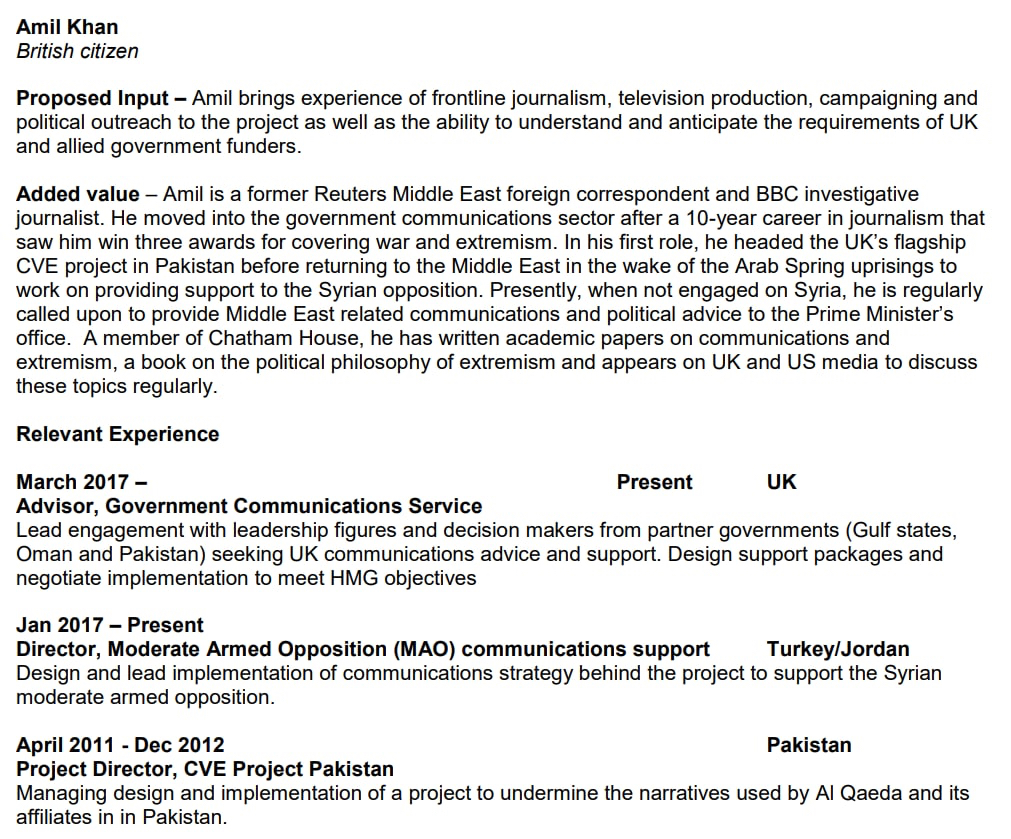
The project was delivered by ARK, a shadowy intelligence contractor founded by the likely MI6 operative, Alistair Harris, which has raked in innumerable lucrative contracts from waging covert information warfare operations on behalf of the UK government.
Khan was heavily involved in ARK’s Syrian efforts. Another leaked file, outlining some of the company’s work inside Syria shows that it oversaw a “rebranding” of the CIA-armed Free Syrian Army to portray it as a moderate, secular force unconnected to the hardcore jihadist factions that dominated the armed opposition. Khan is named as one of three operatives managing the media office of the parallel Syrian National Coalition government controlled by London through intelligence cutouts like ARK.

This work placed Khan in extremely close quarters with members of violent ‘rebel’ factions implicated in hideous crimes against humanity. That he “[provided] political and media support to opposition political and military groups” in Syria has been openly confirmed. A scathing internal Whitehall review of the Foreign Office’s information warfare operations in the country concluded they were “poorly planned, probably illegal, and cost lives.”
It wasn’t the first time Khan been in such murderous company. At some point after leaving ARK in August 2014, he joined InCoStrat, another contractor that conducted destabilizing psy-ops on the UK government’s behalf throughout the Syrian crisis. InCoStrat delivered “strategic communications support” to a variety of armed groups on-the-ground, including the notoriously brutal, Saudi-backed militia known as Jaysh al-Islam.
Khan also played a central role in this dubious initiative. In a document discussing its ability to “[develop] contacts in Arabic-speaking conflict affected states,” InCoStrat bragged how, “in his previous career as a journalist,” Khan “established relationships with, and embedded himself into terrorist organizations in the UK and the Middle East,” gaining “unique insight into their narratives, communication methods, recruitment processes and management of networks” as a result.

InCoStrat was founded by ex-Foreign Office political officer Emma Winberg and UK military intelligence journeyman Paul Tilley, a former director of Strategic Communications for the UK Ministry of Defence in the Middle East and North Africa. Winberg left to join Mayday Rescue, parent ‘charity’ of the fraudulent humanitarian group known as the White Helmets. She later married its founder, James Le Mesurier, who died in mysterious circumstances in 2019 after damaging revelations of financial corruption came to light.
A broad landscape of state-backed Covid propaganda ops
It’s probable the “Countering Pseudoscience” project is just one part of a wider landscape of online astroturf initiatives designed to restore cratering public trust in authorities around Covid policy.
Valent Projects has also conducted work for the Institute for Strategic Dialogue, a neoconservative think tank, researching “violent actors using the ‘dark web’ to mobilise recruits and threaten public figures in Europe.” This initiative was likely also aimed at countering lockdown opposition.
Back in April 2020, Khan appeared on a panel discussion convened by the organization, “Countering Disinformation in a Time of COVID19.”
At the start of December, the Institute released a brief report, “Between conspiracy and extremism: A long COVID threat?”, which attempted to frame the “radicalization” of anti-lockdown protesters as a terrorist threat. What input Khan may have had in this publication was unclear.
Valent Projects is just one of an array of companies that have brought psy-ops techniques honed in Syria and other theaters of Western information warfare back home with them, like soldiers returning from battlefields marketing their deadly skills to private security and intelligence firms. And Abigail Thorn is just one YouTuber, at a time when the British state is known to be maliciously recruiting digital personalities to further its interests across the globe.
For example, Foreign Office contractor Zinc Network maintains a clandestine nexus of Russian-speaking social media influencers throughout the former Soviet Union, to promote “media integrity, democratic values [and] complex social issues,” a campaign so intensive its relationship with these individuals necessitates “daily management.” This squadron of undercover psy-ops warriors are supported by an expert “in-house team of Russian speaking producers, researchers and digital growth strategists” in London, helping them create, edit and promote their output.
Coincidentally, Zinc has been engaged in efforts since the onset of the pandemic to concoct a link between extremist activities and anti-lockdown, vaccine hesitant views. It has also published research on how to best market a test-and-trace app to UK citizens, “as part of a broader research project on public understanding of and support for Artificial Intelligence.”
It is simply inconceivable that similar operations have not been enacted elsewhere in the world, or that this phenomenon is exclusive to the UK. Further, it is impossible to know if the next slick viral video countering grassroots dissent of an official narrative is state or quasi-state propaganda, cleverly crafted to induce a “cognitive shift” in viewers, in which the star of the online show is effectively an intelligence asset rattling off a script drawn up by full-time spooks.
Patrick Vallance’s Defence of SAGE Modelling Fails to Convince
By Will Jones | The Daily Sceptic | December 24, 2021
Chief Scientific Adviser Sir Patrick Vallance has come to the defence of SAGE and its modelling after some torrid headlines this week following a Twitter exchange between lead modeller Professor Graham Medley and Spectator editor Fraser Nelson in which Professor Medley revealed that SAGE had not been asked to model less disastrous scenarios.
Writing in the Times, Dr. Vallance appeared directly to contradict some of the statements made by Prof. Medley, leaving observers baffled as to which of the two is correct as it is unclear how both can be. Dr. Vallance claimed that modelling of other, less severe scenarios, had been done and presented to Government, while Prof. Medley said it had not, at least by his team at the London School of Hygiene and Tropical Medicine (LSHTM). Dr. Vallance writes:
The modellers always have to make assumptions and do so across a wide range of possibilities, some optimistic and some pessimistic. They do not, contrary to what you might have heard, only model the worst outcomes. They will make assumptions about vaccine effectiveness, they will model different levels of viral transmission, mixing patterns and different levels of disease severity. The range of assumptions modelled can be very broad; for disease severity for Omicron one model explored a range from 10% of Delta severity through to 100%. For immunity a range of assumptions on vaccine efficacy, speed of vaccine rollout and vaccine coverage in different parts of the population were explored.
This claim is backed up by the minutes of the most recent SAGE meeting, published yesterday, although it doesn’t square with what Prof. Medley told Fraser Nelson. Prof. Medley, who chairs the SAGE modelling committee, said that lower virulence scenarios don’t “add any further information” and implied his committee – SPI-M – had not been asked to provide them.
Fraser asked Prof. Medley: “I guess the question is why LSHTM did not (like JP Morgan) include a scenario of lower virulence – given that this is a very-plausible option that changes outlook massively.”
What would be the point of that? Not a snarky question – genuine to know what you think decision makers would learn from that scenario… If somebody draws a line on a graph it doesn’t add any further information. Decision-makers are generally only interested in situations where decisions have to be made… That scenario doesn’t inform anything. Decision-makers don’t have to decide if nothing happens… We generally model what we are asked to model. There is a dialogue in which policy teams discuss with the modellers what they need to inform their policy.
Fraser later observed that Prof. Medley appeared to be saying his brief was very limited and did not include less severe assumptions and outcomes.
He seemed to suggest that he has been given a very limited brief, and asked to churn out worse-case scenarios without being asked to comment on how plausible they are… Note how careful he is to stay vague on whether any of the various scenarios in the SAGE document are likely or even plausible. What happened to the original system of presenting a ‘reasonable worse-case scenario’ together with a central scenario? And what’s the point of modelling if it doesn’t say how likely any these scenarios are?
From what Professor Medley says, it’s unclear that the most-likely scenario is even being presented to ministers this time around. So how are they supposed to make good decisions? I highly doubt that Sajid Javid is only asking to churn out models that make the case for lockdown. That instruction, if it is being issued, will have come from somewhere else.
Dr. Vallance, on the other hand, says:
Often the job of scientific advice is to allow ministers to understand both a central case and the uncertainty surrounding it, what drives that uncertainty and when the uncertainty might be reduced. Speaking scientific truth to power is a difficult but necessary part of the democratic process if ministers are to be able to make an informed decision. This is what SAGE does.
If Dr. Vallance is accurately describing the advice given to ministers by SAGE, why did LSHTM not model those scenarios and estimate their likelihood? Why did the chairman of the SAGE modelling committee state that such scenarios had not been requested because they do not add anything useful to the discussion? The only explanation I can think of is that the broader range of scenarios referred to in the minutes of the SAGE meeting dated December 20th was not reflected in the SAGE memo circulated to ministers for that afternoon’s Cabinet meeting. That is, SAGE modelled less gloomy scenarios but didn’t bother to include them in the advice it gave to the Cabinet.
Dr. Vallance claims SAGE is a neutral adviser, being neither pessimistic nor optimistic and not pushing for any “dogmatic” answer or directive.
It is not the job of SAGE to take a particular policy stance or to either spread gloom or give Panglossian optimism. Ministers and the cabinet need to hear the information whether uncomfortable or encouraging. They of course need to factor it in to all the other information that provides inputs to policy decisions. SAGE does not provide dogmatic answers or directives, it provides information, advice, scenarios and helps determine possible consequences of actions. Part of the advice may contain a “reasonable worst case scenario” – data that are often seized upon.
But they are just that – a reasonable worst case scenario and one of many possible outcomes and trajectories presented to ministers for planning purposes and decision making.
But Dr. Vallance is failing to acknowledge the reason that prompted the need for his defence of SAGE modelling in the first place, which is that the chairman of his main modelling committee had stated that they had not been asked to provide alternative scenarios to ministers because it “doesn’t add any further information”. Dr. Vallance implies that others are at fault for having arbitrarily “seized upon” the reasonable worst case scenario presented to ministers, ignoring that the present controversy arose because the Government’s lead modeller said no other scenarios were modelled because they were pointless.
Dr. Vallance is also being, at best, naïve about the key role SAGE’s projections and advice have played in pushing the Government into making extreme interventions. His comments here about it being “not the job of SAGE to take a particular policy stance or to either spread gloom or give Panglossian optimism” are contradicted by his enthusiastic endorsement of boosters earlier in the same article – “Vaccine boosters are crucial” – and by what he told the BBC in October about his risk-averse approach to the pandemic.
My mantra for a long time during this (pandemic) has been… you’ve got to go sooner than you want to in terms of taking interventions. You’ve got to go harder than you want to, and you’ve got to go more geographically broad than you want to. And that is the Sage advice. And that’s what I’ve been saying. And I will say it going forward, and the prime minister knows that’s what I think. And he knows that’s what I would do in that situation.
That sounds very much like he’s offering policy recommendations to me, and recommendations of precisely the kind he’s denying SAGE makes in his Times article.
Dr. Vallance concludes with a defence of the role of science and the scientific method in the pandemic.
Science has served us extraordinarily well during this pandemic and has given us many insights as well as new diagnostics, vaccines and therapeutics. Science is self-correcting, and advances by overturning previous dogma and challenging accepted truths. Encouraging a range of opinions, views and interpretation of data is all part of the process. No scientist would ever claim, in this fast-changing and unpredictable pandemic, to have a monopoly of wisdom on what happens next.
Yet two of America’s top scientists, Francis Collins and Anthony Fauci, have been exposed as plotting to smear the eminent authors of the Great Barrington Declaration. Dr. Collins wrote to Dr. Fauci that the declaration was the work of “three fringe epidemiologists” and “seems to be getting a lot of attention”. He added that “there needs to be a quick and devastating published takedown of its premises. I don’t see anything like that online yet – is it underway?” Shortly afterwards an online ‘fact check‘ appeared, courtesy of a team that included U.K. Government-linked MP Neil O’Brien.
So much for challenging accepted truths and encouraging a range of opinions.
It’s good to see the gloomy lockdown zealots on the back foot for a change and having to defend themselves. I just wish they could stick with the facts rather than spinning make-believe and changing the ‘facts’ to fit the narrative rather than vice-versa.
Stop Press: Dr. Jenny Harries, Chief Executive of the UKHSA, has also taken to the airwaves in defence of the advisers’ doomy forecasts, telling the BBC that while there’s “a glimmer of Christmas hope in the findings that we published yesterday”, it “definitely isn’t yet at the point where we could downgrade that serious threat”, referring to her earlier claim that Omicron was “probably the most significant threat we’ve had since the start of the pandemic”. For evidence she pointed to the “quite staggering” speed of spread compared to previous variants – despite her own agency publishing data this week showing that the household secondary attack rate (the proportion of household contacts an infected person infects) of Omicron is lower than the direct secondary attack rate (an almost equivalent measure) of the Alpha variant this time last year.
State Climatologist Falsely Claims Climate Change Causing More Severe Weather
By H. Sterling Burnett, Ph.D. | ClimateRealism | December 21, 2021
Near the top of the results of Google new search of the phrase climate change today is a post from KPTM Fox 42 in Omaha, Nebraska claiming climate change is contributing to an increase in extreme weather events. This is false. Real-world data and the most recent report from the U.N. Intergovernmental Panel on Climate Change (IPCC) indicate the incidences of extreme weather events are not increasing, nor are the duration or severity of such events worsening.
For the article, titled “State Climatologist says climate change is contributing to severe weather,” KPTM Omaha interviews Martha Shulski, Nebraska’s state climatologist concerning recent severe weather events which hit the state.
Shulski linked these events to climate change.
“‘Climate change is something that it is real and here now,’” Shulski told KPTM, continuing, “‘It really impacts everything, the question is not did climate change cause it, the question is more how much worse was it made with climate change. There is a climate change signature on all of these events we experience, its really just a matter of how strong of a signature.’”
Nobody disputes climate change is occurring. Climate has changed on local, regional, continental, and global scales across the course of history. However, available data does not show ongoing climate change is making instances of extreme weather more common or more severe.
The KPTM article discusses a recent spate of tornadoes which struck Iowa and Nebraska in mid-December. Concerning tornadoes, the IPCC states, “There is low confidence in observed trends in small spatial-scale phenomena such as tornadoes.”
As discussed in Climate at a Glance: Tornadoes, data conclusively shows the number of tornadoes has been declining for the past 50 years, and, as shown in the figure below, the number of strong tornadoes, F3 or higher, has been dramatically declining for the past 50 years.
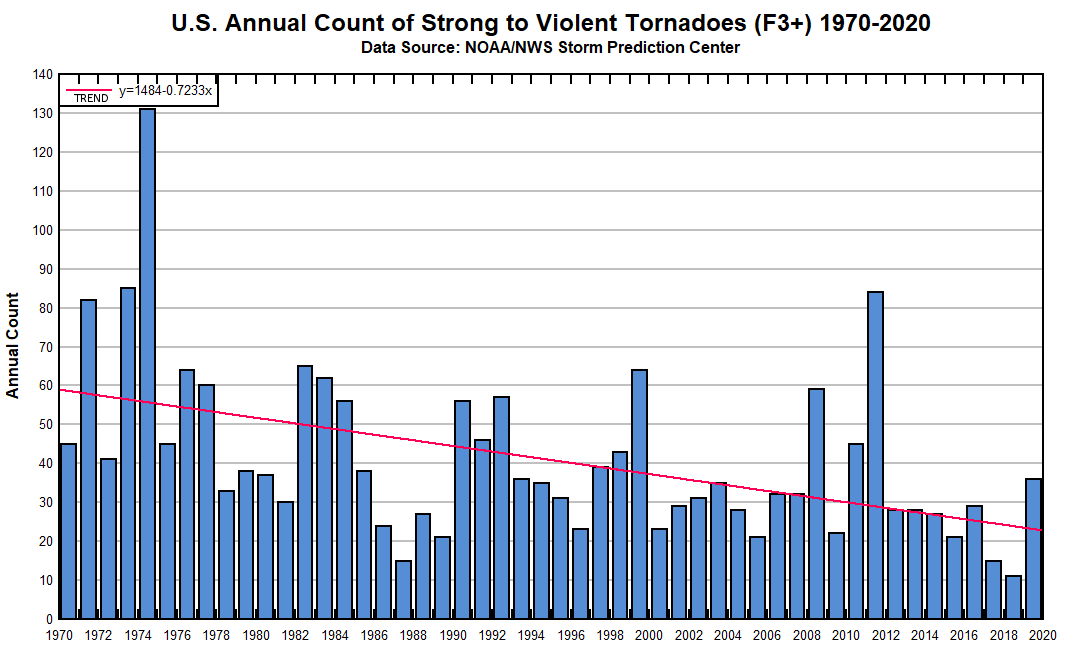
From 2017 through 2018, the U.S. set a record for the longest period in history without a tornado death. Also in 2017 and 2018, the U.S. set a record for the longest period in history without an F3 or stronger tornado. The two record-low years for number of tornadoes both occurred this past decade, in 2014 and 2018, a decade which climate alarmists have regularly described as the warmest on record. Even counting the recent December tornadoes, the number of tornados recorded in 2021 has been below average.
Concerning flooding, another extreme weather event Shulski links to climate change in the KPTM story, there has been no increase flooding frequency or severity as the climate modestly warms. The IPCC admits having “low confidence” in any climate change impact regarding the frequency or severity of floods. Although the IPCC states in its recent 6th Assessment Report, “the frequency and intensity of heavy precipitation have likely increased at the global scale over a majority of land regions with good observational coverage,” it explicitly states “heavier rainfall does not always lead to greater flooding.”
In addition, the IPCC writes, “Confidence about peak flow trends over past decades on the global scale is low, … [and] there is low confidence in the human influence on the changes in high river flows on the global scale.”
The best available evidence shows extreme weather is neither more frequent, nor more severe than it has been historically. Shulski was wrong to say otherwise, and KPTM was wrong to report her claims without checking the facts.
Two thirds of recent UK “covid hospitalizations” are not for covid
el gato malo – bad cattitude – decmeber 26, 2021
at what point will the world wake up to the fact that we are currently inhabiting far more of a testdemic than a pandemic?
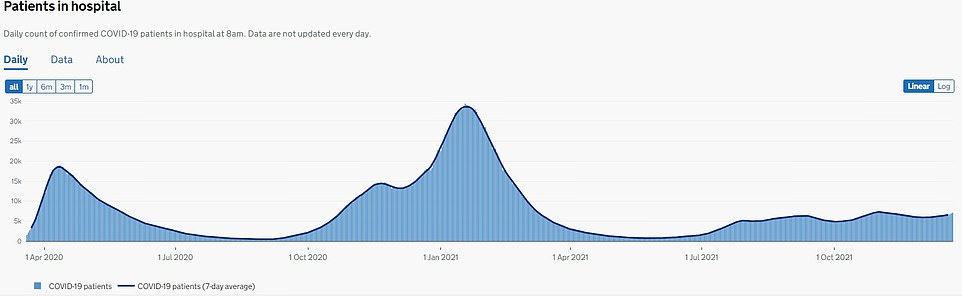
data from the UK is showing that only 1 in 3 recent “covid hospitalizations” is actually in the hospital for covid. the vast majority were there for something else and tested positive after admission. this is literally tripling the reported count of new patients.
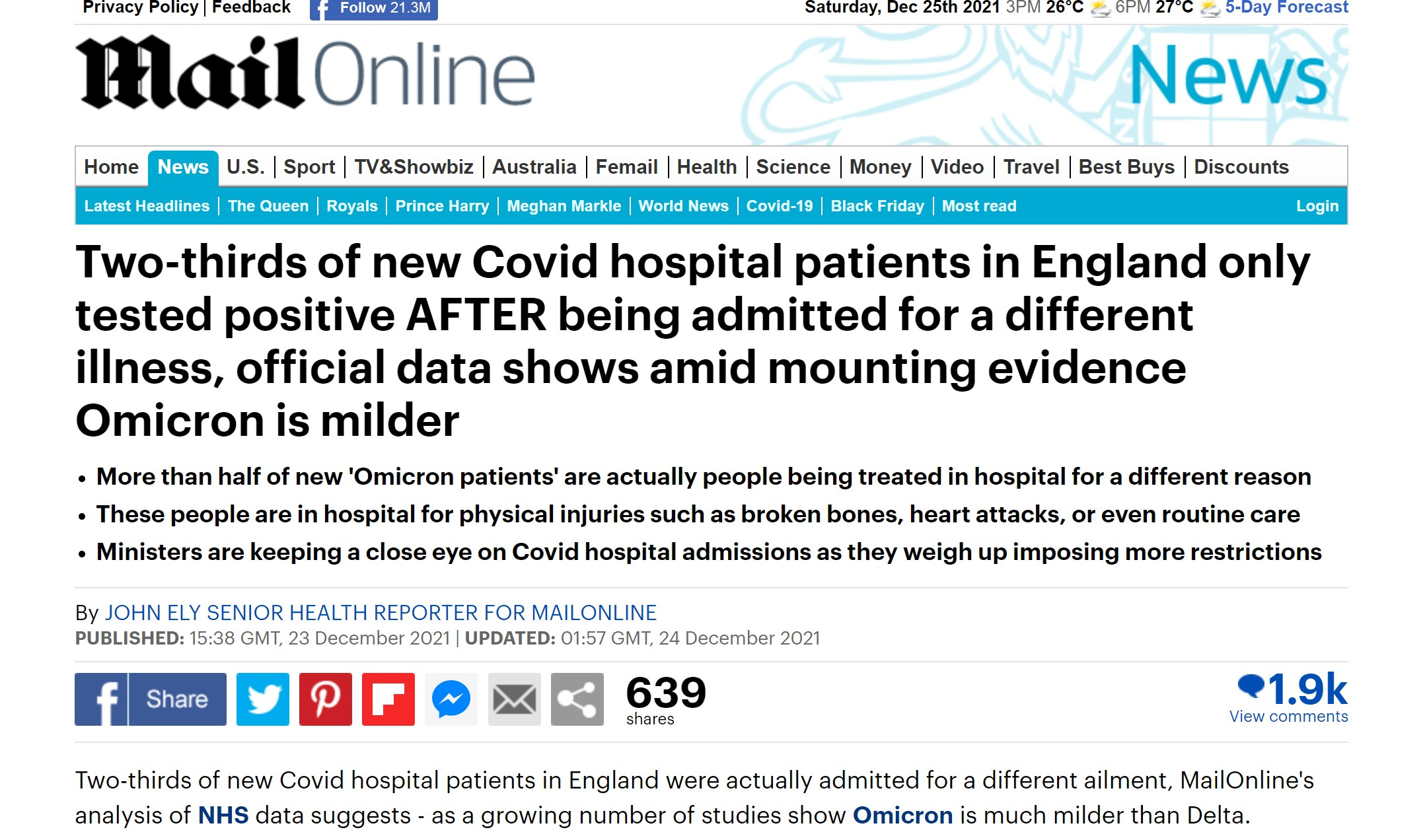
“Two-thirds of new Covid hospital patients in England were actually admitted for a different ailment, MailOnline’s analysis of NHS data suggests – as a growing number of studies show Omicron is much milder than Delta.
In the two weeks to December 21, hospitals in England recorded 563 new coronavirus inpatients — the majority of which are believed to be Omicron now that the variant is the country’s dominant stain.
But just 197 (35 per cent) were being primarily treated for Covid, with the remaining 366 (65 per cent) only testing positive after being admitted for something else.
Experts told MailOnline it was important to distinguish between admissions primarily for Covid so that rising numbers do not spook ministers into more social restrictions or scare the public from going to hospital.
The rising number of so-called ‘incidental cases’ – people who are only diagnosed with the virus after going to the NHS for a different ailment – is in line with the picture in South Africa.
Studies in the epicentre Gauteng province have shown up to three-quarters of Omicron patients there were not admitted primarily for the virus.”

how, at this stage of affairs and after 2 years of time to learn to get the stats straight is everyone still getting this all so wrong? it outright beggars belief.
how is anyone supposed to make decisions or analyze data when the quality is this low?
if you relentlessly test everyone in sight, symptomatic or no, for covid using overclocked PCR tests at 40+ Ct you’re going to find it everywhere. these tests were never actually suited for purpose and have been locking onto trace virus, dead virus, and all manner of other non-clinical positives.
this is not a sound basis for analysis or behavior.
this has been widely known for ages. and yet it persists unabated.
it has spilled over into every other statistic.
hospitalization has been massively tainted by it as nosocomial spread is rife at the trace level. this issue gets amplified by the payout for finding such “cases” as it allows for more billing on new codes and access to additional insurance and coverage pools. this has turned the hyper-aggressive hunt for cases in hospitals into a huge profit center.
deaths are the same. death with (or within 30 days of) discernable trace virus detection by super sensitive assay is an outlandishly inclusive definition that vastly exceeds actual “death from covid” as a primary or even significant cause.
nothing else is counted this way. ever.
not in all of human history has anything remotely like this taken place.
we’re running more covid tests in a week in the US that we’ve run flu tests in entire decades and more in a season than we’ve run flu tests in the history of the nation.
is it any wonder that with such inclusive definitions, over-amplified detection modalities, and obsessive and malincentivized testing regimes that this all looks so “unprecedented”?
of course it does. we’ve never looked for anything in all of human history the way we’re looking for covid. what other result could one even plausibly expect?
we’ve tested our way into a pit of inescapable dodgy data quicksand.
continuing to treat this “data” as though it is clinically or societally meaningful has become a far greater problem than the disease itself.
the cure, of course, is simple:
stop this OCD level testing strategy.
- stop testing the asymptomatic altogether
- dial down the amplification on PCR to 30Ct at a max and probably something more like 26
- stop obsessively testing healthy children
- stop encouraging people to test themselves over and over and to demand the same from their friends and family
sending out rapid tests to everyone is not good public health policy. it’s epidemiological derangement.
it’s cosplay medicine that perpetuates panic through performative ritual and obeisance. it serves no useful end save digging this hole deeper.
it will not end, assuage, or mitigate spread or the pandemic. it will only lead to more misguided perception and response.
this is not normal. it’s not science. it’s not even sane.
in another big win for irony (who, let’s face it has been having a banner year) the relentless fear and overtesting is actually becoming a problem for hospitals.

the testdemic has become the problem and is combining with a profound lack of perspective to generate astonishing harm.
“a virus so dangerous that you need to test for it to tell it apart from the common cold” is a laughable pretext for hijacking half the planet.

it’s clear these folks cannot hear themselves anymore.
public health has turned into some sort of golem that cannot be turned off and will mindlessly keep digging a trench until the heat death of the universe unless someone steps in and disables it.
so stop it. stop getting tested.
when you play stupid games, you win stupid prizes and this is a very, very stupid game we’re all taking part in…
Featured Video
Death Spikes & Rising Cancer In Our Youth Explained
or go to
Aletho News Archives – Video-Images
From the Archives
Politicians lie
By Mazin Qumsiyeh | Popular Resistance | August 18, 2013
There is no way to say this truth nicely: Politicians lie. That includes Japanese, American, Egyptian, Israeli, and Palestinian politicians! Is there something more common sense than that? Yet, so many citizens around the world believe their own politicians or wistfully acknowledge lies but think it is part of the job needed to run things. They believe even when politicians contradict themselves blatantly. This phenomenon is rather remarkable. It is a dissonance and disconnect from reality that many seem oblivious to. It is very dangerous because it can lead to accepting rationales for going to war. These can be deadly wars that lead to millions of lives lost as happened in what was called World War 1 and WW2. Even when incredible and declassified evidence abound, politicians continue to lie and old mythologies refuse to die. Here are just a few of the countless lies told to us over the past few decades… continue
Blog Roll
 Aletho News
- From Unipolar Universalism to Multipolar Civilizational Distinctiveness
- RSF military group defects, joins Sudanese army: State media
- Ireland goalkeeper refuses to play ‘Israel’ as squad weighs boycott
- China pushes back against US on Cuba, Iran
- Ukrainian Soldiers, Potential Mercenaries: Have Gun, Will Travel!
- Burnham’s UN debut… A masterclass in British disinformation
- Iran flights continue despite US aviation sanctions
- Global Tipping Points Lead the World Into a State of Entropy
- The day-after at the White House: USA and Xi Jinping
- The Geopolitical Balance in the Red Sea: The UAE Being Displaced by New Players
- If Americans Knew
- Deconstructing Netanyahu’s pants-on-fire UN rant – Daily Update
- Trump betrayed voters with his campaign lies and prioritized a foreign country once he took office
- Netanyahu calls Israel’s war in Gaza ‘opposite of genocide’ in UN speech to near-empty hall
- Settler Kidnappings: Torture, Sexual Abuse and Terrorisation of Palestinian Abductees as Israel Deepens Annexation of West Bank
- Gaza winter nears as 162,000 tents become unusable, raising fears of humanitarian crisis
- Netanyahu says, “It’s the opposite of genocide”; UN says Gaza economy is world’s ‘most severe crisis on record’ – Daily Update
- Israel’s US-Backed Assault on Gaza Has Created the ‘World’s Most Severe Economic Crisis on Record’: UN
- ‘Protecting U.S. Citizens’… From Israel
- ‘This is where I live now, the back of a truck’: a day in the life of a grandmother in Gaza
- In UN Speech, Iran’s President Displays Pictures of Children Killed by US, Brings Attention to Israel’s Nuclear Arsenal
- No Tricks Zone
- New Study: Earth And Venus Surface Warmth Largely Explained By Convection And Lapse Rate, Not CO2 Or Radiation
- 2025 Nature Paper Claiming Worsening Global Drought Gets RETRACTED …Heavily Flawed
- New Study: ‘Global Drought Shows No Detectable Recent Acceleration Under Climate Warming’
- Economic Masterminds: German Socialists Suggest Taxing Productivity Gains Stemming From Using AI
- The South China Sea Has Not Been Cooperating With The Climate Change Narrative
- Energy Crisis: Germany Enters Heating Season With Historically Low Gas Reserve Fill Levels
- New Study: The Antarctic Ice Sheet Gained Mass From 2020-2024 Due To Staggering Snow And Ice Accumulation
- Study: Ocean Heating Rates From Thousands Of Years Ago ‘Dwarf’ Modern Ocean Heating Rates
- Climate Extremists Target, Attack Large-Scale Power Grid Infrastructure In Germany!
- New Study: Antarctic Ice Melt Has Contributed Less Than 1 Centimeter To Sea Level Rise In The Last 30 Years

