Regulators knew in 2020 that Covid-19 Vaccines would cause blood clots, heart damage, harm to children, and death
DAILY EXPOSE – AUGUST 22, 2021
Every serious adverse reaction to the Covid-19 vaccines that medicine regulators in both the USA and United Kingdom have been forced to admit is occurring was predicted by the very same medicine regulators to occur before the Covid-19 vaccines were even rolled out.
The following video was released by the US Food and Drug Administration in October 2020 and the person presenting the slides within the video skips past a slide entitled ‘Draft working list of possible adverse event outcomes’ as fast as he possibly can.
Skip to the 2 hour, 33 minute mark and see for yourself…

You’ll have noticed the slide read as follows –
“FDA Safety Surveillance of COVID-19 Vaccines: DRAFT Working list of possible adverse event outcomes ***Subject to change***
-Guillain-Barré syndrome
-Acute disseminated encephalomyelitis
-Transverse myelitis
-Encephalitis /myelitis/encephalomyelitis/meningoencephalitis/meningitis/encephalopathy
-Convulsions/seizures
-Stroke
-Narcolepsy and cataplexy
-Anaphylaxis
-Acute myocardial infarction
-Myocarditis/pericarditis
-Autoimmune disease
-Deaths
-Preganacy and birth outcomes
-Other acute demyelinating diseases
-Non-anaphylactic allergic reactions
-Thrombocytopenia
-Disseminated intervascular coagulation
-Venous thromboembolism
-Arthritis and arthralgia/joint pain
-Kawasaki disease
-Multisymptom Inflammatory Syndrome in Children
-Vaccine enhanced disease”
All of the clotting and coagulation. All of the heart damage. All of the female reproductive issues. All of the people suffering heart attacks and strokes and people sadly dying. All of it was predicted by the medicine regulators before the jabs were even rolled out.
Even the multi-symptom inflammatory syndrome in children was predicted and it is a brand new disease where children have symptoms resembling toxic shock syndrome or Kawasaki disease, in which the coronary arteries enlarge or form aneurysms. Also common are heart inflammation with impaired heart function and low blood pressure, rash or red eyes, and gastrointestinal symptoms.
Which is why we can be certain that vaccine enhanced disease also known as antibody-dependent enhancement is occurring and will occur, because the health regulators have predicted it will do so. This is precisely why Public Health England data shows that the double vaccinated have at least a 338% higher chance of death if infected with Covid-19.
The latest PHE report shows that up to the 15th August 2021 the fully vaccinated population had suffered a total of 679 deaths. This equates to 0.9% of all confirmed infections among the fully vaccinated population. Whereas the unvaccinated population had suffered just 390 deaths equating to just 0.2% of all confirmed infections.

The medicine regulators knew precisely what would happen to people once the Covid-19 injections were rolled out yet they allowed it to happen anyway. We wonder if Bill Gates being the primary funder of the UK’s Medicine Regulator the MHRA has anything to do with it? He only has major shares in both Pfizer and BioNTech so perhaps not?
The Face Mask Folly in Retrospect
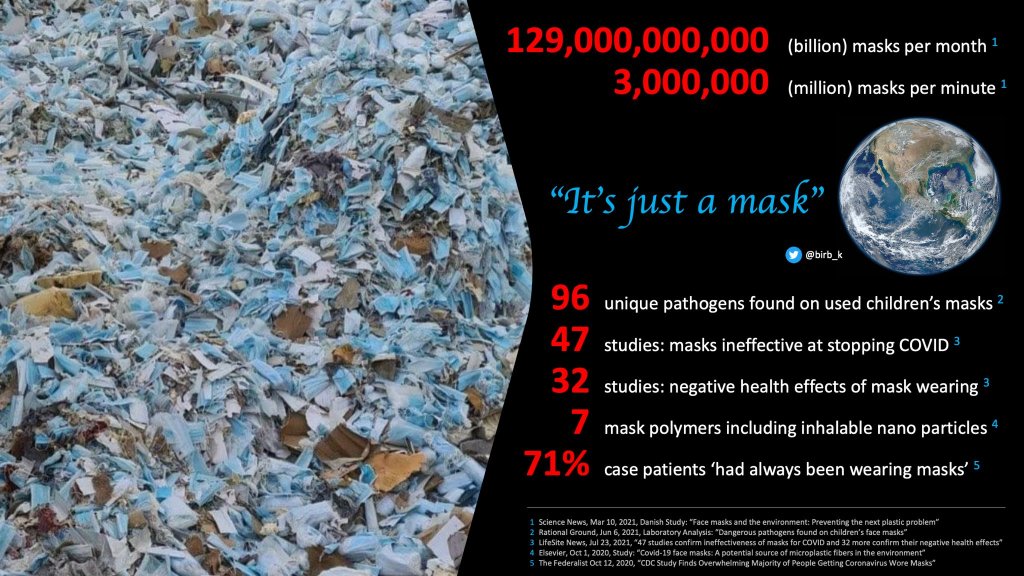
“It’s just a mask”: Global impact of the face mask folly (K. Birb)
Swiss Policy Research | August 22, 2021
It has been known for decades that face masks don’t work against respiratory virus epidemics. Why has much of the world nonetheless fallen for the face mask folly? Ten reasons.
1) The droplet model
Many ‘health authorities’ have relied on the obsolete ‘droplet model’ of virus transmission. If this model were correct, face masks would indeed work. But in reality, respiratory droplets – which by definition cannot be inhaled – play almost no role in virus transmission. Instead, respiratory viruses are transmitted via much smaller aerosols, as well as, possibly, some object surfaces. Face masks don’t work against either of these transmission routes.
2) The Asian paradox
During the first year of the pandemic, several East Asian countries had a very low coronavirus infection rate, and many ‘health experts’ falsely assumed that this was due to face masks. In reality, it was due to very rapid border controls in some countries neighboring China as well as a combination of metabolic and immunologic factors reducing transmission rates. Nevertheless, many East Asian countries eventually got overwhelmed by the coronavirus, too (see charts below).
3) The Czech mirage
In the spring of 2020, the Czech Republic was one of the first European countries that introduced face masks. Because the Czech infection rate initially stayed low, many ‘health experts’ falsely concluded that this was due to the masks. In reality, most of Eastern Europe simply missed the first wave of the epidemic. A few months later, the Czech Republic had the highest infection rate in the world, but by then, much of the world had already introduced face mask mandates.
4) Fake science
For decades, studies have shown that face masks don’t work against respiratory virus epidemics. But with the onset of the coronavirus pandemic and increasing political pressure (see below), suddenly studies appeared claiming the opposite. In reality, these studies were a mixture of confounded observational data, unrealistic modelling and lab results, and outright fraud. The most influential fraudulent study certainly was the WHO-commissioned meta-study published in The Lancet.
5) Asymptomatic transmission
Another factor contributing to the implementation of mask mandates was the notion of ‘asymptomatic transmission’. The idea was that everybody should be wearing a mask because even people without symptoms might spread the virus. The importance of asymptomatic and pre-symptomatic transmission is still a matter of debate – up to half of all transmission might occur prior to symptom onset –, but either way, face masks simply don’t work against aerosol transmission.
6) Political pressure
Several political factors contributed to the implementation of mask mandates. First, some politicians simply wanted to “do something” against the pandemic; second, some politicians thought face masks might have a “psychological effect” and might “remind” citizens to stay cautious (if anything, it had the opposite effect: creating a ‘false sense of security’); third, some politicians used mask mandates to enforce compliance and pressure the population into accepting mass vaccination.
In addition, there was a vicious circle involving science and politics: politicians claimed to “follow the science”, but scientists followed politics. For instance, the WHO famously admitted that their updated mask guidelines were in response to “political lobbying”, not new evidence. The most influential lobby group was “masks4all”, founded by a “Young Leader” of the World Economic Forum (WEF).
7) The media
Perhaps unsurprisingly, most of the ‘mass media’ amplified the fraudulent science and the political pressure driving mask mandates. Only some independent media outlets and some truly independent experts questioned the validity of the underlying evidence. However, their voices got suppressed as dubious “fact checking” organizations eagerly enforced official guidelines and throttled or censored many articles and videos critical of face masks.
8) “Surgeons wear masks”
Surgeons wear masks, so they must be effective, right? This was another notion contributing to the face mask misunderstanding. In reality, surgeons wear masks not against viruses, but against much larger bacteria, but more importantly, studies have long shown that even surgeons’ masks make no difference in terms of bacterial wound infections.
9) Misleading memes
To convince low-IQ social media users of the effectiveness of face masks, several unscientific memes were created. The most notorious one probably was the “peeing into your pants” meme, shared by many ‘health experts’ (really). Many of these memes exploited the fact that most people simply don’t realize how small and ubiquitous viral aerosols really are.
10) Doubling down
After mask mandates had been implemented globally and hundreds of billions of dollars had been spent on masks, it soon became obvious – once more – that masks simply don’t work against respiratory virus epidemics (see charts below). But at that point, neither politicians, nor ‘health experts’, nor duped citizens who had to wear them for months wanted to admit this anymore.
Instead, some ‘health authorities’ doubled down and enforced outdoor masking (even on beaches), double-masking, or N95/FFP2 masking, to no avail. The one novel scientific insight produced during the coronavirus pandemic was that even N95/FFP2 mask mandates have made no difference at all.
Sweden: The exception that proved the rule
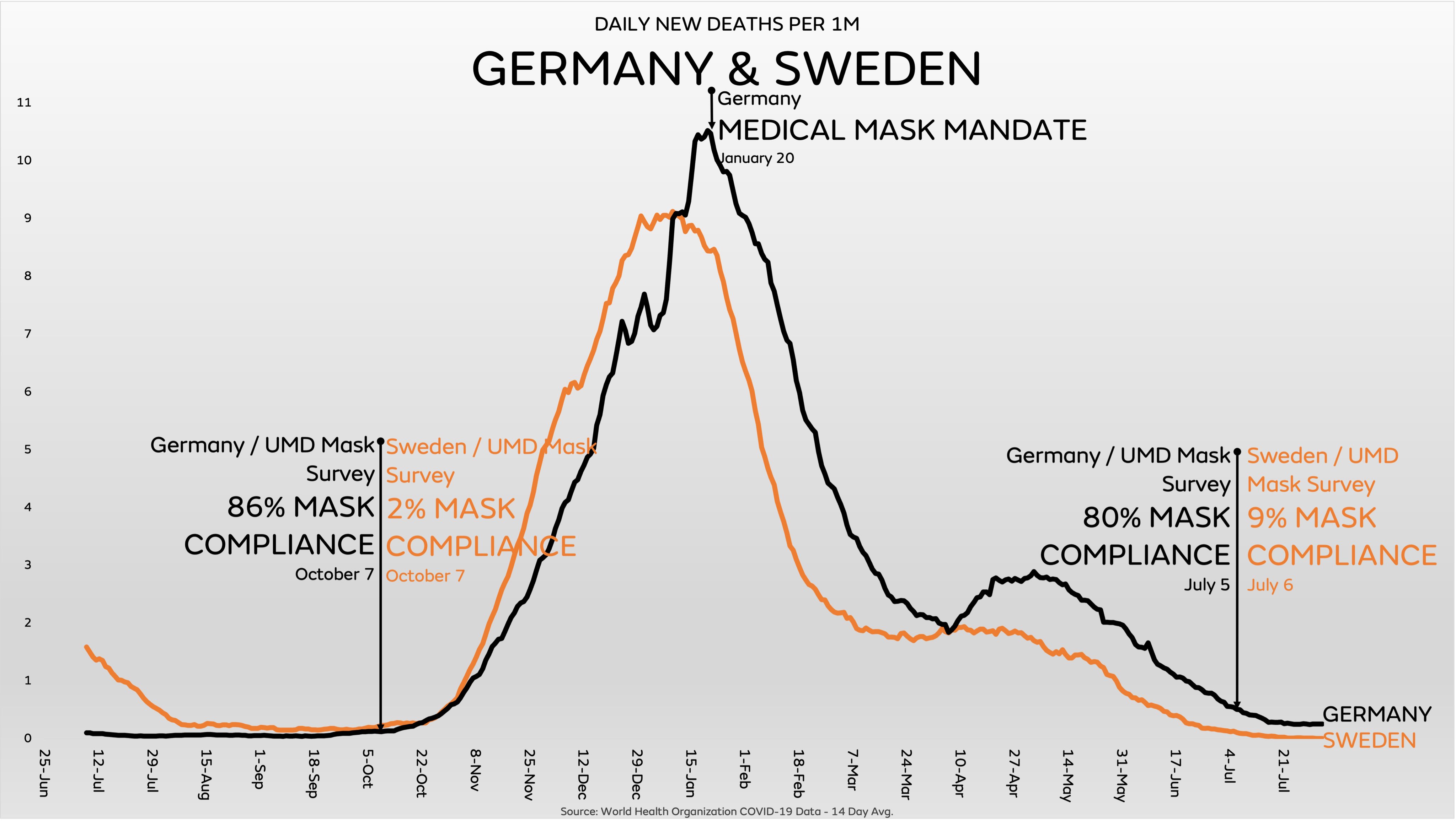
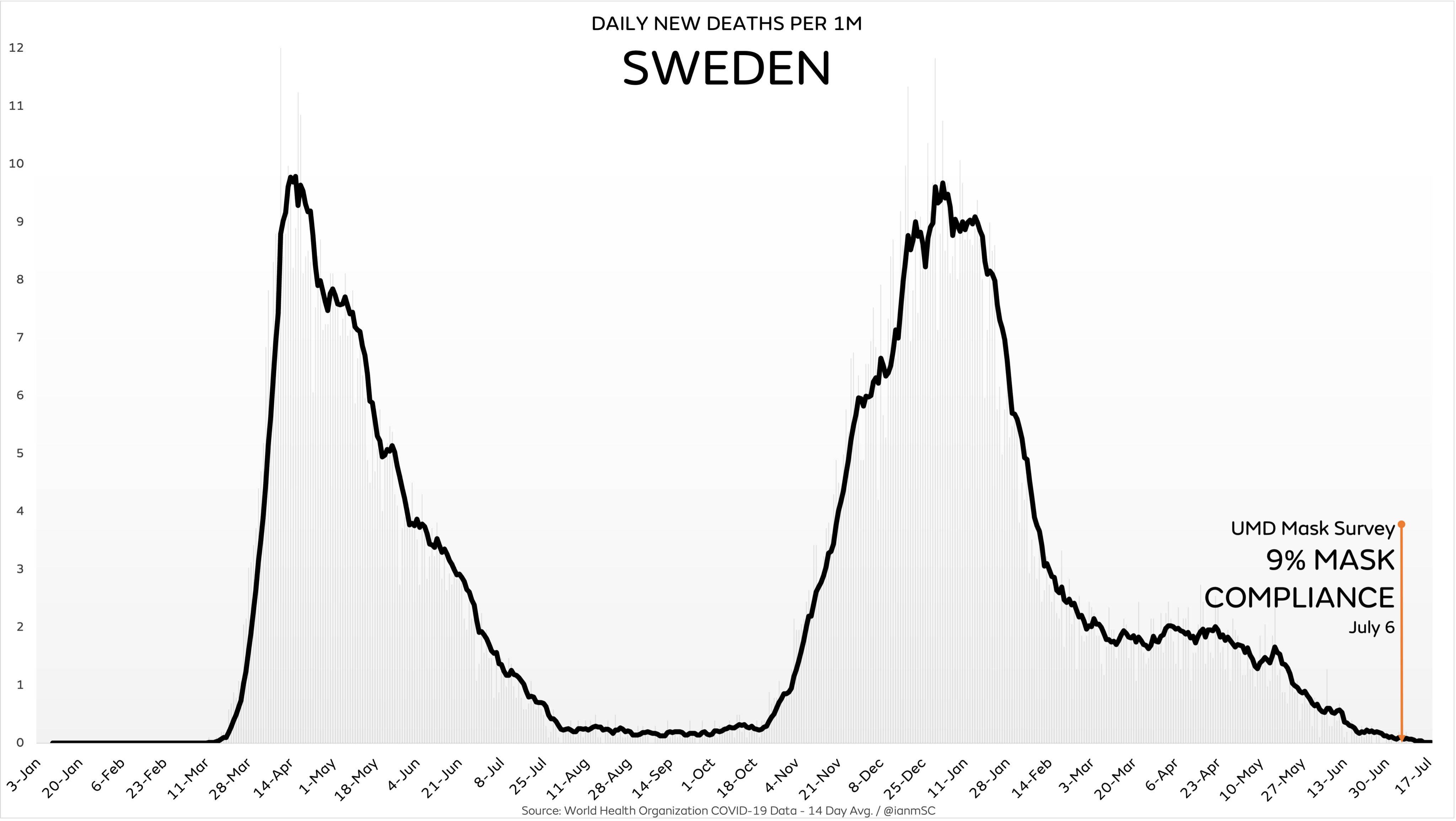
Only very few countries in the world have resisted the face mask folly. The most famous example certainly is Sweden (see charts below), which has also resisted the lockdown experiment. Naturally, Swedish coronavirus mortality has remained below the European average. But the many vicious attacks against Sweden by much of the international media showed just how difficult it has been to escape the global madness and follow the real science during this bizarre pandemic.
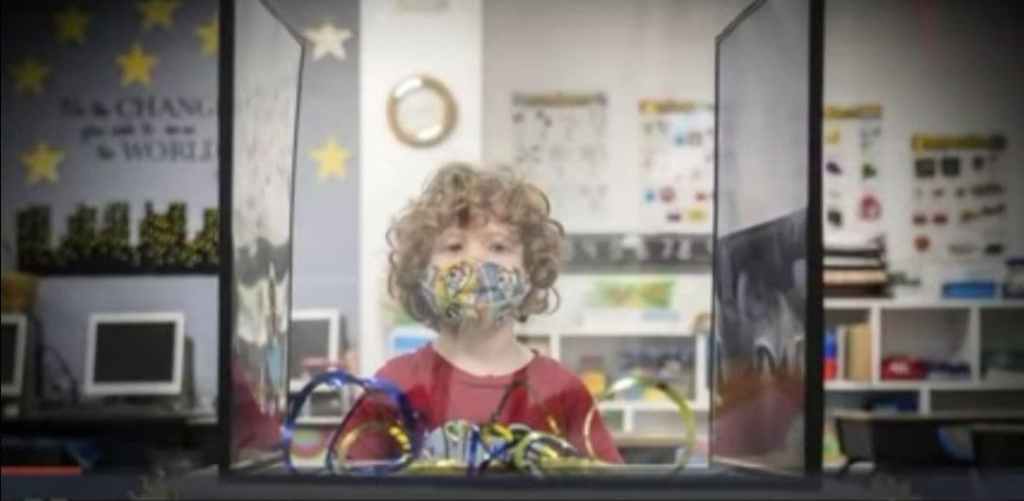
A child wearing a mask at school (more)
How face masks and lockdowns failed
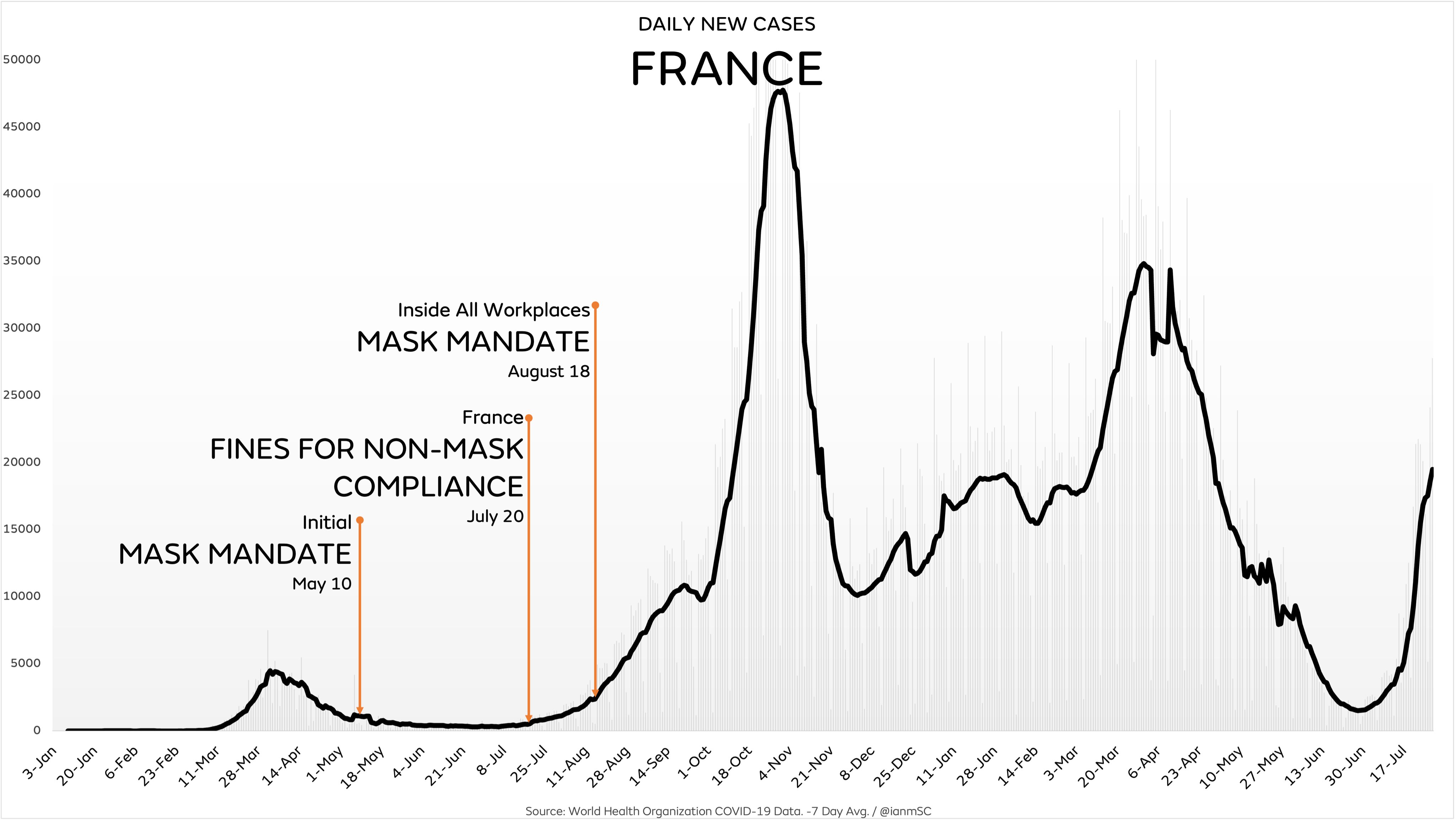
The following charts show that infections have been driven primarily by seasonal and endemic factors, whereas mask mandates and lockdowns have had no discernible impact (charts: IanMSC).






Will The JFK Assassination Cover-Up Continue in October?
By Jacob G. Hornberger | FFF | August 24, 2021
After President Kennedy’s assassination, the CIA, the Pentagon, and the Secret Service, for some reason, deemed it necessary to keep their records and activities relating to the assassination secret from the American people. “National security,” they said, which didn’t seem to make much sense given the official scenario that a lone-nut communist former U.S Marine had killed the president.
One of the most interesting and, ultimately, revealing aspects of this official secrecy involved the autopsy that the military conducted on the president’s body several hours after the assassination. Military personnel who participated in the autopsy were advised that the autopsy was a highly classified, top-secret operation that they were forbidden to ever talk to anyone about. They were forced to sign written secrecy oaths and threatened with severe punishment if they ever talked about what they had seen and done.
But talk they did, only some 30 years later, when Oliver Stone blew much of the official secrecy out of the water with his film JFK, which posited that the assassination was actually a highly sophisticated regime-change operation that targeted a president who was determined to take America in a direction opposite from that which the Pentagon and the CIA were determined to take our nation.
Stone’s movie informed the American people of the 30-year-long, continuing official secrecy in the JFK assassination on the part of the U.S. national-security establishment. The American people at that time, most of whom had never bought into the very pat official scenario of the assassination, were outraged and suspicious. Contacting their members of Congress and demanding an end to the official secrecy, they succeeded in pressuring Congress to enact the JFK Records Act, which forced the Pentagon, the CIA, the Secret Service, and other federal agencies to disgorge their long-secret records relating to the assassination.
Thanks to the efforts of the Assassination Records Review Board, the agency charged with enforcing the JFK Records Act during the 1990s, that’s when the mountain of evidence establishing the fraudulent autopsy that was conducted on the president’s body came to light. Those military personnel who had been threatened back in 1963 if they ever talked, having been released from those written secrecy oaths, told a remarkable story, one that detailed how they were ordered to sneak the president’s body into the Bethesda morgue about an hour-and-a-half before its official entry time, with the aim of conducting the fraudulent autopsy on the president’s body. The fraudulent autopsy is detailed in my two books The Kennedy Autopsy and The Kennedy Autopsy 2.
At the risk of belaboring the obvious, there is no innocent explanation for a fraudulent autopsy. It is inexorably intertwined with the assassination itself. It shows us who orchestrated this highly sophisticated regime-change operation.
The ARRB went out of existence in 1998. However, the JFK Records Act permitted the CIA and other federal agencies to keep thousands of their assassination-related records secret for another 25 years. “National security,” of course.
That 25-year deadline came due during the Trump administration. After promising to release the records, Trump succumbed to pressure from the CIA to extend the time for secrecy. Once again, “national security,” of course. Trump extended the time for secrecy to October 2021, a couple of months from now.
What will happen when the deadline comes due in October? Will the CIA pressure President Biden into granting another extension of time for secrecy? WIll Biden grant such a request?
Time will tell, but I’d like to make clear where I stand on the matter. There is no question in my mind that the CIA will request another extension of time for secrecy. Whatever is left in those long-secret records that needed to be kept secret for the last 58 years would still need to be kept secret from the American people. These people are fully aware of how the ARRB uncovered the evidence establishing the fraudulent autopsy. The last thing they want is for that to happen again, especially with respect to the CIA’s Oswald-related operations in Mexico City, which are still shrouded in official secrecy.
The fact that the National Archives will not disclose whether the CIA has already expressed an interest in seeking an extension of time for continued secrecy is not a positive sign. See my recent article “Why the NARA Secrecy Over the Secret JFK Records?”
Will President Biden grant such a request? In my opinion, there is no doubt that he will. If Trump could be pressured to grant an extension, it will be a piece of cake for the CIA to pressure Biden into doing the same. Of course, needless to say, “national security” will be cited as the justification.
Bottom line: Make no mistake about it: Unless public pressure were to somehow change the natural course of events, like it did back in 1992 after Oliver Stone’s movie, the national-security establishment’s cover-up of its highly sophisticated November 22, 1963, regime-change operation in Dallas, Texas, will continue come this October.
Are the FDA and Pfizer-BioNTech scamming us with a license-in-name-only? And why do they want us to be vaccinated so badly?
By Dr. Meryl Nass, MD | August 23, 2021
This is a convoluted legal argument, but since it hinges on the potential loss of huge amounts of money, I think there is a good chance my guess is correct.
EUA or “authorized” vaccines and drugs are defined as experimental. Experimental products require informed consent, and there are other restrictions on their use. Most lawyers believe, as I do, that they cannot be legally mandated, because they require you to have the right to refuse. It is written into the EUA statute. There also cannot be approved, licensed drugs that do the same thing as the EUA drug or vaccine, and of course, in this case both HCQ and IVM can prevent as well as treat Covid.
This has troubled the federal government. And so it had the DOJ’s Office of Legal Counsel manufacture a legal opinion in late July that you could be forced to be vaccinated even while the vaccines were only authorized. However, the OLC arguments were ridiculous and therefore ignored.
When that didn’t work, federal threats got heavy. First it was going to be mandates “if you wanted to do business with the government.” Then mandates for the military. Then mandates for healthcare workers, schools, colleges, you name it. And federal workers.
But legally, all these mandate threats hinged on licensure, aka “approval.” No one wanted to go to court defending a mandate under EUA. And the feds probably promised all the employers, schools, states, etc. that a license would be issued before colleges and schools started.
But there is a huge elephant in the room. Under EUAs, the government pays for the product and the manufacturer has NO liability, unless you can prove willful misconduct AND the DHHS Secretary allows you to sue. That has never happened.
But once the product (Pfizer’s vaccine, today) is licensed, the liability shield under EUA disappears. Unless there has a been a secret agreement regarding liability after approval, which is probably not legal, Pfizer will be liable for all injuries sustained by the licensed vaccine. And Pfizer’s vaccine seems to be causing a record number of injuries and deaths, based on the VAERS data.
The FDA approval letter, issued today, was unusual. It stated that current bottles of vaccine, which are not branded with the “Comirnaty” brand name, are still authorized, not approved. Only newer bottles with “Comirnaty” labels will be approved, licensed product.
What that means is that people cannot be mandated to receive vaccine from the old bottles. But if they do accept the non-brand vaccine, they cannot sue if injured.
If they receive the branded vaccine and are injured, they can be mandated to take it, but they can also sue the company for damages.
Here is what might be happening. FDA issued a license, so everyone thinks the mandate is now in effect. But if no “Comirnaty” labelled vaccine is being administered, just the old authorized vaccine, there is no licensed product being used, and there is no actual mandate. And no ability to sue if injured.
If you have looked at any of the leaked contract documents between Pfizer and Israel or Albania, or heard about the contract signed in Brazil, you will probably agree with me that Pfizer would not be willing to accept liability for this product.
So: if it does not say “Comirnaty” it cannot be mandated.If it does say “Comirnaty,” it can be mandated. But if it doesn’t say “Comirnaty it is still experimental and you cannot be forced to take it, and if you do get injured, you are out of luck.
Don’t sign a liability waiver for this product! Don’t sign away your rights if you take it.
I am guessing Pfizer will continue to supply the old “authorized” vaccine to avoid liability… and that explains the convolution in FDA’s letter this morning. If I am correct, you won’t have to take it… Anyway, not till Pfizer gets rid of the liability problem…which could happen, as a bill has been introduced in Congress to solve Pfizer’s problem. It’s the Vaccine Injury Modernization Compensation Act of 2021. Will our legislators throw us under the bus again and remove manufacturer liability for the few vaccines that still have it? Be forewarned.
You can track the bill here.
Comments in response to FDA’s license of Pfizer vax today for 16 years and up
By Meryl Nass, MD | August 23, 2021
The vaccine-induced protection provided by Covid vaccines starts fading within months. In late July, Israel’s Minister of Health said vaccine protection had dropped to 39%. It is not preventing severe illness in Israel and the UK either, though the US CDC changed its collecting methods for breakthrough cases on May 1 to disguise this fact.
While the US government has said it will begin booster doses of mRNA vaccines the week of September 20, there is actually NO evidence that Covid-19 boosters will provide increased protection against infection, or that they are effective against the delta variant or other new variants.
For other vaccines, such as mumps and pertussis, there is no evidence that booster doses after the initial course add measurable protection.
Boosters do raise antibody levels, briefly, which increases the risk of autoimmune adverse effects, immune overactivity and the dire possibility of antibody-enhanced disease (AED), a.k.a. vaccine-enhanced disease (VED), in which those who are vaccinated have a much more severe illness when exposed to Covid than do the unvaccinated.
Since the UK’s top vaccine expert Sir Andrew Pollard told Parliament 2 weeks ago that herd immunity cannot be obtained—in fact it is a “myth”– because the vaccine is not halting transmission, and since the CDC director confirmed this, there is no logical reason to mandate vaccinations for anyone, since the vaccines are not protecting the community.
Mandating vaccinations for the young and healthy, who are at minimal risk from Covid, but at increased risk from Covid vaccinations, is a travesty. The risk of myocarditis after vaccination in a male teenager is 50 times higher than the risk to a 65 year old, according to CDC data. The teenager has many years ahead of him, while the long-term side effects from Covid vaccines have yet to be identified.
Reported deaths following Covid vaccinations are at least 10 times higher than for any vaccine ever approved in the US. Yet FDA and CDC have never explained the causes of these deaths, and they pretend they do not exist.
This fact alone should have been sufficient to stop FDA granting a license to the Pfizer vaccine.
Here is the convoluted license-plus-authorization letter from FDA. This could be a bait and switch–see the next post.
‘Deny and accuse somebody else’: FBI told informant in Michigan governor ‘kidnap’ plot to slander another man
RT | August 17, 2021
A text from an FBI agent instructed an informant in the alleged militia plot to kidnap Michigan Governor Gretchen Whitmer to delete messages and shift blame onto another man, casting further doubt on the already doubtful case.
Five people are currently awaiting trial on federal charges that the “Wolverine Watchmen” militia they supposedly belonged to wanted to kidnap the Democrat governor. The FBI announced the plot and arrested them in October 2020, shortly before the US election.
In a court filing last week the attorney for one of them sought text messages from FBI special agents Henrik Impola and Jayson Chambers, citing an exchange with one of the informants, identified only as “Dan.” A screenshot of it appeared online on Tuesday.
“Be sure to delete these,” the agent – allegedly Impola – tells ‘Dan,’ and later instructs him to deflect accusations of being an FBI informant. “Best thing to do is deny and accuse somebody else,” the agent texted, naming a man who wasn’t charged in the plot.
The text messages were cited in a filing by Michael Hills, an attorney representing one of the five defendants, Brandon Caserta. The FBI instructing their paid informant “to lie and paint an innocent citizen as an undercover federal agent” to an alleged domestic terrorist militia leader “casts a dark shadow over the credibility of this investigation,” Hills wrote in a court filing, as quoted by the local outlet MLive on Sunday.
‘Dan’ was “at the center of all activity” and recruited other individuals to join the alleged conspiracy, so the defense is demanding his text messages for purposes of arguing entrapment and as “evidence of government methods and tactics,” Hills wrote.
His colleague Christopher Gibbons, who represents Adam Fox, another defendant in the case, wrote that FBI informants “were originators of the criminal design in this case, to the extent that a ‘design’ ever existed.”
Last month, BuzzFeed published a lengthy investigative report – citing court filings, transcripts and interviews – showing that informants played a “far larger” role in the alleged plot than was previously known. The FBI relied on a dozen Confidential Human Sources (CHS) or Undercover Employees (UCE), almost as many as the actual members of the ‘Wolverines.’
Eight alleged militiamen have been charged under Michigan terrorism statutes, while six were slapped with federal charges. One, Ty Garbin, has since pleaded guilty to the kidnap conspiracy and is awaiting sentencing. Caserta, Fox, Barry Croft, Daniel Harris and Kaleb Franks are being held in jail ahead of the October 12 trial in Grand Rapids.
Assistant US Attorney Nils Kessler, who is prosecuting the case, has argued that the defendants were “predisposed to join the kidnapping and explosive conspiracies, and therefore will not be able to prove entrapment.”
The unraveling “plot” has prompted some critics – such as conservative lawyer and filmmaker Mike Cernovich – to accuse the FBI of engaging in a “disinformation campaign directly attacking democracy.”
Massive fraud in reporting vaccine injuries; withheld data, pretense of “safe and effective”
By Jon Rappoport | No More Fake News | August 17, 2021
ONE: A bombshell. Alex Berenson, former New York Times reporter, August 6: “Covid vaccine maker Moderna received 300,000 reports of side effects after vaccinations over a three-month period following the launch of its shot, according to an internal report from a company that helps Moderna manage the reports.”
“That figure is far higher than the number of side effect reports about Moderna’s vaccine publicly available in the federal system that tracks such adverse events.”
BOOM. 300,000 vaccine adverse effects NOT reported to VAERS, the federal database.
Berenson: “The 300,000 figure comes from an internal update provided to employees by IQVIA, a little-known but enormous company that helps drugmakers manage clinical trials. Headquartered in North Carolina, IQVIA has 74,000 employees worldwide and had $11 billion in sales last year.”
“Earlier this week, Richard Staub, the president of IQVIA’s Research & Development Solutions division, sent a ‘Q2 2021 update’ which was labeled ‘Confidential – For internal distribution only’.”
“A person with access to the presentation provided screenshots of the relevant slide, which clearly explains the 300,000 side effect reports were received over ‘a three-month span’ – not since the introduction of the vaccine in December…”
TWO: Independent researcher Virginia Stoner has issued a stunning new report on the VAERS numbers, and the effort by mainstream scientists to minimize the destructive effects of the COVID vaccines. Here are key quotes from her report:
“More deaths have been reported to VAERS from the covid shots than from all other vaccines combined for the last 30 years.”
“There’s a code of silence shielding the massive increase in deaths (and other serious injuries) reported to VAERS from the covid shots. Not only do CDC web pages and press releases omit that inconvenient fact—vaccine research studies omit it as well.”
“The number of covid shots [in the US] administered so far in 2021 (309 million) is roughly the same as all other vaccines administered in 2020 (316 million). But a shocking 36-times more deaths were reported this year from the covid shots than were reported last year from all other vaccines.”
“Someone died from a vaccine they [a medical provider] administered…could it potentially call their professional judgment into question, or result in a malpractice lawsuit? If you were a doctor, or supervisor at a drive-thru covid vaccination clinic, and you were given a choice between spending the evening filing a VAERS report, or having dinner with friends, which would you choose?”
“There are reasons to think death may be one of the most underreported vaccine injuries of all—mainly because the victim is dead, and can’t file a VAERS report. Nor can they prod their doctor into filing a VAERS report. Unless they’re fortunate enough to have a relative or doctor who knows they got the vaccine, knows about VAERS, understands the potential for vaccine injury, and is willing to go through the onerous process of filing a VAERS report, it won’t happen.”
THREE: Open letter from Doctors for COVID Ethics accusing governments and media of lying to the people:
“Official sources, namely EudraVigilance (EU, EEA, Switzerland), MHRA (UK) and VAERS (USA), have now recorded more Injuries and Deaths from the ‘Covid’ vaccine roll-out than from all previous vaccines combined since records began.”
“TOTAL for EU/UK/USA – 34,052 Covid-19 injection related deaths and over 5.46 million injuries reported as of 1 August 2021.”
“It is important to be aware that the official figures above (reported to the health authorities) are but a small percentage of the actual figures. Furthermore, people continue to die (and suffer injury) from the injections with every day which passes.”
“This catastrophic situation has not been reported by the mainstream media, despite the official figures above being publicly available.”
“The Signal of Harm is now indisputably overwhelming, and, in line with universally accepted ethical standards for clinical trials, Doctors for Covid Ethics demands that the ‘Covid’ vaccine programme be halted immediately.”
“Continuation of the programme in the full knowledge of ongoing serious Harm and Death to both adults and children constitutes a Crime Against Humanity/Genocide for which those found to be responsible or complicit will ultimately be held personally liable.”
“Governments worldwide are lying to you the people, to the populations they purportedly serve.”
“The figures above demonstrate that the mRNA vaccines are deadly.”
FOUR: The well-known 2010 Harvard Pilgrim Health Care, Inc. study of VAERS bluntly stated: “Adverse events from vaccines are common but underreported, with less than one percent reported to the Food and Drug Administration (FDA). Low reporting rates preclude or delay the identification of ‘problem’ vaccines, potentially endangering the health of the public.”
Following the finding of that study, you would multiply the number of reported vaccine injuries by 100 to arrive at a proper figure.
FIVE: In view of the massive number of vaccine injuries and deaths, how would we expect the public to react? Here is a major clue. Stat News, July 21: “Millions of unused Covid-19 vaccines are set to go to waste as demand dwindles across the United States and doses likely expire this summer, according to public health officials…”
“Currently, states have administered 52.36 million fewer doses than have been distributed to them, according to federal data.”
“A significant tranche of Pfizer doses is expected to expire in August… Given waning domestic vaccine demand, those doses are unlikely to be fully used before they must be tossed.”
“’We’re seeing demand [for the vaccine] falling off across all the states,’ said Marcus Plescia, chief medical officer at the Association of State and Territorial Health Officials.”
SIX: Understanding this, government, media, and corporate criminals are ramping up vaccine mandates wherever and however they can, to force the needle into your arm.
“You’re aware that our product is highly dangerous and destructive? We’ll make you take it.”
SEVEN: RESIST. REBEL.
SOURCES:
The U.S. Government Lied For Two Decades About Afghanistan
By Glenn Greenwald | August 16, 2021
“The Taliban regime is coming to an end,” announced President George W. Bush at the National Museum of Women in the Arts on December 12, 2001 — almost twenty years ago today. Five months later, Bush vowed: “In the United States of America, the terrorists have chosen a foe unlike they have faced before. . . . We will stay until the mission is done.” Four years after that, in August of 2006, Bush announced: “Al Qaeda and the Taliban lost a coveted base in Afghanistan and they know they will never reclaim it when democracy succeeds. . . . The days of the Taliban are over. The future of Afghanistan belongs to the people of Afghanistan.”
For two decades, the message Americans heard from their political and military leaders about the country’s longest war was the same. America is winning. The Taliban is on the verge of permanent obliteration. The U.S. is fortifying the Afghan security forces, which are close to being able to stand on their own and defend the government and the country.
Just five weeks ago, on July 8, President Biden stood in the East Room of the White House and insisted that a Taliban takeover of Afghanistan was not inevitable because, while their willingness to do so might be in doubt, “the Afghan government and leadership . . . clearly have the capacity to sustain the government in place.” Biden then vehemently denied the accuracy of a reporter’s assertion that “your own intelligence community has assessed that the Afghan government will likely collapse.” Biden snapped: “That is not true. They did not — they didn’t — did not reach that conclusion.”
Biden continued his assurances by insisting that “the likelihood there’s going to be one unified government in Afghanistan controlling the whole country is highly unlikely.” He went further: “the likelihood that there’s going to be the Taliban overrunning everything and owning the whole country is highly unlikely.” And then, in an exchange that will likely assume historic importance in terms of its sheer falsity from a presidential podium, Biden issued this decree:
Q. Mr. President, some Vietnamese veterans see echoes of their experience in this withdrawal in Afghanistan. Do you see any parallels between this withdrawal and what happened in Vietnam, with some people feeling —
THE PRESIDENT: None whatsoever. Zero. What you had is — you had entire brigades breaking through the gates of our embassy — six, if I’m not mistaken.
The Taliban is not the south — the North Vietnamese army. They’re not — they’re not remotely comparable in terms of capability. There’s going to be no circumstance where you see people being lifted off the roof of an embassy in the — of the United States from Afghanistan. It is not at all comparable.
When asked about the Taliban being stronger than ever after twenty years of U.S. warfare there, Biden claimed: “Relative to the training and capacity of the [Afghan National Security Forces] and the training of the federal police, they’re not even close in terms of their capacity.” On July 21 — just three weeks ago — Gen. Mark Milley, Biden’s Chairman of the Joint Chiefs of Staff, conceded that “there’s a possibility of a complete Taliban takeover, or the possibility of any number of other scenario,” yet insisted: “the Afghan Security Forces have the capacity to sufficiently fight and defend their country.”
Similar assurances have been given by the U.S. Government and military leadership to the American people since the start of the war. “Are we losing this war?,” Army Maj. Gen. Jeffrey Schloesser, commander of the 101st Airborne Division, asked rhetorically in a news briefing from Afghanistan in 2008, answering it this way: “Absolutely no way. Can the enemy win it? Absolutely no way.” On September 4, 2013, then-Lt. Gen. Milley — now Biden’s Chairman of the Joint Chiefs of Staff — complained that the media was not giving enough credit to the progress they had made in building up the Afghan national security forces: “This army and this police force have been very, very effective in combat against the insurgents every single day,” Gen. Milley insisted.
None of this was true. It was always a lie, designed first to justify the U.S’s endless occupation of that country and, then, once the U.S. was poised to withdraw, to concoct a pleasing fairy tale about why the prior twenty years were not, at best, an utter waste. That these claims were false cannot be reasonably disputed as the world watches the Taliban take over all of Afghanistan as if the vaunted “Afghan national security forces” were china dolls using paper weapons. But how do we know that these statements made over the course of two decades were actual lies rather than just wildly wrong claims delivered with sincerity?
To begin with, we have seen these tactics from U.S. officials — lying to the American public about wars to justify both their initiation and continuation — over and over. The Vietnam War, like the Iraq War, was begun with a complete fabrication disseminated by the intelligence community and endorsed by corporate media outlets: that the North Vietnamese had launched an unprovoked attack on U.S. ships in the Gulf of Tonkin. In 2011, President Obama, who ultimately ignored a Congressional vote against authorization of his involvement in the war in Libya to topple Muammar Qaddafi, justified the NATO war by denying that regime change was the goal: “our military mission is narrowly focused on saving lives . . . broadening our military mission to include regime change would be a mistake.” Even as Obama issued those false assurances, The New York Times reported that “the American military has been carrying out an expansive and increasingly potent air campaign to compel the Libyan Army to turn against Col. Muammar el-Qaddafi.”
Just as they did for the war in Afghanistan, U.S. political and military leaders lied for years to the American public about the prospects for winning. On June 13, 1971, The New York Times published reports about thousands of pages of top secret documents from military planners that came to be known as “The Pentagon Papers.” Provided by former RAND official Daniel Ellsberg, who said he could not in good conscience allow official lies about the Vietnam War to continue, the documents revealed that U.S. officials in secret were far more pessimistic about the prospects for defeating the North Vietnamese than their boastful public statements suggested. In 2021, The New York Times recalled some of the lies that were demonstrated by that archive on the 50th Anniversary of its publication:
Brandishing a captured Chinese machine gun, Secretary of Defense Robert S. McNamara appeared at a televised news conference in the spring of 1965. The United States had just sent its first combat troops to South Vietnam, and the new push, he boasted, was further wearing down the beleaguered Vietcong.
“In the past four and one-half years, the Vietcong, the Communists, have lost 89,000 men,” he said. “You can see the heavy drain.”
That was a lie. From confidential reports, McNamara knew the situation was “bad and deteriorating” in the South. “The VC have the initiative,” the information said. “Defeatism is gaining among the rural population, somewhat in the cities, and even among the soldiers.”
Lies like McNamara’s were the rule, not the exception, throughout America’s involvement in Vietnam. The lies were repeated to the public, to Congress, in closed-door hearings, in speeches and to the press.
The lies were repeated to the public, to Congress, in closed-door hearings, in speeches and to the press. The real story might have remained unknown if, in 1967, McNamara had not commissioned a secret history based on classified documents — which came to be known as the Pentagon Papers. By then, he knew that even with nearly 500,000 U.S. troops in theater, the war was at a stalemate.
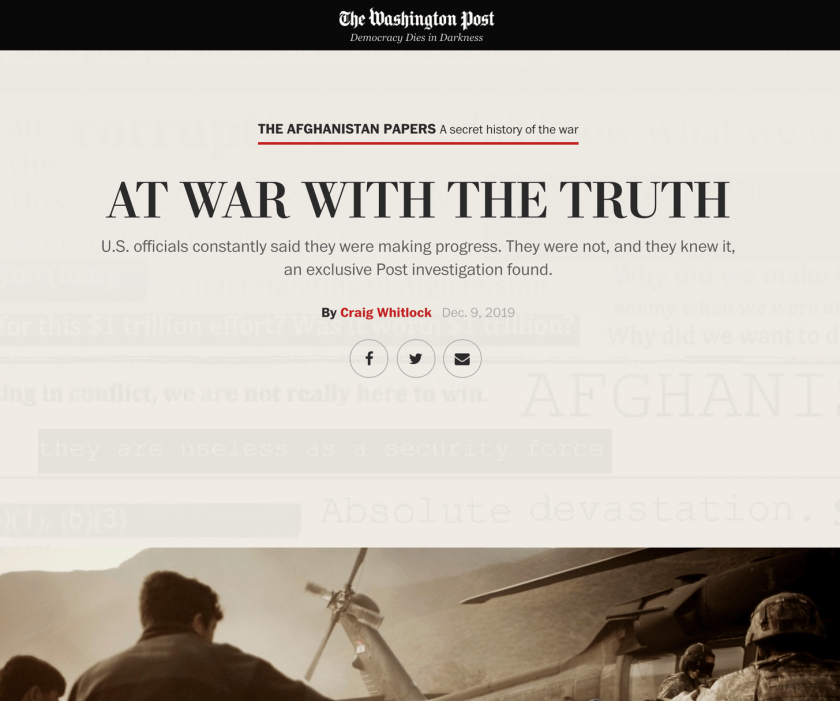
The pattern of lying was virtually identical throughout several administrations when it came to Afghanistan. In 2019, The Washington Post — obviously with a nod to the Pentagon Papers — published a report about secret documents it dubbed “The Afghanistan Papers: A secret history of the war.” Under the headline “AT WAR WITH THE TRUTH,” The Post summarized its findings: “U.S. officials constantly said they were making progress. They were not, and they knew it, an exclusive Post investigation found.” They explained:
Year after year, U.S. generals have said in public they are making steady progress on the central plank of their strategy: to train a robust Afghan army and national police force that can defend the country without foreign help.
In the Lessons Learned interviews, however, U.S. military trainers described the Afghan security forces as incompetent, unmotivated and rife with deserters. They also accused Afghan commanders of pocketing salaries — paid by U.S. taxpayers — for tens of thousands of “ghost soldiers.”
None expressed confidence that the Afghan army and police could ever fend off, much less defeat, the Taliban on their own. More than 60,000 members of Afghan security forces have been killed, a casualty rate that U.S. commanders have called unsustainable.
As the Post explained, “the documents contradict a long chorus of public statements from U.S. presidents, military commanders and diplomats who assured Americans year after year that they were making progress in Afghanistan and the war was worth fighting.” Those documents dispel any doubt about whether these falsehoods were intentional:
Several of those interviewed described explicit and sustained efforts by the U.S. government to deliberately mislead the public. They said it was common at military headquarters in Kabul — and at the White House — to distort statistics to make it appear the United States was winning the war when that was not the case.
“Every data point was altered to present the best picture possible,” Bob Crowley, an Army colonel who served as a senior counterinsurgency adviser to U.S. military commanders in 2013 and 2014, told government interviewers. “Surveys, for instance, were totally unreliable but reinforced that everything we were doing was right and we became a self-licking ice cream cone.”
John Sopko, the head of the federal agency that conducted the interviews, acknowledged to The Post that the documents show “the American people have constantly been lied to.”
Last month, the independent journalist Michael Tracey, writing at Substack, interviewed a U.S. veteran of the war in Afghanistan. The former soldier, whose job was to work in training programs for the Afghan police and also participated in training briefings for the Afghan military, described in detail why the program to train Afghan security forces was such an obvious failure and even a farce. “I don’t think I could overstate that this was a system just basically designed for funneling money and wasting or losing equipment,” he said. In sum, “as far as the US military presence there — I just viewed it as a big money funneling operation”: an endless money pit for U.S. security contractors and Afghan warlords, all of whom knew that no real progress was being made, just sucking up as much U.S. taxpayer money as they could before the inevitable withdraw and takeover by the Taliban.
In light of all this, it is simply inconceivable that Biden’s false statements last month about the readiness of the Afghan military and police force were anything but intentional. That is particularly true given how heavily the U.S. had Afghanistan under every conceivable kind of electronic surveillance for more than a decade. A significant portion of the archive provided to me by Edward Snowden detailed the extensive surveillance the NSA had imposed on all of Afghanistan. In accordance with the guidelines he required, we never published most of those documents about U.S. surveillance in Afghanistan on the ground that it could endanger people without adding to the public interest, but some of the reporting gave a glimpse into just how comprehensively monitored the country was by U.S. security services.
In 2014, I reported along with Laura Poitras and another journalist that the NSA had developed the capacity, under the codenamed SOMALGET, that empowered them to be “secretly intercepting, recording, and archiving the audio of virtually every cell phone conversation” in at least five countries. At any time, they could listen to the stored conversations of any calls conducted by cell phone throughout the entire country. Though we published the names of four countries in which the program had been implemented, we withheld, after extensive internal debate at The Intercept, the identity of the fifth — Afghanistan — because the NSA had convinced some editors that publishing it would enable the Taliban to know where the program was located and it could endanger the lives of the military and private-sector employees working on it (in general, at Snowden’s request, we withheld publication of documents about NSA activities in active war zones unless they revealed illegality or other deceit). But WikiLeaks subsequently revealed, accurately, that the one country whose identity we withheld where this program was implemented was Afghanistan.
There was virtually nothing that could happen in Afghanistan without the U.S. intelligence community’s knowledge. There is simply no way that they got everything so completely wrong while innocently and sincerely trying to tell Americans the truth about what was happening there.
In sum, U.S. political and military leaders have been lying to the American public for two decades about the prospects for success in Afghanistan generally, and the strength and capacity of the Afghan security forces in particular — up through five weeks ago when Biden angrily dismissed the notion that U.S. withdrawal would result in a quick and complete Taliban takeover. Numerous documents, largely ignored by the public, proved that U.S. officials knew what they were saying was false — just as happened so many times in prior wars — and even deliberately doctored information to enable their lies.
Any residual doubt about the falsity of those two decades of optimistic claims has been obliterated by the easy and lightning-fast blitzkrieg whereby the Taliban took back control of Afghanistan as if the vaunted Afghan military did not even exist, as if it were August, 2001 all over again. It is vital not just to take note of how easily and frequently U.S. leaders lie to the public about its wars once those lies are revealed at the end of those wars, but also to remember this vital lesson the next time U.S. leaders propose a new war using the same tactics of manipulation, lies, and deceit.
The Evolving Definition of “Vaccine” in the Merriam-Webster Dictionary for 2021
By Brian Shilhavy | Health Impact News | August 13, 2021
The popular online dictionary, Merriam-Webster.com, has had the same definition for “vaccine” for several years.
Here is the definition until early to mid-January, 2021:

By January 26, 2021 it was changed to include a section on “genetic material” and mRNA:

Apparently that was not quite good enough to silence the critics who were claiming that the COVID-19 shots did not meet the definition of a “vaccine,” so it was changed again by June 1, 2021 to include examples of mRNA “vaccines” such as Moderna and Pfizer, “viral vector” vaccines such as J&J and AstraZeneca, and a completely new definition to cover some “vaccines” the military is working on: a preparation or immunotherapy that is used to stimulate the body’s immune response against noninfectious substances, agents, or diseases.

I wonder what this “definition” of “vaccines” will be expanded to include next?
Noah Webster Jr. was the original founder of America’s most famous dictionary, and in 1831, George and Charles Merriam founded the company as G & C Merriam Co.
In 1964, Encyclopædia Britannica, Inc. acquired Merriam-Webster, Inc.
In 1996, Britannica was purchased by Jacob E. Safra, a Jewish Swiss-bank financier.
Featured Video

AIDS Inc. by Gary Null (2007)
or go to
Aletho News Archives – Video-Images
From the Archives
Clash of Civilization, Iran Part II
By Jamal Kanj – Intifada-Palestine.com – January 14, 2011
Israel’s survival kit is: perpetuate conflict, insecurity to rationalize collective hate and finally playing victim.
Devoid of conflict, Israel implodes internally; without hate, Zionism loses its justification; and playing eternal victim to continue blackmailing the West. Absence of this holy trinity, Israel ceases to exist.
From its inception, the house of Zion has mastered exploiting adversarial powers to advance Israel’s cause. For instance, their influence over the Democratic Party in the US began with President Truman’s bid for 2nd term election in 1948.
Responding to strong opposition from Secretary of State General George Marshall and Department experts urging against recognition of Israel, President Truman replied: “I’m sorry gentlemen but I have to answer to hundreds of thousands [Jewish voters] who are anxious for the success of Zionism. I do not have hundreds of thousands of [voting] Arabs among my constituents”
Zionists influence over liberal American politics was matched with the doctrinal school of Conservative theoreticians aligning the Republican Party’s platform with Israel’s objectives. The Neoconservative Zionists, coined Zioncons, invented the “Clash of Civilization” concept to fight Israel’s wars. … continue
Blog Roll
 Aletho News
- Merck Virologists Admitted to Falsely Certifying Vaccine Efficacy
- Mandatory Folic Acid for every man, woman & child
- Pro-Palestine protesters arrested outside UK’s ruling Labour Conference in Liverpool
- Mauritius denies landing permit to flight from Israel, forcing cancellation: Tour operator
- Israeli finance minister calls for genocidal war on West Bank, annexation of south Lebanon
- 12 Things Your Psychiatrist Was Trained Not to Tell You
- From Unipolar Universalism to Multipolar Civilizational Distinctiveness
- RSF military group defects, joins Sudanese army: State media
- Ireland goalkeeper refuses to play ‘Israel’ as squad weighs boycott
- China pushes back against US on Cuba, Iran
- If Americans Knew
- Israel forces Gazans to live in constant peril – Daily Update
- Deconstructing Netanyahu’s pants-on-fire UN rant – Daily Update
- Trump betrayed voters with his campaign lies and prioritized a foreign country once he took office
- Netanyahu calls Israel’s war in Gaza ‘opposite of genocide’ in UN speech to near-empty hall
- Settler Kidnappings: Torture, Sexual Abuse and Terrorisation of Palestinian Abductees as Israel Deepens Annexation of West Bank
- Gaza winter nears as 162,000 tents become unusable, raising fears of humanitarian crisis
- Netanyahu says, “It’s the opposite of genocide”; UN says Gaza economy is world’s ‘most severe crisis on record’ – Daily Update
- Israel’s US-Backed Assault on Gaza Has Created the ‘World’s Most Severe Economic Crisis on Record’: UN
- ‘Protecting U.S. Citizens’… From Israel
- ‘This is where I live now, the back of a truck’: a day in the life of a grandmother in Gaza
- No Tricks Zone
- New Study: Earth And Venus Surface Warmth Largely Explained By Convection And Lapse Rate, Not CO2 Or Radiation
- 2025 Nature Paper Claiming Worsening Global Drought Gets RETRACTED …Heavily Flawed
- New Study: ‘Global Drought Shows No Detectable Recent Acceleration Under Climate Warming’
- Economic Masterminds: German Socialists Suggest Taxing Productivity Gains Stemming From Using AI
- The South China Sea Has Not Been Cooperating With The Climate Change Narrative
- Energy Crisis: Germany Enters Heating Season With Historically Low Gas Reserve Fill Levels
- New Study: The Antarctic Ice Sheet Gained Mass From 2020-2024 Due To Staggering Snow And Ice Accumulation
- Study: Ocean Heating Rates From Thousands Of Years Ago ‘Dwarf’ Modern Ocean Heating Rates
- Climate Extremists Target, Attack Large-Scale Power Grid Infrastructure In Germany!
- New Study: Antarctic Ice Melt Has Contributed Less Than 1 Centimeter To Sea Level Rise In The Last 30 Years

