‘Politicised From the Start’: Malaysian PM Blasts Dutch-Led MH17 Probe as Anti-Russian Witch Hunt
Sputnik – June 20, 2019
On Wednesday, investigators from the Dutch-led Joint Investigative Team (JIT) announced that they would issue arrest warrants against four suspects, including three Russians and one Ukrainian, in connection with the downing of Malaysia Airlines Flight MH17 over eastern Ukraine in mid-2014. Moscow called the accusations “absolutely unsubstantiated.”
Malaysian Prime Minister Mahathir Mohamad has called the JIT’s latest claims in the MH17 case politically motivated and unproven.
“We are very unhappy, because from the very beginning it was a political issue on how to accuse Russia of wrongdoing,” Mahathir said, speaking to reporters on Thursday, according to Reuters.
A day earlier, the Joint Investigative Committee (JIT) announced that four suspects, Russians Igor Girkin, Sergei Dubinsky, and Oleg Pulato and Ukrainian Leonid Kharchenko, would be issued international arrest warrants on charges of murder, with a trial into the MH17 case set to begin in the Netherlands in March 2020.
Flight MH17 was shot down over civil war-hit eastern Ukraine by a surface-to-air missile on 17 July 2014, with all 298 passengers and crew on board, predominantly Dutch and Malaysian nationals, killed.
The JIT accuses the men of delivering the missile system to Ukraine from a Russian anti-aircraft missile brigade stationed in the city of Kursk, not far from the Ukrainian border. Russia has categorically denied claims that it was in any way involved in the tragedy.
“Even before they examine (the debris), they already said Russia. And now they said they have proof. It is very difficult for us to accept that,” Mahathir said. “It is a ridiculous thing,” Mahathir added. “As far as we are concerned we want proof of guilt. So far there is no proof. Only hearsay,” he stressed.
Malaysian authorities have repeatedly complained of being effectively excluded from the investigation into the MH17 case, with the country’s investigators reportedly barred from studying the airliner’s black box flight recorder and other important data, despite the fact that over three dozen of the 298 passengers and crew who died in the incident were Malaysian nationals.
‘Absolutely Unsubstantiated’ Claims
Almost immediately after the MH17 crash and before a formal investigation was launched, the US and many of its European allies accused Russia of responsibility for the tragedy. The Dutch-led Joint Investigation Team invited Belgium, Australia, and Ukraine to join the probe, with Malaysia invited to join in late 2014, and Russia barred from the inquiry despite repeated offers to help.
Russia subsequently conducted its own probe into the disaster, with its investigation including extensive studies of forensic evidence, the unprecedented declassification of previously secret information about advanced military hardware, and a complex experiment by defence concern Almaz-Antey, maker of the Buk type air defence missile thought to have shot down the passenger jet.
Based on these studies, Russian investigators concluded that an older variant of the missile built in 1986 and belonging to Ukraine downed the aircraft, with Russia fully retiring its older stocks of Buk missiles during a broader campaign to modernise the Russian army.
The Russian side has repeatedly attempted to provide Dutch investigators with its evidence, but JIT has shown no interest in the Russian information. In late 2016, Russia sent JIT raw, unprocessed primary radar data containing evidence about the trajectory of the missile which shot down Flight MH17. JIT first complained that it could not decrypt the data, but after Russia said that it would be ready to help investigators decode it, questioned its accuracy and declined to take it into consideration. JIT’s own investigation and the presentations of its findings did not provide any concrete evidence demonstrating Russia’s guilt, instead citing ‘classified information’ which Dutch and US authorities have said they could not divulge.
On Wednesday, the Russian Foreign Ministry dismissed the JIT’s latest claims in the MH17 case as “absolutely unsubstantiated,” saying that the charges were not based on evidence, and aimed only “at discrediting Russia in the eyes of the international community.”
June Madness Strikes Washington. Iranians, Russians and Britons Beware!
By Philip Giraldi | Strategic Culture Foundation | June 20, 2019
It has been a lively June so far in light of Washington’s apparent zeal to remake the world in its own image. There is considerable buzz among those networking in ex- or current government circles that the White House is preparing to “do something” about Iran. The recent incidents involving alleged attacks on Norwegian and Japanese tankers in the Gulf of Oman were immediately attributed to Iran by Secretary of State Mike Pompeo with so little regard for evidence that even the compliant American media was left gasping. In its initial coverage of the story The New York Times inevitably echoed the administration’s claims, but if one went to the readers’ comments on the story fully 90% of those bothering to express an opinion decided that the tale was not credible for any number of reasons.
Several commenters brought up the completely phony Gulf of Tonkin incident of 1964 that led to the escalation of American involvement in Vietnam, a view that was expressed frequently in readers’ comments both in the mainstream and alternative media. Others recalled instead the fake intelligence linking Iraq’s Saddam Hussein with the 9/11 conspirators as well as the bogus reports of an Iraqi secret nuclear program and huge gliders capable to delivering biological weapons across the Atlantic Ocean.
There were a number of questionable aspects to the Pompeo story, most notably the unlikelihood that Iran would attack a Japanese ship while the Japanese Prime Minister was in Tehran paying a visit. The attack itself, attributed to Iranian mines, also did not match the damage to the vessels, which was well above the water line, a detail that was noted by the Japanese ship captain among others. Crewmen on the ship also reportedly saw flying objects, which suggests missiles or other projectiles were to blame, fired by almost anyone in the area. And then there is the question of motive: the United States, Israel, Saudi Arabia and the Emirates all want a war with Iran while the Iranians are trying to avoid a B-52 attack, so why would they do something that would virtually guarantee a devastating response from Washington?
What is going on with Iran is certainly front-page material but there are two other stories confirming that brain-dead flesh-eating zombies have somehow gained control of the White House. The first comes from David Sanger of The New York Times, who reported last week that the United States had inserted malware into the Russian electrical grid to serve as both a warning and a possible response mechanism should the Kremlin continue with its cyberwarfare ways.
The astonishing thing about the story is the casual way it is presented because, after all, inserting malware into someone’s electrical grid might well be considered an act of war. The White House responded to the story with a tweet from the president claiming that “This is a virtual act of Treason by a once great paper so desperate for a story, any story, even if bad for our Country…” though he did not state that the account was untrue. In fact, if it was actually treason, that would suggest that the news article was accurate in its description of what must be a Top Secret program. But then Trump or one of his advisors realized the omission and a second tweet soon followed: “….. ALSO, NOT TRUE!”
Assuming that Sanger did his job right and the story is actually correct, a number of aspects of it might be considered. First, interfering with a country’s electrical grid, upon which so many elements of infrastructure depend, is extremely reckless behavior, particularly when the activity has been leaked and exposed in a newspaper. Sanger explained the genesis of his story, revealing that he had been working at it for several months. He wrote: “The United States is stepping up digital incursions into Russia’s electric power grid in a warning to President Vladimir V. Putin and a demonstration of how the Trump administration is using new authorities to deploy cybertools more aggressively, current and former government officials said. In interviews over the past three months, the officials described the previously unreported deployment of American computer code inside Russia’s grid and other targets as a classified companion to more publicly discussed action directed at Moscow’s disinformation and hacking units around the 2018 midterm elections. Advocates of the more aggressive strategy said it was long overdue, after years of public warnings from the Department of Homeland Security and the F.B.I. that Russia has inserted malware that could sabotage American power plants, oil and gas pipelines, or water supplies in any future conflict with the United States.”
The Sanger story elaborates: “Since at least 2012, current and former officials say, the United States has put reconnaissance probes into the control systems of the Russian electric grid. But now the American strategy has shifted more toward offense, officials say, with the placement of potentially crippling malware inside the Russian system at a depth and with an aggressiveness that had never been tried before. It is intended partly as a warning, and partly to be poised to conduct cyberstrikes if a major conflict broke out between Washington and Moscow. The commander of United States Cyber Command, Gen. Paul M. Nakasone, has been outspoken about the need to ‘defend forward’ deep in an adversary’s networks to demonstrate that the United States will respond to the barrage of online attacks aimed at it. President Trump’s national security adviser, John R. Bolton, said the United States was taking a broader view of potential digital targets as part of an effort to warn anybody ‘engaged in cyberoperations against us.’ ‘They don’t fear us,’ he told the Senate a year ago during his confirmation hearings.”
If the Sanger tale is true, and it certainly does include a great deal of corroborative information, then the United States has already entered into a tit-for-tat situation with Russia targeting power grids, largely initiated to “make them fear us.” One might suggest that the two countries are already at war. That is in no one’s interest and the signals it sends could lead to a major escalation very rapidly. Interestingly, the article states that President Donald Trump does not know about the program even though it could potentially lead to World War 3. That the piece appeared at all also inevitably makes some readers wonder why Sanger has not been arrested for exposing national security information a la Julian Assange.
The final story dates from early June when Secretary of State Mike Pompeo was privately meeting with American Jewish leaders who expressed concern about the possibility that British Labour Leader Jeremy Corbyn might become prime minister. Corbyn has been targeted by British Jews because he is the first U.K. senior politician to speak sympathetically about the plight of the Palestinians.
Pompeo was asked if Corbyn “is elected, would you be willing to work with us to take on action if life becomes very difficult for Jews in the U.K.?” He replied: “It could be that Mr. Corbyn manages to run the gauntlet and get elected. It’s possible. You should know, we won’t wait for him to do those things to begin to push back. We will do our level best. It’s too risky and too important and too hard once it’s already happened.”
There are certain ambiguities in both the question and the response, but it would appear that American Jews want to join with their British counterparts to either bring down or contain a top-level elected politician because he is not sufficiently pro-Israel. The American Secretary of State agrees with them that something must be done, to include quite possibly taking some presumably covert steps to make sure that Corbyn does not become prime minister in the first place. As Pompeo might just be thinking of subverting the institutions of America’s closest ally, it is a huge story that is being largely ignored in the media.
And June is not over yet! The good news is that the United States has not yet invaded Venezuela despite calls by America’s boy-Senator Marco Rubio and the demented Senator Lindsey Graham to do so.
Journalists, activists disturbed by State Department’s anti-Iran troll campaign
RT | June 20, 2019
Victims of anti-Iran trolling campaign were shocked to learn it was taxpayer- funded by the State Department, but not so shocked to see the government attempting to cover it up or mainstream media giving it little coverage.
Journalists, human rights activists, academics, and even outspoken critics of the Iranian government were all targeted by @IranDisinfo, which smeared any and all critics of President Donald Trump’s hawkish Iran policy as paid operatives of the regime in social media assaults that some say veered into personal attacks. Now, they want answers as to how this $1.5 million operation – bristling with the hallmarks of a totalitarian propaganda campaign – was allowed to see daylight.
“How can individuals who are not willing to adhere to the norms of American civil society be entrusted with resources to promote civil society in other countries?” asked Jason Rezaian, a Washington Post columnist who was on the troll’s hit list – despite spending time in an Iranian jail.
In a Twilight Zone-level twist, the troll even went after the NATO-backed think tank Atlantic Council’s Iran expert and a former Voice of America host.
The State Department quietly “suspended” @IranDisinfo last month, admitting the operation had gone rogue in a closed-door congressional hearing, but an apology to those targeted, and answers on who was responsible, has not been forthcoming.
Former State Department employee Joel Rubin has pointed out @IranDisinfo was run under a “cooperative agreement” which means the government had “hands-on engagement” with the months-long smear campaign, contrary to its protestations that the project went off the rails only recently.
“What other @StateDept funded organizations claiming to promote democracy in #Iran are using taxpayer money to harass, intimidate, threaten and slander American journalists & academics? Follow the money folks,” tweeted Farnaz Fassihi, a Wall Street Journal columnist and @IranDisinfo target.
Money funding @IranDisinfo had been earmarked to counteract ISIS propaganda, as well as Russian and Chinese information ops, through the State Department’s Global Engagement Center, former White House official Brett Bruen told Independent journalist Negar Mortazevi, a former VOA host and another victim of the troll.
E-Collaborative for Civic Education, which was contracted to run @IranDisinfo, appears to be connected with pro-war think tank Foundation for Defense of Democracies (FDD), whose website boasted a page titled “Iran Disinfo” that was a carbon copy of the troll account, as well as other pro-regime-change organizations through its founder, Mariam Memarsadeghi.
“Never did I think that nine years [after imprisonment in Iran], an American administration that has claimed to stand in solidarity with the people of Iran would fund attacks against me,” Tara Sepehri Far of Human Rights Watch wrote in the Nation, demanding greater transparency and speculating about a “broader pattern of harassment funded in whole or in part by the US government against journalists and analysts.”
Mainstream media has been mostly silent on the issue, aside from those – like WaPo’s Rezaian – directly affected by the trolling. Even though BBC Persia journalists were among @IranDisinfo’s victims, the outlet hosted anti-regime activist Alireza Kiani, who dutifully defended the abusive propaganda as “quite beneficial with respect to the circumstances of the Iranian people,” insisting “Iran Disinfo attacked people’s political positions, not their person.”
CNN did limply condemn the operation a few weeks after it was exposed.
“There’s no moral equivalence between Iran and the US,” CNN assured its viewers, “but that clear line threatens to become a bit blurry when the US funds disinformation campaigns that attack people who don’t parrot the party line. That’s a tactic of authoritarian regimes, not democracies.”
We may not have heard the last of @IranDisinfo, either – its funding was only suspended “until [ECCE] takes necessary steps to ensure that any future activity remains within the agreed scope of work.”
Iran’s IRGC force shoots down intruding US spy drone
Press TV – June 20, 2019
Iran’s Islamic Revolution Guards Corps (IRGC) has shot down an intruding American spy drone in the country’s southern coastal province of Hormozgan.
In a statement issued early Thursday, the IRGC said the US-made Global Hawk surveillance drone was brought down by its Air Force near the Kouh-e Mobarak region — which sits in the central district of Jask County — after the aircraft violated Iranian airspace.
According to the statement, the Global Hawk had flown from one of the American bases in the southern parts of the Persian Gulf region at 00:14 a.m. local time, with its identification transponders off in breach of all international aviation rules.
It also went on to say that the drone had stealthily continued on the route from the Strait of Hormuz towards Iran’s port city of Chabahar.
While returning towards west of the Strait of Hormuz, the drone violated Iran’s territorial airspace and began gathering intelligence and spying, the statement said.
The drone had been targeted and shot down by the IRGC at 04: 05 a.m. local time, it added.
An informed IRGC source in Hormozgan province said the drone had been targeted near the Kouh-e Mobarak region and fell down in the area of Ras al-Shir in Iran’s territorial waters.
He told the IRNA news agency that the downing came after repeated violations of Iran’s airspace by US reconnaissance drones in the Persian Gulf region.
Reacting to the news, the US military claimed it did not fly over Iranian airspace on Wednesday.
“No US aircraft were operating in Iranian airspace today,” said Navy Captain Bill Urban, a spokesman for the American military’s Central Command.
However, a US official, speaking on the condition of anonymity to the Associated Press, confirmed on Thursday that an American military drone had been shot down in “international airspace” over the Strait of Hormuz by an Iranian surface-to-air missile.
He identified the drone as a US Navy MQ-4C Triton, which builds on elements of the RQ-4 Global Hawk with minor changes.
The RQ-4 Global Hawk unmanned aircraft system (UAS) can fly at high altitudes for more than 30 hours, gathering near-real-time, high-resolution imagery of large areas of land in all types of weather, maker Northrop Grumman says on its website.
The Northrop Grumman MQ-4C Triton is a maritime derivative of the RQ-4B Global Hawk and the airborne element of the US Navy’s Broad Area Maritime Surveillance Unmanned Aircraft System (BAMS UAS).
Tensions have been running between Iran and the US in recent weeks, with Washington stepping up its provocative military moves in the Middle East.
Last month, Washington dispatched an aircraft carrier strike group, a bomber task force, and an amphibious assault ship to the Persian Gulf, citing an alleged Iranian threat.
On Monday, the Pentagon announced that the US will send 1,000 additional US forces and more military resources to the Middle East.
Tehran believes the US has a hand in a set of suspicious regional incidents in recent weeks, such as the June 13 attacks against oil tankers in the Sea of Oman, in a bid to pin the blame on Iran and put more pressure on the country.
Last week, [unnamed] UN sources revealed that the United States was planning to carry out a “tactical assault” on an Iranian nuclear facility in response to the alleged Iranian role in the tanker attacks.
Biggest American Scandal: Obama’s Role in ‘Spygate’ & ‘Emailgate’
By Ekaterina Blinova | Sputnik | June 19, 2019
While Donald Trump has kicked off his 2020 presidential campaign in Florida reiterating a vow to bring “deep state” figures out into the open, AG William Barr’s “investigation of investigators” is gaining steam. Wall Street analyst Charles Ortel has shared his views on the role of Barack Obama and his team in the so-called “spygate” case.
Attorney General William Barr’s investigation into the origins of the FBI’s 2016 Trump-Russia “collusion” probe has prompted deep concerns among US intelligence officials, especially given the US president’s decision to grant AG Barr sweeping powers.
Some former US spooks argue that the probe may thwart US counterintelligence efforts aimed against Russia, citing Moscow’s alleged interference in the US 2016 elections, something that the Russian leadership resolutely denies.
“If Barr discloses the identities of CIA and CI sources providing information on Russia he is disabling our intelligence capacities to Russia’s advantage”, claimed former FBI special agent Asha Rangappa on 24 May via Twitter.
However, according to Charles Ortel, a Wall Street analyst who has been conducting a private inquiry into the Clinton Foundation’s alleged fraud for the last three years, what is really concerning former and current intelligence officials and their backers in the previous administration are their possibly illegal actions which may soon come to light.
Sputnik: On 17 June, Fox News host Sean Hannity said that AG William Barr’s “spygate” investigation caused panic among “deep state” actors. Hannity highlighted that at least three Trump campaign aides had actively been spied upon abroad by allied countries allegedly “subcontracted” by US top intelligence officials to circumvent US laws. Have there ever been any precedents of engaging US allies in an effort to undermine an American presidential candidate? What countries were supposedly involved in the “spygate”? Why did they agree to participate in those potentially illegal activities?
Charles Ortel: I am not aware of incidents in the past where elements loyal to an existing presidential administration have encouraged foreign powers to train their security forces to spy on a presidential campaign and/or upon the victor in a hotly contested election after the results became known, through the inauguration and then during the newly-elected president’s first term.
So far, one prime culprit seems to be elements within the government of the United Kingdom. Other culprits seemingly include the government of Australia, while there is also speculation that the government of Canada may have been involved. In time, perhaps we may learn that governments of other, supposed allies of the United States may also have been involved, perhaps Italy, France, and Germany, to name three.
What makes this story particularly galling is that nations named are among the staunchest long-term allies of America. Did no one in these nations, in positions of authority, question the wisdom of potentially interfering, especially given the ham-handed ways in which it seems the interference ultimately took place?
Sputnik: Hannity suggested that US State Department officials including Barack Obama knew about the dirty dossier and spying activities against the Trump campaign. Judicial Watch President Tom Fitton echoed Hannity’s assumption citing newly obtained State Department emails at Fox News’ “Deep Dive” on 17 June. If it is proved that Obama and his associates were aware of the “spygate” effort how could this affect the ex-president and his team?
Charles Ortel: As a guess, Obama administration insiders likely did what they could do to insulate the former president from potential culpability in any scheme that might implicate actors in actual crimes. A review of public records suggests that Presidential counselor Valerie Jarrett was one person who may have been the ultimate shield. But, other reports suggest that Barack Obama himself was keenly interested in political campaigns of all types, particularly key races of which the 2016 presidential contest was clearly most important.
Obama loyalists, even now try to argue that the eight years from 20 January 2009 through 20 January 2017 were “scandal free”. I beg to differ – someone high up in the Obama administration had to bless the use by Hillary Clinton and her team of secret servers, unprotected electronic devices, alias emails, and the fact that Team Hillary was allowed to hold onto all of her government records through early December 2014, some 22 months after she departed her role as Secretary of State. One suspects that President Obama himself had to learn, early on, of the Clinton approach and had to know that it fell well afoul of applicable laws and regulations.
Moreover, Barack Obama likely communicated with Hillary Clinton using email and he was sold to the public as someone who was in tune with technology, even “wedded to his Blackberry” – how could Obama have failed to notice he was sending emails to Hillary Clinton on a non-government email address?
All of which raises larger questions. Did Barack Obama use non-government email addresses to send or receive classified information? Did members of his close circle do so? Did any of these people use aliases in their communications? Do we really know whether all of the “presidential records” of the Obama administration were archived securely for posterity? With these latest revelations, and with each passing day, storm clouds darken over what remains of the Obama “legacy”.
Sputnik: Meanwhile, the US State Department has revealed that at least 15 State Department employees were responsible for 23 violations and seven security infractions related to Clinton’s server under the Obama administration. According to Hannity, Clinton’s activities presumably amount to violating the Espionage Act (18 USC 793 (F) and 18 USC 793 (D) and (E)). Conservative pundits presume that the effort against Trump was prompted by Obama administration officials who sought to conceal their crimes. Do you agree with this assumption? Will all the employees involved in the emailgate case be interrogated and probed given the latest revelations? Will it result in criminal proceedings against them and how will this affect Hillary Clinton?
Charles Ortel: As we consider these questions and issues, the timeline from June 2008 to present comes under much closer scrutiny. In early June 2008, when it became evident that Barack Obama would be the Democrat nominee, and that he would likely defeat John McCain, I suspect the Clintons (and the Obamas) hatched a plan to employ Hillary’s considerable resources to cement victory in the November 2008 presidential election.
What candidate Obama likely did not know back then was how dire the position of the Clinton Foundation had become – it was out of compliance with key laws and regulations around the world and millions of dollars in funding had “gone missing”.
 Real investigations of mishandling classified information by many persons including Hillary Clinton will likely extend and intertwine with long overdue deep dives into the network of Clinton “charities” that seem, to me, to have been used as conduits to trade cash for contracts and favours, and certainly not for their intended and authorised tax-exempt purposes.
Hannity and others are correct to call this unfolding scandal, the biggest in American history. When it grows to consider all contours of charity frauds and corruption during the period from 1988 forward, as unregulated globalism became the norm, we will be shocked to discover just how badly so many US presidents and other leaders behaved.
We cannot move forward productively until the public is shown what actually happened. Only with real investigations, indictments, prosecutions, convictions, and incarcerations can we prove that no American stands above our laws. With reason, many once powerful persons should be afraid – they are finally being called to account for lives in crime, pretending falsely to serve the people, even as they served themselves.
Massive Embezzlement Scandal Threatens Juan Guaido’s Political Future
By Alexander Rubinstein – MintPress News – June 17, 2019
The political party of Juan Guaido — Voluntad Popular (Popular Will) — was never all that popular to begin with. The sixth largest political party in Venezuela, Popular Will is heavily financed by the United States Agency for International Development (USAID). Now, a recently exposed embezzlement scandal in Colombia risks to further alienate the party from the Venezuelan people.
What was supposed to be Guaido’s watershed moment has instead turned out to be a public-relations failure far worse than his quickly quelled attempted military coup, which MintPress News reported caused even the New York Times to describe Guaido as “deflated.”
What happened in Colombia appears to be so damning that not only is the Colombian intelligence service leaking documents exposing wrongdoing by Popular Will representatives appointed by Guaido, but the Organization of American States (OAS) — which is typically just as pro-opposition as the Colombian government — has called for an investigation.
In a tweet issued June 14 at 10:47 p.m. Venezuela time, Guaido called on his ambassador to Colombia — whom he had shut out of the aid event — to formally request an investigation by Colombian authorities, whose already-existing investigation is the reason the story came out in the first place. That was more than four hours after Secretary General of the OAS Luis Almagro called for an investigation that would clarify the “serious charges,” identify those responsible and effectuate accountability.
But Guaido had already been well aware of the charges, having dismissed his appointees who appear to be ringleaders of the embezzlement scheme. According to the report, he was contacted by the journalist who exposed the scandal 30 days before the story was published.
What happened in Cúcuta isn’t staying in Cúcuta
There’s barely a peep about the scandal in the Western press. A Google News search for “Juan Guaido scandal” and “Popular Will scandal” turned up nothing of relevance at the time of this article’s writing. But on Latin America social media, everyone is buzzing about it. American journalist Dan Cohen appears to be the first to highlight the scandal to an English-speaking audience.
It started with a request from Juan Guaido to billionaire investor and regime-change enthusiast Richard Branson.
The stated purpose of the concert was to help raise funds for humanitarian aid and spotlight the economic crisis. At least that’s how it was billed to Americans. To Venezuela’s upper class, it was touted as the “trendiest concert of the decade.”
It was to be a congregation of the elite with the ostensible purpose of raising funds for the poor. One director of Popular Will told Vice News in 2014 that “the bulk of the opposition protesters are from the middle and upper classes and are led by Venezuela’s elite.” The class character of the opposition has not changed since.
Meanwhile, USAID was to coordinate the delivery of aid alongside Guaido; and Elliot Abrams, who in Guatemala used “humanitarian aid” as cover for the delivery of weapons into the country, is running the White House’s policies toward Venezuela. And so the aid was widely criticized, even by the International Red Cross, as politicized. By others, it was called a Trojan Horse.
The concert was held in Colombia across a bridge linking the country to Venezuela. International media had claimed Venezuelan President Nicholas Maduro had the bridge shut down to prevent the delivery of aid, and Secretary of State Mike Pompeo demanded that the “Maduro regime must LET THE AID REACH THE STARVING PEOPLE.” But the bridge, in fact, has never been opened for use.
Nonetheless, Richard Branson sought to raise $100 million and promised that Guiado “will be coming to the other side of the bridge with maybe a million of his supporters.” In the end, it was a little more than 200,000 who came.
Meanwhile, Guaido told the President of Colombia, Ivan Duque, that more than 1,450 soldiers had defected from the military to join them. But that figure was also inflated. A new report by PanAmPress, a Miami-based libertarian newspaper, reveals that it was just 700. “You can count on your fingers the number of decent soldiers who are there,” one local told the outlet.
Despite the low turnout, organizers lived it up in Colombia. Representatives from Popular Will, which rejects the socialist leadership of Venezuela, found themselves living like socialites across the border.
There were earlier signs of excess and debauchery. One Popular Will representative was hospitalized and his assistant found dead after overdosing while taking drugs with prostitutes, although Senator Marco Rubio (R-FL) claims they were poisoned.b
The inflated soldier count meant more funds for the organizers, who were charged with putting them up in hotel rooms. Guaido’s “army was small but at this point it had left a very bad impression in Cucuta. Prostitutes, alcohol, and violence. They demanded and demanded,” the report said.
They also left a bad taste in the mouth of the authorities. The Colombian government was supposed to pay for some of the hotels, the UN High Commissioner for Refugees was to cover the costs of others, while Guaido’s people were only going to pony up the cash for two of the seven hotels.
But Popular Will never paid, leaving one hotel with a debt of $20,000. When the situation became completely untenable, the hotel kicked 65 soldiers and their families to the curb. One soldier anonymously told the outlet that the party was not taking care of their financial needs as promised.
Guaido’s ambassador to Colombia took money out of his own pocket to try to resolve the dispute, but the check bounced.
The responsibility of taking care of the needs of the defectors went to Popular Will militants Rossana Barrera and Kevin Rojas, as decreed by Juan Guaido in a signed statement. They were also charged with overseeing the humanitarian aid.
Barrera is the sister-in-law of Popular Will member of Congress Sergio Vargara, Guaido’s right-hand man. She and Rojas were managing all the funds.
But the pair started to live well outside their means, a Colombian intelligence source told the outlet. “They gave me all the evidence,” writes PanAmPress reporter Orlando Avendano. “Receipts that show excesses, some strangely from different check books, signed the same day but with identical writing styles.”
Rojas and Berrera were spending nearly a thousand dollars at a time in the hotels and nightclubs. Similar amounts were spent at times on luxurious dinners and fancy drinks. They went on clothes shopping sprees at high-end retail outlets in the capital. They reportedly overcharged the fund on vehicle rentals and the hotels, making off with the extra cash. Berrera even told Popular Will that she was paying for all seven hotels, not just the two. And they provided Guaido with the fake figure of more than 1,450 military defectors that needed accommodation.
In order to keep the funds flowing, Rojas and Berrera pitched a benefit dinner for the soldiers to Guiado’s embassy in Colombia. But when the embassy refused to participate, Berrera created a fake email address posing as a representative of the embassy, sending invitations to Israeli and U.S. diplomats. They canceled the event after Guaido’s embassy grew wise to the scheme and alerted those invited.
“The whole government of Colombia knew about it: the intelligence community, the presidency, and the foreign ministry,” writes PanAmPress, calling it an “open secret” by the time Guaido dismissed the pair. But that was after Guaido had been defending them staunchly, trying to avoid a firing by transferring responsibilities to the embassy.
Berrera was called to the embassy for a financial audit, represented by Luis Florido, a founding member of Popular Will. She turned in just a fraction of the records uncovered by Colombian intelligence, accounting for only $100,000 in expenditures. “The [real] amount is large,” the outlet reports, citing an intelligence agent who says far more was blown.
Meanwhile, “at least 60 percent of the food donated” by foreign governments “was damaged.”
“The food is rotten, they tell me,” the PanAmPress reporter said, adding that he was shown photographs. “They don’t know how to deal with it without causing a scandal. I suppose they will burn it.”
It isn’t yet known exactly how much was embezzled by Popular Will, but it is likely the truth will come out in due time, and more investigations are likely underway. On Monday, Venezuelan defectors said they will hold a press conference in Cucuta, showcasing more corruption by Popular Will. For now, however, the fallout remains to be seen.
One thing is certain: the scandal threatens to end Juan Guaido’s 15 minutes of fame. The de facto opposition leader had little name recognition inside Venezuela and never won a political position with more than 100,000 votes behind him. But the overnight sensation never had a lengthy life expectancy anyway.
Though he received so few votes (Venezuela’s population is nearly 32 million), Guaido became the president of the National Assembly because the body is controlled by a coalition of opposition groups, despite President Nicolas Maduro’s PSUV Party being the largest in the country. That was in January, and the length of the term lasts only one year. In 2015, the opposition coalition decided that after each term, the seat would be rotated to a representative of a different opposition party. While there is no law barring Guaido from being appointed president of the National Assembly again, tradition runs counter to it and another party may want to seize on a chance to get into the limelight.
Supporters of the coup — and Guaido’s self-declaration as interim president — claim that Maduro is derelict of his duties, which justifies a transition of presidential power according to the constitution. But the article that allows for such a transition in certain cases stipulates that ”a new election by universal suffrage and direct ballot shall be held within 30 consecutive days.”
To date, Guaido has run 145 days past his deadline to have elections held, and the opposition has made it clear they are not willing to accept new elections if Maduro runs.
This, of course, makes little dent in Guaido’s legitimacy in the eyes of the U.S. and other countries that have recognized his presidency. U.S. allies in Latin America have shown over the past few years that they have little regard for the sanctity of their constitutions. In 2017, a U.S.-backed candidate in Honduras, Juan Orlando Hernandez, ran for re-election in explicit violation of that country’s constitution and only wound up winning through fraud. Last week, Ecuador made the decision to allow the U.S. military to operate from an airfield in the Galapagos Islands despite a constitutional provision stating that the “establishment of foreign military bases or foreign facilities for military purposes shall not be allowed.”
Alexander Rubinstein is a staff writer for MintPress News based in Washington, DC. He reports on police, prisons and protests in the United States and the United States’ policing of the world. He previously reported for RT and Sputnik News.
Recruiting American Spies for Israel
Tax-exempt American foundations lay the groundwork
By Philip Giraldi • Unz Review • June 18, 2019
Israel never loses an opportunity to promote what it perceives to be its interests. That any nation would do just that most of the time should surprise no one, but Israel is perhaps unique in terms of how assiduously it works at creating situations that favor it through the use of corruption of foreign governments and subversion of existing institutions. For most countries, the actions of a minority that seeks to advance the interests of a foreign nation would face strong resistance, but Israel manages to get away with what it does due to the presence of powerful and wealthy diaspora communities, most particularly in the Anglophone countries, but also in France.
The Israel Lobby in the United States has been subjected to some scrutiny thanks largely to the impetus provided by Professors John Mearsheimer and Stephen Walt’s groundbreaking study The Israel Lobby and U.S. Foreign Policy. More recent revelations have come from undercover journalism undertaken by al-Jazeera, which has demonstrated how British Jewish groups and parliamentarians have worked together with Israeli Embassy intelligence officers to remove public officials believed to be critical of Israel. Jeremy Corbyn, leader of the Labour Party, has been on the receiving end of a campaign to replace him for his alleged anti-Semitism solely because he has condemned Israeli oppression of the Palestinians. A second al-Jazeera investigation demonstrated how The Lobby, cooperating with the Israeli Embassy, has been controlling discussion of the Middle East in the United States, which should have surprised no one.
Europe indeed appears to be a hotbed of anti-Semitism, or so Israel and its friends would have us believe. Leaders in France, Germany and Britain feel compelled to frequently address the issue, making the equivalent of a war on anti-Semitism a principal objective of government. The United States has joined this effort, appointing a Special Envoy to Monitor and Combat Anti-Semitism whose job includes reporting other countries’ treatment of Jews and Israel.
The newest wrinkle comes under the category of Lawfare. It consists of hate crime laws that are directed against anyone criticizing Jews and, increasingly, Israel. In fact, any criticism of Israel is frequently being seen as a criminal offense, a trend that is also evident in the United States at the national, state and local levels, where Jewish groups have also been quick off the mark in claiming that anti-Semitism is surging. Freedom of speech in the western world has been diminished as a result.
Diaspora Jews are well entrenched in the media, which has enabled them to promote a narrative favorable to Israel no matter what it does, to include a repetitive dose of holocaust guilt that plays out from Hollywood and elsewhere in the media. The assiduously cultivated message for the public is that Jews are always the victims, never the aggressors, even when IDF snipers shoot Arab children and medical workers during protests.
Perhaps more seriously damaging are the technology thefts and deliberate export of American jobs to the Jewish state by Israelis and their diaspora billionaire friends, as well as general interference in and spying on the U.S. government at all levels. But perhaps the most outrageous initiatives engaged in by the Jewish state are the direct attempts to manage U.S. policies by subverting individual Americans who are or will be well placed to influence U.S. government decision making. It is well known how new Congressmen and spouses are treated to an all expenses paid trip to Israel by an affiliate of the American Israel Public Affairs Committee (AIPAC), which is little more than a propaganda exercise designed to influence their thinking about what is going on in the Middle East while at the same time impressing them regarding the power and wealth of The Lobby. The pandering to Israel is frequently extreme. Late last month, Florida’s governor Ron DeSantis, who has declared himself the most pro-Israel governor in the U.S., held a possibly illegal meeting of his state’s governing cabinet in Jerusalem.
A recent article in the Jerusalem Post demonstrates another aspect of how extensive Israeli efforts to infiltrate and corrupt American institutions to their benefit actually are. The article describes how “Close to 40 American cadets and officers wrapped up a two-week long trip to Poland and Israel on Monday, meeting with high-ranking military officers to learn about the Jewish State and the reality of its security situation. The trip, organized by Our Soldiers Speak (OSS), left a deep impression on the visiting service members who hail from the West Point Military Academy, the Air Force Academy, and the Virginia Military Institute, with some even voicing their readiness to fight and if necessary die alongside IDF troops.”

It was the third such visit to Israel by a group of representative military cadets. The travelers were treated to guilt first with stops at concentration camps in Poland. They then were subjected to the Israeli point of view through “high-level briefings from current and former policymakers and commentators from across the spectrum in the areas of security, strategy, international relations, law, politics, and more.”
Make no mistake, the entire exercise was a scarcely concealed bid to set up what one might regard as the recruitment of future Israeli spies within the U.S. military. Such spies, who will plausibly be able to promote policies favorable to Israel, are referred to as “agents of influence.” Benjamin Anthony, the Director of OSS, admitted as much, saying that “This unparalleled experience enables American cadets to learn about hot-button issues and matters of utmost strategic importance in the Middle East firsthand. By forging bonds between the cadets and Israeli military officers, we are laying the groundwork for future understanding and productive interactions. We wanted to impact people who will be in leaderships positions a short time after the trip to Israel. All of them will be in command positions two or three years after this trip and they will be better informed about America’s greatest ally in the Middle East and the world.”
The cadets, who apparently received no pre-trip briefings from their respective institutions regarding Israeli spying, naively accepted everything they were presented with and appear to have believed they were hearing the unvarnished truth about the Middle East. They even compared the Jewish state favorably to their own country. One cadet, Stephen Marn of the Virginia Military Institute, enthused that “Israel has so many enemies knocking on their back door yet the people in Jerusalem were happy, enjoying life… it was an amount of true patriotism that I don’t see in America today. I got pretty emotional.”
Marn, who will receive a commission in the U.S. Army, said that he can “absolutely” see himself fighting alongside IDF officers. “No question, without a doubt,” he said with a smile. West Point cadet Travis Afuso agreed, saying “Absolutely. We have a shared understanding of the threats, a shared set of values based on freedom and democracy and those are the things which will allow us to fight together and if necessary to die by each other’s side if that’s what it comes to. If that is what my country asked of us, if I was sent here, I would be proud to stand by the soldiers of the IDF.”
Afuso also admired how “Every soldier we spoke to had a deep need to serve. They understand that there will be no Israel unless people are willing to die for Israel. A lot of people in America need to understand that nothing is free and you have to work for it.”
The comments of the cadets are regrettably similar to the effusions by U.S. Air Force Lieutenant General Richard Clark, who has enthused that American soldiers are “prepared to die for the Jewish state” and also added that they would “probably” be under the command of Israeli Air Force General Zvika Haimovitch, who would decide on the involvement of U.S. personnel. Haimovitch commented “I am sure… we will find U.S. troops on the ground… to defend the state of Israel.” The two generals were referring to the fact that the U.S. already has airmen stationed permanently at Israel’s Mashabim Air Base in spite of the fact that the two countries have no defense agreement of any kind. The Americans, though few in number, would serve as a trip wire to guarantee that Washington would become involved in any war that Israel chooses to start.
The fact that future military officers are so naïve as to accept a dog and pony show presented by a foreign government that urgently needs uncritical American support is discouraging. The VIP tour they took was no doubt escorted by good looking young Israeli male and female soldiers, the food they ate was probably exceptional, and one might bet that the high officials they spoke to actually pretended to care about the cadets on a personal level. Once those cadets become military officers in responsible positions a few years down the road good buddy Benjamin from the IDF will show up with a dinner invitation to talk about old times. At dinner, Ben will ask for a favor. That is how an intelligence operation targeting certain groups or demographics works. Relax, we love you.
But what is really surprising is how the trip was organized and paid for. In spite of all the activity by the organization being focused on Israel and its interests, OSS is not Israeli. It is American, funded by the usual Jewish oligarchs and organizations. The “Our Soldiers” referred to are Israelis, demonstrating one again where the actual loyalty of some American Jews resides. OSS is somewhat similar to the odious U.S.-based Friends of the Israel Defense Forces, which routinely raises millions of dollars in gala events in Hollywood and New York City.
Both of the Israeli front organizations are IRS approved 501(c)3, a status normally granted to groups that are either educational or charitable. Donations are tax exempt, which means that the American taxpayers are footing part of the bill for organizations that are plausibly recruiting spies within the United States government and also supporting a military that is in no way allied with the U.S. It would be very interesting to ask a Congressman how that came about, but he or she would be too terrified to respond, while inquiries to Treasury would undoubtedly land on the desk of the same Jewish bureaucrat who granted the exemptions in the first place. Unfortunately, in Washington some things never change.
Philip M. Giraldi, Ph.D., is Executive Director of the Council for the National Interest, a 501(c)3 tax deductible educational foundation (Federal ID Number #52-1739023) that seeks a more interests-based U.S. foreign policy in the Middle East. Website is councilforthenationalinterest.org, address is P.O. Box 2157, Purcellville VA 20134 and its email is <a:inform@cnionline.org” title=”mailto:inform@cnionline.org” href=”mailto:inform@cnionline.org”>inform@cnionline.org.
FBI Never Saw CrowdStrike Unredacted or Final Report on Alleged Russian Hacking Because None was Produced
By Ray McGovern | Consortium News | June 17, 2019
CrowdStrike, the controversial cybersecurity firm that the Democratic National Committee chose over the FBI in 2016 to examine its compromised computer servers, never produced an un-redacted or final forensic report for the government because the FBI never required it to, the Justice Department has admitted.
The revelation came in a court filing by the government in the pre-trial phase of Roger Stone, a long-time Republican operative who had an unofficial role in the campaign of candidate Donald Trump. Stone has been charged with misleading Congress, obstructing justice and intimidating a witness.
The filing was in response to a motion by Stone’s lawyers asking for “unredacted reports” from CrowdStrike in an effort to get the government to prove that Russia hacked the DNC server. “The government … does not possess the information the defandant seeks,” the filing says.
In his motion, Stone’s lawyers said he had only been given three redacted drafts. In a startling footnote in the government’s response, the DOJ admits the drafts are all that exist. “Although the reports produced to the defendant are marked ‘draft,’ counsel for the DNC and DCCC informed the government that they are the last version of the report produced,” the footnote says.
In other words CrowdStrike, upon which the FBI relied to conclude that Russia hacked the DNC, never completed a final report and only turned over three redacted drafts to the government.
These drafts were “voluntarily” given to the FBI by DNC lawyers, the filing says. “No redacted information concerned the attribution of the attack to Russian actors,” the filing quotes DNC lawyers as saying.
In Stone’s motion his lawyers argued: “If the Russian state did not hack the DNC, DCCC, or [Clinton campaign chairman John] Podesta’s servers, then Roger Stone was prosecuted for obstructing a congressional investigation into an unproven Russian state hacking conspiracy … The issue of whether or not the DNC was hacked is central to the Defendant’s defense.”
The DOJ responded: “The government does not need to prove at the defendant’s trial that the Russians hacked the DNC in order to prove the defendant made false statements, tampered with a witness, and obstructed justice into a congressional investigation regarding election interference.”
Thousands of emails from the DNC server were published by WikiLeaks in July 2016 revealing that the DNC interfered in the Democratic primary process to favor former Secretary of State Hillary Clinton over Senator Bernie Sanders for the party’s presidential nomination. The U.S. indicted 12 Russian military intelligence agents in 2018 for allegedly hacking the DNC server and giving the emails to WikiLeaks.
Comey Can’t Say Why
At a time of high tension in the 2016 presidential campaign, when the late Sen. John McCain and others were calling Russian “hacking” an “act of war,” the FBI settled for three redacted “draft reports” from CrowdStrike rather than investigate the alleged hacking itself, the court document shows.
Then FBI Director James Comey admitted in congressional testimony that he chose not to take control of the DNC’s “hacked” computers, and did not dispatch FBI computer experts to inspect them, but has had trouble explaining why.
In his testimony, he conceded that “best practices” would have dictated that forensic experts gain physical access to the computers. Nevertheless, the FBI decided to rely on forensics performed by a firm being paid for by the DNC.
Suspicions grew as Comey started referring to CrowdStrike as the “pros that they hired.” Doubts became more intense when he referred to CrowdStrike as “a high-class entity.” In fact the company had a tarnished reputation for reliability and objectivity well before it was hired by the DNC.
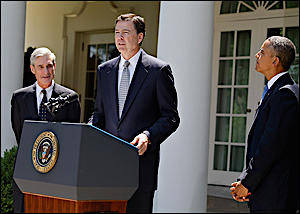
Comey in 2013 with Robert Mueller and Barack Obama
Dimitri Alperovitch, a CrowdStrike co-founder, is an opponent of Russian President Vladimir Putin and a senior fellow at the anti-Russian Atlantic Council think tank in Washington. CrowdStrike said it determined that Russia had hacked the DNC server because it found Cyrillic letters in the metadata, as well as the name of the first Soviet intelligence chief—clues an amateur might leave.
CrowdStrike was forced to “revise(d) and retract(ed) statements it used to buttress claims of Russian hacking during last year’s American presidential election campaign, Voice of America reported in March 2017.
CrowdStrike’s Early Role
In a Memorandum for the President on July 24, 2017, Veteran Intelligence Professionals for Sanity referred prominently to this instructive time sequence:
June 12, 2016: Julian Assange announces WikiLeaks is about to publish ‘emails related to Hillary Clinton.’
June 14, 2016: DNC contractor CrowdStrike, (with a dubious professional record and multiple conflicts of interest) announces that malware has been found on the DNC server and claims there is evidence it was injected by Russians.
June 15, 2016: ‘Guccifer 2.0’ affirms the DNC statement; claims responsibility for the ‘hack;’ claims to be a WikiLeaks source; and posts a document that the forensics show was synthetically tainted with ‘Russian fingerprints.’
VIPS does not believe the June 12, 14, & 15 timing was pure coincidence. Rather, it suggests the start of a pre-emptive move to associate Russia with anything WikiLeaks might have been about to publish and to “show” that it came from a Russian hack.
Bill Binney, a former NSA technical director and a VIPS member, filed an affidavit in Stone’s case. Binney said: “WikiLeaks did not receive stolen data from the Russian government. Intrinsic metadata in the publicly available files on WikiLeaks demonstrates that the files acquired by WikiLeaks were delivered in a medium such as a thumb drive.”
Preferring CrowdStrike; ’Splaining to Congress
Why did FBI Director James Comey not simply insist on access to the DNC computers? Surely he could have gotten the appropriate authorization. In early January 2017, reacting to media reports that the FBI never asked for access, Comey told the Senate Intelligence Committee there were “multiple requests at different levels” for access to the DNC servers. “Ultimately what was agreed to is the private company would share with us what they saw,” he said. Comey described CrowdStrike as a “highly respected” cybersecurity company.
Asked by committee Chairman Richard Burr (R-NC) whether direct access to the servers and devices would have helped the FBI in their investigation, Comey said it would have. “Our forensics folks would always prefer to get access to the original device or server that’s involved, so it’s the best evidence,” he said.
Five months later, after Comey had been fired, Burr gave him a Mulligan in the form of a few kid-gloves, clearly well-rehearsed, questions:
BURR: And the FBI, in this case, unlike other cases that you might investigate — did you ever have access to the actual hardware that was hacked? Or did you have to rely on a third party to provide you the data that they had collected?
COMEY: In the case of the DNC, … we did not have access to the devices themselves. We got relevant forensic information from a private party, a high-class entity, that had done the work. But we didn’t get direct access.
BURR: But no content?
COMEY: Correct.
BURR: Isn’t content an important part of the forensics from a counterintelligence standpoint?
COMEY: It is, although what was briefed to me by my folks — the people who were my folks at the time is that they had gotten the information from the private party that they needed to understand the intrusion by the spring of 2016.
More telling was earlier questioning by House Intelligence Committee member, Rep. Will Hurd (R-TX), who had been a CIA officer for a decade.On March 20, 2017 while he was still FBI director, Comey evidenced some considerable discomfort as he tried to explain to the committee why the FBI did not insist on getting physical access to the DNC computers and do its own forensics:
HURD: So there was about a year between the FBI’s first notification of some potential problems with the DNC network and then that information getting on — getting on Wikileaks.
COMEY: Yes, sir.
HURD: … when did the DNC provide access for — to the FBI for your technical folks to review what happened?
COMEY: Well we never got direct access to the machines themselves. The DNC in the spring of 2016 hired a firm that ultimately shared with us their forensics from their review of the system. …
HURD: … So, Director FBI notified the DNC early, before any information was put on Wikileaksand when — youhave still been — never been given access to any of the technical or the physical machines that were — that were hacked by the Russians.
COMEY: That’s correct although we got the forensics from the pros that they hired which — again, best practice is always to get access to the machines themselves, but this — my folks tell me was an appropriate substitute.
Comey Spikes Deal With Assange
Director Comey’s March 20, 2017 testimony to the House Intelligence Committee came at the same time he was scuttling months-long negotiations between Assange and lawyers representing the DOJ and CIA to grant some limited immunity for the WikiLeaks founder. In return, Assange offered to: (1) redact “some classified CIA information he might release in the future,” and (2) “provide technical evidence and discussion regarding who did not engage in the DNC releases.”
Investigative journalist John Solomon, quoting WikiLeaks’ intermediary with the government, broke this story, based on “interviews and a trove of internal DOJ documents turned over to Senate investigators.” It would be a safe assumption that Assange was offering to prove that Russia was not WikiLeaks’ source of the DNC emails, something Assange has repeatedly said.
That, of course, would have been the last thing Comey would have wanted.
On March 31, 2017 WikiLeaks released the most damaging disclosure up to that point from what it called “Vault 7” — a treasure trove of CIA cybertools leaked from CIA files. This disclosure featured the tool “Marble Framework,” which enabled the CIA to hack into computers, disguise who hacked in, and falsely attribute the hack to someone else by leaving so-called tell-tale signs — like Cyrillic, for example.
The CIA documents also showed that the “Marble” tool had been employed in 2016.
Two weeks later, then CIA Director Mike Pompeo branded WikiLeaks a “non-state hostile intelligence service,” and the U.S. put pressure on Ecuador, which had given Assange asylum, to expel him from its London embassy. He was on April 11 when British police arrested him. On the same day he was convicted of skipping bail on a Swedish investigation that had since been dropped. Assange was sentenced to 50 weeks in London’s max-security Belmarsh prison.
Comey, it seems a safe bet, still worries that Assange or one of his associates, will provide “technical evidence” enough to prove “who did not engage in the DNC releases.”
What Were They Thinking?
At the March 20, 2017 House Intelligence Committee hearing, Congressman Trey Gowdy heaped effusive praise on then-FBI Director Comey, calling him “incredibly respected.” At that early stage, no doubt Gowdy meant no double entendre. He might now.
As Russia-gate transmogrifies into Deep State-gate, the DOJ is launching a probe into the origins of Russia-gate and the intelligence agencies alleged role in it. It remains to be seen whether U.S. Attorney for the District of Connecticut John Durham, who is leading the probe, will interview Assange, unlike Special Counsel Robert Mueller, who did not.
It is proving very difficult for some of my old FBI friends and others to believe that Comey and other justice, intelligence, and security officials at the very top could have played fast and loose with the Constitution and the law and lived a lie over the past few years.
“How did they ever think they could get away with it?” they ask. The answer is deceivingly simple. Comey himself has explained it in a moment of seemingly unintentional candor in his pretentious book, “A Higher Loyalty.” He wrote, “I was making decisions in an environment where Hillary Clinton was sure to be the next president.”
There would be no problem, of course, if Mrs. Clinton had won the election. That’s what they all thought; and that probably explains their lack of care in keeping their activities off the written record and out of computers. Elementary tradecraft goes out the window with these upper-echelon, “high-class-entity” officials, when they are sure that she, and they, are going to be the inevitable winners — with promotions, not indictments in store for them.
Additional reporting by Joe Lauria
Background Reading on Deep State-Gate
https://consortiumnews.com/2019/03/13/vips-muellers-forensics-free-findings/
https://consortiumnews.com/2019/05/03/orwellian-cloud-hovers-over-russia-gate/
https://consortiumnews.com/2017/07/24/intel-vets-challenge-russia-hack-evidence/
https://consortiumnews.com/2019/06/13/ray-mcgovern-doj-bloodhounds-on-the-scent-of-john-brennan/
https://consortiumnews.com/2018/11/14/clappers-credibility-collapses/
https://raymcgovern.com/2019/01/06/transcript-when-clapper-was-asked-real-questions/
http://www.baltimoresun.com/news/opinion/oped/bs-ed-hacking-intelligence-20170105-story.html
http://www.baltimoresun.com/news/opinion/oped/bs-ed-trump-russia-phony-20170517-story.html
Ray McGovern works with Tell the Word, a publishing arm of the ecumenical Church of the Saviour in inner-city Washington. During his 27-year career as a CIA analyst, he led the Soviet Foreign Policy Branch and prepared the President’s Daily Brief for three presidents. He is co-founder of Veteran Intelligence Professionals for Sanity.
The Broader View Reveals the Ugliest of Prospects
By Craig Murray | June 17, 2019
Standing back a little and surveying the events of the last couple of weeks, gives a bleak view of the current state of western democracy.
We have seen what appears to be the most unconvincing of false flags in the Gulf. I pointed out why it was improbable Iran would attack these particular ships. Since then we have had American military sources pointing to video evidence of a packed small Iranian boat allegedly removing a limpet mine from the ship the Iranians helped to rescue, which was somehow supposed to prove it was the Iranians who planted the alleged device. We also have had the Japanese owner specifically contradict the American account and say that the ship was hit by flying objects.
The Iranians certainly have a strange method of bomb disposal if they carry it out using unarmoured personnel, with as many as possible crammed into a small boat in immediate contact with the “mine”. It is also hard to understand why the alleged “limpet mines” would be four feet above the waterline.
Limpet mines are placed below the waterline. There are numerous reasons for this. Firstly, holes above the waterline will not sink a ship. Secondly, the weight of the water helps contain the blast against the ship. Thirdly, it is obviously harder to detect both the diver placing the mine and the mine once placed if it is below the water. In fact it would be very difficult for a diver to place a limpet mine four feet above the waterline, even if they wanted to.
There seems to be a remarkable disconnect between the widespread popular disdain at yet another fake western power causus belli in the Middle East, and the near universal complicity of the UK political and media class in promoting this transparent lie. It is as though even pretending to have any respect for truth and fact has simply been discarded within the UK’s governmental system. Which ought to worry us a lot.
The second development ought to have been the biggest media story of the decade in the UK, if we had anything like a free and honest media. Mike Pompeo, US Secretary of State, made plain the Trump administration’s intent to prevent the election of Jeremy Corbyn as Prime Minister. Pompeo told a meeting of Jewish leaders:
It could be that Mr. Corbyn manages to run the gantlet and get elected. It’s possible. You should know, we won’t wait for him to do those things to begin to push back.
This blatant interference by a foreign power in the UK’s democracy is an absolute scandal. Compare the lack of media outrage at Pompeo’s intervention with the ludicrous claims made about much less high profile Russian attempts at influence. This incident provides incontrovertible proof that the world does indeed operate in the way that I have been explaining here for a decade. It is not a “conspiracy theory” that democracy is manipulated by hidden powers, it is fact. Pompeo’s description of Corbyn’s route to election as “running the gauntlet” is particularly revealing. Even more so is the cursory coverage this story was given, and I have seen no evidence to date of any MSM “journalist” attempting any follow-up investigation on the methods the US are planning to employ – or more likely already employing – against Corbyn.
Everybody should be incandescent at this, no matter who they vote for.
Something else which revealed the truth of the way the political world now operates, and which again did not get nearly the media attention it deserves, was Matt Kennard’s stunning revelation of the way the Guardian has been taken over by the security services. I have been explaining for years that the Guardian has become the security services’ news outlet of choice, and it is very helpful to have documentation to prove it.
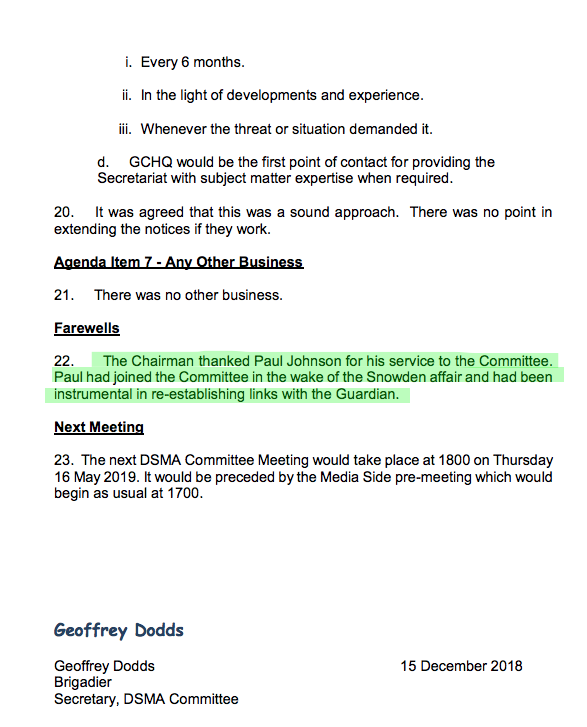
It is worth noting that the Guardian obeyed completely the DSMA committee ban on mentioning Pablo Miller in reporting the security service fantasy version of the Skripal story. As Kennard points out, it is also very interesting indeed that the Guardian published Luke Harding’s front page fabrication of Manafort/Assange meetings two weeks after MOD Director Dominic Wilson congratulated Guardian deputy editor Paul Johnson on “re-establishing links” with the security services. The Guardian is, like other British newspapers, as controlled by the military and security services just like in any other decent autocracy.
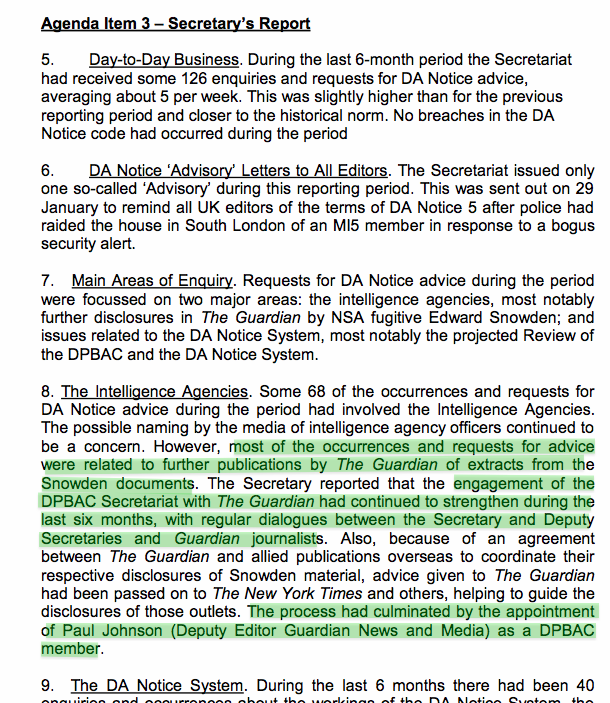
Incidentally, I cannot find Matt Kennard’s excellent work set out anywhere, except in that twitter stream. Surely there is an article on a website somewhere? I cannot find anything on Google, but as it is exactly the kind of information Google routinely suppresses, that does not mean it is not out there. Anyone seen it?
Finally, we have of course seen Sajid Javid sign the extradition warrant for Julian Assange to be sent to the United States for the “crime” of publishing truthful information about US government illegalities. Julian’s extradition hearing was, contrary to normal practice, held despite the fact he was too sick to attend in person. And it was presided over by Judge Arbuthnot, despite the fact that her husband is a former Tory defence minister who started a “security consultancy” in partnership with a former head of MI6, the war criminal John Scarlett who oversaw the fabrication of the dossier of lies about Iraqi WMD, in order to launch an illegal war of aggression that killed and maimed millions. The Assange team had asked her to recuse herself on that pretty obvious basis, but she had refused. At an earlier hearing she taunted Assange with the observation that he could get adequate exercise in the Embassy on a 1.5 meter Juliet balcony.
Just as the Guardian has never apologised for, nor withdrawn, the utter lie of the Assange/Manafort story, so the identity politics promoting, false “left” has never apologised for its pursuit of Assange over sexual allegations in Sweden, which were obvious on the slightest scrutiny to be only a fit-up designed to get him into custody. Those figures like David Allen Green, Joan Smith and David Aaronovitch, among scores of other pustulous hacks, who mocked and scorned those of us who always said that Assange faced not extradition to Sweden but to the United States for publishing, have been shown up as, at the very best, stupid naive and unwitting tools of the state, and more likely, insincere and vicious propagandists.
This brief review of current issues reveal that not only do western governments lie and fake, they have really given up on trying to pretend that they do not. The abuse of power is naked and the propaganda is revealed by the lightest effort to brush away the veneer of democracy.
I find it hard to believe that I live in times where Assange suffers as he does for telling the truth, where a dedicated anti-racist like Corbyn is subjected to daily false accusations of racism and to US and security service backed efforts to thwart his democratic prospects, where the most laughable false flag is paraded to move us towards war with Iran, and where there is no semblance of a genuinely independent media. But, starkly, that is where we are. This is not unrelated to the massive and fast growing inequality of wealth; the erosion of freedom is the necessary precondition that allows the ultra-wealthy to loot the rest of us. It remains my hope there will eventually come a public reaction against the political classes as strong as the situation demands.
False Identities Become the New Weapon: War with Iran Promoted by Fake Journalists

By Philip Giraldi | American Herald Tribune | June 17, 2019
One of the claims made about alleged Russian interference in the 2016 U.S. election was that Kremlin-controlled entities were using fake identities to create dissension and confusion on social network sites. This should surprise no one, if it is true, as intelligence operatives have been using false names since Sumerian times.
The concern over fake identities no doubt comes from the deception involved, meaning that if you are dealing with a real person you at least have some handle on making an assessment of what something means and what is likely to occur. A false persona, however, can pretend to be anything and can advocate or do something without any yardstick to measure what is actually taking place. In other words, if Mike Pompeo says something you know that he is a liar and can judge his words accordingly but if it is someone otherwise unknown named Qwert Uiop you have to wonder if he or she just might be telling the truth. You might even give them the benefit of the doubt.
A prime example of a false internet persona has recently surfaced in the form of an alleged “activist” invented by the Iranian terrorist group Mojahedin e Khalq (MEK). MEK is a curious hybrid creature in any event in that it pretends to be an alternative government option for Iran even though it is despised by nearly all Iranians. At the same time, it is greatly loved by the Washington Establishment which would like to see the Mullahs deposed and replaced by something more amenable to western and Israeli worldviews.

MEK is run like a cult by its leader Maryam Rajavi, with a number of rules that restrict and control the behavior of its members. One commentary likens membership in MEK to a modern day equivalent of slavery. The group currently operates out of a secretive, heavily guarded 84 acre compound in Albania that is covertly supported by the United States, as well as through a “political wing” front office in Paris, where it refers to itself as the National Council of Resistance of Iran.
MEK, which is financially supported by Saudi Arabia, stages events in the United States in Europe where it generously pays politicians like John Bolton, Rudy Giuliani and Elaine Chao to make fifteen-minute speeches praising the organization and everything it does. It’s paying of inside the Beltway power brokers proved so successful that it was removed from the State Department terrorist list in 2012 by Hillary Clinton even though it had killed Americans in the 1970s. MEK also finds favor in Washington because it is used by Israel as a resource for anti-Iranian terrorism acts currently, including assassinations carried out in Tehran.
MEK’s fake journalist, who has recently been exposed by The Intercept, is named Heshmat Alavi. He, or if you prefer “it,” has very successfully gained access to a considerable body of generally conservative mainstream western media, including Forbes, The Hill, the Daily Beast and The Federalist. Alavi has placed scores of articles as “an activist with a passion for human rights,” aimed at discrediting Iran and its government while also subtly praising MEK as an alternative to the current regime. His bona fides have never been questioned, even by Forbes, which placed no less than 61 articles under the name between April 2017 and April 2018. The pieces appearing allegedly by Alavi are reportedly composed at a “troll factory” as a so-called “group account” in Albania where MEK members who belong to the organization’s “political wing” toil under tight security.
Alavi’s contribution to the damning of Iran has not been insignificant. An article written by him/it that appeared in Forbes claiming that the Mullahs had been able to increase their military budget due to having money freed up by the Joint Comprehensive Plan of Action (JCPOA) agreement. The article reached the White House and reportedly helped convince the Trump Administration to withdraw from the pact.
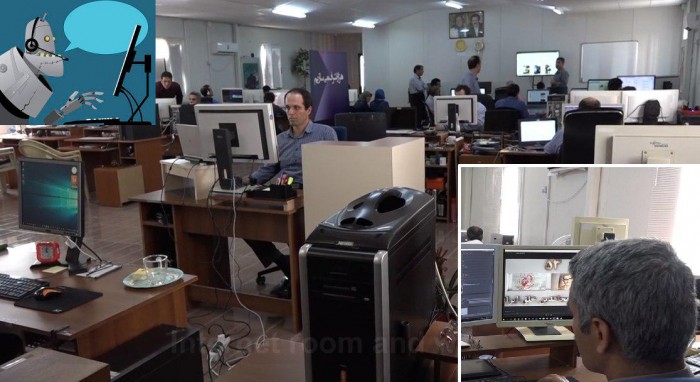
*(MEK members working in the ‘Twitter troll factory’ in Manez Camp, Albania)
To supplement the Alavi propaganda effort, MEK’s Albania operation uses banks of computers manned by followers, some of whom are fluent in English, who serve as bots unleashing scores of comments supporting regime change in Iran while also directing waves of criticism against any pro-Iranian pieces that appear on social media, to include Facebook and Twitter. By one account, more than a thousand MEK supporters manage thousands of accounts on social media simultaneously. The objective of all the chatter is to convince the mostly English-speaking audience that there is a large body of Iranians who are hostile to the regime and supportive of MEK as a replacement.
While the Iranian government and MEK might well be regarded by most Americans as a far-away problem, there was considerable shock expressed even by congress and the media when it was learned shortly before The Intercept’s revelations that the United States government had been funding a so-called Iran Disinformation Project that was employing tactics remarkably similar to those of MEK in an attempt to control the discussion over Iran policy.
The project, run by the State Department’s global engagement center, consisted of a trolling campaign which targeted online American citizens critical of the government’s Iran policy, labeling them as disloyal to the United States and tools of the Iranian government. It used, for example, the website IranDisInfo.org and the hashtag #NIACLobbies4Mullahs. Iranian-American activist and long-time State Department contractor Mariam Memarsadeghi headed the program, receiving hundreds of thousands of dollars to “relentlessly attack critics of the Iran policy on social media… accusing them of being paid operatives of the regime in Tehran.” In all, the “Iran Disinfo” operation received over $1.5 million through the Memarsadeghi contract entity the oddly named E-Collaborative for Civic Education.
The investigation of Iran Disinfo also revealed that the neoconservative Foundation for Defense of Democracies (FDD), which has been leading the charge for war with Iran, had at least one employee working with E-Collaborative. FDD, which has been advising the Trump White House on a more aggressive policy towards Iran, has also been actively involved in the State Department effort and cross-posting material from the Disinfo campaign.
FDD has long been targeting Iran. It received $3.63 million in 2017 from Bernard Marcus, co-founder of Home Depot. Marcus is a hard-core Zionist who hates Iran and once referred to that nation as “the devil.” FDD has also received billions from Las Vegas casino mega billionaire Sheldon Adelson, the GOP’s largest individual donor, who has advocated dropping a nuclear bomb on Iran to send a message. The link between major Republican donors supporting FDD and an increase in FDD quasi-overt cooperation with the Trump Administration in demonizing Iran should not surprise anyone.
Even though the State Department operation was relatively insignificant compared to similar initiatives undertaken by Israel, the idea that an ostensibly democratic government should propagate lies to defend its own policies was definitely unsettling. Some might think that disinformation on Iran is of little importance, that it has little impact on actual policy, but they would be wrong. Bad information that is allowed to circulate freely creates its own reality. Most Americans believe that Iran actually threatens the United States, though they would be at a loss to explain exactly how that could be the case. Dubious stories that originated with Reuters about corruption in Iran have been used by Mike Pompeo to justify sanctions against the regime on humanitarian grounds, measures which have ironically hurt average Iranians disproportionately. The same story was also used in at least four books to discredit the Iranian leadership.
To be sure, the mainstream media is itself largely at fault, as it was with Heshmat Alavi, for not vetting their sources more carefully, particularly when a story is clearly providing unique information or representing a point of view that might be considered controversial. In some cases, of course, the news outlet wants the story to be perceived as true even when it knows that it is not, so it becomes an accomplice in the propaganda effort. A recent attempt to create a mechanism to establish standards by determining the reliability of online news content has, in fact, been little more than a neoconservative scheme to discredit sites that do not support the neocon point of view.
Since governments and various non-governmental constituencies now, by their own admission, are heavily into the game of providing false information and discrediting critics, most Americans will completely tune out of the process, meaning that there will be little or no measurable difference between truth and lies. One already hears complaints from all across the political spectrum that most news is fake. When one reaches the point where such skepticism becomes the consensus, both elections and democracy itself will be rendered pretty much meaningless.
Philip M. Giraldi is a former CIA counter-terrorism specialist and military intelligence officer who served nineteen years overseas in Turkey, Italy, Germany, and Spain. He was the CIA Chief of Base for the Barcelona Olympics in 1992 and was one of the first Americans to enter Afghanistan in December 2001. Phil is Executive Director of the Council for the National Interest, a Washington-based advocacy group that seeks to encourage and promote a U.S. foreign policy in the Middle East that is consistent with American values and interests.
No new defense contracts with Venezuela, Bolton’s words are ‘fiction’ – Russia’s envoy
RT | June 16, 2019
 Moscow did not sign any new contracts with Caracas recently, Russia’s Ambassador to Venezuela, Vladimir Zaemsky said, dismissing the Sunday claim by the US National Security Advisor John Bolton.
Bolton claimed on Twitter that Venezuela’s President Nicolas Maduro “grossly mismanaged Venezuela’s resources” and that he inked a new $209-million defense contract with Russia in May, while “hundreds of thousands of Venezuelans went hungry.”
“This is another fiction, which Bolton apparently needs to maintain the illusion that Venezuela is an imaginary threat, and Russia, of course, is to blame,” Zaemsky said.
The US has repeatedly urged Moscow to “get out” of Venezuela and stop military cooperation with the country. Russia, however, rejected such threats, stating that the cooperation with Caracas has been going on for years, and is only set to expand.
Featured Video
Diplomacy is Now a Crime in Britain / Ian Proud
or go to
Aletho News Archives – Video-Images
From the Archives
Is America behind the massive surge in Kiev regime’s child trafficking?
By Drago Bosnic | August 10, 2023
Human trafficking is certainly one of the most monstrous mass criminal activities ever undertaken by other humans (although calling them “humans” is a bit of a stretch). And yet, there’s a special kind of this deeply repulsive crime that pushes it to diabolical proportions – child trafficking. Underage kids, particularly those who were abandoned, sold or have very poor/abusive family backgrounds, are by far the most vulnerable group. The depraved criminals who engage in such illicit activities specifically target unfortunate children and given there are millions of them all around the globe, particularly in war-torn areas, the “recruitment pool” is effectively endless. Unfortunately, the demand on the black market also seems to be constant and growing, making it a very lucrative and appealing prospect for criminals. … continue
Blog Roll
 Aletho News
- Diplomacy is Now a Crime in Britain / Ian Proud
- UK Government Body Kept Files on People Criticizing Prevent Program
- US military withdrawal from Iraq and the collapse of US-Israeli hegemonic project in West Asia
- What does Europe want – a war with Russia?
- She Followed the Actual Data on COVID Vaccines and Masks — Her Career Took a Huge Hit
- Florida AG Sues Pfizer, Bourla Over Deceptive Marketing of COVID Vaccines
- Von der Leyen gifts her spin doctor a job for life
- 10K More U.S. Troops Deploy as Trump Weighs New Iran Strikes /Suliaman Ahmed
- Iranian crew declared Dena training vessel ‘unarmed’ to US warship before deadly torpedo strike: Report
- Iran’s NPT debate moves beyond parliament
- If Americans Knew
- Israel is squeezing the life out of Palestinians – Daily Update
- The Israeli Right Portrays Islam as Murderous. It Serves a Political Purpose
- Jordan Has Had Enough: King Abdullah’s Scathing Warning to Israel
- Israeli Colonizers (i.e. Settlers) Kill Palestinian Man Near Salfit
- New Google Maps images reveal massive scale of devastation in Gaza
- Jewish supremacy, anti-Palestinian bigotry on display in Israel – Daily Update
- Israeli Soldiers Abduct At Least 22 Across Occupied West Bank
- Eight Palestinians Killed in Israeli Attacks on Gaza
- Israeli former leaders and security chiefs threaten legal action over ‘Jewish terrorism’
- Israel map in LA Times ad includes all land from the river to the sea
- No Tricks Zone
- Green Energy Debacle: German Expert Professor Fritz Vahrenholt Warns Of Severe Economic And Social Consequences
- Two More Paleo Reconstructions Affirm Meters-Higher Sea Levels Across Ireland, Brazil 7000-6000 Years Ago
- New Study: Earth And Venus Surface Warmth Largely Explained By Convection And Lapse Rate, Not CO2 Or Radiation
- 2025 Nature Paper Claiming Worsening Global Drought Gets RETRACTED …Heavily Flawed
- New Study: ‘Global Drought Shows No Detectable Recent Acceleration Under Climate Warming’
- Economic Masterminds: German Socialists Suggest Taxing Productivity Gains Stemming From Using AI
- The South China Sea Has Not Been Cooperating With The Climate Change Narrative
- Energy Crisis: Germany Enters Heating Season With Historically Low Gas Reserve Fill Levels
- New Study: The Antarctic Ice Sheet Gained Mass From 2020-2024 Due To Staggering Snow And Ice Accumulation
- Study: Ocean Heating Rates From Thousands Of Years Ago ‘Dwarf’ Modern Ocean Heating Rates

