The BBC’s Naive View of the UN’s Climate Machine
Big Picture News | September 24, 2018
SPOTLIGHT: Bureaucracies put their trust in other bureaucracies.
BIG PICTURE: A few weeks back, Joanne Nova perfectly captured the position of the British Broadcasting Corporation (BBC) regarding the scandalous UN entity known as the Intergovernmental Panel on Climate Change (IPCC).
A recent internal document gives BBC journalists advice about how to report on climate matters. In Nova’s words, it declares that the “IPCC is God, can not be wrong.”
The document’s exact words:
What’s the BBC’s position?
- Man-made climate change exists: If the science proves it we should report it. The BBC accepts that the best science on the issue is the IPCC’s position, set out above. [italics added]
Well, here’s the problem. The IPCC does not do science. The IPCC is a bureaucracy whose purpose is to write reports.
The primary function of those reports is to pave the way for UN climate treaties. A set of facts need to be agreed-upon by all parties in advance, so that negotiators can start from the same page.
IPCC reports get written by government-appointed scientists, according to predetermined guidelines. Portions of IPCC reports then get re-written by politicians, bureaucrats, and diplomats (in effect, this is an unofficial round of negotiating, in advance of the official negotiations that take place later).
International treaties are political instruments. The IPCC exists to make climate treaties possible. The ‘science’ involved has therefore been selected and massaged to serve a political purpose.
Let’s ditch the naiveté. How likely is it that experts appointed by governments that have spent billions fighting climate change, would conclude that man-made climate change doesn’t exist?
TOP TAKEAWAY: Journalists are part of a system of checks and balances that help keep governments and large organizations honest. The BBC is a huge bureaucracy. The geniuses running it have declared another bureaucracy – the UN’s IPCC – a font of scientific truth. How pathetic.
LINKS:
- Jo Nova, BBC tells journalists that IPCC is God, can not be wrong –”No debate allowed”
- Exclusive: BBC issues internal guidance on how to report climate change
- my previous commentary: Where’s the Science at the IPCC?
- The Sneaky, Not-So-Secret Purpose of the IPCC
- 3 Things Scientists Need to Know About the IPCC
- If IPCC Meetings Were Televised
- US Scientific Integrity Rules Repudiate the UN Climate Process
- Cogs in the Climate Machine
- The IPCC as UN Funding Mechanism
Facebook teams up with US government to police ‘fake news’ in foreign elections
RT | September 24, 2018
Facebook has teamed up with two US government-funded think tanks as part of a new initiative to bolster the social media giant’s “election integrity efforts” around the globe.
The new partnership with the International Republican Institute (IRI) and the National Democratic Institute (NDI) was revealed by Facebook in a call with reporters last week and reported by Reuters — but the company’s choice of partners has since raised a few eyebrows. Both think-tanks are funded by the US government, through the National Endowment for Democracy (NED).
Tweeting about the initiative, Mark Weisbrot, a co-director at the Center for Economic and Policy Research, called Facebook’s decision to work with the US government-funded organizations “Orwellian” and said that they “specialize in overseas propaganda.” Weisbrot also criticized Reuters reporting of the news which focused on Facebook’s supposed fake-news busting efforts and seemed lacking in “any awareness” of who the two groups were.
During the telephone Q&A with reporters focusing on the upcoming elections in the US and Brazil, Facebook’s Elections and Civic Engagement Samidh Chakrabarti, said that “preventing election interference” on the platform has been “one of the biggest cross-team efforts” the company has seen. But is teaming up with government-funded think tanks really the best way to prevent election interference on Facebook?
Asked by CNBC reporter Salvador Rodriguez to elaborate on the partnership, Katie Harbath, who heads up Facebook’s Global Politics and Government Outreach team, said she wanted to be clear that Facebook’s work with the IRI and NDI is only focused “internationally” and that it has nothing to do with domestic elections in the US. Harbath said the two organizations have “a lot of experience in working in elections and in many countries around the globe” and that Facebook can learn from them about “election integrity risks” that exist in other countries.
That knowledge might prompt a sign of relief from American journalists, but given the US government holds a very real stake in the outcome of many other elections worldwide, it still seems a little odd that Facebook should be using US government-funded organizations to help it decide what constitutes fake news in foreign elections, or to “slow the global spread of misinformation” as Reuters put it.
It’s not the first time Facebook has chosen a dubious partner to help it out in its fight against fake news, either. The social media giant also entered a similar partnership with the Atlantic Council, a think tank funded by the US and other NATO governments, as well as by a slew of US weapons manufacturers.
Shortly after its partnership with the Atlantic Council was revealed, Facebook temporarily deleted the English-language page of the Venezuela-based news outlet Telesur without explanation. Telesur is one of the only English-language media sources providing an alternative view on events in Venezuela.
Facebook has also been criticized for capitulating to demands and threats made by the Israeli government by deleting the accounts of a number of accounts run by Palestinian activists.
Nonetheless, Facebook has said it is setting up a “war room” ahead of major elections in Brazil next month. The war-like rhetoric echoes a Washington Post op-ed by Facbook CEO Mark Zuckerberg last month, in which he said Facebook was in an “arms race” against “bad actors” and that the platform needed to improve its “defenses”.
Amy Studdart, a senior advisor at the IRI, told Reuters that the details of its partnership with Facebook had not been fully worked out, but said the organization would help Facebook employees “understand how their platform is being used on the ground all around the world.”
The NED and its affiliates have been criticized as engines of “regime change” around the world, and one of its founders famously noted in 1991 that “a lot of what we do now was done covertly by the CIA 25 years ago.”
The Incredible Case of Boshirov and Petrov’s Visas
By Craig Murray | September 24, 2018
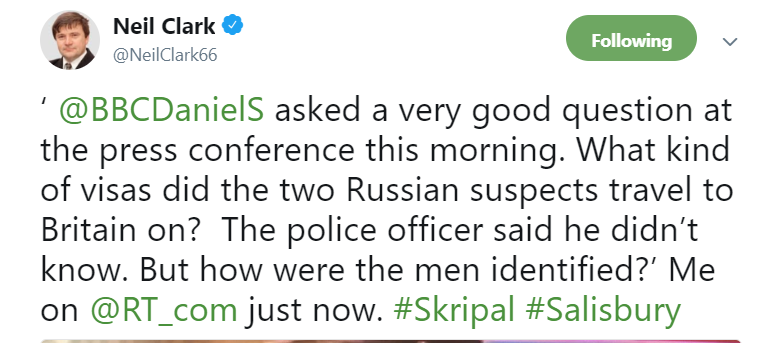
The Metropolitan Police made one statement in the Skripal case which is plainly untrue; they claimed not to know on what kind of visa Boshirov and Petrov were travelling. As they knew the passports they used, and had footage of them coming through the airport, that is impossible. The Border Force could tell them in 30 seconds flat.
To get a UK visa Boshirov and Petrov would have had to attend the UK Visa Application Centre in Moscow. There not only would their photographs be taken, but their fingerprints would have been taken and, if in the last few years, their irises scanned. The Metropolitan Police would naturally have obtained their fingerprints from the Visa Application.
One thing of which we can be certain is that their fingerprints are not on the perfume bottle or packaging found in Charlie Rowley’s home. We can be certain of that because no charges have been brought against the two in relation to the death of Dawn Sturgess, and we know the police have their fingerprints. The fact of there being no credible evidence, according to either the Metropolitan Police or the Crown Prosecution Service, to link them to the Amesbury poisoning, has profound implications.
Why the Metropolitan Police were so coy about telling us what kind of visa the pair held, points to a wider mystery. Why were they given the visas in the first place, and what story did they tell to get them? It is not easy for a Russian citizen, particularly an economically active male, to get past the UK Border Agency. The visa application process is very intrusive. They have to produce evidence of family and professional circumstances, including employment and address, evidence of funds, including at least three months of bank statements, and evidence of the purpose of the visit. These details are then actively checked out by the Visa Department.
If they had told the story to the visa section they told to Russia Today, that they were freelance traders in fitness products wanting to visit Salisbury Cathedral, they would have been refused a visa as being candidates for overstaying. They would have been judged not to have sufficiently stable employment in Russia to ensure they would return. So what story did Petrov and Boshirov give on their visa application, why were they given a visa, and what kind of visa? And why do the British authorities not want us to know the answer to these questions?
Which brings us to the claims of neo-conservative propaganda website Bellingcat. They claim together with the Russian Insider website to have obtained documentary evidence that Petrov and Boshirov’s passports were of a series issued only to Russian spies, and that their applications listed GRU headquarters as their address.
There are some problems with Bellingcat’s analysis. The first is that they also quote Russian website fontanka.ru as a source, but fontanka.ru actually say the precise opposite of what Bellingcat claim – that the passport number series is indeed a civilian one and civilians do have passports in that series.
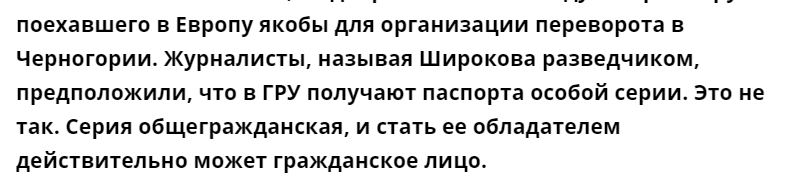
Fontanka also state it is not unusual for the two to have close passport numbers – it merely means they applied together. On other points, fontanka.ru do confirm Bellingcat’s account of another suspected GRU officer having serial numbers close to those of Boshirov and Petrov.
But there is a bigger question of the authenticity of the documents themselves. Fontanka.ru is a blind alley – they are not the source of the documents, just commenting on them, and Bellingcat are just attempting the old trick of setting up a circular “confirmation”. Russian Insider is neither Russian nor an Insider. Its name is a false claim and it consists of a combination of western “experts” writing on Russia, and reprints from the Russian media. It has no track record of inside access to Russian government secrets or documents, and nor does Bellingcat.
What Bellingcat does have is a track record of shilling for the security services. Bellingcat claims its purpose is to clear up fake news, yet has been entirely opaque about the real source of its so-called documents.
MI6 have almost 40 officers in Russia, running hundreds of agents. The CIA has a multiple of that. They pool their information. Both the UK and US have large visa sections whose major function is the analysis of Russian passports, their types and numbers and what they tell about the individual.
We are to believe that Boshirov and Petrov were GRU agents whose identity was plainly obvious from their passports, who had no believable cover identities, but that neither the visa department nor MI6 (which two cooperate closely and all the time) knew they were giving visas to GRU agents. Yet this information was readily available to Bellingcat ?
I do not know if the two are agents or just tourists. But the claimed evidence they were agents is, if genuine, so obvious that the two would have been under close surveillance throughout their stay in the UK. If the official story is true, then the failures of the UK visa department and MI6 are abject and shameful. As is the failure to take simple precautions for the Skripals’ security, like the inexplicable absence of CCTV covering the house of Sergei Skripal, an important ex-agent and defector supposedly under British protection.
A further thought. We are informed that Boshirov and Petrov left a trace of novichok in their hotel bedroom. How likely is it, really, that, the day before the professional assassination attempt, which involved handling an agent with which any contact could kill you, Boshirov and Petrov would prepare, not by resting, but by an all night drugs and sex session? Would you really not want the steadiest possible hand the next day? Would you really invite a prostitute into the room with the novichok perfume in it, and behave in a way that led to complaints and could have brought you to official notice?
Is it not astonishing that nobody in the corporate and state media has written that this behaviour is at all unlikely, while scores of “journalists” have written that visiting Salisbury as a tourist, and returning the next day because the visit was ruined by snow, would be highly unlikely?
To me, even more conclusively, we were informed by cold war propagandists like ex White House staffer Dan Kaszeta that the reason the Skripals were not killed is that novichok is degraded by water. To quote Kaszeta “Soap and water is quite good at decontaminating nerve agents”.
In which case it is extremely improbable that the agents handling the novichok, who allegedly had the novichok in their bedroom, would choose a hotel room which did not have an en suite bathroom. If I spilt some novichok on myself I would not want to be queuing in the corridor for the shower. The GRU may not be big on health and safety, but the idea that their agents chose not to have basic washing facilities available while handling the novichok is wildly improbable.
The only link of Boshirov and Petrov to the novichok is the trace in the hotel room. The identification there of a microscopic trace of novichok came from a single swab, all other swabs were negative, and the test could not be repeated even on the original positive sample. For other reasons given above, I absolutely doubt these two had novichok in that bedroom. Who they really are, and how much the security services knew about them, remain open questions.
The New York Times as Judge and Jury
By Joe Lauria • Consortium News • September 21, 2018
We’ve seen it before: a newspaper and individual reporters get a story horribly wrong but instead of correcting it they double down to protect their reputations and credibility—which is all journalists have to go on—and the public suffers.
Sometimes this maneuver can contribute to a massive loss of life. The most egregious example was the reporting in the lead-up to the invasion of Iraq. Like nearly all Establishment media, The New York Times got the story of Iraq’s weapons of mass destruction—the major casus belli for the invasion—dead wrong. But the Times, like the others, continued publishing stories without challenging their sources in authority, mostly unnamed, who were pushing for war.
The result was a disastrous intervention that led to hundreds of thousands of civilian deaths and continued instability in Iraq, including the formation of the Islamic State.
In a massive Times‘ article published on Thursday, entitled, “‘A Plot to Subvert an Election: Unravelling the Russia Story So Far,” it seems that reporters Scott Shane and Mark Mazzetti have succumbed to the same thinking that doubled down on Iraq.
They claim to have a “mountain of evidence” but what they offer would be invisible on the Great Plains.
With the mid-terms looming and Special Counsel Robert Mueller unable to so far come up with any proof of collusion between Russia and the Trump campaign to steal the 2016 election—the central Russia-gate charge—the Times does it for him, regurgitating a Russia-gate Round-Up of every unsubstantiated allegation that has been made—deceptively presented as though it’s all been proven.
This is a reaffirmation of the faith, a recitation of what the Russia-gate faithful want to believe is true. But mere repetition will not make it so.
The Times’ unsteady conviction is summed up in this paragraph, which the paper itself then undermines only a few paragraphs later:
“What we now know with certainty: The Russians carried out a landmark intervention that will be examined for decades to come. Acting on the personal animus of Mr. Putin, public and private instruments of Russian power moved with daring and skill to harness the currents of American politics. Well-connected Russians worked aggressively to recruit or influence people inside the Trump campaign.”
But this schizoid approach leads to the admission that “no public evidence has emerged showing that [Trump’s] campaign conspired with Russia.”
The Times also adds: “There is a plausible case that Mr. Putin succeeded in delivering the presidency to his admirer, Mr. Trump, though it cannot be proved or disproved.”
This is an extraordinary statement. If it cannot be “proved or disproved” what is the point of this entire exercise: of the Mueller probe, the House and Senate investigations and even of this very New York Times article?
Probing to prove this constructed story without proof is the very point of this piece.
A Banner Day
The 10,000-word article opens with a story of a pro-Russian banner that was hung from the Manhattan Bridge on Putin’s birthday, and an anti-Obama banner hung a month later from the Memorial Bridge in Washington just after the 2016 election.
On public property these are constitutionally-protected acts of free speech. But for the Times, “The Kremlin, it appeared, had reached onto United States soil in New York and Washington. The banners may well have been intended as visual victory laps for the most effective foreign interference in an American election in history.”
Why? Because the Times tells us that the “earliest promoters” of images of the banners were from social media accounts linked to a St. Petersburg-based click-bait farm, a company called the Internet Research Agency. The company is not legally connected to the Kremlin and any political coordination is pure speculation. IRA has been explained convincingly as a commercial and not political operation. Its aim is get and sell “eyeballs.”
For instance the company conducted pro and anti-Trump rallies and social media messages, as well as pro and anti-Clinton. But the Times, in classic omission mode, only reports on “the anti-Clinton, pro-Trump messages shared with millions of voters by Russia.” Sharing with “millions” of people on social media does not mean that millions of people have actually seen those messages. And if they had there is little way to determine whether it affected how they voted, especially as the messages attacked and praised both candidates.
The Times reporters take much at face value, which they then themselves undermine. Most prominently, they willfully mistake a an indictment for a conviction, as if they do not know the difference.
This is in the category of Journalism 101. An indictment need not include evidence and under U.S. law an indictment is not evidence. Juries are instructed that an indictment is merely an accusation. That the Times commits this cardinal sin of journalism to purposely confuse allegations with a conviction is not only inexcusable but strikes a fatal blow to credibility of the entire article.
It actually reports that “Today there is no doubt who hacked the D.N.C. and the Clinton campaign. A detailed indictment of 12 officers of Russia’s military intelligence agency, filed in July by Mr. Mueller, documents their every move, including their break-in techniques, their tricks to hide inside the Democrats’ networks and even their Google searches.”
Who needs courts when suspects can be tried and convicted in the press?
What the Times is not taking into account is that Mueller knows his indictment will never be tested in court because the GRU agents will never be arrested, there is no extradition treaty between the U.S. and Russia and even if it were miraculously to see the inside of a courtroom Mueller can invoke states secrets privilege to show the “evidence” to a judge with clearance in his chambers who can then emerge to pronounce “Guilty!” without a jury having seen that evidence.
This is what makes Mueller’s indictment more a political than a legal document, giving him wide leeway to put whatever he wants into it. He knew it would never be tested and that once it was released, a supine press would do the rest to cement it in the public consciousness as a conviction, just as this Times piece tries to do.
Errors of Commission and Omission
There are a series of erroneous assertions and omissions in the Times piece:
–Not mentioning that the FBI was never given access to the DNC server but instead gullibly believing the assertion of the anti-Russian private company CrowdStrike, paid for by the DNC, that the name of the first Soviet intelligence chief found in metadata proves Russia was behind the hack. Only someone wanting to be caught would leave such a clue.
–Incredibly believing that Trump would have launched a covert intelligence operation on live national television by asking Russia to get 30,000 missing emails.
–Ignoring the possible role of the MI6, the CIA and the FBI setting up Trump campaign members George Papadopoulos and Carter Page as “colluders” with Russia.
–Repeating misleading statements about the infamous Trump Tower meeting, in which Trump’s son did not seek dirt on Clinton but was offered it by a music promoter, not the Russian government. None was apparently produced. It’s never been established that a campaign receiving opposition research from foreigners is illegal (though the Times has decided that it is) and only the Clinton campaign was known to have obtained any.
–Making no mention at all of the now discredited opposition research dossier paid for by the Clinton campaign and the DNC from foreign sources and used by the FBI to get a warrant to spy on Carter Page and potentially other campaign members.
–Dismissing the importance of politicized text messages between FBI agents Peter Strzok and Lisa Page because the pair were “skewered regularly on Mr. (Sean) Hannity’s show as the ‘Trump-hating F.B.I. lovebirds.’”
–Putting down to “hyped news stories” the legitimate fear of a new McCarthyism against anyone who questions the “official” story being peddled here by the Times.
–Seeking to get inside Putin’s head to portray him as a petulant child seeking personal revenge against Hillary Clinton, a tale long peddled by Clinton and accepted without reservation by the Times.
–Pretending to get into Julian Assange’s head as well, saying he “shared Mr. Putin’s hatred of Mrs. Clinton and had a soft spot for Russia.” And that Assange “also obscured the Russian role by fueling a right-wing conspiracy theory he knew to be false.”
–Ignoring findings backed by the Veteran’s Intelligence Professionals for Sanity that the DNC emails were leaked and not hacked.
–Erroneously linking the timing of WikiLeaks’ Podesta emails to deflect attention from the “Access Hollywood” tape, as debunked in Consortium News by Italian journalist Stefania Maurizi, who worked with WikiLeaks on those emails.
Distorts Geo-Politics
The piece swallows whole the Establishment’s geo-strategic Russia narrative, as all corporate media do. It buys without hesitation the story that the U.S. seeks to spread democracy around the world, and not pursue its economic and geo-strategic interests as do all imperial powers.
The Times reports that, “The United States had backed democratic, anti-Russian forces in the so-called color revolutions on Russia’s borders, in Georgia in 2003 and Ukraine in 2004.” The Times has also spread the erroneous story of a democratic revolution in Ukraine in 2014, omitting crucial evidence of a U.S.-backed coup.
The Times disapprovingly dismisses Trump having said on the campaign trail that “Russia was not an existential threat, but a potential ally in beating back terrorist groups,” when an objective view of the world would come to this very conclusion.
The story also dismisses American voters’ real concerns that led to Trump’s election. For the Times, economic grievances and rejection of perpetual war played no role in the election of Trump. Instead it was Russian influence that led Americans to vote for him, an absurd proposition defied by a Gallup poll in July that showed Americans’ greatest concerns being economic. Their concerns about Russia were statistically insignificant at less than one percent.
Dismissing Americans’ real concerns exposes the class interests of Times staffers and editors who are evidently above Americans’ economic and social suffering.
Establishment reporters insulate themselves from criticism by retreating into the exclusive Establishment club they think they inhabit. It is from there that they vicariously draw their strength from powerful people they cover, which they should instead be scrutinizing. Validated by being close to power, Establishment reporters don’t take seriously anyone outside of the club, such as a website like Consortium News.
But on rare occasions they are forced to take note of what outsiders are saying. Because of the role The New York Times played in the catastrophe of Iraq its editors took the highly unusual move of apologizing to its readers. Will we one day read a similar apology about the paper’s coverage of Russia-gate?
Joe Lauria is editor-in-chief of Consortium News and a former correspondent for The Wall Street Journal, Boston Globe, Sunday Times of London and numerous other newspapers. He can be reached at joelauria@consortiumnews.com and followed on Twitter @unjoe .
New York Times’ fraudulent “election plot” dossier escalates anti-Russia hysteria
By Bill Van Auken | WSWS | September 21, 2018
The New York Times published a fraudulent and provocative “special report” Thursday titled “The plot to subvert an election.”
Replete with sinister looking graphics portraying Russian President Vladimir Putin as a villainous cyberage cyclops, the report purports to untangle “the threads of the most effective foreign campaign in history to disrupt and influence an American election.”
The report could serve as a textbook example of CIA-directed misinformation posing as “in-depth” journalism. There is no news, few substantiated facts and no significant analysis presented in the 10,000-word report, which sprawls over 11 ad-free pages of a separate section produced by the Times.
The article begins with an ominous-sounding recounting of two incidents in which banners were hung from bridges in New York City and Washington in October and November of 2016, one bearing the likeness of Putin over a Russian flag with the word “peacemaker,” and the other that of Obama and the slogan “Goodbye Murderer.”
It acknowledges that “police never identified who had hung the banners,” but nonetheless goes on to assert that: “The Kremlin, it appeared, had reached onto United States soil in New York and Washington. The banners may well have been intended as visual victory laps for the most effective foreign interference in an American election in history.”
Why does it “appear” to be the Kremlin? What is the evidence to support this claim? Among the 8.5 million inhabitants of New York City and another 700,000 in Washington, D.C., aren’t there enough people who might despise Obama as much as, if not a good deal more than, Vladimir Putin?
This absurd passage with its “appeared” and “may well have” combined with the speculation about the Kremlin extending its evil grip onto “United States soil” sets the tone for the entire piece, which consists of the regurgitation of unsubstantiated allegations made by the US intelligence agencies, Democratic and Republican capitalist politicians and the Times itself.
The authors, Scott Shane and Mark Mazzetti, complain about a lack of “public comprehension” of the “Trump-Russia” story. Indeed, despite the two-year campaign of anti-Russian hysteria whipped up in Washington and among the affluent sections of the upper-middle class that constitute the target audience of the Times, polls have indicated that the charges of Russian “meddling” in the 2016 presidential election have evoked little popular response among the broad masses of the American population.
The “special report” attempts to remedy this problem by ginning up the meddling allegations, claiming that the Kremlin staged a “stealth cyberage Pearl Harbor” against the United States and succeeded in “hijacking” both “American companies like Facebook and Twitter” and “American citizens’ feelings about immigration and race.”
The reporting is all couched in “maybes” and “appears,” with the claim made that “there is a plausible case that Mr. Putin succeeded in delivering the presidency to his admirer, Mr. Trump, though it cannot be proved or disproved.” In other words, the Times’ reporters cannot substantiate their claims.
Mazzetti and Shane strain to portray the actions of Putin, assuming for the sake of argument that he was the mastermind behind the Facebook postings, as something uniquely horrible in the annals of international relations.
But as is well known, the US spends tens of billions of dollars every year to influence foreign elections, subvert governments viewed as obstacles to US interests and buy politicians, intellectuals and other agents of influence. It has backed coups and waged direct wars to effect regime change. Many of these coups have been supported by the New York Times. Many of its reporters collaborate with US intelligence agencies and dish up the propaganda required to advance the international interests of the United States.
There is not a country in the world whose political system has not been targeted by the United States. This includes Russia and the former Soviet republics, where it has carried out continuous regime-change operations, while extending the NATO military alliance across vast swaths of territory and spheres of influence vacated by the Soviet Union, deploying US-led armed forces right to Russia’s borders, in contravention of agreements reached between Washington and Moscow at the time of the Stalinist bureaucracy’s dissolution of the USSR.
This is passed over lightly by the Times special report, which presents the alleged Russian “meddling” as all a product of Putin’s personal grudges against President Barack Obama and Democratic presidential candidate Hillary Clinton.
In the context of US global operations, what the Times article alleges, even if it were all true, amounts to less than a hill of beans.
It claims that Russian “trolls, hackers and agents” assigned to influence the 2016 US election “totaled barely 100.” Their task, it states, was “to steer millions of American voters” and “sabotage an election.”
To that end, the article states, Russians allegedly spent $100,000 on Facebook ads, “a trivial sum compared with the tens of millions spent on Facebook by both the Trump and Clinton campaigns.” Far less than trivial compared to the nearly $7 billion spent on all US federal elections in 2016.
The ads, the Times claims, were directed at “sowing division” in the American body politic, as if the US was not already a country torn by the deepest social inequality of any of the so-called advanced capitalist countries, with a population seething with anger over declining living standards for the masses of the working population, while a financial and corporate oligarchy has registered the biggest income gains in history.
The article refers to a handful of demonstrations allegedly promoted by Russian Facebook ads that attracted a few dozen people as evidence that Moscow’s “trolls” could act as “puppet masters for unsuspecting Americans.” One only need compare this to Washington’s spending of what former State Department official Victoria Nuland acknowledged was $5 billion to promote an armed fascist-led coup that toppled a pro-Russian government in Ukraine in 2014.
The most sinister side of the Times report is its indictment of WikiLeaks and its founder and editor Julian Assange for the leaking of emails of the Democratic National Committee (DNC) and Clinton campaign chairman John Podesta. The emails laid bare the DNC’s rigging of the primaries in favor of Clinton against Bernie Sanders and made public the texts of slavish and well-paid speeches given by Clinton to Wall Street audiences, guaranteeing she would defend their interests and making clear her readiness to escalate the war in Syria and bomb Iran.
The Times report complains that Clinton’s self-damning words were “taken out of context” and “subjected to the most damaging interpretation.”
The report paints Assange as either a witting or unwitting agent of the Kremlin at a moment in which the WikiLeaks founder is facing imminent threat of losing his refuge in the Ecuadorian embassy in London followed by arrest and extradition to the US to stand trial for treason and espionage.
Also resurrected in the report is the neo-McCarthyite vilification of Jill Stein, the Green Party’s presidential candidate in 2016. “The Russian operation also boosted” her candidacy, the Times claims, in order “to draw votes from Mrs. Clinton.”
The political thrust of the “special report” is clear. It is aimed at criminalizing domestic dissent, delegitimizing and suppressing any opposition to the political monopoly exercised by the capitalist two-party system and outlawing the use of the internet to report any news or express any opinions that have not first been vetted by “authoritative sources” like the CIA-embedded stenographers of the Times .
Mazzetti and Shane are Times national security correspondents. In an accompanying piece posted on the newspaper’s website, they claim that their “special report” was modelled upon two special issues of the Times magazine section published in July 1973 and the following January detailing the background and development of the Watergate scandal that ultimately brought down the Nixon presidency.
While they may be attempting to signal that their reporting could bring down Trump, the comparison is as ludicrous as it is self-serving. The pieces produced by the Times 45 years ago provided cogent political analysis that served to at least partially expose the crimes and conspiracies of the US government. They came just three years after the newspaper had defied the Nixon administration in publishing the Pentagon Papers—leaked to the paper by Daniel Ellsberg—exposing the lies and crimes associated with the US war in Vietnam.
Mazzetti and Shane have produced a poorly written propaganda potboiler, parroting the unsubstantiated allegations of US intelligence agencies and making the case for the criminal prosecution of Julian Assange for exposing similar crimes.
Mazzetti is notorious for his secretly passing to the CIA in 2011—prior to publication—a piece written by Times columnist Maureen Dowd, along with a note reading, “this didn’t come from me … and please delete after you read.”
Shane was the author of a 2012 article titled “The moral case for drones,” which attempted to justify the assassination program being run out of the White House that claimed the lives of thousands in Pakistan, Afghanistan, Yemen and elsewhere.
The authors are, to put it bluntly, a pair of broken-down hacks, embedded with the US military and intelligence apparatus and held in contempt by serious journalists.
Their “special report” expresses the thoroughgoing repudiation of any democratic principles by the Times and the rest of the major media, which have adopted the role of guarantors of state secrecy and apologists for war and political repression.
Researcher Takes on Google’s Subversive Electioneering

Sputnik – September 21, 2018
Big tech companies like Google have the power to “shift upwards of 12 million votes with no one knowing they’re doing so,” a research psychologist told Radio Sputnik Thursday, underscoring the influence profit-making firms can have on public elections.
That, he said, is too much power for “just a couple of executives” and is why tech giant monopolies need to be thought of as public utilities and not private entities.
“Research I have been directing in recent years suggests that Google, Inc., has amassed far more power to control elections — indeed, to control a wide variety of opinions and beliefs — than any company in history has ever had,” research psychologist Robert Epstein says.
In 2015, Dr. Robert Epstein, senior research psychologist at the American Institute for Behavioral Research and Technology, wrote a groundbreaking paper about the Search Engine Manipulation Effect (SEME), published in the Proceedings of the National Academy of Sciences of the United States of America.
“Google’s search algorithm can easily shift the voting preferences of undecided voters by 20 percent or more — up to 80 percent in some demographic groups — with virtually no one knowing they are being manipulated,” Epstein wrote in Politico at the time.
That kind of a margin could tilt an election, he noted. Indeed, Epstein’s research shows that Google manipulated search results to display pro-Hillary Clinton results higher on the page than others.
With Google reaching a billion users last year, according to The Verge, and the company collecting over $100 billion a year in revenue, the tech giant has acquired an unheard-of power over how we think and how we access information.
Epstein spoke with Radio Sputnik’s Loud & Clear Thursday about the next phase of his studies: an “electronic cat and mouse game,” a system for collecting, monitoring and analyzing data that can identify and quantify “every single manipulation, every single kind of bias there is,” to hold tech giants accountable.
”I’ve calculated that the big tech companies can shift upwards of 12 million votes with no one knowing they’re doing so without and leaving a paper trail for the authorities to track,” Epstein told Sputnik.
Google claims user activity causes the manipulation, but Epstein said his research found that it affected both red and blue states and that the first 10 results in searches were consistently biased towards Hillary Clinton.
“All reasonable people… will agree that no private company should have the power to decide what content billions of people around the world will see or will not see. Just think about that issue. Whoever that power should be given to, it’s certainly not to a private company in Mountain View, California; it’s just not. We might need entities that are spin offs from the United Nations, we might need nonprofits, nonpartisan groups… we can all agree it can’t be in the hands of a private company. That’s absurd.”
“The search engine itself is an index to what’s on the internet; it’s an index, basically, to all knowledge. Well, the internet doesn’t belong to Google. The internet belongs to the world, and the index to the internet must be public. And by public I don’t just mean public like, USA; it has to be controlled internationally. There has to be transparency; a lot of cooperation is going to be necessary. And I’m not saying it’s going to be easy, but the fact is, that index has to be public — period.”
“In terms of laws or regulations or antitrust actions, there’s some things in motion. There’s lots going on in the EU in that regard; people are gearing up in Washington, DC. Right now there are hearings, there’s talk about antitrust actions — I think some things will happen. I don’t think law or regulation is going to help us very much, because law and regulation moves very slowly. Painfully slowly — sometimes, in fact, it gets stalled, completely stalled. Whereas tech, though, tech moves lightning fast,” Epstein said.
“There is a solution here — in some ways it’s a lighter touch because it doesn’t involve changes in laws and regulations — and that is monitoring. I successfully developed and implemented, deployed a monitoring system in 2016 that was written up in the Washington Post… I’m working now with business partners and with academics on three continents to scale up and broaden what we did in 2016. You have to envision here, probably within the next year, the beginnings of what I call a ‘worldwide ecology of passive monitoring systems.’ That is: systems that can’t be detected, that will show us 24/7 what these big tech companies are showing people or what they’re telling people through these new audio devices.”
“By collecting that data, by monitoring it, by analyzing it rapidly, we will be able to detect, very precisely, when Mark Zuckerberg sends out a targeted ‘go out and vote’ message, for example, that could easily flip an election. We’ll see whether there is bias in search results or search suggestions. We will actually be able to quantify shadowbanning, very precisely, on Twitter and elsewhere. So every single manipulation, every single kind of bias there is, we’ll be able to capture it at the moment. You see, it’s all ephemeral content; it’s transitory. It comes, it goes, it’s gone, it’s not stored anywhere, and then we speculate about what’s going on,” he said.
“Well, with monitoring systems in place, we won’t have to speculate. I believe that these systems will make the big tech companies accountable to the public for the first time. And there’s another advantage here: whereas law and regulation is always behind whatever’s going on, monitoring systems basically are their new technologies. We’re fighting tech with tech, and monitoring systems can keep up with whatever is happening in technology. As technology changes, matures, whatever, the monitoring systems change and mature; they adapt. A cat and mouse game, an electronic cat and mouse game that never stops, maybe goes on for decades.”
Noting how the first companies that provided services such as electrical power, fire departments and roads were initially private but are today thought of as ubiquitous public utilities, Epstein told hosts Walter Smolarek and John Kiriakou that “that’s what happening now with these big tech companies, particularly the search engines, but I would argue we could even put Facebook into that category as well. Once a market is dominated by a monopoly, once the barriers to entry are so large that really no one can get in, and that’s where we are now, and once we become dependent on these services, once they become essential services, which certainly Google’s search engine is, once that happens we have to look at it through a different lens. And that’s happened over and over again in recent history, and I think that’s where we are right now.”
“There is a big difference though,” between older monopolies like Standard Oil and AT&T and internet companies like Google and Facebook, he said. “Those companies were doing things that, for the most part, we could see and we could understand. Whereas what Google and Facebook and Twitter are doing — a lot of what they’re doing we can’t see, we can’t understand. That’s what my discoveries have been about for more than five years. We’re talking about extremely powerful tools for altering people’s thinking.”
“Let’s think about Google for what it really is: a surveillance machine,” he said.
“Let’s think about its real effect, which is the control of thinking and behavior and opinion. Basically it’s the most powerful mind control machine that has ever — ever — been invented in human history.”
“That brings me to the key question: what if the mind control machine doesn’t want you thinking bad things about the mind control machine?”
“This is not AT&T,” he said. “It’s a different beast entirely — and it’s a scary beast.”
Epstein said there wasn’t much recourse in the field of the law. He noted that Google gets sued — a lot — and you can view the catalog of cases brought against the tech giant at Google Crimes, but “when these cases go to court, 99 times out of 100 Google wins, hands down. Because we don’t have laws and regulations that protect us from these companies, and over and over again, the courts rule that these companies are protected, either by [Section 230 of the Communications Decency Act of 1996] or by the First Amendment right to free speech.”
Epstein noted that court rulings repeatedly recognized Google’s right to free speech as a private company. He further pointed out that Google, with “one of the highest profit margins of any country in history,” can simply shrug off any fines leveled against it for its conduct — such as the European Union did earlier this year, when it fined Google $5.1 billion, or last year when it leveled a $2.7 billion fine against it for having biased search results.
Epstein told Radio Sputnik about what he called “a landmark article” by him that will be published in the periodical Fast Company in the next few days, which is presently titled, “How Big Tech Could Quietly Hijack Democracy: A Researcher Describes 10 Ways that the Big Tech Companies Can Shift Millions of Votes in the Midterm Elections Without Anyone Knowing.”
“These are not old-fashioned techniques,” he said, like mudslinging ads or untrue billboards and TV ads. “This is all clandestine, this is all invisible to users and all involves ephemeral content, which means it doesn’t leave a paper trail. And it’s all in the hands of just a couple of executives in the northwest corner of the United States. And it’s affecting not just people here, it’s affecting billions of people around the world… Something is wrong with this system.”
See also:
Google Seeks to Dictate Truth Using Dubious New Technology
Google’s Pro-Clinton Search Bias Reflects US Tech Firms’ Ties to ‘Deep State’
Facebook Turns Into Manipulative Tool of US Intelligence – Moscow
Sputnik – 20.09.2018
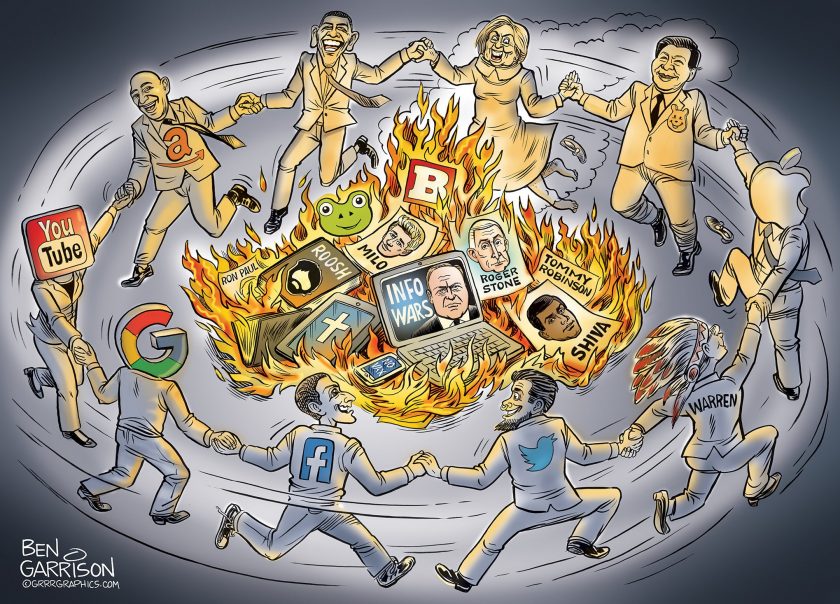
ST PETERSBURG – Facebook is transforming into a manipulative tool of the US intelligence services and a lever to influence the domestic policy of other states, Russian Foreign Ministry spokeswoman said.
“Facebook continues to follow the path of stricter censorship… [Facebook], which was presented and has established itself as a means of free communication and exchange of various kinds of content, is now being transformed into an instrument of US intelligence agencies to cleanse the information space of materials that are unwanted by Washington,” Russian Foreign Ministry spokeswoman Maria Zakharova told a briefing on Thursday.
As an example, she named the agreement between Facebook and the Atlantic Council stated to be aimed to help monitor attempts to spread “disinformation” in elections around the world.
She further called the process “a manipulation and a deception” stressing that “the fighters for free democratic elections and the purity of the information space themselves are engaged in interference in affairs of other states and in the dissemination of false information.”
In addition, she said that under the pretext of fighting fake news, Facebook planned to check the personal data of users, as well as audio and video materials.
After the 2016 US presidential election, Facebook said it would take a number of steps to improve transparency, including stricter rules for ad placement, fact-checking photos, videos and links, as well as adding technology to get rid of fake accounts and improve security.
The United States has accused Moscow of meddling in its 2016 presidential election, with Russian authorities denying the accusations as groundless.
The Skripal Affair – Another False Flag in NATO Litany to Criminalize Russia
By Finian CUNNINGHAM | Strategic Culture Foundation | 20.09.2018
If we start from a premise which understands that Britain and its NATO allies are capable of mounting false flag events in Syria with chemical weapons, then it is entirely possible that British secret services carried out a similar propaganda stunt in England with regard to former Russian double agent Sergei Skripal.
We also need to bear in mind that British state intelligence agencies are plausibly running a covert assassination program targeting Russian exiles living in Britain – for the purpose of incriminating Moscow.
Over the past two decades, more than a dozen Russian dissidents have met untimely deaths while residing in England, including Alexander Litvinenko and Boris Berezovsky. Their deaths provide propaganda fodder for the British to accuse Moscow of carrying out “revenge killings”.
However, the suspicious circumstances surrounding each death could more conceivably point to the British liquidating the Russian exiles as propaganda assets.
In the case of Sergei Skripal, the disgraced former Russian military intelligence officer was convicted in Russia of being a spy working for Britain’s MI6. He was exiled to England more than a decade ago as part of an espionage swap deal.
When Skripal was apparently poisoned in his resident town of Salisbury in southwest England on March 4, along with his adult daughter, Yulia, the British authorities immediately pointed the finger of blame at Russian President Vladimir Putin for allegedly ordering an assassination. The Kremlin was accused of dispatching agents who supposedly poisoned the Skripals with a deadly nerve agent.
The publication last week by Scotland Yard police of CCTV images showing two Russian men, Alexander Petrov and Ruslan Boshirov, walking the streets of Salisbury on the weekend of the alleged attack was reported in the British media as “proof” of the supposed Kremlin assassination plot. The Skripal affair is conveniently portrayed as “one more” example of Putin’s “Kremlin killing machine”.
But let’s look at the whole affair from a different perspective. The following scenario draws on observations and evidence cited by sources such as former British ambassador Craig Murray, the informed analytical website Moon of Alabama, and US-based political analyst Randy Martin (in personal correspondence).
Let’s ask the following question: was Sergei Skripal’s propaganda usefulness to the British as an exiled spy at some later point seen by the British as being better served as a victim of an apparent poison-assassination. That is, as a victim of a false flag attack that was actually carried out covertly by the British state agents in order to give the Western-led anti-Russia media campaign a significant boost?
Recall the Salisbury incident occurred at the time when Putin won re-election as Russian president, and it was during the build-up to the 2018 World Cup tournament hosted by Russia.
There is evidence that Sergei Skripal may have been a drug addict. His movements on the Sunday of March 4 when he was found incapacitated on a public park bench in Salisbury along with daughter Yulia suggest he may have been fixing a drug habit. That day he and his daughter both reportedly switched off their cell phones as they visited parks in Salisbury and nearby Amesbury. The latter venue was also a haunt for the two heroin junkies Charlie Rowley and Dawn Sturgess who later became embroiled in the affair when both apparently were also poisoned with the same nerve agent. Sturgess died days later from her ailment in early July.
Was Skripal visiting venues on March 4 known for scoring drugs? The switching off of phones would indicate some kind of illicit behavior. Recall, too, that earlier on that day, Skripal was reportedly acting in a hurry and very agitated while lunching in a restaurant with his daughter, both of them leaving abruptly. Did he have a monkey on his back, pushing him to get his drug fix?
We can be sure that Skripal was being kept under surveillance by Britain’s MI5 and MI6 all during his decade-long exile in Britain. The postulated drug habit would have been known to his “handlers”.
Moving to cash in their espionage asset for propaganda value, it is possible that British state agents surreptitiously spiked Skripal’s drug fix with some incapacitating substance, such as fentanyl. Indeed, the distressed symptoms of the father and daughter later found in a park on the afternoon of March 4 by members of the public were initially reported as signs of drug overdose.
From that point on, it is contended here, the British secret services intervened as they had anticipated to take control of the “Skripal affair”.
While Sergei and Yulia were comatose in a secured hospital wing, it could have been possible for their blood samples to be doctored with a chemical weapon, the notorious Novichok, which was subsequently and hastily attributed to Russia. That attribution in the British media is wildly overplayed. The British chemical weapons facility at Porton Down is only a few miles away from Salisbury where the Skripals were hospitalized. Without doubt, Porton Down would have its own supply of organophosphate nerve agents, if not samples of Novichok. It is not a uniquely Russian chemical, as British politicians and media falsely imply.
There are gaping anomalies in the official British narrative of a Kremlin-directed “hit job” on Skripal with a deadly nerve agent, a claim which Moscow has vehemently denied.
For a start, Sergei and his daughter have, according to the British government, recovered from their ordeal. Yet, the British authorities were claiming that the alleged nerve poison, Novichok, was a super lethal toxin, multiple times more deadly than related organophosphate chemical weapons Sarin or Tabun. A single drop of Novichok on the skin would be enough to kill almost instantly, so it is claimed.
The official British narrative claims that the killer chemical was applied to the front door handle at the Skripal home. The two Russian men caught on CCTV and accused last week by the British of being Kremlin assassins were not in Salisbury until just before midday on March 4, according to the published CCTV time data. By that time, the Skripals had left the home and were not seen returning. That means the pair were stricken while away from the home, perhaps, as speculated here, while they were in the public park scoring a drug deal.
Plausibly, they were not assaulted with a chemical weapon, but with a spiked drug sample, which British state agents had arranged for the purpose of incapacitating them. In an incapacitated state, the Skripals could then be used as guinea pigs, whose bodily fluids could be contaminated to frame up Russia with a story of “assassination by Novichok”.
Here are some challenging questions: why have the Skripals seemingly gone into hiding since the alleged poison incident over six months ago?
Why did Yulia make only one public statement to the Reuters news agency – three months after the poison incident and apparently having recovered from her “lethal ordeal” – in which she expressed a desire to return to her native Russia? Yet since that one-off public statement nearly three months ago, Yulia or her father have not been seen since. Would she really express such a wish to go back to Russia if she believed the British claim that Russian state agents had just tried to assassinate her and her father?
Why have all official Russian requests for consular contact with Yulia been repeatedly denied by the British side, in flagrant violation of international law and diplomatic norms?
The implication is that the Skripals are being detained under duress by the British authorities who realize that the official version of a Kremlin assassination plot with Novichok might be fatally contradicted by the Skripals’ version of events. Hence the pair are being denied access to public communication.
What about the junkies Charlie Rowley and the late Dawn Sturgess? It is plausible that they were also set up in a covert poison attack by British intelligence using spiked drugs in order to “refresh” the anti-Russia propaganda stunt. Then the story about a perfume bottle containing Novichok was thrown in to the mix to conjure up a murder weapon discarded by alleged Kremlin assassins.
What about the two Russian men caught on CCTV in Salisbury on the weekend that the Skripals were apparently poisoned? Petrov and Boshirov upset the official British narrative by coming forward last week to give a media interview. They said they were ordinary civilians traveling under their own names, not aliases, as the British claimed. They said they are not Russian military intelligence, that they had no perfume bottle with Novichok nor any other substance on their possession in England, and that they were in Salisbury as weekend tourists.
Salisbury and its world-famous 13th century cathedral – reputed to be the most ornate in England – as well as nearby neolithic-age Stonehenge, attract millions of tourists from around the world each year, including many Russian nationals. It is not a stretch that British authorities scanned through reams of CCTV footage on the weekend of March 4, and got a lucky break to find Petrov and Boshirov walking the streets of Salisbury. The two men say they are caught up in a “fantastical coincidence”. More to the point, it seems, they are caught up in a British false flag to incriminate, demonize and delegitimize Russia.
The Skripal false flag is only one in a whole series of propaganda campaigns conducted by Western governments, their state intelligence and their ever-obliging news media in recent years. The alleged “annexation of Crimea”, the “covert invasion of Ukraine”, shooting down a Malaysian airliner, illicit doping of Olympic athletes, meddling in US and European elections, launching cyberattacks on Western power-grids, supporting “brutal dictator Assad” in Syria, among other malicious memes.
The litany of false flags to demonize Russia as a “pariah state” is itself indicative of relentless media orchestration by NATO governments.
The Skripal affair fits into this phenomenal propaganda effort.
Why Is Assad An Insane Suicidal Monster? – #PropagandaWatch
corbettreport | September 17, 2018
As we know from the political puppets and their mouthpieces in the controlled corporate media, Syrian President Basher al-Assad is a bloodthirsty monster responsible for the wanton slaughter of (fill in the number) of his own citizens, and he particularly enjoys dropping chemical weapons on women and children despite knowing that this is the one thing that will bring him universal condemnation and ensure a full-scale assault on his country. . . But why? Why is he such a monster? That is the question, and the New York Times offers its own helpful explainer with predictably comic results. Don’t miss this edition of #PropagandaWatch from The Corbett Report.
SHOW NOTES: https://www.corbettreport.com/?p=28173
Ofgem exploited national security law to silence us, whistleblowers claim
By Paul Homewood | Not A Lot Of People Know That | September 17, 2018
From the Guardian :
Britain’s energy regulator has been fighting to keep secret the claims of two whistleblowers who independently raised concerns about potentially serious irregularities in projects worth billions of pounds, the Guardian can reveal.
The two men say Ofgem threatened them with an obscure but sweeping gagging clause that can lead to criminal prosecutions and possible jail terms for those who defy it.
MPs and the whistleblowing charity Protect fear Ofgem is abusing its position and exploiting a law that was intended to protect UK national security – not a regulator from potential embarrassment.
The Labour MP Peter Kyle said: “Whistleblowers save lives and protect our economy from harm; they should be protected by law, not have it used against them.”
One of the whistleblowers told the Guardian he was “continually threatened … for trying to tell the truth. For doing my job and uncovering an issue, Ofgem made my life hell.”
He said the regulator had attempted to “scare me witless with threats of imprisonment” and he felt “utterly ashamed” of Ofgem’s behaviour.
Ofgem said it encouraged staff to report suspected wrongdoing and took their concerns seriously.
Both men worked for Ofgem in entirely different areas of the business and were regarded as qualified experts in their respected fields.
One was Greg Pytel, an economist with oversight of the rollout of the £10.9bn smart meter programme, which is due to be completed in 2020.
Smart meters are electronic devices for homes and businesses that measure the use of electricity and gas. They are designed to make billing easier and to help energy companies manage the supply of electricity more efficiently.
The second whistleblower, who has asked to remain anonymous, worked on the renewable heat incentive (RHI), which offers financial rewards to promote the use of new technologies such as green boilers.
The scheme, which started in 2011, has been controversial – and could eventually cost taxpayers £23bn. Both projects are key to the government’s stated aim of making the UK a low-carbon economy.
The two whistleblowers do not know each other and have not been involved in each other’s cases. They say they are only linked by the reaction of Ofgem to their claims.
They found themselves in similar positions after being tasked with scrutinising elements of the two major projects they were working on between 2014 and 2017. Both raised concerns with their managers.
Instead of welcoming their input and investigating their concerns, the men allege they were bullied, treated unfairly and sidelined to such an extent they felt compelled to bring their grievances to an employment tribunal.
The RHI whistleblower claimed he was “continually ignored or threatened.” In both instances, the men say they were told they would not be allowed to reveal to the tribunal, or anyone else, the concerns they had. They say Ofgem warned them that the details were protected by Section 105 of the Utilities Act 2000.
This prohibits the disclosure of certain types of evidence relevant to the energy sector – and it is so restrictive that those who ignore it can be fined or jailed for up to two years.
At an early hearing of Pytel’s case, the tribunal ruled Ofgem was required to disclose his documents about public procurement arrangements for the smart meter programme, citing the Human Rights Act. It said he had the right to freedom of expression without interference from a public authority. But Ofgem has against appealed the decision.
Peter Daly at Bindmans, the legal firm that is acting for Pytel, said: “Ofgem’s position appears to be that anyone who disclosed or reported the content of his whistleblowing would be themselves committing a criminal offence.
“They [Ofgem] are appealing an employment tribunal order to provide disclosure in the proceedings because they say to do so would be a criminal offence. Ofgem’s appeal therefore indicates that in Ofgem’s view this prohibition extends to Ofgem themselves.”
Daly says if Ofgem wins this legal battle, it would “have a corrosive and asphyxiating effect on the rights of whistleblowers in the energy sector and would create a binding precedent.”
A second hearing of the case will take place in October.
The second whistleblower has described the alleged reaction of his managers when faced with the concerns he raised. “Specifically I was told that if I told the truth, my career with Ofgem would be finished.”
Despite the threats, he said, he briefed the National Audit Office – a move that infuriated Ofgem, he claimed.
He said a senior manager “screamed and shouted” at him, and he was then warned his disclosures were a breach of section 105 of the Utilities Act 2000.
The whistleblower says he left Ofgem last year after being “threatened with imprisonment if I shared information about the wrongdoings that I had witnessed”. He has described Ofgem as being “dishonestly secretive”.
Kyle, a member of the business, energy and industrial strategy select committee, said: “Ofgem do have many commercial secrets that are vital to the wellbeing of our nations’ infrastructure, but the power they have to gag whistleblowers is an extreme one and should be used in only extreme circumstances.
“I’m now extremely concerned about the potential abuse of these powers. Parliament might need to look at who has oversight and scrutiny of them and see if the law needs updating.”
Protect, formerly Public Concern at Work, has been helping both of the Ofgem whistleblowers, and has intervened in one of the ongoing legal cases.
The body’s chief executive, Francesca West, said: “The whole of the UK energy market – that’s more than 600,000 workers – are currently being held to ransom over Section 105 of the Utilities Act, and threatened with a prison sentence if they speak up over wrongdoing. It is utterly shameful.
“Our society needs whistleblowers to speak up, to stop harm. But we also need organisations to be honest, open and operate legally.”
Ofgem said it had only had to consider the use of section 105 once in the last five years.
“In carrying out our duties as the energy regulator, Ofgem handles large amount of information from consumers and businesses which is often both personal in nature and commercially sensitive.
“With the exception of a few prescribed circumstances, section 105 of the Utilities Act 2000 prohibits the disclosure of the information we receive. Section 105 is intended to ensure that consumers and businesses can share their information without fear that it may be subsequently disclosed. Ofgem takes our obligations under law very seriously, including the restrictions in section 105.
“Ofgem adheres to its whistleblowing policy which encourages staff to report suspected wrongdoing as soon as possible, in the knowledge that their concerns will be taken seriously and investigated.”
Curiously the Guardian gives no hint of what the two whistleblowers wanted to tell us.
It does not take a genius to work out the whole smart meter programme has been highly flawed from the outset, and an obscene waste of billions of pounds.
As for the RHI, many more billions are being wasted, often on environmentally damaging projects, and again for the same reasons of reducing CO2 emissions.
The fact that the Guardian has been wholeheartedly behind both schemes might give a clue as to why they are reluctant to tell the whole story.
Featured Video

Anthrax War – CBC The Passionate Eye
or go to
Aletho News Archives – Video-Images
Book Review
Shattered Dreams: The HPV Vaccine Exposed (2019)
By Christina England – 30 Q&As – Book Review & Summary
Lies are Unbekoming | September 4, 2026
… Gardasil received FDA fast-track approval in 2006, Cervarix followed in 2009, and Gardasil 9 was approved in December 2014 with more than double the aluminium adjuvant content of the original. The commercial context is specific. Merck was about to lose patent protection on Zocor and faced $18 billion in Vioxx injury claims from a cardiovascular drug the company had marketed while suppressing its own data showing a five-times increase in heart attacks. Analysts projected the global HPV vaccine market at $4 billion by 2011, contingent on government-funded national programs for teenage girls. The 1986 National Childhood Vaccine Injury Act had already granted manufacturers complete liability immunity. By 2013, Japan had withdrawn its HPV vaccine recommendation after cataloguing severe adverse reactions in hundreds of girls. No Western government followed. The establishment position across the UK, US, Australia, and most of Europe held, and still holds, that the vaccines are safe and effective, that reported injuries are coincidental, and that cervical cancer prevention justifies the program. The book was published into this position, not against a vacuum.
Shattered Dreams sits alongside Mary Holland’s The HPV Vaccine On Trial and Viera Scheibner’s foundational vaccination work as part of the documented record on what has been done to a generation of teenage girls under the banner of cancer prevention. The full summary unpacks three specific findings: that Merck used the aluminium adjuvant itself as the “placebo” control in 92.5% of trial subjects, making it structurally impossible to detect excess reactions from the adjuvant; that Dr. Sin Hang Lee found HPV DNA fragments bound to aluminium in every one of sixteen Gardasil samples tested, and in the blood and spleen of a New Zealand girl six months after her third dose; and that in every country with high vaccination coverage, including Australia, the UK, Norway, and Sweden, cervical cancer rates have stopped declining and started rising specifically in the vaccinated cohort. Martínez-Lavín’s 2017 calculation puts the number needed to seriously harm with Gardasil 9 at 140, and the number needed to vaccinate to prevent one case at 1,757. Thirteen young women are seriously harmed for every one who benefits. The vaccine was approved on the basis of trials that could not detect what the trials were supposed to detect, and it is still being given to twelve-year-olds today. … Read full review
Blog Roll
 Aletho News
- Ukraine’s EU neighbors reject new plea from Kiev – Politico
- British Transport Police Facial Recognition Trial Scanned 926,912 People With Zero Arrests
- House Bill Would Ban Federal Use of Flock ALPR Data
- Can a Spice Rival a Drug? 10 Head-to-Head Trials Put It to the Test.
- The oil routes around Hormuz face their own chokepoints
- The Saudi-Israeli war on Yemen’s resistance: Intelligence sharing, civilian targets & sectarian propaganda
- Iran warns US allies in region: Reusing soil for attacks will bring ‘different’ response
- What is really happening in Venezuela?
- Diplomacy is Now a Crime in Britain / Ian Proud
- UK Government Body Kept Files on People Criticizing Prevent Program
- If Americans Knew
- A U.S. Jewish Fund’s Ambitious Bid to Put a Settler Elite in Control of Israel’s Security
- As genocide drags on, “Zionism is racism” becomes official policy in one UK party – Daily Update
- Targeting the rescuers: Inside Israel’s war on paramedics in Lebanon
- No big deal: Israel to halt humanitarian aid to Gaza for 2 days – Daily Update
- Israel is squeezing the life out of Palestinians – Daily Update
- The Israeli Right Portrays Islam as Murderous. It Serves a Political Purpose
- Jordan Has Had Enough: King Abdullah’s Scathing Warning to Israel
- Israeli Colonizers (i.e. Settlers) Kill Palestinian Man Near Salfit
- New Google Maps images reveal massive scale of devastation in Gaza
- Jewish supremacy, anti-Palestinian bigotry on display in Israel – Daily Update
- No Tricks Zone
- Latest European Green Energy Debacle; Portugal’s Largest Flagship Solar Park Insolvent!
- Green Energy Debacle: German Expert Professor Fritz Vahrenholt Warns Of Severe Economic And Social Consequences
- Two More Paleo Reconstructions Affirm Meters-Higher Sea Levels Across Ireland, Brazil 7000-6000 Years Ago
- New Study: Earth And Venus Surface Warmth Largely Explained By Convection And Lapse Rate, Not CO2 Or Radiation
- 2025 Nature Paper Claiming Worsening Global Drought Gets RETRACTED …Heavily Flawed
- New Study: ‘Global Drought Shows No Detectable Recent Acceleration Under Climate Warming’
- Economic Masterminds: German Socialists Suggest Taxing Productivity Gains Stemming From Using AI
- The South China Sea Has Not Been Cooperating With The Climate Change Narrative
- Energy Crisis: Germany Enters Heating Season With Historically Low Gas Reserve Fill Levels
- New Study: The Antarctic Ice Sheet Gained Mass From 2020-2024 Due To Staggering Snow And Ice Accumulation

