Mueller indictment ‘aims to spoil’ Trump-Putin summit – Russian Foreign Ministry
RT | July 13, 2018
The indictment of 12 Russians for allegedly hacking the Democratic Party in 2016 appear to be politically motivated, with the goal of spoiling the upcoming Helsinki summit, the Russian Foreign Ministry said.
“It is regrettable that spreading false information has become the norm in Washington, and [the] indictments are based on openly political motives,” the ministry said on Friday, responding to the announcement by Deputy Attorney General Rod Rosenstein. “The question is for how long will they continue to flog this shameful comedy that disgraces the US.”
Claiming that the people indicted are intelligence officers and hackers does not make them either, the ministry said, adding that the allegation of illegal entry into Democratic Party computers is not backed by any factual evidence.
“The goal of this ‘information attack’ is obviously to spoil the atmosphere prior to the Russian-American summit,” the ministry said in a statement, referring to the forthcoming meeting between Russian President Vladimir Putin and US leader Donald Trump. “The influential political forces in the US, that are opposed to the normalization of relations between our countries and have spread open slander for the past two years, are desperately trying to make the best use of yet another fake,” it added.
The ministry also warned that “sooner or later, the initiators of these lies will have to answer for the damage they have done to American democracy, undermining trust in it for their own personal gains.”
Earlier on Friday, the US Department of Justice announced that 12 people, whom it identified as “Russian intelligence officers,” had been indicted for hacking the Democratic Party and the Hillary Clinton campaign. At the same time, it admitted that the alleged hacking attack in fact did not eventually affect any votes.
The suspects, named as members of the GRU (Russian military intelligence), are alleged to have hacked into the Democratic Congressional Campaign Committee (DCCC), the Democratic National Committee (DNC), and the Clinton campaign during the 2016 presidential election. Left out from the indictment is how the federal investigators obtained any evidence of this, given that the FBI never got access to the DNC servers.
The announcement comes just days before the summit between Trump and his Russian counterpart Putin in Finland on Monday. Ahead of the meeting, which has already provoked concerns among US, UK and Germany’s officials, Trump called Putin a “competitor.” He also said during a joint press conference with the British Prime Minister Theresa May that his administration was “tougher on Russia than anybody.”
At the same time, he also admitted that getting along with Moscow would actually still be “a good thing.” Moscow said it sees the US as “partners” and hopes to use the summit to improve bilateral relations with Washington.
Mueller was appointed special counsel in May last year, to investigate allegations of Trump’s collusion with Russia during the 2016 US presidential election. In February, his prosecutors indicted 13 Russian nationals associated with the Internet Research Agency and Concord Management, accusing them of conducting “information warfare” against the US on social media. Attorneys for Concord challenged the charges in US court, however, saying they amounted to a “make-believe crime” and that Mueller was trying to “justify his own existence” and “indict a Russian ‒ any Russian” for political reasons.
Read more:
The Holes in the Official Skripal Story
By Craig Murray | July 12, 2018
In my last post I set out the official Government account of the events in the Skripal Case. Here I examine the credibility of this story. Next week I shall look at alternative explanations.
Russia has a decade long secret programme of producing and stockpiling novichok nerve agents. It also has been training agents in secret assassination techniques, and British intelligence has a copy of the Russian training manual, which includes instruction on painting nerve agent on doorknobs.
The only backing for this statement by Boris Johnson is alleged “intelligence”, and unfortunately the “intelligence” about Russia’s secret novichok programme comes from exactly the same people who brought you the intelligence about Saddam Hussein’s WMD programme, proven liars. Furthermore, the question arises why Britain has been sitting on this intelligence for a decade and doing nothing about it, including not telling the OPCW inspectors who certified Russia’s chemical weapons stocks as dismantled.
If Russia really has a professional novichok assassin training programme, why was the assassination so badly botched? Surely in a decade of development they would have discovered that the alleged method of gel on doorknob did not work? And where is the training manual which Boris Johnson claimed to possess? Having told the world – including Russia -the UK has it, what is stopping the UK from producing it, with marks that could identify the specific copy erased?
The Russians chose to use this assassination programme to target Sergei Skripal, a double agent who had been released from jail in Russia some eight years previously.
It seems remarkable that the chosen target of an attempt that would blow the existence of a secret weapon and end the cover of a decade long programme, should be nobody more prominent than a middle ranking double agent who the Russians let out of jail years ago. If they wanted him dead they could have killed him then. Furthermore the attack on him would undermine all future possible spy swaps. Putin therefore, on this reading, was willing to sacrifice both the secrecy of the novichok programme and the spy swap card just to attack Sergei Skripal. That seems highly improbable.
Only the Russians can make novichok and only the Russians had a motive to attack the Skripals.
The nub of the British government’s approach has been the shocking willingness of the corporate and state media to parrot repeatedly the lie that the nerve agent was Russian made, even after Porton Down said they could not tell where it was made and the OPCW confirmed that finding. In fact, while the Soviet Union did develop the “novichok” class of nerve agents, the programme involved scientists from all over the Soviet Union, especially Ukraine, Armenia and Georgia, as I myself learnt when I visited the newly decommissioned Nukus testing facility in Uzbekistan in 2002.
Furthermore, it was the USA who decommissioned the facility and removed equipment back to the United States. At least two key scientists from the programme moved to the United States. Formulae for several novichok have been published for over a decade. The USA, UK and Iran have definitely synthesised a number of novichok formulae and almost certainly others have done so too. Dozens of states have the ability to produce novichok, as do many sophisticated non-state actors.
As for motive, the Russian motive might be revenge, but whether that really outweighs the international opprobrium incurred just ahead of the World Cup, in which so much prestige has been invested, is unclear.
What is certainly untrue is that only Russia has a motive. The obvious motive is to attempt to blame and discredit Russia. Those who might wish to do this include Ukraine and Georgia, with both of which Russia is in territorial dispute, and those states and jihadist groups with which Russia is in conflict in Syria. The NATO military industrial complex also obviously has a plain motive for fueling tension with Russia.
There is of course the possibility that Skripal was attacked by a private gangster interest with which he was in conflict, or that the attack was linked to Skripal’s MI6 handler Pablo Miller’s work on the Orbis/Steele Russiagate dossier on Donald Trump.
Plainly, the British government’s statements that only Russia had the means and only Russia had the motive, are massive lies on both counts.
The Russians had been tapping the phone of Yulia Skripal. They decided to attack Sergei Skripal while his daughter was visiting from Moscow.
In an effort to shore up the government narrative, at the time of the Amesbury attack the security services put out through Pablo Miller’s long term friend, the BBC’s Mark Urban, that the Russians “may have been” tapping Yulia Skripal’s phone, and the claim that this was strong evidence that the Russians had indeed been behind the attack.
But think this through. If that were true, then the Russians deliberately attacked at a time when Yulia was in the UK rather than when Sergei was alone. Yet no motive has been adduced for an attack on Yulia or why they would attack while Yulia was visiting – they could have painted his doorknob with less fear of discovery anytime he was alone. Furthermore, it is pretty natural that Russian intelligence would tap the phone of Yulia, and of Sergei if they could. The family of double agents are normal targets. I have no doubt in the least, from decades of experience as a British diplomat, that GCHQ have been tapping Yulia’s phone. Indeed, if tapping of phones is seriously put forward as evidence of intent to murder, the British government must be very murderous indeed.
Their trained assassin(s) painted a novichok on the doorknob of the Skripal house in the suburbs of Salisbury. Either before or after the attack, they entered a public place in the centre of Salisbury and left a sealed container of the novichok there.
The incompetence of the assassination beggars belief when compared to British claims of a long term production and training programme. The Russians built the heart of the International Space Station. They can kill an old bloke in Salisbury. Why did the Russians not know that the dose from the door handle was not fatal? Why would trained assassins leave crucial evidence lying around in a public place in Salisbury? Why would they be conducting any part of the operation with the novichok in a public area in central Salisbury?
Why did nobody see them painting the doorknob? This must have involved wearing protective gear, which would look out of place in a Salisbury suburb. With Skripal being resettled by MI6, and a former intelligence officer himself, it beggars belief that MI6 did not fit, as standard, some basic security including a security camera on his house.
The Skripals both touched the doorknob and both functioned perfectly normally for at least five hours, even able to eat and drink heartily. Then they were simultaneously and instantaneously struck down by the nerve agent, at a spot in the city centre coincidentally close to where the assassins left a sealed container of the novichok lying around. Even though the nerve agent was eight times more deadly than Sarin or VX, it did not kill the Skripals because it had been on the doorknob and affected by rain.
Why did they both touch the outside doorknob in exiting and closing the door? Why did the novichok act so very slowly, with evidently no feeling of ill health for at least five hours, and then how did it strike both down absolutely simultaneously, so that neither can call for help, despite their being different sexes, weights, ages, metabolisms and receiving random completely uncontrolled doses. The odds of that happening are virtually nil. And why was the nerve agent ultimately ineffective?
Detective Sergeant Bailey attended the Skripal house and was also poisoned by the doorknob, but more lightly. None of the other police who attended the house were affected.
Why was the Detective Sergeant affected and nobody else who attended the house, or the scene where the Skripals were found? Why was Bailey only lightly affected by this extremely deadly substance, of which a tony amount can kill?
Four months later, Charlie Rowley and Dawn Sturgess were rooting about in public parks, possibly looking for cigarette butts, and accidentally came into contact with the sealed container of a novichok. They were poisoned and Dawn Sturgess subsequently died.
If the nerve agent had survived four months because it was in a sealed container, why has this sealed container now mysteriously disappeared again? If Rowley and Sturgess had direct contact straight from the container, why did they not both die quickly? Why had four months searching of Salisbury and a massive police, security service and military operation not found this container, if Rowley and Sturgess could?
I am, with a few simple questions, demolishing what is the most ludicrous conspiracy theory I have ever heard – the Salisbury conspiracy theory being put forward by the British government and its corporate lackies.
My next post will consider some more plausible explanations of this affair.
Conspiracy of Silence: Israeli Government Still Covering Up Historic Atrocities
Sputnik – July 12, 2018
In 1948, just prior to the foundation of Israel, six Polish Christians were executed without trial in Tel Aviv and Jerusalem by the fledgling country’s Jewish army, the Haganah. An investigative analysis on the killings – dubbed the Riftin Report – was compiled for future Prime Minister David Ben-Gurion, but has never been made public until now.
Official refusal to disclose the document comes despite fervid recommendations by chief Israeli state archivist Dr. Yaacov Lozowick, and the campaigning of the investigative Akevot Institute.
According to Israeli official secrecy laws, the report should’ve been made accessible to the public in 1998 — however, state archivists argued it should remain classified. Dr. Lozowick sought to reverse this decision in 2014, but his recommendation was opposed by Ilana Alon, Director of the Israeli Defense Force and Defense Establishment Archives.
Lozowick’s case for declassification is available via various web resources. In it, he made clear there was “no justification” for refusing to publish the report after so many years had elapsed, and doing so demonstrated “the state has something to hide”.
 “If after the passage of more than half a century the state is still concealing certain files from the public, it’s only because they contain particularly dark secrets — that is what the reasonable individual understands. A democratic society is obliged to allow a free discussion of its wars. The discussion is a guarantee of democratic resilience. This file perhaps contains material for such a discussion, but that is a reason to open it, not close it,” he explained.
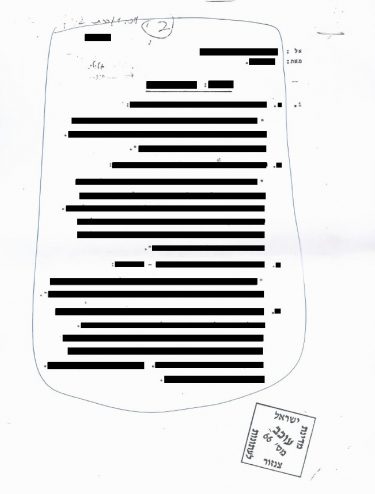
The state archivist’s impassioned plea was nonetheless ignored, and the government committee overseeing the release of classified files blocked its publication for a further five years on unarticulated grounds — however, ministers did not restrict citizens from viewing the report ‘in-the-flesh’ at the Israeli archives. As a result, Akevot Institute researchers located and digitized a copy of the Riftin Report stored at the Yad Tabenkin Archives and prepared to publish it on their website, submitting its version to the Israeli Military Censor for review in November 2017. Several months later, they received a response.
“After Akevot issued a letter demanding the Censor give its decision within seven days, Akevot was provided with a copy of the report with each of the pages circled and stamped with the word “on hold”, in other words, barred from publication pending the final decision of the Military Censorship [committee]. Despite several reminders, for the past eight months, the [committee] has yet to provide a decision whether to allow the publication of this March 1948 document,” the group writes.
For the organization, the Riftin Report saga is a palpable microcosm of the wider issue of Israeli government determination to suppress archival material implicating the state in atrocities carried out against civilians when the country was in its infancy. For instance, the Military Court of Appeals is currently reviewing a historian’s request to declassify files relating to the 1956 Kafr Qasim massacre — an application steadfastly opposed by the Ministry of Foreign Affairs, Israeli Military Censor, and IDF Information Security Department. Authorities likewise repeatedly blocked attempts to declassify files related to the 1948 Deir Yassin massacre, although ultimately settled for publishing heavily redacted versions due to public pressure. … continue
What’s Happening in Nicaragua?
Task Force on the Americas | July 1, 2018
For over two decades, Nicaragua was:
The safest country in Latin America.[2]Its police force was internationally recognized for its innovative community policing policies. Unlike its neighbors El Salvador, Honduras, and Guatemala, where undocumented immigrants were fleeing to the US border, Nicaragua had kept gang violence and organized drug cartels in check.
Far from a dictatorship.[3] President Daniel Ortega was democratically elected and then twice re-elected, each time with an increasing percentage and number of votes.In 2017, polls showed he had the highest approval rating of any chief of state in the entire hemisphere.[4]
Where social indices were on the rise. [5]Literacy, small businesses promotion, free public education, poverty reduction, and economic growth were among the highest in the hemisphere.[6]
Then on April 18 things suddenly changed dramatically. Triggered by a minor adjustment to the social security program, which was designed to avoid austerity measures promoted by big business and the International Monetary Fund (IMF), violence broke out across Nicaragua.[7]
Incongruously, the opposition was led by students from private universities, who had little material interest in old age pensions, and by rightwing elements that favored draconian cuts in social welfare programs.[8]Despite the government rescinding the adjustment and its attempts to meet with the opposition and negotiate a settlement,[9]the violence has escalated with a death toll of over 200.[10]
Road blocks have been set up on vital streets and highways throughout the country. They are forcefully maintained by young militants, with reports that many are paid.[11]Organized crime, aligned with the violent protests, has infiltrated Nicaragua.[12]Some believe the extreme opposition is intent on escalating the conflict to paralyze or overthrow the elected government.[13]
This is within the larger context the US government targeting[14]independent and progressive governments for regime change.[15]Nicaragua is allied with Cuba, Venezuela, and Bolivia and has not served as a client state to the dictates of Washington.
The US has poured millions into Nicaraguan private non-governmental organizations (NGOs) in what is called “democracy promotion” but may be better understood as regime change training.[16]Even sources hostile to the Ortega government admit US involvement in the current unrest.[17]Meanwhile the US Senate is considering the NICA Act designed to cripple the Nicaraguan economy.
The Task Force on the Americas:
Recognizes the Nicaraguan people may have legitimate grievances with their elected government. But the rightwing attack is on what the Sandinistas have done right, not what they’ve done wrong.
Believes there is a huge amount of distortion and misinformation in how the situation is being portrayed.
Supports an objective and independent investigation of who carried out and who provoked the violence [18] with all parties held responsible for their actions. [19]
Commends efforts to mediate a peaceful settlement in Nicaragua, including dismantling the barricades and cessation of destruction of public property. [20]
Opposes the NICA Act and US interference [21] in the internal affairs of Nicaragua including through the NED, [22] USAID, and other instruments of intervention.
NOTES and SOURCES
[1]The Task Force on the Americas is a 32-year-old anti-imperialist human rights organization. http://taskforceamericas.org/
[2]How Central America’s poorest country became one of its safest. 01/28/12. https://www.economist.com/the-americas/2012/01/28/a-surprising-safe-haven
[3]Pérez, Foundations of Democracy,06/25/18. http://www.redvolucion.net/2018/06/25/cimientos-de-la-democracia/
[4]Nicaraguan President Daniel Ortega at 80% approval rate, 10/11/17. https://www.telesurtv.net/english/news/Nicaraguan-President-Daniel-Ortega-at-80-Aproval-Rating-Poll-20171019-0008.html
[5]Di Fabio, Economic growth in Nicaragua has helped reduce poverty, 04/18. https://borgenproject.org/economic-growth-in-nicaragua-helped-reduce-poverty/
[6]The World Bank on Nicaragua, 04/16/18. http://www.worldbank.org/en/country/nicaragua/overview
[7]The reform of the social security system and the interest groups of Nicaragua,04/25/18. http://www.celag.org/la-reforma-del-sistema-seguridad-social-y-los-grupos-de-interes-en-nicaragua/
[8]Fernandez, A Nicaragua spring or an imperial spring cleaning. 05/07/18. https://www.aljazeera.com/indepth/opinion/nicaraguan-spring-imperial-spring-cleaning-180507082508249.html
[9]Tricker, Update on Nicaragua: the national dialogue is back on…for now.06/22/18. https://quixote.org/update-on-nicaragua-the-national-dialogue-is-back-on-for-now/
[10]Perry, After 2 months of unrest, Nicaragua is at a fateful crossroads, 06/22/18. https:/ /www.thenation.com/article/two-months-unrest-nicaragua-fateful-crossroad/
[11]Kovalik, The US, Nicaragua and the continuing counter-revolutionary war.06/27/18. https://ahtribune.com/world/americas/2316-us-nicaragua.html
[12]Violencia armada en Nicaragua: un product importado (investigación), 06/24/18.http://misionverdad.com/trama-global/violencia-armada-y-paracriminal-exportada-a-nicaragua-investigacion
[13]Tortilla con Sal, Nicaragua’s crisis – the latest stage in a permanent war, 06/17/18.https://www.telesurtv.net/english/opinion/Nicaraguas-Crisis—the-Latest-Stage-in-a-Permanent-War-20180617-0021.html
[14]Kovalik, The US & Nicaragua: a case study in historic amnesia and blindness. 06/15/18. https://www.counterpunch.org/2018/06/15/the-us-nicaragua-a-case-study-in-historical-amnesia-blindness/
[15]Chossudovsky, Social media and the destabilization of Cuba,04/05/14. https://www.globalresearch.ca/social-media-and-the-destabilization-of-cuba-usaids-secret-cuban-twitter-intended-to-stir-unrest/5376720
[16]Blumenthal & Norton, US gov’t regime change machine exacerbates Nicaragua’s violent protests,06/2/18. https://therealnews.com/stories/us-govt-regime-change-machine-fuels-nicaraguas-violent-right-wing-insurgency
[17]Waddell, Laying the groundwork for change: a closer look at the U.S. role in Nicaragua’s social unrest. 05/01/18. https://theglobalamericans.org/2018/05/laying-groundwork-change-closer-look-u-s-role-nicaraguas-social-unrest/
[18]Sweeney, Right-wing militias committing ‘acts of terrorism’ in an effort to destabilize Nicaragua, police say,06/111/18. https://www.morningstaronline.co.uk/article/f-lead-nicaraguan-acts-terrorism
[19]Kaufman, Let’s think about the consequences of our actions. 06/06/18. https://afgj.org/nicanotes-lets-think-about-the-consequences-of-our-actions
[20]Mejia, Open letter to Amnesty International on Nicaragua from a former Amnesty International Prisoner of Conscience. 06/15/18.https://www.counterpunch.org/2018/06/15/open-letter-to-amnesty-international-on-nicaragua-from-a-former-amnesty-international-prisoner-of-conscience/
[21]Blumenthal, U.S. gov. meddling machine boasts of ‘laying the groundwork for insurrection’ in Nicaragua.06/19/18. https://grayzoneproject.com/2018/06/19/ned-nicaragua-protests-us-government/
[22]Tricker, Manufacturing dissent: the N.E.D., oppositionmedia and the political crisis in Nicaragua, 05/11/18. https://quixote.org/manufacturing-dissent-the-n-e-d-opposition-media-and-the-political-crisis-in-nicaragua/
Iran Foreign Ministry dismisses US implicating of Iranian embassies in terror acts
Press TV – July 11, 2018
Iran’s Foreign Ministry Spokesman Bahram Qassemi has dismissed as ludicrous a recent US allegation that Iranian embassies are involved in terror attacks in Europe.
Qassemi on Wednesday rejected the allegation by US Secretary of State Mike Pompeo as baseless, preposterous and part of a targeted propaganda campaign and psychological warfare against the activities of the Iranian embassies, which he said were in line with international conventions and aimed at promoting bilateral friendly relations with other countries.
Qassemi said that bringing up such allegations was “another attempt by the United States to destroy our country’s foreign relations.”
Pompeo on Tuesday accused Iran of using its embassies to plot terrorist attacks in Europe.
“Just this past week there were Iranians arrested in Europe who were preparing to conduct a terror plot in Paris, France. We have seen this malign behavior in Europe,” Pompeo said in an interview with Sky News Arabia during a short trip to the United Arab Emirates.
“Pompeo levels such groundless claims against our country while different types of evidence of spying and acts of sabotage by the American embassies with hundreds of military and security personnel [involved]… have been published in various sources, and contemporary history is full of such types of illegitimate activities which are in contravention of international regulations,” Qassemi said.
This came after Belgian authorities claimed earlier this month that an Iranian diplomat had been arrested along with a 38-year-old man and a 33-year-old woman, suspected of plotting a bomb attack on a meeting of the notorious anti-Iran terrorist group the Mujahedin-e Khalq Organization (MKO) in the French capital Paris. The meeting was attended by US President Donald Trump’s lawyer, Rudy Giuliani, and several former European and Arab ministers.
The authorities added that Belgian police had intercepted the two suspects in Belgium on June 30 with 500 grams of the homemade explosive TATP and a detonation device found in their car.
The diplomat, 46-year-old Assadollah A, was arrested in Germany, suspected of having been in contact with the two arrested in Belgium.
Three other people were also arrested in France in connection with the case, two of whom were released.
Iranian officials have denied any involvement in any plot to blow up the MKO meeting and Foreign Minister Mohammad Javad Zarif has condemned the arrests as a “sinister false flag ploy.”
The allegations about the involvement of the Iranian diplomat in the suspected bomb attack on the MKO meeting were designed as Iranian President Hassan Rouhani paid a visit to Switzerland and Vienna and held talks with senior officials of the two European countries.
The Iranian Foreign Ministry said the allegations aimed to damage Iran-Europe relations during the visit.
It’s the Wrong Park! How the Ducks Raise Some Serious Questions in the Salisbury Poisonings

By Rob Slane | The Blog Mire | July 11, 2018
According to the Metropolitan Police investigation into the poisoning of Sergei and Yulia Skripal, here is a timeline of events on 4th March:
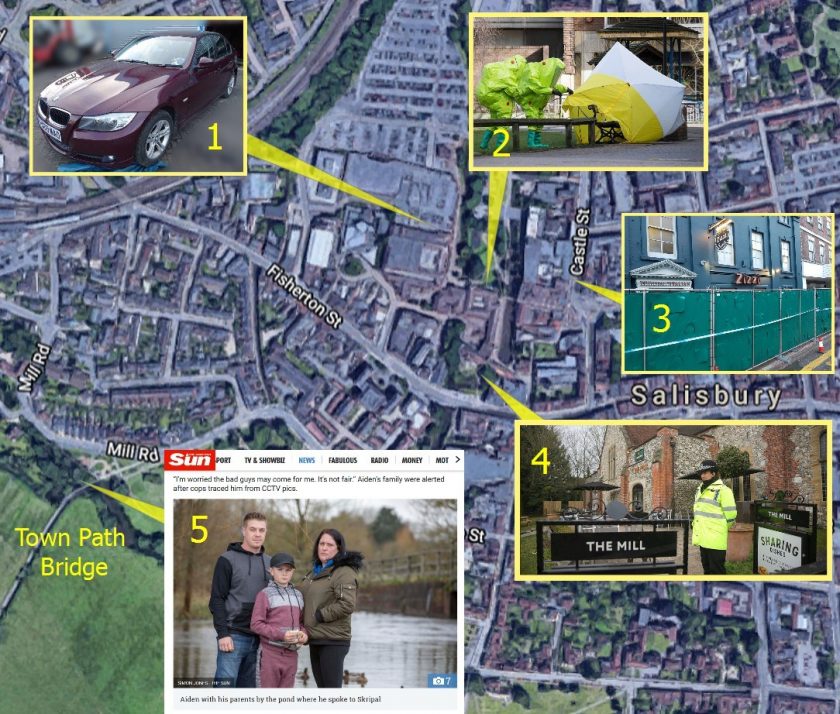
13:40: Sergei and Yulia arrived at the Sainsbury’s upper level car park in The Maltings. The pair go to The Mill pub.
Approximately 14.20: They eat at Zizzi restaurant on Castle Street
15:35: They leave the restaurant
16:15: Emergency services are called by a member of the public to the bench where Sergei and Yulia are slumped on a bench
So: car park, pub, restaurant, bench. Simples? Not so, as we shall see.
On 28th March, an article appeared in the Sun, which talked about a 12-year-old boy from Salisbury, Aiden Cooper, who was apparently in a park with his parents, when he saw the Skripals and went over to them to feed the ducks:
“A schoolboy told yesterday how he was caught up in the poison spy drama after assassination target Sergei Skripal gave him bread to feed ducks. Aiden Cooper, 12, was playing in a park with pals when they saw Skripal and daughter Yulia beside a stream. They were handed bread and are among the last people to have had contact with the retired Russian military intelligence colonel, now fighting for his life.“
Of course, I would always want to have a large bucket of salt on standby when reading anything in The Sun, but in this case I see no reason why they, or the people quoted in the article, would make this up. In any case, the story was repeated in a number of other outlets (The Mirror, The Mail and Metro for instance), and it mentions that the parents only found out about the identity of the breadman when they were contacted by police.
Now, the interesting thing about The Mirror, The Mail and Metro pieces is that they are all either very wrong or very vague about a quite crucial detail. The Mirror and The Mail both tell us that the incident took place “near the Avon Playground”. And Metro tells us that the incident took place at “Riverside Park”.
For those of you not familiar with Salisbury, let me shed some light. The Avon Playground mentioned by The Mirror and The Mail is next to the Avon River, and it is also about 50 yards or so from the bench where the Skripals were found (as an aside, this is not the same Avon as in Stratford-upon-Avon. Avon is a Celtic word meaning river). As for Riverside Park mentioned by Metro, this may be a figment of their imagination, as no such named park exists in Salisbury. But the important point is that from the details given in these articles, nobody would think anything other than that the duck-feeding incident took place in the same park as the bench on which the Skripals were found.
Yet all three of these media outlets are wrong, and in a way that may well be very significant. Turning back to the report in The Sun, we find that it is by far the most detailed of all the reports on the duck incident. In fact, it appeared three days after the others appeared, with The Sun sending a reporter to interview the boy and his parents. Here is a snippet:
“Aiden and his pals are thought to be the youngest of 130 exposed to the nerve agent Novichok, said to have been unleashed in Salisbury by President Vladimir Putin…
Aiden’s family were alerted after cops traced him from CCTV pics.
Aiden’s civil engineer dad Luke, 33, said: ‘Obviously we had seen the incident on the news but didn’t think we were involved at all. Aiden was playing in the park with his friends when they spotted the Russian gentleman and his daughter. Kids being kids they went over and he gave them some bread and they fed the ducks. We didn’t think anything of it until two weeks later when then the police knocked on our door.’
It was terrifying. We took Aiden to hospital for a load of tests and then the police told us they had to burn everything Aiden was wearing that day.’”
So presumably, Aiden and his friends were seen on camera, as was Sergei Skripal and possibly Yulia, and this was on 4th March. We aren’t told when in the day this was, but given that the police traced the family, and Aiden then had to go to hospital, it clearly must have been after the police claim Mr Skripal came into contact with nerve agent on his door handle.
But here’s the significant fact (I am indebted to a lady who contacted me to point it out, and I must say I kicked myself for not having realised it before). Unlike the media outlets mentioned above, The Sun doesn’t mention the name of the park, but the piece is accompanied by four photographs of Aiden with his parents in the park where they saw the Skripals, and indeed one of them has the caption “Aiden with his parents by the pond where he spoke to Skripal”. Here is one of the pictures:

But do you know something? This isn’t the Avon Playground. It isn’t even the non-existent Riverside Park. Do you want to know where it is? It happens to be Queen Elizabeth Gardens.
Why is this important? As you are probably aware, Queen Elizabeth Gardens is now a focal point of Skripal 2.0, as it is alleged to be the place where Dawn Sturgess, who has now sadly passed away, picked up a syringe or a container with the toxic substance in. And whilst I’m not entirely sure whether the location of the duck incident being in Queen Elizabeth Gardens, rather than the Avon Playground, has any bearing in terms of the cases themselves, it does raise three huge questions:
Firstly, according to the Metropolitan Police timeline at the top of this piece, there is no mention of Mr Skripal and Yulia going to Queen Elizabeth Gardens. Why is this, since according to the parents of Aiden Cooper, the police knew that they had been there, having seen footage of them feeding the ducks with their son and his friends?
Secondly, if the police knew that Mr Skripal and Yulia had been in Queen Elizabeth Gardens, and that this was after they were poisoned (as they claim), why was Queen Elizabeth Gardens not closed off immediately and subject to a clean-up operation, as were other places in the City where the Skripals were known to have visited?
Thirdly, assuming the latest official narrative, did the failure to close off and clean up Queen Elizabeth Gardens back in March, when it was known the Skripals had been there, make it more or less likely that someone would come into contact with the alleged nerve agent container at some point?
These are serious questions. I think you’ll agree that they deserve serious answers.
POSTSCRIPT
One or two comments suggest that a map would be helpful. Again, I am indebted to the lady who pointed the Queen Elizabeth Gardens connection out to me, who has helpfully created a map with the main areas of interest (see below).
Can I just caution about one thing though. The point of my post was not to try and work out whether Queen Elizabeth Gardens is important as regards the original case. I think we could go down endless rabbit holes trying to work out where the Skripals went, when they went there, and what this might mean. Unfortunately, we simply do not know this, as there is too much information that we are not party to.
What I am trying to do at the moment is exploit holes in the official story (of which there are more than a few). The police have not included QEG in their timeline, and yet they apparently know that the Skripals were there that day. Why have they not included it? Why did they not close the Gardens down? And had they done so, could this have prevented others from coming into contact with the substance?
I am not saying that I necessarily think there was a substance there. There may or may not have been. However, the point is that the authorities are saying this and yet those same authorities apparently know that the Skripals were there on 4th March, but have hushed this up. Therefore, we need to turn up the volume on it and they need to explain themselves.
British Collusion and Criminality
By Margaret Kimberly | Black Agenda Report | July 11, 2018
Most people believe that Donald Trump owes his presidency to Russian activity because they have been told this repeatedly for the past two years. There was indeed high level collusion taking place in the 2016 presidential campaign but it wasn’t carried out by Trump. It was Hillary Clinton and the Democratic National Committee who acted in concert with intelligence assets in the United States and in the United Kingdom. The British government continues to manufacture false flag incidents, force international agencies to do its bidding, and push for regime change in Syria. Having failed to defeat Trump, they kept up the campaign to cover their tracks, escape blame for Hillary Clinton’s failure, and maintain the foreign policy status quo.
A law firm retained by the Democratic National Committee paid for the opposition research undertaken by former MI6 agent, Christopher Steele. Steele produced a dossier alleging that Trump was compromised by the Russian government and shopped it to the FBI, CIA, influential journalists and politicians like Senator John McCain. The dossier was used to obtain a FISA surveillance warrant against Trump aide Carter Page but the DNC connection was not disclosed to the judge.
Steele isn’t the only British spook in the story. A man named Richard Dearlove, former head of MI6, is a business partner of Stefan Halper, a CIA asset who also spied on Donald Trump. Halper had contacts with Page and George Papadopoulos, two men now under indictment by Robert Mueller’s special investigation. The lesser lights of the Trump team were no match for seasoned professionals who get protection from the New York Times. The Times calls Halper “an FBI informant” and tries to claim that is somehow different from being a spy.
While Russia is vilified at every turn the British government conducts very public and very shady business which could conceivably impact both countries. The case of former Russian double agent Sergei Skripal has the British government’s finger prints all over it. There is no reason for Russia to poison a former spy whom they had swapped eight years earlier. The only logical conclusion is that the act was carried out with the goal of embarrassing Vladimir Putin and creating a possible pretext for war. The Skripal case was soon followed by questionable reporting of yet another chemical weapons attack in Syria which resulted in a short lived United States, British and French attack on that country.
It is the British who use lies and trickery to sway public opinion into supporting a wider war in Syria. Three months after the Skripals were attacked another pair of Britons are said to have been poisoned with Novichok, a chemical weapon originally produced by Russia but which now can be made anywhere. One of the victims died and the claims of Russian involvement have suddenly become much more dangerous.
This second poisoning took place less than one week after the UK pressured the Organization for the Prohibition of Chemical Weapons (OPCW) to take on the role of judge and juror. No longer will the OPCW just determine if chemical weapons have been used, but they will also be tasked with assigning blame, too. Foreign Secretary Boris Johnson proudly stated, “The U.K. has led the diplomatic efforts to secure this action.”
Collusion continues not between Trump and Russians, but between intelligence agencies, the media and American politicians with hidden agendas. While the public are fed a steady diet of tales of an unfree press in Russia, it is the British press which has been censored by its government. A Defence and Security Media Advisory Notice (D Notice) has been issued which prevents them from reporting fully on the Skripal case. Most Americans are unaware that the British government may prevent the media from reporting on any subject or person they choose. The person being protected now may be a man named Pablo Miller.
Miller was Skripal’s MI6 handler and was also employed at Christopher Steele’s firm Orbis. Miller and Steele may have involved Skripal in writing the anti-Trump dossier. While Americans are given endless misinformation making Russia look like the foreign interloper in their nation’s affairs it is actually the British deep state that is well connected to American media and politicians.
The Russiagate purveyors constantly say, “Connect the dots.” If there are any dots to connect they run from the DNC to former MI6 spies to CIA assets to Russian double agents to American intelligence to alleged chemical weapons attacks used to justify war or to stop the upcoming Trump and Putin summit. It is all being used to further the now obligatory anti-Russian propaganda that is pervasive on both sides of the Atlantic.
Anti-Russia sentiment has been stoked for two years straight and with expert precision. Any counter narratives have been obscured with equal precision. Honest discourse is now nearly impossible and the likelihood of public support for anything up to and including hot war between nuclear powers has increased. The world is a more dangerous place but not because of Russia. As always the United States and its allies are the cause of turmoil. This time they may have created dangers that they are unable to contain.
Margaret Kimberley’s Freedom Rider column appears weekly in BAR, and is widely reprinted elsewhere. Ms. Kimberley can be reached via e-Mail at Margaret.Kimberley(at)BlackAgendaReport.com.
The Two Conflicting Histories of the King Assassination
By Bill Willers | Dissident Voice | July 10, 2018
There are now in the public sphere two totally contradictory narratives of the assassination in 1968 of Martin Luther King, Jr. with each being advanced again and again over the years by respective advocates as if the other did not exist.
Attorney William Pepper, confidant of Martin Luther King, Jr., became convinced in 1978 that James Earl Ray, the officially declared lone gunman, was innocent. Years of investigation led to his 1995 book, Orders to Kill, in which Pepper presented evidence of governmental involvement in the assassination. Three years later, Gerald Posner, already famous for his support for the Warren Commission’s report concerning President Kennedy’s assassination, published Killing the Dream, a defense of the official governmental contention that Ray was the assassin. The King Family also believed Ray innocent, but due to governmental refusal to pursue a criminal trial, there was instead a 1999 civil trial, The King Family vs. Loyd Jowers et al. Jowers, who had admitted having received the rifle actually used in the shooting, was granted immunity to reveal all he knew. All facets of news media boycotted the trial, arguably the de facto “Trial of the Century”.
History A
The trial brought together three decades of accumulated information, much for the first time. James Earl Ray was shown as set up to take blame for the killing. Some Memphis policemen had met in Jim’s Grill, where Jowers worked, while planning the assassination. The fatal shot, rather than fired by Ray from a rooming house, as officially reported, was seen by eyewitnesses to have come from a brushy area across the street from the Lorraine Motel. Police units near the Lorraine were called away prior to the shooting, as were the “Invaders”, a gang being lodged at the Lorraine while coordinating with King on the planned sanitation worker’s strike. Inexplicably, within hours following the assassination the brushy area was cut to the ground by the city. Many witnesses were not interviewed, and those with accounts at odds with the governmental explanation were ignored.
The 30-06 rifle presented as the murder weapon had actually been discovered next to a shop door wrapped in a bedspread ten minutes before the shooting. Moreover, it had not been sighted in so could not have hit at point of aim, and bullets found with it did not match the bullet taken from King’s body. The bathroom from which Ray is supposed to have fired was seen by a witness to be empty at the time of the shooting, and observers saw Ray drive away from the area a quarter hour before the shooting. Jowers, who worked at Jim’s Grill, adjacent to the brushy area, was handed a still smoking rifle after the shot was fired, which rifle he hid until giving it the following day to a collaborator to throw into the Mississippi river.
US Army Intelligence maintained surveillance on King, who had become a problem for the Federal Government through his opposition to the Vietnam War and for his plans for a Poor People’s Campaign aimed at obstructing governmental function. Army photographers, positioned on a roof near the Lorraine, photographed the shooter lowering his rifle and departing the brushy area. There were multiple military snipers as backup shooters if needed. Elements of the military, CIA, FBI, Alabama National Guard, Memphis Police, and the Mafia were identified as components of a carefully organized conspiracy.
The trial ended with the jury unanimous in finding that King had been assassinated not by James Earl Ray but by means of a conspiracy involving Jowers (30%) and “others including governmental agencies” (70%). Although the trial did not make the news, a Washington Post editorial (December 12, 1999, pg B08) stated “The more quickly and completely this jury’s discredited verdict is forgotten, the better”. (Note: That editorial is apparently no longer available in the Post’s online archive). In 2003, Pepper published An Act Of State, a book detailing the court’s findings.
History B
In 2010, writer Hampton Sides published Hellhound On His Trail, like Gerald Posner’s 1998 book an elaboration of the official governmental report portraying James Earl Ray as lone assassin. Sides described movements of King and Ray during days leading up to King’s killing on April 4, 1968 and of the ensuing hunt by the authorities for Ray. In minute-by-minute detail, Sides has Ray, a racist interested in a reported bounty, following King to Memphis and renting a room in a boarding house with a clear view of the balcony outside King’s Lorraine Motel room. With King in view, Ray rests a recently purchased, scoped 30-06 on the bathroom windowsill and fires, mortally wounding King. Ray then wraps rifle and other items in a bedspread, runs from the building and, seeing police within view of his car, ditches the suspicious looking bundle next to a shop door. He then departs and is on the run until his arrest.
Meanwhile, King was hurried to ER at Catholic-run St. Joseph’s hospital, where Drs. Ted Galyon and Rufus Brown attended him. Shortly, others, including various specialists, entered. Ralph Abernathy remained in the room along with Reverend Bernard Lee. At 7:05 PM King was pronounced dead by Dr. Jerome Basso, who closed King’s eyes. The bullet found in King is reported by Sides to be consistent with ammunition purchased by Ray and found with his rifle.
Although Sides claims to have explored all available sources of data, including “court proceedings”, declares that he “drew from a wealth of memoirs written by the King Family”, and lists the King Center in his bibliography, there is mention neither of the 1999 trial nor of William Pepper’s two books, published years earlier than his 2010 book. However, and despite years of media censorship, awareness of both the trial and of Pepper’s books had spread by 2010, so one must conclude that Sides’ omissions were deliberate. The evasion of such a quantity of opposing information is fatal to Hellhound On His Trail as an objective history.
Nevertheless, in 2010, the same year as the release of Hellhound On His Trail, the PBS television program “American Experience” aired Roads to Memphis, a documentary film described as “the entwined stories of assassin James Earl Ray and his target, Dr. Martin Luther King, Jr.” The film, for which Sides was historical consultant, was based on his book and featured commentary by Sides himself, as well as by author Gerald Posner, an established supporter of the official governmental account. As the book, so the film, in that there was no mention of either the trial or of Pepper’s books. Like Hellhound On His Trail, Roads to Memphis serves as forceful support for the Government’s narrative.
2016: Pepper’s Magnum Opus
William Pepper published The Plot To Kill King, a 770-page detailed summation of the Government’s role in the killing with new material gathered since his 2003 book. Here, Pepper traced the long-term strategy to bring both King and Ray to Memphis. Half of the book consists of appendices revealing military, CIA, FBI, Memphis police and Mafia involvement in the assassination and supportive of Ray’s innocence. The claim by attorney Percy Foreman that he had never pressured his client into a rash, untimely guilty plea is shown to be a lie by a letter from Foreman in which he offers Ray money “… contingent upon the plea of guilty and … without any unseemly conduct on your part in court.” There is a photocopy of the letter in the book’s appendix.
Pepper writes, “At Hoover’s request, James [Earl Ray] had been profiled as a potential scapegoat.” Clyde Tolson, Hoover’s deputy at the FBI, and shown by Pepper to be a central figure in the conspiracy, paid a prison official to engineer Ray’s escape from a prison, so that this designated patsy could thereafter be managed by another conspirator, Raul Coelho, who would then guide Ray to Memphis. Tolson distributed cash, some of which apparently made its way to Jesse Jackson. Jackson, along with others within King’s group, is depicted as an informant paid by the FBI to relay information on King. There is also a report that it was Jackson who had King’s room changed from the ground floor of the Lorraine to the more exposed second floor with its open balcony, and who ordered the Invaders away from the Lorraine shortly before the shooting. Pepper claims that evidence indicates the actual shooter to have been Memphis Police sharpshooter Frank Strausser.
Mortally wounded, King was taken to St. Joseph’s Hospital where, surprisingly, “a large presence” of military intelligence officers had taken positions well before the shot was fired. More surprisingly, the hospital’s head surgeon, Breen Bland, accompanied by two men in suits, entered the hospital room in which King was being attended by medical staff. Bland is quoted as shouting, “Stop working on the nigger and let him die” and then ordering everyone out of the room. Personnel hearing the sound of men clearing their throats lingered behind and reported seeing Bland and his two accomplices spit on King, after which Bland smothered King to death with a pillow (Note: Pepper describes this in a 2017 lecture, here on Vimeo).
2118: PBS Takes a Stand
In the spring of 2018 there were multiple airings on the PBS program “American Experience” of Hampton Sides’ 2010 film Roads to Memphis. This is renewed reinforcement by PBS of the Government’s depiction of James Earl Ray as lone assassin and an excellent illustration of how televised media can function as servant of the State.
Sides’ contention that he drew from memoirs of the King Family as part of his thorough research is at odds with a filmed interview by ABC of the entire King Family. From dialogue, as well as from the youth of the family members, it is clear the interview was pre-1999 Trial (Note: The link indicated is to a 2-hour piece available, at the time of this writing, on YouTube. Start at 1:03 for the 5-minute segment of the King Family interview). In it, Dexter King states, “Evidence I’ve seen or heard will vindicate or exonerate James Earl Ray”. When asked who was behind the assassination, Dexter continues, “I am told that it was part-and-parcel Army Intelligence, CIA, FBI”. When the interviewer says, “This is a staggering idea to carry around”, Dexter answers, with a short derisive laugh, “I think we knew it all along. It’s why we’re not, like, jumping out of our seats, because we’ve known for years.” How on earth could Sides (or Posner) have overlooked such as that?
Although the keepers of the nation’s information gates have striven to bury the results of William Pepper’s four decade quest for the truth of King’s death, millions by now have been exposed to the fact that two opposing explanations of King’s murder continue to exist. Theologian James Douglass, who attended the 1999 trial, later wrote an article in which he stated:
The Memphis trial has opened wide the door to our assassination politics. Anyone who walks through it is faced by an either/or: to declare naked either the empire or oneself.
Bill Willers is an emeritus professor of biology, University of Wisconsin at Oshkosh. He is founder of the Superior Wilderness Action Network and editor of Learning to Listen to the Land, and Unmanaged Landscapes, both from Island Press. He can be contacted at willer@uwosh.edu.
The Persecution of Rafael Correa
By Joe Emersberger | CounterPunch | July 9, 2018
An Ecuadorean judge has issued an arrest order for former President Rafael Correa. Correa is accused of having masterminded an attempted kidnapping of the right wing former legislator, Fernando Balda, in 2012. Balda was in Colombia at the time evading a prison sentence in Ecuador for libel. The kidnapping was foiled within a few hours by Colombian police and the perpetrators were captured. Months later, Balda was deported to Ecuador where he served two years in jail.
As explained in other pieces for CounterPunch (here, here, and here) in 2017 Lenin Moreno was elected on a platform of continuing the policies of his left wing predecessor, Correa, who was first elected in 2006. Immediately after taking office, Moreno shifted very hard to the right and has therefore made it his main priority to accuse the government he was part of for ten years of being corrupt.
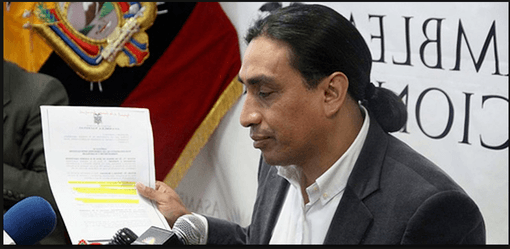
A week before the arrest order for Correa, I spoke with Virgilio Hernandez who was a member of the National Assembly while Correa was in office. Part of the interview was updated after the arrest order came out. A key point Hernandez makes is that the “Transitional” Citizens Participation Council whose members were hand-picked by President Moreno (details here on the reasons the body is unconstitutional) has sweeping powers over the judiciary and other authorities.
JOE EMERSBERGER: Could you please explain the various legal and constitutional problems with the way Correa is being pursued over the Fernando Balda case?
VIRGILIO HERNANDEZ:The obvious thing about the Balda case is its political functionality, the determined effort to prosecute the former president Rafael Correa for anything at all. The case is in its early stages but the prosecution has already perpetrated a series of irregularities, a series of violations of the institutional norms and of the rule of law that makes it absolutely clear that justice is not their goal. They are not pursuing a credible investigation of the facts. They are basically pursuing political objectives through the prosecution of Rafael Correa on frivolous grounds.
The first irregularity is that, according to our constitution, authorization to prosecute the ex-president should have been received from the National Assembly. In fact, it was requested by Judge Camacho on June 11. Unfortunately, a majority that exists in the assembly is an alliance between the Alianza País party [that Correa and his allies resigned from after they broke with President Moreno] and the Social Cristiano party [right wing legislators] and what did they do? On June 15, they voted through [by simple majority] a resolution saying that the assembly is not competent to respond to the judge’s request. Regrettably, the judge then disregarded her own authority, ignored the Organic Law of the Judicial Function, and followed through with a hearing to move the case forward when what she was supposed to do was demand that the National Assembly comply with her request – to vote on whether or not they authorize the prosecution of former president Rafael Correa [a 2/3 vote in favor is required for the prosecution to proceed]. Here is the first thing that that reveals political animosity, that the rule of law is not respected, that due process and the constitution are not respected.
Second (and this explains a huge blunder that was perpetrated in contextual terms) one must understand why the prosecution of the former president had to be authorized by the National Assembly. It was because the events to which he is being linked happened while he was president. The law says that for prosecution to proceed presidential immunity must first be removed for events that took place while he was in office. That’s the second irregularity.
A third irregularity is that in general a whole slew of authorities in our country are acting illegally. The acting attorney general was appointed by the “Transitional” Citizens Participation Council that has been overhauling the justice system by appointing interim prosecutors and an interim Judicial Council. The acting prosecutor has not been sworn in before the National Assembly as mandated by the constitution. Their authority is completely illegitimate.
A fourth irregularity is that the arguments used to link Rafael Correa to the Balda’s case [the attempted kidnapping] are utterly weak and confirm that there is a political vendetta being pursued against the former president. Let’s quickly go over those arguments.
First, the simple fact that he was president is used to argue that he was criminally responsible. Criminal responsibility is something very personal. It cannot be established that he has criminal responsibility for all acts perpetrated while he was in office. That’s a legal absurdity.
Second, the former president is linked through hearsay, from what other people have claimed, or by remarks attributed to the ex-president saying he wanted to see Balda (who was a fugitive from Ecuador’s justice system at the time) captured. Balda was also engaged in electronic espionage and a permanent destabilization effort against the government. There is not even anything documented that proves what Correa is claimed to have said about the case. It is all second hand.
Third, there are letters from people who are being prosecuted who say they alerted the former president about a kidnapping attempt, but it has been shown that these letters never reached the hands of the president. It’s another argument that turns out to be completely weak. There were people in government expressing interest in bringing Balda back to Ecuador but through legal processes – by getting him deported from Colombia [which he ultimately was]. In Ecuador, Balda had a criminal sentence to serve. The prosecutor goes after Correa even though the only thing that has been demonstrated is that Balda’s legal deportation from Colombia was being pursued. Moreover, former President Correa wasn’t even pursuing it. That was up to the authorities who were in charge of the internal and external security of the state. It’s another of the prosecutor’s arguments that are easily answered. Then there are a number of details having to do with checks that were issued and testimony by one “Raúl Ch”that are dubious, contradictory and undermine the prosecutor’s case.
In short, the arguments the acting prosecutor is using to pursue former President Rafael Correa are absolutely feeble. The judge disregarded the feebleness of those arguments, but additionally the case should not have even been allowed to proceed [without National Assembly authorization] but what they did next is worse. The judge, when determining pretrial conditions for Correa, established measures beyond what the prosecutor himself requested. The prosecutor requested that as a precautionary measure – given that the former president has collaborated with the investigation – that he appear regularly before the Ecuadorean consulate in Belgium. The judge responded in a very questionable way. First, she asked the acting prosecutor to reformulate his request for precautionary measures when that is the prosecutor’s job. She was clearly looking for the prosecutor to request pre-trial detention by arguing that the consulates do not have the competence to receive a person who appears by court order. This argument the judge made is absolutely false since the Foreign Service Law establishes that the consulates can comply with this kind of order from a judge. The penal code itself states that if a judicial authority establishes provisions, authorities of the state in general have to comply. Judge Camacho’s claim that the Foreign Service Law does not give consulates that capacity is completely cynical. It reveals political animosity.
And when she asked the acting prosecutor to reformulate his request – clearly looking for harsher pre-trial conditions – the persecutor reminded her “You have the authority to set them. This is what the Comprehensive Organic Criminal Code says and therefore, if you so order that the consulates are obliged to accept this order you give them “. In the end the judge ordered that Correa must appear periodically [every 15 days] before a court here in the city of Quito even though it is common knowledge that he lives in Belgium. She made the legally inadequate claim that he has two addresses and therefore must periodically appear Quito. Everyone knows he lives in Belgium as he said repeatedly he was going to move to Belgium [where his wife is from] for several months before he finished his final term as president. The judge set an obvious trap for the former president not to appear and thus have an excuse to order pretrial detention.
JE: On social media I noticed that many of Correa’s detractors were totally enraged that judge Camacho requested National Assembly authorization and called for her to be sacked. Do you think she became more extreme in response to media and other pressures? [Moreno’s handpicked “Transitional” Citizens Participation Council appointed an interim Judicial Council which has announced that it will be evaluating all judges and dismissing those who “fail”.]
VH: All these arbitrary acts are possible because, as Noam Chomsky might say, the media has worked hard to “manufacture consent” for the idea that one way or another Correa must be indicted. It is very clear that the media play a central role. This persecution would not be possible without the big media networks and the use of media power.
Both the actions and the aversion shown by the acting prosecutor and the judge during the bond hearing clearly reveal that there will be no objective handling of the case – and also that the context that we live in Ecuador, when there are authorities that are hand-picked without any constitutional legitimacy by the “Transitional” Citizen Participation Council, sets up a scenario of political persecution. We are without a doubt living through “lawfare” here in Ecuador and it is directed towards Rafael Correa and the main leaders of the Citizens Revolution.
Now, what we feared has in fact happened. Correa appeared at the consulate in Belgium, but the judge ruled that this was a violation of his pre-trial conditions and replaced the order to appear in Quito with an order of pre-trial detention. She did all this in one hearing disregarding a requirement for 72 hours’ notice before changing the pre-trial conditions. Her stated justification for doing that was based on “procedural economy”, but in criminal matters one cannot invoke procedural economy if it violates rights as has now been done with Rafael Correa. All these arbitrary acts against the Citizen Revolution are perpetrated with the complicity of the media whose silence over unconstitutional actions are aimed at ending what they call “correísmo”
JE: There was a news article I read in El Telegrafo (a government run newspaper) that basically argued that prosecuting Correa is fine because former President Jamil Mahuad was also prosecuted (in a case that was initiated years before Correa first took office in 2007).
VH: When the judge asked for authorization to prosecute Rafael Correa, she cited the precedent that had previously been used to prosecute Jamil Mahuad. Authorization had also been requested by the national congress of that time. And although the Congress also said that it was not competent, let’s not forget that this decision was made with 2/3 of its members and not as in this case that is taken by a simple majority.
Mahuad’s defense team has argued that his case be dismissed on those grounds [of not being authorized].
JE: Looks to me like they have a valid argument, not that anyone should defend Mahuad’s disastrous policies.
VH: Yes and in fact and that was cited by the judge herself. The organic code of the judicial function is clear that authorization from the assembly is required in this case. It does not allow the judge to accept, as she did in Correa’s case, that the National Assembly returns her request saying it is inappropriate. According to what our legal regulations say, the National Assembly cannot assess whether or not a request from a competent authority (in this case a judge of the national court) is appropriate. It has to comply with what the judge requested. If that is not done, it violates the autonomy and authority of the judiciary if a judge’s order is disregarded.
JE: Do you think Mahuad’s case should have been halted on these grounds?
VH: I don’t want to go into the details of something that I do not have very clear in my memory. My concern is relating what is happening at this time with the case of former President Rafael Correa.
JE: You were heavily involved with protests by indigenous groups like CONAIE during the 1990s against neoliberal economic policies. I’ve personally noticed since the 2010 coup attempt against Correa that they’ve become quite reactionary. They recently publicly “recognized” Cesar Trujillo, one of Moreno’s key handpicked members of the “Transitional” Council of Citizens Participation.
VH: Since about the end of the 1990s and the beginning of this century I would say what is evident in CONAIE is that a current became dominant that we’d call a “conservative indigenist” current that has put everything into what they call the “ethnic cause” and left aside the causes of social movements and the left in the country. That explains not only what you describe (these tributes to people like Cesar Trujillo) but also that in the last presidential campaign they openly supported the candidate of the oligarchy and the banks, Guillermo Lasso. It is very clear for almost two decades they lost course and have been useful to the oligarchic groups that have always rabidly opposed Rafael Correa and the Citizens Revolution.
JE: How is the new party the movement is working on organizing going to correct the errors that led to people like Lenin Moreno being in positions of leadership?
VH: The first thing we have to do now is to overcome the political blockade. The political persecution we face is seeking to dismantle all the laws and norms of the Citizens Revolution. Second we have administrative persecution that goes through an “acting” comptroller who also works illegally. They persecute many of the leaders of the Citizen Revolution that way. Third, there is a judicial persecution of former President Rafael Correa. The fourth element of persecution that must be identified clearly is the political blockade. So far they are preventing us from being able to organize ourselves politically even though it is a constitutional right. Therefore, before thinking about self-criticism and the mistakes we should not commit, at this moment our main priority is to break the political blockade. We seek legal recognition to be able to participate in the democratic arena. This will allow voters to continue supporting Citizens Revocation against this ongoing persecution we face.
JE: I am going to make a comment and you can tell me if you agree. I would say to Rafael Correa that he not be a martyr, that he seek political asylum so that his voice is not silenced. I think his ability to speak out, even if from afar in a limited way through social media and other venues, is crucial to overcoming the one-sided media landscape Moreno has established inside Ecuador.
VH: Actually, today, in a meeting of the national coordinators the movement – the group of legislators [who remained loyal to Correa] Andean parliamentarians, councilors of the city of Quito and other authorities of the movement – we have asked Rafael Correa not to come to Ecuador. We said conditions for a fair trial do not exist, conditions for due process do not exist and that therefore that he should not come and that he should seek international assistance to protect his security and freedom. We agree with your position and we have publicly expressed one like it.
Dawn Sturgess and the case against Russia
By Craig Murray | July 9, 2018
The terrible death of Dawn Sturgess casts a new shadow over the Salisbury Affair. Dawn appears to have been a popular and well grounded woman with close friend and family ties, whose life had taken a downward turn before being cruelly ended.
The illogical, inconsistent and shifting government narrative over events in Salisbury and Amesbury had appeared so ludicrous as to be tragi-comic. Any sense of amusement is now abruptly dispelled. But less us take a serious and sober look at the government case.
Savid Javid stated today:
We know back in March that it was the Russians. We know it was a barbaric, inhuman act by the Russian state. Again, for this particular incident, we need to learn more and let the police do their work.
Actually, we know no such thing and, contrary to Javid’s deliberate insinuation, the police have adduced no evidence that it was the Russian state.
The media appear to have entirely excluded from the narrative that Porton Down specifically stated that they cannot determine the origin of the poison that attacked the Skripals. Nor has the OPCW. There are scores of both state and non-state actors who could have produced the nerve agent. No evidence has been produced as to the physical person who allegedly administered the poison. In short, nothing so far has been shown which would lead any reasonable person to conclude a case against the Russian state was proven.
I believe that the following is the government narrative currently. I hope I am not mistating it:
Russia has a decade long secret programme of producing and stockpiling novichok nerve agents. It also has been training agents in secret assassination techniques, and British intelligence has a copy of the Russian training manual, which includes instruction on painting nerve agent on doorknobs. The Russians chose to use this assassination programme to target Sergei Skripal, a double agent who had been released from jail in Russia some eight years previously.
Only the Russians can make novichok and only the Russians had a motive to attack the Skripals.
The Russians had been tapping the phone of Yulia Skripal. They decided to attack Sergei Skripal while his daughter was visiting from Moscow. Their trained assassin(s) painted a novichok on the doorknob of the Skripal house in the suburbs of Salisbury. Either before or after the attack, they entered a public place in the centre of Salisbury and left a sealed container of the novichok there.
The Skripals both touched the doorknob and both functioned perfectly normally for at least five hours, even able to eat and drink heartily. Then they were simultaneously and instantaneously struck down by the nerve agent, at a spot in the city centre coincidentally close to where the assassins left a sealed container of the novichok lying around. Even though the nerve agent was eight times more deadly than Sarin or VX, it did not kill the Skripals because it had been on the doorknob and affected by rain.
Detective Sergeant Bailey attended the Skripal house and was also poisoned by the doorknb, but more lightly. None of the other police who attended the house were affected.
Four months later, Charlie Rowley and Dawn Sturgess were rooting about in public parks, possibly looking for cigarette butts, and accidentally came into contact with the sealed container of novichok. They were poisoned and Dawn Sturgess subsequently died.
I am going to leave you to mull over that story yourselves for a while. I believe it is a fair statement of the British government narrative. I also believe almost (but not quite) every single sentence is very obviously untrue. I hope tomorrow to publish a detailed analysis explaining why that is, but want you to look at it yourselves first.
One final thought. I trust that Dawn Sturgess will get a proper and full public inquest in accordance with normal legal process, something which was denied to David Kelly. I suspect that is something the government will seek to delay as long as possible, even indefinitely.
Roads Melt In Oz “Winter Heatwave”!!
By Paul Homewood | Not A Lot Of People Know That | July 8, 2018
This is typical of the garbage we get so often from so called newspapers:
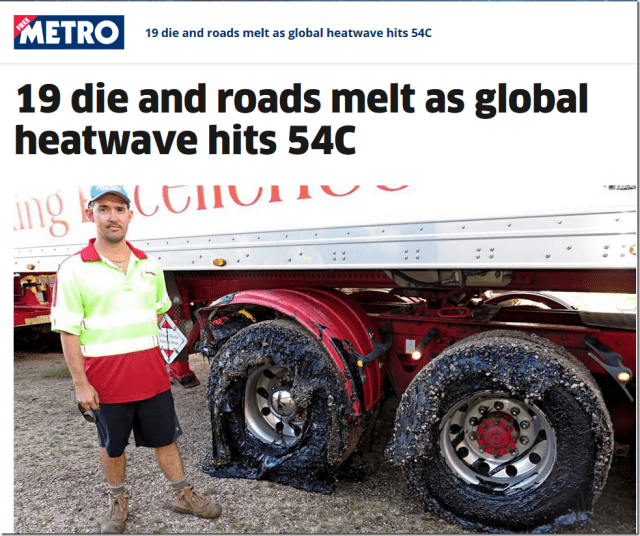
BRITAIN is not alone in experiencing a record-breaking heatwave, with soaring temperatures across the world being blamed for multiple deaths.
Roads have melted in Australia…..
Up to 50 motorists were left with their tyres covered in bitumen that had melted on a stretch of road outside the Australian city of Cairns in northern Queensland. Tablelands regional mayor Joe Paronella said: ‘I have never seen anything like it.’ … Full article
You will probably smell fake news already!
In Australia it just happens to be winter at the moment, and temperatures in July tend to be the lowest of the year.
In the week prior to July 6th, when the Metro article was published, temperatures ranged from 24.2C to 27.7C, perfectly consistent with a monthly mean of 25.8C:

But what about all of that melting tarmac? After all. photos don’t lie!
It turns out it was due to a botched road repair job:
A botched bitumen job on a road in Queensland’s far north has caused chaos, with tyres covered in tar and vehicles having to be abandoned.
Other cars have been damaged by lumps of tar thrown off the tyres of trucks and cars on a stretch of the Millaa Millaa-Malanda Road on the Atherton Tablelands.
Authorities closed the road on Wednesday after more than a dozen motorists had to have tyres replaced after the bitumen lifted.
Vince Whalley, who runs a tyre shop at Malanda, 70 kilometres south of Cairns, told the ABC that damage to vehicles had been significant: “The tar coming off the tyres is knocking bumper bars loose, taking panels out underneath.”
He said one tourist paid $1200 for a new set of tyres.
Motorist Bridget Daley told the ABC her tyres were covered in bitumen, which had also flown off, striking her bumper bar and snapping it off.
“I was absolutely horrified to find that there was [75 millimetres] of bitumen coated around all four wheels of my vehicle,” she said.
“It was like we were insects caught in a spider’s web and we were sinking.
“There were people that were pulled up on the side of the road and they were in total and complete disbelief as to what had happened to their vehicles.”
Another driver posted to social media saying the roads were a disgrace.
“We now have chipped paint and windscreen damage to our brand new car,” Anissa Rasmussen wrote.
“We were stopped by police at Tarzali, 10 kilometres from our destination, because cars were broken down, covered in tar, with it coating their wheels.”
Tablelands Regional Council Mayor Joe Paronella said a change of weather led to the chaos.
“I have never seen anything like it,” he said.
Cr Paronella said a section of the road was repaired by a Main Roads contractor a week ago. There were initial problems when gravel failed to stick to the bitumen.
“We started getting reports in the middle of last week from people getting stones and gravel flying up everywhere,” he said. “We helped with brooms to get the gravel off.”
That was during a period of cold, wet weather. But Deborah Stacey, from nearby Jaggan, told News Corp the problems really started when the weather improved on Wednesday and the bitumen turned to glue.
“We had a week of cracked windscreens, RACQ have been doing three to four a day,” she said.
“Then as soon as the sun came out, it started sticking … There was emulsion everywhere; a lot of soft tar sprayed in big globs and sticking to trucks wheels.”
Small towns, including Jaggan, were isolated while the main road was closed.
Cr Paronella urged those who had been caught up in the issues to contact Main Roads.
“I would certainly be talking to the department about possible compensation,” he said.
A spokesperson for Queensland’s Department of Transport and Main Roads said it was aware of the issues. The road had re-opened, with speed restrictions, after emergency repairs.
Queensland’s Dept of Transport has advised motorists affected to submit claims.
Transport and Main Roads District Director Sandra Burke said about 60 motorists had so far contacted the department seeking compensation for damage caused to their vehicles.
‘The situation is completely unacceptable and I apologise on behalf of the department to all those people whose vehicles were damaged and travel plans disrupted by this extremely unusual event.
We became aware of an issue with about two kilometres of road surface on June 25 and immediately reduced the road speed from 80km/h to 60km/h, swept the road surface and put signs in place.
‘What occurred yesterday will be the subject of a departmental investigation in close consultation with the contractors.
‘We believe recent cold and wet weather followed by a period of warmer conditions combined to destabilise the road surface which effectively became a sticky substance. “
Sandra Burke has missed a trick here though. It would be much cheaper to do what the clowns at the Metro have done, and blame it all on global warming!
Featured Video
Anthrax War – CBC The Passionate Eye
or go to
Aletho News Archives – Video-Images
Book Review
Shattered Dreams: The HPV Vaccine Exposed (2019)
By Christina England – 30 Q&As – Book Review & Summary
Lies are Unbekoming | September 4, 2026
… Gardasil received FDA fast-track approval in 2006, Cervarix followed in 2009, and Gardasil 9 was approved in December 2014 with more than double the aluminium adjuvant content of the original. The commercial context is specific. Merck was about to lose patent protection on Zocor and faced $18 billion in Vioxx injury claims from a cardiovascular drug the company had marketed while suppressing its own data showing a five-times increase in heart attacks. Analysts projected the global HPV vaccine market at $4 billion by 2011, contingent on government-funded national programs for teenage girls. The 1986 National Childhood Vaccine Injury Act had already granted manufacturers complete liability immunity. By 2013, Japan had withdrawn its HPV vaccine recommendation after cataloguing severe adverse reactions in hundreds of girls. No Western government followed. The establishment position across the UK, US, Australia, and most of Europe held, and still holds, that the vaccines are safe and effective, that reported injuries are coincidental, and that cervical cancer prevention justifies the program. The book was published into this position, not against a vacuum.
Shattered Dreams sits alongside Mary Holland’s The HPV Vaccine On Trial and Viera Scheibner’s foundational vaccination work as part of the documented record on what has been done to a generation of teenage girls under the banner of cancer prevention. The full summary unpacks three specific findings: that Merck used the aluminium adjuvant itself as the “placebo” control in 92.5% of trial subjects, making it structurally impossible to detect excess reactions from the adjuvant; that Dr. Sin Hang Lee found HPV DNA fragments bound to aluminium in every one of sixteen Gardasil samples tested, and in the blood and spleen of a New Zealand girl six months after her third dose; and that in every country with high vaccination coverage, including Australia, the UK, Norway, and Sweden, cervical cancer rates have stopped declining and started rising specifically in the vaccinated cohort. Martínez-Lavín’s 2017 calculation puts the number needed to seriously harm with Gardasil 9 at 140, and the number needed to vaccinate to prevent one case at 1,757. Thirteen young women are seriously harmed for every one who benefits. The vaccine was approved on the basis of trials that could not detect what the trials were supposed to detect, and it is still being given to twelve-year-olds today. … Read full review
Blog Roll
 Aletho News
- Georgia’s Largest Healthcare System Will Fire Employees Who Refuse Flu Vaccine
- The Five-Year Fuel Crisis: Why the World Economy Is Paying for a War It Thinks Is Ending
- Trump’s Big Bluff on Iran
- Swiss scammed out of millions by Ukraine-linked call centers – media
- Germany facing potential ‘violent conflict’ with Russia – spy chief
- Ukraine’s EU neighbors reject new plea from Kiev – Politico
- British Transport Police Facial Recognition Trial Scanned 926,912 People With Zero Arrests
- House Bill Would Ban Federal Use of Flock ALPR Data
- Can a Spice Rival a Drug? 10 Head-to-Head Trials Put It to the Test.
- The oil routes around Hormuz face their own chokepoints
- If Americans Knew
- “We See Our Homes Now From A Satellite, Like Strangers”
- Watch “Gaza: Doctors Under Attack”, originally censored by BBC
- NAZA: Israeli embassies in UK and US promote rival documentary to challenge Gaza genocide allegations
- David Ellison appoints Israeli to lead merged Paramount-Warner studios
- Turkish Red Crescent helps elderly Gaza man walk again after Israel confiscates his prosthetic limb
- Four Palestinians Killed in Israeli Attacks in Gaza
- Two Palestinian youths killed and village razed as Israeli attacks on West Bank continue
- Two more Christian women victims of Israeli raids on Gaza
- Cruelty, Deprivation, Indignity: A Journalist’s 22 Months in Israeli Prison
- New IDF Website Frames Slain Gaza Journalists as Terrorists
- No Tricks Zone
- Latest European Green Energy Debacle; Portugal’s Largest Flagship Solar Park Insolvent!
- Green Energy Debacle: German Expert Professor Fritz Vahrenholt Warns Of Severe Economic And Social Consequences
- Two More Paleo Reconstructions Affirm Meters-Higher Sea Levels Across Ireland, Brazil 7000-6000 Years Ago
- New Study: Earth And Venus Surface Warmth Largely Explained By Convection And Lapse Rate, Not CO2 Or Radiation
- 2025 Nature Paper Claiming Worsening Global Drought Gets RETRACTED …Heavily Flawed
- New Study: ‘Global Drought Shows No Detectable Recent Acceleration Under Climate Warming’
- Economic Masterminds: German Socialists Suggest Taxing Productivity Gains Stemming From Using AI
- The South China Sea Has Not Been Cooperating With The Climate Change Narrative
- Energy Crisis: Germany Enters Heating Season With Historically Low Gas Reserve Fill Levels
- New Study: The Antarctic Ice Sheet Gained Mass From 2020-2024 Due To Staggering Snow And Ice Accumulation

