A Brief History of the “Kremlin Trolls”

By Scott Humor | The Saker | October 15, 2018
Saint Petersburg, Savushkina, 55 is the most famous office building in the world, thanks to the relentless promotion of the United States government, the CIA, FBI, and by the powers of the entire Western media, financed by Western governments. VOA, NPR, and Svoboda, by the government of the US; the BBC by the government of the UK; CNN by the governments of Saudi Arabia; the DW, by the government of Germany; and so on and so forth. You name it, they all punched time to promote this office building.
To be specific, it’s not even a building, but several adjoined buildings that cover an entire city block, an urban development plan common for Saint Pete’s. That’s why every business here has the address of Savushkina, 55 followed by a building number. You can take a virtual tour around it, to see for yourself. The buildings are shared by several dozens of private businesses, by the local Police department, and by the newsrooms of half a dozen Russia Media sources like the FAN (Federal News Agency), the Neva News (Nevskie Novosti), Political Russia, Kharkov News Agency, publishing Ukrainian news, and others. They all are privately owned and operated and generate over 55 million unique visitors per month. Overall, several thousand people come to this building to work every morning. But you wouldn’t know this by account of Western media. For over two years now, these people are being harassed and collectively branded as “THE KREMLIN TROLLS.”
The building is very popular because it’s located in a quiet historical neighborhood and is in walking distance from a suburban train station. It’s newly renovated offices offer open floor plans with Scandinavian fleur so very appreciated by the news people. In addition, the rent for this building is less than in center city. Which is why Evgeny Zubarev, a former top editor for the RIA NEWS, choose it for his media startup. He took several offices allowing him to manage his growing media giant without wasting time to commute. Now, the FAN newsroom alone employs about 300 journalists.
This wasn’t always the case.
At the beginning of 2014, the building was still under construction and renovation, when an anti-Russian government group of hackers called first “The Anonymous International” and latter “Shaltay-B0ltay” fingered it as the “Kremlin trolls’ layer.”
Their wordpress blog is still here. It was last updated on November 2016. Its title states: “Anonymous International. Shaltay Boltay/Press Secretary of the group. Creating reality and giving meaning to words.”
November 7, 2014, Khodorkovsky, who acted as an integral part of the CIA “Kremlin trolls” Project, tweeted the picture of one of the entrances to one of the buildings saying: “Savuchkina 55. New home for bots. ID check system. Not a sign there. I won’t say who took the photo.”
Савушкина 55
Новый домик для ботов. Пропускная система. Ни одной вывески. Чье фото – не скажу. pic.twitter.com/oCVUAvSTW4— Ходорковский Михаил (@mich261213) November 7, 2014
Someone commented by saying
Nov 7 2014. The comment reads: “I live there and pass this building on my way to work. The sign on the building says “For Rent”
@tvjihad @mich261213 Михаил, я каждый день мимо проезжаю на работу. и да, чье фото с вывеской не скажу))) pic.twitter.com/FlTEJJwyTt
— Kirill_V (@Kirill_V1) November 7, 2014
The phone number on the picture 324-56-06 belongs to the commercial real estate company Praktis Consulting & Brokerage that managed the rent of offices.
Midsummer 2014, Evgeny Zubarev with his start up and several hundred journalists moved in, along with the Police department, and a slew of other businesses people. Little did they know what was to come.
***
The best way to get information is to make it up.
Everything what we know now about the so-called “Kremlin trolls from the Internet Research Agency paid by Putin’s favorite chef,” came from one source, a group of CIA spies that used the mascot of Shaltay-Boltay, or Humpty-Dumpty, for their collective online persona.
They were arrested in November 2016 and revealed as the FSB and former FSB officers. One of them even managed a security department for the Kaspersky Lab. They all were people highly skilled and educated in manipulating and creating large online databases, in any online research imagined, and the knowledge of hacking and altering databases, including those that were run by the Russian government. They weren’t poor people. They weren’t there for the money. They were ideologically driven. Their hatred towards Russia and its people was the motive for their actions.
At some point, Gazeta.ru, an online Russophobic publication, suggested that “Shaltai-Boltai was just a distraction meant to confuse everybody.” They themselves were more concise by stating that they were working to change the reality.
Russian authorities, the courts, and the lawyers, refused to call these men hackers. There was a reason for this. They weren’t so much hackers in a classic sense, as in when someone gains access to real information and copies it. This group wasn’t necessarily hacking existing information, but planting information. They were creating files about fake nonexistent companies and employees, files with blurry fake paystubs, memos, emails, phone messages and so on. The fakes looked convincing, but they still were forgeries that could be easy disproved for someone who had access to the real information.
That’s when the hacking took place, when the FSB agents went into government databases and created records of people and companies that didn’t exist.
I think that part of the reasons why some of them got the mild sentences of three years in general security prison, and some were left free, wasn’t just the fact that they agreed to collaborate with the Russian government, but also the fact that they didn’t actually steal information from government officials like Medvedev and his press secretary, Nataliya Timakova, or the owner of the largest in Europe catering business, Evgeny Prigozhin. They made information up and claimed that it was real.
These guys gave a bad name to all hackers, whistleblowers, leakers and spies. Now, journalists presented with some “hacked” and leaked secrets has to think it over, less they end up with an egg on their face like journos from the Fontanka, Vedomosti and Novaya Gazeta in case of the “Kremlin’s trolls.”
If we accept that the Shaltay-Boltay group was working to create and distribute documents they forged, claiming that those files were “hacked,” we would also understand a mysterious statement made by them to BuzzFeed.
“In email correspondence with BuzzFeed, a representative of the group claimed they were “not hackers in the classical sense.”
“We are trying to change reality. Reality has indeed begun to change as a result of the appearance of our information in public,” wrote the representative, whose email account is named Shaltai Boltai, which is the Russian for tragic nursery rhyme hero Humpty Dumpty.”
Bazzfeed also said back in 2014, that “The leak from the Internet Research Agency is the first time specific comments under news articles can be directly traced to a Russian campaign.”
Now, this is a very important grave mark.
Just think about this working scheme: Shaltay-Boltay with a group of anti-government “activists” created the “Internet Research Agency,” they and some “activists” created 470 FaceBook accounts used to post comments that looked unmistakably “trollish.”
After that other, CIA affiliated entities, like the entire Western Media, claimed the “Russian interference in the US election.” Finally, the ODNI published a report lacking any evidence in it.
The link to their report is here, but I don’t recommend you to read it. You will gain as much information by reading this report as you would by chewing on some wet newspaper. Ask my dog for details.
Assessing Russian Activities and Intentions in Recent US Elections
https://www.dni.gov/files/documents/ICA_2017_01.pdf
Only three paragraphs are interesting on the page 4:
“Russia used trolls as well as RT as part of its influence efforts to denigrate Secretary Clinton. This effort amplified stories on scandals about Secretary Clinton and the role of WikiLeaks in the election campaign.
The likely financier of the so-called Internet Research Agency of professional trolls located in Saint Petersburg is a close Putin ally with ties to Russian intelligence.
A journalist who is a leading expert on the Internet Research Agency claimed that some social media accounts that appear to be tied to Russia’s professional trolls—because they previously were devoted to supporting Russian actions in Ukraine—started to advocate for President-elect Trump as early as December 2015.”
In other words, in its report with a subtitle: “Background to “Assessing Russian Activities and Intentions in Recent US Elections”: The Analytic Process and Cyber Incident Attribution” the Office of the Director of National Intelligence ODNI, is quoting the Shaltay-Boltay, a group that had been proved to work for the CIA by “creating reality.”
The only reason why they don’t provide us with evidence, with at least one lousy IP address with the Russian trace roots that would convincingly point at the company named the Internet Research Agency, is because this company never existed, it never had any IP addresses assigned to it that would be verifiable via third parties like RIPE network coordination and via online domain tools.
We understand that having hundreds of people working ten to twelve hours a day, as they claimed, posting hundreds messages hourly, would use huge amount of bandwidth. They would need a very fast internet connection with unlimited bandwidth that only a business can get. Inevitably, this internet connection would come with the assigned IP addresses. No internet provider would let this kind of bandwidth hog to create this kind traffic without being forced to separate them from other customers.
One example, a woman with the last name Malcheva filed a lawsuit in court against the companies “Internet Research, LLC” and “TEKA, LLC,” claiming unpaid wages.
The court asked her to produce evidence of her work, and then denied her claim after she produced a photo of a computer with an IP address on its screen as evidence of her employment.
IP Address 109.167.231.85
inetnum: 109.167.231.0 – 109.167.231.255
netname: WESTCALL-NET
descr: S-Peterburg Hotel Corintia Wi-Fi
An IP address that was assigned to a luxury hotel in Saint-Petersburg. A hotel that was awarded multiple international awards for excellence. An immensely popular hotel among discriminating travelers. A very expensive hotel located in the center of a historic city. The woman claimed that she was an “online troll’ working from this location ten hours a day with hundreds of other virtual trolls. The judge didn’t believe her. Would you?
People from the Shaltay-Boltay group weren’t hackers in the proper terms because they worked with and for the CIA. Middle-of the-road and run-of-the-mill intelligence agencies would collect and analyze information for their governments. The CIA invents information, then goes on to manufacture and forge documents in support of their invented information; they then recruit people inside other countries and other governments to claim that they “obtained” this explosive evidence. Being the dirty cops that they are, the CIA doesn’t obtain and secure evidence, but instead they plant fake evidence on their victims.
By this act alone they change our current and past reality, and they change our future. They change our history by forging never existing “proof” of invented myths. They hire and train groups of military men to act as “protesters” around government buildings, while other military men from other countries shoot at unsuspected bystanders whose death allows Washington to claim the sovereign governments’ wrongdoing.
CIA-operated groups arrest and kill government officials or force them to flee, like in Ukraine. They take over a couple of government buildings and declare their victory over a huge country, just like it happened in Russia in 1991 and 1993 and in Ukraine in 2005 and 2014. For some reason, they claim that governments are those people who take over a couple of buildings in one city. When in fact, our countries’ governments are those people whose names we wrote on ballots, regardless of where these people are located. We don’t run around like chickens with our heads cut off electing a new president every time our current president leaves the country.
Going back to the CIA’s Humpty-Dumpty project that came online sometime in 2013. Why would anyone name their enterprise after such predictable failure, you might ask. Because, in the Russian alliteration, Shalti-Boltai means “shake up and brag about it” and not as in its original Carroll’s version of “humping and dumping.”
I went ballistic after someone retweeted me this CNN clip titled “Russia used Pokemon Go to interfere with the US elections.”
I actually listened to the clip itself, in which they brought up the Internet Research Agency” from SP. Knowing full well that the hackers who “leaked” the information about this “Agency” were arrested and successfully charged for treason because they worked for the CIA should prevent the CIA to run fake news about the entities and people they themselves made up. You would think that the matter of the “Kremlin trolls from Saint Petersburg” should be dead and buried after the arrest. The CIA and other 16 intelligence agencies should know better than to use information that is being known now as “discovered’ with their “help.”
Because it’s all fake and we know it.
We also know everything that the CIA touches is fake. Speaking in layman’s term, it’s as if all those middle aged bald guys would start licking their balls while claiming to be in fulfilling relations. If it’s just you, guys, there is no relations. It’s just you. Deal with it!
The American intelligence community cannot claim an existence of threats against America if all fingers in those “threats” are pointing back at the American intelligence community.
By stating that someone interfered with the US election using the Internet Research Agency in SP, is plainly to state that it’s CIA that interfered in the American elections.
—
Let’s just briefly run over the matter, before I tell you what exactly took place.
—
On September 6, 2017, Alex Stamos, a Chief Security Officer, posted a statement titled “An Update On Information Operations On Facebook”:
“In reviewing the ads buys, we have found approximately $100,000 in ad spending from June of 2015 to May of 2017 — associated with roughly 3,000 ads — that was connected to about 470 inauthentic accounts and Pages in violation of our policies. Our analysis suggests these accounts and Pages were affiliated with one another and likely operated out of Russia.”
To make sure that people including myself won’t find those accounts, the FB deleted them.
“We don’t allow inauthentic accounts on Facebook, and as a result, we have since shut down the accounts and Pages we identified that were still active.”
That’s how it’s done in the US. They destroy all potential evidence while laying heavy blame on Russia. Facebook destroys evidence of “Russians crimes” while public ask them to show those evidences. This means only one thing: the pieces of evidence are pointing at something Facebook wants to protect, which is the CIA.
You see, I am not suggesting that they are lying about those accounts being real or that they “affiliated with Russia,” because, if the Shaltay-Boltay group worked with people from the Soros and Khodorkovky-backed group of human rights lawyers “Team 29,” created in February 2015, then their only task, it seems, was to service the psyop of the “Internet Trolls.” It looks to me like they could also coordinated the work done by those 470 FaceBook accounts while being on the territory of Russia. Considering that, it’s not a complete lie for the FB to say that those accounts were “Russia affiliated” and that they were “likely operated from Russia.”
Facebook also can claim with plausible deniability that they are ignorant of the fact that people behind the Internet Research Agency troll hoax are proved by the Russian court to be affiliated with the CIA, while people who have been acting as the “witnesses” to this Project are lawyers from Team 29, “human rights activists and also journalists from the Norwegian Bonnier AB owned Fontanka, Taiwan-based Novaya Gazeta, and the Latvia-based Meduza; these people are factually proven to be backed by Soros, a CIA financial branch, like a journalist who has received an award from Khodorkovsky.
The entire campaign of blaming Russia in “meddling” is being reported without ANY tangible proof that could be verified by at least two independently existing sources, that’s why we should grab ANY grains of information. That’s why Facebook’s statement that “About one-quarter of these ads were geographically targeted, and of those, more ran in 2015 than 2016″is very important.
Why?
Because, fake business entities known as “the Internet Research Agency,” and “the Internet Research” in the government electronic business registry, they were treated as real companies by the system. Because of their inactivity on all of their bank accounts and because no one ever filed required forms, they were automatically liquidated by the electronic system.
The United Business Registry database in Russia works according to the Federal laws, so after twelve months of inactivity a business is simply liquidated. The Internet Research Agency was liquidated in December 2016 by the government system after it been inactive for twelve month. It’s inactivity implied that the company had no employees, no office, and no bank transactions for at least twelve months! The Internet Research company was liquidated on September 2, 2015 by merging with TEKA company. According to the federal business Registry TEKA was a construction retailer. I wasn’t able to find any indication, like an office, phone number, names of the managers or employees, anything at all that would indicate that this company existed. Just like the Internet Research Agency and the Internet Research, TEKA existed only in the federal registry and nowhere else.
The automatic liquidation in the federal registry for inactivity explains the drop in activity on the accounts run by the Shaltay-Boltay and the others. Oh, yes, they were also hunted and on the run, out of the country. It’s hard to use bank accounts to simulate activities after you have fled the country.
The Team 29, of the human rights lawyers and activists, was created in February 2015. To give to this new company some proof of reality and instant notoriety they immediately filed a lawsuit against the Internet Research company using an activist woman with a Ukrainian last name Ludmila Savchuk (Людмила Савчук) who went and filed a lawsuit against the company, claiming some unpaid wages. Her first lawsuit the judge threw out. Only after the local general prosecutor’s office pressed the judge to take the case, the district court took the case and partially granted the Claimant her claim, but not the “moral damages.” She wanted the money for working for the “troll factory.” In essence, they wanted an official court paper that would say black on white, that there is a “troll factory” that this poor woman worked for. Without reading the file, I don’t know what the judge was thinking, but she might have smelled a rat among those virtual “trolls.”
This took place in August 2015, and by September 2 2015, a fake company named the “Internet Research” was liquidated by merging it, in the Business registry, with another fake entity, TEKA, that was created in spring 2015 as the construction materials retailer.
“Facebook disclosed on Wednesday that it had identified more than $100,000 worth of divisive ads on hot-button issues purchased by a shadowy Russian company linked to the Kremlin.”
“Most of the 3,000 ads did not refer to particular candidates but instead focused on divisive social issues such as race, gay rights, gun control and immigration, according to a post on Facebook by Alex Stamos, the company’s chief security officer. The ads, which ran between June 2015 and May 2017, were linked to some 470 fake accounts and pages the company said it had shut down.”
“Facebook officials said the fake accounts were created by a Russian company called the Internet Research Agency, which is known for using “troll” accounts to post on social media and comment on news websites.”
“The January intelligence report said the “likely financier” of the Internet Research Agency was “a close Putin ally with ties to Russian intelligence.” The company, profiled by The New York Times Magazine in 2015, is in St. Petersburg and uses its small army of trolls to put out messages supportive of Russian government policy.”
“To date, while news reports have uncovered many meetings and contacts between Trump associates and Russians, there has been no evidence proving collusion in the hacking or other Russian activities.”
“While there is no direct link between the Kremlin and any of these projects—both Surkov and Zubarev say their projects are privately funded—the timing, scale, and coordination of these efforts are suspicious. BuzzFeed was not able to find evidence of direct government funding to the “Internet Research Agency ,” the pro-Kremlin troll outlet operating out of 55 Savushkina, but they did reference a number of sources that revealed some level of involvement.”
—-
In my next study, I will provide you with more links, screenshots and translations. I will demonstrate to you how this story connects to the war on the Middle East and the international war on the Russian population of Ukraine.
—
In conclusion I just want to say that everything the United State touches turns into a warzone. The building on Savushkina, 55 in Saint Petersburg is no exception.
Multiple death threats are being directed at people who work there. Popular and excellent in their quality media outlets operating there have to hide their true location and rent a separate office across the city for their visitors, because people are simply afraid to come in.
Journalists and multiple business employees are threatened online with rape.
Threats to hang the journalists during a “protest meeting” on Oct 1, 2017
At least one case of terror attack on the office building that resulted in arson on October 26, 2016.
On Oct 26, 2016, several men threw bottles of Molotov cocktail in the windows of the Nevskie Novosti (Neva News). Luckily, no one was there but the owner of the Media conglomerate, Evgeny Zubarev, who put out the fire.
All of these, every threat, every simple lie is all on the United State government, its intelligence community, on those traitors, who are in prison now, and those who are still at large.
UPDATE:
A couple of Kaspersky staff members (Stoyanov and Dokuchaev), including the head of computer crime investigations (Stoyanov), were arrested by
Russian FSB on treason charges in January this year. An FSB officer (Sergei Mikhailov) was also arrested. The treason charges suggest they
were acting on behalf of a foreign power. SputnikMaybe the US actions against Kaspersky Labs anti-virus software are an attempt to preempt the consequences of the trial of the Kaspersky and
FSB operatives?
——————
Scott Humor
Director of Research and Development
author of The enemy of the State
Manufacturing Dissent: US NGO’s Build Opposition in Thailand
By Joseph Thomas | New Eastern Outlook | June 9, 2018
Should decidedly anti-British government organisations be found across the United Kingdom to be funded and directed by Russians, we could only imagine the reaction. Even whispers of hints of Russian influence have resulted in legislation, sanctions and quite literally years of punditry warning of the Kremlin’s insidious reach.
When the tables are turned, it is clear London, Washington and Brussels understand the inappropriateness of one nation interfering in the internal affairs of another.
Yet this acute awareness has not informed US or European foreign policy, including components of what could be called “soft power,” or influence operations. While soft power implies non-coercion, in practice it is always used in conjunction with coercive means toward exacting concessions from targeted nations.
Hiding US Funding
In the Southeast Asian Kingdom of Thailand, a growing army of such influence operations has formed the foundation of an opposition to the current government. It is an opposition that without its current funding and support from abroad otherwise would not exist.
Just as was done for years against nations like Syria, Libya, Ukraine and Egypt (nations to have recently suffered or nearly suffered the impact of Western-sponsored regime change), Thailand faces long-term interference in its internal affairs as a direct result of these influence operations.
The opposition in Thailand itself is minute and unpopular. However the organisations supporting them enjoy a veneer of credibility owed primarily to their efforts to obfuscate from audiences their foreign funding and their actual role in organising and leading the opposition.
One example can be seen in the local English-language newspaper, the Bangkok Post. Its article, “The fight for basic rights,” interviews the American founders of a supposed nongovernmental organisation called, “Fortify Rights.” Fortify Rights has consistently used its platform to support anti-government protests under the pretext of defending human rights.

Nowhere in the interview are Matthew and Amy Smith asked where their money comes from and how, as Americans, it is their moral imperative to involve themselves in critical issues faced by Asia.
Throughout the interview, the Smiths repeatedly admit to reporting back to the United States government, including testifying before US Congress and lobbying in Washington for issues related to Myanmar’s ongoing refugee crisis. The interference in Asia by a nation residing on the other side of the planet seems almost taken for granted by both the Smiths and the interviewer, as if the United States is imbued with the authority to arbitrate universally.
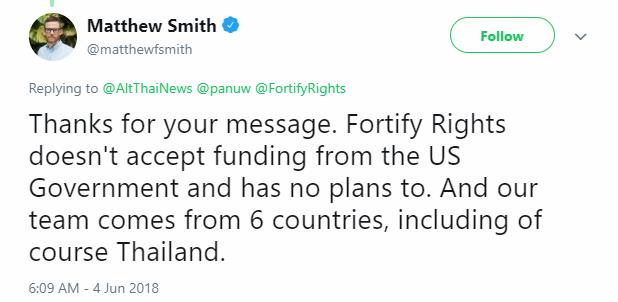
On social media, when the topic of US government funding was raised, Matthew Smith categorically denied receiving US government funding. He would refer to additional questions regarding his organisation’s funding as “trollish.”
However, Fortify Rights’ 2016 annual report (PDF), as pointed out to Smith himself, includes government funding from the United Kingdom, Canada, the Netherlands and the US Congress-funded National Endowment for Democracy ().
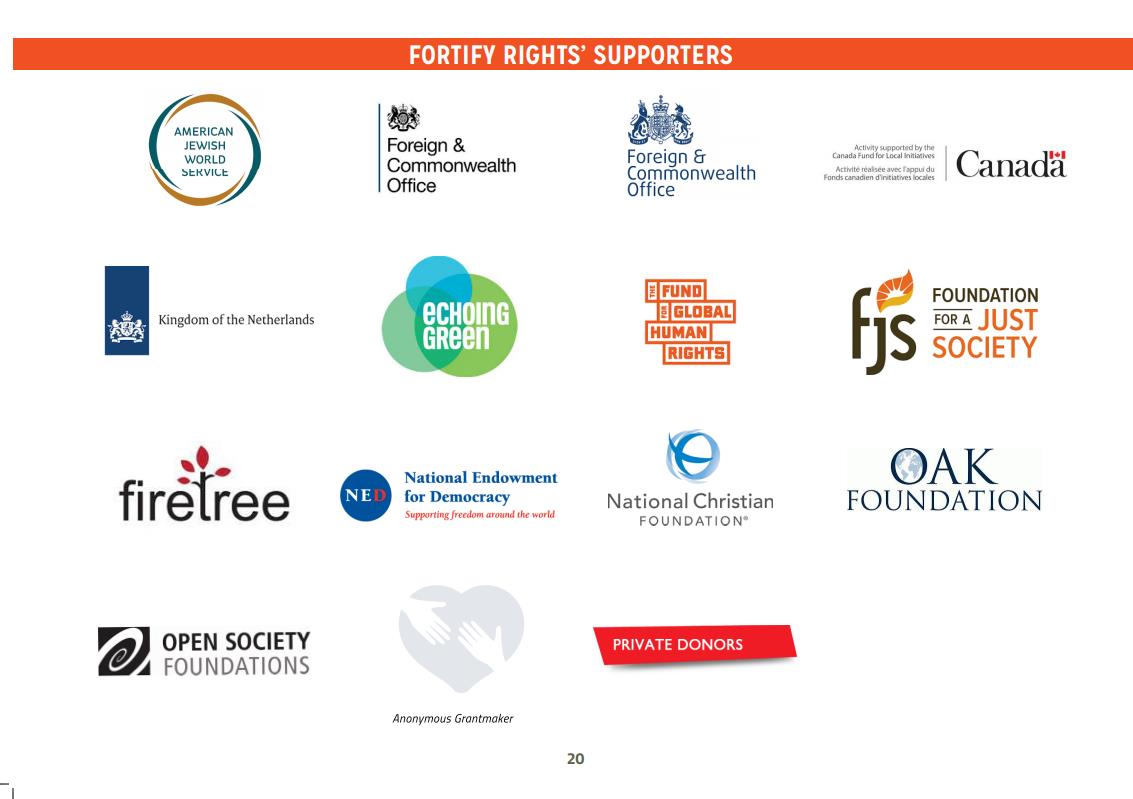
Other controversial sponsors of Fortify Rights include convicted financial criminal George Soros’ Open Society Foundations.
Matthew Smith not only knows that NED is funded by and serves as an intermediary for the US government, (thus making Fortify Rights a recipient of US government funding), he is undoubtedly aware of how controversial such funding is across Asia, a region sensitive to outside interference after centuries of European and more recently, American colonisation.
Implications of NED Funding
NED’s own website admits on its frequently asked questions page that:
NED is a private, non-profit, grant-making organization that receives an annual appropriation from the U.S. Congress through the Department of State. Although NED’s continued funding is dependent on the continued support of the White House and Congress, it is NED’s independent BOARD OF DIRECTORS that controls how the appropriation is spent.
NED itself admits that it is funded through the US State Department. It claims that its board of directors, not the US government itself, then determine how those US tax dollars are spent.
A look at NED’s board of directors only further implicates organisations like Matthew Smith’s Fortify Rights in deep impropriety merely hiding behind “rights” advocacy.
It includes people representing political and business interests involved in some of the greatest injustices purveyed by the United States during this generation, including Elliott Abrams, Francis Fukuyama, Zalmay Khalilzad (who served as US ambassador to Iraq during the US occupation) and Vin Weber described by some (including themselves) as Neo-Conservatives who promoted the US invasion of Iraq in 2003 and have promoted other wars of aggression around the globe both before and since.
Victoria Nuland, who played a central role in ousting the elected government of Ukraine in 2014 through a violent coup spearheaded by Neo-Nazi political parties and their militant wings, also serves on NED’s board of directors, along with Anne Applebaum of the Washington Post who clearly finds herself in a conflict of interest between reporting the truth and promoting organisations and agendas underwritten by the NED she chairs.
Another commonality is shared among NED’s board of directors; their use of “human rights” and “democracy” as pretexts for the wars of aggression and regime change they have promoted and helped execute, which reveals the true purpose, whether Matthew Smith of Fortify Rights knows or admits it or not, of both NED’s existence and the desired outcome of the work it funds around the globe.
NED in Thailand
Fortify Rights is by far not the only front operating in Thailand under the sponsorship of US government-funded NED.
It coordinates with other fronts as well, including media outlets like Prachatai based in Bangkok (whose director also serves as an NED Fellow), Isaan Record based in Thailand’s northeast, and BenarNews covering Thailand’s deep south. All three disingenuously portray themselves as independent local media. They have intentionally taken steps to obfuscate their US government funding from their Thai readers. Prachatai has only disclosed its foreign funding once in 2011, and only on its English-language website.
Each media front specialises in seizing upon and exploiting social and economic tensions to bolster opposition to the current government. Before the 2014 coup ousted the previous, US-backed government of Yingluck Shinawatra, these same media organisations used their platforms to smooth over injustices and emerging tensions threatening that government’s stability.
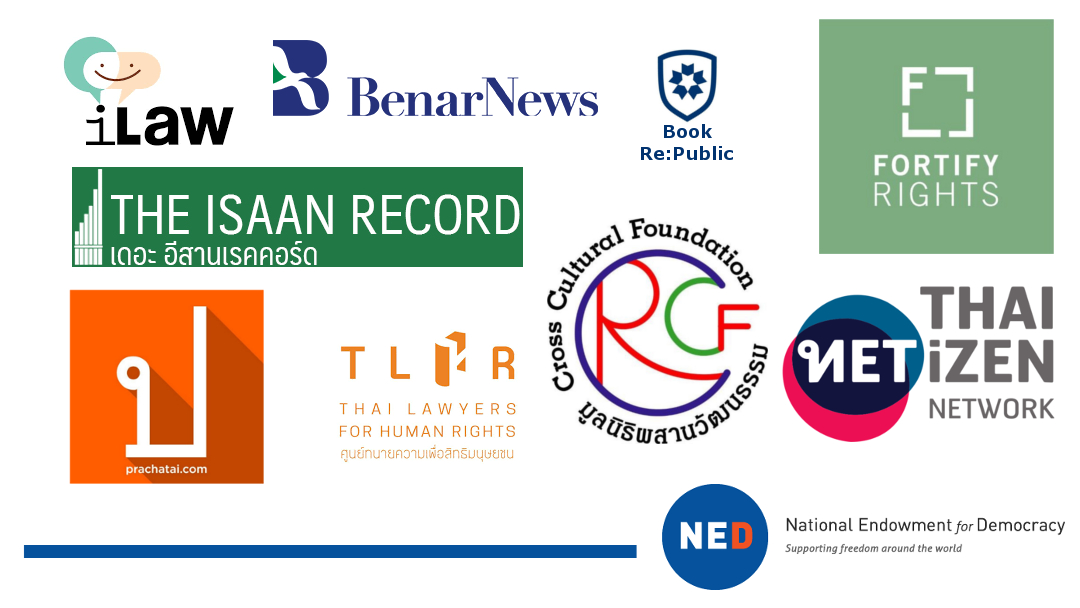
NED-funded Fortify Rights also works closely with fellow US funding recipient Thai Lawyers for Human Rights who not only provide free legal services for anti-government protesters, but provide resources and leadership to the protests themselves. The protesters portraying themselves as “pro-democracy” activists, fail to disclose their foreign funding to potential followers. They also avoid questions regarding how their foreign funding violates democracy’s prerequisite of self-determination independent of foreign interference.
Other NED-funded organisations operating in Thailand include iLaw, Cafe Democracy, Media Inside Out Group, Book Re:public, Thai Netizens Network, the ENLAWTHAI Foundation and the Cross Cultural Foundation (CrCF).
Many of these US government-funded organisations play a direct role in demanding policy changes. Currently in Thailand, protests demanding regime change are also led by US government-funded organisations.
The implications of foreign funded organisations attempting to influence Thailand’s policy or its political future are troubling. Many of the individuals working for these US government-funded organisations on their social media accounts frequently comment on their opposition to “Russian influence” in their US sponsors’ internal affairs, apparently failing to appreciate the irony of what their own work represents.
They also fail to appreciate the irony of portraying themselves as “independent” and working for “nongovernmental organisations,” despite being both dependent on wealthy and influential foreign sponsors as well as working on behalf of foreign governments.
Through their connections with equally compromised organisations and individuals in Thailand’s media, they have written promotional pieces about their supposed work, like in the Bangkok Post, without disclosing their foreign funding to readers.
At other times, complicit individuals within the Thai media have attempted to write pieces defending or dismissing US government-funding when public outcry begins to rise.
Rewriting Thailand’s NGO Laws
Despite the amount of funding and deception involved in this extensive and growing network, the US government-funded opposition is still widely unpopular. It would not be necessary for the Thai government to restrict their activities, let alone uproot and expel them as neighbouring Cambodia has (understandably) done.
Should Thailand simply rewrite its NGO laws to demand the same degree of scrutiny and transparency of these organisations as they themselves demand of targets of US government pressure, their already unpopular message would lose even more credibility and support across Thai society.
Prachatai, for example, being forced to disclose its US government funding at the header or footer (or both) of every article it writes would mean Prachatai finally practising the integrity and transparency it demands of targets of its daily propaganda. Likewise, those like writers at the Bangkok Post writing promotional pieces about Fortify Rights, should be obligated to disclose the organisation’s foreign funding somewhere within the body of the article.
Were these organisations as dedicated to the principles of transparency, freedom, democracy and human rights as they claimed, all of this information would already be freely and repeatedly provided to readers. If these organisations truly believed US, UK and Canadian government funding was benign or beneficial, they would not have gone through such extensive efforts to obfuscate and spin it to begin with. If anything, they would use such funding as a selling point.
Matthew Smith of Fortify Rights would not deceive people on social media by playing off of a technicality in which his US government money is essentially laundered through the NED before reaching him.
As the US continues accusing Russia of interfering in its internal political affairs, measures and consequences it attempts to level against Moscow could easily be cited and adopted by other nations across the globe to deal with the very real interference the US is engaged in within their respective borders.
The double game the US is playing regarding its own interference around the globe and accusations of interference it has levelled against Moscow, prove there is nothing benign at all about its agenda and activities. In turn, this calls into question all those organisations whose existence depends on annual contributions from this malignant political order.
Those truly dedicated to helping people will seek to independently fund their work by finding support from the local communities they claim to represent. If people are unwilling to fund Matthew Smith and Fortify Rights at the local level, it is likely Smith and his organisation are not truly working in the benefit of these communities, and instead, for interests diametrically opposed to them.
Ex-CIA Director John Brennan must testify on ‘spygate’ – Sen. Rand Paul
RT | June 8, 2018
Senator Rand Paul called for former CIA Director John Brennan to testify about whether he received secret information on Trump’s campaign from European or British sources. Paul wants him to testify before Congress under oath.
“BIG question for John Brennan, who has become such a vocal spokesman. Did you receive any secret info on candidate Trump or his campaign from European or British intelligence sources? Brennan should be brought before Congress & made to testify under oath, NOW!” Senator Paul tweeted on Thursday.
Serving as CIA Director under former president Barack Obama, Brennan has been accused by Trump of leading an effort to frame him for colluding with Russia in the runup to the 2016 presidential election. Trump has called Brennan “the genesis of this whole [Russia investigation] debacle.”
Last month, the New York Times and Washington Post revealed that a secretive operation, codenamed Crossfire Hurricane, was conducted by the FBI from the summer of 2016. The counterintelligence operation was reportedly launched on the basis of intelligence received from overseas.
Veteran CIA agent and academic Stefan Halper acted as a confidential informant who tried to extract potentially compromising information from George Papadopoulos, Sam Clovis, Carter Page and other members of the Trump campaign. Papadopoulos later pled guilty to making false statements to the FBI.
The FBI’s mandate is to conduct operations inside the US, while the CIA operates overseas. Since Halper met with Trump’s campaign aides in London, Brennan’s critics are curious if the CIA director had a hand in that operation, either on his own initiative or under orders from the Obama administration.
Since leaving the agency, Brennan – once a defender of the CIA’s practices of torture and domestic spying – has become a darling of the liberal #Resistance for his frequent anti-Trump diatribes.
He did agree with the president on one thing, however: the appointment of long-time CIA employee Gina Haspel to lead the agency after Trump’s first spy chief, Mike Pompeo, was reassigned to the State Department. Haspel was the CIA’s station chief in London at the time of Halper’s contacts with Trump’s campaign staff. She testified in her confirmation hearings that the CIA never spied on Trump or received information from British intelligence.
Senator Paul, who voted against Haspel’s confirmation, cast doubt on that testimony in May.
“Gina Haspel is categorically denying that the CIA got info from the British intelligence. And if what I’m saying today is not her opinion, she needs to speak up today and she needs to say ‘did British intelligence give info to John Brennan?'”
Joining Some Dots on the Skripal Case: Part 4 – The Dodgy Dossier
By Rob Slane | The Blog Mire | June 7, 2018
So far in this series of pieces, I have attempted to demonstrate why I believe the official story of the poisoning of the Skripals doesn’t add up (Part 1). I have then pointed to some of the most significant pieces of the jigsaw, which have either been largely ignored or quietly forgotten (Part 2). And I then went on in Part 3 to show what I believe to be perhaps the key to the whole case; that Mr Skripal became agitated in Zizzis restaurant, not because he was physically unwell and suffering from the effects of poisoning hours earlier, but rather because he had an appointment to keep.
But before coming on to propose a theory of what may have happened, I need to first present a theory of why it might have happened. I emphasise the word theory, because that is all it is — neither more nor less. And of course, it could be well wide of the mark. Make of it what you will!
In a recent blog, Craig Murray, the former UK Ambassador to Uzbekistan, linked to a very interesting piece by Paul Gregory that appeared in Forbes in January 2017. Mr Gregory is Professor of Economics at Houston University, and research fellow at both the Hoover Institution and the German Institute for Economic Research, and he also has extensive knowledge about Russia and the Soviet Union. Here’s what he had to say about the so-called Trump Dossier, just a few days after it was published by Buzzfeed :
“As someone who has worked for more than a decade with the microfilm collection of Soviet documents in the Hoover Institution Archives, I can say that the dossier itself was compiled by a Russian, whose command of English is far from perfect and who follows the KGB (now FSB) practice of writing intelligence reports, in particular the practice of capitalizing all names for easy reference. It was written, in my opinion, not by an ex-British intelligence officer but by a Russian trained in the KGB tradition [my emphasis].”
Now, we know that there is a link between the apparent author of the Trump Dossier, Christopher Steele and Mr Skripal’s MI6 recruiter and handler, Pablo Miller. And we know that Miller and Skripal met regularly. Not only this, but we also know that there is a direct link between Steele and Skripal dating back to the late 1990s, early 2000s. There is, then, a clear link between the man credited (if that be the right word) with writing the Dossier, and a certain ex-Russian intelligence officer, who would have been trained in the KGB tradition (he was actually in the GRU), living in Salisbury. In fact, the Daily Telegraph helpfully pointed out this connection a day before the Government slapped a D-notice on reporting on the issue.
But is there another clue? I think there is. By itself, it would mean nothing, but it is an interesting possibility in connection with what I have just stated.
According to the Czech magazine, Respekt, Mr Skripal had links with Czech Intelligence. This included a meeting in Prague back in 2012, but there were also subsequent meetings where Czech Intelligence officers came to meet with him in Britain. We are not told when or where this took place, suffice it to say that there was an ongoing connection.
If we then turn to the Trump Dossier itself, we find this in the sections dated August and October 2016:
“Kremlin insider reports TRUMP lawyer COHEN’s secret meeting/s with Kremlin officials in August 2016 was/were held in Prague.
We reported previously (2016/135 and /136) on secret meeting/s held in Prague, Czech Republic in August 2016 between then Republican presidential candidate Donald TRUMP’s representative, Michael COHEN and his interlocutors from the Kremlin working under cover of Russian NGO Rossotrudnichestvo…
Speaking to a compatriot and friend on 19 October 2016, a Kremlin insider provided further details of reported clandestine meeting/s between Republican presidential candidate, Donald TRUMP’s lawyer Michael COHEN and Kremlin representatives in August 2016. Although the communication between them had to be cryptic for security reasons, the Kremlin insider clearly indicated to his/ her friend that the reported contact/s took place in Prague, Czech Republic.”
Mr Cohen has of course vehemently denied this claim, saying that he has never been to Prague. Whether he has or hasn’t is not for me to say, but it is in any case irrelevant to the point I am making. That point is this: Sergei Skripal had what looks like extensive connections with Czech Intelligence, and claims – whether true or false –, which presumably came from Czech sources, are found in the Trump Dossier.
Putting these three things together – the Steele/Miller/Skripal connection; the Czech claims in the Dossier; and the emphatic claim made by Paul Gregory that the Dossier itself was compiled by a Russian “trained in the KGB tradition” – then you can begin to see where this might be pointing.
Now, you’d think from the way the BBC and others have reported on Mr Skripal that he was just some old chap enjoying his retirement in the quiet city of Salisbury, where he was in the habit of frequenting local restaurants and pottering about in his garden. Yet his continued work for British Intelligence, which saw him travelling to the Czech Republic and Estonia in 2016 to meet with intelligence officers, paints a somewhat different picture. Also, remember this is a man who once sold out hundreds of his fellow countrymen in the late 1990s and early 2,000s for filthy lucre. The fact that he continued to work for British Intelligence after being settled in Salisbury suggests not only that there was not what you might call deep repentance, but also presents the possibility that he continued to be lured by the promise of cash.
And so one wonders whether the man who was bought for a price by MI6 back in the 1990s might have still been buyable after he settled in Salisbury. Might Steele, who had been commissioned by Fusion GPS on behalf of the Democrats to put together some dirt on Donald Trump, have asked Skripal to cobble something together? Might Skripal have used his contacts in places like the Czech Republic and Estonia to give it some semblance of credibility? Might Skripal have been swayed by the promise of more money to put together a Dossier full of salacious and unverifiable gossip?
And be in no doubt, the Trump Dossier is a Dodgy Dossier. I write this as someone who thinks that Donald Trump is a walking disaster area, and as someone who has no desire to defend him. Yet the fallaciousness of the Dossier, which has formed the basis of the attempts to smear and possibly impeach him, is clear, as Paul Gregory articulated well in his piece for Forbes:
“The Orbis dossier is fake news … [It] makes as if it knows all the ins-and-outs and comings-and-goings within Putin’s impenetrable Kremlin. It reports information from anonymous ‘trusted compatriots,’ ‘knowledgeable sources,’ ‘former intelligence officers,’ and ‘ministry of foreign affairs officials.’ The report gives a fly-on-the-wall account of just about every conceivable event associated with Donald Trump’s Russian connections … There are two possible explanations for the fly-on-the-wall claims of the Orbis report: Either its author (who is not Mr. Steele) decided to write fiction, or collected enough gossip to fill a 30-page report, or a combination of the two.”
Indeed, the whole thing has all the look and feel of having been written by a firm that wanted a payday, but never in their wildest dreams expected the contents of it to become public knowledge. And they never expected it to be revealed because they never expected Mr Trump to win the 2016 election. In the infinitesimally small chance that he did win, I don’t suppose it even occurred to them that it might be taken seriously by US Intelligence.
And so here is the supposition as to the “why” of this case: The Democrat Party paid Fusion GPS to dig up some dirt on Donald Trump. Fusion GPS contracted this out to British Intelligence, who put them on to Orbis Business Intelligence, a private security firm owned by former MI6 officer Christopher Steele. Steele took the money and farmed the project out to Skripal who, because of his knowledge of Russia and his contacts with intelligence agencies in other countries, could make it sound reasonably plausible, at least to those who were paying for it.
But then – and this like that bit in the Lord or The Rings when it says that the Ring came into the possession of the unlikeliest creature – the Dodgy Dossier somehow found its way into the hands of US Intelligence agencies, and instead of seeing it as the obvious fraud that it was, amazingly they took it seriously. So seriously, in fact, that it became what the then Deputy Assistant Director of the Counterintelligence Division, Peter Strzok, described in a text message to his mistress, Lisa Page, as “an insurance policy” – that is, insurance against the unthinkable happening and Donald Trump becoming President.
But of course the unthinkable did happen. Against all expectations, Mr Trump won, and suddenly that same “insurance policy”, full of salacious gossip and unverifiable information, took on a life of its own, with all of the Beltway talking about it, and then with Buzzfeed eventually releasing it into the public domain. And so what was meant to be a product with enough plausibility to satisfy those paying for it, became the foundation for the attempts to bring down a sitting President.
If the above is correct — and let me reiterate once again that it is simply a theory, not necessarily a fact — then Sergei Skripal, not Christopher Steele, was the main author of the Trump Dossier. If that was the case, isn’t it possible that he might have sought a payment to keep quiet about its origins and the nature of its contents? And isn’t it possible that there might have been others who would seek to keep him quiet by other means?
In the final part of this series, I’ll attempt to propose a theory as to what actually happened on the evening of 4th March in Salisbury.
Israeli military attempts to smear slain Palestinian medic with inaccurate video
RT | June 8, 2018
The Israel Defense Forces’ attempt to smear medic Razan al-Najjar, the 21-year-old killed last week, backfired when a video it shared on social media was swiftly debunked.
The IDF shared an edited video of Najjar on both its English and Arabic spokesperson Twitter accounts on Thursday.
“Hamas’ use of human shields must stop.” it wrote in English. “Razan al-Najjar is not the angel of mercy that Hamas propaganda attempts to portray,” the Arabic spokesman Avichay Edraee’s tweet reads. The Arabic version of the video begins with an image of Najjar with angel wings and a halo. The video, which has an ominous soundtrack, claims Najjar was “incited by Hamas,” and it shows footage of Najjar throwing a gas canister.
Another clip shows an interview with Najjar – which has been carefully edited to exclude half of her sentence. “I am Razan al-Najjar. I am here on the frontlines and I act as a human shield,” the English subtitles read. The video then cuts to text reading, “Hamas uses paramedics as human shields,” before encouraging people to share.
Debunking
However, the video turned out to be made from a heavily edited original. The first scene, which reportedly shows Najjar throwing the gas canister, clearly shows her throw it away from the people she is standing with, and nowhere near the fence. The canister falls in the grass mere meters away from the woman. She is wearing a surgical mask at the time, although it has not been confirmed that Najjar is even the woman in the video.
The next clip featured in the video, the interview with Najjar, is also not as it seems. The IDF decided to cut mid-way through the interview with Al Mayadeen, so viewers have no idea what the second half of her sentence is. The full sentence was: “I am Razan al-Najjar. I am here on the frontlines and I act as a rescuing human shield to protect the and save the wounded at the frontlines.”
Najjar was shot in the chest while she was wearing her medical uniform last Friday. A preliminary probe by the Israeli army found soldiers did not mean to fire at Najjar, and that she was not a target.
However, two weeks ago, the IDF shot 19 medical personnel in Gaza in a single day, including Moussa Abu Hassanein, who was fatally shot in the chest. Canadian doctor Tarek Loubani was among the medics who were shot that day, and he maintains they were targeted by Israeli forces.
In her interview with Al Mayadeen, Najjar also said, “With all my strength and determination and whatever risks I will continue my career and I will save all the injured, so that they return and defend our land.” Her words suggest that she had no intention of dying as a human shield.”
Israel often accuses Palestinians of partaking in ‘Pallywood,’ which they claim are fake videos and images designed to gain attention from Western media. However, Israel has been caught doing the same thing it accuses the Palestinians of, only in their case, it is an effort to minimize their crimes against Palestinians. Israel has also been found to use Palestinians as humanshields themselves.
Still Waiting for Evidence of a Russian Hack
By Ray McGovern | Consortium News | June 7, 2018
If you are wondering why so little is heard these days of accusations that Russia hacked into the U.S. election in 2016, it could be because those charges could not withstand close scrutiny. It could also be because special counsel Robert Mueller appears to have never bothered to investigate what was once the central alleged crime in Russia-gate as no one associated with WikiLeaks has ever been questioned by his team.
Veteran Intelligence Professionals for Sanity — including two “alumni” who were former National Security Agency technical directors — have long since concluded that Julian Assange did not acquire what he called the “emails related to Hillary Clinton” via a “hack” by the Russians or anyone else. They found, rather, that he got them from someone with physical access to Democratic National Committee computers who copied the material onto an external storage device — probably a thumb drive. In December 2016 VIPS explained this in some detail in an open Memorandum to President Barack Obama.
On January 18, 2017 President Obama admitted that the “conclusions” of U.S. intelligence regarding how the alleged Russian hacking got to WikiLeaks were “inconclusive.” Even the vapid FBI/CIA/NSA “Intelligence Community Assessment of Russian Activities and Intentions in Recent U.S. Elections” of January 6, 2017, which tried to blame Russian President Vladimir Putin for election interference, contained no direct evidence of Russian involvement. That did not prevent the “handpicked” authors of that poor excuse for intelligence analysis from expressing “high confidence” that Russian intelligence “relayed material it acquired from the Democratic National Committee … to WikiLeaks.” Handpicked analysts, of course, say what they are handpicked to say.
Never mind. The FBI/CIA/NSA “assessment” became bible truth for partisans like Rep. Adam Schiff (D-CA), ranking member of the House Intelligence Committee, who was among the first off the blocks to blame Russia for interfering to help Trump. It simply could not have been that Hillary Clinton was quite capable of snatching defeat out of victory all by herself. No, it had to have been the Russians.
Five days into the Trump presidency, I had a chance to challenge Schiff personally on the gaping disconnect between the Russians and WikiLeaks. Schiff still “can’t share the evidence” with me … or with anyone else, because it does not exist.
WikiLeaks
Schiff: Can’t share evidence
It was on June 12, 2016, just six weeks before the Democratic National Convention, that Assange announced the pending publication of “emails related to Hillary Clinton,” throwing the Clinton campaign into panic mode, since the emails would document strong bias in favor of Clinton and successful attempts to sabotage the campaign of Bernie Sanders. When the emails were published on July 22, just three days before the convention began, the campaign decided to create what I call a Magnificent Diversion, drawing attention away from the substance of the emails by blaming Russia for their release.
Clinton’s PR chief Jennifer Palmieri later admitted that she golf-carted around to various media outlets at the convention with instructions “to get the press to focus on something even we found difficult to process: the prospect that Russia had not only hacked and stolen emails from the DNC, but that it had done so to help Donald Trump and hurt Hillary Clinton.” The diversion worked like a charm. Mainstream media kept shouting “The Russians did it,” and gave little, if any, play to the DNC skullduggery revealed in the emails themselves. And like Brer’ Fox, Bernie didn’t say nothin’.
Meanwhile, highly sophisticated technical experts, were hard at work fabricating “forensic facts” to “prove” the Russians did it. Here’s how it played out:
June 12, 2016: Assange announces that WikiLeaks is about to publish “emails related to Hillary Clinton.”
June 14, 2016: DNC contractor CrowdStrike, (with a dubious professional record and multiple conflicts of interest) announces that malware has been found on the DNC server and claims there is evidence it was injected by Russians.
June 15, 2016: “Guccifer 2.0” affirms the DNC statement; claims responsibility for the “hack;” claims to be a WikiLeaks source; and posts a document that the forensics show was synthetically tainted with “Russian fingerprints.”
The June 12, 14, & 15 timing was hardly coincidence. Rather, it was the start of a pre-emptive move to associate Russia with anything WikiLeaks might have been about to publish and to “show” that it came from a Russian hack.
Enter Independent Investigators
A year ago independent cyber-investigators completed the kind of forensic work that, for reasons best known to then-FBI Director James Comey, neither he nor the “handpicked analysts” who wrote the Jan. 6, 2017 assessment bothered to do. The independent investigators found verifiable evidence from metadata found in the record of an alleged Russian hack of July 5, 2016 showing that the “hack” that day of the DNC by Guccifer 2.0 was not a hack, by Russia or anyone else.
Rather it originated with a copy (onto an external storage device – a thumb drive, for example) by an insider — the same process used by the DNC insider/leaker before June 12, 2016 for an altogether different purpose. (Once the metadata was found and the “fluid dynamics” principle of physics applied, this was not difficult to disprove the validity of the claim that Russia was responsible.)
One of these independent investigators publishing under the name of The Forensicator on May 31 published new evidence that the Guccifer 2.0 persona uploaded a document from the West Coast of the United States, and not from Russia.
In our July 24, 2017 Memorandum to President Donald Trump we stated, “We do not know who or what the murky Guccifer 2.0 is. You may wish to ask the FBI.”
Our July 24 Memorandum continued: “Mr. President, the disclosure described below may be related. Even if it is not, it is something we think you should be made aware of in this general connection. On March 7, 2017, WikiLeaks began to publish a trove of original CIA documents that WikiLeaks labeled ‘Vault 7.’ WikiLeaks said it got the trove from a current or former CIA contractor and described it as comparable in scale and significance to the information Edward Snowden gave to reporters in 2013.
“No one has challenged the authenticity of the original documents of Vault 7, which disclosed a vast array of cyber warfare tools developed, probably with help from NSA, by CIA’s Engineering Development Group. That Group was part of the sprawling CIA Directorate of Digital Innovation – a growth industry established by John Brennan in 2015. [ (VIPS warned President Obama of some of the dangers of that basic CIA reorganization at the time.]
Marbled
“Scarcely imaginable digital tools – that can take control of your car and make it race over 100 mph, for example, or can enable remote spying through a TV – were described and duly reported in the New York Times and other media throughout March. But the Vault 7, part 3 release on March 31 that exposed the “Marble Framework” program apparently was judged too delicate to qualify as ‘news fit to print’ and was kept out of the Times at the time, and has never been mentioned since.
“The Washington Post’s Ellen Nakashima, it seems, ‘did not get the memo’ in time. Her March 31 article bore the catching (and accurate) headline: ‘WikiLeaks’ latest release of CIA cyber-tools could blow the cover on agency hacking operations.’
“The WikiLeaks release indicated that Marble was designed for flexible and easy-to-use ‘obfuscation,’ and that Marble source code includes a “de-obfuscator” to reverse CIA text obfuscation.
“More important, the CIA reportedly used Marble during 2016. In her Washington Post report, Nakashima left that out, but did include another significant point made by WikiLeaks; namely, that the obfuscation tool could be used to conduct a ‘forensic attribution double game’ or false-flag operation because it included test samples in Chinese, Russian, Korean, Arabic and Farsi.”
A few weeks later William Binney, a former NSA technical director, and I commented on Vault 7 Marble, and were able to get a shortened op-ed version published in The Baltimore Sun.
The CIA’s reaction to the WikiLeaks disclosure of the Marble Framework tool was neuralgic. Then Director Mike Pompeo lashed out two weeks later, calling Assange and his associates “demons,” and insisting; “It’s time to call out WikiLeaks for what it really is, a non-state hostile intelligence service, often abetted by state actors like Russia.”
Our July 24 Memorandum continued: “Mr. President, we do not know if CIA’s Marble Framework, or tools like it, played some kind of role in the campaign to blame Russia for hacking the DNC. Nor do we know how candid the denizens of CIA’s Digital Innovation Directorate have been with you and with Director Pompeo. These are areas that might profit from early White House review. [ President Trump then directed Pompeo to invite Binney, one of the authors of the July 24, 2017 VIPS Memorandum to the President, to discuss all this. Binney and Pompeo spent an hour together at CIA Headquarters on October 24, 2017, during which Binney briefed Pompeo with his customary straightforwardness. ]
“We also do not know if you have discussed cyber issues in any detail with President Putin. In his interview with NBC’s Megyn Kelly he seemed quite willing – perhaps even eager – to address issues related to the kind of cyber tools revealed in the Vault 7 disclosures, if only to indicate he has been briefed on them. Putin pointed out that today’s technology enables hacking to be ‘masked and camouflaged to an extent that no one can understand the origin’ [of the hack] … And, vice versa, it is possible to set up any entity or any individual that everyone will think that they are the exact source of that attack.
“‘Hackers may be anywhere,’ he said. ‘There may be hackers, by the way, in the United States who very craftily and professionally passed the buck to Russia. Can’t you imagine such a scenario? … I can.’
New attention has been drawn to these issues after I discussed them in a widely published 16-minute interview last Friday.
In view of the highly politicized environment surrounding these issues, I believe I must append here the same notice that VIPS felt compelled to add to our key Memorandum of July 24, 2017:
“Full Disclosure: Over recent decades the ethos of our intelligence profession has eroded in the public mind to the point that agenda-free analysis is deemed well nigh impossible. Thus, we add this disclaimer, which applies to everything we in VIPS say and do: We have no political agenda; our sole purpose is to spread truth around and, when necessary, hold to account our former intelligence colleagues.
“We speak and write without fear or favor. Consequently, any resemblance between what we say and what presidents, politicians and pundits say is purely coincidental.” The fact we find it is necessary to include that reminder speaks volumes about these highly politicized times.
Tribute to the Last Honorable US Senator: The Story of Paul Wellstone’s Suspected Assassination
By Joachim Hagopian | Global Research | October 26, 2016
On October 25th, 2002 the last great hero of the common people in the US Senate was very likely murdered by agents of the shadow US crime cabal government otherwise known as the Bush-Cheney regime. His wife and daughter and two pilots also died in the air crash. Paul Wellstone’s story deserves to be retold and Americans need to be reminded that criminals in and out of our government still need to be punished for their unindicted crimes. This article was written as both a tribute to an outstanding American patriot and a reexamination of his probable assassination by criminals still on the loose.
Minnesota Democratic Senator Paul Wellstone was a man of integrity who was among the few politicians openly and adamantly opposing the Iraq invasion as well as the creation of the US version of Gestapo-land Security. As a fearless populist leader he’d been a constant thorn in the side ever since then President George H. W. Bush responding to the junior senator’s uncomfortable questions at a reception asked, “Who is this chickenshit?”
Years later as the only senator up for reelection who voted against the Iraq War when Democrats held just a one seat edge over the Republicans in the Senate (with one independent caucusing with Democrats), his thorny side made him the #1 GOP target. With the Karl Rove led Republican Party just one seat away from gaining Republican control over the US Senate, Wellstone’s death gave his Republican challenger Norm Coleman the 49-49 split and, as the President of the Senate, Cheney’s tie breaking vote would deliver the GOP 50-49 advantage needed to steamroll yet more tax cuts through for the rich, unending bankers’ wars and a never seen before boom for the military-security industrial complex. Again, motive and means tilt heavily towards assassination. The facts make it more than probable.
A month prior to the November 2002 election Vice President Cheney had arranged a meeting with Wellstone, threatening him with grave consequences should he vote against the preplanned Iraq invasion. A few days later speaking to a group of war veterans, Wellstone publicly recalled Cheney’s threatening words:
“If you vote against the war in Iraq, the Bush administration will do whatever is necessary to get you. There will be severe ramifications for you and the state of Minnesota.”
Then just days after that, 11 days prior to the midterm election and a year to the exact day after the deadly anthrax pushed Patriot Act victory, on October 25th Paul Wellstone, his wife and daughter along with three staffers and two pilots all died in an extremely suspicious plane crash.
The FBI was at the crash site within 90 minutes, indicating they’d left their Minneapolis office before the “accident” at about the same time Wellstone’s plane was just taking off that morning, indicating the possibility of pre-knowledge.
“The authors note that it would’ve taken agents at least three hours to reach the swampy and remote crash site. How they got there from the Twin Cities so quickly remains a mystery.”
Additionally, the NTSB as the national agency that normally takes the lead role investigating all US plane crashes suddenly wasn’t. The FBI moved in ahead immediately proclaiming just another bad weather accident. Yet all on the ground witnesses and reports disagree, from pilots landing at the destination airport just two hours prior to the Wellstone flight to the airport manager who less than an hour after the crash was himself flying over the crash site. The plane considered a Rolls Royce among small planes was in tiptop shape and the two pilots steeped in skilled experience.
As the feds’ rogue cops for go-to cover-ups, as in 9/11 and the anthrax attacks the year before, and the 1993 World Trade Center and 1995 Oklahoma City bombings, the FBI has a long shady history of leaving its corrupt dirty fingerprints all over these well documented false flag, history changing events.
A couple of brave Democratic House members anonymously stated that they believe Wellstone was murdered. In one Congressman’s words:
I don’t think there’s anyone on the Hill who doesn’t suspect it. It’s too convenient, too coincidental, too damn obvious. My guess is that some of the less courageous members of the party are thinking about becoming Republicans right now.
An unnamed CIA source admitted:
“Having played ball (and still playing in some respects) with this current crop of reinvigorated old white men, these clowns are nobody to screw around with. There will be a few more strategic accidents. You can be certain of that.”
A number of other Democratic politicians at a 2 to 1 margin to Republicans have also incurred mysterious deaths holding “unpopular” views just ahead of hotly contested elections. Two years earlier while traveling in Colombia Senator Wellstone had already experienced one known attempt on his life when a bomb planted en route from the airport was discovered.
As a longtime critic of the CIA and covert operations, Wellstone was targeted for assassination in both Colombia and in Minnesota by the masters of mayhem, murder and deceitful cover-ups – the FBI/CIA Criminals-In-Action at the behest of mastermind Cheney.
So far in our two-tiered justice system, murder pays off for those high up on the psychopath food chain like Cheney, the Bushes and Clintons. Renowned investigative reporter Seymour Hersh exposed Cheney’s “executive assassination ring.” Cheney used the CIA as well as the military Joint Special Operations Command as his personal army of hitmen reporting directly to him. (see video below)
If the neocons can live with themselves for murdering 3000 Americans on 9/11, they certainly never lose sleep over a few more targeted eliminations that include the genocidal 4 million Muslim bloodbath caused by the Bush crime family wars.

Mintpress, August 18, 2015
The heavy-handed Bush-Cheney push for Iraq War and a DHS congressional vote prior to their 2003 invasion cast enormous high stakes in the Senate. Then add the known history of contempt from former CIA director Bush, the Cheney threat just days prior to Wellstone’s death, a slew of brazenly contradictory crash site anomalies, and the exposed murderous means used to pass the Patriot Act and the 9/11 false flag tragedy the year prior, all of this circumstantial evidence taken together strongly points to yet more diabolical skullduggery perpetrated by Skull & Bones criminals against humanity.
The neocons grabbed the Hegelian solution they needed for waging unlimited war in the name of terrorism anywhere in the world while simultaneously at home merging FEMA into their newly created Homeland Security tasked with stripping away the rest of America’s constitutional liberties in the name of “national security.” In its first dozen years alone, deep state’s gluttonously monolithic DHS cancer has metastasized into the third largest federal department boasting near a quarter million full-time employees. By hook, crook and murder the Cheney-Bush gang in 2003 got what they’d been wanting and plotting for years, two concurrent never-ending wars in the Middle East and the monstrous apparatus Homeland Security whose purpose is making war against the American people. Sadly the rest of the Western vassal nations play follow the leader.
If examined according to the Hegelian Dialectic of 1) problem, 2) reaction and 3) solution, a draconian formula used by deep state to manufacture increased authoritarian control over the US populace, Paul Wellstone’s death can easily be explained.
More than any other single member of Congress, the Minnesota senator posed a serious threat as the major opposition leader standing in the way of war criminals Bush and Cheney’s Iraq invasion as well as their formation of the Department of Homeland Security, two preplanned agendas rooted in the neocon think tank the Project for a New American Century (PNAC). Prior to their stealing the 2000 election and their PNAC’s “Pearl Harbor” event they created called 9/11, their regime had already called for attacking Iraq for regime change and erection of the DHS cancer. The Bush-Cheney reaction to their problem Paul Wellstone was to assassinate him making it appear as an accident.
 By murder once Wellstone was out of the way, the neocons’ solution sent a loud and clear message of intimidation and a death threat in order to effectively silence any other potential Congressional opponents to the war in Iraq. Wellstone’s elimination paved the way for the war criminals’ successful campaign to win national support for the March 2003 US invasion of Iraq. That said, the month before the invasion on February 15th, 10-15 million people around the world in over 600 cities assembled in massive protest against the US intervention, the biggest one day antiwar demonstration in history. But unfortunately once the US military occupation began, the antiwar movement gradually fizzled out.
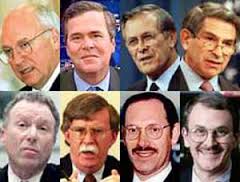
And the PNAC (members of PNAC project, image left) calling for regime change in seven sovereign nations including Iraq within five years was underway. The predatory rape and pillaging of Iraq as the world’s second largest oil producer was justified by lies of Saddam’s non-existent WMD’s and ties to terrorism. Sadly the neocons who are still at the helm wreaking havoc in 2016 were able to implement an enormous new Department of Homeland Security monstrosity masquerading as public “safeguard” against terrorism. So without Wellstone and with virtually no further opposition in Congress, the neocons created their multibillion dollar security state apparatchik promoting and enforcing draconian counterterrorism laws leading to increasing centralized authoritarian government control that is ushering in their New World Order.
This tried and true Hegelian strategy has also been regularly utilized to further identify deep state obstacles as problems based on perceived neocons’ threats to US global unipolar hegemony.
American Empire’s relentless efforts to isolate, weaken and target for global war designated international enemies Russia, China and Iran through propagandized demonization and orchestrating fake crises illustrate yet more examples of the Hegelian Dialectic in action. And just as the US crime cabal was successful in eliminating Wellstone as their New World Order threat, for decades the crime cabal government has been planning its war against identified American dissenters as enemies of the state who object to its heavy-handed tyranny.
Paul Wellstone’s courageous opposition to the powerful Washington establishment’s evil cost him and his family’s life. Since we Americans are now in the same crosshairs of the same still entrenched shadow assassins, it’s time to make their arrests for treason and mass murder prior to our own death and destruction.
As an independent journalist focusing on geopolitics, international relations, globalization and US Empire imperialism for over four years, Joachim has written hundreds of articles published on numerous alternative news sites, foremost among them Global Research, Sott.net and LewRockwell.com. His blog site is at http://empireexposed.blogspot.com.
Joachim is currently writing the A-Z encyclopedia exposing the global pedophilia epidemic entitled Pedophilia& Empire: Satan, Sodomy & the Deep State. The book can be read for free on Joachim’s blog site at or http://tinyurl.com/pedoempire. Many of the first sixteen chapters selling for .99 each since last fall on Amazon Kindle remain in the top 10 in both politics and child advocacy categories. With less than a quarter of the book to go, for those wishing to help complete this all-important project exposing the pedo-crime cabal sooner than later, donations are welcomed at paypal.me/AuthorJH
George Monbiot: selling the 1% agenda in a Green box

George Monbiot NOT shilling for corporate interests
By Catte | OffGuardian | June 8, 2018
The neoliberals of today specialise in using concepts of concern and inclusiveness as a cover for their frankly fascist agenda. Censorship is being repackaged as “anti-hate”. The destruction of the core idea of “innocent until proven guilty” is being repackaged as protecting (mostly female) victims from their persecutors. Reasonable doubt is being repackaged as “denialism.” Minority opinion is being repackaged as treachery or subversion. Facts that contradict a current state-sponsored agenda are repackaged as “fake news.”
Conformity is being encouraged, presented as a cosy and reassuring “consensus blanket”, under which we can all snuggle together, safe from confusion, doubt or the horrendous experience of having our cherished beliefs called into question. Most journos operating in the mainstream have already opted to crawl in and curl up for the long snooze into intellectual and ethical oblivion, while others, the kapos, are actively herding the remaining doubters inside.
George Monbiot is one of the latter. The last few years have outed this one time supposed anti-establishment figure as nothing more than a fully establishment goon, posturing in the sad tatters of his “dissident Green” cosplay. His performance during the Syria crisis made this too obvious. His sub-intelligent smears on those independent journalists daring to question the narrative made his real allegiances, and limitations, more than clear. His preparedness to brazenly lie and his refusal to debate the people he smeared in an open forum cemented this view.
Monbiot is revealed as the guy the establishment uses to try and lure the Left-Greens out in support of the latest agenda roll-out by the likes of Soros, Gates and the Atlantic Council. He’s booked for the same gigs as Avaaz. His brief, as ever, is to sell fascism – but this time in a Green box.
Today George is busy selling us on veganism.
Now, don’t get me wrong. Veganism is fine. It’s a human choice and it has a place. This is not an attack on veganism, or vegans.
But we need to separate what a thing is from what it’s being used for. Everything, even the best things, can be exploited. And we can’t let loyalty to the thing itself stop us from seeing when its being used for less than good ends.
Veganism is being promoted right now by the usual suspects. There has been a rash of articles in the Guardian and elsewhere about the supposed health and environmental benefits of giving up meat and dairy. Even if we happen to be vegan, we’d be insane not to wonder why. Especially when Monbiot is getting involved.
George is a poster child for the New Wave Vegan. Strange, perhaps, given he’s only a “97% vegan” himself. But let’s just ignore the 3% carnivore, since it’s only road kill. The more important point, anyway, is that George wants us all to think he’s a vegan. Because a salesman has to be seen to use the product he’s promoting. His latest article breaks no new ground on this really. He’s said most of it before, as have others. But still, given the mounting evidence for the political mobilisation of veganism, it’s a good idea to look at what he says.
He starts by offering a binary choice – between the current wasteful and insane industrial farming system and a somewhat poorly defined alternative in which everyone eats a plant-based diet, which he implies without really saying, will put an end to this insanity. He tells us not only will this choice fix the problem of worldwide food shortage (because plant-husbandry produces far more calories per hectare than animal husbandry), but it will also remove the problem of all that unused animal waste currently pouring into rivers and creating massive pollution.
George’s ideal future will also be gratifying for the processed food industry. Because vegans need ready meals!
Unless you can cook well – and many people have neither the skills nor the space – a plant-based diet can be either boring or expensive. We need better and cheaper vegan ready meals and quick and easy meat substitutes
And fake meat grown in a lab!
The big shift will come with the mass production of cultured meat.
George recognises the latter will be a tough sell, but he’s up for giving it a try. An objection to this might be that “artificial meat is disgusting”, says George, but:
If you feel this way, I invite you to look at how your sausages, burgers and chicken nuggets are currently raised, slaughtered and processed. Having worked on an intensive pig farm, I’m more aware than most of what disgusting looks like.
Mmmm… Lab-grown pseudo-meat, pink-dyed and not quite as disgusting as something even worse! Lovely Roundup-saturated veggies [silage] processed into some approximation of the kind of protein humans can digest, and piped into microwavable sachets.
Who knew utopia would end up looking quite so much like – now? Who knew the new way would be just like the old way but with more “progressive” slogans?
George uses twisty self-contradictory arguments to claim one minute that eliminating livestock farming would “be a chance to break our complete dependence on artificial nitrogen”, while in his very next para admitting the exact opposite will in fact be the case.
the transition to plant protein is unlikely to eliminate the global system’s need for artificial fertiliser
Though he throws us a bone in the shape of
the pioneering work of vegan organic growers, using only plant-based composts and importing as little fertility as possible from elsewhere
This is blatant bait and switch. Green or green-sounding proclamations being swapped out for their very opposites with a deftness he hopes will fool us. We may, in some misty future time, not need to rely entirely on synthetic chemicals – but yes, OK, for now we will still be sucking up carcinogens with our lovely all veg diet.
Of course we could just use the animal manure to fertilise our veggies, which would entirely eliminate the need for chemical fertilisers… But let’s not think about that too much. Let’s instead soften that focus and just picture fields full of lovely cruelty-free plants waving in the even lovelier breeze…
In case you haven’t noticed, George’s entire article is hand-waving nonsense predicated on a lie, or a system of lies, and his trademark nifty footwork.
His claim that we need to produce more food is used as a blanket rationale for everything he advocates, but it’s a lie. We don’t need to produce more food. We currently produce more than enough food to feed the world. What we need and don’t have is equitable distribution. And that is because of the stranglehold of the minority interests George is carefully eliding.
His initial binary choice is a lie. We don’t need to choose between intensive animal farming and intensive cereal/veg farming. We have the option of non-intensive farming methods that treat the land, the animals and the crops with respect, and use age-old, sustainable methods to produce chemical-free and healthy food.
His dishonesty is nowhere more apparent than when he tries to elide this simple truth. Look at how he acknowledges the illogicality of unused animal waste
Today, the link between livestock and crops has mostly been broken: crops are grown with industrial chemicals while animal slurry stacks up, unused, in stinking lagoons, wipes out rivers and creates dead zones at sea.
but dodges away from the obvious solution – use the “slurry” to fertilise the land in place of synthetic chemicals – with a weak excuse:
When it is applied to the land, it threatens to accelerate antibiotic resistance.
Notice how he avoids mentioning the fact non-intensively reared animals don’t need to be pumped full of antibiotics in the first place. He even links to the source for sustainable husbandry I cite above, but does so only to dismiss it (without data) as “worse” than anything else on offer, by using, once again, the fake claim about the need to produce more food per hectare:
More damaging still is free-range meat: the environmental impacts of converting grass into flesh, the paper remarks, “are immense under any production method practised today”. This is because so much land is required to produce every grass-fed steak or chop
And adding that it’s also bad for the environment
Those who claim that “regenerative” or “holistic” ranching mimics nature deceive themselves. It relies on fencing, while in nature wild herbivores roam freely, often across vast distances. It excludes or eradicates predators, which are crucial to the healthy functioning of all living systems. It tends to eliminate tree seedlings, ensuring that the complex mosaics of woody vegetation found in many natural systems – essential to support a wide range of wildlife – are absent
You thought Monsanto, GM, monocultures and the ripping up of hedgerows was the problem? Nah. It’s fences. And herbivores eating the grass they’re designed to eat. And implicit in this nonsense of course is the greater nonsense that massive veggie monocultures drowned in pesticides and herbicides, are just teaming with wild life, tree seedlings and predators.
Just as he used frank lies to promote the Soros-backed White Helmets as unsung “heroes”, here, in the fake guise of promoting a healthy, organic, back-to-nature solution to the world’s problems, George is promoting the current power system of Big Ag and Big Food monopoly. Just as Avaaz sells us imperial regime change as grass roots activism, George is selling us industrial farming and denatured food as a return to Eden.
Don’t buy what he’s selling. Don’t surrender your sense of the real to this snake oil salesman. Go vegan if you want – that’s a fine personal choice. But not at the expense of the small producers who are already struggling to survive without the subsidies the big guys get. Don’t vote for some future “meat tax” that will drive them out of business, and penalise the poor, just as Big Ag wants. Don’t buy into this soft focus dreamland where our entire livestock herd disappears bloodlessly and completely from our landscape without being killed or culled, and is somehow better for it. Don’t be whispered into campaigning for a new and self-imposed serfdom, in which 7 billion compliant vegans munch their potage or their shrink-wrapped lab-grown Soylent Green, while the 1% quietly eat grass-fed steak and snigger with duping delight.
Medical Aid for Palestinians attacked by pro-Israel lawyers’ groups
MEMO | June 7, 2018
UK charity Medical Aid for Palestinians (MAP) has described allegations of anti-Semitism made by two pro-Israel advocacy groups as an “appalling smear”.
According to a report in the Jewish News, UK Lawyers for Israel (UKLFI) and the US-based Lawfare Project this week submitted a 17-page complaint against MAP to the Charity Commission.
The complaint claims that the respected humanitarian NGO is guilty of “racial hatred of Jews”, and claims MAP has “links to Palestinian terrorist groups”.
A MAP spokesperson told the paper: “This appalling smear appears to be part of a wider pattern of attacks on legitimate NGOs. Should the Charity Commission raise points with us, we would be pleased to respond.”
The article says that the pro-Israel activists accuse MAP of giving a “false impression” about the health of Palestinians. UKLFI’s Jonathan Turner said: “Readers of its misleading website would no doubt be surprised to hear that life-expectancy in Gaza in fact compares favourably with Glasgow.”
Turner added that MAP was “abusing its position as a charity to spread false information about Israel”, and using “the halo of its status as a charity to disguise its racial hatred of Israelis and Jews.”
Lawfare Project direct Brooke Goldstein said “it is incumbent on the Charity Commission to take action against MAP’s sinister abuse of charitable funds”.
The timing of the attack on MAP is no coincidence, coming after an appeal by the charity raised more than £1 million following Israel’s mass killing of Palestinian protesters.
MAP medics have been on the ground in the Israeli-occupied Gaza Strip, and the charity’s social media accounts have given vital insights into Israel’s brutal crackdown.
Is Putin Really Ready to “Ditch” Iran?
The Saker • Unz Review • June 7, 2018
The topic of Russian actions in Syria still continues to fascinate and provoke numerous polemics. This makes sense – the issue is exceedingly important on many levels, including pragmatic and moral ones, and today I want to stick strictly to the pragmatic level and set aside, just for a while, moral/ethical/spiritual considerations. Furthermore, I will also pretend, for argument’s sake, that the Kremlin is acting in unison, that there are no Atlantic Integrationists in the Russian government, no 5th column in the Kremlin and that there is no Zionist lobby exerting a great deal of influence in Russia. I will deal with these issues in the future as there is no doubt in my mind that time and events will prove how unfounded and politically-motivated these denials are in reality. But for the purpose of this analysis, we can pretend that all is well in the Kremlin and assume that Russia is fully sovereign and freely protecting her national interests.
So what do we know about what is going on in Syria?
I submit that it is obvious that Russia and Israel have made some kind of deal. That there is an understanding of some kind is admitted by both sides, but there is also clearly more happening here which is not spelled out in full. The Israelis, as always, are bragging about their total victory and posting articles like this one: “In Syria, Putin and Netanyahu Were on the Same Side All Along” with the subheading reading “Putin is ready to ditch Iran to keep Israel happy and save Assad’s victory.” Really?
The chaotic world of contradictory declarations and statements
Let’s look at that thesis from a purely logical point of view. First, what were the Israeli goals initially? As I have explained elsewhere, initially the Israelis had the following goals:
- Bring down a strong secular Arab state along with its political structure, armed forces, and security services.
- Create total chaos and horror in Syria justifying the creation of a “security zone” by Israel not only in the Golan but further north.
- Trigger a civil war in Lebanon by unleashing the Takfiri crazies against Hezbollah.
- Let the Takfiris and Hezbollah bleed each other to death, then create a “security zone”, but this time in Lebanon.
- Prevent the creation of a Shia axis Iran-Iraq-Syria-Lebanon.
- Break up Syria along ethnic and religious lines.
- Create a Kurdistan which could then be used against Turkey, Syria, Iraq, and Iran.
- Make it possible for Israel to become the uncontested power broker in the Middle-East and force the KSA, Qatar, Oman, Kuwait and all others to have to go to Israel for any gas or oil pipeline project.
- Gradually isolate, threaten, subvert and eventually attack Iran with a wide regional coalition of forces.
- Eliminate all centers of Shia power in the Middle-East.
Now let’s stop right here and ask a very simple question: if Putin and Netanyahu were on the same side all along, what should Putin have done to aid the Israelis? I submit that the obvious and indisputable answer is: absolutely nothing. By the time the Russians initiated their (very limited but also very effective) intervention in Syria those plans were well under way towards full realization!
The undeniable truth is that Putin foiled the initial Israel plan for Syria.
In fact, Hezbollah and Iran had already intervened in Syria and were desperately “plugging holes” in a collapsing Syrian front. So, if anything, Putin has to be the one to be credited for forcing the Israelis to give up on their “plan A” and go to plan “B” which I described here and which can be summarized as follows:
Step one, use your propaganda machine and infiltrated agents to re-start the myth about an Iranian military nuclear program. (…) If Trump says that the JCPOA is a terrible deal, then this is so. Hey, we are living in the “post-Skripal” and “post-Douma” era – if some Anglo (or Jewish) leaders say “highly likely” then it behooves everybody to show instant “solidarity” lest they are accused of “anti-Semitism” or “fringe conspiracy theories” (you know the drill). So step one is the re-ignition ex nihilo of the Iranian military nuclear program canard. Step two is to declare that Israel is “existentially threatened” and (…) and let the dumb Americans fight the Iranians.
As I have explained it in great detail here, Russia does not have any moral obligation to protect anybody anywhere, not in the Middle-East and most definitely not Syria and/or Iran. I have also explained in great detail here why Putin also has a lot of pragmatic internal reasons for not getting Russia involved in a major war in the Middle-East.
Finally, as I have explained here, the Israelis are clearly baiting Iran by striking Iranian (or, more accurately, Iranian-linked or Iranian-supported) targets in Syria. They hope that Iran’s patience will come to an end and that the Iranians will retaliate with enough firepower to justify not only an attack on (relatively low value) Iranian-linked targets in Syria but on Iran proper, thus leading to a guaranteed Iranian retaliation on Israel and The Big Prize: a massive US attack on Iran.
Now let’s look at Russian actions once again. If Putin was “on the same side with Netanyahu all along”, he would be helping the Israelis do what they are doing, that is baiting the Iranians, right? But what did Putin really do?
It all began with a statement by Foreign Minister Lavrov who declared that all foreign forces must leave Syria. It is my understanding that no direct quote exists from Lavrov’s initial statement, only interpreted paraphrases. Lavrov also made some clarifying comments later, like this one. But let’s not get bogged down in trying to decide which was an off-the-cuff comment and which one was “official”, let us begin by noticing this: even before Lavrov’s comment on “all foreign forces” the same Lavrov also said that “all US forces must leave Syria after the defeat of the terrorist forces.“ May I also remind everybody here that Israel has been illegally occupying the Syrian Golan for years and that the IDF exactly fits into the definition of “foreign force in Syria”? It gets better, according to the Syrians and, frankly according to common sense and international law, the Syrians say that all foreign forces must leave Syria except those legally requested to stay by the Syrian government. So when the Russians say that all foreign forces including Iranians (assuming Lavrov really said that) must leave Syria they have absolutely no legal or other authority to impose that, short of a UNSC Resolution endorsing that demand. Considering that the Israelis and the USA don’t give a damn about international law or the UNSC, we might even see a day when such a resolution is passed, enforced on the Iranians only, and ignored by the Israelis. The trick here is that in reality there are rather few Iranian “forces” in Syria. There are many more “advisors” (which would not be considered a “force”) and many more pro-Iranian forces which are not really “Iranian” at all. There is also Hezbollah, but Hezbollah is not going nowhere, and they are Lebanese, not Iranian anyway. No doubt the Israelis would claim that Hezbollah is an “Iranian force” but that is basically nonsense. And just to add to the confusion, the Russians are now being cute and saying: “of course, the withdrawal of all non-Syrian forces must be carried out on a mutual basis, this should be a two-way street.“ I suggest that we can stop listing all the possible paraphrases and interpretations and agree that the Russians have created a holy (or unholy) mess with their statements. In fact, I would even submit that, what appears to be a holy (or unholy) mess, is a very deliberate and crafty ambiguity.
According to numerous Russian sources, all this rhetoric is about the southern part of Syria and the line of contact (it ain’t a border legally speaking) between Syria and Israel. The deals seem to be this: the pro-Iranian forces and Hezbollah get out of the south, and in exchange, the Israelis let the Syrians, backed by Russian airpower and “advisors” regain control of southern Syria but without any attempts to push the Israelis out of the Golan which they illegally occupy. Needless to say, the Syrians are also insisting that as part of the deal, US forces in southern Syria must pack and leave. But, frankly, unless the US plans to have tiny (and useless) US enclaves inside Syrian controlled territory I don’t see the point of them staying. Not only that, but the Jordanians seem to be part of this deal too. And here is the best part: there is some pretty good evidence that Hezbollah and Iran also are part of the deal. And, guess what? So are the Turks.
This sure looks like some kind of major regional deal has been hammered out by the Russians. And if that is really the case, then that would also explain the tense denials in Israel and Iran, followed by more confirmations (also here) And, just to make things even more confused, we now have Stoltenberg (of all people!) saying that NATO would not assist Israel in case of an Iranian attack which, considering that the NATO Secretary General has no power, that NATO is about 80%+ made up of the USA and that the US now has a permanent “tripwire” force inside Israel and could claim to be under attack, is utter nonsense, but still amusing to note as “adding to the chaos”.
And then there is the apparent Syrian plan to kick out the US from northern Syria which, predictably, Uncle Sam doesn’t like too much. So the two sides are talking again.
If all this looks to you like evidence for the thesis that “Putin and Netanyahu were on the same side all along”, then I wonder what it would take to convince you otherwise because to me this looks like one of three things:
- some kind of major regional deal has been made or
- some kind of major regional deal is in the process of being hammered out or
- some kind of major regional deal has been made but nobody trusts anybody else and everybody wants to make that deal better for itself
and, of course, everybody wants to save face by either denying it all or declaring victory, especially the AngloZionists.
So let’s ask the key question: is there any evidence at all that Putin and/or Assad is/are “ditching Iran”?
Away from the realm of declarations and statements and back to the world
Let’s begin with a simple question: What does Iran want above all else?
I submit that the overwhelming number one priority of Iran is to avoid a massive US attack on Iran.
Conversely, triggering such an attack on Iran is the number one objective of the Israelis. They are rather open about that too. The latest idea is to create a “military coalition against Iran” while trying to please NATO by joining anti-Russian exercises in Europe.
Not because of a non-existing Iranian nuclear program threatening Israel, but because Iran offers a most successful, and therefore dangerously competing, alternative civilizational model to both the AngloZionist Empire and the Saudi-Wahabi version of Islam. Furthermore, unlike (alas!) Russia, Iran dares to openly commit the “crime of crimes”, that is, to publicly denounce Israel as a genocidal, racist state whose policies are an affront to all of civilized mankind. Finally, Iran (again unlike Russia, alas!) is a truly sovereign state which has successfully dealt with its 5th columnists and which is not in the iron claws of IMF/WB/WTO/etc types (I wrote about that last week so I won’t repeat it here).
I also submit that Iran also has as a top priority to support all the oppressed people of the Middle-East. Resisting oppression and injustice is a Quranic imperative and I believe that in its Iranian interpretation this also extends to non-Shia Sunnis and even Christians and Jews, but since I know that this will trigger all sorts of angry accusations of being naive (or even a Shia propagandist) I will concede that helping the oppressed Shia in the region is probably more important to the Iranian leaders than helping all the other oppressed. In secular terms, this means that Iran will try to protect and assist the Shia in Iraq, Syria, and Lebanon and I see absolutely nothing wrong with that at all. In fact, considering the amazing mercy shown by Hezbollah to the SLA in southern Lebanon in 2000, and the fact that currently, the Syrian security forces are acting with utmost restraint in the parts of Syria which have accepted the Russian deal (this even has some Russian analysts outright worried) I think that Iranian-backed forces liberating Syria from Daesh are the best thing which anybody could hope for.
Furthermore, the truth is that for all its other faults, the Ba’athist regime in Syria was tolerant of minorities and that Hezbollah has always been protective of absolutely all the Lebanese people regardless of confession or ethnicity (others might disagree with me, but having studied Hezbollah and Iran for several decades now I come to the conclusion that they, unlike most other political actors, are actually truthful when they state their intentions).
So who is the biggest threat to the Shia and, I would argue, to all the people of the Middle-East? The Takfiris of Daesh of course.
And what do all the variants of the possible “big regional deal” have in common? The elimination of Daesh & Co. from Syria.
So how is that against the Iranian interests?!
It isn’t, of course.
The truth is that I see absolutely no evidence at all for “Putin and Netanyahu working together all along”. What I do see is that some kind of deal is being worked out between numerous parties in which everybody is probably trying hard to cheat everybody else, Realpolitik at its worst and most cynical – yes. But hardly a betrayal of Iran by Russia.
What everybody seems to be doing is what blacksmith Vakula did in Gogol’s Christmas Story “The Night Before Christmas“: to trick the devil. In Russia, the devil is known as “лукавый” which does not just mean “evil” but also sly/wily/deceitful/wickedly clever. To try to trick the devil is a very, very dangerous and difficult task and I also find it morally very questionable. But in keeping up with our modern value-neutral “realistic” Zeitgeist, we can also debunk the “Putin betrays Iran” on purely cynical and “pragmatic” reasons with no need to appeal to any higher values at all.
For those who have not seen it yet, I highly recommend this (English subtitled) video of Ruslan Ostashko discussing what Israel can, or cannot, offer Russia and Putin:
Ostashko is absolutely right. The truth is that Israel, unlike Iran, has very little to offer Putin or Russia. This does not mean that Israel does not have influence over the Kremlin, it most definitely does, but that influence is all “stick”, no “carrot” (which is one of the conceptual flaws in the position of those who deny the existence of a Zionist 5th column in Russia – they are denying the existence of the “stick” while producing no “carrot” thus making Russian policies appear both contradictory and inexplicable: hence a need for all sorts of mental contortions to try to explain them).
But Israel’s “stick”, while undeniably big, is dwarfed by Iran’s “carrot”: not only immense resources and billions of Dollars/Rubles/Rials/Euros to be made in energy and weapons and also many sectors of the economy. There is also the fact that Iran is truly the number one regional power in the entire Middle-East: maybe not big enough to impose its will on all others, but definitely big enough to bring down any major plan or policy it does not approve of. Furthermore, now that the international sanctions against Iran have been officially lifted (the USA’s reneging on its signature notwithstanding), Iran can join and become an influential member of the Shanghai Cooperation Organization (along with, possibly, other Middle-Eastern countries). All this makes the Iranian “carrot” very attractive to Russia. There is also a conceptual Iranian “stick”: if Israel gets its way and Iran is massively and viciously attacked by the AngloZionist Empire, and either chaos or a severe crisis result, what would be the impact on Russia and her allies? And, while I don’t think for a second that this is possible, let’s say the Empire overthrows the Islamic Republic and puts a pro-AngloZionist regime in power in Tehran – what would that do to Russian national security? It would be an absolute nightmare, wouldn’t it?
Look at the relationship between Russia and Turkey before the coup attempt against Erdogan. Surely that relationship was much worse than the relationship currently enjoyed between the Islamic Republic and Russia, right? And yet, when the US attempted to topple Erdogan, what did Russia do? Russia gave Erdogan her fullest support and even, according to some rumors, physical protection during a few key hours. If Russia sided with Erdogan against the Empire, why would Russia not side with the Islamic Republic, even if we consider only arguments of Russian self-interest?
For an excellent Iranian analysis of the Russia-Iran alliance, check out this article by Aram Mirzaei.
Conclusion
The simple truth is that regardless of declarations and political statements, China, Russia, Iran, Syria and Hezbollah are all dependent on each other and cannot afford to truly betray anybody lest the Empire take them out one by one. To use Franklin’s expression – they all must hang (i.e. stand) together or most assuredly they will all “hang separately”? That does not mean that they all love each other, or always share the same goals? They might also play against each other to some degree, and even try to get some sweet deal “on the side” with the AngloZionists (remember, Assad used to torture for the CIA!), but the facts on the ground and the correlation of forces in the Middle-East will limit the scope of such “mini-betrayals”, at least for the foreseeable future.
True, there is the Saudi factor to take into account. Unlike the Israelis, the Saudis are offering a lot of “carrot”. But the Saudis are way too arrogant, they are already messing with Russian interests not only in Syria, but also in Qatar, and their brand of Islam is truly a mortal danger for Russia. Right now the Atlantic Integrationists and Eurasian Sovereignists have achieved somewhat of an equilibrium in the Kremlin. One is trying to split the EU from the USA and make lots of money, while the other is left in charge of national security issues, especially towards the South, but this equilibrium is inherently unstable and would be immediately threatened by any meaningful AngloZionist attack. So yes, there is a Zionist Lobby in Russia and yes, it does act as a 5th column, but not, most emphatically no, it is not strong enough to completely disregard the financial interests of the Russian business elites or, even less so, fundamental Russian national security interests. That is the biggest difference between the USA and Russia: Russia, while only partially sovereign, is far from being an Israeli protectorate or colony. And as long as Russia retains her even partial sovereignty she will not “ditch” Iran, regardless of Israeli whining and threats.
My personal evaluation is that Putin is playing a very complex and potentially dangerous game. He is trying to trick not one, but many “devils,” all at the same time. Furthermore, if the US Americans have been недоговороспособны (“not agreement capable”) already since Obama, Trump and his Neocon masters have made that even worse. As for the Israelis, they would make Satan himself look honest and are ideologically incapable of honesty (or even decency). Frankly, I don’t trust Erdogan one bit and I don’t think that the Russians will ever trust him either. Call me naive, but I think that Assad has been changed by this war and even if he did, indeed, collaborate with the CIA in the past, I think that he will be a pretty good ally for Russia in the future. As for Ayatollah Ali Khamenei and Hassan Nasrallah, I see them both as men of honor who will uphold any alliance they formally enter into (informal understandings and temporary mutual interests are a different deal). I also see them as brilliant and wise geostrategists: they fully realize that Iran and Hezbollah need Russia to survive. So Putin’s policy, while dangerous, is not doomed to failure at all: he is trying to save Syria from the AngloZionsts while avoiding a regional war. Time is on his side as Trump’s erratic (and that is putting it mildly) policies (or, really, lack thereof) are inflicting tremendous damage on the Empire on a daily basis (see Dmitri Orlov’s excellent analysis here).
I honestly don’t know if Putin’s dangerous strategy will work or not. I don’t think anybody else does either (except ignorant cheerleaders, of course). But I do know that even if the sight of Bibi Netanyahu in Moscow with a Saint George ribbon was nauseating to my conscience, this absolutely does not indicate that Netanyahu and Putin are working together or that Russia is “ditching Iran”. As always, the Israelis feel almighty and brazenly display their arrogance. Let them. Just remember the inevitable outcome from that kind of Zionist hubris in the past and wait for the inevitable “oy vey!“.
Finally, there is the single most important fact: the AngloZionist Empire and Russia remain at war, and have been so for at least four years or more. That war is still about 80% informational, 15% economic and 5% kinetic, but it is a very real war nonetheless, and it is escalating. As long as Russia will retain even partial sovereignty and as long as she will offer an alternative civilizational model, even an imperfect one, she will remain an existential threat to the Empire and the Empire will remain an existential threat for the entire Russian civilizational realm. While hugely important to Israel, the entire Iranian issue is just a sideshow to the transnational leaders of the Empire who see Russia and China as the real main competitors, especially when joined in a symbiotic relationship as they are today. Hence the crises in the Ukraine and on the Korean Peninsula, hence the constant warnings of a possible full-scale nuclear war (see Eric Zuesse latest article here or Paul Craig Roberts numerous article on his website; also check out Dan Glazebrook’s excellent analysis of Trump’s attempt to repeat the “Rambouillet ruse” in Korea here). Even if Putin succeeds in moving the EU closer to Russia and away from a (clearly insane) USA, and even if he succeeds in preventing the AngloZionists from directly attacking Iran, this will only further convince the AngloZionist leaders of the Empire that he, Putin, and Russia, are the ultimate evil which must be eliminated. Those who hope for some kind of modus vivendi between the Empire and Russia are kidding themselves, because the very nature of the Empire makes this impossible. Besides, as Orlov correctly pointed out – the Empire’s hegemony is collapsing, fast. The Empire’s propaganda machine denies and obfuscates this, and those who believe it don’t see it – but the leaders of the Empire all understand this, hence the escalation on all fronts which we have seen since the Neocons re-took power in the White House. If the Neocons continue on their current course, and I don’t see any indication whatsoever that they are reconsidering it, then the question is only when/where this will lead to a full-scale war first. Your guess is as good as mine.
Holding Hope Hospital Accountable: How the Western Public Was Led to Aid Islamist Terrorists in Syria
By Steven Sahiounie | OffGuardian | June 6, 2018
On April 29 of this year, the Guardian published a ‘feel good’ story about a Syrian refugee chef in London, who is cooking to support Hope Hospital in Aleppo. The claims in the article bear scrutiny. For example, there’s the claim that “… Hope Hospital […] has saved tens of thousands of lives in Aleppo.” Another claim is that “It is the only pediatric hospital in the Aleppo region, serving more than 250,000 people.”
From these details, the readers will come away with the impression that Hope Hospital is a worthwhile charity, which is located in Aleppo, Syria and which is the only children’s hospital in the area. However, those claims are not supported by facts.
Hope Hospital is not located in the city of Aleppo. The mainstream media covered the battles of East Aleppo for months in 2016, culminating in the December 2016 evacuation of all armed fighters and their families from East Aleppo, and the evacuation of most besieged civilians to West Aleppo, as a result of the Syrian Arab Army’s taking control of East Aleppo after it had been occupied by armed fighters for years.
Aleppo is the most populous city in Syria: during the Syrian conflict, one section was overrun by armed fighters, who occupied the area and subjugated the citizens under Radical Islam. These various armed groups were Jaysh Islam, Nouriddeen Al-Zinki, Jabhat Al-Nusra, Ahrar Al-Sham, Jibhat ansar al-din, Army of Mujahadeen, Sham Legion and Levant Front.
These armed militias were sponsored by USA, NATO, Turkey, Saudi Arabia and Qatar. All of these groups had the same goal: to defeat the Syrian government and establish an Islamic State in Syria. These groups were numerous and bore different names; however, they were all basically the same type of armed fighters which would be commonly termed terrorists. These groups did not only target Syrian government personnel, but often their target was the unarmed civilian population in Western Aleppo: their neighbors.
The Syrian government made a decision to fight the armed groups in order to liberate the civilians and to restore peace and order to the city. It was a very long and difficult military campaign, which cost the lives of hundreds of unarmed Syrian civilians and armed military personnel, as well as armed fighters. The battle culminated in December 2016, and since then peace and order of the city have been restored; however, it will take years to rebuild all the homes and buildings which were destroyed in the process of liberating the area.
The vast majority of those who had been held captive in East Aleppo by the armed groups poured out in streams of humanity during the last days of December 2016. Only a very small number of the total involved chose of their own free-will to leave Aleppo and take the offered option of going to areas under the occupation of armed groups, as opposed to remaining in the areas administered by the Syrian government. In the terms of a brokered deal, the armed fighters and their families, and others who adhered to their ideology, left in a convoy of 10 buses to their chosen destination of Idlib. Idlib is the largest area in Syria under armed opposition control. It sits on the Turkish border and receives aid and protection from Turkey as well as from a host of international charities.
Hope Hospital is located in the Syrian city of Jarabulus, which is now under the military occupation of Turkey. If you pull out a map of Aleppo and the region, you will see that Jarablous is 60 miles from Aleppo. Hope Hospital does not serve any patients in Aleppo. The article appeals for the charity of Guardian readers, who associate that location, i.e. Aleppo, with suffering civilians who deserve help, especially medical assistance.
In reality, when you dig through the news articles, and look at the map, you see that Jarabulus is the location of Hope Hospital, and Aleppo is a misleading name used to grab the attention and purse strings of the uninformed Western reader. Jarabulus belongs to the Aleppo province. In the 2004 census, the city had a population of 11,570. However, the Guardian article claims Hope Hospital will serve 170,000 patients. The location and numbers concerning Hope Hospital do not correspond. Why are the charities and news articles misleading the public that Hope Hospital is in Aleppo, when it is located in Jarabulus? Why are they inflating the numbers, and using misinformation and subterfuge in appealing to the public for charitable contributions?
Jarabulus is the destination of the terrorists and their families who were in the evacuation deal in many areas in Syria. For example, the Jaysh al-Islam group with their wives, families and supporters left Douma and went to Jarabulus. They could have chosen Idlib; however, the armed groups numbering in the hundreds of thousands who already live in Idlib hate Jaysh al- Islam and have been vocal about it, so the latter had to opt for Jarabulus or face death at the hands of their ‘brothers-in-arms’.
The western charity market in Europe and North America would not be so inclined to send their hard-earned donations to a hospital which caters to the armed fighters, their wives and children, and supporters. Some might not mind: thinking that to save the life of a wife or child of a terrorist is worth a donation. A life is a life, in humanitarian terms. However, there is another school of thought, which says that by helping armed fighters you are playing the global role of their ‘enabler’. You are sending these groups a clear message: that no matter how brutal and savage you may be, in the end we will come to your rescue, and save your wives and children; you can count on us. There is also the accusation of child abuse: aren’t armed fighters and their wives responsible for the health and safety of their children? Some people would call it child abuse to subject children to a life of violence and destruction, especially as such a life was not thrust upon the parents but reflects their own choice driven by a political ideology.
In reality, the city of Aleppo is now populated by about 1,602,264. Prior to the conflict, Aleppo had 112 hospitals, of which 14 were state hospitals providing health care free of charge. Some the hospitals were destroyed during the conflict. Aleppo still had more than 20 hospitals which were operating during the conflict, even though the Western media and charities were telling unwitting donors that the ‘last Doctor in Aleppo’ was gone, and the ‘last Hospital in Aleppo was destroyed’. Aleppo University Hospital was never closed during the conflict. The children living in Aleppo, the city and countryside, are being well served between a network of state hospitals and state clinics, which are smaller and scattered in rural areas, and still offer free health care, especially for all the existing children’s vaccinations and routine pediatric visits.
Hope Hospital was equipped and supplied in part by “The People’s Convoy”, set up in December 2016 to transport hospital equipment and supplies from Chelsea & Westminster Hospital to Turkey; a journey covering over 2,600 miles by land, through Europe. These supplies were not sent to Syria legally, or efficiently. This was an illegal international smuggling operation, crossing borders without any passport controls or any visas. The legal route would be to load the equipment on a ship in England and off-load it in the Port of Latakia legally, as a humanitarian shipment, and then truck the shipping container to Jarabulus.
Turkey is one of the main supporters of the armed fighters in Syria. They have acted as the hosting country for international terrorists, flying them in to Turkish airports and passing through Turkey unhindered. In fact, Turkish merchants have made money off the terrorists on their way to Syria. The Turkish government officially transported weapons and supplies for use by the terrorists in Syria. The Obama administration used the Port of Iskanderun, Turkey to offload weapons and supplies stolen from the Libyan government to be given to the terrorists in Syria.
The funding behind “The People’s Convoy” was the charity “CanDo”, which was founded by Dr. Rola Hallam, who now serves as its CEO.
Robert Stuart, formerly a newspaper reporter, has been forensically investigating the apparent fabrication of the BBC Panorama documentary “Saving Syria’s Children”. A recurring character throughout “Saving Syria’s Children” is Dr. Rola Hallam, a British doctor representing the charity Hand in Hand for Syria. She immediately jumped out to Robert due to the manner of her introduction — taking time out during the apparent mass casualty scenario to conduct a calm and coherent to-camera interview.”
Stuart presents evidence this footage was staged. Experts have examined the footage and declared the portrayed burn victims are actors and not victims. Dr Hallam’s claims were edited and her words changed between different versions of the video.
The Guradian and BBC ‘feel good’ stories don’t feel so good after all. They feel like they were designed to ‘pimp’ for the support of Hope Hospital. The people of Syria have suffered 7 years of an international proxy-war against them. There will continue to be the need for charitable and humanitarian donations. However, there are some charities which have remained connected exclusively to areas occupied by the defeated armed fighters, and in refugee camps which are not on Syrian soil. Those charities have taken sides in the war and will only help those who are committed to the Radical Islamic ideology of the various armed groups. The charities are free to choose to support their cause; however, uninformed Western donors may not share that ideology.
Why the Evidence Mueller Has for the Indicting 13 Russian Nationals is Fraudulent
By George Elias | OffGuardian | June 5, 2018
It’s almost a shame that a headline like that won’t spark anything more than casual curiosity when you consider the charges Richard Mueller is looking into. The Russian company Concord Management decided to answer his charges in early May, which threw a wrench into Mueller’s strategy.
I’m more interested in showing what Robert Mueller’s sources are not, than who they are. This opens a much greater conspiracy that’s playing out in a complicit US media today. What do I mean? The flawed source for both investigators and journalists that know anything about the Russian troll factory in St. Petersburg, Russia is Shaltai Boltai. They are supposed to be connected to the GRU (Russian Military Intelligence).
Fancy Bear is also supposedly the GRU hacking team that everyone is actually looking for. Shaltai Boltai is supposed to have those connections. Is it an official Intel operation or was a criminal undertaking to discredit Russia?
Over a year ago, I found evidence of the identity of Crowdstrike’s Fancy Bear, just short of a confession. When I looked into Shaltai Boltai, I found additional information that is even better for identifying Fancy Bear. The next article will detail that clearly.
Once it’s clear that the source of Mueller’s evidence – Russian hackers called Shaltai Boltai (Humpty Dumpty) – did NOT hack Concord Catering or the Russian government, we can cross off a couple of hackers from our list on our way to Fancy Bear. Shaltai Boltai tried unsuccessfully to confess to the DNC hacks.
They aren’t the hackers they make themselves out to be. They are Information Operation (IO) specialists that were paid to build a narrative which became a convenient hook for Mueller to hang his coat on.
Unfortunately, the slam dunk he would have won if they stayed away was taken from his grasp the second real people materialized. You see, Robert Mueller has to prove the Internet Research Company existed in reality and did the things he alleges.
He now has to authenticate the communications from the Troll Farm that his Russian interference investigation is based on and he can’t do it. This was the reason Mueller asked to delay the trial instead of moving forward. His case is built on fraudulent (nonexistent) evidence. Even that is laughable because what he is alleging goes against the grain of some of his foundational documentary evidence.
The source for Mueller’s indictment are Russian traitors that were hired for the purpose of destroying Russia. That Mueller’s evidence was an Information Operation to discredit both the Kremlin and the current US government changes everything because fabricated evidence is still considered too tainted to use in a court of law, even if the defendant is Russian.
Let’s get down to brass tacks and avoid any confusion. Once you understand that the original source of information for the Internet Research Agency, viz. hackers calling themselves Shaltai Boltai (Humpty Dumpty), fabricated the evidence, you understand the irresolvable problem Mueller stepped into.
Mueller’s problem in this scenario, according to what should be a foundational article by Scott Humor at the Saker, is that the “Internet Research Agency”, which existed only on paper, ceased to exist in 2015. It was liquidated and merged with a construction retail company called TEKA. I found Humor’s article after almost finishing this one. He left little need for any additional research on the matter.
About the troll farm, he notes the results of a court case that an NGO was pushing to get legal recognition of the troll farm as a working business in St Petersburg. It didn’t work out.
One example, a woman with the last name Malcheva filed a lawsuit in court against the companies “Internet Research, LLC” and “TEKA, LLC,” claiming unpaid wages.
The court asked her to produce evidence of her work, and then denied her claim after she produced a photo of a computer with an IP address on its screen as evidence of her employment.
IP Address 109.167.231.85
inetnum: 109.167.231.0 – 109.167.231.255
netname: WESTCALL-NET
descr: S-Peterburg Hotel Corintia Wi-FiAn IP address that was assigned to a luxury hotel in Saint-Petersburg. A hotel that was awarded multiple international awards for excellence. An immensely popular hotel among discriminating travelers. A very expensive hotel located in the center of a historic city. The woman claimed that she was an “online troll” working from this location ten hours a day with hundreds of other virtual trolls. The judge didn’t believe her. Would you? – Scott Humor Saker.is
Secondly, and more importantly, is that although charged with treason by the Russian government, the “hackers” did not serve time for hacking. They served time for conspiring against the Russian government. This is an important point.
First things first, how do I know it is an information operation against the United States? Everything hinges on how carefully and accurately this single question is answered.
If Mueller is alleging that this entity interfered in the 2016 US election, yet all the information about it is faked, it is safe to say the word Information Operation.
The reason is simple. The “Anon” information Mueller uses for his indictment about the Russian Internet Research Agency every MSM news story is based on states quite clearly in the posts that it is an Information Operation. Shaltai Boltai reiterates this fact throughout different posts!
If only this single fact is true, Robert Mueller needs to step down to answer some questions. The first one is why he would knowingly take part in a foreign influence operation to publicly destroy the credibility of the United States Government?
Before getting into some of the fraudulent information, watch how the source purposefully discredits itself. I don’t think the hacker imagined things would bloom this large. The following are a couple of questions the hacker answered for a journalist. Question 2 was asked because this hacker group is anti-Putin and anti-Russian government as it stands.
The answer to question 3 states they are an Information Operation seeking to influence (policy). While it is a surprise that even a highly politicized investigation would claim fabrications as legitimate evidence, it’s more of a surprise that it wasn’t caught by MSM. You’ll see for yourself, the hackers were honest. Mueller, on the other hand, is not.
From the b0ltai.wordpress.com June 5th, 2014 post – These were questions that a Russian journalist asked the Anon group that found the Russian Internet Research Agency(IRA) of St. Petersburg and released the information currently used by Mueller and the MSM including the New York Times.
2. Journo: Many consider you a “wiring”(wire service) for the discharge of Kremlin secrets. What do you say to that?
Shaltai Boltai: How many people, so many opinions. We do not intend to prove or deny it. We will be told for already laid out “stories” and those that we will lay out.
3. Journo: What is your ultimate goal?
Shaltai Boltai: We never concealed it. The goal is published in our blog and twitter – we create realities and give meanings to words. More – trying to change reality, create another reality. To launch certain events according to a certain scenario.
So, there it is. This informative post is a confession by the original source made directly after posting information about the Russian Internet Research Agency for over one month in May 2014.
If the information that Mueller used in his indictment was true, it would still have to be thrown out of a court of law because of the source. In the US, a police officer can’t lie to a judge or grand jury about probable cause to get a search or arrest warrant and expect anything he found to be admissible in court. Special Prosecutor Mueller can’t either. He cannot cite information that :
- Was purported to be hacked and was obtained illegally if that were true
- Cannot use information where the source states the information was manufactured to create new realities, in this case political realities.
- Fake emails do not constitute evidence. None of the MSM stories even provide him with an inch of cover.
- He doesn’t get a free pass today.
Let’s step back and look at how this developed. The second point that deserves special attention from Robert Mueller’s investigative team is the “Russians” shown through the hacked documents don’t seem to speak Russian or English well. It’s kind of like Mr. Bean does James Bond. It’s funny and at the same time absurd because it could never work.
The Russian language mistakes are grammar school stuff like you’d expect from a foreigner. They consist of basic spelling, gender confusion, and other simple grammatical errors that won’t be found in communications from law firms or multimillion dollar businesses.
This is important because according to Mueller the IRA (Internet Research Agency) is supposed to be composed of handpicked professional journalists, information war specialists, attorneys, and business people. These are supposed to be educated people. After all, they got past 19 Intel agencies right?
The hackers material almost conclusively shows that the Concord communications shown below were from people that use Russian as a 2nd language. I will post a link and show you how to search the blog easily. If they take the blog down, I saved it on the Wayback machine. It is entirely searchable and it is saved for posterity.
Next up, looking at the basic technical information. The proofs were posted by the hacker before anyone was looking for them, so that’s pretty bad. They seem very juvenile.
According to Paul Craig Roberts, “Mueller claims to have emails from some of the 13 Russians. If the emails are genuine, they sound like a few kids pretending to friends that they are doing big things. One of the emails brags that the FBI got after them so they got busy covering up their tracks.”
And Rollingstone Magazine wrote “All 13 individuals are named in the indictment, including Yevgeniy Viktorovich Prigozhin, a Russian oligarch who is the man behind the Internet Research Agency, the so-called “troll factory” located in St. Petersburg, Russia… Prigozhin, who is otherwise known as “Vladimir Putin’s chef,” operates a catering company and a related consulting firm, Concord Catering and Concord Management and Consulting LLC, both of which participated in the 2016 U.S. election conspiracy and both of which were also indicted by Mueller.
Prigozhin is supposed to be at the center of this. If you know anything about well-heeled Slavic Oligarchs, or just fat cats in general, regardless of who they are, they take a lot of pride in the look of their organizations.
This is where the source information gets interesting.

The email is supposed to address Roman Kovalev at Prigozhin’s Concord Catering and Concord Management and Consulting LLC. Do you see the problem?
All the pieces of correspondence share the same traits. Either Ole’Yevgeniv (Prigozhin) is the cheapest Oligarch on the planet and uses gmail and yandex for company correspondence – or it is a fake email. If the emails are faked, what need is there to go on trying to convince you further? We’ve already crossed the endzone and scored.
The image below shows what real authenticated Concord Catering and Concord Management and Consulting LLC contact information looks like. Can you see the difference right away? If you were spending $1 Million + on a project every month, wouldn’t you give your project management something a little more secure than gmail and maybe just a touch snazzier?

There are no gmail addresses here. If we look at another image we can get down to how elite these trolls were very quickly.

I clicked on the image at the hackers blog and if you look at the link on top, the name of the image appears – “troll.jpg”. By itself it means nothing. But we’ve already found out what’s going on. When you look at the communication, it is poorly formed instructions to post videos and comment.
How good is the supposed Information Operation unit of the Internet Research Agency in St. Petersburg?
According to Mueller’s hackers, they were bad. No, beyond bad, they were barely literate in English, bad. They probably had a hard time getting directions to Starbucks, bad. Yes, I mean bad.
From the hackers in June, 2014: “Igor Osadchy is the head of the “external department” of the AII (Internet Research Agency, also known as the “trolley factory in Olgino”), that is, the very Prigozhin trolls working in bad English on foreign sites and flooding their “sincere” opinion forums and comments foreign media.”
If this is the source Mueller is using, it’s not just tainted information, it’s information that is tainting you. Look at how this foreign information operation is playing out across American media and dividing society. The following shows these posts are from the hackers.

According to the Washington Post, the other staff mentioned are merely incidental. I mean, it seems like they put down all the names they could get. Some were people that worked there in 2014, but most of these guys didn’t work for the troll factory for a long time. They didn’t even work for the troll factory during the elections.
Wikipedia also tells us that “The extent to which these Russians tried to influence public opinion using social media became widely known after a June 2014 BuzzFeed article greatly expanded on government documents published by hackers earlier that year.”
Adrian Chen’s non-article at the New York Times identifies the above as the source that Robert Mueller would eventually use. The hacking group using the Anonymous name isn’t even part of Anonymous.
At this point I can sit and list every article, publication, and journalist that has been taken in by this information operation, but what would be the point.
Featured Video
Anthrax War – CBC The Passionate Eye
or go to
Aletho News Archives – Video-Images
Book Review
Shattered Dreams: The HPV Vaccine Exposed (2019)
By Christina England – 30 Q&As – Book Review & Summary
Lies are Unbekoming | September 4, 2026
… Gardasil received FDA fast-track approval in 2006, Cervarix followed in 2009, and Gardasil 9 was approved in December 2014 with more than double the aluminium adjuvant content of the original. The commercial context is specific. Merck was about to lose patent protection on Zocor and faced $18 billion in Vioxx injury claims from a cardiovascular drug the company had marketed while suppressing its own data showing a five-times increase in heart attacks. Analysts projected the global HPV vaccine market at $4 billion by 2011, contingent on government-funded national programs for teenage girls. The 1986 National Childhood Vaccine Injury Act had already granted manufacturers complete liability immunity. By 2013, Japan had withdrawn its HPV vaccine recommendation after cataloguing severe adverse reactions in hundreds of girls. No Western government followed. The establishment position across the UK, US, Australia, and most of Europe held, and still holds, that the vaccines are safe and effective, that reported injuries are coincidental, and that cervical cancer prevention justifies the program. The book was published into this position, not against a vacuum.
Shattered Dreams sits alongside Mary Holland’s The HPV Vaccine On Trial and Viera Scheibner’s foundational vaccination work as part of the documented record on what has been done to a generation of teenage girls under the banner of cancer prevention. The full summary unpacks three specific findings: that Merck used the aluminium adjuvant itself as the “placebo” control in 92.5% of trial subjects, making it structurally impossible to detect excess reactions from the adjuvant; that Dr. Sin Hang Lee found HPV DNA fragments bound to aluminium in every one of sixteen Gardasil samples tested, and in the blood and spleen of a New Zealand girl six months after her third dose; and that in every country with high vaccination coverage, including Australia, the UK, Norway, and Sweden, cervical cancer rates have stopped declining and started rising specifically in the vaccinated cohort. Martínez-Lavín’s 2017 calculation puts the number needed to seriously harm with Gardasil 9 at 140, and the number needed to vaccinate to prevent one case at 1,757. Thirteen young women are seriously harmed for every one who benefits. The vaccine was approved on the basis of trials that could not detect what the trials were supposed to detect, and it is still being given to twelve-year-olds today. … Read full review
Blog Roll
 Aletho News
- Georgia’s Largest Healthcare System Will Fire Employees Who Refuse Flu Vaccine
- The Five-Year Fuel Crisis: Why the World Economy Is Paying for a War It Thinks Is Ending
- Trump’s Big Bluff on Iran
- Swiss scammed out of millions by Ukraine-linked call centers – media
- Germany facing potential ‘violent conflict’ with Russia – spy chief
- Ukraine’s EU neighbors reject new plea from Kiev – Politico
- British Transport Police Facial Recognition Trial Scanned 926,912 People With Zero Arrests
- House Bill Would Ban Federal Use of Flock ALPR Data
- Can a Spice Rival a Drug? 10 Head-to-Head Trials Put It to the Test.
- The oil routes around Hormuz face their own chokepoints
- If Americans Knew
- “We See Our Homes Now From A Satellite, Like Strangers”
- Watch “Gaza: Doctors Under Attack”, originally censored by BBC
- NAZA: Israeli embassies in UK and US promote rival documentary to challenge Gaza genocide allegations
- David Ellison appoints Israeli to lead merged Paramount-Warner studios
- Turkish Red Crescent helps elderly Gaza man walk again after Israel confiscates his prosthetic limb
- Four Palestinians Killed in Israeli Attacks in Gaza
- Two Palestinian youths killed and village razed as Israeli attacks on West Bank continue
- Two more Christian women victims of Israeli raids on Gaza
- Cruelty, Deprivation, Indignity: A Journalist’s 22 Months in Israeli Prison
- New IDF Website Frames Slain Gaza Journalists as Terrorists
- No Tricks Zone
- Latest European Green Energy Debacle; Portugal’s Largest Flagship Solar Park Insolvent!
- Green Energy Debacle: German Expert Professor Fritz Vahrenholt Warns Of Severe Economic And Social Consequences
- Two More Paleo Reconstructions Affirm Meters-Higher Sea Levels Across Ireland, Brazil 7000-6000 Years Ago
- New Study: Earth And Venus Surface Warmth Largely Explained By Convection And Lapse Rate, Not CO2 Or Radiation
- 2025 Nature Paper Claiming Worsening Global Drought Gets RETRACTED …Heavily Flawed
- New Study: ‘Global Drought Shows No Detectable Recent Acceleration Under Climate Warming’
- Economic Masterminds: German Socialists Suggest Taxing Productivity Gains Stemming From Using AI
- The South China Sea Has Not Been Cooperating With The Climate Change Narrative
- Energy Crisis: Germany Enters Heating Season With Historically Low Gas Reserve Fill Levels
- New Study: The Antarctic Ice Sheet Gained Mass From 2020-2024 Due To Staggering Snow And Ice Accumulation

