New Mexico Health Officials Mum on Whether Adult Died From — or With — Measles
By Brenda Baletti, Ph.D. | The Defender | March 7, 2025
An adult who died in Lea County, New Mexico, tested positive for measles, state health officials said on Thursday, but officials did not confirm that measles caused the death.
David Morgan, public information officer for the New Mexico Department of Health (NMDOH), told The Defender today that the state’s medical examiner is still investigating the official cause of death.
However, given the presence of the measles virus, the health department was counting the death as a “measles-related death,” Morgan said.
He said no additional information about the patient would be released, including comorbidities or other information about the patient’s health status.
The NMDOH said in a press release that a laboratory confirmed the presence of the measles virus and that the person was unvaccinated. The health department also said the person did not seek medical attention before dying, suggesting the measles test was performed post-mortem.
New Mexico health authorities said people should get vaccinated. “We don’t want to see New Mexicans getting sick or dying from measles,” said Dr. Chad Smelser, NMDOH deputy state epidemiologist. “The measles-mumps-rubella (MMR) vaccine is the best protection against this serious disease.”
The health department scheduled two free MMR vaccination clinics for next week.
The New Mexico Office of the Medical Examiner and the Centers for Disease Control and Prevention (CDC) did not respond to The Defender’s request for comment.
The NMDOH announcement followed news last week that a hospitalized 6-year-old child in Texas who died also reportedly tested positive for measles — it was the first measles-related death reported in the U.S. in 10 years. Texas health authorities did not release additional information about the child’s health.
‘Why do they keep so much information hidden?’
Internist Dr. Meryl Nass, who has been covering the measles outbreaks on her Substack, said, “The big question in my mind is, why do they keep so much information hidden?”
Karl Jablonowski, Ph.D., senior research scientist for Children’s Health Defense (CHD), voiced a similar concern. “This is the second death reported from a state health department where the minimum amount of information was released.” He accused health authorities of inciting fear and promoting vaccination as the “solution to that fear.”
In an email to The Defender, Jablonowski wrote:
“Lea County [New Mexico]: adult, unvaccinated, measles, dead. Lubbock [Texas]: school-aged child, unvaccinated, measles, dead. Without cause of death, comorbidities, circumstances, or any other details, it is akin to screaming fire in a crowded theater.”
CHD Chief Scientific Officer Brian Hooker said the adult who died was not tested for measles until after death — presumably an autopsy — showing that the person “most likely died with the measles but not necessarily from the measles.”
Hooker added:
“This is similar to the death of a young adult woman in 2015 in Washington state whose autopsy testing revealed she died with the measles virus. The woman had multiple comorbidities, including pneumonia, which was the cause of death.
“To tell the reader that they died from the measles is quite a quantum leap for a deceased person who wasn’t tested for measles until their autopsy, which yielded a positive test.
“Also, was it a RT-PCR test? Do we know the reliability of the test? There are so many questions that need to be answered rather than ‘rubber stamping’ this a ‘measles death.’
“It seems all too convenient for the narrative of ‘vaccinate, vaccinate, vaccinate.’”
Mainstream media were quick to report that the adult death in New Mexico was from measles, even though the NMDOH did not confirm that:
- “Second measles death reported as outbreak grows in Southwest” — The Hill
- “Second death reported in growing measles outbreak — The Washington Post
- “Unvaccinated New Mexico Resident Dies of Suspected Measles — The New York Times
Public health strategy: ‘increase vaccination rates at all costs’
Six adults and four children have tested positive for measles in Lea County, which borders West Texas, where a larger outbreak is ongoing. However, health authorities have not confirmed a link between the two outbreaks.
The outbreak in West Texas — particularly in Gaines County — garnered mainstream media attention after the Texas Department of State Health Services last week reported what it called “the first death from measles in the ongoing outbreak in the South Plains and Panhandle regions.”
Media reports highlighted the fact that many of the cases were among a Mennonite community.
Many members of that community said they feel “frustrated” and “targeted” by mainstream media coverage of the outbreak, said Mennonite community member Tina Siemens in an interview with The Defender.
“The media is portraying the unvaccinated as uneducated” and reporting that because they decline the vaccine, “they are the ones that are carrying all of the measles outbreak,” Siemens said.
Jablonowski said this type of coverage is part of a public health strategy:
“If you are over 12 months old and unvaccinated, you are unvaccinated for a reason. And there are many good reasons: religious convictions, personal philosophy, a different view of medicine, a different interpretation of the science, a different balance of risk, the beneficial effects of actually getting wild-type measles, and — frankly — distrust in the widely and wildly conflicted zealots.
“The posturing of so-called public health is to increase vaccination rates at all costs. It is a value-free enterprise, meaning it doesn’t matter what your values are — they still want you to vaccinate. When we accept achieving a goal as value-free is when we lose our humanity, let alone our freedoms.”
41 deaths reported to VAERS following MMR or MMRV vaccines in past 10 years
Evidence exists of serious health risks associated with the MMR vaccine. Researchers in 2004 found that boys vaccinated with their first MMR vaccine on time were 67% more likely to get diagnosed with autism compared to boys who got their first vaccine after their 3rd birthday.
The CDC recommends that children receive their first dose of the MMR vaccine between 12 and 15 months old.
Research also shows that the MMR vaccine causes febrile seizures, anaphylaxis, meningitis, encephalitis, thrombocytopenia, arthralgia and vasculitis.
Over the past 10 years, there have been 41 deaths following MMR or MMRV vaccination reported in the Vaccine Adverse Event Reporting System (VAERS).
There is also evidence that contracting measles provides more comprehensive and long-term immunity to the illness, although the illness can also be serious.
“There are risks from measles and risks from the vaccine,” Nass wrote. “There are apparent benefits from both. … And everyone should have the right to balance their own risks and benefits and make this decision for themselves.”
Mainstream media smears treatments
Health and Human Services Secretary Robert F. Kennedy Jr. last week recommended vaccination against measles. However, he also endorsed treatments for the disease — which mainstream media used to discredit Kennedy and the treatments he recommended.
The Times wrote:
“This outbreak has been a trial by fire of the new secretary of health and human services, Robert F. Kennedy Jr., a prominent vaccine skeptic. His equivocal response has drawn harsh criticism from scientists, who say he has offered muted support for vaccination and has emphasized untested treatments for measles like cod liver oil.”
However, according to doctors who treat patients with measles, the treatments Kennedy recommended — cod liver oil (a food-based source of vitamin A and vitamin D), budesonide (a steroid used to relieve inflammation affecting the airways), and clarithromycin (an antibiotic) — can be effective.
Nass noted that the World Health Organization also recommends vitamin A supplements to treat measles.
Dr. Ben Edwards, an integrative medicine family practitioner in Lubbock who has been treating measles patients there, told The Defender earlier this week that he was having a lot of success with what the Times called “untested treatments” for measles.
He also said that the hospital treating the child who died refused to give the child “breathing treatments,” as the family requested.
Reports also indicate that children exposed to the measles in Texas are being given the MMR vaccine, which is contraindicated for anyone who is pregnant, immunocompromised or sick with a fever — a common measles symptom — according to its package insert.
This article was originally published by The Defender — Children’s Health Defense’s News & Views Website under Creative Commons license CC BY-NC-ND 4.0. Please consider subscribing to The Defender or donating to Children’s Health Defense.
White House COVID Task Force Coordinator Deborah Birx Came Directly from USAID
By Debbie Lerman | February 12, 2025
This article adds to the evidence presented in the COVID Dossier to support the following claim:
COVID was not a public health event, although it was presented as such to the world’s population. It was a global operation, coordinated through public-private intelligence and military alliances and invoking laws designed for CBRN (chemical, biological, radiological, nuclear) weapons attacks.
USAID-COVID CONNECTION
Deborah Birx, who became the White House Coronavirus Task Force Coordinator on February 27, 2020, came directly from USAID – the department everyone now knows to be a front for CIA propaganda and regime change operations. [ref]
She served as U.S. Special Representative for Global Health Diplomacy, a joint USAID and State Department office that had ” developed a strategic approach to accomplish their shared mission that focuses on robust diplomacy and development as central to solving global problems.” [ref]
Almost exactly five years ago, the public was told that Deborah Birx was appointed by Vice President Mike Pence who, on February 26, 2020, took over coordination of the U.S. government’s response to the novel coronavirus. [ref]
The announcement said:
Ambassador Birx is a world-renowned global health official and physician. She will be detailed to the Office of the Vice President and will report to Vice President Mike Pence. She will also join the Task Force led by Health and Human Services Secretary Alex Azar. She will be supported by the National Security Council staff. [ref]
This announcement contains hints that Birx was not chosen by public health agencies or officials. Rather, she appears to be coming from the national security apparatus, and “will be supported by the National Security Council staff.”
Further supporting this supposition, on March 11, 2020, at a Heritage Foundation Talk, Trump’s National Security Advisor, Robert O’Brien, when discussing what the White House and NSC were doing about the virus, said:
We brought into the White House Debi Birx, a fantastic physician and ambassador from the State Department. We appreciate Secretary Pompeo immediately moving her over to the White House at our, well at the President’s, request. [min. 21:43 – 21:56]
In other words, Birx was “moved over to the White House” by the Secretary of State, at the request of the National Security Council.
The National Security Council Was in Charge of the U.S. Government’s Covid Response
These facts about Deborah Birx’s appointment to the Task Force are consistent with the government pandemic planning documents that show the NSC – not the HHS, CDC, NIAID, or any other public health agency – was in charge of the U.S. government’s Covid response policy.
Investigating Deborah Birx’s Role in the Covid Response
In August 2022 I published a series of articles investigating how Deborah Birx got the job on the Task Force, the bogus science she promoted, and her relationship with the public health officials on the Task Force.
Here are excerpts from, and links to, those articles:
How Did Deborah Birx Get the Job?
Deborah Birx, an immunologist and Army Colonel who worked for the Department of Defense and US Military on AIDS research, served as Directory of the CDC’s Division of Global HIV/AIDS and as the US Global AIDS Coordinator [ref], was appointed White House Coronavirus Response Coordinator on February 27th, 2020.
She had no training or experience in epidemiology, novel pathogen pandemic response, or airborne respiratory viruses like the coronavirus.
She was offered the position by Matt Pottinger, Deputy National Security Advisor for China, who told Birx that if she did not take the job American lives could be lost.
In her “excruciating story” of the pandemic, Silent Invasion, Deborah Birx does not even try to make coherent scientific or public health policy arguments in favor of the Chinese-style totalitarian measures she advocated. Instead, she provides self-contradictory assertions – some downright false and others long disproven in the scientific literature.
We know Birx was not working with President Trump, although she was on a task force ostensibly representing the White House. Trump did not appoint her, nor did the leaders of the Task Force, as Scott Atlas recounts in his revelatory book on White House pandemic activity, A Plague Upon Our House. When Atlas asked Task Force members how Birx was appointed, he was surprised to find that “no one seemed to know.” (Atlas, p. 82)
Yet, somehow, Deborah Birx – a former military AIDS researcher and government AIDS ambassador with no training, experience, or publications in epidemiology or public health policy – found herself leading a White House Task Force on which she had the power to literally subvert the policy prescriptions of the President of the United States.
It is my (as yet unproven) theory that the lab-leak cabal, for which Birx was a primary agent in the US government, wanted to impose strict lockdowns all over the world.
Whatever their motives, the goal seems very clear: Get as many countries as possible to lock down for as long as possible, at least until vaccines become available.
But locking down entire countries full of healthy populations was never an accepted or ethically/medically/scientifically supported pandemic response, and people might object to such draconian measures. So Birx+cabal had to create enough panic to make it happen.
Given this connection between the U.S. government’s Covid response, the CIA-adjacent USAID, and the National Security Council, maybe those who say they are interested in full transparency can answer the questions presented here:
Hey, Jim Jordan: Ask Fauci Who His Bosses Were!
And the crucial questions raised by the Covid Dossier.
Trump’s threats encourage Israeli breach of Gaza ceasefire: Hamas
Al Mayadeen | March 6, 2025
US President Donald Trump’s threats complicate the ceasefire agreement in Gaza and encourage the Israeli occupation to continue violating its requirements, Hazem Qassem, the spokesperson for the Palestinian Resistance movement Hamas, stated on Thursday.
Trump told Hamas that he would authorize fresh Israeli strikes on Gaza unless the group released the remaining Israeli captives.
Trump’s ultimatum came during direct discussions in Doha between his envoy for captive matters, Adam Boehler, and Hamas leaders in an attempt to achieve a fresh Gaza ceasefire and prisoner exchange agreement.
“‘Shalom Hamas’ means Hello and Goodbye – You can choose. Release all of the Hostages now, not later, and immediately return all of the dead bodies of the people you murdered, or it is OVER for you,” Trump wrote on his social media platform.
Trump advised Hamas officials in Gaza to evacuate the area “while they still have a chance” and warned that “not a single Hamas member will be safe” if the captives are not released. “This is your last warning!” he warned.
In response, Qassem, in a statement to Anadolu Agency, said, “There is a deal that was signed, and the United States was a participating mediator, and it includes the release of all captives in three separate phases.”
“These threats complicate matters regarding the ceasefire agreement and encourage the occupation to avoid implementing its terms,” he warned.
The spokesperson stressed that Hamas fully complied with the requirements during the first phase, while “Israel” consistently evaded adhering to its commitments.
He called on the US administration to pressure “Israel” into commencing the second-phase negotiations, as per the ceasefire agreement.
The first phase of the truce ended at the weekend after six weeks that included exchanges of Israeli captives for Palestinian prisoners and detainees held in Israeli occupation prisons.
While “Israel” has said it wants to extend the first phase until mid-April, Hamas has insisted on a transition to the second phase, which should lead to a lasting ceasefire.
“Israel” has ramped up its rhetoric and halted the flow of goods and supplies into Gaza, in violation of the agreement.
Zelensky’s New ‘Ceasefire’ Offer Shows He’s Back to His Old Jokes
Sputnik – 05.03.2025
Zelensky’s latest so-called ‘peace offer,’ which the ex-comedian claims could help end the conflict, has zero chance to succeed as it contains NO NEW proposals, a source in military and diplomatic circles has said.
A ‘Truce at Sea’
- Such a truce was actually implemented during the Black Sea Grain Initiative (BSGI) during 2022-2023.
- Whereas Russia honored all of its BSGI commitments, the other parties to the agreement did not fulfil their part of the deal.
- That ‘truce’ was in fact used by the West to ship weapons into Ukraine on vessels that were ostensibly meant to ferry Ukrainian grain to global markets.
- In November last year, a proposal similar to the BSGI was made by Ukraine to Russia via Turkiye’s President Recep Tayyip Erdogan. The offer was reviewed by Russia’s Ministry of Defense and Foreign Ministry, but ultimately rejected due to being one-sided, with Moscow expected to make concessions but receive nothing in return.
No Attacks on Energy Infrastructure
- Again, a similar offer was made to Russia before via Turkiye, former Russian Defense Minister Sergei Shoigu revealed last year.
- Russia studied that offer carefully. President Vladimir Putin even postponed plans to launch a campaign of massed precision strikes against energy facilities that supplied power to Ukraine’s military-industrial complex, both because of such offers and due to humanitarian concerns.
- Ukraine, however, proceeded to launch drone strikes on Russian energy infrastructure, achieving some of their goals. However, superior Russian strikes have now rendered inoperable about 70 percent of the energy infrastructure that provides power to the Ukrainian military and to Kiev’s arms industry.
Thus, it seems highly likely that Volodymyr Zelensky simply wants to use his old tricks to gain an advantage over Russia, and is not really interested in peace.
Something is smelling really bad among the peace brokers of Ukraine
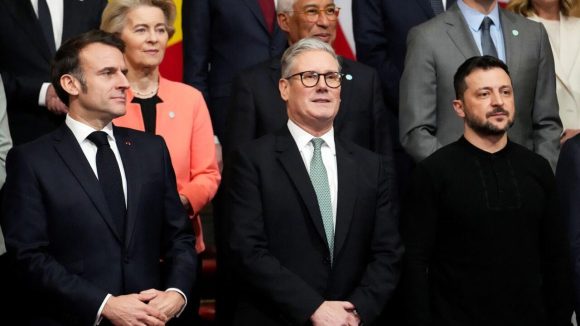
By Martin Jay | Strategic Culture Foundation | March 5, 2025
You don’t have to be a genius to work out that if you exclude Russia and just look at the three groups who are vying for war, or whining for peace, that no one is being very honest about their intentions. Previously, I tackled head on how Trump is not being very honest when he talks of peace as he has the means to enforce it at the drop of a hat, but chooses to drag his feet and hold out for deals. This is not simply Trump Basic who we all know well – where’s the deal? – but also Trump playing out a longer game with Russia, looking at where the sweet spot could be. Trump’s tour de force is always to create a crisis and then position himself to be the only person on the planet who is capable or willing to resolve it. His personality is always paramount to everything.
And so the stunt in the White House needs to be seen in the correct context. Zelensky was not honest in coming to the White House in the first place as it was believed that he was to meet Trump and JD Vance to sign a mineral deal which he agreed to and retracted from signing a number of times leading up to the visit. This became apparent when he met with Trump behind close doors and so the Plan B was to lower Zelensky into a trap and make him look ungrateful, arrogant and entirely impossible to work with. But what’s the real story behind Zelensky’s decision? Again, we see the puppet Zelensky having his strings pulled by others. Is it a coincidence that just days earlier British PM Keir Starmer arrives in the White House where, just a matter of hours earlier he announces in the British parliament that defence spending will be increased, in line with Trump’s demands for European members of NATO? Was it merely that Starmer needed to show some goodwill to Trump even to get the meeting, or was Starmer preparing for choppier waters to come, when Trump would finally hear the rumours? According to some reports, Zelensky has sold all the mineral rights already to the UK, so he was playing a game with Trump all along.
But there are more lies and games to come.
If we look at Zelensky’s European partners can we honestly say they are being honest with the public which elected them? While Macron announces a no-fly zone rule, Starmer tells his own people that Britain will send its own troops to Ukraine. Has the world gone mad, or are these leaders actually serious about their intentions? How many of UK soldiers, airmen and sailors could Starmer actually send out of a total of barely 150,000 in uniform? In reality, probably only a third at best. And presumably this move would be without the support of the U.S., who would keep out of it? If that isn’t the craziest batshit idea, there is more madness to follow. Zelensky, since arriving in the UK for the emergency meeting of mostly EU leaders who support him – including Erdogan of Turkey – has started saying some very odd things to the press, while he picks up these huge checks for military support. He keeps talking about getting a peace deal with Russia.
As Starmer prepares to send British troops to Ukraine, he continues to jail people for posting nasty messages in Facebook, in particular when they slur his own party members – an irony that only Joe Stalin would appreciate, as it’s straight from the dictators’ handbook. Starmer preaches about supporting a free and democratic Ukraine while persecuting anyone who doesn’t agree with his views or uses social media to complain about the state of Britain. In reality it’s one despot supporting another and it’s hard to see how many days this could last with body bags coming back to the UK while pensioners get plain clothed policeman come to their houses and threaten them with imprisonment – or even more cuts to the poor. Of course the body bags will be hidden by a tawdry deal struck between the government and the British press, just as so many ‘no-go zones’ were agreed beforehand. But citizen journalism will call them out as the families won’t stay quiet. Starmer and Macron seem to think that just as Churchill pulled a few stunts to draw the U.S. into the Second World War, that European soldiers on Ukrainian soil will override any agreement that the U.S. and Russia could pull off. The move by Starmer is so idiotic that it leaves many wondering whether he is being controlled by Mossad or the Obamas, comes from the same camp which so fabulously made so many poor predictions from the beginning – namely Russian sanctions.
There is only one conclusion to it, although it leaves Trump and Putin with two options, neither particularly edifying. One, to let the Europeans go ahead with their stunt and watch the collapse of NATO as a credible organization worthy of its funding; or two, to pull the rug out from under the feet of Zelensky and force presidential elections, where of course Trump will install his own puppet to replace the incumbent one. The huge mistake Starmer is making is that he is assuming British troops need not be sent to the front line, but can encircle Kiev to show political support for Zelensky. Yet, each day Russian troops will gain ground and move closer to the Ukrainian capital. For Trump to attempt regime change will be harder of course with a strong contingent of European soldiers on the ground as the State Department and all its dirty tricks doesn’t normally encounter such resistance. Is Zelensky’s ‘we want peace’ mantra a trick so that time can be bought to re-arm? Likely. Monty Python would have had a lot of fun with these clowns. Blessed are the peace brokers.
Let’s Not Forget JFK’s Attitude Toward Russia
By Jacob G. Hornberger | FFF | March 4, 2025
In the aftermath of the tirade at the White House among President Trump, Vice-President Vance, and Ukrainian President Zelensky, both conservatives and liberals (i.e., “progressives” or leftists) are going ballistic over Trump’s friendly attitude toward Russia. They are pointing out that since at least the end of World War II, the official attitude of the U.S. government has always been that Russia is to be considered a threat to U.S. “national security” as well as an official enemy, rival, opponent, or competitor of the United States. They say that Trump’s positive overtures to Russia are unprecedented.
For example, consider a March 2 article in the New York Times entitled “Trump Is Doing Real Damage to America” by David French, which states that after World War II, “both parties saw the Soviet Union as the grave national security threat it was. For decades, both parties were more or less committed to a strategy of containment that sought to keep Soviet tyranny at bay.” French also suggests that America’s “fundamental identity” lies to this very day in a continued commitment to NATO and a continuous antipathy toward Russia.
French’s mindset is pretty much mirrored in an op-ed in the Wall Street Journal in a March 3 article entitled “Trump’s Embrace of Russia Rocks NATO Alliance” by Daniel Michaels. The article states: “The American president’s embrace of Russia, an adversary that has worked for years to undermine U.S. global leadership, runs counter to decades of Western policy. The U.S. and its allies founded the North Atlantic Treaty Organization 75 years ago as protection against Soviet Russia.”
There is one notable omission from both articles, however, an omission that occurs in other articles along these same lines in the mainstream press. That omission is President John F. Kennedy and, specifically, Kennedy’s move toward peaceful, friendly, and normal relations with Soviet Russia and, for that matter, with the rest of the communist world.
Why would members of the mainstream press fail to point out this one important exception to the official policy of perpetual hostility and antipathy toward Russia? After all, they have to be familiar with Kennedy’s June 10, 1963, commencement address at American University — a speech that became known famously as Kennedy’s Peace Speech.
My hunch is that the reason the mainstream press omits this major exception to its official anti-Russia historical narrative is twofold: (1) It would cause them to have to explain why Kennedy was trying to change America’s direction, something that the mainstreamers would prefer not to do and (2) It would cause them to have to address the uncomfortable subject of the JFK assassination, something the mainstream press has always been loathe to do.
By the time JFK delivered his speech, he had achieved a “breakthrough’ that enabled him to see that the Cold War was just one great big racket, one that was not only extremely dangerous but also one that was being used to justify the conversion of the federal government from its founding system of a limited-government republic to a national-security state, a totalitarian type of system in which the federal government wields omnipotent powers, including assassination, torture, and indefinite detention. He had achieved this breakthrough after experiencing the national-security establishment’s perfidy in the Bay of Pigs fiasco, its advocacy of a surprise first-strike nuclear attack on Russia, its infamous Operation Northwoods proposal, and its highly dangerous and irresponsible actions during the Cuban Missile Crisis.
To get a sense of the dramatic and revolutionary shift JFK was taking America, it is necessary to read or listen to the entire speech, which can be done here. To get a sense of why there was so much anger, hatred, and distrust for Kennedy within the U.S. government and the mainstream press, consider the following excerpts from his speech:
I also believe that we must reexamine our own attitude–as individuals and as a Nation–for our attitude is as essential as theirs. And every graduate of this school, every thoughtful citizen who despairs of war and wishes to bring peace, should begin by looking inward–by examining his own attitude toward the possibilities of peace, toward the Soviet Union, toward the course of the cold war and toward freedom and peace here at home.
First: Let us examine our attitude toward peace itself. Too many of us think it is impossible. Too many think it unreal. But that is a dangerous, defeatist belief. It leads to the conclusion that war is inevitable–that mankind is doomed–that we are gripped by forces we cannot control.
We need not accept that view. Our problems are manmade–therefore, they can be solved by man. And man can be as big as he wants. No problem of human destiny is beyond human beings. Man’s reason and spirit have often solved the seemingly unsolvable–and we believe they can do it again.
I am not referring to the absolute, infinite concept of peace and good will of which some fantasies and fanatics dream. I do not deny the value of hopes and dreams but we merely invite discouragement and incredulity by making that our only and immediate goal….
So let us persevere. Peace need not be impracticable, and war need not be inevitable. By defining our goal more clearly, by making it seem more manageable and less remote, we can help all peoples to see it, to draw hope from it, and to move irresistibly toward it.
Second: Let us reexamine our attitude toward the Soviet Union….
No government or social system is so evil that its people must be considered as lacking in virtue. As Americans, we find communism profoundly repugnant as a negation of personal freedom and dignity. But we can still hail the Russian people for their many achievements–in science and space, in economic and industrial growth, in culture and in acts of courage.
Among the many traits the peoples of our two countries have in common, none is stronger than our mutual abhorrence of war. Almost unique among the major world powers, we have never been at war with each other. And no nation in the history of battle ever suffered more than the Soviet Union suffered in the course of the Second World War. At least 20 million lost their lives. Countless millions of homes and farms were burned or sacked. A third of the nation’s territory, including nearly two thirds of its industrial base, was turned into a wasteland–a loss equivalent to the devastation of this country east of Chicago….
I am taking this opportunity, therefore, to announce two important decisions in this regard.
First: Chairman Khrushchev, Prime Minister Macmillan, and I have agreed that high-level discussions will shortly begin in Moscow looking toward early agreement on a comprehensive test ban treaty. Our hopes must be tempered with the caution of history–but with our hopes go the hopes of all mankind.
While JFK did not formally declare an end to the Cold War, every official within the Pentagon, the CIA, and the NSA — as well as their Operation Mockingbird assets within the mainstream press — fully understood that that was the import of his Peace Speech. Thus, it is not difficult to see why U.S. officials deemed Kennedy to be a grave threat to “national security.” The president who they considered to be a naive, incompetent, traitorous womanizer was not only taking America down a road to communist defeat in the Cold War, he was also implicitly challenging the need for a totalitarian-like national-security state for America. JFK’s Peace Speech was effectively a declaration of war by the executive branch of the U.S. government against the national-security branch.
JFK’s Peace Speech left the national-security establishment with a deeply discomforting choice: Sit back and let Kennedy take the country down or keep America “safe” by eliminating Kennedy. See FFF’s book JFK’s War with the National Security Establishment: Why Kennedy Was Assassinated by Douglas P. Horne, who served on the staff of the Assassination Records Review Board and JFK and the Unspeakable: Why He Died and Why It Matters by James W. Douglass. Also see The Kennedy Autopsy and An Encounter with Evil by Jacob Hornberger.
Do you see why the mainstream press would prefer to airbrush John Kennedy’s decision to end the Cold War racket and move America toward peaceful and harmonious relations with Russia out of America’s history? If they include that major exception in their official historical narrative, they would have to explain the reasons for Kennedy’s decision as well as delve into the national-security establishment’s motive for eliminating him. They then have to explain how his assassination restored things to “normal” — with the continuation of the Cold War, the war in Vietnam, which ended up sacrificing more than 58,000 American men for nothing, the never-ending support of the Cold War dinosaur known as NATO, and the perpetual anti-Russia mindset that pervades America today.
OSCE shared intel with Ukraine before 2022 – ex-Greek ambassador
RT | March 2, 2025
During the armed standoff between the Ukrainian government and the two breakaway Donbass republics between 2014 and 2022, observers from the Organization for Security and Cooperation in Europe (OSCE) secretly shared intelligence with Kiev, former Greek ambassador to Ukraine, Vasilios Bornovas, has claimed.
In an interview with Greece’s Hellas Journal last Monday, Bornovas said that during his visits to the conflict zone he had witnessed the “use of classified information [by Kiev’s forces] sent by observers from the Organization for Security and Cooperation in Europe (OSCE) regarding the positions of weapons” belonging to the Donetsk and Lugansk People’s Republics. The diplomat recounted that “since these positions were immediately hit by Ukrainian fire, it was obvious that the observers’ reports first went through to the Ukrainian services.”
Commenting on the apparent decision by the US and Russia to sideline the European Union from negotiations on Ukraine, the former envoy argued that the bloc “has reached an impasse” due to multiple internal crises. Bornovas remarked that having long “uncritically” toed Washington’s line on the conflict, Brussels is finding it “extremely difficult to extricate itself from this policy” now that President Donald Trump has apparently changed course.
According to the diplomat, the EU is suffering “from a deficit of visionary leaders with will and personality,” with its foreign policy being largely directed by the Baltic states and Poland.
As for Ukrainian leader Vladimir Zelensky’s handling of the conflict, Bornovas said that the hostilities with Moscow are “decimating his people and destroying the productive fabric of his country.” The former official argued that the current conflict had been in the making for some time before February 2022, suggesting that Zelensky may have abandoned his original pro-peace platform under pressure from former US President Joe Biden’s administration.
According to Bornovas, the Ukrainian leader may also have hoped to distract his population’s attention from internal problems, such as widespread corruption, with the help of an armed conflict.
Since the escalation of the hostilities, Moscow has called out OSCE’s supposed failings on multiple occasions, both in the conflict zone and further afield.
Last October, Russia claimed that the organization had covered up irregularities in the Moldovan presidential election, which saw pro-Western President Maia Sandu squeak by a relatively small margin.
In March and February 2024, Moscow accused OSCE of failing to denounce the killings of Russian civilians by Ukrainian forces during their raids in border regions in what Russia characterized as hypocrisy that “goes beyond all possible boundaries.”
Pro-Israel Think Tank WINEP Outed as ‘Dark Money’ Operation Driving US Wars
By Robert Inlakesh | MintPress News | February 26, 2025
The AIPAC-aligned Washington Institute for Near East Policy (WINEP), which often refers to itself simply as The Washington Institute, was recently outed as a “dark money” think tank for its lack of transparency on donors and is continuing to push the United States to engage in conflicts overseas to Israel’s benefit. Its case raises questions about how the Israel Lobby functions through think tanks across the board, shaping U.S. foreign policy behind closed doors.
WINEP has a long history of shaping U.S. foreign policy. It was deeply involved in the neoconservative push for regime change in Iraq, joining calls for the Clinton administration to topple Saddam Hussein as early as 1998. They also pushed for U.S. military intervention and helped justify the eventual invasion in 2003.
At the beginning of the year, the Quincy Institute for Responsible Statecraft unveiled the “Think Tank Funding Tracker,” a one-of-a-kind project that examined the funding sources of the top 50 U.S. think tanks since 2019 and rated their transparency from 0 to 5. WINEP and 16 others—including the neoconservative Foundation for Defense of Democracies (FDD)—received a zero transparency rating, exposing its reliance on “dark money” contributions.
While WINEP claims “to be funded exclusively by U.S. citizens” on its website, it does not publicly disclose its donor list. Its AIPAC roots were first exposed in 2006 by Stephen Walt and John Mearsheimer in The London Review of Books, where they described WINEP as an AIPAC cutout advancing Israel’s agenda under the guise of independent research. The pair wrote at the time that “The Lobby created its own think tank in 1985, when Martin Indyk helped found WINEP. Although WINEP plays down its links to Israel and claims instead that it provides a “balanced and realistic” perspective on Middle East issues, this is not the case. In fact, WINEP is funded and run by individuals who are deeply committed to advancing Israel’s agenda.”
This claim that AIPAC created WINEP was later corroborated by former AIPAC official MJ Rosenberg, who wrote in HuffPost : “How do I know? I was in the room when AIPAC decided to establish WINEP.” The now-deceased WINEP co-founder, Martin Indyk, was also the head of the Saban Center for Middle East Studies, funded by Israeli-American billionaire Haim Saban.
Recent U.S. foreign policy developments have only strengthened WINEP’s influence. The Biden administration’s unwavering support for Israel’s war on Gaza, including a $14 billion emergency military aid package, aligns with WINEP’s long-standing push to ensure that U.S. military assistance to Israel remains untouchable. WINEP actively shaped public discourse as the war progressed, with Executive Director Robert Satloff praising Biden’s refusal to support an early ceasefire, calling it “correct and courageous.”
When House lawmakers convened hearings in late 2023 to attack the administration’s Iran policy, their rhetoric mirrored WINEP’s narratives, particularly opposition to any sanctions relief. Witnesses from WINEP-adjacent institutions like FDD and JINSA were brought in to reinforce the case for a more aggressive posture toward Iran. Meanwhile, WINEP continues to push for U.S. military leverage in post-Assad Syria, another key policy area where the Biden administration has quietly followed its recommendations by maintaining a military foothold and targeting Iranian assets with airstrikes.
WINEP’s revolving-door relationship with the U.S. government does little to shed its reputation for shaping policy. In May 2023, National Security Advisor Jake Sullivan delivered a keynote address at WINEP’s annual Soref Symposium, praising Satloff’s “extraordinary work.” Sullivan’s participation wasn’t just symbolic—it reinforced WINEP’s position as an informal but essential policy hub. This is evident from the administration’s embrace of the Abraham Accords, another WINEP priority.
Former WINEP fellow Dan Shapiro was appointed the State Department’s senior advisor for regional integration, carrying out the think tank’s long-standing vision for Arab normalization with Israel. WINEP is currently led by Michael Singh, Robert Satloff, Dennis Ross, and Dana Stroul. Stroul, who serves as WINEP’s Research Director, returned to the position after serving as the Biden administration’s deputy assistant secretary of defense for the Middle East from 2021 to 2024. During her tenure, she played a central role in Washington’s anti-Iran initiatives, the response to the Gaza war, and shaping U.S. Syria policy.
Beyond WINEP, the broader issue of think tank influence is now facing increasing scrutiny. In 2023, lawmakers introduced the Think Tank Transparency Act, which requires policy organizations to disclose foreign government funding and contractual agreements. While WINEP does not receive direct funding from Israel, watchdogs have highlighted that its pro-Israel agenda is sustained through wealthy American donors closely linked to AIPAC. Using domestic contributions to advance a foreign policy agenda has enabled WINEP to operate without falling under the scrutiny of foreign lobbying laws, even as its “scholars” shape U.S. positions on Iran, Syria, and the Israel-Palestine conflict.
Currently, the two primary issues on WINEP’s agenda are how to best leverage American influence to shape outcomes in post-Assad Syria and how to assure regime change in Iran. Indicative of the think tank’s influence is that not only was its hardline Syria strategy the exact model used by the U.S. to aid regime change in Damascus, but its chief researcher was taken on as a senior official by the previous administration.
As demonstrated by the Quincy Institute’s new report, the lack of transparency over who exactly finances the AIPAC lobby’s “cutout” think tank presents serious questions about who is actually shaping U.S. foreign policy and to whose benefit.
Hamas decries as ‘war crime’ Israeli suspension of humanitarian aid to Gaza
The Cradle | March 2, 2025
Israel has accepted a proposal brought by US envoy Steve Witkoff to extend the first phase of the Gaza ceasefire and prisoner exchange agreement for another 42 days, facing rejection from the Hamas movement.
As a result of Hamas’s rejection – which stems from the resistance movement’s insistence on abiding by the terms of what was initially agreed upon – Israel announced on 2 March that it halted the entry of aid and supplies into the Gaza Strip.
“With the end of the first stage of the prisoner swap deal and following Hamas’ rejection of Witkoff’s proposal to continue negotiations – which Israel agreed to – Prime Minister Netanyahu has decided to halt all imports of goods and supplies to the Gaza Strip as of today,” said the office of Israeli Prime Minister Benjamin Netanyahu in a statement.
“Israel will not allow a ceasefire without the release of its prisoners. If Hamas continues to refuse, there will be further consequences,” the premier’s office added.
The extension deal agreed to by Netanyahu calls for the release of half of the estimated 22 living captives in Gaza, in exchange for Palestinian prisoners.
According to Netanyahu, the Witkoff plan gives Israel the right to resume the war after the 42-day extension if talks do not progress. Israel’s Channel 12 reported that the prime minister has approved a potential call-up of 400,000 reserve soldiers.
“The decision we made last night to completely halt the entry of humanitarian aid into Gaza until Hamas is destroyed or surrenders completely and all our hostages are returned is an important step in the right direction— ‘standing at the gates of hell,’” said Israeli Finance Minister Bezalel Smotrich.
“Now, we must open these gates as quickly and as lethally as possible against the cruel enemy until absolute victory,” he added.
Israeli opposition leader Yair Lapid blasted the government’s decision.
“The prisoner exchange deal has been halted. Humanitarian aid to Gaza has been stopped. The government has approved the mobilization of 400,000 reserve soldiers. What is the goal? What objective has Israel set for itself? Has the government decided to abandon the prisoners, and if so, why? For what greater national purpose? If we return to war, what is the objective of the war? Who will replace Hamas in the end?” Lapid said.
“Once again, the government is acting without a plan, without a vision. We can only hope things turn out okay—because that seems to be the extent of their planning.”
Phase one of the Gaza ceasefire was due to end on Saturday. Israel has been pushing for the extension in recent days and has continuously delayed the start of negotiations for the second phase, violating the original ceasefire agreement.
“The statement issued by the office of the terrorist occupation Prime Minister Netanyahu, regarding his approval of American proposals to extend the first phase of the agreement under arrangements that violate the ceasefire agreement in Gaza is a blatant attempt to evade the agreement and avoid entering negotiations for its second phase,” Hamas said in a statement.
“Netanyahu’s decision to halt humanitarian aid is a form of blackmail, a war crime, and a blatant violation of the agreement,” it went on to say.
Since the morning of 2 March, Israeli attacks on Gaza have killed at least four Palestinians. Israel has been violating the ceasefire daily since it was reached in January, carrying out deadly attacks and consistently holding up the entry of aid and essentials into Gaza.
Trump takes on the ‘collective west’
By M. K. BHADRAKUMAR | Indian Punchline | March 1, 2025
The dramatic scene in the Oval Office on Friday evening signals that President Donald Trump is decoupling the US from the ‘forever war’ in Ukraine that his predecessor Joe Biden left behind. The war is poised to end with a whimper, but its ‘butterfly effect’ on our incredibly complex, deeply interconnected world will define European and international security for decades to come.
The western media which is hostile toward Trump, have seized the opportunity to caricature him as an impulsive figure in a role reversal with Zelenskyy. In reality, though, Trump has been literally driven to this point by the Biden administration.
The highly charged emotional reaction by the European Commission president Ursula von der Leyen commiserating with President Zelensky speaks for itself: “Your dignity honours the bravery of the Ukrainian people. Be strong, be brave, be fearless. You are never alone, dear President.” Trump’s refusal to give Von der Leyen an appointment may partly explain her fury as a woman scorned. Truly, the ‘Collective West’ find themselves at a crossroads and do not know which road to take. Without US air cover and satellite inputs, western troop deployment in Ukraine will be impossible. Even French Emmanuel Macron would agree that his troops will be put through a meat grinder.
Both Von der Leyen and Macron had a whale of a time as cheerleaders of Biden’s war but any further adventures in Ukraine will be suicidal, to put it mildly. Ukraine’s military will collapse if Trump freezes support. None of the European powers will risk a collision with Russia.
Trump knows by now that the western narrative of Biden’s war is a load of bullshit peppered with falsehoods and outright lies, and that the war erupted only out of the diabolic western plot to poke the bear, which got provoked finally and hit out.
The CIA’s coup in Kiev in February 2014 was a watershed event paving the way for a NATO presence on Ukrainian soil. Indeed, terrible things happened, which have been shoved under the carpet — for instance, then German foreign minister (current president) Frank-Walter Steinmeier’s dubious links with the neo-Nazi Ukrainian groups who acted as storm troopers in the 2014 coup. Just think of the grotesqueness of it — a German social democrat patronising neo-Nazi groups!
Most certainly, Trump knows that the US deep state had set in motion an agenda to destabilise the Russian Federation and dismember it as the unfinished business no sooner than the Soviet Union was dissolved. The Chechen War has no other explanation. In fact, Putin has accused US agents of directly aiding the insurgents.
Again, the Bill Clinton administration floated the idea of NATO expansion as early as in 1994. It came out of the blue but was obviously a work in progress since the disbandment of the Soviet Union. By the mid-nineties, even Boris Yeltsin understood that he was played nicely. The return of Evgeny Primakov to the Kremlin and Yeltsin’s overture to Beijing were the surest signs of a course correction.
Those familiar with Soviet history had known all along that Ukraine would be the theatre where the US would try to seal the fate of Russia. If further confirmation was needed, it came with the CIA’s colour revolution in Ukraine in 2003 where the election was rigged (as is happening in Romania today) and carried to a third round till the proxy emerged victorious and surely, Viktor Yushchenko brought the NATO membership issue to the table. At the 2008 NATO summit in Bucharest, George W. Bush insisted that the alliance formally offered membership to Ukraine!
Today, Britain’s MI6 calls the shots in Kiev. Zelenskyy admitted recently that much of the money given by Biden simply ‘disappeared’. Sordid tales of massive kickbacks and corruption are galore. Biden ignored them. The Biden family’s involvement in Ukraine’s cesspools is widely known. Contrary to his pledge earlier not to do so, Biden felt constrained finally to grant a presidential pardon to son Hunter Biden so that he wouldn’t end up in jail.
Suffice to say, Zelensky’s ‘strategic defiance’ stems out of his quiet confidence that western leaders — starting with Boris Johnson and Biden — who have been fellow travellers in the gravy train during the past three years of the war are beholden to him till eternity.
The axis between Zelensky and his European Union supporters is cajoling Trump, pressuring him and flattering him in turn to get him on board the bandwagon so that the war rolls on for another four years. Last week alone, the presidents of France and Poland and the British prime minister descended on the White House one after another seeking assurance that the war in Ukraine will continue. But Trump has refused to oblige.
Zelensky and his European backers want a ‘forever war’ in the western border lands of Eurasia, the traditional invasion route to Russia. And last week Trump again ruled out NATO membership for Ukraine. He also pointed to the ongoing talks on “major economic development transactions which will take place between the United States and Russia.”
Trump repeated last week that the war could be ended “within weeks” and warned of the risk of escalation into a “third world war.” Basically, he realises that this is an unwinnable war, and is apprehensive that a prolonged war may transform into a quagmire sinking his presidency and derailing the grand bargain he hopes to strike with the two other superpowers, Russia and China, to create synergy for his ambitious MAGA project.
Trump has chalked up 2026, the Quarter Millennial of the United States Declaration of Independence, for hosting the leaders of Russia and China on American soil to celebrate the high noon of his quest for world peace. The European political elites weaned on the liberal-globalist ‘rules-based order’ cannot understand Trump’s deep-rooted convictions and his abhorrence of war.
The big question now is wether the unprecedented fracas in the White House yesterday could backfire on Zelensky, since Washington has significant leverage vis-a-vis Kiev and given the latter’s heavy dependence on the US for some of the critical elements of its defence.
Following the Oval Office argument, Zelenskyy has issued a lengthy statement admitting that it is “crucial” for Ukraine to have Trump’s support. A patch-up cannot be ruled out but the transatlantic system has received a big jolt, as the overwhelming majority of European countries have voiced support for Zelensky. In fact, there hasn’t been a solitary voice censuring Zelensky. Britain kept mum. Keir Starmer, UK prime minister is hosting a meeting of European leaders on Sunday which Zelensky is due to attend. It is unlikely that Europeans will push the envelope further
In this dismal scenario, the best hope is that Zelensky’s ouster, which seems probable, will not be a violent bloody event, considering the power rivalries within the regime in Kiev. At any rate, his replacement may not be a terrible thing to happen since it would necessitate holding the long overdue election and lead to the emergence of a legitimate leadership in Kiev, which has now become a dire necessity for what Trump would call ‘common sense’ to prevail.
Israel pushes for six week ‘extension’ of Gaza ceasefire’s phase one
The Cradle | February 28, 2025
An Israeli delegation in Cairo is negotiating with mediators a potential extension for the first phase of the Gaza ceasefire agreement, according to Egyptian security officials cited by Reuters on 28 February.
“Hamas opposes the extension and insists on proceeding to the second phase of the deal as originally agreed,” the sources said. They added that Tel Aviv seeks to extend the first phase for another 42 days.
Israeli sources had previously told the British news outlet that Tel Aviv sought an extension and the release of three Israeli captives per week in exchange for Palestinian prisoners held in Israeli prisons.
According to a military source cited by Times of Israel, Tel Aviv “still prioritizes dismantling Hamas’s ability as an authority in Gaza.”
Hamas released a statement on Friday confirming “its full commitment to implementing all the terms of the agreement in all its stages and details.”
“We call on the mediators, guarantors, and the international community to pressure the Zionist occupation to fully commit to its role in the agreement and immediately enter the second phase of it without any hesitation or evasion,” it added.
US envoy to the region, Steve Witkoff, is expected to travel to Israel on Sunday to negotiate an extension of the first phase of the ceasefire deal, which ends on 2 March. Tel Aviv has continuously delayed talks for phase two of the agreement.
Israel recently imposed new conditions on the Gaza ceasefire agreement, demanding a full disarmament of Hamas’s military wing.
According to reports, Israel is looking to violate the deal by maintaining its military presence along the Philadelphi Corridor on southern Gaza’s border with Egypt.
Israel’s Defense Minister, Israel Katz, said on Thursday that the corridor will remain “a buffer zone just as the case is in Lebanon and Syria.” Tel Aviv is also reportedly planning for a resumption of its brutal war against Gaza
A recent report by Haaretz says that “as far as [Israeli Prime Minister Benjamin] Netanyahu is concerned, there is no second stage” of the deal.
The report says Israeli Minister of Strategic Affairs Ron Dermer recently told Witkoff that Netanyahu’s plan is to secure the release of all captives in a single stage, and that Hamas will receive prisoners in exchange. Otherwise, “Israel will return to intense warfare” and reimplement a “version” of the Generals’ Plan – which saw the expulsion of hundreds of thousands of Palestinians from north Gaza, the killing of thousands, and the destruction of the Gaza health sector.
Good Riddance to Bad Rubbish: Why the Five Eyes Alliance Should Be Dismantled
Sputnik – February 28, 2025
UK media have reported that senior Trump advisor Peter Navarro lobbied his boss to cut Canada out of the Five Eyes intel-sharing network. Navarro rejected the report. But given the harm the intel coalition has done to Trump, Americans and relations with allies, removing members or dismantling the organization wouldn’t be a bad idea. Here’s why.
In 2024, journalists Matt Taibbi and Michael Shellenberger revealed that Barack Obama’s CIA chief had worked with Five Eyes partners to circumvent restrictions on domestic spying to illegally tap Trump’s 2016 campaign, targeting Trump himself and over two dozen of his associates.
In 2013, NSA contractor-turned whistleblower Edward Snowden exposed his former employer’s work with the Five Eyes using tools like PRISM and XKeyscore to engage in a global, unfathomably massive warrantless spying program targeting foreigners and Americans alike.
Besides ordinary people, the Snowden leaks revealed Five Eyes spying on non-Anglosphere allied countries’ leaders, including Chancellor Merkel of Germany and President Hollande of France.
The Five Eyes have also been linked to diplomatic crises between Western nations and the developing world, with the 2023-present spat between Canada and India over the extraterritorial killings of Sikh separatists accompanied by allegations of a Five Eyes plot to destabilize India.
In 2013, a scandal erupted in Australian-Indonesian relations after it was revealed that Canberra and its Five Eyes partners sought to tap the phones of Indonesia’s sitting president, his wife and other senior officials.
And the Five Eyes’ shady activity goes back much further than that, with the ECHELON surveillance program, launched in the early 1970s, ostensibly to monitor Eastern Bloc countries and the Soviet Union, actually engaging in the interception of communications worldwide.
In the late 1990s, it was revealed that ECHELON had been used by US corporations to spy on their European competitors.
Similar activity was uncovered by WikiLeaks in 2015, with Japanese officials and companies revealed to have been monitored by the NSA using Five Eyes during negotiations on the TPP trade pact.
Featured Video

Chinese jet fuel and the myth of energy independence
or go to
Aletho News Archives – Video-Images
Book Review
Former Insiders Criticize Iran Policy as U.S. Hegemony
By GARETH PORTER | CounterPunch | February 27, 2013
“Going to Tehran” arguably represents the most important work on the subject of U.S.-Iran relations to be published thus far.
Flynt Leverett and Hillary Mann Leverett tackle not only U.S. policy toward Iran but the broader context of Middle East policy with a systematic analytical perspective informed by personal experience, as well as very extensive documentation.
More importantly, however, their exposé required a degree of courage that may be unparalleled in the writing of former U.S. national security officials about issues on which they worked. They have chosen not just to criticise U.S. policy toward Iran but to analyse that policy as a problem of U.S. hegemony. … continue
Blog Roll
 Aletho News
- Iran war will leave long-term ‘scar’ on Wall Street, investors warn
- How Iran decimated US power projection in West Asia: Military lessons of 40-day war
- Iran’s report details US-Israeli war crimes in targeting schools, hospitals, livelihoods
- NATO’s Slow Fracture: How Trump’s Iran War Exposed the Instrument of Hegemony
- Chinese jet fuel and the myth of energy independence
- Ukraine Sea Drone Fired From Libya Hit Russian Tanker in Mediterranean
- IRGC: Iranian forces launched no attacks during ceasefire hours
- Trump Administration Moves To Automate U.S. Military Draft Registration
- Spain orders reopening of Tehran embassy, condemns Israel’s carpet bombing of Lebanon
- Israel faces ‘unsustainable’ strategic crisis following 40-day war against Iran: Analyst
- If Americans Knew
- Israel killed at least 303 Lebanese yesterday – who were they? Daily Update
- Amnesty: Urgent – Protect Lebanese civilians from brutal escalation in Israeli attacks
- Is The War Against Iran Over?
- Inside the Israeli army’s propaganda wing
- Hundreds of Gaza Amputees Stranded in Legal Limbo
- The gallows law: Israel moves toward executing Palestinian children
- Tucker Carlson: The Path to Peace requires ending ‘special alliance’ with Israel
- This is ceasefire? Israel’s biggest massacre yet in Lebanon, another journalist killed in Gaza – Daily Update
- Tucker Carlson on Israel: This Is the Behavior of an Ally? Really?
- Gazans face a triple crisis: severe shortages of water and bread, healthcare in tatters
- No Tricks Zone
- An Inconvenient Tree: Uncovered In Alps… Europe Much Warmer Than Today 6000 Years Ago
- New Study Reports A 60% Slowdown In Greenland’s Ice Loss Rate In The Last Decade
- Low Intensity Tornado Wrecks Major Solar Farm, Creating A Potential Toxic Dump
- New Study Finds Warming Saves Lives…Cold Temperatures 12 Times More Deadly Than Excess Heat
- German Science Blog Accuses PIK Climate Institute Of Hallucinating Climate Tipping Points
- Devastating Assessment Of Comirnaty Vaccine By Former Senior Pfizer Europe Toxicologist
- New Study: CO2 Is ‘Effectively Negligible’ As An Explanatory Climate Change Factor Since 2000
- Former Pfizer Toxicologist Dr. Helmut Sterz Tells Bundestag Hearing Pfizer Vaccine Should Have Never Been Approved
- Energy Expert: Germany’s Nuclear Phaseout Was A “500 Billion Euro Mistake”
- New Research: South Australia’s Mid-Holocene Sea Surface Temperatures Were 4°C Warmer Than Today
 Aletho News